Category: Uncategorized

B.B.B.

B.B.B.

When you pick up a hymnal or book of songs, you usually find the composer and author of the lyrics listed at the top of the page, near the title. When both music and lyrics are written by the same person, often just the person’s initials appear. Today, November 7, marks what would have been the 100th birthday of one of the most popular and beloved writers of gospel songs, Beatrice Bush Bixler, or B.B.B.

life-is-a-sym

Bea was a gifted and prolific song writer. After attending Houghton College for two years, she toured with evangelist Burton B. Bosworth in the late 1930s and early 1940s; Bosworth was a trombone player in addition to a speaker and it was there that Bea first accompanied a trombonist. It was not to be her last time doing so. She continued and finished her studies at Nyack Missionary Training Institute, later renamed Nyack College, where my wife’s father met her when he was in school there after World War II. She went on to publish dozens of gospel songs including Life is a Symphony, I Am Not Worthy, It May Be Today and The Breaking of the Bread, many of these were featured in the song  books by Singspiration, Favorites. These songs were particularly popular in the 1940s through 1970s in church meetings and revivals. Singspiration published two books of her music, now out of print, that contain many of her most beloved songs.

Bea Bixler had a style that was all her own. I’ve often described her voice as that of a rough-hewn Kate Smith. Her piano playing was, at times, typical of the style used among evangelical Christian pianists of her time – fingers running up and down the keyboard, huge waves of sound that swept over you like a mighty wave. But Bea also had a beautiful, poetic piano touch that could melt your heart. She recorded two LPs of her singing, also long out of print.

Here is a track of her singing (and playing piano) on the Bibletone Records LP, BL-1519, her song, It May Be Today:

I had the pleasure – no, the joy – of meeting Bea Bixler many  years ago at the Hepzibah Heights Camp in Monterey, Massachusetts. From that first meeting our family forged a deep friendship, one that came to particular fruition when I recorded my CD, Cornerstone, in 1999. That recording featured music that my wife and I had played in churches over the years and I wanted to use four pianists with whom I had collaborated many times over the years. In addition to my wife, Patricia, the other pianists were Stephen E. Gerber, Wesley Ross and Bea Bixler. The photo below shows all of us at the recording session on November 4, 1999:

cornerstone_players

Cornerstone recording session, November 4, 1999. Sonic Temple, Roslindale, Massachusetts. Left to right: Douglas Yeo, Patricia Yeo, Beatrice Bush Bixler (seated), Stephen E. Gerber, Wesley Ross

Bea died in 2013 but her influence is still felt today by those who knew her and heard her music. The wife of a Christian and Missionary Alliance pastor, she loved Jesus deeply, and she was vivacious and energetic. I treasure the times our family had with her, enjoying the stories of how she came to write her songs, collaborating with her in music, and listening to her robust laugh.

Click here to hear a track from my CD, Cornerstone, with me on bass trombone and Bea Bixler at the piano, playing her song I Am Not Worthy. She improvised her accompaniment at the recording session; it makes me smile as I remember this remarkable woman. Beatrice Bush Bixler, B.B.B. A dear friend and saint of the Lord who would have been 100 years old today.

bez_bixler_01

Conversation

Conversation

By Douglas Yeo (November 3, 2016)

I know I’m not the only person who thinks that Conversation by Charles Small is the finest duet ever written for tenor and bass trombone. I’ve played this piece dozens of times with dozens of tenor trombonists over the year, beginning with the first time I played it in a recital at Peabody Conservatory of Music in Baltimore with my then Baltimore Symphony trombone colleague, Jim Olin in 1983. I recorded Conversation in 1996 with my Boston Symphony colleague, Ronald Barron and that recording was released on my CD, Proclamation, and Ron’s CD, In the Family. This past spring, I played it at Arizona State University on a doctoral recital given by my one of my students, Tim Hutchens. In fact, I will be playing it again this Friday, November 4, with jazz trombonist Jim Pugh at a masterclass I’m giving at University of Illinois School of Music at 2:30 PM in the University of Illinois School of Music Auditorium (the class is free and open to the public). Charlie wrote the duet for himself and bass trombonist David Taylor and has become a regular feature on student and professional trombone recitals for many years.

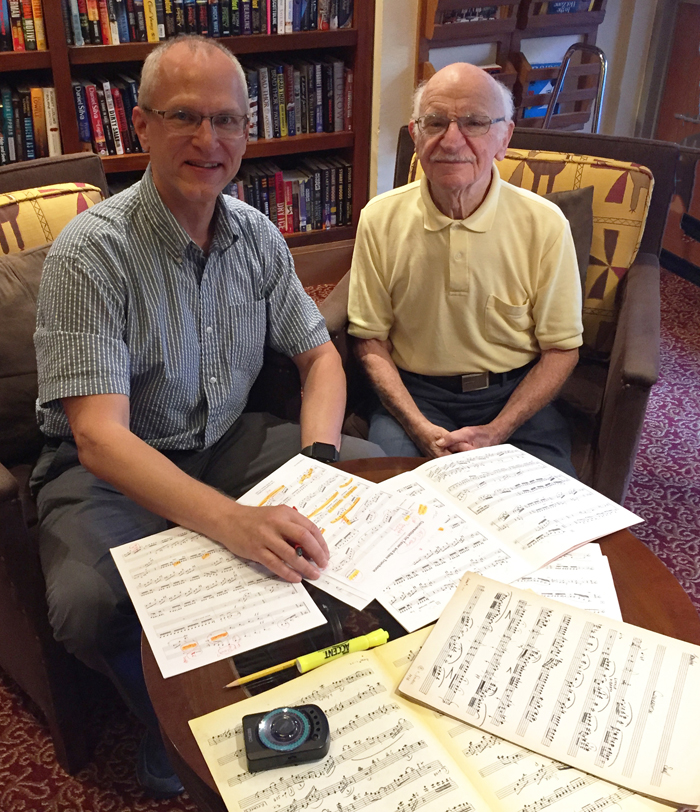
I have always played Conversation off set of parts that were done from Charlie Small’s original manuscript by a copyist (shown at the top of this article). But that version was not widely available, and in 1993, Conversation was published by Kagarice Brass Editions. The duet saw several printings by KBE but each had particular problems – things that were missing or not clear. Kagarice Brass Editions is now part of Ensemble Publications, and I asked the owner of Ensemble Publications, my friend Chuck DePaolo, if he would be interested in making a new printing of Conversation with Charlie Small’s approval. Chuck thought it would be great to to this so a few days ago, I called up Charlie Small – he lives here in Arizona, not far from where my wife and I live – and yesterday, we spent a several hours going over Conversation with a fine toothed comb.

yeo_small_11_01_201low

It should be said that spending time with Charlie Small is a rare and truly wonderful thing. A member of the Tommy Dorsey Orchestra in the 1940s when he was a teenager, Charlie has been a major influence on the trombone scene for many decades. Conversation is only one of his many compositions and it was great not only to sit down and talk about his piece, but hear Charlie tell some great stories as well. We went through Conversation measure by measure. After several hours of working together, Charlie felt confident that we had identified all of the things that needed to be changed/fixed in this new edition. It’s now been sent off to the publisher and very shortly, a version of Conversation that reflects the composer’s intentions will soon be available. At last!

conversition_edited


They will come for you

They will come for you

by Douglas Yeo

Today, October 31, is Reformation Day, commemorating the 499th anniversary of the beginning of the Protestant Reformation. The day is associated with Martin Luther’s Disputation of Martin Luther on the Power and Efficacy of Indulgences which became popularly known as the 95 Theses. Luther sent this document to the Archbishop of Maenz, Albert of Brandenburg,  on October 31, 1517, and a few days later,  posted it on the door of the Church of All Saints in Wittenberg, Germany. This event is considered to be the spark that led to the Protestant Reformation, a major reform movement in the Christian church.

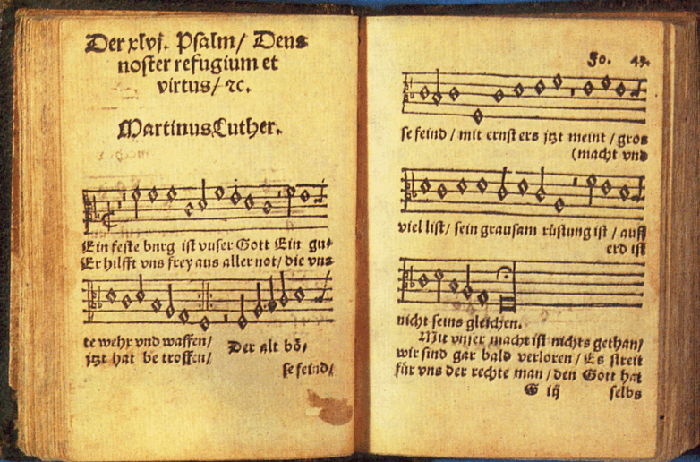
In our church’s worship service yesterday morning, we sang Luther’s great hymn,  Ein feste Burg ist unser Gott, usually translated into English as A Mighty Fortress Is Our God. The image above shows the original version of the tune in the handwriting of Luther’s friend, Johann Walter. Luther composed the words and melody sometime between 1527 and 1529 and it has been used in churches around the world since that time, in particular since Frederick Hedge made his English versification in 1853. It was also used by Johann Sebastian Bach in his Cantata for Reformation Day, BWV 80.

When I was a student at Wheaton College, I memorized the four verses of this hymn for extra credit in a class, Christ in Culture, taught by Dr. Herbert Jacobsen. While I was grateful for the extra credit, I’m very glad I took the time to memorize A Mighty Fortress. I call it to mind every day.

Translations of texts into English that originally appeared in other languages help us to sing songs with understanding. But in the case of A Mighty Fortress, the standard English translation of the fourth verse has always struck me as being overly pleasant; it does not truly reflect the seriousness of Luther’s original text.

Here is what we often find in English hymnals for the fourth version of A Mighty Fortress Is Our God:

That word above all earthly powers, no thanks to them, abideth;

The Spirit and the gifts are ours through Him who with us sideth.

Let goods and kindred go, this mortal life also.

The body they may kill; God’s truth abideth still:

His kingdom is forever.

This is all well and good, but the phrase, “Let goods and kindred go, this mortal life also,” sounds like we should simply let things go – let go of things, even our own lives, since they are, in the big scheme of things, not as important as knowing that one is a Child of God.

But Luther’s original German text includes something very important. A better, more literal rendering of this verse in English looks something like this:

That word they must let stand, no thanks to their own efforts.

He is with us indeed according to the plan, with his Spirit and gifts.

Though they take from us our body, possessions, honor, child and wife,

Let them have all these things; they gain nothing from them: 

There still remains for us the Kingdom.

Do you see the difference? It’s not a matter of just “letting things go.” No, THEY TAKE FROM US OUR BODY, POSSESSIONS, HONOR, CHILD AND WIFE. They will come for you and all that you hold to be dear. Persecution WILL come. The things that are most valuable and important to us – including our own lives – are not simply things that we will have to let go of. No. They will be taken from us. Yet God, who rules over this fallen, messed up world, reminds us that even when you have lost everything, you still have the most important thing: the Kingdom of God. This is a tremendous comfort for the Christian.

We live in troubling times. Increasingly, in some parts of the world, to speak of the Christian faith leads to persecution, even death. Luther’s great text reminds us of this; it is as fresh today as when it was written centuries ago.

Luther’s first verse, as it usually appears in English, is a good translation that captures the original intent of the text even as it is in rhyming verse, and it is a great reminder for those who know and follow Christ. Amidst the craft and power of the ancient foe, the evil one, Satan himself, God is our refuge and strength, a very present help in time of trouble (Psalm 46:1):

A mighty fortress is our God, a bulwark never failing;

Our helper He amid the flood of mortal ills prevailing.

For still our ancient foe, doth seek to work us woe – 

His craft and power are great, and, armed with cruel hate,

On earth is not his equal.

Likewise, the second verse – and this is the verse I call to mind every day – tells us who it is that will conquer this evil one:

Did we in our own strength confide, our striving would be losing,

Were not the right Man on our side, the Man of God’s own choosing.

Dost ask who that may be? Christ Jesus, it is he;

Lord Sabaoth his name, from age to age the same;

And he must win the battle.

Today, the 499th anniversary of Reformation Day, reminds us that in the midst of the trials and tribulations of life, God is there, our mighty fortress.

luther_eine_feste_burg_02Martin Luther’s Ein feste Burg ist unser Gott, published by Josef Klug, 1533.