Category: teaching

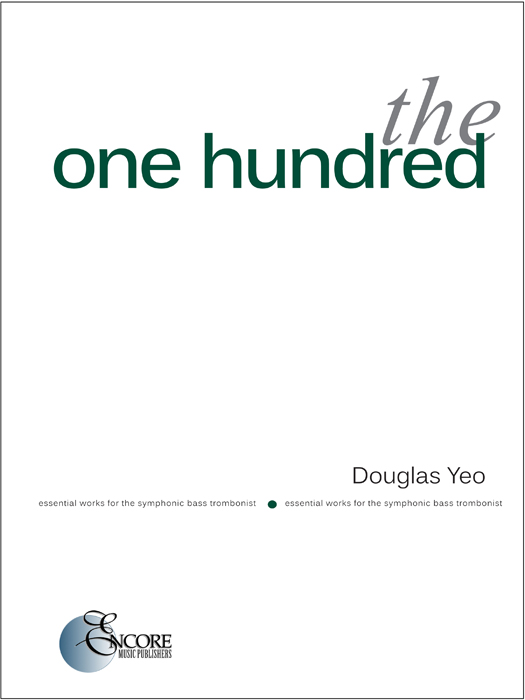
A new book – The One Hundred: Essential Works for the Symphonic Bass Trombonist

A new book – The One Hundred: Essential Works for the Symphonic Bass Trombonist

Over the last year and a half, I have been at work every day on a new book that has actually taken me 40 years to write. I’m very pleased that The One Hundred: Essential Works for the Symphonic Bass Trombonist is now at the printer and available for pre-order; copies will be shipped in March.

I took my first professional symphony orchestra audition in 1977, the year after I graduated from Wheaton College. That audition was for the Minnesota Orchestra. I didn’t win; the audition was won by Max Bonecutter, although I was one of four players in the final round and got cut at the same time as Charles Vernon, bass trombonist of the Chicago Symphony Orchestra who at the time was bass trombonist of the Baltimore Symphony Orchestra. That was the beginning of a process that eventually brought me to the Boston Symphony in 1985. Over these many decades, I have been engaged in  studying the orchestral literature and learning all I could from colleagues, conductors, authors and many others. I brought the full orchestra score to most works to rehearsals, I took notes about how conductors were handling certain passages, and I noted when there were misprints and mistakes in my part. I have hundreds of scores, books and facsimile editions in my personal library and I have gotten great pleasure from studying them over and over again.

After having played the standard orchestral repertoire many times over, served on dozens of audition committees and taught hundreds of lessons in this music, I was glad that eighteen months ago, Wesley Jacobs, owner of Encore Music Publishers, asked me if I would like to write an annotated orchestral excerpt book for bass trombone.

I was delighted to be asked to undertake this huge project, and to have a book stand alongside the two other important annotated orchestral excerpt books in The One Hundred series:  The One Hundred: Essential Works for the Symphonic Tenor Trombonist (by Megumi Kanda, principal trombonist of the Milwaukee Symphony) and The One Hundred: Essential Works for the Symphonic Tubist (by Wesley Jacobs, retired tubist of the Detroit Symphony).

In an effort to write the most comprehensive book on the subject of bass trombone orchestral repertoire preparation, I collected as many sources as I could to inform my scholarship. Take, for instance, the well-known passage from the fourth movement of Beethoven’s Symphony No. 9. Below you can see the first page of this important excerpt as printed in my new book (FYI, the watermark, 2021, is the Encore Music Publishers catalog number; this image is from the final PDF proof of the book):

beethoven_9_the_100

I’m sure the music looks mostly familiar to those who have played this part. But I did not simply duplicate what I have seen in various editions of the symphony. Below you can see all of the sources that I consulted to inform both my commentary and my presentation of Beethoven’s music:

beethoven_9_sources

I used two different editions of the full orchestra score, two editions of the bass trombone part, two books about Beethoven, a book about the Ninth Symphony, a critical commentary about the Ninth Symphony and a facsimile of Beethoven’s manuscript to the piece. All of these sources, in addition to my own performance notes that I had taken during my dozens of performances of this great work, all were utilized as I put together this single page in my book. I have corrected some mistakes that have appeared in earlier printings of this music, and provided some insight into both how I approach playing this music and how conductors have led it during rehearsals and performances as well. I endeavored to leave no stone unturned and provide readers with the best, most accurate information to help them in their preparation.

While our aim was to have a book that contained 100 works, there are actually 109 works in my book. Among those works that we wanted to include were 30 that are currently under copyright, for which we needed to obtain a license and pay royalties to copyright holders in order to reproduce them in the book. We anticipated that some of the copyright holders might not give us permission to reproduce so I came up with a list of 110 works to include in case we came up short with copyrighted works. We were very pleased that 29 of the 30 copyright holders graciously agreed to license us. This left us with more works than we had originally intended but we decided to include the additional nine works over the intended 100; I have a feeling nobody will complain! The result? A book with 360 excerpts from 109 works by 49 composers.

If you are interested in more information about this new book or would like to order a copy, there are three ways you can do this:

The website of Encore Music Publishers will lead you to a page about the book; it is featured on the website’s first page. While there, have a look at Encore Music Publisher’s many other fine publications, including the edition of the Arban Complete Method for trombone and euphonium by Joseph Alessi and Brian Bowman, and the Complete Vocalises by Marco Bordogni edited by Michael Mulcahy.

Encore Music Publishers has created a website for the three books in The One Hundred series. This is a convenient gateway to information about all three books in the series, for tenor trombone, bass trombone and tuba.

I have put a page on my own website devoted to The One Hundred. There you can get a fuller account of how this book came to be, and you can also download a free PDF with 10 sample pages from the book so you can see the front and back covers, table of contents, preface, and four sample pages.

I want to thank Wesley Jacobs, owner of Encore Music Publishers, for working with me so I could – at last – write this book. It has been a labor of love, something I have wanted to do for a very long time. It is very, very satisfying to know that soon, it will be in the hands of students and players around the world.

01_cover

76 Trombones

76 Trombones

by Douglas Yeo (November 12, 2016)

Last week I had the great pleasure of traveling to University of Illinois Urbana-Champaign to take part in several immensely rewarding activities.

Over the years I have been a guest artist at dozens of schools, colleges and universities around the world. The opportunity to engage with students – whether in a lecture, performance, masterclass or, as was the case at University of Illinois, something completely different – is exceptionally rewarding and I always enjoy becoming part of the local musical culture when I am visiting.

The invitation to travel to Urbana-Champaign came from Scott Schwartz, Archivist for Music and Fine Arts and Director of the Sousa Archives and Center for American Music on the University of Illinois campus. Scott and I had met many years ago at the Great American Brass Band Festival in Danville, Kentucky, where I had presented a paper about the use of serpent and ophicleide in brass bands and I performed a solo on ophicleide accompanied by the Athena Brass Band.

yeo_lecture_table

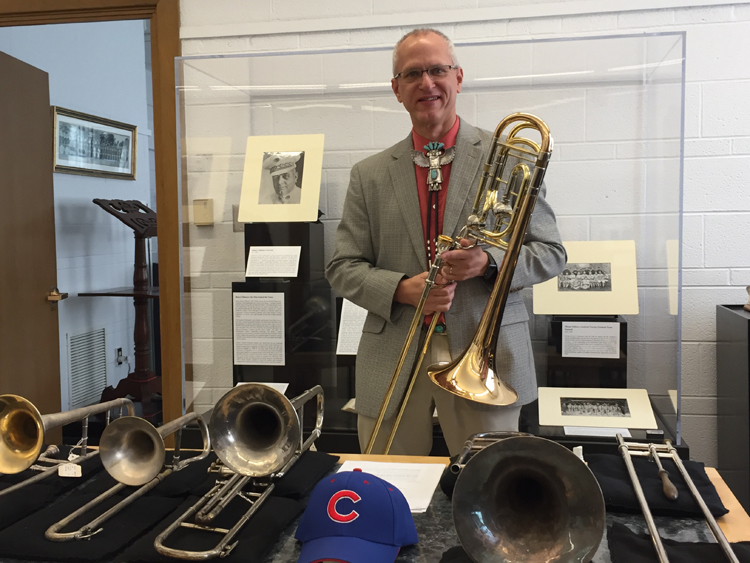
Scott asked if I would be interested in coming to Illinois to give a lecture/demonstration about early American trombone makers, their innovations and marketing strategies. The Sousa Archives had set up a very nice exhibit of six late-nineteenth and early-twentieth trombones as well as mouthpieces, catalogs, advertisements and other ephemera. In addition, we had selected six other instruments for me to play and demonstrate. Oh, and not to be lost in the moment is that the Chicago Cubs had just won baseball’s World Series and it seemed appropriate to make my Cubs hat part of the display.

yeo_lecture_03

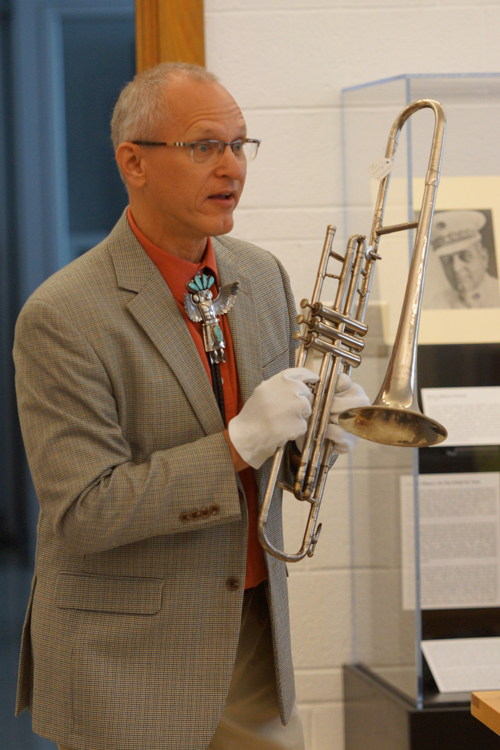
I always enjoy getting my hands on, talking about and playing old instruments, such as the alto valve trombone pictured above. The time at the Sousa Archives was very rewarding and was made more so because of the engaged audience and their great questions.

From the Sousa Archives I went to the University of Illinois School of Music where I gave a trombone masterclass. I worked with three talented students and also enjoyed getting together with my friend, Jim Pugh, who teaches jazz trombone and composition at University of Illinois. That was fun.

yeo_pugh

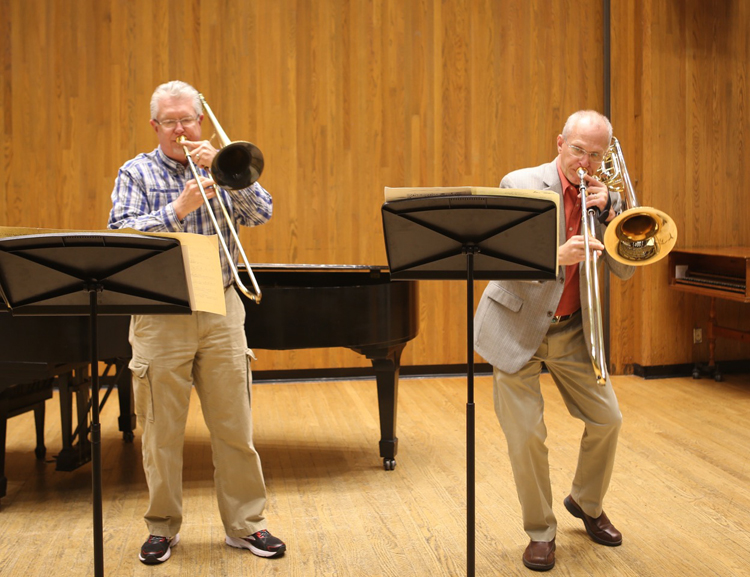
I have known Jim for decades and have the utmost respect for him as a player and a person. Several years ago I reviewed his superb CD, X Over Trombone, and I consider him to be one of the most creative players – and composers – on the scene today. Despite our long friendship, we had never played together, so we started the masterclass with a performance of Charles Small’s duet Conversation.

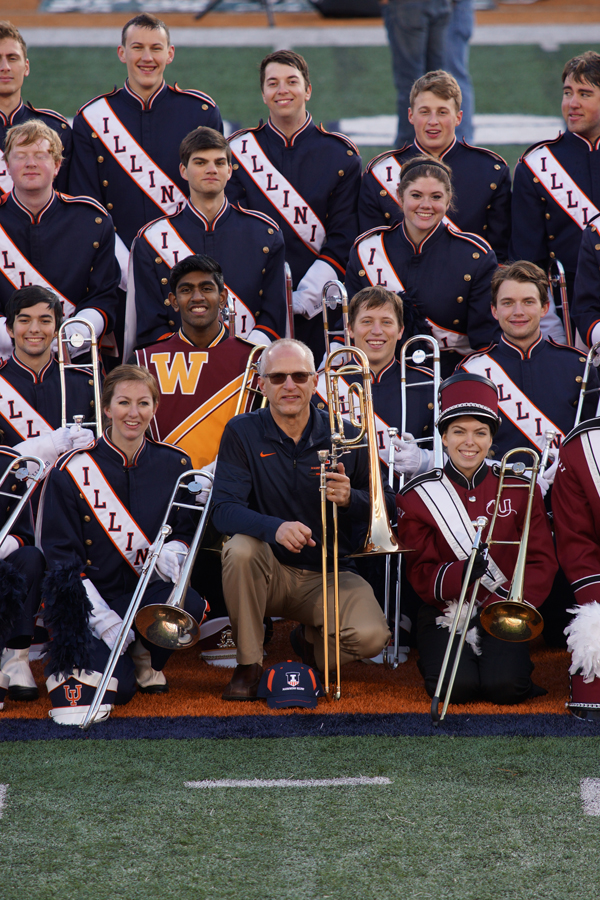
The third piece of my University of Illinois trip was a performance with the Marching Illini Band under the direction of Barry Houser. As an event with another connection to my trombone lecture and masterclass, I led a group of 75 trombone players – both members of the Marching Illini Band and students from local high schools – in a performance of Meredith Wilson’s 76 Trombones to start the halftime show of the Illinois/Michigan State football game. 75 + me = 76 Trombones. That doesn’t happen every day. Click the video image below to see the whole halftime show; it begins with 76 Trombones, and continues with a tribute to the Chicago Cubs and much more.

Now, when you put 76 trombones on a football field accompanied by a marching band, that is one impressive sight and sound. My hat is off to the Marching Illini for inviting local high school trombone players to join with the 40 trombonists of the Illini Band to get us up to 76 trombone players. This is one fine band, and I was caught up in many of their great traditions. School spirit was alive and well; it was a great day of interaction for all of us and, hey, Illinois won the game. It must have been the trombones.

yeo_halftime_03

I want to send a big THANK YOU to Scott Schwartz for making all of this happen, to Jim Pugh for his setting up the trombone masterclass and for playing Conversation with me, and to Barry Houser and all of the members of the Marching Illini Band for a great few days where we all came together in Illini orange and blue and celebrated the trombone. This was a memorable and very satisfying trip. Go Illini! I – L – L – – I – N -I !

yeo_newspaper

[And thanks to Scott Schwartz and Grace Talusan for the photos.]

The land of the free. Yes. The free.

The land of the free. Yes. The free.

I’ve recently returned from a week in Baltimore, Maryland, a trip that had many facets and which returned me to the place where my professional orchestral career started. Before joining the Boston Symphony Orchestra in 1985, I was bass trombonist of the Baltimore Symphony Orchestra from 1981-1985. In those four years, I was part of a great low brass section along with Jim Olin, David Fetter, Eric Carlson and David Federley (tuba); the photo below was taken in the fall of 1981.

baltimore_section_1981

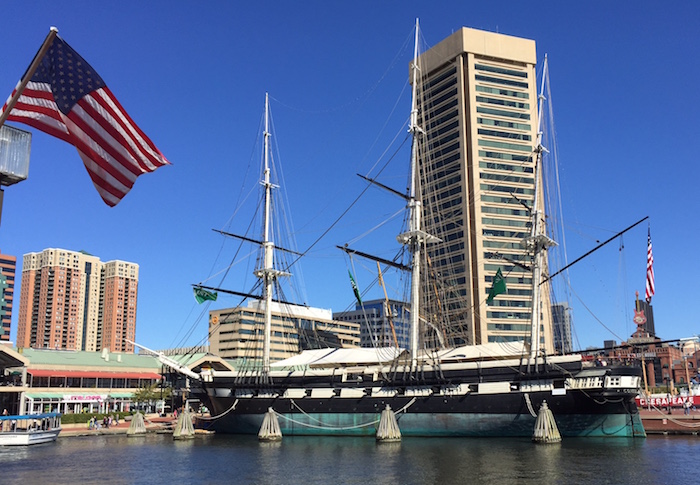
Returning to Baltimore brought me down to the city’s Inner Harbor, a superb urban development project that began just before we came to Baltimore more than 35 years ago. It was nice to see the changes to the area over the years, particularly the new stadiums for the Baltimore Orioles and Baltimore Ravens, both very much tied to the fabric of downtown Baltimore. The U.S.S. Constellation, the 1854 “tall ship” that served as part of the US Navy for over 100 years and seen in the background in the photo above is still there.

constellation

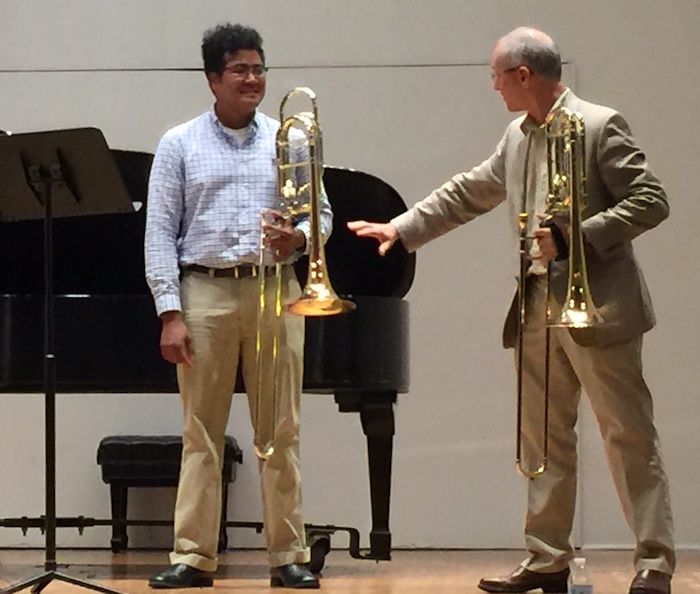
I also gave a master class at the Peabody Institute where I was on the faculty during my time in the Baltimore Symphony. It was quite nice to be back in that venerable place, with so much that was familiar but so much that was new. I very much enjoyed working with several talented Peabody students, including Jahi Alexander, shown below, who is a student of the Baltimore Symphony’s current bass trombonist and my former student, Randy Campora.

jahi

We also visited Fort McHenry (photos at the top and bottom of this post), particularly known as the site of a ferocious battle during the War of 1812. I had never been there before but I as very happy to finally get there. Our visit was a very strong moment, even emotional, as we learned the history not only of the battle but of its lasting consequence: the writing, by Francis Scott Key, of the words to our National Anthem, “The Star Spangled Banner.”

Our National Anthem is in the news these days, in particular because a small number of athletes have decided not to stand when it is played before the start of a game. They are doing this, they say, to protest the the anthem’s final words, “The land of the free and the home of the brave,” which they feel do not apply to all people in our country.

Everyone, it seems, has an opinion about this, although some writers have seen evidence that people  overwhelmingly see the gesture as being, in the words of Supreme Court Justice Ruth Bader Ginsburg, “dumb and disrespectful.”

Yes, our country has problems. Injustice exists. But I have been to 30 countries in the world on five continents and have seen how governments work. There are many good things about many countries in the world. But my late father had it right when he often said, “The American system of government is the worst in the world. Except for all the others.” The glory of the United States is the freedoms we have. Freedoms like those in no other place in the world. Our National Anthem is a symbol of our hopes and aspirations. In the face of injustice, we turn to that hope and work in meaningful ways to make positive change. Choosing to not stand at the playing of the National Anthem does not protest against injustice; to many, it is a selfish, narcissistic gesture that accomplishes nothing but draw attention to an individual. When we stand for our National Anthem – even while we are fully aware of the imperfections of our country – we honor those who have served our country to ensure our freedoms, we express gratitude for all that is good and right in our land, and we resolve to do better to improve the lot of everyone in our country. Standing while our National Anthem is played or sung is a rare gesture of unity in a country that is deeply divided over many issues.

Yes: athletes and others have the freedom to not stand for the National Anthem. That freedom is enshrined in our Constitution and Bill of Rights. And that freedom is celebrated in the words of the National Anthem itself. But those freedoms also include the right of others to call out those who do so as being selfish and “dumb and disrespectful.” See injustice? Work for justice. The battle of Fort McHenry and our National Anthem remind us of this.

O say, does that star spangled banner yet wave,

O’er the land of the free, and the home of the brave!

mchenry_inside


Important discoveries for brass players – with big implications

Important discoveries for brass players – with big implications

Players of brass instruments spend a lot of time thinking about their tongue, and how it factors in tone production, tonal range and articulation. Many books have been written on the subject but the truth is that since we can’t SEE inside our mouth while we’re playing and it’s very difficult to feel where the tongue actually IS while playing, a lot of what has been said on the subject is just theoretical.

Until now.

In what is proving to be a fascinating study with significant implications, Dr. Peter Iltis (Professor of Kinesiology at Gordon College) and Eli Epstein (former 2nd horn of the Cleveland Orchestra, now teaching at the Boston Conservatory at Berklee and New England Conservatory of Music) are announcing research involving the filming of elite horn players by way of MRI technology. This allows us to see inside the oral cavity of a group of superb players and begin to draw conclusions about the placement of their tongue while playing. Iltis and Epstein have created a Youtube channel to present some of their findings. These findings are applicable to all brass players, not just horn players. For convenience, here are two of the videos. They are each about 20 minutes long but if you are a brass player, they will definitely get your attention and get you thinking about tonguing in a completely new way:

Their second video continues the discussion:

But wait, there’s more! My friend, Dr. John Ericson, horn professor at Arizona State University, has three video podcasts in which he has further conversations with Dr. Peter Iltis about the MRI horn insights. You can see them here:

John Ericson and Peter Iltis, discussion 1

John Ericson and Peter Iltis, discussion 2

John Ericson and Peter Iltis, discussion 3

If you’ve stuck with this so far, then you will want to read this article by Peter Iltis, Jens Frahm, Dirk Voit, Arun Joseph, Erwin Schoonderwalds and Eckart Altenmüller (click the title below to read or download the article – it’s free):

Divergent oral cavity motor strategies between healthy elite and dystonic horn players

This article discusses the comparison between group of elite horn players and a group of players who are experiencing a form of “focal dystonia,” and how tongue placement is an important aspect of healthy brass playing. The article is technical but readable and understandable. And a real revelation.

I think we are just now at the beginning of a new era of understanding about this very important aspect of brass playing. I tip my hat to John Ericson for letting me know about this. I don’t know about you, but after looking at all of this, I think I need to go and practice.