Category: composers, conductors, performers

The land of the free. Yes. The free.

The land of the free. Yes. The free.

I’ve recently returned from a week in Baltimore, Maryland, a trip that had many facets and which returned me to the place where my professional orchestral career started. Before joining the Boston Symphony Orchestra in 1985, I was bass trombonist of the Baltimore Symphony Orchestra from 1981-1985. In those four years, I was part of a great low brass section along with Jim Olin, David Fetter, Eric Carlson and David Federley (tuba); the photo below was taken in the fall of 1981.

baltimore_section_1981

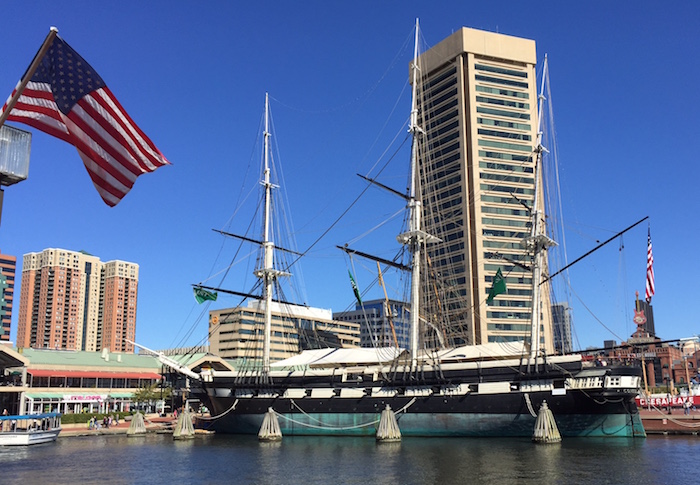
Returning to Baltimore brought me down to the city’s Inner Harbor, a superb urban development project that began just before we came to Baltimore more than 35 years ago. It was nice to see the changes to the area over the years, particularly the new stadiums for the Baltimore Orioles and Baltimore Ravens, both very much tied to the fabric of downtown Baltimore. The U.S.S. Constellation, the 1854 “tall ship” that served as part of the US Navy for over 100 years and seen in the background in the photo above is still there.
constellation

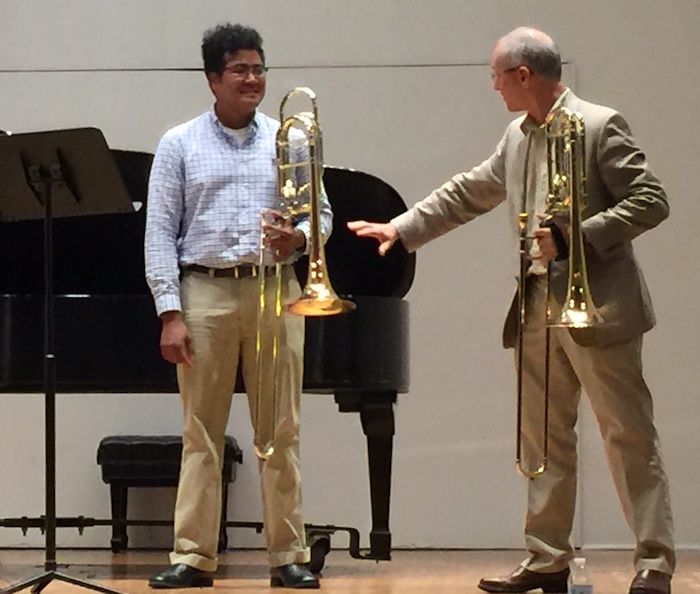
I also gave a master class at the Peabody Institute where I was on the faculty during my time in the Baltimore Symphony. It was quite nice to be back in that venerable place, with so much that was familiar but so much that was new. I very much enjoyed working with several talented Peabody students, including Jahi Alexander, shown below, who is a student of the Baltimore Symphony’s current bass trombonist and my former student, Randy Campora.
jahi

We also visited Fort McHenry (photos at the top and bottom of this post), particularly known as the site of a ferocious battle during the War of 1812. I had never been there before but I as very happy to finally get there. Our visit was a very strong moment, even emotional, as we learned the history not only of the battle but of its lasting consequence: the writing, by Francis Scott Key, of the words to our National Anthem, “The Star Spangled Banner.”

Our National Anthem is in the news these days, in particular because a small number of athletes have decided not to stand when it is played before the start of a game. They are doing this, they say, to protest the the anthem’s final words, “The land of the free and the home of the brave,” which they feel do not apply to all people in our country.

Everyone, it seems, has an opinion about this, although some writers have seen evidence that people  overwhelmingly see the gesture as being, in the words of Supreme Court Justice Ruth Bader Ginsburg, “dumb and disrespectful.”

Yes, our country has problems. Injustice exists. But I have been to 30 countries in the world on five continents and have seen how governments work. There are many good things about many countries in the world. But my late father had it right when he often said, “The American system of government is the worst in the world. Except for all the others.” The glory of the United States is the freedoms we have. Freedoms like those in no other place in the world. Our National Anthem is a symbol of our hopes and aspirations. In the face of injustice, we turn to that hope and work in meaningful ways to make positive change. Choosing to not stand at the playing of the National Anthem does not protest against injustice; to many, it is a selfish, narcissistic gesture that accomplishes nothing but draw attention to an individual. When we stand for our National Anthem – even while we are fully aware of the imperfections of our country – we honor those who have served our country to ensure our freedoms, we express gratitude for all that is good and right in our land, and we resolve to do better to improve the lot of everyone in our country. Standing while our National Anthem is played or sung is a rare gesture of unity in a country that is deeply divided over many issues.

Yes: athletes and others have the freedom to not stand for the National Anthem. That freedom is enshrined in our Constitution and Bill of Rights. And that freedom is celebrated in the words of the National Anthem itself. But those freedoms also include the right of others to call out those who do so as being selfish and “dumb and disrespectful.” See injustice? Work for justice. The battle of Fort McHenry and our National Anthem remind us of this.

O say, does that star spangled banner yet wave,

O’er the land of the free, and the home of the brave!

mchenry_inside


Improvisation: A Careful Carelessness

Improvisation: A Careful Carelessness

Last month I had the great joy of traveling to Duke Divinity School in North Carolina to take part in a two day Convocation titled, “Call and Response: Two Days of Theology and the Arts.” I was involved in a program called “A Careful Carelessness: An Evening of Theology and Improvisation.” Organized by Dr. Jeremy Begbie, the event included both classical and jazz musicians in a thought provoking evening that related the idea of improvisation – a skill that is careful but also careless – to both jazz and classical music, as well as our view of God.

ostling_yeo_duke

In Christian circles today, much is often made of so-called “freedom in Christ.” By this, many people conflate salvation and sanctification; they say: “I am God’s child, I am saved, therefore I can do pretty much whatever I want. The Law is not in force with me; I am a child of grace.” But just because an idea is popular doesn’t make it true. In fact, this way of thinking leads to spiritual anarchy and antinomianism, and is the anthesis of the Christian Gospel.

As Jeremy Begbie insightfully said at the Duke Convocation:

“All music making depends on improvisation to some degree. This interweaving of order and openness is built into the way music works. . . . In improvisation we learn that freedom comes from the interplay between openness and constraints. Of course in the modern world, freedom usually means something like the absence of constraint. . . Improvisation makes us rethink all that. It makes us wonder if true freedom comes only from leaning into the constraints. Flannery O’Connor once said, ‘Art transcends its limitations only by staying within them.’  When God gave the law to the Israelites, it wasn’t to cramp their freedom, but to liberate his people to be the people they were meant to to be. Walk outside the laws and you became unfree, slaves again. When Jesus says the “The Son makes you free, you will be free indeed,”  he didn’t mean free from everybody else and free from all limits – but free to love people the way they were meant to be loved.”

Indeed. Think of music. Within rules – chord changes and such – comes tremendous freedom and beauty. Rules don’t mean “no fun” – they mean great fun, great freedom. The Duke event was a reminder of just how hilarious – and I use that word in its meaning, “unbridled joy” – music can be when we work within a series of constraints, whether in jazz or classical or any style.

megumi-doug

In all of this this I was joined with colleagues from symphony orchestras from around the country and some fine jazz musicians as well. I played in a brass quartet with Andrew Balio and Nate Hepler (trumpets) of the Baltimore Symphony, and my good friend Megumi Kanda, principal trombonist of the Milwaukee Symphony. We played a canzona of Giovanni Gabrieli and also took part in large group performances of “Sing, Sing, Sing” and “Sweet Georgia Brown” where we were joined by Anne Martingale Williams, principal cellist of the Pittsburgh Symphony, Scottish violinist Alan Torrence, and John Brown (bass) and Donovan Cheatham (drums). Jeremy Begbie also contributed his skills as a superb pianist.

I also played an arrangement I made of a Bach two-part invention along with my Boston Symphony friend and colleague, associate principal flutist Elizabeth Ostling (who also played in the large group pieces). A highlight of the evening was Duke’s Dean of Chapel Luke Powery leading a call and response with the audience of the spiritual, “Wade in the Water,” over which I improvised a trombone solo. What a joy it was to work with such capable, flexible, and positive friends and colleagues while at the same time being musically and spiritually challenged myself.

dukegroup

There will be more from me on this theme of order and openness in future posts. For now, you can read more about the Duke Convocation in this article on the Duke Divinity School website, Duke Initiatives in Theology and the Arts (DITA) Celebrates New School Year with Theology and the Arts.

[Giving credit where credit is deserved: photos in this post were taken by Jessina Leonard and Pilar Timpane.]

The President and the trombone

The President and the trombone

by Douglas Yeo (September 26, 2016)

With today’s debate between US Presidential candidates Donald Trump and Hillary Clinton, we enter into an intense season of politics in the United States. It seems like the right time to remember a humorous incident that occurred several years ago regarding the President and the trombone

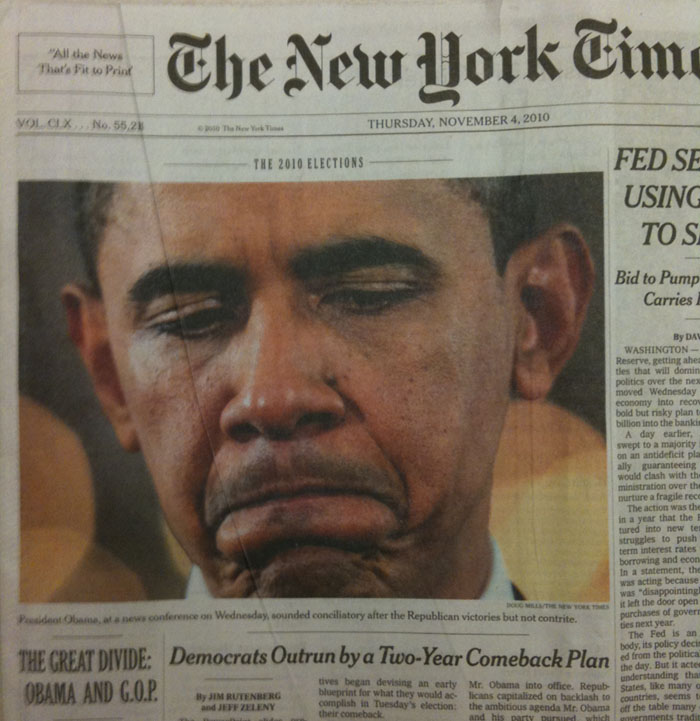
Things happen on the Internet and the Internet has a long memory. In 2010, after the mid-term elections, I was in my locker room in the basement of Boston’s Symphony Hall, preparing for the evening’s Boston Symphony concert. On the table was a copy of the day’s The New York Times, with a front page photo of President Obama:

obama_01

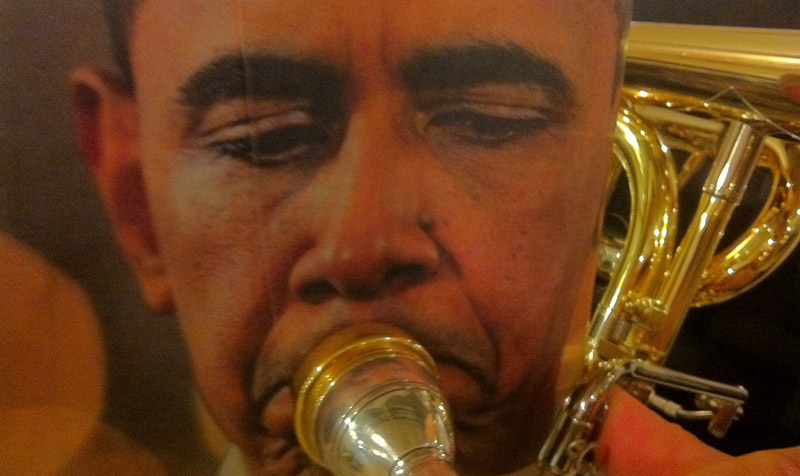
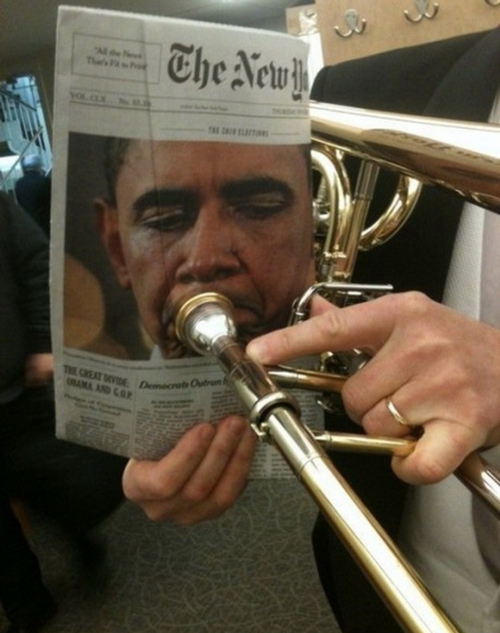
The President was wearing an unhappy face, but as I looked at the photo more closely, I saw some possibilities. I held up my Yamaha YBL-822 bass trombone to the photo and my Boston Symphony trumpet colleague, Michael Martin, snapped this photo, below. I was on to something…

obama_trombone_yeo

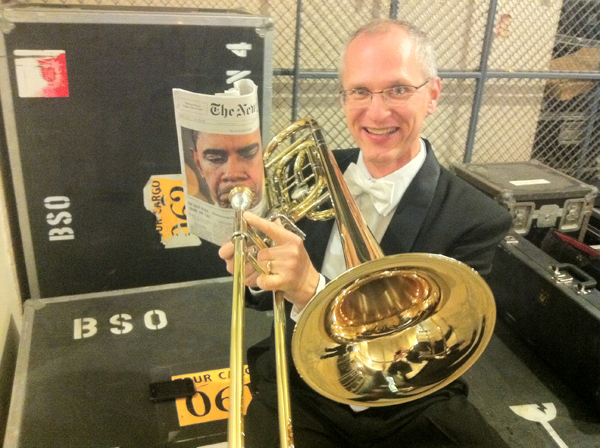
A few minutes later I walked down to an area in the Symphony Hall basement where I thought I could get a photo in better light. My Boston Symphony trombone colleague, Steve Lange, took this photo:

obama_trombone_yeo_02

After a little careful placement of the mouthpiece and folding of the newspaper, Steve snapped the photo that heads this post. I cropped it and a few minutes later,  I made a post to the Trombone Forum with the photo.  I was not prepared for what came next. The photo went viral, passed around on many websites and fora. It made the rounds on Facebook, on Reddit, Twitter, Buzzed, Pininterest, and email. Hardly a week has gone by in the last six years when someone hasn’t sent the photo to me, wondering if I’d ever seen it. The photo got named “Baraque Trombone” and “Trombama” and “Obamabone.” If you do a Google search on the words “Obama Trombone” and click “images” you will see these images over and over and over.

When I saw the photo in The New York Times, I thought, “Hmm, I think the President might have a pretty good trombone embouchure.” One thing led to another. And now you know the whole story. All in a little fun. You just don’t have to send the photo to me and ask if I’ve seen it before.

Waiting

Waiting

I’m an active person, always wanting to engage with projects, things and people that are around me. For many years, I didn’t particularly care for waiting. I don’t know many people who do. Waiting in traffic. Waiting for a movie to begin. Waiting on a line at the airport. Waiting for others to get ready to go out to dinner. Waiting often seems like a waste of time. But I don’t think so any more. As with may things, it all depends on how you look at it.

I took the photo above last month at Yellowstone National Park. I was struck by three people sitting on the boardwalk that surrounds Old Faithful geyser, one of the park’s iconic features. This remarkable geyser erupts to spectacular effect about every 90 minutes or so. Since it erupts with such regularity, great crowds come to see Old Faithful. The three people above came early. About an hour early. So they did not have to deal with this to find a good spot to watch (below):

crowd_yellowstone

This is the scene that is repeated many times each day. Several thousand – yes, thousand – people waiting for Old Faithful to erupt. The three people who got there an hour early certainly got a good seat. But they got more than that. They had some time without the crowds, time to think and consider what they had and what they were about to see. I have a feeling they felt the wait was very much worth it.

Musicians do a lot of waiting as well. Trombone players, in particular, spend a great deal of time sitting and waiting for things to happen. Consider Beethoven’s Symphony 9. Here’s the beginning of the first page of the bass trombone part, a part I played dozens and dozens of times as a member of the Boston Symphony Orchestra.

beethoven_9_snapshot

Look carefully. See where I played my first note of the piece? It’s in measure 414 of the second movement. I didn’t play a single note in the first movement (that movement has 547 measures). Then had to wait 414 measures (well, actually there were more than that if the conductor took the repeat) to play in the second movement. And my first note was a note that I had to get right – the other two trombone players don’t play there. By contrast, the first violin part requires eight pages of music to get to that same place in the music. So I had to do a lot of waiting before I played my first note of the Beethoven Symphony 9.

One thing I did NOT do was count rests. There are simply too many rests to count to be 100% sure you’ll count correctly. So I made it a point, for every piece I ever played, to study the full score and know and understand the piece so well that I did not need to rely on counting rests. I simply knew when it was time to play. When you count rests for hundreds of measures, you can’t do anything else; you have to concentrate to get the count right. That never interested me. (By the way, my colleagues will attest to the fact that I rarely came in wrong. I don’t say that as a point of pride but simply an acknowledgement of the fact that if you prepare thoroughly, you will not need to count every rest and can have confidence that you will come in correctly.) You’ll see why, below.

When I retired from the Boston Symphony, I received several meaningful gifts from the Orchestra and my colleagues. Several of them are hanging on the wall in my home studio.

yeo_wall

The centerpiece is a photo of the Boston Symphony and Tanglewood Festival Chorus performing Beethoven’s Symphony 9 in Symphony Hall, Boston during my last week of concerts; the photo was taken on May 3, 2012 and the performance was conducted by Bernard Haitink. The photo is beautifully framed and matted and my colleagues in the Orchestra signed the matte. It is an exceptionally meaningful artifact of my career. But if you look closely, you will see the orchestra playing – every member in full throat – except the three trombone players. Toby Oft, Steve Lange and I are seen doing what we did for so much time: we were sitting with our hands folded, trombones at the ready but they are silent.

bso_waiting

I haven’t done a calculation, but my guess is I have spent years of my life waiting, and much of that time was done at orchestra rehearsals and concerts. Since waiting is unavoidable, the question arises: What are you going to do while you’re waiting? You could just sit there and be bored, unhappy that you’re not DOING something. But I learned that there are a lot of things you can do while you’re waiting to play. You may come up with a different list but I think the important thing is that you HAVE a list of things that you can do to redeem the time that you spend waiting. Here are some things that I do while waiting to play.

  • Listen. I always felt like I had the best seat in Symphony Hall. I could hear every note that was played with great clarity. Sometimes I would simply listen to the great orchestra around me and enjoy it like I was attending a concert.
  • Pay attention. My students will tell you that the words “pay attention” are a theme of my teaching. So often we experience things and so much goes by without our even noticing. Sometimes I would choose a particular colleague and pay attention to what he or she was doing. While it’s true that Edward Kleinhammer and Keith Brown were my trombone teachers in college, if asked who my teachers were, I rattle off a list of dozens of names – and most of them were not trombone players. They were my colleagues in the Boston Symphony who taught me so much when I took the time to intentionally pay attention to what they were doing. I am a much better trombone player because I paid attention to string, woodwind, percussion and other brass players exercise their craft. Likewise, I learned a great deal from observing soloists and conductors. Too many trombone players are only interested in the trombone parts. Pay attention to others and you will experience tremendous growth as a musician.
  • Watch the audience. People go to concerts to hear and see an orchestra. But it’s also true that those on stage are aware of the audience. Over my nearly 30 years in the Boston Symphony, I got to know many audience members. Some I met personally; others I observed only from a distance. I recall one woman who came to concerts with her husband when I first joined the Boston Symphony. As the years went on, she began to come to some concerts with her daughter. Years later, she came with her granddaughter. And in my final years in the orchestra, she came again with her husband. It was a touching thing to see each Thursday night. It taught me something about inter-generational relationships and the love a family shares.
  • Analyze the music. When I prepare to play any piece, I study the score to understand it better. This is not just so I wouldn’t have to count lengthy numbers of rests. It is so I can enjoy and appreciate the music on a new level. I would always read the program notes written by the Boston Symphony’s expert scholars and writers and I often would read a book about the piece we were playing. With that background, I often sat during concerts and analyzed the composer’s work, seeing how themes weaved in and out, doing harmonic and rhythmic analysis. I felt that every concert was a music history lesson. I learned so much.
  • Pray. Prayer is not a singular event that I do at a particular time of day. The worship of God is something that I do all day long, all the time. The title of a book by my music-spiritual mentor, Harold M. Best, says it well: Unceasing Worship. When I had long movements where I didn’t play, I would often pray. Pray for family and friends, pray for our country and its leaders, pray for wisdom and understanding, and much more. Surrounded by God’s great gift of music, prayer flows naturally.

Waiting is an exercise; patience can only be learned while in a situation that makes you tend to be impatient. But waiting can be a great blessing, even a thrill, if you look at it as an opportunity to to do more than simply sit with your hands folded in your lap.