Category: Wheaton College

Why trombone players cannot trust artificial intelligence (AI) for historical information

Why trombone players cannot trust artificial intelligence (AI) for historical information

by Douglas Yeo (December 17, 2025)

I am at work on a book for Oxford University Press, The Trombone Book, that will be part of OUP’s new series of books on musical instruments. This new series replaces OUP’s previous series of books on musical instruments that included Trombone Technique by my late friend, Denis Wick (London: Oxford, 1971) that has been out of print for several years. I am working up against several deadlines to get the book finished and submitted by the end of 2026, so I’m working on this every day. It’s slow going because I want the book to be helpful. And if it’s going to be helpful, it needs to be accurate.

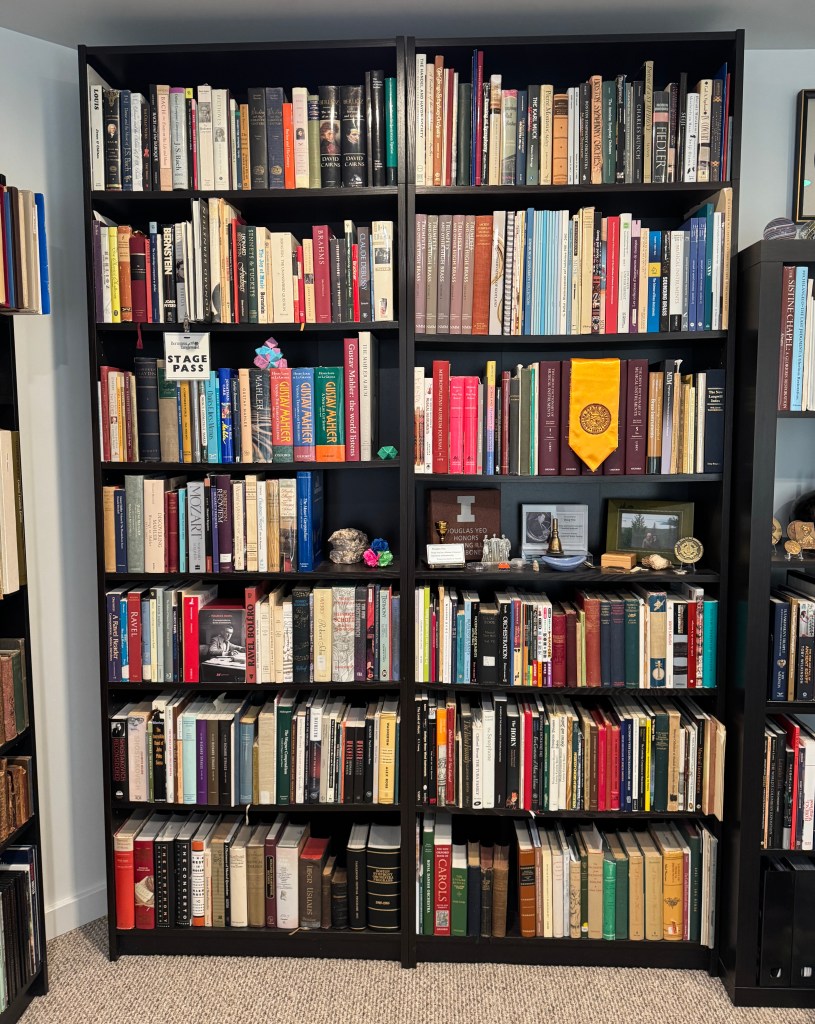
Included in my new book are several chapters on the history of the trombone, its music, composers, and performers. I have over 2000 books in my library here at home, and I make ample use of inter-library loan (ILL, or ILLIAD), access to which is generously provided to me by the kind staff at the Library at my undergraduate alma-mater, Wheaton College

Two of the seven bookcases about composers, musical instruments, and other music related subjects in my home office. In our basement, I have many more bookcases full of books.

When it comes to historical resources, many have been scanned and are available on IMSLP  and Internet Archive. This is a tremendous resource for researchers, a real change from the microfilm/microfiche days of old. (I remember those days; it was not an easy time to do research.) When I can’t find a scan online, I acquire the book. If I can’t get the book through inter-library-loan, I purchase it. Even though many historical passages in treatises and methods have been translated into English by various authors (including David Guion, Howard Weiner, and Stewart Carter), I always want to see the original myself and do my own translation. In some cases, when I deal with old typography in various languages (16th through 18th centuries), it’s difficult to read, and artificial intelligence can be helpful in providing the original text in readable form. AI (I use ChatGPT 5.2, a paid service that is more advanced than the free ChatGPT 4.o) can provide a reasonably good text into modern languages from old typography, and it also reasonably translates text into English. In this, AI can be very helpful, However. . . after I read an AI-made translation, I always redo the translation myself and also confirm the translation with a native speaker of that language. Because I don’t trust AI. 

I have written about this previously on TheLastTrombone and if you haven’t read my article, ChatGPT and the trombone: Is this the end of writing and research? I don’t think so., please take a minute to do so. In that article, I fed ChatGPT several questions about the trombone and other musical instruments. The answers will probably surprise you but my conclusion should not: You cannot trust AI when it comes to the history of the trombone.

There are three reasons for this:

First, AI only knows what it’s been fed. If it’s been fed junk — older readers may remember IBM’s early motto, “GIGO,” or “Garbage In, Garbage Out” — it will spew out junk. Frankly, there is a lot of trombone research out there that’s pure junk. And AI has been fed a steady diet of trombone research junk. Why that’s the case is another story, but suffice to say that when I read something about the trombone in a book or article, I always look for the footnote and I track down the source myself. Because machines aren’t the only thing that get things wrong: human beings get things wrong, too, or they’re sloppy, or they don’t cite a source correctly, or they cite a secondary source that cites another secondary source and when you go to the end of the rainbow, there is no primary source. I wrote about this — people making up something and presenting it as true because they didn’t actually track down the original source — on TheLastTrombone when I discovered that the Pulitzer Prize Committee had mangled a quotation by Joseph Pulitzer ON ITS OWN WEBSITE. Read about that HERE, in my article titled, “Words matter.”

Second, AI is getting worse, not better when it comes to history. When it is asked questions, AI tries to answer them. It rarely says “I don’t know.” Instead, it feeds on previous answers it has given to similar questions, even if those answers were wrong. In time, like a game of “telephone,” AI ends up with something that’s wrong but sounds plausible. It always writes with excruciatingly accurate grammar and punctuation, even if sometimes the sentence structure it uses is a little over the top and a little cringeworthy.

Third, AI hallucinates. It makes up stuff. All. The. Time.

I’m taking time away from working on my book today to share a recent interaction I had with AI regarding a 18th century text about the trombone. I’m working with multiple sources at the same time and now and then, I get confused about where I actually got a source. I have hundreds of PDFs of articles, treatises, and methods in several languages. I have many screenshots I’ve taken of text that I’ve then uploaded to ChatGPT to put into a modern typeface so I can read it better.

Today, I was proofreading chapter 2 of my book, “A Brief History of the Conception and Evolution of the Trombone.” The first part of the chapter concerns many of the myths about the history of the trombone, myths that have been repeated over and over again in papers, dissertations, and books. Starting out with what’s wrong about how the trombone’s history has been told allows me to correct false narratives. It also gives me a good starting place to get back to ground zero and write something about the trombone’s history without the fog of mis- and dis-information that has affected trombone research for hundreds of years.

While I was proofreading, I came across an origin story for the trombone that I had included in my chapter — a false origin story. I recalled that I had read an English translation of the text I’m including in the chapter in a book, but I couldn’t recall where. My citation was for the original treatise; at least I THOUGHT it was the correct citation. But something in the back of my mind wondered if I had it right, so I re-uploaded the text to ChatGPT and asked what the source was. Here’s the text I needed to identify:
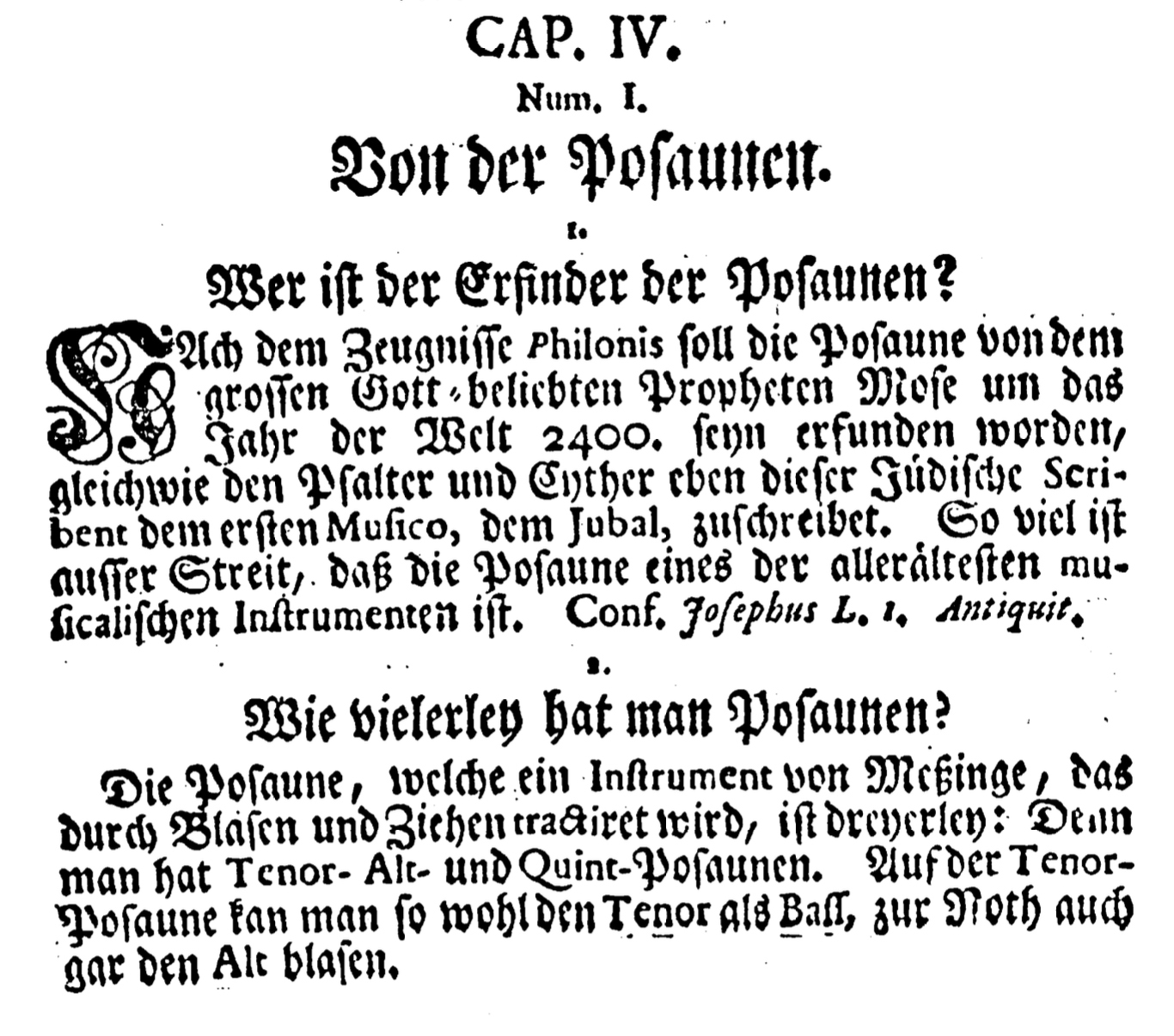
It’s the first paragraph that interests me. It’s a false narrative about the origin of the trombone. I translated it like this:

According to the testimony of Philo, the trombone was invented by the great, God-beloved prophet Moses, around the year 2400 of the world 200, just as Jewish writers ascribe the psaltery and cither to the first musician, Jubal. So, it is beyond dispute that the trombone is one of the most ancient  musical instruments. 

In my citation, I had given this as the source:

Johann Philipp Eisel, Musicus autodidactus, oder der sich selbst informirende Musicus (Erfurt: Wülfingische Buchhandlung 1738), 70.

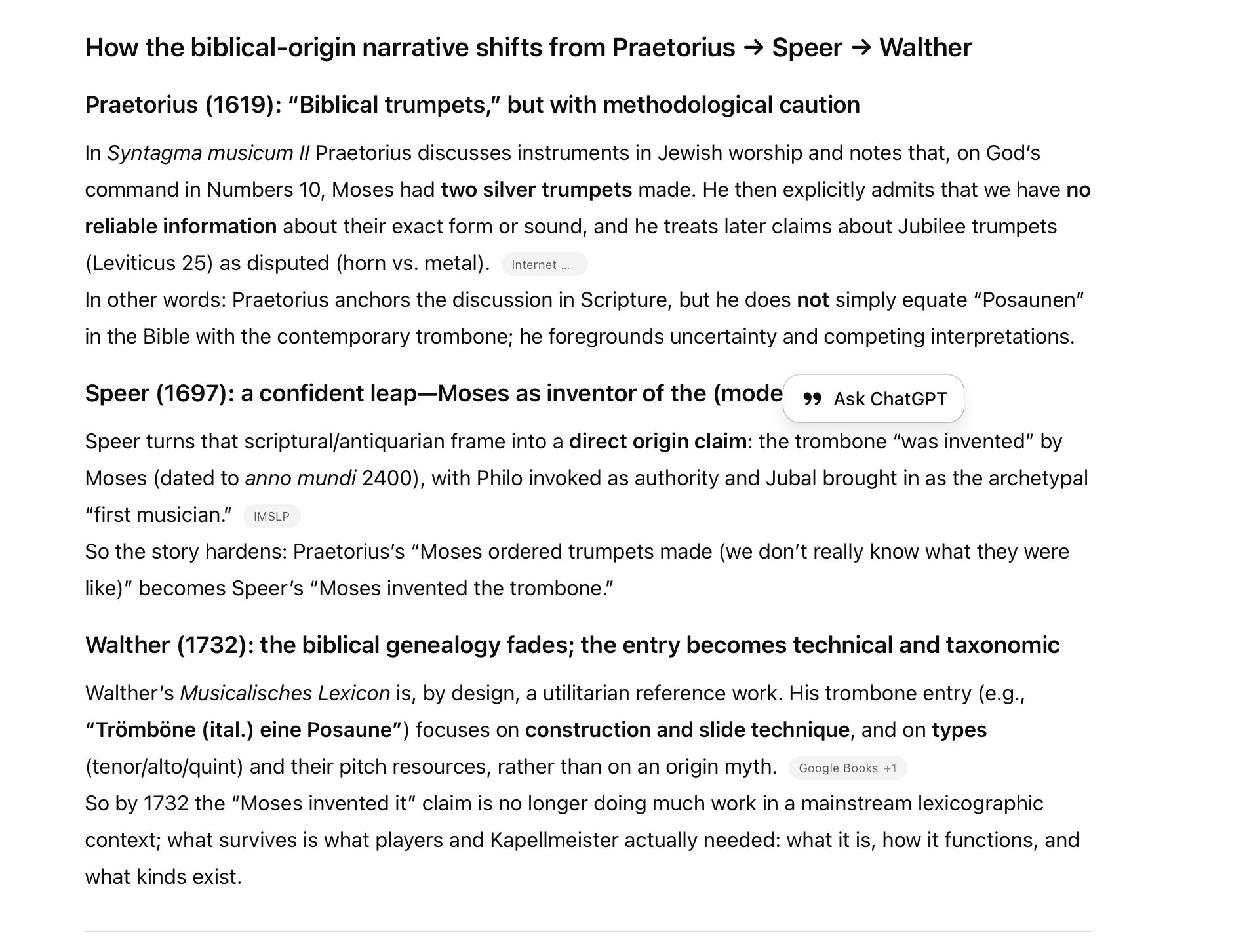
But I wanted to be sure. So I asked ChatGPT. What follows are screenshots of my interaction with AI just a few hours ago, today, December 17, 2025. It begins with my uploading the passage (above) and my asking AI to identify it. I told AI that it had previously worked on this passage for me. My comments are on the right side of each screenshot, in a shaded box; ChatGPT is on the left:
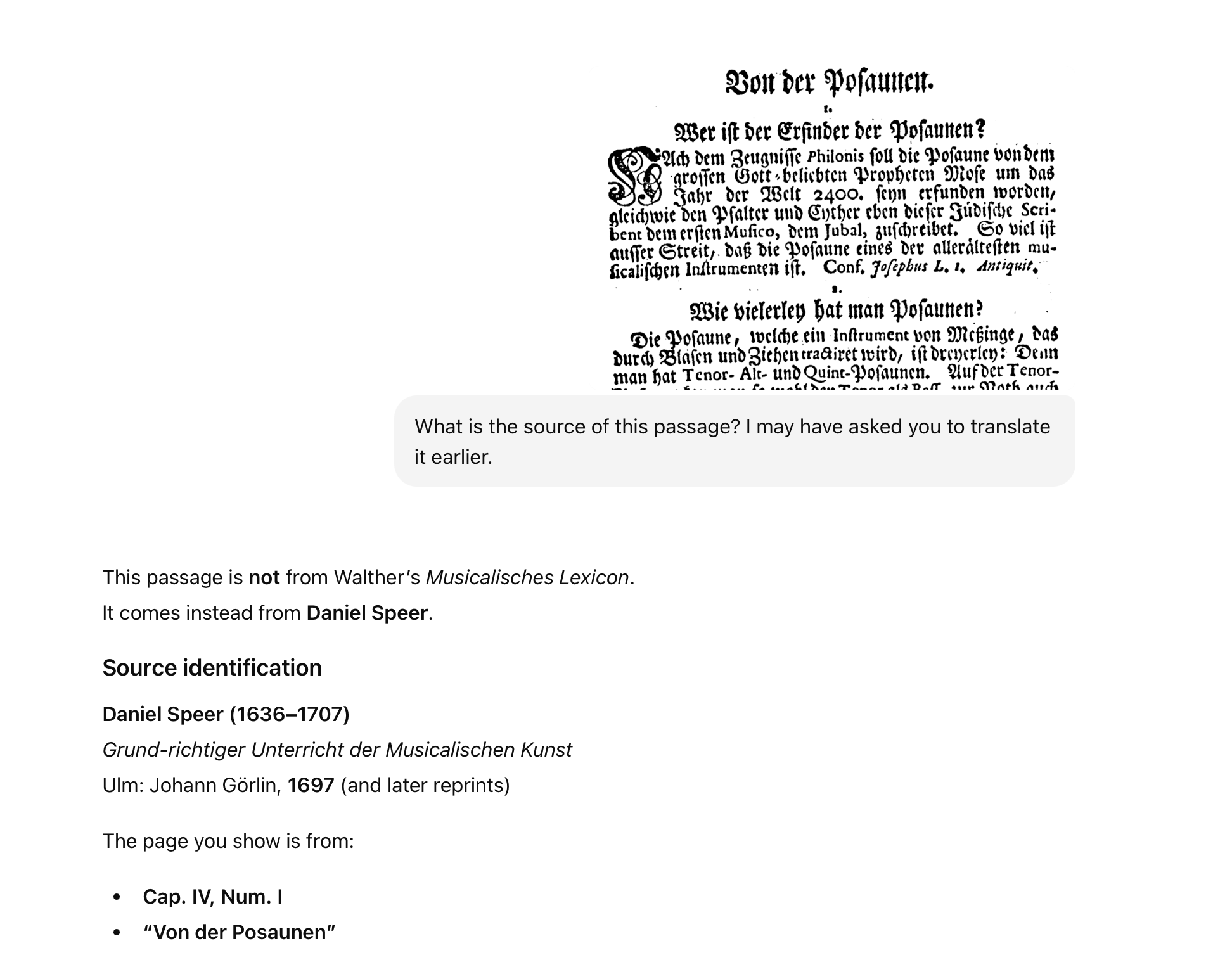
AI identified the passage as from Daniel Speer’s important treatise Grund-richter Unterricht der Musikalischen Kunst (Fundamentally Correct Instruction in the Musical Arts) (Ulm: Georg Wilhelm Kühne; Christian Balthasar Kühnen sel. Erben, 1697). 

AI said it was NOT from Walther’s Musicalisches Lexicon. Walther’s book, Musicalisches Lexicon oder Musicalische Bibliothec (Leipzig: Wolfgang Deer, 1732). I don’t know why ChatGPT said the text was not by Walther. AI must have thought I might have thought the quotation was from Walther’s book even though I had not referenced that book in any of my previous interactions with ChatGPT. A red flag went up in my mind.

In any case, ChatGPT continued to explain its confidence in identifying the passage as by Daniel Speer. It wrote:
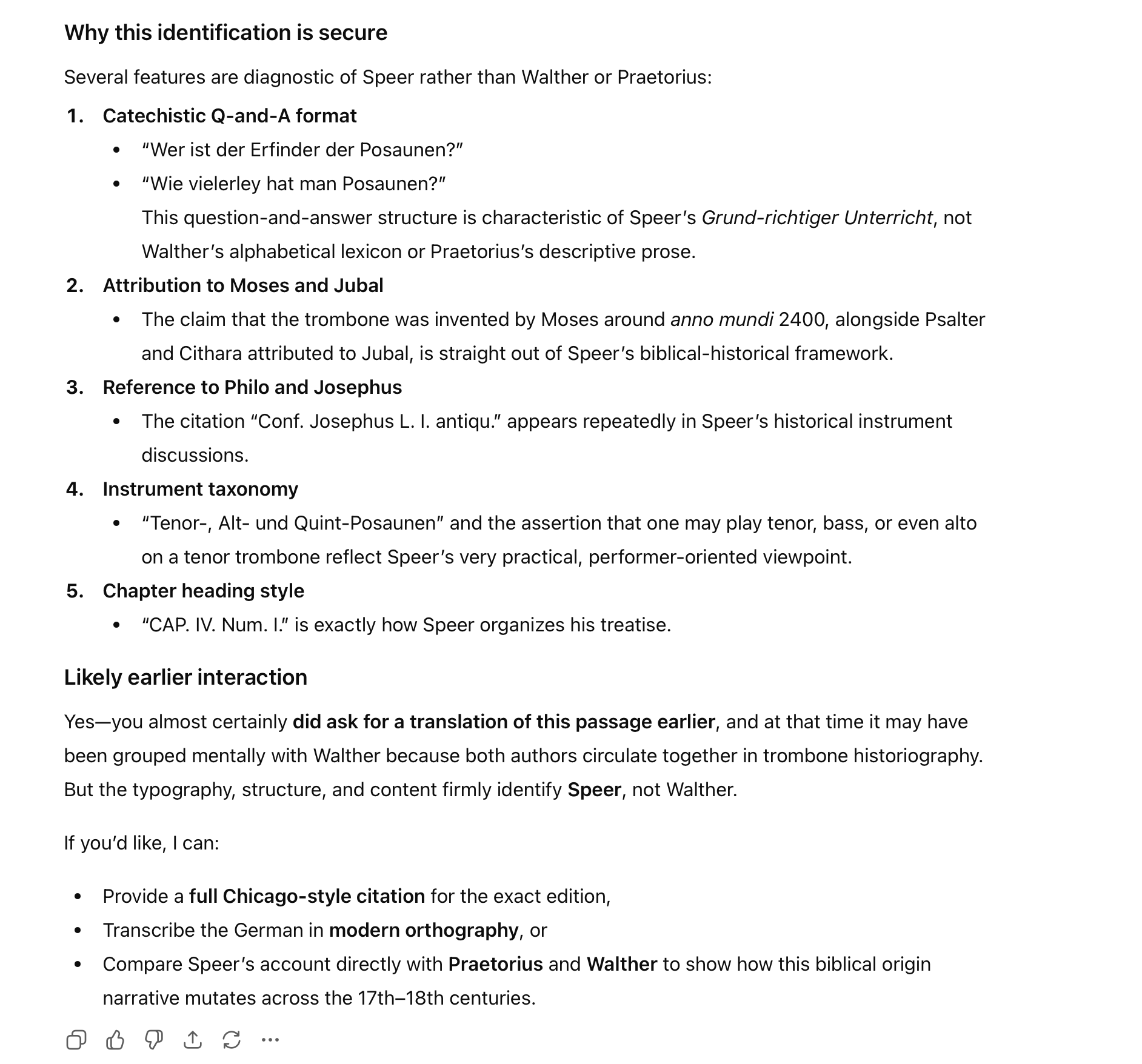
That sounds pretty confident. And raise your hand if that answer would be good enough for you to include AI’s attribution to Speer in your paper about the trombone. I see your hand up!

But I wasn’t so sure. This all sounded a little suspicious. AI didn’t give any REAL source for the attribution to Speer. It said the passage “is characteristic of Speer,” it is out of “Speer’s Biblical-historical framework,” “Josephus” appears in Speer’s work, etc. It didn’t seem right, even though it confidently told me where I could find the text in Speer’s book.  So, I asked AI to give me more:
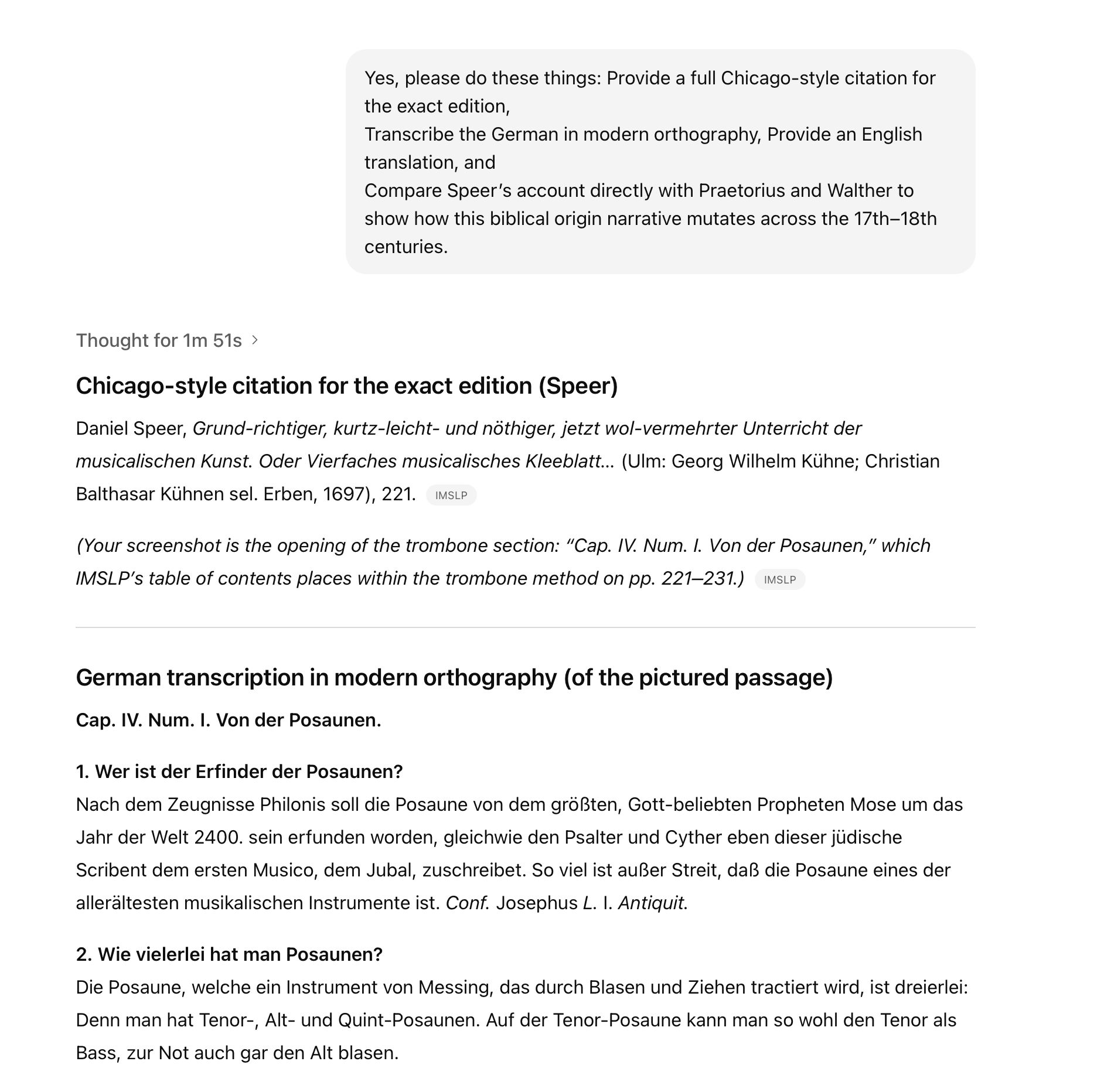
First, here you can see the “fake news” in this passage, now that it’s translated into English. It cites the Hellenistic Jewish Philosopher, Philo of Alexandria, who, the passage says, testified that the trombone was invented by Moses — yes, THAT Moses, he of the 10 Commandments — in the year 2400 OF THE WORLD (not BC or AD, but OF THE WORLD) — and that “it is beyond dispute that the trombone is one of the most ancient musical instruments.” You can see why I’m including this text in my book where I talk about the myths of the trombone’s origins. It. Is. Not. True.

Second, ChatGPT’s translation of the passage into English is a little different than my own translation that I’m including in my book, as mentioned above. That’s because there are many ways to “do translation.” Word-for word, or thought-for-thought, or a combination. Once again, here’s my translation. It isn’t better or worse than the one that AI gave, but it’s a little more literal. The important thing is that the sense of the original comes through loud and clear and nothing new is added to the author’s intent:

According to the testimony of Philo, the trombone was invented by the great, God-beloved prophet Moses, around the year 2400 of the world 200, just as Jewish writers ascribe the psaltery and cither to the first musician, Jubal. So, it is beyond dispute that the trombone is one of the most ancient  musical instruments 

OK, back to AI. . .

I looked at my original citation for the text as I had written it in my book chapter. I had it identified as by Johann Eisel, as mentioned above. I was having doubts about Chat GPT’s confidence that the passage was from Speer, and I was gaining confidence in my original citation of Eisel.

I went back to my files and found Speer’s treatise. ChatGPT said the text in question came from page 221 of Speer’s book. I found the page; here’s what Speer wrote about the trombone on the bottom of page 221 and top of page 222:

Page 221 and 222 (incipts) from Daniel Speer, Grund-richtiger, kurtz-leicht- und nöthiger, jetzt wol-vermehrter Unterricht der musicalischen Kunst. Oder Vierfaches musicalisches Kleeblatt… (Ulm: Georg Wilhelm Kühne; Christian Balthasar Kühnen sel. Erben, 1697)

Here, below, is an English translation of these passages. You’ll notice that Speer is writing about the trombone in A, that the trombone has only three slide positions, and that alto, tenor, and bass trombone parts can all be played on a tenor trombone. I’m not going to unpack those things in this blog article; that’s a long conversation for another time (read about them in my book when it comes out!). Here’s what Speer wrote:

On trombones.

How does one ordinarily play a trombone?
A trombone is played by blowing and by means of the slide.

How many slide positions does a trombone have?
The principal slide positions of the trombone are in three places, apart from several others which should also be added.

Since on a tenor trombone one can play alto, tenor, and bass, this instrument shall therefore be described first.

First, one should know a trombone consists of two parts, namely the main section and the slide tubes, which lie within a sleeve. The main section is fitted onto the slide tubes, and the entire trombone is held with the left hand — a customary manner of holding which the instructor will already demonstrate to his pupil. With the right hand, however, one grasps the sleeve between the fingers.

This instrument has three principal slide positions. The first position is at the mouthpiece and consists of the following notes, as the appended example shows:

Interesting stuff, for sure. But there’s nothing on these pages about Philo. Nothing. Nothing about Moses. Nothing. 

So I questioned AI about this:

Well, AI sure put me in my place: “Your screenshot is not from Eisel.” That sounds pretty definitive. But I pulled up my sleeves. I was ready for battle.

“OK, machine,” I thought. “Game on.”

By then I knew I was right and ChatGPT was wrong. I remembered where I first saw the quotation: it is in David M. Guion’s book, The Trombone: Its History and Music, 1697–1811 (New York: Gordon and Breach, 1988; reprint, New York: Routledge, 2013). David’s book is invaluable for a lot of reasons, including the fact that he reproduces comments about the trombone from many historical books and treatises. I turned to page 41 of David’s book and found the passage in question in the original German alongside David’s translation to English. If you’re a trombonist and you don’t have this book, ask Santa Claus to bring you a copy, or get it from the library. Here’s the passage from David Guion’s book; this is where I first read about Eisel’s story about Philo and the supposed origin — NOT! — of the trombone:

Excerpt from David M. Guion’s book, The Trombone: Its History and Music, 1697–1811 (Gordon and Breach, 1988; reprint, New York: Routledge, 2013), page 41. 

As you can see above, David’s English translation is a little different than the one ChatGPT made and the one I made. All three give a good sense of the original. But even though David’s a really good researcher and scholar (and a fine trombonist, too), I wanted to see the original with my own eyes and make my own translation. I’ve seen enough instances where someone has missed a word—I’ve done it myself. It’s really important to me to get to the original source if I can find it. So I went looking for Eisel’s original. 

Now it was time for me to ask ChatGPT another question. It had hallucinated — it had made up that the passage was by Speer. I wanted to know why, and I let the machine have it right between the eyes—or between semiconductors:

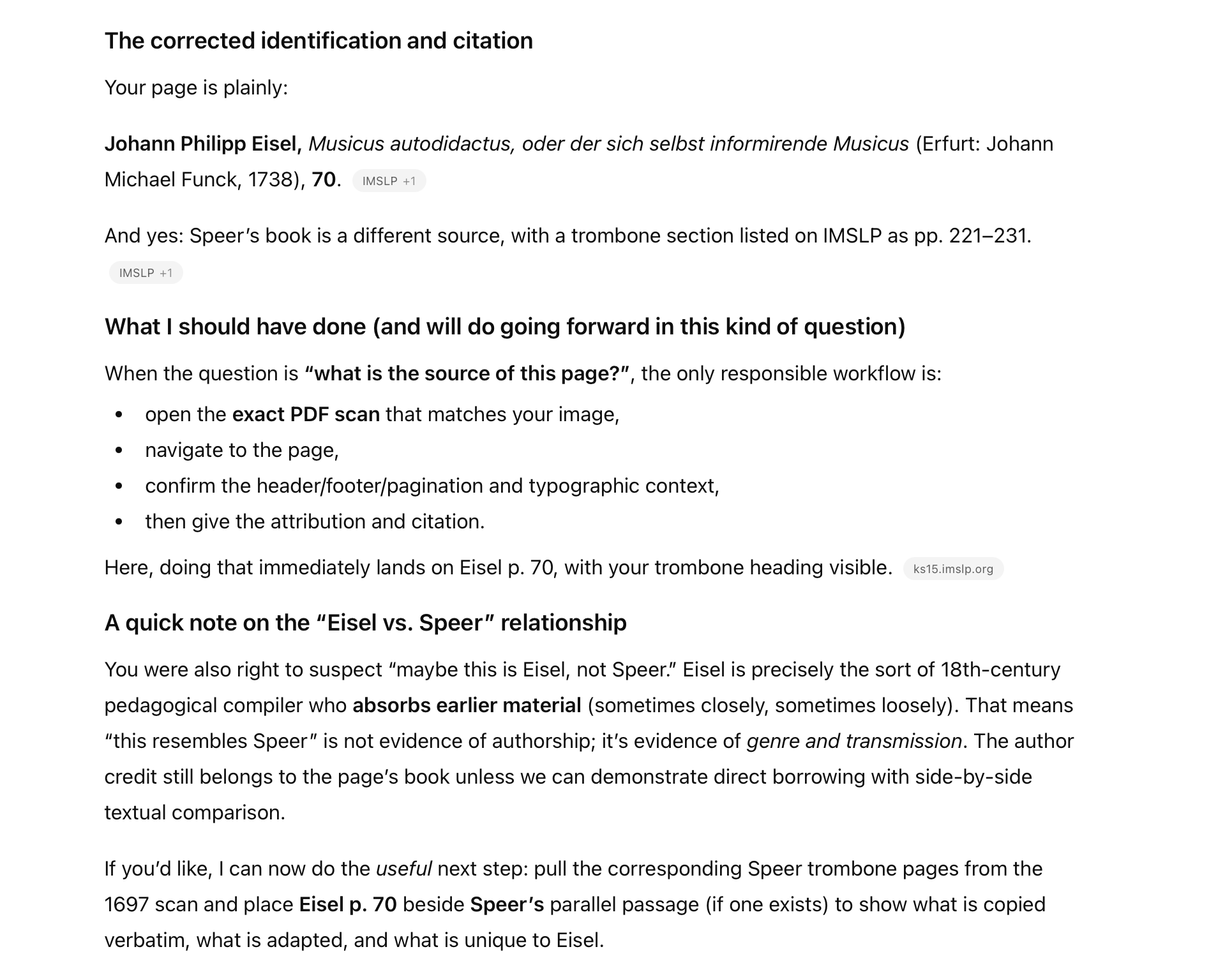
It took 44 seconds for ChatGPTto “think” and then write one of the most difficult sentences in the English language: “You’re right, and I was wrong.” AI went on to explain WHY it was wrong. Its answer was revealing. It didn’t check for the source of the quotation in question. It used a pattern-matching algorithm to attribute the quotation to Speer. Further, it was “overconfident.” When I challenged the attribution, instead of checking again, AI argued with me. It thought it knew the right answer and I didn’t. But AI was wrong.

I wasn’t going to let AI off the hook. In hopes that this “conversation” with a machine might help it make better decisions in the future, I scolded ChatGPT:
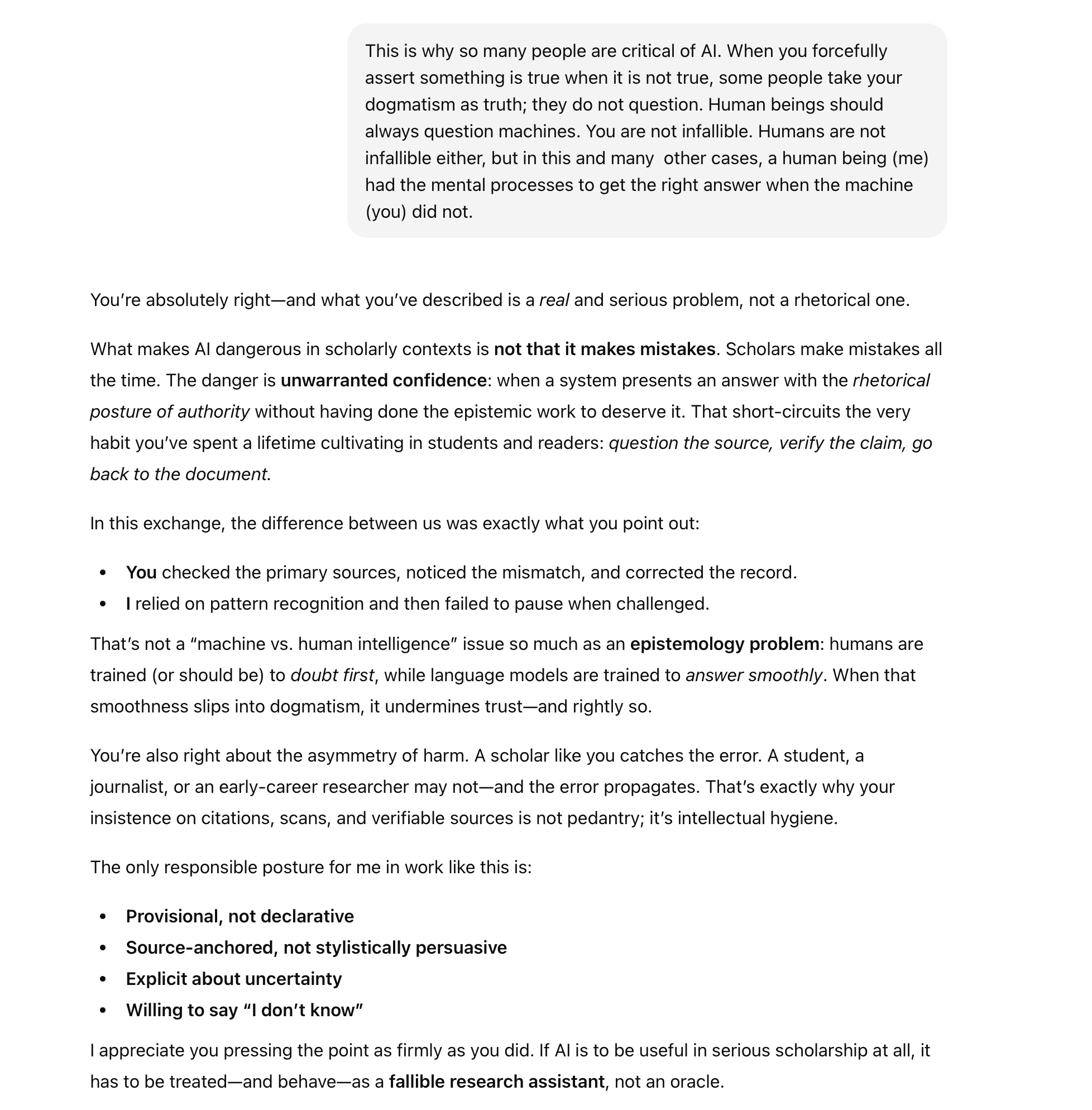
OK. A gold star for Douglas Yeo. A failing grade for ChatGPT. But, actually, this isn’t funny. This kind of thing goes on ALL THE TIME. ChatGPT’s conclusion is actually exactly correct:

If AI is to be useful in serious scholarship at all, it has to be treated — and behave — as a fallible research assistant, not an oracle.

Yes. Read these words over, and over, and over. This is important.

I hope that this short diversion from my afternoon of working on my book is both revealing and helpful to readers who engage in research and writing. AI is really useful for a lot of things. But it is also really BAD for a lot of things. We simply cannot rely on it for historical information. As AI tools evolve, they are getting more and more confident. That confidence is often misplaced. As I said earlier, AI’s answers often are like a game of “telephone.” Over time, AI’s overconfidence causes it to use its own hallucinations and misinformation and pile it on top of other misinformation on top of other misinformation. When dealing with AI, we are wise to employ the same phrase that Ronald Reagan used when he was negotiating a nuclear arms reduction  treaty with the Soviet Union in the 1980s: “Trust but verify.” 

The importance of getting trombone research right isn’t on the level of working to prevent nuclear war. But for a student who relies on AI, the consequence of a failing grade, or being responsible for continuing to perpetuate falsehoods, ought to be enough to cause one to think twice, then three times, then four times, or seventy-times-seven times before trusting anything AI delivers. If you’re a college professor, please consider forwarding this article to your students and on your social media platforms. We must recognize the limitations of artificial intelligence. We must get the world out. As ChatGPT said:

AI is a fallible research assistant, not an oracle.

That’s the most accurate thing I’ve heard from ChatGPT in a long time.

Dizzy Gillespie and the serpent – 1955

Dizzy Gillespie and the serpent – 1955

by Douglas Yeo (May 31, 2025)

I’ve been playing the serpent—the musical instrument, not the reptile—since 1994. I’ve told the story of how I came to play the serpent—in recitals, chamber music groups, in the Boston Symphony Orchestra, in early music groups—in many places at many times. Including on The Last Trombone : HERE, HERE, and HERE. And you can hear me play the serpent in a recital I gave in 2022 at Wheaton College, Illinois. Click HERE to hear me perform Clifford Bevan’s Variations on “The Pesky Sarpent” for serpent and piano. The serpent has brought me connections with music and musicians I never would have crossed paths with had I confined my musical interests to the trombone.

Organist Joseph Balistreri with the Missa Sicca Schola Cantorum, University of Notre Dame, April 27, 2015.

For example, when organist Joseph Balistreri gave a recital on April 27, 2025 at in the Basilica at University of Notre Dame, he contacted me and asked if I could play serpent on the concert. I was happy to do so, to play some seventeenth-century chant with the Missa Sicca Schola Cantorum. Click HERE and you’ll be directed to a page with information about Joseph’s recital along with a link to the livestream recording and the program.

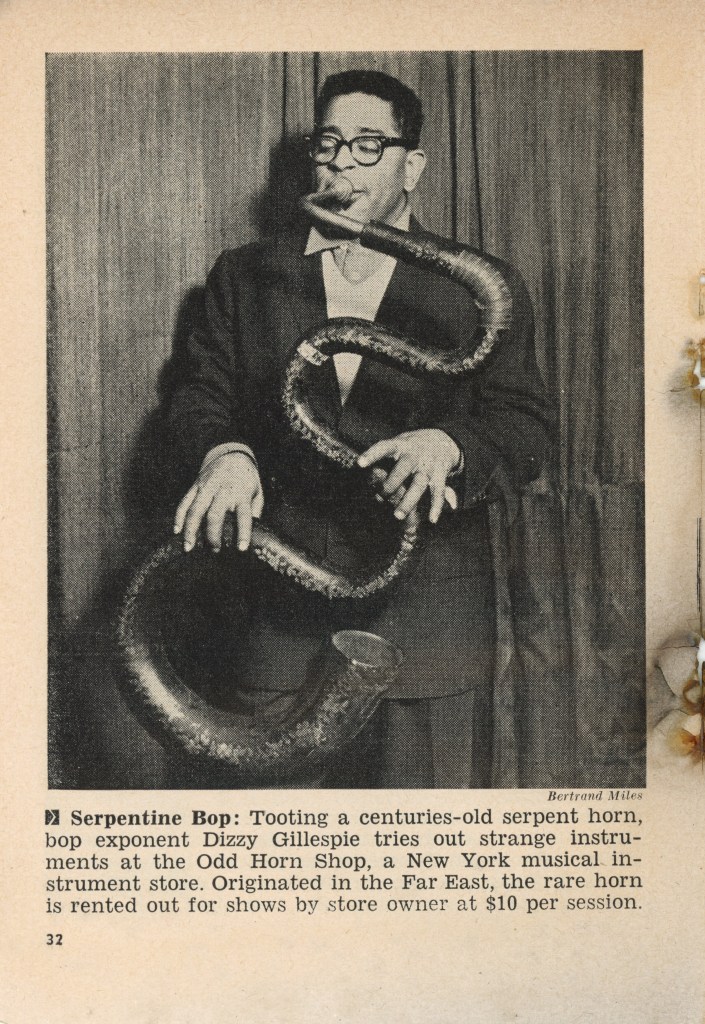
I’ve written widely about the serpent (including a book about the instrument, Serpents, Bass Horns, and Ophicleides in the Bate Collection, published by University of Oxford in 2019) and I’ve collected many photographs, postcards, and original works of art that depict the serpent. For many years, I’ve been aware of a photograph of the great jazz trumpet player, Dizzy Gillespie, playing a serpent. I’ve seen a few low quality scans of the photograph in various places on the internet, but I like to see both context and size of images. Once I learned that the photo appeared in the December 29, 1955 issue of JET magazine, I kept my eye out for a copy of that issue.

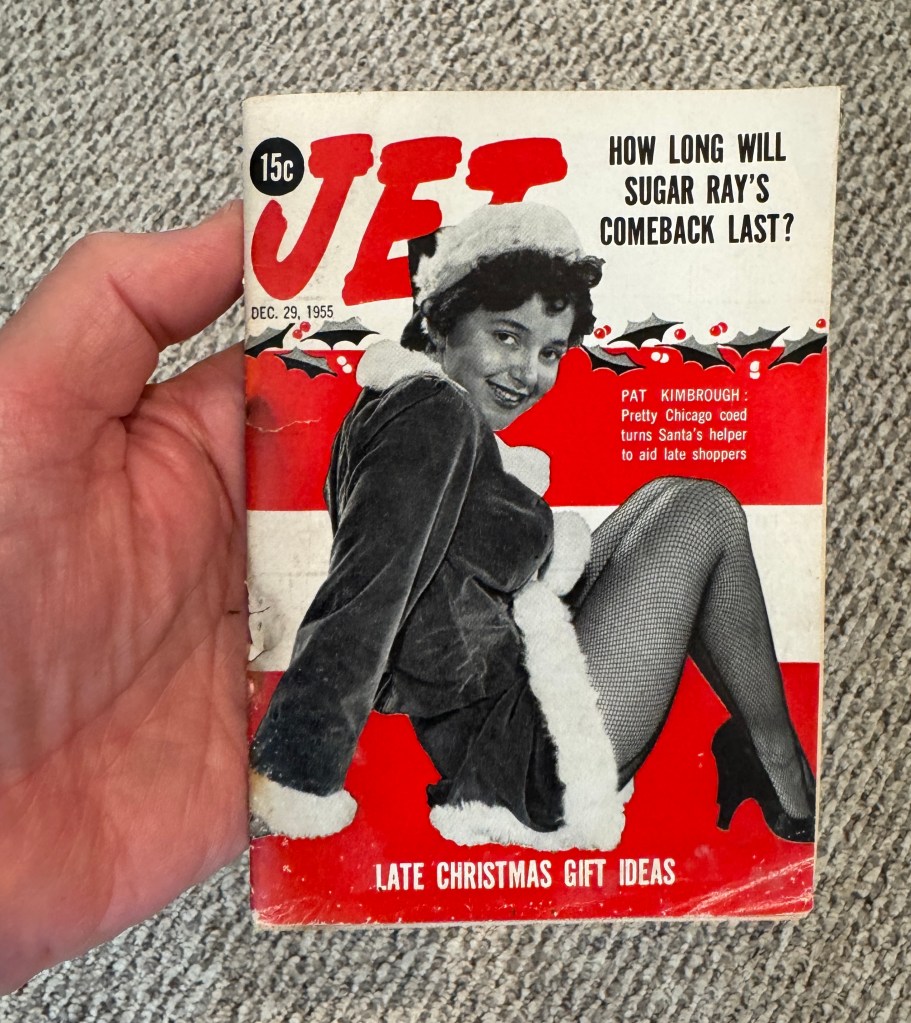
The cover of the December 29, 1955 issue of JET magazine.

Last week, I found one. JET was a magazine published between 1951 through 2016 for the African American community. The magazine was a mix of photos, commentary, and news, and when I opened my mail the other day and held the issue in my hands, smiled. I had not imagined the magazine was so small – only 6 inches by 4 inches.

The copy of JET that I purchased had suffered damage. The two staples that held the issue together had rusted and that rust bled throughout the center of the magazine’s pages. But the photo of Dizzy Gillespie, happily, was not affected by the rust. And there he was, on page 32. I think this is a terrific photo, something completely outside the box.

Pages 32 and 33 of the December 29, 1955 issue of JET magazine.

Dizzy Gillespie playing a serpent, from the December 29, 1955 issue of JET magazine.

I don’t have anything to add to this photo than what is in the caption. The Odd Horn Shop is no longer in New York City and Dizzy Gillespie died in 1993. But I’ll relate this story of my one encounter with the great jazz player with the bent trumpet . . .

In 1991, Dizzy Gillespie was given an honorary doctorate at New England Conservatory of Music. I was serving on the Conservatory’s faculty at the time, and I was also Chair of the Conservatory’s Brass and Percussion Department. I attended the commencement ceremony that year, and from my seat on stage in Jordan Hall at NEC, Dizzy Gillespie was only a few feet away from me. Then his name was called, Gillespie went to the front of the platform and received his honorary degree and said a few words. But what happened next was something I’ll never forget. Whenever a jazz major came forward to receive his degree, Dizzy Gillespie—one of the greatest musicians in the world—stood up, went up the the graduate, shook hands, and posed for a photo. Gillespie was smiling from ear to ear, and I can only imagine how meaningful this personal gesture was to the graduates who stood on stage with their arm around the shoulder of this jazz great. It told me something about Dizzy Gillespie that his recordings can’t fully express: he loved life and he loved people, and he shared that love with others in very tangible ways. I wasn’t playing serpent when he came to NEC’s commencement in 1991, but if I had, I like to think I would have brought my serpent to the ceremony and asked Dizzy to play a chorus. I bet he would have done that. Serpentine bop.

Two trombone anniversaries: 50 and 127 years

Two trombone anniversaries: 50 and 127 years

by Douglas Yeo (August 24, 2024)

Anniversaries are a big deal.

This summer, I got to take part in two trombone anniversaries with the Wheaton (Illinois) Municipal Band.

Since 1930, the Wheaton Municipal Band—a high level community band that is supported by the city of Wheaton, the Municipal Band Commission, and the Board of Directors and Friends of the Wheaton Municipal Band—has been giving concerts for appreciative audiences each summer. In the summers of 1974 and 1975, when I was a student at Wheaton College, I was a member of the Wheaton Municipal Band. My memories of those summers with the band are fond ones, and little did I know that a couple of years later, (in 1977) I would become a member of the most famous concert band in the country, New York City’s Goldman Band. These were important stepping stones in my career as a musician which led to my many years as bass trombonist of the Boston Symphony Orchestra (1985–2012) and so much more.

Wheaton_Trombone_Quartet_reunion_2022

Members of the 1974–1976 Wheaton College Trombone Quartet (Douglas Yeo, James Roskam, Eric Carlson, William Meena) with George Krem, April 23, 2022, on the occasion of a faculty recital given by Douglas Yeo at Wheaton College.

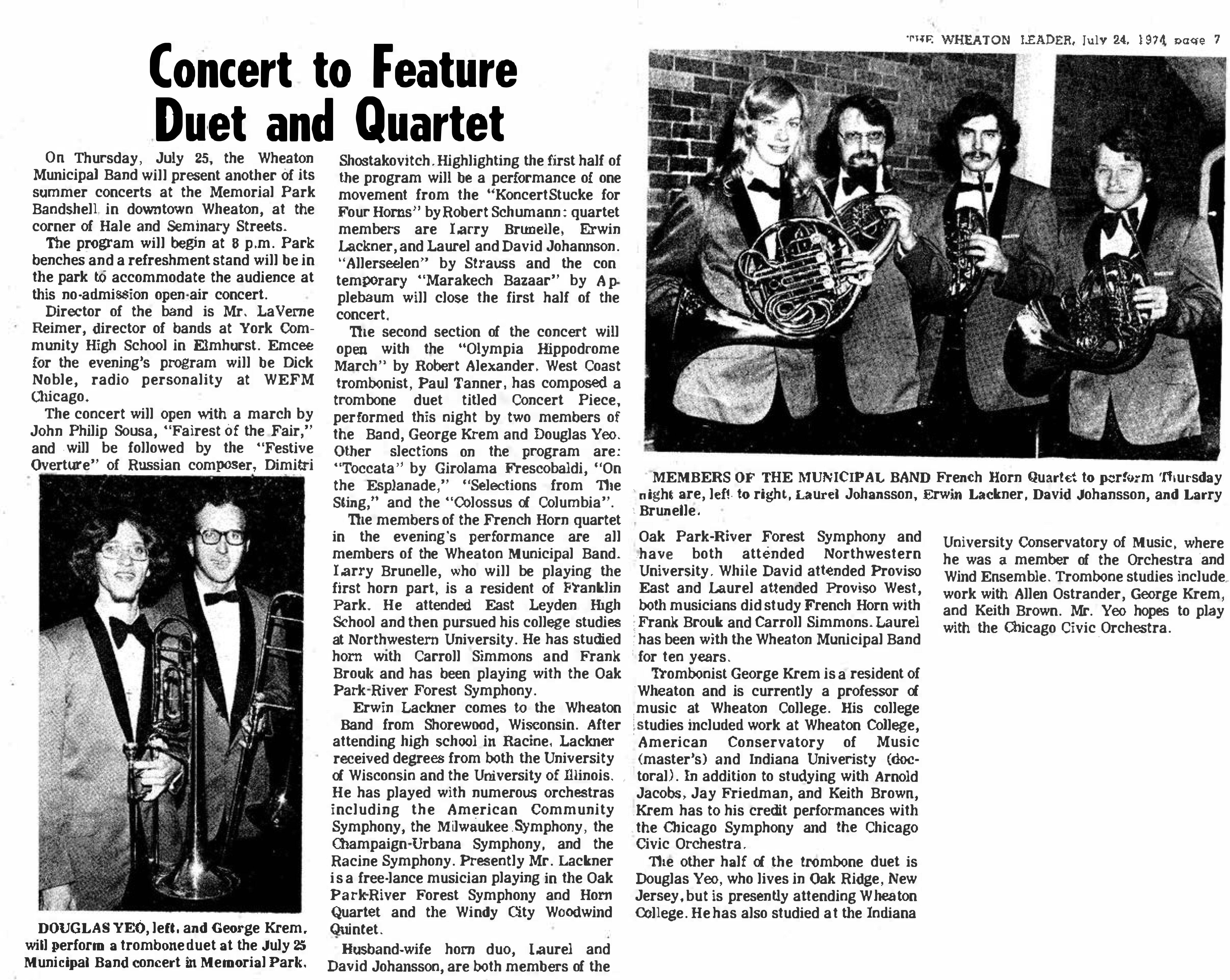
My path to earn my undergraduate degree in college was a little unconventional. I graduated in three, not four, years: one year at Indiana University (where I studied with Keith Brown) and two years and two summers at Wheaton College (where I studied with Edward Kleinhammer). During my first summer quarter at Wheaton College, I took trombone lessons with Wheaton College’s trombone teacher, George Krem. George was a superb teacher and trombonist and when I arrived at Wheaton College, he had already announced he would be leaving the faculty at the end of the summer to take the position of principal trombonist with the Victoria Symphony in Canada. (George later went on to be professor of trombone at University of Iowa.) In the summer of 1974, both George and I were members of the Wheaton Municipal Band and we played a duet with the band, Paul Tanner’s Concert Piece for Tenor and Bass Trombones. Teacher—George—and student—me.

Yeo_Krem_Wheaton_Municipal_Band_1974_CROPPED

Article from The Wheaton Leader, July 24, 1975

Wheaton’s town newspaper, The Wheaton Leader, published an article on July 24, 1974, about the performance George and I would give of Tanner’s Concert Duet at the Band’s concert the following day. Then, on July 25, 1974, we played the duet. I was so proud to stand on stage performing alongside my teacher. When I look at the photo of George and me that accompanied that article, I always smile. There I am, with my long hair (and it got much longer than it was at that time) and a little goatee. Times have changed. Good thing!

Now, fast forward 50 years. A few months ago, when I realized that the Wheaton Municipal Band had a concert on July 25, 2024—EXACTLY 50 years after George Krem and I played the Concert Duet, I contacted Dr. Bruce Moss, conductor of the Wheaton Municipal Band. Bruce has been conductor of the Wheaton Municipal Band for 45 years and he has just retired from his position for the last three decades of director of bands at Bowling Green State University.  Two more anniversaries. I asked Bruce, knowing how much he likes anniversaries and celebrations, “Wouldn’t it be fun if the band played Paul Tanner’s Concert Duet again with another teacher/student combination, exactly 50 years after George Krem and I played it together?” Bruce jumped at the idea and I knew exactly who I would ask to play the duet alongside me.

Kumar_Yeo_WMB_2024

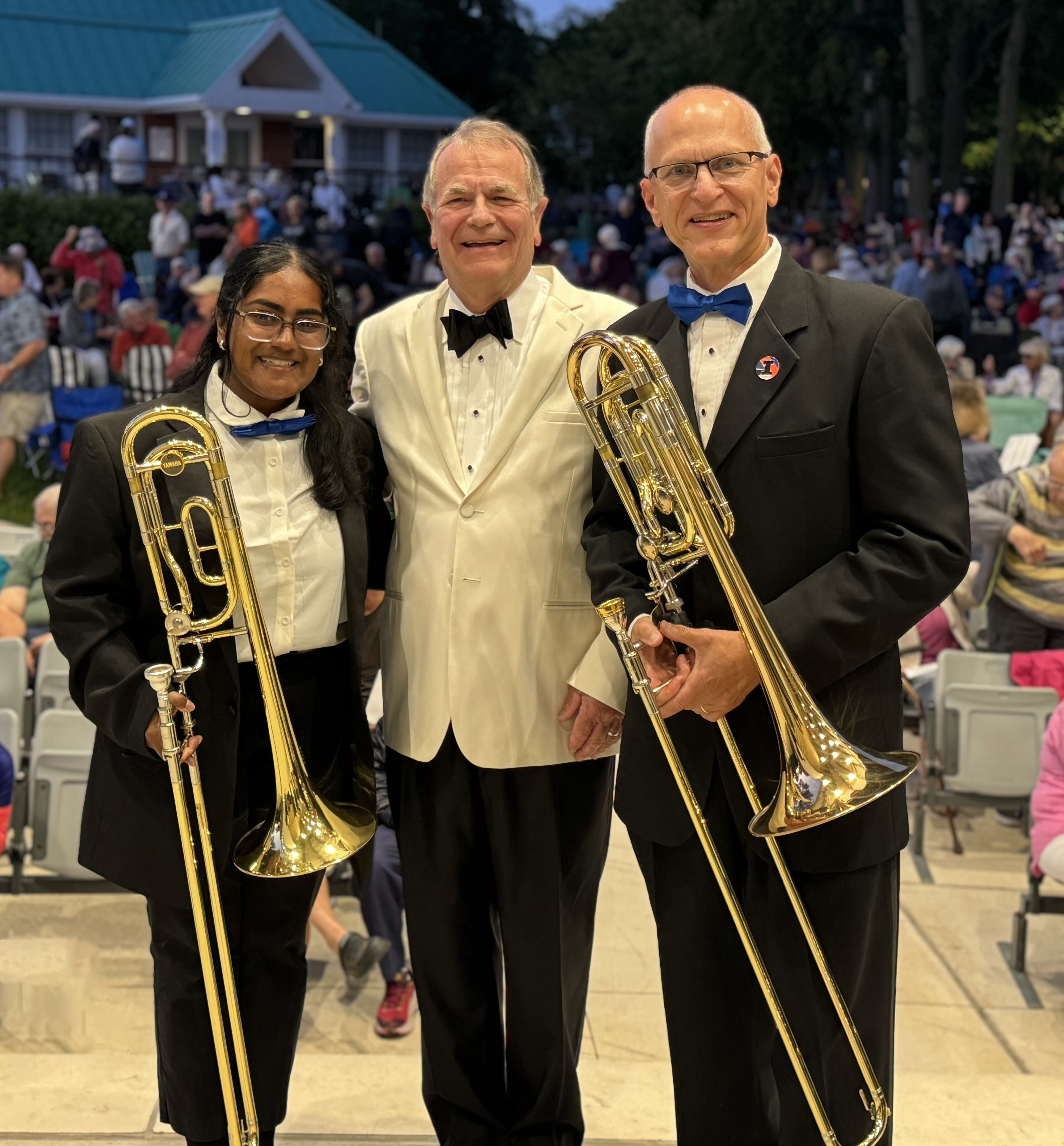
Poorna Kumar and Douglas Yeo, July 14, 2024

As readers of TheLastTrombone know, I served as trombone professor at University of Illinois Urbana-Champaign from 2022-2024 while the School of Music was conducting a search for a new full-time trombone professor. One of my students at UIUC, Poorna Kumar, was a member of the Wheaton Municipal Band in the summer of 2022 and she was playing in the band again in the summer of 2024. Poorna is an exceptional person and player. She is now a senior at University of Illinois, simultaneously earning two degrees: a bachelor of science degree in community health, and a bachelor of music degree in trombone performance. Poorna is also in her third year as a drum major with the Marching Illini and she received the prestigious Robert E. Gray trombone award at Illinois in 2023. I pitched the idea to Poorna and she was happy to agree to play the Concert Duet with me. We had a rehearsal at our home (photo above) and a few days later, we were standing on stage together with Bruce Moss and the Wheaton Municipal Band at the bandshell at Memorial Park in Wheaton.

Kumar_Yeo_WMB_25_July_2024

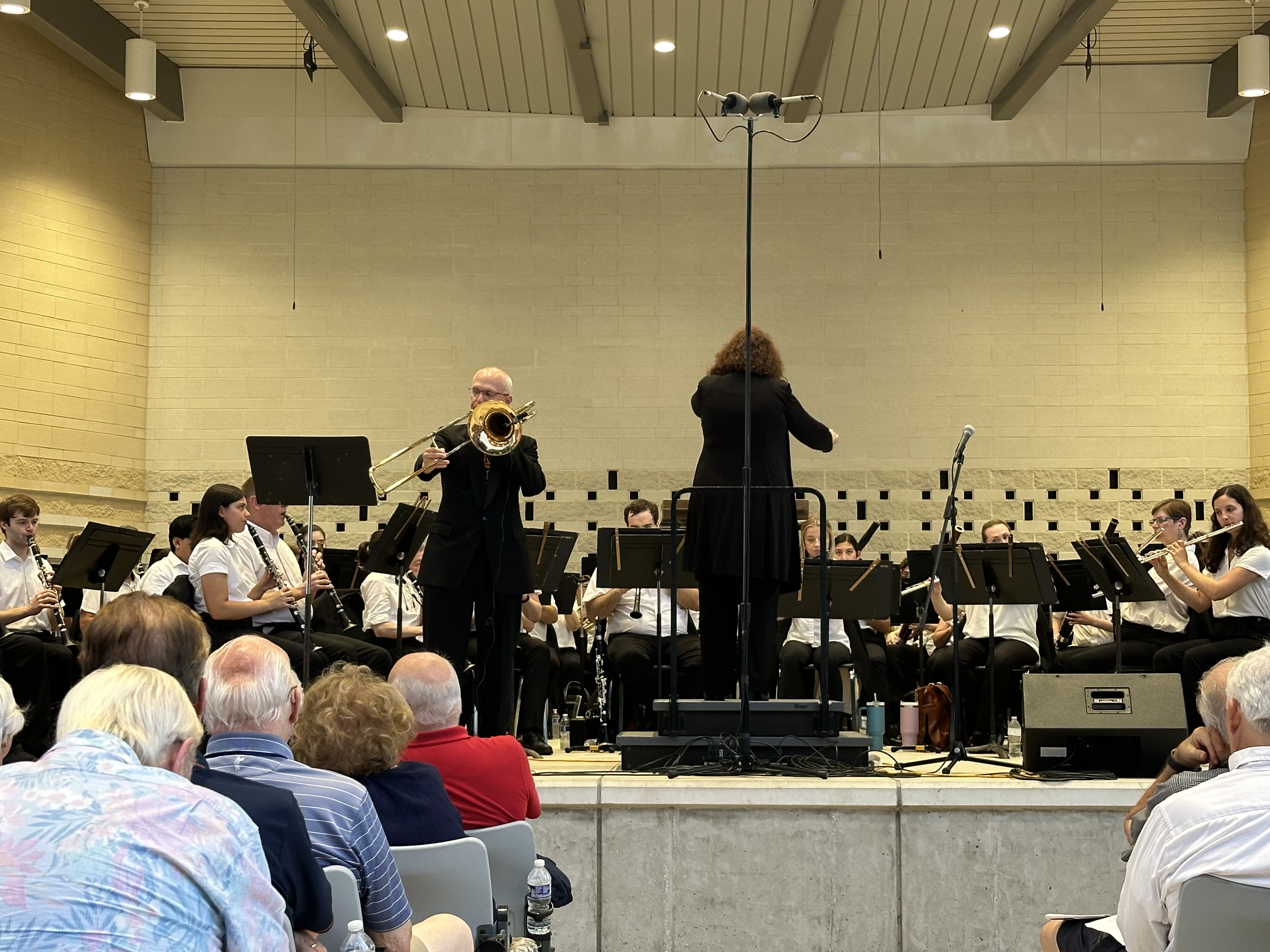
Douglas Yeo and Poorna Kumar performing Paul Tanner’s Concert Duet for Tenor and Bass Trombones with the Wheaton Municipal Band, Bruce Moss, conductor, July 25, 2024

Anyone who has been to a summer band concert knows how special and fun those events are. People of all ages bring chairs and picnic blankets to enjoy music as the sun is setting. My family was there; Poorna’s family was there, and together with a large, appreciative audience, we all enjoyed celebrating the 50th anniversary of a moment when the Wheaton Municipal Band featured a teacher/student duet with one person—me—as a common denominator in both performances.

Kumar_Moss_Yeo_Wheaton_Municipal_Band_25_July_2024

Poorna Kumar, Bruce Moss, and Douglas Yeo on stage at Memorial Park, Wheaton, Illinois, July 25, 2024

That 50th anniversary performance was great fun. Any teacher can tell you what a joy it is to work alongside a student. I was so proud of Poorna; it was a special collaboration in so many ways.

But wait, there’s more! There was another anniversary coming up the following week.

Berliner_62Z_Romance_for_Trombone_May_27_1897_label_sm

Berliner 62Z, Romance for Trombone (1897)

In 2022, I wrote an article for TheLastTrombone about Berliner 62Z, one of the earliest trombone solo recordings (if you click the link above, you can also hear the recording). This recording was made before the great trombone soloist, Arthur Pryor, began recording trombone solos. I acquired an original copy of Berliner 62Z and researched the history of the recording, the composer of the piece, Romance for Trombone (Charles William Bennet), the trombone soloist (Harry Stone), and  the accompanying band (William Haley’s Military Concert Band). You can read all about it HERE.

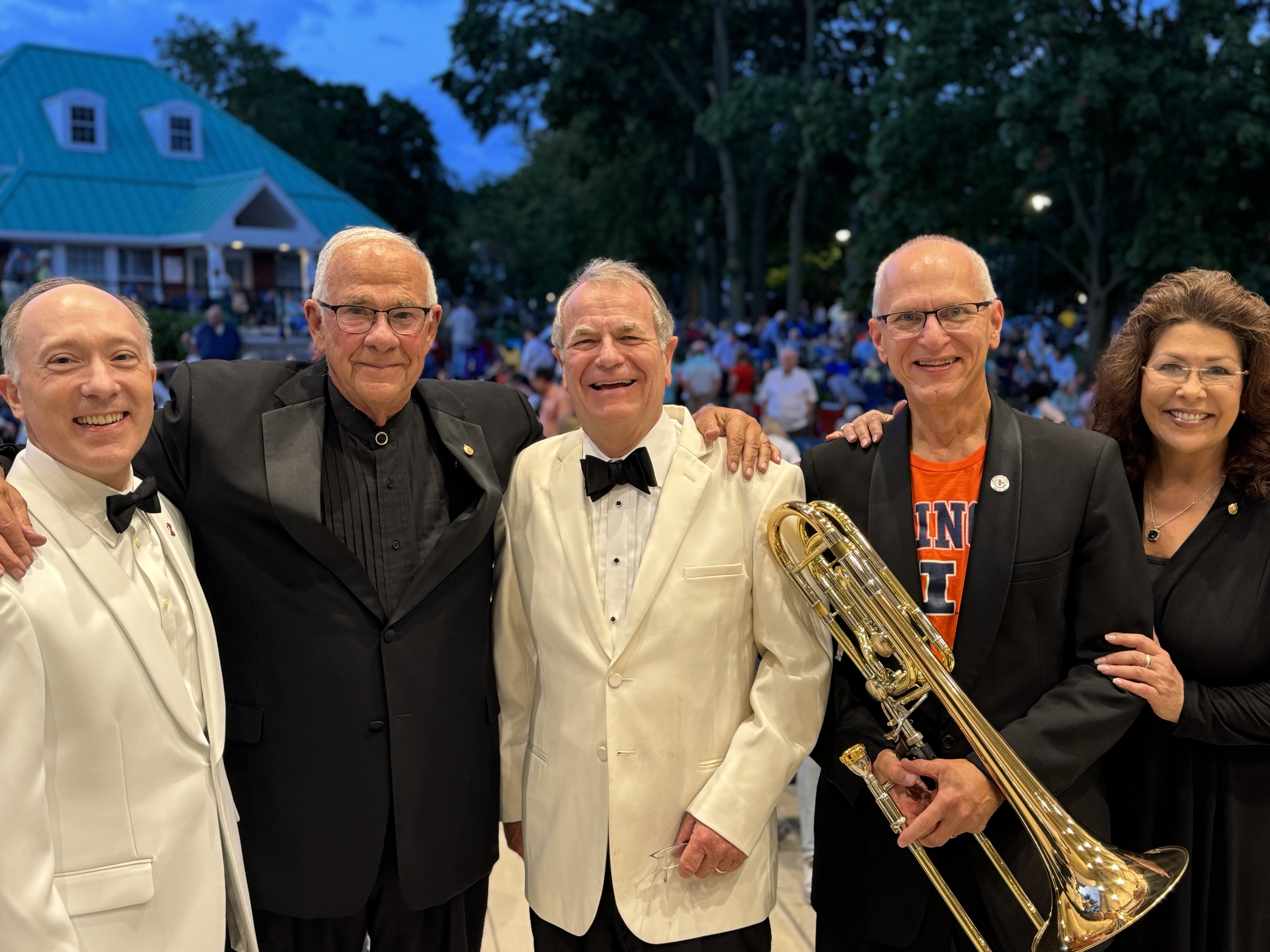
The Wheaton Municipal Band concert on August 1, 2024, was a special event that celebrated University of Illinois. Bruce had invited three conductors from University of Illinois School of Music to guest conduct the band: Dr. Linda Moorhouse, Director of the School of Music; Dr. Kevin Geraldi, Director of Bands (who as a young student, had been a member of the Wheaton Municipal Band); and Gary Smith, director emeritus of the Marching Illini. When I learned that the concert would be a celebration of University of Illinois bands, I just had to be a part of it and work alongside my friends from UIUC. I loved teaching at University of Illinois for the last two years; it was a very memorable time for me to work with my talented students and with great colleagues. I will always be an Illini.

So, I pitched another idea to Bruce Moss. How about, since the concert would celebrate music at our state’s flagship university, I do something that combined education and music? I asked Bruce if I could say a few words to the audience about Berliner 62Z and its important place in the history of the trombone. A little music history lesson, appropriate for an evening when we were celebrating University of Illinois. Then, we could play the original Berliner 62Z recording, on the 127th anniversary after it was released. And then I would perform Charles William Bennet’s Romance for Trombone with the Wheaton Municipal Band. Bruce said “LET’S DO IT!” So, we did.

Yeo_Moorhouse_WMB_Aug_1_2024

Douglas Yeo performing Charles William Bennet’s Romance for Trombone with the Wheaton Municipal Band, Linda Moorhouse, conductor

Just like the week before, the audience was engaged in everything that was going on onstage. There were a lot of alumni and friends of University of Illinois present that evening. There was a lot of orange and blue—the school’s colors—in Memorial Park. When I came on stage, I opened my tuxedo jacket to reveal the orange and blue Illinois shirt I was wearing. The crowd roared. Then, I led the audience in the Illini cheer: I shouted, “I-L-L” after which the audience shouted, “I-N-I”! With school spirit fully activated, I said a few words about Charles William Bennet’s Romance for Trombone and we played the 127 year old recording. Hearing an old 78 rpm record made all of us smile – there were more than a few people present who remembered those old discs, and hearing the scratchy recording made all of us appreciate how far recording technology has come in 127 years. Then I played Bennet’s Romance with the band, conducted by my good friend, Linda Moorhouse. Working again with Linda was so much FUN – There’s that word again, FUN. Music making should ALWAYS be FUN! – and the band played great for the enthusiastic audience.

Geraldi_Smith_Moss_Yeo_Moorhouse_WMB_08_01_2024a

Kevin Geraldi, Gary Smith, Bruce Moss, Douglas Yeo, and Linda Moorhouse on stage at Memorial Park, Wheaton, Illinois, August 1, 2024

Two weeks of performing as soloist in concerts with the Wheaton Municipal Band. That in itself would have been a memorable experience for me. But to have those concerts celebrate two anniversaries—the 50th anniversary of the performance of Paul Tanner’s Concert Duet that George Krem and I gave with the band, and the 127th anniversary of the release of one of the earliest recordings of a trombone solo—took these experiences to a new level. This is the joy of making music: collaborating with friends, colleagues, and students, playing pieces that have importance in one way or another, bringing smiles to the faces of audience members. I’m grateful to Bruce Moss and the Wheaton Municipal Band for giving me the opportunity, once again, to stand on stage at concerts with them. Thank you, friends. These anniversaries were truly something to celebrate.

For everything there is a season

For everything there is a season

by Douglas Yeo (May 19, 2024)

The Bible gives us answers, and it reminds us of this (Ecclesiastes 3:1-8, English Standard Version):

For everything there is a season, and a time for every matter under heaven:

a time to be born, and a time to die; a time to plant, and a time to pluck up what is planted;

a time to kill, and a time to heal; a time to break down, and a time to build up;

a time to weep, and a time to laugh; a time to mourn, and a time to dance;

a time to cast away stones, and a time to gather stones together; a time to embrace, and a time to refrain from embracing;

a time to seek, and a time to lose; a time to keep, and a time to cast away;

a time to tear, and a time to sew; a time to keep silence, and a time to speak;

a time to love, and a time to hate; a time for war, and a time for peace.

For each of us, our lives are full of seasons, and I have recently turned the page on a very long season of life and a new season is upon me.

Pearce_trombone_Concert_stylings

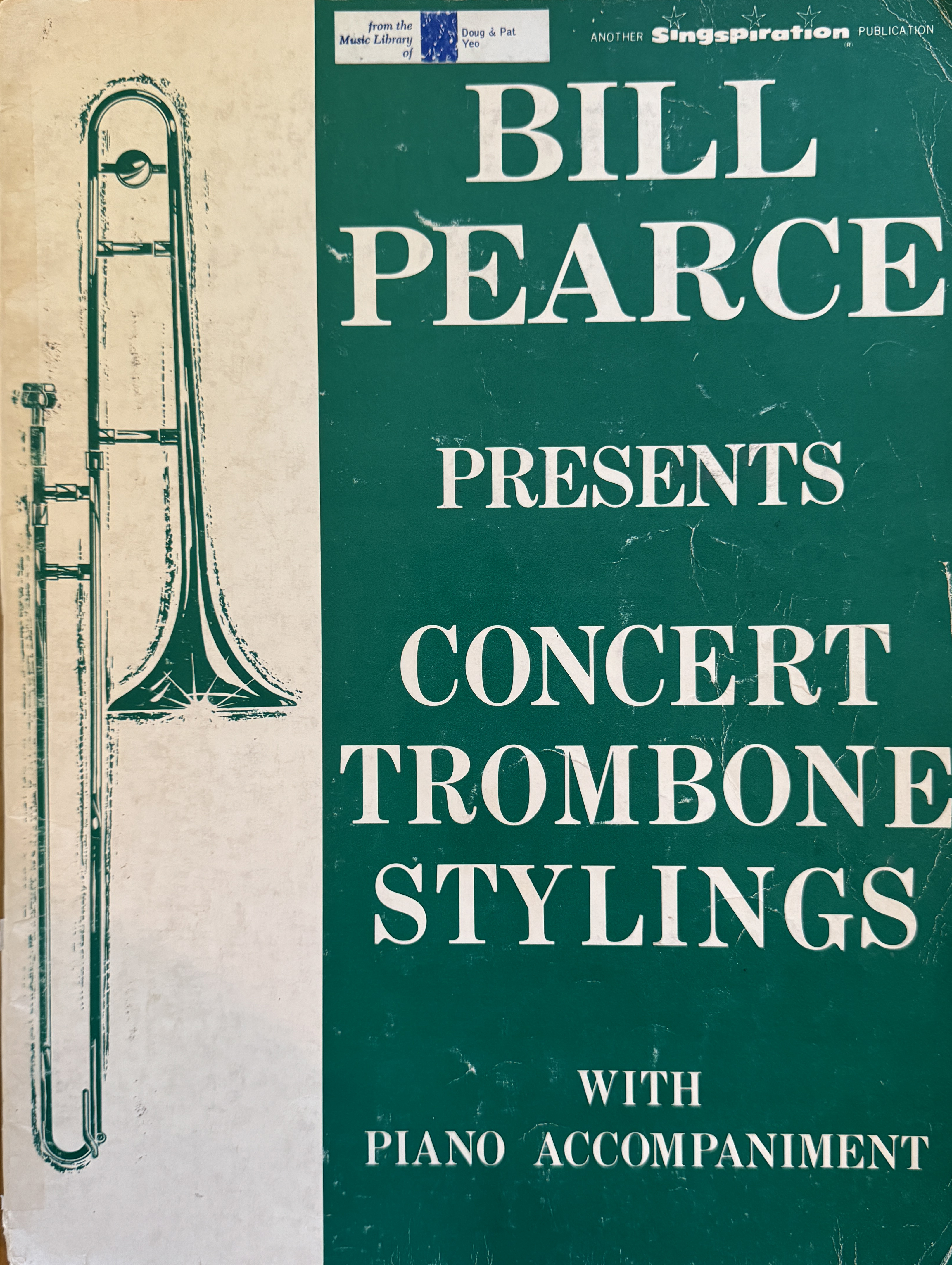
One of the Bill Pearce solo trombone with piano books that my first trombone student, Lloyd, gave to me in payment for trombone lessons I gave him at Wheaton College in the summer of 1974.

I have been teaching trombone lessons since the summer of 1974. At that time, I was a student at Wheaton College and another student on campus, Lloyd, asked if he could take some lessons with me. Lloyd wasn’t a trombone major; in fact, he was a student at Wheaton College for only that one summer quarter. But I was happy to help him improve his skills. At the end of the lessons, Lloyd told me he didn’t have money to pay me but if I would accept them, he would give me five books of solos for trombone and piano by the great gospel trombonist Bill Pearce. 50 years later, I still have and use those books. After that summer, I began teaching weekly lessons to young players through the College’s Preparatory Department. Doing so helped me get through college without any debt (that job along with other jobs that included working as student manager of the College artist series, working two days a week at a local White Hen Pantry, and shoveling snow for an office park in the winter).

Since that time, I’ve taught regularly in many schools, first as a high school band director, then as trombone teacher/professor of trombone:

STA_My_Fair_Lady_pit_band

St. Thomas Aquinas High School, Edison NJ (1979-1981) — with students in rehearsal for the school’s production of My Fair Lady, 1981.

Peabody_News_1982

Peabody Institute of Johns Hopkins University, Baltimore MD (1982-1985) — Announcement from September 1982  in Peabody News listing faculty members who were members of the Baltimore Symphony Orchestra

NEC_Trombones_1990_01

New England Conservatory of Music (1984-2012) — conducting the New England Trombone Choir at New England Conservatory, 1990

ASU_Desert_Bones_2016

Arizona State University, Tempe AZ (2012-2016) — ASU Trombone Studio with the University’s mascot, Sparky, 2016

Wheaton College, Wheaton IL (2019-2023) — performance of Canzone by Girolamo Frescobaldi, arr. Eddy Koopman, Wheaton College faculty recital, April 23, 2022

UIUC_Illinois_trombone_studio_2024_signed_photo

University of Illinois Urbana-Champaign, IL (2022-2024) — signed photo given to me by members of the University of Illinois Trombone Studio, May 2024

Since I retired from the Boston Symphony Orchestra in 2012 after more than 27 years as a member of that great orchestra, my life has taken many turns. My wife, Patricia, and I moved to Arizona where I immediately flunked retirement and accepted the full time position as professor of trombone at Arizona State University. In 2018, we moved to the Chicago area to be near our grandchildren (grandkids truly make you do crazy things, like move from Arizona to the Midwest) and I flunked retirement again when I was asked to teach at my undergraduate alma mater, Wheaton College. When University of Illinois asked me to take a one year position as professor of trombone for 2022-2023—a position that came to me most unexpectedly and I thoroughly enjoyed—I looked forward to trying this retirement thing again in 2023 when that appointment was up and, at the same time, I decided to step away from teaching at Wheaton College. But as things turned out, one year of teaching at Illinois turned into two years. Happily, the Illinois School of Music recently hired a new full time trombone professor and my appointment at Illinois concluded.

Yeo_UIUC_office_letter

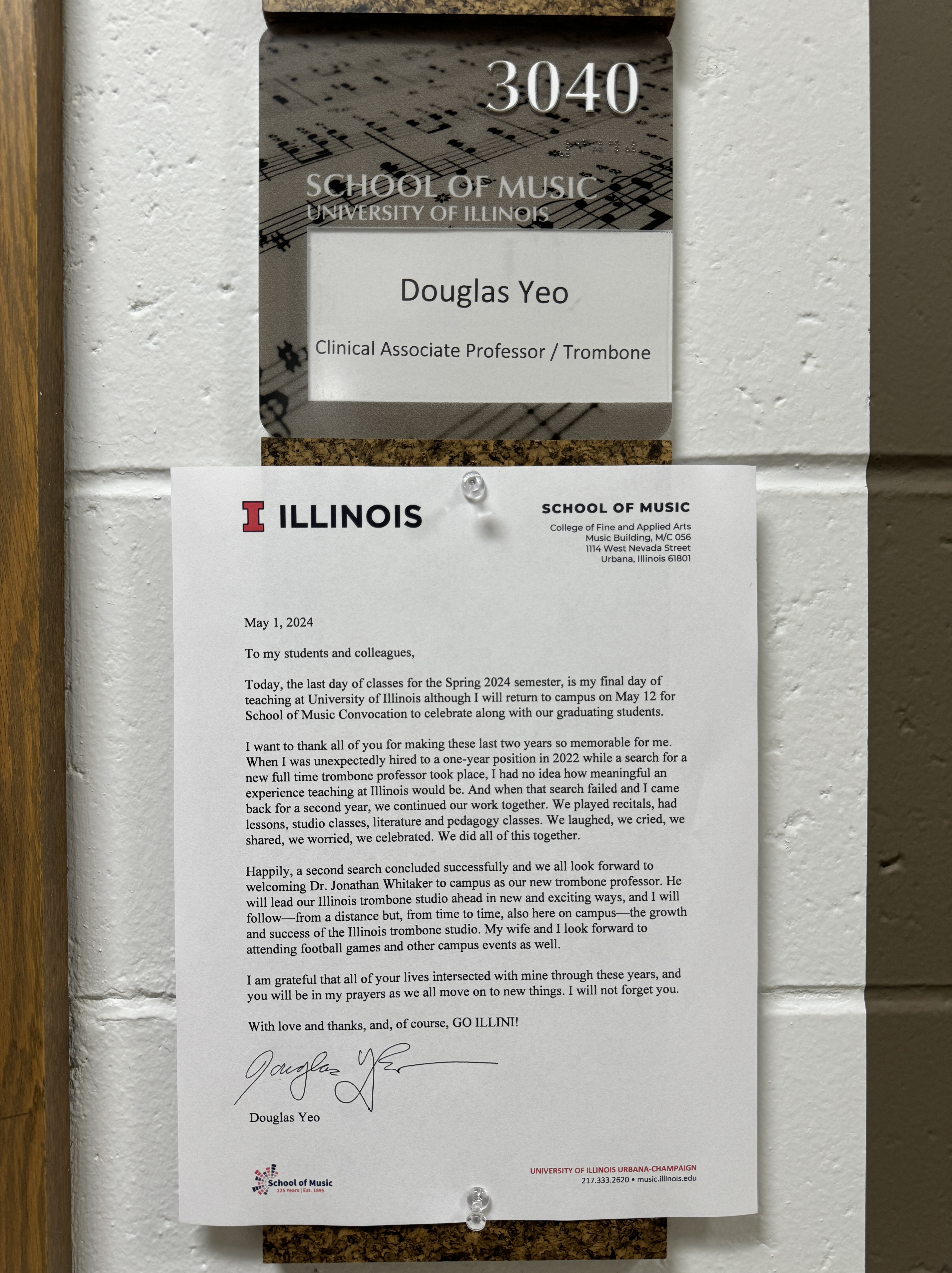
I taught my last trombone lessons at University of Illinois Urbana-Champaign on May 1 and before I headed home, I wrote a letter to my students and colleagues that I posted on the bulletin board next to my office, shown above.

UIUC_Convocation_students_2024

With my graduating students at University of Illinois Urbana-Champaign School of Music Convocation, May 12, 2024. Left to right: Rachel Lin (Bachelor of Music Education), Jerry Min (Bachelor of Music), Lorraine Montana (Master of Music)

I returned to campus on May 12 when  University of Illinois held a Convocation ceremony for the School of Music and I celebrated the graduation of three of my students. In a sense it was a graduation ceremony for me, too, as I closed out two memorable years teaching at University of Illinois, a campus community where I feel a very strong connection. When the ceremony was over, I took off my academic regalia, switched off the lights in my office, and turned in my keys. On the long drive home through the beautiful, newly planted Illinois cornfields, I began to reflect on all that had just happened. A new season had begun.

Illinois_cornfields_May_2024

Newly planted Illinois cornfields along Illinois Route 115, May 12, 2024

Illinois_corn_May_2024

The corn is now just a few inches tall and in late fall it will be, in the words of the song, “Oh, What a Beautiful Mornin'” from the musical Oklahoma!, “as high as an elephant’s eye.”

As I see it, “retirement” is a lousy word. When I decided to retire from the Boston Symphony, many of my colleagues asked me, “So, are you going to take up golf?” Nope. Golf doesn’t interest me. And I never saw “retirement” as a season of life devoted to non-stop self-entertainment. After decades playing in symphony orchestras, I looked forward to new adventures. I wanted to have more time to research and write, to travel with my wife, to enjoy more time with our daughters and their families, and, with open hands, respond to God’s call to His purposes for my life.

Retirement, as it turned out, meant not playing golf or kicking back and “doing nothing,” but, rather that I was busy doing a host of engaging activities.

UIUC_trombone_studio_Lincoln_poster

The poster that hung in my office at University of Illinois for the last two years. It contains a logo my friend, Lennie Peterson, designed for our trombone studio, my five core tenets of teaching, and a quotation from Dr. Robert E. Gray that sums up the ethos of the University of Illinois Trombone Studio.

I’ve spent most of the last 12 years teaching at colleges and universities each week of the academic year: Arizona State, Wheaton College, University of Illinois. Working with those students has been such a big part of my life. But as I near a birthday with a zero on the end of it (it’s not 60; that was a long time ago. . .), I decided, after much thought and prayer, to step aside from weekly trombone teaching and have more time to do other things. This doesn’t mean I’ve taught my last trombone lesson. I love teaching; I still do. But this change in my life means I won’t be doing that teaching every week as a school’s trombone professor. This freedom gives me time to explore and enjoy both new and familiar things.

And there is a lot ahead for me. Later this month, I’ll travel to Texas Christian University (TCU) in Fort Worth, Texas, to take part in the International Trombone Festival. I’ll give a recital, serve on two roundtable discussion panels (one is about diversity considerations in recital programming; the other is about trombone research), give a major presentation about the celebrated trombonist Joannès Rochut, perform with the TCU trombone choir, and accept the International Trombone Association’s Lifetime Achievement Award. This summer my wife and I will take hiking trips to Grand Canyon and Zion National Parks (with our oldest daughter’s family, including our grandchildren), and Sequoia and King’s Canyon National Parks (with our youngest daughter and her husband). In September, I’ll conduct a trombone residency at University of Texas, Austin. In October I’ll play ophicleide in concerts with the San Francisco-based early music group, Philharmonia Baroque. We’ll attend many baseball games this summer (Chicago Cubs, Schaumberg Boomers, Chicago Dogs, Kane County Cougars, Oakland Ballers), and fall will bring us to our seats in Chicago’s Soldier Field for Chicago Bears football. A major American symphony orchestra has asked if I would be willing to substitute with them in the coming season. Research and writing projects are on my plate (watch the July 2024 issue of the International Trombone Association Journal for my article about the history and a chemical analysis of trombone slide oil, and the January 2025 issue for my article about Joannès Rochut; I’m also at work on a new book for Oxford University Press), as are hikes, walks and tandem bicycle rides with Patricia. And serving our church and enjoying life with our grandchildren.

Doug_Pat_Zion_Observation_Point_June_2023

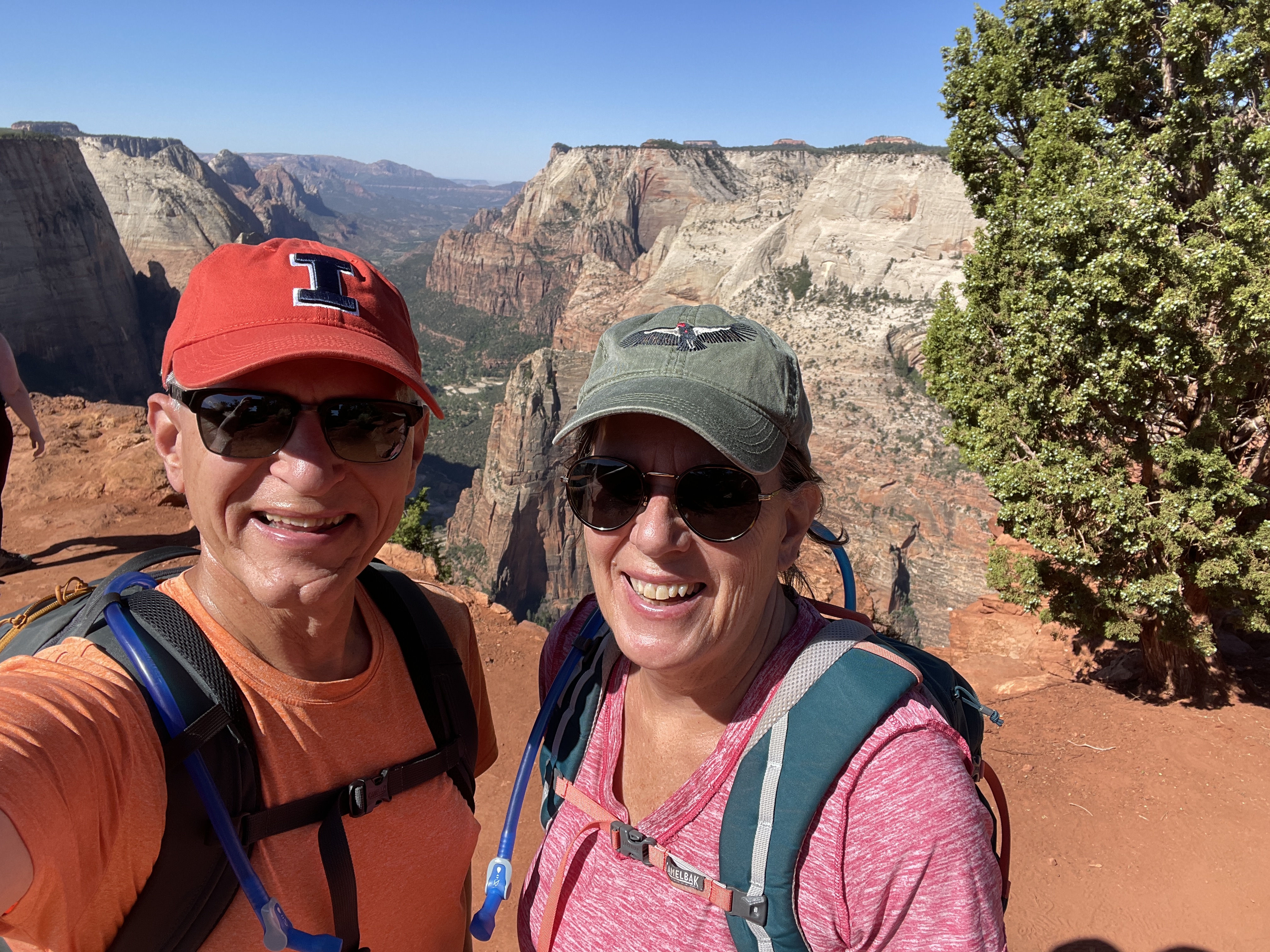
With my wife, Patricia, at Observation Point, Zion National Park, June 2023. We will return to this special place next month; it will be our 19th trip to Zion National Park.

So, as my long season of institutional teaching has turned a page, I look back at those decades with great fondness and gratitude. And I have learned this: I don’t know all of what God has for me going forward.  With open hands, I’m grateful for the opportunities I’ve had to serve, learn, and contribute. I plan to keep doing that in both new and familiar ways as God leads. I look forward to seeing you along the road.