Category: United States of America

When classical music meets sports

When classical music meets sports

Last night’s American football AFC Championship game between the Jacksonville Jaguars and the New England Patriots was full of high drama. Full disclosure: I lived in Boston for nearly 30 years and attended more Patriots games than I can count. Before their astounding period of success began in 2001, I went to plenty of games when the team was, frankly, terrible. Today, the Patriots are heading to another Super Bowl. Their eighth since 2002. This is remarkable. My wife and I now live in Arizona, and we hold season tickets to Arizona Cardinals football. We love the Cardinals. But we still love the Patriots. There you have it.

I’ve written about the Patriots before on The Last Trombone, particularly about quarterback Tom Brady and how he was the 199th pick in the 2000 NFL draft. Brady has used that fact – that teams passed him over repeatedly until the Patriots drafted him in the sixth round – to fuel his engine of excellence. The result: he has gone on to be what most football observers consider to be the greatest football player of all time – the G.O.A. T.

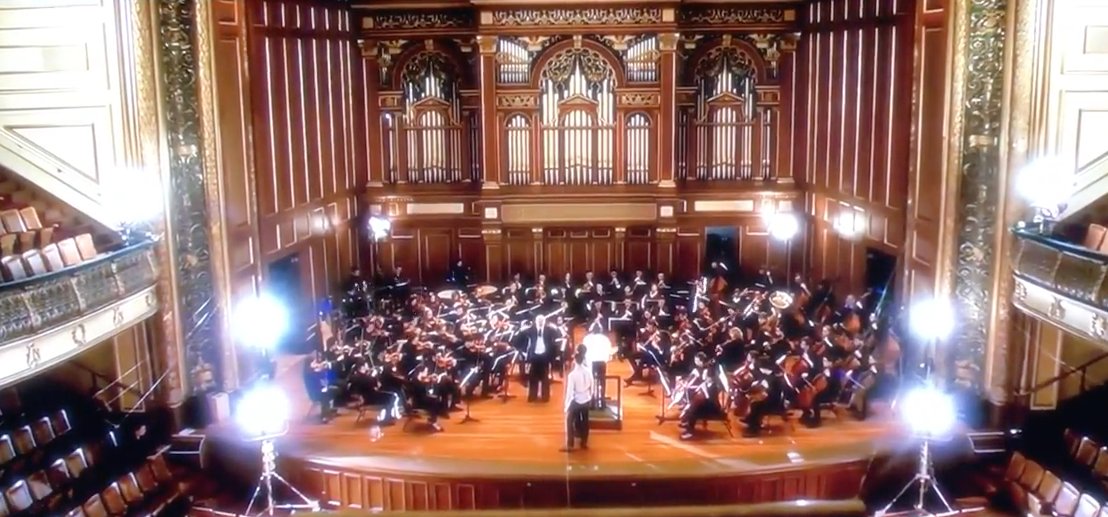
We spent yesterday afternoon with some friends who had invited us to their home to watch the AFC and NFC Championship games. When I watch TV, I rarely watch commercials. And I’m not particularly interested in pre-game commentary from talking heads. I like to watch the game. So when, before the game started, there was a segment with an actor I had never seen before, I didn’t pay much attention. Until I realized the piece was filmed in Jordan Hall at New England Conservatory of Music. STOP. Rewind the DVR. I taught at New England Conservatory for 27 years. I played countless concerts and recitals in Jordan Hall. What is this?

“This” was a “teaser” for the game featuring actor John Malkovich. It is long by television standards, three and one-half minutes long. Have a look (if you can’t see the video below, click HERE to see it on YouTube):

The story about how this video came about is terrific. Recorded just a few days before yesterday’s game, students at NEC were featured in this short film. You can read how this all came together in a story in Sports Illustrated by Richard Deitsch. Click HERE to read his story.

I think the video is brilliant. It takes a little time to get going but it’s very, very clever. And bravo to the NEC students who were a part of it. I’m sure it was a thrill for them. Seeing this teaser for the game on TV reminded me of the thrill I had playing the National Anthem at Super Bowl XXXVI in 2002 as a member of the Boston Pops Orchestra, something I wrote about on my website, in my article: The New England Patriots and the Boston Pops: A Super Bowl XXXVI Diary (click here to read it). Because of that experience – and many more like it where I played the National Anthem before sporting events as a member of the Boston Symphony Orchestra – I wanted to bring that opportunity to my students at Arizona State University. On two occasions, we played the Star Spangled Banner at an Arizona Diamondbacks baseball game. To see my students on the big stage and catch their excitement and sense of wonder as it unfolded was one of the most satisfying things I did during my years as ASU’s Professor of Trombone. Have a look at this video (below) of their performance at Chase Field in Phoenix in 2014 (if you can’t see the video below, click HERE to see it on YouTube):

Sports and music. Sometimes they come together in a way that adds something to our joy of living, and when I see students benefitting from this, as the students at New England Conservatory of Music did when they were part of an exciting football game yesterday, I smile and remember the thrills I’ve had doing the same kind of thing. It’s amazing where life can lead when you have a trombone – or any musical instrument – in your hand.


The land of the free. Yes. The free.

The land of the free. Yes. The free.

I’ve recently returned from a week in Baltimore, Maryland, a trip that had many facets and which returned me to the place where my professional orchestral career started. Before joining the Boston Symphony Orchestra in 1985, I was bass trombonist of the Baltimore Symphony Orchestra from 1981-1985. In those four years, I was part of a great low brass section along with Jim Olin, David Fetter, Eric Carlson and David Federley (tuba); the photo below was taken in the fall of 1981.

baltimore_section_1981

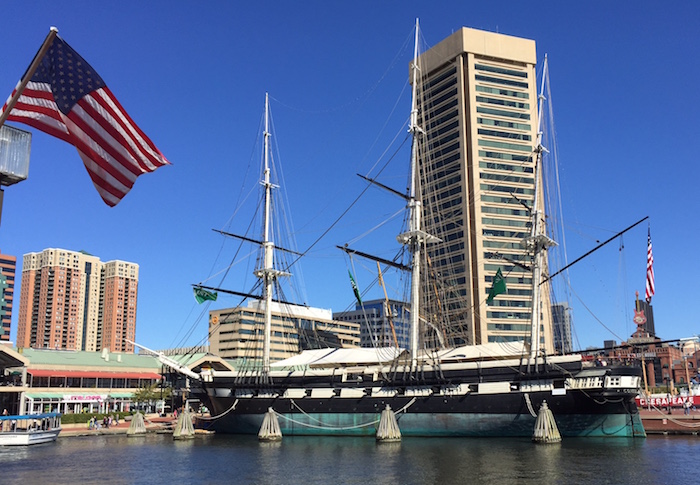
Returning to Baltimore brought me down to the city’s Inner Harbor, a superb urban development project that began just before we came to Baltimore more than 35 years ago. It was nice to see the changes to the area over the years, particularly the new stadiums for the Baltimore Orioles and Baltimore Ravens, both very much tied to the fabric of downtown Baltimore. The U.S.S. Constellation, the 1854 “tall ship” that served as part of the US Navy for over 100 years and seen in the background in the photo above is still there.

constellation

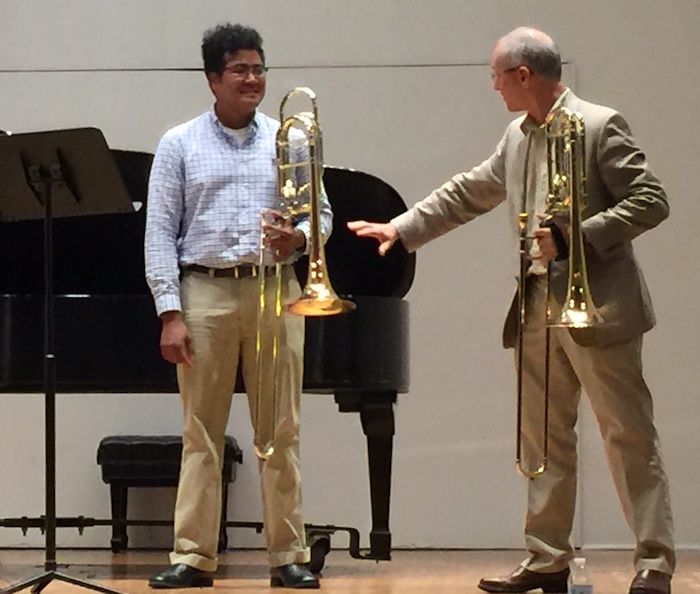
I also gave a master class at the Peabody Institute where I was on the faculty during my time in the Baltimore Symphony. It was quite nice to be back in that venerable place, with so much that was familiar but so much that was new. I very much enjoyed working with several talented Peabody students, including Jahi Alexander, shown below, who is a student of the Baltimore Symphony’s current bass trombonist and my former student, Randy Campora.

jahi

We also visited Fort McHenry (photos at the top and bottom of this post), particularly known as the site of a ferocious battle during the War of 1812. I had never been there before but I as very happy to finally get there. Our visit was a very strong moment, even emotional, as we learned the history not only of the battle but of its lasting consequence: the writing, by Francis Scott Key, of the words to our National Anthem, “The Star Spangled Banner.”

Our National Anthem is in the news these days, in particular because a small number of athletes have decided not to stand when it is played before the start of a game. They are doing this, they say, to protest the the anthem’s final words, “The land of the free and the home of the brave,” which they feel do not apply to all people in our country.

Everyone, it seems, has an opinion about this, although some writers have seen evidence that people  overwhelmingly see the gesture as being, in the words of Supreme Court Justice Ruth Bader Ginsburg, “dumb and disrespectful.”

Yes, our country has problems. Injustice exists. But I have been to 30 countries in the world on five continents and have seen how governments work. There are many good things about many countries in the world. But my late father had it right when he often said, “The American system of government is the worst in the world. Except for all the others.” The glory of the United States is the freedoms we have. Freedoms like those in no other place in the world. Our National Anthem is a symbol of our hopes and aspirations. In the face of injustice, we turn to that hope and work in meaningful ways to make positive change. Choosing to not stand at the playing of the National Anthem does not protest against injustice; to many, it is a selfish, narcissistic gesture that accomplishes nothing but draw attention to an individual. When we stand for our National Anthem – even while we are fully aware of the imperfections of our country – we honor those who have served our country to ensure our freedoms, we express gratitude for all that is good and right in our land, and we resolve to do better to improve the lot of everyone in our country. Standing while our National Anthem is played or sung is a rare gesture of unity in a country that is deeply divided over many issues.

Yes: athletes and others have the freedom to not stand for the National Anthem. That freedom is enshrined in our Constitution and Bill of Rights. And that freedom is celebrated in the words of the National Anthem itself. But those freedoms also include the right of others to call out those who do so as being selfish and “dumb and disrespectful.” See injustice? Work for justice. The battle of Fort McHenry and our National Anthem remind us of this.

O say, does that star spangled banner yet wave,

O’er the land of the free, and the home of the brave!

mchenry_inside


A memorable day out

A memorable day out

It’s hot in Phoenix in the summer. Sure, we know the old joke, found on the postcards in the airport:

dry_heat.jpg

And to an extent it’s true. I’d much rather be in the middle of 110 degrees with 12% humidity than 90 degrees with 90% humidity. No doubt about that from where I sit. This is the tradeoff we get here: five months of hot followed by seven months of amazing weather. And, as I like to say, I don’t have to shovel heat  (like I used to have to shovel snow).  But, still, it’s hot, and in the summer, we look for things to do to get out of the house and out of the heat. Sometimes we travel to cooler places–more on that in future posts–but sometimes there are things nearby that are just waiting to be explored.

Even before we moved to Arizona in 2012 we were fascinated by many aspects of the state. Its geography, arts culture, the Native American story, the flora and fauna and so much more. We moved here for specific reasons, and one of those big reasons was our interest in continuing to learn more about this place that is so very different than the east coast where we spent most of our lives.

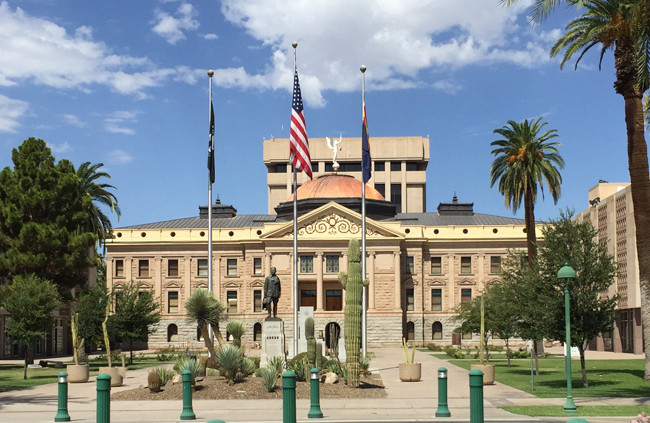
Earlier this week, my wife and I went to visit the Arizona State Capitol in Phoenix. “Big deal,” you might say. Well, it actually IS a big deal here. Arizona’s capitol building was built in 1901 when Arizona was still aTerritory, before it became a State in 1912. State  government has outgrown the old Capitol building so, instead of tearing it down, it is now a museum that pays tribute to the state’s history. It was a nice way to spend a few hours out of the heat.

But there was a bonus. Before going into the Capitol with its copper-toned dome (and if you don’t know why copper is important to Arizona, click this link to find out), we took advantage of the moderate morning temperatures (it was a balmy 91 degrees when we stepped out of the car and a few high clouds helped keep the sun from heating things up) to walk around the  Wesley Bolin Memorial Plaza that adjoins the Capitol building. The Plaza has 30 memorial monuments dedicated to a host of topics including a memorial to the victims of the 9/11 attacks, veterans and fallen heroes from many wars and conflicts and, as its centerpiece, a memorial to the USS Arizona, sunk in Pearl Harbor on December 7, 1941 with the loss of 1,777 lives.

USS_Arizona_anchor_small

The USS Arizona’s anchor has pride of place in the memorial and it is a powerful reminder of the sacrifices that the men and women in our armed forces make every day to ensure our freedoms. Inside the Capitol building, there were more tributes to the USS Arizona, including a large piece of the ship’s hull.

USS_Arizona_hull_small

It’s one thing to read history in a book. It is another to see it right before your eyes. You can touch this twisted piece of metal, look around the room at photos that show where it was before the ship sank. Our trip to the Capitol was full of powerful moments, a welcome distraction from the heat, and an opportunity to celebrate many of the things that make our state such a fascinating place.

Arizona_promised_land_small

As we were leaving the Capital, we went through a room that featured articles about Arizona’s early tourism industry. I smiled when I saw the old postcard, pictured above, with its old spelling of “canyon” as “canon” and its iconic association of the great saguaro cactus with the State. We continue to enjoy exploring Arizona, and days like we had earlier this week are serendipitous reminders of the joys and wonders to discover when you get out of the house. Even on a hot day.