Readers of The Last Trombone know that last year, University of Illinois Press published a book co-authored by my friend, Kevin Mungons, and me. The subject of the book is Homer Rodeheaver, the trombone-playing song leader for the evangelist William “Billy” Sunday for twenty years during the first third of the twentieth century. Rodeheaver played the trombone for over 100 million—yes, million—people during his lifetime (1880-1955) and he profoundly shaped the course of gospel music. Rodeheaver created the first gospel music record company (Rainbow Records), and he founded what was, at the time, the largest and most successful Christian music publishing company. His influence, nearly 70 years after his death, is still felt today.
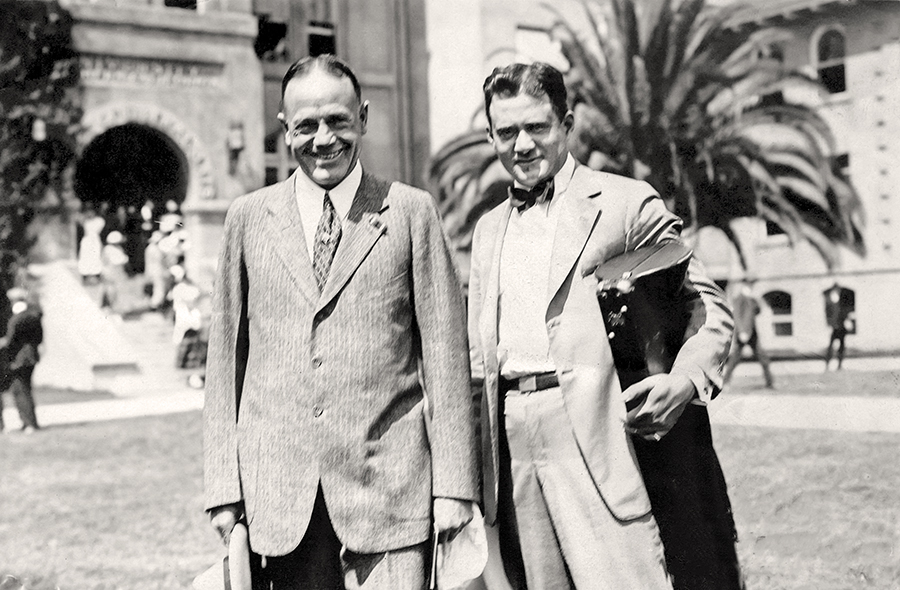
Above: Billy Sunday and Homer Rodeheaver, 1917. Courtesy of Morgan Library, Grace College, Winona Lake, Indiana.
Kevin Mungons and Douglas Yeo have collaborated on a scholarly, nuanced biography of Homer Rodeheaver. Mungons and Yeo’s book, Homer Rodeheaver and the Rise of the Gospel Music Industry, combines painstaking research with insightful sociological and musicological analysis. Although the book is co-authored, it has a unified narrative. The extensive citations, alone, are worth the price of purchase. Even if one has only marginal interest in Homer Rodeheaver as a person, this scholarly description of American society at the turn of the 20th century proves fascinating and illuminating.
Like virtually all books in the University of Illinois’s much-honored Music in American Life series, Homer Rodeheaver and the Rise of the Gospel Music Industry fills in significant blanks in our understanding of different aspects of music history. Mungons and Yeo elevate their contribution with meticulous detail and research; a penchant for finding fascinating, revealing stories and anecdotes; and a sparkling, highly readable prose style that’s all too rare in most academic books.
Last week (October 12), we learned that our book has just received a major award. The Association for Recorded Sound Collections (ARSC) gives annual awards “to authors of books, articles, or recording liner notes to recognize those publishing the very best work today in recorded sound research.” This is a highly coveted award, one with major significance to the large community of individuals who are heavily invested in understanding and promoting the history and preservation of recorded sound. ARSC publishes a peer-reviewed journal and its 2022 Awards for Excellence in Historical Recorded Sound Research include books on a wide variety of musical styles and genres written by highly respected authors.
Our book received the “Best History” award in the category for Best Historical Research in Recorded Blues, Gospel, Hip Hop, Soul, or R&B. The award will be presented to Kevin and me at the ARSC Conference that will be held in Pittsburgh in May 2023. We are very grateful for this recognition.
Between now and October 31, our publisher, University of Illinois Press, is offering a 50% discount off the cover price of the book. Click on this link to the UofI Press website’s page on books that have won awards in 2022. You’ll find our book there. Click on the image of the cover and you’ll be directed to UofI Press’s page about our book. You can order the book there. Put in the Promo Code MAL50 and the cost of the book will go from $31 to $15.50. That’s a real money savings. But this offer expires on October 31; now is your chance!
Doing this is always a thrill, whether I’m playing trombone or conducting. In 2021, I gave a masterclass for the trombone section of the Northshore Concert Band, based in Evanston, Illinois. I was impressed with the playing of these players and their enthusiasm for both the trombone and for great music making. During the course of our time together, I encouraged the NCB trombone section to make a video of them playing TheStar Spangled Banner and send it around to Chicago-area professional sports teams and see if they could get an opportunity to perform the National Anthem at a game. They liked the idea, made a video, submitted it to teams, and they were delighted when the Chicago White Sox invited them to play the National Anthem at a game at Guaranteed Rate Field on the south side of Chicago.
I was happy for the group when Joe Schorer, one of the band’s trombone players, told me about this, and I was honored when they asked if I would be willing to conduct the Anthem. Yes, of course! I knew this would be a special, memorable occasion for the Northshore Concert Band’s trombone section and I was glad to share the moment with them. Here’s a little bit of the story.
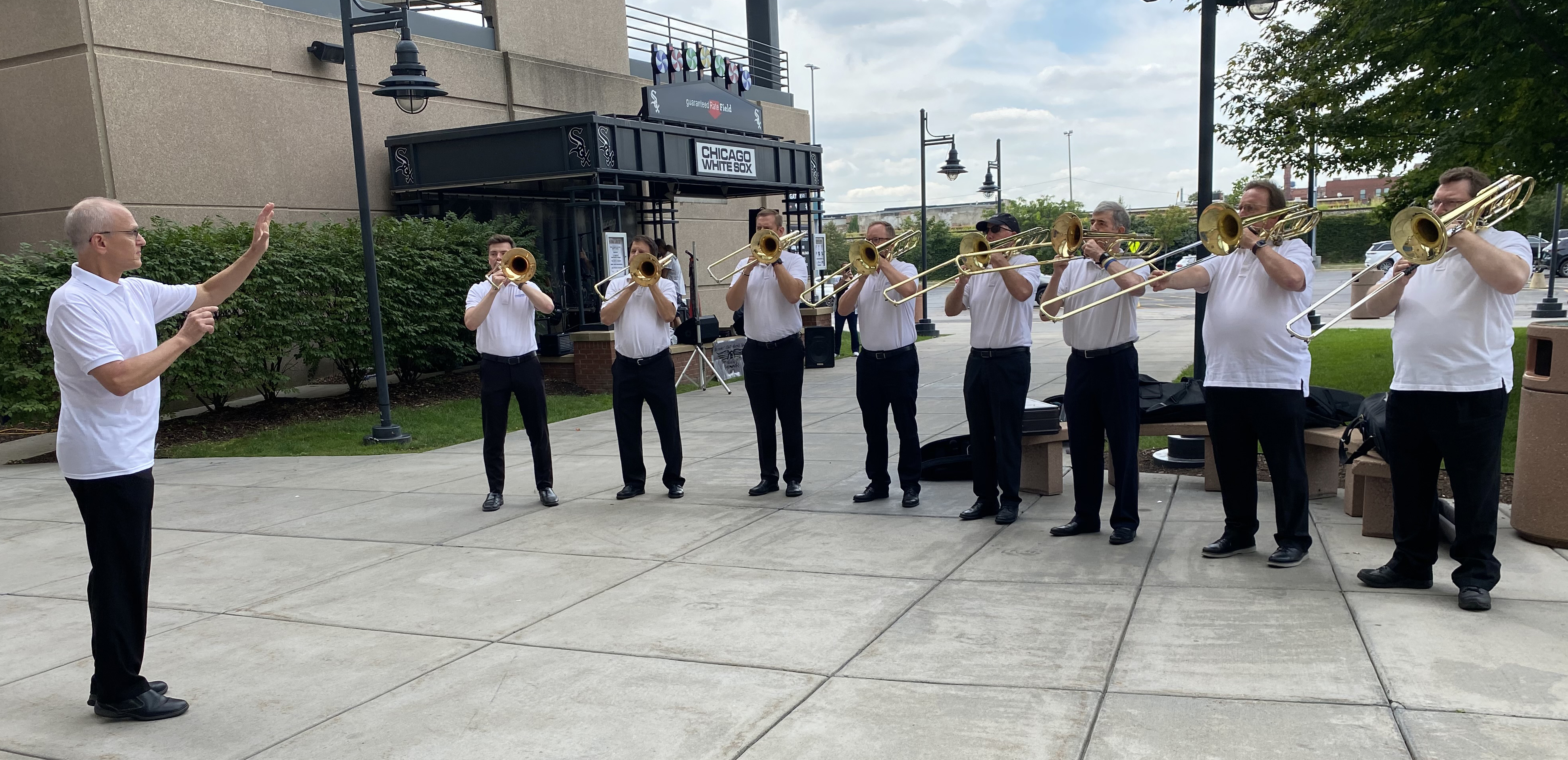
Northshore Concert Band trombone section (left to right: Mitchell Clark, Brad Say, Bryan Tipps, Andy Burkemper, Greg Glover, Joe Schorer, Paul Bauer, and Dan DiCesare) with Douglas Yeo, conductor. Rehearsal outside of Guaranteed Rate Field (Chicago White Sox), August 27, 2022. Photo by Chad Leonard.
We all assembled outside of Gate 4 at Guaranteed Rate Field, home of the Chicago White Sox, where we had a rehearsal. While I had played and conducted the National Anthem at sporting events many times before, it was really great to share the experience with the NCB trombone section for whom this was all new. I had recently had surgery on my right shoulder and I asked if my son-in-law, Chad Leonard (who has been a baseball fan since his childhood), could come along to help me carry food, open doors, etc. As it turned out, Chad acted as our official photographer. With his own and Joe’s cameras in hand, Chad documented the whole experience. But, full disclosure, our family are Chicago Cubs fans. But, hey, baseball is baseball, and for one day, Chad and I were glad to put aside the north and south side Cubs/White Sox rivalry and enjoy a great day at a ballpark. As soon as the trombone section started playing at our rehearsal, I knew this would be an terrific performance of the National Anthem. The players had memorized the music (we played an arrangement by Robert Elkjer) and they were at the top of their game.
Members of the Northshore Concert Band trombone section (front to back: Andy Burkemper, Brad Say, Dan DiCesare, Bryan Tipps, and Greg Glover). Security check outside of Guaranteed Rate Field (Chicago White Sox), August 27, 2022. Photo by Chad Leonard.
After our rehearsal outside of Guaranteed Rate Field, we went through security (trombone cases and their contents had to be examined) and we headed into the ballpark and then on to the field for our soundcheck.
Northshore Concert Band trombone section (left to right: Mitchell Clark, Brad Say, Bryan Tipps, Andy Burkemper, Greg Glover, Joe Schorer, Paul Bauer, and Dan DiCesare). Sound check inside Guaranteed Rate Field (Chicago White Sox), August 27, 2022. Photo by Chad Leonard.
The White Sox staff was well-organized, friendly, and exceptionally helpful, and we ran through the Anthem several times. The sound of eight trombones coming over the extensive network of speakers throughout the ballpark was impressive.
View of the field at Guaranteed Rate Field (Chicago White Sox) from Section 346, August 27, 2022. Photo by Douglas Yeo.
The White Sox gave each of us a ticket to the game, and in between the soundcheck and our performance, we got to check out view from our box seats in Section 346. Pretty great. Shortly before the start of the game, we headed down to the field again to get ready for our performance. But first, there was time for photos on the field and with the White Sox’s mascot, Southpaw. Meeting Southpaw was, somehow, very appropriate. Because of my shoulder surgery, I had to conduct mostly with my left arm. When I told my students at University of Illinois that I’d be conducting the National Anthem left-handed at a White Sox game, one of them piped up, “Of course you’ll be a southpaw. You’ll be on the south side [of Chicago]!” Hardy-har-har. . .
Douglas Yeo with Chicago White Sox mascot “Southpaw” and members of the Northshore Concert Band Trombone section (left to right: Joe Schorer, Andy Burkemper, Greg Glover, and Mitchell Clark), August 27, 2022. Photo by Chad Leonard.
And, I have to say, there is something about standing on the field in a Major League Baseball stadium next to a team’s logo that just can’t be described.
Chad Leonard and Douglas Yeo, Guaranteed Rate Field (Chicago White Sox), August 27, 2022.
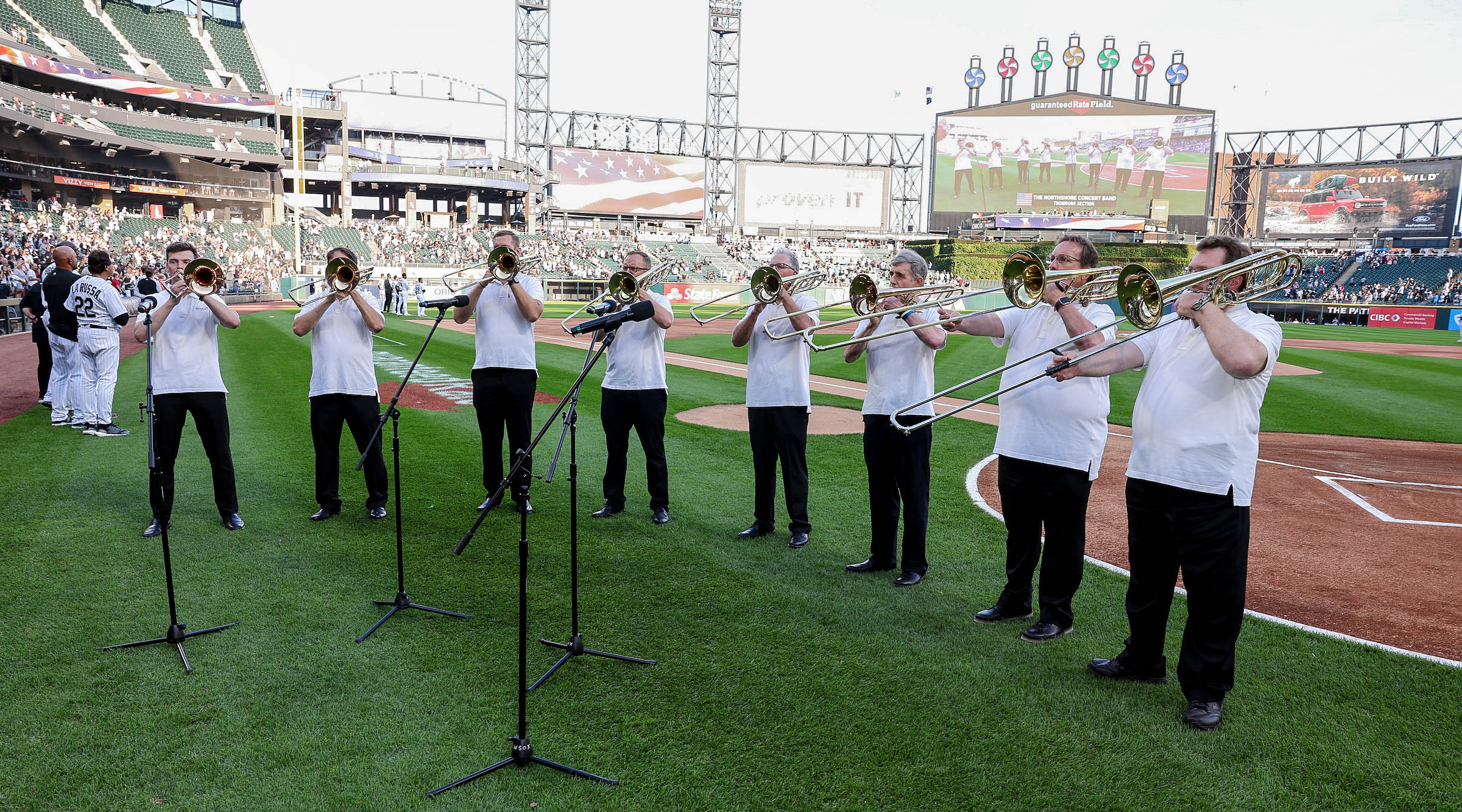
We assembled near home plate, and as the teams lined up in front of their dugouts, the announcement for our performance began. And in a memorable one minute and thirty seconds, the Northshore Concert Band trombone section gave a stirring rendition of TheStar Spangled Banner for the players and crowd. When we were done playing, White Sox Manager Tony La Russa turned around and applauded the players. It was a job well done in every respect.
Northshore Concert Band trombone section (left to right: Mitchell Clark, Brad Say, Bryan Tipps, Andy Burkemper, Greg Glover, Joe Schorer, Paul Bauer, and Dan DiCesare) National Anthem performance at Guaranteed Rate Field (Chicago White Sox) with Douglas Yeo, conductor, August 27, 2022. Photo by Chad Leonard.
Northshore Concert Band trombone section (left to right: Mitchell Clark, Brad Say, Bryan Tipps, Andy Burkemper, Greg Glover, Joe Schorer, Paul Bauer, and Dan DiCesare) National Anthem Performance at Guaranteed Rate Field (Chicago White Sox, August 27, 2022). Photo courtesy of the Chicago White Sox.
Friends who are reading this: If you’re part of a trombone section or a group of trombone players who like to play together, consider doing this! Major League baseball teams have 81 home games. And there are minor league and independent league teams, too. Football, basketball, hockey, soccer, too. That’s a lot of National Anthem performances. The Northshore Concert Band trombone section asked themselves the question, “Why not us?” and look what happened. And why not YOUR trombone section? Have a look at the video below (the video is courtesy of the Chicago White Sox) and put yourself in the moment (you can also watch the video directly on YouTube):
Congratulations to the Northshore Concert Band trombones—(left to right as we performed) Mitchell Clark, Brad Say, Bryan Tipps, Andy Burkemper, Greg Glover, Joe Schorer, Paul Bauer, and Dan DiCesare. They made their Band proud, and their excellent, respectful rendition of The Star Spangled Banner was the traditional, ceremonial start to another game of America’s pastime, baseball. Once again, I would to thank the NCB trombone section for asking me to lead them in their performance of the National Anthem. I was proud to be associated with them. Well done, Northshore Concert Band trombones!
Artist Jean-Jacques Sempé died on August 11 at the age of 89. Like so many people in the United States, I got to know his whimsical cartoons while reading The New Yorker (Sempé was French and his artwork appeared internationally). When I was a young boy, my father subscribed to The New Yorker and I used to run home from school on the day the new issue would arrive in our mailbox so I could look enjoy the cover and the many sophisticated cartoons inside. I got to love Sempé’s sense of humor and his artistic style. He drew many covers for The New Yorker but he also drew cartoons that appeared in its interior pages.
And Sempé loved to draw the trombone.
Over the years, I’ve torn out many pages of issues of The New Yorker and saved copies of several of Sempé’s cartoons that feature the trombone. They make me smile. Here are three of my favorites.
Sempé’s cartoons could be simple or complex. I think that this cartoon (above) is a masterpiece of construction and the use of color. The scene is tranquil and there is a beautiful simplicity to the moment. Two friends playing trombone around a swimming pool in a backyard. What could be finer.
Sempé’s cartoons could also be busy and provide commentary in the midst of familiar scenes. Here we are (above) at a symphony orchestra concert. The viewer’s eye is drawn immediately to the tuba player who is late in coming to his seat on stage. Four annoyed trombone players are expressing their displeasure. The conductor is waiting for things to settle down before giving the downbeat. But don’t miss the other scene that’s going on in the audience. A woman is also coming late to her seat. Both the tuba player and the woman in in the green dress have the same urgent, forward moving posture as they are trying to get to their seats. Parallel situations on the same vertical plane, on and off stage. Genius. Sempé’s use of vivid color to highlight the tuba player and the woman is a masterpiece of design. FYI, the big white blotch in the audience is a spot where the paper is torn off. I don’t remember how that happened. . .
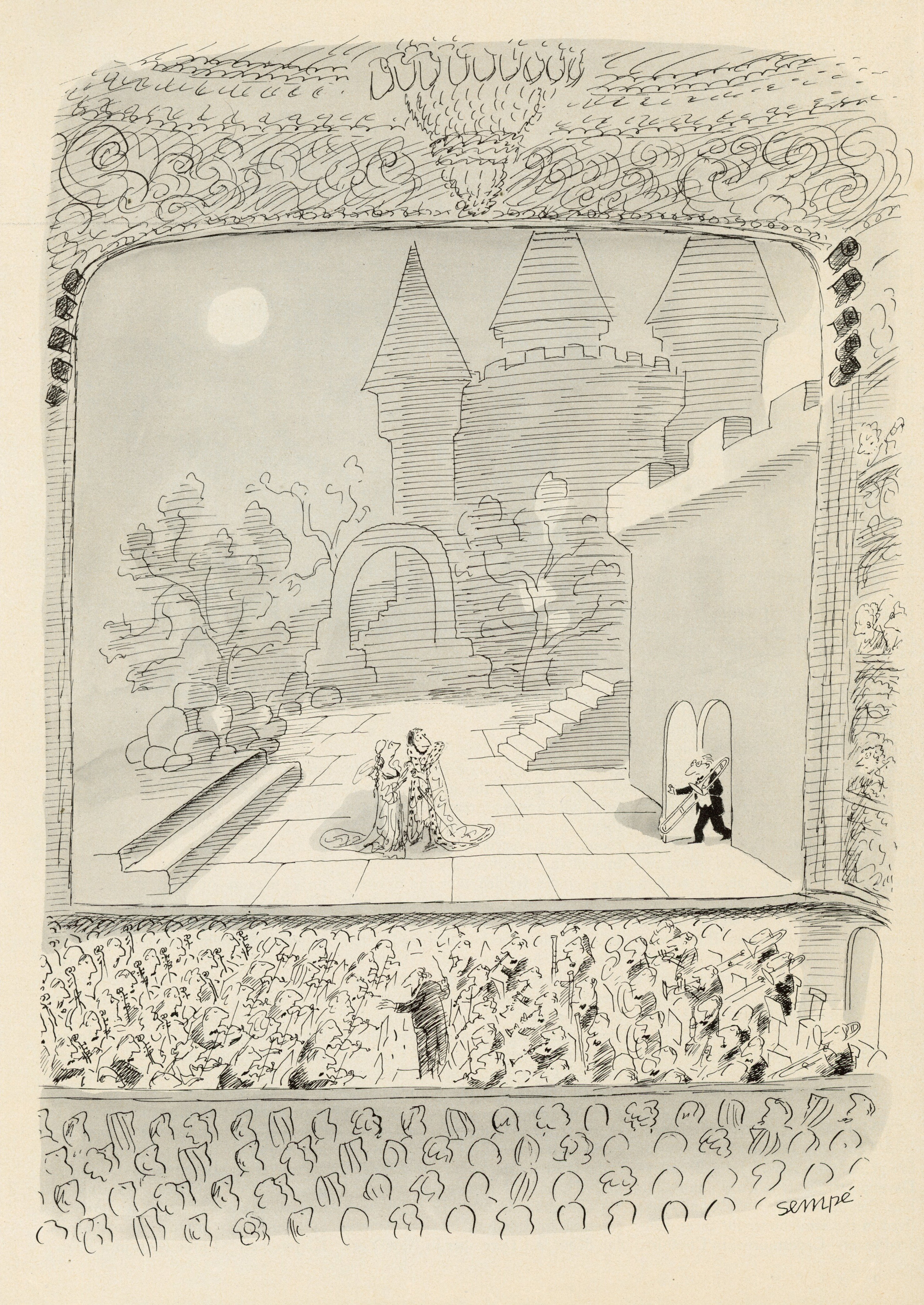
This is my favorite Sempé cartoon (above). It was not a cover for The New Yorker; it appeared on an interior page. I ripped this page from the issue so I don’t know the date it appeared. This scene is perfect. A night at the opera and a big moment with the singers on stage. The trombonist, who had left his chair in the opera pit (to get a drink? to relieve himself? to make a phone call? to check his stock portfolio?), opens the wrong door and ends up on stage in the middle of the performance. The expression of the two singers, the trombonist’s empty chair in the pit, and the orchestra playing at full throat in the midst of this epic faux pas tells the story with great clarity.
Jean-Jacques Sempé understood life, and he understood the trombone. While he’s no longer with us to create new art, we are truly fortunate to have the art he left behind. Longue vie Sempé!
My favorite colors are orange and blue. Why? Well, they’re the colors of my undergraduate alma mater, Wheaton College (Illinois). I graduated from Wheaton College in 1976, and I’ve been the College’s trombone professor since 2019.
Compact disc recording of the Wheaton College Trombone Quartet, 1974–1976 (released 2022), Like a River Glorious. James Roskam, Eric Carlson, William Meena, and Douglas Yeo, trombones.
Orange and blue are also the colors of the Chicago Bears. My wife and I are season ticket holders to Bears football. There’s a lot of orange and blue in our family’s wardrobes.
Douglas and Patricia Yeo at Soldier Field, Chicago. Minnesota Vikings vs. Chicago Bears, September 2019.
In November 2016, I traveled to University of Illinois at Urbana-Champaign to give a lecture at the Sousa Archives and Center for American Music, give a trombone masterclass, and participate as guest soloist at an Illinois football game halftime show with the Marching Illini Band. You can read about those memorable days by clicking HERE. And, what, you may ask, are University of Illinois’ colors? You guessed it: orange and blue.
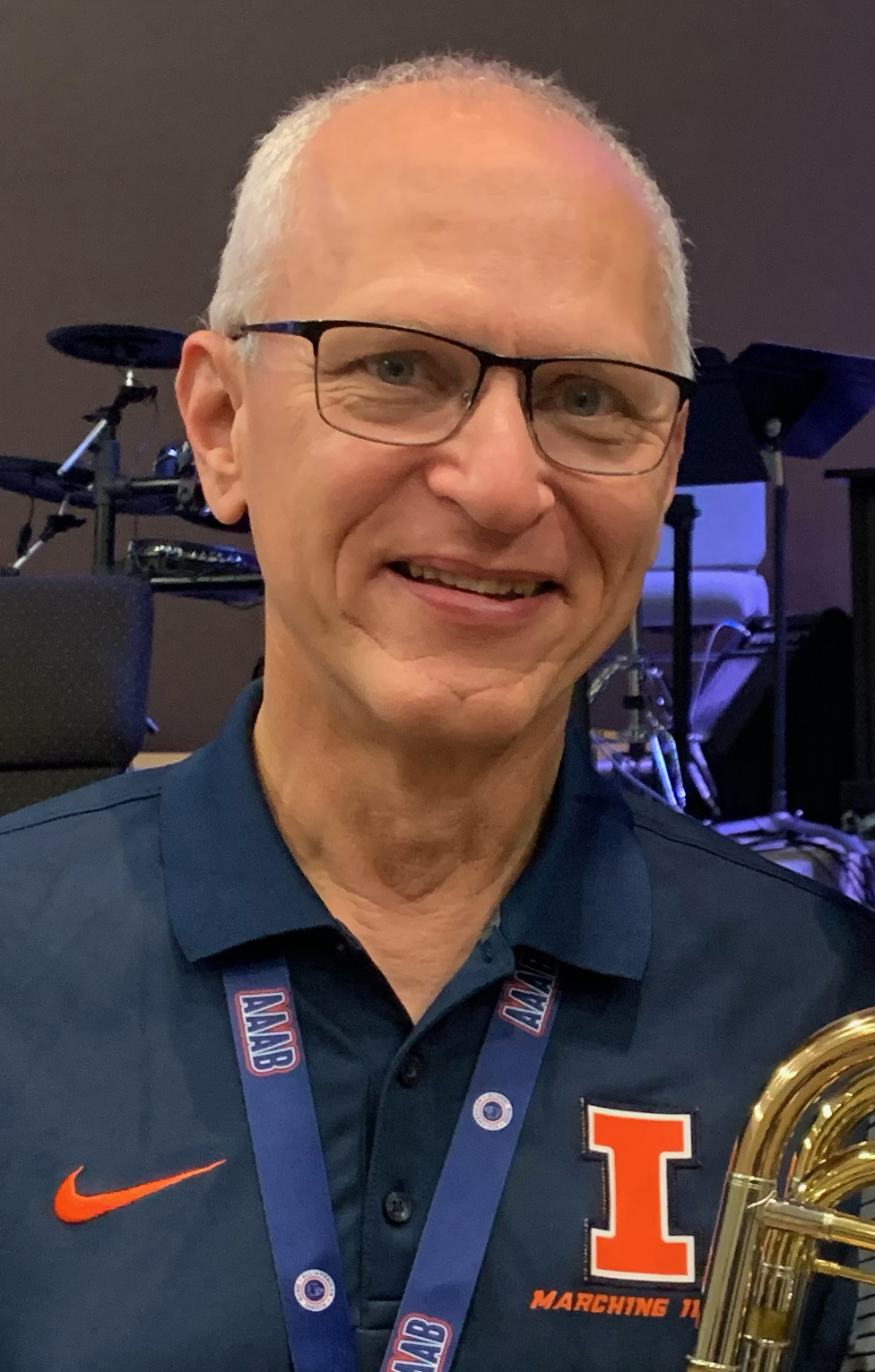
In May of this year, I took part in the All-American Alumni Band reunion in Ohio. That was fun, and you can read about it by clicking HERE. Although I represented New Jersey when I was a member of the McDonald’s All-American High School Band in 1972-1973, I wanted to show a little Illinois pride at our recent reunion, so I pulled out the polo shirt that Dr. Barry Houser, director of the Marching Illini Band, gave to me in 2016.
Little did I know that just two months later, that shirt would have a lot more meaning for me.
Last week, University of Illinois School of Music announced my appointment as its trombone professor (Adjunct Clinical Associate Professor of Trombone) for the 2022–2023 academic year. At the end of May, the University’s trombone professor abruptly retired, and the School of Music reached out to several people including me to ask if we would be interested in applying for a one-year position. I was intrigued by the idea so I tossed my hat in the ring, not at all sure that everything could possibly come together to make it happen on my end even if the University turned out to be interested in me. As things turned out, they were interested in me and after several interviews, I was offered the position. After a lot of thought and prayer, I decided to accept, and in a few weeks, I’ll be in Urbana each week working with a trombone studio of talented players, and working alongside my good friend, Jim Pugh, who is University of Illinois’ professor of jazz trombone and composition.
Jim Pugh and Douglas Yeo playing Charles Small’s Conversation, University of Illinois School of Music, November, 2016
I also have another friend who teaches at University of Illinois—trumpet professor Charles Daval. Charles was a member of the Boston Symphony Orchestra during my first years in the BSO. This photo, below, shows the Boston Symphony Orchestra conducted by Seiji Ozawa in a memorable performance of Dmitri Shostakovich’s Symphony No. 10 at the Philharmonie in Berlin, August 1984. You can see Charles on the far right and me behind him, playing over his right shoulder. Our second trombonist for part of that tour was Carl Lenthe, then principal trombonist of the Bayerische Staatsoper, and now Professor of Trombone at Indiana University. Ronald Barron is playing principal trombone. I plan to hang this photo in my office at University of Illinois, a reminder of how Charles and I find ourselves together once again nearly 40 years after we first met.
Boston Symphony Orchestra conducted by Seiji Ozawa, performing Symphony No. 10 of Dmitri Shostakovich. Philharmonie, Berlin, August 1984. Charles Daval (far right), third trumpet; Douglas Yeo (behind Daval’s right shoulder), bass trombone.
When my appointment to the University of Illinois faculty was announced, flute professor and chair of Winds/Brass/Percussion, Dr. Jonathan Keeble, interviewed me for a press release. Here’s the interview, which tells a little more of this story:
What have been your favorite professional musical experiences?
Making a list of favorite musical experiences is like asking, “Which of your children do you love the most?” But if I had to choose a few from my long career, they would include performing Gustav Mahler’s Symphony No 2 with Leonard Bernstein in the National Cathedral, Washington DC, Dmitri Shostakovich’s Symphony No. 10 with Seiji Ozawa in Berlin, Josef Haydn’s The Creation with Simon Rattle in Boston’s Symphony Hall, and Johannes Brahms’ Symphony No. 2 in Amsterdam with Bernard Haitink. And recording the film scores to Schindler’s List and Saving Private Ryan with John Williams on the podium.
What pulled you away from the Boston Symphony Orchestra, and into teaching when you moved over to Arizona State University?
After playing in the Boston Symphony for nearly 30 years, I had accomplished every dream I had imagined as a member of a great symphony orchestra. My wife and I decided to retire to Arizona—we love the landscape and diverse cultures of the Southwest—not knowing exactly what was next for us but we were ready for new adventures. Then, Arizona State University approached me about accepting their full time Professor of Trombone position; I could not refuse. Trombone students at a university are interested in a host of artistic expressions: performer, educator, arranger, author, and much more. I am a trombonist who has been involved in everything – from performing the symphonic canon, to actively participating in early music as a sackbut, serpent, and ophicleide player, to being a New York City jazz freelancer, as well as a high school band director, and author of numerous books and articles. It’s through this broad set of experiences that I can relate to and help students who have many different goals. Engaging with my students at ASU and helping them to become difference makers in society was immensely gratifying but in 2018, we decided to move to the Chicago area. Grandkids can do that to you.
What about University of Illinois at Urbana-Champaign (UIUC) coaxed you to come out of retirement for the upcoming year?
In 2016, I came to the Illinois campus on two occasions. The first was to give a concert in the Krannert Center with Philharmonia Baroque (I played serpent on Handel’s Music for the Royal Fireworks). The second was to give a lecture at the Sousa Archives and Center for American Music, and perform as guest soloist with the Marching Illini at a football halftime show. I was impressed with all I experienced on campus, and when the University approached me about its need for a trombone professor for 2022–2023, the idea was immediately appealing. Also, I played alongside UIUC’s trumpet professor Charles Daval when he was a member of the Boston Symphony Orchestra in the 1980s, and jazz trombone and composition professor Jim Pugh and I have been good friends for many years. The prospect of working with them and UIUC’s talented students was simply irresistible. I keep flunking retirement but I’m OK with that.
Indeed, it seems as though you’ve hardly taken a breath since “retiring!” What is it you find most gratifying about teaching trombone?
Watching a student have that Eureka! moment when a concept clicks. When a student understands that making music is more than a job but it’s a calling, the intensity of the student/teacher relationship kicks into high gear. I have been fortunate to have many students who are passionate about positively influencing the world with a trombone in their hands, and the joy of working with them is incalculable.
Who’s Professor Yeo when the trombone’s out of his hands?
I love to write. In fact one of two books I completed last year is published by University of Illinois Press (Homer Rodeheaver and the Rise of the Gospel Music Industry, co-authored with my friend, Kevin Mungons). My favorite non-musical thing to do is hiking with my wife, our favorite place to do that is Zion National Park in Utah, and we are Chicago Bears football season ticket holders. Our family bleeds orange and blue. That’s another reason why I’m very excited to be part of the UIUC community!
So, here we go. In a few weeks, I’ll be in Urbana teaching at UIUC. Orange and blue. That same week, I’ll be also back in my studio teaching at Wheaton College. Orange and blue. And a few weeks later, the Chicago Bears will open their season and my wife and I will be in our seats at Soldier Field, Chicago. Orange and blue.












 The Last Trombone – Douglas Yeo