Category: trombone

Fake News: The Trombone

Fake News: The Trombone

by Douglas Yeo (January 14, 2017)

Fake news is in the news. Unless you believe it isn’t. Fake news has been around for a very long time. Sometimes it’s a mistake borne out of ignorance, such as the early belief that the earth was flat. If nobody knows it’s round, it’s flat. But it’s not flat; it’s round. So the flat earth assertion is fake news. Sometimes fake news is known to be false but is spread with malicious intent. Say something enough times and people will think it’s true. It’s important to develop a good filter when information comes your way. It may be true; it may be fake.

The trombone has not been immune to its own fake news stories, especially regarding its history. I’ve been doing some research into this for one of the books that I’m writing and thought I’d share several items that have led many people to believe that the trombone was invented in antiquity, in Roman and early Biblical times. These myths – this trombone fake news – continue to the surface now and then as proof of an ancient origin of the trombone. Let’s set the record straight.

Shakespeare: Coriolanus

shakespeare_sackbut

The Trumpets, Sackbuts, Psalteries, and Fifes,

Tabors, and Cymbals, and the shouting Romans,

Make the Sun dance. Hark you. (A shout within)

Men: This is good news!

Above, in the 1623 published edition of Shakespeare’s play and in a transcription in modern English, are several lines from Act V of William Shakespeare’s 1605 play, Coriolanus. The play is based on the life of the legendary–most scholars now believe that he never existed–Roman general, Gaius Marcius Coriolanus.

Here, Shakespeare includes the sackbut, an English name for the early trombone, among the list of instruments that were being played as Volumnia triumphantly enters the city. We know that trombones were part of the stage prop inventory for the “Admiral’s Men,” a theatrical company that was contemporary with Shakespeare. But in Coriolanus, Shakespeare takes an instrument with which he was familiar–the trombone, or sackbut–and places it in ancient Rome. Fake news.

Trombones at Pompeii and Herculaneum

The destruction of Pompeii and Herculaneum due to the explosion of the volcano, Mount Vesuvius in A.D. 79, has led to many legends about what actually was found during the excavation of the cities that began in 1599. One of the most fanciful tales is that “two Roman Sackbuts” were found in the ruins of Herculaneum. This report first circulated in the 1700s but was, fortunately, debunked in the second edition of the Grove Dictionary of Music (1910):
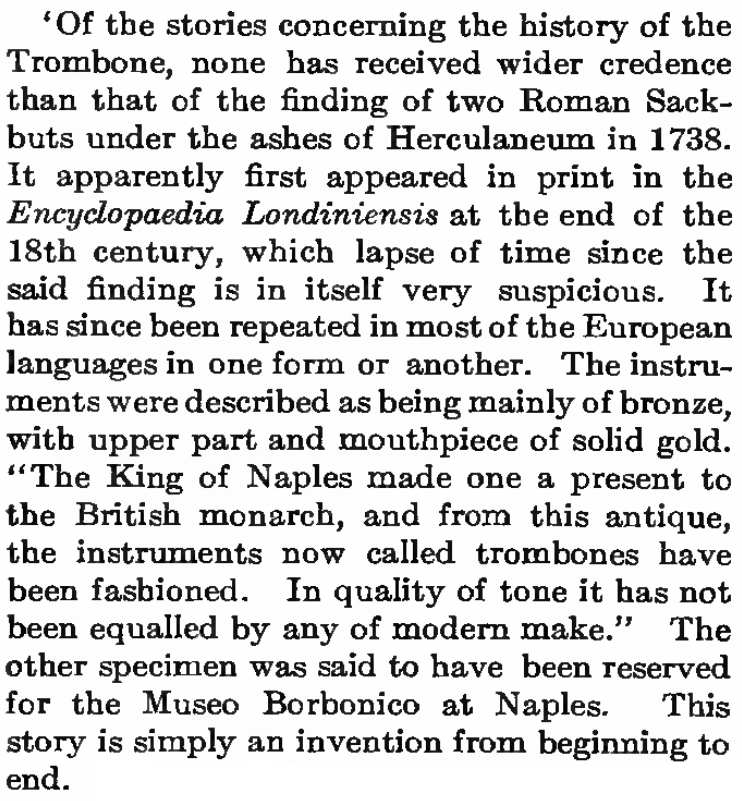
grove_dictionary_1910_trombone_excerpt

The instruments that actually WERE found in the ruins of Herculaneum were Roman cornu. Here is a photo of one of the Herculaneum cornu and more photos and commentary about these instruments may be found by clicking HERE.
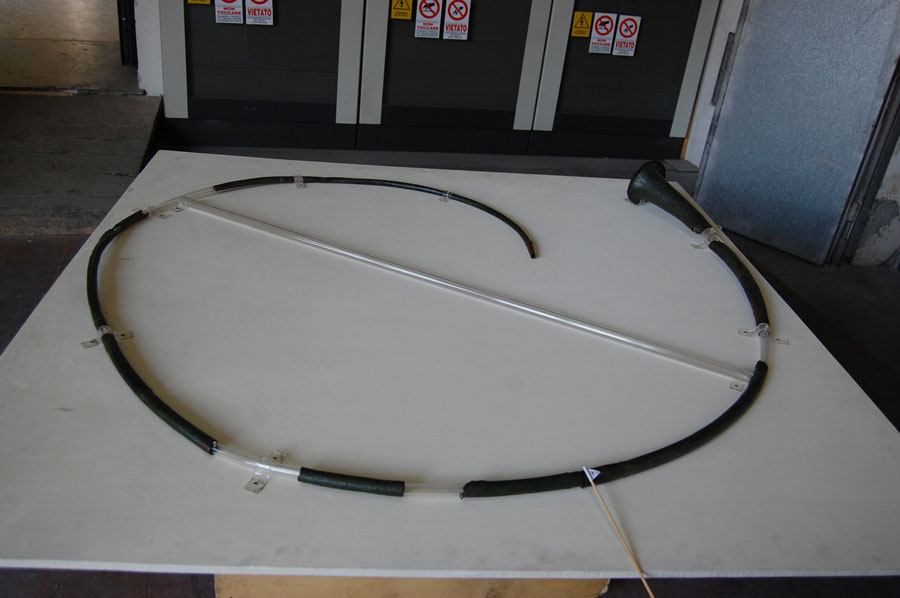
naples_cornu

The trombone in Roman times? Fake news.

Longfellow: Tales of a Wayside Inn

Henry Wadsworth Longfellow’s collection of poems, Tales of a Wayside Inn, is a classic of English literature. Written in 1863, the book relates fictional stories and tall tales told by a group of guests at the Wayside Inn, a real Inn in Sudbury, Massachusetts. Early in the book, Longfellow introduces “A Spanish Jew from Alicant.” As Canon Francis Galpin wrote in his essay, The Sackbut, Its Evolution and History (1906), “Longfellow (Tales of a Wayside Inn, Prelude), has unfortunately added popularity to this idea of the antiquity of the instrument [sackbut/trombone] by the following reference to ancient history.” At which point he quotes the closing lines of this excerpt from Longfellow’s poem (two scanned files since they appear over two pages in my copy of the 1913 edition):
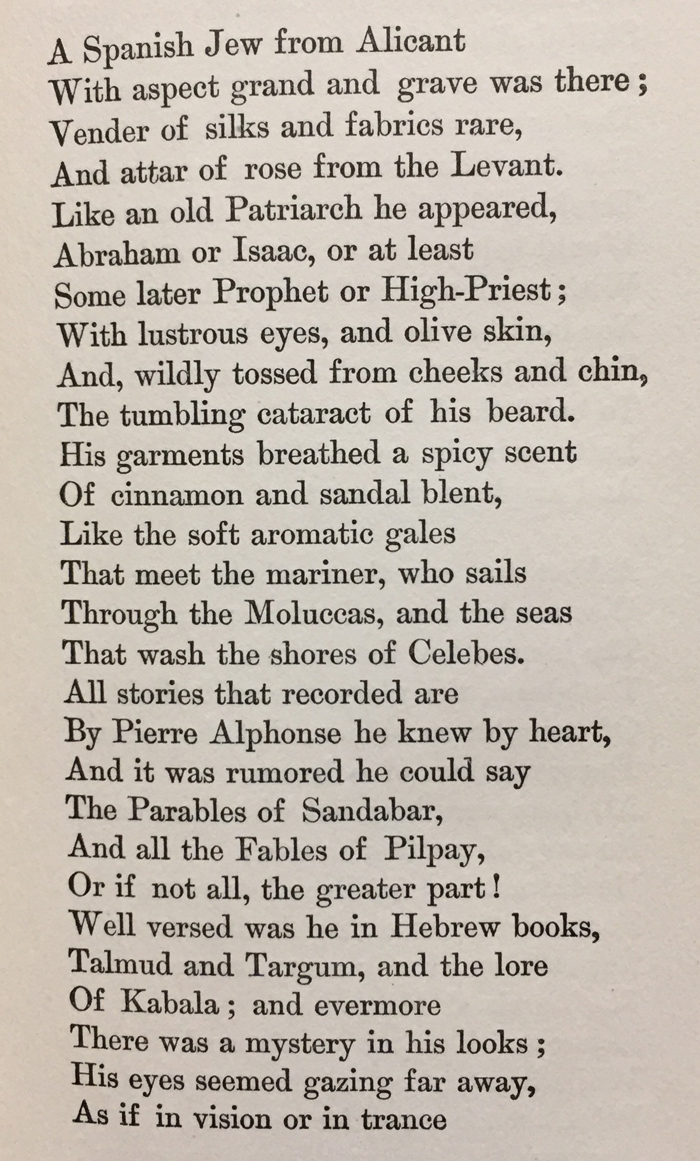

wayside_inn_01wayside_inn_02

Trombones in the ancient Middle East? Fake news.

Sackbut in the Bible: The 1611 King James Version

I have a high view of the authority of the Bible and believe that it is the inspired, inerrant word of God. But there is a problem with the idea of Biblical inerrancy. The Bible was originally – and inerrantly – written in ancient languages, including Hebrew and Aramaic. Those who have translated the Bible into other languages have often had trouble knowing what words in the original languages actually meant/mean.

In the famous 1611 translation of the Bible into English, the so-called “Authorized King James Version,” we find this verse from the Book of Daniel, Chapter 3, verse 5:
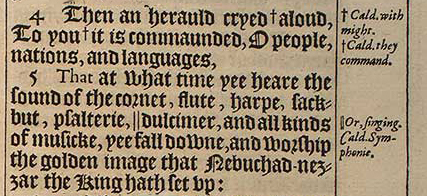
daniel_3_kjv_1611_detail

That at what time yee heare the sound of the cornet, flute, harpe, sackbut, psaltery, dulcimer, and all kinds of music, yee fall down and worship the golden image that Nebuchadnezzar the King hath set up:

This passage goes on to reference the Prophet, Daniel, who, because he would not bow down and worship Nebuchadnezzar’s golden image, was thrown into a den of lions where God preserved his life.

The problem with Nebuchadnezzar’s little band is that the sackbut wasn’t part of the jam session. Translators of the King James Version were stumped. They came across an Aramaic word in the passage and did not know what instrument was being described. Jeremy Montague describes the problem:

The reason for [the sackbut’s] use in the Authorized Version is that the word in the Aramaic is sabb-cha, and King James’s translators had no idea of what it meant but just picked something familiar that sounded similar. The Septuagint has sambyke each time (Vulgate, sambuca), and it is probably that it is the word that the author of Daniel was aiming at. Jeremy Montagu, Musical Instruments of the Bible (London: Scarecrow Press, 2002), p. 98.

So what WAS the instrument, the sambuca, that was rendered as sackbut, that was played in Nebuchadnezzar’s band? It was a type of small harp, a bow harp, that looked something like this example found in the Edinburgh University Collection of Historical Musical Instruments:

0033799c

Since the King James Version was published, Biblical scholars know much more about ancient languages and ancient musical instruments, and the sambuca is now usually translated as psaltery or lyre. In fact, the New King James Version translates it as lyre. Not sackbut. Not trombone.

The trombone in ancient, Biblical times? Fake news.

It is important to keep in mind that apart from the fanciful report of the discovery of trombones in the excavation of Herculaneum, none of these “fake news” reports about the trombone were malicious or intended to deceive. Shakespeare and Longfellow were using poetic license to place the trombone in ancient times, putting an instrument with which they were familiar into an historical setting. They also may just have liked the sound of the name of the instrument and how it rolls off the tongue. The translators of the King James Version did the very best they could with the knowledge they had when they translated sambuca as sackbut. Over time, scholars gained a better understanding of the meaning of the word and they corrected it in subsequent translations of the Bible. The problem occurs when people today don’t understand that these references that place the trombone in ancient times are false. The assertion that the trombone was found in antiquity still comes up in books, articles, and student papers today. The trombone has a long and noble history that dates from the fifteenth century. We continue to learn more about this rich history including when things previously thought to be true are now known to be false. Check your sources when you write about the trombone. You’ll be doing your part to stop trombone fake news.

stop-fake-news-logo-large

Santa Plays the Trombone

Santa Plays the Trombone

Of course Santa plays the trombone. There’s even a song about it:

In 2012, I wrote this poem with apologies to Clement Moore, and sent it to my students; it became an annual thing. So here it is again. Just another reminder that Santa Plays the Trombone.

A Visit From Santa Claus To A College Trombone Player

T’was the night before Christmas and all through my home,
All the horns were in cases, including trombones.
For after the finals and juries and tests,
It was time for some shut-eye; I needed some rest.

I was dreaming of straight mutes and pBones and more,
When I woke to a sound that I’d not heard before.
And what should I see on my roof up on high?
A Moravian choir, with trombones playing fine.

Alessi and Lindberg, Kleinhammer and Yeo,
Were all playing their horns, their heads covered with snow.
And who should be leading this heavenly band?
But old Santa himself, a trombone in his hand!

“On JJ! On Jörgen! On Tommy and George!”
This band was so sweet, I sure did thank the Lord!
“On Norman and Pryor, Ron, Urbie and Frank!”
Some others played, too, but my mind drew a blank.

I grabbed my trombone and I lubed up the slide,
With no time for a warm-up, I hurried outside.
The gang was all playing some mighty nice tunes,
And we jammed some cool charts by light of the moon.

I invited them in just to warm up their chops,
But they just kept on playing, man, this sure was tops!
Saint Nick put his horn down to fill up my stocking,
With valve oil, and slide cream, CDs – so inspiring!

In time, things wound down and they packed up their horns,
And the sleigh got revved up and was heavenly borne.
But Santa looked back, and he said with a smile,

“Merry Christmas to all, and don’t forget to keep practicing even though you’re on vacation!”

— Douglas Yeo (with apologies to Clement Clarke Moore)

Cliff Barrows (1923-2016): A man of song. And the trombone.

Cliff Barrows (1923-2016): A man of song. And the trombone.

by Douglas Yeo (November 16, 2016)

Clifford “Cliff” Barrows, long-time song leader for evangelist Billy Graham, died yesterday at the age of 93. He was part of a trio – along with Graham and singer George Beverly Shea – who defined large-scale Christian evangelism in the second half of the twentieth century. Graham, Shea and Barrows preached, sang and led singing before millions of people since they first worked together in 1946. The photo above shows Cliff Barrows leading singing at the 1946 Youth for Christ meeting in Seattle, Washington.

The newspapers today are full of tributes to Cliff Barrows and a good summary of his life and career is found in his obituary in the Charlotte (North Carolina) Observer. This was a Godly man who changed lives in many ways and he is more than deserving of all of the warm remembrances that are being written about him today.

But several years ago, I learned about a side of Cliff Barrows that most people had either not ever known about or had long forgotten: he played the trombone.

low_bgc_barrows_trombone_02_front

I first learned that Cliff Barrows played trombone while touring the Billy Graham Center Museum at my undergraduate alma mater, Wheaton College (Illinois). As I came around a corner, I saw photographs of two men that were holding trombones: Homer Rodeheaver (I had never heard of him before) and Cliff Barrows (I didn’t know he had played trombone). I learned quickly that Rodeheaver was the trombone-playing song leader for evangelist Billy Sunday in the first third of the 20th century. And this realization – that the two most influential Christian evangelists of the 20th century were both named “Billy” and both had song leaders that played the trombone  – sent me running to learn more.

I turned my attention to Rodeheaver, a man who was a household name for decades but today has been largely forgotten. Here was a man who played the trombone for over 100 million people; his tremendous influence as a trombonist is incalculable. “Surely,” I thought, “there must be a story in all of this.” And indeed there was. It first led to my writing an article, “Homer Rodeheaver: Reverend Trombone” that was published in the Historic Brass Society Journal earlier this year. And, happily, it has now led to my co-authoring a book about Rodeheaver for University of Illinois Press with my friend, Kevin Mungons. We are, at this moment, deep into the process of writing the book and when it appears in a few years, it will be accompanied by a two-CD set of recordings of Rodeheaver singing, speaking and playing trombone. More on this in time! But while doing research about Rodeheaver at the Billy Graham Center Archives and at Grace College in Winona Lake, Indiana (where Billy Sunday and Rodeheaver had their homes and archives for both Sunday and Rodeheaver are found) and the Winona History Center, photos of Cliff Barrows kept popping up. I needed to know more.

barrows_graham_1949

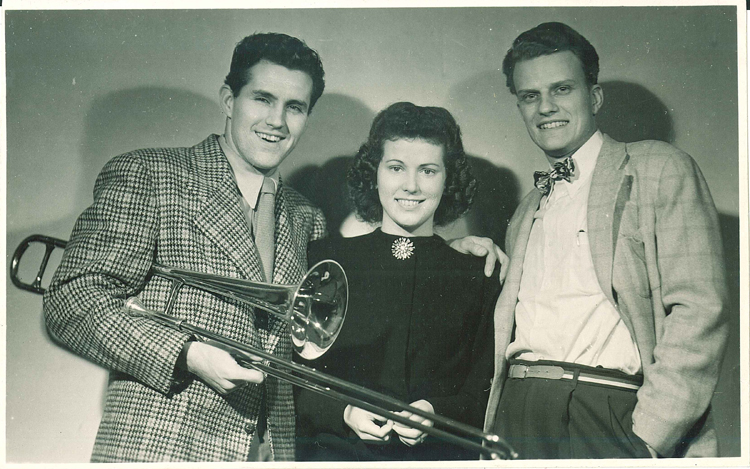
As I researched Cliff Barrows, I learned that he had played trombone while growing up in Ceres, California. With his first wife, Billie (shown above, with Cliff Barrows and Billy Graham around 1946), Barrows worked with evangelist Jack Shuler. The Statesville (North Carolina) Record & Landmark newspaper had this to say about Cliff Barrows at one of Shuler’s meetings in an article from June 26, 1945:

The Barrows’ specialize in piano and trombone arrangements, and their duets and solos have made them friends of everyone who has attended their performances. It was ventured by one who attended the great Billy Sunday campaigns that Mr. Barrows is the equal of Homer Rodeheaver, song leader for the late evangelist, so skillfully does he lead the large crowds in congregational singing of hymns and choruses. Billie Barrows, who, by the way, has been Cliff’s wife for just 13 days, has thrilled young and old with her renditions of favorite songs at the piano.

The mentioning of Cliff Barrows in the same sentence with Homer Rodeheaver was no accident. On April 1, 2014, I interviewed Cliff Barrows and he spoke about Rodeheaver’s influence on his life and ministry:

Homer Rodeheaver  was a most wonderful man. He had a way of using a crowd to prepare them for Billy [Sunday] and Billy would get anxious; he’d want to get up and start to preach and Homer would turn around and say, “They ain’t ready yet.” So he’d pick up his trombone and say, “This is a Methodist trombone, it slips and slides all over the place.” . . . I never met a more gracious man. We had him come to every [Billy Graham] Crusade when he was alive until he died in 1955 and I went to his funeral. They asked me to stand by his casket at the piano at [his home at] Rainbow Point [in Winona Lake, Indiana] and lead some of his favorite songs. And I did. I led “Beyond the sunset, O blissful morning…”

barrows_la_1949

Unfortunately, there are no known recordings of Cliff Barrows playing the trombone. But there is a brief moment where he is seen on film with the trombone in his hands. The screenshot above is from a video of Cliff Barrows playing the trombone at the 1949 Christ for Greater Los Angeles Billy Graham Crusade. You’ll find the footage of Barrows at around 5:00 in the video (click on the link in the text above to view the complete film).

In my conversation with Cliff Barrows, his affection for the trombone was palpable. By that time, he had not played the trombone in many years. After the 1953 London Billy Graham Crusade, Graham and Barrows began making changes in their manner of presenting the Christian Gospel, creating their own style after having been compared so frequently to Sunday and Rodeheaver. By 1957, he had put the trombone down. Still, during our interview, he told me that he was holding a trombone in his lap that had been given to him by the 1950 Atlanta Billy Graham Crusade Choir, on which was inscribed the verse from Psalm 98:1: Sing to the Lord a new song, for he has done marvelous things; his right hand and his holy arm have worked salvation for him. As we spoke at that moment, Cliff Barrows was nearly blind and near the end of his life, yet when we talked about the trombone, he wanted it in his hands. Of Rodeheaver and the trombone, Cliff Barrows said, “Well, they are two of my best friends.”

bgc_barrows_graham_yfc_england_01_1946-7_small

Cliff Barrows, like Homer Rodeheaver before him, found that the trombone was an effective tool in leading song for large groups of people. The photo above, from the 1946-1947 Youth for Christ meetings in England, show the young Billie Barrows, Billy Graham and Cliff Barrows standing out with their exuberant, youthful energy. In our interview, Cliff Barrows talked about how he used the trombone to lead singing:

I would play with the choir and bring the downbeat with my horn and when I would hold a long note, I’d hold it out with them and the horn was just a part of me. I felt so natural with it hanging on my arm.

bgea_barrows_helsinki_trombone_front_small_full

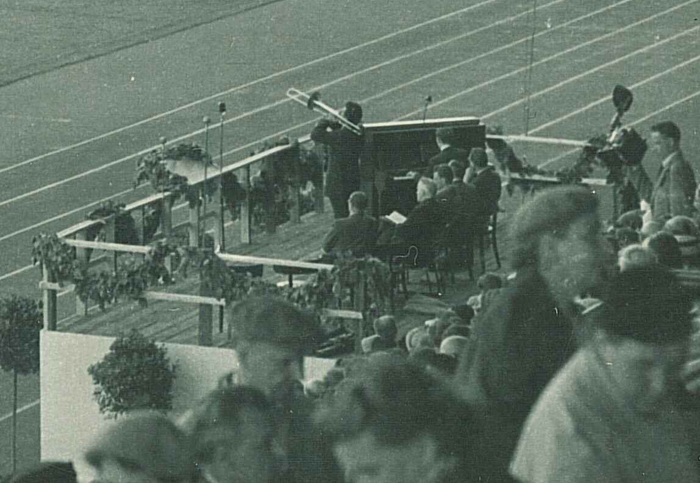
Of all of the photographs I have seen of Cliff Barrows, it is the one above, taken at the 1954 Billy Graham Crusade at the Olympic Stadium in Helsinki, Finland, that I like the best. Look at the tens of thousands of people sitting in the stadium. The infield is empty. And on the platform is Cliff Barrows, playing his trombone accompanied by an upright piano (see the enlargement, below). Two people playing a hymn tune. They are minuscule and nearly lost in the enormity of the crowd. But when a trombone was in his hand, Cliff Barrows knew how to make it sing.

bgea_barrows_helsinki_trombone_front_detail_small

When my interview with Cliff Barrows was drawing to a close, I thanked him for his time and insights. But this humble man turned it around on me, and said,

You’re welcome, Brother Yeo. God bless you brother. Thank you for letting me visit with you.

And with that, two trombone players named Cliff Barrows and Douglas Yeo hung up the phone. Today, as I reflect on the life and ministry of Cliff Barrows, I am so grateful my life intersected with his for a brief moment, where our shared love of Jesus Christ, music and the trombone came together. It was Homer Rodeheaver who led me to Cliff Barrows, the same Homer Rodeheaver who was such an encouragement when Cliff Barrows was just beginning his ministry with Billy Graham. And like Rodeheaver, shown below with Billy Sunday (in a white suit standing behind Rodeheaver) at Winona Lake, Indiana in 1931, Cliff Barrows used the trombone as a tool for leading singing and for bringing the Good News of Jesus Christ to millions of people. It’s something I’ll be doing this Sunday when, with my wife at the piano, I pick up my trombone and play the great song by George Beverly Shea and Rhea Miller, I’d Rather Have Jesus Than Silver or Gold as the offertory in our church’s Sunday morning service. At that moment, I certainly will be thanking God for the life, ministry and influence of Cliff Barrows, a man of song. And the trombone.

rodeheaver_sunday_winona_lake_cropped

[With thanks to the Billy Graham Center Archives and Winona History Center and Grace College for the photos that accompany this post.]

76 Trombones

76 Trombones

by Douglas Yeo (November 12, 2016)

Last week I had the great pleasure of traveling to University of Illinois Urbana-Champaign to take part in several immensely rewarding activities.

Over the years I have been a guest artist at dozens of schools, colleges and universities around the world. The opportunity to engage with students – whether in a lecture, performance, masterclass or, as was the case at University of Illinois, something completely different – is exceptionally rewarding and I always enjoy becoming part of the local musical culture when I am visiting.

The invitation to travel to Urbana-Champaign came from Scott Schwartz, Archivist for Music and Fine Arts and Director of the Sousa Archives and Center for American Music on the University of Illinois campus. Scott and I had met many years ago at the Great American Brass Band Festival in Danville, Kentucky, where I had presented a paper about the use of serpent and ophicleide in brass bands and I performed a solo on ophicleide accompanied by the Athena Brass Band.

yeo_lecture_table

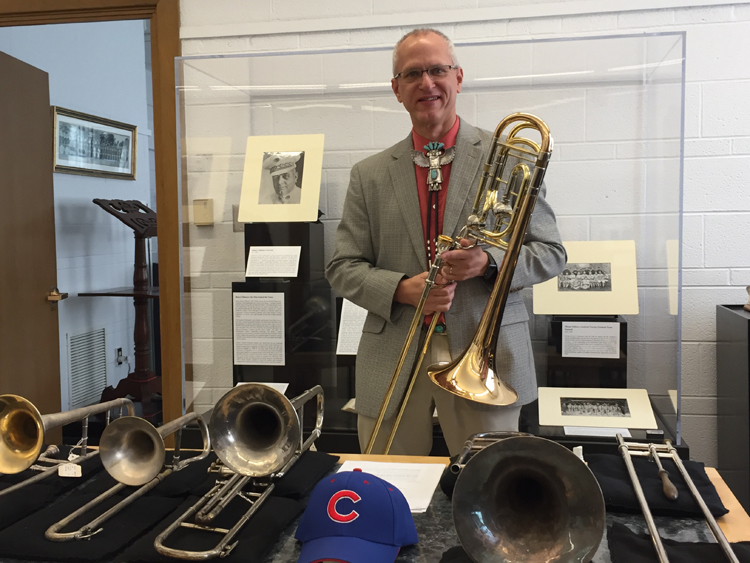
Scott asked if I would be interested in coming to Illinois to give a lecture/demonstration about early American trombone makers, their innovations and marketing strategies. The Sousa Archives had set up a very nice exhibit of six late-nineteenth and early-twentieth trombones as well as mouthpieces, catalogs, advertisements and other ephemera. In addition, we had selected six other instruments for me to play and demonstrate. Oh, and not to be lost in the moment is that the Chicago Cubs had just won baseball’s World Series and it seemed appropriate to make my Cubs hat part of the display.

yeo_lecture_03

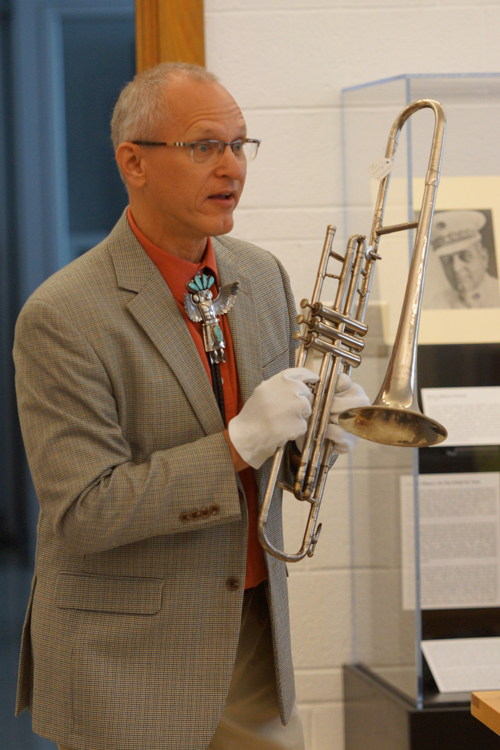
I always enjoy getting my hands on, talking about and playing old instruments, such as the alto valve trombone pictured above. The time at the Sousa Archives was very rewarding and was made more so because of the engaged audience and their great questions.

From the Sousa Archives I went to the University of Illinois School of Music where I gave a trombone masterclass. I worked with three talented students and also enjoyed getting together with my friend, Jim Pugh, who teaches jazz trombone and composition at University of Illinois. That was fun.

yeo_pugh

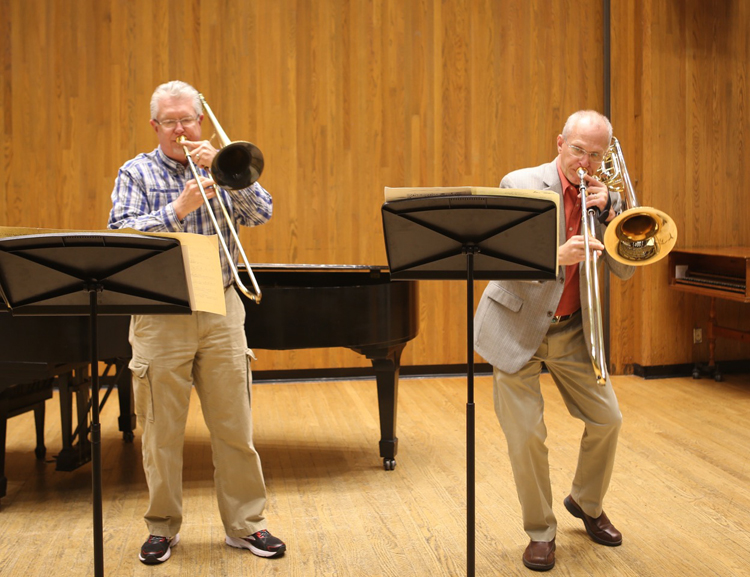
I have known Jim for decades and have the utmost respect for him as a player and a person. Several years ago I reviewed his superb CD, X Over Trombone, and I consider him to be one of the most creative players – and composers – on the scene today. Despite our long friendship, we had never played together, so we started the masterclass with a performance of Charles Small’s duet Conversation.

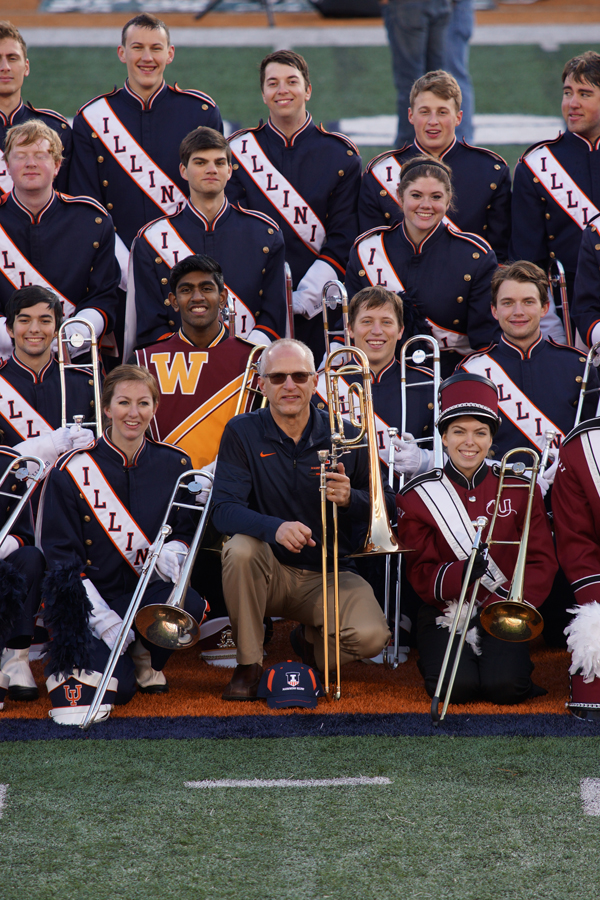
The third piece of my University of Illinois trip was a performance with the Marching Illini Band under the direction of Barry Houser. As an event with another connection to my trombone lecture and masterclass, I led a group of 75 trombone players – both members of the Marching Illini Band and students from local high schools – in a performance of Meredith Wilson’s 76 Trombones to start the halftime show of the Illinois/Michigan State football game. 75 + me = 76 Trombones. That doesn’t happen every day. Click the video image below to see the whole halftime show; it begins with 76 Trombones, and continues with a tribute to the Chicago Cubs and much more.

Now, when you put 76 trombones on a football field accompanied by a marching band, that is one impressive sight and sound. My hat is off to the Marching Illini for inviting local high school trombone players to join with the 40 trombonists of the Illini Band to get us up to 76 trombone players. This is one fine band, and I was caught up in many of their great traditions. School spirit was alive and well; it was a great day of interaction for all of us and, hey, Illinois won the game. It must have been the trombones.

yeo_halftime_03

I want to send a big THANK YOU to Scott Schwartz for making all of this happen, to Jim Pugh for his setting up the trombone masterclass and for playing Conversation with me, and to Barry Houser and all of the members of the Marching Illini Band for a great few days where we all came together in Illini orange and blue and celebrated the trombone. This was a memorable and very satisfying trip. Go Illini! I – L – L – – I – N -I !

yeo_newspaper

[And thanks to Scott Schwartz and Grace Talusan for the photos.]