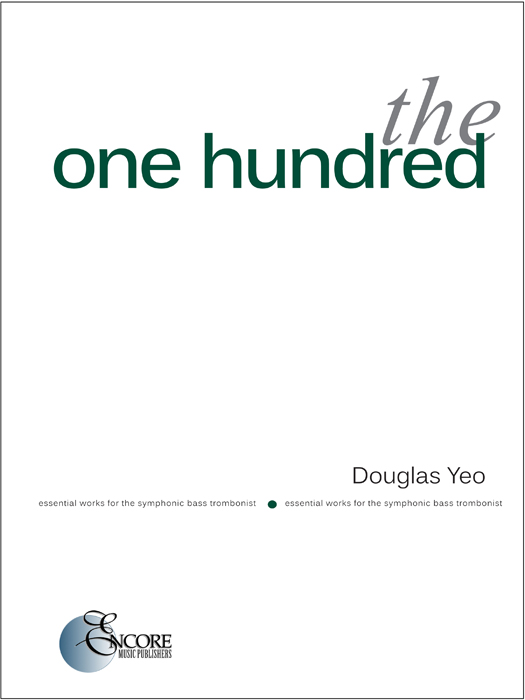
Over the last year and a half, I have been at work every day on a new book that has actually taken me 40 years to write. I’m very pleased that The One Hundred: Essential Works for the Symphonic Bass Trombonist is now at the printer and available for pre-order; copies will be shipped in March.
I took my first professional symphony orchestra audition in 1977, the year after I graduated from Wheaton College. That audition was for the Minnesota Orchestra. I didn’t win; the audition was won by Max Bonecutter, although I was one of four players in the final round and got cut at the same time as Charles Vernon, bass trombonist of the Chicago Symphony Orchestra who at the time was bass trombonist of the Baltimore Symphony Orchestra. That was the beginning of a process that eventually brought me to the Boston Symphony in 1985. Over these many decades, I have been engaged in studying the orchestral literature and learning all I could from colleagues, conductors, authors and many others. I brought the full orchestra score to most works to rehearsals, I took notes about how conductors were handling certain passages, and I noted when there were misprints and mistakes in my part. I have hundreds of scores, books and facsimile editions in my personal library and I have gotten great pleasure from studying them over and over again.
After having played the standard orchestral repertoire many times over, served on dozens of audition committees and taught hundreds of lessons in this music, I was glad that eighteen months ago, Wesley Jacobs, owner of Encore Music Publishers, asked me if I would like to write an annotated orchestral excerpt book for bass trombone.
In an effort to write the most comprehensive book on the subject of bass trombone orchestral repertoire preparation, I collected as many sources as I could to inform my scholarship. Take, for instance, the well-known passage from the fourth movement of Beethoven’s Symphony No. 9. Below you can see the first page of this important excerpt as printed in my new book (FYI, the watermark, 2021, is the Encore Music Publishers catalog number; this image is from the final PDF proof of the book):
I’m sure the music looks mostly familiar to those who have played this part. But I did not simply duplicate what I have seen in various editions of the symphony. Below you can see all of the sources that I consulted to inform both my commentary and my presentation of Beethoven’s music:
I used two different editions of the full orchestra score, two editions of the bass trombone part, two books about Beethoven, a book about the Ninth Symphony, a critical commentary about the Ninth Symphony and a facsimile of Beethoven’s manuscript to the piece. All of these sources, in addition to my own performance notes that I had taken during my dozens of performances of this great work, all were utilized as I put together this single page in my book. I have corrected some mistakes that have appeared in earlier printings of this music, and provided some insight into both how I approach playing this music and how conductors have led it during rehearsals and performances as well. I endeavored to leave no stone unturned and provide readers with the best, most accurate information to help them in their preparation.
While our aim was to have a book that contained 100 works, there are actually 109 works in my book. Among those works that we wanted to include were 30 that are currently under copyright, for which we needed to obtain a license and pay royalties to copyright holders in order to reproduce them in the book. We anticipated that some of the copyright holders might not give us permission to reproduce so I came up with a list of 110 works to include in case we came up short with copyrighted works. We were very pleased that 29 of the 30 copyright holders graciously agreed to license us. This left us with more works than we had originally intended but we decided to include the additional nine works over the intended 100; I have a feeling nobody will complain! The result? A book with 360 excerpts from 109 works by 49 composers.
If you are interested in more information about this new book or would like to order a copy, there are three ways you can do this:
I have put a page on my own website devoted to The One Hundred. There you can get a fuller account of how this book came to be, and you can also download a free PDF with 10 sample pages from the book so you can see the front and back covers, table of contents, preface, and four sample pages.
I want to thank Wesley Jacobs, owner of Encore Music Publishers, for working with me so I could – at last – write this book. It has been a labor of love, something I have wanted to do for a very long time. It is very, very satisfying to know that soon, it will be in the hands of students and players around the world.
Fake news is in the news. Unless you believe it isn’t. Fake news has been around for a very long time. Sometimes it’s a mistake borne out of ignorance, such as the early belief that the earth was flat. If nobody knows it’s round, it’s flat. But it’s not flat; it’s round. So the flat earth assertion is fake news. Sometimes fake news is known to be false but is spread with malicious intent. Say something enough times and people will think it’s true. It’s important to develop a good filter when information comes your way. It may be true; it may be fake.
The trombone has not been immune to its own fake news stories, especially regarding its history. I’ve been doing some research into this for one of the books that I’m writing and thought I’d share several items that have led many people to believe that the trombone was invented in antiquity, in Roman and early Biblical times. These myths – this trombone fake news – continue to the surface now and then as proof of an ancient origin of the trombone. Let’s set the record straight.
Shakespeare: Coriolanus
The Trumpets, Sackbuts, Psalteries, and Fifes,
Tabors, and Cymbals, and the shouting Romans,
Make the Sun dance. Hark you. (A shout within)
Men: This is good news!
Above, in the 1623 published edition of Shakespeare’s play and in a transcription in modern English, are several lines from Act V of William Shakespeare’s 1605 play, Coriolanus. The play is based on the life of the legendary–most scholars now believe that he never existed–Roman general, Gaius Marcius Coriolanus.
Here, Shakespeare includes the sackbut, an English name for the early trombone, among the list of instruments that were being played as Volumnia triumphantly enters the city. We know that trombones were part of the stage prop inventory for the “Admiral’s Men,” a theatrical company that was contemporary with Shakespeare. But in Coriolanus, Shakespeare takes an instrument with which he was familiar–the trombone, or sackbut–and places it in ancient Rome. Fake news.
Trombones at Pompeii and Herculaneum
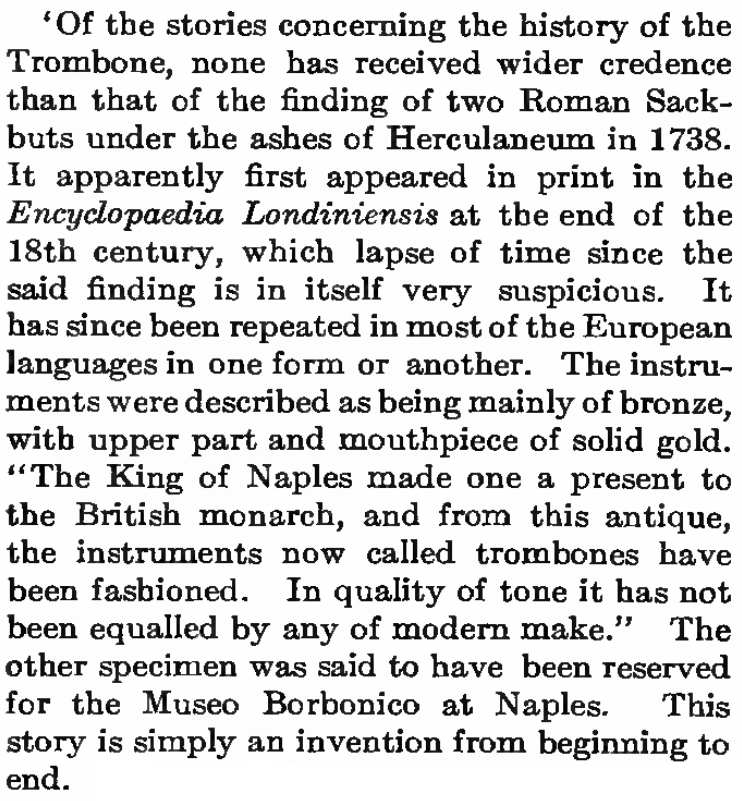
The destruction of Pompeii and Herculaneum due to the explosion of the volcano, Mount Vesuvius in A.D. 79, has led to many legends about what actually was found during the excavation of the cities that began in 1599. One of the most fanciful tales is that “two Roman Sackbuts” were found in the ruins of Herculaneum. This report first circulated in the 1700s but was, fortunately, debunked in the second edition of the Grove Dictionary of Music (1910):
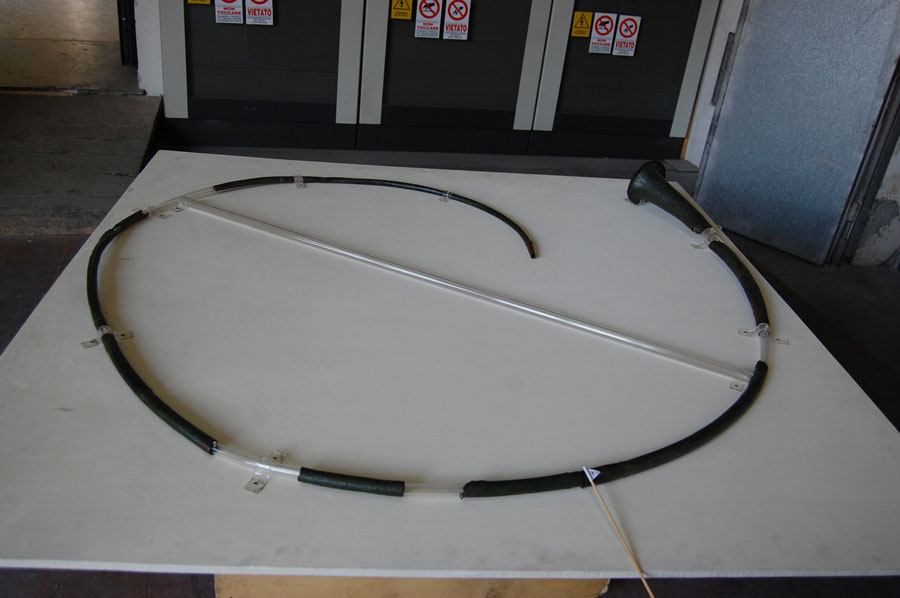
The instruments that actually WERE found in the ruins of Herculaneum were Roman cornu. Here is a photo of one of the Herculaneum cornu and more photos and commentary about these instruments may be found by clicking HERE.
The trombone in Roman times? Fake news.
Longfellow: Tales of a Wayside Inn
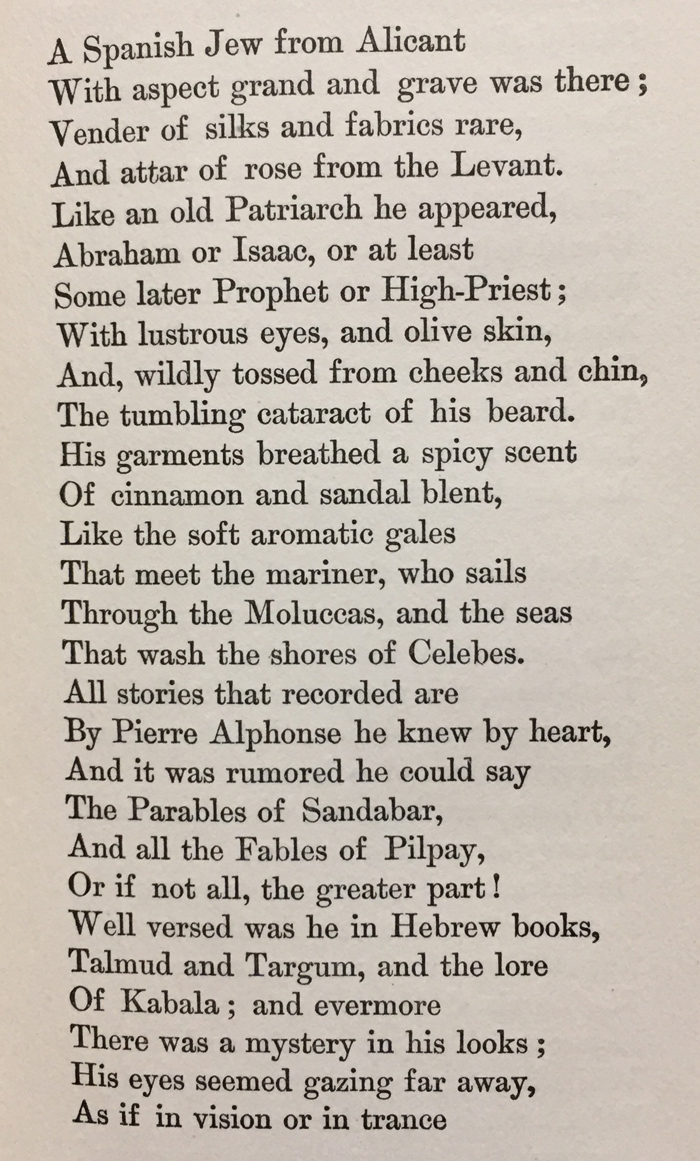
Henry Wadsworth Longfellow’s collection of poems, Tales of a Wayside Inn, is a classic of English literature. Written in 1863, the book relates fictional stories and tall tales told by a group of guests at the Wayside Inn, a real Inn in Sudbury, Massachusetts. Early in the book, Longfellow introduces “A Spanish Jew from Alicant.” As Canon Francis Galpin wrote in his essay, The Sackbut, Its Evolution and History (1906), “Longfellow (Tales of a Wayside Inn, Prelude), has unfortunately added popularity to this idea of the antiquity of the instrument [sackbut/trombone] by the following reference to ancient history.” At which point he quotes the closing lines of this excerpt from Longfellow’s poem (two scanned files since they appear over two pages in my copy of the 1913 edition):
Trombones in the ancient Middle East? Fake news.
Sackbut in the Bible: The 1611 King James Version
I have a high view of the authority of the Bible and believe that it is the inspired, inerrant word of God. But there is a problem with the idea of Biblical inerrancy. The Bible was originally – and inerrantly – written in ancient languages, including Hebrew and Aramaic. Those who have translated the Bible into other languages have often had trouble knowing what words in the original languages actually meant/mean.
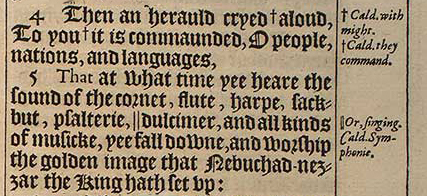
In the famous 1611 translation of the Bible into English, the so-called “Authorized King James Version,” we find this verse from the Book of Daniel, Chapter 3, verse 5:
That at what time yee heare the sound of the cornet, flute, harpe, sackbut, psaltery, dulcimer, and all kinds of music, yee fall down and worship the golden image that Nebuchadnezzar the King hath set up:
This passage goes on to reference the Prophet, Daniel, who, because he would not bow down and worship Nebuchadnezzar’s golden image, was thrown into a den of lions where God preserved his life.
The problem with Nebuchadnezzar’s little band is that the sackbut wasn’t part of the jam session. Translators of the King James Version were stumped. They came across an Aramaic word in the passage and did not know what instrument was being described. Jeremy Montague describes the problem:
The reason for [the sackbut’s] use in the Authorized Version is that the word in the Aramaic is sabb-cha, and King James’s translators had no idea of what it meant but just picked something familiar that sounded similar. The Septuagint has sambyke each time (Vulgate, sambuca), and it is probably that it is the word that the author of Daniel was aiming at. Jeremy Montagu, Musical Instruments of the Bible (London: Scarecrow Press, 2002), p. 98.
Since the King James Version was published, Biblical scholars know much more about ancient languages and ancient musical instruments, and the sambuca is now usually translated as psaltery or lyre. In fact, the New King James Version translates it as lyre. Not sackbut. Not trombone.
The trombone in ancient, Biblical times? Fake news.
It is important to keep in mind that apart from the fanciful report of the discovery of trombones in the excavation of Herculaneum, none of these “fake news” reports about the trombone were malicious or intended to deceive. Shakespeare and Longfellow were using poetic license to place the trombone in ancient times, putting an instrument with which they were familiar into an historical setting. They also may just have liked the sound of the name of the instrument and how it rolls off the tongue. The translators of the King James Version did the very best they could with the knowledge they had when they translated sambuca as sackbut. Over time, scholars gained a better understanding of the meaning of the word and they corrected it in subsequent translations of the Bible. The problem occurs when people today don’t understand that these references that place the trombone in ancient times are false. The assertion that the trombone was found in antiquity still comes up in books, articles, and student papers today. The trombone has a long and noble history that dates from the fifteenth century. We continue to learn more about this rich history including when things previously thought to be true are now known to be false. Check your sources when you write about the trombone. You’ll be doing your part to stop trombone fake news.
Last week I had the great pleasure of traveling to University of Illinois Urbana-Champaign to take part in several immensely rewarding activities.
Over the years I have been a guest artist at dozens of schools, colleges and universities around the world. The opportunity to engage with students – whether in a lecture, performance, masterclass or, as was the case at University of Illinois, something completely different – is exceptionally rewarding and I always enjoy becoming part of the local musical culture when I am visiting.
The invitation to travel to Urbana-Champaign came from Scott Schwartz, Archivist for Music and Fine Arts and Director of the Sousa Archives and Center for American Music on the University of Illinois campus. Scott and I had met many years ago at the Great American Brass Band Festival in Danville, Kentucky, where I had presented a paper about the use of serpent and ophicleide in brass bands and I performed a solo on ophicleide accompanied by the Athena Brass Band.
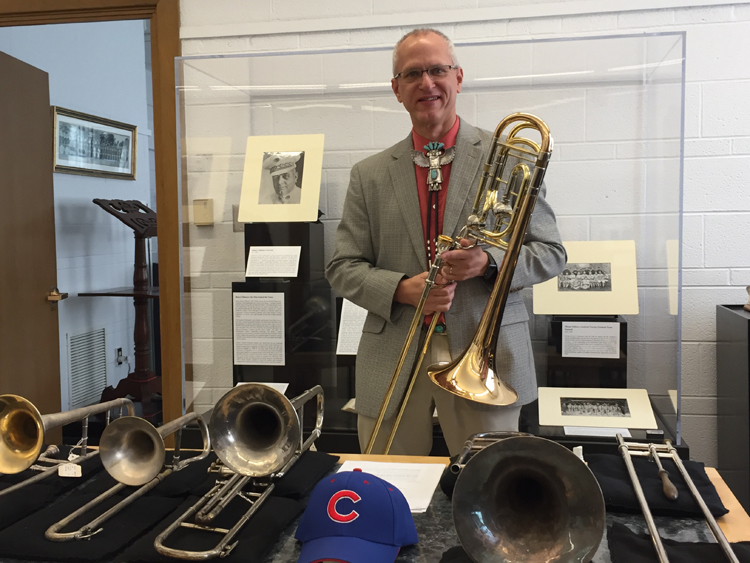
Scott asked if I would be interested in coming to Illinois to give a lecture/demonstration about early American trombone makers, their innovations and marketing strategies. The Sousa Archives had set up a very nice exhibit of six late-nineteenth and early-twentieth trombones as well as mouthpieces, catalogs, advertisements and other ephemera. In addition, we had selected six other instruments for me to play and demonstrate. Oh, and not to be lost in the moment is that the Chicago Cubs had just won baseball’s World Series and it seemed appropriate to make my Cubs hat part of the display.
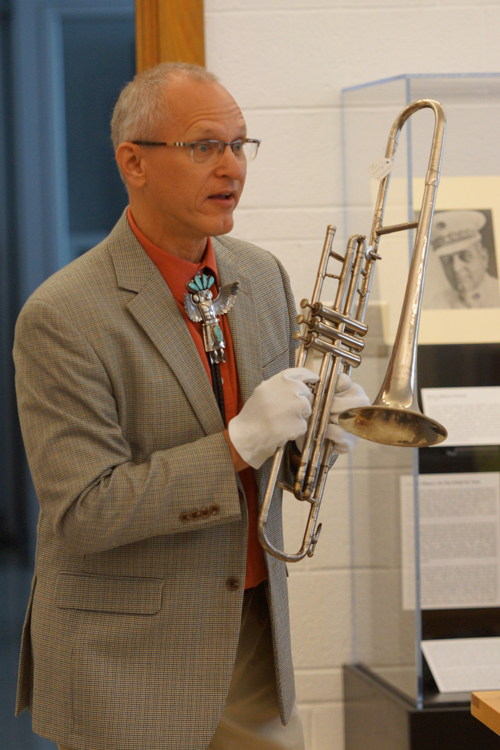
I always enjoy getting my hands on, talking about and playing old instruments, such as the alto valve trombone pictured above. The time at the Sousa Archives was very rewarding and was made more so because of the engaged audience and their great questions.
From the Sousa Archives I went to the University of Illinois School of Music where I gave a trombone masterclass. I worked with three talented students and also enjoyed getting together with my friend, Jim Pugh, who teaches jazz trombone and composition at University of Illinois. That was fun.
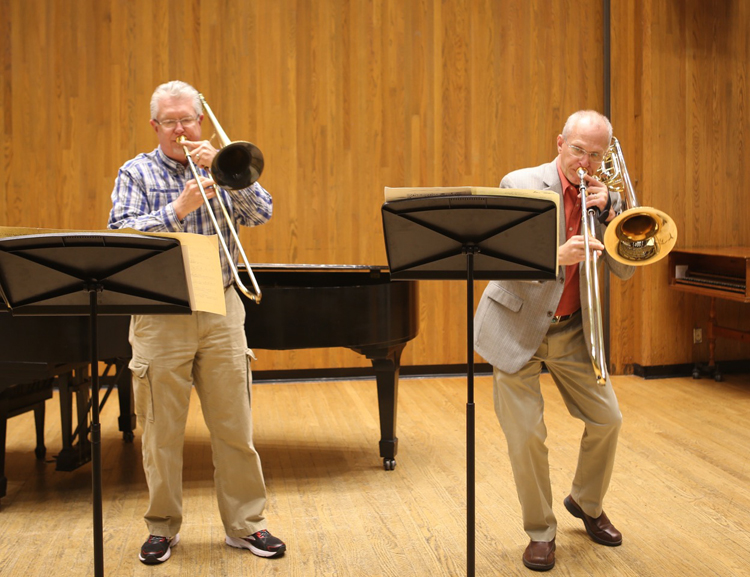
I have known Jim for decades and have the utmost respect for him as a player and a person. Several years ago I reviewed his superb CD, X Over Trombone, and I consider him to be one of the most creative players – and composers – on the scene today. Despite our long friendship, we had never played together, so we started the masterclass with a performance of Charles Small’s duet Conversation.
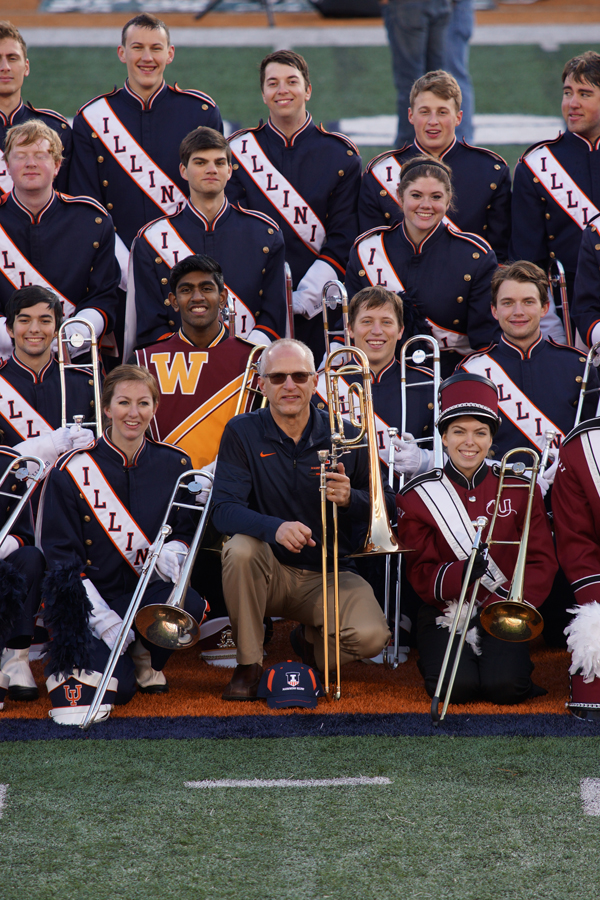
The third piece of my University of Illinois trip was a performance with the Marching Illini Band under the direction of Barry Houser. As an event with another connection to my trombone lecture and masterclass, I led a group of 75 trombone players – both members of the Marching Illini Band and students from local high schools – in a performance of Meredith Wilson’s 76 Trombones to start the halftime show of the Illinois/Michigan State football game. 75 + me = 76 Trombones. That doesn’t happen every day. Click the video image below to see the whole halftime show; it begins with 76 Trombones, and continues with a tribute to the Chicago Cubs and much more.
Now, when you put 76 trombones on a football field accompanied by a marching band, that is one impressive sight and sound. My hat is off to the Marching Illini for inviting local high school trombone players to join with the 40 trombonists of the Illini Band to get us up to 76 trombone players. This is one fine band, and I was caught up in many of their great traditions. School spirit was alive and well; it was a great day of interaction for all of us and, hey, Illinois won the game. It must have been the trombones.
I want to send a big THANK YOU to Scott Schwartz for making all of this happen, to Jim Pugh for his setting up the trombone masterclass and for playing Conversation with me, and to Barry Houser and all of the members of the Marching Illini Band for a great few days where we all came together in Illini orange and blue and celebrated the trombone. This was a memorable and very satisfying trip. Go Illini! I – L – L – – I – N -I !
[And thanks to Scott Schwartz and Grace Talusan for the photos.]
To readers of The Last Trombone: Since I wrote this article in October 2016, I have continued my research on this subject. This has led to publication of a follow up article, written on April 25, 2017, to the comments that appear below; I urge you to read Rethinking Mozart’s Tuba mirum – part 2 when you finish reading this article.
• • •
The trombone solo in the Tuba mirum of Wolfgang Mozart’s Requiem is one of the most important solos for trombone in the orchestral literature. It appears on nearly every tenor trombone audition – whether an audition for college or a professional symphony orchestra. As most trombonists know, Mozart (1756-1791) did not live to finish the Requiem and many people have stepped in to put the piece in a playable form since Mozart’s wife asked Franz Süssmayr to finish the piece shortly after the composer’s death. A look at Mozart’s manuscript shows us that he made very few markings to guide how the solo should be played.
Over the years, a type of settled wisdom came to define how players should approach the solo. Süssmayr added dynamics and many slurs, and most conductors ask players to, after the initial opening seven note “fanfare,” to play the solo in a legato, beautiful style. Audition committees seem to expect this style as well.
But I wonder if it isn’t time to revisit how we play this solo. I think it’s possible that we have been approaching it all wrong.
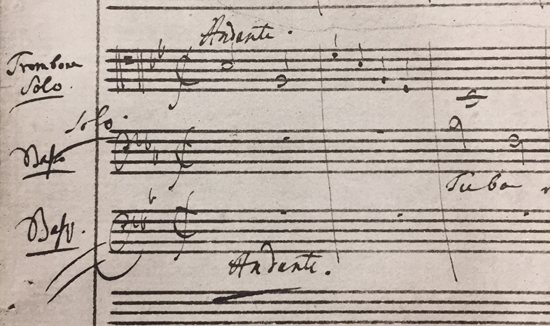
The “historically informed performance practice” movement (HIP) of recent years has helped us to revise our thinking about this in some important ways. First, many reproductions of the trombone solo of Mozart’s Tuba mirum, including its inclusion in many orchestral excerpt books, have shown the movement’s time signature to be common time, or 4/4. But when we look at Mozart’s manuscript, we see that the composer clearly intended the movement to be in cut time, or 2/2.
Here is a detail of the beginning of the Tuba mirum in Mozart’s manuscript; the cut time marking is unambiguous:
Here is the beginning of the Tuba mirum as found in Orchestral Excerpts from the Symphonic Repertoire for Trombone and Tuba, ed. Keith Brown, Volume 1, p. 83; the meter is given as common time:
And here is the beginning of the Tuba mirum as found in Moderne Orchesterstudien Für Posaune und Baßtuba, ed. Alfred Stöneberg, Vol. 1, p. 3; the meter is given as common time:
So, we have our first question: what is the tempo of a late 18th century Andante in 2/2? In fact, if you look carefully at the first page of Mozart’s manuscript above, he underlines the word Andante in the tempo – he could not be more emphatic that he wanted this tempo. Until recently, most conductors have conducted this movement in 4/4, with a tempo of approximately quarter note = 82. Or slower. Herbert von Karajan’s recording of the Tuba mirum with the Berlin Philharmonic clocks in at about quarter note = 66 and he has all three trombone players play the solo in unison. Copyright restrictions do now allow me to embed von Karajan’s recording in this article but you can hear it by clicking on this link (the recording will open in YouTube in a new window).
But is that kind of tempo REALLY Andante? A tempo of quarter note = 82 would be a tempo of half note = 41, or Lento, or in von Karajan’s case, quarter note = 66 is the same as half note = 33, or Grave. We first must examine whether the “traditional tempo” is too slow. I think it is. Listen to this performance of the solo by trombonist Susan Addison with John Elliot Gardiner conducting the English Baroque Soloists. This tempo is about half note = 50 (and do not be thrown off by the fact that this performance is in A major rather than B-flat major; the performance is at Baroque pitch, A=415):
Even this tempo seems a little slow for Andante, a tempo that is often defined as “walking tempo.” From a correct understanding of Mozart’s intentions regarding the tempo flow other questions.
Here is a larger point that I think bears some consideration: the text of the Tuba mirum and its implication on the musical character of the movement.
Tuba mirum is part of the Dies irae of the Requiem mass. In the Requiem, Mozart combines five sections of the Dies irae into the movement he titles “Tuba mirum.” These are Tuba mirum (baritone solo with trombone), Mors stupebit (tenor solo), Liber scriptus (tenor solo),Judex ergo (alto solo) and Quid sum miser (soprano solo and vocal solo quartet). For the sake of this discussion, I am limiting myself to talking about the first part, Tuba mirum, with the three lines of text reproduced below. Its text is in Latin, in trochaic meter, and it describes the day of judgment when all mankind is called before the throne of God. This is not a text that is gentle in any way:
Tuba mirum spargens sonum
Per sepulchral regionum,
Coget omnes ante thronum.
A “standard literal” English translation of this text is:
The trumpet, scattering a wondrous sound
through all the sepulchers of the regions,
will summon all before the throne.
A fuller translation that gives the Biblical sense of the text runs something like this:
The trumpet, blowing its amazing sound to all of the corners of the earth,
signals to all of the dead in the world
to rise from their tombs and come before the throne of God for judgment.
Here is how Michelangelo pictured the moment described in the Tuba mirum, in his famous fresco of The Last Judgment in the Sistine Chapel. Trumpets sounding, the dead being raised before the throne, in fulfillment of these words from John 5:28:
“The hour is coming in which all that are in the graves shall hear his voice, and shall come forth; they that have done good unto the resurrection of life; and they that have done evil unto the resurrection of damnation.”
Here, below, is a detail of the lower left of Michelangelo’s work, showing the dead rising from their tombs. Certainly this is a moment of exceptional drama:
The point I am making is this: does the text of the Tuba mirum support a gentle style of music making, with the soft dynamic and generous legato that has become so commonplace in our performances?
Listen, for instance, to how Hector Berlioz (1803-1869) set the Tuba mirum text in his Requiem. He required four brass bands – one for each corner of the earth – to call the dead from their graves to judgment:
It’s easy to argue that Berlioz was French, a 19th century Romantic-era composer and it is unfair to compare him with Mozart. But can it really be disputed that Berlioz didn’t capture the character of the Tuba mirum with the drama of dozens of brass players being the summons of God to judgment?
If we go to Requiems of contemporaries of Mozart, we find that many treat the Tuba mirum with more drama than we traditionally give to our interpretations of Mozart. Antonio Salieri (1750-1825), Mozart’s contemporary, uses trumpets and three trombones to loudly proclaim the call to judgment, while the chorus alternates between a breathless declaration and a loud summons. In it you can hear a foreshadowing of Berlioz’s brass bands:
In his unfinished Requiem in B-flat major, Johann Michael Haydn (1737-1806) employs three trombones in dramatic fashion at the presentation of the Tuba mirum:
The same can be said for the Requiem of Luigi Cherubini (1760-1842), whose setting of the Dies ire begins with a loud brass fanfare, the crash of a gong, and a brisk, dramatic treatment by chorus and brasses. The audio clip below contains the whole piece and the Tuba mirum is at 9:04:
It should be noted that this issue – the editorial dynamics and phrasings that have been added by editors other than Mozart that cause the Tuba mirum to be performed in a way that is rather disconnected from the character of the text – is not discussed in any of the Mozart literature that I have read. There are many editions of the Requiem and many completions of Mozart’s incomplete score. Most contain extensive front matter and a discussion of editorial decisions. Yet none speak to this issue. Among those I have examined are those by Alfred Schnerich (first publication of Mozart’s manuscript in facsimile, Gesellschaft for Graphische Industrie, Vienna, 1913), Leopold Nowak (Bärenreiter edition of Süssmayr’s completion, 1966), Franz Beyer (Beyer’s instrumentation, Edition Kunzelmann, 1971) and Richard Maunder (Maunder’s instrumentation, Oxford University Press, 1987). Nor is this discussed in The Mozart Compendium (H. C. Robbins Landon, G. Schirmer, 1990), Mozart (Maynard Solomon, HarperCollins, 1995), or Constanze Mozart: After the Requiem (Heinz Gärtner, translated by Reinhard Pauly, Amadeus Press, 1991). Neither it mentioned in Alfred Einstein’s important study, Mozart: His Character, His Word (Oxford University Press, 1945). In short, the Mozart literature is mute on this subject.
There are two recordings of the Requiem that are of particular interest to me and show that some conductors ARE thinking about this.
The recording below, by Christoph Sperling with Das Neue Orchester, contains a complete recording of the Süssmayer edition and also a recording of the Requiem as Mozart left it, without any editorial additions. The instrumentation of Mozart’s manuscript is very thin and the trombone soloist (who is unidentified in the liner notes but the three trombone players are listed as Robb Tooley, Katherine Couper and Uwe Haase) plays with strength and clean articulation. Note, too, the tempo, which is faster that we are accustomed to hearing:
Another interesting recording for comparison is that by Boston Baroque, conducted by Martin Pearlman, in the completion of Mozart’s manuscript by Robert Levin. The trombone soloist is Cormack Ramsey and the tempo and interpretation seems to better reflect the character of the text. Copyright restrictions do not allow me to embed that recording in this article but you can hear it by clicking this link (YouTube will open in a new window).
As with the presentation of any idea that is outside the established box, people will raise questions. I’m good with that. Let me answer some questions here:
Yes: I know that Mozart did write three slurs at the end of the Tuba mirum trombone solo; these are verified to have been Mozart’s own instruction in his own hand (they are the only slurs for trombone that were written by Mozart in the Tuba mirum). But does the inclusion of slurs necessarily mean the phrase should be played softly?
Yes: Mozart wrote several dynamic markings in the Tuba mirum but the first one, forte-piano, doesn’t occur until measure 18, where the tenor begins singing Mors stupebit natura. Mozart wrote no dynamics during the entire trombone solo (measures 1-18; we must keep in mind that the “second half” of the trombone solo, that in some editions appears starting at measure 24, is entirely a creation of Süssmayr, not Mozart). As well, keep in mind that for the entire Tuba mirum, the only music that we have in Mozart’s own hand is written for cello/bass, trombone solo and vocal soloists. He wrote no parts for violins or violas or any wind instruments apart from trombone. Mozart left the movement, as he did most of the Requiem, as an uncompleted torso.
Yes: I know that the way the Tuba mirum is traditionally played is quite lovely, and it makes for a very nice musical presentation. Mozart had previously used a trombone solo as an obligato to a vocal line to great effect (with a very different kind of text) in his Die Schuldigkeit des ersten Gebots. My point is that the way we traditionally the Tuba mirum doesn’t seem to fit with the message of the text.
But none of this prevents me from asking: Can we start a conversation about the way in which we are interpreting the Tuba mirum of Mozart’s Requiem? Does our traditional way of playing the Tuba mirum – with its soft dynamic and gentle legato – fit the drama of the text? Have we added too much to the sparse instructions Mozart left in his unfinished manuscript? Knowing how conductors somehow overlooked the correct meter and tempo for this movement for so long, have we overlooked the fundamental character of the movement as expressed by the text? Have we gotten into a habit of how we interpret this without considering other options might open new doors of understanding?
I am posing an idea, a theory; I am not presenting this as a settled thought in need of adoption. Certainly more research and study needs to be done. I am simply posing the question. Let’s keep thinking.
• • •
Please note: After reading this article, please read my follow up article, Rethinking Mozart’s Requiem – part 2, published on The Last Trombone on April 25, 2017.










 The Last Trombone – Douglas Yeo