Category: music

Monteverdi. And A Trace of Grace

Monteverdi. And A Trace of Grace

Last week, a good friend of mine was singing Claudio Monteverdi’s Vespers of 1610, the Vespro Della Beata Vergine (Vespers of the Blessed Virgin). This is an extraordinary work, one that I have loved since I first heard it many decades ago. I was very fortunate to have an opportunity to play the Vespers in 2003 as a member of Boston’s Handel and Haydn Society. This was a unique performance that was semi-staged (statues of the Virgin Mary were plentiful at those performances) at the Colonial Theatre in Boston’s theater district. The photo below shows the winds of that performance (clockwise from bottom left): Michael Collver , Paul Perfetti and Kiri Tollaksen (cornettos) and myself, John Faieta and Robert Couture (sackbuts).
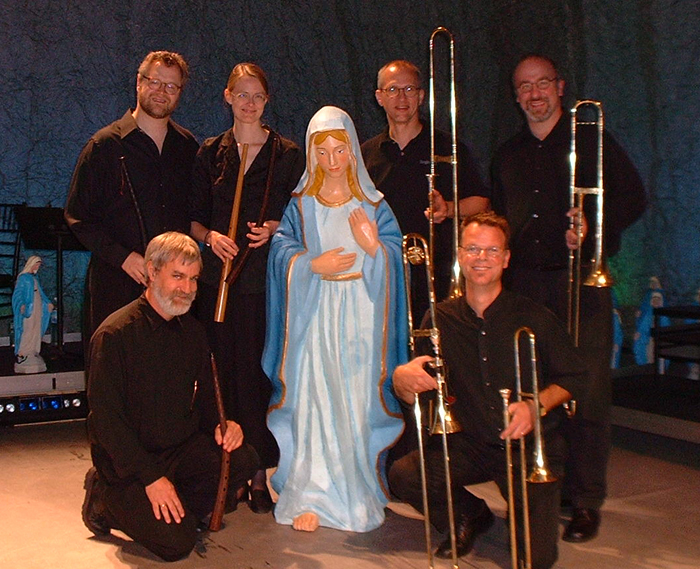
monteverdi_band_01_blog

All of this thinking about Monteverdi has had me listening to a lot of his music in the last few weeks, and I turned in particular to my favorite recording of the Vespers, that by Boston Baroque conducted by Martin Pearlman. Here’s a short video with highlights from a Boston Baroque performance of the Vespers from 2014. If you can’t view the imbedded video below, click HERE to view the video on the Vimeo website.

Most people, if they know Monteverdi’s music at all, know the Vespers. But he wrote so much more.

One of my favorite Monteverdi pieces, one I never tire of listening to, is his aria, Si dolce è il tormento. It is a haunting, plaintive melody of an irregular length that is sung over an interesting, even curious bass line. It has been sung by many of the world’s finest singers. Scored for singer with continuo – it has been performed with a host of accompaniments –  it seems most effective, to me, when the accompaniment is simple rather than complex. Here is a performance by Anne Sophie von Otter. If you can’t view the imbedded video below, click HERE to view the video on the YouTube website.

Von Otter is one of my favorite singers, and she had a lead part in one of the most memorable concerts I played when I was a member of the Boston Symphony Orchestra,  conducted by James Levine. These were performances of Les Troyens by Hector Berlioz where von Otter had the role of Dido, the Queen of Carthage. It was electrifying, stunning, unforgettable. The Boston Globe‘s review is glowing but words cannot really express that beauty and power of those performances.

But I take nothing away from Sophie von Otter when I say I have particular affection for a performance of Si dolce è il tormento that my good friend, Michel Godard, organized. Michel is an exceptional player of the serpent, an instrument I’ve been playing since 1993. He is also a man of unusual and special creative abilities, and he has recorded many albums of music that features his playing serpent. These albums are classical, jazz and what Gunther Schuller referred to as “third-stream,” a synthesis of classical music and jazz. His CD, Monteverdi: A Trace of Grace, includes a remarkable performance of Si dolce è il tormento. Guillemette Laurens has a deep, rich voice with a unique timbre, and the combination of theorbo, violin, serpent and electric bass accompaniment is beautiful to behold. I am not such a purist (read: snob) that I cannot enjoy creative treatments of classic works. Treated with respect, love and care, great music can live in many forms. Michel and his collaborators bring all of that and more to this beautiful performance.

Fortunately, Michel’s recording session was captured on video and you can enjoy it below. If you can’t view the imbedded video below, click HERE to view the video on the Vimeo website.

Monteverdi. A Trace of Grace, indeed.

[The photo at the top of this post shows my serpent d’église by Baudouin (Paris, c. 1812). The photo was taken in my room at Kloster Michaelstein, Germany, when I was there presenting a paper and giving a concert at the symposium, Der Zink: Geschichte, Instrumente und Bauweise, in 2009.]

199: Perseverance and excellence

199: Perseverance and excellence

This article starts with football but even if you’re not interested in that sport, if you stick with it, you’ll see how football flows to music after a few paragraphs.

My students know that I often turn to sports – usually football – for metaphors about excellence, motivation and perseverance. My wife and I have been football fans for many years. We have season tickets to the Arizona Cardinals and we attended many New England Patriots games when we lived in Boston. I attended Super Bowl XXXVI (Patriots defeated the St. Louis Rams) where I played the National Anthem and pregame show as a member of the Boston Pops Orchestra, and my wife and I attended Super Bowl XLIX (Patriots defeated the Seattle Seahawks) here in Arizona just two years ago. Fun times. Great memories.

But there things in football that I turn to over and over as I work with students to help them develop the engine that drives their pursuit of excellence. One of them is the number 199.

When I would attend college football games, I often remarked that very, very few college football players ever end up in the National Football League. The NFL draft has seven rounds; there are 32 teams. That means there are 224 players chosen in the regular draft; several others are chosen as “compensatory picks” and some undrafted players are also signed by teams. The hard reality is that most college football players never play in the NFL. It’s an elite group. Like being a member of a great symphony orchestra.

In the 2000 NFL draft, there were 254 college players chosen in the draft. Number 199, chosen with a compensatory pick in the sixth round, was Tom Brady, from University of Michigan. Six other quarterbacks were drafted before him.

Brady, of course, went on to be arguably the best quarterback in NFL history; some analysts consider him to be the best PLAYER in NFL history. He has led the New England Patriots to five Super Bowl victories; he is a four time Super Bowl Most Valuable Player.

But when the Patriots drafted him at 199 in the 2000 NFL draft, he was a long shot to make the Patriots’ roster. The Patriots had no idea if he would make the team. But Brady had ideas of his own. Brady knew he had what it takes to make a difference on a team. All he needed was a chance.

Tom Brady used the fact that he wasn’t picked until 199 in the sixth round as fuel for his engine. He wanted to prove everyone wrong. When he first met Robert Kraft, owner of the Patriots, Brady said, “Mr. Kraft, drafting me was the best decision you ever made.” I’m sure Kraft’s eyebrows raised a little. But Brady knew he had something. And in his second year with the Patriots, thrust into the starting quarterback role when quarterback Drew Bledsoe was injured, Tom Brady led the Patriots to their first Super Bowl championship.

tb_199_shirt

One of my favorite t-shirts is one  by Under Armour that simply says “199.” It’s a reminder that sometimes you know you have something to offer but you just need a chance to prove it. The chip that Tom Brady carries on his shoulder, the chip that says, “You thought I was only good enough to be 199 but I will show you that you are wrong,” is a reminder that motivation to pursue excellence comes in many shapes and sizes, and from many places.

Tom Brady also has one of the most disciplined work ethics of any person I have known. He absolutely is the embodiment of a phrase I often use: “Success comes from delaying present pleasures for future rewards.” Brady is fanatical about caring for his body, his diet, his physical regimen, for getting the sleep he wants/needs, for engaging in mental stimulation. These things keep him from other recreational pursuits or dietary desires that would throw him off his disciplined routine. There will be time, when he retires someday, for those other things. For now, he remains disciplined to achieve his goals.

A few weeks ago, I was interviewed by the website careersinmusic.com. The interview focused on what is required for a musician to win a position as a section member in a symphony orchestra. The result was a straight-shooting dialogue that I want to share with readers. In the interview, I talk about perseverance, the sacrifices needed to succeed, and the importance of two words that most people don’t really understand at all: Work. Hard.

Click HERE to read my interview on careersinmusic.com

Everyone has a ceiling. Not everyone will succeed at the highest level. Some people with tremendous talent don’t have the discipline needed to succeed at the highest level. Some people with a tremendous work ethic don’t have the talent needed to succeed at the highest level. But everyone CAN succeed at SOME level. The idea that you only need to work at something for 10,000 hours to succeed is foolishness. Practice doesn’t make perfect: practice makes permanent. If you don’t know how to practice something CORRECTLY, then you will get excellent at playing it poorly. And unless you understand the real meaning of the word “perseverance,”  you will never know where your talent and work ethic can take you.

Tom Brady found out. Number 199 became number 1. Not by accident. Not by getting “lucky.” He got there by combining his God-given talent with perseverance and hard work. He had what it took even when others didn’t see it. As my teacher, Edward Kleinhammer (bass trombonist of the Chicago Symphony, 1940-1985) said:

World class trombone players do not just happen. Their talents are forged in the dual furnaces of determination and diligence.


199.

A new book – The One Hundred: Essential Works for the Symphonic Bass Trombonist

A new book – The One Hundred: Essential Works for the Symphonic Bass Trombonist

Over the last year and a half, I have been at work every day on a new book that has actually taken me 40 years to write. I’m very pleased that The One Hundred: Essential Works for the Symphonic Bass Trombonist is now at the printer and available for pre-order; copies will be shipped in March.

I took my first professional symphony orchestra audition in 1977, the year after I graduated from Wheaton College. That audition was for the Minnesota Orchestra. I didn’t win; the audition was won by Max Bonecutter, although I was one of four players in the final round and got cut at the same time as Charles Vernon, bass trombonist of the Chicago Symphony Orchestra who at the time was bass trombonist of the Baltimore Symphony Orchestra. That was the beginning of a process that eventually brought me to the Boston Symphony in 1985. Over these many decades, I have been engaged in  studying the orchestral literature and learning all I could from colleagues, conductors, authors and many others. I brought the full orchestra score to most works to rehearsals, I took notes about how conductors were handling certain passages, and I noted when there were misprints and mistakes in my part. I have hundreds of scores, books and facsimile editions in my personal library and I have gotten great pleasure from studying them over and over again.

After having played the standard orchestral repertoire many times over, served on dozens of audition committees and taught hundreds of lessons in this music, I was glad that eighteen months ago, Wesley Jacobs, owner of Encore Music Publishers, asked me if I would like to write an annotated orchestral excerpt book for bass trombone.

I was delighted to be asked to undertake this huge project, and to have a book stand alongside the two other important annotated orchestral excerpt books in The One Hundred series:  The One Hundred: Essential Works for the Symphonic Tenor Trombonist (by Megumi Kanda, principal trombonist of the Milwaukee Symphony) and The One Hundred: Essential Works for the Symphonic Tubist (by Wesley Jacobs, retired tubist of the Detroit Symphony).

In an effort to write the most comprehensive book on the subject of bass trombone orchestral repertoire preparation, I collected as many sources as I could to inform my scholarship. Take, for instance, the well-known passage from the fourth movement of Beethoven’s Symphony No. 9. Below you can see the first page of this important excerpt as printed in my new book (FYI, the watermark, 2021, is the Encore Music Publishers catalog number; this image is from the final PDF proof of the book):

beethoven_9_the_100

I’m sure the music looks mostly familiar to those who have played this part. But I did not simply duplicate what I have seen in various editions of the symphony. Below you can see all of the sources that I consulted to inform both my commentary and my presentation of Beethoven’s music:

beethoven_9_sources

I used two different editions of the full orchestra score, two editions of the bass trombone part, two books about Beethoven, a book about the Ninth Symphony, a critical commentary about the Ninth Symphony and a facsimile of Beethoven’s manuscript to the piece. All of these sources, in addition to my own performance notes that I had taken during my dozens of performances of this great work, all were utilized as I put together this single page in my book. I have corrected some mistakes that have appeared in earlier printings of this music, and provided some insight into both how I approach playing this music and how conductors have led it during rehearsals and performances as well. I endeavored to leave no stone unturned and provide readers with the best, most accurate information to help them in their preparation.

While our aim was to have a book that contained 100 works, there are actually 109 works in my book. Among those works that we wanted to include were 30 that are currently under copyright, for which we needed to obtain a license and pay royalties to copyright holders in order to reproduce them in the book. We anticipated that some of the copyright holders might not give us permission to reproduce so I came up with a list of 110 works to include in case we came up short with copyrighted works. We were very pleased that 29 of the 30 copyright holders graciously agreed to license us. This left us with more works than we had originally intended but we decided to include the additional nine works over the intended 100; I have a feeling nobody will complain! The result? A book with 360 excerpts from 109 works by 49 composers.

If you are interested in more information about this new book or would like to order a copy, there are three ways you can do this:

The website of Encore Music Publishers will lead you to a page about the book; it is featured on the website’s first page. While there, have a look at Encore Music Publisher’s many other fine publications, including the edition of the Arban Complete Method for trombone and euphonium by Joseph Alessi and Brian Bowman, and the Complete Vocalises by Marco Bordogni edited by Michael Mulcahy.

Encore Music Publishers has created a website for the three books in The One Hundred series. This is a convenient gateway to information about all three books in the series, for tenor trombone, bass trombone and tuba.

I have put a page on my own website devoted to The One Hundred. There you can get a fuller account of how this book came to be, and you can also download a free PDF with 10 sample pages from the book so you can see the front and back covers, table of contents, preface, and four sample pages.

I want to thank Wesley Jacobs, owner of Encore Music Publishers, for working with me so I could – at last – write this book. It has been a labor of love, something I have wanted to do for a very long time. It is very, very satisfying to know that soon, it will be in the hands of students and players around the world.

01_cover

The Sackbut, The Psaltery and The Dulcimer – 1954 recording

The Sackbut, The Psaltery and The Dulcimer – 1954 recording

by Douglas Yeo (February 3, 2017)

A few weeks ago, I posted an article on The Last Trombone about Fake News and The Trombone. One of the things that has caused a lot of confusion about the origin of the trombone is the fact that the translators of the King James Bible (1611) translated an Aramaic word for a form of lyre as “sackbut” in Daniel Chapter 3. Sackbut is an early word for the trombone and, faced with an Aramaic word they didn’t understand, the KJV Bible translators substituted a word for something they DID know that sounded similar. Hence, the myth that the trombone dates from ancient times (rather than the 15th century) gained traction. And to be fair, most translations of the Bible since then get it right—the early trombone is no longer credited with being around in Biblical times. Including the New King James Bible.

In my ongoing research on the trombone for several of my book projects, I came across a recording made in 1954 by a doo-wop group, The Collegians, with the Sid Bass Orchestra. I saw the 45rpm record on sale on an auction site and sight unseen, I decided to buy it. The title of the song? The Sackbut, the Psaltery and the Dulcimer.

sackbut_the_collegians

That got my attention. Those are three of the instruments that are found in the King James translation of the Bible, in Daniel, Chapter 3, verse 5:

That at what time ye hear the sound of the cornet, flute, sackbut, psaltery, dulcimer, and all kinds of music, ye fall down and worship the golden image that Nebuchadnezzar the King hath set up.

The connection between the recording and the Bible verse was immediately apparent to me. So I bought the record, not knowing what I was getting. And, wow, I am glad I bought it. I found myself owning a recording of an absolutely charming song. The songwriters – who are only identified as Hoffman-Manning-Sloane – crafted a clever story about six musicians at in ancient Babylon and Egypt who played sackbut, psaltery, dulcimer, harp, cornet and flute. They stuck the harp in for good measure. The Sid Bass Orchestra’s trombone section has a prominent role, of course. It’s well sung and played, and adds something to what we know about how the trombone was used in popular culture.

You can hear this cute song on YouTube by clicking this link or click on the video image below (if you’re reading this message in an email message, you won’t see the video image below):

If you don’t smile when you hear this, you don’t have a pulse. The trombone in Biblical times? No, that’s fake news. But that doesn’t mean we can’t have a little fun with the idea. The Collegians sure did, and we can, too.

sackbut-and-musicians