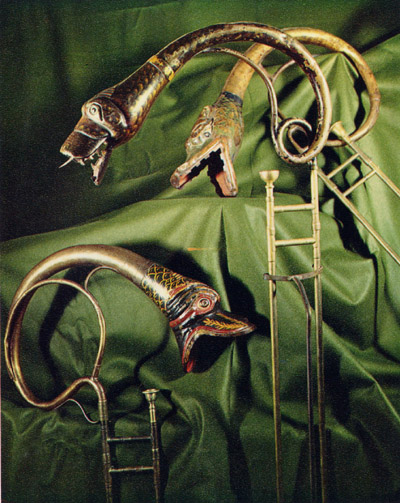
I’ve been fascinated with musical instruments for as long as I can remember. One of my earliest childhood memories is of going to the Metropolitan Museum of Art in New York City and standing in front of a display case that displayed three dragon bell trombones. These instruments, made in Belgium and France in the early nineteenth century, went by the name buccin, and I still have the postcard I bought on that afternoon, shown below. It is the oldest artifact that I have from my childhood and I wrote an article about the buccin on The Last Trombone. You can read it by clicking HERE.
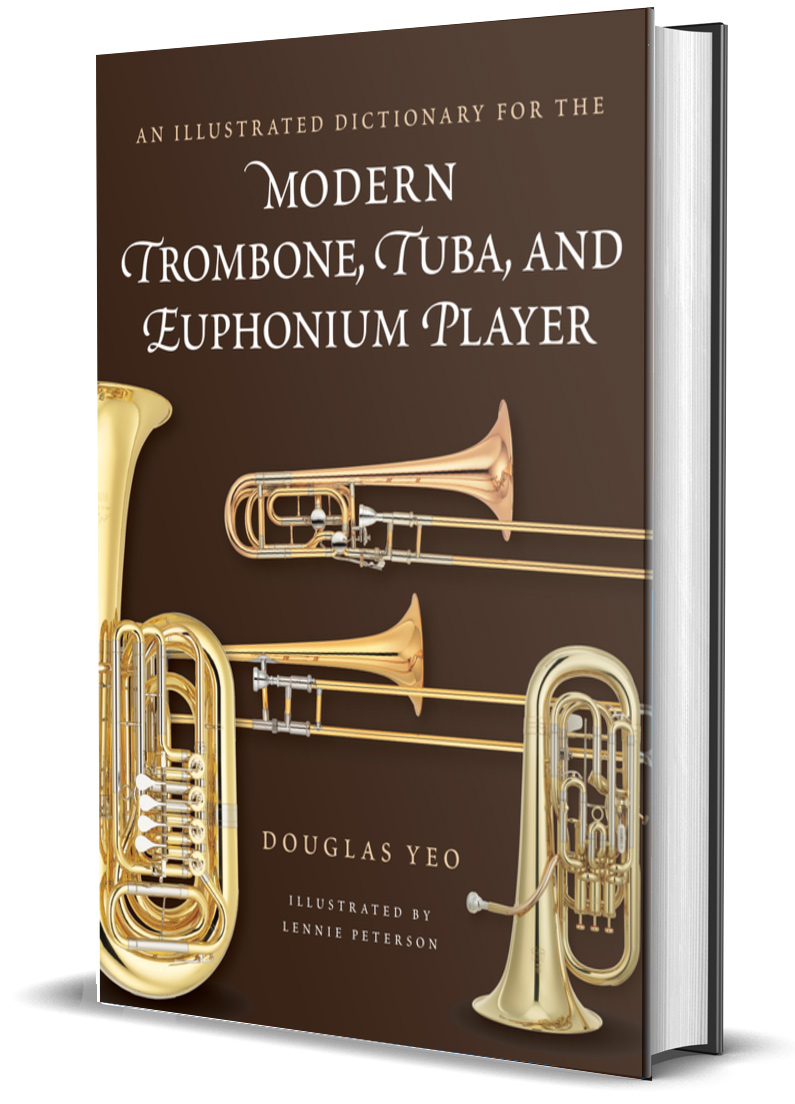
My fascination with musical instruments continued and grew from that time long ago, and over the years, I learned to play many of them. I started with the trombone, then bass trombone, bass trumpet, contrabass trombone, serpent, bass sackbut, ophicleide, didgeridoo, conch shell, and many more. That exploration of musical instruments continues today and I’m pleased to announce the upcoming publication of my newest book, one which is devoted to many of the instruments that I and many others have come to love so much, An Illustrated Dictionary for the Modern Trombone, Tuba, and Euphonium Player.
In a sense, this new book is the culmination of a lifetime of interest in and exploration of low brass instruments. The publisher, Rowman & Littlefield, contacted me in 2016 and asked if I would be interested in writing a book on low brass instruments for their series of Dictionaries for the Modern Musician. At that time, there were dictionaries for conductors, clarinet, trumpet, and strings, and since then, the series has grown to include dictionaries for singers, piano, percussion, and flute. One for trombone, tuba, and euphonium was needed, and I was pleased to set about working to add a new volume to the series.
This was quite a project. I had the opportunity to create a dictionary with hundreds of entries about instruments I love and which have intersected with my life on a daily basis for decades. I could include anything I thought was important for players, teachers, conductors, and audiences to know about these instruments. What is that part called? Why was it invented? Where does it fit on the evolutionary chain of the instrument’s family? Who played it? Who wrote great pieces for it? Questions, questions, questions. So I set about looking for answers.
The process was an enlightening one. I started by making up an initial working list of entries: instruments, instrument makers, parts of instruments, composers, performers, teachers, musical compositions, and more. I then asked several friends who are professors of trombone, tuba, and euphonium at several colleges, universities, and conservatories of music to ask their students to make a list of 50 words they would like to see included in the book. The lists that they sent to me were fascinating. Of course there was some commonality between the lists, and they included many words that I had already decided should be a part of the book. But there were other words that I didn’t know. Why did someone think that term would be important? I set about researching, and reading and reaching out to friends, colleagues, and scholars to get answers.
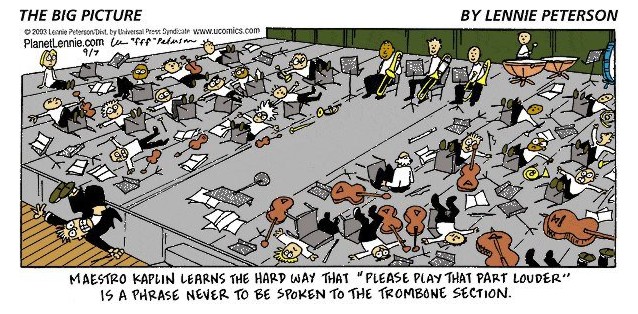
But before I got too far along in the process, I needed to make a big decision. The old phrase “a picture is worth a thousand words” is self-evidently true. The book needed illustrations to bring my text alive, and when I asked myself the question, “Who should make the illustrations?”, there was only one possible answer that came to my mind: Lennie Peterson. I’ve written previously about Lennie Peterson here on The Last Trombone and you can read that article by clicking HERE. He’s a remarkable artist and a close friend (and a superb trombonist), equally conversant as an illustrator, fine artist (oil and other media), and cartoonist. If you only know Lennie from one of his most famous cartoons from his comic strip, The Big Picture (not a week passes by without someone sending me this cartoon, “Have you seen this? It’s fantastic!” Yes, I’ve seen it, and I bought the original from Lennie many years ago and it hangs in my home office), then you don’t know the true scope of what he can do.
For instance, when I asked Lennie to make an illustration of the stays (or braces) on a Renaissance-era trombone, he could have made a great illustration of the handiwork of one of the great Nuremberg masters of the sixteenth century. But instead, Lennie made an illustration with his own creative twist that shows how HE would have made stays on a Renaissance-era trombone:
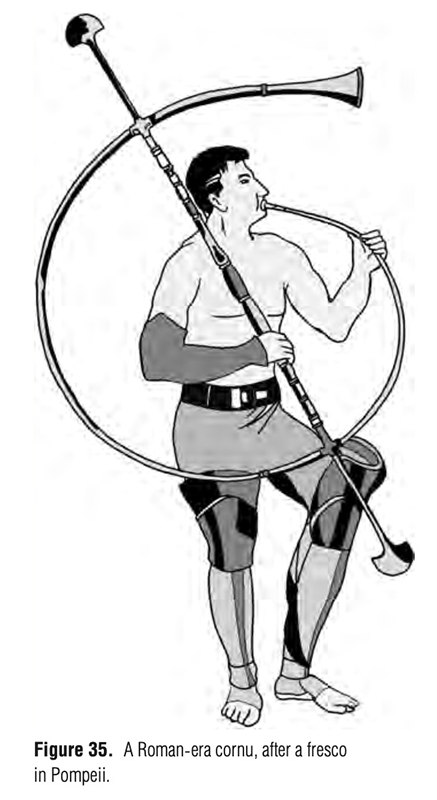
Sometimes Lennie took an existing work of art, such as a fresco of a Roman-era cornu in Pompeii (Don’t know what a cornu is? Look in the book!), and he gave it a personal touch:
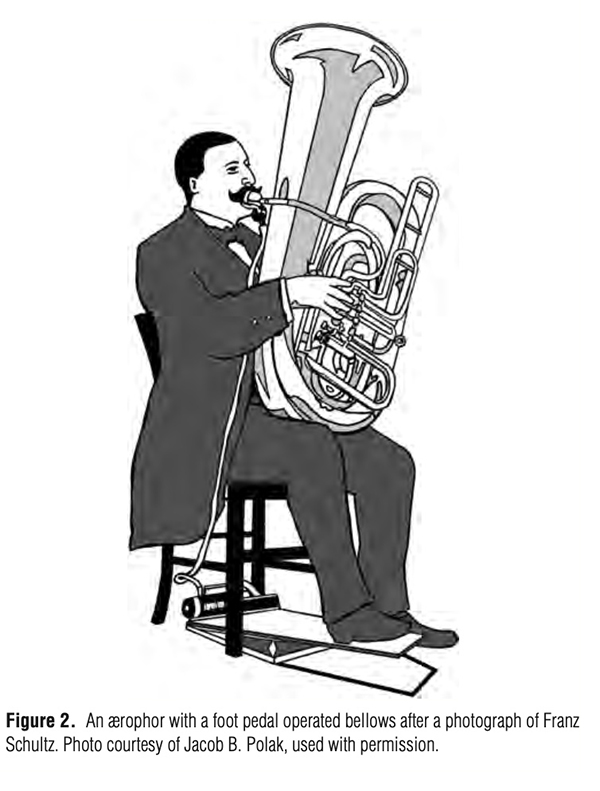
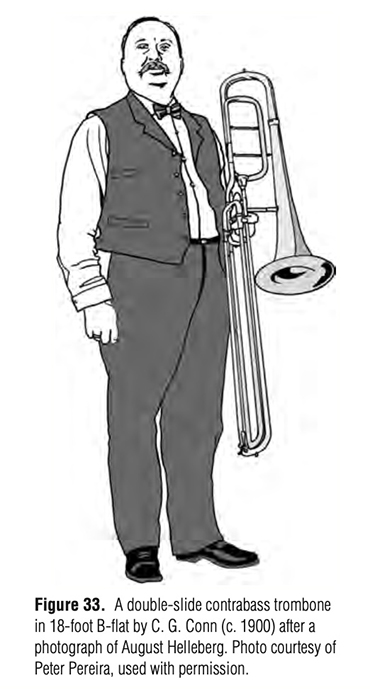
On other occasions, Lennie based his illustration on a photograph that was generously provided to us by the owner of the image, such as his illustration of tubist Franz Schultz using an ærophor that was provided to us by the late Jacob B. Polak (Don’t know what an ærophor is? Look in the book!), or his illustration of August Helleberg (Don’t know who August Helleberg was? Look in the book!) with his Conn double-slide contrabass trombone that was provided to us by Peter Pereira. Showing instruments in the hands of individuals sometimes helps readers understand their size and scale:
Still other images were based on photographs what were generously provided to us by the rights holder of the image, such as Lennie’s illustration of Andrew Van der Beek playing the contrabass serpent, The “Anaconda” (Don’t know that The “Anaconda” is? Look in the book!), based on a photo from Edinburgh University, provided to us by my good friend, Arnold Myers:
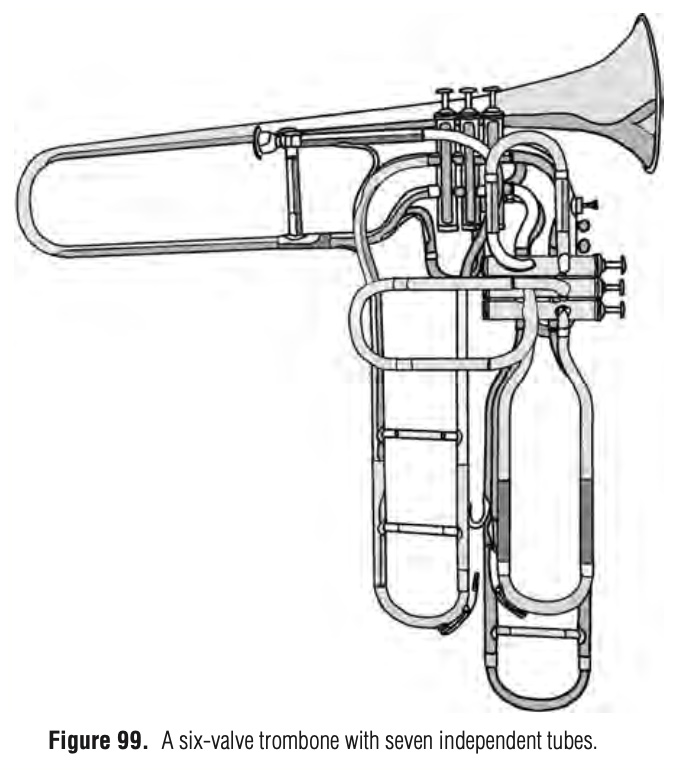
Lennie also based illustrations on photographs I took of instruments in my own and other collections, and his attention to detail allows the reader to follow the intricacies of instrument tubing and other details, such as his illustration of a six-valve trombone with seven independent tubes:
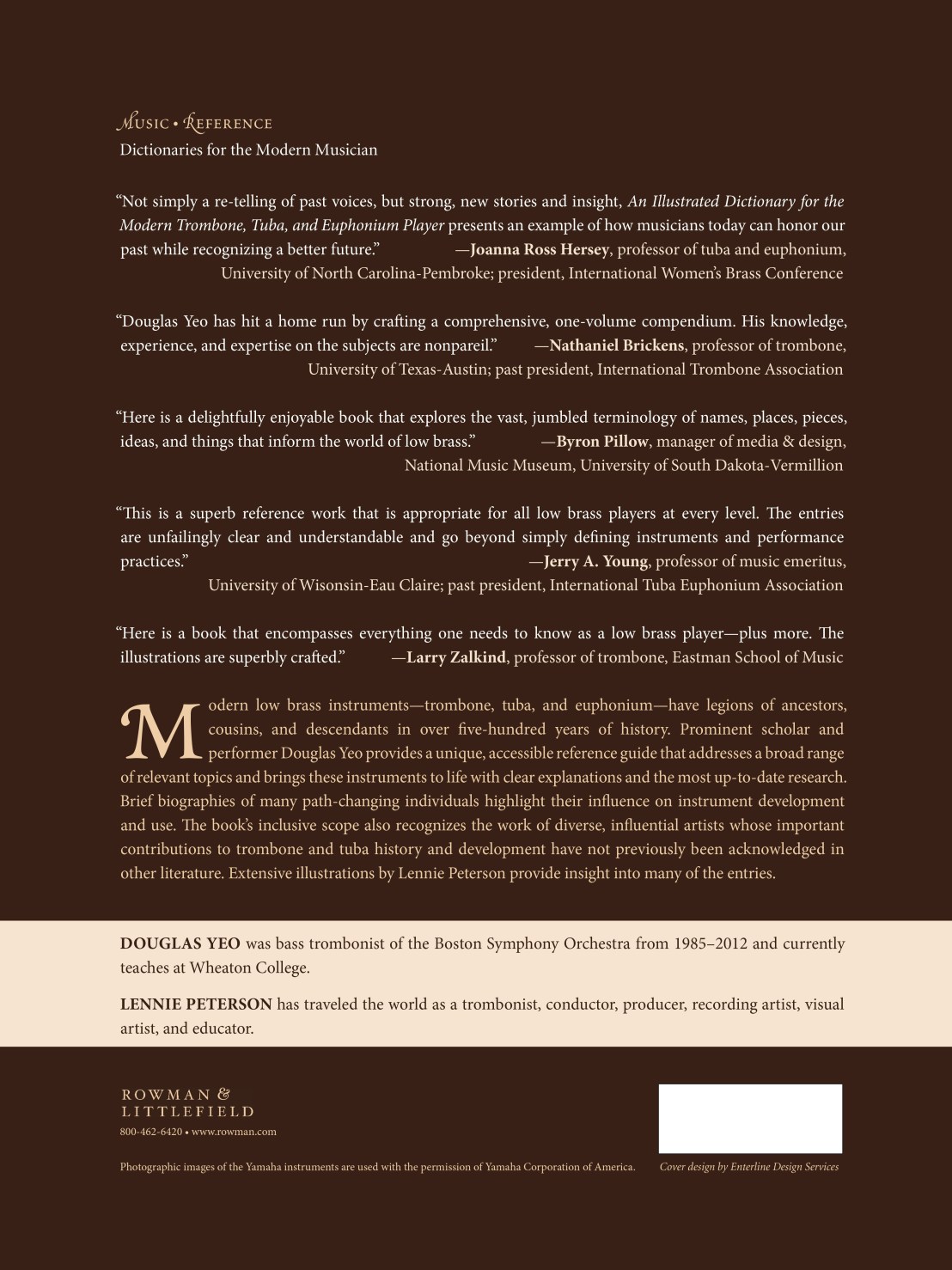
As I began writing, Lennie began illustrating, and when we were done, I had written 675 entries and Lennie had made 125 illustrations. Back and forth we went, with me refining words and Lennie refining lines and shadows. When we were done, the book went out for peer review and at the end of that process, we were more than happy that the reviewers pronounced that the book was both engaging and factually accurate. Several respected members of the low brass community added their endorsement to the book—see some of their words on the back cover below (the white rectangle on the back cover will be filled by the book’s ISBN number and bar code). A long period of editing, correcting, adding, copyediting, proofreading, and layout ensued, and recently, the book went to the printer. It will be available around November 1 but it can be ordered now. More on that below.
Readers will find entries about a host of subjects, from ærophor to Antoniophone, to articulation, back pressure, ball joint, baritone horn, bass horn, bass trombone, bass tuba, Bellophone, Hector Berlioz, Clifford Bevan, bombardon, Giulio Marco Bordogni, Brian Bowman, braze, breathing, Lillian Briggs, “Bydlo” tuba, carnyx, chops, cimbasso, circular breathing, compensating valve system, double-bell euphonium, well, you get the idea. The book is all about instruments, parts of instruments, “path changers” who changed the course of an instrument in some way, manufacturers, playing techniques, and much more. The book’s page on amazon.com has a few “look inside” pages so you can get a closer look at the book.
An important element of the book has been the effort to recognize voices that have not been widely or adequately recognized in other literature. Hence, readers will find entries on many women (and also an entry on the word “gender”) including Cora Youngblood Corson, Dorothy Ziegler, Betty Glover, Maisie Ringham-Wiggins, Constance Weldon, Melba Liston, Lillian Briggs, Abbie Conant, and others, as well as entries on many people of color (and also an entry the word “race” and one on “regional music”) including James Reese Europe, Nathaniel Davis, Edward “Kid” Ory and Joseph “Tricky Sam” Nanton, Howard Johnson, John M. Kuhn, Russell Moore, Juan Tizol, and others.
If what you’ve read so far has piqued your interest, Rowman & Littlefield has a special offer for you. For a limited time, the publisher is offering a 30% discount on the book, in both the hard cover and ebook editions. Of course, if you want to pay full price, you can order the book on amazon.com. On the other hand, if you’d like to save 30%, you can order it on the book’s page on the Rowman & Littlefield website and enter this promo code:
RLFANDF30
(Note: This discount code has been corrected. If you tried to order the book with a different code, try again with this one. It works!)
You can also download an order form for the book with the the discount by clicking HERE. The order form has complete information on all of the ways you can order the book with the discount: online, by phone, by email, by fax, or by mail. Orders placed directly with the publisher will be shipped as soon as the book arrives in the warehouse.
It is my hope that An Illustrated Dictionary for the Modern Trombone, Tuba, and Euphonium Player will find its place on the bookshelves of libraries, and in the hands of teachers, players, composers, and lovers of these instruments as we, together, work to better understand the “what,” “when,” “where,” “how,” and “why” of the trombone, tuba, and euphonium and their ancestors and descendants. Please feel free to share and link this blog post with your friends, students, and others via email, reblogging, or social media.
Last week was Leonard Bernstein’s birthday. Born on August 25, 1918, he would have been 103 years old this year. He died in 1990, at the age of 72, and this year’s anniversary of his birth—not being one with a memorable number like 100—passed quietly. But I remembered. I had just finished reading a book about Bernstein, Famous Father Girl: A Memoir of Growing up Bernstein, by Leonard Bernstein’s daughter, Jamie Bernstein (HarperCollins, 2018). The book stirred up a lot of memories of my own life’s intersection with the life and person of Leonard Bernstein, and on his birthday, I texted my good friend and former Boston Symphony trombone section colleague, Norman Bolter. I had just read a page in Famous Father Girl that spoke of Bernstein’s love of anagrams. Norman loves anagrams, too. So I texted him two anagrams that Jamie Bernstein said her father came up with: Solti (as in conductor Sir George Solti) = toils; elf’s thread = self hatred. Norman replied, “Thanks for those! Did you know this anagram??: trombone = to be Norm.” No, I didn’t, but I do now!
That brief exchange with Norman about Leonard Bernstein got me thinking even more about Bernstein’s life and work. Someday, I may write a book about my long career in music, and some of the people, places, and things that it brought into my life, as well as the intersection of that life in music with my Christian faith. In that book, there will be a chapter on conductors, and in that chapter on conductors, there will be something about Leonard Bernstein. Something like this (hold on, friends, this is long). . .
While I was born in Monterey, California—my father was in the United States Army 6th Infantry Division from 1953-1955, which was stationed at Fort Ord, California—I lived there only a few weeks before my mother, father, and I took the long train ride to Queens, New York where I grew up until I was five years old. Then, in 1960, with my younger brother in tow, we moved just across the Queens border to Valley Stream, New York, where I began playing the trombone in 1964 at the age of nine.
Program for the New York Philharmonic’s Young People’s Concert conducted by Leonard Bernstein, December 23, 1963. The program shows the date as November 23, 1963, but the concert was postponed after the assassination of President John F. Kennedy on November 22, 1963.
Leonard Bernstein’s name was familiar to me from my earliest memory. He was music director of the New York Philharmonic from 1958-1969, and Laureate Conductor of the orchestra from 1969 until his death in 1990. Our family would regularly watch his series of Young People’s Concerts on CBS Television. I don’t remember if we watched all of them—he recorded 53 such concerts between 1959 and 1972—but we certainly watched a lot of them. I even attended one, on December 23, 1963, where I heard Rossini’s William Tell Overture for the first time. It was a pivotal moment, one that I would later recall when I began playing the trombone the following year. That concert was memorable for another reason: The concert was supposed to have been performed on November 23 (the program carries that date) but the day before, President John F. Kennedy was assassinated and the concert was postponed.
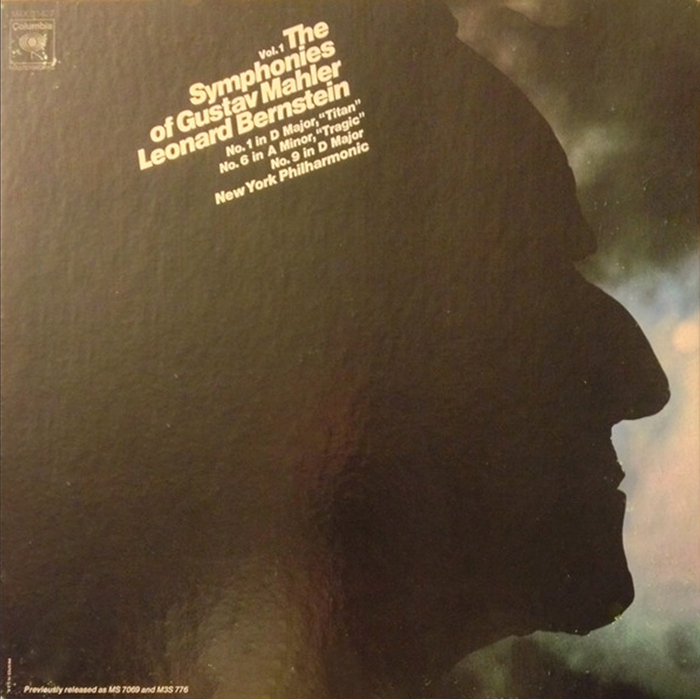
Growing up in and around New York City, Leonard Bernstein was a household word. In my youth, Bernstein was already a musical superstar. If he had done nothing else but write the music to West Side Story, his place in music history would have been assured. It was a while before I learned that he attended Harvard University, was a member of the first class of students at the Berkshire Music Center (now the Tanglewood Music Center) in 1940, where Boston Symphony Orchestra music director Serge Koussevitzky started a summer program that continues to this day. Little by little, Bernstein’s life and work unfolded before me and I took notice. He was a musical everyman: a composer, a pianist, a conductor, an author, an educator. The first symphony of Gustav Mahler that I learned was his Symphony No. 6, part of a boxed set of LPs that included his Symphonies 1, 6, and 9, conducted by Bernstein with the New York Philharmonic (I had it on the re-release package of the three symphonies, four discs, Columbia Masterworks M4X 31427). I devoured his published books, including The Joy of Music (Simon & Schuster, 1959) and The Infinite Variety of Music (Simon & Schuster, 1966), and I read books about him. I bought his recordings, watched him on television, and attended his concerts. My early musical life was shaped by Leonard Bernstein. I found his work to be inspiring. Little did I imagine how deeply our lives would intersect.
Around 1966, I wrote Leonard Bernstein a letter. I don’t have a copy of that letter, but I remember that I invited him to my birthday party. The reply from his secretary (and his first piano teacher), Helen Coates, was gracious. I’ve lost that letter, too, but I recall she said something like, “Mr. Bernstein is pleased to receive your invitation but unfortunately, he is too busy to attend.” I was 11 years old. Of course I thought that Leonard Bernstein had read my letter. I was disappointed, but I was undaunted.
My program for a performance of Leonard Bernstein’s Mass, presented by the John F. Kennedy Center for the Performing Arts at the Metropolitan Opera House, New York City, summer 1972.
In the summer of 1971, our family moved to New Jersey. A note to parents: Moving when your son is entering his junior year in high school is something to be avoided. That fall, Leonard Bernstein wrote his Mass for the dedication of the John F. Kennedy Center for the Performing Arts in Washington, DC. Reviews were mixed but there was one thing on which all of the critics agreed: the piece was monumental and impossible to describe. I was intrigued, so in the summer of 1972, just before I began my senior year in high school, I took the bus to New York City and saw Mass at the Metropolitan Opera House. It was all encompassing, theologically confusing, disconnected and even incoherent (and perhaps blasphemous as well), musically schizophrenic (classical, twelve-tone, rock, blues), and sensorially overwhelming. I didn’t know what to think of it but it made me think. A lot. A few months later, I was selected as a member of McDonald’s All-American High School Band. We performed in the Macy’s Thanksgiving Parade in New York City and then in the Tournament of Roses Parade in Pasadena, California. While we were in California, the band was taken to see a performance of Bernstein’s Mass at the Los Angeles Forum. I saw two performances of Mass in the span of just a few months, in cities from coast to coast. Seriously? And a few weeks after that, I played Bernstein’s Overture to Candide as a member of the All-Eastern Orchestra in a concert in Boston conducted byKeith Brown, with whom I studied trombone at Indiana University during my freshman year in college, 1973-74, before I transferred to Wheaton College, Illinois, and studied bass trombone with Edward Kleinhammer. That All-Eastern concert was the first time I had ever played bass trombone. I liked it. And it was the first time I had ever played a piece written by Leonard Bernstein. I REALLY liked that.
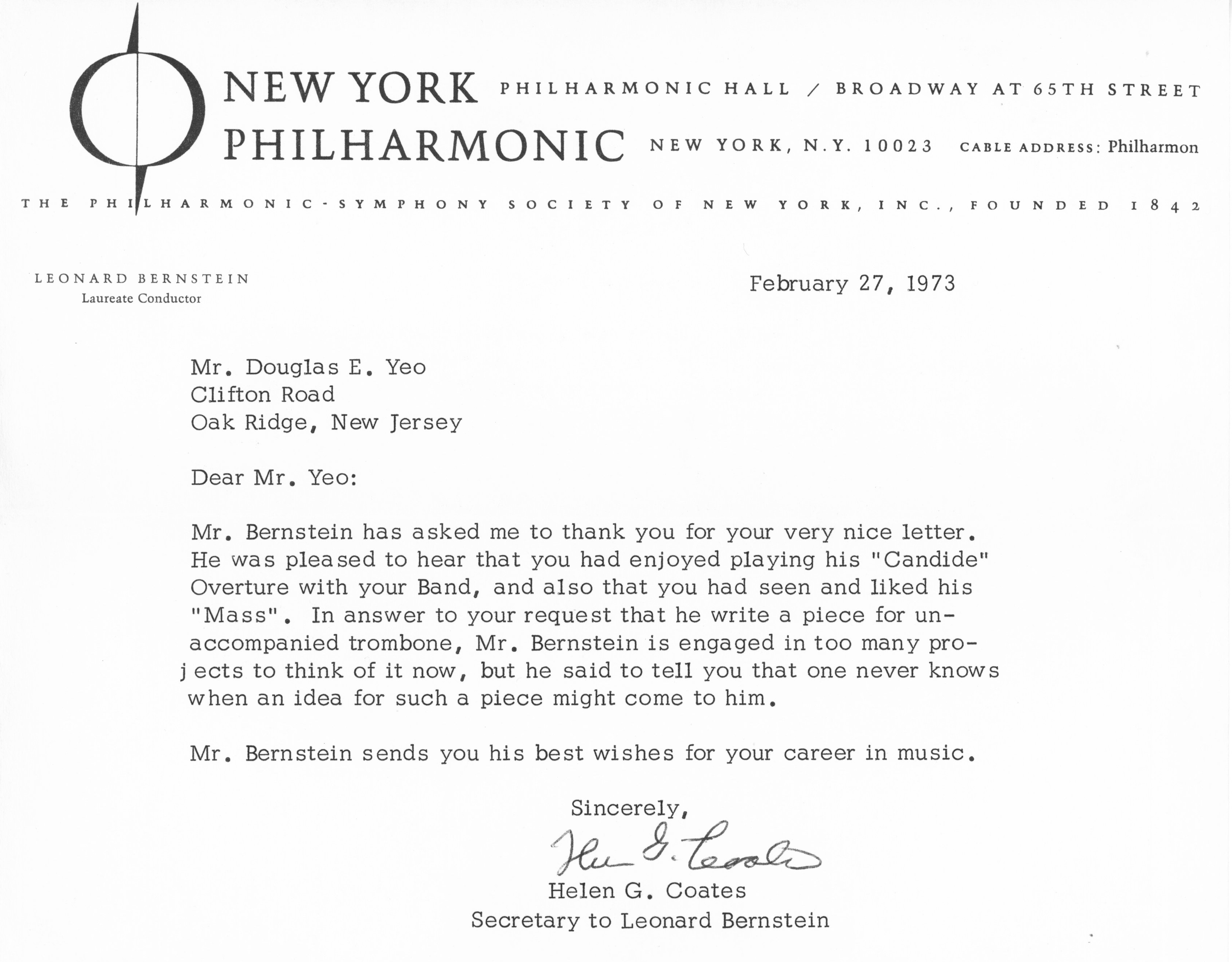
When I got home from All-Eastern, I wrote Leonard Bernstein another letter. I told him how thrilling it was to play one of his pieces and then I made an audacious request. “Would you please write a piece for me?” This time I saved Helen Coates’ reply, above.
As it turned out, an idea to write a piece for me apparently never came to him (no surprise, although I have played his only solo for trombone, Elegy for Mippy II, on many occasions), but imagine my reaction when in 1974, I came home from college on Thanksgiving vacation and found an envelope waiting for me from the New York Philharmonic. I opened it and found a personally autographed photo of Bernstein. No, it wasn’t the piece for trombone I had asked for, but, wow.
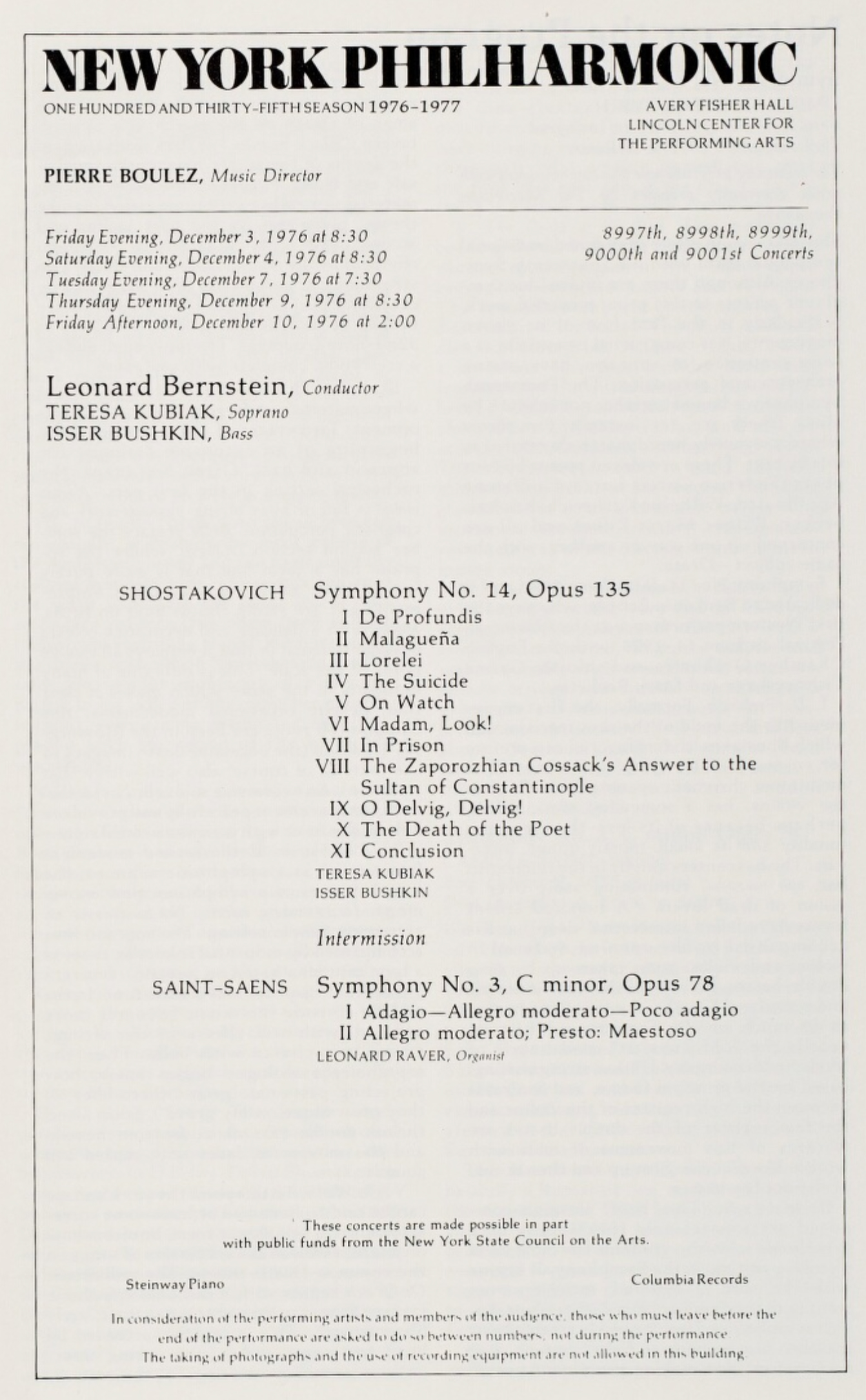
Despite Leonard Bernstein’s growing influence in my life, I had never met him. He was larger than life, up on a pedestal of my own making, famous, untouchable. But I was determined to meet him, somehow, in some way, to thank him in person for his outsized influence on my growing musical life. That moment came in 1976. I had graduated from Wheaton College that spring and my wife, Patricia, and I had moved to New York City. We didn’t have two nickels to rub together so we found ways to get free or very inexpensive tickets to concerts and shows. We managed to get two free tickets to a remarkable concert on Saturday, December 14, 1976, but as it turned out, Pat couldn’t go, so I went with a friend. The New York Philharmonic was playing Dmitri Shostakovich’s Symphony No. 14 and Camille Saint-Säens’ Symphony No. 3 (“Organ”). And Leonard Bernstein was conducting. ARE YOU KIDDING ME!? Our seats were in the third row, right in the center of the main floor. And when Leonard Bernstein came on stage, instead of bowing and giving the downbeat to the orchestra, he faced the audience and raised his hand. He had something to say to us. “Shostakovich dedicated his Fourteenth Symphony to his friend, Benjamin Britten,” Bernstein said. “And today, Benjamin Britten died. Therefore, we are dedicating tonight’s performance to his memory.” Wow. The performance was emotionally moving and powerful, and there we were, in the third row, looking up at Bernstein and the orchestra’s principal cellist, Lorne Monroe. Also on the program was the “Organ” symphony, and even with an electronic rather than a pipe organ, the performance was thrilling. It was also the first time I had heard the orchestra’s new bass trombonist, Donald Harwood, in concert. Don, who had previously been bass trombonist with the Metropolitan Opera Orchestra, had recently won the bass trombone position with the Philharmonic after the retirement of Allen Ostrander. I was studying with Don at the time—taking lessons in his tiny studio in Manhattan’s Ansonia Hotel—so there was another nice connection with that program.
After the concert, I told my friend that I just had to see Leonard Bernstein. I had to. We went backstage and got in line to see the great maestro in the green room. When we were ushered in, my heart stopped. There was my classical music hero, the great Leonard Bernstein, sitting on a couch, a woman in one arm and a man in the other, a cigarette in one hand and a Scotch in the other. I was speechless. This was my hero? I stammered a few words—I don’t remember what I said but I was truly struck speechless by the shock—and we left. My hero had feet of clay. As time went on, I was to learn more about Leonard Bernstein. There was more to him than that handsome, polished conductor and speaker on his Young People’s Concerts; there was more to him than what was written about him in the press, or in the puffy biographies of him that I had read. Little did I know that in less than 10 years time, I would see first hand how his drug, alcohol, and cigarette use, and his hedonistic lifestyle was literally killing him.
Still, I remained fascinated by Leonard Bernstein. There was something about this musical everyman that inspired me. Not his lifestyle, for sure, but his “all-in” commitment to music. I was working hard on the orchestra audition circuit and I found in Bernstein an inspiration to keep working hard. “Perhaps,” I thought, “someday I might sit in an orchestra and play for him.” It took a few years, but in 1984, it happened.
I joined the Baltimore Symphony in May 1981, after five years of freelancing in New York City (I played with big bands, Broadway shows, some studio jingles and recording sessions, and some concerts with the Mostly Mozart Festival and the American Symphony, but I paid the rent for the first three years not with my musical earnings, but with the money I earned from my full time secretarial job) and two concurrent years as a high school band director. I took five auditions in a 12 month period in 1980-1981: Baltimore (won by John Engelkes), Detroit (won by Tom Klaber), Philadelphia (won by Charles Vernon), San Francisco (won by John Engelkes), and Baltimore again where I was the winner. There I was reunited with my Wheaton College trombone classmate, Eric Carlson, who had joined the Baltimore Symphony as second trombonist the year before after several years as a member of the North Carolina Symphony (Eric left Baltimore in 1986 to join the Philadelphia Orchestra; he just retired from that great orchestra earlier this year), and I was thrilled to have a full time job playing in a symphony orchestra. We had many fine conductors on our podium but Baltimore did not attract the top echelon of conductors who were on the circuit. They were busy guest conducting the great orchestras of Europe, and American orchestras like Boston, Cleveland, New York, Chicago, and Philadelphia.
Program page for Leonard Bernstein’s concert of Mahler Symphony No. 2 (“Resurrection”) at the National Cathedral, Washington DC, with members of the National and Baltimore Symphony Orchestras.
When, in late 1983, I learned that Leonard Bernstein was going to be conducting a concert in Washington DC, and he wanted to assemble an orchestra made up of players from the National and Baltimore Symphonies, I could hardly believe my ears. The program: Gustav Mahler’s Symphony No. 2 (“Resurrection”). The piece was, and remains, one of my favorite pieces of classical music. But the timing of this concert wasn’t great. Rehearsals were going to be in the National Cathedral in DC where the concert was to be held. That was a 90 minute drive one way. The whole Bernstein/Mahler project was sandwiched into an already busy week with the National and Baltimore symphonies. But I had to do it. I immediately volunteered, and our low brass section consisted of Milton Stevens (National), K. D. Nichols (at that time, she was our first call extra trombone player in Baltimore), me (Baltimore), Robert Kraft (National), and David Bragunier (tuba, National). The soloists were soprano Barbara Hendricks and mezzo-soprano Jessye Norman.
Photo of Leonard Bernstein that I took from my seat on stage during a rehearsal for Mahler Symphony No. 2., National Cathedral, Washington DC, January 8, 1984.
Leonard Bernstein was involved in a host of progressive—he would say he was a liberal—causes. He and his wife famously—or infamously, depending on one’s point of view—hosted a party in 1970 to raise money for the Black Panthers. Bernstein and his wife were widely criticized for the party—it gave rise to the phrase “radical chic” when Tom Wolfe wrote a long form essay about it in New York Magazine, “That Party at Lenny’s.” Bernstein also argued for world-wide nuclear disarmament, and the Mahler Symphony 2 concert at the National Cathedral in Washington DC was to benefit a new organization, Musicians Against Nuclear Arms (MANA), now called Musicians for Peace and Disarmament (MPD). I was not a particularly political person at the time, and while I was certainly against nuclear war, it was the opportunity to work with Leonard Bernstein, and not so much the political cause (none of us were paid for our services), that was most important at the moment.
Program listing of orchestra members for Bernstein’s performance of Mahler, Symphony No. 2 at the National Cathedral, Washington DC. Members of the Baltimore Symphony are indicated with a dot to the left of their name.
In the end, 38 of my Baltimore Symphony colleagues took part in the concert. The setting—Washington’s National Cathedral—was a stunningly beautiful and appropriate place to perform Mahler’s “Resurrection” Symphony. The Cathedral’s cavernous space did create some challenges in our getting precise ensemble playing but somehow it all came together. The dress rehearsal remains one of the most memorable musical experiences of my life. Everybody was ON. Jessye Norman’s performance of the fourth movement, “Urlicht,” was truly transcendent. And Bernstein milked the massive percussion crescendo before rehearsal No. 14 in the finale for what seemed like an eternity, until it reached a near deafening dynamic and we thought the cathedral itself might come crashing down. It was electrifying, and the concert was a huge success. I had finally played a concert with Leonard Bernstein.
A year and a half later, in 1985, I joined the Boston Symphony Orchestra, and I quickly learned that each summer, Leonard Bernstein held a residency at Tanglewood, the BSO’s summer festival home in the Berkshire Hills of western Massachusetts. So it was that I played again with Bernstein, and again, and again, and again. These were to be memorable experiences to say the least.
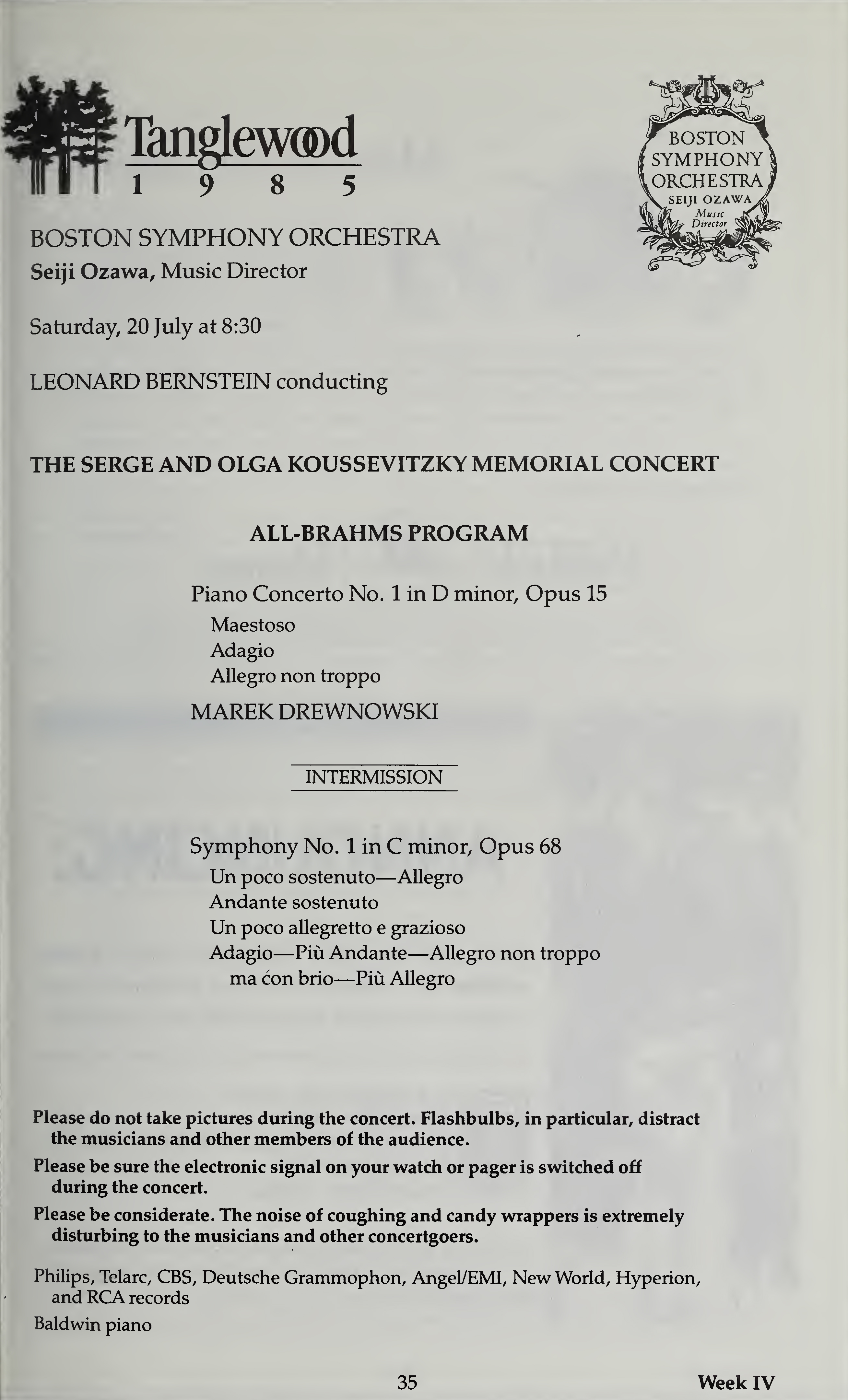
The first time was July 20, 1985. I had joined the orchestra just a few months earlier, in May, and Bernstein’s concert was all-Brahms: Piano Concerto No. 1 and Symphony No. 1. At the first rehearsal, I was introduced to the BSO/Lenny experience. Yes, Lenny. Everyone called him Lenny. But there was a respectful familiarity between Bernstein and Tanglewood and the BSO. Lenny spent the first 15 minutes of the rehearsal going around the orchestra, saying hello, hugging and kissing players. It was a lovefest. I’d never seen anything like it. Bernstein’s annual BSO concert was always on Sunday afternoon and the Saturday morning rehearsal was open to the public. That’s when disaster struck for me.
The Boston Symphony Orchestra’s bass trombone part to Brahms’ Symphony No. 1, with my hand written violin cues over measures 431-437.
The finale of Brahms’ Symphony No. 1 was humming along nicely at the rehearsal. The bass trombonist has an important entrance near the end, one marked fortissimo, and one that sets up the movement’s final measures. Suddenly, Lenny did something that threw me off—watching his gyrations from the audience was one thing, but trying to follow them on stage was another thing entirely. I came in wrong; early. Fortissimo. I immediately noticed my mistake and got back on track but, of course, I couldn’t put the genie back in the bottle. I was terribly embarrassed.
After the rehearsal ended, as I was slinking back to the locker room in a futile attempt to get away unnoticed, I heard, over the backstage PA system, “Douglas Yeo, please come to the conductor’s dressing room.” Uh-oh. Here I was, a new member of the orchestra—without tenure— and I had just messed up in a rehearsal conducted by the most famous musician in the world. I didn’t have a good feeling.
I made my way to the maestro’s dressing room and identified myself to Lenny’s handler who was guarding the door. I was ushered in and there was Lenny, stripped naked to the waist, a handful of pills in one hand and a Scotch in the other. As he downed the pills, he noticed me and called for me with his left index finger in that familiar gesture to any child who comes for a reckoning with a parent, “Come here.” As I stood in front of Lenny—I was six feet tall and he was about five feet, six inches tall—he grabbed me by my shoulders and, in his best mock-Jewish mother accent, he said, “Dahlink! Vaht happent?!” I explained that I was very embarrassed by my faux pas and that I had written the violin cue into my part (which was much more useful than the printed timpani cue). “It will be fine at the concert tomorrow,” I promised. At which point Lenny smiled a wide grin and said, “I know it vill,” and he threw his arms around my chest and we locked in a tight bear hug. As my head towered over his shoulder with his hairy, sweaty, sticky body making my shirt and body just as wet and sticky as he was, I thought to myself, “When I started playing trombone back in 1964, they never told me something like this would happen.” But it did.
The concert was fine; no big mistake from the third trombone player. And a few months later, I received tenure in the Boston Symphony. No harm done for my big goof on Brahms Symphony No. 1, but I learned an important lesson that has stuck with me until this day: Know and understand every piece I play so well that I don’t have to rely on counting rests to know what to do. I began a vigorous study of the score of every piece I ever played so I knew the piece as well as the conductor. Not just my own part, but all of the parts. I never made that counting mistake again.
In 1986, Lenny’s annual concert with the Boston Symphony included Tchaikovsky’s Symphony No. 6. The performance of the symphony was white hot—the third movement was ablaze with Lenny jumping all over the podium while he exhorted the orchestra to ever faster and louder playing, and his famous “Lenny leap” was on full display—and the trombone and tuba chorale at the end of the fourth movement was conducted at such a slow pace, that I thought I could feel my beard grow. Somehow it worked. With Lenny, it always worked. But the big story of that concert was violin soloist Mi Dori (now Midori). A child prodigy, she, at the age of 14, performed Bernstein’s Serenade for violin and orchestra. That in itself was a remarkable accomplishment. But the headline over the New York Times review of the concert screamed, “Girl, 14, Conquers Tanglewood With 3 Violins.” In the Serenade’s fifth movement, Midori’s violin popped a string. Hardly missing a beat, she exchanged her violin with the violin of BSO concertmaster, Malcolm Lowe. She continued playing on Malcom’s violin and then it happened again—another string popped. Midori then exchanged Malcolm’s violin for acting associate concertmaster Max Hobart’s violin, and the performance concluded to thunderous applause. I have never seen anything like that happen before or since, and the concert catapulted Midori to international fame.
William”Will” Gibson, William “Bill” Moyer, and Kauko “Koko” Kahila at Bill Moyer’s retirement party at Serge Koussevitzky’s former home, Saranak, Lenox, Massachusetts, summer 1987.
Lenny was present at Tanglewood for his 1987 visit even before he arrived. At the end of the summer, Boston Symphony Orchestra personnel manager William “Bill” Moyer was going to retire. Bill had joined the BSO in 1953 as the orchestra’s second trombonist, a position he held until 1966 when he became Personnel Manager. By the way, it was Bill Moyer who played the famous Tuba mirum second trombone solo in Mozart’s Requiem at the Solemn Pontifical High Mass for President John F. Kennedy. The Mass was given on January 19, 1964, in Boston’s Cathedral of the Holy Cross and it was captured on recording by RCA Victor which released the service with the full Mozart Requiem performance as part of the Mass. You can hear the Tuba mirum by clicking HERE. Conductor Erich Leinsdorf’s tempo is incredibly slow by today’s standards. Clearly, he missed Mozart’s cut time meter. But Bill played the solo beautifully. Bill and I were close friends—we shared a love of the BSO’s history as well as our natural connection as trombonists—and I wanted to stage a retirement party for him. Our principal trombonist, Ronald Barron, and our tubist, Chester Schmitz, and I rented Serge Koussevitzky’s former home, Seranak, and we had a nice dinner catered for the occasion (our second trombonist, Norman Bolter, was unable to attend). We invited Bill’s former BSO colleagues, former principal trombonist William Gibson, and former bass trombonist Kauko Kahila, and their wives (and our wives) to come to the party and it was a fun, joyful event, full of a lot of story telling.
As personnel manager of the BSO, one of Bill’s many duties was to come on stage just before the end of a rehearsal and give the conductor “a significant look,” which indicated that the rehearsal was going to be over in a matter of minutes. Overtime was expensive and was very rarely granted to conductors. Of course, Lenny wasn’t just any conductor, and when he was around, the clock was always covered. Bill would come on stage and give Lenny “the look” which Lenny would ignore, the rehearsal would continue past the designed ending time (at which point, players would whisper, “cha-ching!”, the sound of a cash register opening), and Bill would walk off stage. But Union rules said that after 25 minutes of overtime, the rehearsal HAD to stop for a five minute break. So when Bill would come on at the 25 minute mark and clap his hands and the orchestra would get up and leave the stage —sometimes in mid-phrase— Lenny would throw a little tantrum. Of course, Bill was only doing his job and Lenny knew it, and there was no personal acrimony between the two of them despite Lenny’s histrionics.
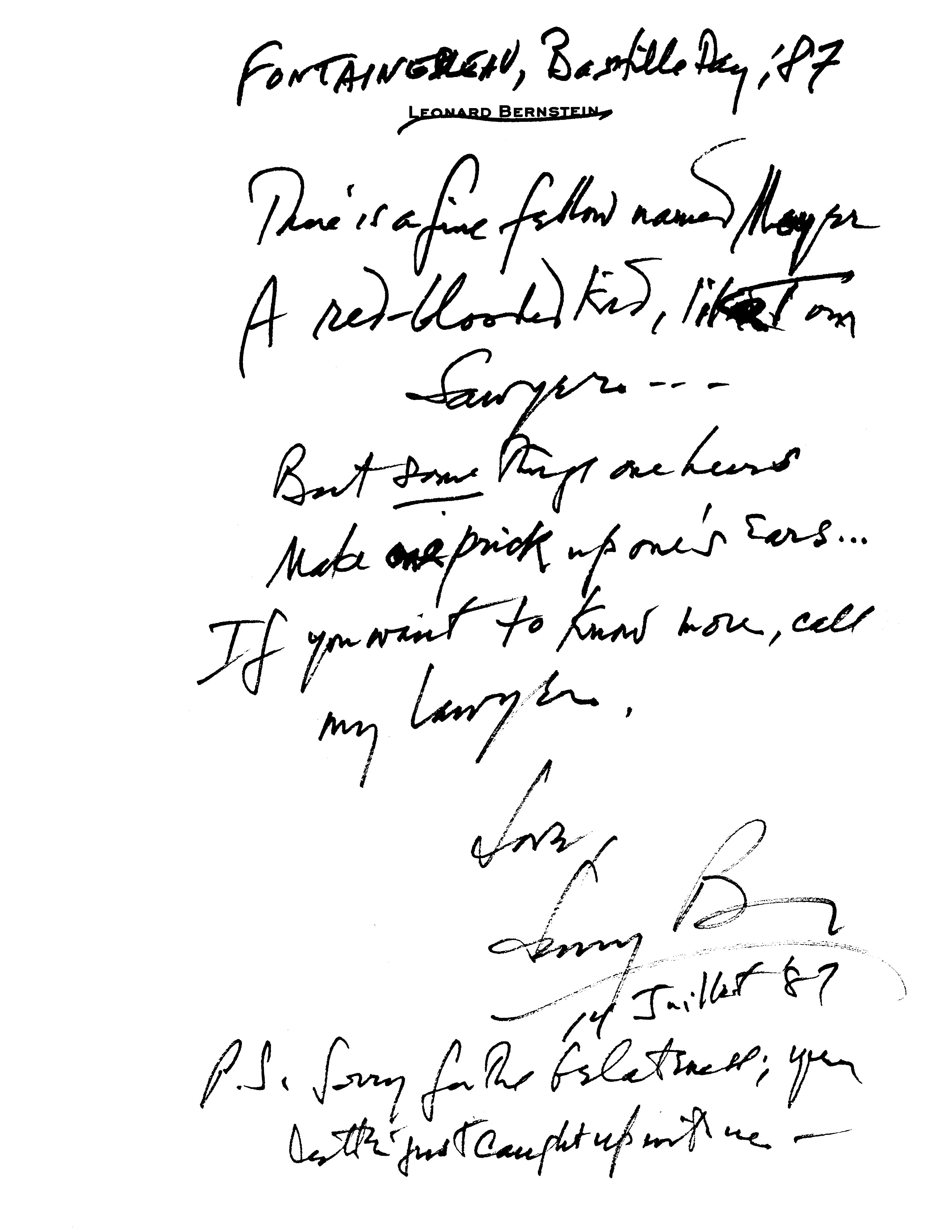
When Bill announced his retirement, I got the idea to write to Lenny and ask if he would write a short note to Bill that I could read at his party. A few weeks later, I opened my mail to find a handwritten letter from Lenny (above) with a few lines of verse to Bill and a personal note to me. I gave the original to Bill but I kept a photocopy for myself. In his signature scrawl, Lenny wrote:
Fontainebleau, Bastille Day, ’87
Leonard Bernstein
There is a fine fellow named Moyer
A red-blooded kid, like Tom Sawyer- – –
But some things one hears
make one prick up one’s ears. . .
If you want to know more, call my lawyer.
Love, Lenny B
14 Juillet ’87
P.S. Sorry for the belatedness; your letter just caught up with me –
When I read Lenny’s playful poem at Bill’s party it was met with laughter and smiles. It was great of Lenny to take the time to scribble a few words for his friend/nemesis.
Later that summer, Lenny returned for his annual visit to Tanglewood, which occurred during Tanglewood’s fiftieth anniversary season.
Leonard Bernstein’s 1987 Boston Symphony concert was memorable for several reasons. Principal among them was the fact that we were playing one of Bernstein’s own works, his Symphony No. 1, “Jeremiah.” The symphony has a prominent role for a mezzo-soprano soloist, and my friend and Wheaton College classmate, Wendy White, was the soloist. Wendy graduated from Wheaton College in 1975, a year before I graduated in 1976; she and I were co-winners (along with Chuck Grey, violin, and Grace McFarlane, piano) of Wheaton Conservatory of Music’s 1975 concerto competition where she sang an aria from Camille Saint-Säens’ opera Samson and Delilah and I played the Tuba Concerto by Ralph Vaughan Williams.
Anyone who knows me or anything about me knows that my Christian faith informs all I think, do, say, and am. When I transferred to Wheaton College from Indiana University in 1974, I entered a completely different learning and spiritual environment. Wheaton College is a Christian college, informed by its Christian world view and its motto, Christo et regno ejus — For Christ and His Kingdom. I was thrilled to be there and I learned so much. And as an aside, I have been Wheaton College’s trombone professor since 2019. But during my first quarter on campus in the summer of 1974, I noticed that so many students were on degree tracks that would lead them to Christian vocational ministry, such as pastors, missionaries, Bible translators, church ministers of music, and such. Many students were walking around campus with large rings with Greek flash cards, fingering them like beads on a rosary as they mumbled Greek vocabulary and verb tenses. All of these students seemed to have such noble, righteous callings. But every time I prayed and asked God what He wanted me to do with my life, He said, “Play the trombone.”
I met with my advisor, Dean of the Conservatory of Music, Harold M. Best (who became and remains one of my closest friends). I poured out my soul to Dr. Best, and explained that somehow, playing the trombone didn’t seem very admirable when compared with the callings of many of my classmates. He walked me off the ledge, and affirmed my calling. He said, in words that I remember to this day, “Doug, if everyone on campus was going to be a pastor or minister of music or a Bible translator, who would preach the Gospel to people who would not walk in the front door of a church. Who knows, maybe someday, you might get to preach the Gospel to Leonard Bernstein.” Relieved, supported, and energized, I continued my pursuit of the trombone—and my commitment to Jesus Christ.
Bernstein’s “Jeremiah” Symphony has a thorny, difficult text. It quotes the words of the Biblical prophet, Jeremiah, who delivers strong, prophetic words from God that speak of His disappointment of the wayward, sinful acts of His people, and judgment and affliction that is delivered to them. The text comes from Jeremiah 1:1-3, 1:8, 4:14-15, and 5:20-21. And, yet, the piece ends with hope, as the prophet asks, “Turn thou us unto thee, O Lord.”
At the intermission of our first rehearsal, I felt prompted to approach Bernstein at the podium. After I introduced myself—if he had any memory of my Brahms Symphony 1 mistake he did not show it—I told him how much I enjoyed playing his symphony. I then spoke to him about the text, and while doing so—I spoke about the truth of the Bible’s words and its important admonitions—I spoke to him about Jesus. Lenny listened carefully and respectfully and then put his arm on my shoulder and said, “Thank you.” I do not know what went through his mind when this trombone player spoke boldly to him about faith and Christ. That is God’s business and God’s work. But later in the week, I related this story to Wendy and she said she had had the very same conversation with Lenny the day before. Two graduates of Wheaton College fulfilled Dr. Best’s prophetic words on two consecutive days by talking to Leonard Bernstein about Jesus. And we didn’t even need Greek flash cards.
The next summer, Lenny returned to Tanglewood for his annual appearance. There are hardly words in the English language to describe his 1988 visit.
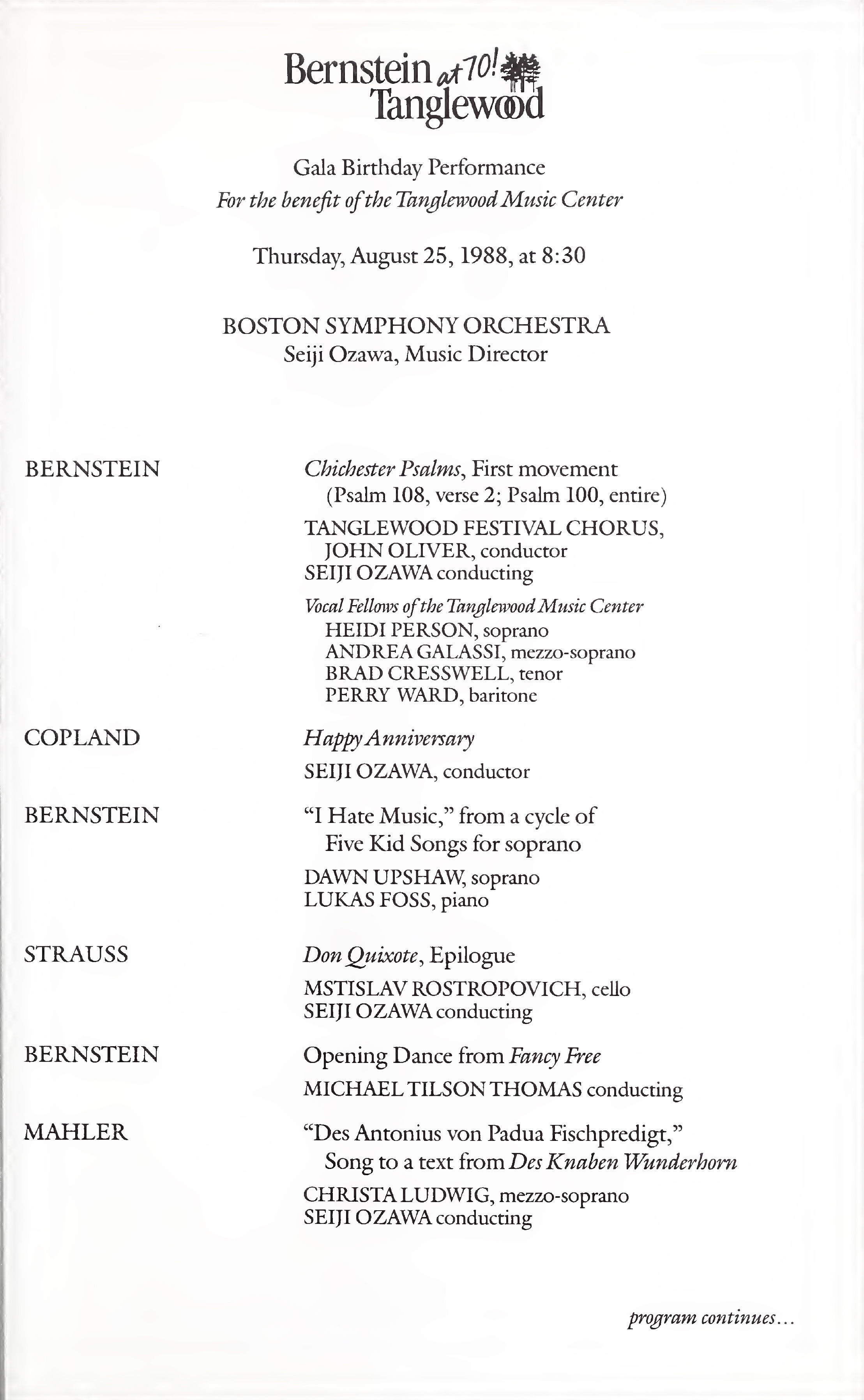
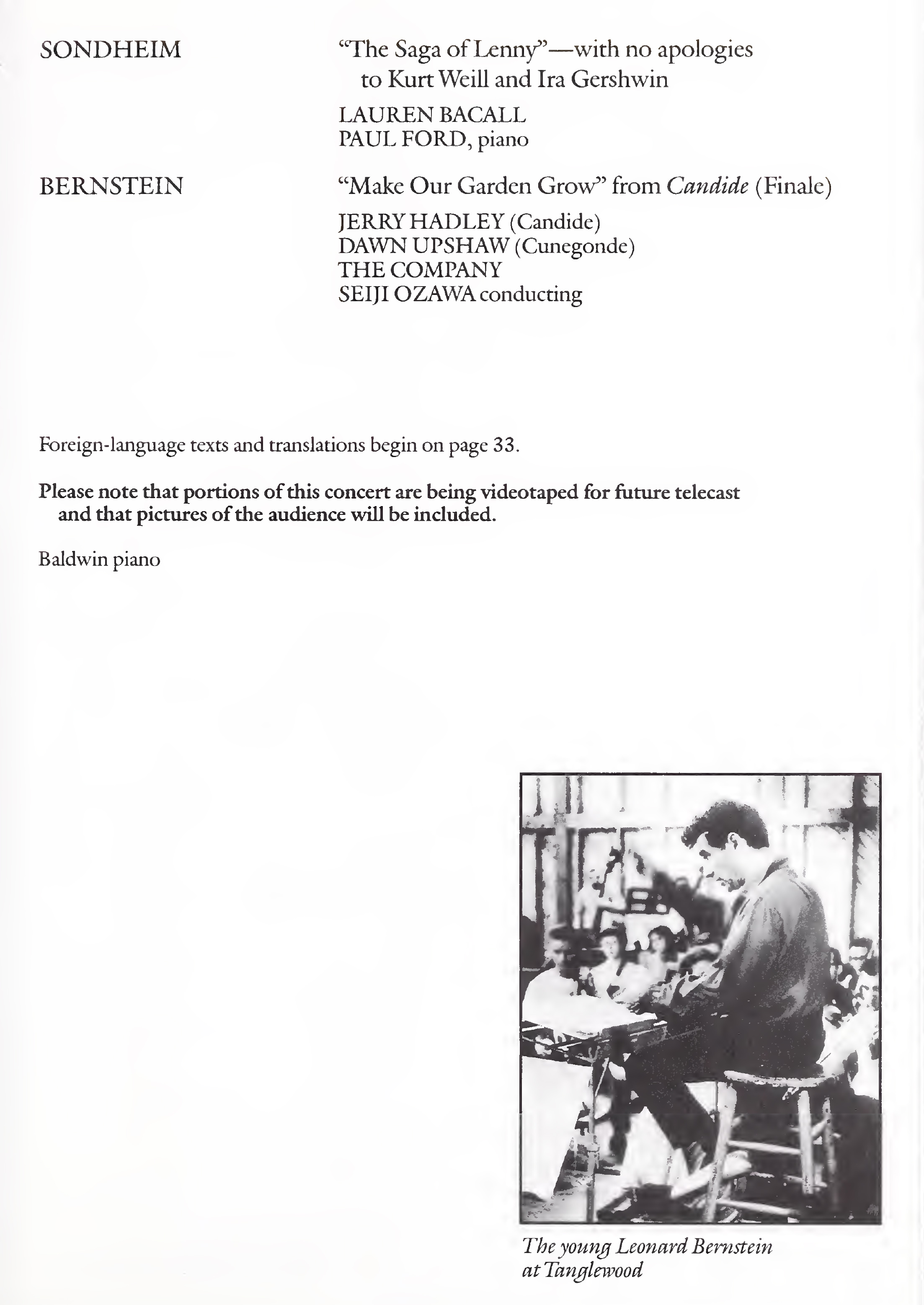
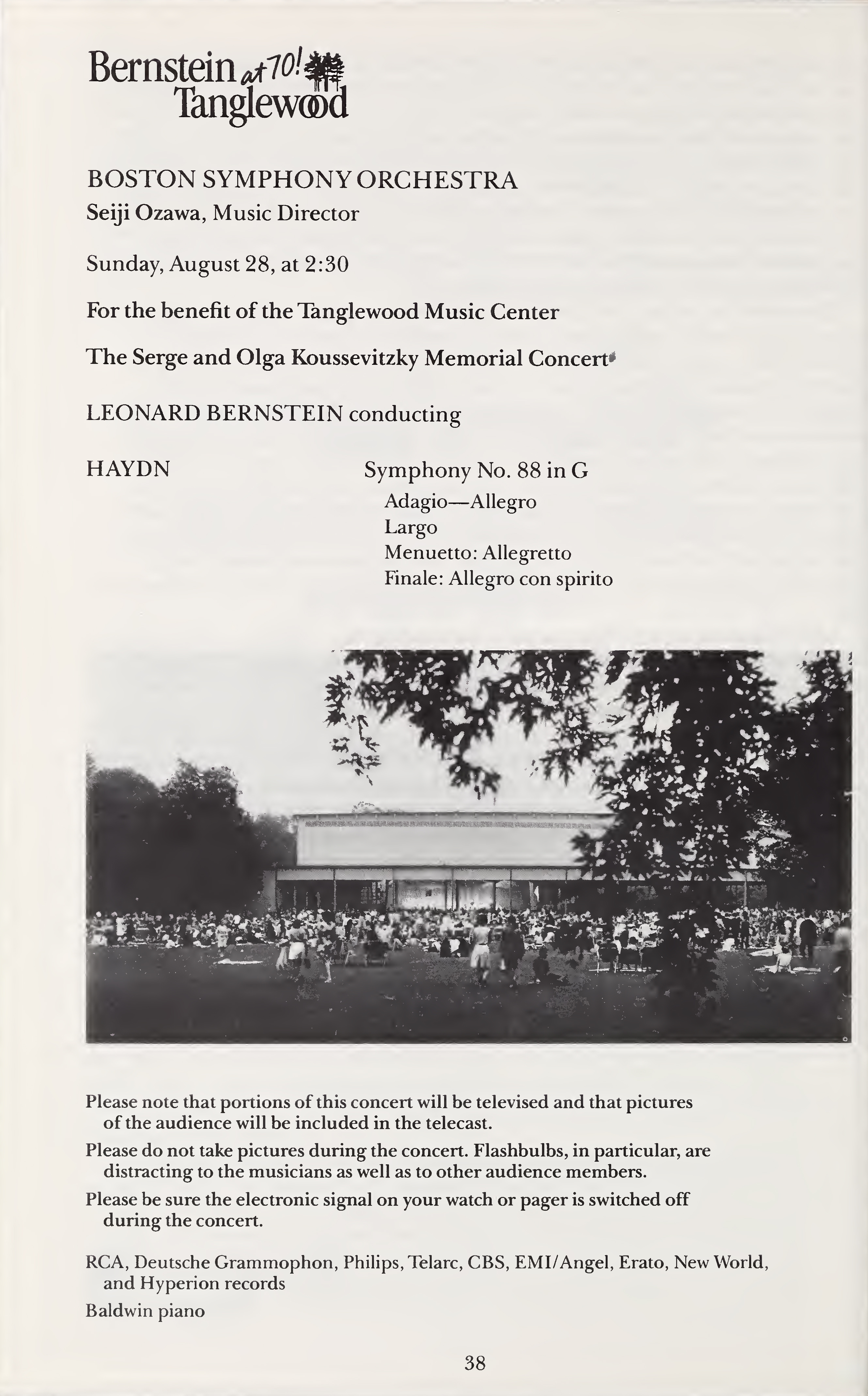
Leonard Bernstein turned 70 years old on August 25, 1988, and the Boston Symphony was going to celebrate in style. In addition to conducting his annual concert with the Boston Symphony (more on that, below), the BSO planned a grand birthday bash for its most famous son. Along with the usual weekend BSO concerts on Friday and Saturday evenings and Sunday afternoon (Lenny’s concert was always on Sunday afternoon), a special concert was planned for Thursday, August 25, the exact day of Lenny’s birthday. Here are the five pages of the three-hour long Bernstein gala concert program, everything that happened in that extraordinary evening. Looking at it now after the passage of time, I can hardly believe that it all came together.
It was intermission time. More on that below.
Now it’s time for the second half of this marathon concert. . .
The concert was broadcast on worldwide television. We had so much overtime in rehearsals—and our salaries carried additional payments for the concert itself and the television broadcast—that we all took home an extra week of pay. For that one concert.
A photo I took of Leonard Bernstein backstage at the Tanglewood Music Shed before his gala birthday concert performed by the Boston Symphony Orchestra, August 25, 1988.
Lenny was not doing well on his birthday. In her book, Famous Father Girl, his daughter, Jamie, tells the story of how he was dealing with life—emotional issues, physical issues, relational issues, and the fact that he was now 70 years old—with a growing cocktail of drugs and alcohol. He was experiencing prostate problems, and he really didn’t want to be at a public birthday party. For Lenny, if there is music being made, he wanted to make it, not watch it happen. But he came. I snapped this photo, above, backstage before the concert. Conductor John Mauceri, dressed in the white jacket, has his back to my camera, and there’s Lenny wearing Serge Koussevitzky’s cape and cufflinks, holding court among musicians. While smoking his ubiquitous cigarette.
Lenny had penned a personal note for inclusion in the concert program (above). He referenced the “Biblical Birthday.” Several times in the Bible, age seventy (a “score” is twenty years) is referenced as the normal lifespan of a person. Such as in Psalm 90:10,
The days of our years are threescore years and ten;
and if by reason of strength they be fourscore years,
yet is their strength labor and sorrow;
for it is soon cut off, and we fly away.
Bernstein also wrote the quotation, “In my end is my beginning.” This was the motto of Mary Stuart, Queen of Scots, and it was also used by T. S. Eliot (in the opposite form) in his book, Four Quartets, where he wrote, “In my beginning is my end.” And Tanglewood, which was so influential on the young Leonard Bernstein when he was a student in the first class of the Berkshire Music Center in 1940, was the logical place for his party. It was, in a sense, where his professional musical life had its beginning. But would Tanglewood be his end as well?
Throughout the concert, Lenny sat in a box seat, about half way back in the Tanglewood Music Shed, with his children and Helen Coates and other friends. The first half of the program was 90 minutes long and during the intermission, I went backstage to go to the orchestra member’s men’s room—a no-frills, cinderblock constructed space—where I stood in front of a wall of porcelain, doing what men do when they are facing a wall of porcelain. And who came up to the urinal next to me but Lenny. Lenny started to do his business while I was finishing up mine, but very quickly, I realized that Lenny was starting to topple over; his knees were buckling. I reached over with both hands to hold him up so he could complete his task and while doing so, he looked up at me with glazed over eyes— it was obvious that he was stoned, under the effect of an unknown cocktail of pills—and said, “Thanks, man.”
He recovered and we walked out of the men’s room together, arm in arm. And back to his birthday party we both went.
The incident was a cause célèbre; several of my colleagues were in the men’s room at the time and they saw the whole thing. “DID YOU SEE THAT DOUG YEO HAD TO HOLD UP LENNY SO HE COULD PEE!?!?!?”
After the concert was over—Did it get over? Is it still going on?—Danny Katzen, our second horn player, got out a sharpie and wrote, on the wall over the urinal that Lennie had christened:
LB peed here 8/25/88
Thus was penned the classical music world’s equivalent to “George Washington slept here.”
The next week, we all went home, and the following year, we came back to Tanglewood and found that the Boston Symphony’s management had Danny’s comment painted over. They erased history! So Danny wrote it again. The management painted over it. This went on for a few years until Danny wrote it AGAIN and put he a little frame with glass around it, and affixed to the wall with Crazy Glue (photo above). It stayed up for a few years until the BSO’s management renovated the whole backstage area, the men’s room got a makeover, and the urinals were replaced.
So, there you go. I held up the most famous musician in the world so he could pee when he was stoned at his birthday party.
But the week wasn’t over. There was another concert to come.
A photo I took during Leonard Bernstein’s rehearsal of the Boston Symphony Orchestr in Pyotr Tchaikovsky’s Symphony No. 5, August 1988.
Lenny was, from all reports, exhausted after his birthday party. We all were. But he pulled himself together to rehearse the BSO for the Sunday concert which featured Joseph Haydn’s Symphony No. 88 and Pyotr Tchaikovsky’s Symphony No. 5. But there was one more segment of music on the program.
The Boston Symphony had commissioned eight composers—Luciano Berio, Leon Kirchner, Jacob Druckman, Lukas Foss, John Corigliano, John Williams, Toru Takemitsu, and William Schumann— to write short, celebratory variations on the theme “New York, New York” from Bernstein’s show, On the Town. The lyrics to that musical moment—the theme—are:
New York, New York, a helluva town
The Bronx is up, but the Battery’s down
The people ride in a hold in the groun’
New York, New York, it’s a helluva town!
Seiji Ozawa, who at that time was the BSO’s music director—he had been Lenny’s assistant in the New York Philharmonic many years earlier—conducted the theme and all of variations.
After intermission, Lenny conducted Tchaikovsky’s Symphony No. 5. I remember the first rehearsal vividly. Lenny came on stage, and after the usual greetings and kissing and hugging, he announced, very seriously, “I have a brand new score with no markings. I have had a REVELATION about this piece.” The orchestra sat with bated breath: What was this new revelation?
Half tempo. Lenny started the opening of the first movement at HALF of the usual tempo. It was glacial. This went on for about 20 minutes, the orchestra straining to give the music a sense of coherence. But it was not long before Lenny was back to his old tricks, the tempo was back to normal, and the Lenny leap was on full display. Revelation? Not so much. But it was a really exciting performance. Here is a brief excerpt of the finale of the Tchaikovsky symphony. Classic Lenny in every way.
In 1989, Lenny returned to Symphony Hall, Boston, where he attended his Harvard 50th reunion concert. The Boston Pops Orchestra—made up of members of the Boston Symphony minus most of its principal players (and other players who simply don’t want to play the Pops season and take off those weeks without pay) and some Boston freelance players—often hosted class reunions which were fund raisers for various colleges and universities. We had Harvard night, Boston University night, Boston College night, Northeastern night, and so on. Lenny had conducted part of the concert on June 8, 1964, for his 25th reunion, and he came back to Symphony Hall to conduct on his 50th reunion.
So it was that Lenny conducted the Boston Pops Orchestra on June 6, 1989. He chose to conduct, on this occasion, his Divertimento for Orchestra which he had written for the Boston Symphony in celebration of the orchestra’s centennial in 1981. The Boston Pops Orchestra had recorded the piece in spring of 1985—it was the first of many recordings I made with the Pops—conducted by John Williams, and the BSO made a private issue compact disc recording with Lenny’s 1989 Divertimento performance combined with his 1964 25th reunion performance as a fund raising project for an annual event called “Salute to Symphony.” By the way, for anyone that wonders why there is a euphonium solo written into the tuba part of Divertimento—doubling for the tuba player!—it’s because Lenny knew exactly who he was writing for. In the Boston Symphony, our tuba player from 1966 to 2001, Chester Schmitz, also played euphonium. In most orchestras, euphonium is played by a trombone player, but Chester played it in the BSO and Lenny knew that. He took care of his own; Chester pocketed a doubling fee of 50% of base scale pay in addition to his regular salary every time he (or anyone else in the orchestra) doubled on another instrument. Cha-ching! Thanks, Lenny!
But I missed Lenny’s 1989 Tanglewood appearance which was on August 27. On July 31, my oldest daughter (who was 9 years old at the time) and I were in a horrific automobile accident when the car I was driving was hit broadside by a fuel oil truck that was speeding through a red light. We never saw it coming. Our daughter was seriously injured (the truck hit on her side of the car and as a result, my injuries were much less serious than hers) but God gave her a truly miraculous healing, and she not only recovered from the accident (and she has a remarkable story of God’s work in her life), but she is the mother of our two precious grandchildren. My friend, Steve Norrell, who at that time was bass trombonist of the Metropolitan Opera Orchestra, substituted for me for the last month of the 1989 Tanglewood season, including Lenny’s performance with the BSO of Dmitri Shostakovich’s Symphony No. 5.
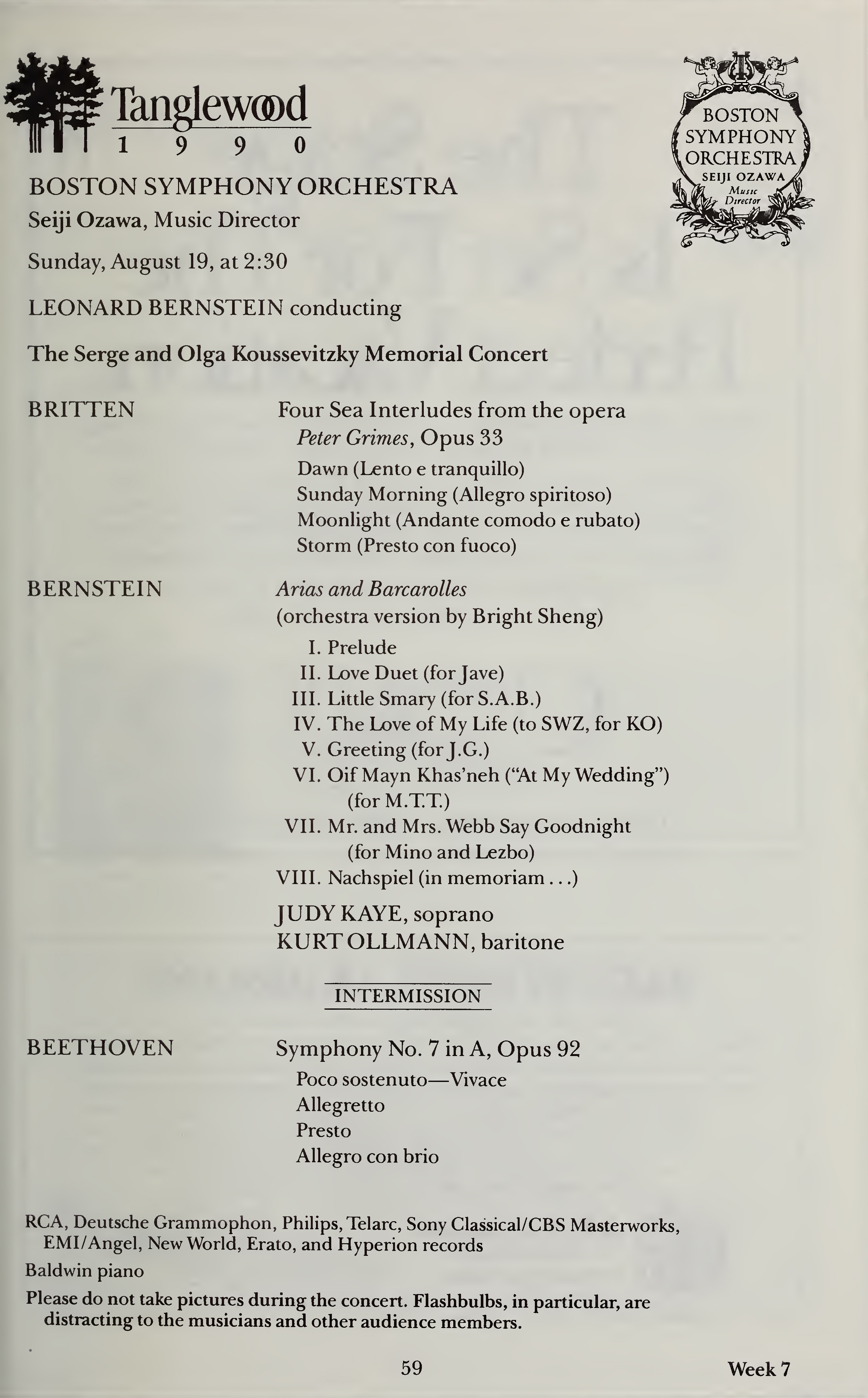
The End came at Tanglewood, 1990. At his birthday celebration in 1988, and at his Boston Pops Orchestra performance in Symphony Hall in 1989, we all knew Lenny wasn’t right. He was taking more and more pills, his abdomen was swollen, and he was a little “off.” It wasn’t just that he was stoned at his birthday celebration and I had to help him relieve himself. By 1990, reports were coming in of his many serious medical issues. While the fact that he had lung cancer was mostly kept a secret (we all suspected it), his shortness of breath was evident to all. In summer, 1990, he had to withdraw from conducting the final concerts of the Pacific Music Festival in Sapporo, Japan, what he had planned to be an Asian equivalent to the Tanglewood Music Center. By the time he came to Tanglewood, he was worn out. Still, he was planning to take the Tanglewood Music Center Orchestra on tour to Europe at the end of the summer, and he had planned his usual big concert with the BSO.
It was to be his final concert.
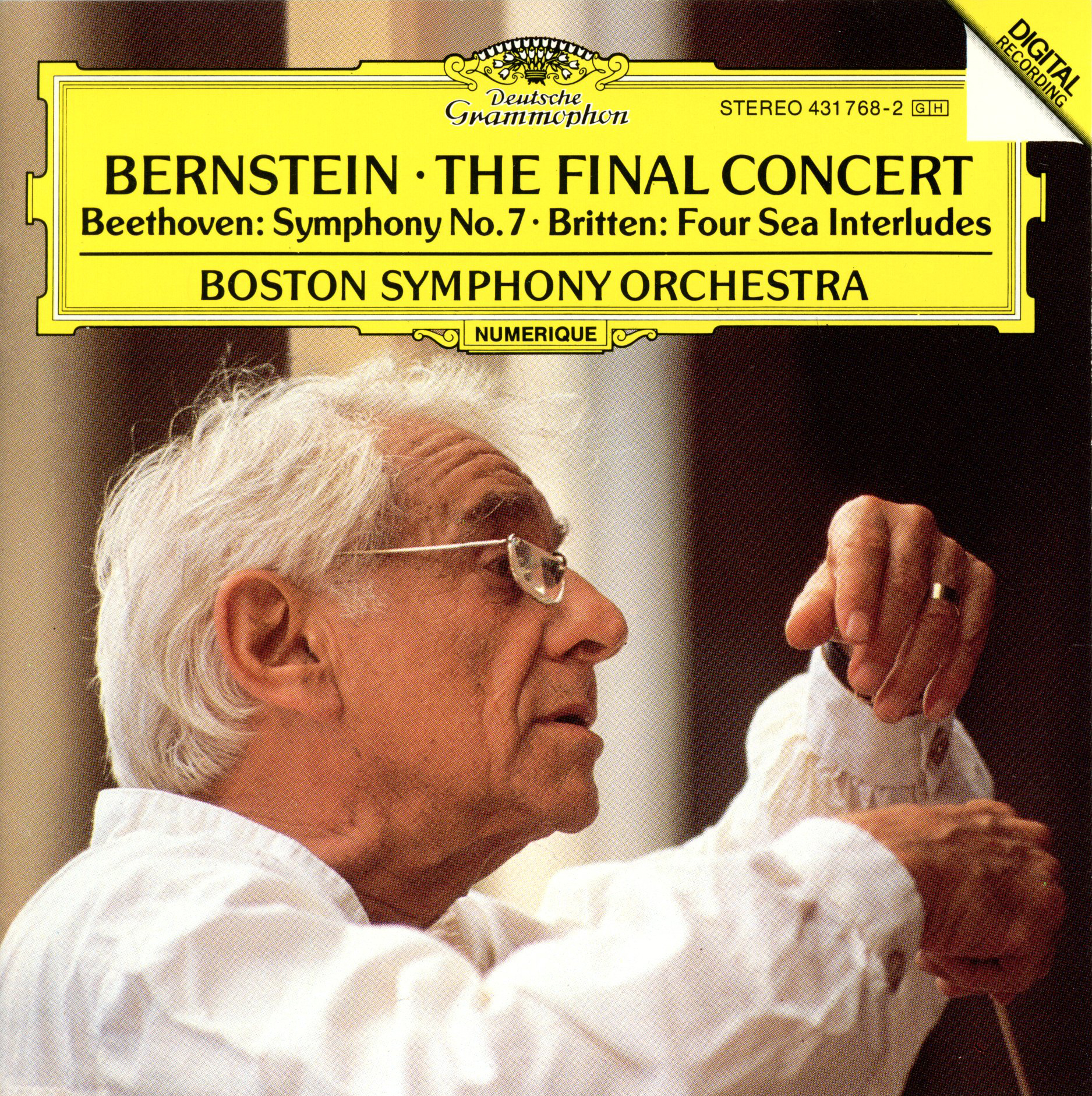
The cover of Deutsche Grammophon’s release, Bernstein: The Final Concert, taken from the radio broadcast tapes of the Boston Symphony concert of August 19, 1990.
That is what Deutsche Grammophon called the concert—The Final Concert—when it released a CD of the radio broadcast recording of the Boston Symphony Orchestra concert of August 19, 1990. All of us who were on stage with Lenny at Tanglewood on that day knew that we were at The End. He had planned to conduct his own Arias and Barcaroles for soprano, baritone, and orchestra in a new version for orchestra (the original was with piano) by Bright Sheng. But after starting to rehearse it, he just couldn’t do it, and he turned the piece over to BSO assistant conductor, Carl St. Clair.
Lenny did conduct Benjamin Britten’s “Four Sea Interludes” from his opera Peter Grimes. The inclusion of the piece on the program truly was an “In my end is my beginning moment.” Lenny had conducted the American premiere of Peter Grimes at Tanglewood in 1946 with the Berkshire Music Center Orchestra. And now, on what turned out to be his Final Concert, he was conducting Peter Grimes again at Tanglewood. Lenny’s conducting was labored; his conducting gestures at the opening of the first movement can be best described if you imagine someone slowly kneading bread dough. No defined ictus to his conducting. But somehow, we knew how to give him what he wanted and it held together. The fourth movement of the Interludes, “Storm,” was stunning. Lenny rallied his strength during the concert and the orchestra played over its head and delivered the performance of a lifetime.
Leonard Bernstein conducting his final concert, August 19, 1990. This photograph by Walter H. Scott appeared in the booklet that accompanied the Deutsche Grammophon CD release of the concert.
There are no trombones in Beethoven’s Symphony No. 7 and while many of my colleagues who didn’t play the piece hurried off stage at intermission and ran to their cars to get home before the crush of traffic that always awaited us at the end of one of Lenny’s concerts, I stayed. I walked around to the side of the Tanglewood Music Shed and stood next to some other audience members, riveted to what was going on onstage. Lenny was clearly struggling throughout. During the third movement, the scherzo, Lenny had a coughing fit. He stopped conducting—the orchestra didn’t miss a beat as every eye was on concertmaster Malcolm Lowe who kept the orchestra together—and Lenny held on to the railing at the back of the podium. We truly thought he was going to die on the podium. He coughed and coughed but he finally recovered and he finished the concert.
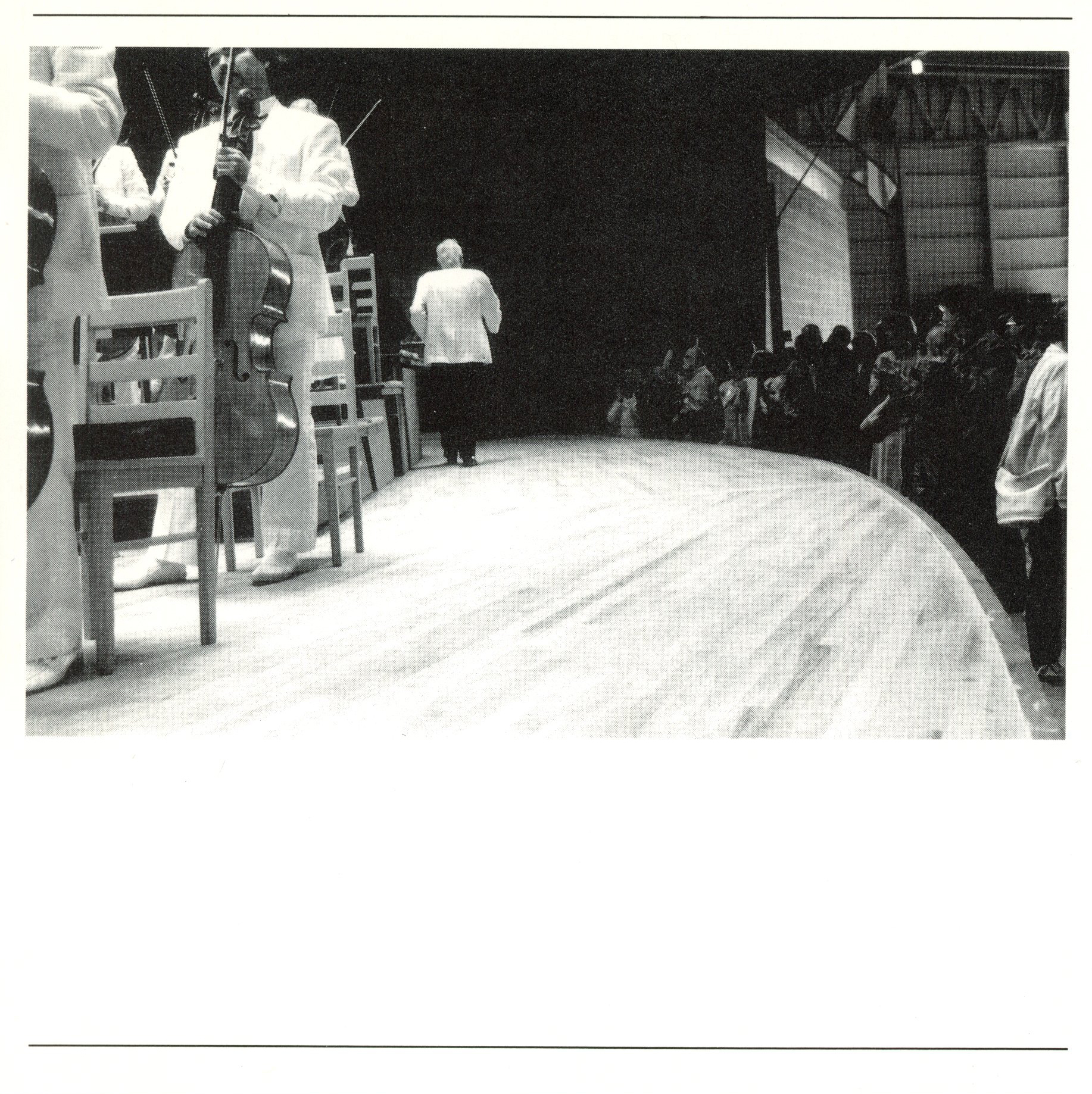
Leonard Bernstein walking offstage at the conclusion of his final concert, August 19, 1990, after he conducted the Boston Symphony Orchestra in Beethoven’s Symphony No. 7. Photo by Walter H. Scott. This photograph appeared in the booklet that accompanied the Deutsche Grammophon release of the concert.
It was over. We all knew it was over. The photograph by Walter H. Scott of Lenny walking off stage at the end of the concert—it appeared as the last page in Deutsche Grammophon’s CD release of the performance (above)—is heartbreaking. I was standing so I could see Lenny’s face. It was the face of a man who knew it was over.
That afternoon, Leonard Bernstein cancelled the planned tour of Europe with the Tanglewood Music Center Orchestra. The students were crushed in their disappointment. But there was no other option. Lenny was not well. His cancer was progressing, and no amount of pain pills could keep him from pain. A month later, he “officially” retired from conducting although his concert at Tanglewood was the last one he would ever conduct and we all knew there would be no more. Then, on October 14, 1990, he died at home in The Dakota in New York City.
An era, the era of the superstar conductor, died with him.
The announcement in the New York Times for the memorial tribute to Leonard Bernstein, held at the Majestic Theatre on December 13, 1990.
My ticket to the Leonard Bernstein memorial tribute put on by the Broadway community, December 13, 1990.
But even though it was over, it wasn’t actually over. There were tributes. Many tributes. I attended one, while the Boston Symphony while was in New York City to perform at Carnegie Hall. The Broadway community wanted to pay tribute to one of their own, and the Boston Symphony was given a few tickets to the event that were distributed to players. I was very happy to get one, and very glad to be there. The event was rambunctious from the start. Several hundred tickets were made available to the public on a first come-first serve basis just before the event. After I found a seat, a woman ran—RAN—to the seat next to me, stood on it, and, while waving furiously, shouted—put on your best New York City accent—”MURRAY! MURRAY! OVER HEEEEAAH!” Murray shuffled over, “All right, all right, I’m coming.” It was a microcosm of the tribute. It was noisy, poignant, touching, loud. Tears were shed, we clapped our hands, and when it was over, I walked a few blocks uptown to Carnegie Hall for my evening concert with the BSO. As our concert concluded with Giuseppe Verdi’s Quatro pezzi sacri—”Four Sacred Pieces”—I had my own personal benediction of sorts for Leonard Bernstein.
As I reflect on the life of the man we in the Boston Symphony Orchestra called Lenny, I recall a profoundly talented but deeply flawed man. He had so much to offer the world. While many critics found his compositions to be of uneven quality, who can argue that West Side Story isn’t one of the great musicals of the twentieth century, or that Chichester Psalms —a piece I played on seven occasions with the Boston Symphony Orchestra—does not touch the heart of all who have ever heard it. I played his Symphony No. 2 “Age of Anxiety” around the world on tour with the BSO and I was always glad to play it—and I was always happy WHEN I was playing it. Candide Overture, the final benediction from Mass, even Lenny’s Elegy for Mippy II for solo trombone (during intermission of a rehearsal at Tanglewood, I asked him about the ambiguous articulations he had put on the music—should it be played straight or swung— and he looked me in the eye, put his arm on my shoulder, and said, “It’s jazz, man, it’s jazz.”) have given me and so many others so much pleasure. My home library contains 15 books about Leonard Bernstein, second only to my books about Hector Berlioz (17) and ahead of Gustav Mahler (13). My stage pass for the Bernstein at 70! Tanglewood extravaganza hangs from the dust jacket of Humphrey Burton’s biography of Lenny.
Lenny died as he lived, full tilt, a hedonist to the extreme, the exemplar of a life lived unrestrained. He was a musical superhero and a character from a Greek tragedy rolled up in one. He needed to be needed, he needed to be loved, but he often looked for love in all the wrong places. He was as complex a person as ever lived on earth and who knows what he might have done had he not lived life with so much excess and died at age 72. We will never know. Only God knows. But what we do know is that Leonard Bernstein made an impact in the musical world, and my world, and the world of so many others. There will never be another like him.
In January 2014, I decided to write an article about Homer Rodeheaver, the trombone-playing song leader for evangelist William “Billy” Sunday in the first third of the twentieth century. I first learned of Rodeheaver a few years earlier when I visited the Billy Graham Museum on the campus of Wheaton College, Illinois, and saw a near life-size cardboard cutout of him with a trombone in one hand and a songbook in the other. The cutout was of the image of Rodeheaver below. What? Who was this? I had never heard of him and I needed to know more. It wasn’t long before I learned that Rodeheaver (one of the first things I learned was that he pronounced his name “ROW-duh-hay-vehr”) played the trombone for over 100 million people in his lifetime. That’s a lot of people. Did anyone play trombone for more people? Maybe Arthur Pryor? Maybe? I thought his story might be interesting. It didn’t take long for Rodeheaver’s interesting story to change my life.
Above: Homer Rodeheaver promotional postcard.
Several things flowed from what became an obsession to learn more about Homer Rodeheaver. The first was that I met Kevin Mungons, a Chicago-area editor and writer who had also been researching Rodeheaver. We were introduced by Margaret Banks, a curator at the National Music Museum in Vermillion, South Dakota, when I reached out to her with some questions about Rodeheaver’s endorsements for Conn trombones. Peggy told me that Kevin had been asking her some of the same questions a few years earlier. So it was natural for me to contact him and ask him some questions. We immediately became good friends (it didn’t hurt that Kevin also plays trombone).
Secondly, Kevin was very happy to help me as I worked on my article about Rodeheaver which, once completed, was published in the 2015 Historic Brass Society Journal. Click HERE to read and download that article.
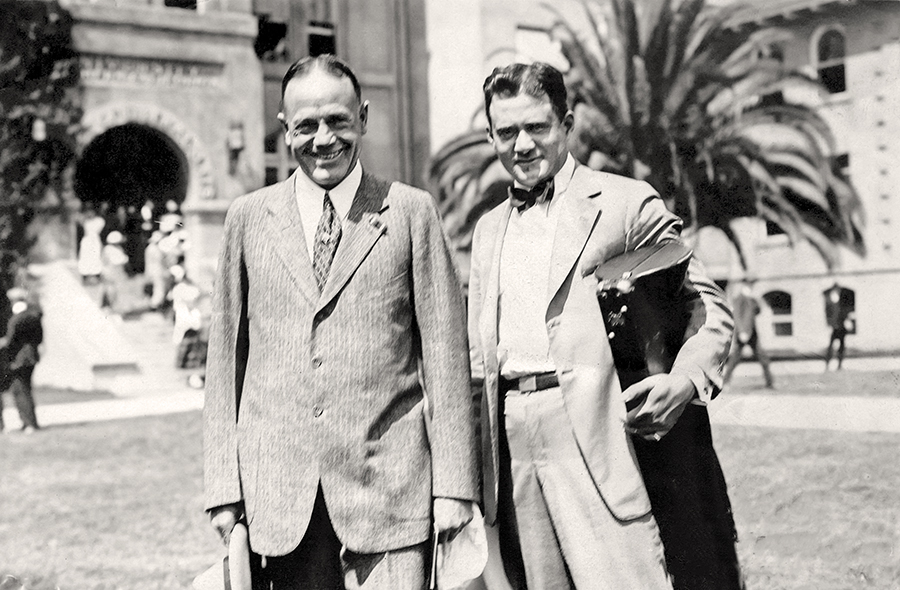
Above: Billy Sunday and Homer Rodeheaver, 1917. Courtesy of Morgan Library, Grace College, Winona Lake, Indiana.
And, thirdly, as Kevin and I continued talking about Rodeheaver, we decided that two heads were better than one, and that it might be a good idea—and fun—for us to collaborate and, together, write a book about Rodeheaver. Once we had committed to the idea, we did a deep dive into Rodeheaver’s life and work. Because Kevin was living in the Chicago area and I was living in Arizona at the time (my wife and I moved to the Chicago area in 2018 so we could live closer to our grandchildren), we collaborated mostly through phone and email. But we did meet up a few times, both in the Billy Graham Center Archives at Wheaton College, and in Winona Lake Indiana, where Grace College and the Winona History Center have a remarkable archive of documents, photographs, and ephemera relating to Billy Sunday and Homer Rodeheaver. During our research trip to Winona Lake, I played Rodeheaver’s Conn trombone (below). Of course, I played “Brighten the Corner Where You Are,” which was one of Rodeheaver’s signature tunes (he also owned the copyright to the song, and the big money was, as Rodeheaver knew, in copyrights).
Above: Douglas Yeo playing Homer Rodeheaver’s Conn trombone, 2014, Winona History Center, Winona Lake, Indiana.
Homer Rodeheaver was not only a trombonist, and not only the song leader for Billy Sunday for 20 years, but he established the first gospel music record label (Rainbow Records), established what was, for many decades, the largest publisher of Christian hymnals, songbooks, and other music (Rodeheaver Music Co., later Rodeheaver-Hall Mack Co.), was a driving force behind the popularization of African American spirituals, and had an influence on church and community singing that is still felt today. The subject of daily front page news and feature stories and celebrity gossip, nobody during his lifetime (1880–1955) had to ask, “Who is Homer Rodeheaver?” But for people today, Homer Rodeheaver is the most famous person you never heard of. Until now.
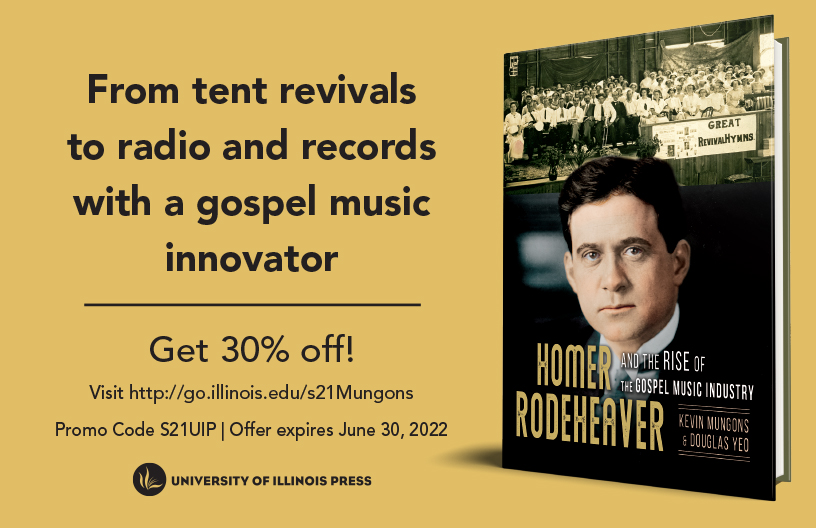
Last week, after seven years of writing and research (not including the many years before we met when Kevin was also researching Rodeheaver), the submission of our book manuscript to University of Illinois Press, several rounds of peer review, even more rounds of rewriting and editing, our book, Homer Rodeheaver and the Rise of the Gospel Music Industry came to market. It is published as part of UIP’s Music in American Life series of books. On Saturday, I held it in my hands for the first time.
Rodeheaver’s story is a rich story about music, publishing, Chicago, the Civil War, Jim Crow, race, the Ku Klux Klan, the perks and perils of being a celebrity, churches, money, religious devotion, Christian evangelism, community singing, marketing, airplanes, speedboats, philanthropy, Billy Graham and Cliff Barrows and George Beverly Shea, and the trombone. Lots of trombones. And that’s just the tip of Rodeheaver’s very large iceberg.
The back cover of the book features two reviews. Here’s what Robert Marovich, author of A City Called Heaven: Chicago and the Birth of Gospel Music, says:
Kevin Mungons and Douglas Yeo’s biography of Homer Rodeheaver brightens an important corner of gospel music history that has gone unexplored for far too long. What they reveal in their remarkable portrait of “Reverend Trombone” is a man both of his time and ahead of his time. It’s more than a tale of the emergence of gospel singing and revivalism, it’s a quintessentially American story about a quintessential American.
And Harold Best, emeritus professor of music and Dean emeritus of Wheaton College Conservatory of Music, past president of the National Association of Schools of Music, and author of Music Through the Eyes of Faith, wrote:
I am truly taken by the book. It is good, informative, comprehensive, and free of the usual assortment of clichés, academic hems and haws, and over-spiritualization. It takes the often over-simplified view of music and revivalism and exposes it to a fascinating cross-weave of thought, content, and context which, to my embarrassment, I thought I had already had a handle on. I recommend it without reservation. There is no doubt in my mind that general readers and specialists alike will benefit from reading this book.
If what you’ve read so far piques your interest, then, as the late night television pitchman says, “Do I have a deal for you!” Right now, University of Illinois Press is offering a 30% discount on the book, both the softcover and the hardcover editions. If course, you can pay full price if you’d like; just go to the book’s page on amazon.com. But if you’d be interested in paying less, click HERE go to the book’s page on the University of Illinois Press website and enter this promo code:
S21UIP
If you’d like to tell your friends about the book, click HERE to view and download a one page promotional PDF that has full information about the book and the same 30% off discount code.
After seven years of delving into every aspect of Homer Rodeheaver’s life, I still find his story to be interesting, informative, inspirational, challenging, and thought-provoking. I hope you, too, will enjoy the story of the man who called himself, “Reverend Trombone.”
In recent years, many performers and teachers have been working to encourage more diverse programming in recitals and concerts that would include more excellent works by underrepresented composers. In an effort to help my students and colleagues who would like to know more about such works, I have started a working list of pieces for tenor or bass trombone solo by composers who are members of diverse races and ethnic groups including but not limited to Asian, Black, Indigenous, and Latino/Latina. 80% of the world’s people are non-white—they are the global majority—and their music deserves to be heard.
The list is now available on my website and may be downloaded by clicking HERE. The direct URL is: http://www.yeodoug.com/Yeo_POC_PGM_Women_composer_trombone_solo_list.pdf At the moment, the list mostly features works by Black composer as well as two important resources by Dr. Natalie Mannix with detailed information about works by women composers. I will continually update the list to include works of many other composers and I welcome hearing about additional works that should be included. Readers can contact me at the email address that is found on my list. The most recent version of the list will always be available on my website at the URL above.
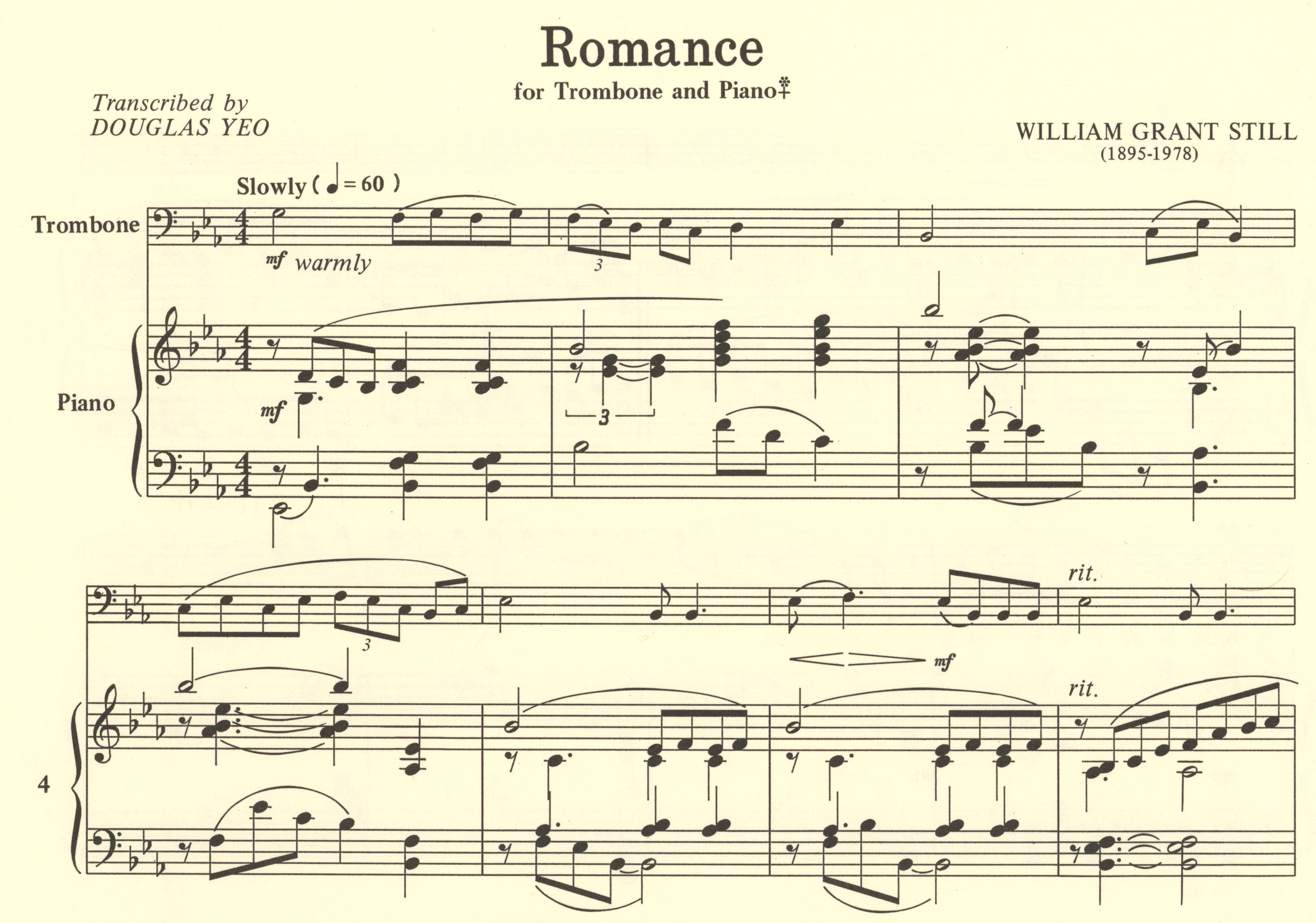
Among the works on the list is my transcription of William Grant Still’sRomance. Still (1895–1978) was a celebrated African American composer who wrote more than 200 works. In 1990, his daughter, Judith Anne Still, reached out to me and asked if I would be interested in transcribing her father’s Romance—which had been originally composed for alto saxophone in 1966—for trombone. Judith was interested in the piece becoming more widely known and I was very happy to make my transcription which was subsequently published by International Music Company. Romance is a solo with piano accompaniment but William Grant Still also arranged it with orchestra accompaniment which is available on rental from International Music Company. In May 1991, I performed Romance with the Boston Pops Orchestra conducted by John Williams. The performance, which came on the same concert where I played John Williams’ Tuba Concerto (played on bass trombone), was aired nationally on the radio and you can hear it by clicking HERE.
On April 23, 2022, I will be giving a faculty recital at Wheaton College, and my program will include two pieces that are found on my new list, Concertino by David F. Wilborn and Extremely Close by Daniela Candillari. I hope my list and other lists like it that others are preparing will be helpful as we work to know more about more great music, and have our recital and concert programming reflect compositions by a more diverse group of composers. It matters.



























 The Last Trombone – Douglas Yeo