Category: history

Residency at Bowling Green State University: serpent, trombone and a face cake

Residency at Bowling Green State University: serpent, trombone and a face cake

I have just returned from a residency at Bowling Green State University (BGSU), College of Music Arts, in Bowling Green, Ohio.

Plans for this residency were first laid in July 2014 when I received an unusual request. BGSU had recently received a gift of a 19th century English military serpent and they wanted to know if I would be willing to come to the University to introduce the instrument to the community. And thus began a very interesting journey.

01_Yeo_Varney

It seems that Dr. Glenn Varney, BGSU Professor of Management (Emeritus), shown with me in the photo above, had gifted a 19th century serpent to the BGSU College of Musical Arts. This instrument, an English military serpent with four keys that was probably made around 1830, had been in the family of his late wife, Ruth P. Varney for many years, having been purchased from a dealer in London who said the serpent was last used by a musician in a regimental band during the Boer War (1899-1902). Over the years, the serpent had suffered some accidents  – then again, wouldn’t YOU be in rough shape if you were nearly 200 years old? – and some needed restoration was done by J.c. Sherman of Cleveland. The University contacted me to ask if I could give some kind of a program at BGSU that would feature the serpent.

Now, those who know me know that I have played the serpent since 1994.  I’ve played many historical instruments in museums around the world, but before I could commit to playing a concert on an instrument I had never seen – let alone played – I needed to hold it in my hands and spend time with it. So last year, BGSU shipped the Ruth P. Varney Memorial Serpent to me so I could get to know this instrument.

07_rehearsal

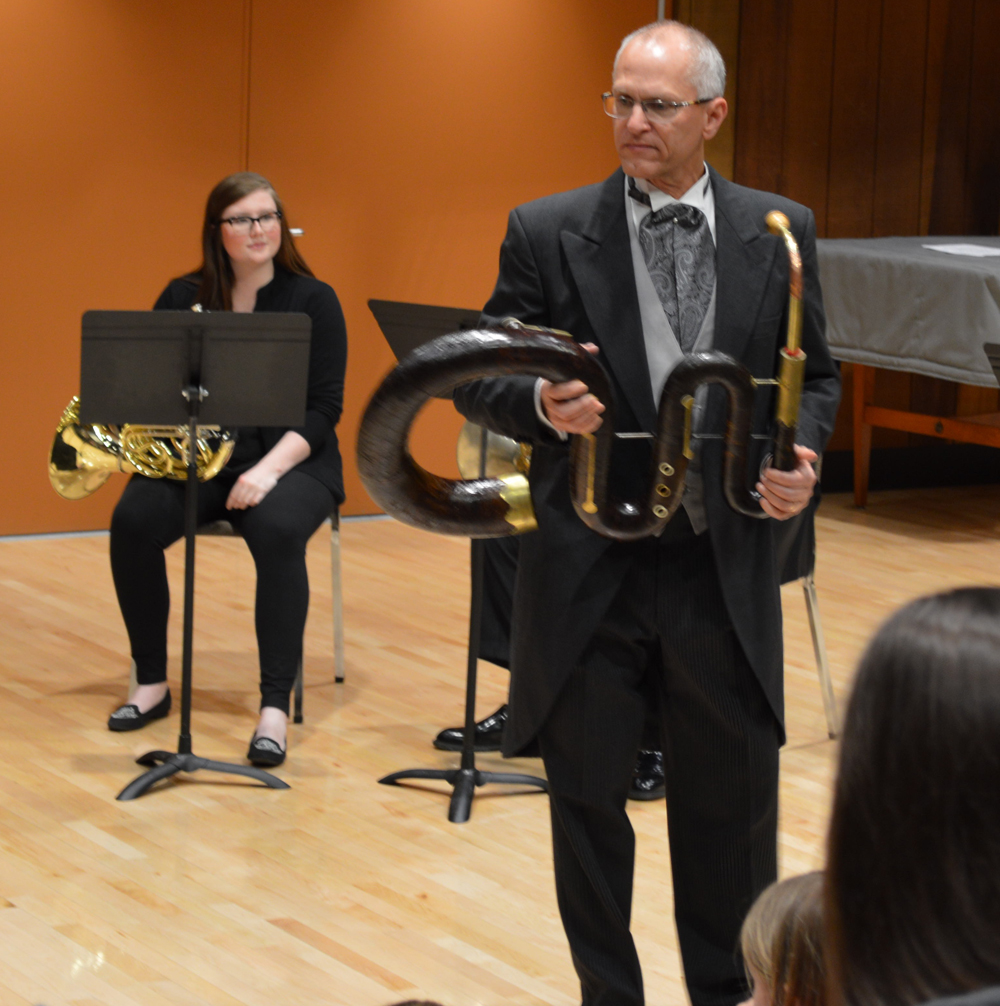
No two serpents are alike and it took me several months to understand the unique qualities of the Varney serpent. My friend, Phil Humphries, a serpent player in England who plays in the London Serpent Trio and the Mellstock Band, likes to say that every day before he picks up his serpent, he looks at it and says, “Well, what kind of mood are you in today?” In time, I managed to come to grips with the playing characteristics of this particular serpent to the point where I could commit to use it in performance. I organized a program of chamber music that had been written to include the serpent, a program I had given in 2011 in Rouen and Paris, France: marches by Christopher Eley, Samuel Wesley and Josef Haydn, and a Divertimento attributed to Haydn that included the famous “St. Antoni Chorale” that Johannes Brahms famously used as the basis for his “Variations on a Theme By Haydn.” The concert that we presented – the group was superb, featuring a mix of BGSU faculty, students and other local players – was enthusiastically received by the audience. The group included Nermis Mieses and Jana Zilova, oboe; Derek Emch and Erin Cameron, clarinet; Andrew Pelletier and Kristen Running, horn; Greg Quick, Alex Meaux and Jack Smolenski, bassoon; and Charles Saenz, trumpet.
05_Yeo_concert

I titled the concert, “The Ruth P. Varney Memorial Serpent: A Conversation and Concert Led  By Douglas Yeo.” In this, I was able to engage the audience with information about the serpent, its role in music – from its important work accompanying chant in the church in France from the 16th century through its introduction into military bands, chamber music and the symphony orchestra – and the generosity of Glenn Varney in donating this extraordinary instrument to BGSU in memory of his late wife.

06_Yeo_seminar

While at Bowling Green, I also had the opportunity to lead a music history seminar that discussed the serpent. The class, taught by Dr. Arne Spohr, provided an opportunity to discuss how the serpent was part of musical culture in France, Germany and England, and its particular role and sound in large and small performance spaces. This was a very stimulating class with great discussion and questions from the students.
03_Yeo_trombone_class

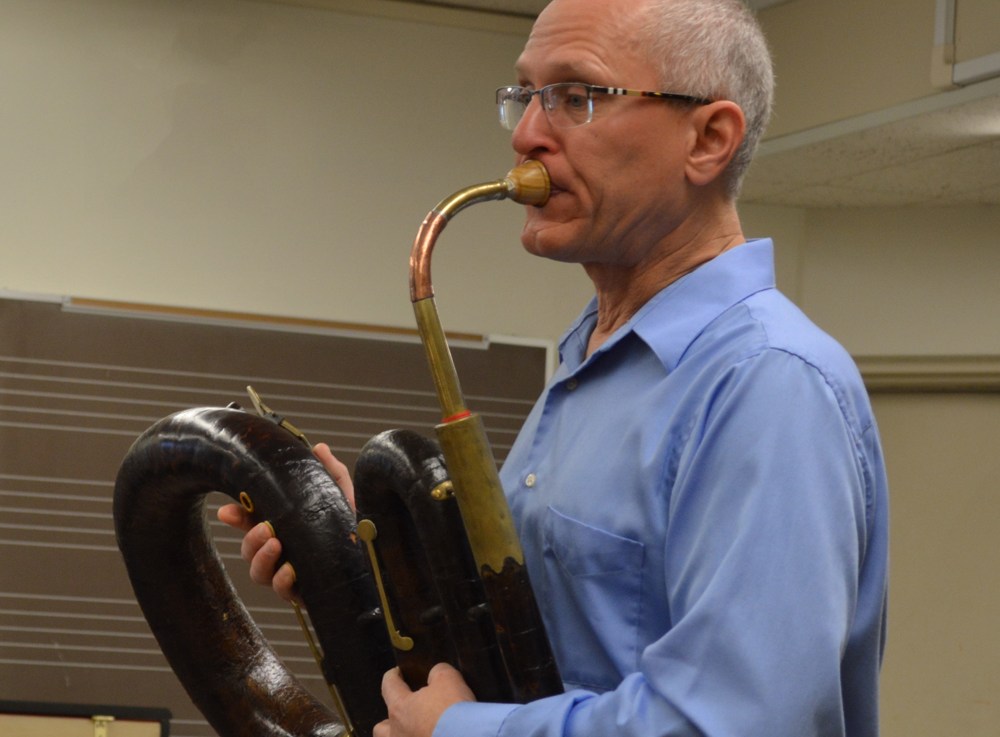
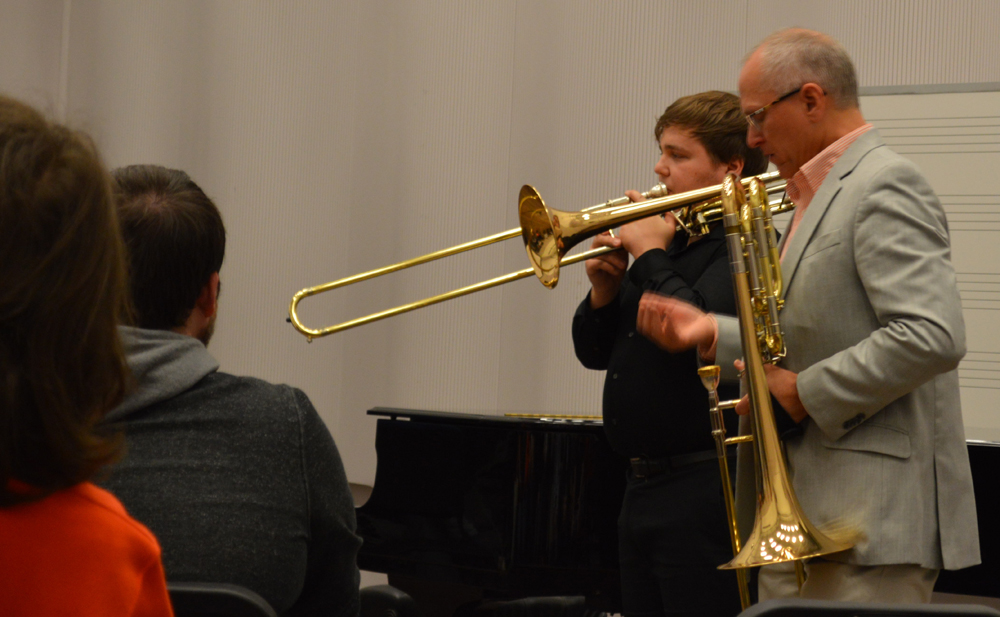
In addition to a masterclass for the BGSU tuba/euphonium studio – the photo at the top of this post was taken in that class as I was demonstrating the serpent (if you receive posts from The Last Trombone by email and can’t see that photo, click on the title of this post to open it in your web browser where you can see the photo) – I also gave a trombone masterclass where I worked with several students on solos, heard a low brass section play excerpts from Brahms’ Symphony No. 2, and also a trombone quartet. These were talented students and working with them was a great pleasure.
04_Yeo_cake

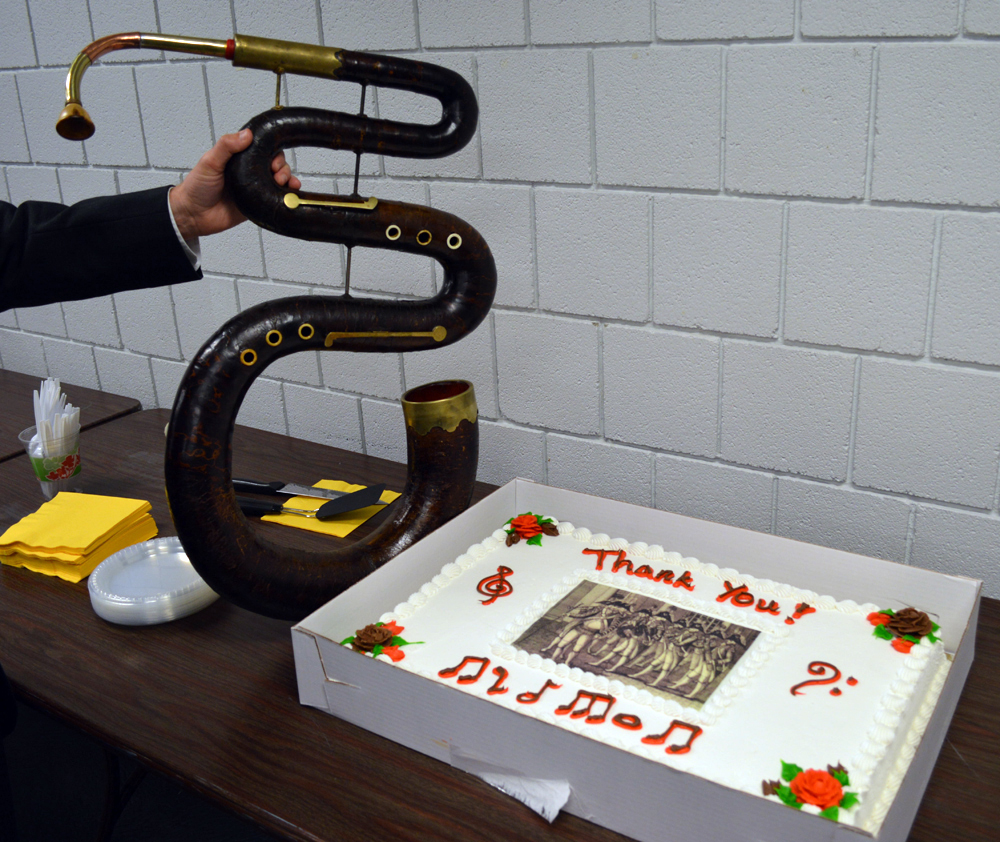
And, hey, it’s not every day you get to see a face cake with a serpent on it. Following the concert, the College of Musical Arts hosted a reception in honor of Glenn Varney and his gift of the serpent in memory of his wife, Ruth. On the cake was a famous image from the British Museum of the Duke of York’s Band, c1790, with serpent front and center. Seriously!

Yeo_cake

My time at BGSU generated some nice articles in the local press that you can read here:

Musical serpent to be celebrated at BGSU (BG Independent News)

Serpent performance to send BGSU back in time (Bowling Green Sentinel-Tribune)

Over the years, I have conducted many residencies at colleges and universities around the world. This residency at Bowling Green State University was one of the most diverse I’ve ever conducted and it was exceptionally well organized and very satisfying in every way. I owe a big “thank you” to BGSU Dean of the college of musical arts, Dr. William Mathis, tuba instructor David Saltzman, adjunct associate professor of trombone Garth Simmons, associate professor of horn Andrew Pelletier, and associate professor of musicology Arne Spohr for all they did to organize my various activities during my visit. And I must also thank Lindsay Gross, manager of Public-Community Relations for the BGSU College of Musical Arts who was of tremendous help in making everything during my visit work so smoothly.

Most of all, I left Bowling Green with gratitude to Glenn Varney, whose gift of his wife’s family’s serpent was the driving force behind my visit. Thank you, Glenn, for providing me with this rich opportunity to engage with students, faculty and the BGSU community and to bring the serpent to the fore in a very unique and special way.

[NOTE: All photos in this post were taken by Lindsay Gross.]
The trombone and words: Duke Ellington

The trombone and words: Duke Ellington

When most people think of Duke Ellington, they remember the superb jazz musician – composer, arranger, pianist – and the great players who worked with him in his bands. Joe “Tricky Sam” Nanton, Juan Tizol, Lawrence Brown – these are names imbedded in the jazz lore of trombonists. This is reason enough to remember Ellington, but most people aren’t as aware that Ellington was also a deep thinker, a brilliant man who had a lot to say about music and music making, and many other subjects.

The three part series of articles about Ellington by Richard O. Boyer that appeared in The New Yorker magazine in June and July 1944 is “must reading” for any student of music. Part 1 is available to read online; click HERE to read it in The New Yorker archives. Unfortunately, parts 2 and 3 are only available to subscribers of the magazine but you can find back issues in many libraries.

But there is one small thing in part 3 that got my attention in a big way. Boyer wrote, speaking of Ellington,

New acquaintances are always surprised when they learn that Duke has written poetry in which he advances the thesis that the rhythm of jazz has been beaten into the Negro race by three centuries of oppression. The four beats to a bar in jazz are also found, he maintains in verse, in the Negro pulse. Duke doesn’t like to show people his poetry. “You can say anything you want on the trombone, but you gotta be careful with words,” he explains.”

Richard O. Boyer, “Profiles: The Hot Bach–III,” The New Yorker, Vol XX, No. 21, July 8, 1944, p. 27.

Oh, wow. There is a lot to unpack in these sentences, but I want to particularly draw your attention to Ellington’s quote about being careful with words. I wrote about this subject – being careful with words – on The Last Trombone several months ago (click HERE to read my article from August 2016 about the importance of words). As I keep working on several book projects, I keep Ellington’s quotation in front of me at all times: “You gotta be careful with words.” Now, I LITERALLY keep Ellington’s words in front of me, thanks to a nice little bit of artistic work by my friend, Kevin Mungons. Kevin and I are collaborating on a book for University of Illinois Press about Homer Rodeheaver, the trombone-playing song leader for evangelist Billy Sunday in the first third of the twentieth century. When I shared Ellington’s words with Kevin, he was so taken by them that he made up a poster that I now have hanging up in my home office (see the photo that appears at the top of this post; if you’re reading this by email and don’t see that image, click on the title of this post to see this article, including the featured image, in your web browser). I love it. Kevin made this poster in the style of an old Blue Note jazz album.

Ellington Trombone Quote

The next time you sit down to write something, remember Ellington’s words. He’s right: with a trombone in your hands, you can say anything. But words? You gotta be careful. Very careful!

Monteverdi. And A Trace of Grace

Monteverdi. And A Trace of Grace

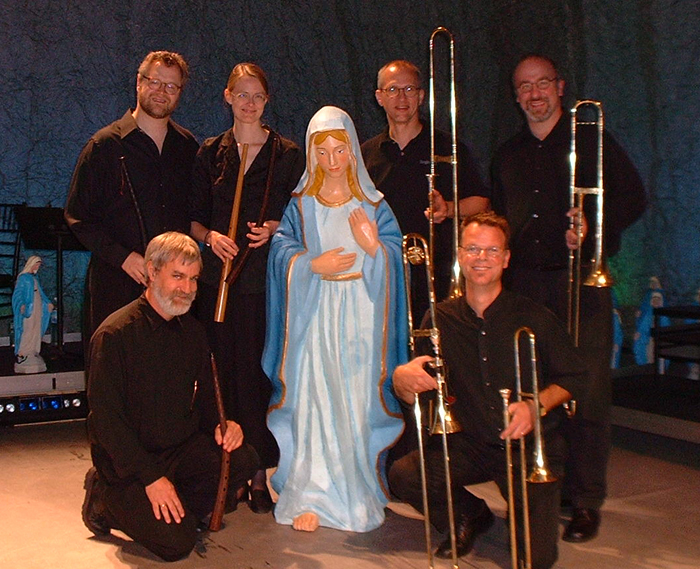
Last week, a good friend of mine was singing Claudio Monteverdi’s Vespers of 1610, the Vespro Della Beata Vergine (Vespers of the Blessed Virgin). This is an extraordinary work, one that I have loved since I first heard it many decades ago. I was very fortunate to have an opportunity to play the Vespers in 2003 as a member of Boston’s Handel and Haydn Society. This was a unique performance that was semi-staged (statues of the Virgin Mary were plentiful at those performances) at the Colonial Theatre in Boston’s theater district. The photo below shows the winds of that performance (clockwise from bottom left): Michael Collver , Paul Perfetti and Kiri Tollaksen (cornettos) and myself, John Faieta and Robert Couture (sackbuts).

monteverdi_band_01_blog

All of this thinking about Monteverdi has had me listening to a lot of his music in the last few weeks, and I turned in particular to my favorite recording of the Vespers, that by Boston Baroque conducted by Martin Pearlman. Here’s a short video with highlights from a Boston Baroque performance of the Vespers from 2014. If you can’t view the imbedded video below, click HERE to view the video on the Vimeo website.

Most people, if they know Monteverdi’s music at all, know the Vespers. But he wrote so much more.

One of my favorite Monteverdi pieces, one I never tire of listening to, is his aria, Si dolce è il tormento. It is a haunting, plaintive melody of an irregular length that is sung over an interesting, even curious bass line. It has been sung by many of the world’s finest singers. Scored for singer with continuo – it has been performed with a host of accompaniments –  it seems most effective, to me, when the accompaniment is simple rather than complex. Here is a performance by Anne Sophie von Otter. If you can’t view the imbedded video below, click HERE to view the video on the YouTube website.

Von Otter is one of my favorite singers, and she had a lead part in one of the most memorable concerts I played when I was a member of the Boston Symphony Orchestra,  conducted by James Levine. These were performances of Les Troyens by Hector Berlioz where von Otter had the role of Dido, the Queen of Carthage. It was electrifying, stunning, unforgettable. The Boston Globe‘s review is glowing but words cannot really express that beauty and power of those performances.

But I take nothing away from Sophie von Otter when I say I have particular affection for a performance of Si dolce è il tormento that my good friend, Michel Godard, organized. Michel is an exceptional player of the serpent, an instrument I’ve been playing since 1993. He is also a man of unusual and special creative abilities, and he has recorded many albums of music that features his playing serpent. These albums are classical, jazz and what Gunther Schuller referred to as “third-stream,” a synthesis of classical music and jazz. His CD, Monteverdi: A Trace of Grace, includes a remarkable performance of Si dolce è il tormento. Guillemette Laurens has a deep, rich voice with a unique timbre, and the combination of theorbo, violin, serpent and electric bass accompaniment is beautiful to behold. I am not such a purist (read: snob) that I cannot enjoy creative treatments of classic works. Treated with respect, love and care, great music can live in many forms. Michel and his collaborators bring all of that and more to this beautiful performance.

Fortunately, Michel’s recording session was captured on video and you can enjoy it below. If you can’t view the imbedded video below, click HERE to view the video on the Vimeo website.

Monteverdi. A Trace of Grace, indeed.

[The photo at the top of this post shows my serpent d’église by Baudouin (Paris, c. 1812). The photo was taken in my room at Kloster Michaelstein, Germany, when I was there presenting a paper and giving a concert at the symposium, Der Zink: Geschichte, Instrumente und Bauweise, in 2009.]

Encouragement

Encouragement

Life is full of ups and downs. Nobody is immune from hard knocks and I don’t know a person in the world who has not faced tough times and discouragement. In recent days, I’ve been talking to a number of people who are struggling with difficulties. It’s then that you find out the true meaning of the word “friend” – how to be one and how to be grateful for one.

I thought I’d share three items that have come to mind in the last few weeks that I have shared with friends who have been going through some tough stuff. Each speaks to a different kind of situation and each offers encouragement and hope. When you’re working hard to make lemonade out of the lemons of life, when “stuff” is piling up all around, when you can’t see a way out of a problem, Rudyard Kipling, William Shakespeare and the Apostle Paul have something to encourage us.

if

IF

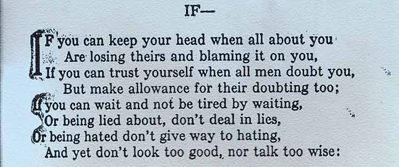
by Rudyard Kipling (first published in 1895)

If you can keep your head when all about you
Are losing theirs and blaming it on you,
If you can trust yourself when all men doubt you,
But make allowance for their doubting too;
If you can wait and not be tired by waiting,
Or being lied about, don’t deal in lies,
Or being hated, don’t give way to hating,
And yet don’t look too good, nor talk too wise:

If you can dream—and not make dreams your master;
If you can think—and not make thoughts your aim;
If you can meet with Triumph and Disaster
And treat those two impostors just the same;
If you can bear to hear the truth you’ve spoken
Twisted by knaves to make a trap for fools,
Or watch the things you gave your life to, broken,
And stoop and build ’em up with worn-out tools:

If you can make a heap of all your winnings
And risk it on one turn of pitch-and-toss,
And lose, and start again at your beginnings
And never breathe a word about your loss;
If you can force your heart and nerve and sinew
To serve your turn long after they are gone,
And so hold on when there is nothing in you
Except the Will which says to them: “Hold on!”

If you can talk with crowds and keep your virtue,
Or walk with Kings—nor lose the common touch,
If neither foes nor loving friends can hurt you,
If all men count with you, but none too much;
If you can fill the unforgiving minute
With sixty seconds’ worth of distance run,
Yours is the Earth and everything that’s in it,
And—which is more—you’ll be a Man, my son!

sonnett_29

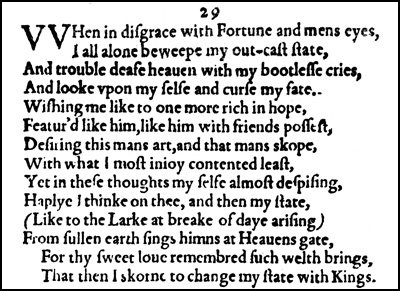
Sonnet 29

William Shakespeare (first published in 1609)

When, in disgrace with fortune and men’s eyes,
I all alone beweep my outcast state,
And trouble deaf heaven with my bootless cries,
And look upon myself, and curse my fate,
Wishing me like to one more rich in hope,
Featur’d like him, like him with friends possess’d,
Desiring this man’s art and that man’s scope,
With what I most enjoy contented least;
Yet in these thoughts myself almost despising,
Haply I think on thee, and then my state,
Like to the lark at break of day arising
From sullen earth, sings hymns at heaven’s gate;
For thy sweet love remember’d such wealth brings
That then I scorn to change my state with kings.

p46

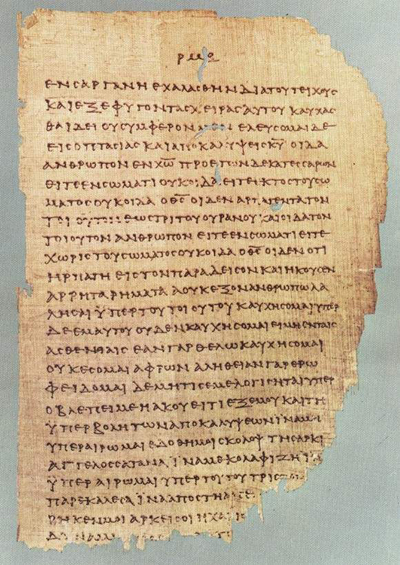
I Corinthians 13 (English Standard Version)

Apostle Paul (written between approximately 53-57 AD)

If I speak in the tongues of men and of angels, but have not love, I am a noisy gong or a clanging cymbal. And if I have prophetic powers, and understand all mysteries and all knowledge, and if I have all faith, so as to remove mountains, but have not love, I am nothing. If I give away all I have, and if I deliver up my body to be burned, but have not love, I gain nothing.

Love is patient and kind; love does not envy or boast; it is not arrogant  or rude. It does not insist on its own way; it is not irritable or resentful; it does not rejoice at wrongdoing, but rejoices with the truth. Love bears all things, believes all things, hopes all things, endures all things.

Love never ends. As for prophecies, they will pass away; as for tongues, they will cease; as for knowledge, it will pass away. For we know in part and we prophesy in part, but when the perfect comes, the partial will pass away. When I was a child, I spoke like a child, I thought like a child, I reasoned like a child. When I became a man, I gave up childish ways. For now we see in a mirror dimly, but then face to face. Now I know in part; then I shall know fully, even as I have been fully known.

So now faith, hope, and love abide, these three; but the greatest of these is love.