Category: faith

They will come for you

They will come for you

by Douglas Yeo

Today, October 31, is Reformation Day, commemorating the 499th anniversary of the beginning of the Protestant Reformation. The day is associated with Martin Luther’s Disputation of Martin Luther on the Power and Efficacy of Indulgences which became popularly known as the 95 Theses. Luther sent this document to the Archbishop of Maenz, Albert of Brandenburg,  on October 31, 1517, and a few days later,  posted it on the door of the Church of All Saints in Wittenberg, Germany. This event is considered to be the spark that led to the Protestant Reformation, a major reform movement in the Christian church.

In our church’s worship service yesterday morning, we sang Luther’s great hymn,  Ein feste Burg ist unser Gott, usually translated into English as A Mighty Fortress Is Our God. The image above shows the original version of the tune in the handwriting of Luther’s friend, Johann Walter. Luther composed the words and melody sometime between 1527 and 1529 and it has been used in churches around the world since that time, in particular since Frederick Hedge made his English versification in 1853. It was also used by Johann Sebastian Bach in his Cantata for Reformation Day, BWV 80.

When I was a student at Wheaton College, I memorized the four verses of this hymn for extra credit in a class, Christ in Culture, taught by Dr. Herbert Jacobsen. While I was grateful for the extra credit, I’m very glad I took the time to memorize A Mighty Fortress. I call it to mind every day.

Translations of texts into English that originally appeared in other languages help us to sing songs with understanding. But in the case of A Mighty Fortress, the standard English translation of the fourth verse has always struck me as being overly pleasant; it does not truly reflect the seriousness of Luther’s original text.

Here is what we often find in English hymnals for the fourth version of A Mighty Fortress Is Our God:

That word above all earthly powers, no thanks to them, abideth;

The Spirit and the gifts are ours through Him who with us sideth.

Let goods and kindred go, this mortal life also.

The body they may kill; God’s truth abideth still:

His kingdom is forever.

This is all well and good, but the phrase, “Let goods and kindred go, this mortal life also,” sounds like we should simply let things go – let go of things, even our own lives, since they are, in the big scheme of things, not as important as knowing that one is a Child of God.

But Luther’s original German text includes something very important. A better, more literal rendering of this verse in English looks something like this:

That word they must let stand, no thanks to their own efforts.

He is with us indeed according to the plan, with his Spirit and gifts.

Though they take from us our body, possessions, honor, child and wife,

Let them have all these things; they gain nothing from them: 

There still remains for us the Kingdom.

Do you see the difference? It’s not a matter of just “letting things go.” No, THEY TAKE FROM US OUR BODY, POSSESSIONS, HONOR, CHILD AND WIFE. They will come for you and all that you hold to be dear. Persecution WILL come. The things that are most valuable and important to us – including our own lives – are not simply things that we will have to let go of. No. They will be taken from us. Yet God, who rules over this fallen, messed up world, reminds us that even when you have lost everything, you still have the most important thing: the Kingdom of God. This is a tremendous comfort for the Christian.

We live in troubling times. Increasingly, in some parts of the world, to speak of the Christian faith leads to persecution, even death. Luther’s great text reminds us of this; it is as fresh today as when it was written centuries ago.

Luther’s first verse, as it usually appears in English, is a good translation that captures the original intent of the text even as it is in rhyming verse, and it is a great reminder for those who know and follow Christ. Amidst the craft and power of the ancient foe, the evil one, Satan himself, God is our refuge and strength, a very present help in time of trouble (Psalm 46:1):

A mighty fortress is our God, a bulwark never failing;

Our helper He amid the flood of mortal ills prevailing.

For still our ancient foe, doth seek to work us woe – 

His craft and power are great, and, armed with cruel hate,

On earth is not his equal.

Likewise, the second verse – and this is the verse I call to mind every day – tells us who it is that will conquer this evil one:

Did we in our own strength confide, our striving would be losing,

Were not the right Man on our side, the Man of God’s own choosing.

Dost ask who that may be? Christ Jesus, it is he;

Lord Sabaoth his name, from age to age the same;

And he must win the battle.

Today, the 499th anniversary of Reformation Day, reminds us that in the midst of the trials and tribulations of life, God is there, our mighty fortress.
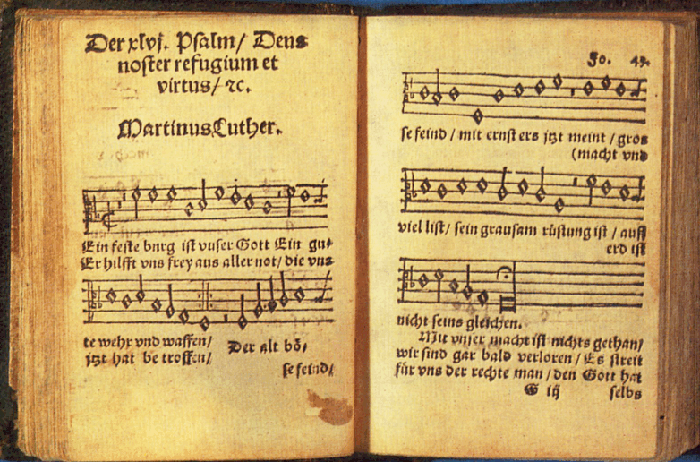
luther_eine_feste_burg_02Martin Luther’s Ein feste Burg ist unser Gott, published by Josef Klug, 1533.

Location. Location. Location.

Location. Location. Location.

It has often been said that there are three rules about buying real estate:

  1. Location
  2. Location
  3. Location

OK, it’s an old joke. But it happens to be true.

Recently we’ve been traveling and have visited two places that are in spectacular locations. And they have the hallmarks of important, memorable buildings that stay in our minds in the midst of the chaotic, frenetic pace of life. One is simple and rough hewn. The other is modern and sleek. Both speak to timeless things. Both are reminders  for us to take moments in our busy lives to find places where we can stop, think, reflect and, after renewal and a deep breath, push on.

The Chapel of the Transfiguration in Grand Teton National Park, Wyoming, shown above. Location. Location. Location. This simple Chapel was built in 1925; it is a survivor made of lodge pole pine. Through decades of ice, wind, sun and snow, through the cycle of the seasons – death and new life – it has stood as a place of worship and contemplation in the midst of the exceptional beauty of the Grand Teton mountain range. The altar frames this spectacular view:

chapel_transfig_altar

I’m sure every visitor to the Chapel of the Transfiguration takes this photograph. And why not. With the Grand Teton centered above the altar cross, our eyes go up. Up. It reminds us of the words of Psalm 121 (KJV):

I will lift mine eyes unto the hills, from whence cometh my help.

My help cometh from the LORD, which made heaven and earth.

He will not suffer thy foot to be moved; he that keepeth thee will not slumber.

Behold, he that keepeth Israel shall neither slumber nor sleep.

The LORD is thy keeper: the LORD is thy shade upon thy right hand.

The sun shall not smite thee by day, nor the moon by night.

The LORD shall preserve thee from all evil: he shall preserve thy soul.

The LORD shall preserve thy going out and thy coming in from this time forth, and even for evermore.

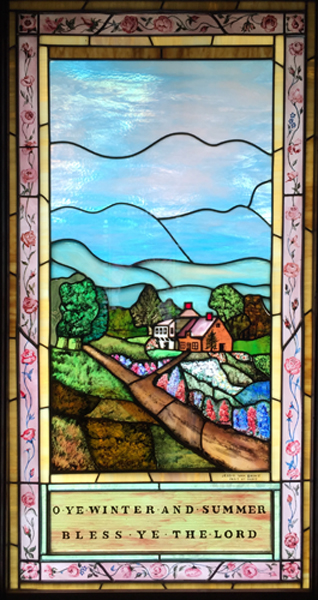
As soon as you enter the Chapel you are aware of two stained glass windows – one on the left and one on the right – beautiful, artistic reminders of the natural beauty you see ahead through the window behind the altar:

chapel_transfig_winter_summerchapel_transfig_ice_snow


The Chapel of the Transfiguration in the Grand Tetons of Wyoming. Stop, think, reflect, renew, push on.

Closer to home is a very different kind of Chapel in a very different kind of location.

holy_cross_02

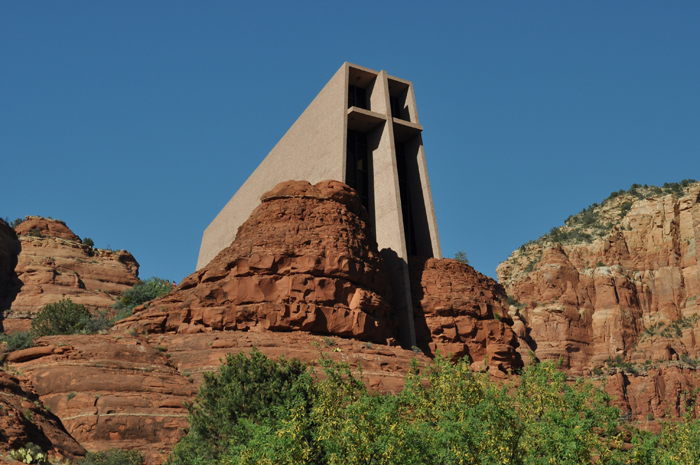
The Chapel of the Holy Cross in Sedona, Arizona, shown above. Location. Location. Location. The Chapel was built in 1956, perched high on a promontory of rock. It appears to be emerging out of its surroundings and in fact, until you get right up to it, you’re not even aware that it is there, so well does it integrate with all that is around. Here is a view of the Chapel from the Bell Rock/Courthouse Butte trail, below; the Chapel is in the exact center of the photograph:

holy_cross_04

Can you see it? Just a tiny speck of tan colored rock, but it is the Chapel of the Holy Cross, disguised as part of nature’s landscape. Inside, its altar frames a dramatic scene:

holy_cross_03

Secure on the rocks, the Chapel stands as a sentinel, looking out at the massive red rock formations of Sedona, not far from the Grand Canyon, majestic, solid, immovable. We are reminded of the words of the Psalmist (Psalm 93:1-2, NIV):

 The LORD reigns, he is robed in majesty; the LORD is robed in majesty and armed with strength; indeed, the world is established, firm and secure.

Your throne was established long ago; you are from all eternity.

holy_cross_01

Stop, think, reflect, renew, push on.

Paul Hindemith had it right with the closing words of his poem, The Posthorn:

Your task it is, amid confusion, rush and noise,

To find the lasting, calm and meaningful and, finding it anew,

To hold and treasure it.

Improvisation: A Careful Carelessness

Improvisation: A Careful Carelessness

Last month I had the great joy of traveling to Duke Divinity School in North Carolina to take part in a two day Convocation titled, “Call and Response: Two Days of Theology and the Arts.” I was involved in a program called “A Careful Carelessness: An Evening of Theology and Improvisation.” Organized by Dr. Jeremy Begbie, the event included both classical and jazz musicians in a thought provoking evening that related the idea of improvisation – a skill that is careful but also careless – to both jazz and classical music, as well as our view of God.

ostling_yeo_duke

In Christian circles today, much is often made of so-called “freedom in Christ.” By this, many people conflate salvation and sanctification; they say: “I am God’s child, I am saved, therefore I can do pretty much whatever I want. The Law is not in force with me; I am a child of grace.” But just because an idea is popular doesn’t make it true. In fact, this way of thinking leads to spiritual anarchy and antinomianism, and is the anthesis of the Christian Gospel.

As Jeremy Begbie insightfully said at the Duke Convocation:

“All music making depends on improvisation to some degree. This interweaving of order and openness is built into the way music works. . . . In improvisation we learn that freedom comes from the interplay between openness and constraints. Of course in the modern world, freedom usually means something like the absence of constraint. . . Improvisation makes us rethink all that. It makes us wonder if true freedom comes only from leaning into the constraints. Flannery O’Connor once said, ‘Art transcends its limitations only by staying within them.’  When God gave the law to the Israelites, it wasn’t to cramp their freedom, but to liberate his people to be the people they were meant to to be. Walk outside the laws and you became unfree, slaves again. When Jesus says the “The Son makes you free, you will be free indeed,”  he didn’t mean free from everybody else and free from all limits – but free to love people the way they were meant to be loved.”

Indeed. Think of music. Within rules – chord changes and such – comes tremendous freedom and beauty. Rules don’t mean “no fun” – they mean great fun, great freedom. The Duke event was a reminder of just how hilarious – and I use that word in its meaning, “unbridled joy” – music can be when we work within a series of constraints, whether in jazz or classical or any style.

megumi-doug

In all of this this I was joined with colleagues from symphony orchestras from around the country and some fine jazz musicians as well. I played in a brass quartet with Andrew Balio and Nate Hepler (trumpets) of the Baltimore Symphony, and my good friend Megumi Kanda, principal trombonist of the Milwaukee Symphony. We played a canzona of Giovanni Gabrieli and also took part in large group performances of “Sing, Sing, Sing” and “Sweet Georgia Brown” where we were joined by Anne Martingale Williams, principal cellist of the Pittsburgh Symphony, Scottish violinist Alan Torrence, and John Brown (bass) and Donovan Cheatham (drums). Jeremy Begbie also contributed his skills as a superb pianist.

I also played an arrangement I made of a Bach two-part invention along with my Boston Symphony friend and colleague, associate principal flutist Elizabeth Ostling (who also played in the large group pieces). A highlight of the evening was Duke’s Dean of Chapel Luke Powery leading a call and response with the audience of the spiritual, “Wade in the Water,” over which I improvised a trombone solo. What a joy it was to work with such capable, flexible, and positive friends and colleagues while at the same time being musically and spiritually challenged myself.

dukegroup

There will be more from me on this theme of order and openness in future posts. For now, you can read more about the Duke Convocation in this article on the Duke Divinity School website, Duke Initiatives in Theology and the Arts (DITA) Celebrates New School Year with Theology and the Arts.

[Giving credit where credit is deserved: photos in this post were taken by Jessina Leonard and Pilar Timpane.]

And then, suddenly, the room was quiet.

And then, suddenly, the room was quiet.

Time, like an ever rolling stream, bears all its sons away…

So begins the seventh stanza of Isaac Watts’ 1719 hymn, Our God, Our Help in Ages Past.

Last week, I received word that my father, Alan Yeo, who was 85 years old, had been ill for some time, and who struggled with a number of medical issues, had taken a turn for the worse. I immediately flew to Baltimore to be at his bedside at a hospice facility.

Surrounded by family members, he was lovingly cared for by the hospice staff. The sound of his breathing filled the room and it had a rhythm that both told us he was still with us and also that his end was near.

And then, suddenly, the room was quiet.

My father breathed his last and passed from this world to the next. He was no longer in a broken, fallen world; he had gone to his heavenly home where his suffering was no more.

If you are reading this and have experienced the death of a parent you know that no matter how prepared you think you are for this moment, when it comes, it brings with it a sense of finality that cannot be explained. It can only be experienced. While we rejoice that my father knew and loved God and we have assurance of his place in his new home “over Jordan,” I am very aware I will not speak with him again on this earth. I will not hear his voice greet me with, as he always did, “What’s happening, Douglas?” I won’t hold his hand or kiss his cheek. Time has borne him away, as it does each of us.

So, now, we move on. There are details to attend to and emotions to process. But most of all, this moment reminds me of the precious nature of each day. All of us are good at wasting time; each has his own way to wile away hours in trivial pursuits. But when one you loves breathes his or her last, you are aware in a new way that your days, too, are numbered. I don’t feel much like wasting time right now.

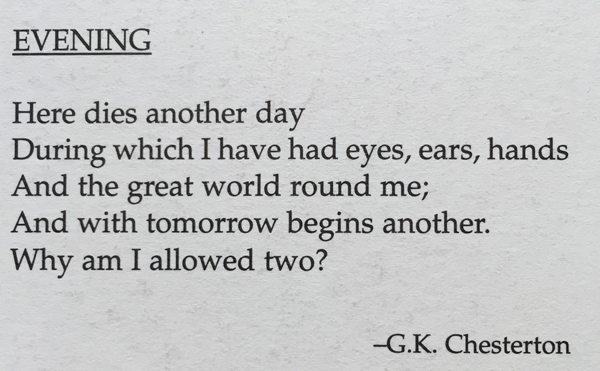
The British writer G. K. Chesterton reminds us of the remarkable gift of each day in his poem, EVENING. I keep this poem in my Bible and read it every day:

chesterton_evening

Why, indeed, am I allowed two? Because God, in his Sovereign will, has work for me to do in another day for the cause of His Kingdom. With renewed purpose, I push ahead to be a good steward of the talents and gifts God has given me until He decides my work here is done and, like my father, He bears me home.

The Lord gave, and the LORD hath taken away; blessed be the name of the LORD. (Job 1:21)

+ + + + +

Alan Deane Yeo passed from this world to his heavenly home on September 4, 2016 in Columbia, Maryland; he was 85 years old. Born in Brooklyn, he graduated from Westminster College (New Wilmington, Pennsylvania) in 1953 and married Jeannine Spangler (d. 1985). He served in the United States Army’s 6th Infantry Division immediately following the Korean conflict and worked as Vice-President and Secretary of S. P. Skinner Co. in New York City before answering the call to become a United Methodist minister in 1971. He earned his Master of Divinity and Doctor of Ministry degrees from Drew Theological School (Madison, New Jersey) and pastored churches in Milton (1971-1975), Hopatcong (1978-1983), Roselle Park (1983-1987) and Washington, New Jersey (1988-1993) as well as Matamoras, Pennsylvania (1975-1978).

After his retirement from full time ministry work, Alan continued in the service of the Gospel, preaching in churches, assisting in hospice, and as chaplain and teacher of New Testament at Randolph Macon Academy (Front Royal, Virginia). He will be missed by all who knew and were influenced by him and is survived by his wife of 30 years, Annemarie Andersen Yeo, his three sons, six grandchildren, two great-grandchildren and Annemarie’s daughter and grand-daughter.