Category: faith

Christmas in Bethlehem—and at home

Christmas in Bethlehem—and at home

by Douglas Yeo (December 24, 2017)

Today is December 24 – Christmas Eve – and it is already Christmas day in parts of the world.

Last year, my wife and I traveled to Israel, and among the many places we visited was the Church of the Nativity in Bethlehem. This church is built over the traditional site of the birth of Jesus Christ. Of course we cannot know for sure if this is the exact location of His birth, but as I have told many people, that is not important to me, or to most who come to this place. We were in the neighborhood of this world-changing event, and we were able to take in the mystery of the Incarnation in a concrete way, and share in the devotion of millions of pilgrims who have come to this place over the centuries.

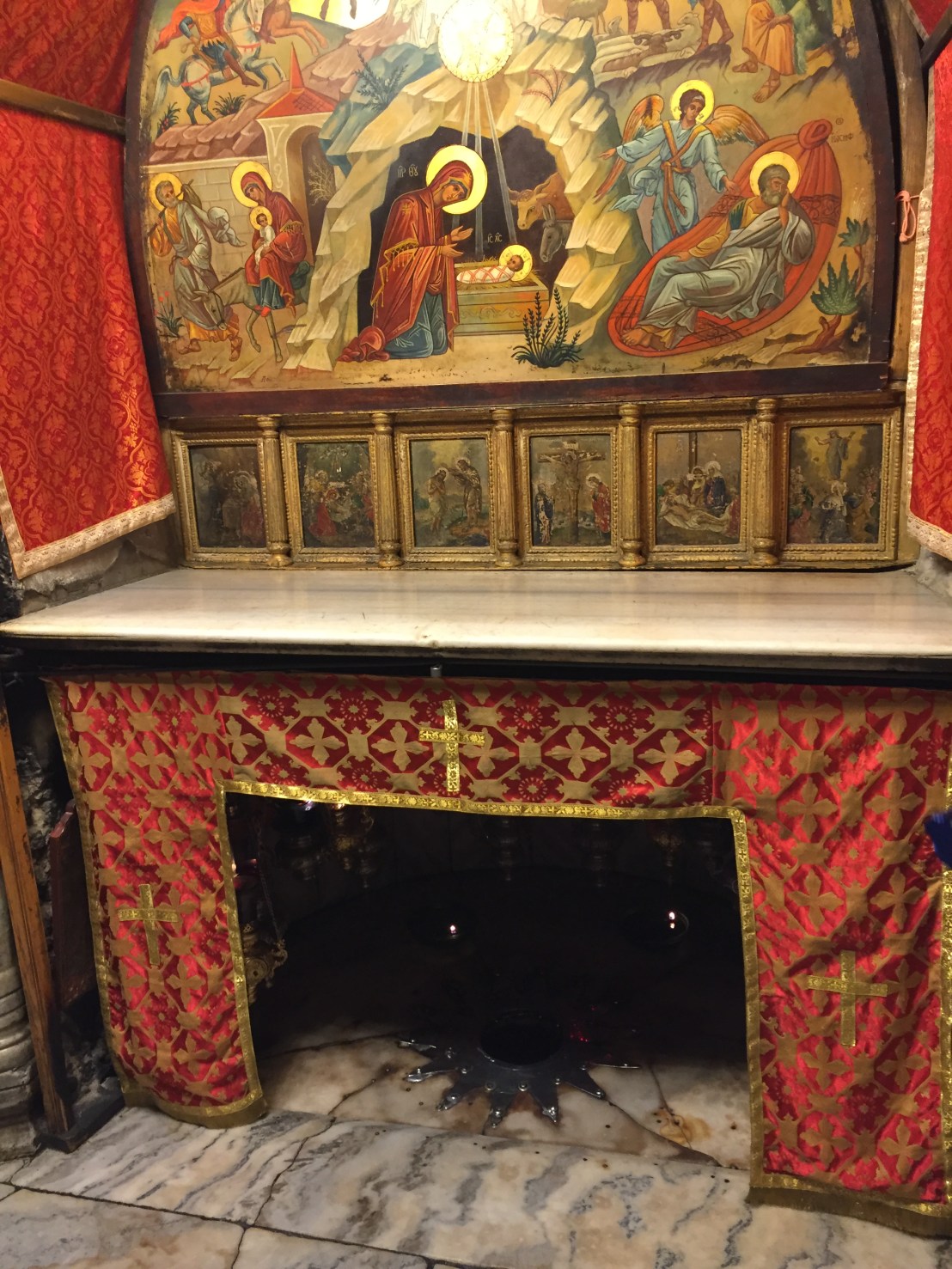
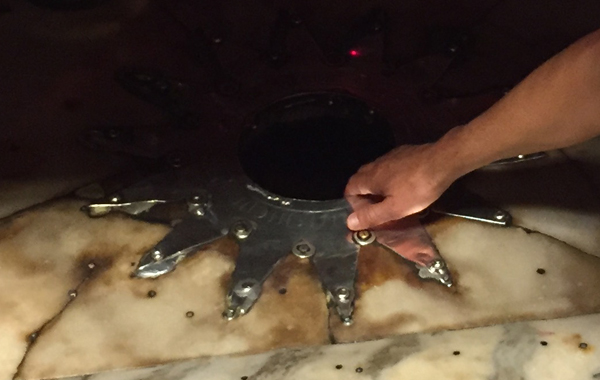
Here is the traditional site of the birth of Christ, beneath the floor under the altar in the grotto of the Church of the Nativity. Many years ago, people began chipping off pieces of the floor so a marble floor was laid with a hole surrounded by a silver star where you  can put your hand to touch the original ground.

051_Bethlehem_Church_of_Nativity

Doug_hand_Bethlehem_Church_of_Nativity_Doug

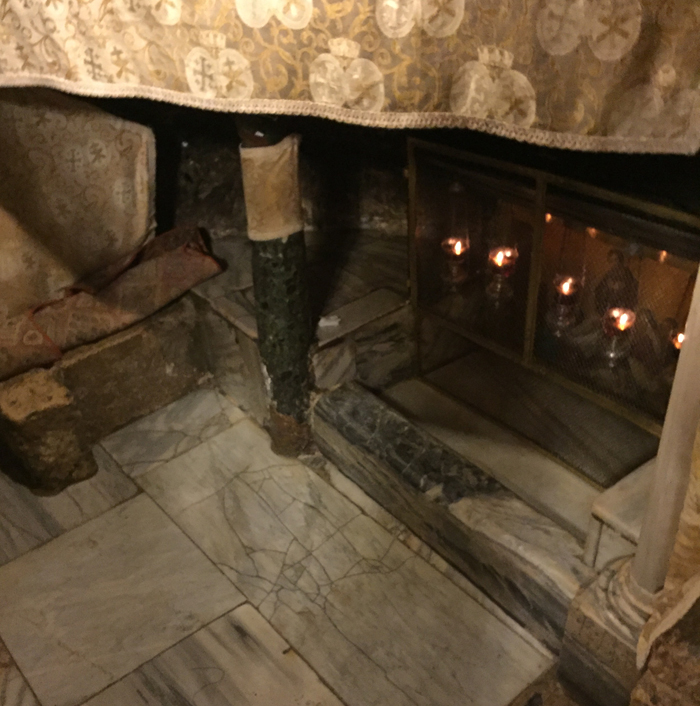
Across the room from this spot is the traditional location of the cattle manger where Jesus was laid after birth. Again, we cannot be sure this was THE spot, but the coldness of the stone reminded me that Jesus’ birth was not in a modern hospital with today’s clean and comfortable conveniences. His birth was humble in the extreme.

Bethlehem_Church_of_Nativity_manger

In the courtyard of the church, we saw a sign in two languages – we’ve seen them around the world in England, Greece, throughout the United States, and several places in Israel – that reminded us once again of the truth of  what happened on that night so long ago.

Verse_Church_Nativity

We also visited the traditional Bethlehem shepherd’s fields, and a cave that was used by shepherds. We used our imagination to picture the sight of the angel announcing Jesus’ birth:

Fear not! For behold, I bring you good news of great joy that will be for all people. For unto you is born this day in the city of David, a Savior, who is Christ the Lord. (Luke 2:10-22)

Here is a painting of the announcement of the angels that is in the Chapel of the Shepherd’s Fields in Bethlehem:

Bethlehem_Chapel_of_Shepherds_Fields

In our home, we have a nativity set that was given to us in 1978 by my grandmother. We’ve always displayed it around this time of year and in our home here in Arizona, it sits on the mantle above our fireplace (yes, even in Arizona, a fireplace is welcome in the winter, although I confess that instead of hauling firewood for our wood stove like I did in Massachusetts for so many years, I am very grateful that this natural gas fireplace is operated by a remote control in my hand).

Yeo_hearth

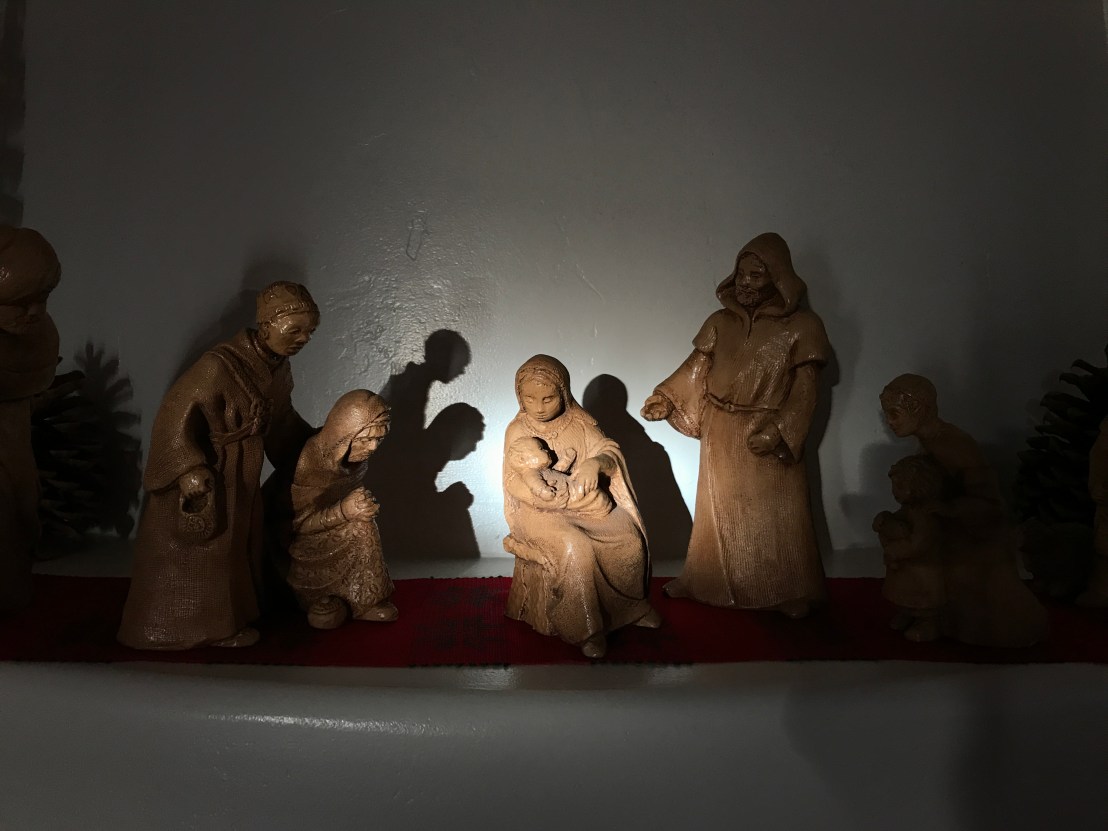
When we moved here in 2012, we noticed something quite startling: on Christmas Day, the sun shines through a small glass block window over our front door and at exactly 8:30 am, it comes to rest on the central figures of Mary and Jesus. We didn’t plan this; it just happened.

Nativity_light_Yeo

It is a remarkable little thing, with this happening every year at the same time. The light on Mary and Jesus reminds us of the important truth of the Incarnation of Jesus Christ:

Then Jesus spoke to them, saying, “I am the light of the world. Whoever follows me will not walk in darkness, but will have the light of life.” (John 8:12)

The light of life. Everlasting light. Yes, we have fun with Santa Claus and Jingle Bells and all the rest. But the Truth of Christmas is much more interesting. And important.

Merry Christ-mas, friends.

Touched by beauty

Touched by beauty

The least frequently performed of Paul Hindemith’s sonatas for various instruments is his Sonata for Alto Horn in E-flat and Piano. It was written for an instrument that is not played in concert bands and symphony orchestras, but rather is mostly used in British style brass bands. Still, I believe this Sonata is one of Hindemith’s finest and it also has a unique feature. Before the final movement, Hindemith wrote a poem to be recited in dialogue by the soloist and accompanist. Titled The Posthorn, the poem speaks about technology, memory, and beauty. Its final lines are among my favorites in literature:

Your task it is, amid confusion, rush, and noise

to grasp the lasting, calm, and meaningful,

and finding it anew, to hold and treasure it.

I am very interested in “the lasting, calm, and meaningful.” The world is a loud, busy, chaotic place. I seek out its antidote: quiet, beautiful, and ordered places. One of the reasons why my wife and I moved to Arizona in 2012 when I retired from the Boston Symphony is so we could be in proximity to the great National Parks of the west, places we have turned to time and time again for refreshment.

This past August, we took a three week road trip through California and up to Oregon, where we spent time hiking in several National and State Parks. Here are a few photos from that trip. I don’t need to provide extensive commentary; you can click on the links in the caption to each photo for information about each park, but perhaps at this particular moment in time, you, like I, might receive some refreshment from looking at these photos. Perhaps they will stir your own memory of a visit to these places, or inspire you to want to see them yourself. They are, indeed, “lasting, calm, and meaningful.”

Sequoia National Park

The giant sequoia trees of Sequoia National Park defy description. These trees are the largest living things on earth; some are as tall as 275 feet high. Think about that. Nearly as tall as the length of a football field. We took a long hike through the Giant Forest Grove and did not see another person for over two hours. We were alone with these magnificent trees. Here is a photo of Sentinel Tree, mature sequoia tree that is just outside the Giant Grove Visitor Center.

00.Sequoia_tree

It’s difficult to get a sense of perspective of just how large these trees are from a photo. So here is a video to help get a grip on this. It shows my wife, Patricia, standing in front of “The Happy Family” group of giant sequoia trees in the General Grant Grove in Kings Canyon National Park, adjacent to Sequoia National Park. A picture is worth a thousand words. A video is worth a million. And listen carefully while playing the video in a quiet place; you can hear the chirping of birds. We took this video very early one morning when no other people were in the area. To view this video on YouTube, click on THIS LINK:

Kings Canyon National Park

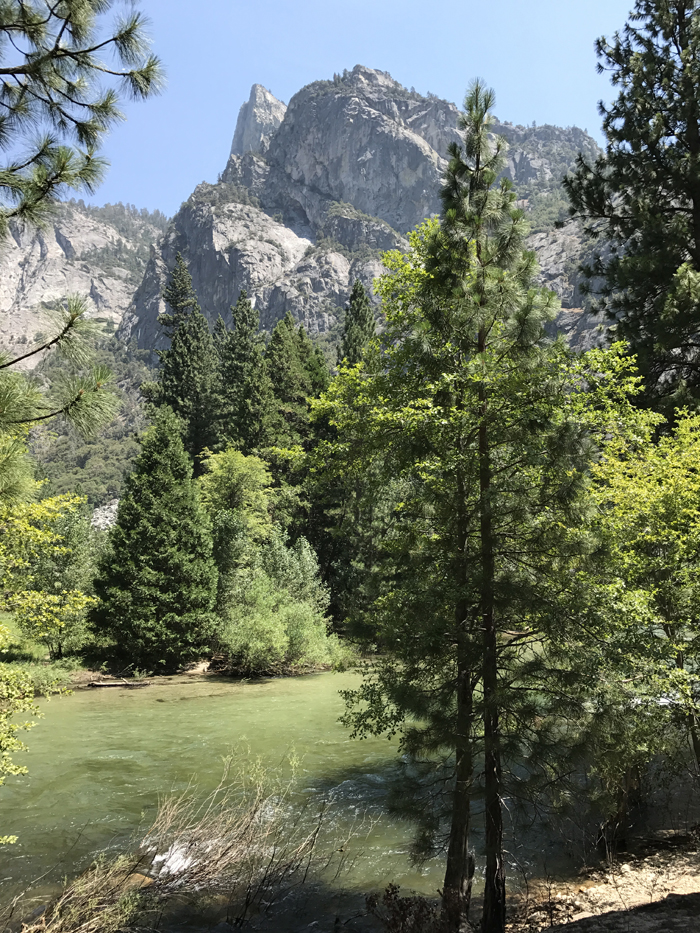
As mentioned above, Kings Canyon National Park is adjacent to Sequoia National Park; they are jointly administered by the National Park service. A small part of Kings Canyon has giant sequoia trees, but most of the park is the dramatic canyon, a mile deep, through which flows the Kings River. There are peaks in the park that are over 14,000 feet high; here is a photo of the Grand Sentinel peak which is at the end of the Kings Canyon Scenic Byway.

00.Kings_Canyon

Mount Shasta region

From Sequoia and Kings Canyon National Parks we entered California’s Mount Shasta region. Mount Shasta is 14,179 feet high and covered with snow year round. On the way to our trailhead, we passed thousands of perfectly formed pine trees. I had never seen such symmetry in trees; it was stunning to behold.

00.Shasta_trees

We had intended to hike from Gray Butte but the road to the trail was closed. It was blocked by snow. In late July. So we parked at Bunny Flat and hiked to the Sierra Club Cabin at Horse Camp. The view of Mount Shasta was stunning.

00.Doug_Shasta

Pat has an aunt and uncle who live in northern California so we stopped to see them a few days. It was a bit of a family reunion, too, with several of her cousins and their families there as well. We spent a morning driving and then hiking to a remote alpine lake, a pristine body of water in a stunningly beautiful setting. This panoramic photo gives only an idea of the majesty and solitude of this remarkable place.

00.CA_lake

Crater Lake National Park

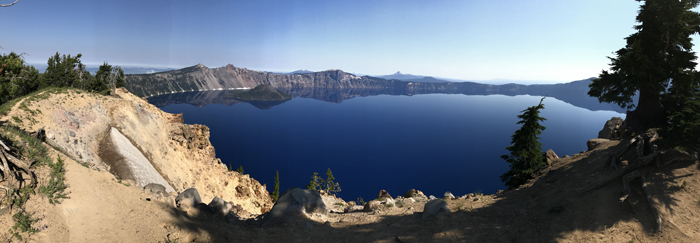
I have been fascinated by Crater Lake National Park since my childhood. Located in Oregon, the lake formed when Mount Mazama literally blew its top. The lake is 1,943 feet deep at its deepest point and is six miles across. I was unprepared for its size; it is breathtaking. Inside the lake is Wizard Island, a volcano inside the volcano. Sometimes things come together to allow our eyes to see an iconic view that is then called to mind every day thereafter. Such was the case at the moment I took this photo, below. The stillness of the water, the reflections of the crater and clouds in the water, the bits of snow, and the deep green of the trees all came together to give us a memorable moment in time. A panoramic photo of Crater Lake I took a few minutes later is at the top of this article.

00.Crater_Lake

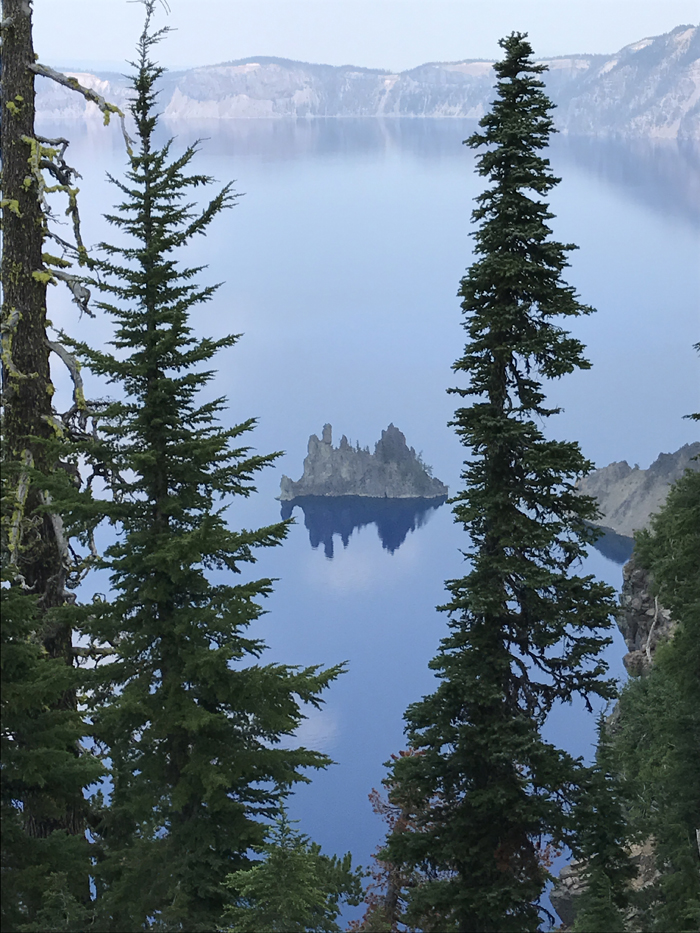
In addition to Wizard Island, there is one other geologic feature that comes up through the surface of the water at Crater Lake. That is Phantom Ship, a rocky outcropping that stands 200 feet high. Getting close to Phantom Ship was the last thing we did at Crater Lake, and seeing it was the realization of a long held dream. You can also see the difference in the clarity of the air between this photo and the one above. Smoke from wildfires in the area created a light haze, and these fires were precursors to the horrific and damaging fires that burned in the San Francisco Bay and Los Angeles areas later in the year.

00_Crater_Lake_Phanton_Ship

Redwood National Park

Giant redwood trees are not the same as giant sequoia trees. Redwoods grow taller, and do not have the same, thick, soft bark as sequoias. They are also not as wide at their base as sequoias. Redwood National Park in California is one of the few places in the world where these majestic coastal redwoods grow. The park is actually a collection of parks, some of which are state parks, that form a chain of areas that protect these majestic trees.

As we took hikes on the Hope Creek and Rhododendron Trails in Redwood National park, we were instantly transported into a dramatic, quiet, lush forest. It reminded me of the opening lines of Henry Wadsworth Longfellow’s epic poem, Evangeline, where he wrote:

This is the forest primeval. The murmuring pines and the hemlocks,

Bearded with moss, and in garments green, indistinct in the twilight,

Stand like Druids of eld, with voices sad and prophetic,

Stand like harpers hoar, with beards that rest on their bosoms.

Loud, from its rocky caverns, the deep-voiced neighboring ocean

Speaks, and in accents disconsolate answers the wail of the forest.

00.Redwood_pano_primeval

The tallest redwood tree is 379 feet and like the giant sequoia trees, a photograph simply cannot give a sense of perspective. So here is a video of me looking up at a giant redwood in Redwood National Park. Again, if you listen carefully, you can hear the sounds of birds. We did not see another person on this hike. To view this video on YouTube, click on THIS LINK.

Lassen Volcanic National Park

We had intended to visit Lassen Volcanic National Park on the first part of our trip, on our way up to Crater Lake. But the park road was closed due to snow. We kept checking the status of the snow plowing at the park and we were very pleased when the road cleared just as were beginning our trip south back home to Arizona. We rejigged our plans so we could spend a day at Lassen.

This was an unexpectedly wonderful park. Like Mount Shasta, it features a snow covered mountain as its centerpiece. But on our hike around Manzanita Lake, we saw a group of deer, a doe and two fawns. They were aware of our presence but we quietly passed. It was a beautiful moment.

00.Lassen_deer

Manzanita Lake provided us with another of those remarkable views that combined water, sky, mountain (Lassen Peak), and trees. It was a “postcard view” that we stopped and took in for quite awhile.

00.Lassen_mountain

We did not climb to the top of Lassen Peak but we did go to its trailhead. It was this area of the park that had the most snow in the winter of 2016-17 and the last to be cleared of snow. As we walked around the area, I did something I had not done since the winter of 2011-12: I made a snowball. Pat snapped this photo of me tossing the snowball up in the air and she caught it just as it was at the peak of my toss. Holding snow in my hands brought back a lot of memories of our life in New England, although I confess I had never done this before in the month of August!

00.Lassen_Doug_snow

These trips to National Parks refresh, invigorate, and inspire us. They are, indeed, part of what God has given to us to enjoy that embody Hindemith’s memorable words, “the lasting, calm, and meaningful.” We never tire of visiting them, either for the first time, as was the case with all of the parks we visited on this trip, or over and over, like Grand Canyon National Park.  The Parks are, indeed, in the words of historian Wallace Stegner, America’s best idea. But while their preservation and access are the responsibility of our great National Park Service, it is the Creator who made all of this for us to enjoy who receives my greatest thanks and praise:

O Lord, how manifold are thy works!

In wisdom has thou made them all: the earth is full of Thy riches.

• Psalm 104:24

Reformation: Luther, Mendelssohn, and the serpent

Reformation: Luther, Mendelssohn, and the serpent

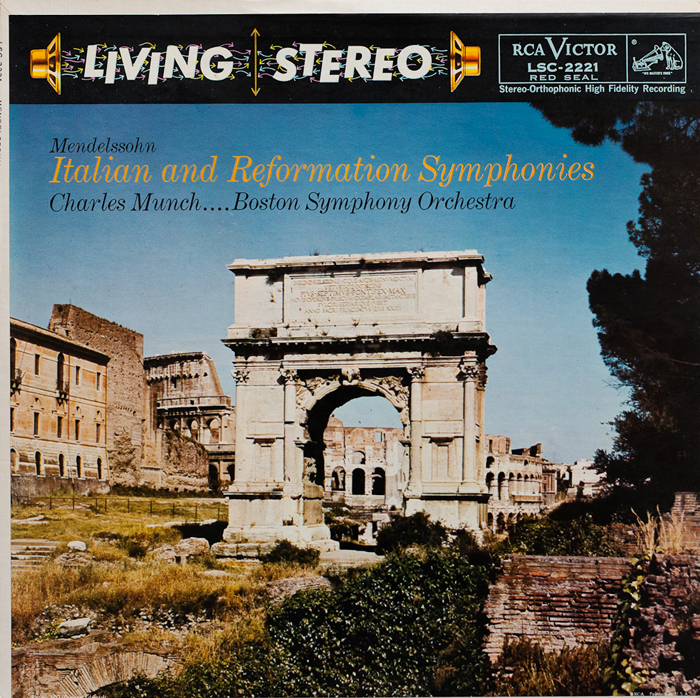
I don’t own many things that date from my childhood. I moved many times, collected other things, have lived a long life, and things that seemed so important when I was a kid mostly got lost along the way. I do wish I still had those baseball cards, though. . . But one of the few things I do have from that time in my life is a Boston Symphony recording of Mendelssohn’s “Reformation” Symphony, conducted by Charles Munch. I bought it in 1970 when I was 15 years old.

Mendelssohn_Reformation_Sym_BSO

[As an aside, this album cover shows the Arch of Titus in Rome, with the Colosseum in the background. During my wife’s and my recent trip to Italy, we stood in this very place, and noted the significant connection the Arch has with our trip last year to Israel. More on this in an upcoming article on The Last Trombone.]

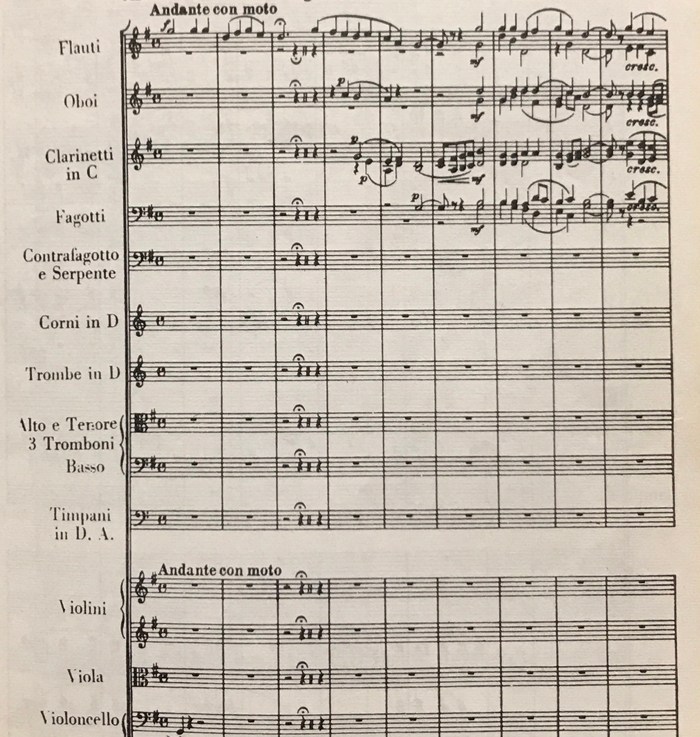
That I ended up being a member of the Boston Symphony for 27 years (1985-2012) is one of the great joys of my life, and in a sense that was the fulfillment of a long held dream since I was in high school. Several Boston Symphony recordings were very influential on me at an early age when I was just beginning to understand the trombone, and this Mendelssohn recording stands tall in my record collection. In fact, one of the first orchestra scores I ever purchased was of this symphony; I purchased it a few days after I heard Munch’s recording for the first time (the first page of the final movement of my score is shown at the top of this article).  Click below to hear that recording that influenced me so deeply so long ago (to hear this recording in YouTube, click here):

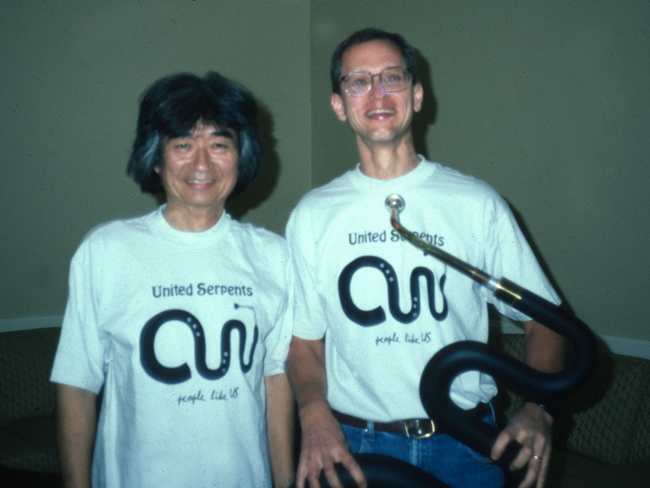
I have always loved this piece. It has a terrific part for bass trombone; just a few measures in the beginning of the symphony and then much to do in its finale. I first played the symphony on bass trombone with the BSO conducted by then-music director, Seiji Ozawa; the photo below shows Seiji and me in 1994 before a rehearsal for Hector Berlioz’s Messe solennelle; you’ll see I have my serpent in my handFor more on that, keep reading.

Ozawa_Yeo_serpent_1994_small

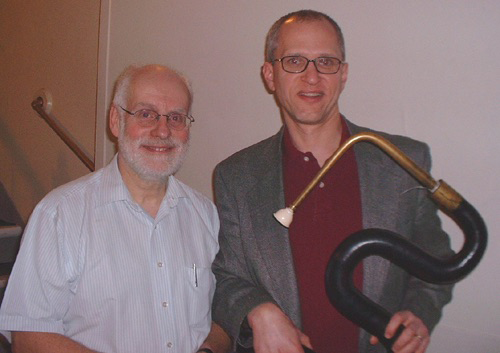
After I took up the serpent, I played the serpent part for Mendelssohn’s symphony in performances with the BSO conducted by the great early music conductor, Ton Koopman; the photo below shows us backstage at Boston’s Symphony Hall before a rehearsal in 2004.

koopman_yeo_02

Mendelssohn’s “Reformation” symphony – it usually bears the number 5 in the numbering of his symphonies but it was not his fifth in order of composition – was composed in 1830 to commemorate the 300th anniversary of the Augsburg Confession, one of the great confessional documents of the Christian faith. The theme of the symphony’s fourth movement is none other than Martin Luther’s famous hymn, Ein feste Burg est unser Gott — A Mighty Fortress is Our God. I wrote about this hymn last year on The Last Trombone, where I took the opportunity to discuss the importance of its text, especially the its fourth, final verse. I invite readers to look at that article again; click here.

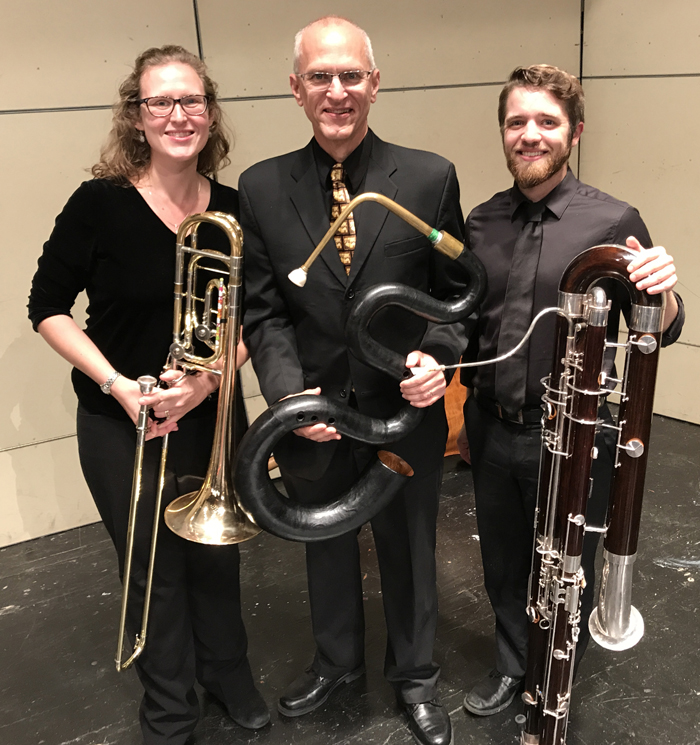
Last week, I played serpent in a performance of the “Reformation” Symphony by the Northbrook Symphony near Chicago. My oldest daughter, Linda Yeo Leonard, plays bass trombone in the Northbrook Symphony, and my wife and I have heard many concerts played by the orchestra. When the orchestra’s conductor, Lawrence Rapchak, asked me if I would be available to play serpent in their performance of Mendelssohn’s symphony – performed on a concert with other symphonies in the key of D but also in recognition of the 500th anniversary of the beginning of the Protestant Reformation – it was easy to say yes.

Northbrook_Sym_11_2017_small

The photo above shows Linda and me along with the Northbrook Symphony’s fine contrabassoon player, Nicholas Ritter; Nick and I sat next to each other on stage with Linda seated just behind me. Mendelssohn’s part for the serpent doubles the contrabassoon at the octave and the result is a new kind of bass sound, caused by the acoustical blending of the two instruments. Murray Campbell wrote an article several years ago about this unique sound in an article for the International Tuba Euphonium Association Journal; you can read it by clicking here. The performance was a great success in every way, and it was a special joy to sit on stage with Linda.

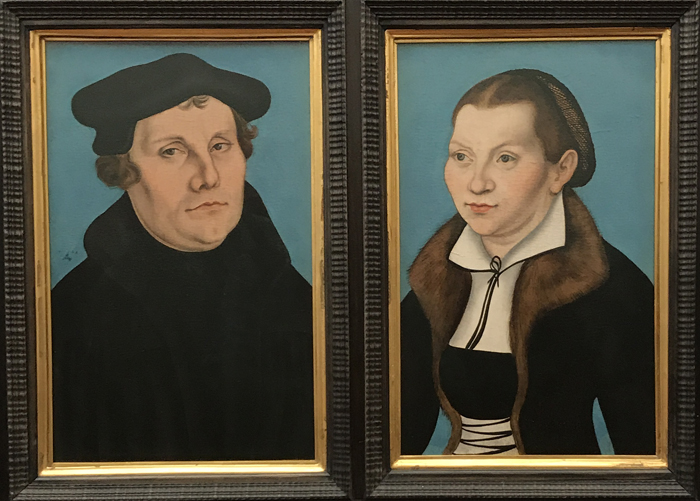
There have been other recent connections to Luther that have recently gotten my attention. As mentioned earlier, my wife and I were in Italy last month, enjoying the glories of Renaissance art and their connections to the Christian faith. Among the places we visited was the Ufizzi Gallery in Florence, one of the world’s great art museums. As we were going through various galleries, we came across a painting of Martin Luther and his wife, Katharina von Bora, painted by the workshop of Lukas Cranach the Elder in 1529. The portrait was made when Luther was still alive (1483-1546) and is considered to be a true likeness.

Luther_Uffizi

As I enjoyed this iconic painting – it is the most famous portrait of Luther – I noticed that the museum’s display card had a curious final sentence:

In Medici collection since 1567/1570.

Of course the Medici family was one of the most famous and influential families of the Italian Renaissance, and they were strong patrons of the arts. But this sentence got my attention. “Why,” I wondered, “did the Medici family, who were Roman Catholics and whose family produced three Popes (Leo X, Clement VII, and Leo XI), own this portrait of the most famous Protestant reformer?” I can’t answer that question, but I’ve been wondering about this.

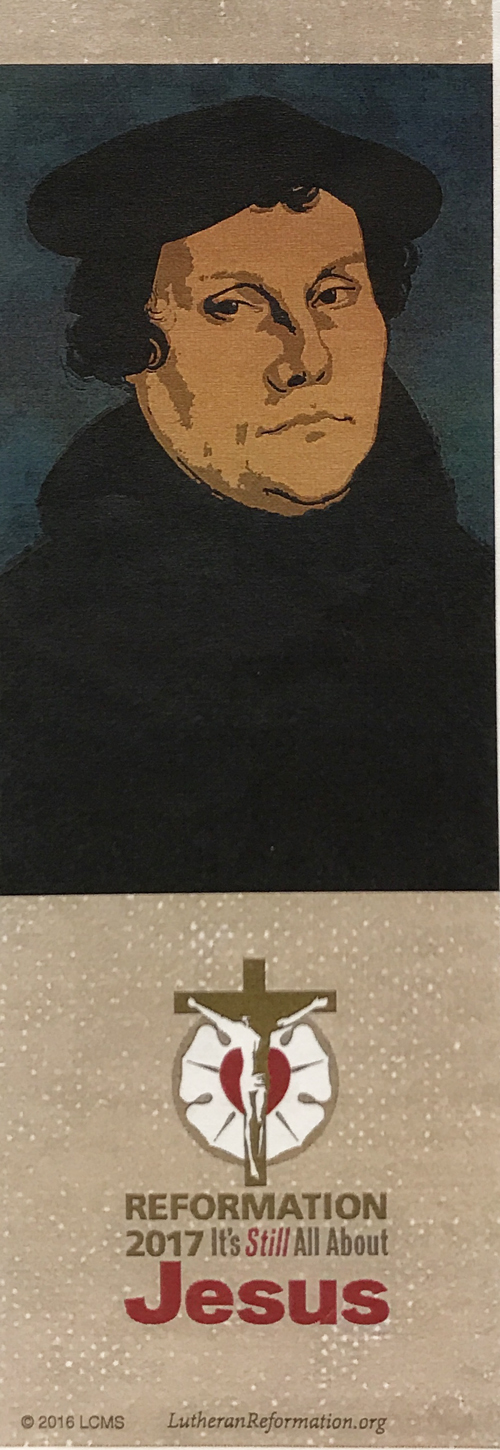
Last Sunday, I worshiped at Trinity Lutheran (LCMS) Church in Lisle, Illinois, where Linda’s family are members and her husband, Chad, a Lutheran pastor and hospice chaplain, coordinates the church’s care ministries. This year, the Lutheran Church – and Protestant churches of all denominations – is celebrating this 500th anniversary of the beginning of the Protestant Reformation – dated to October 31, 1517 when Luther attached his famous Ninety-Five Theses on the door of All Saints’ Church in Wittenburg, Germany, and set off a reform movement in Christianity that is still with us. When I sat down in our pew on Sunday and opened my bulletin, what did I see but an insert about Luther and the Reformation with a stylized version of the very same portrait of Luther we had seen in Florence. It was a nice, serendipitous moment.

Luther_LCMS_image

The Protestant Reformation changed history, and this convergence of events – Mendelssohn’s symphony, our trip to Italy, seeing a famous portrait of Martin Luther in Florence, and worship in a Lutheran church – brought many aspects of its importance together for me.

When I was a student at Wheaton College (Illinois), I memorized Luther’s great hymn. It got me extra credit on an exam in the class, “Christ in Culture,” and I needed all the extra credit I could get. I don’t remember how I did on that test, but I still call A Mighty Fortress to mind every day. It is a hymn of great strength and comfort, and Luther’s words are just as relevant and important today as they were nearly 500 years ago when he wrote the text. Here is its second verse; to read the whole text and my commentary on Luther’s original words, click HERE.

Did we in our own strength confide, our striving would be losing,

Were not the right Man on our side, the Man of God’s own choosing.

Dost ask who that may be? Christ Jesus, it is he;

Lord Sabaoth his name, from age to age the same;

And he must win the battle.


Three trips: music, friends, and faith

Three trips: music, friends, and faith

The last few months have been full of travel, as I’ve criss-crossed the United States several times to play and speak at a number of events. It is times like this that are very refreshing and invigorating to me, as I get to be with other fine musicians and make music at a high level. At the same time, my conversations with others are always very rich, and when I come home, I find myself energized and grateful for the blessing of a life lived with music.

The first of these three tripe was to the International Trombone Festival (June 27-July 1), which was held at University of Redlands, California. As I mentioned earlier in this blog, I played duets with three friends: Jim Markey (bass trombonist of the Boston Symphony), Megumi Kanda (principal trombonist of the Milwaukee Symphony), and Gerry Pagano (bass trombonist of the Saint Louis Symphony). In addition, Megumi and I gave a class titled The One Hundred: Effective Strategies for Successful Audition Preparation.

[From top left, clockwise: Douglas Yeo with Megumi Kanda, Gerry Pagano, Bill Watrous, Jennifer Wharton]

Part of the fun of being at these kinds of events is meeting up with old friends. I ran into jazz great, Bill Watrous, while walking through the vendor area at the ITF. Bill was tremendously influential on me – and countless other players – when I first hear him on his Manhattan Wildlife Refuge recording in 1975; have a listen to his iconic and influential performance of Fourth Floor Walk-Up. Years later, we began a friendship that, interestingly enough, does not center around jazz. Rather, when we speak on the phone, Bill always wants to talk about classical music, especially Edward Elgar. Bill is expertly conversant in classical music, something that may come as a surprise to many who know him as a jazz trombone icon. I recall hearing him give a clinic at Lexington High School in Massachusetts (the town in which my wife and I lived from 1985-2012 when I was a member of the Boston Symphony) where he played Samuel Barber’s Adagio for Strings on trombone using multiphonics. To say his performance was stunning is a profound understatement.

I also got to meet up with my former student, Jennifer Wharton, who was at the ITF to play in the XO All Stars jazz trombone quartet. Jen is a remarkable person and player, living in New York City with her husband, John Fedchock, playing a Broadway show, teaching, and freelancing. Jen is one of the most positive and engaging people I’ve ever met, and having time to meet up with her, have some conversation and a meal together, and play duets was a real joy.
Natl_parks_pass

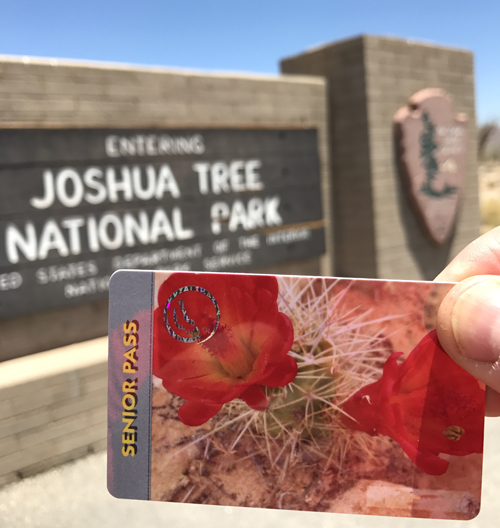
While on my way to Redlands, I stopped off at Joshua Tree National Park in California to purchase my National Parks Lifetime Senior Pass. Getting older bring with it some challenges, for sure, but my first “senior discount” after turning 62 this past May was this Pass, a real deal for $10.00; I got mine just before the fee changed to $80.00. Going to National Parks is a real passion for my wife and me, and to hold this lifetime pass in my hand was a moment that made me smile. More on our recent trip to five National Parks in a future post on The Last Trombone.
Scott_Doug_posed

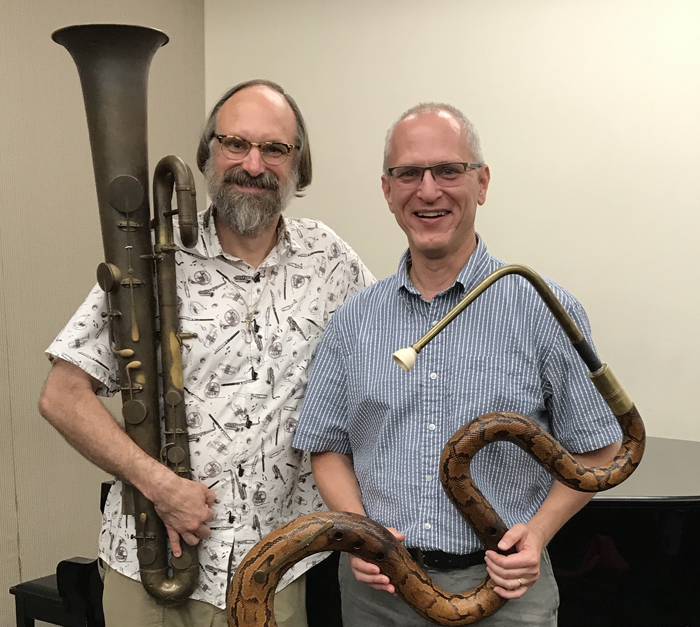
[Scott Robinson, ophicleide; Douglas Yeo with serpent by Keith Rogers]

Just a few days after the ITF in California, I flew to New York City for the Third Historic Brass Symposium (July 12-14). This time I didn’t have a trombone in my hand. Rather, I brought along a serpent, for I was at the Symposium to premiere a new duet for serpent and ophicleide commissioned by the Historic Brass Society, Caduceus Mixtus, by Jaron Lanier. My partner for the duet was Scott Robinson, known mostly for his superb playing on saxophone, but he also plays ophicleide. The piece was difficult, interesting, and rewarding to play, and our performance at New York University happened to be in the same recital hall where I gave my two graduate recitals when I was a student at NYU for my master’s degree back in 1979. For this performance I used a serpent made by the late Keith Rogers that was entrusted to me by his wife, Kathryn, after Keith’s death in 2008. It is made of plum wood and covered with a (pre-ban) python skin. It seemed to be the right instrument to use for a piece that had as part of its inspiration, the caduceus, with its intertwined snakes.

Scott_Doug_performance

In addition to hearing scholars present exceptionally interesting papers at the Symposium, we enjoyed a day of papers and concerts at the Metropolitan Museum of Art. The Museum is one of my favorite places in the world, having grown up in and around New York City and then returning there after I graduated from Wheaton College, from 1976-1979. The musical instrument gallery of the Museum is closed for a complete renovation, but we were given a preview of the construction and also saw some of the Museum’s new acquisitions, including a Baudouin serpent and the Bellophone, a combination tuba and euphonium that was made for the legendary tuba player, Bill Bell, by the H.N. White company.

We also got an up close look at a stunning new installation on the balcony between the two rooms of musical instruments, Fanfare, that features about 60 brasswind instruments. It is an exceptional installation and to have the opportunity to be among the first to see it up close was a real privilege.

MET_Fanfare

I also had time to view some of my favorite works of art at the Museum, including Rembrandt’s Aristotle With a Bust of Homer, a beautiful stained glass window, Autumn Landscape, by Tiffany Studios, and several sculptures by one of my favorite artists, Daniel Chester French. His Angel of Death and the Sculptor and Mourning Victory are displayed in the Museum as marble copies made by French of his bronze cemetery monuments that I discuss in my website resource, Daniel Chester French: Sculpture in Situ.

[From top, clockwise from left: Rembrandt, Aristotle With a Bust of Homer; Tiffany Studios Autumn Landscape; Daniel Chester French, Mourning Victory and The Angel of Death and the Sculptor]

While in New York, there was one thing I wanted to see that was not connected to the Symposium: the 9/11 Memorial and Museum. Anyone alive on September 11, 2001, remembers that horrific, difficult day; the world has never been the same since. Having been up the World Trade Center tower many times, its destruction hit me, as it did many others, very hard. Going to the 9/11 Memorial and Museum was a very strong, powerful experience. To see wreckage of the Twin Towers and a crushed fire truck up close is something I will always carry with me, even as I admired the new building, 1 World Trade Center (originally nicknamed the “Freedom Tower”), that has arisen to the height of 1,776 feet and now is a new icon in the New York Skyline. The fountains that form the memorial, covering the original footprints of the World Trade Center towers, are a powerful and moving thing to behold.

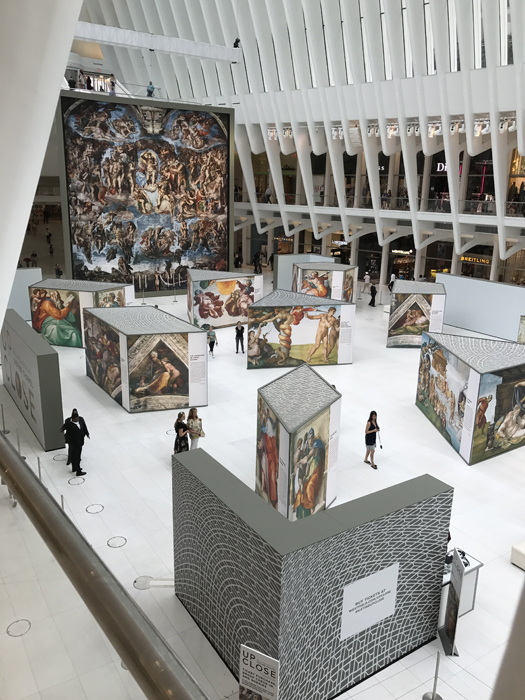
But there was an unexpected surprise. As I came out of the subway to go to the Memorial and Museum, there was a new shopping center, Oculus, that featured a remarkable display of images from the Sistine Chapel at the Vatican in Rome. In nearly life size, enormous photographs of the ceiling and altar wall were on display. I found this to be serendipitous, since my wife and I will be soon be traveling to Rome and we will see the Sistine Chapel with our own eyes. To walk around this installation and see Michaelangelo’s  frescos of the ceiling of the Chapel up close was a delightful surprise.
WTC_Sistine_Chapel

On to the third trip.

Just last week, I was back on the east coast, at Duke Divinity School in Durham, North Carolina, to perform at two programs that focused on theology and music (August 30-September 2).

DITA_poster_2017

These were led by Dr. Jeremy Begbie, professor of theology at Duke Divinity School. Last year, about a dozen musicians took part in the first of these kinds of events, sponsored by Duke Initiatives in Theology and the Arts. After the success of that event, a much large scale offering was planned for this year, with over 30 musicians invited to take part in the events.

A concert at Duke’s Nasher Museum of Art was in conjunction with a new exhibition, The Medici’s Painter: Carlo Dolci and 17th-Century Florence. The exhibition was revelatory, and at the evening’s program that included two fascinating lectures about Dolci and his work, our group of eight brass players performed two Italian Renaissance works while a chamber music group played as part of two lectures and also performed the first movement of Bach’s Brandenburg Concerto 2. If you find yourself in the Durham area soon, I urge you to visit this superb exhibit at the Nasher.

[Carlo Dolci, Virgin and Child, late 1640s. Collection of The Bob Jones University Museum & Gallery, Greenville, South Carolina, installed at The Nasher Museum, Duke University]

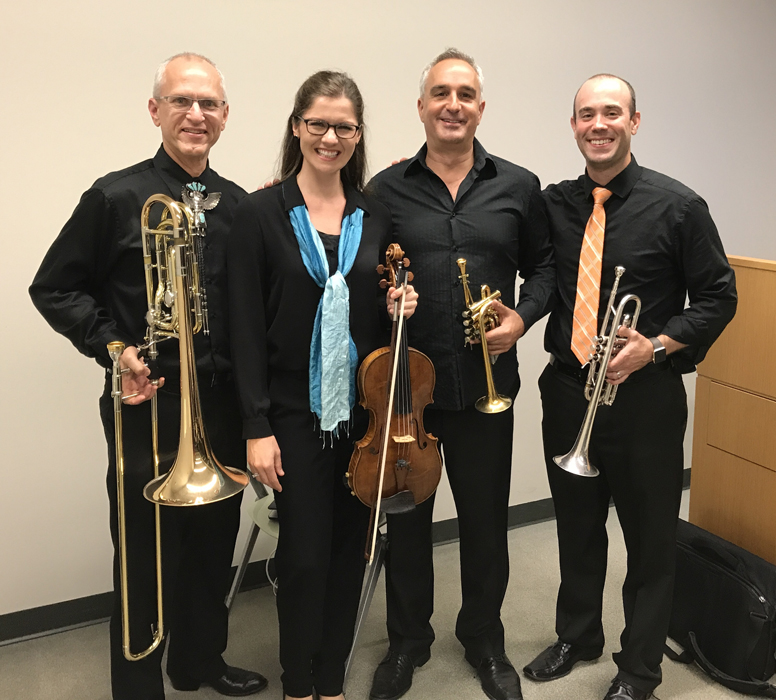
The players at these DITA events are all Christians and come from symphony orchestras and universities from around the United States. Working with these like-minded colleagues was pure joy, and our playing, meals together, and conversations were invigorating. After the program at the Nasher, we took a photo of current and former members of the Baltimore Symphony Orchestra who were participating in the program. Here you can see me (I played bass trombone in the Baltimore Symphony from 1981-1985), Rebekah Edewards (now a violist with the Boston Symphony), and current principal trumpeter Andrew Ballio and second trumpeter, Nate Hepler.
DITA_Baltimore_Sym_players

[Left to right: Douglas Yeo, Rebekah Edewards, Andrew Ballio, Nate Hepler]

As to the trombone section for the events, I was reunited with Megumi Kanda and Jim Kraft, who for many years played trombone in the National Symphony in Washington, D.C. A concert with what was named The New Caritas Orchestra was titled, Home, Away, & Home Again: The Rhythm of the Gospel in Music. Led by Jeremy Begbie – who made insightful and powerful comments throughout the evening and also was a superb piano soloist in works by Rachmaninoff and Shostakovich – the concert was a benefit for The Corner House in Durham, a house where disabled and non-disabled people live together in community. The House is supported by Reality Ministries, and it was truly beautiful to see residents of the house at the concert, and hear some of them speak and others play percussion instruments with us on the final piece on the program. It was a moving, joyful time.

DITA_Doug_Megumi_Jim

[Left to right: Douglas Yeo, Megumi Kanda, Jim Kraft]

At the request of those of us who played the DITA event in 2016, a seminar was given for the orchestra members on Saturday morning, led by Jeremy Begbie (whose book Resounding Truth: Christian Wisdom in the World of Music is one of the finest I’ve ever read about the intersection of music with the Christian faith) and Alan Torrance. I confess that the three hours spent in this seminar were revelatory. Alan’s presentation on God’s covenant relationship with His people – especially his unpacking of Hebrew words and how they, over time, were poorly translated into Latin and then to English, something that has had an important effect on our understanding of God’s covenant-– and Jeremy’s discussion on the Holy Trinity have given me much to think about and meditate on. God was at work at Duke Divinity School last week and I left there refreshed and challenged.

Three trips in just a few weeks (and another, much longer trip in the middle of these trips about which I will write soon), back and forth over our great country, from sea to shining sea. Music, friends, and faith.