Category: faith

What is happening? It’s not all about you. Or me. It’s about the music.

What is happening? It’s not all about you. Or me. It’s about the music.

by Douglas Yeo (October 15, 2023)

I retired from the Boston Symphony Orchestra in 2012 after nearly 30 years as a member of that remarkable institution. I use the word institution because the BSO was more than an orchestra. Yes, the orchestra itself was the raison d’être for BSO Inc., but there was so much that flowed from the decision by Major Henry Higginson to establish a symphony orchestra in Boston in 1881. The Boston Symphony Orchestra, the Boston Pops Orchestra—which is the BSO minus most of its principal players—Symphony Hall in Boston, the BSO’s annual summer festival at Tanglewood, recordings, tours. It’s all part of the life I led for so many years and I am grateful that I was able to live my dream.

In the 11 years since I retired from the BSO, I’ve been engaged in a host of interesting and very rewarding activities. From recreational trips with my wife and other members of our family, to the joy of living near our grandchildren, to writing many books and articles, to teaching in several colleges/universities (Arizona State University, Wheaton College (Illinois), University of Illinois Urbana-Champaign), to serving now as interim music director at my church, New Covenant Church in Naperville, Illinois, my life is full and interesting. Yet while I left the full time symphony orchestra world in 2012, I’m still interested in it. Now, however, I’m mostly looking at it from the outside. And with this new perspective, I’m increasingly asking myself this question:

What is happening?

“Time,” as the hymn writer Isaac Watts reminded us in his great hymn, Our God, Our Help in Ages Past, is “like an ever-rolling stream.” Times change, things change. Nothing stays the same. It’s easy for someone at my season of life to look back at “the good old days” and assume the ways things were done back then were always better than they are today. Through an honest lens, I can say that some things were better. But not everything. And part of getting older is seeing things change and evaluating them in light of the ever-rolling stream of the passage of time.

As a college professor and one who now sits more frequently in the audience at concerts than on the stage, I am observing many trends in the performing arts. Many of these flow from current cultural mores, the evolution (and let’s remember that evolution of anything is not always for the better) of cultural thinking and operating. Recently, I’ve observed and heard about some things in the orchestra world that have me asking,

What is happening?

To wit, I recently:

  • Attended a concert by a certain professional symphony orchestra where a member of the ensemble—who did not play in the second movement of a piano concerto—took a large sheaf of yellow lined papers out from his tail coat pocket, crossed his legs, sat back in his chair, and proceeded to read the papers—shuffling the pages—for 10 minutes while the concert was going on around him.
  • Learned that a member of a certain professional symphony orchestra was recently dismissed because the member arrived late to a concert and had to conspicuously walk through the orchestra to get to the member’s seat in full view of the audience.
  • Saw a concert performed by a certain professional symphony orchestra where a player had a rough time with a long, exposed solo—I’m sympathetic to the problem; it can happen to anyone—and while he was missing notes all over the place, leaned back in his chair and kicked up his legs, making light of the situation.
  • Learned that a member of a certain professional orchestra was recently dismissed for being rude and insubordinate to the orchestra’s conductor and playing inappropriately loudly after repeatedly being asked to stop doing so during rehearsals and concerts.
  • Attended a concert by a certain professional symphony orchestra where a member of the brass section added many extra notes to his part, took several notes down an octave, and generally obliterated the orchestra with his crass, loud playing. And at the end of the concert, he smiled broadly.
  • Learned recently that the trombone section of a certain professional symphony orchestra is “the most hated section in the orchestra” because they play so loudly and out of context.

What is happening?

When I joined the Boston Symphony Orchestra in 1985, I was 30 years old. I was an experienced bass trombonist, having been a member of the Baltimore Symphony Orchestra for four years, and having worked in New York City as a freelance player for five years. I was very aware of the storied history of the Boston Symphony, its long roster of celebrated music directors, and its unparalleled recorded legacy. I was also aware that Joannès Rochut, whose name is familiar to many of not most trombonists because of the three volumes of Melodious Etudes he arranged from works of Marco Bordogni, had been principal trombonist of the BSO from 1925–1930. I knew I was coming into something that had been around for over 100 years before me.

The Boston Symphony Orchestra has traditions. Tradition is a word that gets knocked about these days. Many people equate tradition with stuffiness, with a “dead” way of doing things. But that’s not the case if tradition is vibrant. For the 104 years before I joined the Boston Symphony, it had evolved to do things in particular ways. The sound of the orchestra was rich and lush, a sound that was enhanced by the fact that the orchestra played in one of the finest concert halls in the world, Symphony Hall, built in 1900.

Boston_Symphony_low_brass_section_Barron_Bolter_Yeo_Schmitz_2001_standing

Boston Symphony Orchestra low brass section: Ronald Barron, Norman Bolter, Douglas Yeo, Chester Schmitz. Symphony Hall, Boston, 2001.

At the time I joined the BSO, there were members in the orchestra who had been hired by the orchestra’s music director from 1924–1949, Serge Koussevitzky, and many more had been hired by Charles Munch, who was music director from 1949–1962. A member of the orchestra’s cello section had played with Glenn Miller’s orchestra during World War II and was part of Miller’s group at the time Miller died when his plane’s frozen carburetor caused it to crash into the English Channel on December 15, 1944. There were men in the orchestra who wore a jacket and tie to rehearsal. There were certain ways the orchestra played, and the expectation was that new players would come into the orchestra and add to that tradition by blending with the rest of the orchestra while adding one’s own musical personality in appropriate ways. It was exhilarating. There I was, sitting in the orchestra’s low brass section between Chester Schmitz—hands down the finest orchestral tuba player that I have ever heard—and Norman Bolter—who had joined the BSO at the age of 20, a prodigy of epic proportions. Ronald Barron headed our low brass section as principal trombonist. Principal bassoonist Sherman Walt, principal clarinetist Harold “Buddy” Wright, principal timpanist Everett “Vic” Firth—they were all there, plying their craft at the highest level. I sat, I played, I observed, I learned, and above all, I fit in. Fitting in required a measure of humility. It wasn’t just because I was “the young guy” and I needed to wait my turn. No, this was normal, usual operating procedure. The goal of the entire orchestra was to present a unified musical product. And we did.
CSO_low_brass_May_1972

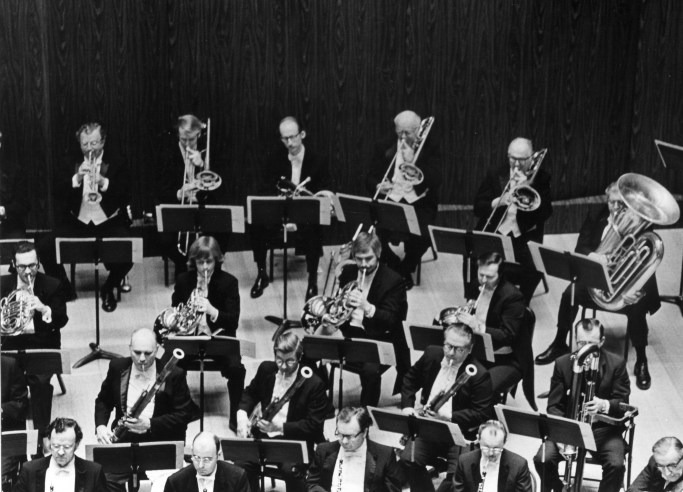
Members of the Chicago Symphony Orchestra brass section. Back row: Adolph Herseth, trumpet; James Gilbertson, Jay Friedman (with euphonium), Frank Crisafulli, Edward Kleinhammer, Arnold Jacobs. Orchestra Hall, Chicago, 1972. Photo courtesy of the Chicago Symphony Orchestra Archives.

I learned the importance of this when I was an undergraduate student at Wheaton College. I studied with Edward Kleinhammer, the celebrated bass trombonist of the Chicago Symphony Orchestra from 1940–1985. In 1975, my wife and I attended a CSO performance of Richard Strauss’ Eine Alpensinfonie. I had never heard the piece before I heard it at that concert (imagine a time in the world’s history where there was only one recording of Strauss’ epic work—and I had not heard it) and I was stunned by the piece and the CSO’s performance. After the concert, my wife and I waited for Mr. Kleinhammer to come up the stairs from the basement of Orchestra Hall and when he arrived at the lobby landing, I blathered away about how amazing he was in the concert. He looked at me with a penetrating stare and then said, “If you heard me, I was a failure. You shouldn’t have heard a fourth trombone player. You should have heard a great orchestra.” And he walked away. I was stunned.

The next day I had a lesson with Mr. Kleinhammer where he unpacked his comment. He told me I was listening to the wrong things. That Eine Alpensinfonie was not all about the fourth trombone player—or the trombones at all. Yes, there were moments when the trombones had a melodic line. But for most of the piece, they worked in community, supporting other instruments. Mr. Kleinhammer told me, “Douglas, it’s not about me. It’s about the MUSIC.” It was at that moment that scales fell from my eyes. I was intoxicated with the trombone section and I missed the orchestra. I had lost the forest for the trees.

And, as God can only do because He is God, I came home from that lesson and opened my Bible and read something that got my attention and changed my life. In the book of First Corinthians, the Apostle Paul wrote about the church, and how a healthy church should be and act. He wrote (1 Corinthians 12:14–27, English Standard Version):

For the body does not consist of one member but of many. If the foot should say, “Because I am not a hand, I do not belong to the body,” that would not make it any less a part of the body. And if the ear should say, “Because I am not an eye, I do not belong to the body,” that would not make it any less a part of the body. If the whole body were an eye, where would be the sense of hearing? If the whole body were an ear, where would be the sense of smell? But as it is, God arranged the members in the body, each one of them, as he chose. If all were a single member, where would the body be? As it is, there are many parts, yet one body.

The eye cannot say to the hand, “I have no need of you,” nor again the head to the feet, “I have no need of you.” On the contrary, the parts of the body that seem to be weaker are indispensable, and on those parts of the body that we think less honorable we bestow the greater honor, and our unpresentable parts are treated with greater modesty, which our more presentable parts do not require. But God has so composed the body, giving greater honor to the part that lacked it, that there may be no division in the body, but that the members may have the same care for one another. If one member suffers, all suffer together; if one member is honored, all rejoice together.

Now you are the body of Christ and individually members of it.

It was at that moment I understood the flaw in my musical thinking. I realized that playing the trombone in an orchestra was not about me. It was not about showing anyone else what I could do, it was not about strutting my stuff, it was not about calling attention to myself. The Apostle Paul’s metaphor for the proper working of the Church—the human body and all of its diverse parts, each of which has a unique function—was a metaphor for the proper working of ANY group of people. A friendship, a marriage, a football team, a business, a church. And a symphony orchestra.

It was then that I distilled Paul’s words into a phrase that I have repeated countless times to my students and colleagues (just ask them; they’ll tell you I say this frequently):

All members of the orchestra are equally important, but at any given moment, all members of the orchestra are not equally prominent.

This is what a symphony orchestra should be about. Each member is equally important. Whether playing the melody, or an underlying rhythmic figure, or soft whole notes, every part is equally important. Just like every part of the body. But when I have long soft notes to play, they are not as prominent as the melody played by the first oboe player. The fact that the oboist has the melody in no way diminishes my contribution at that moment. And if, at the end of the concert, the conductor asks the oboe player to stand up and take a bow and the conductor does not ask me to do so, that is fine, and I will join in the applause for my colleague. Because my oboist colleague was more prominent than I was. It wasn’t about me. It’s about the MUSIC.

If I had made it about me—if I had played my whole notes in a manner that brought attention to myself while obliterating the oboe player’s solo—I would have ruined the performance. So, I committed myself to being a team player, to being part of the body that is the symphony orchestra, and to understanding my role in the greater whole. And this I did—and do—in the service of the MUSIC.

Yeo_team_player_ITAJ

Header graphic and title for Douglas Yeo’s article, “Me, Myself, and I—Are Orchestral Brass Players Losing the Concept of Being Team Players? International Trombone Association Journal, Vol. 25, No. 1, Winter 1997, 21–23.

In 1997, I wrote an article on this subject that was published in the International Trombone Association Journal (Vol. 25, No. 1, Winter 1997); it was subsequently republished in the Tubists Universal Brotherhood Association Journal—the organization has since changed its name to International Tuba Euphonium Association—(Vol. 24, No. 3, Summer 1997). My article was titled, “Me, Myself, and I: Are Orchestral Brass Players Losing the Concept of Being Team Players?” I wrote it in response to a trend I was observing—the very trend that, 26 years later, I am speaking about in this present blog post on The Last Trombone—where I sensed that students and colleagues were beginning to shift from working together to create a unified whole in performance to wanting to stand out and be noticed. A few months later, my friend Gene Pokorny, tubist with the Chicago Symphony, penned a response to my article that was published in the T.U.B.A. Journal in its Winter 1998 issue (Vol. 25, No. 2) in which he echoed and supported my arguments. You can read my article and excerpts from Gene’s response on my website,  HERE and Gene’s whole article HERE.

Which brings me back to my question:

What is happening?

As Gene said in his article:

It may be inexperience which dictates some players to not be part of the team on stage but in many cases it is CHOICE. There are many venerable professionals out there who know how to be ensemble players but, for whatever reasons, choose to not be part of the group. Some of it is carelessness, but some of it is choosing to “get back” at a conductor, make a point to a player on stage, impress some friend in the audience, etc. Whatever the reason, the choice of not playing together with everybody else on stage is a mistake in which everybody pays for somebody else’s lack of maturity. . .

Yet, here we are in 2023, and I’m writing about this again. As I observe the ongoing evolution of musical art, I am seeing more, not less of this tendency to promote one’s self at the expense of the whole. As the examples at the top of this article show so clearly, the “me first” attitude, the “it’s all about me” attitude, the “who are you to tell me what to do” attitude is on display. Players want their students to think of them as “monster” players. A monster? How about being a great trombonist who understands the role of your part in the greater whole? How about some humility? How about an understanding of the difference between importance and prominence? And how about some respect for the music, for your colleagues, for the audience, and for the tradition and history of the ensemble of which you are a part, and to be, as Gene said in his article, “a cog in the wheel” instead of “the nut behind the wheel”? Nobody—including me—does this perfectly. But can this be the goal, the aspiration, something to strive for, and can we talk about this with—even call out— those whose inherent selfishness ruins concerts on a regular basis?

There are things to learn from the way things used to be done. From from our teachers, from the teachers of our teachers, from the people in the jackets and ties. Last week, I was talking with a friend about this ongoing trend of individual players who play in order to be heard and noticed rather than playing in order to support the whole product. Like me, he studied bass trombone with Edward Kleinhammer, and my friend I and frequently talk about the state of the modern symphony orchestra. In a series of text messages last week, he offered:

I miss the old days and our old role models.

Why is the easy stuff SO HARD for some people?

God love you, Ed Kleinhammer.

To which I replied,

Preach it, brother.

Last night, when I was reading my Bible, I turned to this passage (Jeremiah 6:16, English Standard Version) that reminds us of something very important. It starts off with words of wisdom but then observes the response of many people:

Thus says the Lord: “Stand by the roads, and look, and ask for the ancient paths, where the good way is; and walk in it, and find rest for your souls. But they said, ‘We will not walk in it.’”

The ancient paths. The good way. There is a lot we can learn from them. When it comes to playing the trombone, I learned about them from Edward Kleinhammer, and I have tried to emulate his spirit of being a team player throughout my career. My students have heard this from me through my over 40 years of college teaching. There are many players who understand the Apostle Paul’s metaphor of the body and how it perfectly shows us how each of us is valuable and important to any task as long as we understand our role. But there are also many who are hung up on themselves and who ruin music and music making because of their unwillingness to be a team player. Guess what? People are noticing you. Just like the music critic who noticed the trombone section when he heard a certain professional symphony orchestra perform Richard Strauss’ Also Sprach Zarathustra (New York Times, February 15, 1995; review by Alex Ross):

The trombones, who had been emitting ghastly sounds all night, blared too loudly in the “Zarathustra” fanfare, obliterating the top trumpet line.

Yes. You’re noticed.

Will you join me and many others—like Edward Kleinhammer, who taught so many of us about this—in walking “where the good way is”? It’s not all about you. It’s not all about me. It’s about the MUSIC.

Thankful for farmers

Thankful for farmers

by Douglas Yeo

Today is Thanksgiving Day in the United States. George Washington, in his Thanksgiving proclamation of October 3, 1789, reminds us what this day is for:

Whereas it is the duty of all Nations to acknowledge the providence of Almighty God, to obey his will, to be grateful for his benefits, and humbly to implore his protection and favor—and whereas both Houses of Congress have by their joint Committee requested me “to recommend to the People of the United States a day of public thanksgiving and prayer to be observed by acknowledging with grateful hearts the many signal favors of Almighty God especially by affording them an opportunity peaceably to establish a form of government for their safety and happiness,” now therefore I do recommend and assign Thursday the 26th day of November next to be devoted by the People of these States to the service of that great and glorious Being, who is the beneficent Author of all the good that was, that is, or that will be—that we may then all unite in rendering unto him our sincere and humble thanks.

There is much for which we can be thankful. Last night, my wife and I went to a Thanksgiving Eve service at our church, New Covenant Church of Naperville, Illinois. About halfway through the service, we sang a hymn that I have sung more times than I can count, “Come, Ye Thankful People, Come.”

Come_Ye_Thankful_People_Come

Last night, the hymn had new meaning for me. Because this year, I am especially grateful for farmers.

Each Wednesday since the end of the August, I have gotten up early in the morning to drive south to Urbana, Illinois, where, for the 2022–2023 academic year, I am serving as Clinical Associate Professor of Trombone at University of Illinois Urbana-Champaign. I’ve made this trip 13 times this semester, a 159 mile, nearly three hour long drive. After two days of teaching at Illinois, I get in my car again and make the same drive home. When I first mapped out my drive, I made a decision. I could have taken interstate highways all the way from our home in the Chicago area to Urbana. Interstate 355 to 55, then 57 all the way to Urbana. But I on that first trip in August, I decided to try something different. I decided to take the back roads through the cornfields.

The decision was, as I first thought it through, a pragmatic one. Interstate highways are fast, fast roads. Speed limits mean little on interstates. A speed limit of 60 or 65 miles per hour means many—if not most—people are driving 70 or 75. Or faster. I thought the drive on back roads would be more peaceful. Fewer trucks, less noise, and perhaps I could take in a nice view along the way. I wasn’t prepared for what happened.

Illinois_cornfields

The view on Illinois 115 near Cabery, Illinois, August 22, 2022

On my first drive south on August 22, I turned off Interstate 55 to Illinois 31, the first of several state roads with a posted speed limit of 55 mph that took me straight south from the Chicago area to Urbana. State Routes 31, 18, and 115. 55 miles an hour, that is until I came across a small village (which happened several times) when the speed limit dropped to 40 mph for a minute while I passed a village with a population of 250. Or fewer. There certainly were fewer trucks on the road. In fact, there were NO trucks. In fact, there were no cars, either. I had the road completely to myself. So much so that I stopped in the middle of the road and snapped this photo, above. And you can see what I saw for hours: endless cornfields.

In August, the corn was high. And as far as my eyes could see, I saw thousands of acres of corn. Corn that went on to the horizon and beyond. I was fascinated by the endless stalks of corn, gently undulating in the breeze. I saw farmhouses and silos that dotted the landscape. As the weeks went on, I witnessed the ritual that’s done by farmers around the world: harvest. Massive pieces of farm machinery appeared in the cornfields. Stalks were cut down, and the corn was separated from its husks and shot into huge trucks. In recent weeks, with the fields shorn of their stalks, I’ve seen new pieces of huge equipment plowing the fields. The fields will lay fallow until the spring when I will see another ritual: planting. And the cycle will go on again, just as it’s been going on since the first humans walked the earth. The hymn reminds us that this cycle applies to us as well:

First the blade and then the ear, then the full corn shall appear.

Lord of harvest, grant that we, wholesome grain and pure may be.

These drives through the cornfields—I have two more trips to campus this semester before the Christmas break and then I will repeat this driving ritual next semester—have given me a new appreciation for farmers. Farming is hard work. I never thought about how much time it takes to harvest hundreds and hundreds of acres of fields. Now I do. It’s not a one day job. And farming requires a lot of trust and faith. These fields rely on the rain that God showers down from the sky. The right balance of sun, heat, and rain means a bountiful harvest. When that balance is off, the harvest is compromised. Farmers trust, hope, and pray.

I also have thought about these farmers and how I have a relationship with them. One way or another, their corn finds its way into the global food cycle. I have certainly eaten food that has been made, either directly or indirectly, with the fruit of their land and the work of their hands. And every now and then during my long drives through the cornfields, I see a sign stuck in the ground that offers a simple message, lest we forget:

no_farms_no_food

Today, on Thanksgiving day, my oldest daughter, her husband, and our two grandchildren will come over to our home for our annual Thanksgiving dinner. We’ll be joined by some friends from church. There will be laughter in the house. We’ll watch some of the Macy’s Thanksgiving Parade, something we do each year since I marched in that parade with the McDonald’s All-American High School Band on Thanksgiving Day, 1972. Later, we’ll have a football game on television in the background as we wait for the food to be ready. Then, days of preparation and cooking will culminate in a moment when we sit around the table with a feast before us (with three pies—blueberry, apple, and pumpkin—waiting their turn in the kitchen). It is a feast that I have been reliving each year since my earliest memory, a feast I suppose I’ve always taken for granted (with gratitude to my mother, mother-in-law, wife, and daughters who have done so much over the years to prepare the feast). We will look at this bounty before us, we will hold hands, bow our heads, and I will pray. I will pray and thank God for the many blessings He has given to us over the last year. I will thank God for His faithfulness through the year, through the cheerful days and through the storms of life. I will thank him for church and school and work and love and life. And I will thank Him for farmers who do the back-breaking work that puts the food on our table. Backbreaking work that most people never see.

I’m very glad for my weekly drives through the cornfields in Illinois. Because today, these words have new meaning for me:

Come, ye thankful people, come. Raise the song of harvest-home:

All is safely gathered in, ere the winter storms begin.

God, our Maker, doth provide, for our wants to be supplied:

Come to God’s own temple, come—raise the song of harvest-home.

Happy Thanksgiving, friends. We have so much for which we can be thankful. And before you put a fork to your mouth today, thank God for farmers.

the_road_home_sunset_cropped

The view along Illinois 115 near Piper City, Illinois, November 22, 2022.

An award for “Best Historical Research”

An award for “Best Historical Research”

by Douglas Yeo

Readers of The Last Trombone know that last year, University of Illinois Press published a book co-authored by my friend, Kevin Mungons, and me. The subject of the book is Homer Rodeheaver, the trombone-playing song leader for the evangelist William “Billy” Sunday for twenty years during the first third of the twentieth century. Rodeheaver played the trombone for over 100 million—yes, million—people during his lifetime (1880-1955) and he profoundly shaped the course of gospel music. Rodeheaver created the first gospel music record company (Rainbow Records), and he founded what was, at the time, the largest and most successful Christian music publishing company. His influence, nearly 70 years after his death, is still felt today.

Fig 01-1 rodeheaver-and-sunday

Above: Billy Sunday and Homer Rodeheaver, 1917. Courtesy of Morgan Library, Grace College, Winona Lake, Indiana.

Our book has received many enthusiastic reviews , including one in the October 2022 issue of the International Trombone Association Journal:

Kevin Mungons and Douglas Yeo have collaborated on a scholarly, nuanced biography of Homer Rodeheaver. Mungons and Yeo’s book, Homer Rodeheaver and the Rise of the Gospel Music Industry, combines painstaking research with insightful sociological and musicological analysis. Although the book is co-authored, it has a unified narrative. The extensive citations, alone, are worth the price of purchase. Even if one has only marginal interest in Homer Rodeheaver as a person, this scholarly description of American society at the turn of the 20th century proves fascinating and illuminating.

And this one from Christianity Today in March 2022:

Like virtually all books in the University of Illinois’s much-honored Music in American Life series, Homer Rodeheaver and the Rise of the Gospel Music Industry fills in significant blanks in our understanding of different aspects of music history. Mungons and Yeo elevate their contribution with meticulous detail and research; a penchant for finding fascinating, revealing stories and anecdotes; and a sparkling, highly readable prose style that’s all too rare in most academic books.

arsc

Last week (October 12), we learned that our book has just received a major award. The Association for Recorded Sound Collections (ARSC) gives annual awards “to authors of books, articles, or recording liner notes to recognize those publishing the very best work today in recorded sound research.” This is a highly coveted award, one with major significance to the large community of individuals who are heavily invested in understanding and promoting the history and preservation of recorded sound. ARSC publishes a peer-reviewed journal and its 2022 Awards for Excellence in Historical Recorded Sound Research include books on a wide variety of musical styles and genres written by highly respected authors.

Our book received the “Best History” award in the category for Best Historical Research in Recorded Blues, Gospel, Hip Hop, Soul, or R&B. The award will be presented to Kevin and me at the ARSC Conference that will be held in Pittsburgh in May 2023. We are very grateful for this recognition.

Between now and October 31, our publisher, University of Illinois Press, is offering a 50% discount off the cover price of the book. Click on this link to the UofI Press website’s page on books that have won awards in 2022. You’ll find our book there. Click on the image of the cover and you’ll be directed to UofI Press’s page about our book. You can order the book there. Put in the Promo Code MAL50 and the cost of the book will go from $31 to $15.50. That’s a real money savings. But this offer expires on October 31; now is your chance!

ARSC Award graphic

A “Senior” Recital—Celebrating the 46th Anniversary of Douglas Yeo’s Wheaton College Senior Recital, April 1976

A “Senior” Recital—Celebrating the 46th Anniversary of Douglas Yeo’s Wheaton College Senior Recital, April 1976

By Douglas Yeo

The last consequential musical performance I gave before the coronavirus pandemic hit in March 2020 was a joint recital in St. Louis with my good friend, Megumi Kanda, principal trombonist of the Milwaukee Symphony. That recital, on February 17, was hosted by the St. Louis Low Brass Collective, and it was a fun and memorable time of sharing music and music making with friends and an appreciative audience. Little did any of us know that the course of the pandemic over the next two-plus years would greatly constrain public performances. While the pandemic is still with us—let’s not kid ourselves: it’s still wreaking havoc around the world despite our collective desire to put it in our rear view mirrors—we are taking tentative steps to regain the rhythm of life that we enjoyed before anyone knew what the acronym COVID stood for.

Last year, I wanted to give a faculty recital at Wheaton College. Since 2019, I’ve been Wheaton College’s trombone professor, and the College has been important to our family since the early 1970s because my wife, our daughters, and I all went to school there. For this faculty recital, I an idea. Instead of the usual fare—play several important pieces written for bass trombone—I envisioned a program based on several stories. On April 19, 1976, I gave my senior bass trombone recital at Wheaton College; I was 20 years old. It was one of several culminating events that occurred during my last months as a student at Wheaton College and it remains memorable to this day. As I reflected on that, I realized that 2021 was the 45th anniversary of that recital. Also in 2021, I was 65 years old. In 1976 I was a senior in college. In 2021, I was officially a senior citizen. So why not do A Senior Recital, and celebrate the 45th anniversary of my senior recital—as a senior?

But it was not to be. In April 2021, the coronavirus pandemic was in full swing and I could not give the kind of recital I wanted to give. I didn’t want to perform a recital in an empty room that would only be seen over a live stream. For me, concerts are collaborative events between performers and audience, interactive affairs where we all feed off each other’s energy. I put aside the idea of A Senior Recital for another day. And that day came last week.

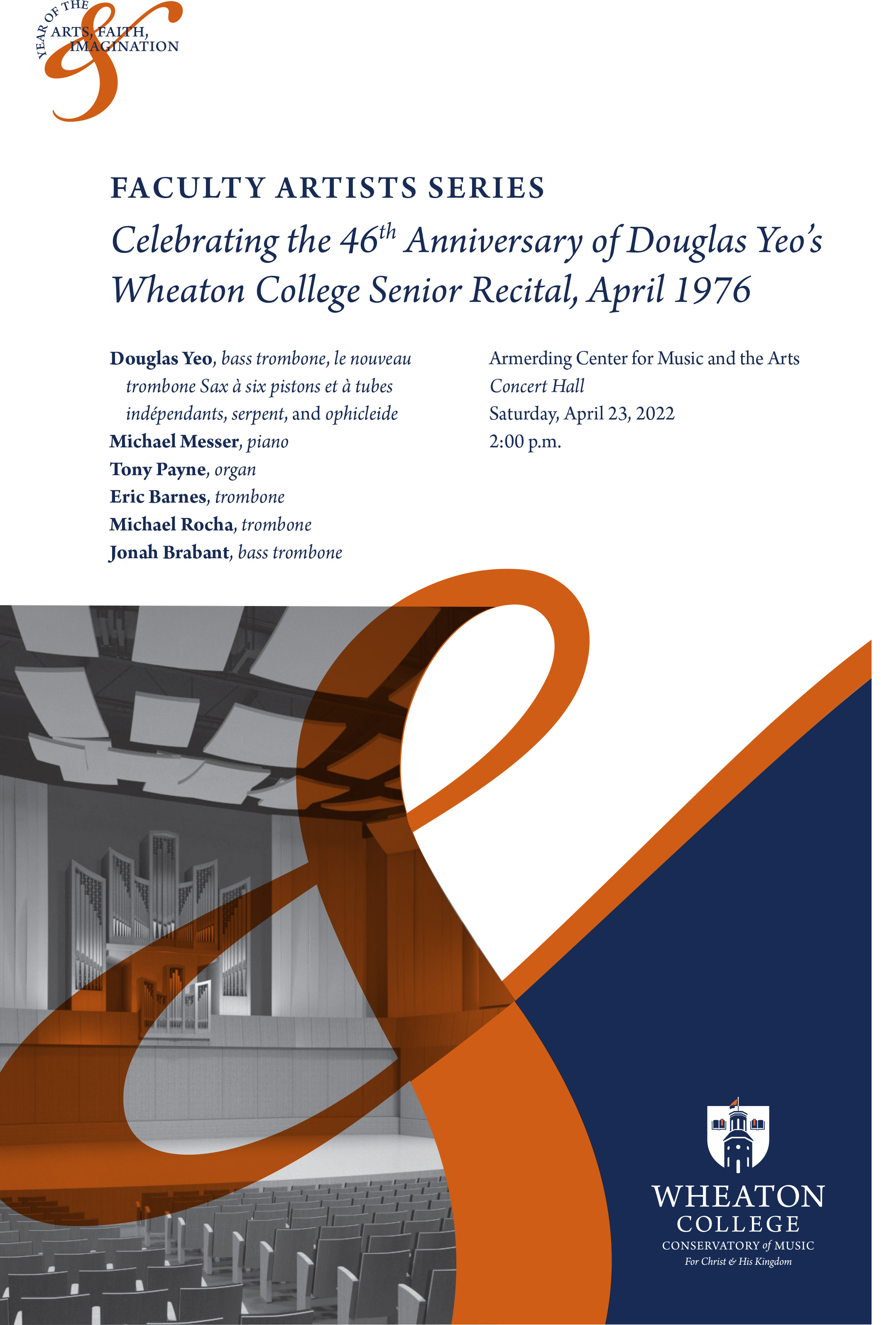
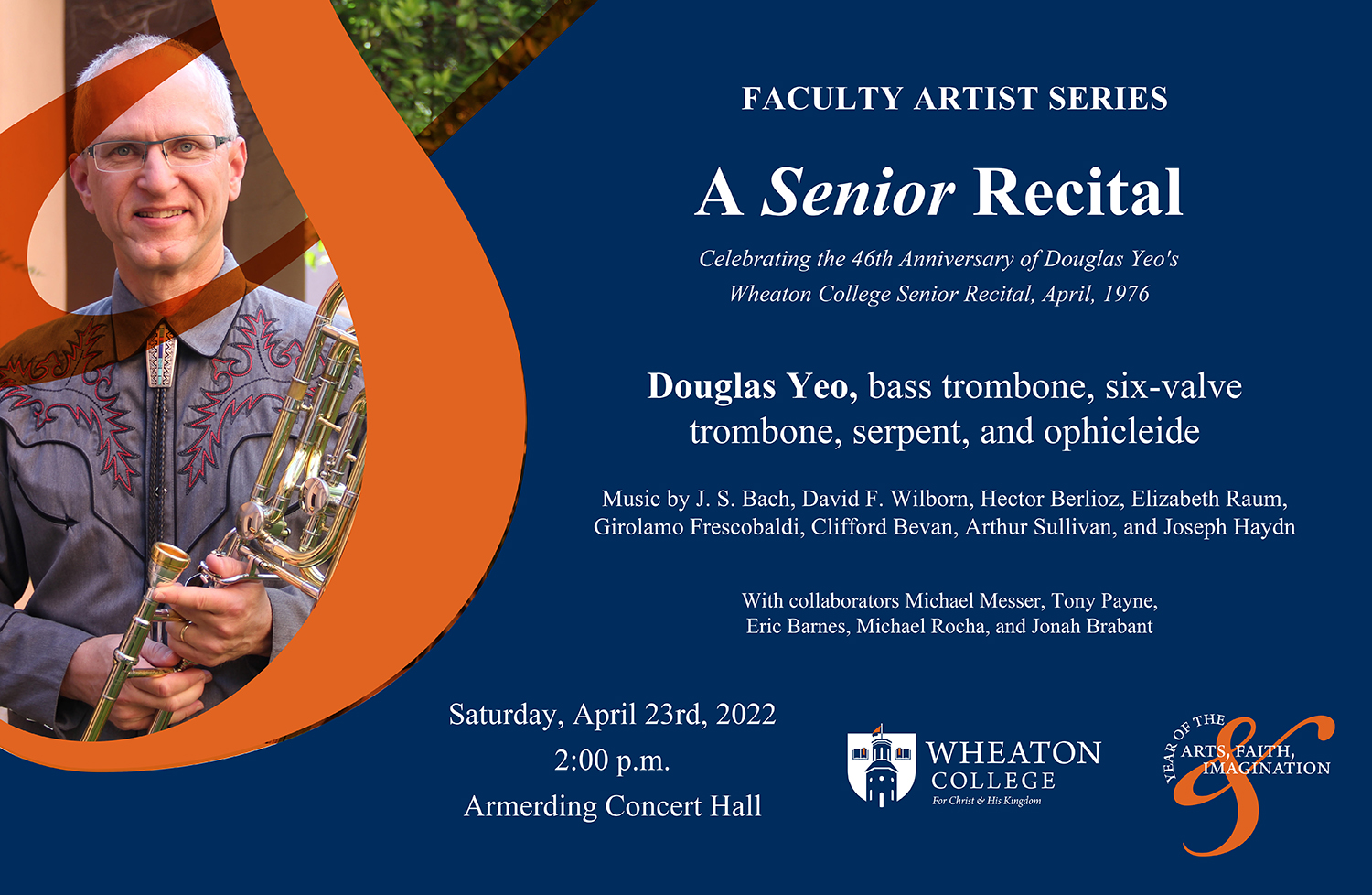
Douglas_Yeo_Wheaton_College_faculty_recital_program_April_23_2022_FINAL-1_cropped

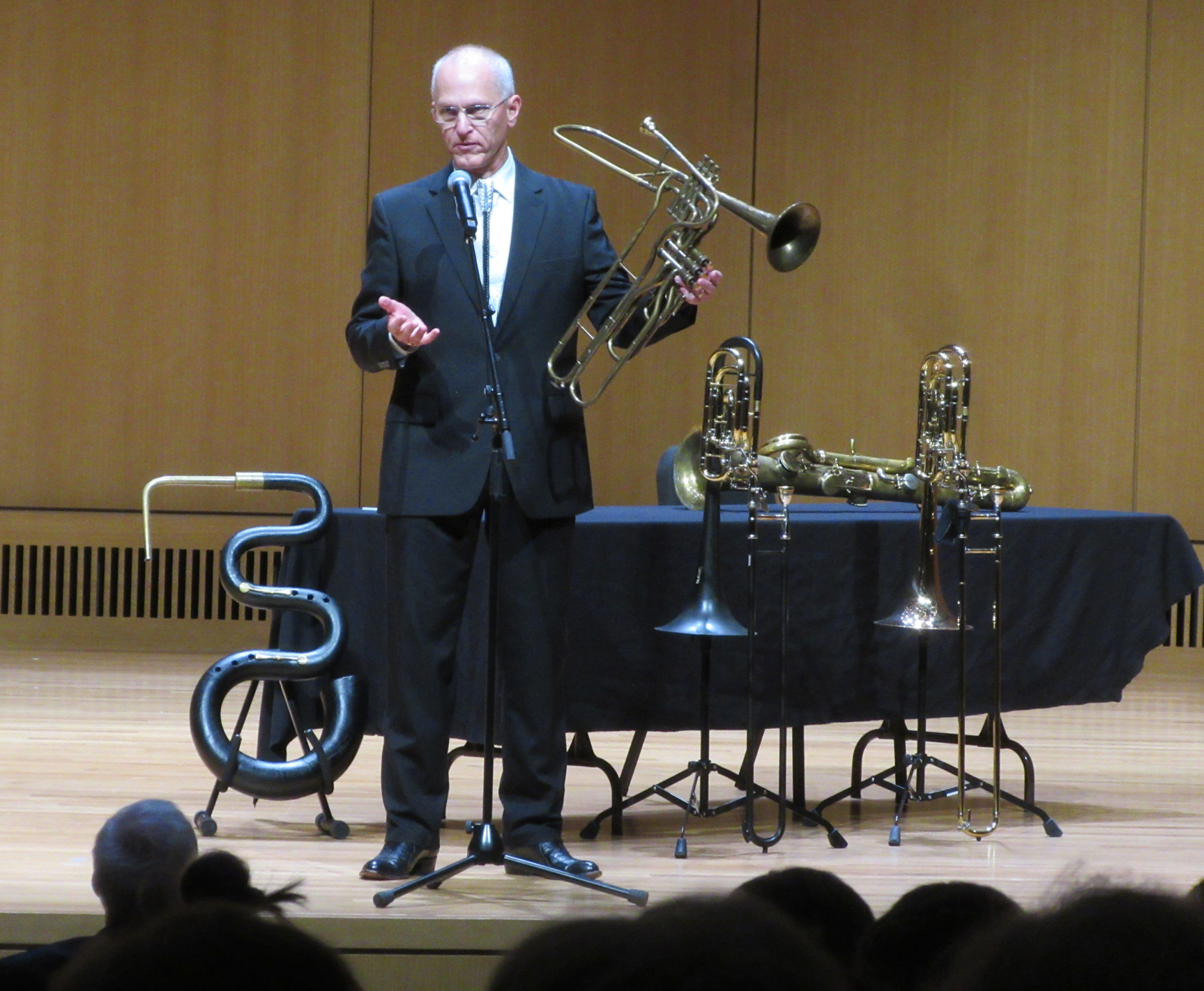
Last Saturday, on April 23, 2022, I gave A Senior Recital, in the new concert hall in Wheaton College’s Armerding Center for the Arts. Now on the 46th anniversary of my 1976 recital, and a year older, I decided to give a recital that celebrated the spirit of creativity that infused my 1976 recital. I also wanted to perform on several different musical instruments that have been a big part of my life for many years. I spent some time during the recital in front of a long table that held all of the instruments I used in the recital and I gave a little talk about each one. A word about the instruments. Naturally, I played bass trombone, my Yamaha YBL-822G bass trombone. But I introduced the audience to some other instruments, too. Serpent, ophicleide, six-valve trombone, and my new carbon fiber conversion of one of my Yamaha bass trombones, made by Butler Trombones. “Yeo’s music store” was visible throughout the recital on a table on stage, and some of the audience reactions when I played and talked about these instruments can be heard on the full stream of the recital. More on that below.

Yeo_six_valve_trombone_2023_cropped

Douglas Yeo talking about the six-valve trombone. Other instruments that are visible include serpent, ophicleide (on the table), and two Yamaha bass trombones, one with a carbon fiber conversion by Butler Trombones. April 23, 2022. Photo by Paul Schmidt.

Finally, I wanted to tell a story—several stories, actually. I wanted to tell stories about music, music-making, musical instruments, faith, hope, and love, and Wheaton College. So, I did.

At this season of life—I will turn 67 years old in a couple of weeks—I’m grateful for any opportunity I have to make music. While I don’t have my 35 year old body and I’m not able to do everything with a musical instrument in my hand that I was able to do in the past, I still like to play and share music with others. Whether in a recital, or as part of a church service, or alongside my wife, daughters, or grandchildren, music making has been a part of our family’s life for as long as any of us can remember. And for this recital, I was very fortunate to have superb collaborating artists. For five pieces, Dr. Michael Messer, a piano professor at Wheaton College, provided absolutely tremendous accompaniment for me. He is a superb musician and player—those two words do not always go together but in his case, they do, in spades—and collaborating with him was a real joy. Also, for one piece on the program, Dr. Tony Payne, a classmate of mine from my days as a student at Wheaton College who also now teaches and performs administrative roles including running the Artist Series at Wheaton College, played organ along with me. Working with these friends made the recital all the more enjoyable. For A Senior Recital, I chose a program that I hoped would be engaging for the audience, and from reports from people who attended, it was mission accomplished. We had a good time. So, in the spirit of sharing this model of putting together a recital, what follows are some links so you can watch and listen to it, too.

First, you can download the recital program by clicking HERE. The program tells a story, so if you take the time to read it, you’ll understand exactly what I was trying to do with this recital.

You can view the entire recital—from top to tail— by clicking HERE. This Boxcast link will be live for a year, until April 23, 2023. The recital was performed without intermission, and with the full Boxcast link, you’ll hear everything from Dr. Michael Wilder’s (Dean of the Wheaton College Conservatory of Music and Division of Arts and Communications) introduction to the moment after the last piece where our two grandchildren brought flowers to me on stage. You’ll hear my conversation with the audience about the music, and see me give brief demonstrations of all of the musical instruments I played on the recital. It’s all there.

I’ve also put videos of a few performances from the recital on YouTube—no talking or introductions, just the music. Those links follow here.

Elizabeth Raum: Turning Point (2008)

I’ve enjoyed playing many of Elizabeth Raum’s compositions over the years. When I was teaching trombone at Arizona State University (2012–2016), our faculty brass trio of John Ericson (horn), Deanna Swoboda (tuba), and me commissioned Betsy to write a piece for us, Relationships, and we recorded it on a CD produced by Summit Records, Table for Three. Click HERE to hear our recording of the first movement of Relationships, “Two Against One.” Her solo for bass trombone and piano, Turning Point, found inspiration in the Robert Burns poem, “To a Mouse,” where Burns penned the famous line, “The best laid plans of mice and men oft go awry.” Indeed, we have all seen this line in action over the last two years of the pandemic, where many plans were upended. Turning Point speaks to this turbulence but it ends in a positive, hopeful way. Michael Messer is at the piano.

Hector Berlioz: Oraison funèbre from Grande Symphonie funèbre et triomphale, H. 80 (1840)

Asking a person, “Who is your favorite composer?”,  is a little like asking, “Who is the favorite of your children?” It’s an impossible question. But if I had to make a list of those composers who have inspired and challenged me, Hector Berlioz will be on that list. High up on that list.  I have played a great deal of his music over the years during my long career as a member of the Boston Symphony Orchestra (1985–2012). In 1840, Berlioz wrote a three movement symphony for band, his Grande Symphonie funèbre et triumphale, the middle movement of which is a funeral oration intoned by a solo trombone. I’ve known about this piece since I was in high school when I encountered it in Henry Charles Smith’s fine book, Solos for the Trombone Player (Henry retitled it “Recitative and Prayer”). Several years ago, I purchased a six-valve trombone with independent tubes, a creation of Adolphe Sax in the mid-nineteenth century. This instrument—its formal name is quite wonderful: le nouveau trombone Sax à six pistons et à tubes indépendants—was Sax’s attempt to create a brass instrument with valves that has “perfect intonation.” As brass players know, with a standard three or four valve brass instrument whose valves are used in combination with each other, the lengthening of tubing when using the valves causes intonation challenges. By creating an instrument with six valves—and the open instrument with no valves— that work independently (the valves do not work in combination), and each valve (and the open instrument) has its own independent length of tubing, certain problems with intonation that valves in combination cause are eliminated. But that’s not to say that all pitch problems are solved, and that, along with the fact that the fingerings are anything but intuitive,  the instrument is quite heavy, and condensation from the player’s breath collects quickly in the small bore (.460″) tubes, led the six-valve trombone (and a whole family of six-valve instruments that Sax invented) to have its moment on the stage in France and Belgium for the second half of the nineteenth century into the twentieth century before it disappeared from the musical scene. Still, I enjoy bringing old instruments back to life, and while I have never succeeded in performing a piece on this instrument without making a valve fingering gaffe—my brain always wants to return to standard three valve fingerings, a consequence of having played bass trumpet in the Boston Symphony for many years—I like bringing Berlioz’s Orasion to audiences. In this performance I’m playing my six-valve trombone by Joseph Persy, a Belgian maker who was active in Brussels from 1897. Again, Michael Messer is at the piano.

Girolamo Frescobaldi, recomposed by Eddy Koopman: Canzone (Canzon primo basso solo, F. 8.06b, 1628)

Girolamo Frescobaldi wrote several works for unspecified bass instruments which I have played on many occasions. In 2012, I gave a recital at Arizona State University where I played Frescobaldi’s first Canzon on a bass sackbut in F with Dr. Kimberly Marshall playing organ. You can see a video of that performance HERE.  I’ve also played it on bass trombone accompanied by piano. But I confess I never enjoy playing it more than when accompanied by Eddy Koopman’s creative techno-pop electronic treatment. The arrangement was written for my friend, Dutch bass trombonist Ben van Dijk, and I played it on the buccin (dragon bell trombone) in Nagoya, Japan in 2018 as part of the Second Nagoya Trombone Festival. You can read about that and see photos of that event HERE.

For my recent recital performance of Canzone, I decided to pair the oldest piece on my recital with my newest trombone, a carbon fiber conversion of my Yamaha YBL-822G bass trombone made by Dave Butler of Butler Trombones. I became interested in acquiring a carbon fiber trombone a few years ago in light of a number of challenges I’ve been facing with my shoulders, hands, and elbow. Over 55 years of playing the trombone—of lifting it up and down, holding it up, moving the slide continuously—has taken its toll on my body, and the idea of sometimes playing a lighter instrument is very appealing. I was initially suspicious of the idea of a carbon fiber trombone, but as I learned more about it and discovered that it actually sounds great, I’ve embraced this instrument as something that I use regularly. You can read more about my impressions about this instrument in an article I wrote for The Last Trombone HERE. With my carbon fiber trombone in my hands, I once again had the chance to bring Eddy Koopman’s take on Frescobaldi’s Canzon to a new audience.

Clifford Bevan: Variations on “The Pesky Sarpent”

My fascination with historical musical instruments dates from my childhood, when I spent many hours in the Metropolitan Museum of Art’s (New York City) musical instrument galleries. I wrote about my first encounter—as a young boy— with the buccin, the dragon-bell trombone of the nineteenth century, in an article on The Last Trombone that you can read HERE. I’ve been playing the serpent since 1994, when I learned it so I could play the serpent in performances of Hector Berlioz’s Messe solennelle with the Boston Symphony Orchestra in Boston, Carnegie Hall, and Tokyo. Since then, I’ve been an evangelist for the instrument. I’ve written articles about it (such as this one about serpents in collections in Boston, and this one about the serpent in the works of English author, Thomas Hardy), a book about it, and recorded a solo CD and an instructional DVD about it. I love this curious. odd, and old instrument that was invented in the sixteenth century.

Over the years, I’ve gotten to know many of the world’s leading serpent players and scholars (yes, they do exist!). Clifford Bevan is acknowledged as the leading expert on the tuba family (he authored a book of that name, The Tuba Family, which remains the seminal and most important volume about the tuba and its ancestors, including the serpent). I’ve known Cliff for many years, and in 1996, he wrote what may be the first piece ever written for serpent and piano, Variations on “The Pesky Sarpent.” The piece takes its title from a nineteenth century folksong titled, “On Springfield Mountain,” which relates the sad tale of a young man who was bitten by a rattlesnake. Cliff’s piece includes the text of the song and in my performance, I began by reading the poem before Michael Messer started “The Pesky Sarpent” in dramatic, Lisztian fashion.

Sir Arthur Sullivan: The Lost Chord

Yeo_Payne_Sullivan_Lost_Chord_2022

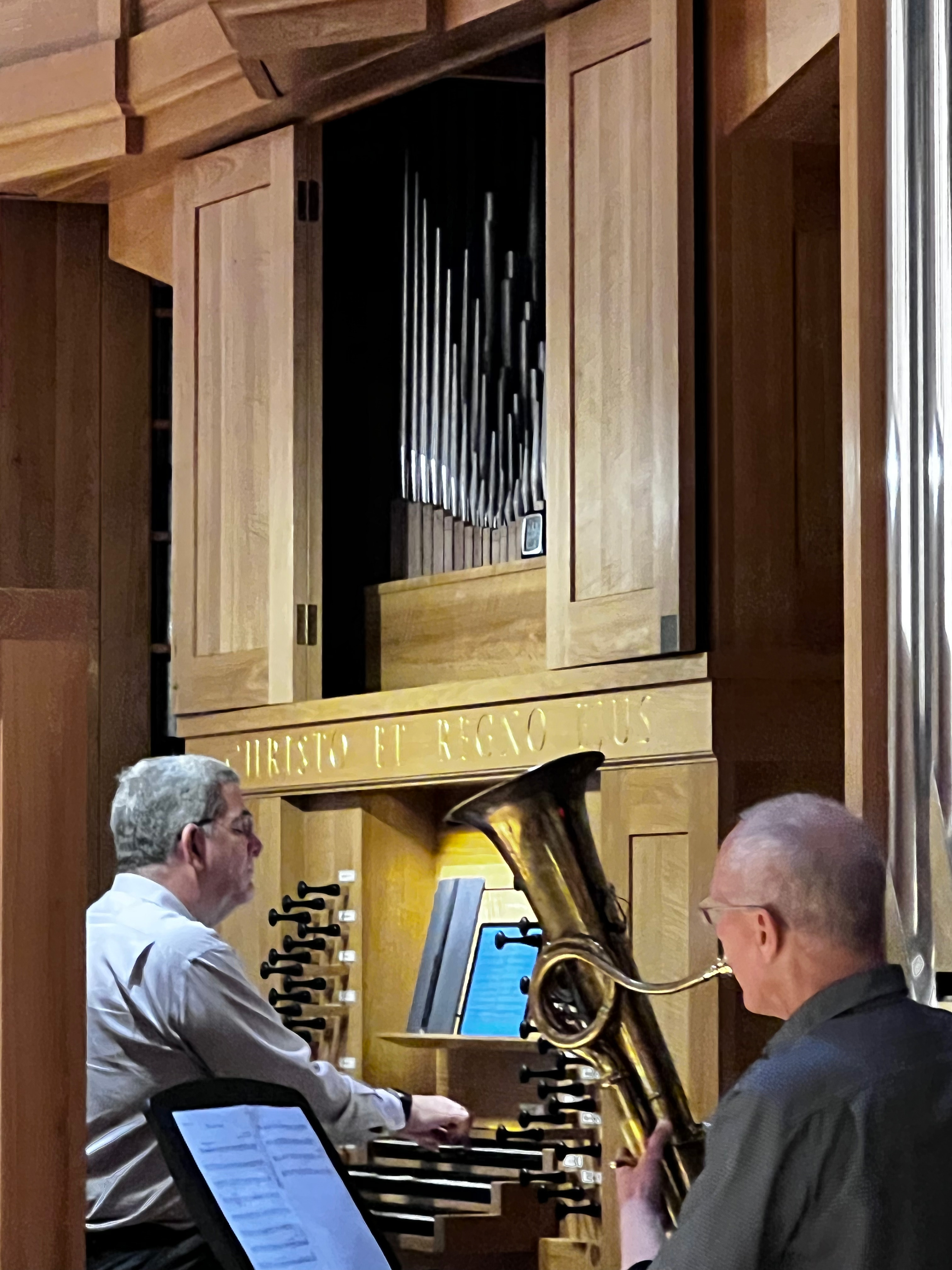
Tony Payne, organ, and Douglas Yeo, ophicleide, rehearsing Sir Arthur Sullivan’s, The Lost Chord. Concert Hall, Armerding Center for the Arts, Wheaton College. April 23, 2022. Organ by Taylor & Boody. Photo by Marian Payne.

Yeo_ophicleide_2022_a

Douglas Yeo performing Sir Arthur Sullivan’s, The Lost Chord. April 23, 2022. Photo by Paul Schmidt.

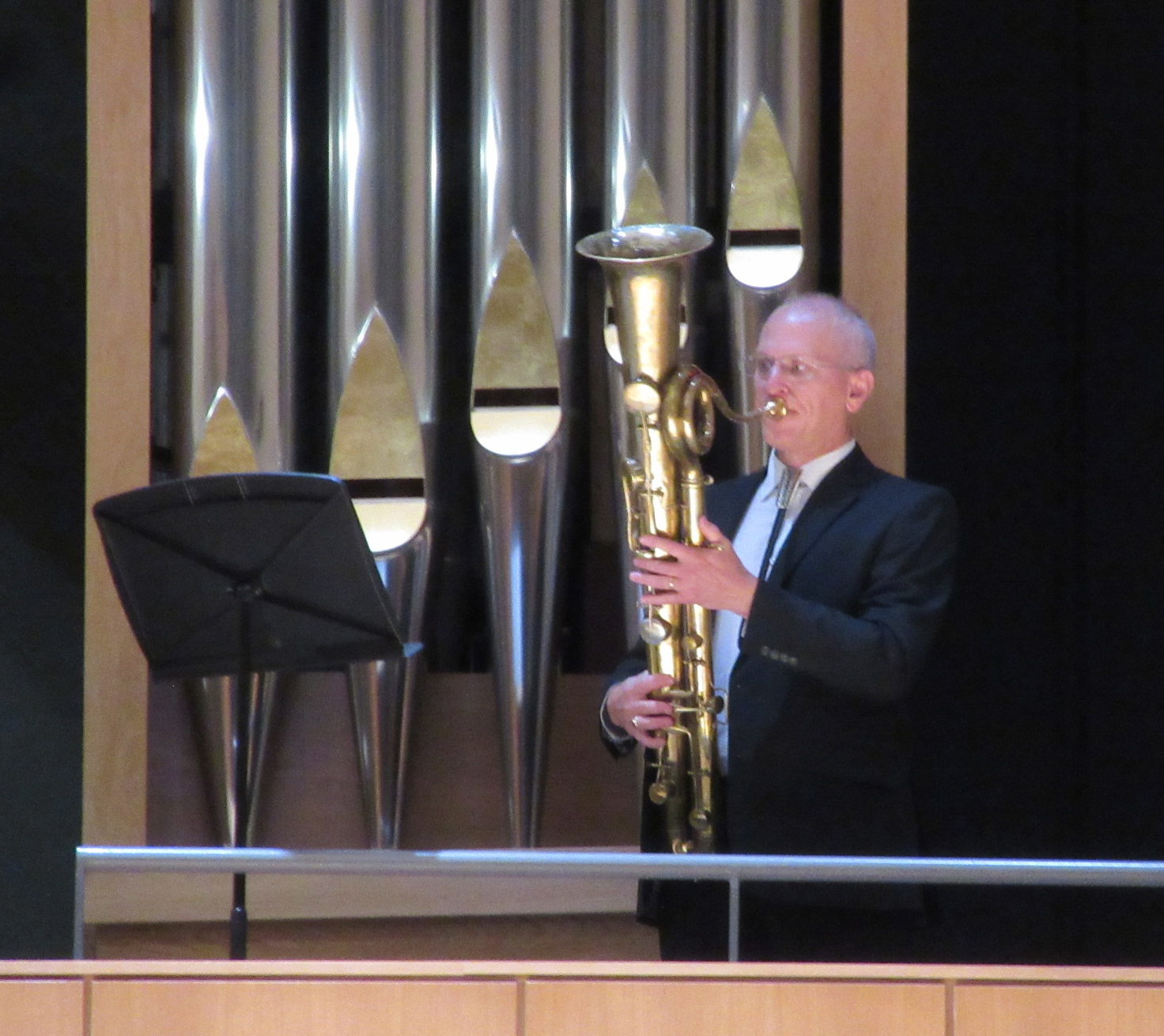
After playing the serpent I turned to the ophicleide, a brass, keyed successor to the serpent that was invented in France in the early nineteenth century. The ophicleide has a warm, mellow sound, and it’s no surprise that it remained on the scene—particularly in France and England—until the dawn of the twentieth century when the euphonium and tuba replaced it in most settings. Unfortunately the lighting in the Armerding Center for the Arts Concert Hall organ loft was rather dark so the video quality is not good enough to upload it to YouTube. A few photos are above. However, an audio recording was made and you can hear my performance of Sir Arthur Sullivan’s The Lost Chord on ophicleide with Tony Payne at the organ HERE.

The recital contained other music as well, and as I mentioned earlier, you can see and hear the entire recital on the Boxcast streaming video. Before the last piece (more on that below), I welcomed to the stage four friends from my time as a student at Wheaton College. From 1974–1976, James Roskam, Eric Carlson, William Meena, and I had a trombone quartet on campus. George Krem, Wheaton College’s trombone professor when the four of us first met in the summer of 1974, suggested that we form the quartet. That group was a very special one, and to have Jim, Eric, Bill, George, and me together for the first time in over 45 years—I invited them to be recognized on stage at the end of the recital and we enjoyed some time together afterward—was very special.

Wheaton_Trombone_Quartet_reunion_2022

left to right: Douglas Yeo, James Roskam, Eric Carlson, William Meena, and George Krem. April 23, 2022, Wheaton College, Illinois. Photo by Tony Payne.

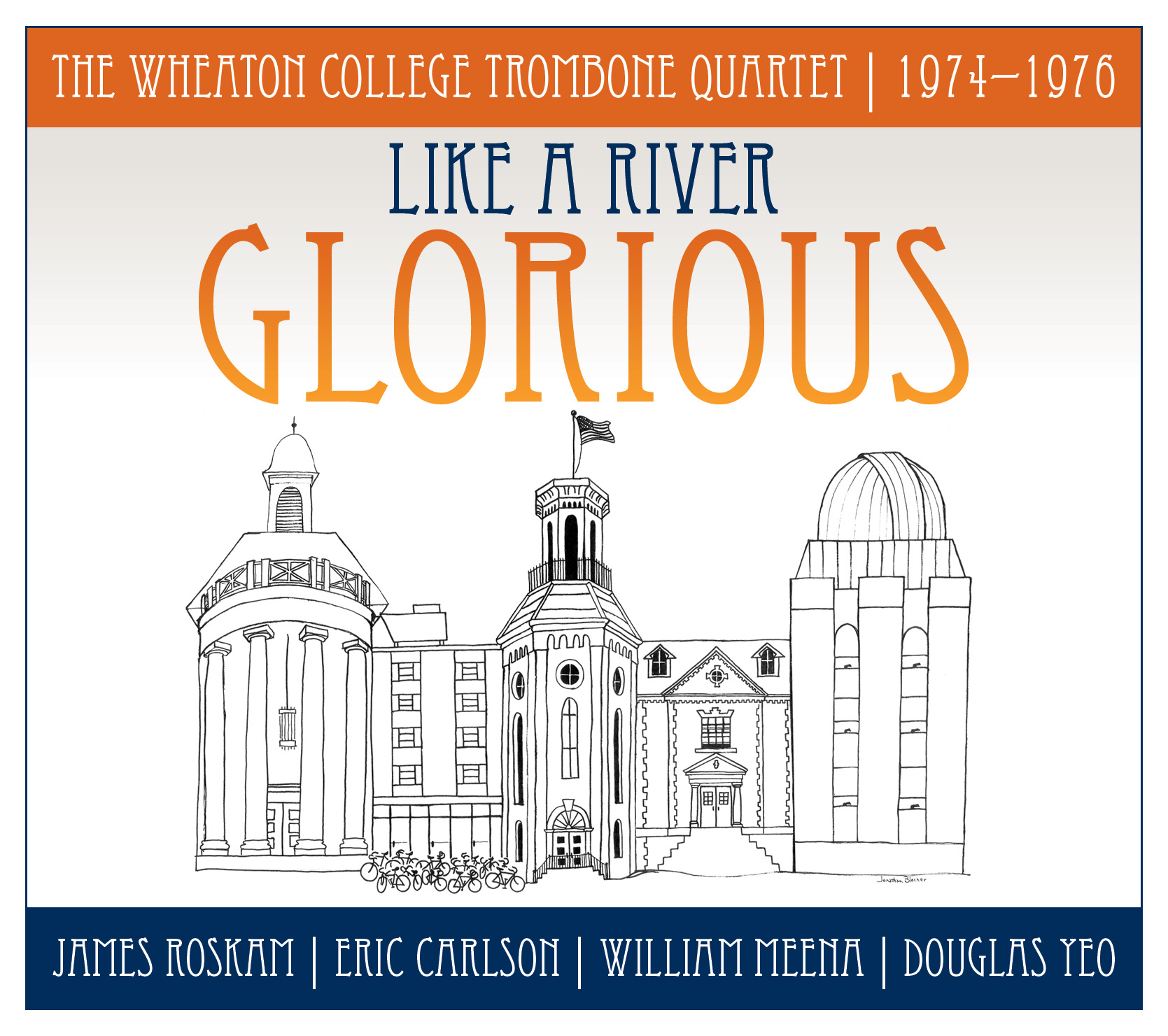
The recital also served as a kind of release party for a new trombone quartet compact disc recording, Like A River Glorious. Well, a new but also old recording. This CD, which features both live recordings and recordings from a recording session our quartet gave between 1974 and 1976, was produced by the four members of our quartet and our recording engineer, Craig Ediger (it is not produced by Wheaton College, although College administrators have been very supportive of and approve of the project). We made this CD to celebrate the spirit of student-led creativity that was such a part of our experience as students at Wheaton College and we are giving it away as a recruiting aid for the Wheaton College Conservatory of Music. You can’t buy it; we’re just giving it away. But we are reserving copies for prospective students; we don’t have the resources to distribute it widely by packing it up and mailing it to people. We will be getting the audio tracks available for free download soon—information about that will appear in a future article on The Last Trombone—along with the CD packaging. If you came to my recital, an usher put a copy of the CD in your hand as you left the Concert Hall. It is only 46 years overdue, but we finally made the recording we had hoped to make way back in 1976.

Wheaton_College_Trombone_Quartet_cover_Like_a_River_Glorious

Joseph Haydn, arr. Donald Miller: Achieved is the Glorious Work from The Creation

My recital ended with a piece that was the signature piece for our 1974–1976 Wheaton College Trombone Quartet, Donald Miller’s arrangement of Achieved is the Glorious Work from Joseph Haydn’s The Creation. I was joined on stage by three of my current students at Wheaton College: sophomore Michael Rocha, senior Daniel Casey, and Senior Jonah Brabant. It seemed fitting to close the recital in a way that came full circle for me, from my student days at Wheaton College to my time now as the College’s trombone professor. A Senior Recital.

Douglas_Yeo_recital_poster_April_2022_sm