Category: Boston Symphony Orchestra

Reformation: Luther, Mendelssohn, and the serpent

Reformation: Luther, Mendelssohn, and the serpent

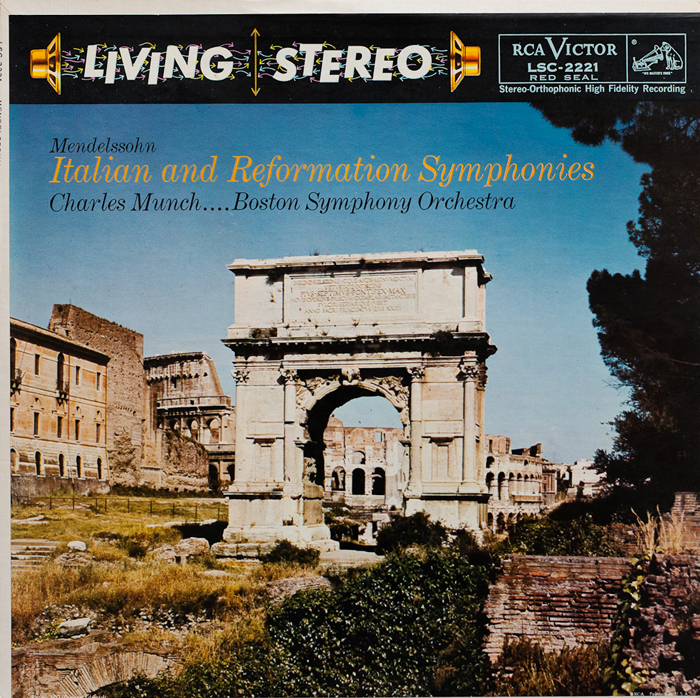
I don’t own many things that date from my childhood. I moved many times, collected other things, have lived a long life, and things that seemed so important when I was a kid mostly got lost along the way. I do wish I still had those baseball cards, though. . . But one of the few things I do have from that time in my life is a Boston Symphony recording of Mendelssohn’s “Reformation” Symphony, conducted by Charles Munch. I bought it in 1970 when I was 15 years old.
Mendelssohn_Reformation_Sym_BSO

[As an aside, this album cover shows the Arch of Titus in Rome, with the Colosseum in the background. During my wife’s and my recent trip to Italy, we stood in this very place, and noted the significant connection the Arch has with our trip last year to Israel. More on this in an upcoming article on The Last Trombone.]

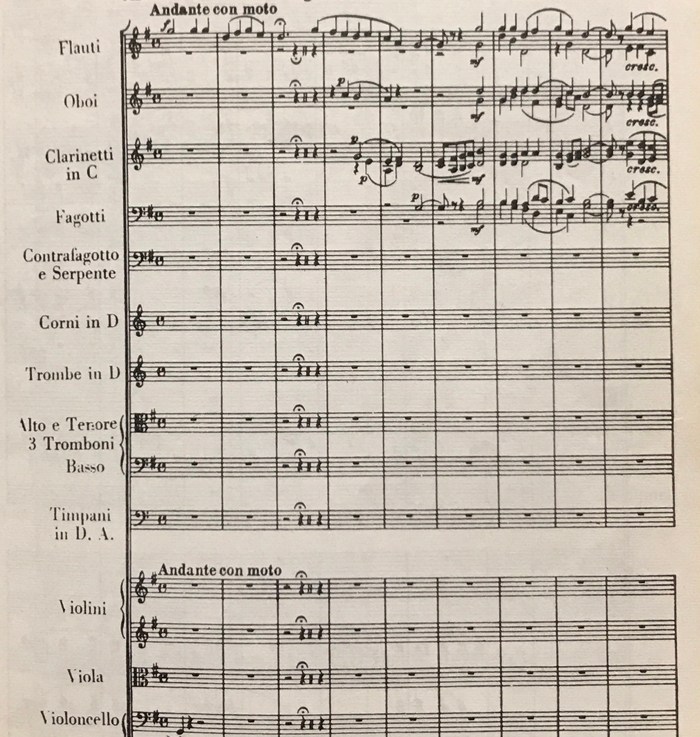
That I ended up being a member of the Boston Symphony for 27 years (1985-2012) is one of the great joys of my life, and in a sense that was the fulfillment of a long held dream since I was in high school. Several Boston Symphony recordings were very influential on me at an early age when I was just beginning to understand the trombone, and this Mendelssohn recording stands tall in my record collection. In fact, one of the first orchestra scores I ever purchased was of this symphony; I purchased it a few days after I heard Munch’s recording for the first time (the first page of the final movement of my score is shown at the top of this article).  Click below to hear that recording that influenced me so deeply so long ago (to hear this recording in YouTube, click here):

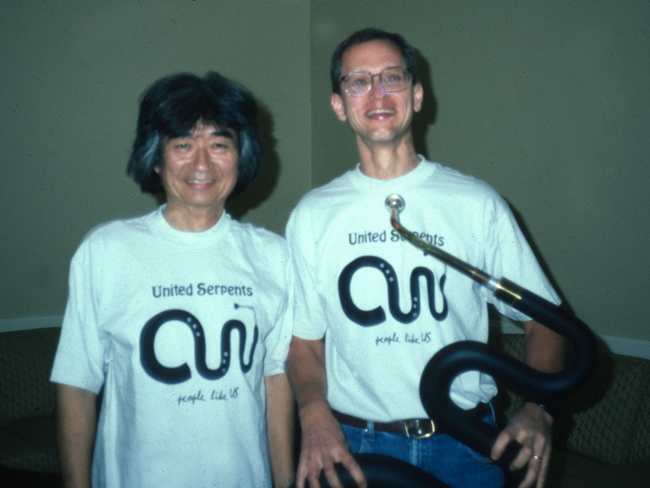
I have always loved this piece. It has a terrific part for bass trombone; just a few measures in the beginning of the symphony and then much to do in its finale. I first played the symphony on bass trombone with the BSO conducted by then-music director, Seiji Ozawa; the photo below shows Seiji and me in 1994 before a rehearsal for Hector Berlioz’s Messe solennelle; you’ll see I have my serpent in my handFor more on that, keep reading.

Ozawa_Yeo_serpent_1994_small

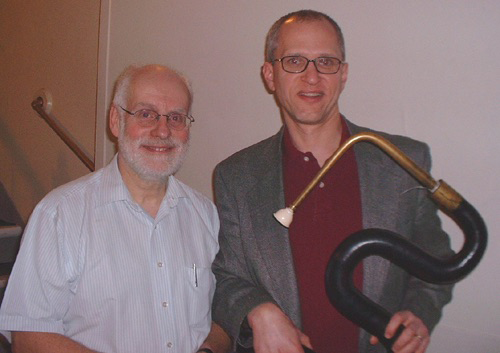
After I took up the serpent, I played the serpent part for Mendelssohn’s symphony in performances with the BSO conducted by the great early music conductor, Ton Koopman; the photo below shows us backstage at Boston’s Symphony Hall before a rehearsal in 2004.
koopman_yeo_02

Mendelssohn’s “Reformation” symphony – it usually bears the number 5 in the numbering of his symphonies but it was not his fifth in order of composition – was composed in 1830 to commemorate the 300th anniversary of the Augsburg Confession, one of the great confessional documents of the Christian faith. The theme of the symphony’s fourth movement is none other than Martin Luther’s famous hymn, Ein feste Burg est unser Gott — A Mighty Fortress is Our God. I wrote about this hymn last year on The Last Trombone, where I took the opportunity to discuss the importance of its text, especially the its fourth, final verse. I invite readers to look at that article again; click here.

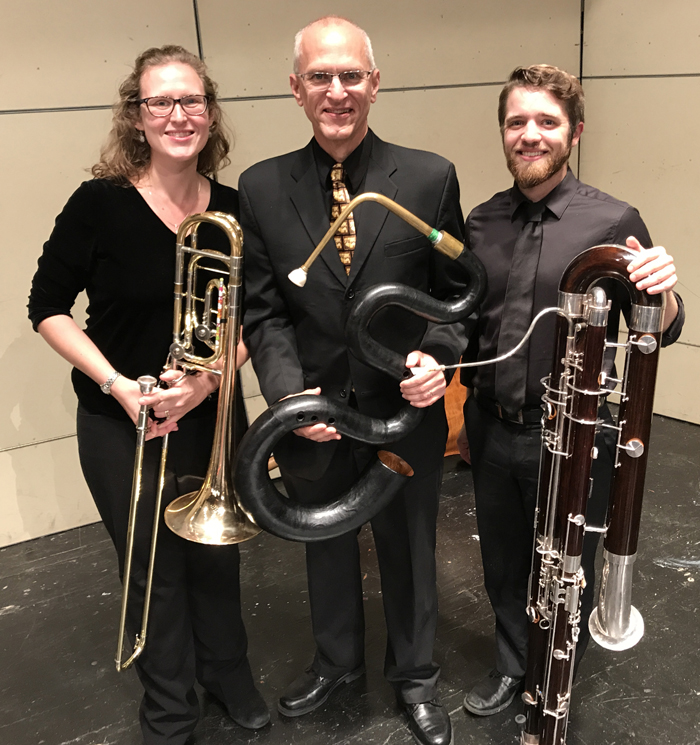
Last week, I played serpent in a performance of the “Reformation” Symphony by the Northbrook Symphony near Chicago. My oldest daughter, Linda Yeo Leonard, plays bass trombone in the Northbrook Symphony, and my wife and I have heard many concerts played by the orchestra. When the orchestra’s conductor, Lawrence Rapchak, asked me if I would be available to play serpent in their performance of Mendelssohn’s symphony – performed on a concert with other symphonies in the key of D but also in recognition of the 500th anniversary of the beginning of the Protestant Reformation – it was easy to say yes.
Northbrook_Sym_11_2017_small

The photo above shows Linda and me along with the Northbrook Symphony’s fine contrabassoon player, Nicholas Ritter; Nick and I sat next to each other on stage with Linda seated just behind me. Mendelssohn’s part for the serpent doubles the contrabassoon at the octave and the result is a new kind of bass sound, caused by the acoustical blending of the two instruments. Murray Campbell wrote an article several years ago about this unique sound in an article for the International Tuba Euphonium Association Journal; you can read it by clicking here. The performance was a great success in every way, and it was a special joy to sit on stage with Linda.

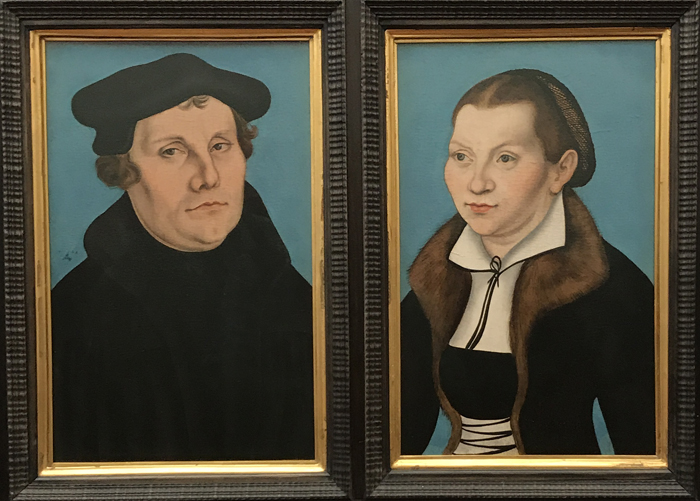
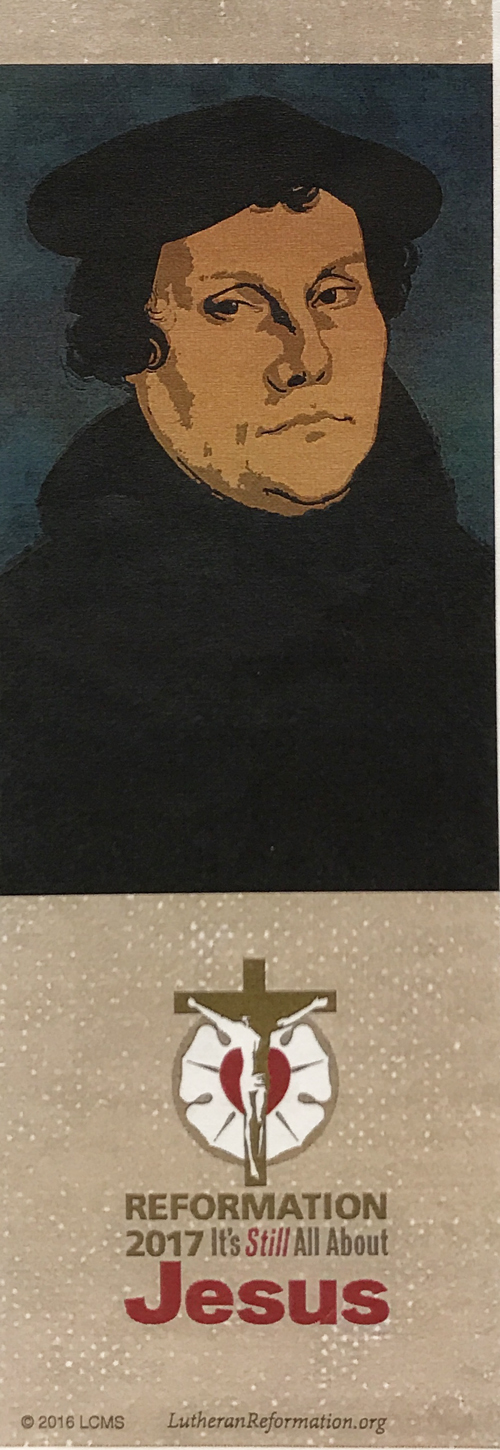
There have been other recent connections to Luther that have recently gotten my attention. As mentioned earlier, my wife and I were in Italy last month, enjoying the glories of Renaissance art and their connections to the Christian faith. Among the places we visited was the Ufizzi Gallery in Florence, one of the world’s great art museums. As we were going through various galleries, we came across a painting of Martin Luther and his wife, Katharina von Bora, painted by the workshop of Lukas Cranach the Elder in 1529. The portrait was made when Luther was still alive (1483-1546) and is considered to be a true likeness.
Luther_Uffizi

As I enjoyed this iconic painting – it is the most famous portrait of Luther – I noticed that the museum’s display card had a curious final sentence:

In Medici collection since 1567/1570.

Of course the Medici family was one of the most famous and influential families of the Italian Renaissance, and they were strong patrons of the arts. But this sentence got my attention. “Why,” I wondered, “did the Medici family, who were Roman Catholics and whose family produced three Popes (Leo X, Clement VII, and Leo XI), own this portrait of the most famous Protestant reformer?” I can’t answer that question, but I’ve been wondering about this.

Last Sunday, I worshiped at Trinity Lutheran (LCMS) Church in Lisle, Illinois, where Linda’s family are members and her husband, Chad, a Lutheran pastor and hospice chaplain, coordinates the church’s care ministries. This year, the Lutheran Church – and Protestant churches of all denominations – is celebrating this 500th anniversary of the beginning of the Protestant Reformation – dated to October 31, 1517 when Luther attached his famous Ninety-Five Theses on the door of All Saints’ Church in Wittenburg, Germany, and set off a reform movement in Christianity that is still with us. When I sat down in our pew on Sunday and opened my bulletin, what did I see but an insert about Luther and the Reformation with a stylized version of the very same portrait of Luther we had seen in Florence. It was a nice, serendipitous moment.
Luther_LCMS_image

The Protestant Reformation changed history, and this convergence of events – Mendelssohn’s symphony, our trip to Italy, seeing a famous portrait of Martin Luther in Florence, and worship in a Lutheran church – brought many aspects of its importance together for me.

When I was a student at Wheaton College (Illinois), I memorized Luther’s great hymn. It got me extra credit on an exam in the class, “Christ in Culture,” and I needed all the extra credit I could get. I don’t remember how I did on that test, but I still call A Mighty Fortress to mind every day. It is a hymn of great strength and comfort, and Luther’s words are just as relevant and important today as they were nearly 500 years ago when he wrote the text. Here is its second verse; to read the whole text and my commentary on Luther’s original words, click HERE.

Did we in our own strength confide, our striving would be losing,

Were not the right Man on our side, the Man of God’s own choosing.

Dost ask who that may be? Christ Jesus, it is he;

Lord Sabaoth his name, from age to age the same;

And he must win the battle.
 

The President and the trombone

The President and the trombone

by Douglas Yeo (September 26, 2016)

With today’s debate between US Presidential candidates Donald Trump and Hillary Clinton, we enter into an intense season of politics in the United States. It seems like the right time to remember a humorous incident that occurred several years ago regarding the President and the trombone

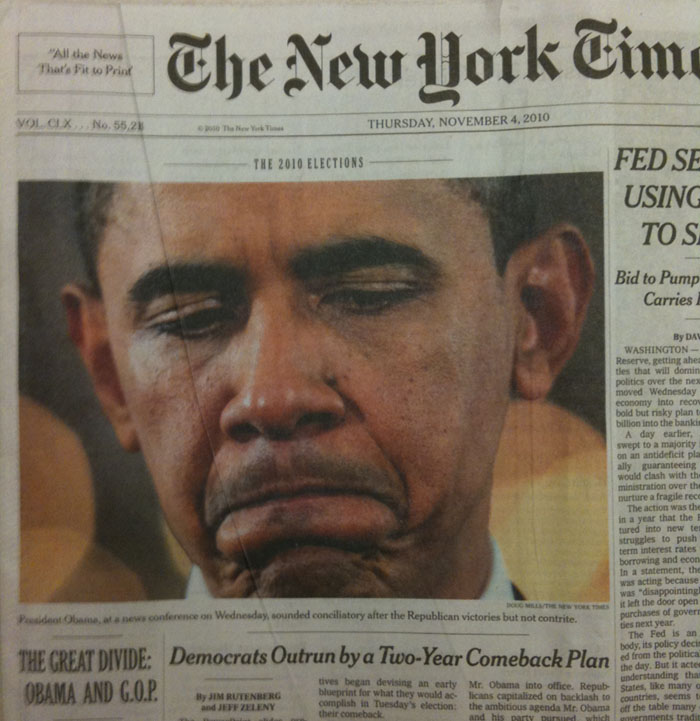
Things happen on the Internet and the Internet has a long memory. In 2010, after the mid-term elections, I was in my locker room in the basement of Boston’s Symphony Hall, preparing for the evening’s Boston Symphony concert. On the table was a copy of the day’s The New York Times, with a front page photo of President Obama:

obama_01

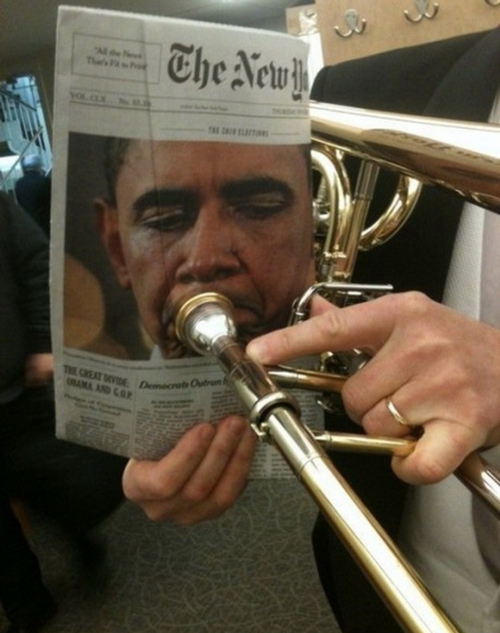
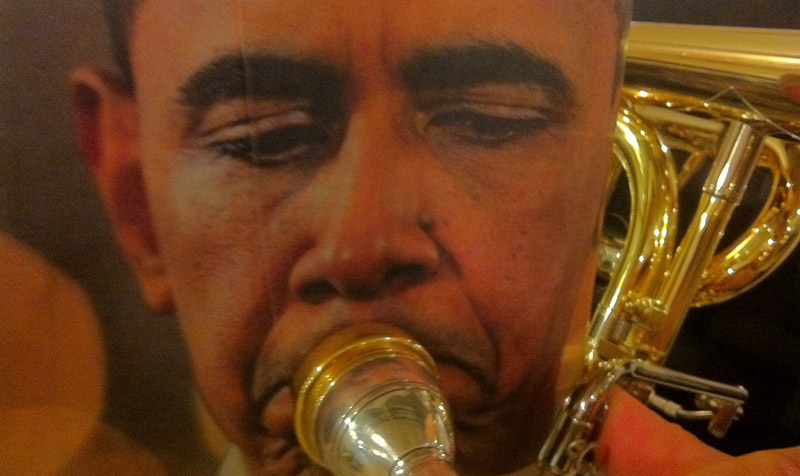
The President was wearing an unhappy face, but as I looked at the photo more closely, I saw some possibilities. I held up my Yamaha YBL-822 bass trombone to the photo and my Boston Symphony trumpet colleague, Michael Martin, snapped this photo, below. I was on to something…

obama_trombone_yeo

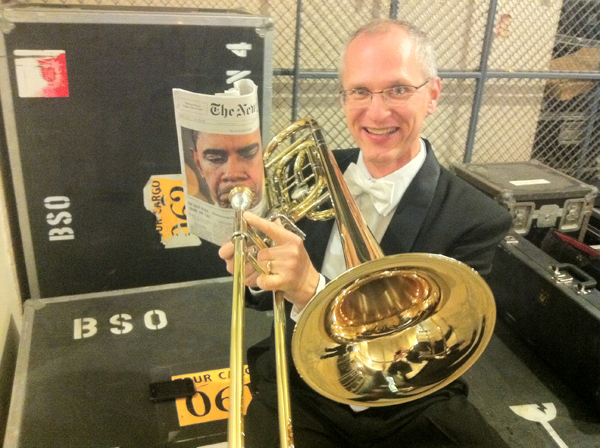
A few minutes later I walked down to an area in the Symphony Hall basement where I thought I could get a photo in better light. My Boston Symphony trombone colleague, Steve Lange, took this photo:

obama_trombone_yeo_02

After a little careful placement of the mouthpiece and folding of the newspaper, Steve snapped the photo that heads this post. I cropped it and a few minutes later,  I made a post to the Trombone Forum with the photo.  I was not prepared for what came next. The photo went viral, passed around on many websites and fora. It made the rounds on Facebook, on Reddit, Twitter, Buzzed, Pininterest, and email. Hardly a week has gone by in the last six years when someone hasn’t sent the photo to me, wondering if I’d ever seen it. The photo got named “Baraque Trombone” and “Trombama” and “Obamabone.” If you do a Google search on the words “Obama Trombone” and click “images” you will see these images over and over and over.

When I saw the photo in The New York Times, I thought, “Hmm, I think the President might have a pretty good trombone embouchure.” One thing led to another. And now you know the whole story. All in a little fun. You just don’t have to send the photo to me and ask if I’ve seen it before.

Waiting

Waiting

I’m an active person, always wanting to engage with projects, things and people that are around me. For many years, I didn’t particularly care for waiting. I don’t know many people who do. Waiting in traffic. Waiting for a movie to begin. Waiting on a line at the airport. Waiting for others to get ready to go out to dinner. Waiting often seems like a waste of time. But I don’t think so any more. As with may things, it all depends on how you look at it.

I took the photo above last month at Yellowstone National Park. I was struck by three people sitting on the boardwalk that surrounds Old Faithful geyser, one of the park’s iconic features. This remarkable geyser erupts to spectacular effect about every 90 minutes or so. Since it erupts with such regularity, great crowds come to see Old Faithful. The three people above came early. About an hour early. So they did not have to deal with this to find a good spot to watch (below):

crowd_yellowstone

This is the scene that is repeated many times each day. Several thousand – yes, thousand – people waiting for Old Faithful to erupt. The three people who got there an hour early certainly got a good seat. But they got more than that. They had some time without the crowds, time to think and consider what they had and what they were about to see. I have a feeling they felt the wait was very much worth it.

Musicians do a lot of waiting as well. Trombone players, in particular, spend a great deal of time sitting and waiting for things to happen. Consider Beethoven’s Symphony 9. Here’s the beginning of the first page of the bass trombone part, a part I played dozens and dozens of times as a member of the Boston Symphony Orchestra.

beethoven_9_snapshot

Look carefully. See where I played my first note of the piece? It’s in measure 414 of the second movement. I didn’t play a single note in the first movement (that movement has 547 measures). Then had to wait 414 measures (well, actually there were more than that if the conductor took the repeat) to play in the second movement. And my first note was a note that I had to get right – the other two trombone players don’t play there. By contrast, the first violin part requires eight pages of music to get to that same place in the music. So I had to do a lot of waiting before I played my first note of the Beethoven Symphony 9.

One thing I did NOT do was count rests. There are simply too many rests to count to be 100% sure you’ll count correctly. So I made it a point, for every piece I ever played, to study the full score and know and understand the piece so well that I did not need to rely on counting rests. I simply knew when it was time to play. When you count rests for hundreds of measures, you can’t do anything else; you have to concentrate to get the count right. That never interested me. (By the way, my colleagues will attest to the fact that I rarely came in wrong. I don’t say that as a point of pride but simply an acknowledgement of the fact that if you prepare thoroughly, you will not need to count every rest and can have confidence that you will come in correctly.) You’ll see why, below.

When I retired from the Boston Symphony, I received several meaningful gifts from the Orchestra and my colleagues. Several of them are hanging on the wall in my home studio.

yeo_wall

The centerpiece is a photo of the Boston Symphony and Tanglewood Festival Chorus performing Beethoven’s Symphony 9 in Symphony Hall, Boston during my last week of concerts; the photo was taken on May 3, 2012 and the performance was conducted by Bernard Haitink. The photo is beautifully framed and matted and my colleagues in the Orchestra signed the matte. It is an exceptionally meaningful artifact of my career. But if you look closely, you will see the orchestra playing – every member in full throat – except the three trombone players. Toby Oft, Steve Lange and I are seen doing what we did for so much time: we were sitting with our hands folded, trombones at the ready but they are silent.

bso_waiting

I haven’t done a calculation, but my guess is I have spent years of my life waiting, and much of that time was done at orchestra rehearsals and concerts. Since waiting is unavoidable, the question arises: What are you going to do while you’re waiting? You could just sit there and be bored, unhappy that you’re not DOING something. But I learned that there are a lot of things you can do while you’re waiting to play. You may come up with a different list but I think the important thing is that you HAVE a list of things that you can do to redeem the time that you spend waiting. Here are some things that I do while waiting to play.

  • Listen. I always felt like I had the best seat in Symphony Hall. I could hear every note that was played with great clarity. Sometimes I would simply listen to the great orchestra around me and enjoy it like I was attending a concert.
  • Pay attention. My students will tell you that the words “pay attention” are a theme of my teaching. So often we experience things and so much goes by without our even noticing. Sometimes I would choose a particular colleague and pay attention to what he or she was doing. While it’s true that Edward Kleinhammer and Keith Brown were my trombone teachers in college, if asked who my teachers were, I rattle off a list of dozens of names – and most of them were not trombone players. They were my colleagues in the Boston Symphony who taught me so much when I took the time to intentionally pay attention to what they were doing. I am a much better trombone player because I paid attention to string, woodwind, percussion and other brass players exercise their craft. Likewise, I learned a great deal from observing soloists and conductors. Too many trombone players are only interested in the trombone parts. Pay attention to others and you will experience tremendous growth as a musician.
  • Watch the audience. People go to concerts to hear and see an orchestra. But it’s also true that those on stage are aware of the audience. Over my nearly 30 years in the Boston Symphony, I got to know many audience members. Some I met personally; others I observed only from a distance. I recall one woman who came to concerts with her husband when I first joined the Boston Symphony. As the years went on, she began to come to some concerts with her daughter. Years later, she came with her granddaughter. And in my final years in the orchestra, she came again with her husband. It was a touching thing to see each Thursday night. It taught me something about inter-generational relationships and the love a family shares.
  • Analyze the music. When I prepare to play any piece, I study the score to understand it better. This is not just so I wouldn’t have to count lengthy numbers of rests. It is so I can enjoy and appreciate the music on a new level. I would always read the program notes written by the Boston Symphony’s expert scholars and writers and I often would read a book about the piece we were playing. With that background, I often sat during concerts and analyzed the composer’s work, seeing how themes weaved in and out, doing harmonic and rhythmic analysis. I felt that every concert was a music history lesson. I learned so much.
  • Pray. Prayer is not a singular event that I do at a particular time of day. The worship of God is something that I do all day long, all the time. The title of a book by my music-spiritual mentor, Harold M. Best, says it well: Unceasing Worship. When I had long movements where I didn’t play, I would often pray. Pray for family and friends, pray for our country and its leaders, pray for wisdom and understanding, and much more. Surrounded by God’s great gift of music, prayer flows naturally.

Waiting is an exercise; patience can only be learned while in a situation that makes you tend to be impatient. But waiting can be a great blessing, even a thrill, if you look at it as an opportunity to to do more than simply sit with your hands folded in your lap.

The Olympic Games

The Olympic Games

The games of the XXXI Olympiad get underway today with the opening ceremony in Rio de Janeiro, Brazil.  As a young boy, I was thrilled by the games – the spectacle, the competition, and as ABC television aptly put it, “the thrill of victory and the agony of defeat.” In recent years the Olympics have suffered a bit with world-wide scandals involving the use of performance enhancing drugs. But, still, there is something about the big stage of the Olympics, the celebration of success and what one hopes is a healthy kind of nationalism as we are proud of our country being represented by excellent athletes.

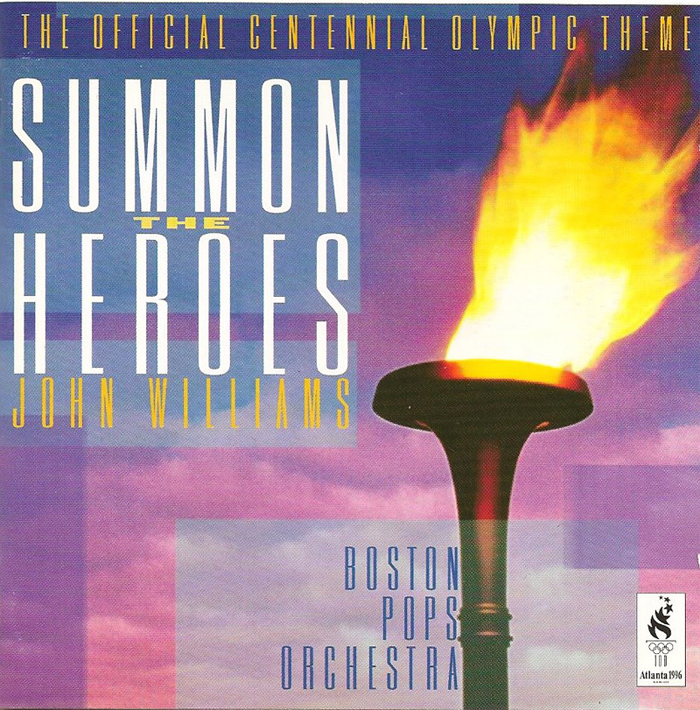
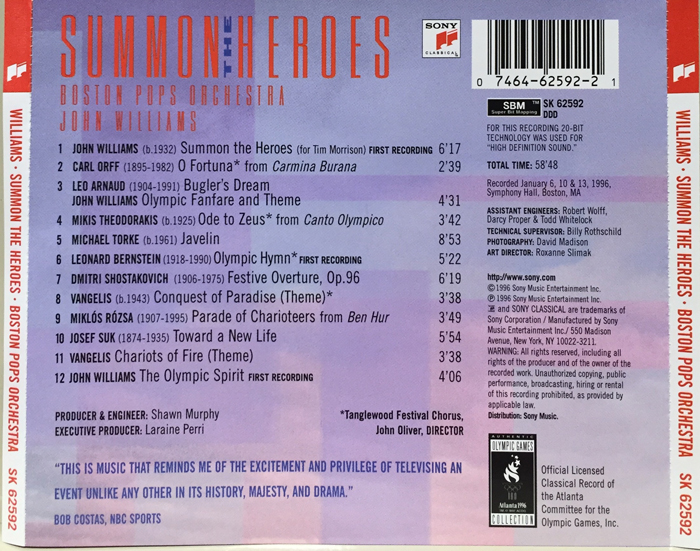
I’ve never been to an Olympic event but I got close. Musically. In 1996, the Olympics were held in Atlanta, Georgia, USA. As a member of the Boston Symphony Orchestra at the time – and membership in the BSO brought with it membership in the Boston Pops Orchestra – I played on the official soundtrack album of the Atlanta 1996 Olympic games, “Summon the Heroes.” Conducted by John Williams, the Boston Pops Orchestra had recording sessions on January  6, 10 and 13, 1996 of a playlist that included well known Olympic game themes (by John Williams) and other heroic, brass-centric, noble works that are often associated with the Olympics. Here is the tray card with the full track list:

Summon_Heroes_playlistThe recording sessions came in the midst of a grueling week of Boston Symphony Orchestra rehearsals and concerts that included Richard Strauss “Eine Alpensinfonie” and we brass players were stretched to our limits. Still, it remains a memorable moment in time for me, my closest personal association with the Olympic games, and “Summon the Heroes” remains one of my favorite recordings from my nearly three decades as a member of the Boston Symphony/Boston Pops Orchestra. “Summon the Heroes” is still available, as a CD or mp3 download.   And you can see a performance of that great fanfare with John Williams conducting the Boston Pops Orchestra on the YouTUBE link, below. The low brass section consists of Norman Bolter, Darren Acosta, Phil Swanson and myself on trombone, Chester Schmitz on tuba, and trumpets Tim Morrison, Tom Rolfs, Peter Chapman and Bruce Hall.  There are offstage trumpets and trombones as well. Enjoy. To our Olympians: Citius – Altius – Fortius – the motto of the modern Olympic games, swifter – higher – stronger.