
Category: books and articles

A new book and a special offer: Homer Rodeheaver and the Rise of the Gospel Music Industry

A new book and a special offer: Homer Rodeheaver and the Rise of the Gospel Music Industry

In January 2014, I decided to write an article about Homer Rodeheaver, the trombone-playing song leader for evangelist William “Billy” Sunday in the first third of the twentieth century. I first learned of Rodeheaver a few years earlier when I visited the Billy Graham Museum on the campus of Wheaton College, Illinois, and saw a near life-size cardboard cutout of him with a trombone in one hand and a songbook in the other. The cutout was of the image of Rodeheaver below. What? Who was this? I had never heard of him and I needed to know more. It wasn’t long before I learned that Rodeheaver (one of the first things I learned was that he pronounced his name “ROW-duh-hay-vehr”) played the trombone for over 100 million people in his lifetime. That’s a lot of people. Did anyone play  trombone for more people? Maybe Arthur Pryor? Maybe? I thought his story might be interesting. It didn’t take long for Rodeheaver’s interesting story to change my life.

Fig 02-5 rodeheaver-trombone-postcard

Above: Homer Rodeheaver promotional postcard.

Several things flowed from what became an obsession to learn more about Homer Rodeheaver. The first was that I met Kevin Mungons, a Chicago-area editor and writer who had also been researching Rodeheaver. We were introduced by Margaret Banks, a curator at the National Music Museum in Vermillion, South Dakota, when I reached out to her with some questions about Rodeheaver’s endorsements for Conn trombones. Peggy told me that Kevin had been asking her some of the same questions a few years earlier. So it was natural for me to contact him and ask him some questions. We immediately became good friends (it didn’t hurt that Kevin also plays trombone).

Secondly, Kevin was very happy to help me as I worked on my article about Rodeheaver which, once completed, was published in the 2015 Historic Brass Society Journal. Click HERE to read and download that article.

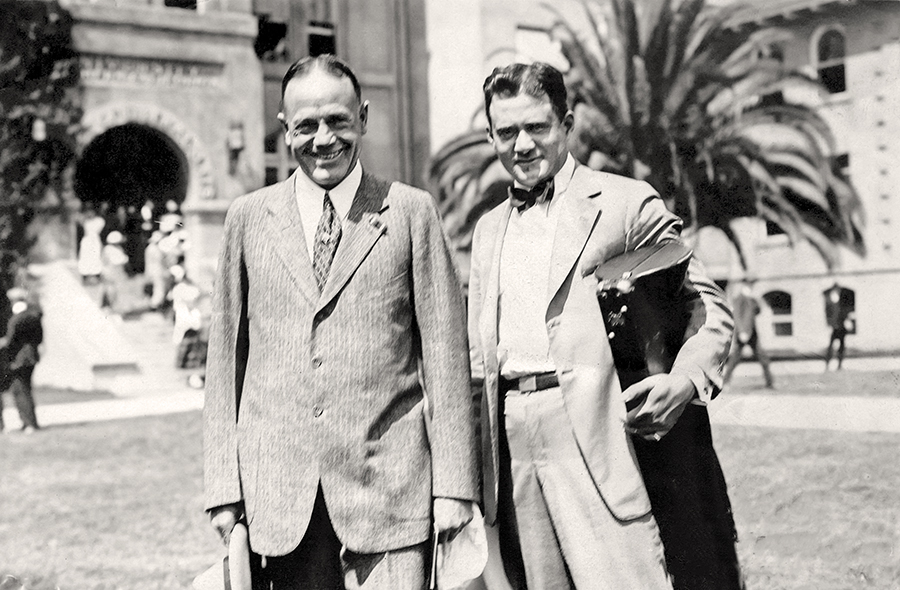
Fig 01-1 rodeheaver-and-sunday

Above: Billy Sunday and Homer Rodeheaver, 1917. Courtesy of Morgan Library, Grace College, Winona Lake, Indiana.
And, thirdly, as Kevin and I continued talking about Rodeheaver, we decided that two heads were better than one, and that it might be a good idea—and fun—for us to collaborate and, together, write a book about Rodeheaver. Once we had committed to the idea, we did a deep dive into Rodeheaver’s life and work. Because Kevin was living in the Chicago area and I was living in Arizona at the time (my wife and I moved to the Chicago area in 2018 so we could live closer to our grandchildren), we collaborated mostly through phone and email. But we did meet up a few times, both in the Billy Graham Center Archives at Wheaton College, and in Winona Lake Indiana, where Grace College and the Winona History Center have a remarkable archive of documents, photographs, and ephemera relating to Billy Sunday and Homer Rodeheaver. During our research trip to Winona Lake, I played Rodeheaver’s Conn trombone (below). Of course, I played “Brighten the Corner Where You Are,” which was one of Rodeheaver’s signature tunes (he also owned the copyright to the song, and the big money was, as Rodeheaver knew, in copyrights).
Douglas_Yeo_Rodeheaver_trombone_2014_sm

Above: Douglas Yeo playing Homer Rodeheaver’s Conn trombone, 2014, Winona History Center, Winona Lake, Indiana.

Homer Rodeheaver was not only a trombonist, and not only the song leader for Billy Sunday for 20 years, but he established the first gospel music record label (Rainbow Records), established what was, for many decades, the largest publisher of Christian hymnals, songbooks, and other music (Rodeheaver Music Co., later Rodeheaver-Hall Mack Co.), was a driving force behind the popularization of African American spirituals, and had an influence on church and community singing that is still felt today. The subject of daily front page news and feature stories and celebrity gossip, nobody during his lifetime (1880–1955) had to ask, “Who is Homer Rodeheaver?” But for people today, Homer Rodeheaver is the most famous person you never heard of. Until now. 

Rodeheaver 3D Book Cover

Last week, after seven years of writing and research (not including the many years before we met when Kevin was also researching Rodeheaver), the submission of our book manuscript to University of Illinois Press, several rounds of peer review, even more rounds of rewriting and editing, our book, Homer Rodeheaver and the Rise of the Gospel Music Industry came to market. It is published as part of UIP’s Music in American Life series of books. On Saturday, I held it in my hands for the first time.

Rodeheaver’s story is a rich story about music, publishing, Chicago, the Civil War, Jim Crow, race, the Ku Klux Klan, the perks and perils of being a celebrity, churches, money, religious devotion, Christian evangelism, community singing, marketing, airplanes, speedboats, philanthropy, Billy Graham and Cliff Barrows and George Beverly Shea, and the trombone. Lots of trombones. And that’s just the tip of Rodeheaver’s very large iceberg. 

The back cover of the book features two reviews. Here’s what Robert Marovich, author of A City Called Heaven: Chicago and the Birth of Gospel Music, says:

Kevin Mungons and Douglas Yeo’s biography of Homer Rodeheaver brightens an important corner of gospel music history that has gone unexplored for far too long. What they reveal in their remarkable portrait of “Reverend Trombone” is a man both of his time and ahead of his time. It’s more than a tale of the emergence of gospel singing and revivalism, it’s a quintessentially American story about a quintessential American.

And Harold Best, emeritus professor of music and Dean emeritus of Wheaton College Conservatory of Music, past president of the National Association of Schools of Music, and author of Music Through the Eyes of Faith, wrote:

I am truly taken by the book. It is good, informative, comprehensive, and free of the usual assortment of clichés, academic hems and haws, and over-spiritualization. It takes the often over-simplified view of music and revivalism and exposes it to a fascinating cross-weave of thought, content, and context which, to my embarrassment, I thought I had already had a handle on. I recommend it without reservation. There is no doubt in my mind that general readers and specialists alike will benefit from reading this book.

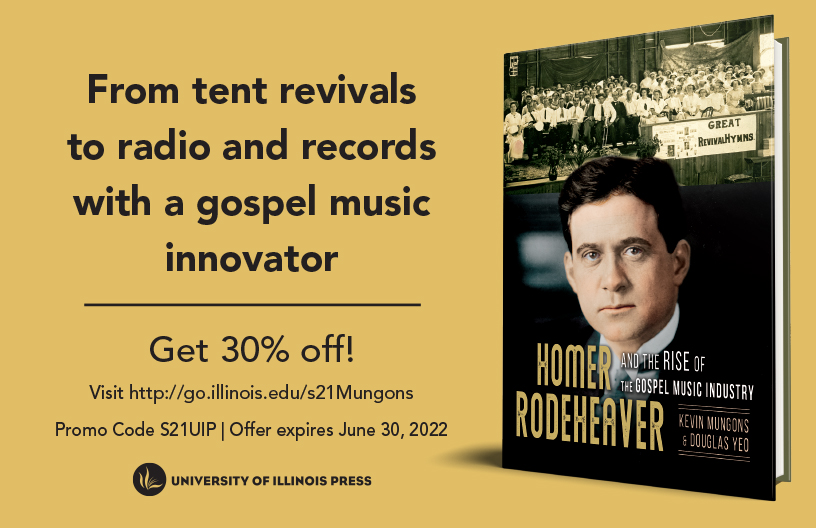
If what you’ve read so far piques your interest, then, as the late night television pitchman says, “Do I have a deal for you!” Right now, University of Illinois Press is offering a 30% discount on the book, both the softcover and the hardcover editions. If course, you can pay full price if you’d like; just go to the book’s page on amazon.com. But if you’d be interested in paying less, click HERE go to the book’s page on the University of Illinois Press website and enter this promo code:

S21UIP

Mungons Yeo social media graphic with discount

If you’d like to tell your friends about the book, click HERE to view and download a one page promotional PDF that has full information about the book and the same 30% off discount code.

After seven years of delving into every aspect of Homer Rodeheaver’s life, I still find his story to be interesting, informative, inspirational, challenging, and thought-provoking. I hope you, too, will enjoy the story of the man who called himself, “Reverend Trombone.”

Fig 11-1 rodeheaver-conducting

Above: Homer Rodeheaver leading singing, 1950s.

Reflections on a year: COVID-19 and more

Reflections on a year: COVID-19 and more

The coronavirus pandemic has upended everything. Everything. Everyone has a story. It is true that “we are all in this together”—it effects everyone. But it is not true that “we are all in the same boat.” Some boats are doing better than others. Some are sinking. Some have sunk. The virus is real and it’s bad. In the words of a good friend of mine who is a Dean at a major medical school and research hospital in New York City, “this virus is scary and sneaky.” Yes, it is.

Global_COVID_cases_2021_02_04

The COVID-19 dashboard at Johns Hopkins University, Baltimore, February 4, 2021.

We in our extended family consider ourselves very fortunate: none of us has contracted COVID-19. We are all exceptionally cautious. We wear masks and take other protective measures. But over the last couple of weeks, I’ve received email messages from a number of friends who have noticed that I haven’t posted anything on The Last Trombone since October. “Are you OK?”, they’ve asked.  I appreciate the concern, and it’s a reminder how we all are on edge, uncertain what lack of contact with someone might mean. I’m well—thank you for asking!—but as I have been reflecting on a number of things, I find it remarkable that in a season of life where I have done almost no traveling and I have been at home since mid-March, 2020, I am so busy in so many ways.

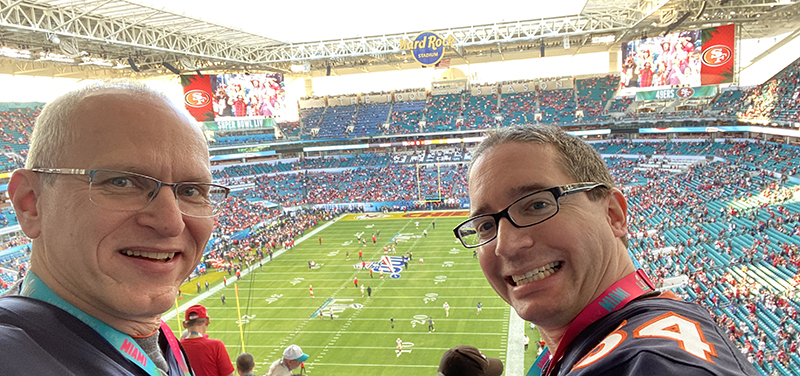
Doug_Chad_Super_Bowl_LIV_sm

It has been nearly a year since the coronavirus has been part of our every day vocabulary. On February 2, 2020, my son-in-law, Chad, and I went to Super Bowl LIV in Miami. I won a contest sponsored by the Chicago Bears (you can read about how I won the contest HERE and our experience at Super Bowl LIV HERE) and we had an amazing trip. Chad and I were in the midst of 65,000 other fans. We gave high-fives and hugs to total strangers, stood in crowed lines for food and to use the rest room, we screamed our lungs out during the game, we flew on planes, traveled on buses, and we did this without even thinking. We didn’t know that in a few weeks, that would all change.

Doug_Megumi_edited_01_sm

Megumi Kanda and Douglas Yeo in recital in St. Louis, February 16, 2020.

A few days  later, I was in St. Louis, playing a recital and giving a masterclass along with my good friend, Megumi Kanda who is principal trombonist of the Milwaukee Symphony.  The recital was sponsored by the St. Louis Low Brass Collective. In addition to my trombone activities, I went up the St. Louis Arch in a small elevator that seated seven people, all jammed in like sardines. I didn’t even think twice about doing it.

St_Louis_Arch_elevator

The elevators at the St. Louis Arch, February 15, 2020.

Coronavirus? It was “one of those viruses” we hear about from time to time that affected people in lands far away. It had no impact on us. Yet.

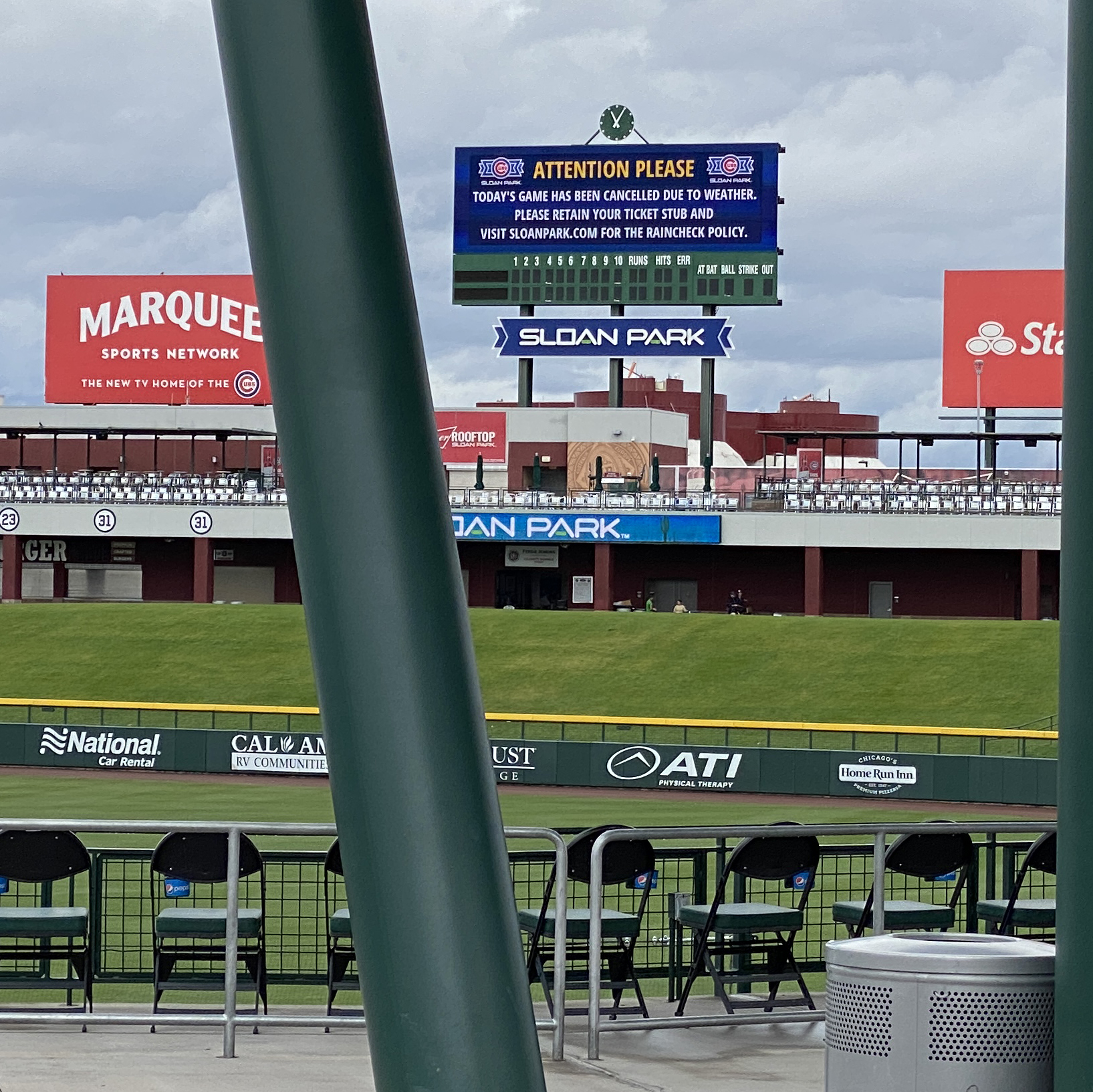
Sloan_Park_2020_03_12

Sloan Park, spring training home of the Chicago Cubs. March 12, 2012.

Then in March, we went to Arizona for a week. Our plan was to go to some Chicago Cubs spring training games, do some hiking, enjoy restaurants, and all of the nice things you do on vacation. On March 12, we arrived at the Cubs spring training facility, Sloan Park, ready to watch a game. We found that the gates were locked and the scoreboard said that the game had been cancelled due to weather. But it wasn’t raining, and the forecast was for sun as the clouds were moving away. Nobody at the ballpark gave us more information. We went to have lunch at Portillos to assuage our disappointment and then went hiking. When we got back to our rented house, we heard that all Major League Baseball games had been cancelled. Coronavirus became real.

Wheaton_College_COVID_dashboard

Wheaton College’s COVID-19 dashboard, February 5, 2021. Students start returning to campus tomorrow for the spring semester under strict virus mitigation protocols. The entire student body will be tested for COVID-19 when students arrive on campus this weekend and they will all be tested regularly throughout the semester.

Later that day, I received an email from the President of Wheaton College. I am Wheaton College’s trombone professor and I was anticipating getting back to teaching when we got home from our spring break vacation. But our President said that spring break was being extended for another week and that all faculty needed to get prepared for several days of training: Wheaton College was going to a combination of remote and greatly modified in-person learning. Everything was changing.

Event_Cancelled

We all know the kinds of things that happened after that. No in-person concerts or theater performances, restaurants and movie theaters were closed, church doors were shuttered, life moved from personal engagement to a computer screen. We all learned that Zoom was not just a word little kids say when they’re pretending to pilot a rocket ship to Mars. Trombone lessons with Zoom and Cleanfeed. Recitals without an audience. Symphony orchestras making mashed up videos with players recording in their living rooms. Cancel. Cancel. Cancel. Masks. Social distancing. Hand sanitizer. Wash your hands. Wash your hands again. CAN’T TOUCH THIS!

So, here we are, nearly a year later. Nobody saw this coming, nobody imagined it would last this long. But we are starting to see hopeful signs for deliverance from the pandemic. Vaccines are now being distributed. I had my first jab of the Moderna vaccine yesterday morning—it was a truly joyful, emotional experience, the fruition of something I had been praying for over many months. We continue to pray that the rest of our family will receive the vaccine soon. So much will change for the better when that happens.

Moderna_COVID_vaccine

The first dose of the Moderna COVID-19 vaccine I received yesterday, February 4, 2021, at Central DuPage Hospital.

We are hopeful that with continued vigilance in following guidance on protective measures (wear your mask—keep apart from others—wash your hands—get the vaccine), we will slowly come out of this long tunnel. And when we do, and when we go to the first sporting event, the first church service, the first concert, play, or musical, the first restaurant after not doing those things for over a year, we will have a new sense of appreciation for all of those things that we always seemed to take for granted. That is one of the important lessons we have learned over these long months.

Still, the pandemic has provided us with opportunities to do other things. Like everyone else, I had to cancel a host of performing and teaching trips over the last year. Soloing at a brass band festival in Seattle. Cancelled. Playing with the Finnish National Radio Orchestra in concerts in Finland and Japan. Cancelled. Teaching at Gene Pokorny’s low brass seminar, at Interlochen Arts Academy, at the Wheaton College summer music camp, at the Csehy summer school of music. All cancelled. Planned vacations to Glacier National Park, Zion National Park, to Arizona. All cancelled. You’ve had things cancelled, too.

But we’ve spent more time with our grandkids, took more walks in forest preserves when the weather was good, and we go sledding down a four foot high berm next to our home (we don’t do “mountains” here in the Chicago area)—the most exhilarating five second ride on a sled that our grandkids have ever had. And in the midst of the storm, and without traveling regularly, that’s freed up time to do a lot of other things. No, I would not have chosen to be at home day after day. But that’s what we have. So I’ve been busy. Here’s some of what I’ve been doing lately.

Yeo_Kanda_ITA_article_sm

  • I wrote an article about my friend, Megumi Kanda, for the International Trombone Association Journal. that published in January of this year. Megumi was the 2020 recipient of the ITA’s highest honor, the ITA Award. Click HERE to read the article.

Yeo_teaching_workstation

Part of my teaching workstation at my home.

  • I’ve continued teaching my students at Wheaton College each week, both weekly lessons and trombone studio class. And, last semester, trombone literature class. Due to the pandemic, all wind, brass, and voice lessons are done online. I set up a new work station in our basement where I do all of my online remotely. We all know the limitations of Zoom and Cleanfeed, but we’re grateful that the technology allows us to continue to work together and make good progress. We all look forward to the day when we can sit side by side and play duets together once again. Everything just takes so much more time when it’s done virtually. For instance: If a student has a noisy F-attachment valve linkage, at an ordinary in-person lesson, I can say, “OK, hand me your horn,” and in a few minutes, I can usually solve the problem. But now, I have to hold my trombone up to the camera and try to help the student run through a number of diagnostic steps so I can identify the problem. “OK, put your thumb on top of the ball joint—no, the ball joint, not the stop rod arm—then with the other hand, move the F-attachment paddle. Where is that clicking sound coming from? No, I don’t think it’s from THERE— I see the movement in the linkage THERE. . .” And so on. But I salute my students who are dealing with so much as they are in school, both remotely and on campus with very strict virus mitigation protocols. Wear your mask and get the vaccine. Help students and teachers everywhere return to 100% in-person learning as soon as possible.

TromboneFamilyFillmore_Ed

Advertisement for Henry Fillmore’s The Trombone Family, c. 1920.

  • In June, I wrote two articles about Henry Fillmore’s iconic collection of trombone ragtime pieces, The Trombone Family, which includes Lassus Trombone. You can read those articles HERE and HERE. To say the articles aroused a lot of interest is a profound understatement. In the first two days after posting my articles, over 100,000 people read them on The Last Trombone. A vigorous discussion about music, race, and racism ensued. Since then, I’ve answered hundreds of emails from people who have written to  me about the subject, my articles have been reprinted in several journals and newsletters, and I have been asked to speak about the subject before several groups. This engagement continues, and a day doesn’t go by when I am not engaging with people about this important issue. This takes a lot of time. A LOT of time. But it matters.

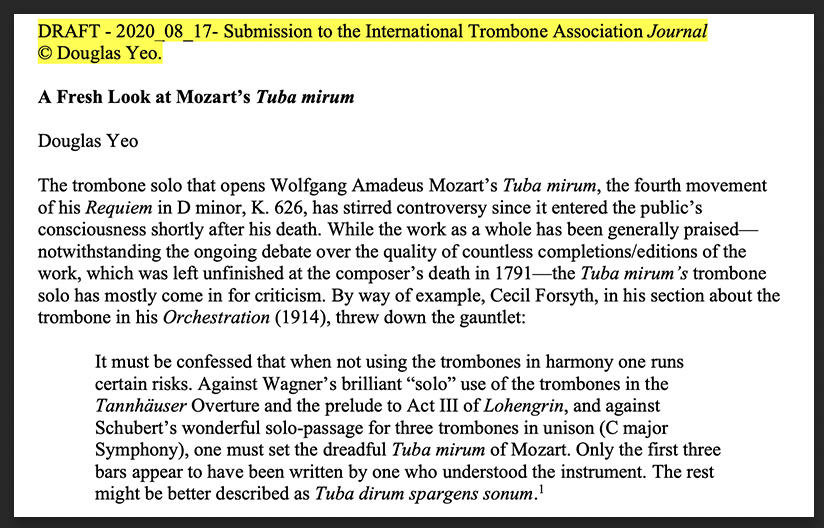
Yeo_draft_Tuba_mirum_article_incipit

  • I wrote a long article about the Mozart Requiem Tuba mirum that will be published in the International Trombone Association Journal sometime next year.

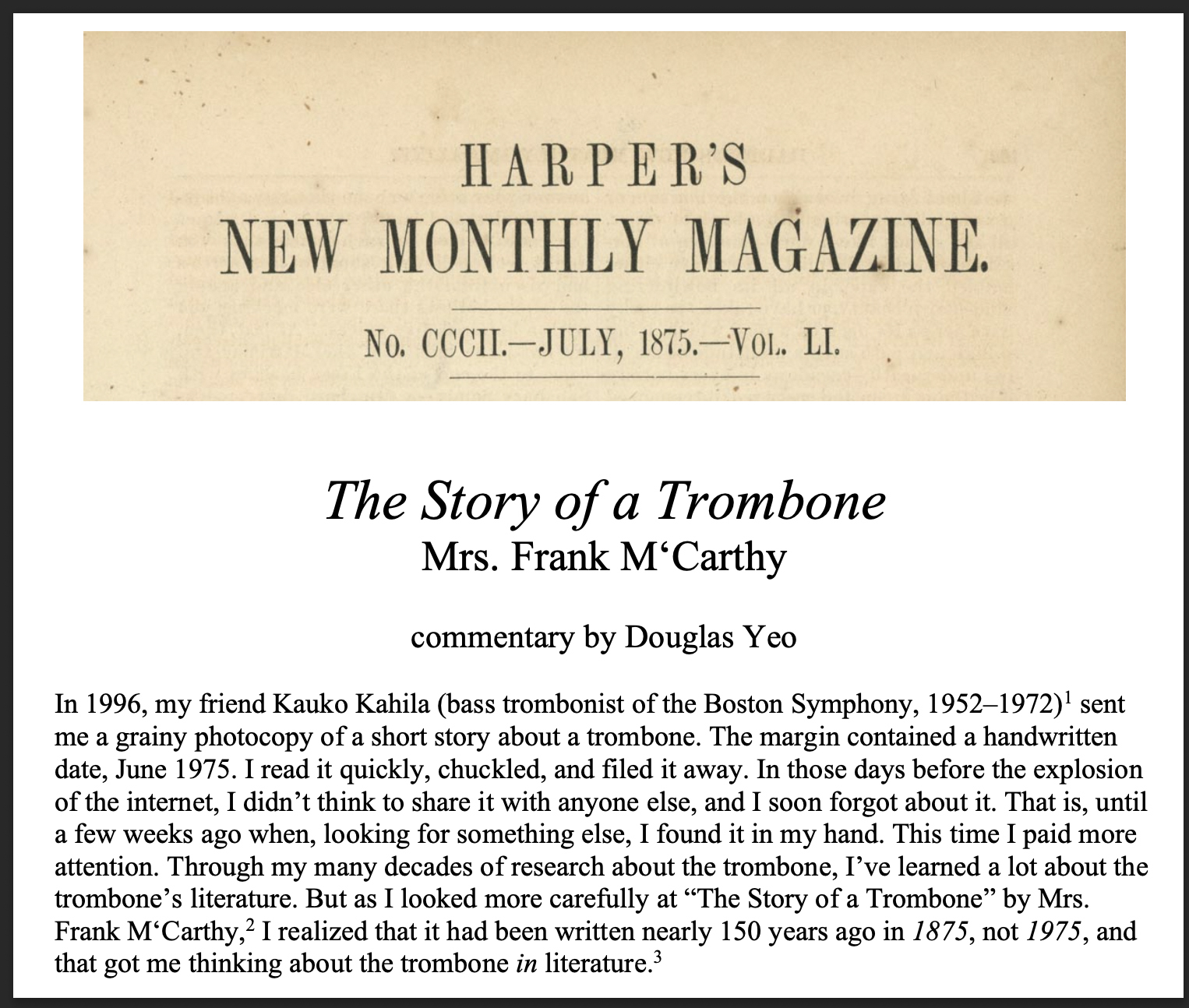
Yeo_Story_of_Trombone_article_incipit

  • I wrote a commentary and glossary to accompany the republication (in the International Trombone Association Journal) of a short story, The Story of A Trombone, that was first published in Harper’s New Monthly Magazine in 1875. It may have been the first short story ever written about the trombone. This will publish in the ITA Journal later this year.

Yeo_Tubby_Tuba_article_incipit

  • I continued working on my eight part series of articles about the piece for tuba, narrator, and orchestra, Tubby the Tuba. The articles have been published in the International Tuba Euphonium Association Journal through all of 2020 and 2021.

Small_Sliding_Stringing_incipit

  • My Boston Symphony Orchestra colleague Ronald Barron (retired principal trombonists) and I have just finished making an edition of Sliding and Stringing Along, a duet for tenor trombone or bass trombone and violin by the late Charlie Small. This was one the last pieces Charlie wrote before his death in 2017 and he had given both Ron and me handwritten copies of the piece. Trombone players know Charlie Small for his superb playing and also for his fantastic duet for tenor and bass trombone, Conversation. Ron premiered Sliding and Stringing Along in 2015 and he and I put our heads together to sort out Charlie’s many manuscripts. It will be published by Ensemble Publications later this year.

Mungons_Yeo_Rodeheaver_book_cover_sm

The cover to Homer Rodeheaver and the Rise of the Gospel Music Industry, by Kevin Mungons and Douglas Yeo.

  • For the last six years, my friend, Kevin Mungons, and I have been working together on a book about the trombone-playing song leader for evangelist Billy Sunday, Homer Rodeheaver. I had previously published an article about Rodeheaver in the Historic Brass Society Journal (to read the article, click HERE), and it’s been a real joy to work with Kevin to write the first full length biography of Rodeheaver. We completed the manuscript—the book is titled Homer Rodeheaver and the Rise of the Gospel Music Industry—last year, it then went out for peer review, we then engaged in a rewrite, and the book went through various editorial processes with our publisher, University of Illinois Press. We have just finished working through proofing the page proofs and the last thing for us to do before publication of the book this spring is to write the index. The pandemic has provided time for extended work on the book  and we are now in the home stretch. For advance information about the book on the University of Illinois Press website, click HERE.

Peterson_buccin_illustration

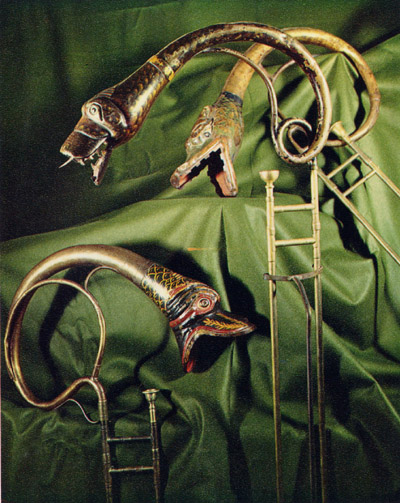
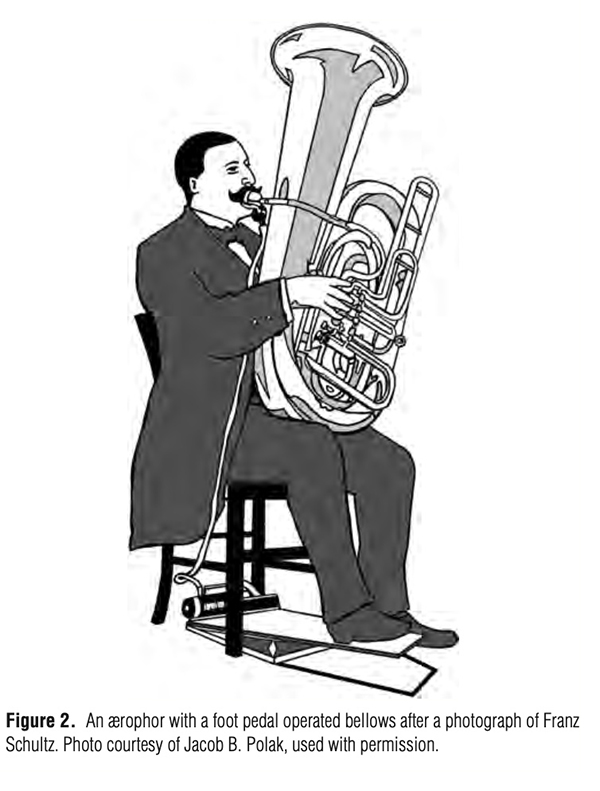
Illustration of a buccin (dragon bell trombone) by Lennie Peterson, for my new book, An Illustrated Dictionary for the Modern Trombone, Euphonium, and Tuba Player (Rowman & Littlefield).

Lennie_Peterson_trombone_Kaplin

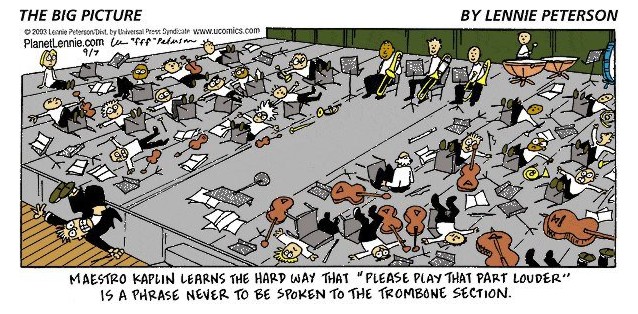
Another side of Lennie Peterson’s artistic persona, a cartoon from his syndicated comic strip, The Big Picture.

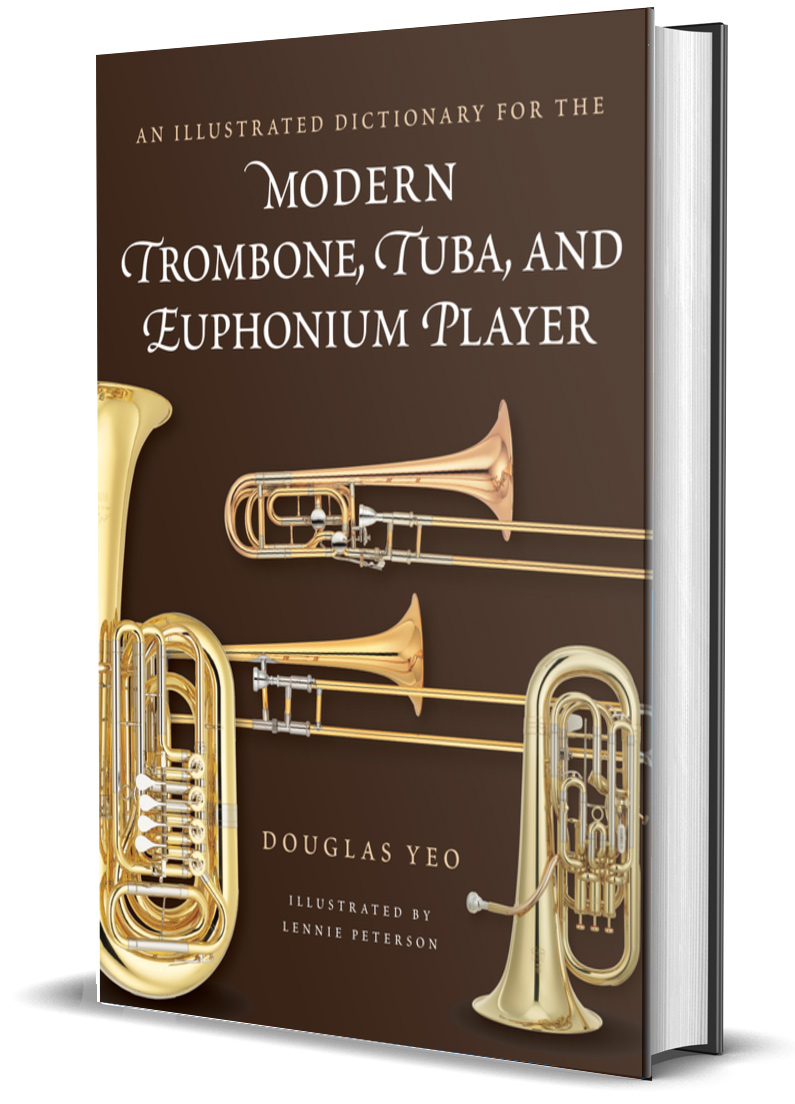
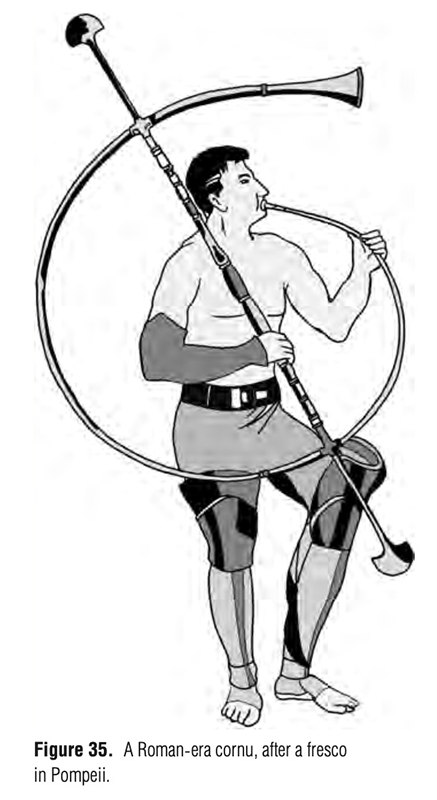
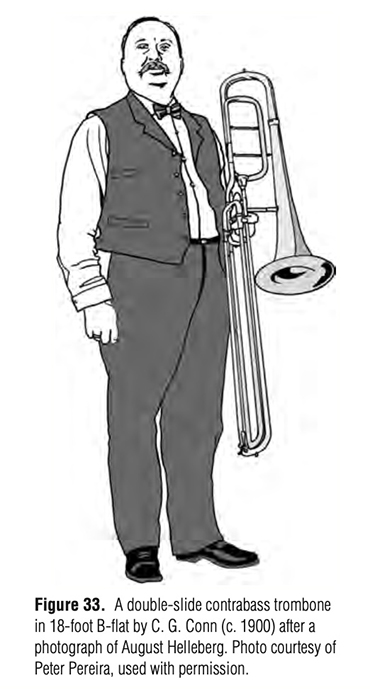
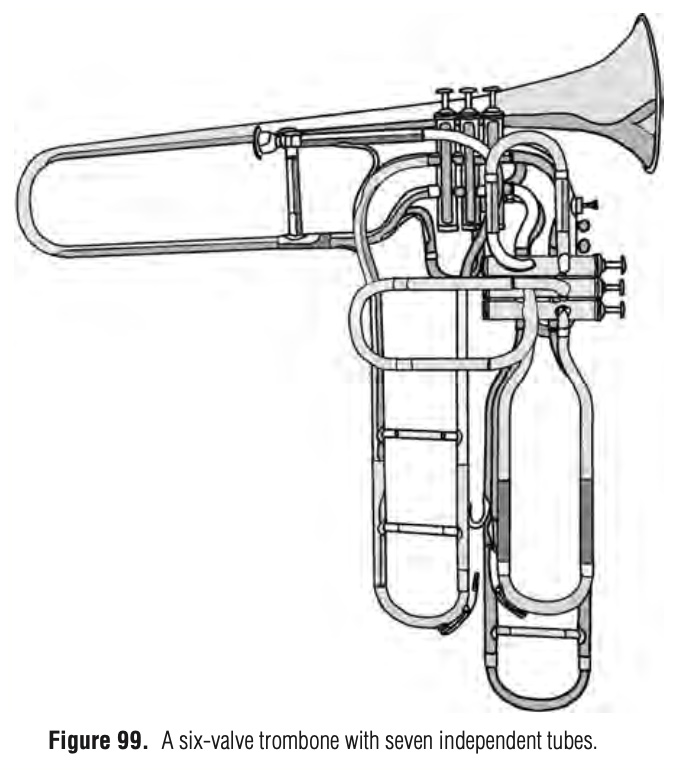
  • For the last five years, I have been working on another book, An Illustrated Dictionary for the Modern Trombone, Euphonium, and Tuba Player. Since being contracted to write the book by Rowman & Littlefield, I’ve been at work putting it together. Last month, I finished my manuscript—over 650 entries about instruments, individuals, composers, manufacturers, and parts of low brass instruments—and submitted it to my publisher. It has now been sent out for peer review and once those comments come back later this month, I’ll engage in a rewrite and the other editorial processes. Hopefully the book will then head toward being published, sometime in late 2021 or early 2022. One of the great joys of working on this book has been working with my illustrator, Lennie Peterson. A sample of his work for the Dictionary is above. Lennie (who is a successful trombonist in addition to his other artistic pursuits) is well known to trombonists for his famous cartoon about trombone players and their band director, Mr. Kaplin (above). Lennie is the rare artist who is expert in a host of styles and I am very happy that we have been partners in putting this book together.

Kuhn_Sousa_Band_1915_crop

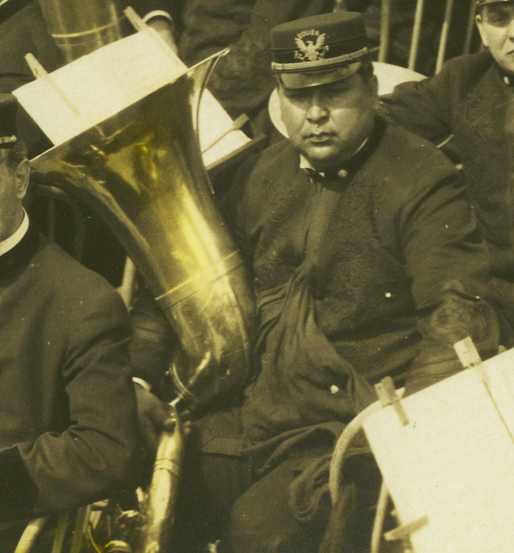
John Kuhn, a member of John Philip Sousa’s Band, at the 1915 San Francisco Panama-American Exhibition.

  • I’ve started researching the legendary Sousaphone player, John Kuhn, and I hope to publish a major article about him in the International Tuba Euphonium Association Journal sometime in 2022. Kuhn is a fascinating subject and as I was researching him for an entry in my Dictionary, I realized that a lot of the information that is known about him is in need of an adjustment. I find this all the time: historical figures have stories associated with them that are “too good not to be true,” but when one actually digs deep to find the root of the story, the narrative needs to be changed. Here’s a photo of Kuhn playing with a massed band (including John Philip Sousa’s band, of which Kuhn was a member) at the 1915 San Francisco Panama-Pacific Exhibition; that’s him looking over his shoulder at the camera. Stay tuned for more about this member of the Sioux nation who was a true force on the Sousaphone for much of the twentieth century.

Yeo_2020_Christmas_ornament_sm

Our family’s 2020 annual Christmas ornament.

  • Every year since we were married 45 years ago, my wife and I have made an ornament for our Christmas tree that reflects some of what our family did in the last year. It’s a nice time capsule that allows us to remember things we might have otherwise forgotten, and to celebrate some of our family’s milestones. It was challenging to find things to put on the 2020 ornament. Here’s what we came up with. A pin from Super Bowl LIV when the world seemed normal, a pin from 2020 baseball spring training when the world changed, and a NO COVID pin. That seemed to summarize the year.

COVID-vaccine_sign_Central_DuPage_Hospital

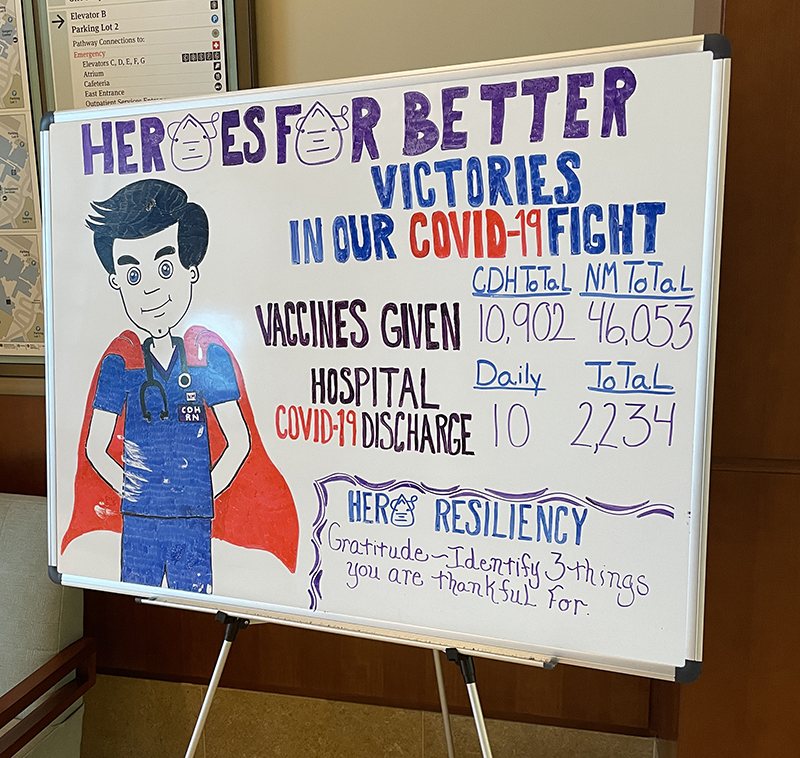
Sign in the lobby of Central DuPage Hospital, Winfield, Illinois, February 4, 2021.

  • As mentioned above, I received my first COVID-19 vaccination yesterday, with another dose coming in a few weeks. And, straight up, I want to say that I had no side effects apart from a slightly sore arm yesterday, no more than what I experience every year when I get a flu shot. By saying that I received the vaccine, I guess I’m giving away my age since here in Illinois, the vaccine is only available at this time to front line essential workers like doctors, nurses, and emergency personnel, teachers, and individuals over 65 years old (and I’m not a front line worker). My son-in-law, Chad, who is a hospice chaplain who is in contact with people all day long in homes and care facilities, has had both of his vaccination doses over the last few weeks. My getting it yesterday means 25% of our immediate family has been vaccinated, and we see this as tangible progress toward all of us getting vaccinated—a key element to returning to a more normal life. I received my vaccine at Central DuPage Hospital in Winfield, Illinois—part of the Northwestern Medicine health network—and I was so impressed by the efficiency of their distribution system and the care of its staff. The process went smoothly from start to finish, and I want to add my voice of thanks to all those who have been working so hard to help get the vaccine into people’s arms, and to those who have been caring for those who have contracted the coronavirus. We all know that this virus is bad—really bad—and we rejoice that deliverance from the pandemic seems to be in reach thanks to the vaccines. Thank you, God. In a world that is upside down, during a time where so many people have lost so much, it’s comforting to finally see the light at the end of the tunnel. And we’ll get there sooner if everyone follows health care directives including wearing a mask, maintaining appropriate distance from one another, and getting the vaccine. It matters.

So, that’s some of what’s been keeping me busy over the last year. Thanks to those who reached out and expressed concern, who wondered why I haven’t been posting more often on my blog. I’ll try to get to it more regularly. I’ve just been busy—like you’ve probably been busy, too.

[Header image: The daily United States coronavirus map from The New York Times, February 5, 2021.]

100 years ago today: Edward Marck Kleinhammer (1919-2013)

100 years ago today: Edward Marck Kleinhammer (1919-2013)

100 years ago today—on August 31, 1919—Edward Marck Kleinhammer was born (that is not a typo, his middle name was spelled Marck). He had a  long and especially distinguished career as bass trombonist of the Chicago Symphony Orchestra from 1940-1985. His influence on bass trombone performance and pedagogy is incalculable, even today, years after his death in 2013.

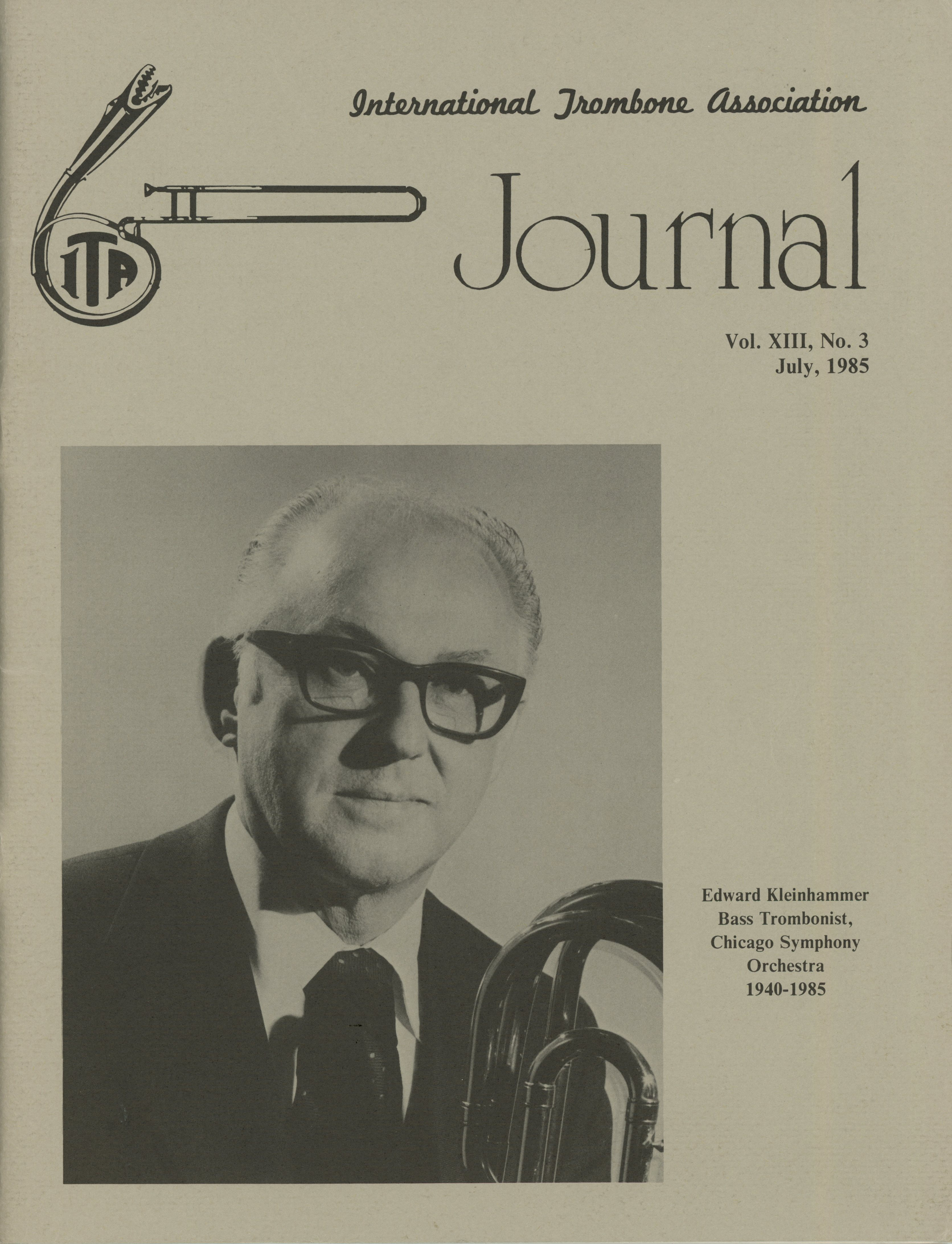
This was a man who changed my life. He was my trombone teacher during my years as an undergraduate at Wheaton College, Illinois (1974-1976). In the years that followed, the teacher/student relationship changed into a deep, abiding friendship, and I count myself very blessed that God brought our lives together. The story of his accomplishments and his influence on me and so many others is something I told in two articles I wrote about him for the International Trombone Association Journal. On both occasions, his photo graced the cover of the Journal. I wrote the first on the occasion of his retirement from the Chicago Symphony, in 1985. You can read it by clicking HERE.

Yeo_Kleinhammer_ITAJ_1985.jpg

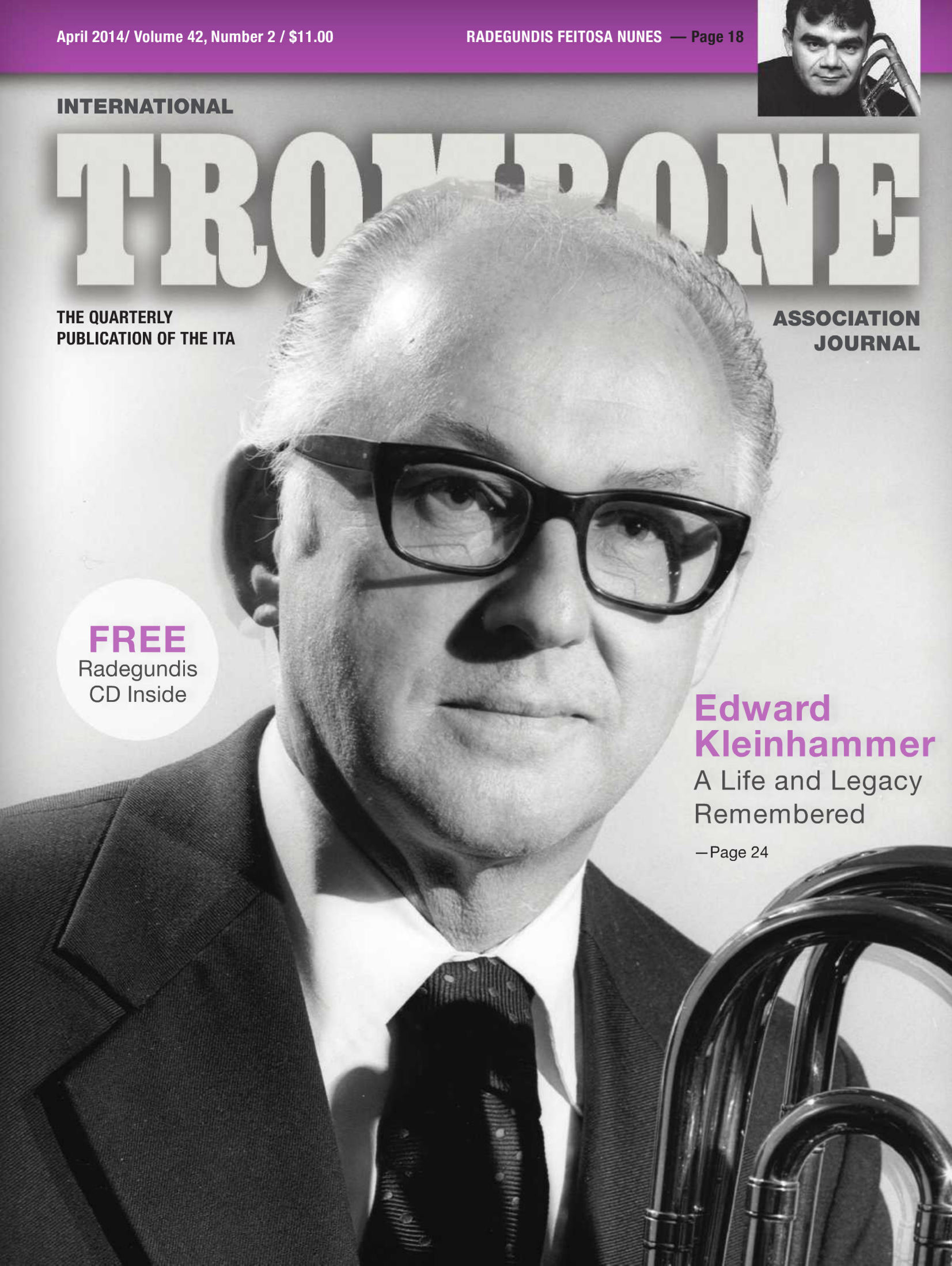
I wrote the second in 2014, shortly after his death. You can read it by clicking HERE.

Yeo_ITAJ_April_2014_Kleinhammer_tribute

The photo on both of these International Trombone Association Journal covers dates from 1976, and first appeared in a book published by the Chicago Symphony in that year, Reflections: A collection of personality sketches of the Chicago Symphony Orchestra.

Kleinhammer_CSO_Reflections_1976

Both of my articles are personal tributes to a great man and contain much information about his life, work, and influence. Today, on what would have been his 100th birthday, I don’t need to say many more words about Mr. Kleinhammer. He was a superb bass trombonist, a caring, challenging, effective, and tremendously inspiring teacher, and one who loved God and lived his life with the Bible as his guide. But a picture, it has been said, tells a thousand words. Here are some photos of him that tell more of his story. Many have never been published before. Several were given to me by Ed Kleinhammer himself; others were given to me by his widow, Dessie, after his death, and still others come from my own collection. Edward Kleinhammer: a life well lived, and a life remembered by all who knew and were influenced by him. Captions are above each photo.

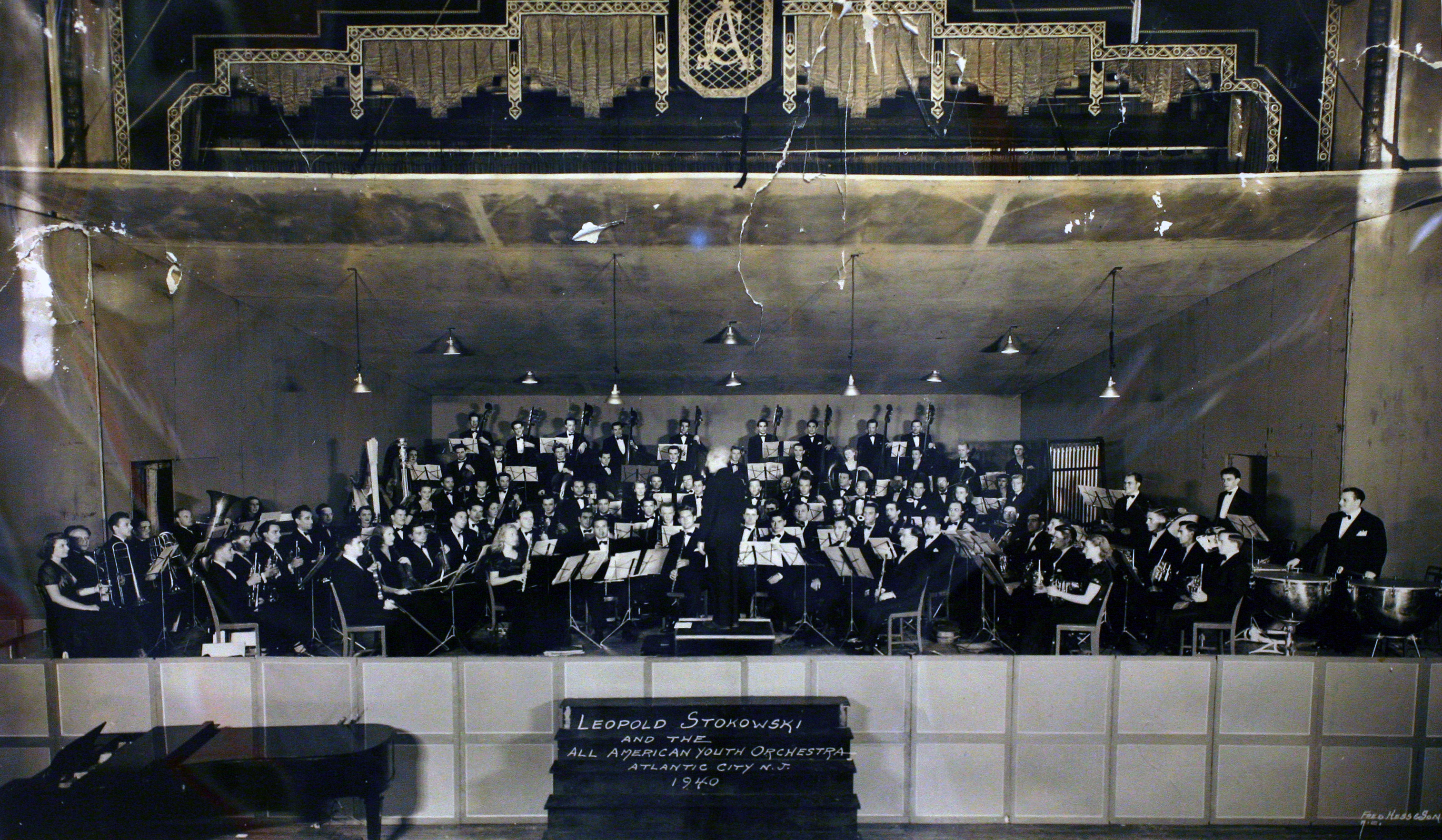
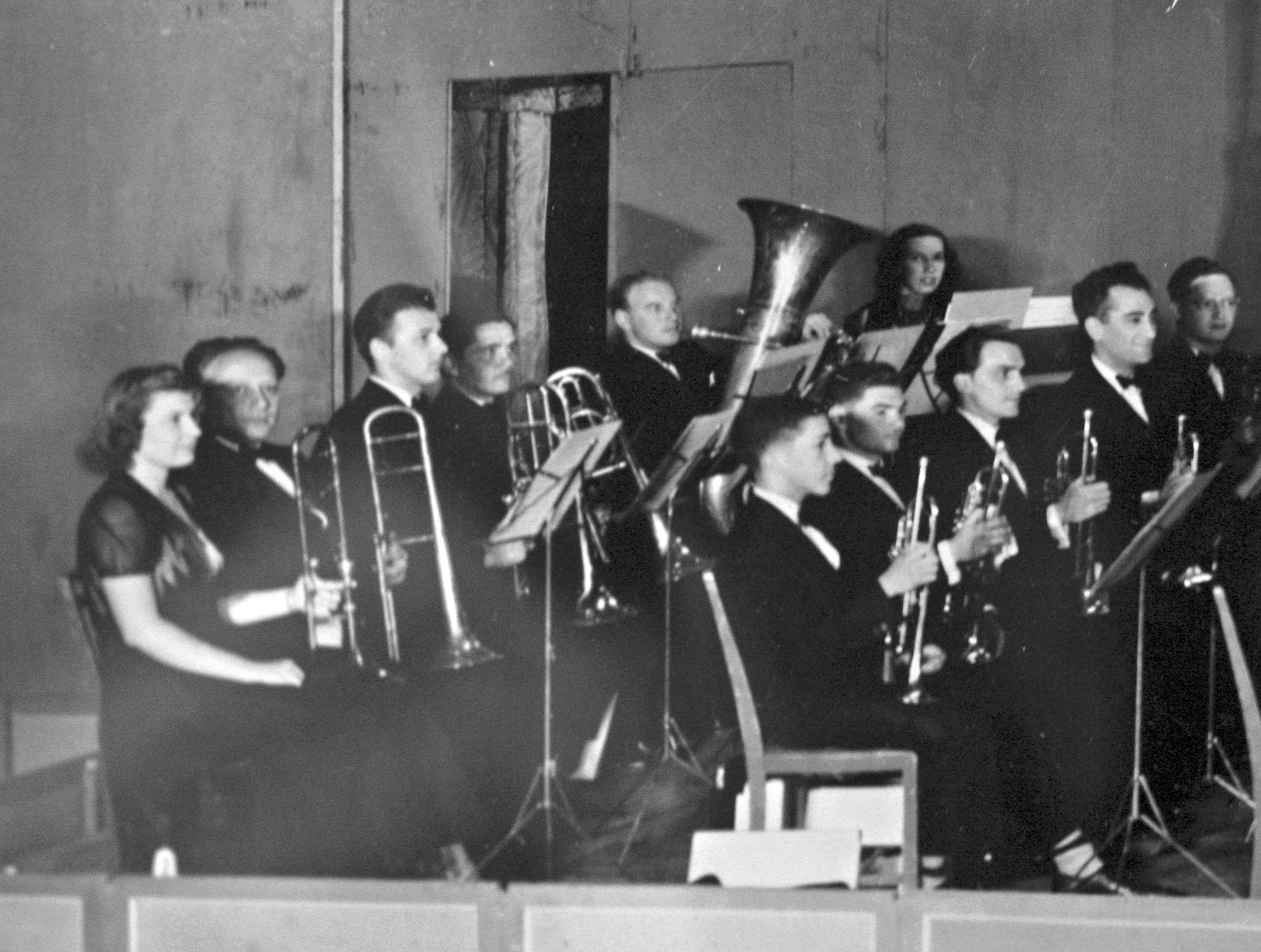
[Below] Ed Kleinhammer played trombone in Leopold Stokowski’s All-American Youth Orchestra in 1940, during the summer before he joined the Chicago Symphony. This photo shows the orchestra on stage at the Boardwalk Hall in Atlantic City before their tour of South America:

1940_AAYO

[Below] This is a closeup of the low brass section of the orchestra, cropped from the above photo. From the left (front) are Dorothy Zeigler, Charles Gusikoff (who was principal trombonist of the Philadelphia Orchestra at the time—Stokowski engaged several members of the PO to play alongside the younger players in the orchestra), Edward Kleinhammer, Howard Cole, and Philip Silverman, tuba:

1940_AAYO_low_brass_Kleinhammer

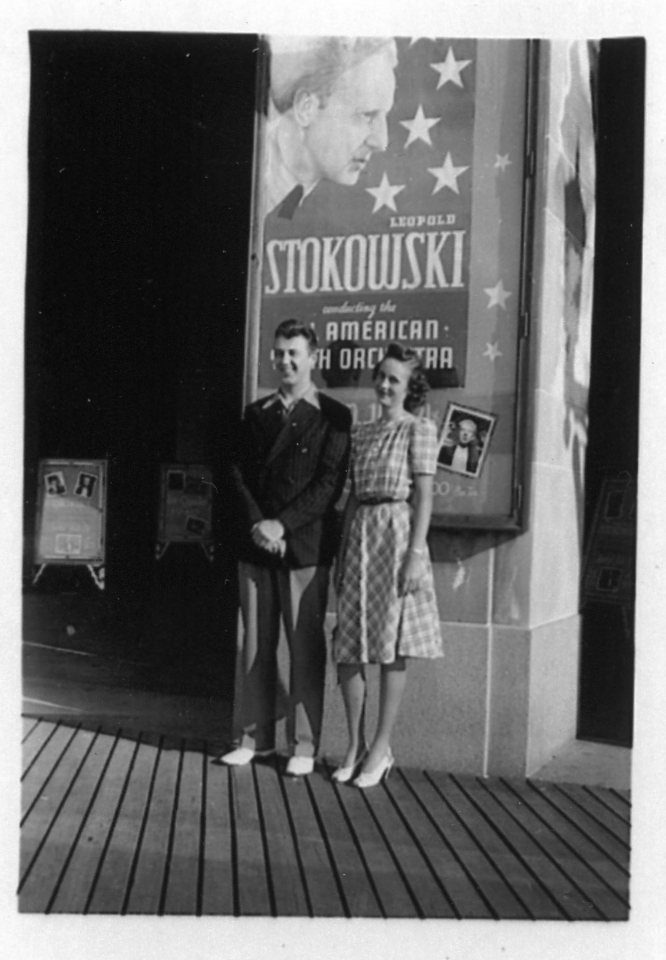
[Below] Edward Kleinhammer and an unidentified All-American Youth Orchestra member  outside the Atlantic City Boardwalk Hall, 1940:

1940_AAYO_Kleinhammer_Zeigler

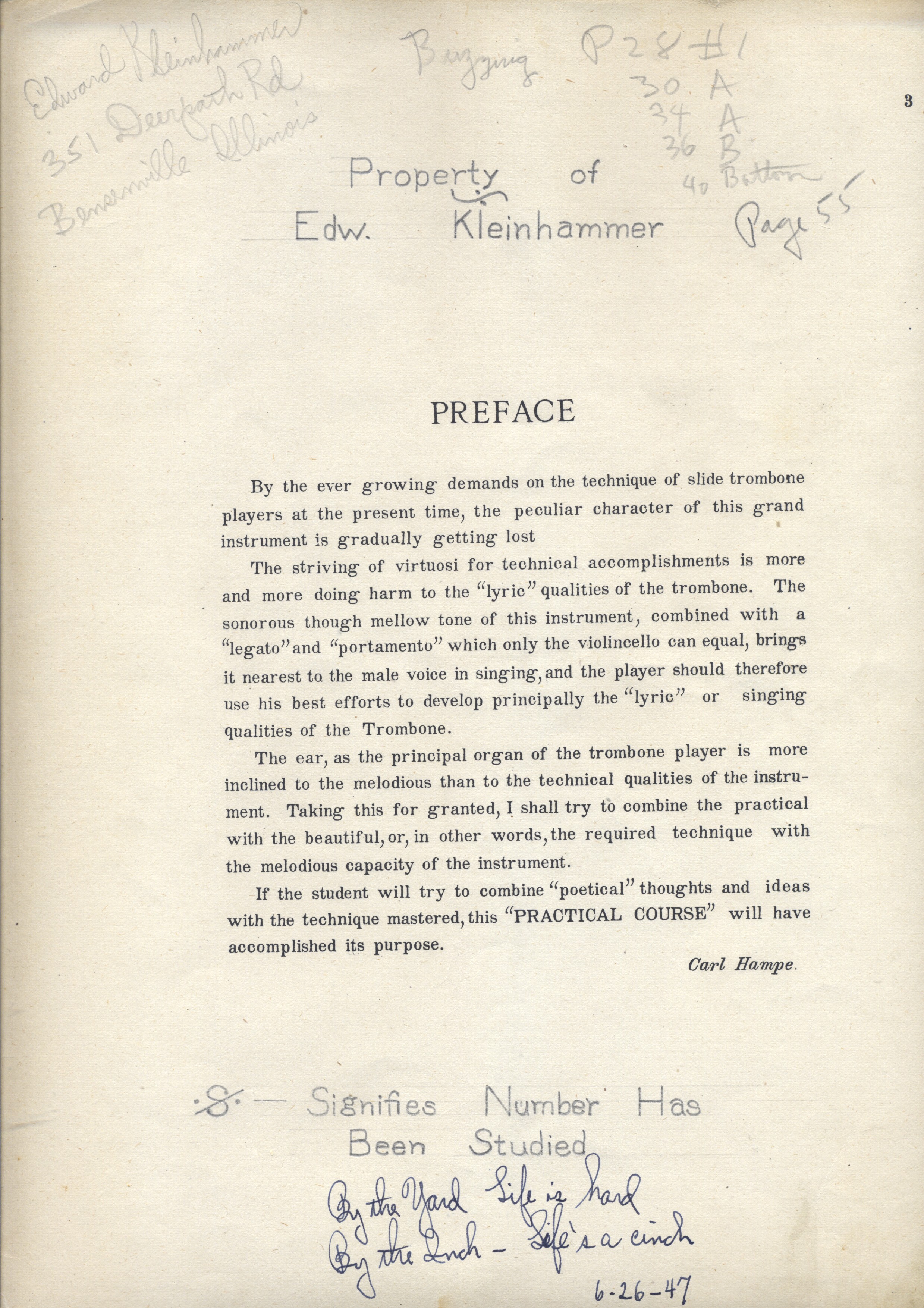
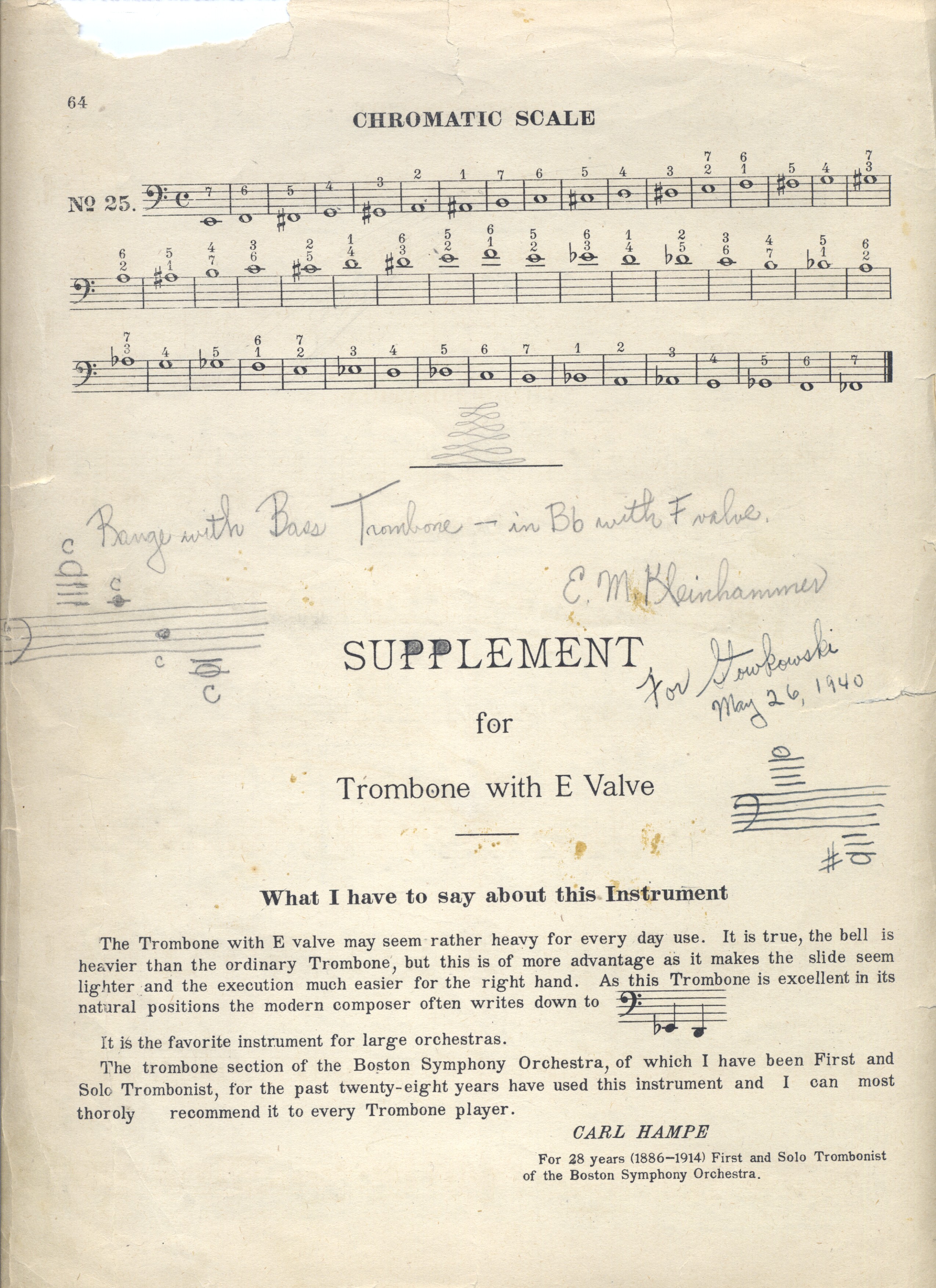
[Below] After I joined the Boston Symphony Orchestra in 1985, Edward Kleinhammer sent me his copy of the Method for trombone by Carl Hampe, who had been principal trombonist with the BSO in the early 20th century. It was one of his earliest trombone study books but it was one he turned to even after he joined the Chicago Symphony. When I opened it, I found many of his markings inside including those on these two pages. This one has an aphorism that he penned in 1947, and is a good reminder of how discipline and “slow and steady wins the race” were themes of his life:

Hampe_Method_01_Kleinhammer

[Below] This page, below, made me smile. Evidently, Leopold Stokowski had asked Mr. Kleinhammer to demonstrate his range on the trombone. His note to himself speaks for itself:

Hampe_Method_02_Kleinhammer

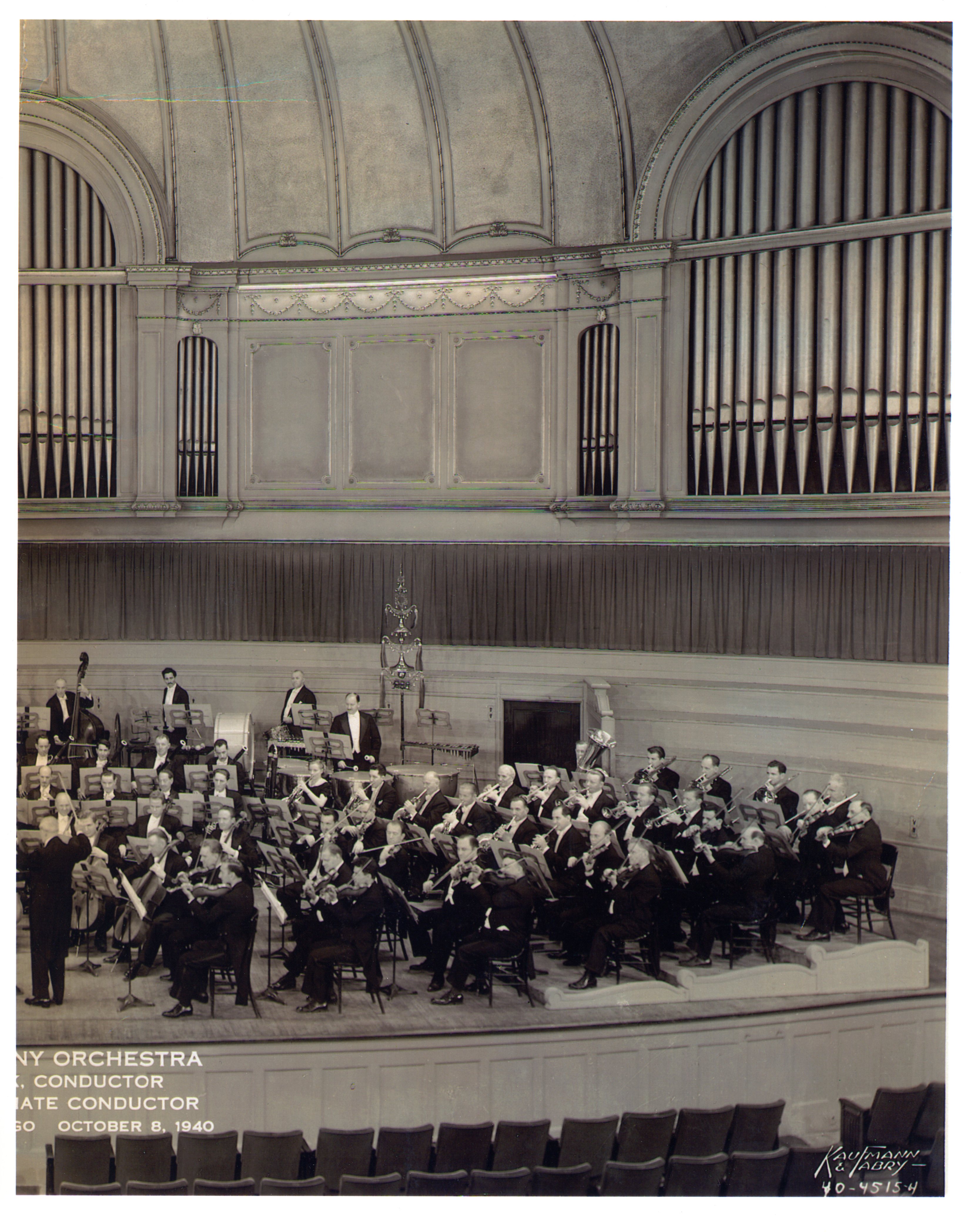
[Below] Here is the Chicago Symphony, October 8, 1940. This is a scan of half of a photo of the orchestra; I only have this scan of this portion of the photo which was given to me by Edward Kleinhammer.

CSO_1940[Below] Here is the low brass section of the Chicago Symphony Orchestra, fall 1940, cropped from the larger photo shown above of the CSO with Frederick Stock, conductor, at the beginning of Edward Kleinhammer’s tenure in the orchestra. Left to right: George Washington Hamburg, tuba; Edward Kleinhammer, bass trombone; David Anderson, second trombone; Frank Crisafulli, principal trombone; Edward Geffert, assistant principal trombone.

CSO_trombones_Kleinhammer_1940

[Below] From 1942—1945, Edward Kleinhammer was in a U.S. Army band, stationed at Fort Leonard Wood, Missouri. In this photo, he is in the top row, second from the right, next to a Sousaphone player:

Kleinhammer_Army_Band_c1942_01

[Below] Ed Kleinhammer in uniform, c. 1944:

Kleinhammer_Army_c.1944

[Below] The caption on the back of this photo is in Edward Kleinhammer’s handwriting and reads, “Stage Band, Independence, Kansas. Early 1940s.” He drew a small “X” on the photo to show where he was sitting in the back row of the Army band:

Kleinhammer_Army_Stage_Band_c.1944

[Below] The caption on the back of this photo, reads (in his wife, Dorothy’s handwriting), “Ed is practicing near our cabin.” In his handwriting, it reads, “Calling ‘Moose'” (Moose was Ed Kleinhammer’s nickname in the CSO). The photo looks to date from the late 1950s.

Kleinhammer_1950s_woods

[Below] This photo is from the Ravinia Festival, taken around 1960. From left to right: Rudolph “Rudy” Nashan, trumpet; Adolph “Bud” Herseth, principal trumpet; Robert Lambert, principal trombone, Frank Crisafulli, second trombone; Edward Kleinhammer, bass trombone; Arnold Jacobs, tuba.

CSO_brass_players_Ravinia_c1960

[Below] This is a Chicago Symphony Orchestra brass quartet, around 1970. David Babcock, horn; Charles Geyer, trumpet; Edward Kleinhammer, bass trombone (playing his single valve Bach 50-B bass trombone); James Gilbertson, tenor trombone.

CSO_Brass_Quartet_c1970

[Below] The caption on the back of this photo, in Edward Kleinhammer’s handwriting, reads, “Trombone Section CSO Circa 1970.” Back to camera: Edward Kleinhammer, Frank Crisafulli; facing camera, James Gilbertson, Jay Friedman.

CSO_trombone_section_c_1970

[Below] Chicago Symphony brass players, May 1972. Back row, from left to right: Adolph “Bud” Herseth, principal trumpet; James Gilbertson, assistant principal trombone; Jay Friedman, euphonium (principal trombone); Frank Crisafulli, second trombone; Edward Kleinhammer, bass trombone; Arnold Jacobs, tuba.

CSO_low_brass_May_1972

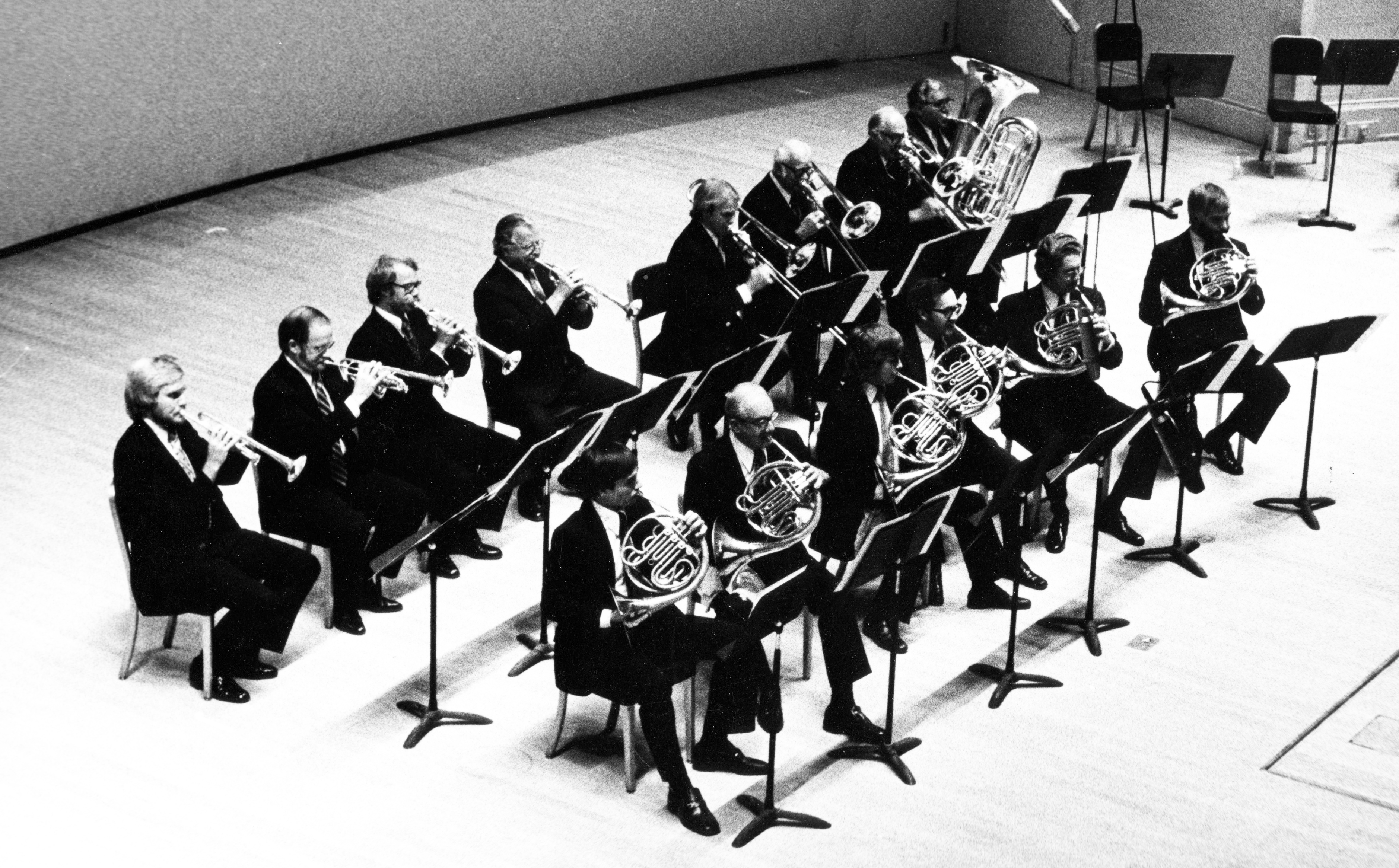
[Below] Members of the Chicago Symphony brass section, around 1975. Back row, left to right: Philip Smith, fourth trumpet; William Scarlett, third trumpet; Charles Geyer, second trumpet; Adolph “Bud” Herseth, principal trumpet; James Gilbertson, assistant principal trombone; Frank Crisafulli, second trombone; Edward Kleinhammer, bass trombone; Arnold Jacobs, tuba.

CSO_Brass_c1975

[Below] This photo was taken by my wife after my last lesson with Edward Kleinhammer, just before my graduation from Wheaton College, May 1976. The location is his studio in the Fine Arts Building on Michigan Avenue, Chicago. He is holding his bass trombone made by Schilke with a bell by Earl Williams.

Kleinhammer_Yeo_1976

[Below] The caption on the back of this photo, in Edward Kleinhammer’s handwriting, reads, “Ravinia 1976.”

Kleinhammer_Ravinia_1976

[Below] Edward Kleinhammer and Arnold Jacobs, c. 1984:

Kleinhammer_Jacobs_c_1984

[Below] Edward Kleinhammer’s final concert with the Chicago Symphony in Orchestra Hall was in May 1985. These three photos (below) were taken during that concert and hung in his home office for many years after.

Edward_Kleinhammer_May_1985_01

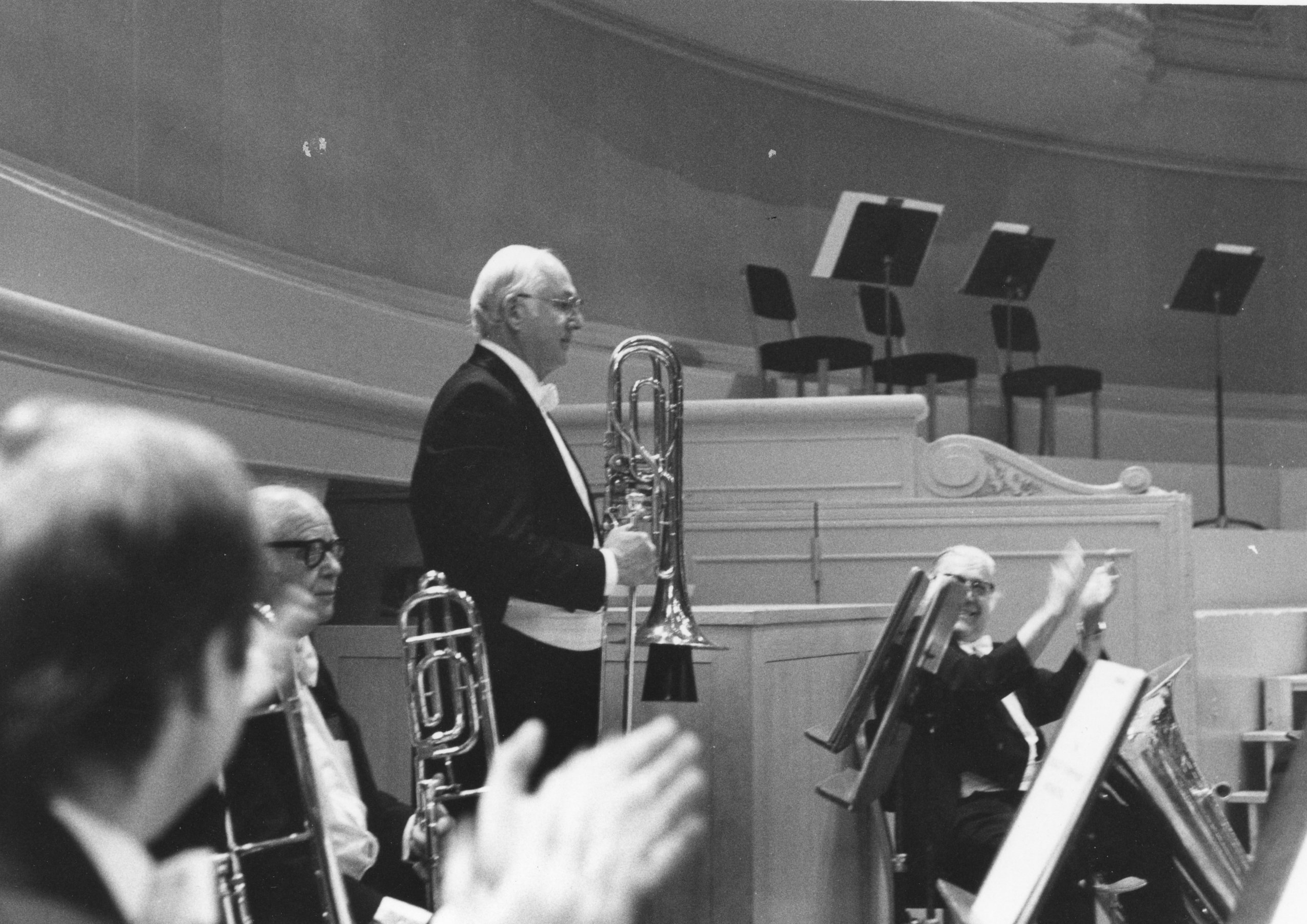
[Below] Edward Kleinhammer’s final bow at his chair in Orchestra Hall, May 1985. Also seen are Frank Crisafulli, second trombone, and Arnold Jacobs, tuba:

Edward_Kleinhammer_May_1985_02

[Below] Edward Kleinhammer’s final concert in Orchestra Hall, May 1985. Here he is at the podium, being presented with the Chicago Symphony’s Theodore Thomas Medallion by guest conductor Michael Tilson Thomas:

Edward_Kleinhammer_May_1985_03


[Below] Edward Kleinhammer’s Theodore Thomas Medallion, presented to him by the Chicago Symphony Orchestra on the occasion of his retirement from the Orchestra:

Chicago Symphony Orchestra

The Theodore Thomas Medallion for Distinguished Service

Presented to Edward Kleinhammer

1940-1985

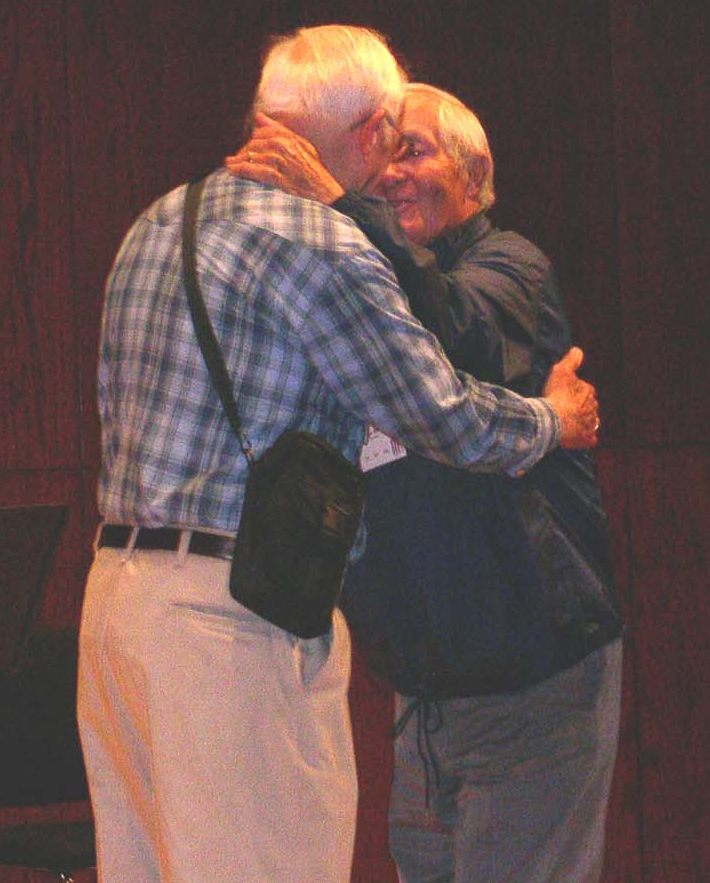
[Below] At the 2004 International Trombone Festival in Ithaca, New York, Edward Kleinhammer and George “Mr. Bass Trombone” Roberts met for the first time. It was a very special moment to see these two giants of the bass trombone from very different parts of the musical universe (classical and commercial) meet on stage together after Mr. Kleinhammer’s master class. George, ever effusive, came up to Ed and gave him a big hug and a kiss on the cheek. At the moment this interaction occurred, I was sitting in the audience with Ed’s wife, Dessie.

Kleinhammer_Roberts_2004

[Below] Edward Kleinhammer at home in Hayward, Wisconsin, around 2000 (photo by David Wilson). The mouthpiece in this Bach 50B3 is my YAMAHA Douglas Yeo Signature Series Mouthpiece that I had given to him several years earlier.

Edward Kleinhammer_c2005

[Below] I kept in close contact with Mr. Kleinhammer over the years; I have several hundred hand written letters from him, even more emails, and we spoke by phone frequently. He always called me on August 31—his birthday— to wish my wife and me a happy anniversary. My wife and I were married on August 31, 1976, and every year, without fail, before I could pick up the phone to wish him a happy birthday, my phone rang and it was him, to wish us well. The last time I saw him was at his home in Hayward in 2009. This is how I will always remember him:

08.Yeo_Kleinhammer_2009

I last spoke to Ed a few days before he died. Nothing in his voice gave a clue that a week later, he would pass from this world to the next while taking a nap in his favorite chair. I am a better person and trombonist because of the influence of Edward Kleinhammer, and I know many others can say the same thing. Today, on what would have been his 100th birthday, we honor this man who did so much for so many.

Rewarded: a new book

Rewarded: a new book

I love to write. Ever since I was a young boy, I have been passionate about writing. Give me a 2,000 word essay on a school exam any day over three math problems. My love of writing was birthed from my love of reading, something imparted to me by my parents. My father was Chairman of our local public library while I was going up, and every week, my brothers and I trekked to the the library to take out another stack of books to read. I was fortunate to attend schools that emphasized reading, whether contemporary literature (a little), the classics (a lot), and the ancients (Edith Hamilton’s Mythology remains a favorite).

I’m at work writing several books at the moment. In the introduction to The Trombone Book, a planned 500 page book I’m writing for Oxford University Press that will cover the history, use, performance, teaching, and care of the instrument (for trombone players who are reading this, think of this book as the successor to the long out of print Trombone Technique by Denis Wick), I’ve written these words:

In a sense, I have been writing this book since I first picked up the trombone in 1964. My parents, Alan and Jeannine Yeo, now gone from this world to the next, taught me to pay attention. From them I received the gift of a disciplined work ethic and the understanding that it was required to succeed in anything. They instilled in me a love of books and reading, and from that it was not a far walk to a love of writing. I grew to appreciate words and how they were put together, and I particularly thank Alfred, Lord Tennyson (Enoch Arden), Henry Wadsworth Longfellow (Evangeline), Herman Melville (Moby Dick), Thomas Hardy (Under the Greenwood Tree and The Choirmaster’s Burial), J. D. Salinger (Catcher in the Rye), William Buckley (The Right Word) and Jacques Barzun (many books, but especially Berlioz and the Romantic Century, From Dawn to Decadence, The Use and Abuse of Art, The Culture We Deserve, and Darwin, Marx, Wagner: Critique of a Heritage) for their exceptional modeling of the possibilities of the English language. An exasperated Abigail Adams was known to say to her husband, John, whose predilection for long narrative introductions before getting to the main point used to annoy her to no end, “John! Do you always have to start at Genesis?” Like our Second President, I confess to being guilty as charged, and also to finding solace in the writing of the Apostle Paul, whose first sentence of his letter to the Romans contains 132 words before the insertion of the punctuation mark we call the period. Stopping a thought is sometimes hard to do.

I love well crafted sentences, the putting together of words, how they flow past the eye and off the lips.

As much as I like writing, I also like what happens before writing: research. I don’t write fiction; I write about music and music making, musical instruments and real people and history. I love the chase, the tracking down of facts both obscure and well known, the hunt for needles in haystacks. It is intense, patient, time-consuming, frustrating, and rewarding work. And I never tire of it.

So, today is a particularly happy day for me, as my mailman brought me a most welcome package: several copies of my newest book, Serpents, Bass Horns and Ophicleides at the Bate Collection, just published by the University of Oxford in Oxford, England.

Bate_Yeo_serpents_cover

The Bate Collection in Oxford has a superb collection of musical instruments. I visited there in 2009 and had the opportunity to play several instruments under the watchful eye of my friend, curator Andrew Lamb.

Yeo_Waterloo_serpent

The Collection is a veritable “Ali Baba’s cave” of musical instruments, as you can see from this snapshot of one of the many display cases:

Bate_serpents_situ

In 2011, Andrew Lamb asked if I would be interested in writing a book about The Bate’s collection of serpents and related instruments. It took me all of one second to agree, although the project was delayed for many reasons. It was not as simple as sitting down and getting to work; a great deal of groundwork needed to be laid. And I also needed time to research and write. In 2012, I retired from the Boston Symphony and promptly flunked retirement and took the full time position of Professor of Trombone at Arizona State University. That job, as wonderful as it was, was all-consuming, and with many other writing projects going at the same time, the Bate book had to wait. But there was much to do as well, including collecting detailed information about all of The Bate’s instruments, arranging for high quality photos to be taken of each instrument, as well as research into the instruments themselves. I devised a plan for the structure of the book and last year, I began discussions with Bryn Walls, a superb designer who had been engaged to lay out and put the book together.

Screen Shot 2019-05-13 at 4.37.15 PM

As you can see from the first page of table of contents above, the book is divided into two primary sections. After a Foreward by Craig Kridel (not a Forward – remember that this book is published in England and England and the USA are two countries separated by a common language – my text needed to undergo “Anglicization” so its spelling and punctuation conformed to British publishing style), five chapters of Historical Context appear. In this section, I wrote a brief history of the instruments as seen through those at The Bate.

Screen Shot 2019-05-13 at 4.37.26 PM

The second section of the book is a detailed discussion of the instruments at The Bate. My commentary is greatly enhanced by superb photos of the instruments by Gary Ombler. Following the discussion of the instruments is a brief section of back matter, including a checklist of the instruments, a bibliography so readers and learn more, a bio and photo of moi, and a page with the index and acknowledgements.

Bate_denuded_serpent

Bate_Courtois_ophicleide

Each instrument is afforded its own two page spread, with at least two full views of the instrument (sometimes there are three or four – front, back, and sides), many photographs of detailed elements of the instruments, as well as my commentary.

With this book, serpents, bass horns, and ophicleides at The Bate come alive in a new way. Visitors to the Collection can walk through the gallery with the book in hand as they look at the instruments and learn more than the identifying label next to the instrument itself can tell them. Those who can’t get to The Bate can enjoy the instruments while sitting at home in their favorite (whoops – favourite) chair. 80 pages of photos and commentary about some of the most interesting musical instruments ever conceived and manufactured.

The book is now available through the Bate Collection’s online publications store; click HERE to go there in a new browser window. Or, of course, you can stop by the Bate Collection yourself and pick one up there. I am delighted that this book, the subject a long period of research, writing, layout, and proofreading, is now available. Holding copies in my hand today is a great reward at the end of a long process. I will enjoy this moment, but tomorrow I’ll be happily back to my other writing projects. More on them soon!

Bate_serpents_situ