Category: Arizona and the Southwest

A Very Merry Phoenix TubaChristmas

A Very Merry Phoenix TubaChristmas

I’m a trombone player. But I also play other instruments as well, and some unusual ones, like the serpent. One of the nice things about playing historical instruments like the serpent is that I get to play music and do things with people that I couldn’t do with a trombone in my hand.

Like play at TubaChristmas. Yup.

The brainchild of the late Harvey Phillips – Professor of Tuba at Indiana University for many years – TubaChristmas has been going for 43 consecutive years. What started at Rockefeller Center in New York City on January 1, 1974 as a tribute to Phillips’ teacher, tuba great William “Bill” Bell (who played tuba with the Sousa Band and the New York Philharmonic Orchestra for many years among many outstanding contributions to the music world) blossomed into a world-wide event. This year, my wife, Pat, and I took part in our first TubaChristmas.
blog_doug_deanna_pat_tuba_christmas_2016a

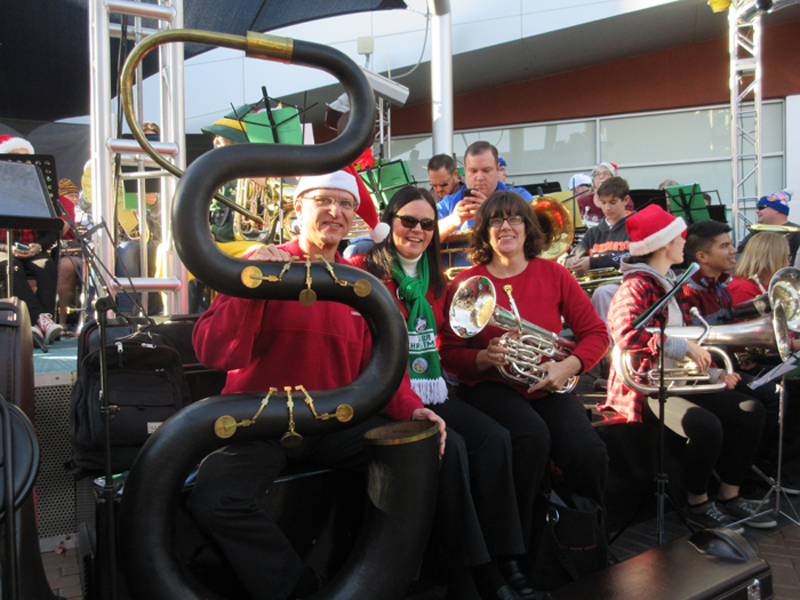
The Phoenix TubaChristmas was led by my ASU Tuba Professor colleague, Dr. Deanna Swoboda . Deanna is a tremendous teacher, player and person, one of my best friends, and she brought her musical expertise and great, fun personality to lead a group of 122 players – a record number for the Phoenix TubaChristmas event – of every type, size and shape of tuba related instrument. Contrabass tubas, bass tubas, Sousaphones, euphoniums, baritones. And a contrabass serpent. The photo above shows me with my “anaconda” serpent, “George,” along with Deanna and Pat (with her British style baritone horn – she played baritone horn in the New England Brass band from 1998-2008 when I was the Band’s music director) at Tempe Marketplace near Phoenix, Arizona.

OK, a word about “George.” Made in 1990 by the late Christopher Monk, “George” was the second contrabass serpent ever made, the first being constructed in the 19th century in Huddersfield, England. “George” was commissioned by the late Philip Palmer and after Phil’s death, I purchased this extraordinary instrument from his widow, Connie Palmer.

blog_doug_pat_tuba_christmas_2016b_small

“George” got its name because it was on April 23 – St. George’s Day – in 1990 that this instrument first received breath from Christopher Monk. 16 feet long, it is in CC; it is made of choice sycamore covered with leather. It was built to be a double size French church serpent with brass keys since the holes are too large to be covered by one’s fingers. The boxwood mouthpiece was made for me by the late Keith Rogers who succeeded Christopher Monk as serpent and cornet maker of Christopher Monk Instruments in England. The serpent is considered the ancestor of the tuba family, a bass wind instrument with a cup shaped mouthpiece that had its origins in – well, it all depends on where you come down on serpent scholarship. Certainly it was being used in France by 1590 but it very likely had origins in Italy somewhat before that time. You can get a lot more information about the serpent by visiting The Serpent Website where you can also download past issues of The Serpent Newsletter. Seriously!
blog_deanna_doug_pat_playing_tuba_christmas_2016b

Bringing “George” along to TubaChristmas – and I should say that this is a real, serious instrument, capable of playing with a beautiful sound; I used this instrument on my CD of music for serpent, Le Monde du Serpent – was great fun. Deanna asked me to say a few words about the serpent both at the rehearsal and the performance, and I played a verse of “Good King Wenceslas” to demonstrate its capabilities. I posed for a photo with many audience members who wanted to be seen with “George,” and I enjoyed many conversations with people who wanted to know more about the serpent.

phoenix_tuba_christmas_2016_playlist

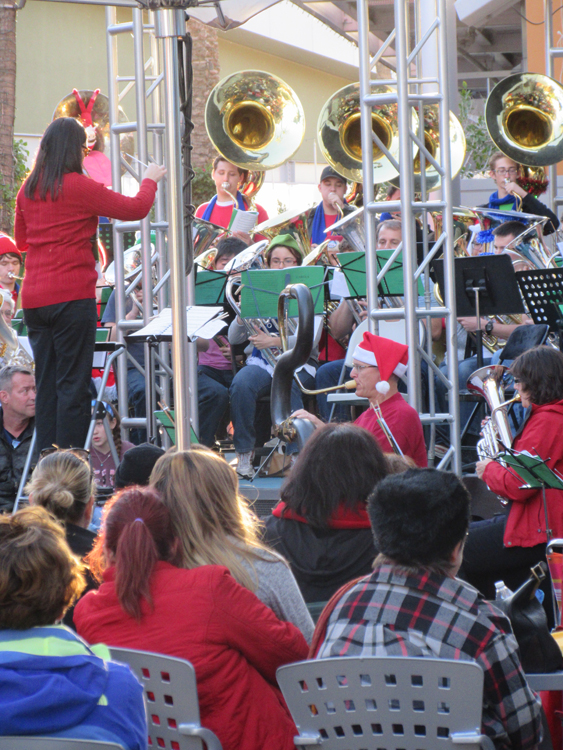
Our playlist featured 18 well-known Christmas tunes, both popular songs and traditional carols. The audience was enthusiastic and appreciative. Well, you don’t exactly see 122 tuba-type instruments gathered in one place, with players from age 13 to in their 70s, celebrating “the most wonderful time of the year” in a festive way. Part of the fun was knowing that this same kind of event was going on all around the world. Not every place could have their TubaChristmas outside like we did here in Phoenix; Chicago, for instance, had their TubaChristmas in a ballroom at the Palmer House Hotel. But no matter whether it was inside our out, with few or many players, TubaChristmas has developed into a very special event that bring people together with music. A big thank you to Deanna Swoboda for her great leadership, and to all participants and audience members. Merry TubaChristmas!

blog_doug_george_tuba_christmas_2016

Conversation

Conversation

By Douglas Yeo (November 3, 2016)

I know I’m not the only person who thinks that Conversation by Charles Small is the finest duet ever written for tenor and bass trombone. I’ve played this piece dozens of times with dozens of tenor trombonists over the year, beginning with the first time I played it in a recital at Peabody Conservatory of Music in Baltimore with my then Baltimore Symphony trombone colleague, Jim Olin in 1983. I recorded Conversation in 1996 with my Boston Symphony colleague, Ronald Barron and that recording was released on my CD, Proclamation, and Ron’s CD, In the Family. This past spring, I played it at Arizona State University on a doctoral recital given by my one of my students, Tim Hutchens. In fact, I will be playing it again this Friday, November 4, with jazz trombonist Jim Pugh at a masterclass I’m giving at University of Illinois School of Music at 2:30 PM in the University of Illinois School of Music Auditorium (the class is free and open to the public). Charlie wrote the duet for himself and bass trombonist David Taylor and has become a regular feature on student and professional trombone recitals for many years.

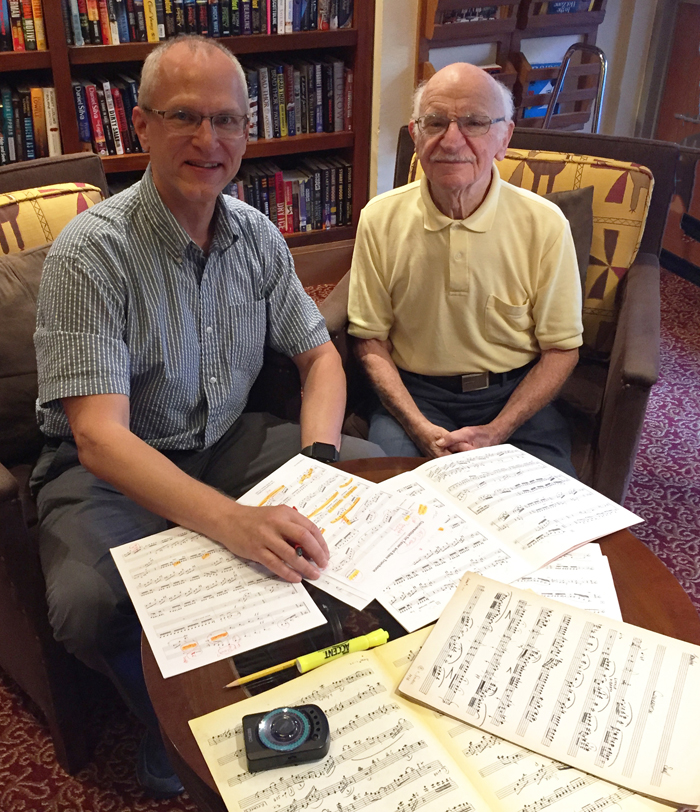
I have always played Conversation off set of parts that were done from Charlie Small’s original manuscript by a copyist (shown at the top of this article). But that version was not widely available, and in 1993, Conversation was published by Kagarice Brass Editions. The duet saw several printings by KBE but each had particular problems – things that were missing or not clear. Kagarice Brass Editions is now part of Ensemble Publications, and I asked the owner of Ensemble Publications, my friend Chuck DePaolo, if he would be interested in making a new printing of Conversation with Charlie Small’s approval. Chuck thought it would be great to to this so a few days ago, I called up Charlie Small – he lives here in Arizona, not far from where my wife and I live – and yesterday, we spent a several hours going over Conversation with a fine toothed comb.

yeo_small_11_01_201low

It should be said that spending time with Charlie Small is a rare and truly wonderful thing. A member of the Tommy Dorsey Orchestra in the 1940s when he was a teenager, Charlie has been a major influence on the trombone scene for many decades. Conversation is only one of his many compositions and it was great not only to sit down and talk about his piece, but hear Charlie tell some great stories as well. We went through Conversation measure by measure. After several hours of working together, Charlie felt confident that we had identified all of the things that needed to be changed/fixed in this new edition. It’s now been sent off to the publisher and very shortly, a version of Conversation that reflects the composer’s intentions will soon be available. At last!

conversition_edited


In the studio/on the air

In the studio/on the air

by Douglas Yeo

In a previous post here on The Last Trombone, I mentioned an interview I gave for Central Sound at Arizona PBS that was broadcast on Phoenix’s classical PBS radio station, KBAQ (the station goes by the sound of its call letters, KBACH). One thing led to another and I now find myself very happily working for Central Sound at Arizona PBS, as an on-air host for their weekly radio program on KBAQ, Arizona Encore!

I confess I never thought of myself as having a “radio voice” but a few weeks ago, I was asked to come to the Central Sound studio in downtown Phoenix for an audition. Nothing ventured, nothing gained, and I was very pleased when, after recording a couple of test scripts, I was asked to join the team of hosts for the show. This “retirement thing” is turning out to be very interesting for me to say the least!

For those interested, Arizona Encore! is a weekly radio program that features live performances of classical music recorded around the state of Arizona. Concerts are professionally recorded by the Central Sound at Arizona PBS staff and packaged as programs that are broadcast weekly at 7:00 pm on Tuesday evenings on KBAQ. I have recorded four programs so far and they will air on September 27, and October 4, 11 and 18.

There are several ways you can listen to Arizona Encore!:

  • Listen live on KBAQ (KBACH), 89.5 FM every Tuesday evening at 7:00 pm Arizona time. Do keep in mind that Arizona – very sensibly, I might add – does NOT recognize daylight savings time so at this time of year, we are in the same time zone as Pacific Time while in the winter, we are in Mountain Time. You can always find out the current time of day in Arizona by clicking here.
  • Listen live on www.kbaq.org every Tuesday evening at 7:00 pm Arizona time.
  • Listen to programs on demand any time on the Arizona Encore! page on the Arizona PBS website by clicking here.
  • Download the KBAQ (KBACH) mobile app and listen to the show live every Tuesday evening at 7:00 pm Arizona time. The app is free and is available from the iTunes Store and Google Play:

Download the KBAQ (KBACH) mobile app from the iTunes Store

Download the KBAQ (KBACH) mobile app from Google Play

  • Download the Classical Arizona PBS mobile app and listen to the show on demand any time. New shows are uploaded each week and can be streamed at no cost at any time of day. The app is also free and is available from the iTunes Store and Google Play. The app also has additional useful features including streaming of concerts (including some Phoenix Symphony concerts and concerts by students and faculty at Arizona State University), videos, concert listings, links to websites to purchase concert tickets, and more.

Download the Classical Arizona PBS mobile app from the iTunes Store

Download the Classical Arizona PBS mobile app from Google Play

  • Listen to Arizona PBS programming live on Digital Television (DTV) channel 8.4; for more information, click here.

While I’m at it, I’d like to give a word of thanks to Arizona Encore! Executive Producer Alex Kosiorek who brought me on to the Central Sound at Arizona PBS team, and Producer Jeanne Barron who is the master of controls in the studio when I’m recording programs. We may live in the Internet age but radio is alive and well. I’m very happy to be a part of a group of people who are working hard to promote classical music here in Arizona – and around the world.

Waiting

Waiting

I’m an active person, always wanting to engage with projects, things and people that are around me. For many years, I didn’t particularly care for waiting. I don’t know many people who do. Waiting in traffic. Waiting for a movie to begin. Waiting on a line at the airport. Waiting for others to get ready to go out to dinner. Waiting often seems like a waste of time. But I don’t think so any more. As with may things, it all depends on how you look at it.

I took the photo above last month at Yellowstone National Park. I was struck by three people sitting on the boardwalk that surrounds Old Faithful geyser, one of the park’s iconic features. This remarkable geyser erupts to spectacular effect about every 90 minutes or so. Since it erupts with such regularity, great crowds come to see Old Faithful. The three people above came early. About an hour early. So they did not have to deal with this to find a good spot to watch (below):

crowd_yellowstone

This is the scene that is repeated many times each day. Several thousand – yes, thousand – people waiting for Old Faithful to erupt. The three people who got there an hour early certainly got a good seat. But they got more than that. They had some time without the crowds, time to think and consider what they had and what they were about to see. I have a feeling they felt the wait was very much worth it.

Musicians do a lot of waiting as well. Trombone players, in particular, spend a great deal of time sitting and waiting for things to happen. Consider Beethoven’s Symphony 9. Here’s the beginning of the first page of the bass trombone part, a part I played dozens and dozens of times as a member of the Boston Symphony Orchestra.

beethoven_9_snapshot

Look carefully. See where I played my first note of the piece? It’s in measure 414 of the second movement. I didn’t play a single note in the first movement (that movement has 547 measures). Then had to wait 414 measures (well, actually there were more than that if the conductor took the repeat) to play in the second movement. And my first note was a note that I had to get right – the other two trombone players don’t play there. By contrast, the first violin part requires eight pages of music to get to that same place in the music. So I had to do a lot of waiting before I played my first note of the Beethoven Symphony 9.

One thing I did NOT do was count rests. There are simply too many rests to count to be 100% sure you’ll count correctly. So I made it a point, for every piece I ever played, to study the full score and know and understand the piece so well that I did not need to rely on counting rests. I simply knew when it was time to play. When you count rests for hundreds of measures, you can’t do anything else; you have to concentrate to get the count right. That never interested me. (By the way, my colleagues will attest to the fact that I rarely came in wrong. I don’t say that as a point of pride but simply an acknowledgement of the fact that if you prepare thoroughly, you will not need to count every rest and can have confidence that you will come in correctly.) You’ll see why, below.

When I retired from the Boston Symphony, I received several meaningful gifts from the Orchestra and my colleagues. Several of them are hanging on the wall in my home studio.

yeo_wall

The centerpiece is a photo of the Boston Symphony and Tanglewood Festival Chorus performing Beethoven’s Symphony 9 in Symphony Hall, Boston during my last week of concerts; the photo was taken on May 3, 2012 and the performance was conducted by Bernard Haitink. The photo is beautifully framed and matted and my colleagues in the Orchestra signed the matte. It is an exceptionally meaningful artifact of my career. But if you look closely, you will see the orchestra playing – every member in full throat – except the three trombone players. Toby Oft, Steve Lange and I are seen doing what we did for so much time: we were sitting with our hands folded, trombones at the ready but they are silent.

bso_waiting

I haven’t done a calculation, but my guess is I have spent years of my life waiting, and much of that time was done at orchestra rehearsals and concerts. Since waiting is unavoidable, the question arises: What are you going to do while you’re waiting? You could just sit there and be bored, unhappy that you’re not DOING something. But I learned that there are a lot of things you can do while you’re waiting to play. You may come up with a different list but I think the important thing is that you HAVE a list of things that you can do to redeem the time that you spend waiting. Here are some things that I do while waiting to play.

  • Listen. I always felt like I had the best seat in Symphony Hall. I could hear every note that was played with great clarity. Sometimes I would simply listen to the great orchestra around me and enjoy it like I was attending a concert.
  • Pay attention. My students will tell you that the words “pay attention” are a theme of my teaching. So often we experience things and so much goes by without our even noticing. Sometimes I would choose a particular colleague and pay attention to what he or she was doing. While it’s true that Edward Kleinhammer and Keith Brown were my trombone teachers in college, if asked who my teachers were, I rattle off a list of dozens of names – and most of them were not trombone players. They were my colleagues in the Boston Symphony who taught me so much when I took the time to intentionally pay attention to what they were doing. I am a much better trombone player because I paid attention to string, woodwind, percussion and other brass players exercise their craft. Likewise, I learned a great deal from observing soloists and conductors. Too many trombone players are only interested in the trombone parts. Pay attention to others and you will experience tremendous growth as a musician.
  • Watch the audience. People go to concerts to hear and see an orchestra. But it’s also true that those on stage are aware of the audience. Over my nearly 30 years in the Boston Symphony, I got to know many audience members. Some I met personally; others I observed only from a distance. I recall one woman who came to concerts with her husband when I first joined the Boston Symphony. As the years went on, she began to come to some concerts with her daughter. Years later, she came with her granddaughter. And in my final years in the orchestra, she came again with her husband. It was a touching thing to see each Thursday night. It taught me something about inter-generational relationships and the love a family shares.
  • Analyze the music. When I prepare to play any piece, I study the score to understand it better. This is not just so I wouldn’t have to count lengthy numbers of rests. It is so I can enjoy and appreciate the music on a new level. I would always read the program notes written by the Boston Symphony’s expert scholars and writers and I often would read a book about the piece we were playing. With that background, I often sat during concerts and analyzed the composer’s work, seeing how themes weaved in and out, doing harmonic and rhythmic analysis. I felt that every concert was a music history lesson. I learned so much.
  • Pray. Prayer is not a singular event that I do at a particular time of day. The worship of God is something that I do all day long, all the time. The title of a book by my music-spiritual mentor, Harold M. Best, says it well: Unceasing Worship. When I had long movements where I didn’t play, I would often pray. Pray for family and friends, pray for our country and its leaders, pray for wisdom and understanding, and much more. Surrounded by God’s great gift of music, prayer flows naturally.

Waiting is an exercise; patience can only be learned while in a situation that makes you tend to be impatient. But waiting can be a great blessing, even a thrill, if you look at it as an opportunity to to do more than simply sit with your hands folded in your lap.