Category: Wheaton College

Reflections on a year: COVID-19 and more

Reflections on a year: COVID-19 and more

The coronavirus pandemic has upended everything. Everything. Everyone has a story. It is true that “we are all in this together”—it effects everyone. But it is not true that “we are all in the same boat.” Some boats are doing better than others. Some are sinking. Some have sunk. The virus is real and it’s bad. In the words of a good friend of mine who is a Dean at a major medical school and research hospital in New York City, “this virus is scary and sneaky.” Yes, it is.

Global_COVID_cases_2021_02_04

The COVID-19 dashboard at Johns Hopkins University, Baltimore, February 4, 2021.

We in our extended family consider ourselves very fortunate: none of us has contracted COVID-19. We are all exceptionally cautious. We wear masks and take other protective measures. But over the last couple of weeks, I’ve received email messages from a number of friends who have noticed that I haven’t posted anything on The Last Trombone since October. “Are you OK?”, they’ve asked.  I appreciate the concern, and it’s a reminder how we all are on edge, uncertain what lack of contact with someone might mean. I’m well—thank you for asking!—but as I have been reflecting on a number of things, I find it remarkable that in a season of life where I have done almost no traveling and I have been at home since mid-March, 2020, I am so busy in so many ways.

Doug_Chad_Super_Bowl_LIV_sm

It has been nearly a year since the coronavirus has been part of our every day vocabulary. On February 2, 2020, my son-in-law, Chad, and I went to Super Bowl LIV in Miami. I won a contest sponsored by the Chicago Bears (you can read about how I won the contest HERE and our experience at Super Bowl LIV HERE) and we had an amazing trip. Chad and I were in the midst of 65,000 other fans. We gave high-fives and hugs to total strangers, stood in crowed lines for food and to use the rest room, we screamed our lungs out during the game, we flew on planes, traveled on buses, and we did this without even thinking. We didn’t know that in a few weeks, that would all change.
Doug_Megumi_edited_01_sm

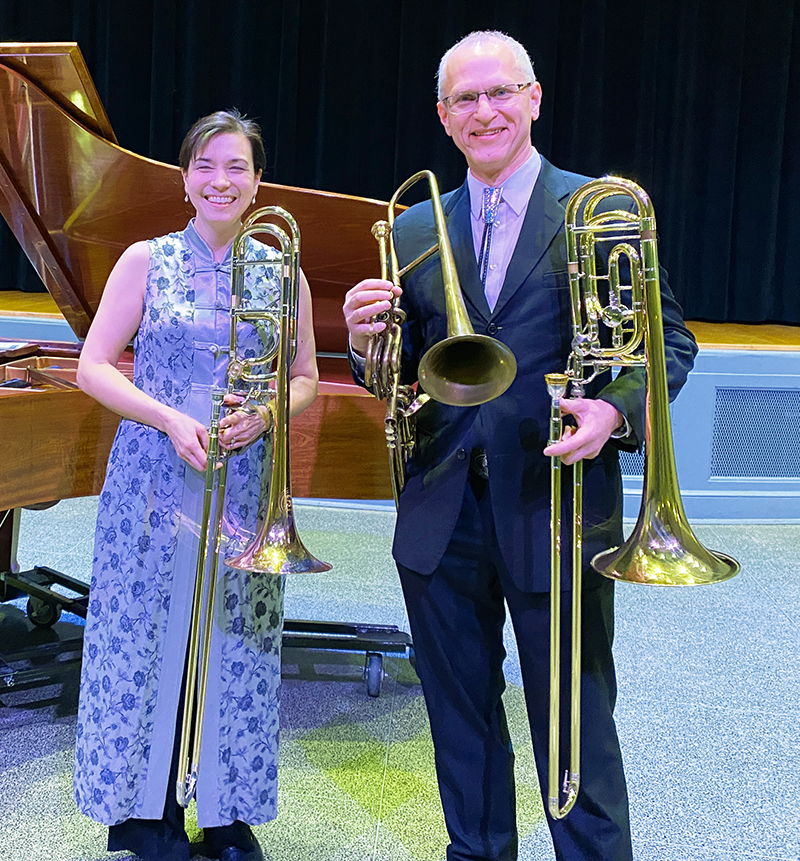
Megumi Kanda and Douglas Yeo in recital in St. Louis, February 16, 2020.

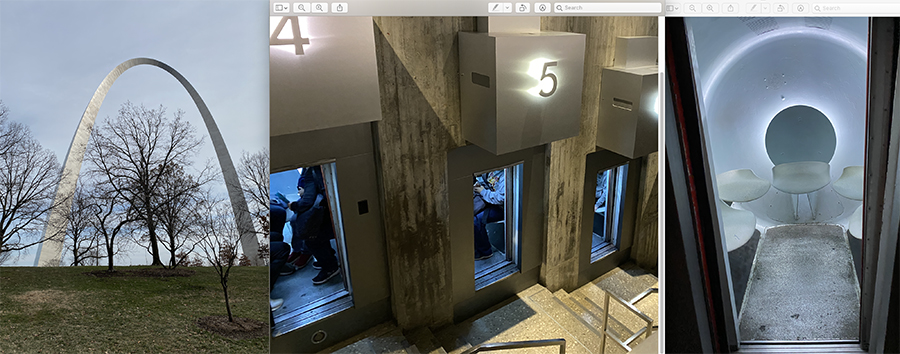
A few days  later, I was in St. Louis, playing a recital and giving a masterclass along with my good friend, Megumi Kanda who is principal trombonist of the Milwaukee Symphony.  The recital was sponsored by the St. Louis Low Brass Collective. In addition to my trombone activities, I went up the St. Louis Arch in a small elevator that seated seven people, all jammed in like sardines. I didn’t even think twice about doing it.
St_Louis_Arch_elevator

The elevators at the St. Louis Arch, February 15, 2020.

Coronavirus? It was “one of those viruses” we hear about from time to time that affected people in lands far away. It had no impact on us. Yet.
Sloan_Park_2020_03_12

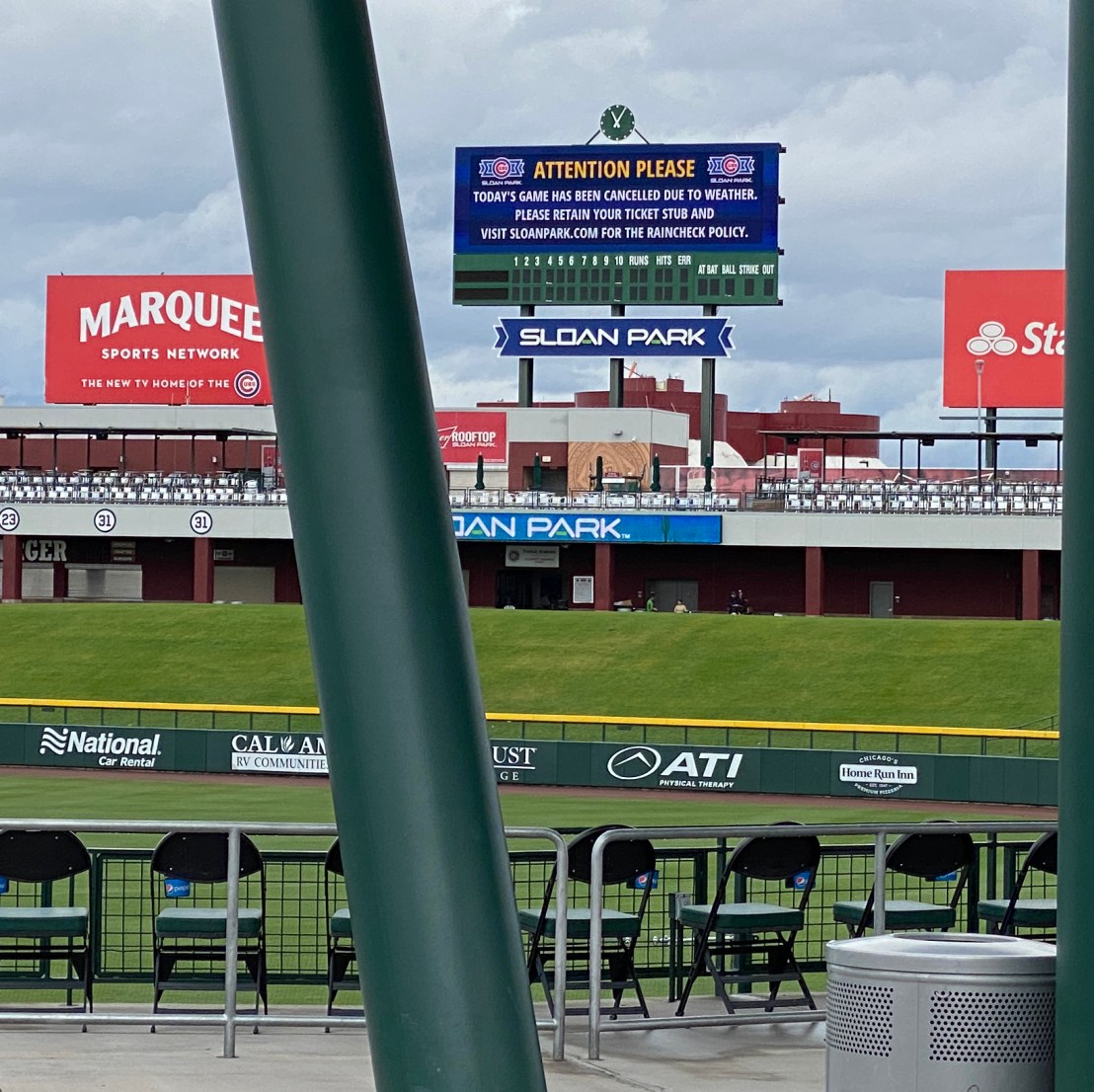
Sloan Park, spring training home of the Chicago Cubs. March 12, 2012.

Then in March, we went to Arizona for a week. Our plan was to go to some Chicago Cubs spring training games, do some hiking, enjoy restaurants, and all of the nice things you do on vacation. On March 12, we arrived at the Cubs spring training facility, Sloan Park, ready to watch a game. We found that the gates were locked and the scoreboard said that the game had been cancelled due to weather. But it wasn’t raining, and the forecast was for sun as the clouds were moving away. Nobody at the ballpark gave us more information. We went to have lunch at Portillos to assuage our disappointment and then went hiking. When we got back to our rented house, we heard that all Major League Baseball games had been cancelled. Coronavirus became real.

Wheaton_College_COVID_dashboard

Wheaton College’s COVID-19 dashboard, February 5, 2021. Students start returning to campus tomorrow for the spring semester under strict virus mitigation protocols. The entire student body will be tested for COVID-19 when students arrive on campus this weekend and they will all be tested regularly throughout the semester.

Later that day, I received an email from the President of Wheaton College. I am Wheaton College’s trombone professor and I was anticipating getting back to teaching when we got home from our spring break vacation. But our President said that spring break was being extended for another week and that all faculty needed to get prepared for several days of training: Wheaton College was going to a combination of remote and greatly modified in-person learning. Everything was changing.
Event_Cancelled

We all know the kinds of things that happened after that. No in-person concerts or theater performances, restaurants and movie theaters were closed, church doors were shuttered, life moved from personal engagement to a computer screen. We all learned that Zoom was not just a word little kids say when they’re pretending to pilot a rocket ship to Mars. Trombone lessons with Zoom and Cleanfeed. Recitals without an audience. Symphony orchestras making mashed up videos with players recording in their living rooms. Cancel. Cancel. Cancel. Masks. Social distancing. Hand sanitizer. Wash your hands. Wash your hands again. CAN’T TOUCH THIS!

So, here we are, nearly a year later. Nobody saw this coming, nobody imagined it would last this long. But we are starting to see hopeful signs for deliverance from the pandemic. Vaccines are now being distributed. I had my first jab of the Moderna vaccine yesterday morning—it was a truly joyful, emotional experience, the fruition of something I had been praying for over many months. We continue to pray that the rest of our family will receive the vaccine soon. So much will change for the better when that happens.

Moderna_COVID_vaccine

The first dose of the Moderna COVID-19 vaccine I received yesterday, February 4, 2021, at Central DuPage Hospital.

We are hopeful that with continued vigilance in following guidance on protective measures (wear your mask—keep apart from others—wash your hands—get the vaccine), we will slowly come out of this long tunnel. And when we do, and when we go to the first sporting event, the first church service, the first concert, play, or musical, the first restaurant after not doing those things for over a year, we will have a new sense of appreciation for all of those things that we always seemed to take for granted. That is one of the important lessons we have learned over these long months.

Still, the pandemic has provided us with opportunities to do other things. Like everyone else, I had to cancel a host of performing and teaching trips over the last year. Soloing at a brass band festival in Seattle. Cancelled. Playing with the Finnish National Radio Orchestra in concerts in Finland and Japan. Cancelled. Teaching at Gene Pokorny’s low brass seminar, at Interlochen Arts Academy, at the Wheaton College summer music camp, at the Csehy summer school of music. All cancelled. Planned vacations to Glacier National Park, Zion National Park, to Arizona. All cancelled. You’ve had things cancelled, too.

But we’ve spent more time with our grandkids, took more walks in forest preserves when the weather was good, and we go sledding down a four foot high berm next to our home (we don’t do “mountains” here in the Chicago area)—the most exhilarating five second ride on a sled that our grandkids have ever had. And in the midst of the storm, and without traveling regularly, that’s freed up time to do a lot of other things. No, I would not have chosen to be at home day after day. But that’s what we have. So I’ve been busy. Here’s some of what I’ve been doing lately.

Yeo_Kanda_ITA_article_sm

  • I wrote an article about my friend, Megumi Kanda, for the International Trombone Association Journal. that published in January of this year. Megumi was the 2020 recipient of the ITA’s highest honor, the ITA Award. Click HERE to read the article.

Yeo_teaching_workstation

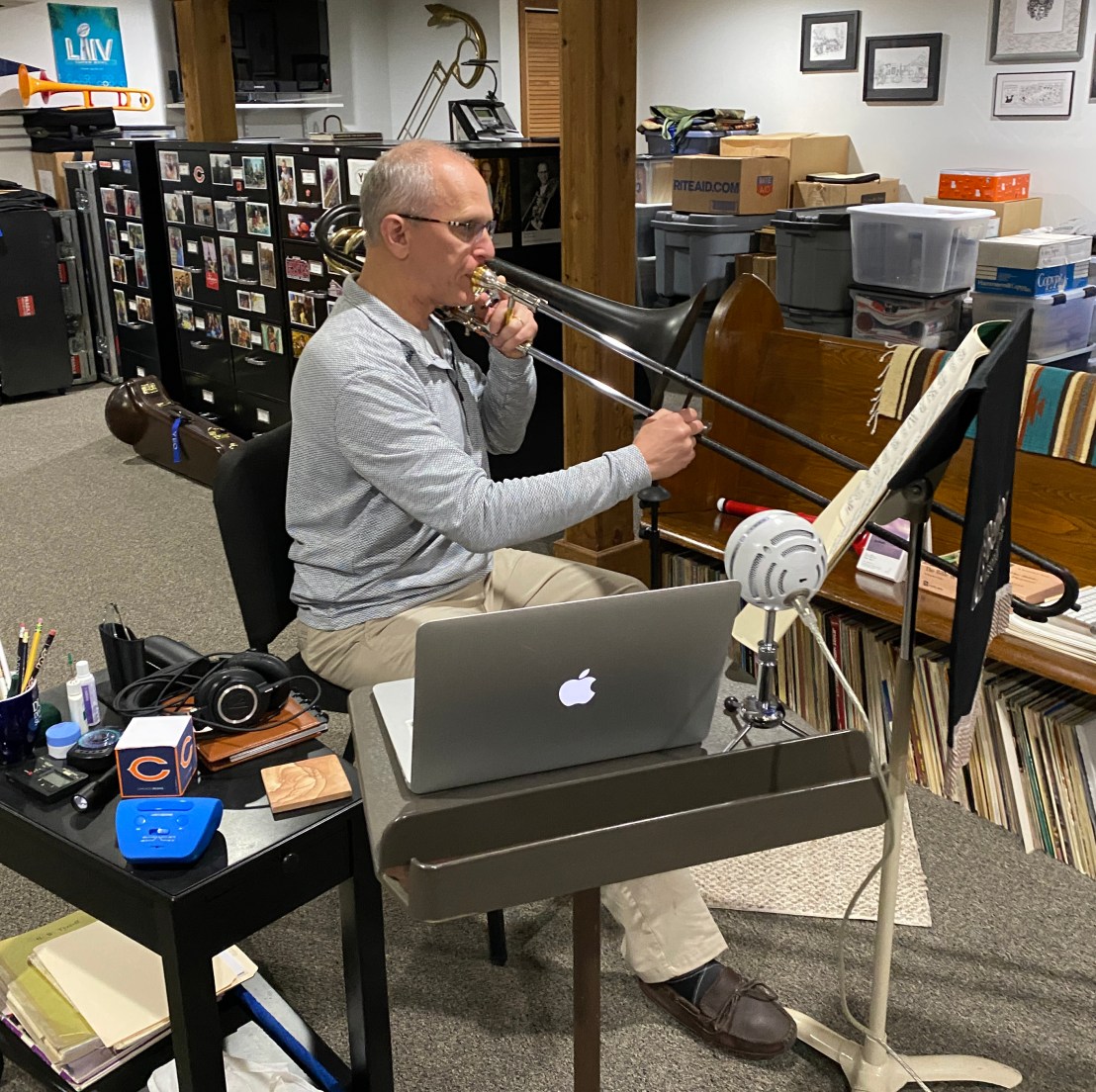
Part of my teaching workstation at my home.

  • I’ve continued teaching my students at Wheaton College each week, both weekly lessons and trombone studio class. And, last semester, trombone literature class. Due to the pandemic, all wind, brass, and voice lessons are done online. I set up a new work station in our basement where I do all of my online remotely. We all know the limitations of Zoom and Cleanfeed, but we’re grateful that the technology allows us to continue to work together and make good progress. We all look forward to the day when we can sit side by side and play duets together once again. Everything just takes so much more time when it’s done virtually. For instance: If a student has a noisy F-attachment valve linkage, at an ordinary in-person lesson, I can say, “OK, hand me your horn,” and in a few minutes, I can usually solve the problem. But now, I have to hold my trombone up to the camera and try to help the student run through a number of diagnostic steps so I can identify the problem. “OK, put your thumb on top of the ball joint—no, the ball joint, not the stop rod arm—then with the other hand, move the F-attachment paddle. Where is that clicking sound coming from? No, I don’t think it’s from THERE— I see the movement in the linkage THERE. . .” And so on. But I salute my students who are dealing with so much as they are in school, both remotely and on campus with very strict virus mitigation protocols. Wear your mask and get the vaccine. Help students and teachers everywhere return to 100% in-person learning as soon as possible.
TromboneFamilyFillmore_Ed

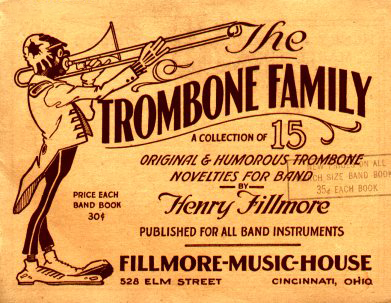
Advertisement for Henry Fillmore’s The Trombone Family, c. 1920.

  • In June, I wrote two articles about Henry Fillmore’s iconic collection of trombone ragtime pieces, The Trombone Family, which includes Lassus Trombone. You can read those articles HERE and HERE. To say the articles aroused a lot of interest is a profound understatement. In the first two days after posting my articles, over 100,000 people read them on The Last Trombone. A vigorous discussion about music, race, and racism ensued. Since then, I’ve answered hundreds of emails from people who have written to  me about the subject, my articles have been reprinted in several journals and newsletters, and I have been asked to speak about the subject before several groups. This engagement continues, and a day doesn’t go by when I am not engaging with people about this important issue. This takes a lot of time. A LOT of time. But it matters.

Yeo_draft_Tuba_mirum_article_incipit

  • I wrote a long article about the Mozart Requiem Tuba mirum that will be published in the International Trombone Association Journal sometime next year.

Yeo_Story_of_Trombone_article_incipit

  • I wrote a commentary and glossary to accompany the republication (in the International Trombone Association Journal) of a short story, The Story of A Trombone, that was first published in Harper’s New Monthly Magazine in 1875. It may have been the first short story ever written about the trombone. This will publish in the ITA Journal later this year.

Yeo_Tubby_Tuba_article_incipit

  • I continued working on my eight part series of articles about the piece for tuba, narrator, and orchestra, Tubby the Tuba. The articles have been published in the International Tuba Euphonium Association Journal through all of 2020 and 2021.

Small_Sliding_Stringing_incipit

  • My Boston Symphony Orchestra colleague Ronald Barron (retired principal trombonists) and I have just finished making an edition of Sliding and Stringing Along, a duet for tenor trombone or bass trombone and violin by the late Charlie Small. This was one the last pieces Charlie wrote before his death in 2017 and he had given both Ron and me handwritten copies of the piece. Trombone players know Charlie Small for his superb playing and also for his fantastic duet for tenor and bass trombone, Conversation. Ron premiered Sliding and Stringing Along in 2015 and he and I put our heads together to sort out Charlie’s many manuscripts. It will be published by Ensemble Publications later this year.

Mungons_Yeo_Rodeheaver_book_cover_sm

The cover to Homer Rodeheaver and the Rise of the Gospel Music Industry, by Kevin Mungons and Douglas Yeo.

  • For the last six years, my friend, Kevin Mungons, and I have been working together on a book about the trombone-playing song leader for evangelist Billy Sunday, Homer Rodeheaver. I had previously published an article about Rodeheaver in the Historic Brass Society Journal (to read the article, click HERE), and it’s been a real joy to work with Kevin to write the first full length biography of Rodeheaver. We completed the manuscript—the book is titled Homer Rodeheaver and the Rise of the Gospel Music Industry—last year, it then went out for peer review, we then engaged in a rewrite, and the book went through various editorial processes with our publisher, University of Illinois Press. We have just finished working through proofing the page proofs and the last thing for us to do before publication of the book this spring is to write the index. The pandemic has provided time for extended work on the book  and we are now in the home stretch. For advance information about the book on the University of Illinois Press website, click HERE.

Peterson_buccin_illustration

Illustration of a buccin (dragon bell trombone) by Lennie Peterson, for my new book, An Illustrated Dictionary for the Modern Trombone, Euphonium, and Tuba Player (Rowman & Littlefield).

Lennie_Peterson_trombone_Kaplin

Another side of Lennie Peterson’s artistic persona, a cartoon from his syndicated comic strip, The Big Picture.

  • For the last five years, I have been working on another book, An Illustrated Dictionary for the Modern Trombone, Euphonium, and Tuba Player. Since being contracted to write the book by Rowman & Littlefield, I’ve been at work putting it together. Last month, I finished my manuscript—over 650 entries about instruments, individuals, composers, manufacturers, and parts of low brass instruments—and submitted it to my publisher. It has now been sent out for peer review and once those comments come back later this month, I’ll engage in a rewrite and the other editorial processes. Hopefully the book will then head toward being published, sometime in late 2021 or early 2022. One of the great joys of working on this book has been working with my illustrator, Lennie Peterson. A sample of his work for the Dictionary is above. Lennie (who is a successful trombonist in addition to his other artistic pursuits) is well known to trombonists for his famous cartoon about trombone players and their band director, Mr. Kaplin (above). Lennie is the rare artist who is expert in a host of styles and I am very happy that we have been partners in putting this book together.
Kuhn_Sousa_Band_1915_crop

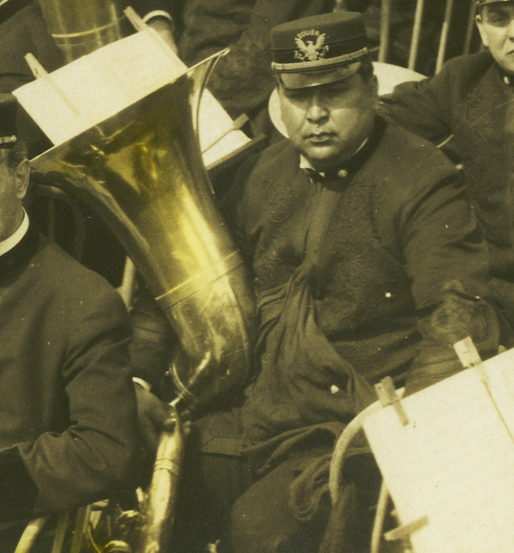
John Kuhn, a member of John Philip Sousa’s Band, at the 1915 San Francisco Panama-American Exhibition.

  • I’ve started researching the legendary Sousaphone player, John Kuhn, and I hope to publish a major article about him in the International Tuba Euphonium Association Journal sometime in 2022. Kuhn is a fascinating subject and as I was researching him for an entry in my Dictionary, I realized that a lot of the information that is known about him is in need of an adjustment. I find this all the time: historical figures have stories associated with them that are “too good not to be true,” but when one actually digs deep to find the root of the story, the narrative needs to be changed. Here’s a photo of Kuhn playing with a massed band (including John Philip Sousa’s band, of which Kuhn was a member) at the 1915 San Francisco Panama-Pacific Exhibition; that’s him looking over his shoulder at the camera. Stay tuned for more about this member of the Sioux nation who was a true force on the Sousaphone for much of the twentieth century.

Yeo_2020_Christmas_ornament_sm

Our family’s 2020 annual Christmas ornament.

  • Every year since we were married 45 years ago, my wife and I have made an ornament for our Christmas tree that reflects some of what our family did in the last year. It’s a nice time capsule that allows us to remember things we might have otherwise forgotten, and to celebrate some of our family’s milestones. It was challenging to find things to put on the 2020 ornament. Here’s what we came up with. A pin from Super Bowl LIV when the world seemed normal, a pin from 2020 baseball spring training when the world changed, and a NO COVID pin. That seemed to summarize the year.

COVID-vaccine_sign_Central_DuPage_Hospital

Sign in the lobby of Central DuPage Hospital, Winfield, Illinois, February 4, 2021.

  • As mentioned above, I received my first COVID-19 vaccination yesterday, with another dose coming in a few weeks. And, straight up, I want to say that I had no side effects apart from a slightly sore arm yesterday, no more than what I experience every year when I get a flu shot. By saying that I received the vaccine, I guess I’m giving away my age since here in Illinois, the vaccine is only available at this time to front line essential workers like doctors, nurses, and emergency personnel, teachers, and individuals over 65 years old (and I’m not a front line worker). My son-in-law, Chad, who is a hospice chaplain who is in contact with people all day long in homes and care facilities, has had both of his vaccination doses over the last few weeks. My getting it yesterday means 25% of our immediate family has been vaccinated, and we see this as tangible progress toward all of us getting vaccinated—a key element to returning to a more normal life. I received my vaccine at Central DuPage Hospital in Winfield, Illinois—part of the Northwestern Medicine health network—and I was so impressed by the efficiency of their distribution system and the care of its staff. The process went smoothly from start to finish, and I want to add my voice of thanks to all those who have been working so hard to help get the vaccine into people’s arms, and to those who have been caring for those who have contracted the coronavirus. We all know that this virus is bad—really bad—and we rejoice that deliverance from the pandemic seems to be in reach thanks to the vaccines. Thank you, God. In a world that is upside down, during a time where so many people have lost so much, it’s comforting to finally see the light at the end of the tunnel. And we’ll get there sooner if everyone follows health care directives including wearing a mask, maintaining appropriate distance from one another, and getting the vaccine. It matters.

So, that’s some of what’s been keeping me busy over the last year. Thanks to those who reached out and expressed concern, who wondered why I haven’t been posting more often on my blog. I’ll try to get to it more regularly. I’ve just been busy—like you’ve probably been busy, too.

[Header image: The daily United States coronavirus map from The New York Times, February 5, 2021.]

Making and sharing music in a challenging time

Making and sharing music in a challenging time

The coronavirus pandemic has shuttered concert halls and theaters, opera houses and nightclubs. Live music with multiple performers working together in a collaboration just can’t be done in public in most places these days.

Yet musicians are finding creative ways to bring music to a world that seems to need it now more than ever. A day doesn’t go by when someone doesn’t forward me a video of some group of performers who put together a music video with a number of “socially distanced” players who have recorded a track individually and then put it together to make a group performance. I’m involved in a project with some friends as well; more on that once we get it done. Some of these projects are not very well done or are just not that interesting to me, but others make me smile, cry, laugh, and celebrate. Here are a few I’ve enjoyed recently. I hope you enjoy them, too.

The Milwaukee Symphony has recorded Edward Elgar’s “Nimrod” from his Enigma Variations. I find this performance very moving on a lot of levels, especially because the music itself is so compelling. Among those members of the orchestra who are performing are my friends, second hornist Dietrich Hemann and his wife, principal trombonist Megumi Kanda, who share a screen. To view this video on YouTube, click HERE.

In 1996, the Boston Pops Orchestra recorded an album of music to celebrate the 1996 Summer Olympic Games in Atlanta. Conducted by John Williams, it included many works that had been written for previous Olympic games, as well as Summon the Heroes, a fanfare which Williams wrote for the Atlanta games. I was a member of the Boston Symphony at that time (1985-2012) and I count recording that album as one of the most memorable events of my musical career. Recently, 50 members of the Boston Pops Orchestra recorded Summon the Heroes once again, conducted by Boston Pops conductor, Keith Lockhart. Tom Rolfs plays the trumpet solo and the low brass section is Toby Oft, Steve Lange, Jim Markey (bass trombone), and Mike Roylance (tuba). To view this video on YouTube, click HERE.

I’ve played many concerts – playing serpent, ophicleide, and bass sackbut – with Boston’s Handel & Haydn Society, an early music group based in Boston. Here’s a fun video by H&H principal flutist Emi Ferguson who makes a do-it-yourself baroque flute. Seriously! And it sounds great (and Emi sounds great, too). Try it! To view this video on YouTube, click HERE.

Here is a new piece, All Day Long (The Coronavirus Song), written by my friend, Paul Langford, and his 14 year old daughter, Chloe. Paul has been a singer and arranger for the acapella group GLAD for many years and I think this original song and Chloe’s performance are absolutely terrific and inspiring inspiring. And there’s euphonium and trombone content, too! For more about the piece and how it came about, see this article from Chicago’s WBZ; click HERE to read it. To view this video on YouTube, click HERE.

Terry Everson is professor of trumpet at Boston University, and a good friend of our family since he and his family moved to Boston in 1999. Terry served as principal cornet of the New England Brass band for most of my tenure as the band’s music director, and he is a super trumpet player (and teacher), pianist, and arranger. In this video of John Dykes’ Holy, Holy, Holy, Terry is joined by his wife, Lori, on violin, and their son, Peter, who just graduated with a degree in trumpet performance from Boston University. To view this video on YouTube, click HERE.

Mashups of classical and popular music don’t usually work for me, but this performance of J. S. Bach’s Brandenburg Concerto No. 3 and Paul Simon’s American Tune does. The group is The Knights, joined by vocalist Christina Courtin. American Tune is my favorite pop song; it has been since it was first released on Simon’s solo album, There Goes Rhymin’ Simon, in 1973. The music is adapted from a tune by Hans Leo Hassler, adapted by J. S. Bach in his Saint Matthew Passion as, O Haupt voll Blut und Wunden (O Sacred Head, Now Wounded). The group gives a superb performance of Bach’s Concerto, and Courtin’s take on American Tune is honest, heartfelt, and moving. Paul Simon’s text never felt more relevant to me than in this challenging time; he could have written it yesterday. To view this video on YouTube, click HERE.

Our youngest daughter, Robin, is Director of Public Relations for San Francisco Symphony. She recently shared this fine performance of Paul Dukas’ Fanfare from La Peri, featuring members of the San Francisco Symphony brass section. And while you have the San Francisco Symphony on your mind, take the time to view the orchestra’s excellent video series, Keeping Score, where music director Michael Tilson Thomas and the orchestra provide an in-depth look at some of classical music’s greatest works including compositions by Aaron Copland, Charles Ives, Ludwig van Beethoven, Hector Berlioz, and many others. To view this video on YouTube, click HERE.

I’ve played the ophicleide for many years, a bass instrument in the brass family that was invented in France in the early nineteenth century and was a predecessor to the tuba on a long evolutionary path. In recent years, the ophicleide has gotten the attention of many superb, young players, including Francesco Gibellini. Of the many overdubbed recordings people are making these days, I think this one is one of the best. I have no idea how he did it but I think this will make you smile. To view this video on YouTube, click HERE.

The coronavirus pandemic is challenging for all of us. But in the midst of the storm, we can hold on to the promise of God: He is faithful. Stevener Gaskin, who is Intercultural Arts Associate at Wheaton College where I teach trombone, has contributed an inspiring video – Faithful Promise –  in his unique performance style. I have heard Stevener in person several times and I’ve never failed to be moved by his work. This video was filmed in part on the front campus of Wheaton College; you will see the College’s first building, historic Blanchard Hall, in the background. I return to this video over and over again to be encouraged to persevere through this storm, knowing that God is faithful and He will bring us through this, even as we pray that we will also learn the important lessons God would have us see and understand that are already unfolding before us. To view this video on YouTube, click HERE.

[Header image of coronavirus in headphones from Variety.]

A different kind of graduation day

A different kind of graduation day

Today is graduation day at Wheaton College, Illinois. The college is both my undergraduate alma mater and also where I now teach trombone to eager, gifted, and hard-working students. One of my students, Brendan, is graduating today. But instead of walking down the aisle of Edman Chapel with his classmates, hearing an inspiring commencement speech, praying and singing with faculty, administrators, families, and fellow students, and then having joyful celebrations at home with food, friends, and relatives, today’s graduation ceremony takes place in the form of a celebratory YouTube video followed by a Zoom meeting. I’ve just finished watching it. It was very nice; it was very joyful; it was very meaningful. But it was different. Still, I am confident that our graduates of 2020 will remember their graduation every bit as vividly as I remember mine. Each graduation is unique, and its memory becomes a part of us.

D-Yeo_JTHS_1973

I’ve received a degree at three graduation ceremonies. I graduated from Jefferson Township High School in New Jersey, 1973. I think the ceremony was outside, on the school’s football field. I only have one photo from that day, a blurry snapshot of me with my mom and dad, taken in our backyard before we left home for the event, above. I received the senior class awards in music and English during the ceremony. People often say that music and math go together. Not for me. I can’t even do basic arithmetic much less mathematics. My body seems to reject math and science. Happily for me, my wife excels in those things so we are a good pair.

Pat_Doug_Hudson_Armerding_May_1976

My graduation from Wheaton College in 1976 was very memorable. The weather was nice, my parents and my wife’s parents travelled to Wheaton from New Jersey for the festivities, and the next day, Pat and I headed back to New Jersey to start our new life in New York City. After the ceremony, she and I had a conversation with Wheaton College’s President, Hudson Armerding (photo above), one of the most godly men I have ever known and a person whom I still hold in the highest esteem.

Three years later, in 1979, I graduated from New York University. Thousands of students graduated that day so a single representative from each of NYU’s colleges received their degree on the platform on behalf of the other graduates. My strongest memory from that day in Washington Square Park was that I played in the NYU band, doing my part to play Elgar’s Pomp and Circumstance March No. 2 more times than I could count. And I also got paid to play in the band that day. $25, I think. Nice. I don’t have a photo from that day; nobody had yet thought of what we, today, call a “selfie.”

HIDA_Convocation_all_graduates_2016

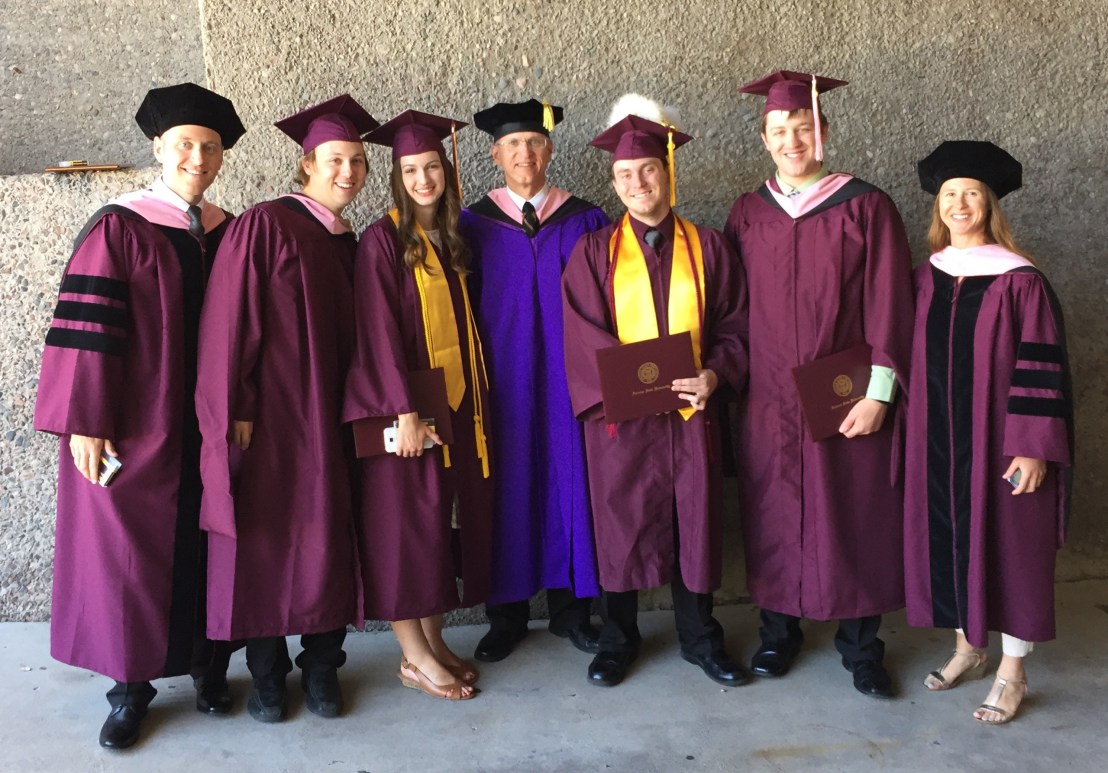
I last attended a graduation ceremony in 2016, my final year as Professor of Trombone at Arizona State University.  In that year, I had six students walk the aisle; every student walked and received their diploma. Seeing this photo (above) brings back so many memories. Look at those smiling faces. Timothy Hutchens (DMA), Paul Lynch (MM; he went on to receive his DMA at ASU a few years later), Kristie Steele (BME), David Willers (BME), Adam Dixon (MM; he also went on to receive his DMA at ASU a few years later), and Emmy Rozanski (DMA).

Today’s graduation ceremonies are different due to the coronavirus pandemic. But we should not for a second think that the accomplishments of our students who graduate today are any less for the fact that their commencement celebration comes across a computer monitor rather than in a football stadium, college arena, or chapel. Today, we celebrate their completion of a race, and their turning of a page to a new chapter. These are ones who will change the world, who will make a difference. We applaud them, celebrate them, and want to encourage them. And so we do. I have just finished watching the Wheaton College Conservatory of Music virtual graduation celebration. I laughed a little, cried a little, and was very grateful. I found it very meaningful to hear Dean Michael Wilder reflect on the last four years, see and hear reflections by graduates, and greetings from faculty. I don’t know how long it will stay up on YouTube but it’s there now. If you want to see a meaningful graduation celebration for the class of 2020, click HERE. Thank you, Wheaton College, for having the vision to put together something so joyful, emotional, and meaningful.

On June 10, 2006, I gave the commencement address at Caritas Academy of Arts and Sciences in Massachusetts. As I reviewed those comments, which appear HERE on my website, I realized that I could have written them yesterday.They are just as timely today as when I wrote them 14 years ago.  I titled my comments, “Hold on to Hope.” Hope is very much a part of our thinking right now where the world is upside down. I thought I would share it again here on The Last Trombone. To graduates everywhere: congratulations! And please, hold on to hope.

HOLD ON TO HOPE

Graduation address by Douglas Yeo
Caritas Academy of Arts and Sciences, Hudson, Massachusetts
June 10, 2006

You may sit here wondering, “What can a trombone player from the Boston Symphony bring to a high school graduation ceremony? Especially if he doesn’t have a trombone in his hand?” That’s a good question. And it is my fervent prayer that you will have an answer to that question in a few minutes time.

I bring to each of you today a warning, a hope, and a task. On occasions such as this, speakers are called upon to offer inspiring words of wisdom to the graduates, a pat on the head to the parents, and encouragement to faculty. But honesty requires something more. I will not pray an Irish blessing over this graduation, as I know that the road will not always rise to meet you, and the wind will not always blow softly at your back. Life is hard. We live in a desperately fallen world, one in need of the redemption that comes only through Jesus Christ. It is a world that screams of its fallenness – natural disaster, war, famine, ethnic conflict, hatred. Discouragement is there for the picking, temptation is constantly knocking at your door. The burden of “doing the right thing” is often suffocating. You do not need platitudes from me. I come with something different. Something “other.”

Midway along the journey of our life
I woke to find myself in a dark wood,
for I had wandered off from the straight path.

Some of you know the context of these words, don’t you? They’re the opening of Dante’s Inferno, the first of the books of his Divine Comedy which includes Inferno, Purgatorio, and Paradiso. Wandering from the straight path, we find ourselves in a dark wood. The dark wood may be something literal, such as a wrong turn when trying to get somewhere and you end up in a forest – or in Connecticut. But more often than that, do we not all end up in a metaphorical dark wood sometimes – the dark wood of an exam without adequate preparation, the dark wood of a confrontation with a friend that goes in a direction that causes hurt that seems irreparable, the darkwood of substance abuse, or the dark wood of any number of poor choices that we could make?

As we travel down the path, we can usually see what is going to happen; there is always that still small voice – or perhaps one that screams as in a hurricane – but we often ignore the words and the decibels. In too deep to get out but not in so far that we can’t wish we could turn around, we head straight into the mouth of disaster.

I’ve been there. We all have. And sometimes those moments can be pretty dark.

The dark moments are moments when Satan can grab us. And one of his most successful tactics is to cause us to give up hope – to think it’s impossible to get through the dark wood, to feel like there is no way out.

Alexander Pope reminds us that “Hope springs eternal.” And so it does. Right now, there are those of you who are hoping that I will get done speaking early so you can get on to your graduation party, or you hope to get back to the computer, the cellphone, your Palm or Treo so you can attend to the tyranny of the urgent.

But hope can be lost when we are overwhelmed. We can give up. While Philippians tells us:

I press on in order that I may lay hold of that for which also I was laid hold of by Christ Jesus. (Philippians 3:12)

we sometimes nevertheless give up and lose hope, the thought of pressing on through a circumstance being too great a weight to bear.

In fact, perhaps the most depressing words that were ever penned are those above the entrance to Hell as found in Dante’s Inferno:

Abandon every hope, all you who enter.

Several years ago, the Boston Symphony Orchestra performed Puccini’s masterpiece, Madama Butterfly. It is the story of a 15 year old Japanese girl from a poor family who marries an American Navy Lieutenant. The officer, Lt. Benjamin Franklin Pinkerton has no intention of remaining faithful to the girl but she takes his vows and covenant at their word. Even after he abandons her for three years – after she has given birth to a child he has never seen – she holds onto hope. Even when all of her friends tell her that he is gone, never to come back, she still hopes. Only when he returns with his new, American wife does she realize that her hope was in vain. Having renounced her religion to marry the American, having lost her family as they in turn renounced her, having lost her virginity, having lost her freedom, having lost her husband, she agrees to his request to give her child to him. In what I find to be the most crushing moment of the opera, Butterfly cries,

O triste madre, triste madre,
Abbandonar mio filio.

“O sorrowful mother,
to abandon my child.”

In the end, she kills herself. For, as her Shinto tradition perversely reminds her, “To die with honor is better than to live with dishonor.”

This is heady stuff even for opera. But Butterfly’s hope is not unlike that which grips many in this world. While everything looks hopeless and overwhelming, people hold on to hope – even hope in something that offers no hope – because they have nothing else.

But our world tells them that there really is nothing to hope for. After all, a popular line of sporting equipment marketed a slogan that said simply:

Life is short, then you die.

That’s about as hopeless as one can get. Isaiah speaks of this as well when he recalls the comments of those nihilists in his time who said:

Let us eat and drink, for tomorrow we may die. (Isa. 22:13).

You see, our society, like Isaiah’s, is obsessed with the here and now. We live in the FAST culture, the NOW culture, the IMMEDIATE culture. Hard work and self-denial give way to the quick fix and the easy get-around.

My trombone teacher while I was a student at Wheaton College, Edward Kleinhammer, played bass trombone in the Chicago Symphony Orchestra for 45 years. He was one of the most disciplined, hard working people I have ever known, and a man who knows and loves the Lord. Several years ago we wrote a book together with the pretentious title “Mastering the Trombone.” In his preface, he penned a sentence that either inspires dedication or causes one to abandon hope. He wrote:

World-class trombone players do not just happen. Their talents are forged in the dual furnaces of determination and diligence.

Not very popular words. Forge, furnace, determination, diligence. White hot heat, self-denial, hard work, discipline.

Why bother, if “tomorrow we die?”

Several years ago I was in Hong Kong and saw a young man with a t-shirt, on which was emblazoned the slogan:

Whoever dies with the most toys – still dies.

What’s the use, why not just “abandon all hope” and wait for the end to come? Look around, do we not all know people like this? Television, the Internet, pornography, the skateboard, video games – we know those who are amusing themselves to death, those who like Peter Pan resist at every turn the siren call to grow up and move ahead, who deny the call to fulfill their calling.

But, we who know Christ know that there is hope, a hope that transcends the collection of “toys,” a hope that makes all we do worthwhile. We have the great promise, told to us in Jeremiah 29:11

‘For I know the plans that I have for you,’ declares the LORD, ‘plans for welfare and not for calamity to give you a future and a hope.’

We know this – even in our darkest moments – and while it may take all of our will and way to keep Satan from deceiving us into believing that the promise is a lie, we DO know this. And we also know that by constantly keeping THE BOOK – God’s word – before us, we can resist the “flaming arrows of the evil one” as he tries to wrest our hope from us.

We know the promise of sticking with the task, and how true are the words of Hebrews:

Therefore, do not throw away your confidence, which has a great reward. For you have need of endurance, so that when you have done the will of God, you may receive what was promised. (Hebrews 10:35-36)

Press on, endure, “stick with it,” determination, diligence.

And, so, we have the warning: the world will try to strip you of your hope. Be on your guard and don’t believe the lie.

We have a hope, the only hope that is worth hoping in: hope in Jesus Christ, hope that there is a future, hope that no matter what this fallen world throws at us, that God is with us not in the twisted untruth of the bumper sticker, “God is my co-pilot” (co-pilot? co-pilot? No: God is not our co-pilot; He is our pilot) but rather, our prayer is to the truth of St. Patrick paraphrased by the great hymn write Cecil Alexander:

Christ be with me, Christ within me,
Christ behind me, Christ before me,
Christ beside me, Christ to win me,
Christ to comfort and restore me.
Christ beneath me, Christ above me,
Christ in quiet, Christ in danger,
Christ in hearts of all that love me,
Christ in mouth of friend and stranger.

And now, the task.

To the teachers of these graduates, I say: remember them. You have left a piece of yourself in each of these students. You nurtured, you lectured, you disciplined, you rejoiced, you felt sympathy, even pity, and at times exercised mercy. You shared your knowledge with them but you also learned from them. As much as you have influenced them, they have also found a way into your life. Perhaps someday they will even write to you and thank you for what you gave them. But remember this: a teacher without a student speaks only to desks and the chalkboard. These graduates have allowed you to fulfill your calling and exercise your gift of teaching. The Talmud says, “Whoever teaches a student teaches that student’s student – and so on until the end of man’s generations.” (Talmud Kedushin 30, a) You are in them. Remember them.

To friends of these graduates, I say: encourage them. They are, at this moment, poised on a precipice. The world is before them, they rejoice at this memorable accomplishment. They look ahead with fear and trembling, with hope and joy. They will know rapturous success and they will stumble. Will you, in the name of Christ, offer them your hand? Will you write them, call them, admonish them, rejoice with them, pray for them? Will you be the kind of friend that can tell them things they don’t want to hear? Will you be the kind of friend who weeps with them – tears of joy when they do well and tears of hurt when they fall? Can you offer encouragement when they need it, can you resist the temptation to act like you know everything and need to impart it to them? Will you be faithful to them, will you remember them in your prayers, and remind them that wherever they may be, there is one in another place who has their face in your eyes, their voice in your mind and their friendship in your heart. Encourage them.

To parents of these graduates, I say: love them. This is both a joyful and wrenching moment for you. Many years of parenting have brought you and your child to this moment in time. You have watched them grow from a helpless infant into a young adult. You have dried their tears, put band- aids on their skinned knees, taught them to ride a bicycle and drive a car. You have cheered their successes and agonized over their failings. They have made you proud and they have let you down. But in all of this, you have loved them. They are ready to fly – they will move away. As they are in transition, so you are in transition as well. You are beginning along the road that will lead to your new role as “parent of adult child.” Your son or daughter still needs your guiding hand but as the years go on, your role as their primary teacher will change significantly. With this milestone event you begin the process of letting them go. You knew this day would come many years ago when they were born, but like Sleeping Beauty’s parents, you hoped that all of the spinning wheels had been taken away lest a finger be pricked. But that is not the way God ordains families to be. You have trained up your child in God’s way. Today you begin the process – which will take a few more years – of releasing them. Your son or daughter will face many temptations. Every choice they make will not be a good one or the right one. But through anything and all things, give them your love. Let them know that no matter what may happen, no matter how low they may fall, no matter what condemnation the world brings upon them, no matter how great their success may be, that they have in you one who loves them. One who will, as you always have – even imperfectly – come alongside them and love them. Let them know that home is the one place on this fallen planet where love – unconditional, deep, abiding love – lives. Love them.

And, finally, to these graduates, I say: hold on to hope. Each of you entered this day full of anticipation. This milestone event is one for which you can be justifiably proud. You know the work it took to get here. But graduation from Caritas Academy is not a goal, it’s a way station. It’s the first punch on your ticket as you move on to accomplish what life has before you. You move from here to somewhere else – to college or the work force, to new relationships, and eventually to a new place to call “home.” This transition, like every step of life, will not be easy. While you may feel you are “boldly going where no man has gone before,” the truth is you’re leaving the comfort of what you know for the uncertainty of what you do not know. All of the confidence in the world will not keep boulders out of your path. You will be hurt, beaten down, discouraged. You will be tempted to give up hope. But look up! We who know Christ understand that He is the blessed hope. That the promises of God are true even when they feel empty. Our culture works hard to plant seeds of doubt in your mind. You are bombarded with advertising that seeks to convince you that you are dissatisfied with all you possess. Don’t believe the lie. You are a child of God, an heir to the throne. You have been gifted with abilities and talents which not only CAN but which WILL have an impact on the world around you. But you have to hold on to your hope. Keep the Book close to you; meditate on it day and night, write it on your forehead. Remember its promise:

Beloved, do not be surprised at the fiery ordeal among you, which comes upon you for your testing, as though some strange thing were happening to you; but to the degree that you share the sufferings of Christ, keep on rejoicing; so that also at the revelation of His glory, you may rejoice with exultation. (1 Peter 4:12-13)

View the world about you with the proper perspective. William Blake wrote:

This life’s dim windows of the soul
Distorts the Heavens from pole to pole,
And leads you to believe a lie
When you see with, not through, the eye.

Malcolm Muggeridge helps us understand this when he said that seeing THROUGH the eye “is to grasp the significance of what is seen, to see it in relation to the totality of God’s creation.” Seeing all before you through the eye of God – the eye which looks past the superficial to the truly important – will help you hold on to your hope, to remain true to your calling, and to persevere through trials and trouble.

And don’t forget THIS: you did not get here alone. Teachers, friends and parents walked with you in this journey called life. They will continue to do so. As you have been blessed by them, remember to bless others. Trust God, Honor God, Thank God, Humble yourself before God. Remember the words of Romans 12:10:

Be devoted to one another in brotherly love; give preference to one another in honor; not lagging behind in diligence, fervent in spirit, serving the Lord; rejoicing in hope, persevering in tribulation, devoted to prayer, contributing to the needs of the saints, practicing hospitality.

And may the God and Father of our Lord Jesus Christ, the Father of mercies and God of all comfort; who comforts us in all our affliction so that we may be able to comfort those who are in any affliction with the comfort with which we ourselves are comforted by God, uphold, guide, perfect, confirm, strengthen and establish you. (2 Corinthians 2:3-4, 1 Peter 5:10)

Amen.


Hope.

Hope.

We are living through an extraordinary crisis. Words fail. Everyone has a story; no one is immune from the implications of COVID-19. Every part of every life is impacted on every level.

As I, like everyone on our planet, work to navigate the challenges before us, I am reminded that there is one thing we cannot do: we cannot give up hope. Everyone hopes in something. My hope is in God. I do not doubt God’s wisdom or rightness; God is Sovereign—God is in, around, above, before, behind, under all things. In this present crisis, as always, I have some questions for God. But I know God  hears my prayers every day. I trust God even in the midst of the storm; God is teaching us something in all of this.

With life now sideways and our feet treading in quicksand, I spent a few hours yesterday cleaning up our basement where I practice trombone and have most of my music, books, recordings, and files. It is there where tomorrow, I will begin teaching remote lessons to my students at Wheaton College (Illinois).

Yeo_remote_teaching

Sometimes when you go looking for something, you find something else. While filing away some documents yesterday, I came across the Boston Symphony Orchestra program for opening night, September 24, 2008, four years before I retired from the orchestra in 2012. It was the fifth year of James Levine’s tenure as music director of the orchestra, and the program included Pictures at an Exhibition of Modeste Mussorgsky, orchestrated by Maurice Ravel. The concert remains memorable to me, but the reason I saved that program is because of its beautiful cover image. It shows the center of the ceiling of Symphony Hall, Boston, where the middle of three crosses on the ceiling is illuminated by a chandelier. I spent many hours looking at that ceiling and its three crosses, which always reminded me of three crosses on a hill called Golgotha outside Jerusalem 2000 years ago where my Hope, Jesus Christ, lived, died and rose again, and gave me the Hope I hold. And now, looking at this beautiful, artistic photograph, I am reminded again of my Hope. Light in darkness. Good in the midst of evil. The solid rock in the midst of sinking sand.

Symphon_Hall_Boston_ceiling_Low_res

In the midst of this storm, the only hope we have is in God. Pray for deliverance from this pestilence. Pray for safety. Pray for wisdom in how we can help others. Pray for others who have greater challenges than we have. Pray that when this ordeal is over, we will act in new ways in light of the lessons we are learning today. This we pray. Amen.

So we do not lose heart. Though our outer self is wasting away, our inner self is being renewed day by day. For this light, momentary affliction is preparing for us an eternal weight of glory beyond all comparison, as we look not to the things that are seen but to the things that are unseen. For the things that are seen are transient, but the things that are unseen are eternal. (2 Corinthians 4:16-18)

[Header image: Sunrise over the Sierra Estrella, Goodyear, Arizona, 2012. I took this photo from the front porch of our home where we lived from 2012-2018. Sunrise. A new day. Hope.]