Category: Uncategorized

Returning to Japan

Returning to Japan

I have been to Japan more times than I can count — maybe 12 or 13 times — and on my many trips, I have always had a trombone in my hand. During my nearly thirty years as bass trombonist of the Boston Symphony, I took part in many Boston Symphony and Boston Pops Orchestra tours to Japan, conducted by Seiji Ozawa and John Williams. The first of these tours, in 1986, led to my introduction to YAMAHA, which resulted in the beginning of my long, productive, and happy relationship with the company and its people. Together we have worked to develop the YAMAHA YBL-822G bass trombone and YAMAHA Douglas Yeo Signature Series Mouthpiece that I have been playing for decades.
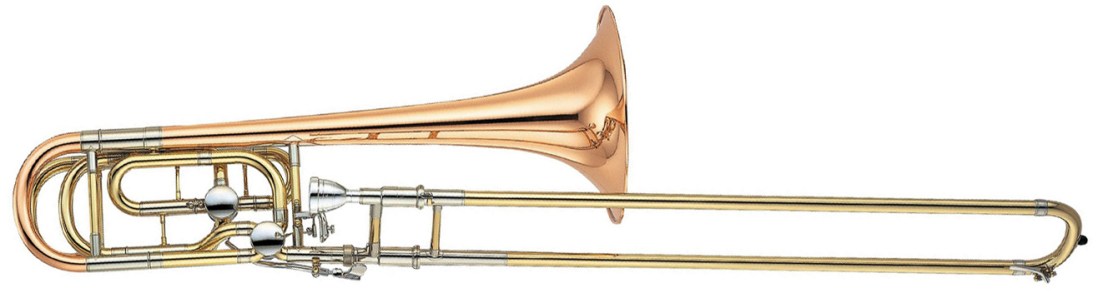
822.jpg

I have also traveled to Japan many times to serve on the faculty of the Hamamatsu International Wind Instrument Academy and Festival, an annual event that brings together an international group of teachers and performers to work with talented students. Sponsored by YAMAHA and the City of Hamamatsu, times working at the Academy have been memorable.

Next week, I will return to Japan once again, as the guest of the Nagoya Trombone Festival, sponsored by the Nagoya Trombone Association. During the two day Festival, I will play a recital (accompanied by a superb pianist, Shoko Gamo), perform as soloist with a trombone ensemble, conduct two trombone ensembles, and give a lecture on the history of the trombone. Here are a few more details:
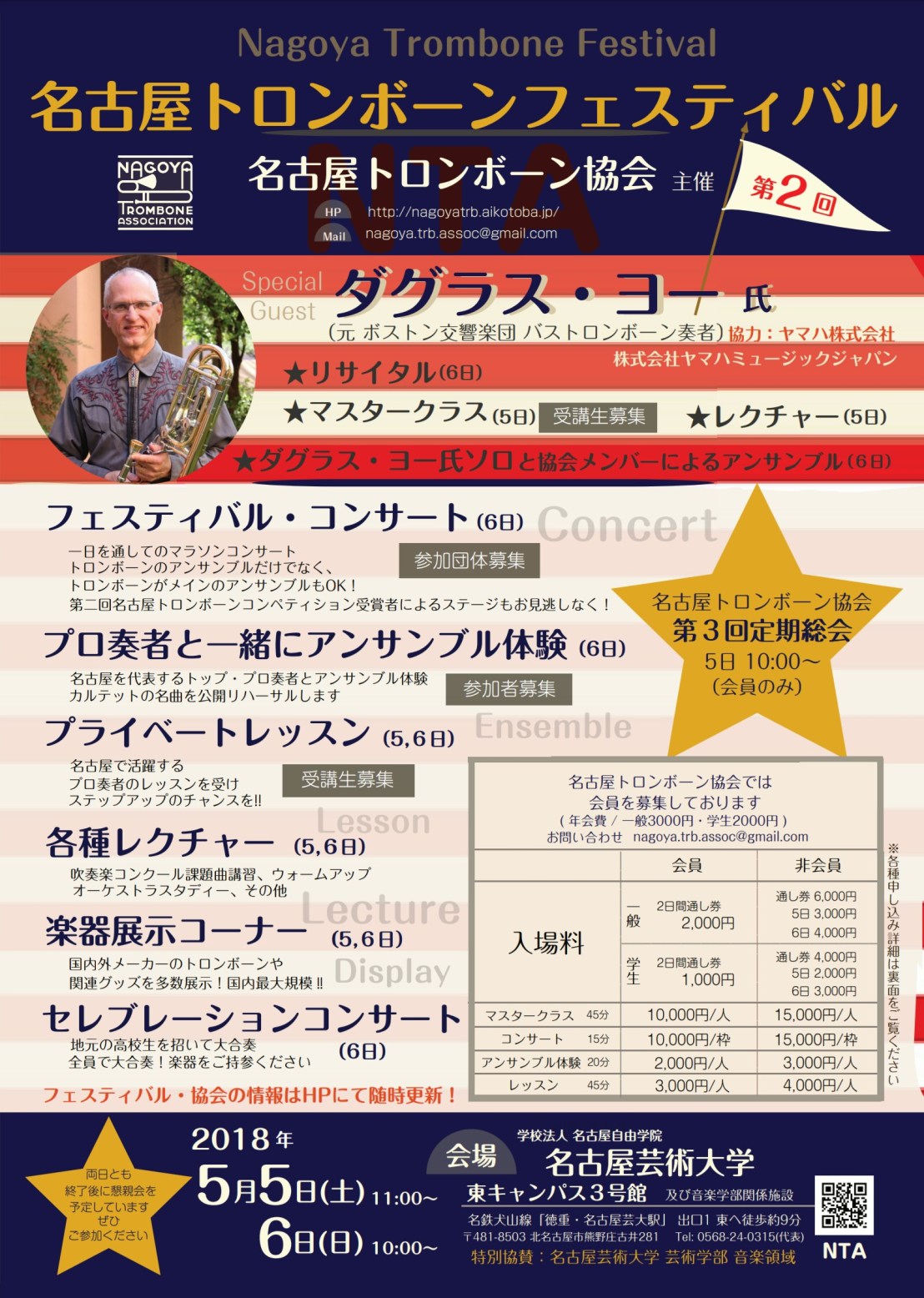
Yeo_Nagoya_trombone_festival_poster

One of the special joys of this trip will be to see my former student, Nozomi Kasano Flatt, who plays bass trombone in the Japan Century Orchestra in Osaka. I met Nozomi in 2004 at the Hamamatsu Academy where she was a student in my trombone class. She subsequently came to Boston where we worked together for three years and she received her Graduate Diploma and Master of Music Degrees at New England Conservatory. I am exceptionally proud of Nozomi and all of her accomplishments and in 2014, she served as my translator for my class at the Hamamatsu Academy. Next week, she will be my translator once again, and we will also play a duet on my recital.
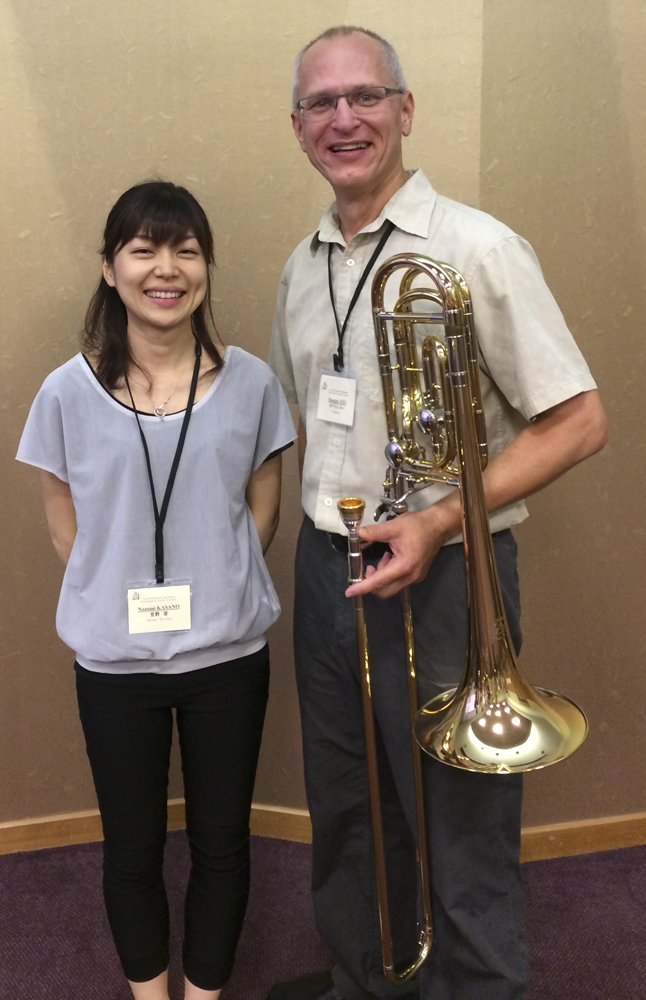
Kasano_Yeo

One of the pieces I will play on my recital is an arrangement of a Canzone by Frescobaldi by Eddie Koopman. Koopman’s electronic accompaniment gives a new flavor to this piece from the Renaissance and to inject something different into my recital, I will play it on a buccin, a dragon bell trombone. In 2015, I gave a recital at the Hamamatsu Museum of Musical Instruments and played this piece on a buccin made by YAMAHA. It’s a great instrument, made by YAMAHA factory workers in their spare time. It’s very nice of YAMAHA to let me use this instrument once again in Nagoya where I will be able to bring a very different kind of trombone sound to the audience.
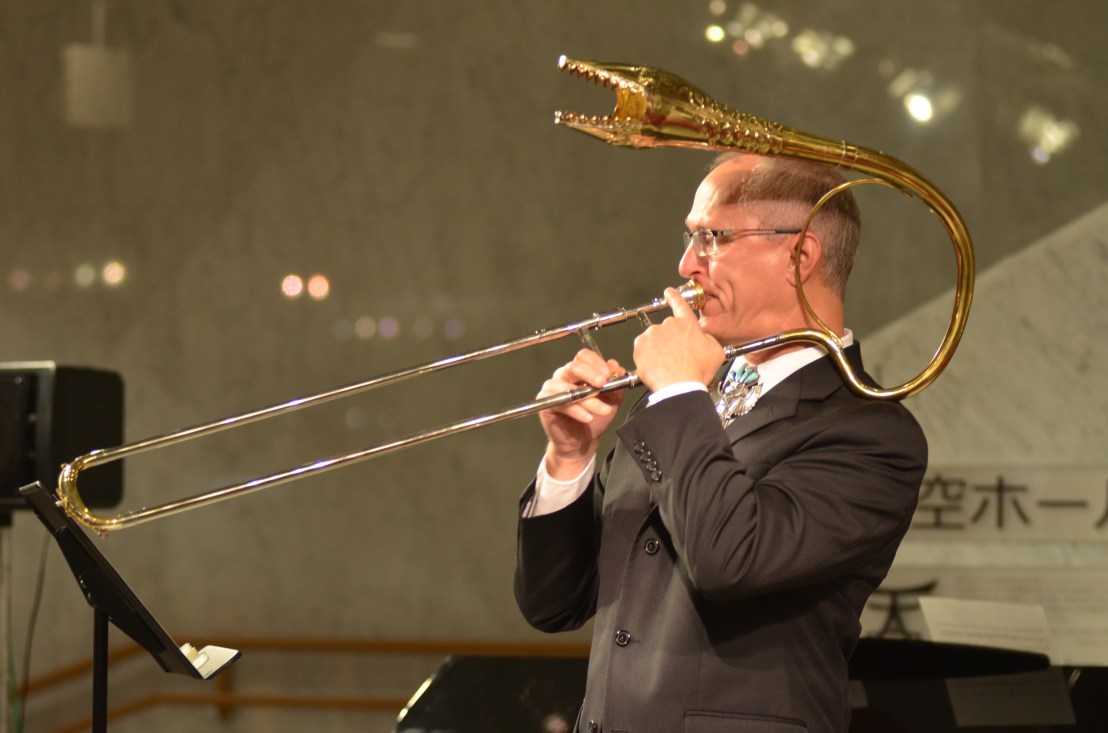
DSC_0600

In addition to my work at the Nagoya Trombone Festival, I will also give a masterclass at Aichi Prefectural University. While there, I will work with several talented young trombonists and also have an informal talk with the students about my life in music. Here is a poster with some more information about my time at the University.

Nagoya_poster_2.jpeg

Japan. Nagoya. Trombone. Music. Friends.
Schermafbeelding-2016-12-21-om-11.55.40-2.png

Screen Shot 2018-04-28 at 7.47.14 AM.png


Trombones in Texas: y’all come!

Trombones in Texas: y’all come!

Texas. It’s a big state. And it has a lot of trombone players.

Next week I’ll be in the Lone Star State, giving masterclasses and performing at University of Texas, Austin (Dr. Nathaniel Brickens, Professor of Trombone) and Texas Christian University (Dr. David Begnoche, Associate Professor of Trombone). I’ve been to these two schools and worked with these fine teachers on previous occasions; it has always been a joy and pleasure to work with their students and enjoy time together.

If you find yourself in Austin or Fort Worth, Texas next week, come on by to some of the events listed below. Here’s a flyer with some of my University of Texas, Austin activities:

Screen Shot 2018-04-05 at 7.11.01 PM

Click on the TCU logo below; it will take you to the website of the TCU Trombone Summit, to be held on Saturday, April 14. It’s an all day event with masterclasses by several artists and a gala concert at night. If you can’t view the image below, click HERE to go to the TCU Trombone Summit website.

Screen Shot 2018-04-05 at 7.08.51 PM

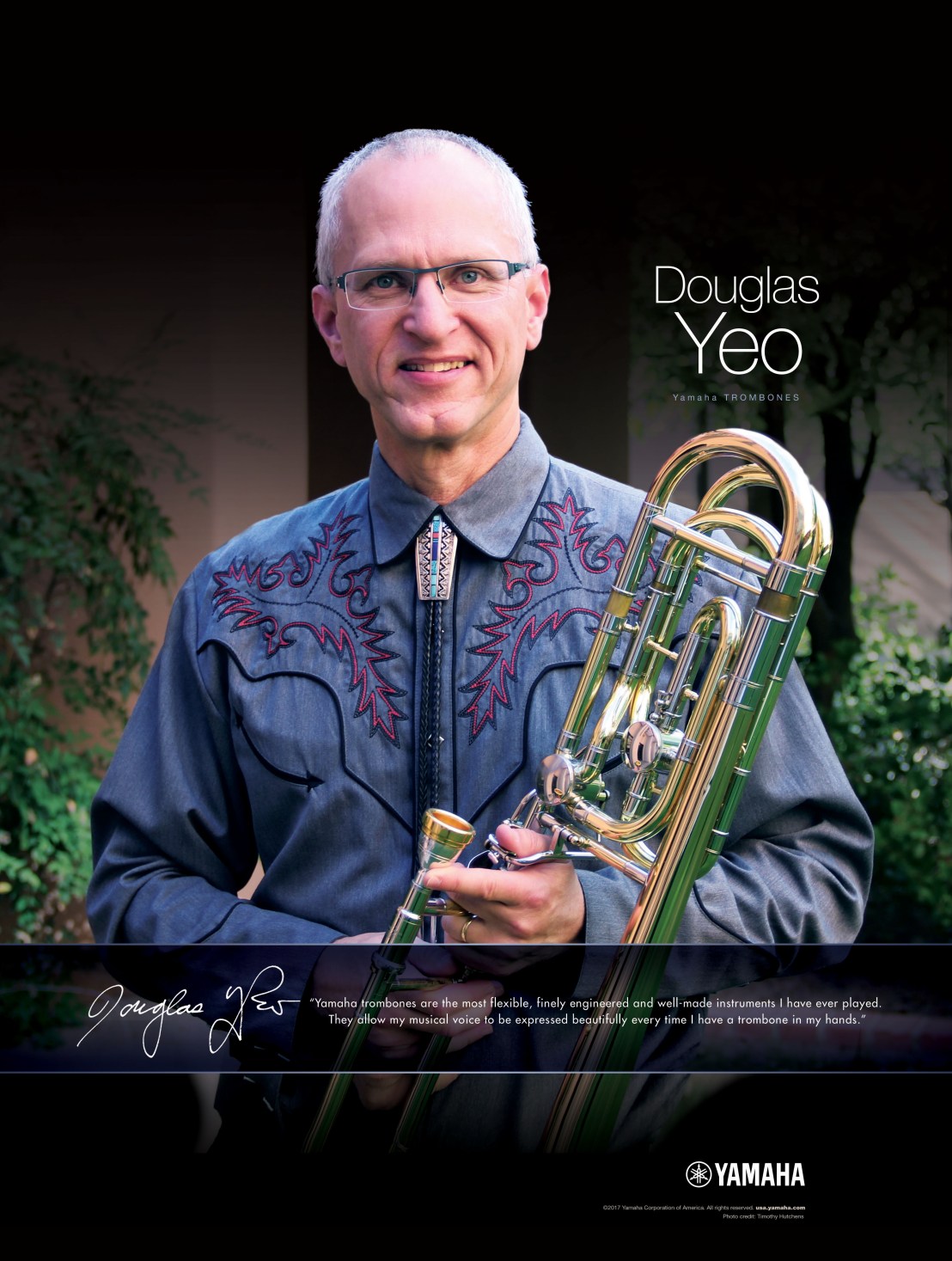
I’d also like to say that I’m very grateful to YAMAHA Corporation of America for their kind sponsorship of my appearance at these Texas events. For information about the YAMAHA YBL-822G trombone that I play — I began my very happy relationship with YAMAHA in 1986 — click HERE.

YAMAHA_Yeo_Poster_18x24_FINAL

Our National Anthem

Our National Anthem

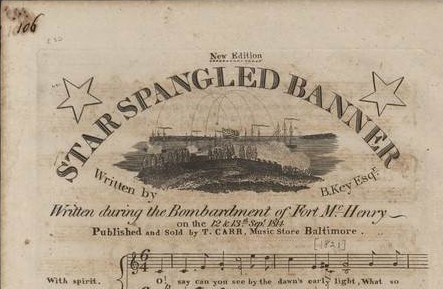
National Anthems have been in the news recently for good reasons (Winter Olympics medal ceremonies) and not so good reasons (see the end of this article). Count me among those who believe that when our National Anthem is performed, it should be done so in a respectful way. Our country has a lot of problems, but our National Anthem speaks to our hope for the best that the American experiment can be. It is a symbol of the freedoms we enjoy, and it is a reminder that the old cliche, “Freedom isn’t free,” is true. My father served in the U.S. Army during the Korean Conflict (6th Infantry Division) and I am proud of his service for our country. Last year, my wife and I visited Fort McHenry in Baltimore where Francis Scott Key wrote the words to The Star Spangled Banner. Being there was a very powerful experience. Sing it or play it: from where I sit, I want to hear our National Anthem performed in such a way where the tune is recognizable, the words (if sung) are understandable, it is at tempo and a key that is singable by the audience, and it draws attention to the Anthem itself, not to the performer.

During my nearly 30 years as a member of the Boston Symphony/Boston Pops Orchestra, I played the National Anthem more times than I can count, and many of the most memorable performances were at sporting events. I played it at Super Bowl XXXVI in New Orleans in February 2002 (when the New England Patriots defeated the St. Louis Rams); this was the first Super Bowl after the terrorist attacks of September 11, 2001. The Boston Pops Orchestra (Keith Lockhart, conductor) accompanied Mariah Carey; the trombones were Norman Bolter, Ronald Barron and myself  (to view this video on Youtube, click HERE):

The Boston Pops brass section, Keith Lockhart, conductor) also played the National Anthem in 2008 at a Boston Celtics/Los Angeles Lakers NBA Finals game (the Celtics won the game and went on to win the NBA Championship); unfortunately no video is available for that performance but here is a photo. James Nova and I played trombone; Gary Ofenloch is playing tuba.

NBA Finals Game 2: Los Angeles Lakers v Boston Celtics In 2010, the Celtics and Lakers were back in the NBA Finals again and the Boston Pops brass section with members of the Tanglewood Festival Chorus (James Orent, conductor) played the National Anthem once more; the trombone  players are Ronald Barron, Hans Bohn and myself. The Celtics won that game but the Lakers went on to win that NBA Championship. To view this video on Youtube, click HERE:
I also played the National Anthem at many other New England Patriots and Boston Red Sox games. It was always a thrill to stand at center court, or the 50 yard line, or around home plate and do this. Always.

When I began my four year tenure as Professor of Trombone at Arizona State University, I wanted to bring special kinds of musical experiences to my students. Twice, the Arizona State University Desert Bones Trombone Choir performed the National Anthem before Arizona Diamondbacks Major League Baseball games. I searched long and hard to find an arrangement for trombones that I thought met all of the criteria I put forth for a great performance at this kind of venue and event. I was very happy to find one by Robert Elkjer that fit the bill.

To have a chance to play the National Anthem at Chase Field in Phoenix, we needed to record a demo video. This we did in the fall of 2012; it was recorded in a large rehearsal room at ASU. Here is our demo video (to view this video in YouTube, click HERE):

The video was well received by the Diamondbacks, and in 2014, we were invited to perform the National Anthem at an Arizona Diamondbacks/Colorado Rockies game. I was so proud of my students for how they performed, how they presented themselves, and how they were received. This video was produced by the Diamondbacks and was shown on the jumbotron while we were playing (to view this video in YouTube, click HERE):

Later that year, I was honored as one of four finalists in the Arizona State University “Faculty/Staff Most Spirited Sun Devil” contest. This was a great, fun honor, to be the representative of ASU’s Tempe campus in this contest. I certainly had school spirit, and I was honored at halftime of an ASU/Stanford basketball game. Our ASU Desert Bones Trombone Choir was asked to play the National Anthem at that game; here is a sideline camera video taken by my wife. I think what I find so riveting about this particular performance is how respectful and quiet the audience was until the Anthem was over, at which time it burst into spontaneous applause and cheering. It was a great moment (to view this video in YouTube, click HERE):

A year later, in 2015, we were invited back to Chase Field to play the National Anthem at an Arizona Diamondbacks/San Francisco Giants game. It was a thrill to do this the first time. To be asked back to do this a second time was very special for my students and me (to view this video in YouTube, click HERE):

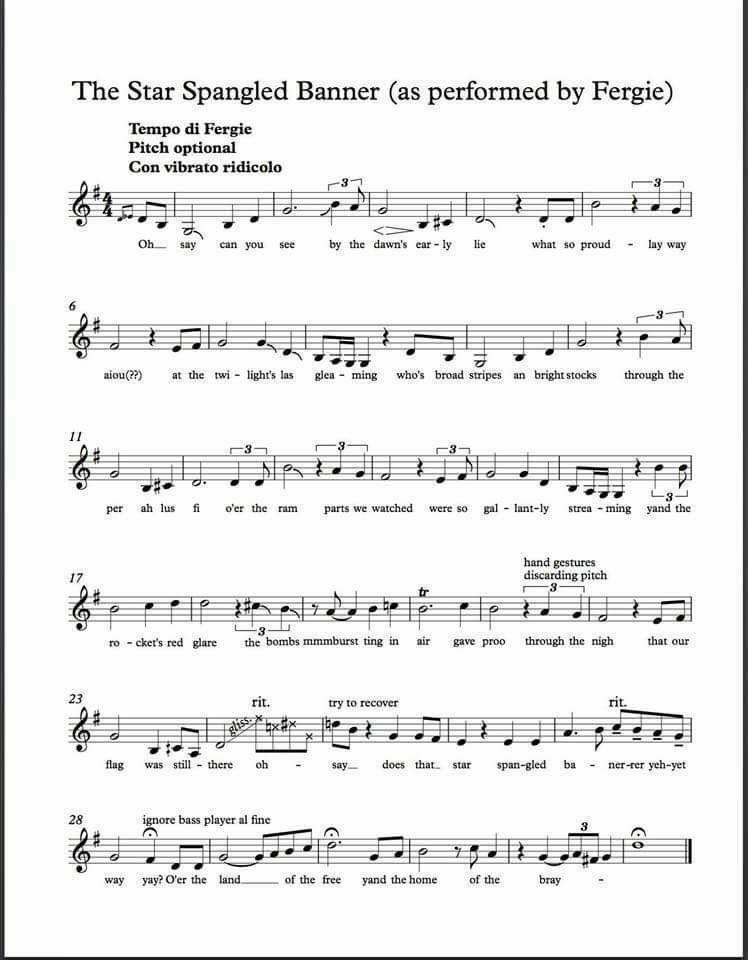
In all of these performances, we tried to bring the best that we could to the table, to honor our country, and express hope in its highest ideals. A recent performance of the National Anthem has been in the news in recent days for all the wrong reasons. A pop singer named Stacy Ann Ferguson, who goes by the name “Fergie,” sang the National Anthem at the recent NBA All Star game. She has come under fire for her performance. Hers was a particularly awful, self-aggrandizing performance that has come in for heavy criticism in the media. Was it the “worst performance” ever of the National Anthem? I haven’t heard enough to judge, but you can hear it for yourself. I’m all for tasteful artistic license, but as you view her video below, follow along with the music below, a transcription of her performance that was sent to me by a friend (it seems to be making the rounds in the Internet; I don’t know who did the transcription). Watch the words (or lack of words). Listen to the pitch. Note that she sings the Anthem in 4/4 meter rather than 3/4. The list goes on. . .

Star_Spangled_Banner_by_Fergie

Uh, no. Memo to “Fergie”: this song isn’t about YOU. It isn’t about how cool you think you are. It isn’t about making a statement. The words have MEANING; they are not just vocal syllables that you can slide over, making them incomprehensible. You gave the world a clinic on how NOT to sing The Star Spangled Banner.

“Fergie’s” performance of the National Anthem stands in contrast to the respectful performances by so many people who, despite the many flaws in our country, recognize that the National Anthem is a powerful symbol of what is good, and right in our land, and the hope we have to make it even better. How we sing or play it matters. I’m glad to have been a part of many memorable performances of The Star Spangled Banner, and thereby do my part – as have so many others – to aspire to its ideals. The Star Spangled Banner. Long may it wave.

The beauty of the saguaro cactus

The beauty of the saguaro cactus

My wife and I live on the southwest side of Phoenix in the foothills of the Estrella Mountains. We love living there. It is quiet and dark at night, and we are surrounded by stunning natural beauty. We live just south of the Gila River, in an area that used to part of Mexico before the Gadsden Purchase transferred 29,670 square miles of Mexico to the United States in 1853 (for a payment of $10 million dollars, roughly $270 million dollars today). Most of that land became part of the Arizona Territory and nearly 60 years later, in 1912, Arizona became the last of the lower 48 states to be admitted to the Union – State 48.

We also live in what is called the Sonoran Desert, a unique ecosystem that covers 100,000 square miles of southern Arizona, a small part of southern California, and Sonora and Baja, Mexico. It is a remarkable place with an iconic, ever changing landscape. Principal among the things that make the Sonoran Desert so interesting is the saguaro cactus.

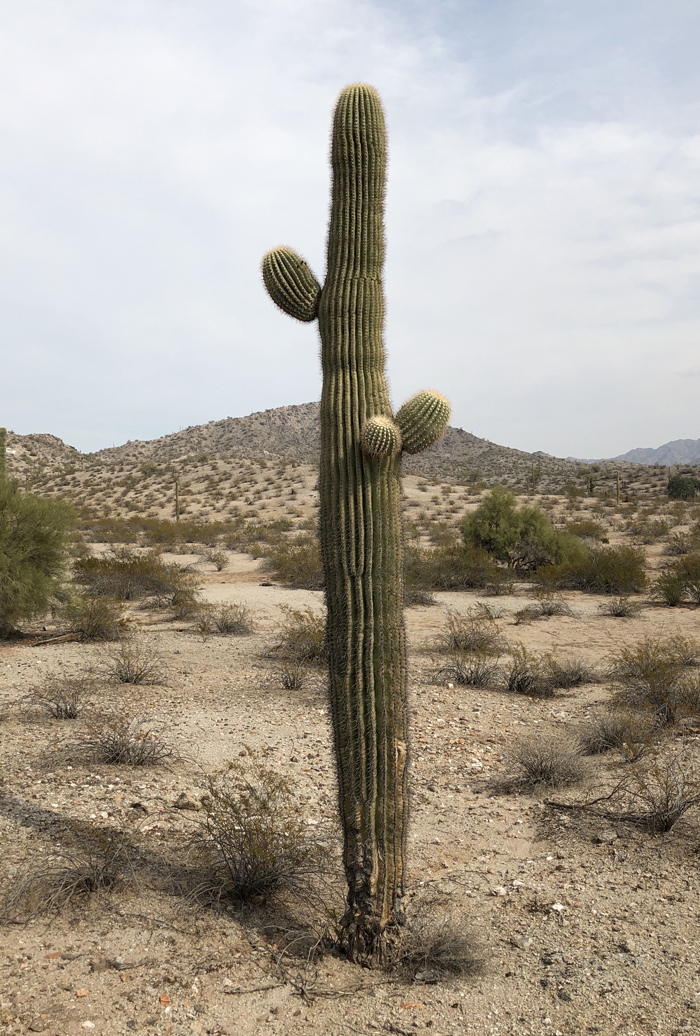
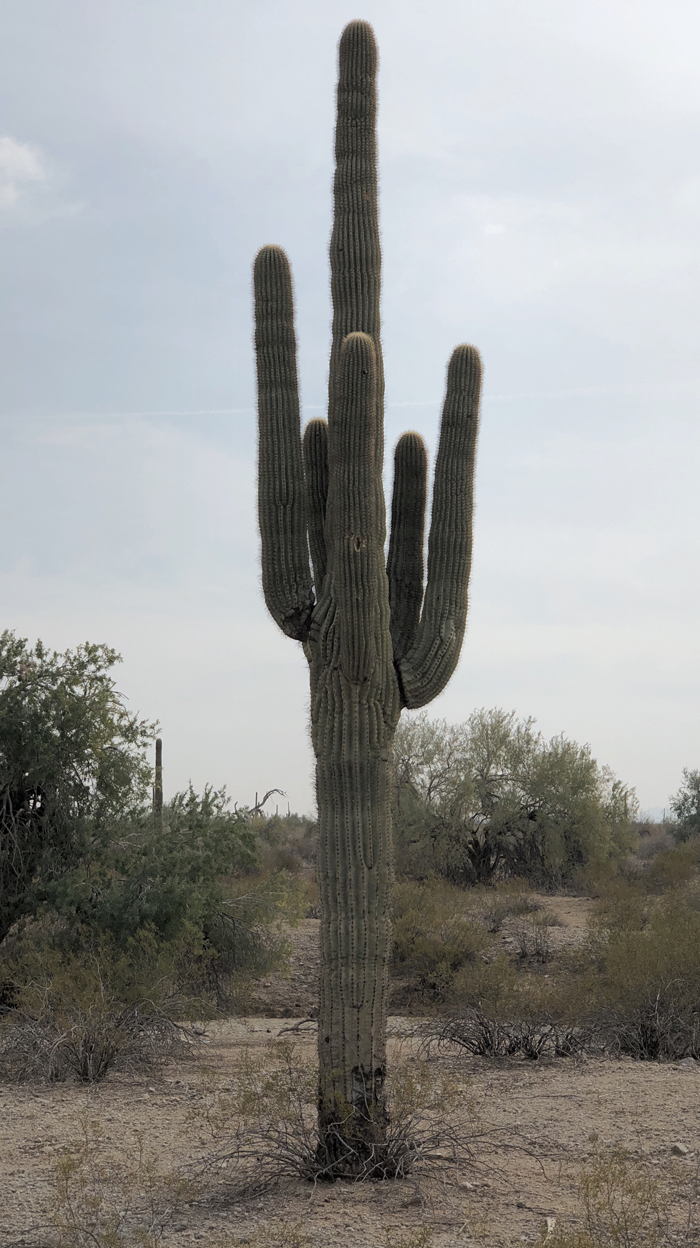
This cactus — pronounced “soh-WAHR-oh” —along with the American bison, has become the symbol of the American west. They grow slowly and they grow tall. They usually sprout arms, and have beautiful, white, trumpet bell shaped flowers in the spring. They live for many decades. And then they die.

Today, my wife and I enjoyed a very nice four mile hike in the desert just a few minutes from our home where we were surrounded by these great cacti. It occurred to me as we were hiking that we got to see saguaro cacti in nearly their whole life cycle. So I took a few photos to share with readers of The Last Trombone.

saguaro_01

Like every plant, the saguaro cactus starts out small. This young saguaro, above, is about three feet high. If it sprouts arms, that won’t happen for many years. The growth cycle of the saguaro cactus isn’t fully understood and some saguaros will bud arms when they are about 60 years old while others stay tall and straight with no arms for their whole lives.

saguaro_02

Pictured above is a saguaro cactus with three small buds that have just started to grow.

saguaro_03

In time, those buds may grow to be very large, like arms, and create the iconic image (above) of a saguaro cactus. Arizona State University’s Alma Mater sings of this:

Where the bold Saguaros raise their arms on high,

Praying strength for brave tomorrows from the Western sky,

Where eternal mountains kneel at sunset’s gate,

Here we hail thee, Alma Mater, Arizona State.

saguaro_05

Eventually a saguaro changes as it nears the end of its life. This process may take many years. At first, the cactus will begin losing its needles and outer pulp, exposing the hard, stiff skeleton that brings water up from the ground to the entire cactus. In the photo above, you can see that water in the wash in the foreground — yes, this would be full of raging water when it rains — has eroded the bottom of the cactus and it is from the bottom that these cacti have begun to rot. Two cacti have already fallen, one remains in good condition, and one is showing the evolution of decay.

saguaro_06

Eventually the saguaro falls. They usually break near their base and fall to the ground in the same shape in which they were standing, as seen in the photo above.

saguaro_07

When the saguaro falls in an orderly way, its “bones” eventually are left exposed on the ground in a straight line.

saguaro_08

Sometimes, the saguaro falls in a chaotic way, uprooted by violent wind, with parts scattered around.

saguaro_11

Other times, the cactus begins to die from its top and as it sheds its pulp, the bones begin to form beautiful shapes as they are pushed by the wind and their own weight.

saguaro_09

On rare occasions, the saguaro falls from its top into an elegant arch. This always reminds me of the St. Louis Gateway Arch, the gateway to the west. The beauty of these fallen saguaro arches is really something to behold.

saguaro_10

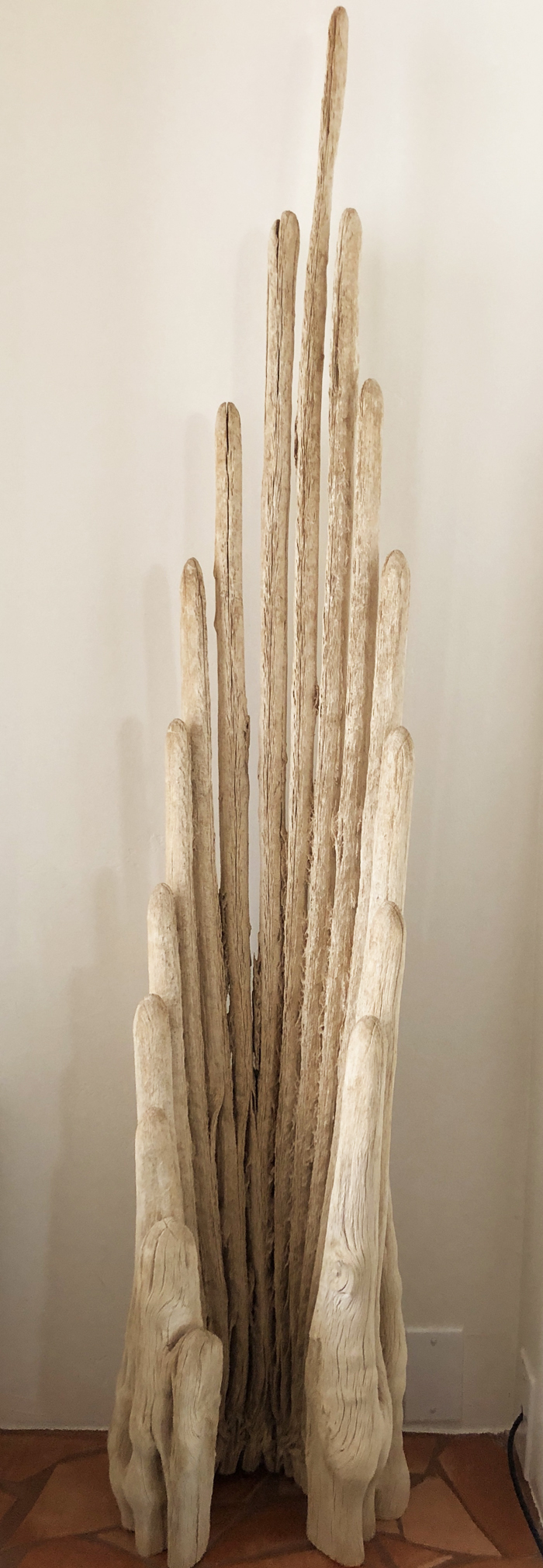
Not all saguaros that fall in the desert decompose and go back to the earth. A few years ago, we purchased these saguaro bones (pictured above) that had been collected by a talented artist who did little more to them than saw the base so they could stand up. These bones — I think they look like organ pipes — stand in our living room. They remind us every day of the beauty and ever changing nature of God’s creation that is around us in this special place, the Sonoran Desert.

GC_08

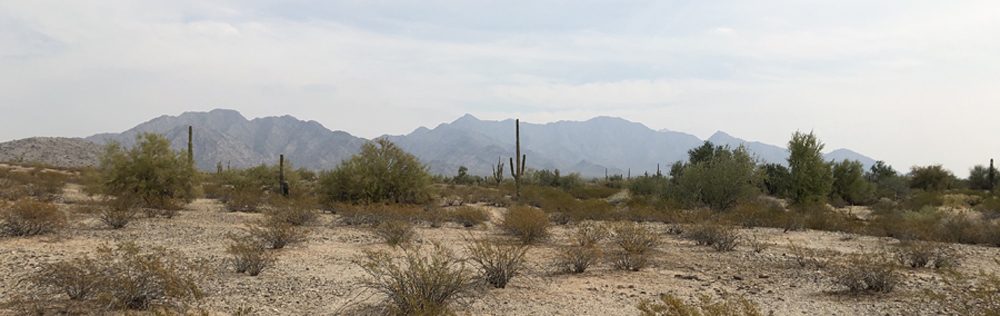
Photo in the header of this article: Estrella Mountains, Arizona.

Photo at the end of this article: Sign at Hermit’s Rest, Grand Canyon National Park:

O Lord, how manifold are thy works!

In wisdom hast thou made them all: the earth is full of Thy riches.

  • Psalm 104:24

And below, a prayer:

Father almighty, wonderful Lord, Wondrous Creator, be ever adored;

Wonders of nature sing praises to You, Wonder of wonders –

I may praise, too!