

I don’t know anyone who doesn’t want to be great at something. I mean, how many people do you know who have, as their goal in life, to be mediocre? I don’t know anyone like that. We all want to excel, to be great at something – or some things – and the pursuit of excellence is high on just about everyone’s life list.
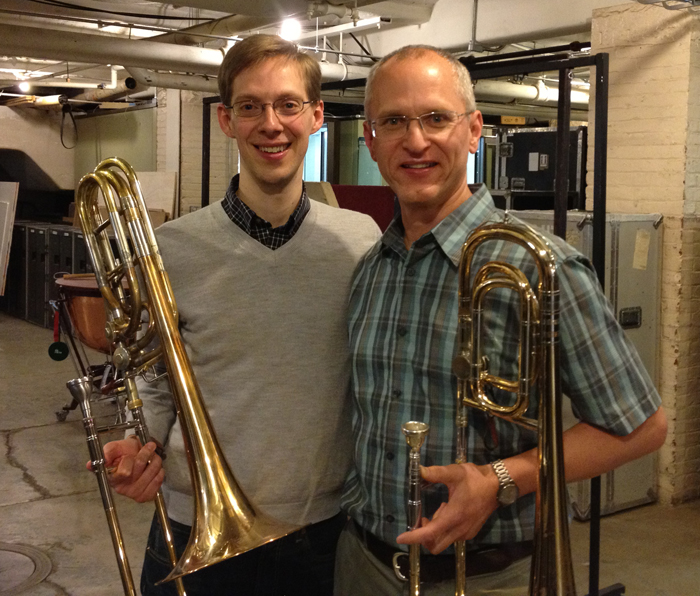
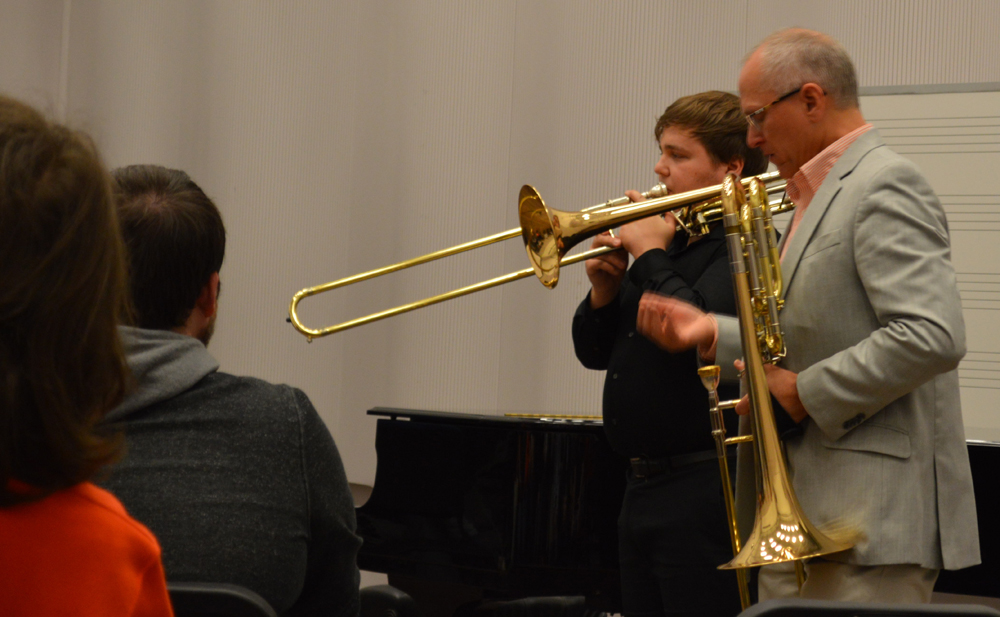
When I was at the International Trombone Festival at University of Redlands, California, a few weeks ago, I presented a class along with my friend, Megumi Kanda. Megumi is principal trombonist of the Milwaukee Symphony, and we have each authored books to help trombone players prepare better for auditions and concerts. In short, we are trying to help trombonists climb the mountain of life and achieve success through the pursuit of excellence.
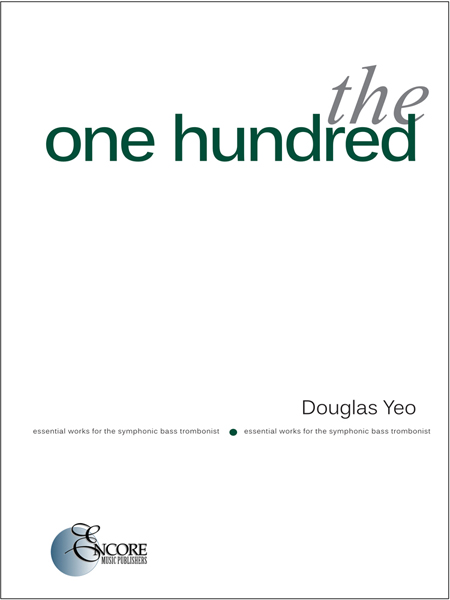
Megumi’s book is The One Hundred: Essential Works for the Symphonic Tenor Trombonist, and my book is The One Hundred: Essential Works for the Symphonic Bass Trombonist. Our class at the International Trombone Festival was titled:
The One Hundred: Effective Strategies for Successful Audition Preparation
Here are the points that I emphasized in my part of the class along with a little commentary. Perhaps there is something here that might resonate with and help you.
Questions to ask yourself:
How good is good enough?
If you are in pursuit of a goal, you need to know what the standard is. You need to know how good you actually have to be in order to attain it. If you don’t know the answer to this question, then you’re not being serious about actually achieving a goal. I wrote an article on my website about this subject; you can read it by clicking here.
Where do you stack up locally? Can you read the signs?
Let’s suppose you want to win a position in the trombone section of the Chicago Symphony Orchestra. You would not be alone; that would be a highly coveted job for many people in the world. If you want this job, look around. Where do you stack up in your local universe of trombone players. In your college, in your local freelance area. If you’re not one of the best players in your local area, how is it that you think that you are really good enough to win a position that will be sought after by the top players in many areas, as well as people who already have jobs in other orchestras? If you’ve taken 50 auditions and you have never advanced past the first round, that is telling you something. Can you look around and read what the signs in your life are telling you?
Does your desire line up with your talent and work ethic?
Desire is important. But desire alone will not lead to success. You need desire, talent and a solid work ethic. I know many people who have a great desire to succeed but they’re lazy. I know highly motivated people who don’t have talent. I know talented people who don’t have desire. If you have a goal in mind, you need to be sure that your desire lines up with the your talent AND your work ethic. As my friend, Gene Pokorny, tubist with the Chicago Symphony Orchestra, says, :
No one can legislate curiosity, and “hope” is not a strategy for success.
Is your goal attainable?
When I was a young boy growing up in the early 1960s, I wanted to be an astronaut. All of my friends wanted to be one, too. But as I grew older, I realized that my goal of wanting to be an astronaut was not attainable. I got glasses in the second grade. End of story. I turned my sights to other goals. Be sure you are pursuing goals that are attainable.
The essentials:
Here are the things that are important for success in a symphony orchestra audition. I’ve developed this list after being on an audition committee for over 20 auditions at the Boston Symphony Orchestra, and hundreds and hundreds of auditions and jury exams at Peabody Conservatory of Music, New England Conservatory of Music and Arizona State University. These are the essentials you must possess if you are going to have a chance of succeeding at a symphony orchestra audition:
A beautiful sound. Without this, nothing else matters.
This speaks for itself.
Impeccable intonation.
Note that I did not say good intonation. Or great intonation. You need to have impeccable intonation. Playing in tune is fundamental to being able to work in a section of other players. Impeccable intonation is noticed very quickly. If you don’t have it, that’s noticed quickly, too.
Exceptional musicality, including a wide dynamic range, appropriate vibrato, seamless legato, and a clear differentiation between various kinds of articulations.
Does your playing exhibit all of these qualities? How wide is your dynamic range? Is it truly from ppppp to fffff? Tchaikovsky requires that in his Symphony No. 6. Do you know how to make every possible kind of articulation? Here’s an example, a short excerpt from the bass trombone part to the second movement, Scherzo, from Gustav Mahler’s Symphony No. 1:

Look at all of the different kind of articulations required on a single note, G-natural. You see sfp, then fp with a marcato, sf with a marcato, f with a marcato, and the note simply with marcato. That’s five different kinds of instructions about playing the same note. Can you make a difference? This matters.
An informed sense of style.
Style is different than musicality, mentioned above. Style is the “why” of music; musicality is the “what” of music. To learn the style of a piece, you have to know it inside and out, and understand what it means and why. Mahler is different than Mozart. Informed style comes through in a person’s playing.
A superb sense of rhythm, including exhibiting what Edward Kleinhammer often referred to as “the unwritten laws of rhythmic pulse.”
Edward Kleinhammer was bass trombonist of the Chicago Symphony Orchestra form 1940-1985; he was my trombone teacher when I was a student at Wheaton College. One of the things he emphasized was getting rhythmic pulse right. Composers can’t write everything that you need to do. There are “unwritten rules” about rhythmic pulse. Some people make this into a complex system, assigning syllables, letters or numbers to each note to show which notes have different weight or emphasis. Mr. Kleinhammer took a very simple approach. In every meter, there is generally an unwritten sense of pulse. For instance, in 4/4 time, the first beat is usually the strongest, the second beat is usually the weakest, the third beat is the second strongest beat, and the fourth beat usually leads to the subsequent first beat. This is true for 99.9% of all music in 4/4 time. Find the pulse and then demonstrate it with musicality and style. It is not complicated. It just needs to be done.
A confident, comfortable physical demeanor devoid of nervous, obsessive gestures or habits. You must pass “the weirdo test.”
When you are at an audition or a job interview, people on the audition committee are trying to decide if you will be a good fit in the group. You must make others around you feel comfortable. If you are obsessive about spraying your trombone slide with your water bottle, or you fidget while a colleague is playing the solo from Ravel’s Bolero, or you need to sit quietly for a few minutes to collect yourself before you play something, you’re probably not going to win the job. Your job – every colleague’s job – is to make the job of the people around you as easy and comfortable as possible. As to the weirdo test? Take a shower regularly. Use deodorant. Comb your hair. Think twice about tattoos and piercings. None of these things speak to who you ARE. But others will draw their own conclusions – fair or not – about what you PROJECT about yourself. Remember: the person hiring you might be your father’s age. Think about how you come across to others. All others.
Strategies to employ:
Question your assumptions.
By this I mean that you should always ask yourself if what you’re doing is the best way of doing it right now. For instance, if you’ve always taken a breath in a certain phrase at the same place, ask yourself, “Is this still the best place to take a breath?” Do the same with every aspect of playing: volume, slide position, type of articulation, tempo, etc. If you don’t ask yourself if the way you’re doing something is still the best way for you to do it, you will never allow for the fact that you are a different – and hopefully better – player today than you were yesterday. Or last week. Or last year when you first put that breath mark in your part. 95% of the time, you will probably answer, “Yup, that was a good idea when I first did it and it’s still a good idea.” But for that other 5% of the time, you just might make a change that is a result of your improvement as a player. You might not need that breath at all, and that new way of phrasing might just be what the audition committee is waiting to here. Don’t be fossilized doing things, “The way I’ve always done them.” Keep asking yourself questions and make changes based on the improvements you’ve made.
Try everything.
This is related to the point above. Try every possible way of solving every possible problem you are faced with. Sometimes you have two or three or four different slide positions where you could play a particular note. Try them all. Don’t be allergic to sixth and seventh positions. If you think you’re playing softly enough, try to the passage softer. Don’t assume you can’t do something. Don’t assume some way of solving a problem is too unconventional and therefore won’t work. Try everything. Only if you try every possible way to approach music will you know that you’ve found the best way for you to successfully play any passage.
Pay attention, ask questions, read, study the sources, leave no stone unturned.
Don’t just sit in a practice room and practice music. Learn more about what you’re playing in order to give your playing context. Study the orchestral score, find out if there are variant editions of a piece, read biographies of composers, read books about pieces you play, learn more about your instrument. Have an insatiable curiosity.
I have a lot of books. Hundreds. And a lot of full scores to music that I’ve played. Hundreds. Here’s a snapshot of two shelves of my books. Take a look at what you see:
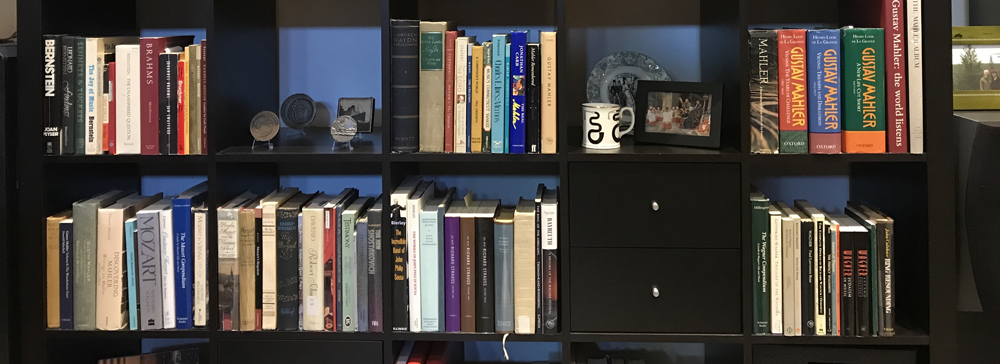
There are six books about Haydn, 14 books about Gustav Mahler, eight books about Mozart, 15 books about Richard Wagner. I’ve read all of them. Multiple times. These books have been invaluable to me as I have prepared for auditions and concerts. They are also extremely helpful in my research as I write articles and books. Everything you read, everything you experience, brings something added to your performance. Talk to people around you – even if they’re not trombone players. Learn from every experience in life. If you pay attention, you will bring special qualities to your playing.
Every player’s lament: But I can do it in the practice room.
OK, then bring the practice room to the stage.
If you can do things just the way you want to in the practice room but can’t replicate that success on stage at an audition or performance, you need to ask yourself, “Why is this happening?” Nobody practices so they can play great in a practice room. We practice so we can play great on stage. But many people set up systems and routines for performance that have nothing at all to do with practicing. Some people need to eat a banana before going on stage, or eat a rare steak 90 minutes before, or be sure Jupiter is aligned with Mars, or any number of things. Why? Do you need to do those things in order to play great in the practice room? Of course not. Then why do you add this layer of process to performance so the performance becomes something completely different than the situation – practicing – where you had success? Bring the practice room to the stage. The reason you play a musical instrument is so you can play it in public in performance. So recreate on stage what you do in the practice room; don’t separate your playing into different kinds of routines for different environments.
Remember:
Practice does not make perfect. Practice makes permanent.
If you practice, you will get better at what you’re practicing. But if you’re practicing something the wrong way, or without understanding, you will get better at doing it wrong. Practice in and of itself will not lead to your playing your best. Practice makes permanent what it is that you’re practicing. So be sure you are practicing correctly. It is not HOW LONG you practice but HOW WELL you practice.
Do not believe the lie of 10,000 hours.
There is a popular school of thought that goes something like this: If you spend 10,000 hours working to develop a skill and are doing so with good guidance, you can do anything. This is nonsense. I could spend 10,000 hours in a gym in order to attain the goal of being a linebacker with the Arizona Cardinals football team but it will not happen. Because I need more than 10,000 hours to succeed in that quest. I need talent, and a particular body type. While people often say, “You can be anything you want to be,” that is not true. See above, my story about my wanting to be an astronaut. You need the right combination of talent, hard work and destiny. That’s the God card; it must be meant to be. That’s another subject all together, and a very important one. That’s a subject for another post. But keep this in mind: hard work – 10,000 hours – is not enough.
Your best may get you to the top. But it might not.
After all of your work, all of your study, all of your practice, you just might get to the top. See my first question: How good is good enough? When you put together all of the aspects of your performing person and persona, you just might get to the top. You just might win that job in the Chicago Symphony. And if you do, congratulations!
But you might not. Everyone has a ceiling. Everyone does not have an equal chance to succeed in a goal that has one winner. Your best might not be good enough to get you to the top of the mountain. That does not make you a failure or a bad person. It’s just the realization that the best you bring to the table might not be good enough to get you to a particular goal. But. . .
The top is not the only place where you may have a rewarding musical life.
Yes, we all want to be reach the top of the mountain. And we should always feel great when we know that we have produced the very best that we can at any task. But if you don’t reach the top, there is still a great view from wherever you are. The Chicago Symphony, for instance, is not the only place where you can have a very satisfying, rewarding musical life. I know freelance players who are very satisfied. I know players in second, or third, or tenth tier orchestras who have fulfilling musical lives. Wherever your combination of talent, hard work and destiny takes you, you can have an exceptionally rewarding life. Do not forget this!
If you would like to view or download a copy of the PDF handout that accompanied my presentation at the International Trombone Festival – it contains the bullet points on which this article is based – click HERE.








 The Last Trombone – Douglas Yeo