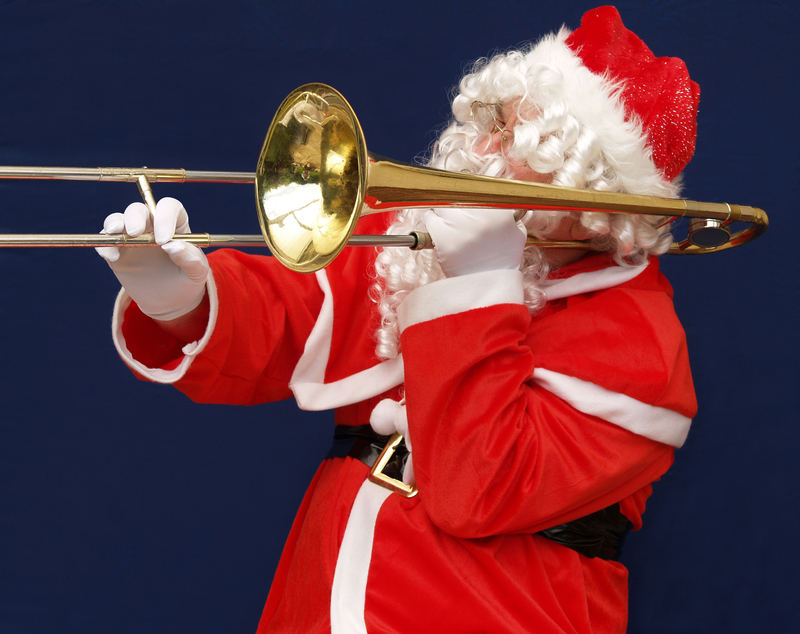
As a reader of The Last Trombone, you know that I enjoy seeing how the trombone intersects with popular culture. At this time of year, it’s time to bring out some of my favorite images and a great recording about that famous man in red and white, Santa Claus. Who, as we all know, plays the trombone. Right?
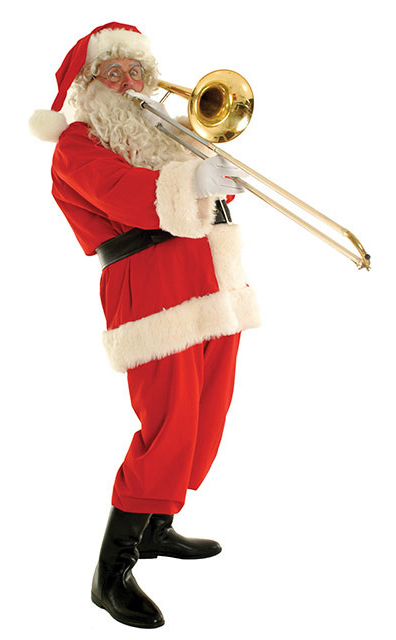
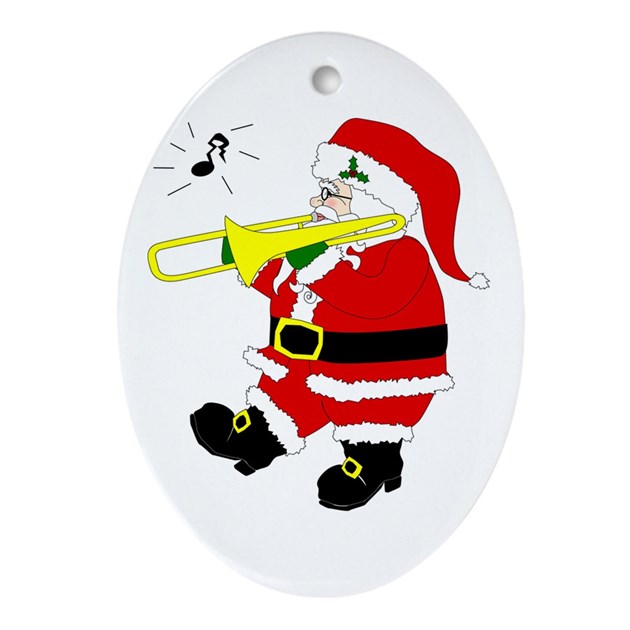
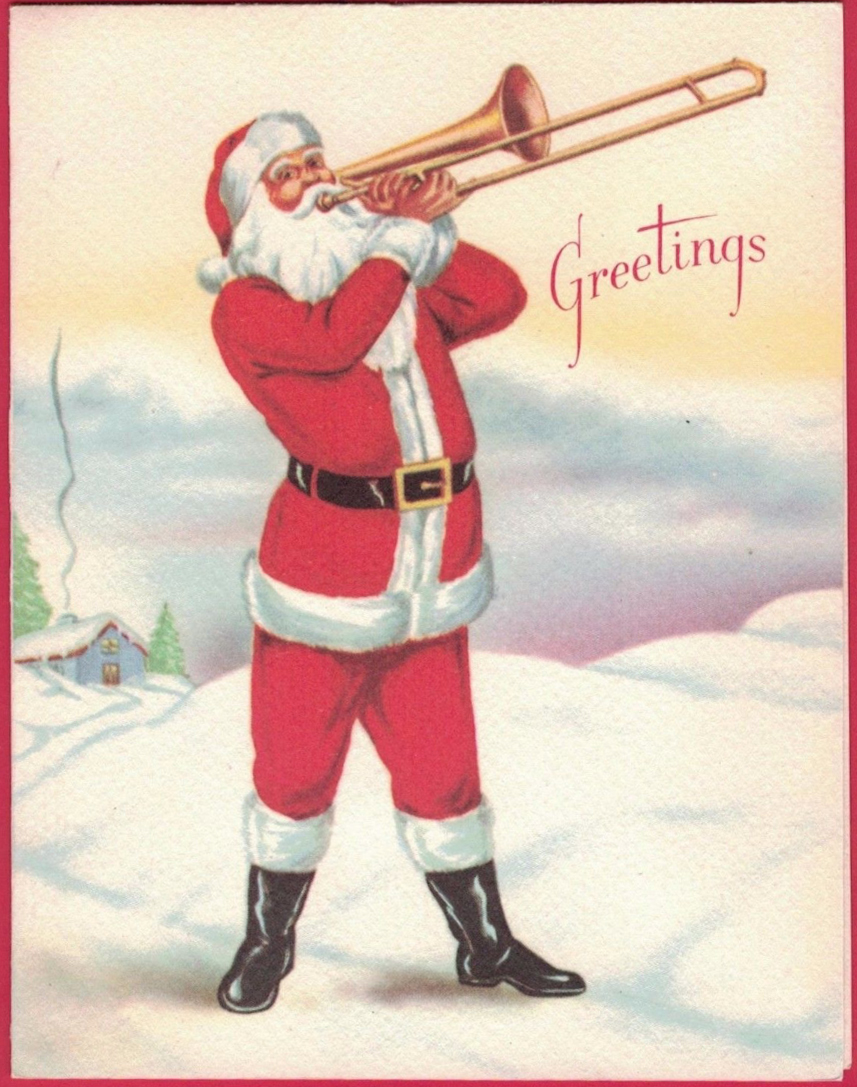
I’m writing a book about the trombone right now and have just finished the chapter on the history and evolution of the instrument. One thing that we always have to keep in mind when looking at images of the trombone throughout history is that iconography is not always a reliable indicator of how an instrument actually looked. Santa is no exception. Sometimes we see him holding the trombone just right, like the image at the top of this article, and this one (Santa not only plays the trombone, but he think’s he’s really cool, too):
It’s hard to see his embouchure but apart from a posture that’s going to give him trouble when he’s 3000 yeas old, he seems to have the trombone under control.
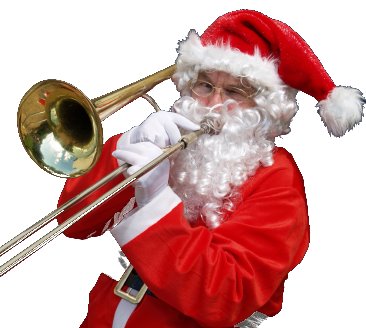
Then again, sometimes Santa puts the trombone together backwards. But he still thinks he’s cool. Time to get your glasses checked, Santa. Here we go again: iconography as a poor indicator of what and instrument looks like or how it works:
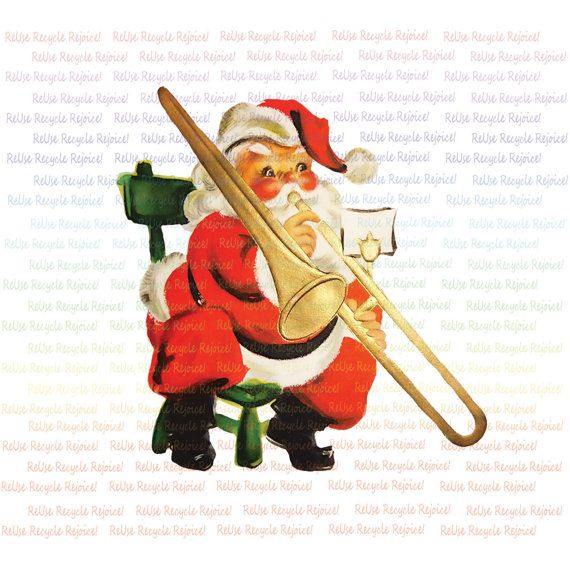
Then there is Santa with the music to “Jingle Bells” on his lyre (seriously, Santa, do you really need to use the music after all these years?). And the trombone put together backwards? Again?
Well, when he puts his glasses back on, evidently Santa can remember how to put the trombone together correctly, but from the look of things, he isn’t exactly making beautiful music – what note IS that?
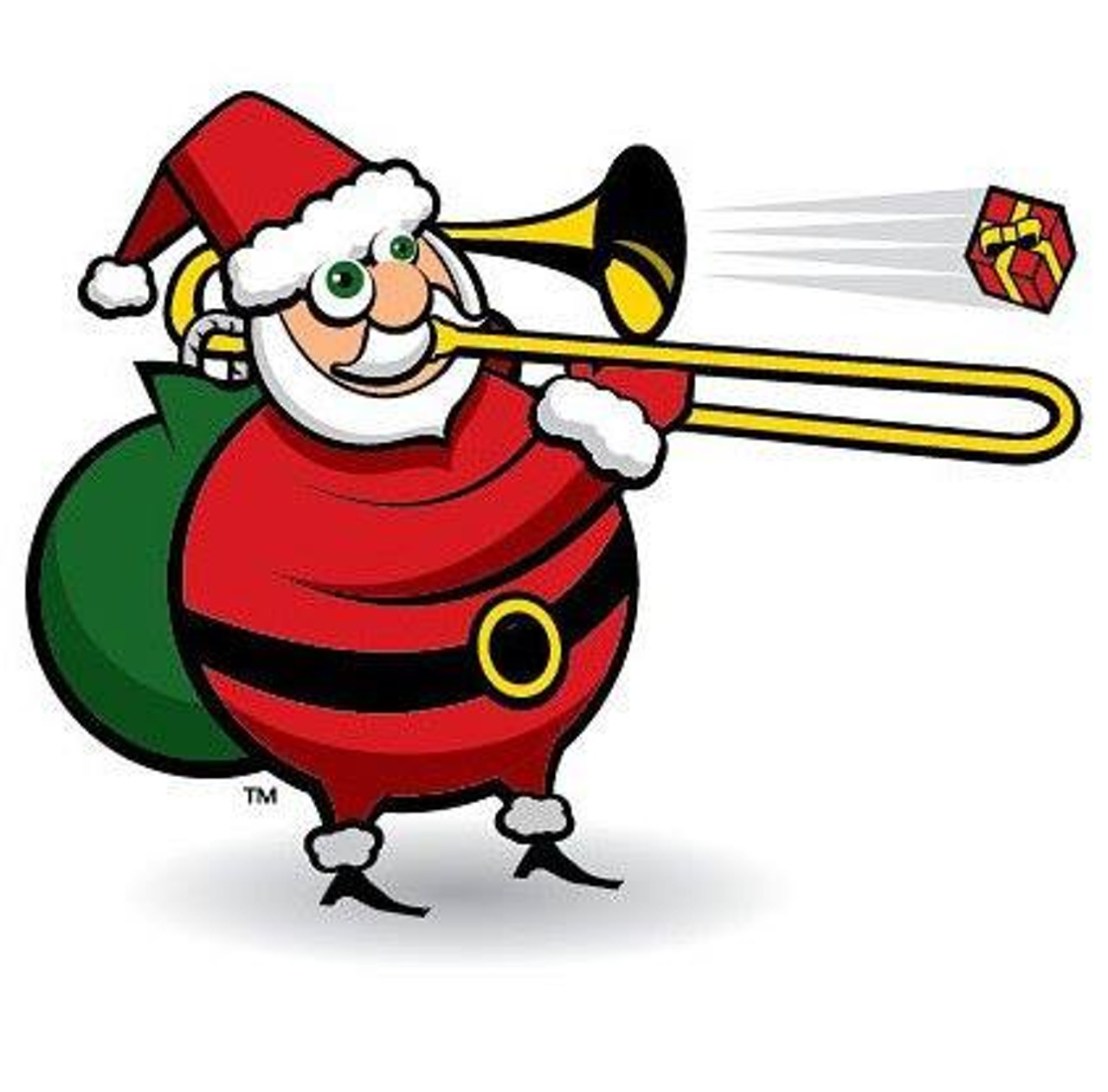
Actually, Santa’s trombone doesn’t always play music. Sometimes he uses it as a present delivery system. Pretty great, don’t you think?
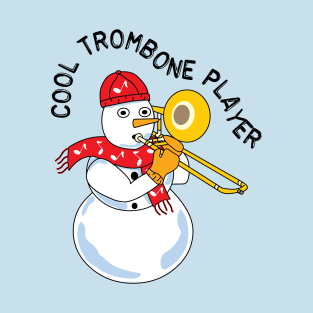
It’s clear that Santa is a really cool trombone player. But when you see a trombone playing snowman, well, that is a REALLY cool trombone player. Cool as in temperature cool. I hope he’s using a mouthpiece with a plastic rim.
If you want to HEAR Santa play the trombone, then here you go. Poppa John Gordy and his Dixielanders recorded Santa’s favorite song, “Santa Plays the Trombone (In the North Pole Band),” with Clint Garvin, vocalist. The trombone player isn’t identified on the record label so, of course, is HAS to be Santa himself. Right? Have a listen by clicking the video below, or view/listen to it on YouTube by clicking here.
If this doesn’t jump to the top of your Christmas music play list, then you’ll probably get coal in your stocking.
I’ll close this little popular culture tour of Santa and the trombone with a poem I wrote that’s made the rounds over the years. It first appeared in December 2012 when I was in my first year as Professor of Trombone at Arizona State University. Santa plays the trombone. He really does.
A Visit From Santa Claus To A College Trombone Player
T’was the night before Christmas and all through my home,
All the horns were in cases, including trombones.
For after the finals and juries and tests,
It was time for some shut-eye; I needed some rest.
I was dreaming of straight mutes and pBones and more,
When I woke to a sound that I’d not heard before.
And what should I see on my roof up on high?
A Moravian choir, with trombones playing fine.
Alessi and Lindberg, Kleinhammer and Yeo,
Were all playing their horns, their heads covered with snow.
And who should be leading this heavenly band?
But old Santa himself, a trombone in his hand!
“On JJ! On Jörgen! On Tommy and George!”
This band was so sweet, I sure did thank the Lord!
“On Norman and Pryor, Ron, Urbie and Frank!”
Some others played, too, but my mind drew a blank.
I grabbed my trombone and I lubed up the slide,
With no time for a warm-up, I hurried outside.
The gang was all playing some mighty nice tunes,
And we jammed some cool charts by light of the moon.
I invited them in just to warm up their chops,
But they just kept on playing, man, this sure was tops!
Saint Nick put his horn down to fill up my stocking,
With valve oil, and slide cream, CDs – so inspiring!
In time, things wound down and they packed up their horns,
And the sleigh got revved up and was heavenly borne.
But Santa looked back, and he said with a smile,
“Merry Christmas to all, and don’t forget to keep practicing even though you’re on vacation!”
— Douglas Yeo (with apologies to Clement Clarke Moore)
While individuals have been playing musical instruments that require vibrating lips to produce sound since before the dawn of recorded time – we need only think of the shofar, didgeridoo, and conch shell to begin a list of lip-blown aerophones of ancient origin – there is much about playing such instruments that remains a mystery. Whether thousands of years old or made last week at a modern brass instrument factory, the fundamental changes to brasses over the millennia have been those of material, construction and ergonomics rather than actual tone production. As every school child that has ever picked up a trumpet, trombone, horn, euphonium or tuba knows, all that is needed to create a sound on a brass instrument is to place one’s lips on the mouthpiece, vibrate the lips by passing air through them, and, Voilá! Another brass player is born.
Yet while trombonist and Boston-based brass pedagogue John Coffey (1907-1981) summarized his teaching with the pithy phrase, “Tongue and blow, kid,” successful brass instrument articulation and tone production actually requires a bit more understanding. Teachers and performers have written legions of books and articles about what players should do with their tongue and other members of the body’s oral cavity, but such descriptions have been hampered by an obvious problem: we cannot see inside the mouth or touch the tongue, glottis or soft palate while playing. One’s tongue cannot touch one’s tongue in order to feel one’s tongue when it is in use. It is clear that much of what has been said about the workings of the tongue during playing has been nothing more than well-meaning conjecture.
In 1897, Harold W. Atkinson summed up the difficulty that researchers faced when attempting to describe tongue’s position while speaking:
Their descriptions, accompanied or unaccompanied by diagrams, as the case may be, vary in those points of detail which are beyond the range of comparatively easy determination. This has been due, it would appear, to lack of suitable methods of measurement, more than to a lack of enthusiasm on the part of observers. Though equipped with the necessary anatomical and physical knowledge, they have lacked the power of designing appropriate methods or apparatus for making exact measurements.[1]
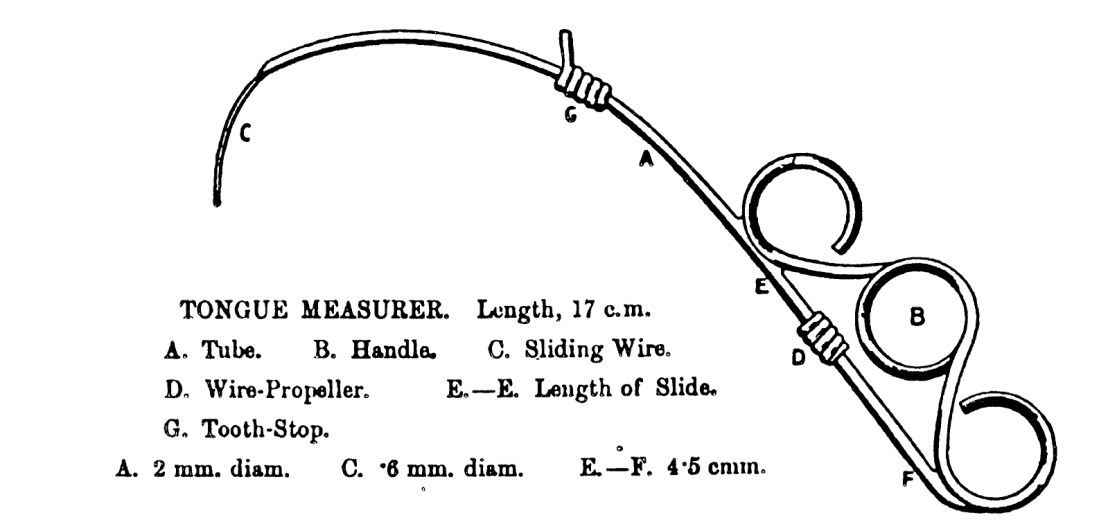
“Tongue measurer” by Harold W. Atkinson (1897)
Atkinson’s solution was to devise a “tongue measurer” made of silver, a delicate, movable wire with a “tooth stop” that slid up and down the wire. Inserted into a subject’s mouth – a reasonable person might immediately exclaim, “Not in my mouth!” – a syllable was spoken, the tooth stop moved, the wire was then applied to a plaster of Paris model of the mouth, and measurements taken. Professor Atkinson can be commended for his desire for understanding as well as his ingenuity, but his methodology was inexact at best.
For low brass players, we have long been accustomed to hearing wisdom about the use of the tongue and throat from some of the finest players and teachers of the twentieth century. Yet words and sentences often are used in murky ways that lead to misunderstanding and confusion. We are used to encountering phrases like:
“. . . The throat should be entirely free of resistance. . . the tongue should be loose and relaxed.”[2]
“Physical law provides that the embouchure is the determiner of pitch, so why should the tongue get so involved. . .?”[3]
“It is important that the tongue remain as relaxed as possible at all times. . .”[5]
“Many brass players react in horror when I suggest using [the glottis] for purposes of playing our instruments.”[6]
“However, especially with the euphonium and tuba, the tongue is never positioned ‘high’ in the oral cavity, even in the upper register.”[7]
“Correct tonguing is an up-and-down motion. . .”[8]
But what exactly is “the throat”? What part of the tongue should be “loose and relaxed”? Does the tongue have a role in determining pitch? Is correct tonguing an up-and-down or a back-and-forth motion?
Confusion continues when authors write suggested vocal syllables that players should keep in mind while playing. “Open” syllables are often spoken of as being preferred to “closed” sounds (there we go again, using words that we haven’t clearly defined), but when one reads the syllable “AY” in print, is that “AY” as in “hay” or “AY” as in “aye”? When one sees the word, “TOO,” is it to be thought of as “two” or “toe”? Should the tongue ever be allowed to rise up high in the oral cavity with the syllable “TEE” or should the tongue always be kept down and low in the mouth while using the open sounding syllable, “TOH”?
These authors quoted above – including this writer – can hardly be blamed for doing their best to describe a complex subject with limited actual understanding with which to work. X-ray vision is the stuff of Superman, not trombone teachers, and the intuitive description of the operation of the tongue by many writers has seemed to be reasonable, if unproven. Yet with the advances of modern medical diagnostic techniques, brass players, teachers, and scientists are coming together to show us what has hitherto been impossible to clearly see: the operation of the tongue and associated organs inside the mouth while playing a brass instrument in real time.[9]
Begun in 2013, the MRI Brass Repository Project (MBRP)[10] was conceived by Dr. Peter Iltis, Professor of Kinesiology at Gordon College, Massachusetts. Iltis’ interest in the physiology of the brass player’s embouchure and associated parts of the oral cavity led to his collaboration and partnership with Dr. Jens Frahm, Director of Biomedical NMR Research at the Max Planck Institute for Biophysical Chemistry in Göttingen, Germany, and Dr. Eckart Altenmüller, Director of the Institute for Music Physiology and Musician’s Medicine in Hannover, Germany, to create the MBRP.[11] The Max Planck Institute has generously provided use of their magnetic resonance imaging (MRI) scanner, a non-invasive tool that allows subjects to be tested without time limitations or exposure to harmful radiation.
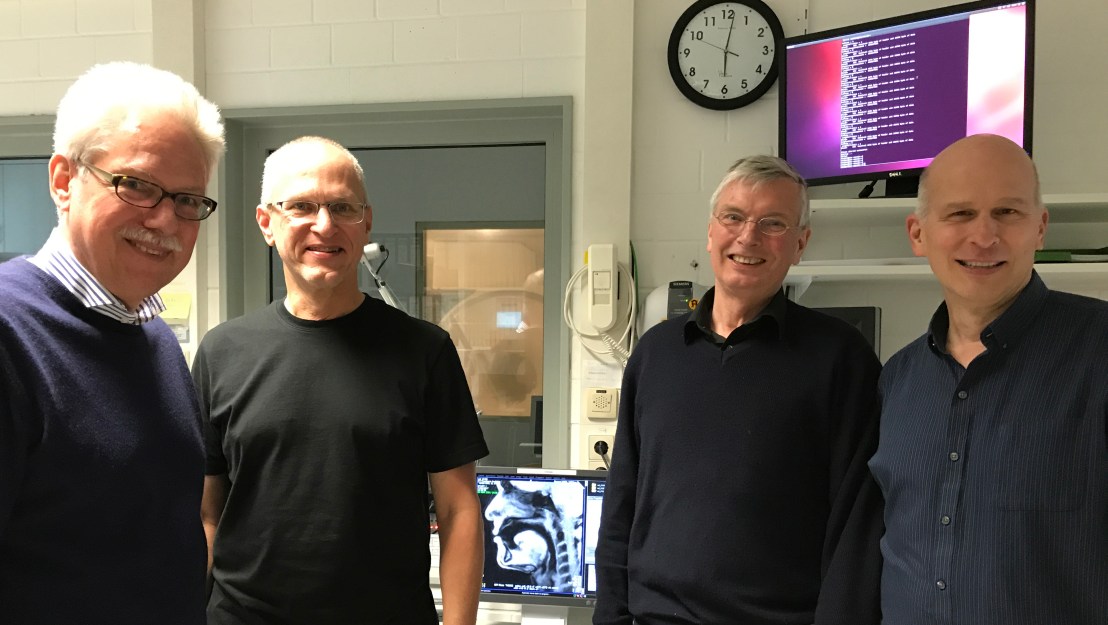
Left to right: Jens Frahm, Douglas Yeo, Eckart Altenmüller, Peter Iltis
The MBRP’s work started with testing of elite, college/conservatory, and embouchure dystonic horn players, using a horn bell made and donated by Rick Seraphinoff (Bloomington, Indiana). Those studies led Iltis and his team to report their preliminary findings in numerous articles in peer-reviewed scientific journals and music publications,[12] as well as in several web-based video interviews and podcasts.[13]
Normal playing of a brass instrument inside a MRI scanner is impossible; there is not enough clearance in the scanner to allow movement of a trombone slide or for the hands of a player to operate valves. Additionally, no ferrous metal can be in the scanner room because of the powerful magnets that are used to create the MRI images; therefore, non-ferrous brass bells must be constructed. A brass instrument bell is then connected to plastic tubing and a plastic mouthpiece, and a player inside the scanner can play notes in the overtone series while the playing is video recorded in sagittal (from the side of the head) and coronal (from the front of the head) views at 55 frames per second. Exercises involving double tonguing were recorded at 100 frames per second in sagittal views. In this way, the workings of the oral cavity during brass playing be observed in real time, and the movement and use of the tongue, and soft palate can be carefully examined.
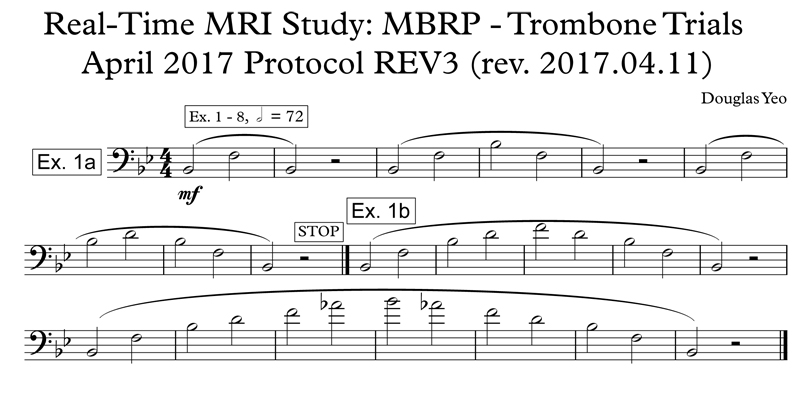
Having tested a large cohort of horn players, Peter Iltis asked me to lead the study of trombone players. This involved my writing a protocol for trombone players to play inside the scanner, and also traveling to the Max Planck Institute in Germany to be the pilot subject in the trombone study. This I did in April 2017. My goal in writing the trombone protocol was to devise exercises that would help us to understand various aspects of trombone playing. In particular, these involved tonguing with various types of articulation, single and double tonguing, slurring, air attacks, and pitch bends. I was also interested to see how the tongue moved while whistling, since the action of the tongue while whistling is often used as a metaphor for tongue placement in various registers of brass playing.
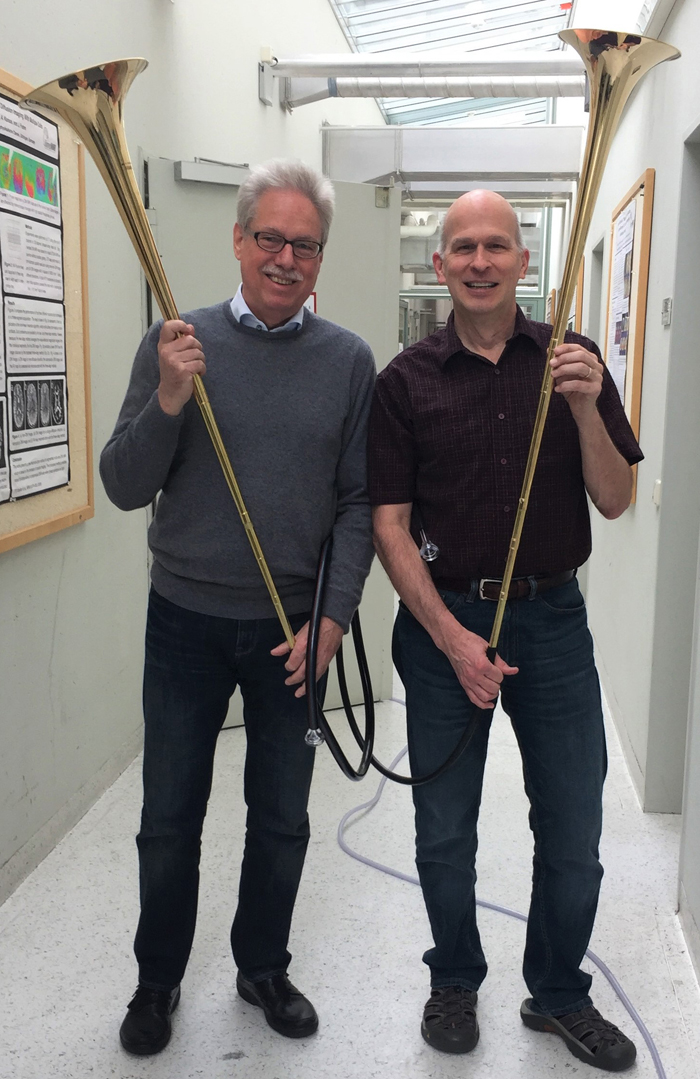
Jens Frahm and Peter Iltis with specially made non-ferrous tenor and bass trombone bells, designed, manufactured and donated by YAMAHA Corporation (Hamamatsu, Japan)
YAMAHA Corporation (Hamamatsu, Japan), designed, manufactured, and donated specially made non-ferrous tenor and bass trombone bells for the study, and Kelly Mouthpieces also donated several plastic trombone mouthpieces for use by players. I also experimented with several types of flexible rubber/plastic tubing (clear, reinforced, PVC, etc), which I had collected in a variety of bore sizes including reasonably standard trombone bore sizes of .500, .550, and .562 inches.
I was familiar with how an MRI scanner worked due to my having had several MRI exams over the years in preparation for various surgical procedures. Those exams involved the taking of still images, and the operation of the MRI scanner’s magnets created a loud, banging sound. However, the scanner used in Göttingen did not make this kind of sound. Rather, the machine made a loud, constant, high-pitched whirr over which I was able to hear myself play the trombone fairly well, despite my wearing earplugs. In addition, as I lay prone on my back in the scanner, my head was gently cradled inside a helmet to help keep my head from making unnecessary movements.
Those who have been inside a MRI scanner know that it can generate a feeling of claustrophobia. Once one is moved into the scanner, one’s nose is only a few inches from the top of the scanner tube. The Max Planck Institute developed an innovative solution to the claustrophobia problem. A double mirror was affixed to the helmet at eye level so when I looked up, I had the impression of looking into the room; this gave me the illusion that I was not in the scanner, but rather I was sitting in a chair looking at my surroundings.
In all, I was in the MRI scanner for two hours and I recorded 57 exercises. Here follows some of what we learned, drawn from 11 selected videos.
Video 1 – lip slurs
[This video may be viewed on YouTube by clicking HERE.]
A good place to start is a simple lip slur exercise. It should be said at the outset that during the time I was playing all exercises inside the scanner, I attempted to follow the advice I learned from Edward Kleinhammer[14] as a student: keep the tongue down and the throat open at all times, in all registers and in all dynamics. As he would simply say, “Yawn, don’t cough.” This was a core tenet of Kleinhammer’s teaching, expressed in his books The Art of Trombone Playing and Mastering the Trombone, and it is a central part of the pedagogy of many trombone teachers and players. My only regret associated with the MBRP is that Edward Kleinhammer did not live to see it come to pass. Knowing him as I did, I know that the process, its outcomes, and conclusions would have fascinated him.
As you view this video, you will first see me swallow several times. What happens when we swallow? The tongue arches upward in the oral cavity and presses both against the roof of the mouth as well as backwards. The larynx – what is popularly referred to as the “Adam’s apple” – is pulled upward to allow the easy passage of saliva into the esophagus. In addition, you will see a small flap of cartilage called the epiglottis move over the trachea (wind pipe) so saliva goes down the esophagus; this prevents a person from choking when saliva goes, as is often said, “down the wrong way.” Also, selected muscles of the oropharynx (what we typically refer to as “the back of the throat”) constrict to aid in pushing saliva – and food – downward.
On the far left edge of many of these videos, part of my thumb that was supporting the mouthpiece can be seen; keep in mind that the mouthpiece was plastic so it does not appear in the MRI images. As I inhale, observe that my soft palate is open at the top of my oral cavity. This closes as I transition from inhaling to playing so air from the oral cavity goes only into the mouthpiece and is not released through my nose. You will also see that my throat is “open.” That is, the several muscles that work to constrict the oropharynx relax, giving the sensation of an open throat.
As I begin playing, you will observe that as I slur higher, my tongue moves both up and back in my oral cavity. There is also movement below the base of my tongue, with my larynx – the opening between the vocal cords – moving slightly upward. When I was playing, I felt no sensation of this upward movement in my neck; I always felt that my throat was very relaxed and my tongue was “down.”
Here we see something very important. When we speak of the tongue, we are speaking of an extraordinarily large, strong, and flexible muscle. It does not move as a single muscle in a single direction, but various parts of the tongue can simultaneously move in various directions. There are muscles called extrinsic muscles that act on the body of the tongue to move it up, down, forward and back within the mouth. There are also muscles making up the body of the tongue itself (intrinsic muscles) that can alter the tongue’s shape. As you view these videos, observe the many varied shapes of the tongue as I play exercises with different articulations and in different registers.
As we look at this, we can see that the idea of an “open throat” is something of a misnomer. We can have the sensation and feeling that we are not changing the size of the oropharynx but in fact we are doing so, and doing so seems to be an essential part of pitch production. Size and shape changes of the oropharynx can also be completely independent of the movement of the tongue. Also, the pulsations of air with each note change may very well be playing some role in assisting with pitch changes. From what we have seen, it is already clear that the embouchure is not the sole determiner of pitch, but that the movement of the tongue and work of the oropharynx play an important role in this as well. As I was playing, I sensed that my tongue was low and down in my mouth at all times and that my throat was always “open.” But as we can see, that was not the case. I had to admit: “The tape don’t lie.”
All of these various processes are happening simultaneously and very quickly, and with virtually no thought on the part of the player. To think about all of this as we play would be an overwhelming exercise, resulting in what Arnold Jacobs[15] used to call, “paralysis by analysis.”[16] The reasonable question arises: How can we be unaware of all of these diverse processes despite our concentrating intently on our playing? When I consider this, I am reminded of the words of the Psalmist when expressed his awe of God as the sovereign creator of all things, “I will praise Thee; for I am fearfully and wonderfully made.” (Psalm 139:14) Indeed.
Video 2 – intervals
[This video may be viewed on YouTube by clicking HERE.]
This exercise is a variation on the slur pattern heard earlier. Here, I articulated intervals of the overtone series rather than slur them. These increasingly wide intervals, particularly in the second half of the exercise when I start each group of two notes on a pedal B-flat, show very clearly the different position of the tongue in various registers. And here is something else to notice: observe how I start this exercise. Many players “flick” their tongue forward before playing, not to moisten their lips, but as an absent-minded gesture of which they are usually not aware. I have seen this on MRI videos of other players who are usually surprised to see it. I have always tried to inject as little extraneous motion into my embouchure’s set up as possible, something that, again, came from Edward Kleinhammer. You’ll also see that I have very little movement of my jaw while playing. When I play the pedal B-flats, I do not engage in an embouchure shift. The helmet that I wore in the MRI scanner did not prevent me from moving my jaw; this is the way I ordinarily play as well.
Which leads to these photos:
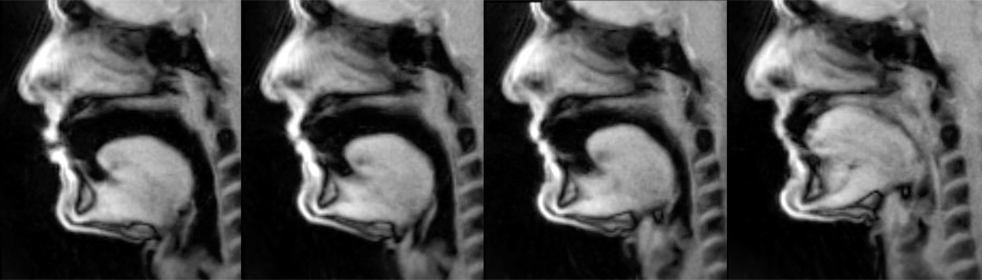
Left to right: pedal B-flat, low B-flat, tuning B-flat, high B-flat
These four images – still screen shots taken from the videos – show four different notes. From left to right, you see me playing and holding a pedal B-flat, low B-flat, tuning B-flat, and high B-flat. As I play successively higher notes, my tongue changes shape. By the high B-flat, my tongue takes up most of the available space in the oral cavity and the oropharynx has constricted as well. Yet the throat and neck remain relaxed. Apart from a slight firming of my chin, my profile is nearly identical on all four notes.
But . . .
There is virtually no change between the images for the pedal B-flat and the low B-flat. For both notes, the shape, size and position of the tongue is almost identical. The oropharynx is slightly more open for the pedal B-flat than for the low B-flat, but this is a very subtle difference. Both notes show a very open oral cavity. What does this mean? First, we see that my approach to playing is generally very stable. While in the scanner, I simply tried to play the way I normally play, despite the constraints imposed by an unfamiliar instrument and mouthpiece, and the need to play lying on my back. I don’t use an embouchure shift for pedal tones, and the pedal tone seems, as I look at these photos and videos, to simply be a lower sounding note than the note above, and one that does not require a radical change in how the note is made. Absent are any embouchure, chin or oral cavity gymnastics to produce the pedal tone. Second, this shows that tongue placement is not always an indicator of pitch production. While some teachers posit that the tongue has no role in pitch production and that embouchure alone determines pitch, that is clearly not true. On the other hand, the nearly identical tongue placement for my pedal B-flat and low B-flat shows that in the case of these two notes, my tongue was not a significant actor in pitch production. Clearly my embouchure had a greater role in determining the pitch of these two notes, and that is evident when you look at my lips. For the pedal B-flat, my lips are more relaxed, and that is the significant factor that allows me to produce and center that note.
Video 3 – articulated arpeggio
[This video may be viewed on YouTube by clicking HERE.]
Here is an articulated arpeggio that shows the slow, even movement of my tongue as I play notes from lower to higher and then from higher to lower. Again, note the fact that there is only a slight firming of my chin as I go higher, and the tongue evenly rises and falls depending on the range of each note. Observe, too, that when I take a quick breath, my oropharynx is open, allowing me to quickly get in as much air as possible.
Video 4 – slow double tongue
[This video may be viewed on YouTube by clicking HERE.]
Up to now, we have seen exercises that have been slurred or single tongued. Here is an exercise in slow double tonguing. With single tonguing, we have seen that the tongue’s motion is primarily from front to back. But with double tonguing, the “ka” syllable requires the tongue to touch the roof of the mouth in order to form a short, temporary seal that is opened quickly to give the impression of a tongued attack. I don’t ordinarily double tongue at this slow tempo, but it is useful to see how the tongue operates in this kind of slow double tongue action. In this video, we see this slow double-tonguing on both low B-flat and middle F. Even at this slow tempo, I exhibit no “chewing” motion when I am tonguing; I allow the tongue to do its work and the oropharynx is relaxed and open throughout. Many players get very tight when they double tongue. I suspect that is usually a product of insecurity – not feeling one can tongue well – rather than from a physical need of some kind to tighten the neck muscles.
Video 5 – fast double tongue (and slow motion video)
[This video may be viewed on YouTube by clicking HERE.]
Here is essentially the same exercise shown above with several important changes. First, this exercise was recorded at 100 frames per second. Second, I double tongue two different notes, low B-flat and middle F, as fast as possible. Then, after the video in which I tongue each note, part of the same video clip is played back at half speed. As you will see, the movement of my tongue is the same here as in the previous, slow double-tonguing exercise. You will also notice that the oropharynx – the back of my throat – remains open and relaxed. In addition, I perform this exercise in both soft and loud dynamics. I wanted to see if the tongue changed shape depending on the dynamic I used. As you can see, it did not. And even at the loud dynamic, you can see that I kept my oropharynx relaxed.
Video 6 – glottis, crescendo/diminuendo
Video 6 has been removed (April 19, 2024) because the video and commentary were not clear in expressing the role of the glottis in brass playing. The glottis is only recently beginning to be properly understood and research findings are just now being published. For a preliminary discussion of the role of the glottis in brass instrument playing, see: Peter W. Iltis, Sarah L. Gillespie, Jens Frahm, Dirk Voit, Arun Joseph, and Eckhart Altenmüller, “Movements of the Glottis During Horn Performance: A Pilot Study,” Medical Problems of Musicians, Vol. 32, No. 1 (March 2017), 33–39. The article may viewed HERE and HERE. Future articles about the role of the glottis in brass playing will be linked here as they are published.
Air attacks
Air attack exercise written by Edward Kleinhammer (1975)
The subject of air attacks is poorly understood. Air attacks were central to Edward Kleinhammer’s pedagogy, and he often wrote out an arpeggio exercise for students to work on – such as the image above, that he wrote for me during a lesson I had with him in 1975 – before finally codifying the exercise in Mastering the Trombone.[21] For him, the practice of air attacks to start notes helped to remove the tongue from the articulation equation, and develop better breath control. Some players use air attacks to start notes if they have a hesitation in articulation when they are under stress. They feel that taking the tongue away from the start of the note allows the note to speak without a stutter. I have rarely used air attacks to start notes at the beginning of phrases but I do use air attacks from time to time in the midst of phrases, especially in legato but also in articulated passages.
Over the years, I have suggested the use of air attacks to many students but most have difficulty understanding the concept beyond using an air attack to start a single note. But thanks to the MBRP, I can now show visually what I previously could only explain in words.
Video 7 – air attacks 1
[This video may be viewed on YouTube by clicking HERE.]
In this exercise, I play notes in two ways: first, a measure of notes is played with a traditional tongued attack. I chose the syllable TOH (as in “toe”) as opposed to TAH (as in “blah”) as a softly articulated syllable with which to start the tongued notes. Each tongued measure is followed by the same measure played with no tongue at all using the syllable HOH; I only used air to start each note. In the musical example above, tongued notes are indicated with a letter T and air attacks are indicated with a letter A.
As you view this video, you can see that when I used an air attack, the tongue was not engaged in articulation. The slight movement of the tongue that occurs during air attacks is caused by the pulsing of the air through the glottis and up the oropharynx. The tongue movement in air attacks is incidental, not causal. The size and shape of the oral cavity is essentially identical for both tongued and air attacked notes. The attack appears to be achieved by “huffing,” or pulsing the air with my diaphragm; whether the glottis is also involved in this cannot be seen in the angle of this video.
Video 8 – air attacks 2 – Finlandia – tongued/double tongued/air attack
[This video may be viewed on YouTube by clicking HERE.]
To show the difference between single tonguing, double tonguing and air attacks, I decided to record an exercise that uses a rhythm from a passage of music in which I use rapid air attacks, Jean Sibelius’ Finlandia. This piece requires the bass trombonist to articulate low E-flats at a rapid tempo in a loud dynamic. While I could not play low E-flats on the trombone I played in the MRI scanner, I compromised by playing Sibelius’ rhythm on both low B-flat and pedal B-flat.
The exercise I played is slightly different than the one printed above; I modified it when I was in the scanner to reflect Sibelius’ exact rhythm. You will hear me play two measures of each note tongued, then two measures double tongued, then two measures with air attacks.
As you will see, single tonguing resulted in a clear articulation. Double tonguing was not as clean as my single tonguing at this tempo and dynamic, and the air attacks come across like a machine gun rat-a-tat-tat. I have used this type of air attack when performing Finlandia, and with this video, a new visual tool is now available to help players understand how this kind of attack works.
These fundamental exercises and the resulting videos summarize a few of the important things I learned as a result of taking part in the MRI Brass Repository Project. But there were a few more esoteric phenomena related to trombone performance that I was able to explore in Göttingen. My friend, John Ericson, who is Associate Professor of Horn at Arizona State University, has long been curious about how the tongue performs while bending the pitch on a note. Trombone players don’t use the skill of bending pitch very often because we can correct pitch with our slide. But I do bend pitches when I play serpent and ophicleide, and sometimes when I play a trombone without an F-attachment and I need to play a note that is not on the instrument, such as a low E-flat or low-D.
Video 9 – pitch bends
[This video may be viewed on YouTube by clicking HERE.]
I decided to record an exercise where I would play several notes and bend them down to the lowest possible note before the note “broke” and then bend it back up to the original note. Lower notes would bend more easily than higher notes, owing to the flexibility of the embouchure in the low register.
Intuitively, I expected that as I bent a note lower, my tongue would flatten and move lower in my oral cavity, and as the note bent higher, my tongue would rise higher. But as you can see in the video above, the exact opposite occurred. Except for the pedal B-flat, which had the greatest bending ability because of lip flexibility in that extreme low register, my tongue raised up higher as I bent the pitch lower. This was a great surprise, especially since the feeling I had in my throat was that my tongue was moving lower. How to account for this? Because the pitch was being bent by the movement of my embouchure, perhaps the tongue rises to narrow the oral air channel to keep the note from breaking to the next lower partial. Clearly there is more study to do to understand this phenomenon. Still, this is a fascinating example of the value of the MBRP in helping to understand something that in reality was at odds with how it felt.
Video 10 – whistling
[This video may be viewed on YouTube by clicking HERE.]
I also wanted to do an experiment in the MRI scanner related to whistling. Teachers often use whistling as a way to describe the movement of the tongue when we play notes in the upper register. With whistling, the embouchure does not, in the main, determine pitch. If you pucker your lips and whistle a low note and slowly glissando to your highest possible note, you will see that your lips move very little or none at all, and you have the feeling that your tongue is raising higher in your oral cavity as the pitch goes higher. I wanted to test this metaphor for brass playing in the MRI scanner and see if it was true. It was. Mostly.
As you can see in this video, the sound of the whistle is not only determined by the pucker of one’s lips. The tongue must be high in the oral cavity in order to modify the airflow to a point where the vibration of air past the lips can create the whistle. However, as the pitch of my whistle got higher, my tongue had no room to move higher; it had to move forward in order to further close the oral cavity.
As a result of these findings, the whistle is shown to be a less than ideal metaphor for the movement of the tongue through various registers in brass playing. In whistling, higher pitch is created, in part, by the tongue going forward; in brass playing, it is created, in part, by the tongue going higher. However, in MBRP studies with other subjects, it has been found that when a person engages in “hollow whistling” – making the sound of air speed rising and falling through relaxed and slightly open lips without making an actual whistling sound – the tongue does mimic the movements the tongue makes while playing. Actual whistling might intuitively seem to be a good model for explaining the use of the tongue in brass playing, but in fact, we would be better to use “hollow whistling” as a more accurate model.
Video 11 – bugle call (Reveille)
[This video may be viewed on YouTube by clicking HERE.]
Finally, I wanted to play some music and see how my oral cavity looked in real-life operation while playing the trombone. Constrained by only being able to play the overtone series, I chose to play the bugle call, Reveille, known to every young person who has been to summer camp and to the men and women of the American Armed Forces as the call to wake up each morning. In this performance, I used a combination of single and double tonguing. The position of my tongue is always clearly visible: going back and forth during single tonguing and then up and down while double tonguing.
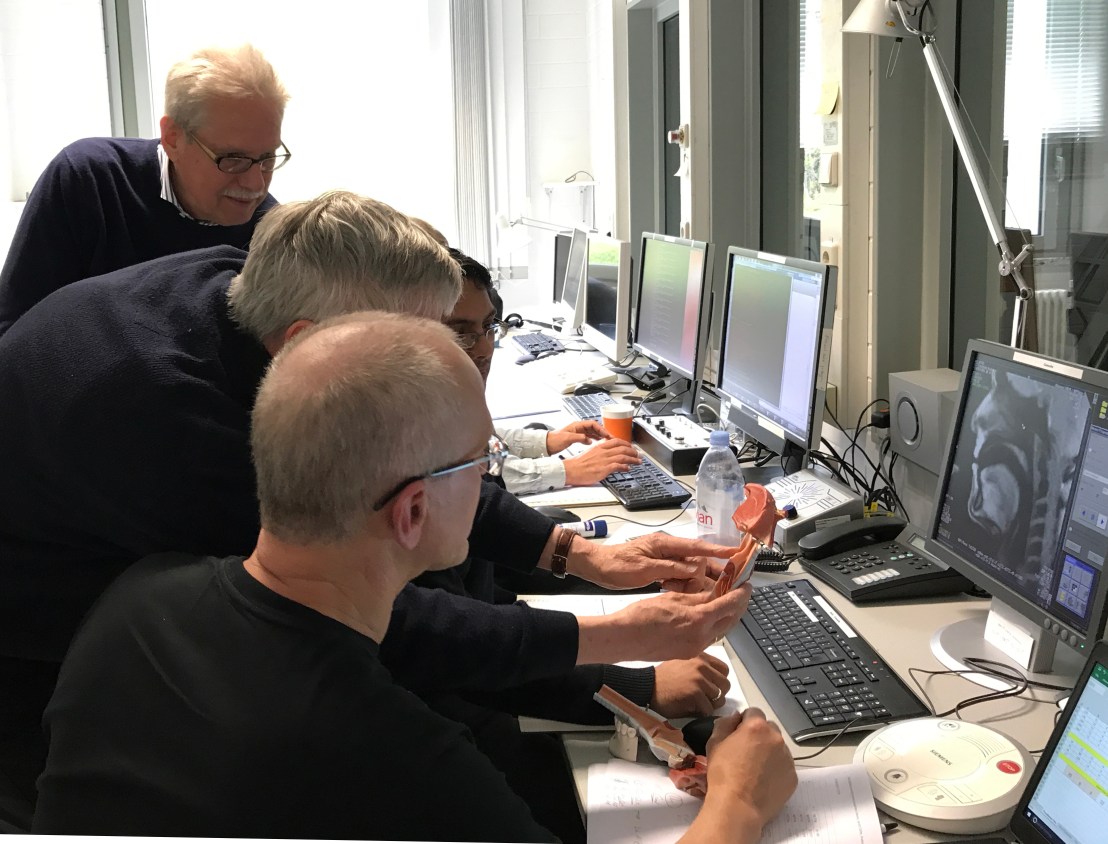
Left to right: Jens Frahm (standing, rear), Eckart Altenmüller (standing, middle), Arun Joseph (seated, rear), Douglas Yeo (seated, front)
After my two hours in the MRI scanner – the time passed very quickly and I actually had no idea I had been in the scanner for so long – I emerged energized and excited to see what I had done. I sat with members of the MRI project team to gain some understanding of what had just happened. In the photo above, I am seated in front of a computer monitor that shows one of my videos. Eckart Altenmüller is seen looking over my left shoulder, holding a plastic model of the tongue, while Jens Frahm (standing) and Arun Joseph (seated) looked on. The resulting conversation opened my eyes to workings of my tongue and other organs in my oral cavity in a new way. Also, our discussion revealed that in my videos, the tip of my tongue was not always imaged as clearly as it is with some other players when it moves to the most anterior (frontal) position. The reason for this is the fact that I have a titanium dental implant in one of my eye teeth that created what is called a susceptibility artifact that led to some signal intensity alterations at that place in my mouth. This is sometime seen as quick flashes of light that some may mistake for spit/saliva. This metal implant did not, however, affect the clarity of the imaging in any other part of my oral cavity, and ongoing study with other trombonists who do not have such a dental implant will result in additional video with greater clarity of the tongue in its most frontal position.
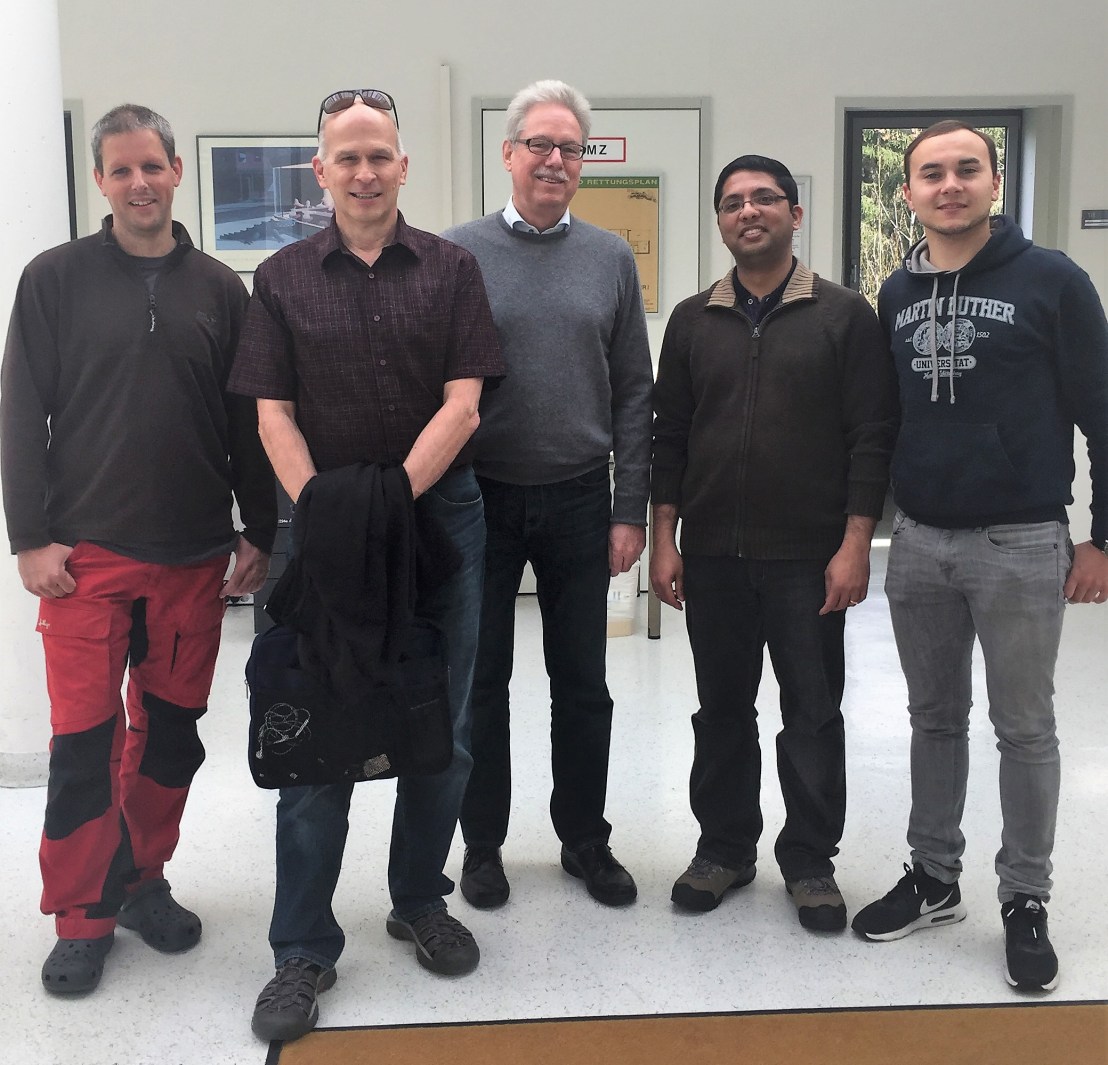
Left to right: Dirk Voit, Peter Iltis, Jens Frahm, Arun Joseph, Sonke Hellwig
Of course, a project like this needs a great deal of help to make it happen. The support staff at the Max Planck Institute was tremendously helpful in myriad ways. The photo above shows the five people who were involved with me during my time in the scanner. They gave me instructions and encouragement, ran the computers and equipment, ensured my safety, and sent me home with data and information that I am still processing. To (from left to right) Dirk Voit, Peter Iltis, Jens Frahm, Arun Joseph and Sonke Hellwig, I owe a great deal of thanks. They, along with Eckart Altenmüller, are helping to change our knowledge about brass playing and are giving concrete answers to long held questions. To YAMAHA Corporation (bell construction coordinated by Naoki Suzuki) and Kelly Mouthpieces (Jim Kelly), I once again express my thanks for providing us with the needed instruments and mouthpieces to conduct the trombone testing.
The MRI Brass Repository Project continues. In the coming months, more elite trombone players will be tested along with players who have experienced embouchure dystonia. While the project is of immeasurable help as we work to understand the why of the how of trombone playing, it is hoped that the project will also provide keys to unlock some of the mysteries of embouchure dystonia. In time, all of the videos from the study will be made available for study by educators and players so future researchers can add new insights to the work done inside the MRI scanner room at the Max Planck Institute for Biophysical Chemistry. We are in their debt.
Douglas Yeo (www.yeodoug.com and http://www.thelasttrombone.com) was bass trombonist of the Boston Symphony Orchestra from 1985-2012. He served as trombone professor at New England Conservatory of Music from 1985 to 2012, professor of trombone at Arizona State University from 2012 to 2016, trombone professor at Wheaton College (IL) from 2019 to 2023, and professor of trombone at University of Illinois Urbana-Champaign from 2022 to 2024. He has given performances and held teaching residencies on five continents, and he has received the International Trombone Association’s highest honor, the ITA Award (2014) and the ITA’s Lifetime Achievement Award (2024). His books include Mastering the Trombone (with Edward Kleinhammer; Ensemble Publications, 1997), The One Hundred: Essential Works for the Symphonic Bass Trombonist (Encore Music Publishers, 2017), Serpents, Bass Horns, and Ophicleides at the Bate Collection (University of Oxford, 2019), Homer Rodeheaver and the Rise of the Gospel Music Industry (with Kevin Mungons, University of Illinois Press, 2021), and An Illustrated Dictionary for the Modern Trombone, Tuba, and Euphonium Player (Rowman and LIttlefield, 2021/2023). He lives in the greater Chicago area.
Footnotes
[1] Harold W. Atkinson, “Tongue Positions of Vowel-Sounds,” The Modern Language Quarterly, Vol. 1, No. 1, July 1897, 13.
[2] Edward Kleinhammer, The Art of Trombone Playing. Evanston: Summy-Birchard Company, 1963, 63.
[3] Edward Kleinhammer and Douglas Yeo, Mastering the Trombone. Ithaca: Ensemble Publications, 2012 (Fourth Edition), 15.
[4] ed. Bruce Nelson, Also Sprach Arnold Jacobs: A Developmental Guide for Brass Wind Musicians. Mindelheim, Germany: Polymnia Press, 2006, 55.
[5] Arnold Jacobs, “Special Studies for the Tuba,” Hal Leonard Advanced Band Method (Basses/Tuba). Winona, Minnesota: Hal Leonard Music, 1963, 56.
[6] Philip Farkas, The Art of Brass Playing. Bloomington: Brass Publications, 1962, 62
[7] Harvey Phillips and William Winkle, The Art of Tuba and Euphonium. Secaucus: Summy-Birchard Inc., 1992, 34.
[9] Joseph (Jody) C. Hall used x-ray photographs of nine trumpet players as a basis for his his 1954 study of vowel sounds but he did not employ video. See: Joseph (Jody) C. Hall, A Radiographic, Spectrographic, and Photographic Study of Non-labial Physical Changes Which Occur in the Transition from Middle to Low and Middle to High Registers During Trumpet Performance (Ph.D. dissertation, Indiana University, 1954). In 1967, Joseph A. Meidt led a study of 10 brass players (five horn and five trumpet), in which the subjects performed several short musical excerpts while being filmed with a Rotalix x-ray (cineflourography) machine. However, the x-ray film showed the tongue only faintly and did not show the operation of the glottis and soft palate at all. See: Joseph A. Meidt, A Cineflorougraphic Investigation of Oral Adjustments for Various Aspects of Brass Instrument Performance (Ph.D. dissertation, University of Iowa, 1967). Also: Lyle C. Merriman and Joseph A. Meidt, “A Cineflourographic Investigation of Brass Instrument Performance.” Journal of Research in Music Education, Vol. 16, No. 1 (Spring, 1968), 31-38. Also: www.youtube.com/watch?v=tpOwuAMqFTA. In 2013, C. Schumacher led a team that became the first to use real-time MRI video in a limited study of trumpet players. The MRI Brass Repository Project has expanded on that work by broadening their study to include horn and trombone players, employing the fastest MRI video film speeds ever published of up to 100 frames/second, and using both elite and embouchure dystonic subjects. See: M. Schumacher, et. al, “Motor Functions in Trumpet Playing: A Real-time MRI Analysis.” Neuroradiology, 2013; 55 (9), 1171-81.
[10] See, www.gordon.edu/mrihorn. The project was originally titled the International MRI Horn Repository Project; its name was changed to MRI Brass Repository Project in 2017.
[11] From 1995-2016, Peter Iltis also taught horn at Gordon College until embouchure dystonia ended his playing career.
[12] Peter W. Iltis, et. al., “Real-time MRI comparisons of brass players: A methodological pilot study.” Human Movement Science, Vol. 42 (2015), 132-145. Peter W. Iltis, et. al., “High-speed real-time magnetic resonance imaging of fast tongue movements in elite horn players.” Quantative Imaging in Medicine and Surgery, 2015; 5 (3), 374-381. Peter W. Iltis, et. al., “Divergent oral cavity motor strategies between healthy elite and dystonic horn players.” Journal of Clinical Movement Disorders, 2015, 2:15. Peter W. Iltis, et. al., “Inefficencies in Motor Strategies of Horn Players with Embouchure Dystonia.” Medical Problems of Performing Artists, 2016. Peter W. Iltis, et. al., “Movement of the Glottis During Horn Performance: A Pilot Study.” Medical Problems of Performing Artists, Vol. 32, No. 1 (March 2017), 33. Peter W. Iltis, “When Science Meets Brass.” The Instrumentalist, Vol. 72, No. 1, August 2017, 36-39.
[14] Edward Kleinhammer (1919-2013) was bass trombonist of the Chicago Symphony Orchestra from 1940-1985. See: Douglas Yeo, “Edward Kleinhammer: A Life and Legacy Remembered.” International Trombone Association Journal, Vol. 42, No. 2, April 2014, 24-31.
[15] Arnold Jacobs (1915-1998) was tubist with the Chicago Symphony Orchestra from 1944-1988.
[16] Brian Frederickson and John Taylor, Arnold Jacobs: Song and Wind. Gurnee, Illinois: WindSong Press, 1996, 93, 141-143.
I don’t know anyone who doesn’t want to be great at something. I mean, how many people do you know who have, as their goal in life, to be mediocre? I don’t know anyone like that. We all want to excel, to be great at something – or some things – and the pursuit of excellence is high on just about everyone’s life list.
When I was at the International Trombone Festival at University of Redlands, California, a few weeks ago, I presented a class along with my friend, Megumi Kanda. Megumi is principal trombonist of the Milwaukee Symphony, and we have each authored books to help trombone players prepare better for auditions and concerts. In short, we are trying to help trombonists climb the mountain of life and achieve success through the pursuit of excellence.
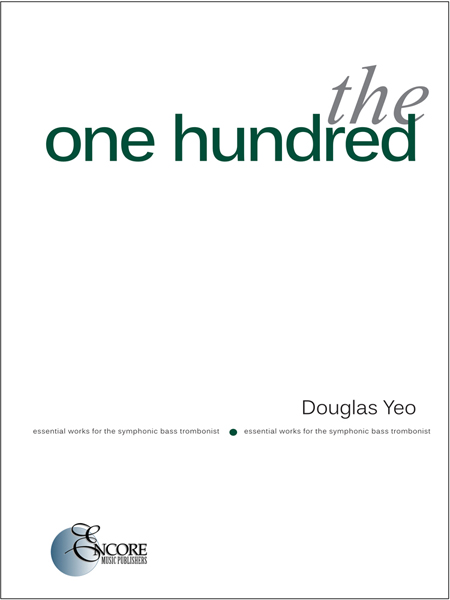
The One Hundred: Effective Strategies for Successful Audition Preparation
Here are the points that I emphasized in my part of the class along with a little commentary. Perhaps there is something here that might resonate with and help you.
Questions to ask yourself:
How good is good enough?
If you are in pursuit of a goal, you need to know what the standard is. You need to know how good you actually have to be in order to attain it. If you don’t know the answer to this question, then you’re not being serious about actually achieving a goal. I wrote an article on my website about this subject; you can read it by clicking here.
Where do you stack up locally? Can you read the signs?
Let’s suppose you want to win a position in the trombone section of the Chicago Symphony Orchestra. You would not be alone; that would be a highly coveted job for many people in the world. If you want this job, look around. Where do you stack up in your local universe of trombone players. In your college, in your local freelance area. If you’re not one of the best players in your local area, how is it that you think that you are really good enough to win a position that will be sought after by the top players in many areas, as well as people who already have jobs in other orchestras? If you’ve taken 50 auditions and you have never advanced past the first round, that is telling you something. Can you look around and read what the signs in your life are telling you?
Does your desire line up with your talent and work ethic?
Desire is important. But desire alone will not lead to success. You need desire, talent and a solid work ethic. I know many people who have a great desire to succeed but they’re lazy. I know highly motivated people who don’t have talent. I know talented people who don’t have desire. If you have a goal in mind, you need to be sure that your desire lines up with the your talent AND your work ethic. As my friend, Gene Pokorny, tubist with the Chicago Symphony Orchestra, says, :
No one can legislate curiosity, and “hope” is not a strategy for success.
Is your goal attainable?
When I was a young boy growing up in the early 1960s, I wanted to be an astronaut. All of my friends wanted to be one, too. But as I grew older, I realized that my goal of wanting to be an astronaut was not attainable. I got glasses in the second grade. End of story. I turned my sights to other goals. Be sure you are pursuing goals that are attainable.
The essentials:
Here are the things that are important for success in a symphony orchestra audition. I’ve developed this list after being on an audition committee for over 20 auditions at the Boston Symphony Orchestra, and hundreds and hundreds of auditions and jury exams at Peabody Conservatory of Music, New England Conservatory of Music and Arizona State University. These are the essentials you must possess if you are going to have a chance of succeeding at a symphony orchestra audition:
A beautiful sound. Without this, nothing else matters.
This speaks for itself.
Impeccable intonation.
Note that I did not say good intonation. Or great intonation. You need to have impeccable intonation. Playing in tune is fundamental to being able to work in a section of other players. Impeccable intonation is noticed very quickly. If you don’t have it, that’s noticed quickly, too.
Exceptional musicality, including a wide dynamic range, appropriate vibrato, seamless legato, and a clear differentiation between various kinds of articulations.
Does your playing exhibit all of these qualities? How wide is your dynamic range? Is it truly from ppppp to fffff? Tchaikovsky requires that in his Symphony No. 6. Do you know how to make every possible kind of articulation? Here’s an example, a short excerpt from the bass trombone part to the second movement, Scherzo, from Gustav Mahler’s Symphony No. 1:
Look at all of the different kind of articulations required on a single note, G-natural. You see sfp, then fp with a marcato, sf with a marcato, f with a marcato, and the note simply with marcato. That’s five different kinds of instructions about playing the same note. Can you make a difference? This matters.
An informed sense of style.
Style is different than musicality, mentioned above. Style is the “why” of music; musicality is the “what” of music. To learn the style of a piece, you have to know it inside and out, and understand what it means and why. Mahler is different than Mozart. Informed style comes through in a person’s playing.
A superb sense of rhythm, including exhibiting what Edward Kleinhammer often referred to as “the unwritten laws of rhythmic pulse.”
Edward Kleinhammer was bass trombonist of the Chicago Symphony Orchestra form 1940-1985; he was my trombone teacher when I was a student at Wheaton College. One of the things he emphasized was getting rhythmic pulse right. Composers can’t write everything that you need to do. There are “unwritten rules” about rhythmic pulse. Some people make this into a complex system, assigning syllables, letters or numbers to each note to show which notes have different weight or emphasis. Mr. Kleinhammer took a very simple approach. In every meter, there is generally an unwritten sense of pulse. For instance, in 4/4 time, the first beat is usually the strongest, the second beat is usually the weakest, the third beat is the second strongest beat, and the fourth beat usually leads to the subsequent first beat. This is true for 99.9% of all music in 4/4 time. Find the pulse and then demonstrate it with musicality and style. It is not complicated. It just needs to be done.
A confident, comfortable physical demeanor devoid of nervous, obsessive gestures or habits. You must pass “the weirdo test.”
When you are at an audition or a job interview, people on the audition committee are trying to decide if you will be a good fit in the group. You must make others around you feel comfortable. If you are obsessive about spraying your trombone slide with your water bottle, or you fidget while a colleague is playing the solo from Ravel’s Bolero, or you need to sit quietly for a few minutes to collect yourself before you play something, you’re probably not going to win the job. Your job – every colleague’s job – is to make the job of the people around you as easy and comfortable as possible. As to the weirdo test? Take a shower regularly. Use deodorant. Comb your hair. Think twice about tattoos and piercings. None of these things speak to who you ARE. But others will draw their own conclusions – fair or not – about what you PROJECT about yourself. Remember: the person hiring you might be your father’s age. Think about how you come across to others. All others.
Strategies to employ:
Question your assumptions.
By this I mean that you should always ask yourself if what you’re doing is the best way of doing it right now. For instance, if you’ve always taken a breath in a certain phrase at the same place, ask yourself, “Is this still the best place to take a breath?” Do the same with every aspect of playing: volume, slide position, type of articulation, tempo, etc. If you don’t ask yourself if the way you’re doing something is still the best way for you to do it, you will never allow for the fact that you are a different – and hopefully better – player today than you were yesterday. Or last week. Or last year when you first put that breath mark in your part. 95% of the time, you will probably answer, “Yup, that was a good idea when I first did it and it’s still a good idea.” But for that other 5% of the time, you just might make a change that is a result of your improvement as a player. You might not need that breath at all, and that new way of phrasing might just be what the audition committee is waiting to here. Don’t be fossilized doing things, “The way I’ve always done them.” Keep asking yourself questions and make changes based on the improvements you’ve made.
Try everything.
This is related to the point above. Try every possible way of solving every possible problem you are faced with. Sometimes you have two or three or four different slide positions where you could play a particular note. Try them all. Don’t be allergic to sixth and seventh positions. If you think you’re playing softly enough, try to the passage softer. Don’t assume you can’t do something. Don’t assume some way of solving a problem is too unconventional and therefore won’t work. Try everything. Only if you try every possible way to approach music will you know that you’ve found the best way for you to successfully play any passage.
Pay attention, ask questions, read, study the sources, leave no stone unturned.
Don’t just sit in a practice room and practice music. Learn more about what you’re playing in order to give your playing context. Study the orchestral score, find out if there are variant editions of a piece, read biographies of composers, read books about pieces you play, learn more about your instrument. Have an insatiable curiosity.
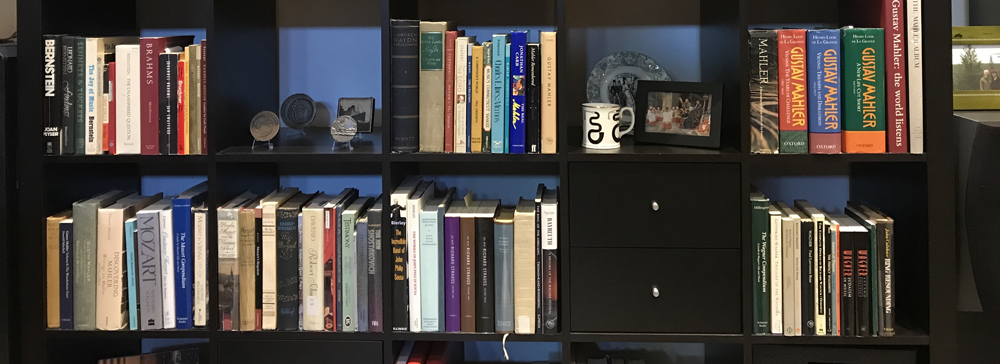
I have a lot of books. Hundreds. And a lot of full scores to music that I’ve played. Hundreds. Here’s a snapshot of two shelves of my books. Take a look at what you see:
There are six books about Haydn, 14 books about Gustav Mahler, eight books about Mozart, 15 books about Richard Wagner. I’ve read all of them. Multiple times. These books have been invaluable to me as I have prepared for auditions and concerts. They are also extremely helpful in my research as I write articles and books. Everything you read, everything you experience, brings something added to your performance. Talk to people around you – even if they’re not trombone players. Learn from every experience in life. If you pay attention, you will bring special qualities to your playing.
Every player’s lament: But I can do it in the practice room.
OK, then bring the practice room to the stage.
If you can do things just the way you want to in the practice room but can’t replicate that success on stage at an audition or performance, you need to ask yourself, “Why is this happening?” Nobody practices so they can play great in a practice room. We practice so we can play great on stage. But many people set up systems and routines for performance that have nothing at all to do with practicing. Some people need to eat a banana before going on stage, or eat a rare steak 90 minutes before, or be sure Jupiter is aligned with Mars, or any number of things. Why? Do you need to do those things in order to play great in the practice room? Of course not. Then why do you add this layer of process to performance so the performance becomes something completely different than the situation – practicing – where you had success? Bring the practice room to the stage. The reason you play a musical instrument is so you can play it in public in performance. So recreate on stage what you do in the practice room; don’t separate your playing into different kinds of routines for different environments.
Remember:
Practice does not make perfect. Practice makes permanent.
If you practice, you will get better at what you’re practicing. But if you’re practicing something the wrong way, or without understanding, you will get better at doing it wrong. Practice in and of itself will not lead to your playing your best. Practice makes permanent what it is that you’re practicing. So be sure you are practicing correctly. It is not HOW LONG you practice but HOW WELL you practice.
Do not believe the lie of 10,000 hours.
There is a popular school of thought that goes something like this: If you spend 10,000 hours working to develop a skill and are doing so with good guidance, you can do anything. This is nonsense. I could spend 10,000 hours in a gym in order to attain the goal of being a linebacker with the Arizona Cardinals football team but it will not happen. Because I need more than 10,000 hours to succeed in that quest. I need talent, and a particular body type. While people often say, “You can be anything you want to be,” that is not true. See above, my story about my wanting to be an astronaut. You need the right combination of talent, hard work and destiny. That’s the God card; it must be meant to be. That’s another subject all together, and a very important one. That’s a subject for another post. But keep this in mind: hard work – 10,000 hours – is not enough.
Your best may get you to the top. But it might not.
After all of your work, all of your study, all of your practice, you just might get to the top. See my first question: How good is good enough? When you put together all of the aspects of your performing person and persona, you just might get to the top. You just might win that job in the Chicago Symphony. And if you do, congratulations!
But you might not. Everyone has a ceiling. Everyone does not have an equal chance to succeed in a goal that has one winner. Your best might not be good enough to get you to the top of the mountain. That does not make you a failure or a bad person. It’s just the realization that the best you bring to the table might not be good enough to get you to a particular goal. But. . .
The top is not the only place where you may have a rewarding musical life.
Yes, we all want to be reach the top of the mountain. And we should always feel great when we know that we have produced the very best that we can at any task. But if you don’t reach the top, there is still a great view from wherever you are. The Chicago Symphony, for instance, is not the only place where you can have a very satisfying, rewarding musical life. I know freelance players who are very satisfied. I know players in second, or third, or tenth tier orchestras who have fulfilling musical lives. Wherever your combination of talent, hard work and destiny takes you, you can have an exceptionally rewarding life. Do not forget this!
If you would like to view or download a copy of the PDF handout that accompanied my presentation at the International Trombone Festival – it contains the bullet points on which this article is based – clickHERE.
Last October, I wrote an article for The Last Trombone titled, Rethinking Mozart’s Tuba mirum. If you’re reading THIS article and haven’t read my earlier thoughts this subject, please take a minute to read my earlier article so you can have a fuller context for what follows.
For many years, I have puzzled over a question: Why does the trombone solo to the Tuba mirum movement in Mozart’s Requiem seem to be of a completely different character than the vocal text of the movement? In my previous article I raised the question and wondered if we could begin a conversation about this. What happened was quite unexpected: that article about Mozart’s Tuba mirum has received thousands of views. Clearly this question is something that is on the mind of many others.
To recap, the text of Tuba mirum of the Requiem mass speaks of the dead being raised from their graves as they are being summoned before the throne of God for judgment. Here is the text in Latin:
Tuba mirum spargens sonum
Per sepulchral regionum,
Coget omnes ante thronum.
And here is the “standard literal” translation in English:
The trumpet, scattering a wondrous sound
through all the sepulchers of the regions,
will summon all before the throne.
Here is a fuller, more accurate translation of the text in English:
The trumpet, blowing its amazing sound to all of the corners of the earth,
signals to all of the dead in the world
to rise from their tombs and come before the throne of God for judgment.
Surely this is a text that demands dramatic treatment. And many composers, like Berlioz, Verdi and even contemporaries of Mozart such as Antonio Salieri, Michael Haydn and Luigi Cherubini infused this movement with fast tempos and loud trumpets, trombones and timpani.
But not Mozart.
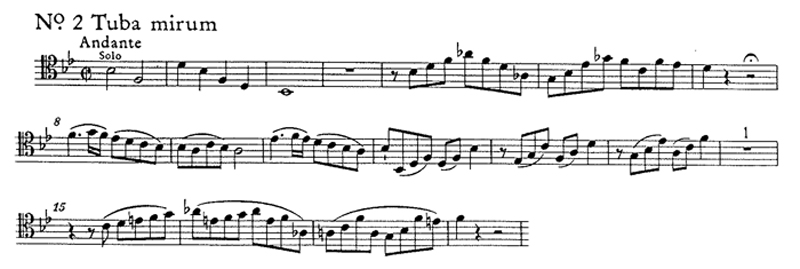
After the initial opening “fanfare” of the call of the last trumpet, Mozart wrote what is usually interpreted as a florid, legato passage to accompany the bass vocal soloist. Here is the trombone solo as printed in a commonly performed edition:
It must first be said that apart from the three slurs that appear in measures 15, 16 and 17, none of the expressive markings are Mozart’s. He did not live to hear the Requiem performed and the Tuba mirum was left unfinished; he did not even indicate an opening dynamic for the trombone solo. Had he lived, he certainly would have gone back to this movement and edited it more clearly for performance. A look at the except from Mozart’s manuscript at the top of this article (if you are reading this article because you have subscribed to The Last Trombone by email, click on the title of this article to open this page in your web browser and you can see the header image) shows just how little Mozart gave us in terms of expressive guidance.
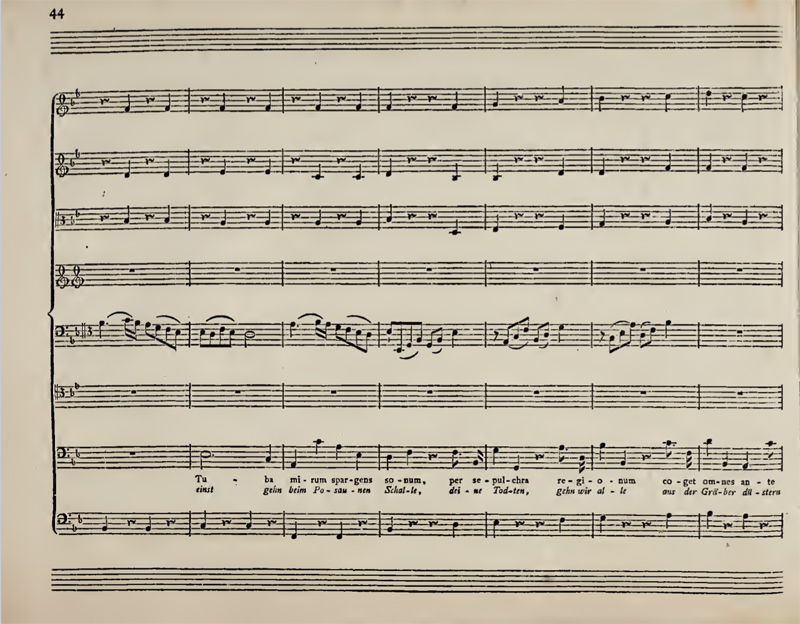
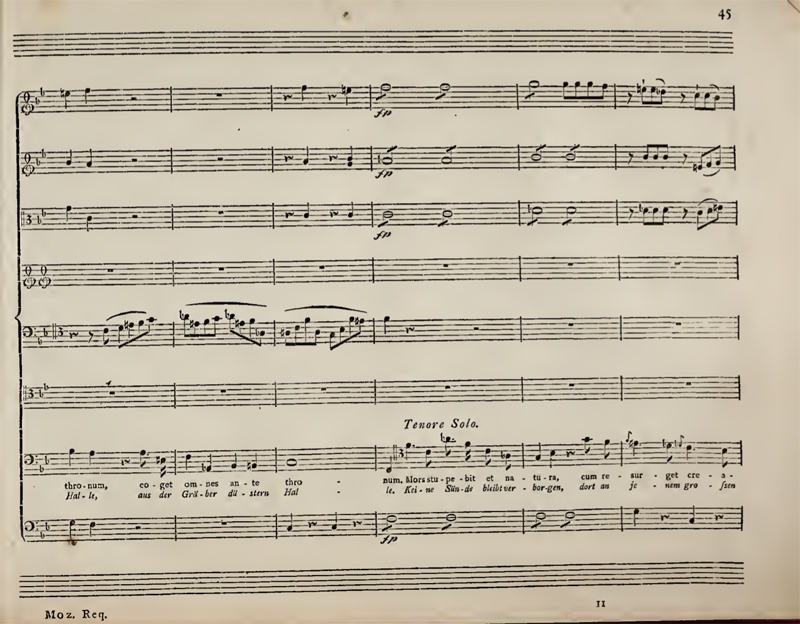
Still, the tradition that calls for this solo to be played legato dates back to the Requiem‘s first edition, published in Leipzig, Germany c1800 by Breitkopf & Härtel. Below are the first three pages of the Tuba mirum in this edition. The full score to this edition, which is owned by the Handel and Haydn Society of Boston and is on deposit at the Boston Public Library for safekeeping, is available online by clicking HERE. You will also notice something that seems a little shocking: after the opening notes of the trombone solo, this edition gives most of the Tuba mirum solo to a solo bassoon (Fagotto in German), not solo trombone. Seriously. But more on this in a minute. Have a look at these pages and you will see that from this first edition, the character of the trombone solo was legato:
Note: You will see that the trombone solo in measures 5-7 is not marked legato even though it is usually played that way by today’s players. I think a case can be made for a detached tenuto OR a legato approach to these measures. Part of this thinking is a consideration of what we are learning about 19th century trombone performance practice and part of it is based on a consideration that these measures might – might – actually depict the initial movement of the dead from their graves.
However, with the mostly legato character of the opening of this movement clearly established from its earliest performances, the question still remains: why does Mozart treat this dramatic text in this way?
After I published my earlier article in which I posed this question, I continued researching in hopes of answering my own question. I had conversations with my friend, Howard Weiner, one of the most respected scholars of the trombone who is also co-editor of the Historic Brass Society Journal, and consulted dozens of books about Mozart and the Requiem. As I looked more carefully at this, some important information came to light and I think I am beginning to understand why Mozart called for the trombone solo to be played in a gentle rather than dramatic style.
As I was researching this, the Boston Symphony Orchestra contacted me. They were planning performances of the Requiem on April 20, 21 and 22 and asked if I would be interested in contributing an article about the Tuba mirum for the BSO program book. The timing was perfect. While I was planning to write a long article on the subject for a scholarly journal, the offer to write a shorter, 1000 word piece was very appealing to me. It allowed me to concisely present my argument to an audience that was preparing to hear the Requiem in performance. And so, last week, my article about the trombone solo in Mozart’s Tuba mirum was published in the Boston Symphony program book.
For the benefit of readers of The Last Trombone, I am reprinting my article below. What you see below is identical to what appeared in the article except the quotations from various authors are fully cited below. If you would like to read or download the article as it appeared in the Boston Symphony program (PDF file), click HERE.
As you will see, I think Mozart knew what he was doing. Of course, there is much room for discussion and further research, and I hope we will all keep asking questions. Still, I think this is a plausible theory to answer a question that has vexed not only trombonists, but, as you will read below, Mozart scholars for over two centuries. I close this article in a way that is similar to my conclusion to my earlier article on this subject:
I am posing an idea, a theory; I am not presenting this as a settled thought in need of adoption. Certainly more research and study needs to be done. Let’s keep thinking.
• • •
Reprinted from the Boston Symphony Orchestra Program Book, April 20, 21, 22, 2017.
“Tuba mirum” or “Tuba dirum”: Mozart’s Requiem and the Trombone
Written in the last months of his life, Mozart’s Requiem has achieved almost mythic status as one of classical music’s greatest works, despite the fact that he did not live to see it to completion. Today we take for granted the near universal praise of the Requiem, and any criticism is usually reserved for discussion about the perceived inadequacies of those who completed the work from Mozart’s sketches. Trombone players have special reason to be grateful to Mozart, since he has provided them with one of the orchestral repertoire’s finest trombone solos, one that stands alongside those found in Maurice Ravel’s Bolero and Gustav Mahler’s Symphony No. 3. Yet Mozart’s trombone solo in the Tuba mirum has been a subject of controversy since its first performances and has not always been held in high esteem.
Mozart’s manuscript for the Tuba mirum contains only the most basic of outlines, containing parts for the vocal soloists, solo trombone, and cellos/basses. He wrote no dynamic marking for the opening solo, and he offered only scant articulation markings to guide performers stylistically. Mozart’s trombone solo extends to the end of the opening text that is sung by the bass soloist; the trombone’s music staff continues throughout the entire movement but those measures were never filled by the composer’s pen.
It is the trombone, rather than the trumpet, that introduces the sound of the Biblical “last trumpet,” a quite logical decision when one understands that the word “trombone” literally means “large trumpet.” Banish any thought that the Latin word “tuba” has anything to do with today’s large brass instrument of that name. Unlike the trombone, the natural (valveless) trumpet of Mozart’s time was not capable of playing fully chromatically. Mozart, at age eleven, had written an exceptional trombone solo in his Die Schuldigkeit des ersten Gebotes (The Obligation of the First Commandment), K.35, and was well acquainted with the instrument’s capabilities. After the Tuba mirum’s opening measures, the trombone writing changes character, and it accompanies the bass soloist with florid lines and arpeggios until the tenor soloist enters (Mors stupebit) with a minor-key version of the trombone’s opening motif. This is all well and good until one considers whether Mozart’s trombone writing actually reflects the character of the vocal text.
After the drama of the Dies irae, the Tuba mirum text continues with an evocative image of the dead rising from their graves to face the judgment of God. While Hector Berlioz (1834) famously complained that Mozart’s single trombone was inadequate to the task— “Why just one trombone to sound the terrible blast that should echo round the world and raise the dead from the grave? Why keep the other two trombones silent when not three, not thirty, not three hundred would be enough?” (1) —other commentators have objected to the character of the solo. Many have echoed Alfred Einstein’s assessment (1945) that “one cannot shake off the impression that the heavenly [trombone] player is exhibiting his prowess instead of announcing terribly the terrible moment of the Last Judgment.” (2) More recently, John Rosselli, in The Life of Mozart (1998), opines that the trombone solo “strains after majesty and fails.” (3) Perhaps the harshest cut came from Cecil Forsyth in his Orchestration (1914) where he wrote, sardonically, “Only the first three bars appear to have been written by one who understood the instrument. The rest might be better described as Tuba dirum spargens sonum.” The text’s reference to the amazing (“mirum”) sound of the last trumpet became, in Mozart’s allegedly inept hands, simply “awful” (“dirum”). (4)
Yet missing from all of this harsh commentary is an understanding of not only the use of the trombone in late-18th-century Vienna, but also how composers at that time and place addressed the subject of death. It is true that many of Mozart’s contemporaries, including Antonio Salieri, Michael Haydn, and Luigi Cherubini, treated the Tuba mirum in dramatic fashion with loud brass and timpani. But others, like Georg Reutter and Franz Joseph Aumann, wrote gentle trombone solos (and trombone duets) in the Tuba mirum movement of their Requiems. Why did some composers treat this text with dramatic effect while others, like Mozart, took a more gentle approach? We do well to note that in Vienna from the mid-18th century, the idea of “eine schöne Leich” (“a beautiful funeral”) was very much in play. Hermann Abert, in his early biography of Mozart (1855), explains “that Mozart pictures the Lord not as a strict and implacable judge but as a lenient, albeit just and serious, God.” (5) Edward Young’s poem “Night Thoughts” (1742), which was translated and widely distributed in Austria, also encouraged this view of “a good death.” If one has led a life according to God’s commands, what, then, is there to fear when the trumpet of God calls one to account?
If we accept that Mozart was fully aware of the implications of using the trombone to reflect a more gentle view of the judgment of God, today’s musicians still need to address other important issues of performance practice. While Mozart’s manuscript clearly shows the meter of Tuba mirum as cut time (2/2), the first published edition (1800) changed that to common time (4/4). This confusion led to a host of conductors leading the movement at an exceptionally slow tempo despite the Andante tempo marking. Many editions, starting with the first edition, gave some or all of the trombone solo over to a bassoon, or even viola and cello, a concession to the lack of competent trombone players in many countries in the 19th century. But Mozart’s trombone solo in the Tuba mirum is a superb example of late 18th-century Viennese writing for the instrument. Its character is consistent with Mozart’s view of death, a view he shared with his father, Leopold, in a letter from 1787:
As death, when we come to consider it closely, is the true goal of our existence, I have formed during the last few years such close relations with this best and truest friend of mankind that his image is not only no longer terrifying to me, but it is indeed very soothing and consoling! And I thank my God for graciously granting me the opportunity…to learn that death is the key which unlocks the door to our happiness. (6)
Citations:
(1) Hugh MacDonald, Berlioz’s Orchestration Treatise: A Translation and Commentary. Cambridge: Cambridge University Press (2002), 220.
(2) Alfred Einstein, Mozart: His Character, His Work. New York: Oxford University Press (1945), 354.
(3) John Rosselli, The Life of Mozart. Cambridge: Cambridge University Press (1998), 160.
(4) Cecil Forsyth, Orchestration. London: Macmillan and Company (1914), 149.
(5) Hermann Abert, translated by Stewart Spencer, edited by Cliff Eisen, W. A. Mozart. New Haven: Yale University Press (2007), 1323-1324.
(6) Christoph Wolff, Mozart’s Requiem: Historical and Analytical Studies. Berkeley: University of California Press (1994), 84.
• • •
DOUGLAS YEO (www.thelasttrombone.com and www.yeodoug.com) was bass trombonist of the Boston Symphony Orchestra from 1985 to 2012 and was Professor of Trombone at Arizona State University from 2012 to 2016; his latest book is The One Hundred: Essential Works for the Symphonic Bass Trombonist (Encore Music Publishers). He lives in the foothills of Arizona’s Sierra Estrella and is currently writing The Trombone Book (Oxford University Press) and Homer Rodeheaver: Gospel Music’s ‘Reverend Trombone’ (University of Illinois Press).











 The Last Trombone – Douglas Yeo