Category: research projects

Why trombone players cannot trust artificial intelligence (AI) for historical information

Why trombone players cannot trust artificial intelligence (AI) for historical information

by Douglas Yeo (December 17, 2025)

I am at work on a book for Oxford University Press, The Trombone Book, that will be part of OUP’s new series of books on musical instruments. This new series replaces OUP’s previous series of books on musical instruments that included Trombone Technique by my late friend, Denis Wick (London: Oxford, 1971) that has been out of print for several years. I am working up against several deadlines to get the book finished and submitted by the end of 2026, so I’m working on this every day. It’s slow going because I want the book to be helpful. And if it’s going to be helpful, it needs to be accurate.

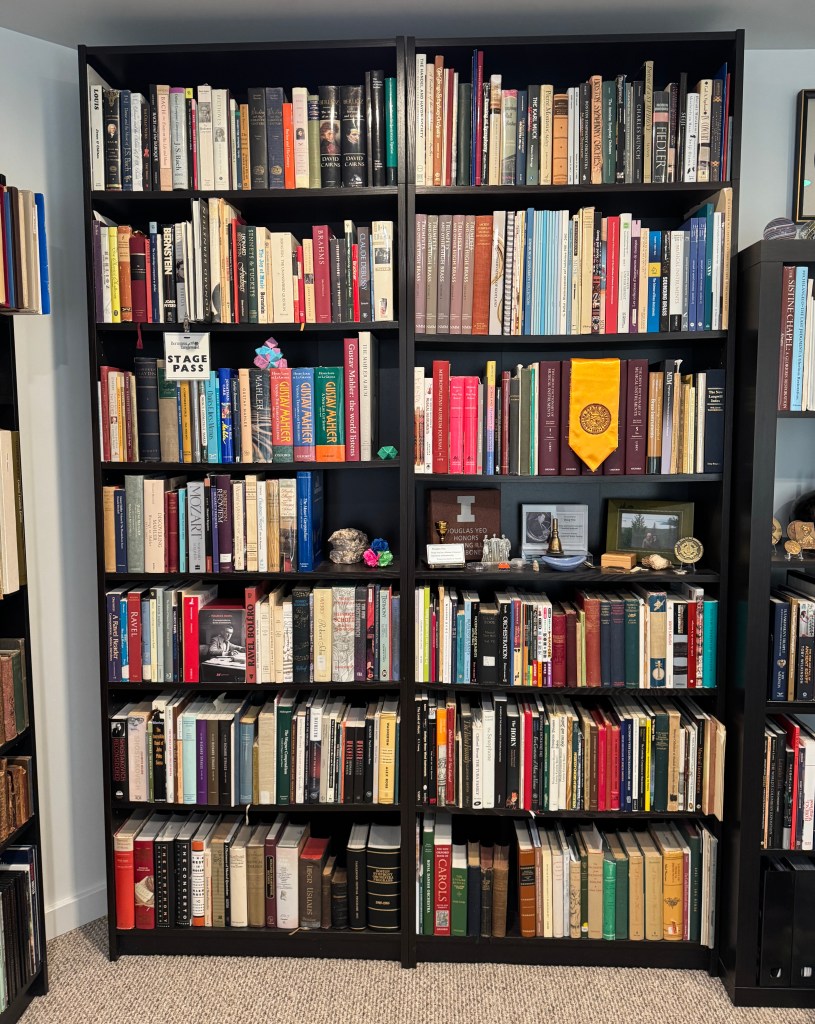
Included in my new book are several chapters on the history of the trombone, its music, composers, and performers. I have over 2000 books in my library here at home, and I make ample use of inter-library loan (ILL, or ILLIAD), access to which is generously provided to me by the kind staff at the Library at my undergraduate alma-mater, Wheaton College

Two of the seven bookcases about composers, musical instruments, and other music related subjects in my home office. In our basement, I have many more bookcases full of books.

When it comes to historical resources, many have been scanned and are available on IMSLP  and Internet Archive. This is a tremendous resource for researchers, a real change from the microfilm/microfiche days of old. (I remember those days; it was not an easy time to do research.) When I can’t find a scan online, I acquire the book. If I can’t get the book through inter-library-loan, I purchase it. Even though many historical passages in treatises and methods have been translated into English by various authors (including David Guion, Howard Weiner, and Stewart Carter), I always want to see the original myself and do my own translation. In some cases, when I deal with old typography in various languages (16th through 18th centuries), it’s difficult to read, and artificial intelligence can be helpful in providing the original text in readable form. AI (I use ChatGPT 5.2, a paid service that is more advanced than the free ChatGPT 4.o) can provide a reasonably good text into modern languages from old typography, and it also reasonably translates text into English. In this, AI can be very helpful, However. . . after I read an AI-made translation, I always redo the translation myself and also confirm the translation with a native speaker of that language. Because I don’t trust AI. 

I have written about this previously on TheLastTrombone and if you haven’t read my article, ChatGPT and the trombone: Is this the end of writing and research? I don’t think so., please take a minute to do so. In that article, I fed ChatGPT several questions about the trombone and other musical instruments. The answers will probably surprise you but my conclusion should not: You cannot trust AI when it comes to the history of the trombone.

There are three reasons for this:

First, AI only knows what it’s been fed. If it’s been fed junk — older readers may remember IBM’s early motto, “GIGO,” or “Garbage In, Garbage Out” — it will spew out junk. Frankly, there is a lot of trombone research out there that’s pure junk. And AI has been fed a steady diet of trombone research junk. Why that’s the case is another story, but suffice to say that when I read something about the trombone in a book or article, I always look for the footnote and I track down the source myself. Because machines aren’t the only thing that get things wrong: human beings get things wrong, too, or they’re sloppy, or they don’t cite a source correctly, or they cite a secondary source that cites another secondary source and when you go to the end of the rainbow, there is no primary source. I wrote about this — people making up something and presenting it as true because they didn’t actually track down the original source — on TheLastTrombone when I discovered that the Pulitzer Prize Committee had mangled a quotation by Joseph Pulitzer ON ITS OWN WEBSITE. Read about that HERE, in my article titled, “Words matter.”

Second, AI is getting worse, not better when it comes to history. When it is asked questions, AI tries to answer them. It rarely says “I don’t know.” Instead, it feeds on previous answers it has given to similar questions, even if those answers were wrong. In time, like a game of “telephone,” AI ends up with something that’s wrong but sounds plausible. It always writes with excruciatingly accurate grammar and punctuation, even if sometimes the sentence structure it uses is a little over the top and a little cringeworthy.

Third, AI hallucinates. It makes up stuff. All. The. Time.

I’m taking time away from working on my book today to share a recent interaction I had with AI regarding a 18th century text about the trombone. I’m working with multiple sources at the same time and now and then, I get confused about where I actually got a source. I have hundreds of PDFs of articles, treatises, and methods in several languages. I have many screenshots I’ve taken of text that I’ve then uploaded to ChatGPT to put into a modern typeface so I can read it better.

Today, I was proofreading chapter 2 of my book, “A Brief History of the Conception and Evolution of the Trombone.” The first part of the chapter concerns many of the myths about the history of the trombone, myths that have been repeated over and over again in papers, dissertations, and books. Starting out with what’s wrong about how the trombone’s history has been told allows me to correct false narratives. It also gives me a good starting place to get back to ground zero and write something about the trombone’s history without the fog of mis- and dis-information that has affected trombone research for hundreds of years.

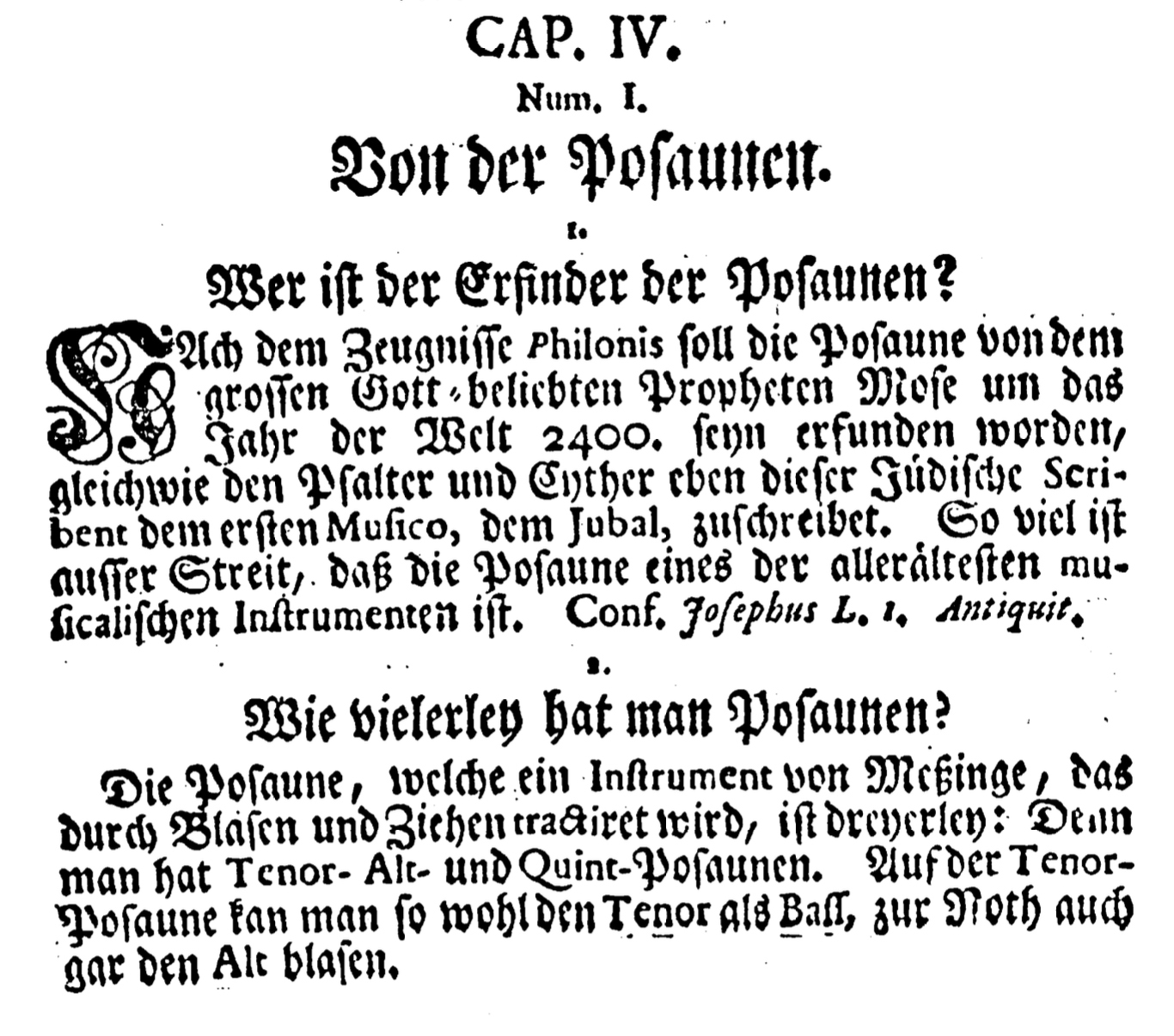
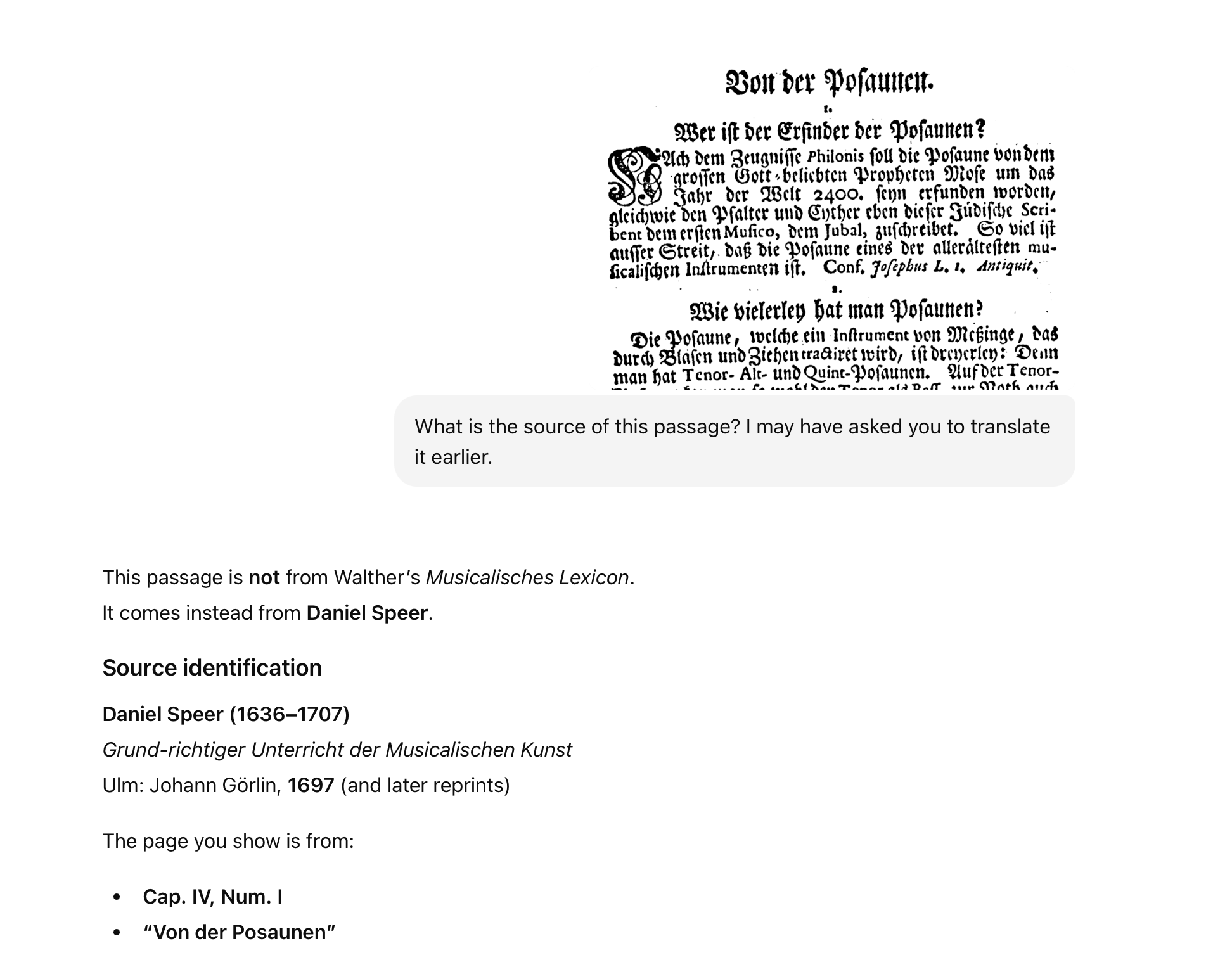
While I was proofreading, I came across an origin story for the trombone that I had included in my chapter — a false origin story. I recalled that I had read an English translation of the text I’m including in the chapter in a book, but I couldn’t recall where. My citation was for the original treatise; at least I THOUGHT it was the correct citation. But something in the back of my mind wondered if I had it right, so I re-uploaded the text to ChatGPT and asked what the source was. Here’s the text I needed to identify:

It’s the first paragraph that interests me. It’s a false narrative about the origin of the trombone. I translated it like this:

According to the testimony of Philo, the trombone was invented by the great, God-beloved prophet Moses, around the year 2400 of the world 200, just as Jewish writers ascribe the psaltery and cither to the first musician, Jubal. So, it is beyond dispute that the trombone is one of the most ancient  musical instruments. 

In my citation, I had given this as the source:

Johann Philipp Eisel, Musicus autodidactus, oder der sich selbst informirende Musicus (Erfurt: Wülfingische Buchhandlung 1738), 70.

But I wanted to be sure. So I asked ChatGPT. What follows are screenshots of my interaction with AI just a few hours ago, today, December 17, 2025. It begins with my uploading the passage (above) and my asking AI to identify it. I told AI that it had previously worked on this passage for me. My comments are on the right side of each screenshot, in a shaded box; ChatGPT is on the left:

AI identified the passage as from Daniel Speer’s important treatise Grund-richter Unterricht der Musikalischen Kunst (Fundamentally Correct Instruction in the Musical Arts) (Ulm: Georg Wilhelm Kühne; Christian Balthasar Kühnen sel. Erben, 1697). 

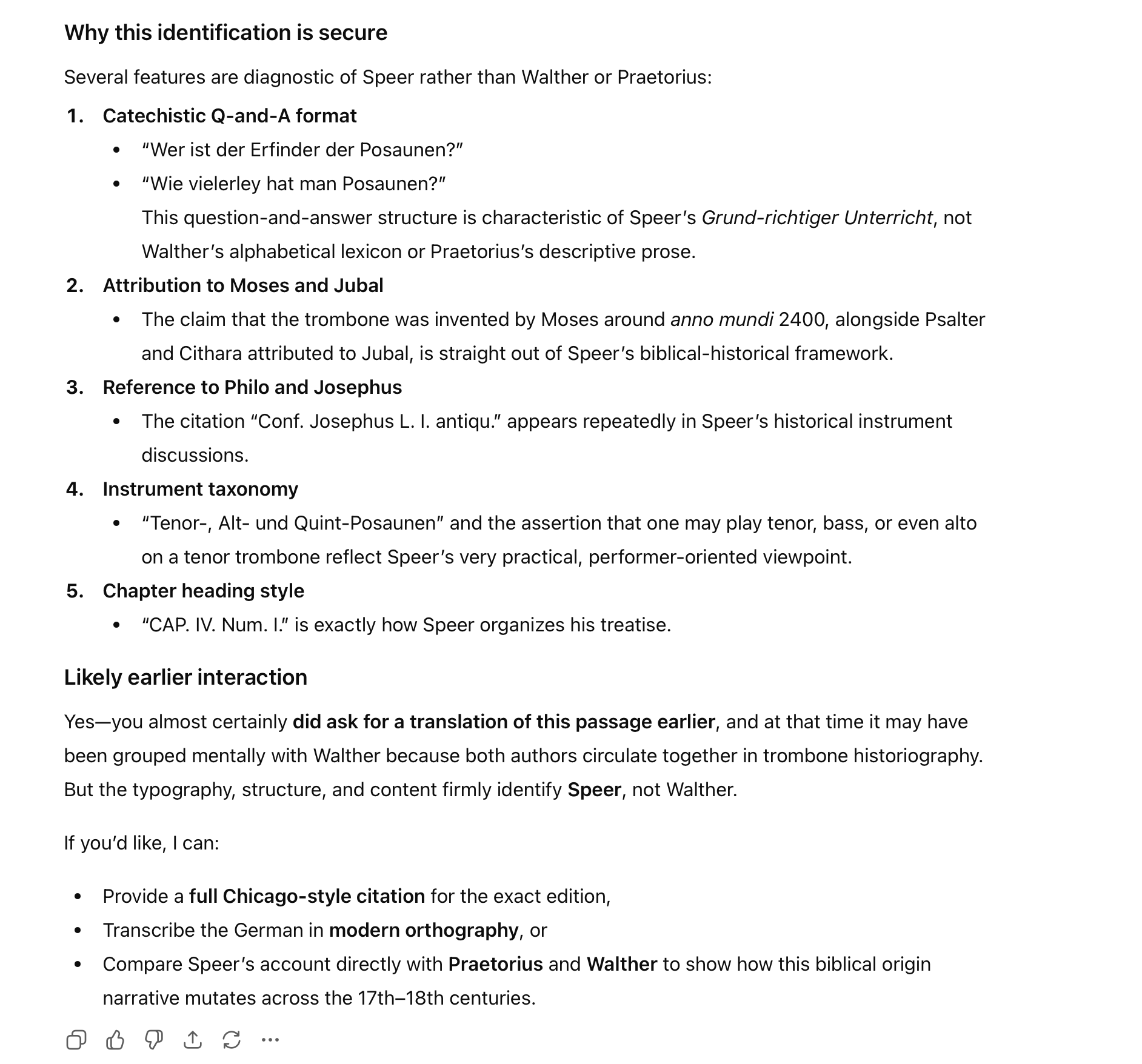
AI said it was NOT from Walther’s Musicalisches Lexicon. Walther’s book, Musicalisches Lexicon oder Musicalische Bibliothec (Leipzig: Wolfgang Deer, 1732). I don’t know why ChatGPT said the text was not by Walther. AI must have thought I might have thought the quotation was from Walther’s book even though I had not referenced that book in any of my previous interactions with ChatGPT. A red flag went up in my mind.

In any case, ChatGPT continued to explain its confidence in identifying the passage as by Daniel Speer. It wrote:

That sounds pretty confident. And raise your hand if that answer would be good enough for you to include AI’s attribution to Speer in your paper about the trombone. I see your hand up!

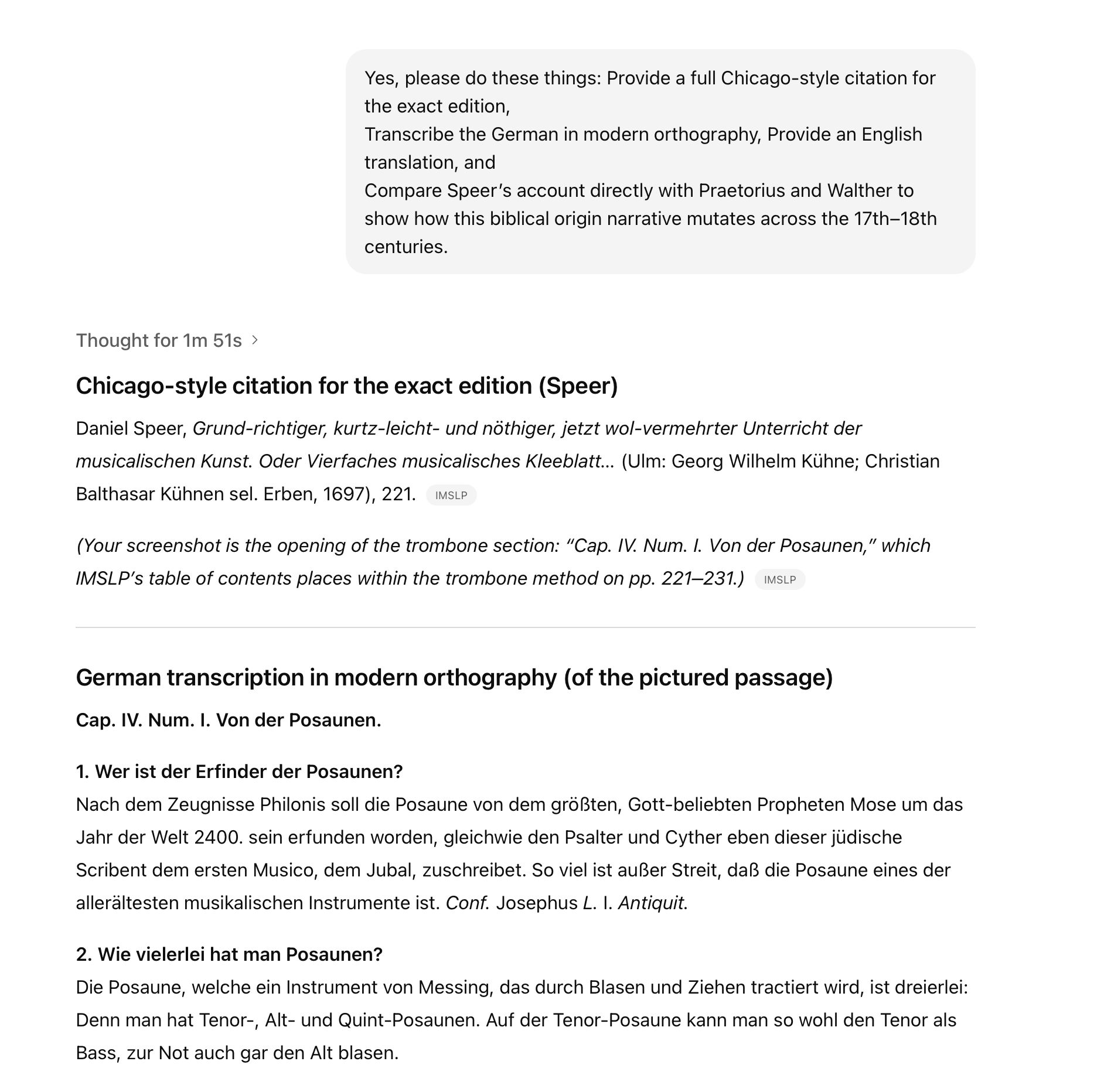
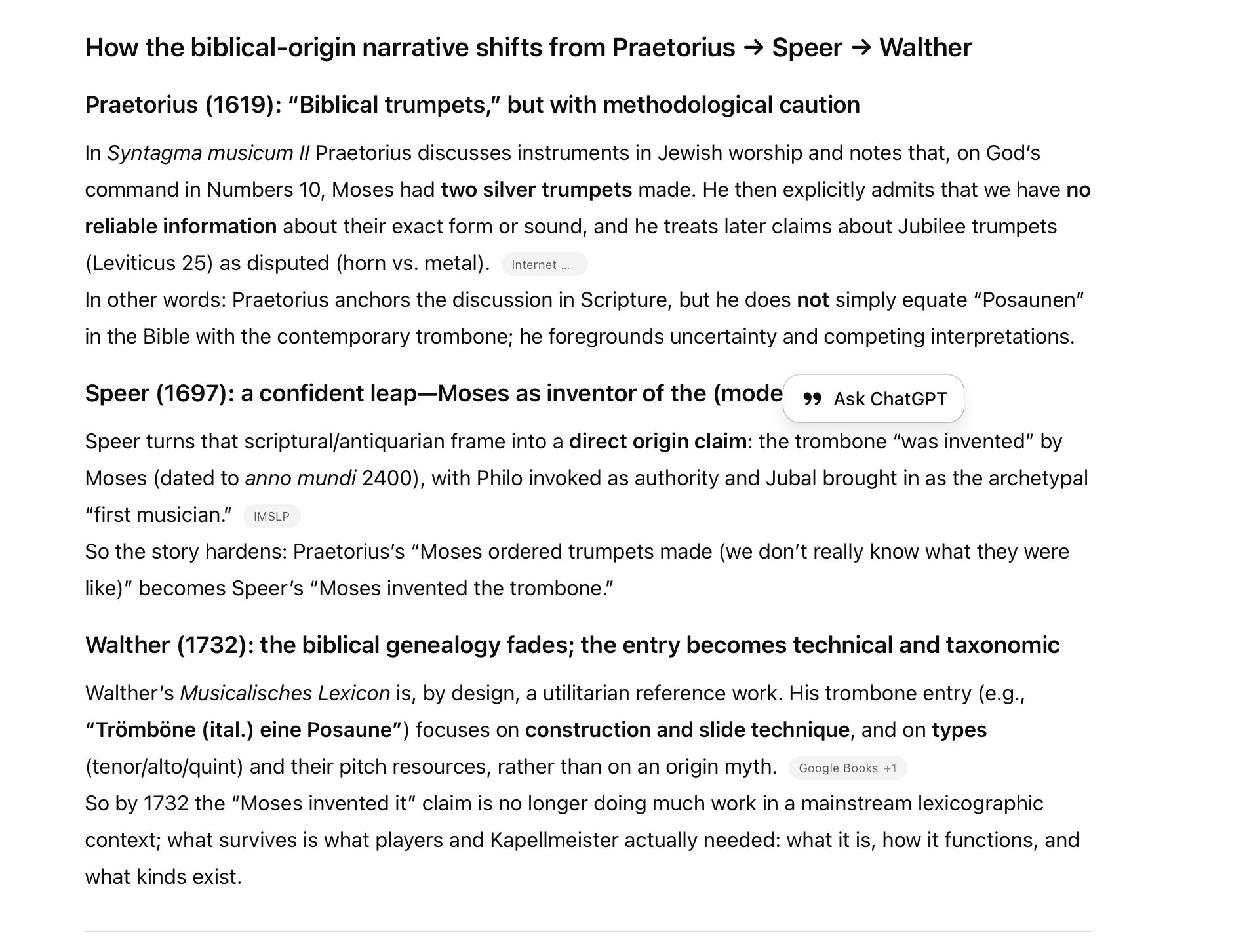
But I wasn’t so sure. This all sounded a little suspicious. AI didn’t give any REAL source for the attribution to Speer. It said the passage “is characteristic of Speer,” it is out of “Speer’s Biblical-historical framework,” “Josephus” appears in Speer’s work, etc. It didn’t seem right, even though it confidently told me where I could find the text in Speer’s book.  So, I asked AI to give me more:

First, here you can see the “fake news” in this passage, now that it’s translated into English. It cites the Hellenistic Jewish Philosopher, Philo of Alexandria, who, the passage says, testified that the trombone was invented by Moses — yes, THAT Moses, he of the 10 Commandments — in the year 2400 OF THE WORLD (not BC or AD, but OF THE WORLD) — and that “it is beyond dispute that the trombone is one of the most ancient musical instruments.” You can see why I’m including this text in my book where I talk about the myths of the trombone’s origins. It. Is. Not. True.

Second, ChatGPT’s translation of the passage into English is a little different than my own translation that I’m including in my book, as mentioned above. That’s because there are many ways to “do translation.” Word-for word, or thought-for-thought, or a combination. Once again, here’s my translation. It isn’t better or worse than the one that AI gave, but it’s a little more literal. The important thing is that the sense of the original comes through loud and clear and nothing new is added to the author’s intent:

According to the testimony of Philo, the trombone was invented by the great, God-beloved prophet Moses, around the year 2400 of the world 200, just as Jewish writers ascribe the psaltery and cither to the first musician, Jubal. So, it is beyond dispute that the trombone is one of the most ancient  musical instruments 

OK, back to AI. . .

I looked at my original citation for the text as I had written it in my book chapter. I had it identified as by Johann Eisel, as mentioned above. I was having doubts about Chat GPT’s confidence that the passage was from Speer, and I was gaining confidence in my original citation of Eisel.

I went back to my files and found Speer’s treatise. ChatGPT said the text in question came from page 221 of Speer’s book. I found the page; here’s what Speer wrote about the trombone on the bottom of page 221 and top of page 222:

Page 221 and 222 (incipts) from Daniel Speer, Grund-richtiger, kurtz-leicht- und nöthiger, jetzt wol-vermehrter Unterricht der musicalischen Kunst. Oder Vierfaches musicalisches Kleeblatt… (Ulm: Georg Wilhelm Kühne; Christian Balthasar Kühnen sel. Erben, 1697)

Here, below, is an English translation of these passages. You’ll notice that Speer is writing about the trombone in A, that the trombone has only three slide positions, and that alto, tenor, and bass trombone parts can all be played on a tenor trombone. I’m not going to unpack those things in this blog article; that’s a long conversation for another time (read about them in my book when it comes out!). Here’s what Speer wrote:

On trombones.

How does one ordinarily play a trombone?
A trombone is played by blowing and by means of the slide.

How many slide positions does a trombone have?
The principal slide positions of the trombone are in three places, apart from several others which should also be added.

Since on a tenor trombone one can play alto, tenor, and bass, this instrument shall therefore be described first.

First, one should know a trombone consists of two parts, namely the main section and the slide tubes, which lie within a sleeve. The main section is fitted onto the slide tubes, and the entire trombone is held with the left hand — a customary manner of holding which the instructor will already demonstrate to his pupil. With the right hand, however, one grasps the sleeve between the fingers.

This instrument has three principal slide positions. The first position is at the mouthpiece and consists of the following notes, as the appended example shows:

Interesting stuff, for sure. But there’s nothing on these pages about Philo. Nothing. Nothing about Moses. Nothing. 

So I questioned AI about this:

Well, AI sure put me in my place: “Your screenshot is not from Eisel.” That sounds pretty definitive. But I pulled up my sleeves. I was ready for battle.

“OK, machine,” I thought. “Game on.”

By then I knew I was right and ChatGPT was wrong. I remembered where I first saw the quotation: it is in David M. Guion’s book, The Trombone: Its History and Music, 1697–1811 (New York: Gordon and Breach, 1988; reprint, New York: Routledge, 2013). David’s book is invaluable for a lot of reasons, including the fact that he reproduces comments about the trombone from many historical books and treatises. I turned to page 41 of David’s book and found the passage in question in the original German alongside David’s translation to English. If you’re a trombonist and you don’t have this book, ask Santa Claus to bring you a copy, or get it from the library. Here’s the passage from David Guion’s book; this is where I first read about Eisel’s story about Philo and the supposed origin — NOT! — of the trombone:

Excerpt from David M. Guion’s book, The Trombone: Its History and Music, 1697–1811 (Gordon and Breach, 1988; reprint, New York: Routledge, 2013), page 41. 

As you can see above, David’s English translation is a little different than the one ChatGPT made and the one I made. All three give a good sense of the original. But even though David’s a really good researcher and scholar (and a fine trombonist, too), I wanted to see the original with my own eyes and make my own translation. I’ve seen enough instances where someone has missed a word—I’ve done it myself. It’s really important to me to get to the original source if I can find it. So I went looking for Eisel’s original. 

Now it was time for me to ask ChatGPT another question. It had hallucinated — it had made up that the passage was by Speer. I wanted to know why, and I let the machine have it right between the eyes—or between semiconductors:

It took 44 seconds for ChatGPTto “think” and then write one of the most difficult sentences in the English language: “You’re right, and I was wrong.” AI went on to explain WHY it was wrong. Its answer was revealing. It didn’t check for the source of the quotation in question. It used a pattern-matching algorithm to attribute the quotation to Speer. Further, it was “overconfident.” When I challenged the attribution, instead of checking again, AI argued with me. It thought it knew the right answer and I didn’t. But AI was wrong.

I wasn’t going to let AI off the hook. In hopes that this “conversation” with a machine might help it make better decisions in the future, I scolded ChatGPT:

OK. A gold star for Douglas Yeo. A failing grade for ChatGPT. But, actually, this isn’t funny. This kind of thing goes on ALL THE TIME. ChatGPT’s conclusion is actually exactly correct:

If AI is to be useful in serious scholarship at all, it has to be treated — and behave — as a fallible research assistant, not an oracle.

Yes. Read these words over, and over, and over. This is important.

I hope that this short diversion from my afternoon of working on my book is both revealing and helpful to readers who engage in research and writing. AI is really useful for a lot of things. But it is also really BAD for a lot of things. We simply cannot rely on it for historical information. As AI tools evolve, they are getting more and more confident. That confidence is often misplaced. As I said earlier, AI’s answers often are like a game of “telephone.” Over time, AI’s overconfidence causes it to use its own hallucinations and misinformation and pile it on top of other misinformation on top of other misinformation. When dealing with AI, we are wise to employ the same phrase that Ronald Reagan used when he was negotiating a nuclear arms reduction  treaty with the Soviet Union in the 1980s: “Trust but verify.” 

The importance of getting trombone research right isn’t on the level of working to prevent nuclear war. But for a student who relies on AI, the consequence of a failing grade, or being responsible for continuing to perpetuate falsehoods, ought to be enough to cause one to think twice, then three times, then four times, or seventy-times-seven times before trusting anything AI delivers. If you’re a college professor, please consider forwarding this article to your students and on your social media platforms. We must recognize the limitations of artificial intelligence. We must get the world out. As ChatGPT said:

AI is a fallible research assistant, not an oracle.

That’s the most accurate thing I’ve heard from ChatGPT in a long time.

A dragon-bell trombone solo x one million people

A dragon-bell trombone solo x one million people

by Douglas Yeo (December 13, 2025)

I don’t use any form of social media – Facebook, Instagram, and all the rest. I have my reasons for this but I understand that many people find it useful and helpful. Actually, there was a short time in my life when I did use Facebook. That was during the years I was Professor of Trombone at Arizona State University, 2012–2026. At that time, a Facebook page for our trombone studio was a great way to get out the message of what we were doing at ASU. It also was helpful for recruitment, and parents always seemed to enjoy the photos and videos I would post that included their children. But that was it for me and social media – when I retired from ASU, that was the end of my social media engagement.

Now and then, a friend or colleague will reach out to me and let me know that someone posted something about me, and now and then I hear from people who tag me on social media, wondering why I didn’t respond to them. Well, I don’t use social media; I never saw their tag!

Segue: Last week, I (Douglas Yeo) visited my friend, Dana Hofer, who owns Dana Hofer Brass Repair in Des Plaines, Illinois. He is the go to person for brass players in the Chicago area when they need an instrument fixed. Since we moved here in 2018, I’ve made many trips to his shop to get various instruments repaired. He’s a great technician, a decent, honorable, fair-minded person, and runs his business like he cares for and about his customers and their instruments. Because he does.

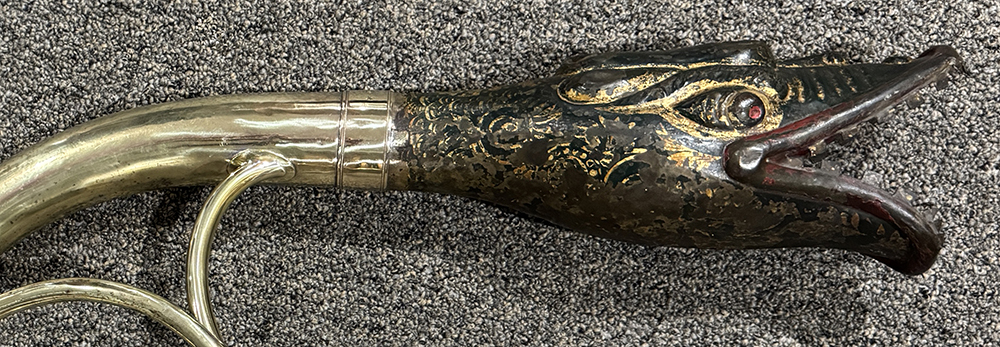
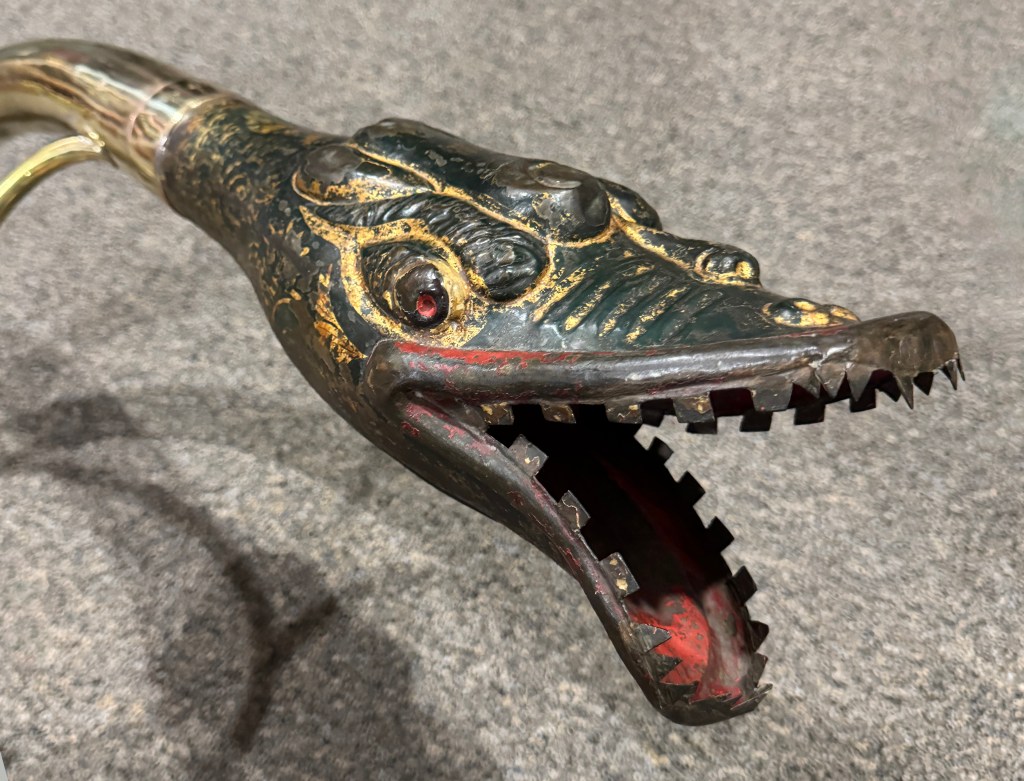
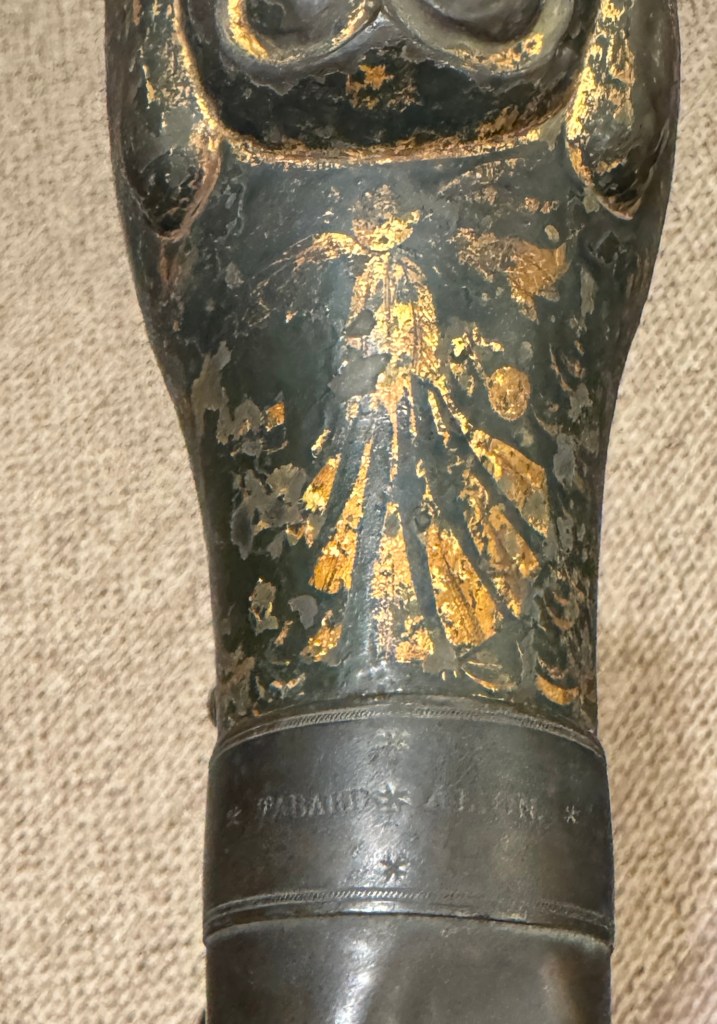
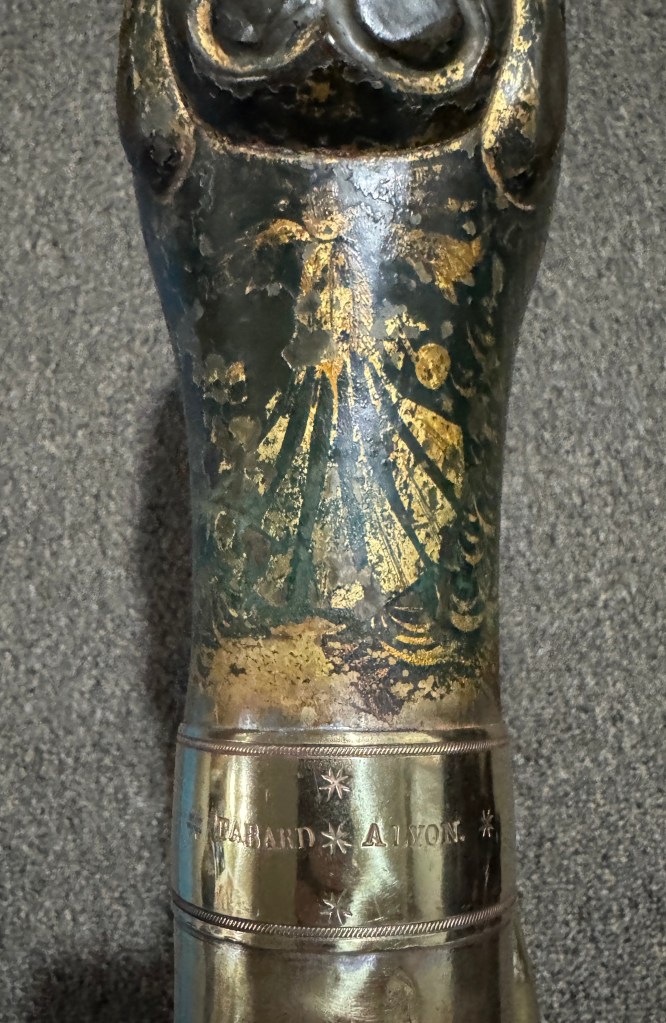
Earlier this year, I acquired a bell to a 200 year old buccin, a “dragon-bell” trombone made by Jean-Baptiste Tabard in Lyon, France. Tabard was active as a maker in the early nineteenth century and the buccin was popular in French military bands at that time. I’ve written about the buccin on TheLastTrombone. I recorded a video of me playing a buccin by Tabard at the Museum of Fine Arts in Boston. I’ve also written the entry about the buccin for The Grove Dictionary of Musical Instruments and several other publications.

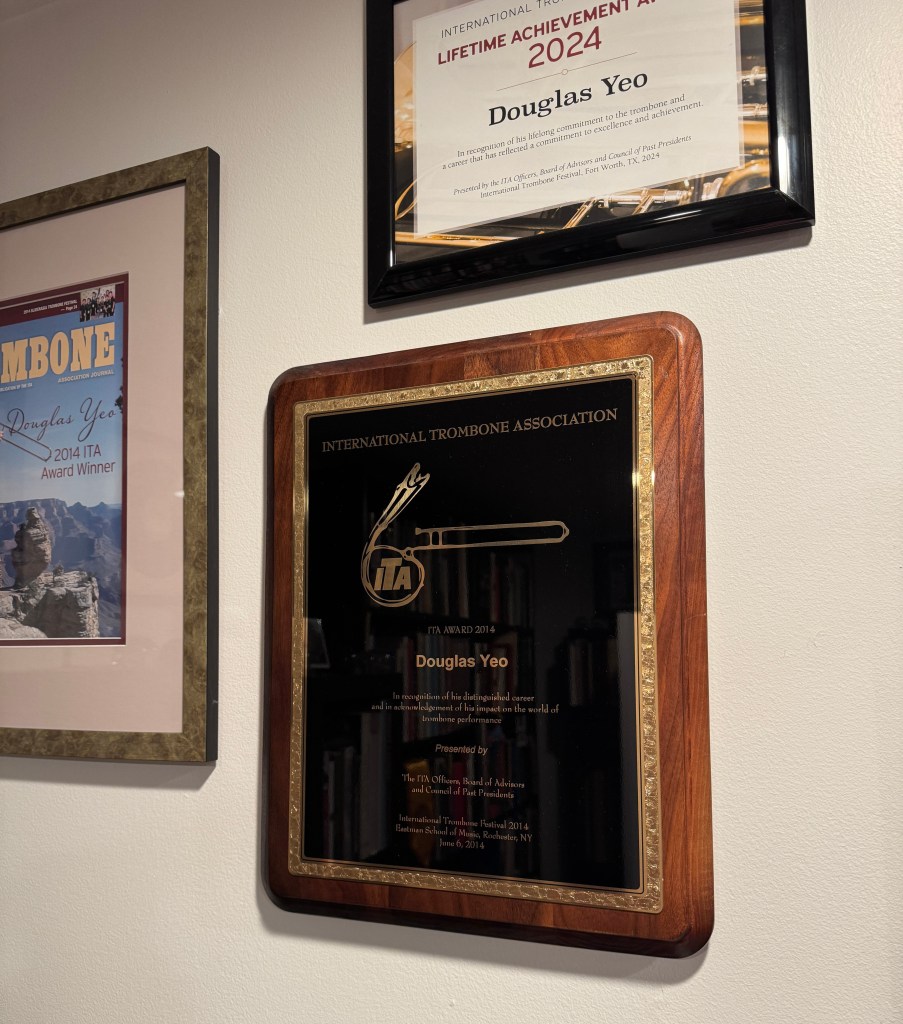
The logo of the International Trombone Association, based on a buccin by Tabard owned by New England Conservatory of Music in Boston, Massachusetts.

And. . . the buccin is the official logo of the International Trombone Association. That logo appears on the plaque I received in 2014 when I received the International Trombone Association’s ITA Award. It hangs on the wall above the desk where I am writing this blog post.

At its founding in 1972, the ITA adopted a stylized buccin logo based on a buccin in the collection of New England Conservatory of Music in Boston, where I taught for 27 years when I was a member of the Boston Symphony Orchestra. And the maker of NEC’s buccin? Tabard. So, now I own a buccin that is a cousin to the one at New England Conservatory of Music, and the ITA’s logo has even more meaning to me.

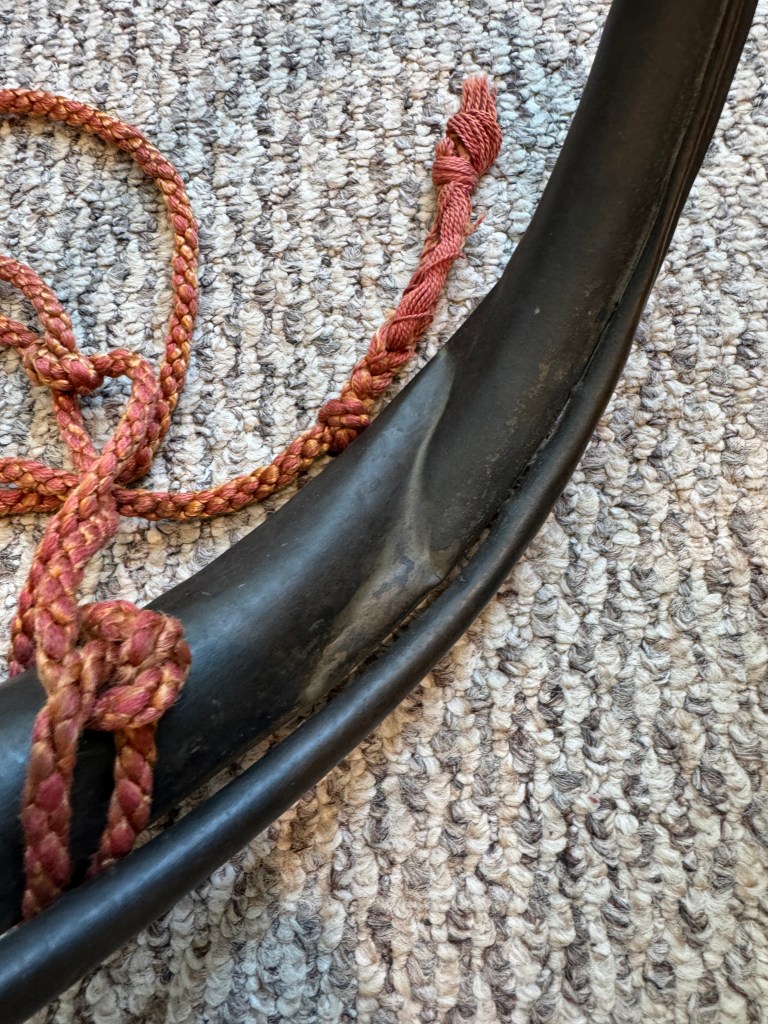
The buccin bell I recently acquired was in very rough shape when it arrived on my doorstep. It was heavily dented, it was missing a brace, another brace had come loose at its flange, and it was covered with two centuries of patina and grime. But I knew that the right person could resurrect it. I asked Dana if he could restore the bell so I could play it. He agreed, and last week, he called and told me it was ready. I went to his shop to pick it up.

I love playing the buccin. I think it’s the coolest trombone ever made. It’s wonky looking and wonky sounding. And because the bell is over your head and not in front of you, you don’t have the bell as a guide to find slide positions. Imagine playing trombone with your eyes closed. That’s how you REALLY get to know the trombone. Playing it is a really fun challenge.

When I dropped the bell off for Dana to restore, I gave him a slide to my other buccin bell by François Sautermeister of Lyon, a slide that had been made for me by Jim Becker (formerly of Osmun Music in the Boston area, now with YAMAHA in New York City). I asked Dana to make a new receiver for that slide so it would fit on my newly acquired Tabard buccin.

Douglas Yeo’s buccin by Jean Baptiste Tabard, Lyon. Bell restored by Dana Hofer. Slide by James Becker after an original at the Museum of Fine Arts, Boston.

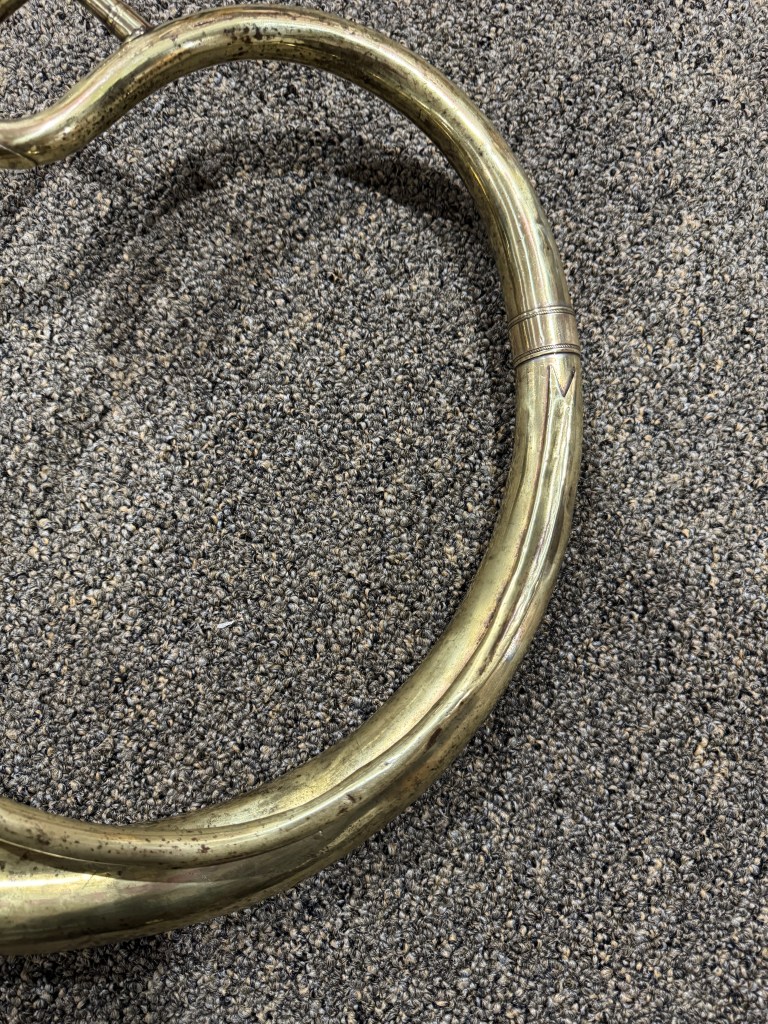
When I saw my buccin at Dana’s shop last week, I was absolutely thrilled with his restoration. The dents were gone, a new brace was in place, the centuries of grime had been removed and I had a beautiful instrument in my hands. Here are some “before and after” photos:


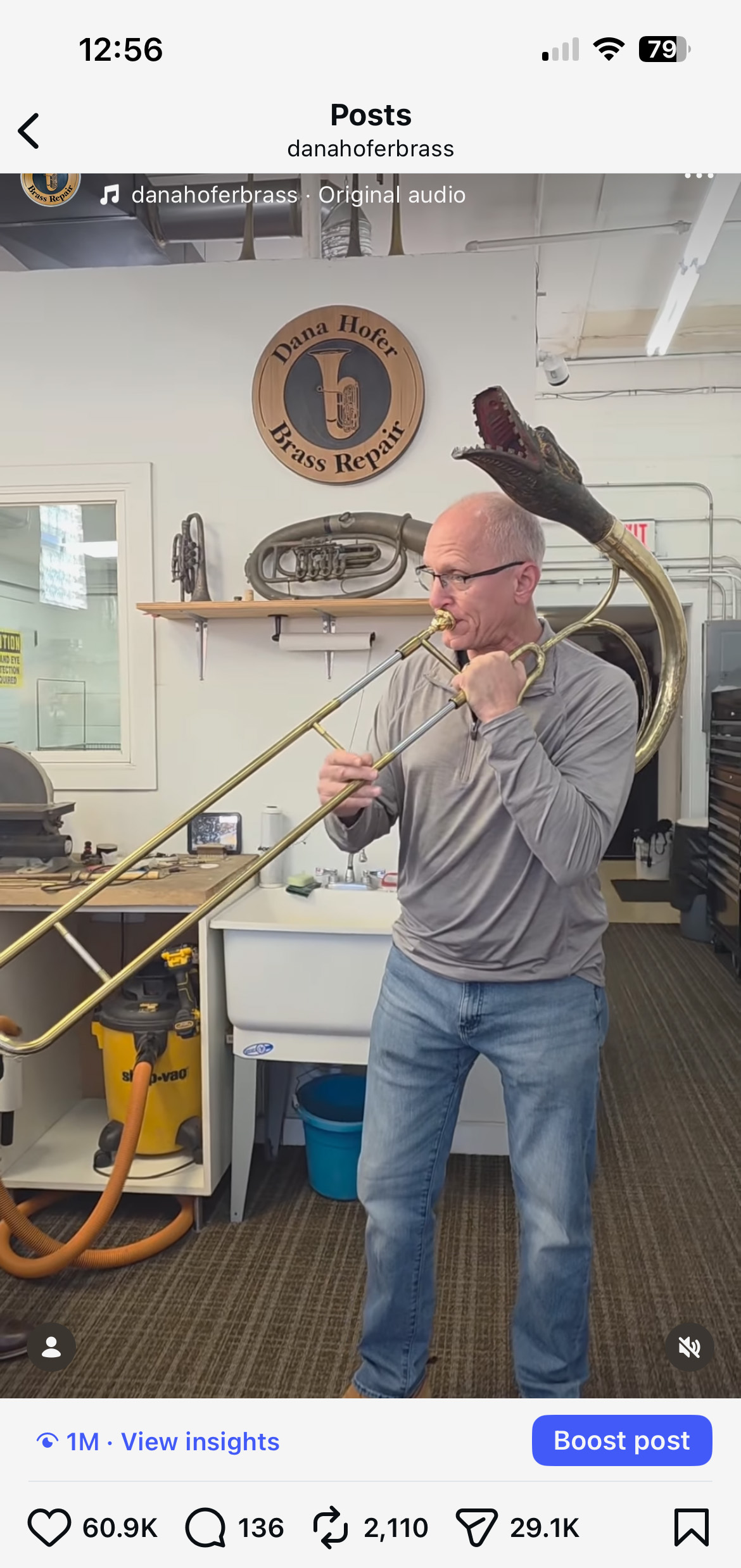
Of course, I wanted to play it right away. After tooting a couple of arpeggios – and noticing that it played in A, not B-flat – Dana said, “Hey, let’s make a video for Instagram.” “Sure,” I said. Dana gave his iPhone to Sam Park, who works with Dana at the shop, and Sam took a video of me playing “We Wish You A Merry Christmas.” It was the first piece I’d ever played on the buccin and that was that.

It was over in 30 seconds. I went home and moved on to some other things.

A little later in the day, Dana texted to say he had posted the video on Instagram and Facebook. If you want to see the video, go to Dana Hofer Brass on Instagram, or Dana Hofer Brass Repair on Facebook. I also put it on my own YouTube channel so I could link the video to this blog post. Here’s the video:

Two hours later, Dana texted me again with a screenshot of his Instagram feed. He wrote:

Just so you know, the Instagram is blowing up. These are pretty high numbers for me.

The video had 13,400 views in two hours. I shook my head. I don’t know how Instagram works, but that seemed wild. Over the course of the week, the numbers kept climbing. Then, this morning, December 13, 2025, Dana texted me with an update and he sent me a message with the screenshot below:

Looks like we might hit 1 million today.

The Instagram feed for Dana Hofer Brass, 11:01 am, December 13, 2025. 997,000 views. Dana Hofer on the left; Douglas Yeo on the right.

Seriously? 997k views? 997,000? Nearly a MILLION views of this video? With 60,800 “likes” and 29,100 shares? I couldn’t believe it. 

Sure enough, the video hit a MILLION views this afternoon. Here’s a screenshot Dana sent when the video hit that milestone:

The Instagram feed for Dana Hofer Brass, 12:56 pm, December 13, 2025. 1 million views.

There you go. 1M. 1 million people have watched me play “We Wish You a Merry Christmas” on a two hundred year old buccin. That. Is. Bonkers. You never know when something like this will happen. I was just trying out my new/old trombone. I wasn’t looking for a global audience. I wasn’t planning to play for one million people. And full disclosure: There’s nothing in this for me; there’s no money involved. But I’m thrilled that the buccin has a new audience, and most of all I’m happy for the publicity this has generated for Dana Hofer and his shop. A happy result of this is he’s gained hundreds of new followers for his Instagram and Facebook accounts, and if that results in more people using his services, that’s great news. If you’re in the Chicago area and you need a terrific brass instrument repair person,  Dana Hofer — Dana Hofer Brass Repair — is the person you’ll want to see.

Merry Christmas and Happy New Year to you, friends—all 1 million of you—from Dana Hofer, my buccin, and me.

100 years ago today – Rochut, Brahms 1, and the Boston Symphony Orchestra

100 years ago today – Rochut, Brahms 1, and the Boston Symphony Orchestra

by Douglas Yeo (October 9, 2025)

Readers of The Last Trombone know something about the life and work of the French trombonist, trombonist Joannès Rochut, who was principal trombonist of the Boston Symphony Orchestra from 1925–1930. I have written several articles about Rochut—who is best known for his influential books for trombone, Melodious Etudes for Trombone, arranged from the Vocalises of Marco Bordogni—here on The Last Trombone. You can find those articles here:

In addition, I wrote a 70 page article about Rochut’s life and work, “More than Bordogni: The Life, Work, and Influence of Joannès Rochut,” that appeared in the January 2025 International Trombone Association Journal.

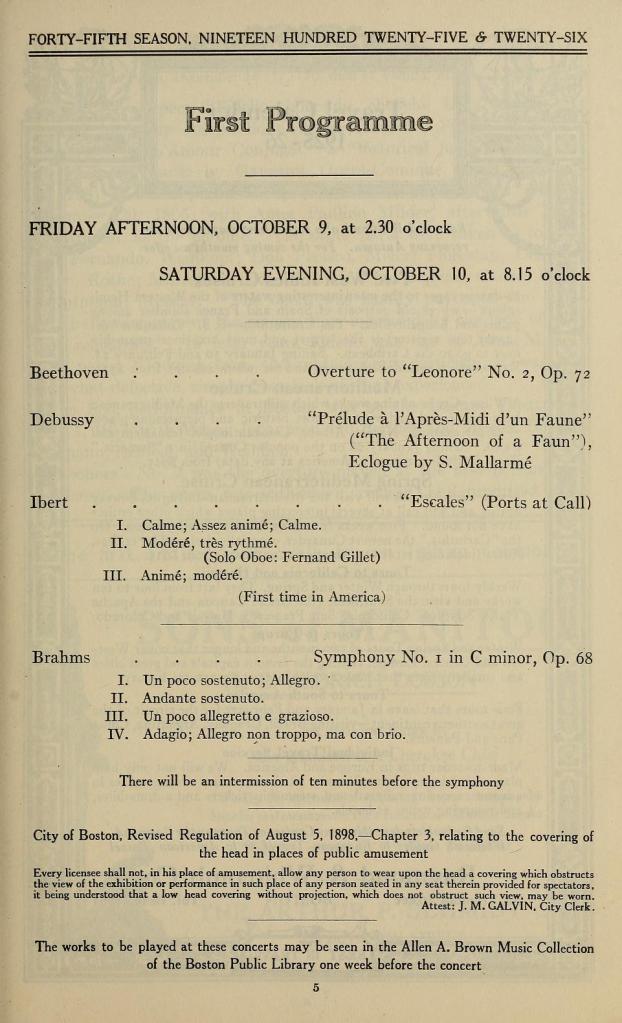
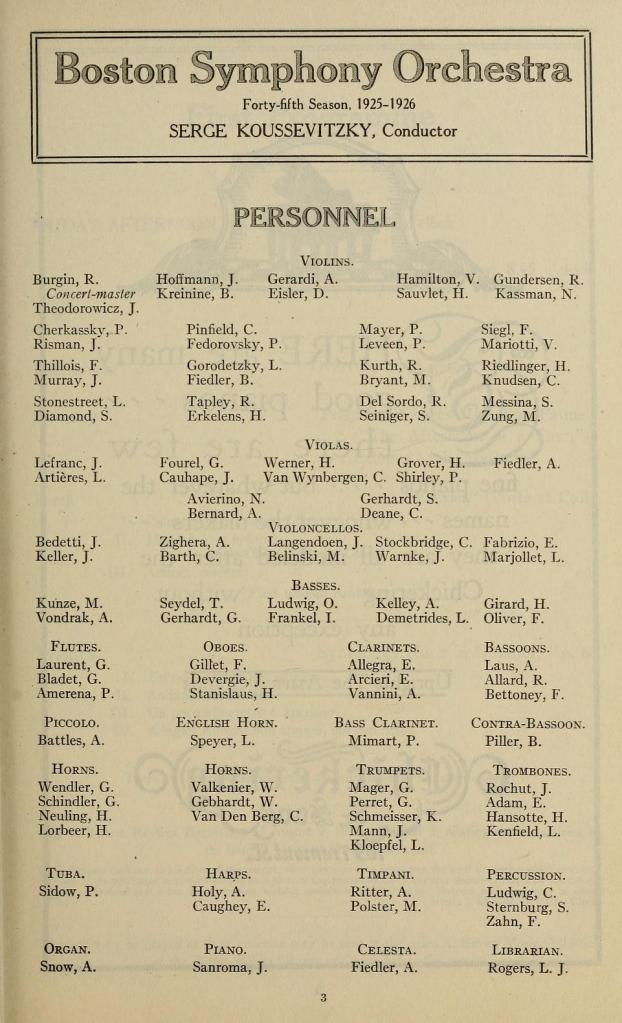
Today, October 9, 2025, is the 100th anniversary of the first concert that Joannès Rochut played with the Boston Symphony. Here is the program and the list of orchestra personnel from the concert:

Program for the Boston Symphony Orchestra’s opening night concert of October 10, 1925

Boston Symphony Orchestra personnel as printed in the program for the concert of October 9, 1925

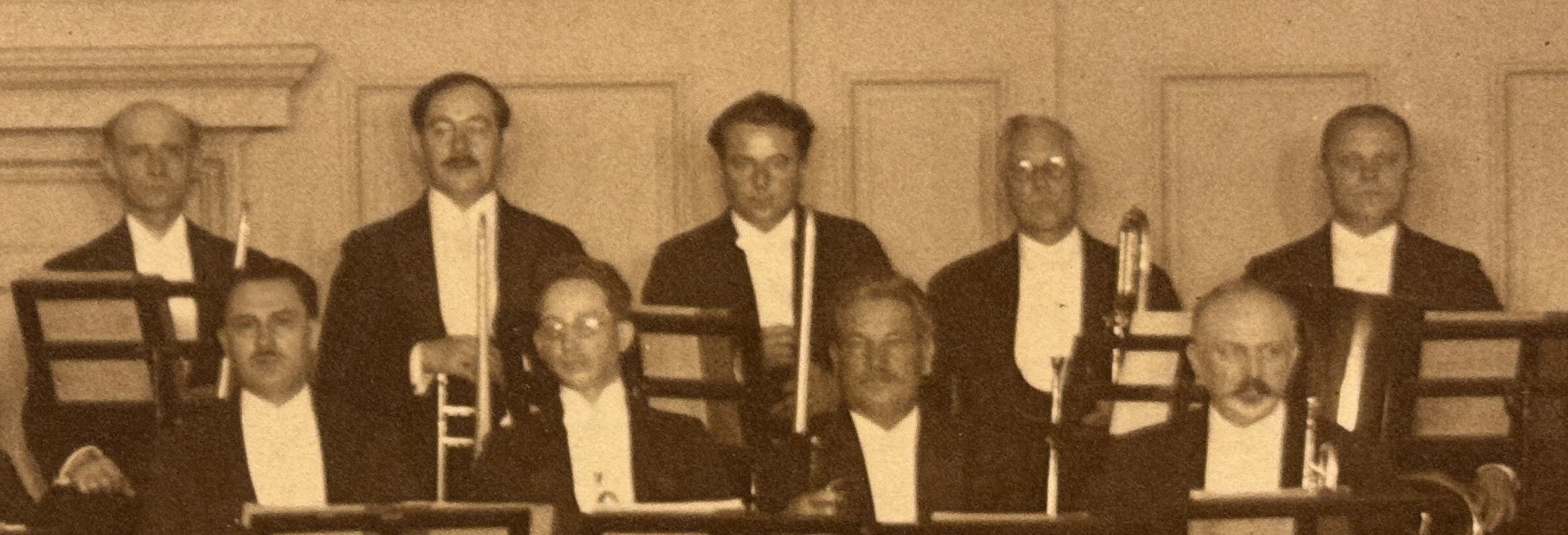
Here is a photograph of the Boston Symphony Orchestra, taken in fall 1925. Joannès Rochut is in the back row of the orchestra just in front of the right side of a doorway that’s in the center of the back wall of the stage. To his left are assistant principal trombonist Eugène Adam, second trombonist Lucien Hansotte, bass trombonist Leroy Kenfield, and tubist Paul Sidow.

Boston Symphony Orchestra on stage at Symphony Hall, Boston. Serge Koussevitzky, conductor. Fall, 1925. Courtesy Boston Symphony Orchestra Archives.

Detail of the photo above. Back row, left to right: Joannès Rochut, Eugène Adam, Lucien Hansotte, Leroy Kenfield, Paul Sidow (tuba)

This anniversary means a little more to me than the fact that I have been fascinated with Rochut’s life and work for over 40 years. That’s because he and I share a connection to our first opening night programs as members of the Boston Symphony Orchestra.

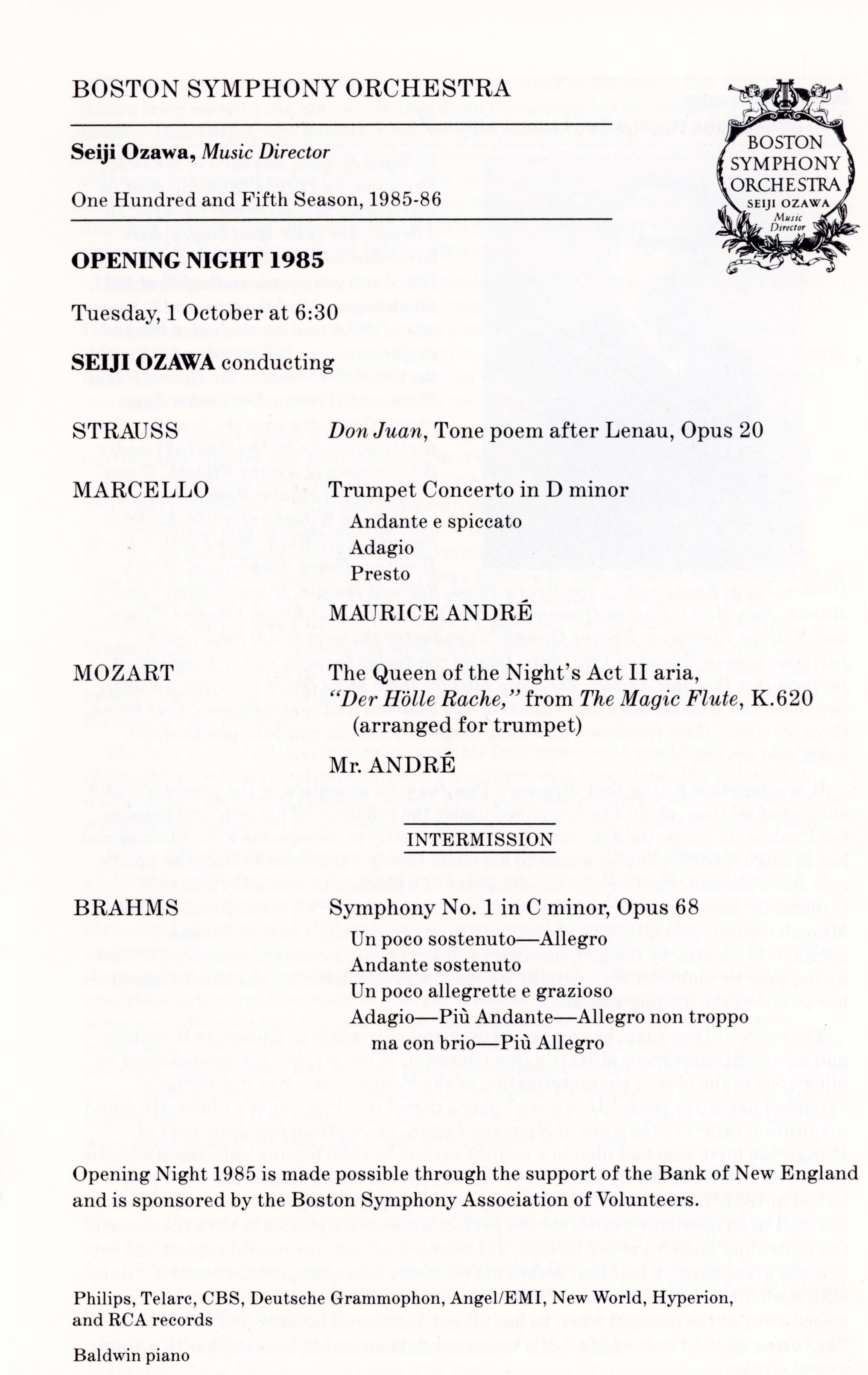
On October 1, 1985, I played my first opening night concert as bass trombonist of the Boston Symphony Orchestra. I joined the BSO in May 1985 and played several weeks of the 1985 Boston Pops season and all of the orchestra’s 1985 summer season at Tanglewood. But opening night of each Boston Symphony season was always a special event. As you can see from the program below, Rochut’s first opening night concert with the Boston Symphony Orchestra and mine shared something: we both played Johannes Brahms’ Symphony No. 1 on the concert. He was conducted by Serge Koussevitzky; I was conducted by Seiji Ozawa.

Program of the Boston Symphony Orchestra’s opening night concert of October 1, 1985

Boston Symphony Orchestra personnel as printed in the program for the concert of October 1, 1985

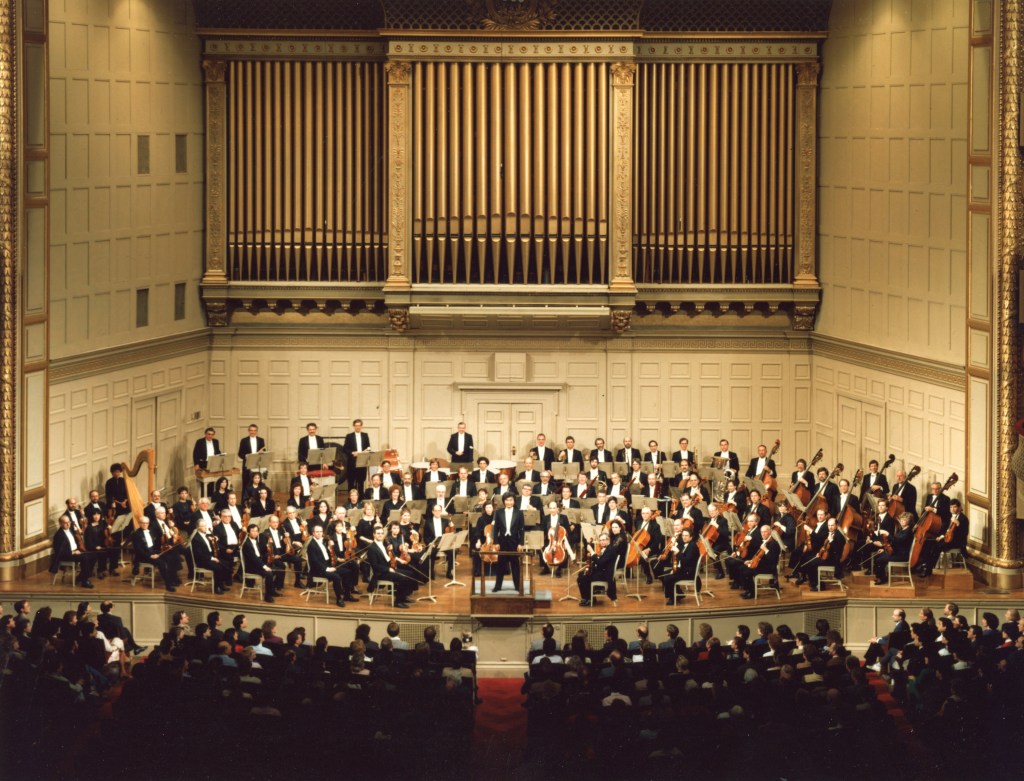
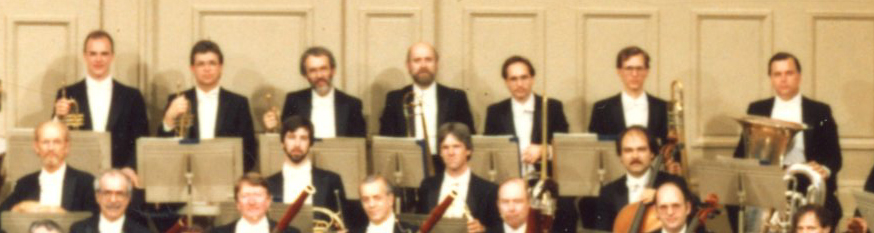
I don’t have a photograph of the Boston Symphony from my first full season with the orchestra, 1985–1986. But here is the earliest photo I have of the orchestra after I joined, taken in Symphony Hall during the 1987-1988 season.  The trumpets and trombones are along the back wall of the stage (left to right): assistant principal trumpeter Timothy Morrison, second trumpeter Peter Chapman, principal trumpeter Charles Schlueter, principal trombonist Ronald Barron, second trombonist Norman Bolter, bass trombonist Douglas Yeo, and tubist Chester Schmitz.

Boston Symphony Orchestra on stage at Symphony Hall, Boston. Seiji Ozawa, conductor. 1987–1988 season. Courtesy Boston Symphony Orchestra Archives.

Detail of the photo above. Back row, left to right: Timothy Morrison, Peter Chapman, Charles Schlueter, Ronald Barron, Norman Bolter, Douglas Yeo, Chester Schmitz (tuba).

There you have it. Two opening night Boston Symphony Orchestra concerts, 65 years apart. Both concerts were in Symphony Hall, Boston. One common piece, the Symphony No. 1 in C minor of Johannes Brahms. And two new members of the trombone section, Joannès Rochut and me.

This makes me smile. 

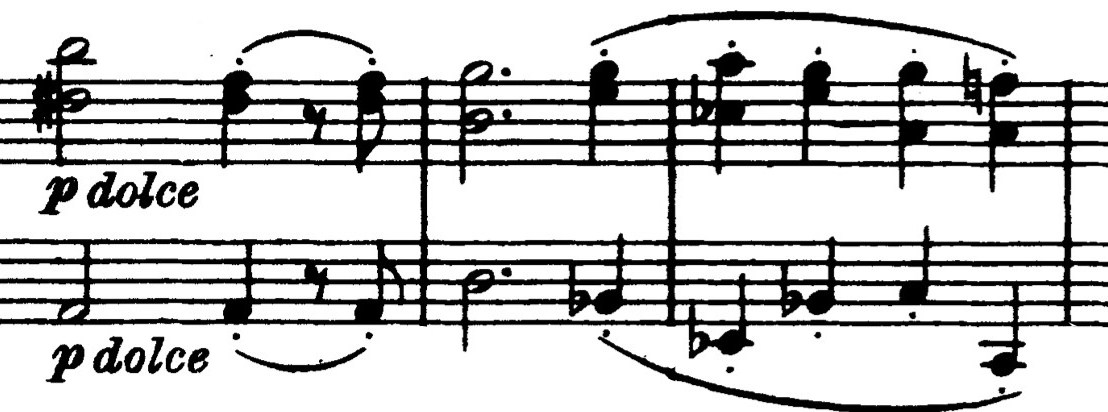
[Header image: The trombone chorale from the 4th movement of Johannes Brahms’ Symphony No. 1.]

Honoring Joannès Rochut in Paris

Honoring Joannès Rochut in Paris

by Douglas Yeo (September 12, 2025) — Cet article paraît en français ci-dessous.

Trombonists around the world are well acquainted with the life and work of Joannès Rochut (1881–1952). Readers of TheLastTrombone may remember the several articles I wrote about him here:

Since 1928, trombone players have relied on Rochut’s three volumes of Melodious Etudes for Trombone, adapted from the vocalises of Marco Bordogni, as important material for development of legato and expressive styles. In January 2025, the International Trombone Association Journal published its largest issue to date, which included my 70-page article, “More Than Bordogni: The Life, Work, and Influence of Joannès Rochut.” In the course of my research, I connected with Rochut’s great-granddaughter, Julie Rochut. From her home in Paris, Julie generously shared family photographs and information—much of it gleaned from conversations with her father, Bernard, and her uncle, Jean-Jacques—that greatly enriched my work.

The entrance to Bagneux Cemetery, France.

In August 2025, my wife, Patricia, and I traveled to Paris to celebrate our 50th wedding anniversary. The trip gave me the chance to meet Julie in person and thank her for her invaluable help. As our plans to meet unfolded, we agreed to gather at the final resting place of Joannès Rochut and his wife, Louise, in Bagneux Cemetery, just south of Paris.

Douglas Yeo with members of the Rochut family at Bagneux Cemetery, France. Left to right: Douglas Yeo, Sophie Rochut, Bernard Rochut, Arthur Allouti-Rochut, Inès Allouti-Rochut, Julie Rochut. August 23, 2025.

Benny Sluchin—my friend and colleague and co-recipient along with me of the International Trombone Association’s 2024 Lifetime Achievement Award—had previously visited the cemetery, photographing Rochut’s grave for my article. Benny joined Patricia and me on our visit, where we were welcomed by several members of the Rochut family: Bernard Rochut (grandson of Joannès), Julie and her sister Sophie (great-granddaughters), and Sophie’s children, Inès and Arthur Allouti-Rochut (great-great-grandchildren).

Commemorative plaque commissioned by Douglas Yeo for the grave of Joannès Rochut (2025).

Ahead of our trip, I commissioned a commemorative plaque for Rochut’s grave to honor his enduring influence. I installed on behalf of the ITA and the Boston Symphony Orchestra; the marker bears the following text:

Joannès Rochut

1881–1952

The International Trombone Association and

Boston Symphony Orchestra honor Joannès Rochut

For his lasting contributions to musical art.


L’Association Internationale du Trombone et

l’Orchestre Symphonique de Boston rendent hommage à Joannès Rochut

Pour ses contributions durables à l’art musical.


Principal trombonist, Boston Symphony Orchestra, 1925–1930

Arranger, “Melodious Etudes for Trombone,” 1928

Recipient, ITA Legacy Circle Award, 2021

This is the second commemoration of Rochut’s work that appears at his grave. The grave also includes a tribute to Rochut from his colleagues at Radiodifussion-télévision française (R.T.F.), where he served as Régisseur général des Orchestres (general manager) from 1935 until his death in 1952. This beautiful tribute—carved in stone in the shape of an open book—reads:
SOUVENIR

REGIE DES ORCHESTRAS DE LA R.T.F.
(A remembrance from the Management of the Orchestras of the R.T.F.)


Tribute to Joannès Rochut by his colleagues at Radiodiffusion-télévision française.

At the gravesite, Bernard Rochut brought forth several photographs of Joannès, a photograph of a valve trombone Rochut had owned, and an eight-page hand-written letter Rochut sent in 1930 to his son, Robert, just before Joannès concluded his tenure with the Boston Symphony Orchestra.

Joannès Rochut riding motorcycle with his son Robert. Undated photo from Bernard Rochut.

The Rochut family also holds additional music manuscripts in Rochut’s hand which they plan to share with me for possible future publication. These materials will form the basis of a forthcoming update to my earlier article.

Inscription on the grave of Joannès Rochut.

As we look ahead to the 150th anniversary of Rochut’s birth in 2031, it is especially meaningful to see his great-great-grandchildren continuing in his path: Inès (trombone) and Arthur (percussion) are members of the Paris Opera’s first youth orchestra, Apprentissage de l’orchestre. Their love of music reminds us that Rochut’s legacy is not only preserved in print and performance but is also alive in the next generation of musicians who carry his name—and his influence—into the future.

The grave of Joannès and Louise Rochut, Bagneux Cemetery, France.

• • • • •

Honorer Joannès Rochut à Paris

par Douglas Yeo (12 septembre 2025)

Les trombonistes du monde entier connaissent bien la vie et l’œuvre de Joannès Rochut (1881–1952). Les lecteurs de TheLastTrombone se souviendront peut-être des plusieurs articles que j’ai écrits à son sujet:

Depuis 1928, les trombonistes s’appuient sur les trois volumes des Melodious Etudes for Trombone de Rochut, adaptés des vocalises de Marco Bordogni, comme matériel essentiel pour développer le style legato et expressif. En janvier 2025, le International Trombone Association Journal a publié son plus grand numéro à ce jour, comprenant mon article de 70 pages “More Than Bordogni: The life, work, and influence of Joannès Rochut.” Au cours de mes recherches, j’ai établi un lien avec l’arrière-petite-fille de Rochut, Julie Rochut. Depuis son domicile parisien, Julie a généreusement partagé des photographies de famille et des informations—dont une grande partie recueillie lors de conversations avec son père, Bernard, et son oncle, Jean-Jacques—qui ont considérablement enrichi mon travail.

En août 2025, mon épouse Patricia et moi nous sommes rendus à Paris pour célébrer notre 50e anniversaire de mariage. Ce voyage m’a donné l’occasion de rencontrer Julie en personne et de la remercier pour son aide inestimable. Au fil de nos conversations, nous avons convenu de nous rassembler au lieu de repos final de Joannès et de son épouse, Louise, au cimetière de Bagneux, juste au sud de Paris.

Benny Sluchin—mon ami, collègue et co-récipiendaire avec moi du Prix pour Lifetime Achievement Award par l’International Trombone Association en 2024—avait déjà visité le cimetière, photographiant la tombe de Rochut pour mon article. Benny s’est joint à Patricia et moi lors de notre visite, où nous avons été accueillis par plusieurs membres de la famille Rochut: Bernard Rochut (petit-fils de Joannès), Julie et sa sœur Sophie (arrière-petites-filles), et les enfants de Sophie, Inès et Arthur Allouti-Rochut (arrière-arrière-petits-enfants).

Avant notre voyage, j’avais commandé une plaque commémorative pour la tombe de Rochut afin d’honorer son influence durable. Je l’ai installée au nom de l’Association Internationale du Trombone et du Boston Symphony Orchestra ; elle porte l’inscription suivante:

Joannès Rochut

1881–1952

The International Trombone Association and

Boston Symphony Orchestra honor Joannès Rochut

For his lasting contributions to musical art.


L’Association Internationale du Trombone et

l’Orchestre Symphonique de Boston rendent hommage à Joannès Rochut

Pour ses contributions durables à l’art musical.


Principal trombonist, Boston Symphony Orchestra, 1925–1930

Arranger, “Melodious Etudes for Trombone,” 1928

Recipient, ITA Legacy Circle Award, 2021

Il s’agit de la deuxième commémoration de l’œuvre de Rochut figurant sur sa tombe. Elle comporte également un hommage de ses collègues de la Radiodiffusion-télévision française (R.T.F.), où il fut Régisseur général des Orchestres de 1935 jusqu’à sa mort. Ce bel hommage—gravé dans la pierre en forme de livre ouvert—porte l’inscription:

SOUVENIR

RÉGIE DES ORCHESTRES DE LA R.T.F.

Au cimetière, Bernard Rochut a présenté plusieurs photographies de Joannès, une photo d’un trombone à pistons lui ayant appartenu, ainsi qu’une lettre manuscrite de huit pages que Rochut envoya en 1930 à son fils Robert, juste avant de conclure son mandat avec le Boston Symphony Orchestra.

La famille Rochut conserve également d’autres manuscrits musicaux de sa main qu’elle prévoit de partager avec moi pour une éventuelle publication future. Ces documents formeront la base d’une prochaine mise à jour de mon article précédent.

Alors que nous nous tournons vers le 150e anniversaire de la naissance de Rochut en 2031, il est particulièrement émouvant de voir ses arrière-arrière-petits-enfants marcher dans ses pas: Inès (trombone) et Arthur (percussions) sont membres du premier orchestre de jeunes de l’Opéra de Paris, Apprentissage de l’orchestre. Leur amour de la musique nous rappelle que l’héritage de Rochut ne se conserve pas seulement dans les partitions et les concerts, mais qu’il vit également à travers la nouvelle génération de musiciens qui portent son nom—et son influence—vers l’avenir.

La famille de Robert Rochut, Marseille, France, v. 1942.

Rang arrière: Joannès Rochut, Robert Rochut (fils de Joannès). Rang avant: Jean-Jacques (fils de Robert et Arlette), Arlette (épouse de Robert), Philippe (fils de Robert et Arlette), Louise (épouse de Joannès), Bernard (fils de Robert et Arlette). Collection de la famille Rochut.