Category: recordings

The Olympic Games

The Olympic Games

The games of the XXXI Olympiad get underway today with the opening ceremony in Rio de Janeiro, Brazil.  As a young boy, I was thrilled by the games – the spectacle, the competition, and as ABC television aptly put it, “the thrill of victory and the agony of defeat.” In recent years the Olympics have suffered a bit with world-wide scandals involving the use of performance enhancing drugs. But, still, there is something about the big stage of the Olympics, the celebration of success and what one hopes is a healthy kind of nationalism as we are proud of our country being represented by excellent athletes.

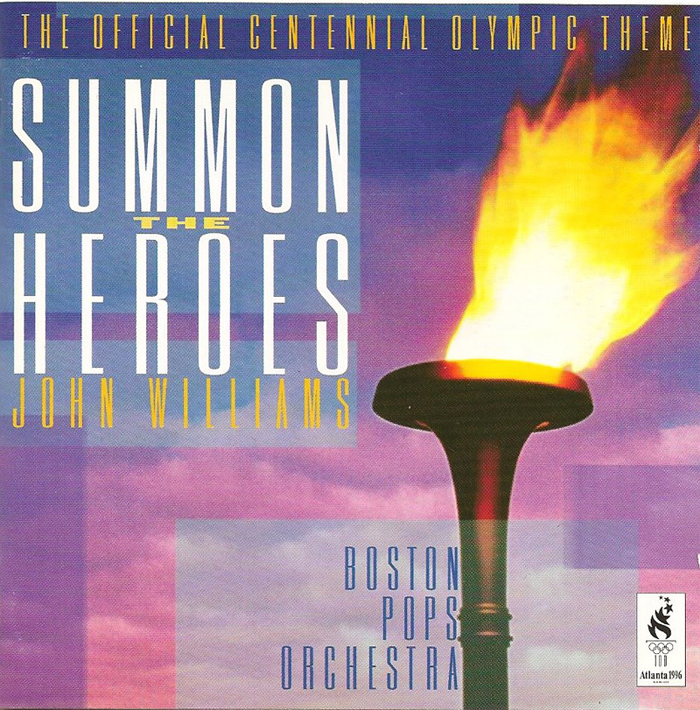
I’ve never been to an Olympic event but I got close. Musically. In 1996, the Olympics were held in Atlanta, Georgia, USA. As a member of the Boston Symphony Orchestra at the time – and membership in the BSO brought with it membership in the Boston Pops Orchestra – I played on the official soundtrack album of the Atlanta 1996 Olympic games, “Summon the Heroes.” Conducted by John Williams, the Boston Pops Orchestra had recording sessions on January  6, 10 and 13, 1996 of a playlist that included well known Olympic game themes (by John Williams) and other heroic, brass-centric, noble works that are often associated with the Olympics. Here is the tray card with the full track list:
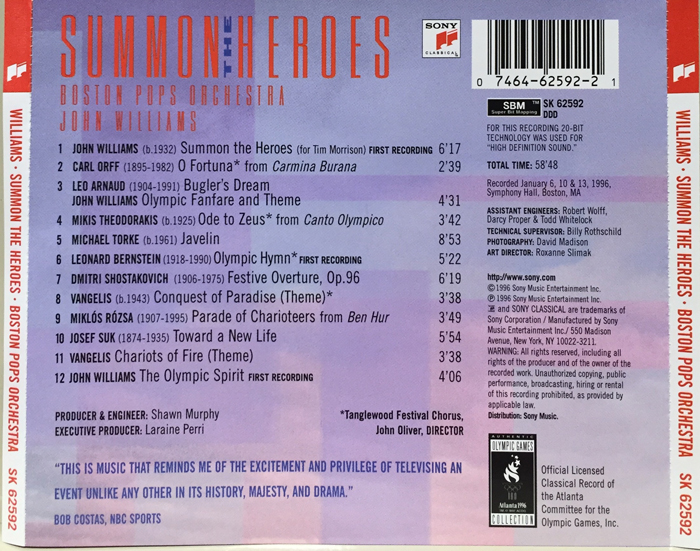
Summon_Heroes_playlistThe recording sessions came in the midst of a grueling week of Boston Symphony Orchestra rehearsals and concerts that included Richard Strauss “Eine Alpensinfonie” and we brass players were stretched to our limits. Still, it remains a memorable moment in time for me, my closest personal association with the Olympic games, and “Summon the Heroes” remains one of my favorite recordings from my nearly three decades as a member of the Boston Symphony/Boston Pops Orchestra. “Summon the Heroes” is still available, as a CD or mp3 download.   And you can see a performance of that great fanfare with John Williams conducting the Boston Pops Orchestra on the YouTUBE link, below. The low brass section consists of Norman Bolter, Darren Acosta, Phil Swanson and myself on trombone, Chester Schmitz on tuba, and trumpets Tim Morrison, Tom Rolfs, Peter Chapman and Bruce Hall.  There are offstage trumpets and trombones as well. Enjoy. To our Olympians: Citius – Altius – Fortius – the motto of the modern Olympic games, swifter – higher – stronger.

Important discoveries for brass players – with big implications

Important discoveries for brass players – with big implications

Players of brass instruments spend a lot of time thinking about their tongue, and how it factors in tone production, tonal range and articulation. Many books have been written on the subject but the truth is that since we can’t SEE inside our mouth while we’re playing and it’s very difficult to feel where the tongue actually IS while playing, a lot of what has been said on the subject is just theoretical.

Until now.

In what is proving to be a fascinating study with significant implications, Dr. Peter Iltis (Professor of Kinesiology at Gordon College) and Eli Epstein (former 2nd horn of the Cleveland Orchestra, now teaching at the Boston Conservatory at Berklee and New England Conservatory of Music) are announcing research involving the filming of elite horn players by way of MRI technology. This allows us to see inside the oral cavity of a group of superb players and begin to draw conclusions about the placement of their tongue while playing. Iltis and Epstein have created a Youtube channel to present some of their findings. These findings are applicable to all brass players, not just horn players. For convenience, here are two of the videos. They are each about 20 minutes long but if you are a brass player, they will definitely get your attention and get you thinking about tonguing in a completely new way:

Their second video continues the discussion:

But wait, there’s more! My friend, Dr. John Ericson, horn professor at Arizona State University, has three video podcasts in which he has further conversations with Dr. Peter Iltis about the MRI horn insights. You can see them here:

John Ericson and Peter Iltis, discussion 1

John Ericson and Peter Iltis, discussion 2

John Ericson and Peter Iltis, discussion 3

If you’ve stuck with this so far, then you will want to read this article by Peter Iltis, Jens Frahm, Dirk Voit, Arun Joseph, Erwin Schoonderwalds and Eckart Altenmüller (click the title below to read or download the article – it’s free):

Divergent oral cavity motor strategies between healthy elite and dystonic horn players

This article discusses the comparison between group of elite horn players and a group of players who are experiencing a form of “focal dystonia,” and how tongue placement is an important aspect of healthy brass playing. The article is technical but readable and understandable. And a real revelation.

I think we are just now at the beginning of a new era of understanding about this very important aspect of brass playing. I tip my hat to John Ericson for letting me know about this. I don’t know about you, but after looking at all of this, I think I need to go and practice.


On the air

On the air

Over the years, I’ve given many interviews for radio programs. I’m still a big believer in radio; the format allows for imagination and a relaxed pace of conversation. Frankly, I’d rather listen to audio than watch television most of the time.

On occasion, interviews have had to do with particular events, such as my retirement from the Boston Symphony Orchestra in 2012; you can hear that interview, where I reflected on my long career in the Orchestra as well as my many collaborations with composer/conductor John Williams here:

Interview of Douglas Yeo by Brian Bell, WGBH Radio, Boston – 2012

Another interview from 2012 found me talking with Peter Stover of Classics Radio in Fredericksburg and Lynchburg, Virginia, where I talked about my Boston Symphony career and the intersection of my life in music with my Christian faith:

Interview of Douglas Yeo by Peter Stover, Classics Radio – 2012

More recently, I was interview by Central Sound at Arizona PBS for broadcast on Classical Arizona PBS (KBAQ), Arizona’s public radio station. I only just learned that part of the interview was broadcast recently along with my performance of Jan Sandström’s Song Till Lotta (Song for Lotta), accompanied by pianist Aimee Fincher. This was a little divertissement in the middle of a broadcast of a concert by Arizona State University bands that also included a performance of Sandström’s Zephyr. In the interview, I talked about how I came to develop the trombone that I use and why I often say, “Trombone is something I do, it’s not who I am.”

This and a host of fine classical music radio programming is available for free and on demand with the Classical Arizona PBS app for iOS and Android. You can more information and download the app by clicking this link and once you load it, touch Music at the bottom navigation bar and scroll through the options to ASU in Concert – Feb 18, 2016 – Douglas Yeo and ASU Bands. While there, have a look at the other excellent offerings available. Happy listening!