When you pick up a hymnal or book of songs, you usually find the composer and author of the lyrics listed at the top of the page, near the title. When both music and lyrics are written by the same person, often just the person’s initials appear. Today, November 7, marks what would have been the 100th birthday of one of the most popular and beloved writers of gospel songs, Beatrice Bush Bixler, or B.B.B.
Bea was a gifted and prolific song writer. After attending Houghton College for two years, she toured with evangelist Burton B. Bosworth in the late 1930s and early 1940s; Bosworth was a trombone player in addition to a speaker and it was there that Bea first accompanied a trombonist. It was not to be her last time doing so. She continued and finished her studies at Nyack Missionary Training Institute, later renamed Nyack College, where my wife’s father met her when he was in school there after World War II. She went on to publish dozens of gospel songs including Life is a Symphony, I Am Not Worthy, It May Be Today and The Breaking of the Bread, many of these were featured in the song books by Singspiration, Favorites. These songs were particularly popular in the 1940s through 1970s in church meetings and revivals. Singspiration published two books of her music, now out of print, that contain many of her most beloved songs.
Bea Bixler had a style that was all her own. I’ve often described her voice as that of a rough-hewn Kate Smith. Her piano playing was, at times, typical of the style used among evangelical Christian pianists of her time – fingers running up and down the keyboard, huge waves of sound that swept over you like a mighty wave. But Bea also had a beautiful, poetic piano touch that could melt your heart. She recorded two LPs of her singing, also long out of print.
Here is a track of her singing (and playing piano) on the Bibletone Records LP, BL-1519, her song, It May Be Today:
I had the pleasure – no, the joy – of meeting Bea Bixler many years ago at the Hepzibah Heights Camp in Monterey, Massachusetts. From that first meeting our family forged a deep friendship, one that came to particular fruition when I recorded my CD, Cornerstone, in 1999. That recording featured music that my wife and I had played in churches over the years and I wanted to use four pianists with whom I had collaborated many times over the years. In addition to my wife, Patricia, the other pianists were Stephen E. Gerber, Wesley Ross and Bea Bixler. The photo below shows all of us at the recording session on November 4, 1999:
Cornerstone recording session, November 4, 1999. Sonic Temple, Roslindale, Massachusetts. Left to right: Douglas Yeo, Patricia Yeo, Beatrice Bush Bixler (seated), Stephen E. Gerber, Wesley Ross
Bea died in 2013 but her influence is still felt today by those who knew her and heard her music. The wife of a Christian and Missionary Alliance pastor, she loved Jesus deeply, and she was vivacious and energetic. I treasure the times our family had with her, enjoying the stories of how she came to write her songs, collaborating with her in music, and listening to her robust laugh.
Click here to hear a track from my CD, Cornerstone, with me on bass trombone and Bea Bixler at the piano, playing her song I Am Not Worthy. She improvised her accompaniment at the recording session; it makes me smile as I remember this remarkable woman. Beatrice Bush Bixler, B.B.B. A dear friend and saint of the Lord who would have been 100 years old today.
To readers of The Last Trombone: Since I wrote this article in October 2016, I have continued my research on this subject. This has led to publication of a follow up article, written on April 25, 2017, to the comments that appear below; I urge you to read Rethinking Mozart’s Tuba mirum – part 2 when you finish reading this article.
• • •
The trombone solo in the Tuba mirum of Wolfgang Mozart’s Requiem is one of the most important solos for trombone in the orchestral literature. It appears on nearly every tenor trombone audition – whether an audition for college or a professional symphony orchestra. As most trombonists know, Mozart (1756-1791) did not live to finish the Requiem and many people have stepped in to put the piece in a playable form since Mozart’s wife asked Franz Süssmayr to finish the piece shortly after the composer’s death. A look at Mozart’s manuscript shows us that he made very few markings to guide how the solo should be played.
Over the years, a type of settled wisdom came to define how players should approach the solo. Süssmayr added dynamics and many slurs, and most conductors ask players to, after the initial opening seven note “fanfare,” to play the solo in a legato, beautiful style. Audition committees seem to expect this style as well.
But I wonder if it isn’t time to revisit how we play this solo. I think it’s possible that we have been approaching it all wrong.
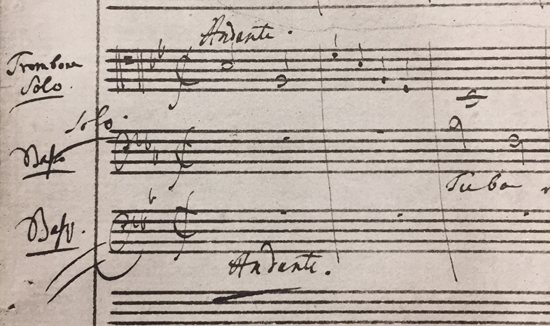
The “historically informed performance practice” movement (HIP) of recent years has helped us to revise our thinking about this in some important ways. First, many reproductions of the trombone solo of Mozart’s Tuba mirum, including its inclusion in many orchestral excerpt books, have shown the movement’s time signature to be common time, or 4/4. But when we look at Mozart’s manuscript, we see that the composer clearly intended the movement to be in cut time, or 2/2.
Here is a detail of the beginning of the Tuba mirum in Mozart’s manuscript; the cut time marking is unambiguous:
Here is the beginning of the Tuba mirum as found in Orchestral Excerpts from the Symphonic Repertoire for Trombone and Tuba, ed. Keith Brown, Volume 1, p. 83; the meter is given as common time:
And here is the beginning of the Tuba mirum as found in Moderne Orchesterstudien Für Posaune und Baßtuba, ed. Alfred Stöneberg, Vol. 1, p. 3; the meter is given as common time:
So, we have our first question: what is the tempo of a late 18th century Andante in 2/2? In fact, if you look carefully at the first page of Mozart’s manuscript above, he underlines the word Andante in the tempo – he could not be more emphatic that he wanted this tempo. Until recently, most conductors have conducted this movement in 4/4, with a tempo of approximately quarter note = 82. Or slower. Herbert von Karajan’s recording of the Tuba mirum with the Berlin Philharmonic clocks in at about quarter note = 66 and he has all three trombone players play the solo in unison. Copyright restrictions do now allow me to embed von Karajan’s recording in this article but you can hear it by clicking on this link (the recording will open in YouTube in a new window).
But is that kind of tempo REALLY Andante? A tempo of quarter note = 82 would be a tempo of half note = 41, or Lento, or in von Karajan’s case, quarter note = 66 is the same as half note = 33, or Grave. We first must examine whether the “traditional tempo” is too slow. I think it is. Listen to this performance of the solo by trombonist Susan Addison with John Elliot Gardiner conducting the English Baroque Soloists. This tempo is about half note = 50 (and do not be thrown off by the fact that this performance is in A major rather than B-flat major; the performance is at Baroque pitch, A=415):
Even this tempo seems a little slow for Andante, a tempo that is often defined as “walking tempo.” From a correct understanding of Mozart’s intentions regarding the tempo flow other questions.
Here is a larger point that I think bears some consideration: the text of the Tuba mirum and its implication on the musical character of the movement.
Tuba mirum is part of the Dies irae of the Requiem mass. In the Requiem, Mozart combines five sections of the Dies irae into the movement he titles “Tuba mirum.” These are Tuba mirum (baritone solo with trombone), Mors stupebit (tenor solo), Liber scriptus (tenor solo),Judex ergo (alto solo) and Quid sum miser (soprano solo and vocal solo quartet). For the sake of this discussion, I am limiting myself to talking about the first part, Tuba mirum, with the three lines of text reproduced below. Its text is in Latin, in trochaic meter, and it describes the day of judgment when all mankind is called before the throne of God. This is not a text that is gentle in any way:
Tuba mirum spargens sonum
Per sepulchral regionum,
Coget omnes ante thronum.
A “standard literal” English translation of this text is:
The trumpet, scattering a wondrous sound
through all the sepulchers of the regions,
will summon all before the throne.
A fuller translation that gives the Biblical sense of the text runs something like this:
The trumpet, blowing its amazing sound to all of the corners of the earth,
signals to all of the dead in the world
to rise from their tombs and come before the throne of God for judgment.
Here is how Michelangelo pictured the moment described in the Tuba mirum, in his famous fresco of The Last Judgment in the Sistine Chapel. Trumpets sounding, the dead being raised before the throne, in fulfillment of these words from John 5:28:
“The hour is coming in which all that are in the graves shall hear his voice, and shall come forth; they that have done good unto the resurrection of life; and they that have done evil unto the resurrection of damnation.”
Here, below, is a detail of the lower left of Michelangelo’s work, showing the dead rising from their tombs. Certainly this is a moment of exceptional drama:
The point I am making is this: does the text of the Tuba mirum support a gentle style of music making, with the soft dynamic and generous legato that has become so commonplace in our performances?
Listen, for instance, to how Hector Berlioz (1803-1869) set the Tuba mirum text in his Requiem. He required four brass bands – one for each corner of the earth – to call the dead from their graves to judgment:
It’s easy to argue that Berlioz was French, a 19th century Romantic-era composer and it is unfair to compare him with Mozart. But can it really be disputed that Berlioz didn’t capture the character of the Tuba mirum with the drama of dozens of brass players being the summons of God to judgment?
If we go to Requiems of contemporaries of Mozart, we find that many treat the Tuba mirum with more drama than we traditionally give to our interpretations of Mozart. Antonio Salieri (1750-1825), Mozart’s contemporary, uses trumpets and three trombones to loudly proclaim the call to judgment, while the chorus alternates between a breathless declaration and a loud summons. In it you can hear a foreshadowing of Berlioz’s brass bands:
In his unfinished Requiem in B-flat major, Johann Michael Haydn (1737-1806) employs three trombones in dramatic fashion at the presentation of the Tuba mirum:
The same can be said for the Requiem of Luigi Cherubini (1760-1842), whose setting of the Dies ire begins with a loud brass fanfare, the crash of a gong, and a brisk, dramatic treatment by chorus and brasses. The audio clip below contains the whole piece and the Tuba mirum is at 9:04:
It should be noted that this issue – the editorial dynamics and phrasings that have been added by editors other than Mozart that cause the Tuba mirum to be performed in a way that is rather disconnected from the character of the text – is not discussed in any of the Mozart literature that I have read. There are many editions of the Requiem and many completions of Mozart’s incomplete score. Most contain extensive front matter and a discussion of editorial decisions. Yet none speak to this issue. Among those I have examined are those by Alfred Schnerich (first publication of Mozart’s manuscript in facsimile, Gesellschaft for Graphische Industrie, Vienna, 1913), Leopold Nowak (Bärenreiter edition of Süssmayr’s completion, 1966), Franz Beyer (Beyer’s instrumentation, Edition Kunzelmann, 1971) and Richard Maunder (Maunder’s instrumentation, Oxford University Press, 1987). Nor is this discussed in The Mozart Compendium (H. C. Robbins Landon, G. Schirmer, 1990), Mozart (Maynard Solomon, HarperCollins, 1995), or Constanze Mozart: After the Requiem (Heinz Gärtner, translated by Reinhard Pauly, Amadeus Press, 1991). Neither it mentioned in Alfred Einstein’s important study, Mozart: His Character, His Word (Oxford University Press, 1945). In short, the Mozart literature is mute on this subject.
There are two recordings of the Requiem that are of particular interest to me and show that some conductors ARE thinking about this.
The recording below, by Christoph Sperling with Das Neue Orchester, contains a complete recording of the Süssmayer edition and also a recording of the Requiem as Mozart left it, without any editorial additions. The instrumentation of Mozart’s manuscript is very thin and the trombone soloist (who is unidentified in the liner notes but the three trombone players are listed as Robb Tooley, Katherine Couper and Uwe Haase) plays with strength and clean articulation. Note, too, the tempo, which is faster that we are accustomed to hearing:
Another interesting recording for comparison is that by Boston Baroque, conducted by Martin Pearlman, in the completion of Mozart’s manuscript by Robert Levin. The trombone soloist is Cormack Ramsey and the tempo and interpretation seems to better reflect the character of the text. Copyright restrictions do not allow me to embed that recording in this article but you can hear it by clicking this link (YouTube will open in a new window).
As with the presentation of any idea that is outside the established box, people will raise questions. I’m good with that. Let me answer some questions here:
Yes: I know that Mozart did write three slurs at the end of the Tuba mirum trombone solo; these are verified to have been Mozart’s own instruction in his own hand (they are the only slurs for trombone that were written by Mozart in the Tuba mirum). But does the inclusion of slurs necessarily mean the phrase should be played softly?
Yes: Mozart wrote several dynamic markings in the Tuba mirum but the first one, forte-piano, doesn’t occur until measure 18, where the tenor begins singing Mors stupebit natura. Mozart wrote no dynamics during the entire trombone solo (measures 1-18; we must keep in mind that the “second half” of the trombone solo, that in some editions appears starting at measure 24, is entirely a creation of Süssmayr, not Mozart). As well, keep in mind that for the entire Tuba mirum, the only music that we have in Mozart’s own hand is written for cello/bass, trombone solo and vocal soloists. He wrote no parts for violins or violas or any wind instruments apart from trombone. Mozart left the movement, as he did most of the Requiem, as an uncompleted torso.
Yes: I know that the way the Tuba mirum is traditionally played is quite lovely, and it makes for a very nice musical presentation. Mozart had previously used a trombone solo as an obligato to a vocal line to great effect (with a very different kind of text) in his Die Schuldigkeit des ersten Gebots. My point is that the way we traditionally the Tuba mirum doesn’t seem to fit with the message of the text.
But none of this prevents me from asking: Can we start a conversation about the way in which we are interpreting the Tuba mirum of Mozart’s Requiem? Does our traditional way of playing the Tuba mirum – with its soft dynamic and gentle legato – fit the drama of the text? Have we added too much to the sparse instructions Mozart left in his unfinished manuscript? Knowing how conductors somehow overlooked the correct meter and tempo for this movement for so long, have we overlooked the fundamental character of the movement as expressed by the text? Have we gotten into a habit of how we interpret this without considering other options might open new doors of understanding?
I am posing an idea, a theory; I am not presenting this as a settled thought in need of adoption. Certainly more research and study needs to be done. I am simply posing the question. Let’s keep thinking.
• • •
Please note: After reading this article, please read my follow up article, Rethinking Mozart’s Requiem – part 2, published on The Last Trombone on April 25, 2017.
In a previous post here on The Last Trombone, I mentioned an interview I gave for Central Sound at Arizona PBS that was broadcast on Phoenix’s classical PBS radio station, KBAQ (the station goes by the sound of its call letters, KBACH). One thing led to another and I now find myself very happily working for Central Sound at Arizona PBS, as an on-air host for their weekly radio program on KBAQ, Arizona Encore!
I confess I never thought of myself as having a “radio voice” but a few weeks ago, I was asked to come to the Central Sound studio in downtown Phoenix for an audition. Nothing ventured, nothing gained, and I was very pleased when, after recording a couple of test scripts, I was asked to join the team of hosts for the show. This “retirement thing” is turning out to be very interesting for me to say the least!
For those interested, Arizona Encore! is a weekly radio program that features live performances of classical music recorded around the state of Arizona. Concerts are professionally recorded by the Central Sound at Arizona PBS staff and packaged as programs that are broadcast weekly at 7:00 pm on Tuesday evenings on KBAQ. I have recorded four programs so far and they will air on September 27, and October 4, 11 and 18.
There are several ways you can listen to Arizona Encore!:
Listen live on KBAQ (KBACH), 89.5 FM every Tuesday evening at 7:00 pm Arizona time. Do keep in mind that Arizona – very sensibly, I might add – does NOT recognize daylight savings time so at this time of year, we are in the same time zone as Pacific Time while in the winter, we are in Mountain Time. You can always find out the current time of day in Arizona by clicking here.
Listen live on www.kbaq.org every Tuesday evening at 7:00 pm Arizona time.
Listen to programs on demand any time on the Arizona Encore! page on the Arizona PBS website by clicking here.
Download the KBAQ (KBACH) mobile app and listen to the show live every Tuesday evening at 7:00 pm Arizona time. The app is free and is available from the iTunes Store and Google Play:
Download the Classical Arizona PBS mobile app and listen to the show on demand any time. New shows are uploaded each week and can be streamed at no cost at any time of day. The app is also free and is available from the iTunes Store and Google Play. The app also has additional useful features including streaming of concerts (including some Phoenix Symphony concerts and concerts by students and faculty at Arizona State University), videos, concert listings, links to websites to purchase concert tickets, and more.
Listen to Arizona PBS programming live on Digital Television (DTV) channel 8.4; for more information, click here.
While I’m at it, I’d like to give a word of thanks to Arizona Encore! Executive Producer Alex Kosiorek who brought me on to the Central Sound at Arizona PBS team, and Producer Jeanne Barron who is the master of controls in the studio when I’m recording programs. We may live in the Internet age but radio is alive and well. I’m very happy to be a part of a group of people who are working hard to promote classical music here in Arizona – and around the world.
I’ve been playing the trombone since I was a young boy, and the bass trombone in particular since I was 18 years old. I’ve been fortunate to have made several solo recordings that are now in the hands of thousands of people around the world – you can see a list of my recordings by clicking here. Many other fine bass trombonists have also made superb solo recordings of diverse repertoire and recently, my good friend Gerry Pagano, bass trombonist of the Saint Louis Symphony, has released a new recording.
I met Gerry in 1987, early in my tenure as a member of the Boston Symphony Orchestra. He was a Fellow at the Tanglewood Music Center that summer and we spent a lot of time together playing and talking. A few months after the Tanglewood season ended, Gerry won the St. Louis Symphony position. Gerry is not only an excellent player but a great person – vivacious, creative, positive. I count it a real privilege to call him my friend.
Gerry’s new recording features works for bass trombone that are accessible to talented players. It doesn’t include works that are only playable by just a handful of super professionals. As always, Gerry’s new album, Horizon, features his beautiful sound and impressive technique. Most of all, his musical artistry comes through.
I’m particularly pleased that Gerry has recorded, along with tenor trombonist Bradley Palmer, my arrangement of Eric Ewazen’sPastorale, which I made with Eric’s permission for inclusion on my own CD, Two of a Mind, with tenor trombonist Nick Hudson. Gerry and Brad’s performance is quite beautiful and I’m very grateful for the inclusion of this lovely piece on the album.
You can obtain Gerry’s album for free. Yes. For free. Here is the link to download the tracks:
Of course this album wasn’t free on Gerry’s end. He had to record and produce it, and has to pay royalties to composers. So if you download the album and feel like it’s worthwhile, please take the opportunity to click the link at the bottom of the download page and send a few dollars Gerry’s way to help defray his expenses. He made this album of music that he loves and his playing is truly inspirational.
In 2014, I asked Gerry to come to Arizona State University to give a master class. The class was terrific; he is such a natural communicator and his time was extremely helpful to my students. After the class, we sat down in my office and made a video of our playing Tommy Pederson’s great duet for two bass trombones, The Crimson Collop. I posted our recording – done in one take – on YouTube and much to my surprise, it’s had over 15,000 views. Seriously? Well, we’re just happy that people have enjoyed it. Perhaps you’ll enjoy it too. Watch the video below to see two friends having a nice time together making music, celebrating the bass trombone. Enjoy.





 The Last Trombone – Douglas Yeo