Category: musical instruments

A musical miscellany

A musical miscellany

I was trained as a classical musician although I am very grateful my musical life did not fit narrowly into that single stylistic box. I am a firm believer in the value of the pluralistic musical life, whether as a performer or listener. During my long career as bass trombonist of the Boston Symphony Orchestra (1985-2012), I was very fortunate to play much of the important canon of western orchestral music that contained trombones: Beethoven (Symphonies 5 and 9), Mozart (he didn’t score for trombones in his symphonies, but I played his Requiem and several operas), all of the symphonies of Brahms, Schumann, Mahler, Tchaikovsky, and Bruckner, the tone poems of Richard Strauss, and so much more. And this I was blessed to do with some of the finest conductors of the twentieth and twenty first centuries—including Leonard Bernstein, Bernard Haitink, Seiji Ozawa, James Levine, Simon Rattle, Sir Colin Davis, and many others—and great soloists—including Mstislav Rostropovich, Anne-Sophie Mutter, Yo-Yo Ma, Jesseye Norman, Evgeny Kissin, Thomas Quasthoff, Gil Shaham, and many others—who inspired me in countless ways.

Yeo_Haitink_Sym_Hall_final_bow_2012

[Above: My final bow at Symphony Hall as a member of the Boston Symphony Orchestra, May 2012. Behind me, standing, are concertmaster Malcolm Lowe and conductor Bernard Haitink following a performance of Beethoven Symphony No. 9.]

After graduation from Wheaton College (IL) in 1976—where I studied trombone with Edward Kleinhammer (bass trombonist of the Chicago Symphony from 1940-1985) and I have now come full circle as the College’s trombone professor since fall 2019—my wife and I moved to New York City. There I had a remarkably diverse performing life, playing concerts with the Mostly Mozart Festival Orchestra and American Symphony, Broadway shows (many performance of “The King and I” starring Yul Brynner), studio jingles and record sessions, jazz bands (including the Gerry Mulligan Big Band, the Elgart Band, and the Dave Chesky Band), and the Goldman Band, with which I played many concerts under the batons of Richard Franko Goldman and Ainslee Cox.

Douglas_Yeo_Goldman_Band_1977

[Photo above: That’s me, warming up before a concert by the Goldman Band, summer of 1977, at the Guggenheim Bandshell next to the Metropolitan Opera House, Lincoln Center. That summer, by the way, was when the New York City blackout of 1977 occurred on June 13, 1977. I was playing a concert with the Goldman Band at Lincoln Center at the moment the blackout struck. Seriously. But that’s another story. In this photo, sitting next to me, which his back to the camera, is trombonist Fred Braverman. Other members of the band at that time included William Arrowsmith, then principal oboist of the Metropolitan Opera, Abraham Perlstein, who had been the second trombonist of the NBC Symphony, and Bill Barber, tuba, who had played with Miles Davis in the seminal “Birth of the Cool” recording sessions and concerts. I learned a lot from my time playing in the Goldman Band. A. Lot.]

In all of this musical activity in New York City I was a free lancer, and a substitute in groups (apart from the Goldman band where I was a full member for four summer seasons, 1977-1980—six concerts a week for six weeks each summer). From day to day, I didn’t know what kind of music I might playing. The phone would ring, I would accept an engagement, gather up my trombone and bag of mutes, and head off to play. This plurality of musical styles served me well when I joined the Baltimore and then the Boston Symphony Orchestras, where “pops” concerts required me to play credibly in a host of styles.

Yeo_Brubeck_Concerto_Boston_Pops_Lockhart_2011

Some of the richest fruit of my early experience in the jazz and commercial worlds came when I performed the two Bass Trombone Concertos written by my friend, Chris Brubeck, with the Boston Pops Orchestra. Working with Chris was pure joy, as was meeting his father, Dave Brubeck. I played Chris’ first Bass Trombone Concerto several times with the Boston Pops, including a performance of the third movement, “James Brown in the Twilight Zone,” on national television as part of the “Evening at Pops” television show. The photo above shows me performing the Concerto with the Boston Pops in 2011, with Keith Lockhart, conductor (photo by Michael J. Lutch). Susan Stempleski reviewed the concert for classicalsource.com and wrote, in part:

Lockhart introduced Douglas Yeo, bass trombonist of the Boston Symphony and Boston Pops orchestras, who delivered a wonderful and lively rendition of “James Brown in the Twilight Zone”, a movement from Chris Brubeck’s jazz-flavored Concerto for Bass Trombone and Orchestra. Yeo’s virtuosic performance electrified the audience. Brubeck was in the audience.
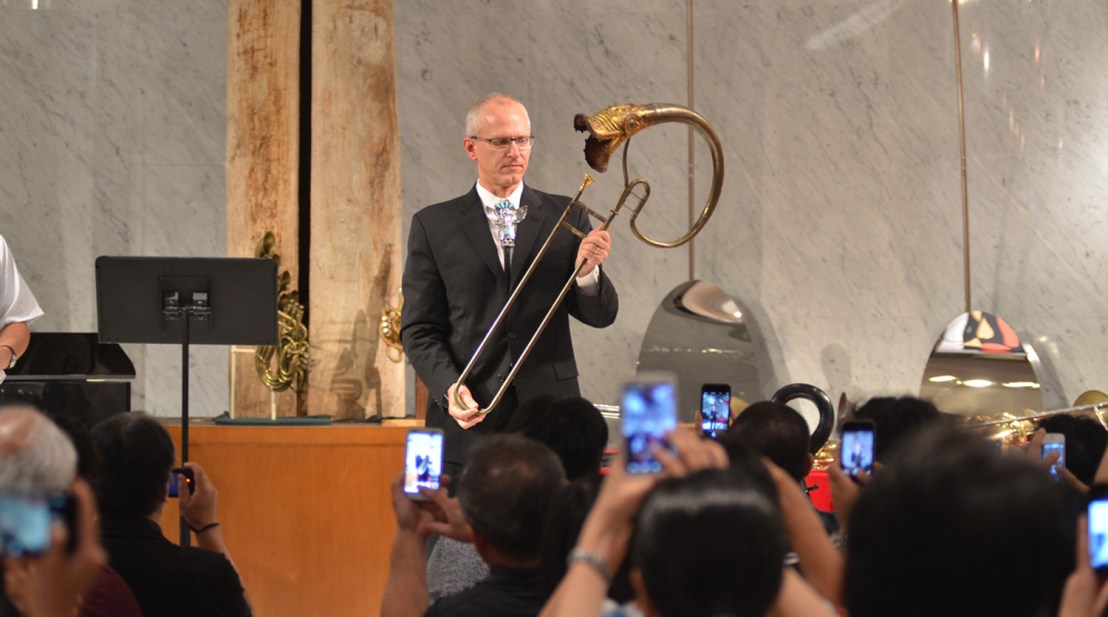
Yeo_buccin_Hamamatsu_2015

In 1996, I began my exploration into early music, first with serpent, then ophicleide, then the early trombone (often referred to as “sackbut”), buccin (dragon bell trombone), and six-valve trombone. This opened another musical world to me, where I have taken part in performances of music that I would not have ever played on bass trombone. I’ve played serpent on a host of pieces with orchestras (both modern orchestras and early music groups) including Hector Berlioz’s Messe solennelle and Symphonie fantastique, Mendelssohn’s Symphony No. 5 (Reformation) and Meerestille und glückliche Fahrt overture (Calm Seas and Prosperous Voyage), ophicleide on Berlioz’s Damnation of Faust and Mendelssohn’s A Midsummer Night’s Dream, and early trombone on Monteverdi’s Vespers of 1610 and L’Orfeo. And I’ve given many recitals that feature serpent, ophicleide, six-valve trombone, and buccin, such as when I gave a concert on nine different instruments in 2015 at the Hamamatsu Museum of Musical Instruments in Hamamatsu, Japan, shown in the photo above.

Today, in this season of life since I retired from the Boston Symphony in 2012, I feel exceptionally blessed to continue to explore playing music in a host of styles, genres, and types of ensembles. Recent months have brought a number of rewarding musical experiences into my orbit. I do not take this for granted, and I am grateful that I continue to get invitations to do interesting things with a trombone (or another instrument) in my hand.
Elijah_Austin_2019

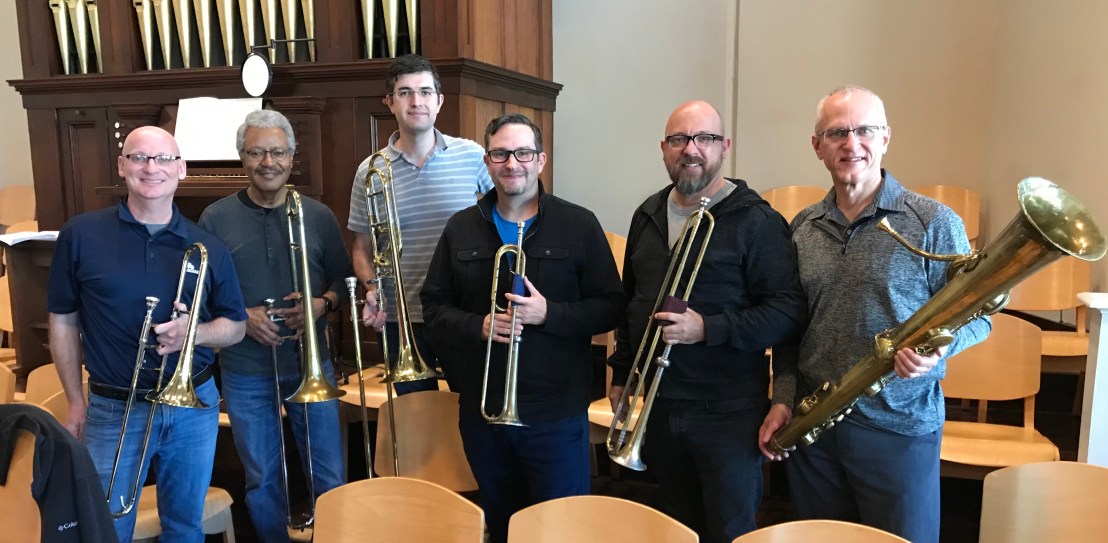
In December 2019, I was in Austin, Texas, taking part in performances of Felix Mendelssohn’s oratorio, Elijah. The concerts were organized by George Dupere, Chief Musician of Redeemeer Presbyterian Church (PCA) in Austin. I have played this piece many times, both the bass trombone and ophicleide parts, and I never tire of it. Never. The piece is so masterfully composed, and it contains such tremendous drama. This time, I played ophicleide with a fine orchestra including some of our brass section, above (left to right): Jamey Van Zandt, Nathaniel Brickens, and Owen Homayoun, trombones, and Chris Carol and Shelby Lewis, natural trumpets.
Gordon_Pagliuca_Yeo_Midwest_2019

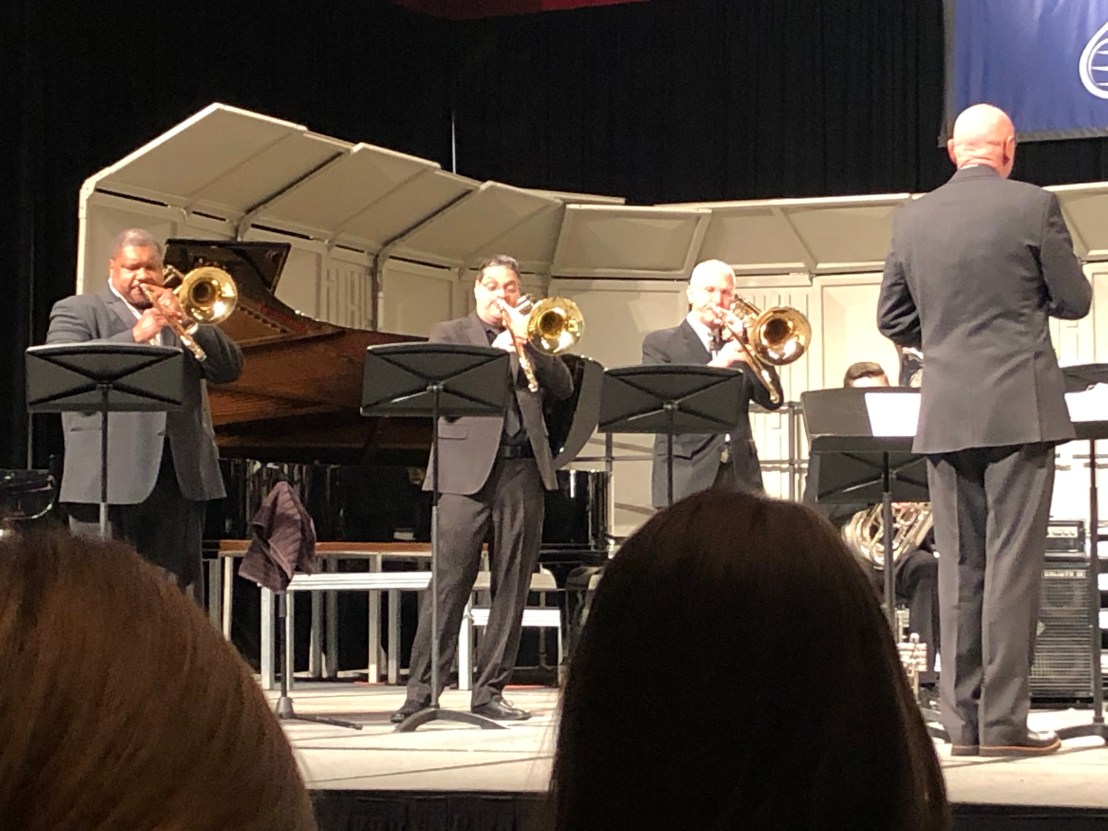
Just a few days later, I switched musical gears into the jazz world. I was delighted to be asked to be part of an “all star” brass jazz ensemble that was put together by YAMAHA for the Midwest Clinic, an annual convention held in Chicago. The Clinic features classes and performances over several days, and is one of the largest (the largest?) such events in the world. Our concert featured some terrific Christmas music, including carols arranged for trumpets, horns, trombones, tuba, and rhythm section by Stan Kenton, Ralph Carmichael, Sam Pilafian, JD Shaw, Jose Sibaja, and others. Boston Brass made up the core of the group and our trombone section (shown in performance above) consisted of Wycliffe Gordon, Domingo Pagliuca (of Boston Brass) and me. Great guys; great players. John Wittman conducted (shown in the photo on the right).

Yeo_trumpets_Midwest_2019

The trumpet section? Not a bad lineup, actually. Ha! Actually, this was a remarkable group of some of the greatest trumpet players in the world, shown backstage with me before the concert: Jose Sibaja (Boston Brass), Allen Vizzutti, Wayne Bergeron, (me), Jeff Conner (Boston Brass), Rex Richardson, and Jens Lindeman. Any questions?

Yeo_Gordon_Midwest_2019

It was such a pleasure to work with Wycliffe Gordon once again. He needs no introduction and it’s no secret to say he is one of the finest jazz trombonists of our time, for a long time member of the Lincoln Center Jazz Orchestra (I first met him at a joint concert between the LCJO and the Boston Symphony Orchestra), and now leader of his own combo. He has more albums out than I can count, and we are simpatico in so many ways. For years I’ve referred to Wycliffe as “my brother from another mother.”

In 2015, Arizona State University hosted Wycliffe for some masterclasses; this happened  while I was Professor of Trombone at ASU. I included his trombone ensemble piece, Dear Lord, I Love Thee on our April 2015 concert. Have a look and listen, above (to open this video in YouTube, click HERE). It was really, really great to see and work with Wycliffe again at the Midwest Clinic.

Kanda_Yeo_SLLBC_2020

February 2020 brought more fun in a different musical world. My good friend Megumi Kanda—principal trombonist of the Milwaukee Symphony— and I travelled to St. Louis to give a joint recital and masterclass, sponsored by the St. Louis Low Brass Collective (STLLBC). Megumi is a superb player and wonderful person (I often refer to her as “my sister from another mother”), and we have done a number of joint events over the years. We also are authors of books about trombone orchestral excerpts and performance. Published by Encore Music Publishers, the annotated orchestral excerpt books, The One Hundred: Essential Works for the Symphonic Trombonist and The One Hundred: Essential Works for the Symphonic Bass Trombonist. To all of you who are reading this who have made our books part of your library: Thank you! And if you’re interested in the books, just click the links on the titles, above.

We began our masterclass with a duet, a movement of Philipp Telemann’s Canonic Sonata No. 3 that I arranged for inclusion in my book, Trombone Essentials, published by G. Schirmer.

Megumi_Kanda_SLLBC_2020

Yeo_SLLBC_2020

We continued the class by each speaking to the assembled audience and then working with several young players. As you can see from the photos above, Megumi and I tend to be  similarly demonstrative when we teach. How about a caption contest?! By the way, I should mention that Megumi is the recipient of the International Trombone Association’s 2020 ITA Award, the Association’s highest honor. She is so deserving of this honor, and it’s a pleasure for me—the 2014 recipient of the ITA Award—to welcome her into this special group of trombonists who have been so honored. I am at work on an article about her to be published later this year in the ITA Journal. Stay tuned; she has quite a story to tell!
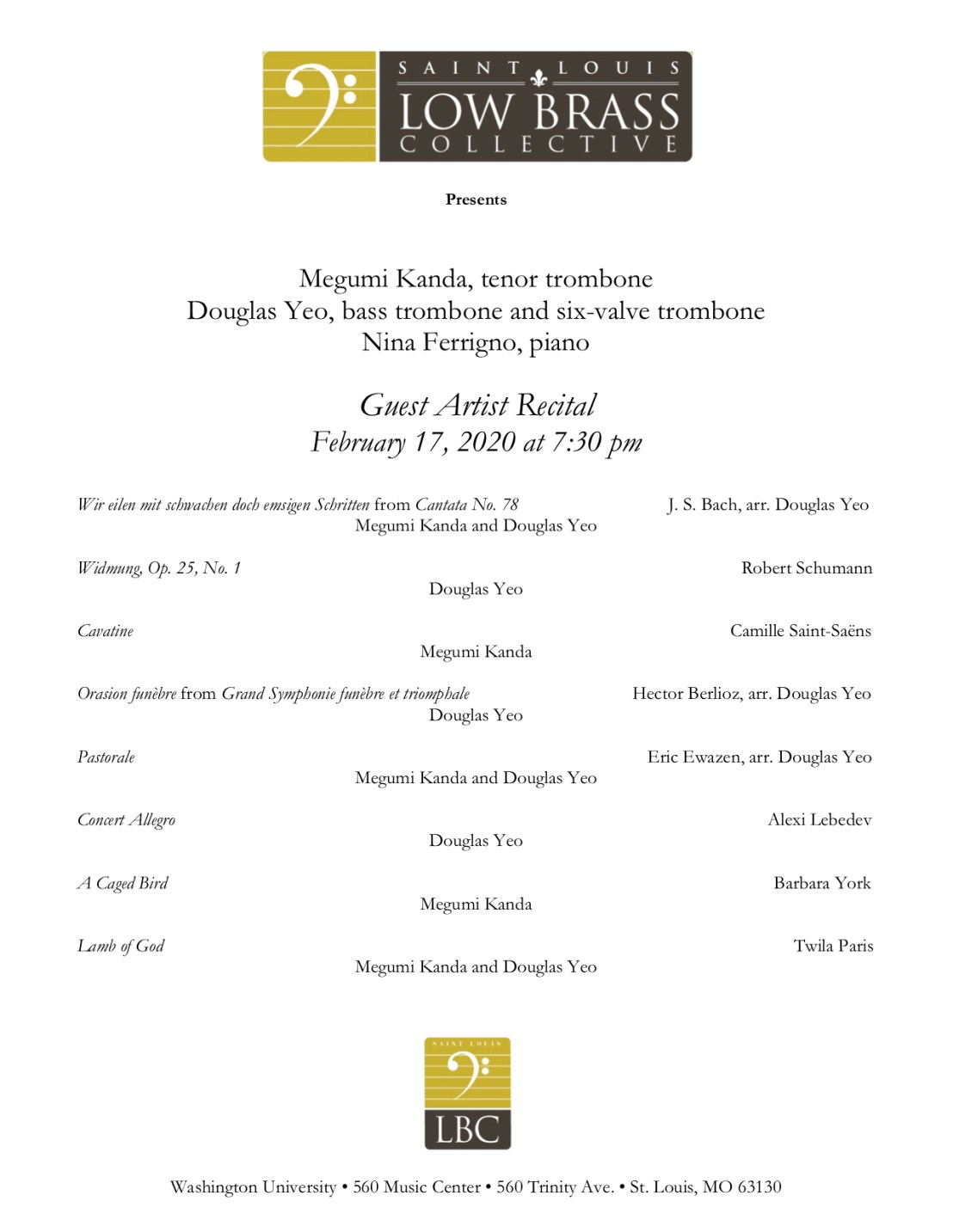
Kanda_Yeo_Recital_program_St_Louis_2020

Kanda_Yeo_St_Louis_2020

Our recital on February 17 featured us playing solos and duets. I even used my six-valve trombone to perform Hector Berlioz’s Orasion funèbre from his Grand symphonie funèbre et triumphale. I want to send a shout out and big thank you to my good friend, Gerry Pagano (bass trombonist of the St. Louis Symphony) and all of those in the STLLBC who made this trip possible.

Gaudete_Yeo_Wheaton_College_selfie_2020

From a solo and duet recital in St. Louis I came back home to the Chicago area to play chamber music. On February 21, the Wheaton College Artist Series presented a concert that featured the Chicago-based brass quintet, Gaudete Brass, as well as organist Nicole Simental and the combined Wheaton College choral groups, conducted by Jerry Blackstone. The centerpiece of the concert was a performance of Morton Lauridsen’s Lux Aeterna. On the first half of the concert, Gaudete Brass performed Ingolf Dahl’s Music for Brass Instruments; Dahl was Lauridsen’s composition teacher at University of Southern California and the piece requires six players. I joined Gaudete Brass as its second trombonist (selfie of me with Gaudete Brass after a rehearsal in Edman Chapel, above).

Gaudete_Yeo_Wheaton_College_2020

[Photo above: Gaudete Brass in Adams Art Gallery on the campus of Wheaton College after our performance. (Left to right) Bill Baxtresser (trumpet), Joanna Schulz (horn), Charles Russell Roberts (trumpet), me, Paul Von Hoff (trombone), and Scott Tegge (tuba)

I have played Dahl’s piece on numerous occasions with groups in performances around the world. But I have to say that this collaboration was, to me, particularly special. First, Gaudete Brass is a superb group of musicians. They play at the highest level and it was a joy to work with them; I hope we will do more things together. Nice people, too! Also, the concert was held in Edman Memorial Chapel at Wheaton College, where, as a student there from 1974-1976, I took part in many concerts on that stage. Many memories came flooding back as I played in Edman Chapel with Gaudete Brass. And there was this. . .

Fine_Arts_Building_Chicago

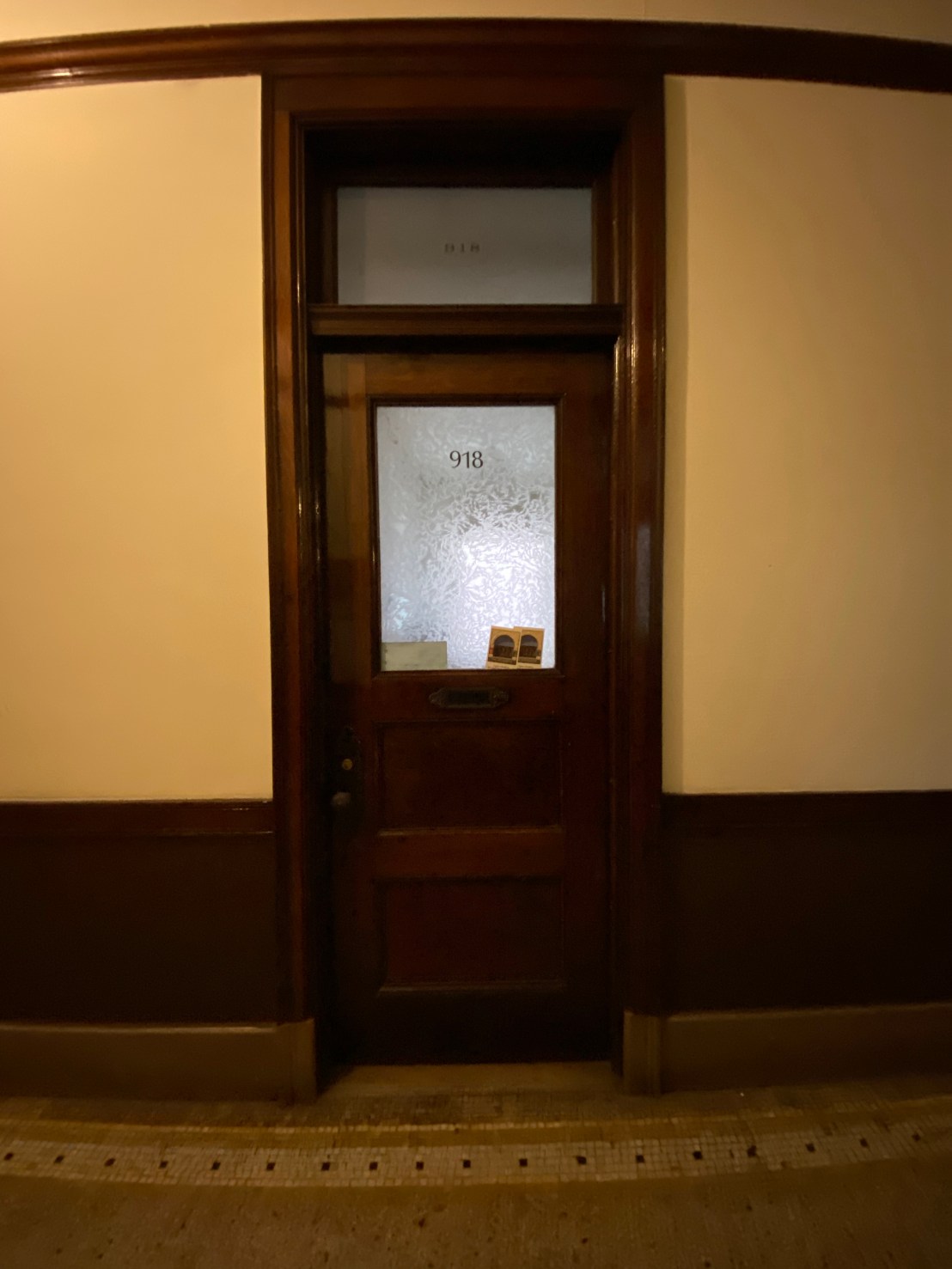
In December, Gaudete Brass and I had a rehearsal in the Fine Arts Building, on Michigan Avenue in downtown Chicago. That building has very special meaning for me: it was there, on the ninth floor, that I had my weekly trombone lesson with Edward Kleinhammer (bass trombonist of the Chicago Symphony Orchestra from 1940-1985) while I was a student at Wheaton College. I had not been in that building since my last lesson with him in May 1976. Walking through the front doors brought back a flood of memories.

Hallway_ninth_floor_Fine_Arts_Building_Chicago

Kleinhammer_Studio_Fine_Arts_Building_2020

After the rehearsal with Gaudete Brass, I climbed the stairs up to the ninth floor, to once again walk down that long hallway (which has not changed a bit since 1976) and stand in front of room 918 where Mr. Kleinhammer had his studio. As I stood there, I reflected on how those lessons impacted me in so many ways. I could not go in the room this time, but I remember every detail of that small space: two chairs, two music stands, a table for music, and a sink (the bathroom is down the hall). This photo, below, shows the two of us after my last lesson in room 918 in 1976:

Kleinhammer_Yeo_1976

In that room my life was changed.  If you did not see it earlier, click HERE to read the photo essay/tribute I wrote about him last year on what would have been his 100th birthday. He was a remarkable man.

And there is more to come. While my planned trip to Seattle to be guest soloist this weekend at the Northwest Band Festival was cancelled due to the coronavirus outbreak in Seattle, my calendar is full of other events in the coming months, including masterclasses at Interlochen Arts Academy and the Csehy Summer School of Music, performances with the Finnish National Radio Orchestra in Helsinki and Japan (unless the coronavirus has something to say about that trip), teaching at the Pokorny Seminar—hosted by Chicago Symphony tubist, Gene Pokorny—and teaching at the Wheaton College Summer Music Camp. Details may be found on the schedule page on my website, yeodoug.com.

[Header photo: Boston Symphony Orchestra, Bernard Haitink, conductor. My final performance in Symphony Hall as a member of the Boston Symphony, May 9, 2012; Beethoven Symphony No. 9. Photo by Stu Rosner; courtesy the Boston Symphony Orchestra.]
Do good. Help a widow.

Do good. Help a widow.

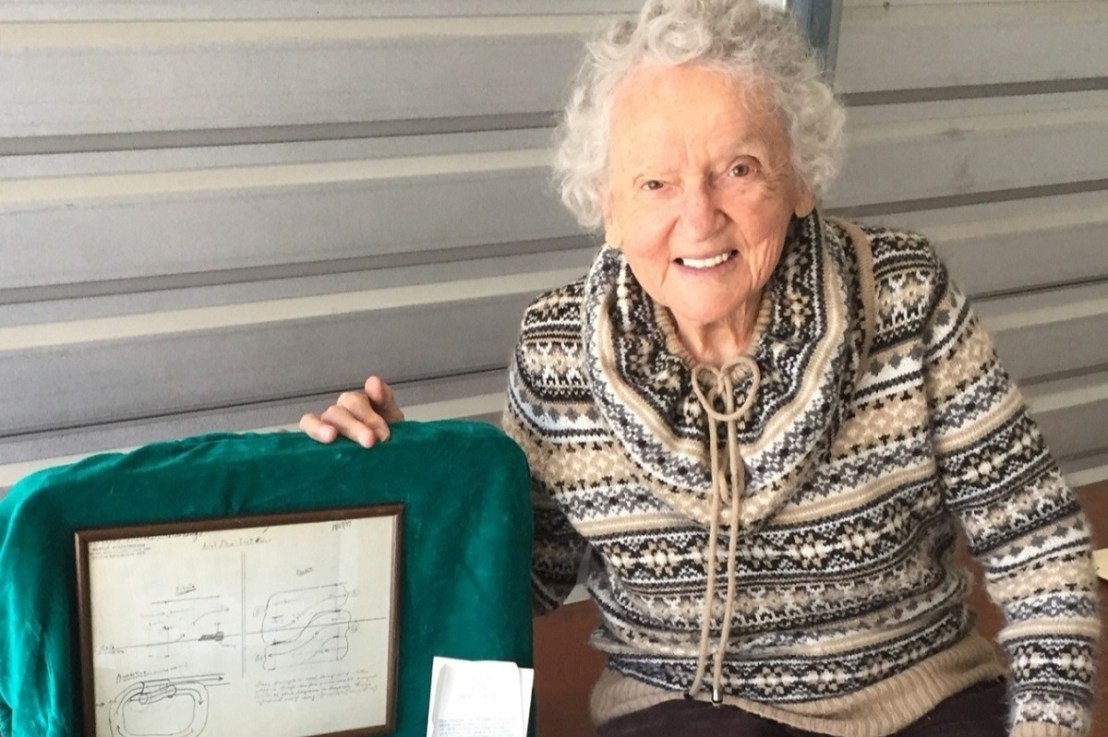
As the page is turned to a new year, from 2019 to 2020, we all do well to reflect upon and remember those who helped us in the past. Sometimes that reflection leads to action, and I hope this blog post might encourage others to follow in the steps of many others who are working today to help a person in need.

Most trombonists are aware of the pioneering work of Orla Edward Thayer, who, in 1977, invented the Thayer axial-flow valve. Ed’s invention was hugely influential in the trombone marketplace and it set off a rush of innovative design of valves by a host of manufacturers which resulted in significant improvements to trombones.

Ed’s valve was first patented in 1978 with a cylindrical valve design. In 1985, he was issued another patent with the well-known cone valve design that is still in use today.

[Above: drawings from Ed Thayer’s 1978 and 1985 patents for his axial-flow valve.]

I was an early adopter of Ed Thayer’s valve. When I was a member of the Baltimore Symphony (1981-1985), I contacted Ed and asked him to add his valve to my Bach bass trombone. This he did, with bass trombone valve number B-6, from the very first group of bass trombone valves he ever made. I endorsed his valve for several years and it was on that single valve trombone with Ed Thayer’s valve that I won the bass trombone position in the Boston Symphony Orchestra in 1985.

Oliin_Carlson_Yeo_March_1985

My colleagues in the Baltimore Symphony, Jim Olin (co-principal), Eric Carlson (second) and I all used axial-flow valve equipped trombones—we became one of the first trombone sections to use trombones with Ed’s valve. The photo above shows Jim, Eric, and me in March, 1985.

Ed Thayer was a superb inventor. More than that, he was a decent, honorable, kind person, and I and many others have always said the same about his wife, Barbara. I count it a privilege to have called them friends. Ed died in 2009, and while the valve he invented changed the face of trombone design, he was not the most savvy businessman. Several unfortunate circumstances surrounding the patent and production of the axial-flow valve drained Ed and Barbara of their financial resources and they were forced to live on Social Security alone. Barbara, now 94 years old, is living month to month.

Ken Novotny has established a gofundme page to help Barbara Thayer pay down her existing debt and help her with a long-term housing solution. This is an admirable project that has already generated many donations from generous donors. But there is a long way to go to the goal of $11,945.

As I was reading my Bible this morning, the following words jumped off the page:

Wash yourselves; make yourselves clean; remove the evil of your deeds from before my eyes; cease to do evil, learn to do good; seek justice, correct oppression; bring justice to the fatherless, plead the widow’s cause.

These words are from Isaiah 1:16-17. It was shortly after reading these words that I received an email from my friend, Marcel Schot, a trombonist in The Netherlands, letting me know about Barbara Thayer’s plight and this effort to help her. As a result, my wife and I have just made a donation to the Help Barbara Thayer gofundme page.

Would you consider doing the same? I don’t think there is any better way to start the new year than to help a widow. Barbara Thayer is deserving of our help, and doing so also honors the legacy of her late husband, Ed. Click the gofundme icon below to be directed to the “Help Barbara Thayer, Widow of Edward Thayer” page. Do a good thing, and “plead the widow’s cause.” Thank you for your consideration.

gofundme

Rewarded: a new book

Rewarded: a new book

I love to write. Ever since I was a young boy, I have been passionate about writing. Give me a 2,000 word essay on a school exam any day over three math problems. My love of writing was birthed from my love of reading, something imparted to me by my parents. My father was Chairman of our local public library while I was going up, and every week, my brothers and I trekked to the the library to take out another stack of books to read. I was fortunate to attend schools that emphasized reading, whether contemporary literature (a little), the classics (a lot), and the ancients (Edith Hamilton’s Mythology remains a favorite).

I’m at work writing several books at the moment. In the introduction to The Trombone Book, a planned 500 page book I’m writing for Oxford University Press that will cover the history, use, performance, teaching, and care of the instrument (for trombone players who are reading this, think of this book as the successor to the long out of print Trombone Technique by Denis Wick), I’ve written these words:

In a sense, I have been writing this book since I first picked up the trombone in 1964. My parents, Alan and Jeannine Yeo, now gone from this world to the next, taught me to pay attention. From them I received the gift of a disciplined work ethic and the understanding that it was required to succeed in anything. They instilled in me a love of books and reading, and from that it was not a far walk to a love of writing. I grew to appreciate words and how they were put together, and I particularly thank Alfred, Lord Tennyson (Enoch Arden), Henry Wadsworth Longfellow (Evangeline), Herman Melville (Moby Dick), Thomas Hardy (Under the Greenwood Tree and The Choirmaster’s Burial), J. D. Salinger (Catcher in the Rye), William Buckley (The Right Word) and Jacques Barzun (many books, but especially Berlioz and the Romantic Century, From Dawn to Decadence, The Use and Abuse of Art, The Culture We Deserve, and Darwin, Marx, Wagner: Critique of a Heritage) for their exceptional modeling of the possibilities of the English language. An exasperated Abigail Adams was known to say to her husband, John, whose predilection for long narrative introductions before getting to the main point used to annoy her to no end, “John! Do you always have to start at Genesis?” Like our Second President, I confess to being guilty as charged, and also to finding solace in the writing of the Apostle Paul, whose first sentence of his letter to the Romans contains 132 words before the insertion of the punctuation mark we call the period. Stopping a thought is sometimes hard to do.

I love well crafted sentences, the putting together of words, how they flow past the eye and off the lips.

As much as I like writing, I also like what happens before writing: research. I don’t write fiction; I write about music and music making, musical instruments and real people and history. I love the chase, the tracking down of facts both obscure and well known, the hunt for needles in haystacks. It is intense, patient, time-consuming, frustrating, and rewarding work. And I never tire of it.

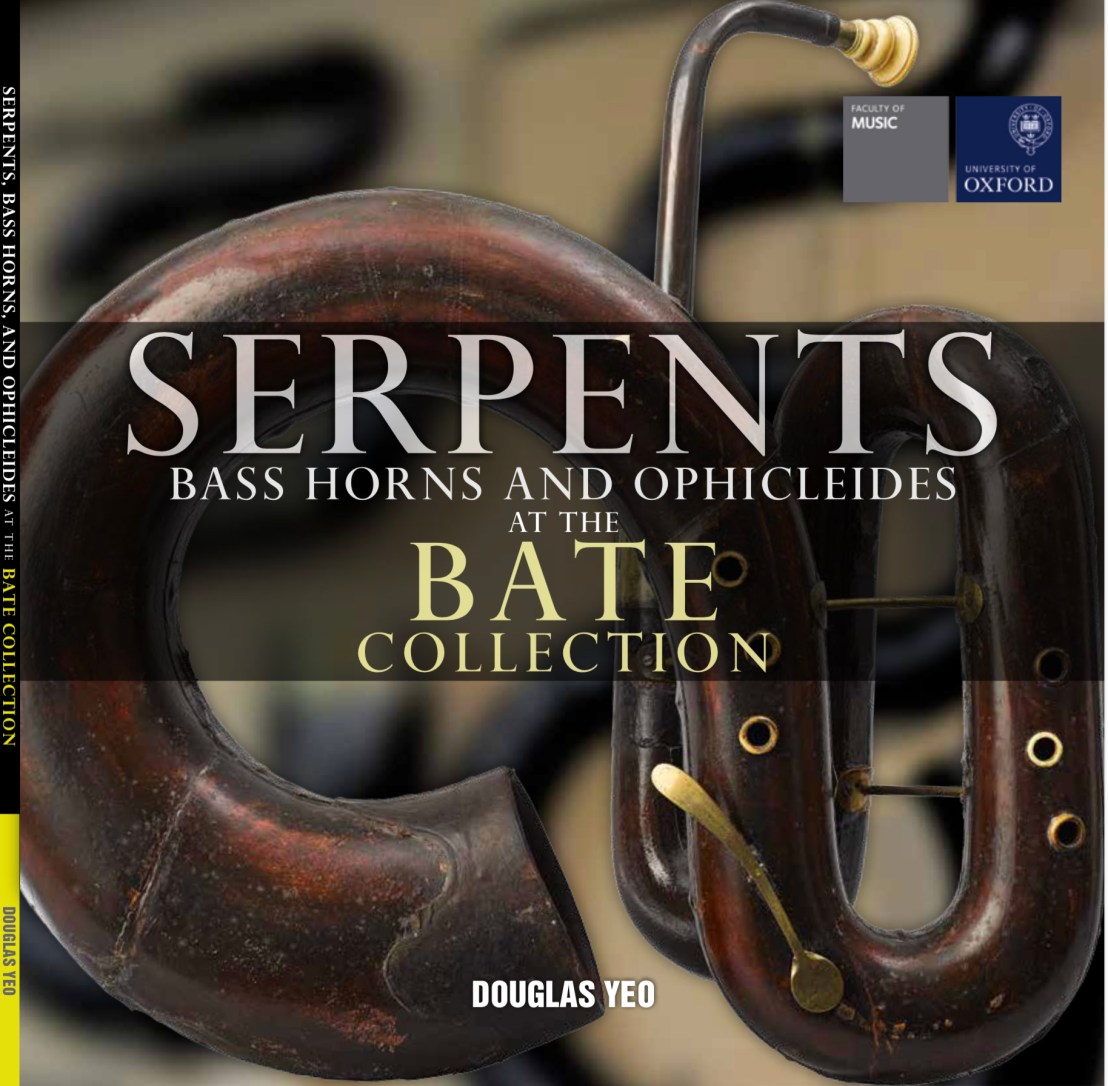
So, today is a particularly happy day for me, as my mailman brought me a most welcome package: several copies of my newest book, Serpents, Bass Horns and Ophicleides at the Bate Collection, just published by the University of Oxford in Oxford, England.

Bate_Yeo_serpents_cover

The Bate Collection in Oxford has a superb collection of musical instruments. I visited there in 2009 and had the opportunity to play several instruments under the watchful eye of my friend, curator Andrew Lamb.

Yeo_Waterloo_serpent

The Collection is a veritable “Ali Baba’s cave” of musical instruments, as you can see from this snapshot of one of the many display cases:

Bate_serpents_situ

In 2011, Andrew Lamb asked if I would be interested in writing a book about The Bate’s collection of serpents and related instruments. It took me all of one second to agree, although the project was delayed for many reasons. It was not as simple as sitting down and getting to work; a great deal of groundwork needed to be laid. And I also needed time to research and write. In 2012, I retired from the Boston Symphony and promptly flunked retirement and took the full time position of Professor of Trombone at Arizona State University. That job, as wonderful as it was, was all-consuming, and with many other writing projects going at the same time, the Bate book had to wait. But there was much to do as well, including collecting detailed information about all of The Bate’s instruments, arranging for high quality photos to be taken of each instrument, as well as research into the instruments themselves. I devised a plan for the structure of the book and last year, I began discussions with Bryn Walls, a superb designer who had been engaged to lay out and put the book together.

Screen Shot 2019-05-13 at 4.37.15 PM

As you can see from the first page of table of contents above, the book is divided into two primary sections. After a Foreward by Craig Kridel (not a Forward – remember that this book is published in England and England and the USA are two countries separated by a common language – my text needed to undergo “Anglicization” so its spelling and punctuation conformed to British publishing style), five chapters of Historical Context appear. In this section, I wrote a brief history of the instruments as seen through those at The Bate.

Screen Shot 2019-05-13 at 4.37.26 PM

The second section of the book is a detailed discussion of the instruments at The Bate. My commentary is greatly enhanced by superb photos of the instruments by Gary Ombler. Following the discussion of the instruments is a brief section of back matter, including a checklist of the instruments, a bibliography so readers and learn more, a bio and photo of moi, and a page with the index and acknowledgements.

Bate_denuded_serpent

Bate_Courtois_ophicleide

Each instrument is afforded its own two page spread, with at least two full views of the instrument (sometimes there are three or four – front, back, and sides), many photographs of detailed elements of the instruments, as well as my commentary.

With this book, serpents, bass horns, and ophicleides at The Bate come alive in a new way. Visitors to the Collection can walk through the gallery with the book in hand as they look at the instruments and learn more than the identifying label next to the instrument itself can tell them. Those who can’t get to The Bate can enjoy the instruments while sitting at home in their favorite (whoops – favourite) chair. 80 pages of photos and commentary about some of the most interesting musical instruments ever conceived and manufactured.

The book is now available through the Bate Collection’s online publications store; click HERE to go there in a new browser window. Or, of course, you can stop by the Bate Collection yourself and pick one up there. I am delighted that this book, the subject a long period of research, writing, layout, and proofreading, is now available. Holding copies in my hand today is a great reward at the end of a long process. I will enjoy this moment, but tomorrow I’ll be happily back to my other writing projects. More on them soon!

Bate_serpents_situ


Surprises

Surprises

Life is full of surprises, unexpected things that intersect our lives. Sometimes a surprise is shocking, such as a car accident, or the sudden death of a friend or loved one. Sometimes surprises are joyful, like getting accepted to a college you thought was out of reach. No matter how they come, surprises always get our attention. A recent surprise got me thinking of how interesting this theme of surprises (good ones!) has been in my life recently.

Among my many ongoing projects, I have been doing a study of the Stephanovsky 20 Etudes for Bass Trombone. As my friend, Peter Ellefson (Professor of Trombone at Indiana University) pointed out to me a few weeks ago, Keith Brown’s 1964 edition of the Stephanovsky 20 Etudes contains a great deal of common material with Brown’s edition of Fritz Werner’s 38 Studies for Trombone. What? Two composers whose books contain much music that is identical? Keith Brown died last year so he isn’t here to explain what happened. So I’ve been trying to figure out this little puzzle.

In my research, I learned that the 20 Etudes were first published under Stephanovsky’s name in the Soviet Union, first around 1950 and then again in 1961 (Werner’s book was first published in 1927). I hunted around for copies of Stephanovsky’s Russian editions to obtain via Inter Library Loan and finally located a copy of the 1961 edition (I did locate a copy of the c. 1950 edition but the library that owns it is in Europe and does not participate in ILL) in the library at University of Texas, Austin. In a few days, it was heading to me for examination.

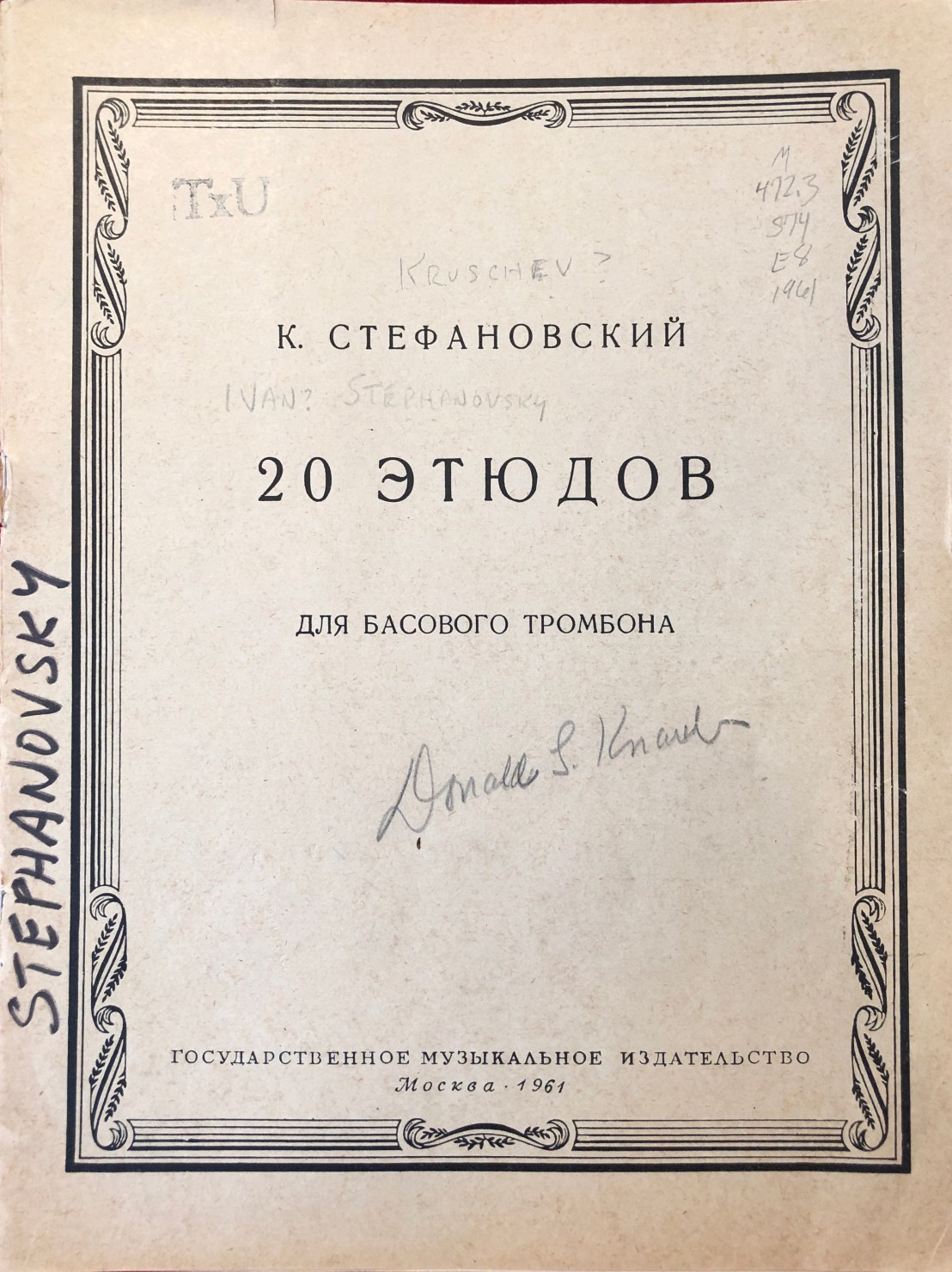
SURPRISE! When I opened it, the title page revealed that this copy had been previously owned by Donald S. Knaub, former professor of trombone at Eastman School of Music and University of Texas. Knaub is one of the most respected trombone teachers of the twentieth century; I was very privileged to meet him a few years ago when I gave a masterclass at University of Houston. A book from his personal library? Nice.

stephanovksy_cover_knaub_copy_1961

SURPRISE! Someone (it was probably Knaub since the handwriting looks like his) made some assumptions about the name of the composer of this music. No, it was not Kruschev, nor Ivan. Stephanovsky’s first name was Karl. The University of Texas librarians got the name right when they entered the music into their catalog.

Whenever I hold music that was owned by someone else, I have great anticipation when I open it up since there are often hand-written markings that prove to be as interesting to me as the music itself. Knaub’s music didn’t disappoint.

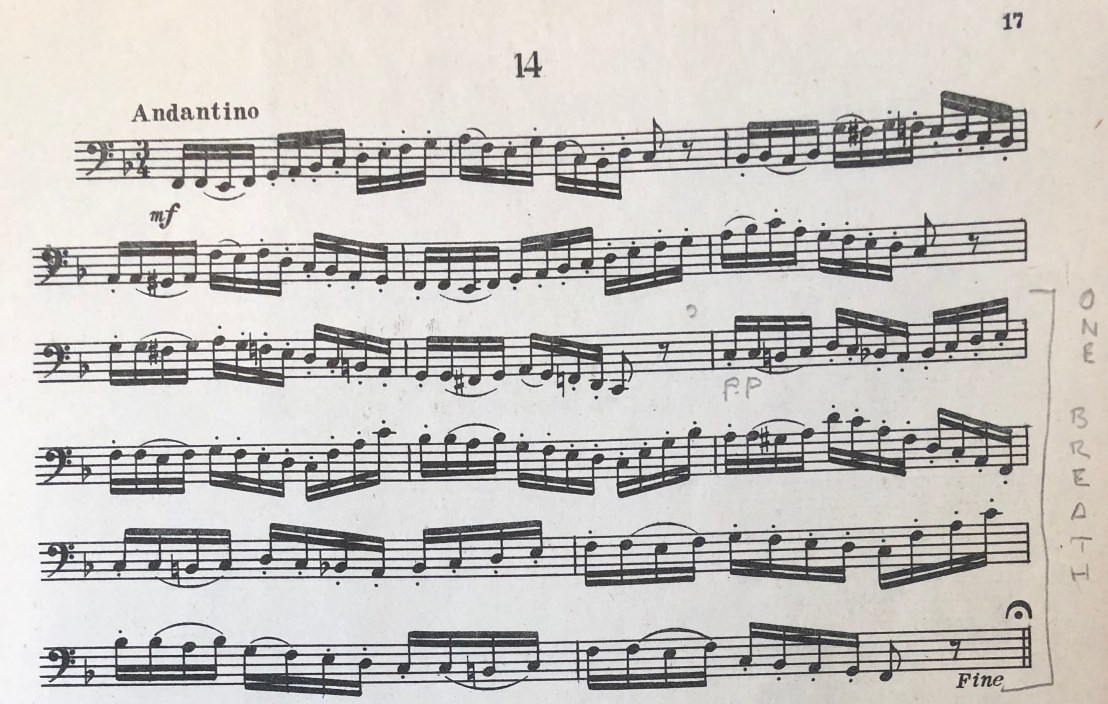
stephanovsky_14_detail_knaub_copy

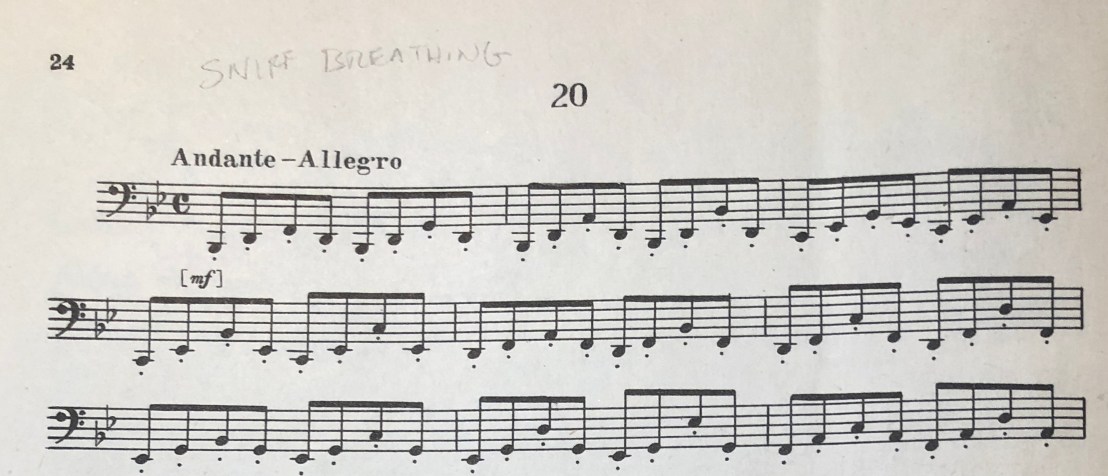
SURPRISE! When I turned to Etude 14 I saw Knaub’s handwriting that marked out several bracketed staves where he had written “ONE BREATH” next to them, after having changed the dynamic of mezzoforte to pianissimo. I had to smile. I have made the same indications in many copies of this book when I have assigned that same etude to students over my many decades of teaching. Pushing ourselves to play long phrases is an essential part of learning good breath control. It was nice to see that Knaub asked the same thing of himself – and he probably asked it of his students as well.

stephanovsky_20_detail_knaub_copy

SURPRISE! When I turned to the final page of the book, Knaub had written “SNIFF BREATHING” at the top of Etude 20. Another big smile from me. I have been extolling the virtues of sniff breathing – that is, taking quick breaths through the nose rather than breathing through the mouth while playing – as a way to deal with playing music like this where there just isn’t a good place to take a breath. I was taught this technique by my former Boston Symphony tuba colleague, Chester Schmitz, and it has served me (and my students) well ever since then. To see that Knaub suggested using sniff breathing on this etude was a great verification to me, since this is the very kind of etude I assign to my students to practice this useful breathing technique.

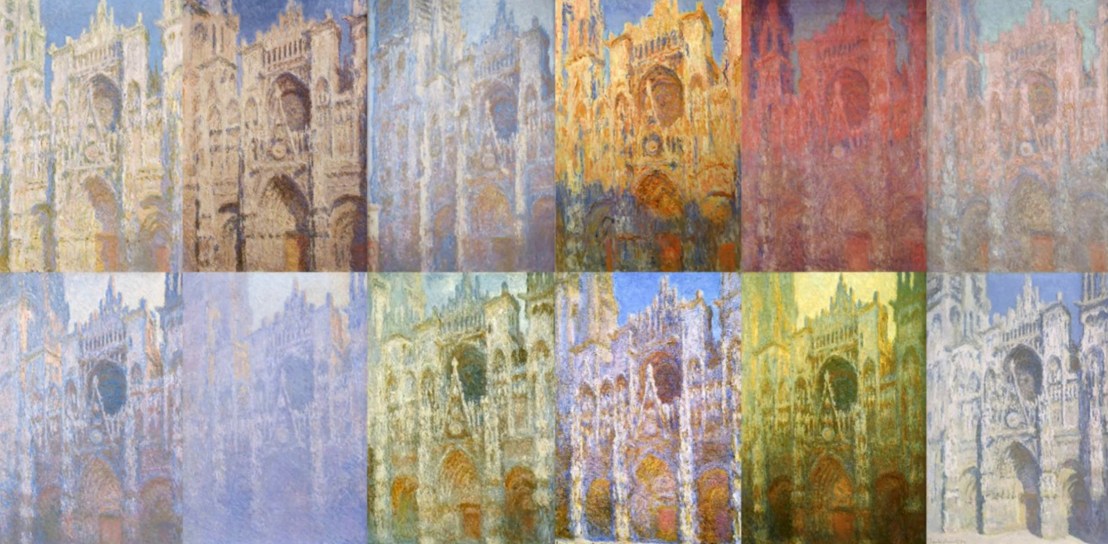
In 2010, I was in Rouen, France, doing some teaching and performing en route to a conference in Paris that was devoted to the musical instrument called the serpent. Whenever I go to Europe, I always seek out cathedrals and large churches. I have a great interest in Gothic-era church architecture. Rouen, of course, has one of the most famous cathedrals in the world, made all the more famous by the more than thirty paintings of its west front by Claude Monet (below).

rouen_cathedral_monet

My oldest daughter, Linda (who was accompanying me on the trip), and I spent some time inside and outside this magnificent church, but my host and friend, Volny Hostiou, told us of another interesting church in Rouen that is much less known. And it had a surprise.

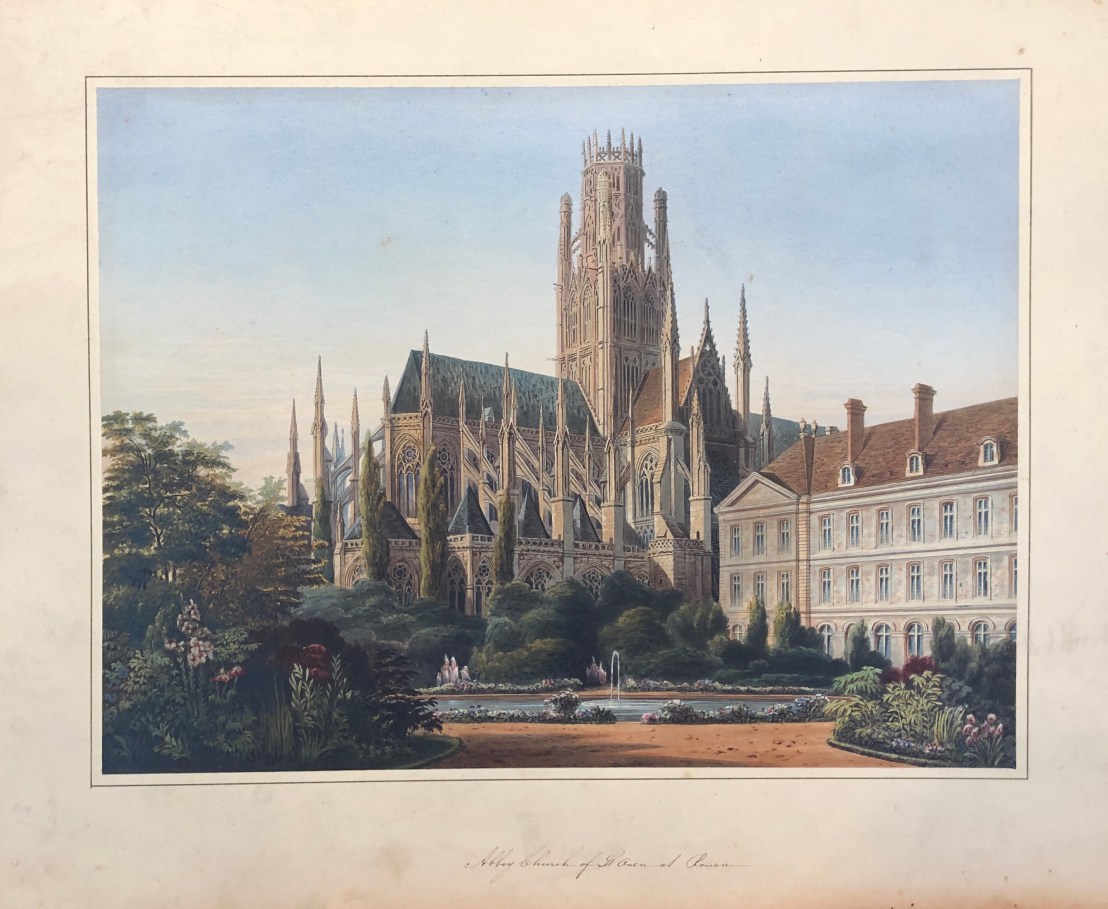
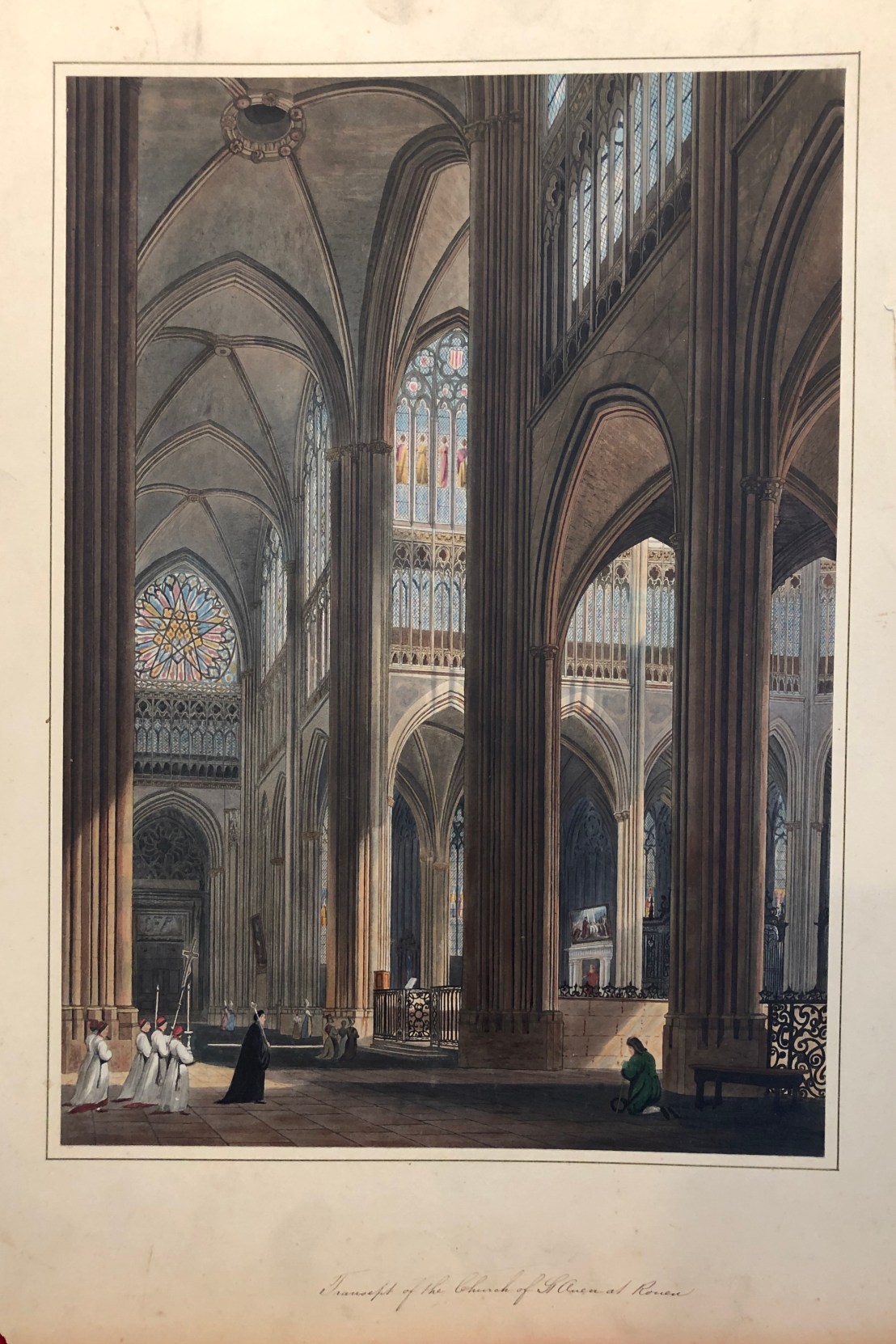
SURPRISE! Actually, when Volny told me about the Abbey Church of St. Ouen, he was surprised it was not the first time I had heard of it. I’ve been aware of its architecture ever since a set of twelve aquatints by the English artist, Charles Wild, came into my possession many years ago. Wild’s “Twelve Selected Examples of the Ecclesiastical Architecture of the Middle Ages, Chiefly in France.” In 2001, I wrote an article about one of these prints, “The Choir of the Cathedral of Amiens,” where I discussed the serpent players depicted in the print (you can view and download my article about this in the Historic Brass Society Journal by clicking this link). Among the prints in Wild’s set are two of the Abbey Church of St. Ouen in Rouen. One is of the outside of the church:

wild_abbey_church_rouen_01

And the other is of the church’s transept:

wild_abbey_church_rouen_02

These are beautiful images, ones that have taught me a great deal about Gothic architecture and cathedral/church life. But now Volny had a surprise for me. “When you go inside,” he said, “look up. You will find a serpent player.” Linda and I made a trip to the Abbey Church to find out what Volny was talking about.

st_ouen_serpent_angel_01

SURPRISE! We looked all through the church for the serpent player and finally we found him. High up on the ceiling in a side chapel, there it was, a remarkable painting of an angel playing the serpent. Nothing there about harps in heaven!

st_ouen_serpent

The serpent, which had been invented sometime in the late fifteenth or early sixteenth century and then evolved to be an instrument to accompany the singing of chant in the Church in France, would have been well known to every person who had worshipped in St. Ouen in the sixteenth through nineteenth centuries. The painting is heavily damaged but it is still remarkable nonetheless. Who painted it? When? Questions. . .

st_ouen_serpent_angel_04

SURPRISE! But there was more. As we looked more carefully at the painting, we realized that the serpent player was not alone. Look at the image, above. Just to the right of the serpent-playing angel’s left wing you see another face. It’s very faint and hard to find. (Maybe this will help: look at the chin of the serpent-playing angel, then move your eyes to the right until the stonework of the ceiling appears. The second angel’s face is there, just to the side of the larger angel’s wing.) You can clearly make out the face of another angel who is looking at the serpent-playing angel. An unexpected surprise on top of a surprise. Did this other angel originally have an instrument in hand? What did the rest of the ceiling look like when the paint was all intact? Questions. . .

Some of my biggest surprises come in books. Because of the nature of the research I do, I purchase a lot of used books, and mostly books that are out of print. I get all of my used books through abebooks.com, a website that serves as a massive catalog of the holdings of thousands of bookstores around the world. I can usually find any book I want there, and usually for only a few dollars. And sometimes when I open up a used book, I find a surprise.

halas_by_halas_cover

SURPRISE! My wife and I enjoy football and one of the first things we did when we moved to the Chicago area last fall was to become season ticket holders for the Chicago Bears. We’re all in with the Bears and since we want get to know the team better, I’ve been acquiring several books and DVDs about its history. Last week, I ordered a used copy of Halas by Halas (New York: McGraw-Hill Co., 1979), the autobiography of George S. Halas who was not only the first coach, then player, then owner of the Chicago Bears, but was the driving force behind the creation of the National Football League in 1919.

halas_by_halas_autographs

You can imagine my surprise when I opened this book – which I purchased for under $20 – and I found several autographs inside the front cover. There is Doug Atkins, defensive end for the Chicago Bears from 1955-1966 and a member of the Pro Football Hall of Fame. And Mike Pyle, center for the Bears from 1961-1969. And George Connor, another member of the Pro Football Hall of Fame who played linebacker/tackle for the Bears from 1948-1955. There is also the signature of Jeanne Morris, a pioneering female television sports broadcaster, and two members of the short-lived Chicago Bears cheerleading squad, the Honey Bears. Also of interest is the book plate that celebrates the event where books were distributed and the autographs were probably inscribed. I wonder who else was there at that Chicago Bears Reunion Dinner? Who was “Charlie,” to whom some of the autographs are signed? Questions. . .

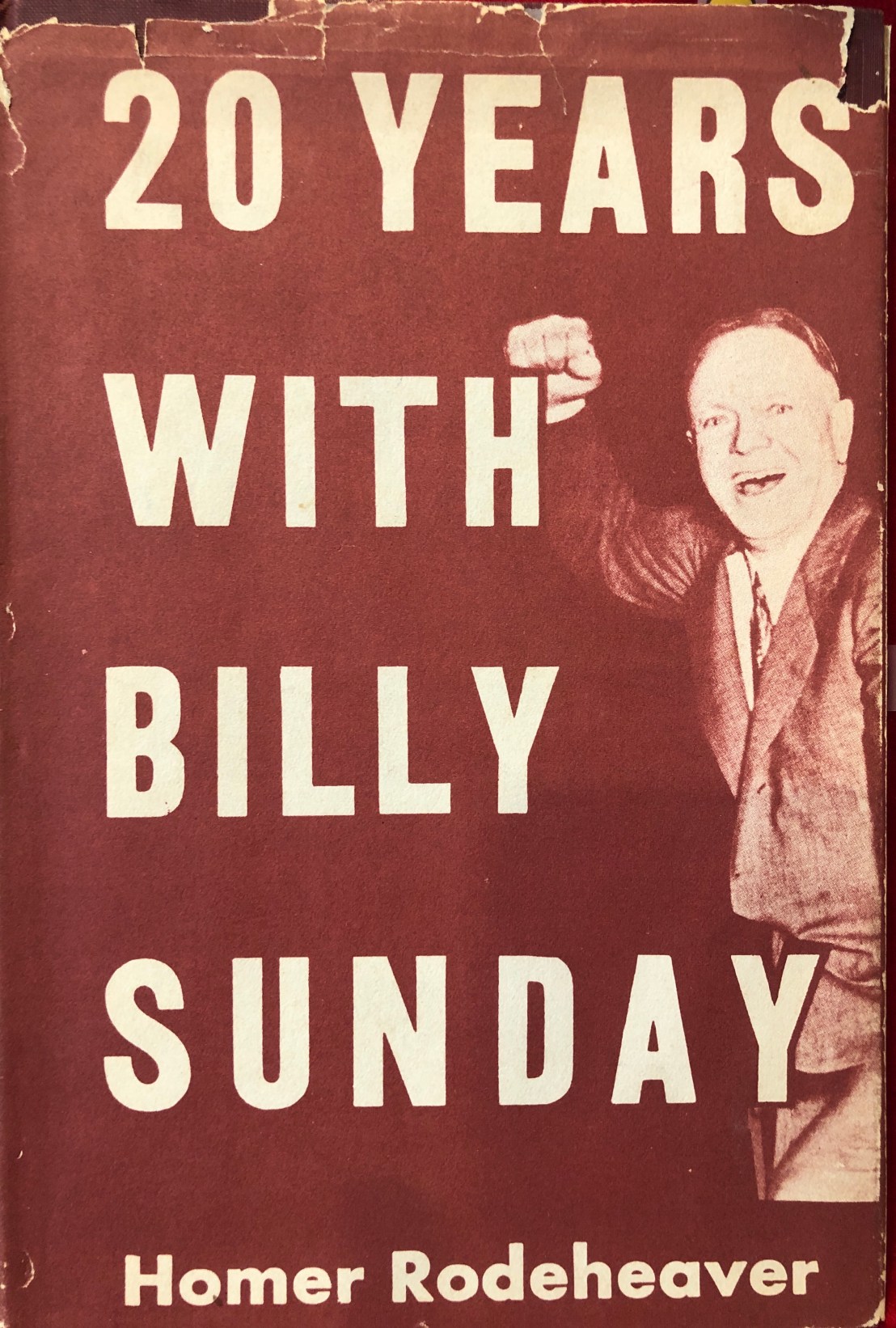
rodeheaver_20_years_billy_sunday_cover

Among the several books I am writing at the moment is a biography of Homer Rodeheaver, the trombone-playing song leader for evangelist William Ashley “Billy” Sunday in the first third of the twentieth century. Rodeheaver is a fascinating character who was a driving force in the promotion of gospel music in the twentieth century through his publishing company, record company, and evangelistic work. With my friend and co-author, Kevin Mungons, we are moving along in the process of bringing this book to publication with University of Illinois Press.

In the course of our research, both Kevin and I have acquired many (hundreds, for sure, maybe thousands?) of books that inform our understanding of Rodeheaver, his life, times, and work. Among them is Rodeheaver’s own book, 20 Years With Billy Sunday (Winona Lake, Indiana: Rodeheaver Hall-Mack Co., 1936), the story of his years as songleader for evangelist Billy Sunday. While long out of print, copies of the book are not especially rare. But. . .

rodeheaver_20_years_billy_sunday_autograph

SURPRISE! When I opened my used copy of Rodeheaver’s book, I found his inscription inside the front cover, with a reference from the Bible, Colossians 3:16, “Let the word of Christ dwell in you richly, teaching and admonishing one another in all wisdom, singing psalms and hymns and spiritual songs with thankfulness in your hearts to God.” I’m not an autograph collector, but to hold and own a copy of Rodeheaver’s book in my hands that he had held in his own hands was a very nice surprise. As to Watts Franklin (or Franklin Watts?) of Elizabethtown, Kentucky, a previous owner of this book – his (her?) return address label appears on the page with Rodeheaver’s signature – I have not been able to learn anything. Did Watts meet Rodeheaver and ask him to sign the book? Was it a gift to him/her? Questions. . .

Unlike Homer Rodeheaver whose life has never been chronicled in a biography, Billy Sunday is the subject of many books. Some were written during his lifetime (he died in 1935) and others are more contemporary. Books about Sunday – whether authorized by the evangelist or not – provide a fascinating window into his life and ministry as seen through the lens of the time in which he lived.

brown_sunday_cover

One of these books is by Elijah P. Brown, The Real Billy Sunday (New York: Fleming H. Revell Co., 1914). My used copy has a stamp in the back that says it was owned by Sarah A. Kemmerer of Allentown, Pennsylvania. Who she was I do not know. More questions. . .

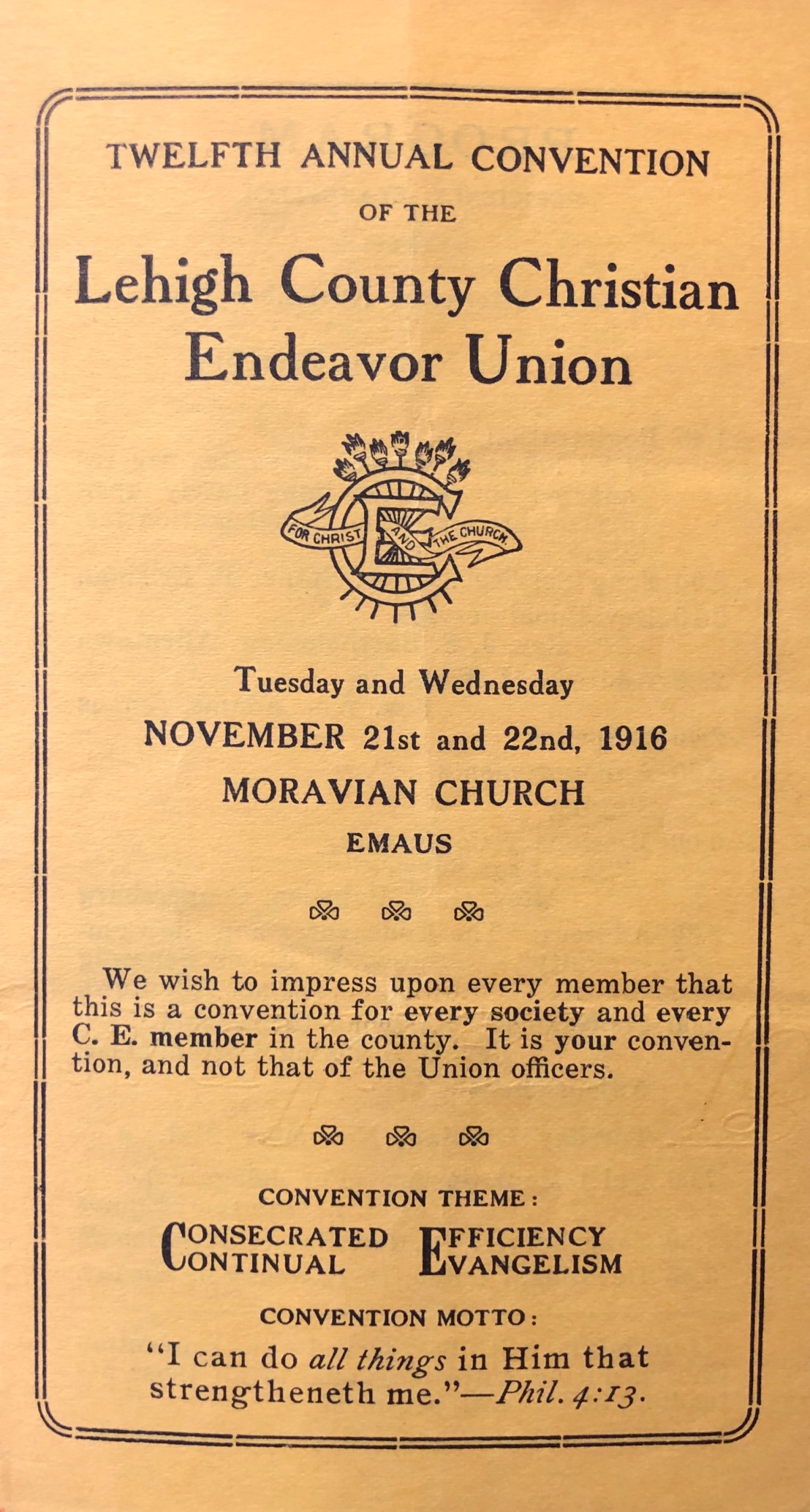
lehigh_christian_endeavor_pamphlet_1916

SURPRISE! When I opened my used copy of Brown’s book, a small, six page pamphlet fluttered to the floor. It was a program for the 1916 convention of the Lehigh (Pennsylvania) County Christian Endeavor Union, November 1916. Held at the Moravian church in Emaus, Pennsylvania (this spelling was used for the borough from 1830-1938; before and after that time it was/is spelled Emmaus), the convention featured sermons, singing, devotionals, and other activities for youth and adults. It provides a fascinating glimpse into the schedule of one of these meetings which were common occurrences at the time.

ellis_billy_sunday_cover

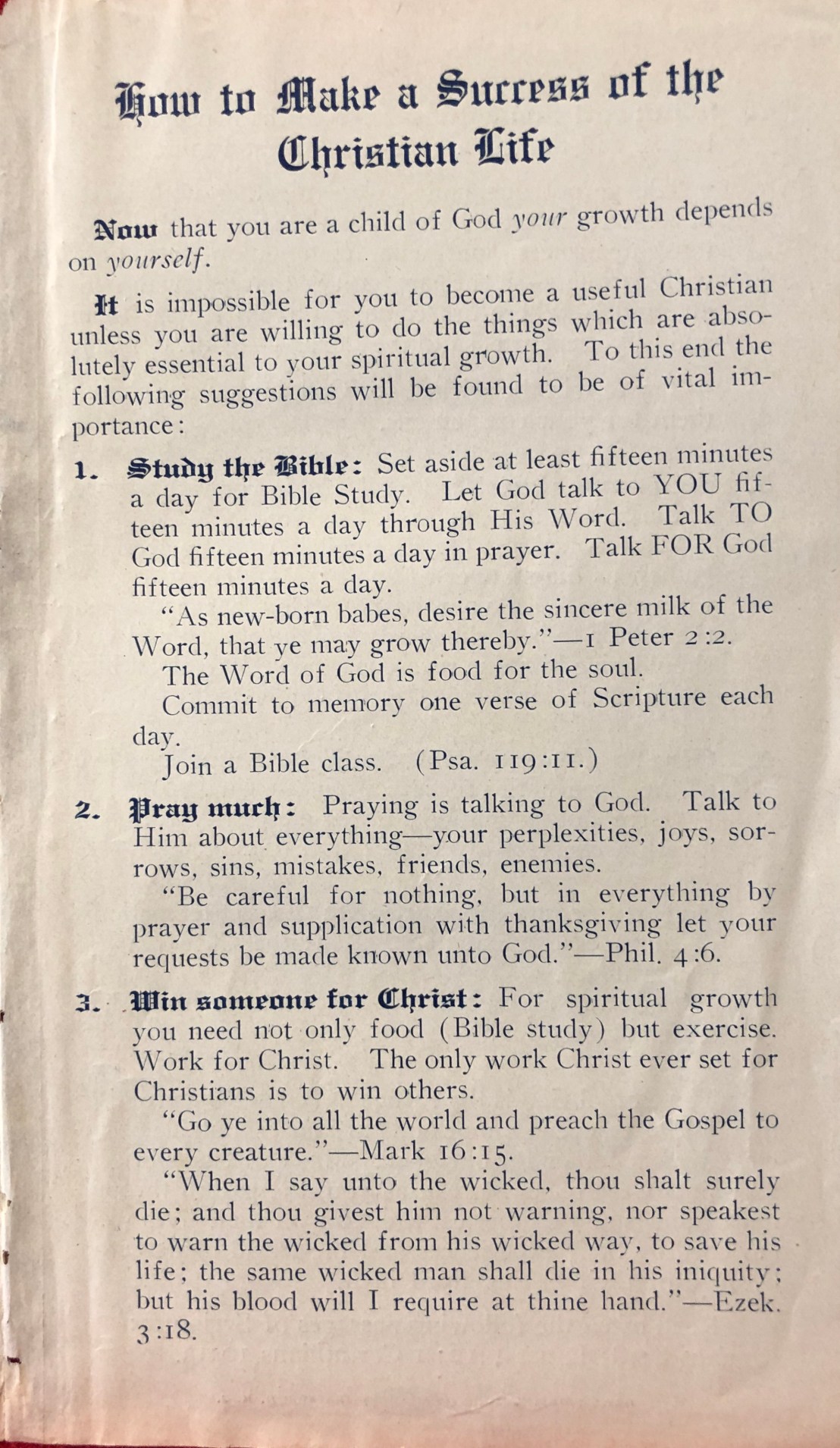
SURPRISE! Another among my many biographies of Billy Sunday is “Billy Sunday” The Man and His Message by William T. Ellis (Philadelphia: John C. Winston Co., 1914). This used copy contained a remarkable surprise: an original copy of the brochure that Billy Sunday put into the hands of tens of thousands of people who attended his tabernacle meetings and “walked the sawdust trail” up the aisle to shake hands with the evangelist as they made a public profession to trust Jesus Christ as Savior. The fact that this tract was kept in the book made me wonder if a previous owner bought the book at one of Sunday’s meetings and then put the pamphlet inside that very night for safekeeping. Names of two previous owners of the book are inscribed inside the front cover: a signature of Arthur S. Beale, and a label with the name L. Wilkins of Watertown, Massachusetts. Who were they? When and how did they come to own this book? Questions. . .

The pamphlet is a remarkable historical document and one that is as fresh today as when it was first used by Sunday in the early twentieth century. There are many things I find interesting about this pamphlet, including the fact that it bears the imprint of a union publishing house, Allied Printing of Paterson, New Jersey. Could this brochure have been printed for the 1917 Billy Sunday meetings in New York City? Questions. . .

Sunday asks some important questions and gives some important advice. Have a look.

sunday_tract_01sunday_tract_02sunday_tract_03sunday_tract_04

Life is full of surprises. Sometimes they cause you to ask questions. Sometimes they can change your life.