Category: music

Honoring Joannès Rochut in Paris

Honoring Joannès Rochut in Paris

by Douglas Yeo (September 12, 2025) — Cet article paraît en français ci-dessous.

Trombonists around the world are well acquainted with the life and work of Joannès Rochut (1881–1952). Readers of TheLastTrombone may remember the several articles I wrote about him here:

Since 1928, trombone players have relied on Rochut’s three volumes of Melodious Etudes for Trombone, adapted from the vocalises of Marco Bordogni, as important material for development of legato and expressive styles. In January 2025, the International Trombone Association Journal published its largest issue to date, which included my 70-page article, “More Than Bordogni: The Life, Work, and Influence of Joannès Rochut.” In the course of my research, I connected with Rochut’s great-granddaughter, Julie Rochut. From her home in Paris, Julie generously shared family photographs and information—much of it gleaned from conversations with her father, Bernard, and her uncle, Jean-Jacques—that greatly enriched my work.

The entrance to Bagneux Cemetery, France.

In August 2025, my wife, Patricia, and I traveled to Paris to celebrate our 50th wedding anniversary. The trip gave me the chance to meet Julie in person and thank her for her invaluable help. As our plans to meet unfolded, we agreed to gather at the final resting place of Joannès Rochut and his wife, Louise, in Bagneux Cemetery, just south of Paris.

Douglas Yeo with members of the Rochut family at Bagneux Cemetery, France. Left to right: Douglas Yeo, Sophie Rochut, Bernard Rochut, Arthur Allouti-Rochut, Inès Allouti-Rochut, Julie Rochut. August 23, 2025.

Benny Sluchin—my friend and colleague and co-recipient along with me of the International Trombone Association’s 2024 Lifetime Achievement Award—had previously visited the cemetery, photographing Rochut’s grave for my article. Benny joined Patricia and me on our visit, where we were welcomed by several members of the Rochut family: Bernard Rochut (grandson of Joannès), Julie and her sister Sophie (great-granddaughters), and Sophie’s children, Inès and Arthur Allouti-Rochut (great-great-grandchildren).
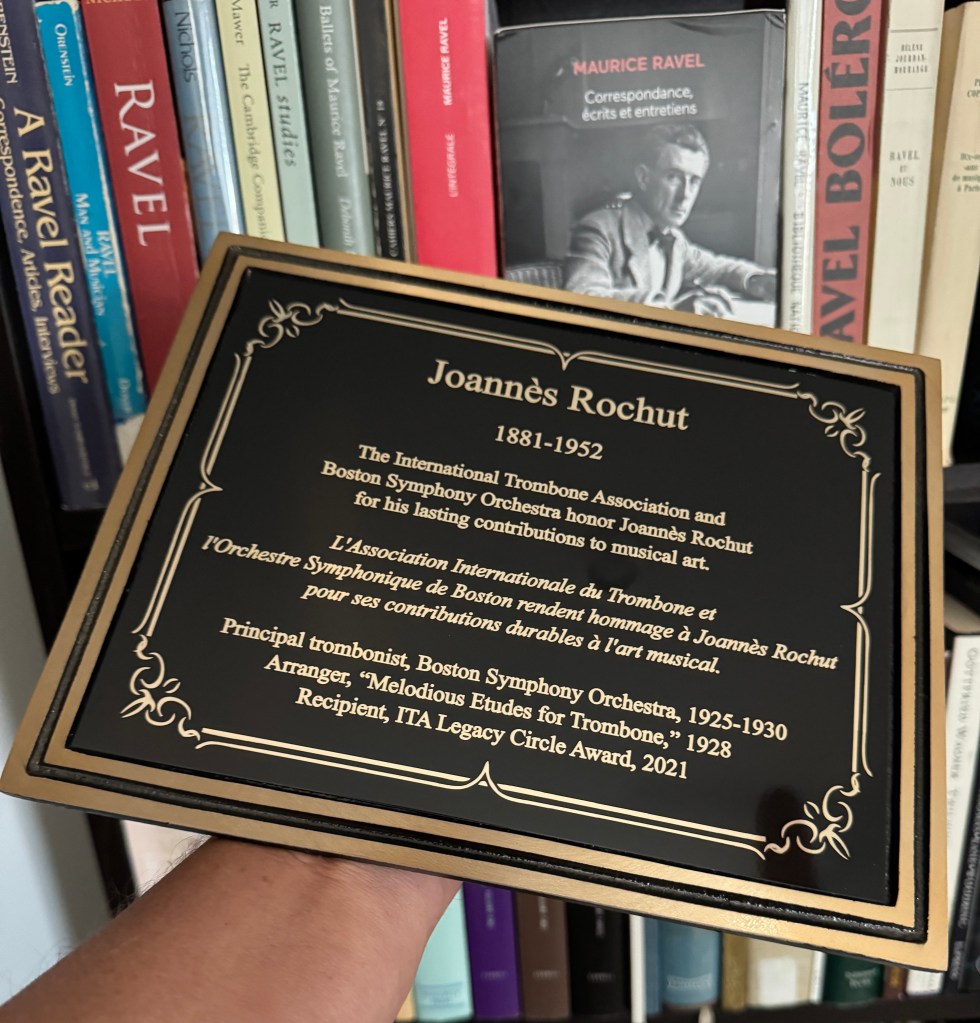
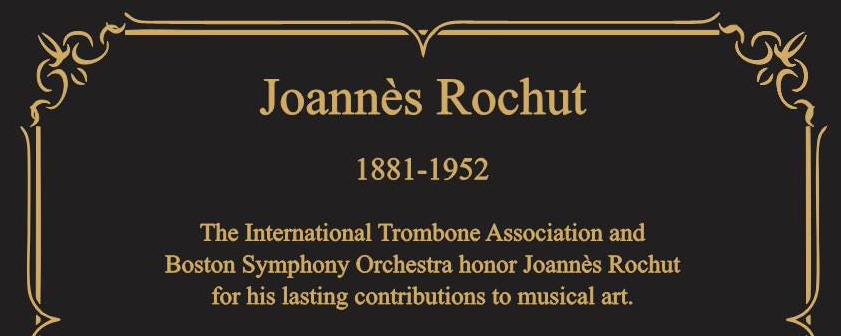
Commemorative plaque commissioned by Douglas Yeo for the grave of Joannès Rochut (2025).

Ahead of our trip, I commissioned a commemorative plaque for Rochut’s grave to honor his enduring influence. I installed on behalf of the ITA and the Boston Symphony Orchestra; the marker bears the following text:

Joannès Rochut

1881–1952

The International Trombone Association and

Boston Symphony Orchestra honor Joannès Rochut

For his lasting contributions to musical art.


L’Association Internationale du Trombone et

l’Orchestre Symphonique de Boston rendent hommage à Joannès Rochut

Pour ses contributions durables à l’art musical.


Principal trombonist, Boston Symphony Orchestra, 1925–1930

Arranger, “Melodious Etudes for Trombone,” 1928

Recipient, ITA Legacy Circle Award, 2021

This is the second commemoration of Rochut’s work that appears at his grave. The grave also includes a tribute to Rochut from his colleagues at Radiodifussion-télévision française (R.T.F.), where he served as Régisseur général des Orchestres (general manager) from 1935 until his death in 1952. This beautiful tribute—carved in stone in the shape of an open book—reads:

SOUVENIR

REGIE DES ORCHESTRAS DE LA R.T.F.

(A remembrance from the Management of the Orchestras of the R.T.F.)


Tribute to Joannès Rochut by his colleagues at Radiodiffusion-télévision française.

At the gravesite, Bernard Rochut brought forth several photographs of Joannès, a photograph of a valve trombone Rochut had owned, and an eight-page hand-written letter Rochut sent in 1930 to his son, Robert, just before Joannès concluded his tenure with the Boston Symphony Orchestra.
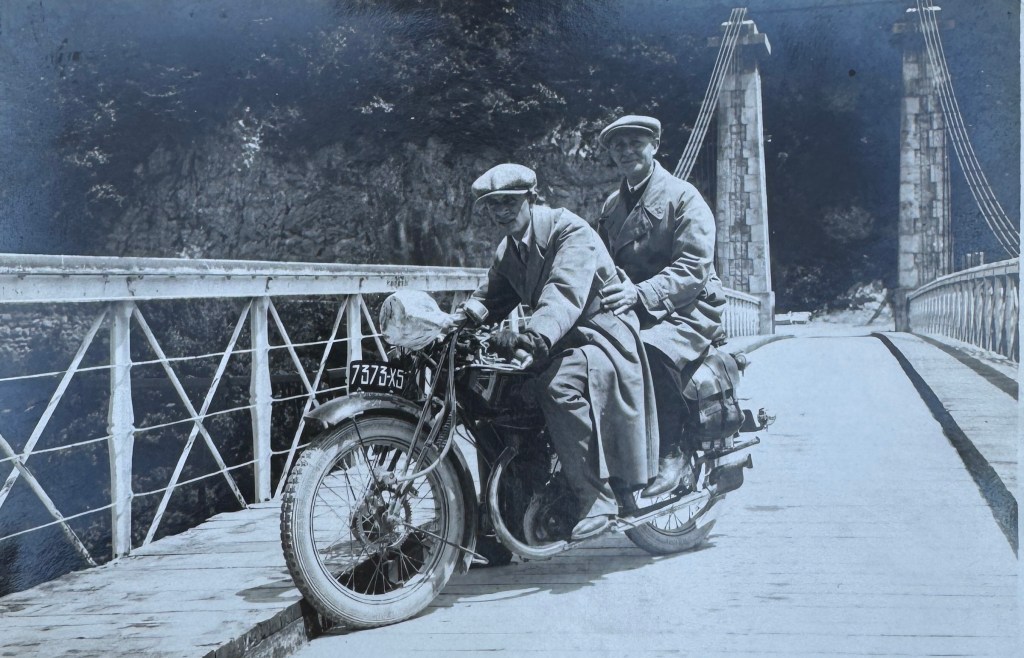
Joannès Rochut riding motorcycle with his son Robert. Undated photo from Bernard Rochut.

The Rochut family also holds additional music manuscripts in Rochut’s hand which they plan to share with me for possible future publication. These materials will form the basis of a forthcoming update to my earlier article.
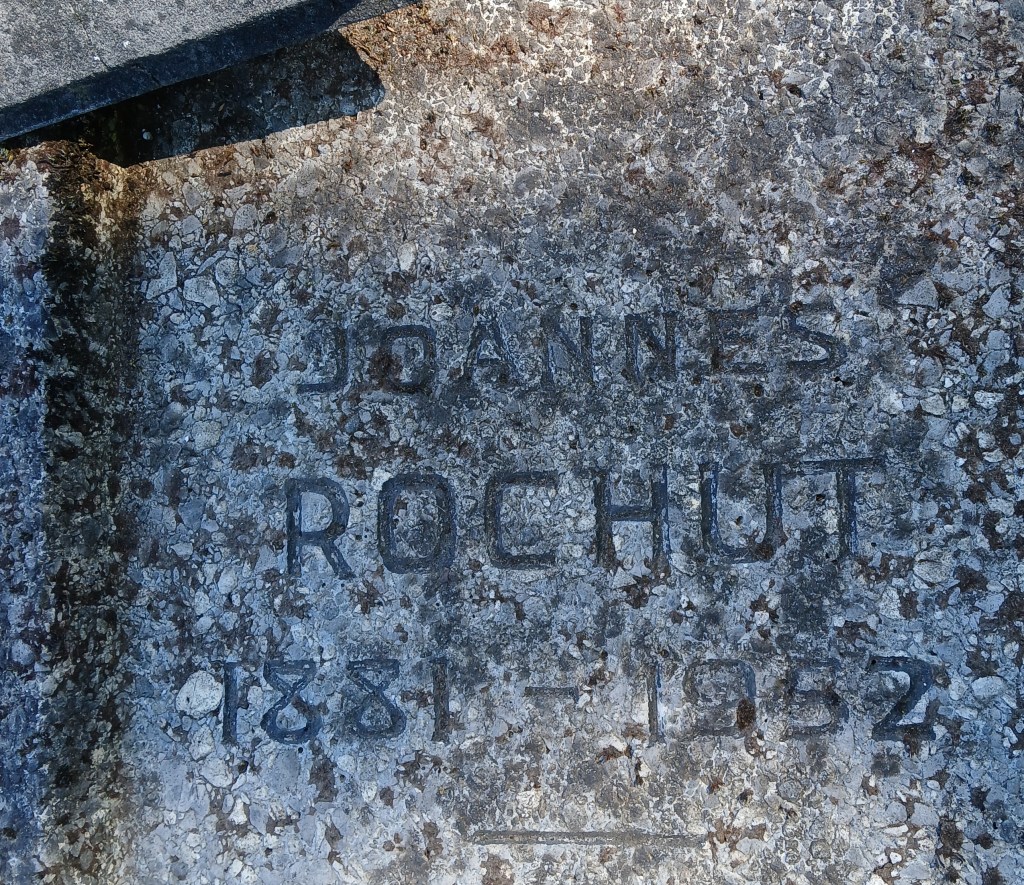
Inscription on the grave of Joannès Rochut.

As we look ahead to the 150th anniversary of Rochut’s birth in 2031, it is especially meaningful to see his great-great-grandchildren continuing in his path: Inès (trombone) and Arthur (percussion) are members of the Paris Opera’s first youth orchestra, Apprentissage de l’orchestre. Their love of music reminds us that Rochut’s legacy is not only preserved in print and performance but is also alive in the next generation of musicians who carry his name—and his influence—into the future.
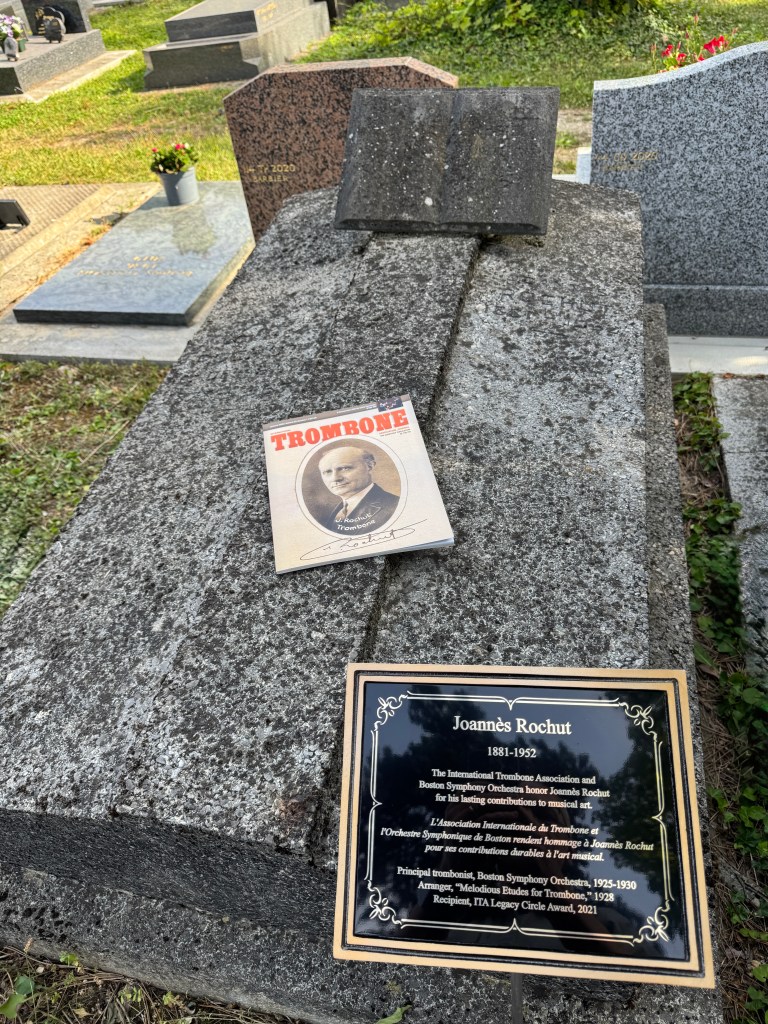
The grave of Joannès and Louise Rochut, Bagneux Cemetery, France.

• • • • •

Honorer Joannès Rochut à Paris

par Douglas Yeo (12 septembre 2025)

Les trombonistes du monde entier connaissent bien la vie et l’œuvre de Joannès Rochut (1881–1952). Les lecteurs de TheLastTrombone se souviendront peut-être des plusieurs articles que j’ai écrits à son sujet:

Depuis 1928, les trombonistes s’appuient sur les trois volumes des Melodious Etudes for Trombone de Rochut, adaptés des vocalises de Marco Bordogni, comme matériel essentiel pour développer le style legato et expressif. En janvier 2025, le International Trombone Association Journal a publié son plus grand numéro à ce jour, comprenant mon article de 70 pages “More Than Bordogni: The life, work, and influence of Joannès Rochut.” Au cours de mes recherches, j’ai établi un lien avec l’arrière-petite-fille de Rochut, Julie Rochut. Depuis son domicile parisien, Julie a généreusement partagé des photographies de famille et des informations—dont une grande partie recueillie lors de conversations avec son père, Bernard, et son oncle, Jean-Jacques—qui ont considérablement enrichi mon travail.

En août 2025, mon épouse Patricia et moi nous sommes rendus à Paris pour célébrer notre 50e anniversaire de mariage. Ce voyage m’a donné l’occasion de rencontrer Julie en personne et de la remercier pour son aide inestimable. Au fil de nos conversations, nous avons convenu de nous rassembler au lieu de repos final de Joannès et de son épouse, Louise, au cimetière de Bagneux, juste au sud de Paris.

Benny Sluchin—mon ami, collègue et co-récipiendaire avec moi du Prix pour Lifetime Achievement Award par l’International Trombone Association en 2024—avait déjà visité le cimetière, photographiant la tombe de Rochut pour mon article. Benny s’est joint à Patricia et moi lors de notre visite, où nous avons été accueillis par plusieurs membres de la famille Rochut: Bernard Rochut (petit-fils de Joannès), Julie et sa sœur Sophie (arrière-petites-filles), et les enfants de Sophie, Inès et Arthur Allouti-Rochut (arrière-arrière-petits-enfants).

Avant notre voyage, j’avais commandé une plaque commémorative pour la tombe de Rochut afin d’honorer son influence durable. Je l’ai installée au nom de l’Association Internationale du Trombone et du Boston Symphony Orchestra ; elle porte l’inscription suivante:

Joannès Rochut

1881–1952

The International Trombone Association and

Boston Symphony Orchestra honor Joannès Rochut

For his lasting contributions to musical art.


L’Association Internationale du Trombone et

l’Orchestre Symphonique de Boston rendent hommage à Joannès Rochut

Pour ses contributions durables à l’art musical.


Principal trombonist, Boston Symphony Orchestra, 1925–1930

Arranger, “Melodious Etudes for Trombone,” 1928

Recipient, ITA Legacy Circle Award, 2021

Il s’agit de la deuxième commémoration de l’œuvre de Rochut figurant sur sa tombe. Elle comporte également un hommage de ses collègues de la Radiodiffusion-télévision française (R.T.F.), où il fut Régisseur général des Orchestres de 1935 jusqu’à sa mort. Ce bel hommage—gravé dans la pierre en forme de livre ouvert—porte l’inscription:

SOUVENIR

RÉGIE DES ORCHESTRES DE LA R.T.F.

Au cimetière, Bernard Rochut a présenté plusieurs photographies de Joannès, une photo d’un trombone à pistons lui ayant appartenu, ainsi qu’une lettre manuscrite de huit pages que Rochut envoya en 1930 à son fils Robert, juste avant de conclure son mandat avec le Boston Symphony Orchestra.

La famille Rochut conserve également d’autres manuscrits musicaux de sa main qu’elle prévoit de partager avec moi pour une éventuelle publication future. Ces documents formeront la base d’une prochaine mise à jour de mon article précédent.

Alors que nous nous tournons vers le 150e anniversaire de la naissance de Rochut en 2031, il est particulièrement émouvant de voir ses arrière-arrière-petits-enfants marcher dans ses pas: Inès (trombone) et Arthur (percussions) sont membres du premier orchestre de jeunes de l’Opéra de Paris, Apprentissage de l’orchestre. Leur amour de la musique nous rappelle que l’héritage de Rochut ne se conserve pas seulement dans les partitions et les concerts, mais qu’il vit également à travers la nouvelle génération de musiciens qui portent son nom—et son influence—vers l’avenir.

La famille de Robert Rochut, Marseille, France, v. 1942.

Rang arrière: Joannès Rochut, Robert Rochut (fils de Joannès). Rang avant: Jean-Jacques (fils de Robert et Arlette), Arlette (épouse de Robert), Philippe (fils de Robert et Arlette), Louise (épouse de Joannès), Bernard (fils de Robert et Arlette). Collection de la famille Rochut.


Dizzy Gillespie and the serpent – 1955

Dizzy Gillespie and the serpent – 1955

by Douglas Yeo (May 31, 2025)

I’ve been playing the serpent—the musical instrument, not the reptile—since 1994. I’ve told the story of how I came to play the serpent—in recitals, chamber music groups, in the Boston Symphony Orchestra, in early music groups—in many places at many times. Including on The Last Trombone : HERE, HERE, and HERE. And you can hear me play the serpent in a recital I gave in 2022 at Wheaton College, Illinois. Click HERE to hear me perform Clifford Bevan’s Variations on “The Pesky Sarpent” for serpent and piano. The serpent has brought me connections with music and musicians I never would have crossed paths with had I confined my musical interests to the trombone.

Organist Joseph Balistreri with the Missa Sicca Schola Cantorum, University of Notre Dame, April 27, 2015.

For example, when organist Joseph Balistreri gave a recital on April 27, 2025 at in the Basilica at University of Notre Dame, he contacted me and asked if I could play serpent on the concert. I was happy to do so, to play some seventeenth-century chant with the Missa Sicca Schola Cantorum. Click HERE and you’ll be directed to a page with information about Joseph’s recital along with a link to the livestream recording and the program.

I’ve written widely about the serpent (including a book about the instrument, Serpents, Bass Horns, and Ophicleides in the Bate Collection, published by University of Oxford in 2019) and I’ve collected many photographs, postcards, and original works of art that depict the serpent. For many years, I’ve been aware of a photograph of the great jazz trumpet player, Dizzy Gillespie, playing a serpent. I’ve seen a few low quality scans of the photograph in various places on the internet, but I like to see both context and size of images. Once I learned that the photo appeared in the December 29, 1955 issue of JET magazine, I kept my eye out for a copy of that issue.

The cover of the December 29, 1955 issue of JET magazine.

Last week, I found one. JET was a magazine published between 1951 through 2016 for the African American community. The magazine was a mix of photos, commentary, and news, and when I opened my mail the other day and held the issue in my hands, smiled. I had not imagined the magazine was so small – only 6 inches by 4 inches.

The copy of JET that I purchased had suffered damage. The two staples that held the issue together had rusted and that rust bled throughout the center of the magazine’s pages. But the photo of Dizzy Gillespie, happily, was not affected by the rust. And there he was, on page 32. I think this is a terrific photo, something completely outside the box.

Pages 32 and 33 of the December 29, 1955 issue of JET magazine.

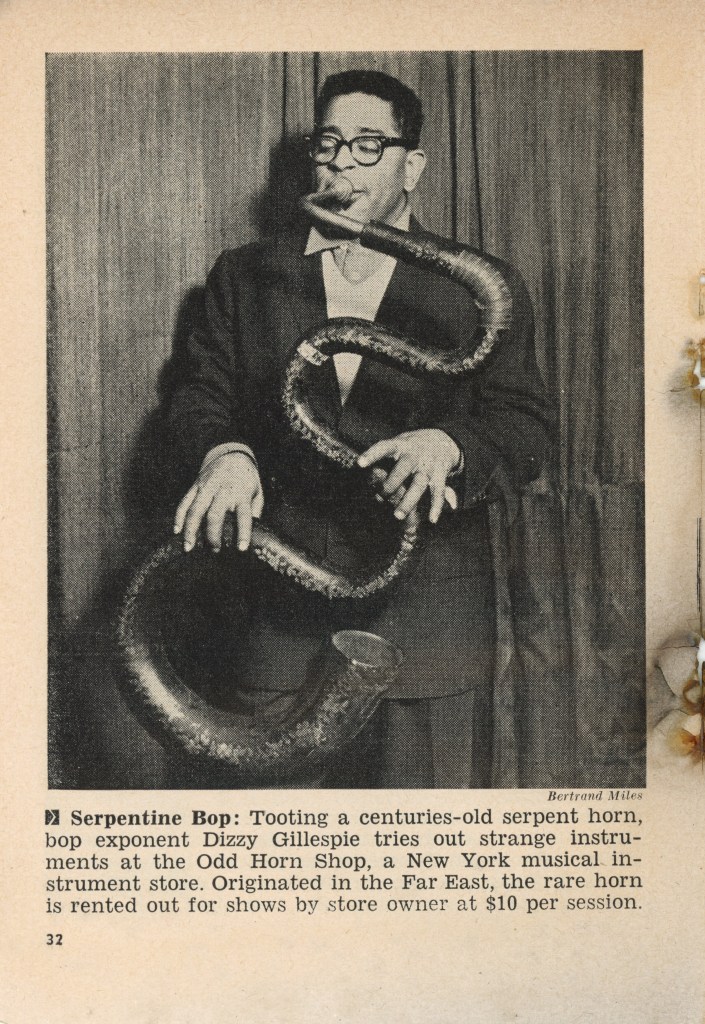
Dizzy Gillespie playing a serpent, from the December 29, 1955 issue of JET magazine.

I don’t have anything to add to this photo than what is in the caption. The Odd Horn Shop is no longer in New York City and Dizzy Gillespie died in 1993. But I’ll relate this story of my one encounter with the great jazz player with the bent trumpet . . .

In 1991, Dizzy Gillespie was given an honorary doctorate at New England Conservatory of Music. I was serving on the Conservatory’s faculty at the time, and I was also Chair of the Conservatory’s Brass and Percussion Department. I attended the commencement ceremony that year, and from my seat on stage in Jordan Hall at NEC, Dizzy Gillespie was only a few feet away from me. Then his name was called, Gillespie went to the front of the platform and received his honorary degree and said a few words. But what happened next was something I’ll never forget. Whenever a jazz major came forward to receive his degree, Dizzy Gillespie—one of the greatest musicians in the world—stood up, went up the the graduate, shook hands, and posed for a photo. Gillespie was smiling from ear to ear, and I can only imagine how meaningful this personal gesture was to the graduates who stood on stage with their arm around the shoulder of this jazz great. It told me something about Dizzy Gillespie that his recordings can’t fully express: he loved life and he loved people, and he shared that love with others in very tangible ways. I wasn’t playing serpent when he came to NEC’s commencement in 1991, but if I had, I like to think I would have brought my serpent to the ceremony and asked Dizzy to play a chorus. I bet he would have done that. Serpentine bop.

A new/old Kruspe bass trombone: Protec to the rescue

A new/old Kruspe bass trombone: Protec to the rescue

by Douglas Yeo (April 22, 2025)

In 1986, I began a collaboration with YAMAHA Corporation to make a new bass trombone. The happy result was the YAMAHA YBL-622 dependent valve double valve bass trombone (with detachable second valve) that, several years ago, was added to YAMAHA’s Xeno trombone line and renamed the YAMAHA YBL-822G bass trombone. Over the years, I’ve continued to try other bass trombones by many different makers. I like to know what is on the market and how those instruments play. I want to play a bass trombone what works best for me but every time I try something else, I keep coming back to my YAMAHA. That instrument works best for me.

Detail of the bell and slide of a Kruspe bass trombone, showing the Schlangenverzierung (“snake garland”).

That said, I love the history of the trombone, and I’ve always enjoyed playing and hearing trombones made by great German makers like Heckel and Kruspe that were made in the late nineteenth and early twentieth centuries. This school of trombone manufacturing is considered a “golden age” of trombone craftsmanship, and these old German trombones are things of beauty, both visually and aurally. They have a unique sound, a truly beautiful sound that blends with rotary valve trumpets and the other winds of the orchestra in a unique way. And visually, there is nothing like the beautiful Schlangenverzierung, or “snake garland” that is found at the top of the bell section and on the hand slide bow (photos above). The artistic design of ferrules, the wrap of the F-attachment, and the leather thumb strap (rather than a fixed, metal linkage) that operates the F-attachment valve add to the beauty of these instruments.

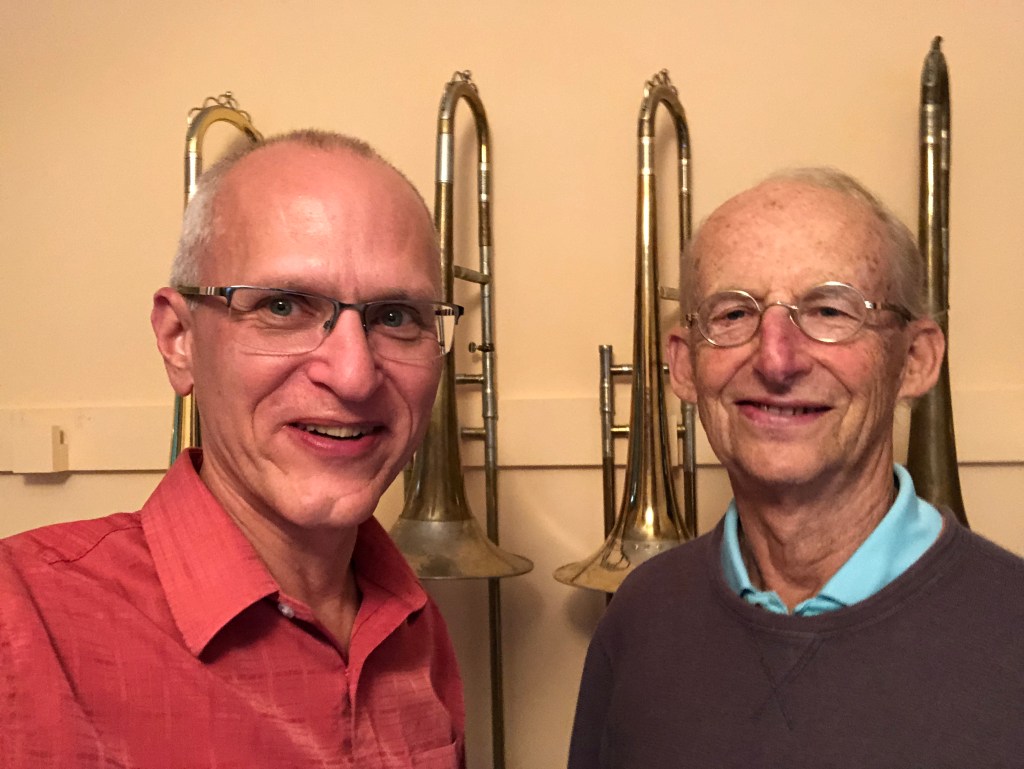
Douglas Yeo and Jay Friedman with some of Jay’s Kruspe trombones, September 9, 2019.

My friend, Jay Friedman, principal trombonist of the Chicago Symphony Orchestra, has an extensive collection of vintage Kruspe trombones, and we often talk about the unique qualities of these iconic instruments.

I played a Kruspe bass trombone during my last seasons as a member of the Boston Symphony Orchestra. Five vintage Kruspe trombones—an alto, two tenors, an F-attachment tenor, and a single valve bass—came on the market in 2007 and I persuaded the management of the BSO to purchase them. I loved playing that Kruspe bass trombone, and I used the BSO’s Kruspe bass whenever we played German repertoire from the 18th through 19th centuries. Music of Mozart, Haydn, Beethoven, Schumann, Schubert, Brahms and their compatriots. Whether my colleagues were using a modern alto and smaller bore tenor trombone, or using the Kruspe alto and a tenor, or an alto and tenor trombone by the modern German maker, Thein, the Kruspe bass blended spectacularly with all of them.

Members of the Boston Symphony Orchestra trombone section, c. 1905, with Holton trombones. Left to right: Leroy Kenfield, bass; Anton Mausebach, second; Carl Hampe, principal.

It’s interesting to note, from an historical perspective, that the American musical instrument makers Frank Holton and C. G. Conn modeled their early 20th century trombones after instruments made by great German makers. This photograph (above) of members of the Boston Symphony Orchestra trombone section (Leroy Kenfield, bass; Anton Mausebach, second; Carl Hampe, principal) was taken around 1905 and they are all playing Holton trombones made in the German style. Likewise, iconic instruments like the Conn 70H bass trombone (including the prized Conn Fuchs model bass trombone) were based on earlier German models. The beauty of sound of these instruments—many factors go into this but they include the bell taper, the bore size, and the type of brass used—is something to behold, and while modern trombonists often favor playing with more “muscle,” there is a lot to be said for the exceptional quality of these German style instruments in the hands of a player who is truly interested in blending into rather than dominating the orchestral texture.

Douglas Yeo’s final bow in Symphony Hall (with Kruspe bass trombone) as a member of the Boston Symphony Orchestra, May 8, 2012. Performance of Beethoven Symphony No. 9. Also shown (standing) are concertmaster Malcolm Lowe (clapping) and conductor Bernard Haitink. 

When I retired from the Boston Symphony Orchestra in 2012, I had to leave that Kruspe bass trombone behind. However, it makes me smile when I remember that the last concert I played in Boston’s Symphony Hall in May, 2012, was the Symphony No. 9 by Ludwig van Beethoven conducted by Bernard Haitink (photo above). I had used BSO’s Kruspe bass trombone for that performance and my final bow in Symphony Hall with the orchestra.

Earlier this year, I played bass trombone with the Atlanta Symphony in performances of Beethoven Symphony No. 5. Acting principal trombonist Nathan Zgnoc played a Thein alto trombone and acting second trombonist Jason Robins played a Conn 8H (that instrument, now owned by Nathan, had previously been owned by Keith Brown). For those performances, I used my YAMAHA YBL-601 Vienna style bass trombone, a dual-bore, single valve bass trombone made in the classic German tradition that, unfortunately, is no longer part of YAMAHA’s trombone catalogue. Our blend worked very nicely in those performances, but knowing I would be returning to the ASO in May 2025 for performances of Beethoven’s Missa solemnis, I began a quest to fulfill a dream and acquire a vintage bass trombone made by the workshop of Eduard Kruspe of Erfurt, Germany.

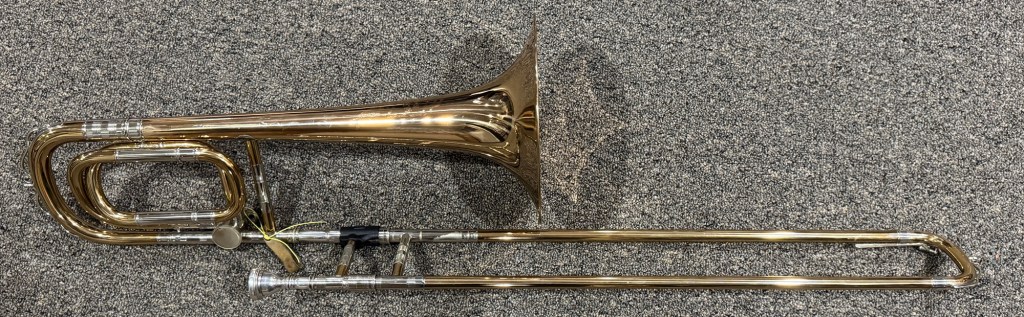
My bass trombone by Kruspe. There is no serial number on the instrument although the number “3” is stamped on the bell receiver.

The bell engraving on my Kruspe bass trombone.

Happily, my search didn’t take long, and in a short time a 100-year old Kruspe single valve bass trombone—of the same vintage as that Kruspe bass I played in the Boston Symphony Orchestra—arrived on my doorstep thanks to Noah Gladstone who runs The Brass Ark in California. Like the BSO’s Kruspe, this instrument is spectacular, and after a little TLC from both Noah and my local brass technician (no, he is much more than a technician, he is an artist, actually), Dana Hofer, I began to get to know my new instrument. Happy times.

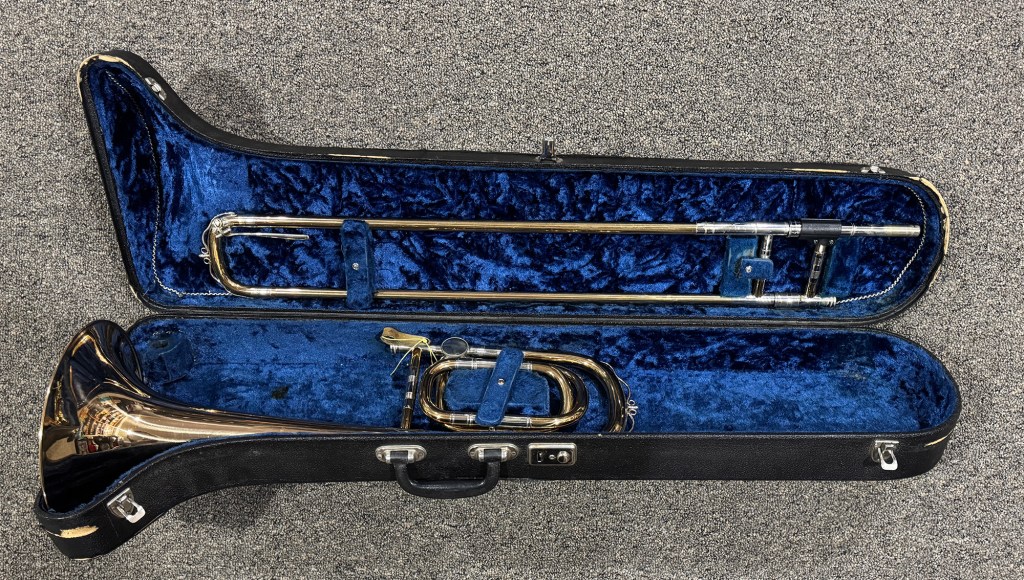
The original wooden case for my Kruspe bass trombone.

My Kruspe bass trombone came in its original wooden case which works quite well but the case is extremely compact (photos above). When I travel by airplane with my trombone, I always bring it onboard (the case for my YAMAHA YBL-822G is very compact) and put it in an overhead compartment, but you never never know when a flight attendant will be less than thrilled to see a trombone in an overhead bin and I might be required to check my trombone as baggage. Because of this, I always pack my trombone in its case as if it had to be checked as baggage, just in case. Fortunately, my YAMAHA YBL-822G case travels very well as checked baggage (with the addition of a styrofoam cone in the bell, the instrument has never suffered damage when I check it as baggage; see my FAQ on my website about traveling with a trombone for some tips). However, while the original Kruspe case is great for normal use of the trombone, it is so compact that I am not confident it would protect my trombone well enough if it ended up as checked baggage.

The slide of my Kruspe bass trombone placed in my YAMAHA YBL-822G bass trombone case.

Unfortunately, solving this dilemma of how to transport my Kruspe bass trombone while flying is not as simple as putting my Kruspe bass trombone in my YAMAHA bass trombone case. As you can see in the photo above, the slide to my Kruspe bass trombone is very long; 35 1/2″ long. My YAMAHA trombone slide is 32″ long. This is typical of these vintage German trombones, and early Conn trombones as well. Their slides are long while their bell sections are short.

Three bass trombone slides, top to bottom: Kruspe bass trombone, Conn 70H bass trombone (made in 1921), Yamaha YBL-822G bass trombone. The black plastic attachment on the Kruspe and Yamaha slides supports a Neotech hand brace.

Trombonists who want a modern trombone case that will fit an historical German bass trombone with a long hand slide do not have many options. I searched a long time to find such a case and happily, Protec came to the rescue.

There are many manufacturers who make aftermarket trombone cases and gig bags. I’m not a fan of gig bags. The risk of damage to a trombone in a soft or semi-hard trombone case is simply too high. I use a rigid trombone case at all times.

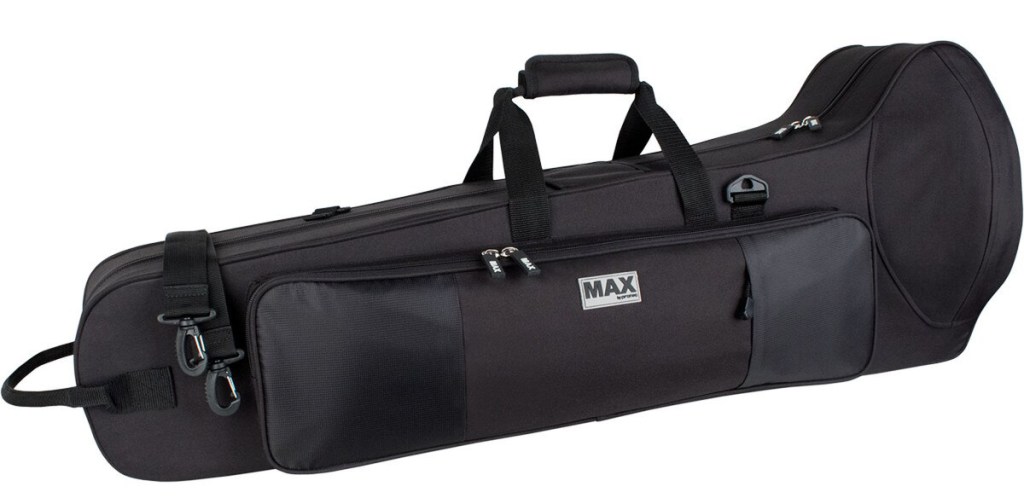
My search to find an aftermarket trombone case to fit my Kruspe bass trombone took some time to reach a good result. Manufacturers make their cases to be as compact as possible. Bass trombone cases are manufactured to fit standard 32″ long trombone slides. The additional 3 1/2″ length of the Kruspe slide meant that a case had to be longer. Most bass trombone cases top out at 36″ length and with the padding inside the case, that’s just not long enough to accommodate a 35 1/2″ bass trombone slide. I searched up for a case that had a length that would accommodate the Kruspe slide. And I finally found one: the Protec MAX contoured case.

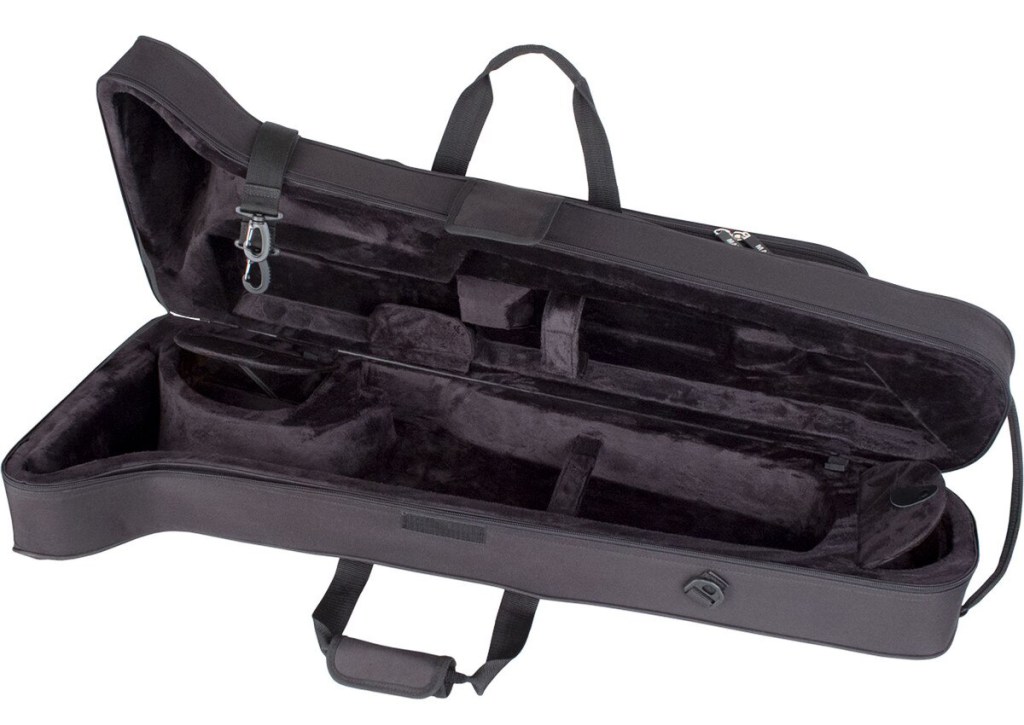
The Protec MAX bass trombone case. Photos courtesy of Protec.

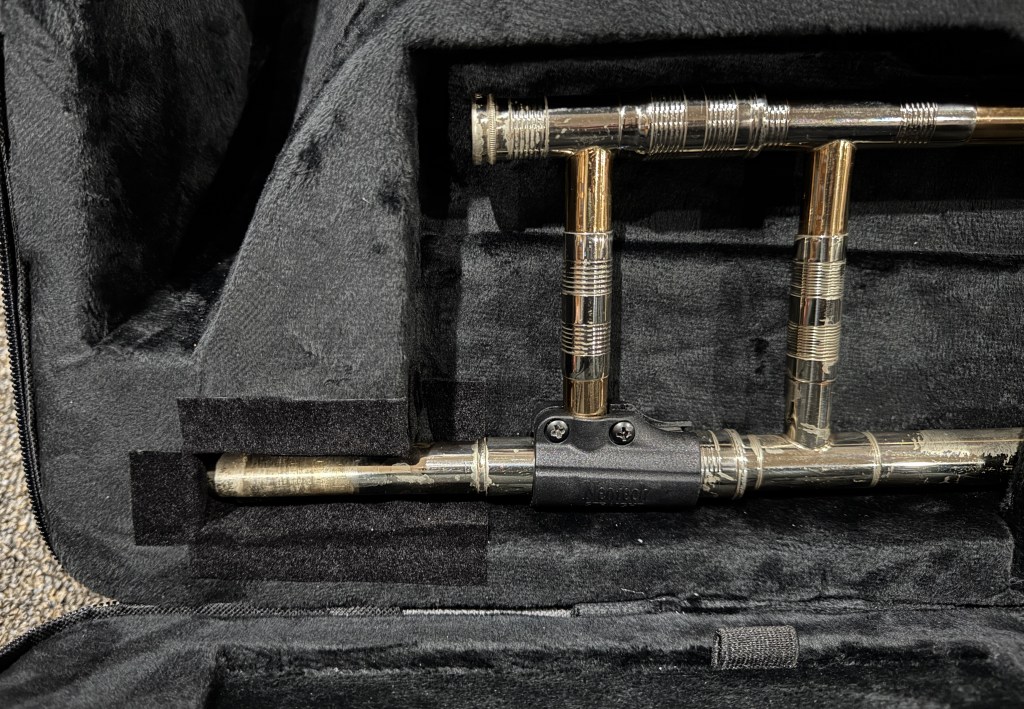
The Protec MAX contoured case is made with EPS styrofoam covered with plush velvet; the outside is covered with durable nylon fabric. With the case’s 38″ length, I thought it might accommodate my Kruspe slide. I called Protec and spent some time talking with Michael Corter. We discussed all of the interior dimensions of the case. As manufactured, the Protec MAX’s compartment for the bass trombone slide was made for a standard 32″ slide. But Michael sent me some photos of the case and I saw that with a slight modification, I could lengthen the slide compartment by a few inches by cutting away some of the styrofoam. It was worth a try.

The interior of my Protec MAX case, showing the cutout I made to accommodate the long Kruspe bass trombone slide tenon.

The result turned out to be exactly what I wanted. With a razor blade, I cut away some of the slide compartment foam so it would fit the long slide tenon of my Kruspe bass trombone. Then, I covered the exposed styrofoam with self-adhesive velvet flocked fabric. This is available from amazon.com for $12.99 for 20 sheets, in black and many other colors. After I cut and applied this fabric to the case, everything looked clean and neat and my Kruspe trombone slide fit nicely in the case. The Protec MAX case also has two storage compartments inside the case, a large storage pocket on the outside of the case, backpack straps (that can be hidden under a fabric panel), and a shoulder strap. Most of all, my Kruspe bass trombone is well protected, ready for my next flight.

My Protec MAX case with my Kruspe bass trombone.

If you have a vintage Conn bass trombone or an historical German bass trombone that has a long slide that will not fit in your modern bass trombone case, Protec has a case for you. I also want to say this as well: My experience with Protec was superb in every way. My conversation with Michael Corter was extremely helpful and informative. Protec’s customer service was outstanding. The case was well packed for shipment and it arrived on my doorstep in perfect condition. The workmanship of the Protec case is also superb. The zippers work easily, the interior storage compartments open and close smoothly, and look at the price of the Protec MAX bass trombone case (it comes with free shipping!) on the Protec website—it is a very affordable product. Props to Protec for making this case, and for manufacturing it in such a way that a user can make modifications to it very easily. 

Protec also makes a full line of trombone cases (and cases for other instruments) and case accessories. Visit their website to see all of their products.

Now, it’s time to get back to practicing my part for Beethoven’s Missa solemnis. As an aside, I recently wrote an article about Missa solemnis for the blog hosted by my church, New Covenant Church of Naperville, Illinois. The article is titled, The Nicene Creed, Beethoven, and the Power of a Small Word. Have a look. There is something about how Beethoven set the Credo to his Missa solemnis that I find truly remarkable.

Beethoven. Kruspe. Protec. A good combination!


Just published: “More Than Bordogni: The life, work, and influence of Joannès Rochut”

Just published: “More Than Bordogni: The life, work, and influence of Joannès Rochut”

by Douglas Yeo (January 4, 2025)

I have been researching the life, work, and influence of the celebrated French trombonist, Joannès Rochut, for nearly 40 years. Rochut, as readers of The Last Trombone know (see my previous blog posts about Joannès Rochut HERE, HERE, and HERE), played principal trombone in the Boston Symphony Orchestra from 1925–1930, and he published three volumes of “Melodious Etudes for Trombone” from the vocalises of Marco Bordogni. Rochut’s books are among the most influential study material for trombone ever published.

In May 2024, I gave a presentation about Rochut at the International Trombone Festival, held at Texas Christian University in Fort Worth, Texas. Yesterday, my full research on Rochut was published in the January 2025 issue of the International Trombone Association Journal (Volume 53, No. 1). The issue—with my article—is now available to all ITA members on the ITA’s website. Members who also subscribe to the print version of the Journal will receive their copy later this month.

ITA_Journal_January_2025_cover

If you are not a member of the International Trombone Association, I’d like to encourage you to join. I’ve been a member of the ITA since its founding in 1972. I was a senior in high school at the time, and when I learned that the ITA had been established, I joined right away. Over the years, I’ve written many articles for the ITA Journal, have served on ITA committees, and have attended and presented at many International Trombone Festivals. I’m very grateful that the ITA bestowed its ITA Award on me in 2014, and its Lifetime Achievement Award in 2024. Members of the ITA receive the Association’s quarterly Journal, a regular e-newsletter, and stay connected with the world-wide community of trombonists. As soon as you join, you’ll have access to the current issue and the archive of past issues of the ITA Journal. This is a rich resource that informs our knowledge about trombone activities in the last half-century. The ITA also has a Facebook page where you can keep up to date on the latest activities of the Association and trombonists around the world.

The ITA has several levels of membership. Student membership is heavily discounted, and a further discount is applied if a member does not want to receive the print edition of the ITA Journal (all ITA members have access to the online version of the ITA Journal; it is an exact reproduction of the printed version). Discounts are also available for multi-year membership and 65+ year old membership, and lifetime membership is also available (I became a paid life member of the ITA in 1983). To learn more about all of the ITA’s membership levels and join the ITA, click HERE.

My article about Joannès Rochut is the longest article ever published in the ITA Journal. At 70 pages, with 80 images and 210 endnotes, I am deeply grateful for the commitment th  ITA’s executive board to publish  my article in nearly a double-sized (112 page) January 2025 issue of the ITA Journal. If you’ve ever played a vocalise by Marco Bordogni, own a copy of one of Rochut’s books, are interested in learning more about trombone teachers and students at the Paris Conservatoire in the late nineteenth and early twentieth centuries, want to know more about the history of the Boston Symphony Orchestra, read about Rochut’s quest for the perfect trombone, or learn about Joannès Rochut’s other trombone publications and the students who studied trombone with him at New England Conservatory of Music (they include Ida Isabella Bisbee–the first woman to graduate from New England Conservatory with a degree in trombone performance—and John Coffey), you’ll find all that and more in my article. Here are a couple of sample pages from my article:

ITA_Journal_January_2025_Rochut_pages

It’s all there—and more—on the International Trombone Association’s website, trombone.net, and members receive all of the benefits the Association has to offer.

I’m already at work on several more articles for the ITA Journal that will publish in late 2025 and early 2026. If you’re an ITA member, you’ll find them there when they publish. Stay tuned.