The new year is upon us, 2018. Resolutions have been made and probably broken already. Such is our human condition: lots of good intentions but difficulty in being disciplined enough to follow through with them.
Most people I know want to be successful, and my son-in-law, John Freeman, recently shared an old cartoon with me titled “The Road to Success.” It dates from 1913, and I thought it was so interesting that I sought out an original copy. The Etude magazine, a long time publication of the Theodore Presser Company, printed it in its October 1913 issue. Presser modified a cartoon put out by National Cash Register company that was about the road to business success – you can view the original by clicking HERE – and Presser’s creative changes that point to the road to musical success are really quite clever. Here is Presser’s version of the cartoon. To download a high-resolution copy from my website, click HERE.
If you follow the road to success, you see there are many pitfalls along the way. You need to keep your eyes open. Many people rush over the threshold of Opportunity but fall into the dark holes of Illiteracy or Conceit. Hotel Know It All has many rooms. So does the Mutual Admiration Society, from which the balloon Hot Air floats. And the Always Right Club has plenty of members. Vices lead immediately to the river of Failure; the same is true for The Faker. Bad Habits lead quickly to Oblivion – as does a Bad Reputation. Jealousy and the desire to Do It Tomorrow are portrayed as spiders with webs that trap many. Weak morals appear to be an elevator to the top of the mountain but actually send you down a chute right back to the beginning. Have a look at this view of “The Road to Success.” Over one hundred years after it first appeared, it is still fresh.
This was a theme of my trombone teacher, Edward Kleinhammer, who played bass trombone in the Chicago Symphony Orchestra from 1940-1985. In his introduction to the book we wrote together, Mastering the Trombone (Ithaca: Ensemble Publications, 2000, fourth edition, 2012, p. 9), he wrote:
World class players do not just happen — their talents are forged in the dual furnaces of determination and diligence.
In this, Mr. Kleinhammer was mirroring a theme that comes from a memorable passage in the Bible, where the writer turns to one of the smallest animals as a model for discipline and hard work (Proverbs 6:6-11):
Go to the ant, O sluggard; consider her ways and be wise.
Without having any chief, officer or ruler,
She prepares her bread in summer and gathers her food in harvest.
How long will you lie there, O sluggard? When will you arise from your sleep?
A little sleep, a little slumber, a little folding of the hands to rest,
And poverty will come upon you like a robber, and want like an armed man.
The desire for shortcuts is always with us. A few weeks ago, I was at Dordt College in Sioux Center, Iowa, where I gave a trombone masterclass and performed a concerto with the Northwest Iowa Symphony Orchestra. As I was walking around the college’s music building, I spotted this cartoon on a bulletin board. It made me laugh, and shake my head. You’ll probably laugh, too, and then sadly recall the many friends, colleagues, students, and others – including ourselves! – who want to find the quick fix to avoid the hard work required to succeed. “The Road to Success” reminds us that there are no shortcuts. That’s a New Year’s resolution worth keeping.
Today is December 24 – Christmas Eve – and it is already Christmas day in parts of the world.
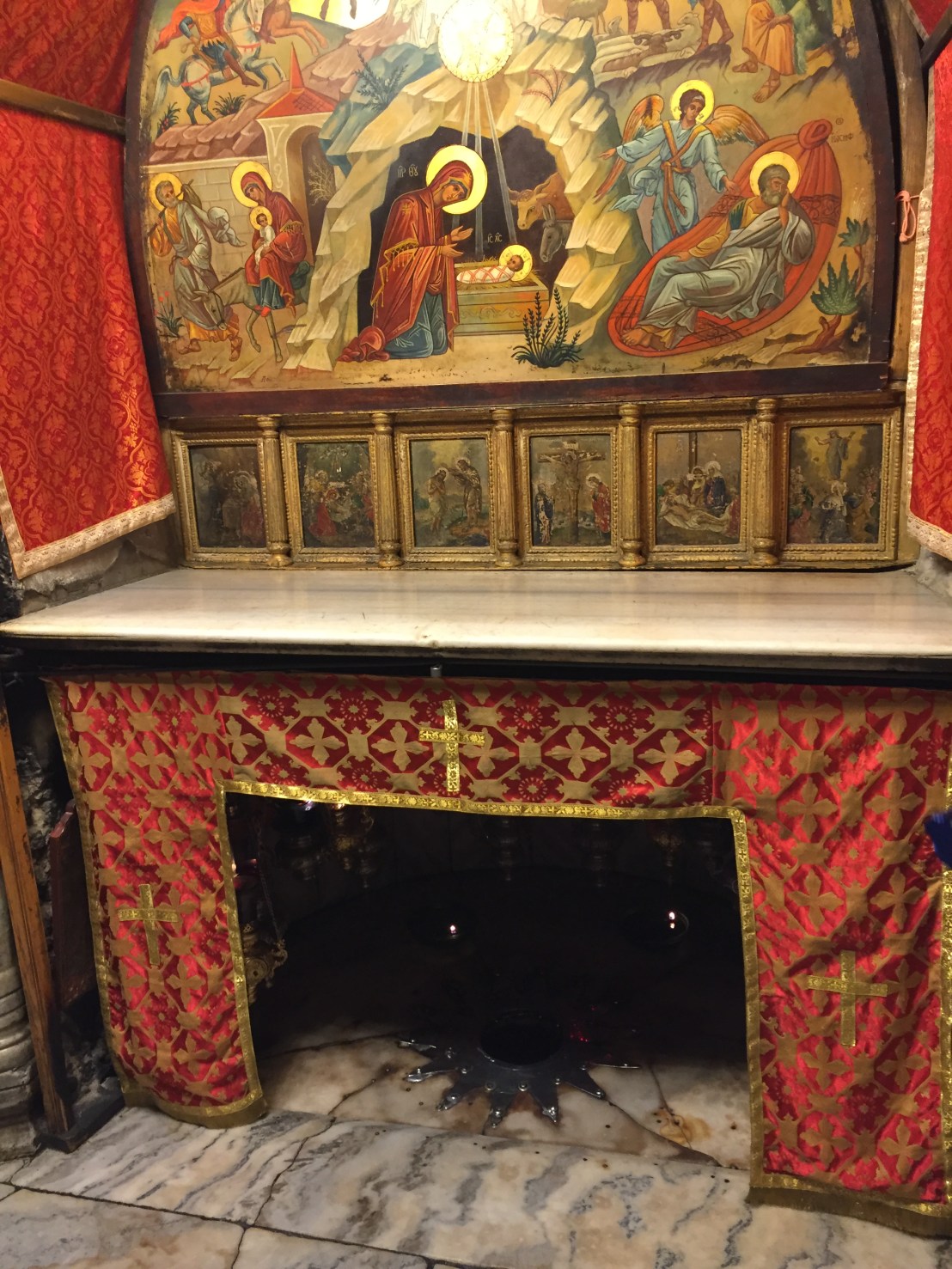
Last year, my wife and I traveled to Israel, and among the many places we visited was the Church of the Nativity in Bethlehem. This church is built over the traditional site of the birth of Jesus Christ. Of course we cannot know for sure if this is the exact location of His birth, but as I have told many people, that is not important to me, or to most who come to this place. We were in the neighborhood of this world-changing event, and we were able to take in the mystery of the Incarnation in a concrete way, and share in the devotion of millions of pilgrims who have come to this place over the centuries.
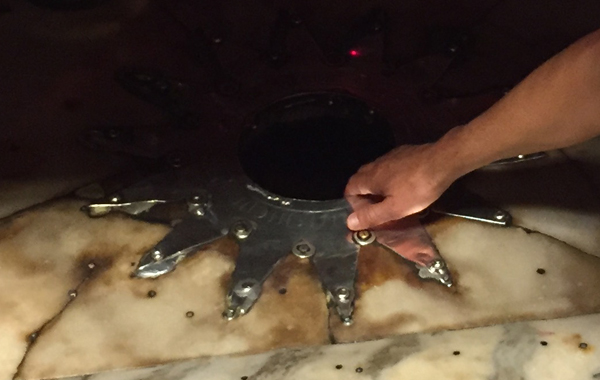
Here is the traditional site of the birth of Christ, beneath the floor under the altar in the grotto of the Church of the Nativity. Many years ago, people began chipping off pieces of the floor so a marble floor was laid with a hole surrounded by a silver star where you can put your hand to touch the original ground.
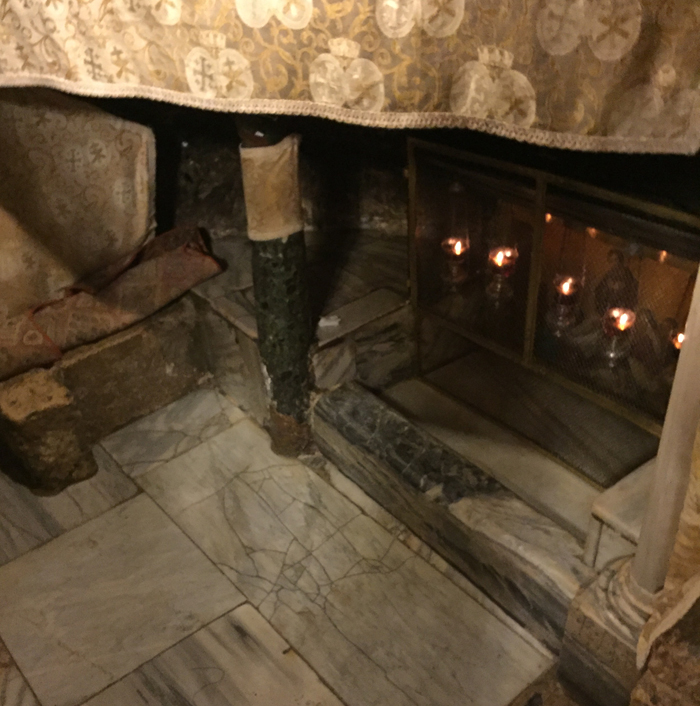
Across the room from this spot is the traditional location of the cattle manger where Jesus was laid after birth. Again, we cannot be sure this was THE spot, but the coldness of the stone reminded me that Jesus’ birth was not in a modern hospital with today’s clean and comfortable conveniences. His birth was humble in the extreme.
In the courtyard of the church, we saw a sign in two languages – we’ve seen them around the world in England, Greece, throughout the United States, and several places in Israel – that reminded us once again of the truth of what happened on that night so long ago.
We also visited the traditional Bethlehem shepherd’s fields, and a cave that was used by shepherds. We used our imagination to picture the sight of the angel announcing Jesus’ birth:
Fear not! For behold, I bring you good news of great joy that will be for all people. For unto you is born this day in the city of David, a Savior, who is Christ the Lord. (Luke 2:10-22)
Here is a painting of the announcement of the angels that is in the Chapel of the Shepherd’s Fields in Bethlehem:
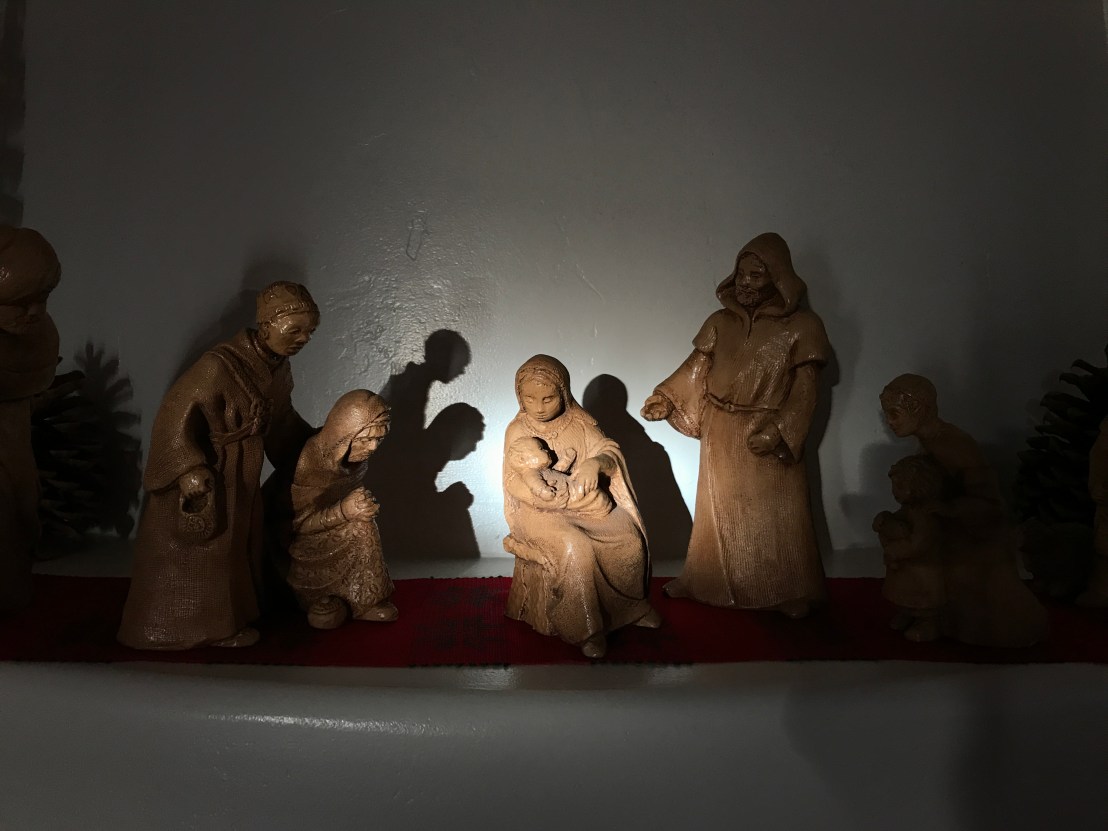
In our home, we have a nativity set that was given to us in 1978 by my grandmother. We’ve always displayed it around this time of year and in our home here in Arizona, it sits on the mantle above our fireplace (yes, even in Arizona, a fireplace is welcome in the winter, although I confess that instead of hauling firewood for our wood stove like I did in Massachusetts for so many years, I am very grateful that this natural gas fireplace is operated by a remote control in my hand).
When we moved here in 2012, we noticed something quite startling: on Christmas Day, the sun shines through a small glass block window over our front door and at exactly 8:30 am, it comes to rest on the central figures of Mary and Jesus. We didn’t plan this; it just happened.
It is a remarkable little thing, with this happening every year at the same time. The light on Mary and Jesus reminds us of the important truth of the Incarnation of Jesus Christ:
Then Jesus spoke to them, saying, “I am the light of the world. Whoever follows me will not walk in darkness, but will have the light of life.” (John 8:12)
The light of life. Everlasting light. Yes, we have fun with Santa Claus and Jingle Bells and all the rest. But the Truth of Christmas is much more interesting. And important.
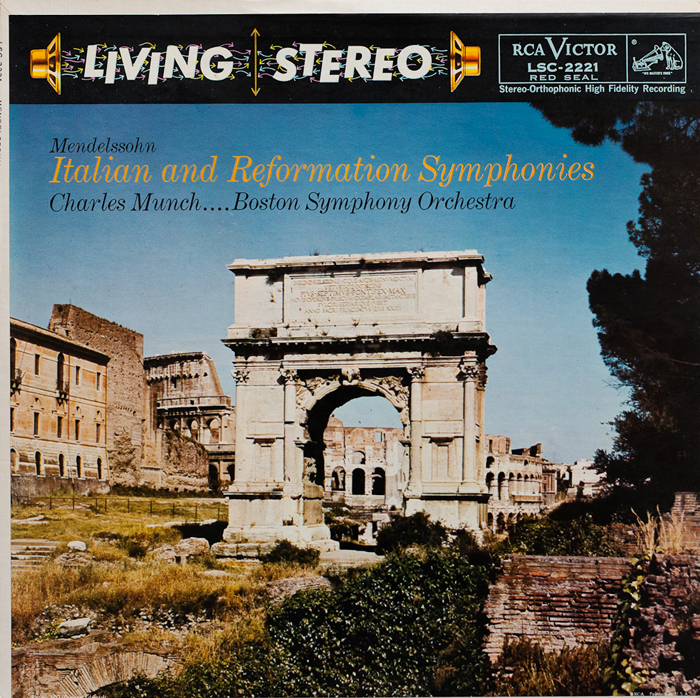
I don’t own many things that date from my childhood. I moved many times, collected other things, have lived a long life, and things that seemed so important when I was a kid mostly got lost along the way. I do wish I still had those baseball cards, though. . . But one of the few things I do have from that time in my life is a Boston Symphony recording of Mendelssohn’s “Reformation” Symphony, conducted by Charles Munch. I bought it in 1970 when I was 15 years old.
[As an aside, this album cover shows the Arch of Titus in Rome, with the Colosseum in the background. During my wife’s and my recent trip to Italy, we stood in this very place, and noted the significant connection the Arch has with our trip last year to Israel. More on this in an upcoming article on The Last Trombone.]
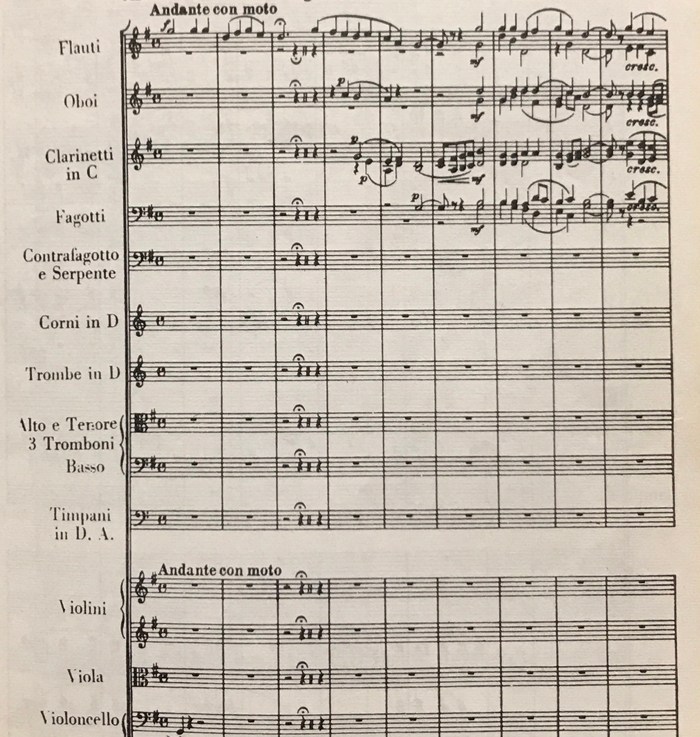
That I ended up being a member of the Boston Symphony for 27 years (1985-2012) is one of the great joys of my life, and in a sense that was the fulfillment of a long held dream since I was in high school. Several Boston Symphony recordings were very influential on me at an early age when I was just beginning to understand the trombone, and this Mendelssohn recording stands tall in my record collection. In fact, one of the first orchestra scores I ever purchased was of this symphony; I purchased it a few days after I heard Munch’s recording for the first time (the first page of the final movement of my score is shown at the top of this article). Click below to hear that recording that influenced me so deeply so long ago (to hear this recording in YouTube, click here):
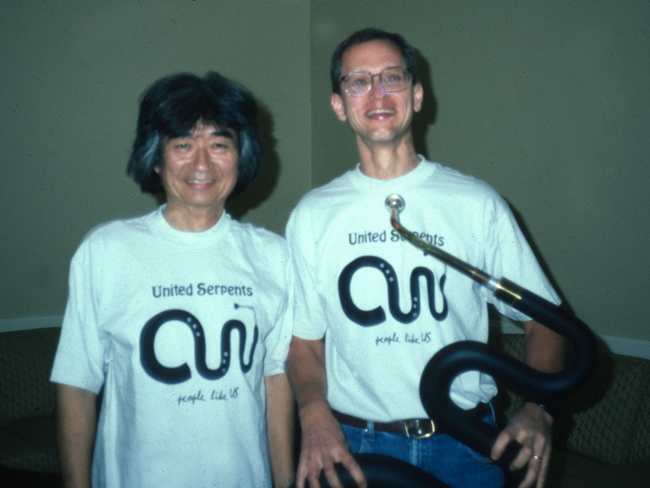
I have always loved this piece. It has a terrific part for bass trombone; just a few measures in the beginning of the symphony and then much to do in its finale. I first played the symphony on bass trombone with the BSO conducted by then-music director, Seiji Ozawa; the photo below shows Seiji and me in 1994 before a rehearsal for Hector Berlioz’s Messe solennelle; you’ll see I have my serpent in my hand. For more on that, keep reading.
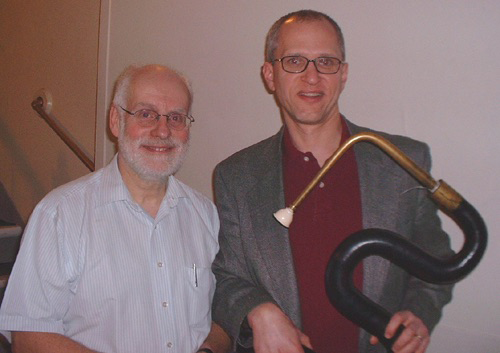
After I took up the serpent, I played the serpent part for Mendelssohn’s symphony in performances with the BSO conducted by the great early music conductor, Ton Koopman; the photo below shows us backstage at Boston’s Symphony Hall before a rehearsal in 2004.
Mendelssohn’s “Reformation” symphony – it usually bears the number 5 in the numbering of his symphonies but it was not his fifth in order of composition – was composed in 1830 to commemorate the 300th anniversary of the Augsburg Confession, one of the great confessional documents of the Christian faith. The theme of the symphony’s fourth movement is none other than Martin Luther’s famous hymn, Ein feste Burg est unser Gott — A Mighty Fortress is Our God. I wrote about this hymn last year on The Last Trombone, where I took the opportunity to discuss the importance of its text, especially the its fourth, final verse. I invite readers to look at that article again; click here.
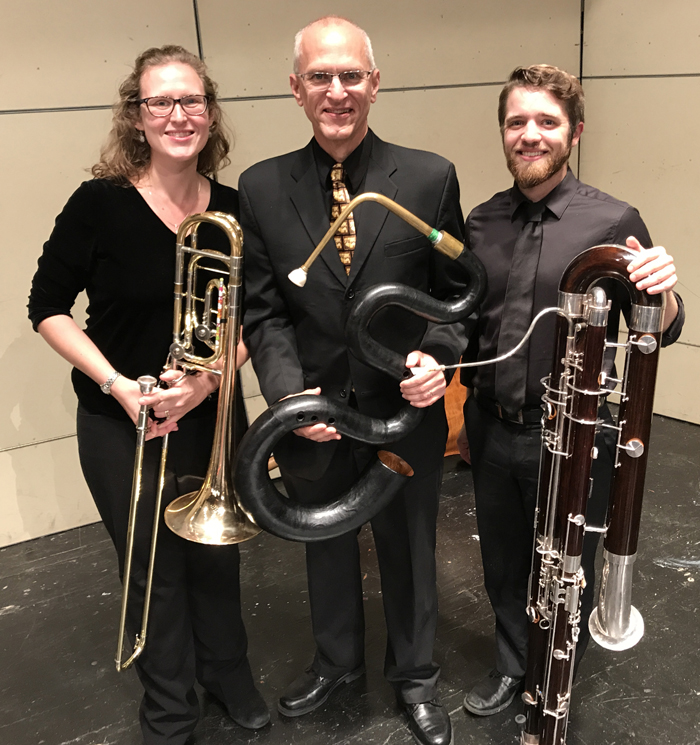
Last week, I played serpent in a performance of the “Reformation” Symphony by the Northbrook Symphony near Chicago. My oldest daughter, Linda Yeo Leonard, plays bass trombone in the Northbrook Symphony, and my wife and I have heard many concerts played by the orchestra. When the orchestra’s conductor, Lawrence Rapchak, asked me if I would be available to play serpent in their performance of Mendelssohn’s symphony – performed on a concert with other symphonies in the key of D but also in recognition of the 500th anniversary of the beginning of the Protestant Reformation – it was easy to say yes.
The photo above shows Linda and me along with the Northbrook Symphony’s fine contrabassoon player, Nicholas Ritter; Nick and I sat next to each other on stage with Linda seated just behind me. Mendelssohn’s part for the serpent doubles the contrabassoon at the octave and the result is a new kind of bass sound, caused by the acoustical blending of the two instruments. Murray Campbell wrote an article several years ago about this unique sound in an article for the International Tuba Euphonium Association Journal; you can read it by clicking here. The performance was a great success in every way, and it was a special joy to sit on stage with Linda.
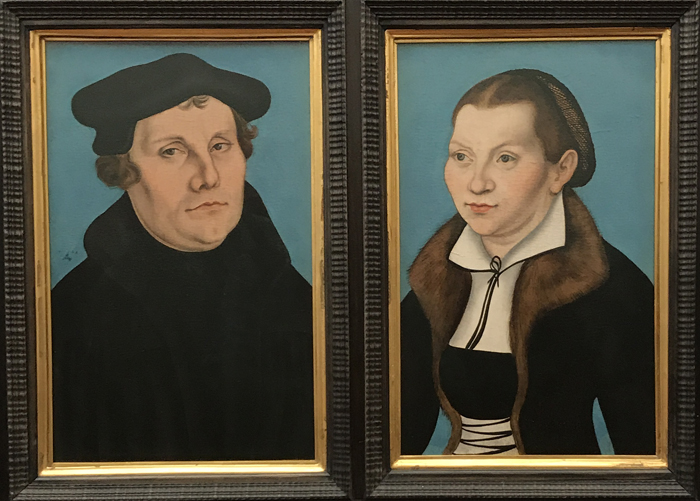
There have been other recent connections to Luther that have recently gotten my attention. As mentioned earlier, my wife and I were in Italy last month, enjoying the glories of Renaissance art and their connections to the Christian faith. Among the places we visited was the Ufizzi Gallery in Florence, one of the world’s great art museums. As we were going through various galleries, we came across a painting of Martin Luther and his wife, Katharina von Bora, painted by the workshop of Lukas Cranach the Elder in 1529. The portrait was made when Luther was still alive (1483-1546) and is considered to be a true likeness.
As I enjoyed this iconic painting – it is the most famous portrait of Luther – I noticed that the museum’s display card had a curious final sentence:
In Medici collection since 1567/1570.
Of course the Medici family was one of the most famous and influential families of the Italian Renaissance, and they were strong patrons of the arts. But this sentence got my attention. “Why,” I wondered, “did the Medici family, who were Roman Catholics and whose family produced three Popes (Leo X, Clement VII, and Leo XI), own this portrait of the most famous Protestant reformer?” I can’t answer that question, but I’ve been wondering about this.
Last Sunday, I worshiped at Trinity Lutheran (LCMS) Church in Lisle, Illinois, where Linda’s family are members and her husband, Chad, a Lutheran pastor and hospice chaplain, coordinates the church’s care ministries. This year, the Lutheran Church – and Protestant churches of all denominations – is celebrating this 500th anniversary of the beginning of the Protestant Reformation – dated to October 31, 1517 when Luther attached his famous Ninety-Five Theses on the door of All Saints’ Church in Wittenburg, Germany, and set off a reform movement in Christianity that is still with us. When I sat down in our pew on Sunday and opened my bulletin, what did I see but an insert about Luther and the Reformation with a stylized version of the very same portrait of Luther we had seen in Florence. It was a nice, serendipitous moment.
The Protestant Reformation changed history, and this convergence of events – Mendelssohn’s symphony, our trip to Italy, seeing a famous portrait of Martin Luther in Florence, and worship in a Lutheran church – brought many aspects of its importance together for me.
When I was a student at Wheaton College (Illinois), I memorized Luther’s great hymn. It got me extra credit on an exam in the class, “Christ in Culture,” and I needed all the extra credit I could get. I don’t remember how I did on that test, but I still call A Mighty Fortress to mind every day. It is a hymn of great strength and comfort, and Luther’s words are just as relevant and important today as they were nearly 500 years ago when he wrote the text. Here is its second verse; to read the whole text and my commentary on Luther’s original words, click HERE.
Did we in our own strength confide, our striving would be losing,
Were not the right Man on our side, the Man of God’s own choosing.
While individuals have been playing musical instruments that require vibrating lips to produce sound since before the dawn of recorded time – we need only think of the shofar, didgeridoo, and conch shell to begin a list of lip-blown aerophones of ancient origin – there is much about playing such instruments that remains a mystery. Whether thousands of years old or made last week at a modern brass instrument factory, the fundamental changes to brasses over the millennia have been those of material, construction and ergonomics rather than actual tone production. As every school child that has ever picked up a trumpet, trombone, horn, euphonium or tuba knows, all that is needed to create a sound on a brass instrument is to place one’s lips on the mouthpiece, vibrate the lips by passing air through them, and, Voilá! Another brass player is born.
Yet while trombonist and Boston-based brass pedagogue John Coffey (1907-1981) summarized his teaching with the pithy phrase, “Tongue and blow, kid,” successful brass instrument articulation and tone production actually requires a bit more understanding. Teachers and performers have written legions of books and articles about what players should do with their tongue and other members of the body’s oral cavity, but such descriptions have been hampered by an obvious problem: we cannot see inside the mouth or touch the tongue, glottis or soft palate while playing. One’s tongue cannot touch one’s tongue in order to feel one’s tongue when it is in use. It is clear that much of what has been said about the workings of the tongue during playing has been nothing more than well-meaning conjecture.
In 1897, Harold W. Atkinson summed up the difficulty that researchers faced when attempting to describe tongue’s position while speaking:
Their descriptions, accompanied or unaccompanied by diagrams, as the case may be, vary in those points of detail which are beyond the range of comparatively easy determination. This has been due, it would appear, to lack of suitable methods of measurement, more than to a lack of enthusiasm on the part of observers. Though equipped with the necessary anatomical and physical knowledge, they have lacked the power of designing appropriate methods or apparatus for making exact measurements.[1]
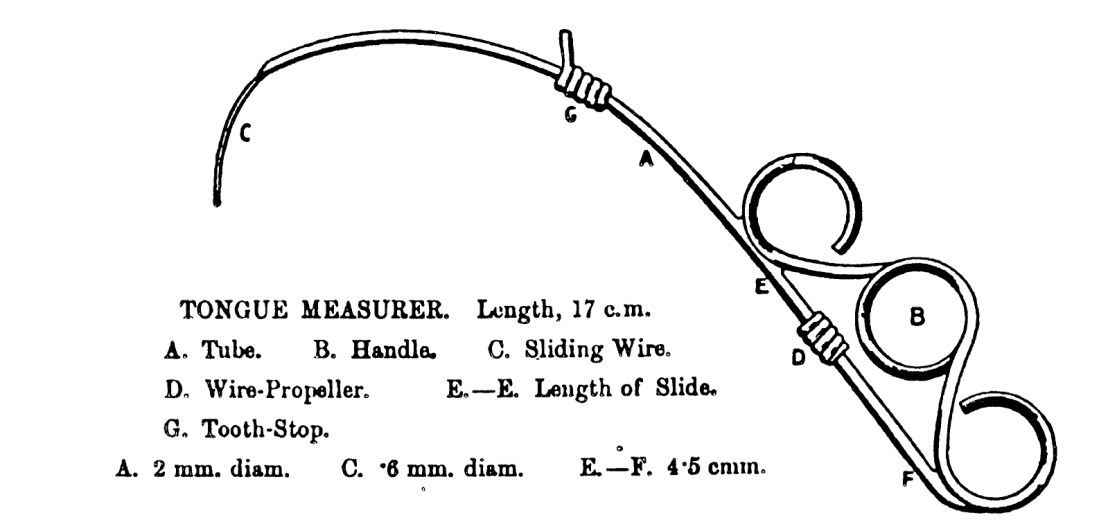
“Tongue measurer” by Harold W. Atkinson (1897)
Atkinson’s solution was to devise a “tongue measurer” made of silver, a delicate, movable wire with a “tooth stop” that slid up and down the wire. Inserted into a subject’s mouth – a reasonable person might immediately exclaim, “Not in my mouth!” – a syllable was spoken, the tooth stop moved, the wire was then applied to a plaster of Paris model of the mouth, and measurements taken. Professor Atkinson can be commended for his desire for understanding as well as his ingenuity, but his methodology was inexact at best.
For low brass players, we have long been accustomed to hearing wisdom about the use of the tongue and throat from some of the finest players and teachers of the twentieth century. Yet words and sentences often are used in murky ways that lead to misunderstanding and confusion. We are used to encountering phrases like:
“. . . The throat should be entirely free of resistance. . . the tongue should be loose and relaxed.”[2]
“Physical law provides that the embouchure is the determiner of pitch, so why should the tongue get so involved. . .?”[3]
“It is important that the tongue remain as relaxed as possible at all times. . .”[5]
“Many brass players react in horror when I suggest using [the glottis] for purposes of playing our instruments.”[6]
“However, especially with the euphonium and tuba, the tongue is never positioned ‘high’ in the oral cavity, even in the upper register.”[7]
“Correct tonguing is an up-and-down motion. . .”[8]
But what exactly is “the throat”? What part of the tongue should be “loose and relaxed”? Does the tongue have a role in determining pitch? Is correct tonguing an up-and-down or a back-and-forth motion?
Confusion continues when authors write suggested vocal syllables that players should keep in mind while playing. “Open” syllables are often spoken of as being preferred to “closed” sounds (there we go again, using words that we haven’t clearly defined), but when one reads the syllable “AY” in print, is that “AY” as in “hay” or “AY” as in “aye”? When one sees the word, “TOO,” is it to be thought of as “two” or “toe”? Should the tongue ever be allowed to rise up high in the oral cavity with the syllable “TEE” or should the tongue always be kept down and low in the mouth while using the open sounding syllable, “TOH”?
These authors quoted above – including this writer – can hardly be blamed for doing their best to describe a complex subject with limited actual understanding with which to work. X-ray vision is the stuff of Superman, not trombone teachers, and the intuitive description of the operation of the tongue by many writers has seemed to be reasonable, if unproven. Yet with the advances of modern medical diagnostic techniques, brass players, teachers, and scientists are coming together to show us what has hitherto been impossible to clearly see: the operation of the tongue and associated organs inside the mouth while playing a brass instrument in real time.[9]
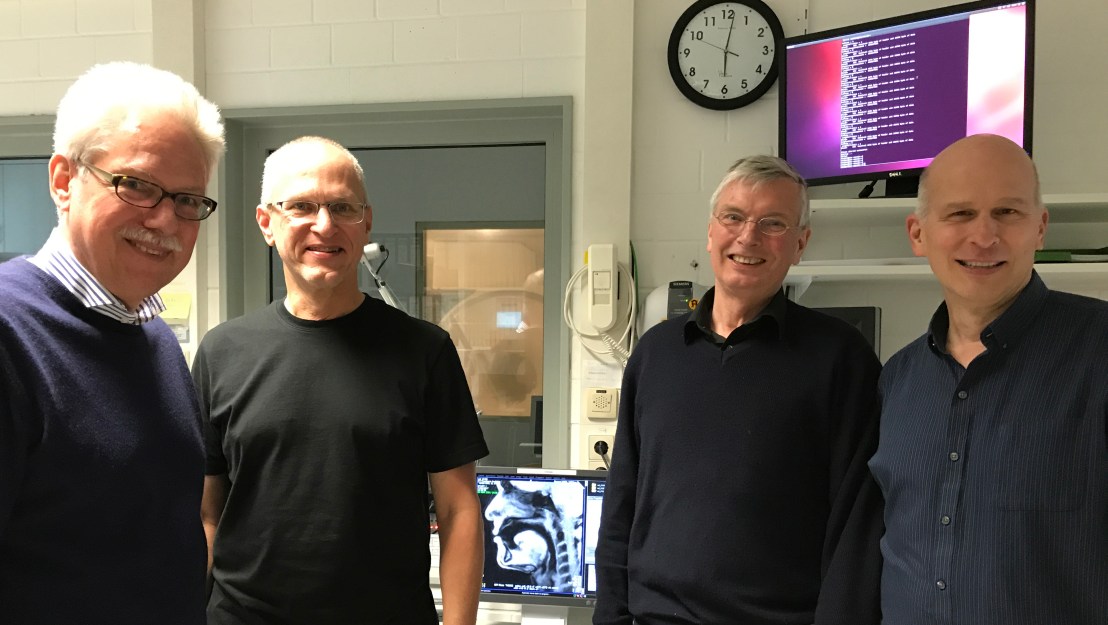
Begun in 2013, the MRI Brass Repository Project (MBRP)[10] was conceived by Dr. Peter Iltis, Professor of Kinesiology at Gordon College, Massachusetts. Iltis’ interest in the physiology of the brass player’s embouchure and associated parts of the oral cavity led to his collaboration and partnership with Dr. Jens Frahm, Director of Biomedical NMR Research at the Max Planck Institute for Biophysical Chemistry in Göttingen, Germany, and Dr. Eckart Altenmüller, Director of the Institute for Music Physiology and Musician’s Medicine in Hannover, Germany, to create the MBRP.[11] The Max Planck Institute has generously provided use of their magnetic resonance imaging (MRI) scanner, a non-invasive tool that allows subjects to be tested without time limitations or exposure to harmful radiation.
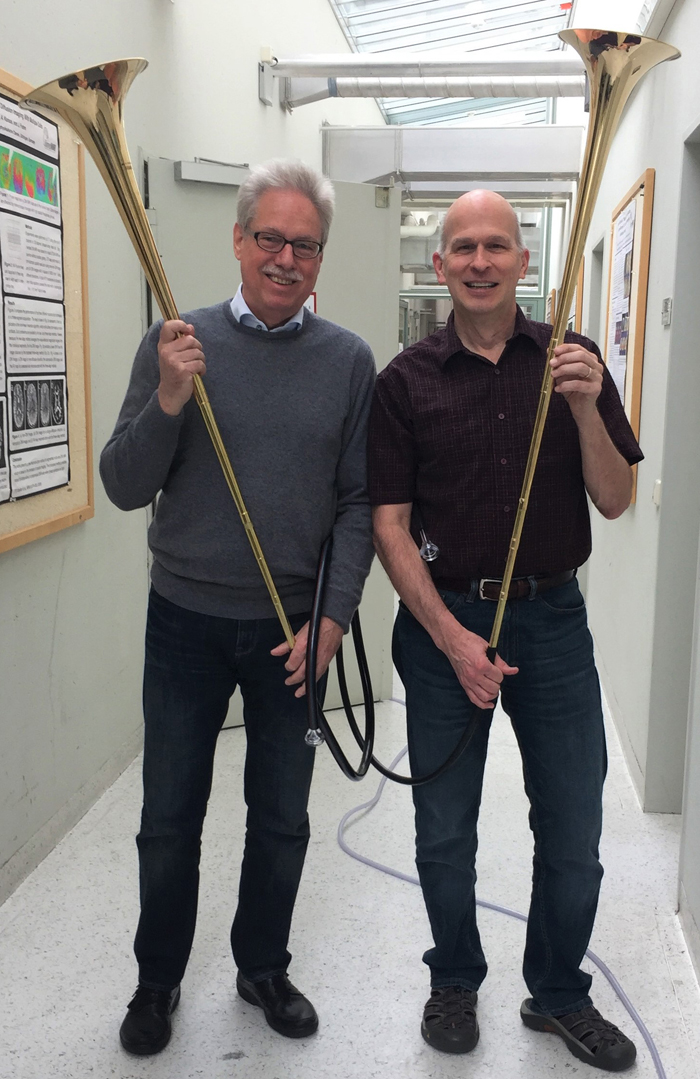
Left to right: Jens Frahm, Douglas Yeo, Eckart Altenmüller, Peter Iltis
The MBRP’s work started with testing of elite, college/conservatory, and embouchure dystonic horn players, using a horn bell made and donated by Rick Seraphinoff (Bloomington, Indiana). Those studies led Iltis and his team to report their preliminary findings in numerous articles in peer-reviewed scientific journals and music publications,[12] as well as in several web-based video interviews and podcasts.[13]
Normal playing of a brass instrument inside a MRI scanner is impossible; there is not enough clearance in the scanner to allow movement of a trombone slide or for the hands of a player to operate valves. Additionally, no ferrous metal can be in the scanner room because of the powerful magnets that are used to create the MRI images; therefore, non-ferrous brass bells must be constructed. A brass instrument bell is then connected to plastic tubing and a plastic mouthpiece, and a player inside the scanner can play notes in the overtone series while the playing is video recorded in sagittal (from the side of the head) and coronal (from the front of the head) views at 55 frames per second. Exercises involving double tonguing were recorded at 100 frames per second in sagittal views. In this way, the workings of the oral cavity during brass playing be observed in real time, and the movement and use of the tongue, and soft palate can be carefully examined.
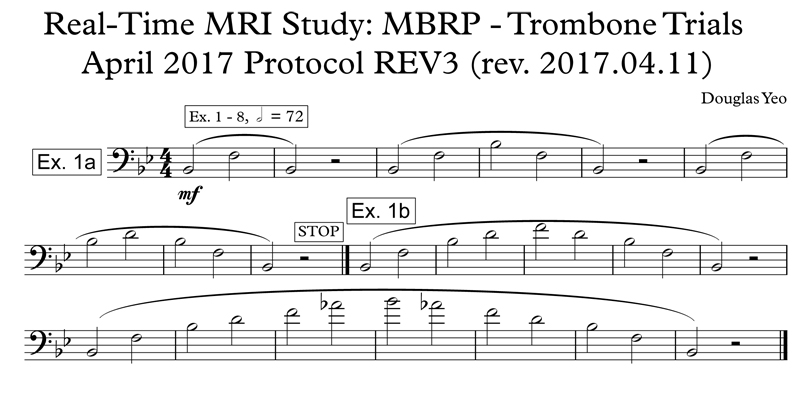
Having tested a large cohort of horn players, Peter Iltis asked me to lead the study of trombone players. This involved my writing a protocol for trombone players to play inside the scanner, and also traveling to the Max Planck Institute in Germany to be the pilot subject in the trombone study. This I did in April 2017. My goal in writing the trombone protocol was to devise exercises that would help us to understand various aspects of trombone playing. In particular, these involved tonguing with various types of articulation, single and double tonguing, slurring, air attacks, and pitch bends. I was also interested to see how the tongue moved while whistling, since the action of the tongue while whistling is often used as a metaphor for tongue placement in various registers of brass playing.
Jens Frahm and Peter Iltis with specially made non-ferrous tenor and bass trombone bells, designed, manufactured and donated by YAMAHA Corporation (Hamamatsu, Japan)
YAMAHA Corporation (Hamamatsu, Japan), designed, manufactured, and donated specially made non-ferrous tenor and bass trombone bells for the study, and Kelly Mouthpieces also donated several plastic trombone mouthpieces for use by players. I also experimented with several types of flexible rubber/plastic tubing (clear, reinforced, PVC, etc), which I had collected in a variety of bore sizes including reasonably standard trombone bore sizes of .500, .550, and .562 inches.
I was familiar with how an MRI scanner worked due to my having had several MRI exams over the years in preparation for various surgical procedures. Those exams involved the taking of still images, and the operation of the MRI scanner’s magnets created a loud, banging sound. However, the scanner used in Göttingen did not make this kind of sound. Rather, the machine made a loud, constant, high-pitched whirr over which I was able to hear myself play the trombone fairly well, despite my wearing earplugs. In addition, as I lay prone on my back in the scanner, my head was gently cradled inside a helmet to help keep my head from making unnecessary movements.
Those who have been inside a MRI scanner know that it can generate a feeling of claustrophobia. Once one is moved into the scanner, one’s nose is only a few inches from the top of the scanner tube. The Max Planck Institute developed an innovative solution to the claustrophobia problem. A double mirror was affixed to the helmet at eye level so when I looked up, I had the impression of looking into the room; this gave me the illusion that I was not in the scanner, but rather I was sitting in a chair looking at my surroundings.
In all, I was in the MRI scanner for two hours and I recorded 57 exercises. Here follows some of what we learned, drawn from 11 selected videos.
Video 1 – lip slurs
[This video may be viewed on YouTube by clicking HERE.]
A good place to start is a simple lip slur exercise. It should be said at the outset that during the time I was playing all exercises inside the scanner, I attempted to follow the advice I learned from Edward Kleinhammer[14] as a student: keep the tongue down and the throat open at all times, in all registers and in all dynamics. As he would simply say, “Yawn, don’t cough.” This was a core tenet of Kleinhammer’s teaching, expressed in his books The Art of Trombone Playing and Mastering the Trombone, and it is a central part of the pedagogy of many trombone teachers and players. My only regret associated with the MBRP is that Edward Kleinhammer did not live to see it come to pass. Knowing him as I did, I know that the process, its outcomes, and conclusions would have fascinated him.
As you view this video, you will first see me swallow several times. What happens when we swallow? The tongue arches upward in the oral cavity and presses both against the roof of the mouth as well as backwards. The larynx – what is popularly referred to as the “Adam’s apple” – is pulled upward to allow the easy passage of saliva into the esophagus. In addition, you will see a small flap of cartilage called the epiglottis move over the trachea (wind pipe) so saliva goes down the esophagus; this prevents a person from choking when saliva goes, as is often said, “down the wrong way.” Also, selected muscles of the oropharynx (what we typically refer to as “the back of the throat”) constrict to aid in pushing saliva – and food – downward.
On the far left edge of many of these videos, part of my thumb that was supporting the mouthpiece can be seen; keep in mind that the mouthpiece was plastic so it does not appear in the MRI images. As I inhale, observe that my soft palate is open at the top of my oral cavity. This closes as I transition from inhaling to playing so air from the oral cavity goes only into the mouthpiece and is not released through my nose. You will also see that my throat is “open.” That is, the several muscles that work to constrict the oropharynx relax, giving the sensation of an open throat.
As I begin playing, you will observe that as I slur higher, my tongue moves both up and back in my oral cavity. There is also movement below the base of my tongue, with my larynx – the opening between the vocal cords – moving slightly upward. When I was playing, I felt no sensation of this upward movement in my neck; I always felt that my throat was very relaxed and my tongue was “down.”
Here we see something very important. When we speak of the tongue, we are speaking of an extraordinarily large, strong, and flexible muscle. It does not move as a single muscle in a single direction, but various parts of the tongue can simultaneously move in various directions. There are muscles called extrinsic muscles that act on the body of the tongue to move it up, down, forward and back within the mouth. There are also muscles making up the body of the tongue itself (intrinsic muscles) that can alter the tongue’s shape. As you view these videos, observe the many varied shapes of the tongue as I play exercises with different articulations and in different registers.
As we look at this, we can see that the idea of an “open throat” is something of a misnomer. We can have the sensation and feeling that we are not changing the size of the oropharynx but in fact we are doing so, and doing so seems to be an essential part of pitch production. Size and shape changes of the oropharynx can also be completely independent of the movement of the tongue. Also, the pulsations of air with each note change may very well be playing some role in assisting with pitch changes. From what we have seen, it is already clear that the embouchure is not the sole determiner of pitch, but that the movement of the tongue and work of the oropharynx play an important role in this as well. As I was playing, I sensed that my tongue was low and down in my mouth at all times and that my throat was always “open.” But as we can see, that was not the case. I had to admit: “The tape don’t lie.”
All of these various processes are happening simultaneously and very quickly, and with virtually no thought on the part of the player. To think about all of this as we play would be an overwhelming exercise, resulting in what Arnold Jacobs[15] used to call, “paralysis by analysis.”[16] The reasonable question arises: How can we be unaware of all of these diverse processes despite our concentrating intently on our playing? When I consider this, I am reminded of the words of the Psalmist when expressed his awe of God as the sovereign creator of all things, “I will praise Thee; for I am fearfully and wonderfully made.” (Psalm 139:14) Indeed.
Video 2 – intervals
[This video may be viewed on YouTube by clicking HERE.]
This exercise is a variation on the slur pattern heard earlier. Here, I articulated intervals of the overtone series rather than slur them. These increasingly wide intervals, particularly in the second half of the exercise when I start each group of two notes on a pedal B-flat, show very clearly the different position of the tongue in various registers. And here is something else to notice: observe how I start this exercise. Many players “flick” their tongue forward before playing, not to moisten their lips, but as an absent-minded gesture of which they are usually not aware. I have seen this on MRI videos of other players who are usually surprised to see it. I have always tried to inject as little extraneous motion into my embouchure’s set up as possible, something that, again, came from Edward Kleinhammer. You’ll also see that I have very little movement of my jaw while playing. When I play the pedal B-flats, I do not engage in an embouchure shift. The helmet that I wore in the MRI scanner did not prevent me from moving my jaw; this is the way I ordinarily play as well.
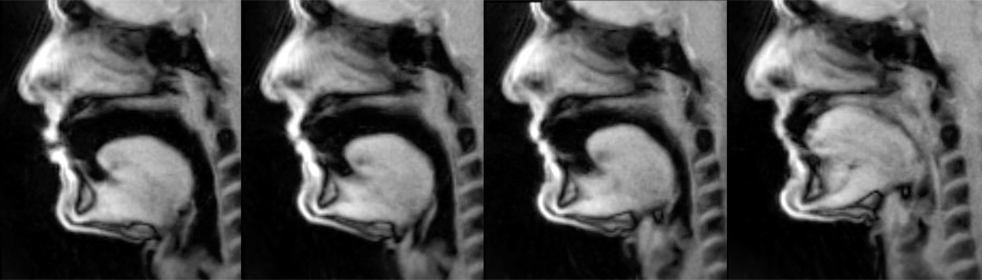
Which leads to these photos:
Left to right: pedal B-flat, low B-flat, tuning B-flat, high B-flat
These four images – still screen shots taken from the videos – show four different notes. From left to right, you see me playing and holding a pedal B-flat, low B-flat, tuning B-flat, and high B-flat. As I play successively higher notes, my tongue changes shape. By the high B-flat, my tongue takes up most of the available space in the oral cavity and the oropharynx has constricted as well. Yet the throat and neck remain relaxed. Apart from a slight firming of my chin, my profile is nearly identical on all four notes.
But . . .
There is virtually no change between the images for the pedal B-flat and the low B-flat. For both notes, the shape, size and position of the tongue is almost identical. The oropharynx is slightly more open for the pedal B-flat than for the low B-flat, but this is a very subtle difference. Both notes show a very open oral cavity. What does this mean? First, we see that my approach to playing is generally very stable. While in the scanner, I simply tried to play the way I normally play, despite the constraints imposed by an unfamiliar instrument and mouthpiece, and the need to play lying on my back. I don’t use an embouchure shift for pedal tones, and the pedal tone seems, as I look at these photos and videos, to simply be a lower sounding note than the note above, and one that does not require a radical change in how the note is made. Absent are any embouchure, chin or oral cavity gymnastics to produce the pedal tone. Second, this shows that tongue placement is not always an indicator of pitch production. While some teachers posit that the tongue has no role in pitch production and that embouchure alone determines pitch, that is clearly not true. On the other hand, the nearly identical tongue placement for my pedal B-flat and low B-flat shows that in the case of these two notes, my tongue was not a significant actor in pitch production. Clearly my embouchure had a greater role in determining the pitch of these two notes, and that is evident when you look at my lips. For the pedal B-flat, my lips are more relaxed, and that is the significant factor that allows me to produce and center that note.
Video 3 – articulated arpeggio
[This video may be viewed on YouTube by clicking HERE.]
Here is an articulated arpeggio that shows the slow, even movement of my tongue as I play notes from lower to higher and then from higher to lower. Again, note the fact that there is only a slight firming of my chin as I go higher, and the tongue evenly rises and falls depending on the range of each note. Observe, too, that when I take a quick breath, my oropharynx is open, allowing me to quickly get in as much air as possible.
Video 4 – slow double tongue
[This video may be viewed on YouTube by clicking HERE.]
Up to now, we have seen exercises that have been slurred or single tongued. Here is an exercise in slow double tonguing. With single tonguing, we have seen that the tongue’s motion is primarily from front to back. But with double tonguing, the “ka” syllable requires the tongue to touch the roof of the mouth in order to form a short, temporary seal that is opened quickly to give the impression of a tongued attack. I don’t ordinarily double tongue at this slow tempo, but it is useful to see how the tongue operates in this kind of slow double tongue action. In this video, we see this slow double-tonguing on both low B-flat and middle F. Even at this slow tempo, I exhibit no “chewing” motion when I am tonguing; I allow the tongue to do its work and the oropharynx is relaxed and open throughout. Many players get very tight when they double tongue. I suspect that is usually a product of insecurity – not feeling one can tongue well – rather than from a physical need of some kind to tighten the neck muscles.
Video 5 – fast double tongue (and slow motion video)
[This video may be viewed on YouTube by clicking HERE.]
Here is essentially the same exercise shown above with several important changes. First, this exercise was recorded at 100 frames per second. Second, I double tongue two different notes, low B-flat and middle F, as fast as possible. Then, after the video in which I tongue each note, part of the same video clip is played back at half speed. As you will see, the movement of my tongue is the same here as in the previous, slow double-tonguing exercise. You will also notice that the oropharynx – the back of my throat – remains open and relaxed. In addition, I perform this exercise in both soft and loud dynamics. I wanted to see if the tongue changed shape depending on the dynamic I used. As you can see, it did not. And even at the loud dynamic, you can see that I kept my oropharynx relaxed.
Video 6 – glottis, crescendo/diminuendo
Video 6 has been removed (April 19, 2024) because the video and commentary were not clear in expressing the role of the glottis in brass playing. The glottis is only recently beginning to be properly understood and research findings are just now being published. For a preliminary discussion of the role of the glottis in brass instrument playing, see: Peter W. Iltis, Sarah L. Gillespie, Jens Frahm, Dirk Voit, Arun Joseph, and Eckhart Altenmüller, “Movements of the Glottis During Horn Performance: A Pilot Study,” Medical Problems of Musicians, Vol. 32, No. 1 (March 2017), 33–39. The article may viewed HERE and HERE. Future articles about the role of the glottis in brass playing will be linked here as they are published.
Air attacks
Air attack exercise written by Edward Kleinhammer (1975)
The subject of air attacks is poorly understood. Air attacks were central to Edward Kleinhammer’s pedagogy, and he often wrote out an arpeggio exercise for students to work on – such as the image above, that he wrote for me during a lesson I had with him in 1975 – before finally codifying the exercise in Mastering the Trombone.[21] For him, the practice of air attacks to start notes helped to remove the tongue from the articulation equation, and develop better breath control. Some players use air attacks to start notes if they have a hesitation in articulation when they are under stress. They feel that taking the tongue away from the start of the note allows the note to speak without a stutter. I have rarely used air attacks to start notes at the beginning of phrases but I do use air attacks from time to time in the midst of phrases, especially in legato but also in articulated passages.
Over the years, I have suggested the use of air attacks to many students but most have difficulty understanding the concept beyond using an air attack to start a single note. But thanks to the MBRP, I can now show visually what I previously could only explain in words.
Video 7 – air attacks 1
[This video may be viewed on YouTube by clicking HERE.]
In this exercise, I play notes in two ways: first, a measure of notes is played with a traditional tongued attack. I chose the syllable TOH (as in “toe”) as opposed to TAH (as in “blah”) as a softly articulated syllable with which to start the tongued notes. Each tongued measure is followed by the same measure played with no tongue at all using the syllable HOH; I only used air to start each note. In the musical example above, tongued notes are indicated with a letter T and air attacks are indicated with a letter A.
As you view this video, you can see that when I used an air attack, the tongue was not engaged in articulation. The slight movement of the tongue that occurs during air attacks is caused by the pulsing of the air through the glottis and up the oropharynx. The tongue movement in air attacks is incidental, not causal. The size and shape of the oral cavity is essentially identical for both tongued and air attacked notes. The attack appears to be achieved by “huffing,” or pulsing the air with my diaphragm; whether the glottis is also involved in this cannot be seen in the angle of this video.
Video 8 – air attacks 2 – Finlandia – tongued/double tongued/air attack
[This video may be viewed on YouTube by clicking HERE.]
To show the difference between single tonguing, double tonguing and air attacks, I decided to record an exercise that uses a rhythm from a passage of music in which I use rapid air attacks, Jean Sibelius’ Finlandia. This piece requires the bass trombonist to articulate low E-flats at a rapid tempo in a loud dynamic. While I could not play low E-flats on the trombone I played in the MRI scanner, I compromised by playing Sibelius’ rhythm on both low B-flat and pedal B-flat.
The exercise I played is slightly different than the one printed above; I modified it when I was in the scanner to reflect Sibelius’ exact rhythm. You will hear me play two measures of each note tongued, then two measures double tongued, then two measures with air attacks.
As you will see, single tonguing resulted in a clear articulation. Double tonguing was not as clean as my single tonguing at this tempo and dynamic, and the air attacks come across like a machine gun rat-a-tat-tat. I have used this type of air attack when performing Finlandia, and with this video, a new visual tool is now available to help players understand how this kind of attack works.
These fundamental exercises and the resulting videos summarize a few of the important things I learned as a result of taking part in the MRI Brass Repository Project. But there were a few more esoteric phenomena related to trombone performance that I was able to explore in Göttingen. My friend, John Ericson, who is Associate Professor of Horn at Arizona State University, has long been curious about how the tongue performs while bending the pitch on a note. Trombone players don’t use the skill of bending pitch very often because we can correct pitch with our slide. But I do bend pitches when I play serpent and ophicleide, and sometimes when I play a trombone without an F-attachment and I need to play a note that is not on the instrument, such as a low E-flat or low-D.
Video 9 – pitch bends
[This video may be viewed on YouTube by clicking HERE.]
I decided to record an exercise where I would play several notes and bend them down to the lowest possible note before the note “broke” and then bend it back up to the original note. Lower notes would bend more easily than higher notes, owing to the flexibility of the embouchure in the low register.
Intuitively, I expected that as I bent a note lower, my tongue would flatten and move lower in my oral cavity, and as the note bent higher, my tongue would rise higher. But as you can see in the video above, the exact opposite occurred. Except for the pedal B-flat, which had the greatest bending ability because of lip flexibility in that extreme low register, my tongue raised up higher as I bent the pitch lower. This was a great surprise, especially since the feeling I had in my throat was that my tongue was moving lower. How to account for this? Because the pitch was being bent by the movement of my embouchure, perhaps the tongue rises to narrow the oral air channel to keep the note from breaking to the next lower partial. Clearly there is more study to do to understand this phenomenon. Still, this is a fascinating example of the value of the MBRP in helping to understand something that in reality was at odds with how it felt.
Video 10 – whistling
[This video may be viewed on YouTube by clicking HERE.]
I also wanted to do an experiment in the MRI scanner related to whistling. Teachers often use whistling as a way to describe the movement of the tongue when we play notes in the upper register. With whistling, the embouchure does not, in the main, determine pitch. If you pucker your lips and whistle a low note and slowly glissando to your highest possible note, you will see that your lips move very little or none at all, and you have the feeling that your tongue is raising higher in your oral cavity as the pitch goes higher. I wanted to test this metaphor for brass playing in the MRI scanner and see if it was true. It was. Mostly.
As you can see in this video, the sound of the whistle is not only determined by the pucker of one’s lips. The tongue must be high in the oral cavity in order to modify the airflow to a point where the vibration of air past the lips can create the whistle. However, as the pitch of my whistle got higher, my tongue had no room to move higher; it had to move forward in order to further close the oral cavity.
As a result of these findings, the whistle is shown to be a less than ideal metaphor for the movement of the tongue through various registers in brass playing. In whistling, higher pitch is created, in part, by the tongue going forward; in brass playing, it is created, in part, by the tongue going higher. However, in MBRP studies with other subjects, it has been found that when a person engages in “hollow whistling” – making the sound of air speed rising and falling through relaxed and slightly open lips without making an actual whistling sound – the tongue does mimic the movements the tongue makes while playing. Actual whistling might intuitively seem to be a good model for explaining the use of the tongue in brass playing, but in fact, we would be better to use “hollow whistling” as a more accurate model.
Video 11 – bugle call (Reveille)
[This video may be viewed on YouTube by clicking HERE.]
Finally, I wanted to play some music and see how my oral cavity looked in real-life operation while playing the trombone. Constrained by only being able to play the overtone series, I chose to play the bugle call, Reveille, known to every young person who has been to summer camp and to the men and women of the American Armed Forces as the call to wake up each morning. In this performance, I used a combination of single and double tonguing. The position of my tongue is always clearly visible: going back and forth during single tonguing and then up and down while double tonguing.
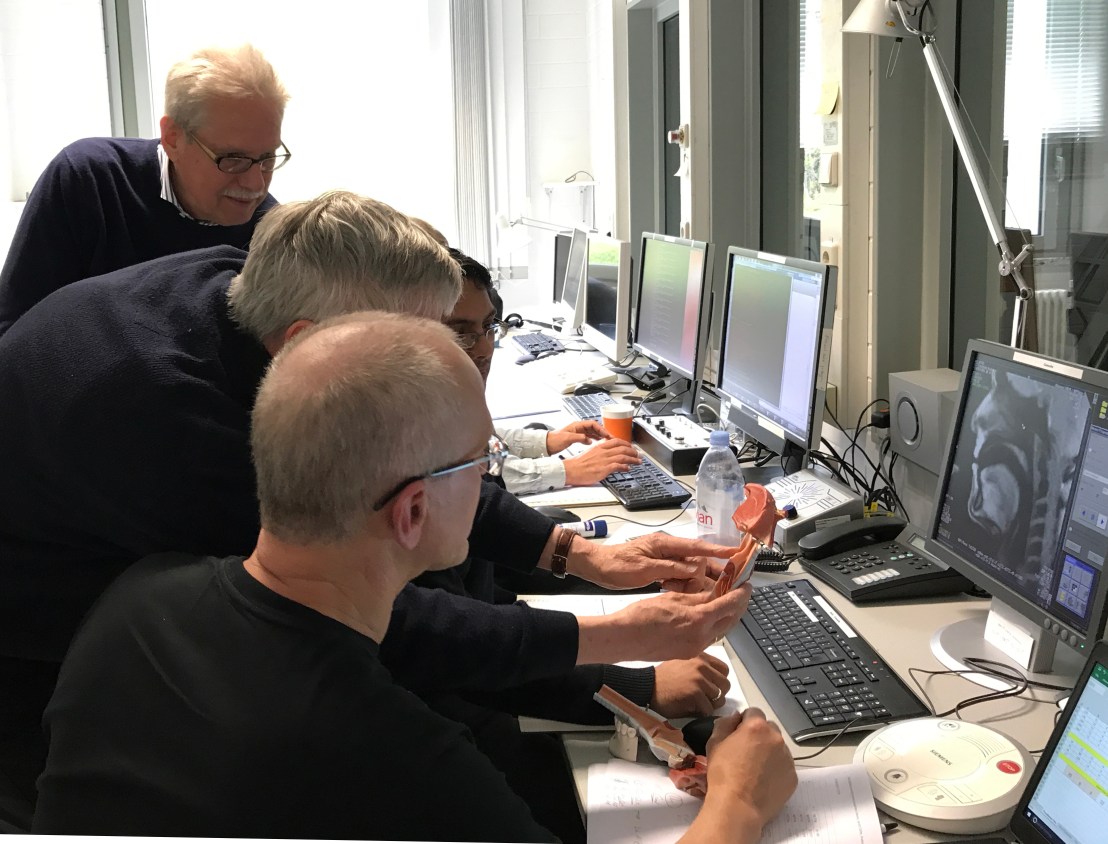
Left to right: Jens Frahm (standing, rear), Eckart Altenmüller (standing, middle), Arun Joseph (seated, rear), Douglas Yeo (seated, front)
After my two hours in the MRI scanner – the time passed very quickly and I actually had no idea I had been in the scanner for so long – I emerged energized and excited to see what I had done. I sat with members of the MRI project team to gain some understanding of what had just happened. In the photo above, I am seated in front of a computer monitor that shows one of my videos. Eckart Altenmüller is seen looking over my left shoulder, holding a plastic model of the tongue, while Jens Frahm (standing) and Arun Joseph (seated) looked on. The resulting conversation opened my eyes to workings of my tongue and other organs in my oral cavity in a new way. Also, our discussion revealed that in my videos, the tip of my tongue was not always imaged as clearly as it is with some other players when it moves to the most anterior (frontal) position. The reason for this is the fact that I have a titanium dental implant in one of my eye teeth that created what is called a susceptibility artifact that led to some signal intensity alterations at that place in my mouth. This is sometime seen as quick flashes of light that some may mistake for spit/saliva. This metal implant did not, however, affect the clarity of the imaging in any other part of my oral cavity, and ongoing study with other trombonists who do not have such a dental implant will result in additional video with greater clarity of the tongue in its most frontal position.
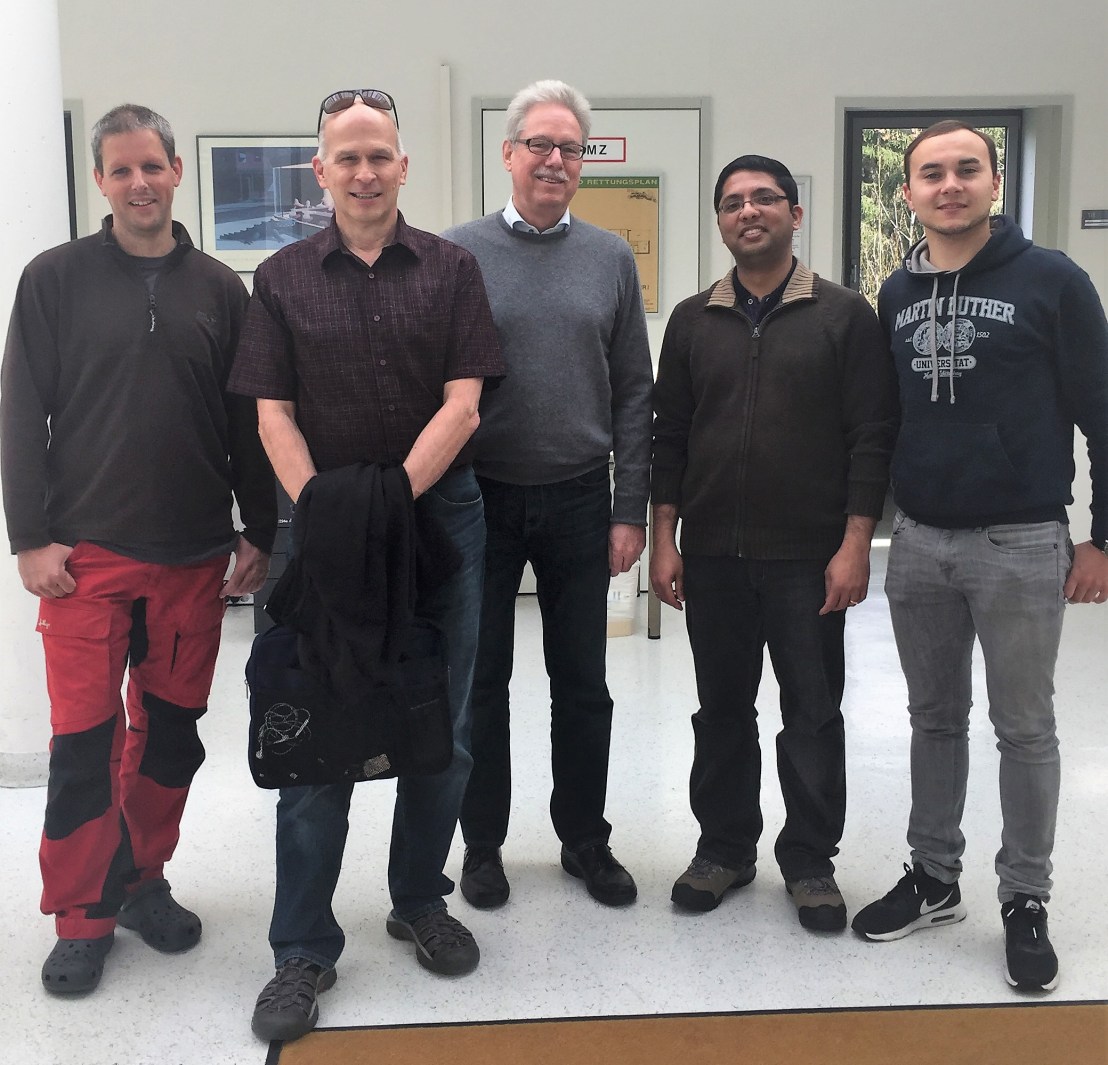
Left to right: Dirk Voit, Peter Iltis, Jens Frahm, Arun Joseph, Sonke Hellwig
Of course, a project like this needs a great deal of help to make it happen. The support staff at the Max Planck Institute was tremendously helpful in myriad ways. The photo above shows the five people who were involved with me during my time in the scanner. They gave me instructions and encouragement, ran the computers and equipment, ensured my safety, and sent me home with data and information that I am still processing. To (from left to right) Dirk Voit, Peter Iltis, Jens Frahm, Arun Joseph and Sonke Hellwig, I owe a great deal of thanks. They, along with Eckart Altenmüller, are helping to change our knowledge about brass playing and are giving concrete answers to long held questions. To YAMAHA Corporation (bell construction coordinated by Naoki Suzuki) and Kelly Mouthpieces (Jim Kelly), I once again express my thanks for providing us with the needed instruments and mouthpieces to conduct the trombone testing.
The MRI Brass Repository Project continues. In the coming months, more elite trombone players will be tested along with players who have experienced embouchure dystonia. While the project is of immeasurable help as we work to understand the why of the how of trombone playing, it is hoped that the project will also provide keys to unlock some of the mysteries of embouchure dystonia. In time, all of the videos from the study will be made available for study by educators and players so future researchers can add new insights to the work done inside the MRI scanner room at the Max Planck Institute for Biophysical Chemistry. We are in their debt.
Douglas Yeo (www.yeodoug.com and http://www.thelasttrombone.com) was bass trombonist of the Boston Symphony Orchestra from 1985-2012. He served as trombone professor at New England Conservatory of Music from 1985 to 2012, professor of trombone at Arizona State University from 2012 to 2016, trombone professor at Wheaton College (IL) from 2019 to 2023, and professor of trombone at University of Illinois Urbana-Champaign from 2022 to 2024. He has given performances and held teaching residencies on five continents, and he has received the International Trombone Association’s highest honor, the ITA Award (2014) and the ITA’s Lifetime Achievement Award (2024). His books include Mastering the Trombone (with Edward Kleinhammer; Ensemble Publications, 1997), The One Hundred: Essential Works for the Symphonic Bass Trombonist (Encore Music Publishers, 2017), Serpents, Bass Horns, and Ophicleides at the Bate Collection (University of Oxford, 2019), Homer Rodeheaver and the Rise of the Gospel Music Industry (with Kevin Mungons, University of Illinois Press, 2021), and An Illustrated Dictionary for the Modern Trombone, Tuba, and Euphonium Player (Rowman and LIttlefield, 2021/2023). He lives in the greater Chicago area.
Footnotes
[1] Harold W. Atkinson, “Tongue Positions of Vowel-Sounds,” The Modern Language Quarterly, Vol. 1, No. 1, July 1897, 13.
[2] Edward Kleinhammer, The Art of Trombone Playing. Evanston: Summy-Birchard Company, 1963, 63.
[3] Edward Kleinhammer and Douglas Yeo, Mastering the Trombone. Ithaca: Ensemble Publications, 2012 (Fourth Edition), 15.
[4] ed. Bruce Nelson, Also Sprach Arnold Jacobs: A Developmental Guide for Brass Wind Musicians. Mindelheim, Germany: Polymnia Press, 2006, 55.
[5] Arnold Jacobs, “Special Studies for the Tuba,” Hal Leonard Advanced Band Method (Basses/Tuba). Winona, Minnesota: Hal Leonard Music, 1963, 56.
[6] Philip Farkas, The Art of Brass Playing. Bloomington: Brass Publications, 1962, 62
[7] Harvey Phillips and William Winkle, The Art of Tuba and Euphonium. Secaucus: Summy-Birchard Inc., 1992, 34.
[9] Joseph (Jody) C. Hall used x-ray photographs of nine trumpet players as a basis for his his 1954 study of vowel sounds but he did not employ video. See: Joseph (Jody) C. Hall, A Radiographic, Spectrographic, and Photographic Study of Non-labial Physical Changes Which Occur in the Transition from Middle to Low and Middle to High Registers During Trumpet Performance (Ph.D. dissertation, Indiana University, 1954). In 1967, Joseph A. Meidt led a study of 10 brass players (five horn and five trumpet), in which the subjects performed several short musical excerpts while being filmed with a Rotalix x-ray (cineflourography) machine. However, the x-ray film showed the tongue only faintly and did not show the operation of the glottis and soft palate at all. See: Joseph A. Meidt, A Cineflorougraphic Investigation of Oral Adjustments for Various Aspects of Brass Instrument Performance (Ph.D. dissertation, University of Iowa, 1967). Also: Lyle C. Merriman and Joseph A. Meidt, “A Cineflourographic Investigation of Brass Instrument Performance.” Journal of Research in Music Education, Vol. 16, No. 1 (Spring, 1968), 31-38. Also: www.youtube.com/watch?v=tpOwuAMqFTA. In 2013, C. Schumacher led a team that became the first to use real-time MRI video in a limited study of trumpet players. The MRI Brass Repository Project has expanded on that work by broadening their study to include horn and trombone players, employing the fastest MRI video film speeds ever published of up to 100 frames/second, and using both elite and embouchure dystonic subjects. See: M. Schumacher, et. al, “Motor Functions in Trumpet Playing: A Real-time MRI Analysis.” Neuroradiology, 2013; 55 (9), 1171-81.
[10] See, www.gordon.edu/mrihorn. The project was originally titled the International MRI Horn Repository Project; its name was changed to MRI Brass Repository Project in 2017.
[11] From 1995-2016, Peter Iltis also taught horn at Gordon College until embouchure dystonia ended his playing career.
[12] Peter W. Iltis, et. al., “Real-time MRI comparisons of brass players: A methodological pilot study.” Human Movement Science, Vol. 42 (2015), 132-145. Peter W. Iltis, et. al., “High-speed real-time magnetic resonance imaging of fast tongue movements in elite horn players.” Quantative Imaging in Medicine and Surgery, 2015; 5 (3), 374-381. Peter W. Iltis, et. al., “Divergent oral cavity motor strategies between healthy elite and dystonic horn players.” Journal of Clinical Movement Disorders, 2015, 2:15. Peter W. Iltis, et. al., “Inefficencies in Motor Strategies of Horn Players with Embouchure Dystonia.” Medical Problems of Performing Artists, 2016. Peter W. Iltis, et. al., “Movement of the Glottis During Horn Performance: A Pilot Study.” Medical Problems of Performing Artists, Vol. 32, No. 1 (March 2017), 33. Peter W. Iltis, “When Science Meets Brass.” The Instrumentalist, Vol. 72, No. 1, August 2017, 36-39.
[14] Edward Kleinhammer (1919-2013) was bass trombonist of the Chicago Symphony Orchestra from 1940-1985. See: Douglas Yeo, “Edward Kleinhammer: A Life and Legacy Remembered.” International Trombone Association Journal, Vol. 42, No. 2, April 2014, 24-31.
[15] Arnold Jacobs (1915-1998) was tubist with the Chicago Symphony Orchestra from 1944-1988.
[16] Brian Frederickson and John Taylor, Arnold Jacobs: Song and Wind. Gurnee, Illinois: WindSong Press, 1996, 93, 141-143.












 The Last Trombone – Douglas Yeo