Category: faith

Encouragement

Encouragement

Life is full of ups and downs. Nobody is immune from hard knocks and I don’t know a person in the world who has not faced tough times and discouragement. In recent days, I’ve been talking to a number of people who are struggling with difficulties. It’s then that you find out the true meaning of the word “friend” – how to be one and how to be grateful for one.

I thought I’d share three items that have come to mind in the last few weeks that I have shared with friends who have been going through some tough stuff. Each speaks to a different kind of situation and each offers encouragement and hope. When you’re working hard to make lemonade out of the lemons of life, when “stuff” is piling up all around, when you can’t see a way out of a problem, Rudyard Kipling, William Shakespeare and the Apostle Paul have something to encourage us.

if

IF

by Rudyard Kipling (first published in 1895)

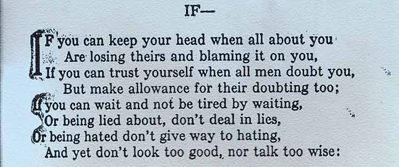
If you can keep your head when all about you
Are losing theirs and blaming it on you,
If you can trust yourself when all men doubt you,
But make allowance for their doubting too;
If you can wait and not be tired by waiting,
Or being lied about, don’t deal in lies,
Or being hated, don’t give way to hating,
And yet don’t look too good, nor talk too wise:

If you can dream—and not make dreams your master;
If you can think—and not make thoughts your aim;
If you can meet with Triumph and Disaster
And treat those two impostors just the same;
If you can bear to hear the truth you’ve spoken
Twisted by knaves to make a trap for fools,
Or watch the things you gave your life to, broken,
And stoop and build ’em up with worn-out tools:

If you can make a heap of all your winnings
And risk it on one turn of pitch-and-toss,
And lose, and start again at your beginnings
And never breathe a word about your loss;
If you can force your heart and nerve and sinew
To serve your turn long after they are gone,
And so hold on when there is nothing in you
Except the Will which says to them: “Hold on!”

If you can talk with crowds and keep your virtue,
Or walk with Kings—nor lose the common touch,
If neither foes nor loving friends can hurt you,
If all men count with you, but none too much;
If you can fill the unforgiving minute
With sixty seconds’ worth of distance run,
Yours is the Earth and everything that’s in it,
And—which is more—you’ll be a Man, my son!

sonnett_29

Sonnet 29

William Shakespeare (first published in 1609)

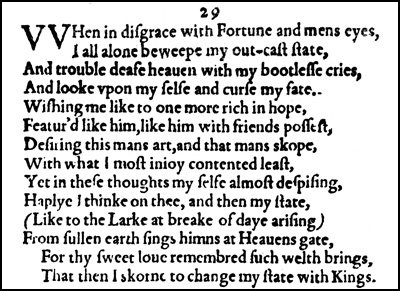
When, in disgrace with fortune and men’s eyes,
I all alone beweep my outcast state,
And trouble deaf heaven with my bootless cries,
And look upon myself, and curse my fate,
Wishing me like to one more rich in hope,
Featur’d like him, like him with friends possess’d,
Desiring this man’s art and that man’s scope,
With what I most enjoy contented least;
Yet in these thoughts myself almost despising,
Haply I think on thee, and then my state,
Like to the lark at break of day arising
From sullen earth, sings hymns at heaven’s gate;
For thy sweet love remember’d such wealth brings
That then I scorn to change my state with kings.

p46

I Corinthians 13 (English Standard Version)

Apostle Paul (written between approximately 53-57 AD)

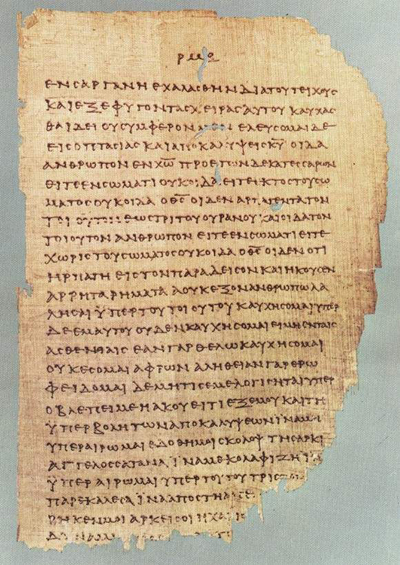
If I speak in the tongues of men and of angels, but have not love, I am a noisy gong or a clanging cymbal. And if I have prophetic powers, and understand all mysteries and all knowledge, and if I have all faith, so as to remove mountains, but have not love, I am nothing. If I give away all I have, and if I deliver up my body to be burned, but have not love, I gain nothing.

Love is patient and kind; love does not envy or boast; it is not arrogant  or rude. It does not insist on its own way; it is not irritable or resentful; it does not rejoice at wrongdoing, but rejoices with the truth. Love bears all things, believes all things, hopes all things, endures all things.

Love never ends. As for prophecies, they will pass away; as for tongues, they will cease; as for knowledge, it will pass away. For we know in part and we prophesy in part, but when the perfect comes, the partial will pass away. When I was a child, I spoke like a child, I thought like a child, I reasoned like a child. When I became a man, I gave up childish ways. For now we see in a mirror dimly, but then face to face. Now I know in part; then I shall know fully, even as I have been fully known.

So now faith, hope, and love abide, these three; but the greatest of these is love.

Wilson Carlile: The Man Behind the Trombone

Wilson Carlile: The Man Behind the Trombone

by Douglas Yeo (January 28, 2017)

Readers of The Last Trombone know that I am at work writing several books, as well as a number of articles for various journals and magazines. I’ve just completed an article for the July 2017 International Trombone Association Journal about jazz trombonist Russell “Big Chief” Moore, a member of the Akimel O’odham (Pima) tribe who was born in Arizona and went on to play with many jazz greats including Louis Armstrong, Sidney Bechet and Charlie Parker. Moore was born in Komatke, Arizona, on the east side of the Sierra Estrella; if you threw a stone from my front porch over the mountains, it would land in Komatke. I’ve also recently completed an article about the Mozart Requiem Tuba mirum trombone solo for the Boston Symphony Orchestra program in April of this year, to coincide with performances of that piece by the orchestra (my good friend, Steve Lange, will be playing the trombone solo). And my new annotated orchestral excerpt book, The One Hundred: Essential Works for the Symphonic Bass Trombonist (Encore Music Publishers) is in the final proofreading process and will be published this spring. More on all of these projects will be coming in future posts on The Last Trombone.

One of the major writing projects that is occupying my time is a biography of Homer Rodeheaver, who was the trombone-playing song leader for evangelist Billy Sunday in the first third of the twentieth century. I am co-authoring this book with my friend Kevin Mungons of Chicago and it will be published by University of Illinois Press. In my research about Rodeheaver, I’ve been studying the use of the trombone by many pastors, evangelists and song leaders.  Many, like the late Cliff Barrows, were inspired by Rodeheaver’s example.

But before Homer Rodeheaver, there was Rev. Wilson Carlile, founder of England’s Church Army. Carlile had a life long ministry to the downtrodden in London and his movement spread around the world. He also used the trombone as a way to gain attention to his ministry, often marching through the streets of London while playing–something that resulted in his being severely beaten on numerous occasions by those who did not want to hear his message of temperance and the saving power of the Christian Gospel.

The photo below appeared as a full page image in the July 22, 1903 issue of The Tatler with the caption:

The Rev. Wilson Carlile, who leads off our series of “Preachers in their Pulpits,” the first newspaper attempt to present the clergy with the genuine actuality that photography can alone provide, is the honorary chief secretary of the Church Army, which he founded in the slums of Westminster in 1882. He is rector of St. Mary-at-Hill, the church which is illustrated in our picture. He is fifty-six years of age.

carlile_full_photo_small

On May 4, 1900, the Chicago Daily Tribune ran an article about Wilson Carlile and his ministry; it is reproduced below. The article is written in a spectacularly evocative style, and is a tremendous tribute to this Godly man who did so much good for so many. The author, who is not credited, certainly found that the trombone made an impression, and his conclusion will bring a smile to anyone who plays the trombone or has known a trombone player:

All this is the work of the man behind the trombone, and for the possibilities that lie in that much maligned instrument let all trombone players be respected. They are not as bad as they look. In the hands of a man truly great, the trombone is more powerful than the sword.

the-man-behind-the-trombone-carlile

Wilson Carlile (1847-1942). The man behind the trombone.

wilson_carlile_trombone_small

Cliff Barrows (1923-2016): A man of song. And the trombone.

Cliff Barrows (1923-2016): A man of song. And the trombone.

by Douglas Yeo (November 16, 2016)

Clifford “Cliff” Barrows, long-time song leader for evangelist Billy Graham, died yesterday at the age of 93. He was part of a trio – along with Graham and singer George Beverly Shea – who defined large-scale Christian evangelism in the second half of the twentieth century. Graham, Shea and Barrows preached, sang and led singing before millions of people since they first worked together in 1946. The photo above shows Cliff Barrows leading singing at the 1946 Youth for Christ meeting in Seattle, Washington.

The newspapers today are full of tributes to Cliff Barrows and a good summary of his life and career is found in his obituary in the Charlotte (North Carolina) Observer. This was a Godly man who changed lives in many ways and he is more than deserving of all of the warm remembrances that are being written about him today.

But several years ago, I learned about a side of Cliff Barrows that most people had either not ever known about or had long forgotten: he played the trombone.

low_bgc_barrows_trombone_02_front

I first learned that Cliff Barrows played trombone while touring the Billy Graham Center Museum at my undergraduate alma mater, Wheaton College (Illinois). As I came around a corner, I saw photographs of two men that were holding trombones: Homer Rodeheaver (I had never heard of him before) and Cliff Barrows (I didn’t know he had played trombone). I learned quickly that Rodeheaver was the trombone-playing song leader for evangelist Billy Sunday in the first third of the 20th century. And this realization – that the two most influential Christian evangelists of the 20th century were both named “Billy” and both had song leaders that played the trombone  – sent me running to learn more.

I turned my attention to Rodeheaver, a man who was a household name for decades but today has been largely forgotten. Here was a man who played the trombone for over 100 million people; his tremendous influence as a trombonist is incalculable. “Surely,” I thought, “there must be a story in all of this.” And indeed there was. It first led to my writing an article, “Homer Rodeheaver: Reverend Trombone” that was published in the Historic Brass Society Journal earlier this year. And, happily, it has now led to my co-authoring a book about Rodeheaver for University of Illinois Press with my friend, Kevin Mungons. We are, at this moment, deep into the process of writing the book and when it appears in a few years, it will be accompanied by a two-CD set of recordings of Rodeheaver singing, speaking and playing trombone. More on this in time! But while doing research about Rodeheaver at the Billy Graham Center Archives and at Grace College in Winona Lake, Indiana (where Billy Sunday and Rodeheaver had their homes and archives for both Sunday and Rodeheaver are found) and the Winona History Center, photos of Cliff Barrows kept popping up. I needed to know more.
barrows_graham_1949

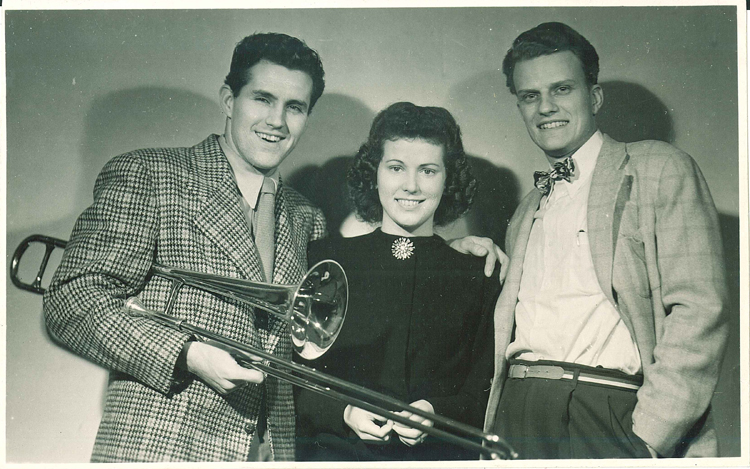
As I researched Cliff Barrows, I learned that he had played trombone while growing up in Ceres, California. With his first wife, Billie (shown above, with Cliff Barrows and Billy Graham around 1946), Barrows worked with evangelist Jack Shuler. The Statesville (North Carolina) Record & Landmark newspaper had this to say about Cliff Barrows at one of Shuler’s meetings in an article from June 26, 1945:

The Barrows’ specialize in piano and trombone arrangements, and their duets and solos have made them friends of everyone who has attended their performances. It was ventured by one who attended the great Billy Sunday campaigns that Mr. Barrows is the equal of Homer Rodeheaver, song leader for the late evangelist, so skillfully does he lead the large crowds in congregational singing of hymns and choruses. Billie Barrows, who, by the way, has been Cliff’s wife for just 13 days, has thrilled young and old with her renditions of favorite songs at the piano.

The mentioning of Cliff Barrows in the same sentence with Homer Rodeheaver was no accident. On April 1, 2014, I interviewed Cliff Barrows and he spoke about Rodeheaver’s influence on his life and ministry:

Homer Rodeheaver  was a most wonderful man. He had a way of using a crowd to prepare them for Billy [Sunday] and Billy would get anxious; he’d want to get up and start to preach and Homer would turn around and say, “They ain’t ready yet.” So he’d pick up his trombone and say, “This is a Methodist trombone, it slips and slides all over the place.” . . . I never met a more gracious man. We had him come to every [Billy Graham] Crusade when he was alive until he died in 1955 and I went to his funeral. They asked me to stand by his casket at the piano at [his home at] Rainbow Point [in Winona Lake, Indiana] and lead some of his favorite songs. And I did. I led “Beyond the sunset, O blissful morning…”

barrows_la_1949

Unfortunately, there are no known recordings of Cliff Barrows playing the trombone. But there is a brief moment where he is seen on film with the trombone in his hands. The screenshot above is from a video of Cliff Barrows playing the trombone at the 1949 Christ for Greater Los Angeles Billy Graham Crusade. You’ll find the footage of Barrows at around 5:00 in the video (click on the link in the text above to view the complete film).

In my conversation with Cliff Barrows, his affection for the trombone was palpable. By that time, he had not played the trombone in many years. After the 1953 London Billy Graham Crusade, Graham and Barrows began making changes in their manner of presenting the Christian Gospel, creating their own style after having been compared so frequently to Sunday and Rodeheaver. By 1957, he had put the trombone down. Still, during our interview, he told me that he was holding a trombone in his lap that had been given to him by the 1950 Atlanta Billy Graham Crusade Choir, on which was inscribed the verse from Psalm 98:1: Sing to the Lord a new song, for he has done marvelous things; his right hand and his holy arm have worked salvation for him. As we spoke at that moment, Cliff Barrows was nearly blind and near the end of his life, yet when we talked about the trombone, he wanted it in his hands. Of Rodeheaver and the trombone, Cliff Barrows said, “Well, they are two of my best friends.”

bgc_barrows_graham_yfc_england_01_1946-7_small

Cliff Barrows, like Homer Rodeheaver before him, found that the trombone was an effective tool in leading song for large groups of people. The photo above, from the 1946-1947 Youth for Christ meetings in England, show the young Billie Barrows, Billy Graham and Cliff Barrows standing out with their exuberant, youthful energy. In our interview, Cliff Barrows talked about how he used the trombone to lead singing:

I would play with the choir and bring the downbeat with my horn and when I would hold a long note, I’d hold it out with them and the horn was just a part of me. I felt so natural with it hanging on my arm.

bgea_barrows_helsinki_trombone_front_small_full

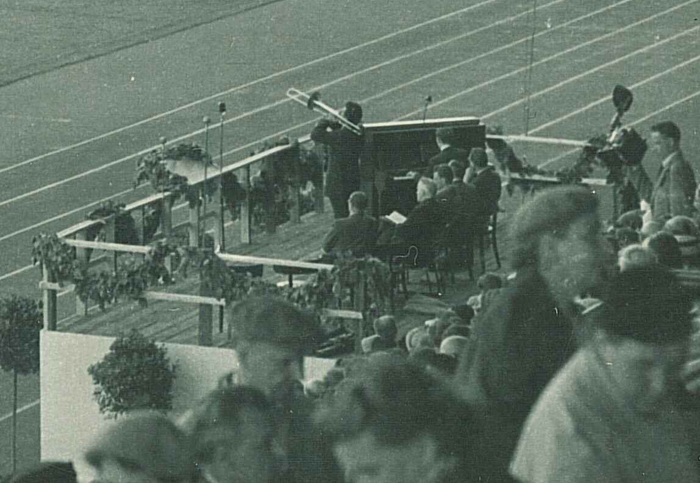
Of all of the photographs I have seen of Cliff Barrows, it is the one above, taken at the 1954 Billy Graham Crusade at the Olympic Stadium in Helsinki, Finland, that I like the best. Look at the tens of thousands of people sitting in the stadium. The infield is empty. And on the platform is Cliff Barrows, playing his trombone accompanied by an upright piano (see the enlargement, below). Two people playing a hymn tune. They are minuscule and nearly lost in the enormity of the crowd. But when a trombone was in his hand, Cliff Barrows knew how to make it sing.
bgea_barrows_helsinki_trombone_front_detail_small

When my interview with Cliff Barrows was drawing to a close, I thanked him for his time and insights. But this humble man turned it around on me, and said,

You’re welcome, Brother Yeo. God bless you brother. Thank you for letting me visit with you.

And with that, two trombone players named Cliff Barrows and Douglas Yeo hung up the phone. Today, as I reflect on the life and ministry of Cliff Barrows, I am so grateful my life intersected with his for a brief moment, where our shared love of Jesus Christ, music and the trombone came together. It was Homer Rodeheaver who led me to Cliff Barrows, the same Homer Rodeheaver who was such an encouragement when Cliff Barrows was just beginning his ministry with Billy Graham. And like Rodeheaver, shown below with Billy Sunday (in a white suit standing behind Rodeheaver) at Winona Lake, Indiana in 1931, Cliff Barrows used the trombone as a tool for leading singing and for bringing the Good News of Jesus Christ to millions of people. It’s something I’ll be doing this Sunday when, with my wife at the piano, I pick up my trombone and play the great song by George Beverly Shea and Rhea Miller, I’d Rather Have Jesus Than Silver or Gold as the offertory in our church’s Sunday morning service. At that moment, I certainly will be thanking God for the life, ministry and influence of Cliff Barrows, a man of song. And the trombone.

rodeheaver_sunday_winona_lake_cropped

[With thanks to the Billy Graham Center Archives and Winona History Center and Grace College for the photos that accompany this post.]


B.B.B.

B.B.B.

When you pick up a hymnal or book of songs, you usually find the composer and author of the lyrics listed at the top of the page, near the title. When both music and lyrics are written by the same person, often just the person’s initials appear. Today, November 7, marks what would have been the 100th birthday of one of the most popular and beloved writers of gospel songs, Beatrice Bush Bixler, or B.B.B.

life-is-a-sym

Bea was a gifted and prolific song writer. After attending Houghton College for two years, she toured with evangelist Burton B. Bosworth in the late 1930s and early 1940s; Bosworth was a trombone player in addition to a speaker and it was there that Bea first accompanied a trombonist. It was not to be her last time doing so. She continued and finished her studies at Nyack Missionary Training Institute, later renamed Nyack College, where my wife’s father met her when he was in school there after World War II. She went on to publish dozens of gospel songs including Life is a Symphony, I Am Not Worthy, It May Be Today and The Breaking of the Bread, many of these were featured in the song  books by Singspiration, Favorites. These songs were particularly popular in the 1940s through 1970s in church meetings and revivals. Singspiration published two books of her music, now out of print, that contain many of her most beloved songs.

Bea Bixler had a style that was all her own. I’ve often described her voice as that of a rough-hewn Kate Smith. Her piano playing was, at times, typical of the style used among evangelical Christian pianists of her time – fingers running up and down the keyboard, huge waves of sound that swept over you like a mighty wave. But Bea also had a beautiful, poetic piano touch that could melt your heart. She recorded two LPs of her singing, also long out of print.

Here is a track of her singing (and playing piano) on the Bibletone Records LP, BL-1519, her song, It May Be Today:

I had the pleasure – no, the joy – of meeting Bea Bixler many  years ago at the Hepzibah Heights Camp in Monterey, Massachusetts. From that first meeting our family forged a deep friendship, one that came to particular fruition when I recorded my CD, Cornerstone, in 1999. That recording featured music that my wife and I had played in churches over the years and I wanted to use four pianists with whom I had collaborated many times over the years. In addition to my wife, Patricia, the other pianists were Stephen E. Gerber, Wesley Ross and Bea Bixler. The photo below shows all of us at the recording session on November 4, 1999:

cornerstone_players

Cornerstone recording session, November 4, 1999. Sonic Temple, Roslindale, Massachusetts. Left to right: Douglas Yeo, Patricia Yeo, Beatrice Bush Bixler (seated), Stephen E. Gerber, Wesley Ross

Bea died in 2013 but her influence is still felt today by those who knew her and heard her music. The wife of a Christian and Missionary Alliance pastor, she loved Jesus deeply, and she was vivacious and energetic. I treasure the times our family had with her, enjoying the stories of how she came to write her songs, collaborating with her in music, and listening to her robust laugh.

Click here to hear a track from my CD, Cornerstone, with me on bass trombone and Bea Bixler at the piano, playing her song I Am Not Worthy. She improvised her accompaniment at the recording session; it makes me smile as I remember this remarkable woman. Beatrice Bush Bixler, B.B.B. A dear friend and saint of the Lord who would have been 100 years old today.

bez_bixler_01