Category: faith

Do good. Help a widow.

Do good. Help a widow.

As the page is turned to a new year, from 2019 to 2020, we all do well to reflect upon and remember those who helped us in the past. Sometimes that reflection leads to action, and I hope this blog post might encourage others to follow in the steps of many others who are working today to help a person in need.

Most trombonists are aware of the pioneering work of Orla Edward Thayer, who, in 1977, invented the Thayer axial-flow valve. Ed’s invention was hugely influential in the trombone marketplace and it set off a rush of innovative design of valves by a host of manufacturers which resulted in significant improvements to trombones.

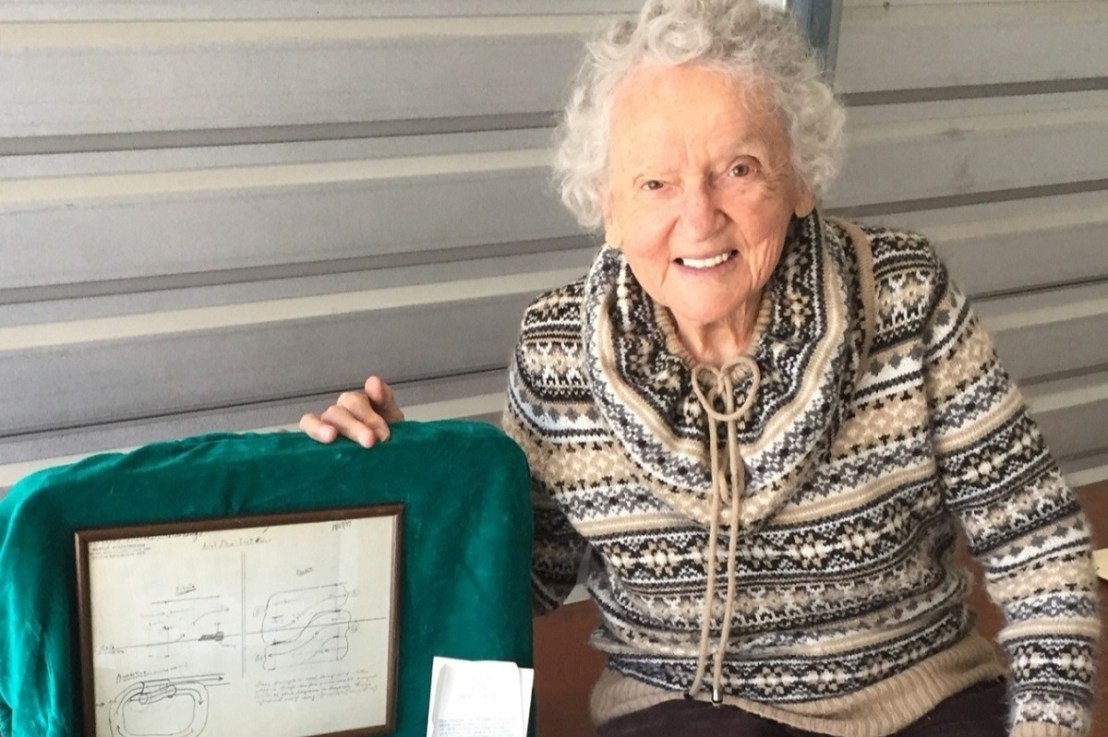
Ed’s valve was first patented in 1978 with a cylindrical valve design. In 1985, he was issued another patent with the well-known cone valve design that is still in use today.

[Above: drawings from Ed Thayer’s 1978 and 1985 patents for his axial-flow valve.]

I was an early adopter of Ed Thayer’s valve. When I was a member of the Baltimore Symphony (1981-1985), I contacted Ed and asked him to add his valve to my Bach bass trombone. This he did, with bass trombone valve number B-6, from the very first group of bass trombone valves he ever made. I endorsed his valve for several years and it was on that single valve trombone with Ed Thayer’s valve that I won the bass trombone position in the Boston Symphony Orchestra in 1985.

Oliin_Carlson_Yeo_March_1985

My colleagues in the Baltimore Symphony, Jim Olin (co-principal), Eric Carlson (second) and I all used axial-flow valve equipped trombones—we became one of the first trombone sections to use trombones with Ed’s valve. The photo above shows Jim, Eric, and me in March, 1985.

Ed Thayer was a superb inventor. More than that, he was a decent, honorable, kind person, and I and many others have always said the same about his wife, Barbara. I count it a privilege to have called them friends. Ed died in 2009, and while the valve he invented changed the face of trombone design, he was not the most savvy businessman. Several unfortunate circumstances surrounding the patent and production of the axial-flow valve drained Ed and Barbara of their financial resources and they were forced to live on Social Security alone. Barbara, now 94 years old, is living month to month.

Ken Novotny has established a gofundme page to help Barbara Thayer pay down her existing debt and help her with a long-term housing solution. This is an admirable project that has already generated many donations from generous donors. But there is a long way to go to the goal of $11,945.

As I was reading my Bible this morning, the following words jumped off the page:

Wash yourselves; make yourselves clean; remove the evil of your deeds from before my eyes; cease to do evil, learn to do good; seek justice, correct oppression; bring justice to the fatherless, plead the widow’s cause.

These words are from Isaiah 1:16-17. It was shortly after reading these words that I received an email from my friend, Marcel Schot, a trombonist in The Netherlands, letting me know about Barbara Thayer’s plight and this effort to help her. As a result, my wife and I have just made a donation to the Help Barbara Thayer gofundme page.

Would you consider doing the same? I don’t think there is any better way to start the new year than to help a widow. Barbara Thayer is deserving of our help, and doing so also honors the legacy of her late husband, Ed. Click the gofundme icon below to be directed to the “Help Barbara Thayer, Widow of Edward Thayer” page. Do a good thing, and “plead the widow’s cause.” Thank you for your consideration.

gofundme

Coming back home: Teaching trombone at Wheaton College

Coming back home: Teaching trombone at Wheaton College

They say you can’t go back. But I just did. In a circle of my life spanning 45 years, I’ve just gone back home. Just a few weeks ago, I was appointed the trombone teacher at my undergraduate alma mater, Wheaton College (Illinois). In a big sense, I feel like I’ve come home, returning to a place that dramatically shaped me even as I now have the opportunity to shape the lives of others.

Yeo_Wheaton_College_1975

[That’s me, warming up before a concert in Wheaton College’s Edman Chapel, spring 1975. This photo appeared in the 1975 edition of Tower, Wheaton College’s annual yearbook.]

It was while I was a student at Wheaton College that I studied trombone with Edward Kleinhammer, then bass trombonist of the Chicago Symphony, and started on my road to become an orchestral bass trombonist, a road that led me to the Boston Symphony Orchestra (1985-2012) and many other remarkable places.

Kleinhammer_Yeo_1976

[Edward Kleinhammer and me at my last lesson with him in his studio in the Fine Arts Building, Chicago, May 1976.]

It was while I was a student at Wheaton College that I met Dr. Harold Best—then the Dean of the Wheaton College Conservatory of Music and author of the remarkable book, Music Through the Eyes of Faithand began an abiding and life-changing relationship with a man who began as my advisor, became my mentor, and is now one of my closest friends.

Douglas_Yeo_Harold_Best_sm.jpg

[Dr. Harold Best and me, at his home in Idaho, 2014.]

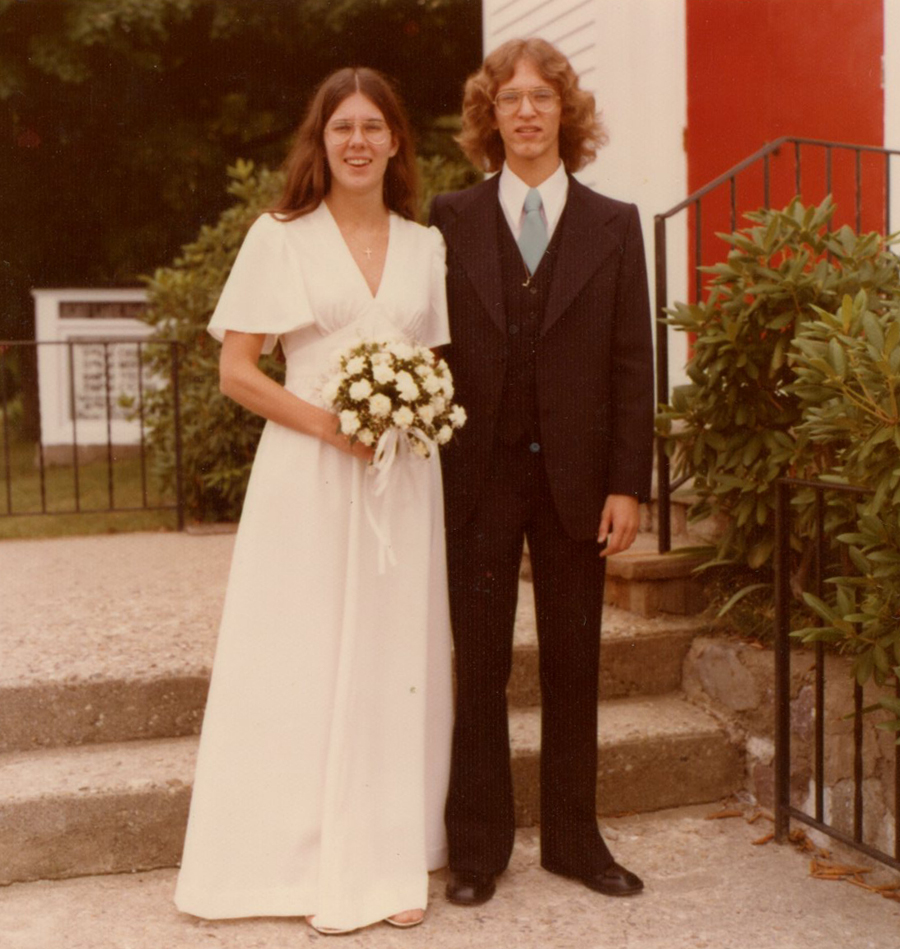
It was while I was a student at Wheaton College where, two weeks after the most wonderful girl in the world and I got married, we set up our first home. After 44 years of marriage, I thank God that she’s still that girl.

Yeo_wedding_1975

[August 31, 1975]

Travis_Yeo_wedding_announcement

It was while I was a student at Wheaton College where I memorized all of the verses to Martin Luther’s great hymn, A Mighty Fortress is Our God (for extra credit on an exam), and since that time, I have recalled it every day of my life, especially its second verse:

Did we in our own strength confide, our striving would be losing;

Were not the right Man on our side, the Man of God’s own choosing.

Dost ask who that may be? Christ Jesus, it is He;

Lord Sabaoth His name, from age to age the same, and he must win the battle.

And it was at Wheaton College where our two daughters attended and graduated with degrees in music.

We all have hopes and dreams. One of mine, held for the last 45 years, has been that God might allow me to return to Wheaton College some day to serve on its faculty, and repay some of what that remarkable place gave to my family and me. Last month, that dream—that prayer—was answered most unexpectedly, when Dr. Michael Wilder, Dean of the Conservatory of Music and Division of Arts and Communication at Wheaton College, asked me to join Wheaton College’s faculty as its trombone teacher. It all happened so quickly, so remarkably, and after a time of prayer and consideration, I accepted.

In announcing my appointment, Dean Wilder said,

“We are delighted to welcome Douglas Yeo to the music faculty of the Conservatory of Music at Wheaton College. He brings an amazing life of experience as a performer, teacher, and thought leader in matters of artistry, faith, and creativity. A very few minutes with Douglas Yeo will pull any person into a whirlwind of ideas and inspiration and we are looking forward to all that he will accomplish at Wheaton College, as he invests in the lives of students, colleagues, alumni, and friends.”

I pray that I might live up to those words.

The fall 2019 semester is now half over, and my students and I are on fall break, a few days of refreshment before we head back to school for more trombone lessons, more trombone studio classes, more concerts, recitals, juries, and our ongoing exploration of music and music making.

Yeo_office_sign

So it is that on Tuesdays, you find me teaching lessons in room 022 of Wheaton College’s brand new (just two years old), state-of-the-art Armerding Center for Music and the Arts. It’s a teaching studio I share with four other Wheaton College faculty, a place where my students and I contend to be better stewards of the talents that God has given to us. On Fridays, I’m in the Armerding Center’s room 141, a spectacular “smart classroom” where we hold our weekly trombone studio class and engage in playing trombone ensembles and solos, listening to music, watching presentations, and much more.

Yeo_WC_piano_dedication_04_sm

[Armerding Center for the Performing Arts, Room 141.]

Next fall, Wheaton College will open a new 648 seat concert hall (this new hall is in addition to the Conservatory’s 101 seat recital hall and the 2400 seat Edman Memorial Chapel), making its music facilities second to none. My wife and I have been blessed to be able contribute to help with the construction and outfitting of these new music buildings and we’d like to encourage others who believe in the mission and work of Wheaton College to support the effort to complete the building of the Concert Hall. Click HERE to read a story about why we are helping with this and learn how you can join us and help as well.

Now, we are already beginning to make plans for the 2020-21 school year. Auditions will take place in the next several months—the deadline to apply for fall 2020 admission is January 10—and I am praying now for the group of students who will be part of the Wheaton College trombone studio next year. If you’re interested in studying trombone with me and attending an outstanding liberal arts college (which has a Conservatory of Music that has a superb undergraduate music curriculum that leads to a bachelor of arts, bachelor of music, or bachelor of music education degree; Wheaton also offers a minor in music), a college that has at its core the commitment to “Christ and His Kingdom,” a place that has high and rigorous academic standards in which students grow and learn to be good stewards of the talents God has given them, and a place that Forbes has recently named one of America’s Top Colleges, I’d like to encourage you to apply for admission. The Wheaton College Conservatory of Music website has details about everything you’d want to know about the study of music at Wheaton: a look at our facilities, biographies of all of our outstanding faculty, videos of large ensemble performances, and much more. You can also get details about how to apply to the Wheaton College Conservatory of Music by clicking HERE. The Conservatory’s mission statement stakes out our commitment to our students:

The Conservatory seeks to bring each of its students to an intellectual understanding of the theoretical, historical, and stylistic aspects of musical practice; to relate each of these to the vast literature of music; and to demand the highest level possible of technical and artistic achievement in performance, composition, and teaching. Most importantly the Conservatory seeks to undertake this task in the light of a biblical perspective which describes the making of music as an act of worship and service, calls for excellence as the norm of stewardship, and relates all of human creativity to the Creatorhood of God.

For more information about trombone study at Wheaton College, go to my bio page on the Wheaton College Conservatory website and click on the tab that says Faith and Learning. There you will find my underlying core philosophy of teaching, and the fundamentals of what it is that we work to do in Armerding Room 022 and 114, across campus, and even to the ends of the earth.

And if you are entering grades 9-12 in the fall of 2020 and are looking for an engaging, one-week long summer music program, I’d like you to know that I will be teaching at Wheaton College’s summer music camp, to be held next summer from June 21-28. This is an ideal way to explore music at Wheaton; for information, click HERE.

I’m back home again, at Wheaton College. If God leads you home there, too, I look forward to seeing you.

Print


An Easter reflection

An Easter reflection

Today is Easter. It is a day that remembers an event of monumental importance: the resurrection of Jesus Christ. The story has been told countless times, and Christians around the world celebrated Easter with song, sermons, and the reading of Scripture.

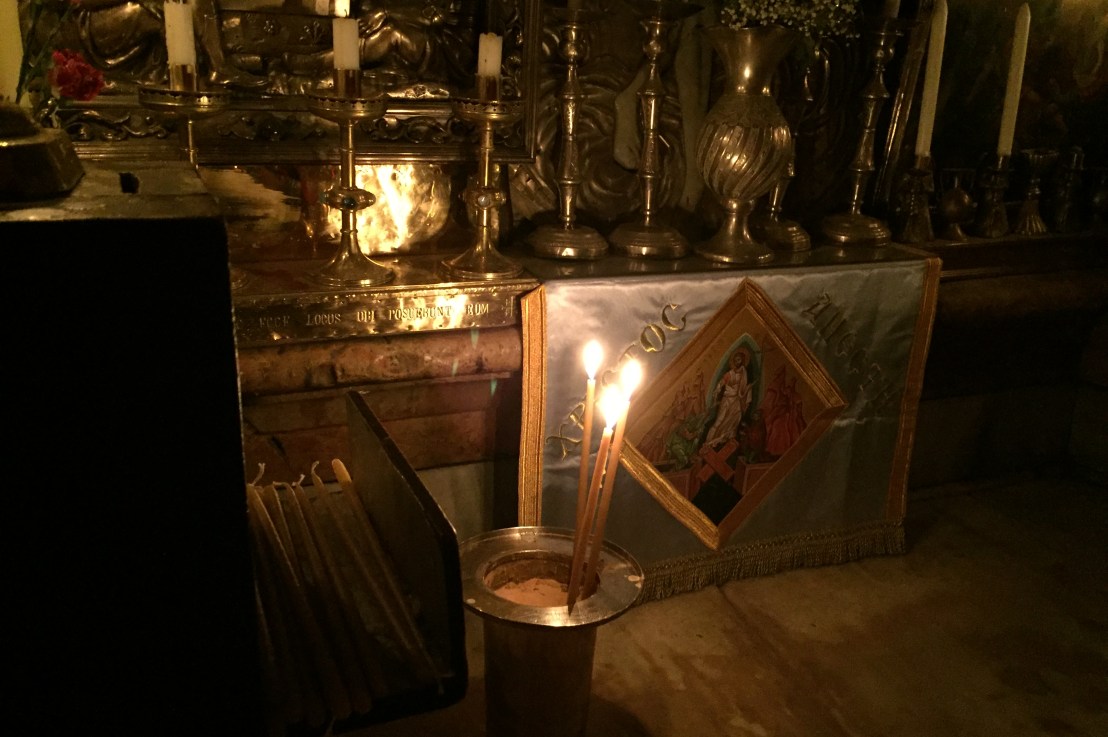
There are four accounts of the death and resurrection of Jesus in the Gospel accounts in the Bible – Matthew, Mark, Luke, and John. Each highlights particular moments in those world-changing days nearly 2000 years ago. In 2016, my wife and I traveled to Israel with a tour group sponsored by our undergraduate alma mater, Wheaton College. The trip was life changing, as we visited many of the traditional sites where pivotal events in the Bible took place. One such site was the Church of the Holy Sepulchre, built over the traditional sites of the crucifixion and burial of Jesus. The photo at the top of this blog entry on The Last Trombone is one I took of the tomb of Jesus in the Church of the Holy Sepulchre. Do we know for sure that he was actually buried there? No, but since at least around 400 AD, Christian pilgrims have venerated this particular place as being the site. I do not engage in debates over whether this or that site is THE site. It enough that I was in the neighborhood.

Artists over the centuries have depicted the resurrection of Jesus as a cataclysmic event, replete with angels and earthquakes, and the moving away of the stone that covered the entrance of the tomb. The Bible tells of this (Matthew 28:1-4):

And behold, there was a great earthquake, for an angel of the Lord descended from heaven and came and rolled back the stone and sat on it. His appearance was like lightning, and his clothing white as snow. And for fear of him the guards trembled and became like dead men.

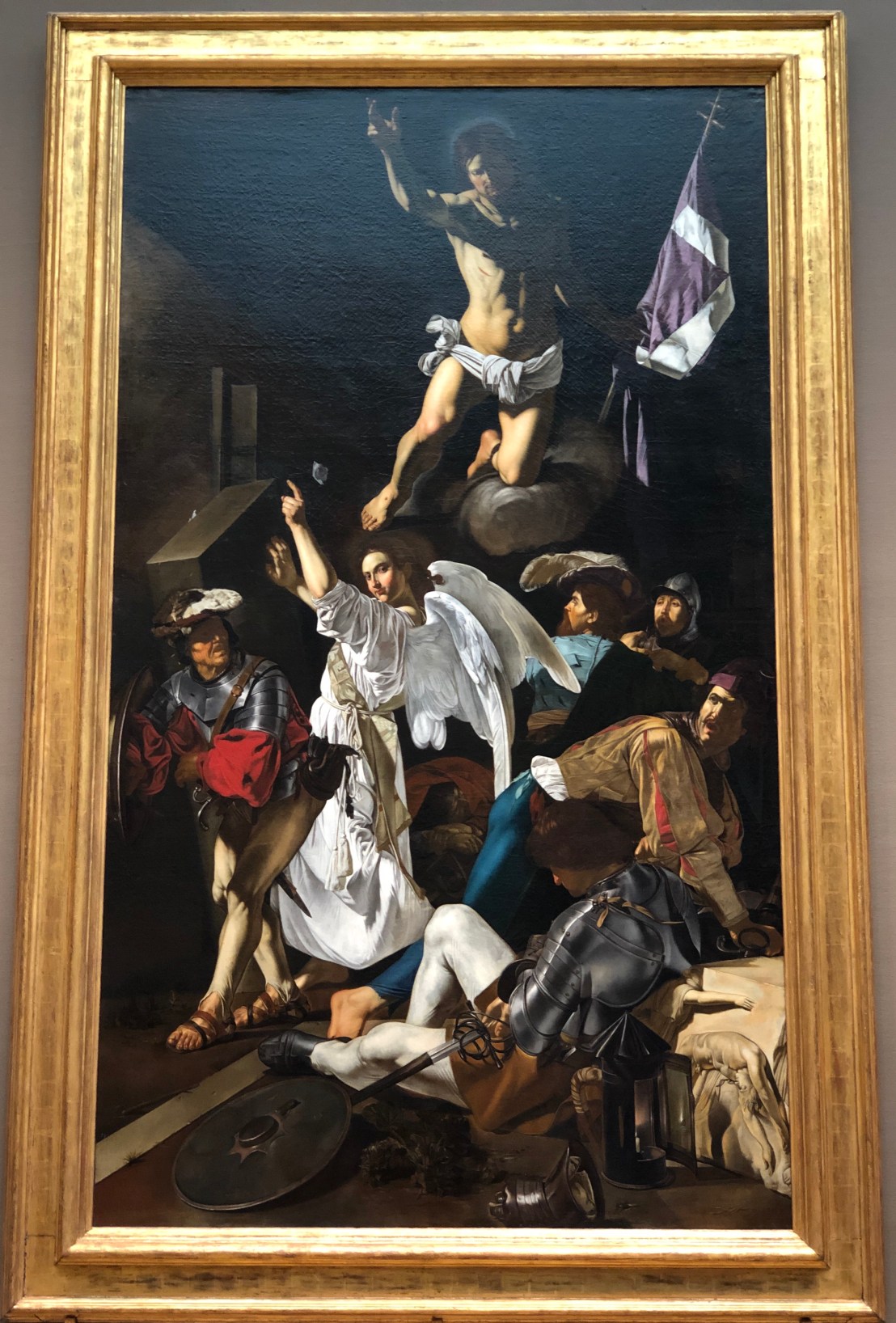
Typical of such artistic representations is the one below that I saw a few days ago at the Art Institute of Chicago.

IMG_2304

The painting is by Cecco del Caravaggio, whose real name was Francesco Buoneri, and it was painted in 1619-1620. Christ appears on top of his tomb, and an angel is dispatching Roman soldiers who were guarding the tomb. Cecco’s use of light and dark is exceptional, and I spent a long time sitting in the museum’s gallery and contemplating the event that it depicts.

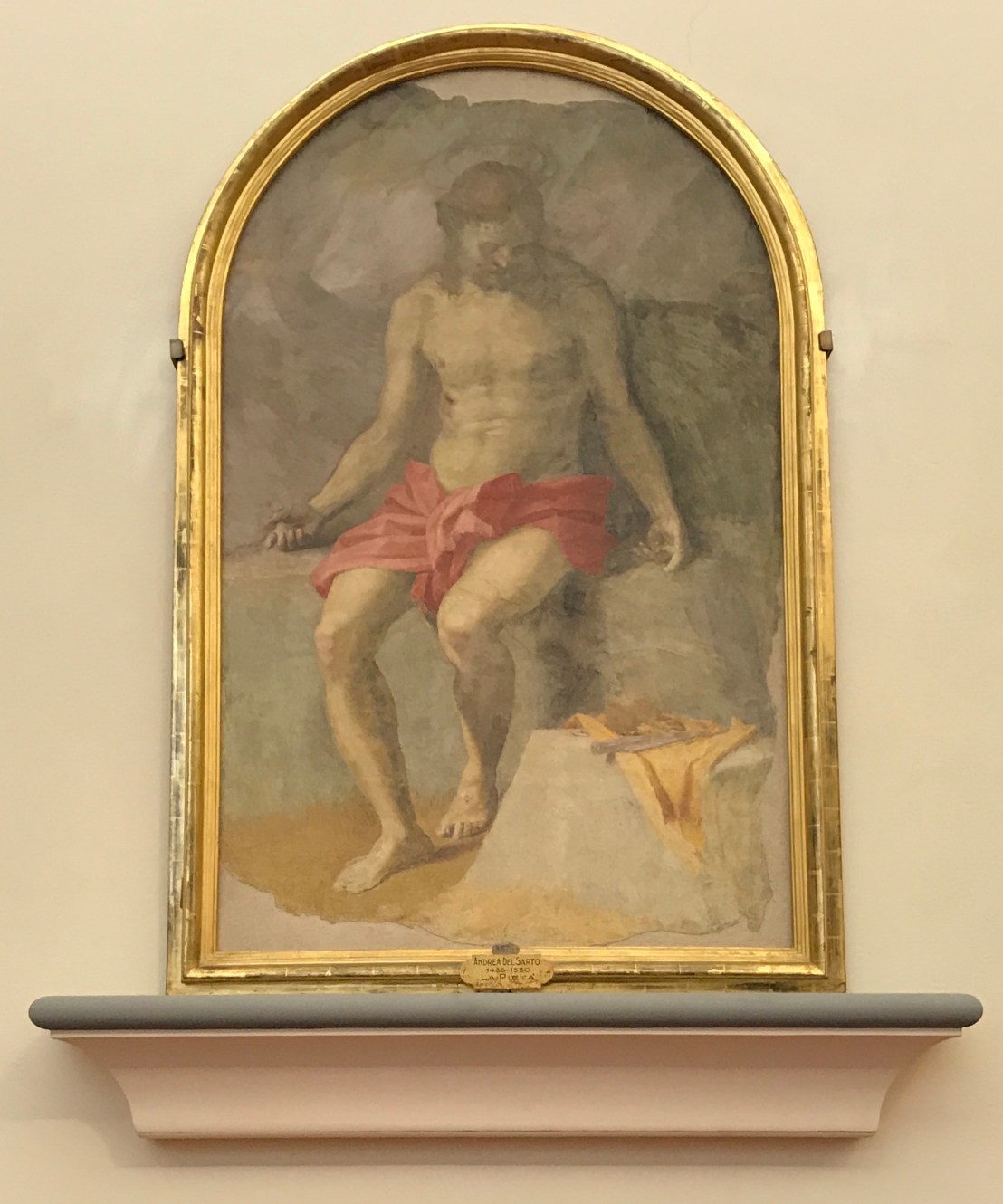
But in 2017, when my wife and I traveled to Italy on another Wheaton College alumni tour — a tour that took us to Florence and Rome — I saw another painting of the resurrection that has stuck in my mind ever since. This painting was in the Galleria dell’ Accademia in Florence, in the same museum that houses Michelangelo’s iconic statue of David. The painting, by Andrea del Sarto, was painted in the early sixteenth century and presents a very different view of the resurrection of Christ.

IMG_2377

Here is a moment before the the earthquake; we see no guards, no angel. It shows Jesus in His tomb at the moment of his resurrection. The wounds from his crucifixion are visible, as are some of his burial cloths. The image is one of quiet contemplation. I am sure I was not alone, when standing before this painting, in asking the question: What was Jesus thinking at this moment?

What I find interesting in all of this is that the Bible is silent about what actually happened inside the tomb at the moment when Christ was raised from the dead. He was dead, buried in the tomb. Then at some point over the next two days, Christ was resurrected, and somehow, in some way, he left the tomb. Two days after his agonizing death on the cross, the tomb was empty. Mary Magdeline was shocked to see the tomb empty when she came to visit it two days after the crucifixion of Jesus, but an angel spoke to her with these earth-shattering words (Matthew 28:6):

He is not here, for he has risen.

I like to meditate on both of these paintings which depict two moments surrounding the resurrection of Jesus. Both speak to the same thing: Jesus was dead, buried, and was raised from the dead. In the days and weeks that followed, He appeared in physical form — not as some kind of ghost or apparition — before hundreds of people. This is documented not only by the Bible, but by other, independent writers. The resurrection of Jesus happened. It was and is true, and it changed the world and the life of every person in it. As the Apostle Paul reminds us (1 Corinthians 15:17-20):

If Christ has not been raised, your faith is futile and you are still in your sins. Then those also who have fallen asleep in Christ have perished. If in Christ we have hope in this life only, we are of all people most to be pitied.

But in fact Christ has been raised from the dead.

C. S. Lewis spoke to this fact in his book, Mere Christianity. I have previously quoted him in my article on The Last Trombone about Christmas, but his words are worth repeating here:

I am trying here to prevent anyone saying the really foolish thing that people often say about [Jesus]: “I’m ready to accept Jesus as a great moral teacher, but I don’t accept his claim to be God.”

That is the one thing we must not say. A man who was merely a man and said the sort of things Jesus said would not be a great moral teacher. He would either be a lunatic — on the level with the man who says he is a poached egg — or else he would be the Devil of Hell. You must make your choice.

Either this man was, and is, the Son of God, or else a madman or something worse. You can shut him up for a fool, you can spit at him and kill him as a demon or you can fall at his feet and call him Lord and God, but let us not come with any patronizing nonsense about his being a great human teacher. He has not left that open to us. He did not intend to.

The death of Jesus Christ. His burial. His resurrection. It happened. And it matters. Happy Easter.

Surprises

Surprises

Life is full of surprises, unexpected things that intersect our lives. Sometimes a surprise is shocking, such as a car accident, or the sudden death of a friend or loved one. Sometimes surprises are joyful, like getting accepted to a college you thought was out of reach. No matter how they come, surprises always get our attention. A recent surprise got me thinking of how interesting this theme of surprises (good ones!) has been in my life recently.

Among my many ongoing projects, I have been doing a study of the Stephanovsky 20 Etudes for Bass Trombone. As my friend, Peter Ellefson (Professor of Trombone at Indiana University) pointed out to me a few weeks ago, Keith Brown’s 1964 edition of the Stephanovsky 20 Etudes contains a great deal of common material with Brown’s edition of Fritz Werner’s 38 Studies for Trombone. What? Two composers whose books contain much music that is identical? Keith Brown died last year so he isn’t here to explain what happened. So I’ve been trying to figure out this little puzzle.

In my research, I learned that the 20 Etudes were first published under Stephanovsky’s name in the Soviet Union, first around 1950 and then again in 1961 (Werner’s book was first published in 1927). I hunted around for copies of Stephanovsky’s Russian editions to obtain via Inter Library Loan and finally located a copy of the 1961 edition (I did locate a copy of the c. 1950 edition but the library that owns it is in Europe and does not participate in ILL) in the library at University of Texas, Austin. In a few days, it was heading to me for examination.

SURPRISE! When I opened it, the title page revealed that this copy had been previously owned by Donald S. Knaub, former professor of trombone at Eastman School of Music and University of Texas. Knaub is one of the most respected trombone teachers of the twentieth century; I was very privileged to meet him a few years ago when I gave a masterclass at University of Houston. A book from his personal library? Nice.
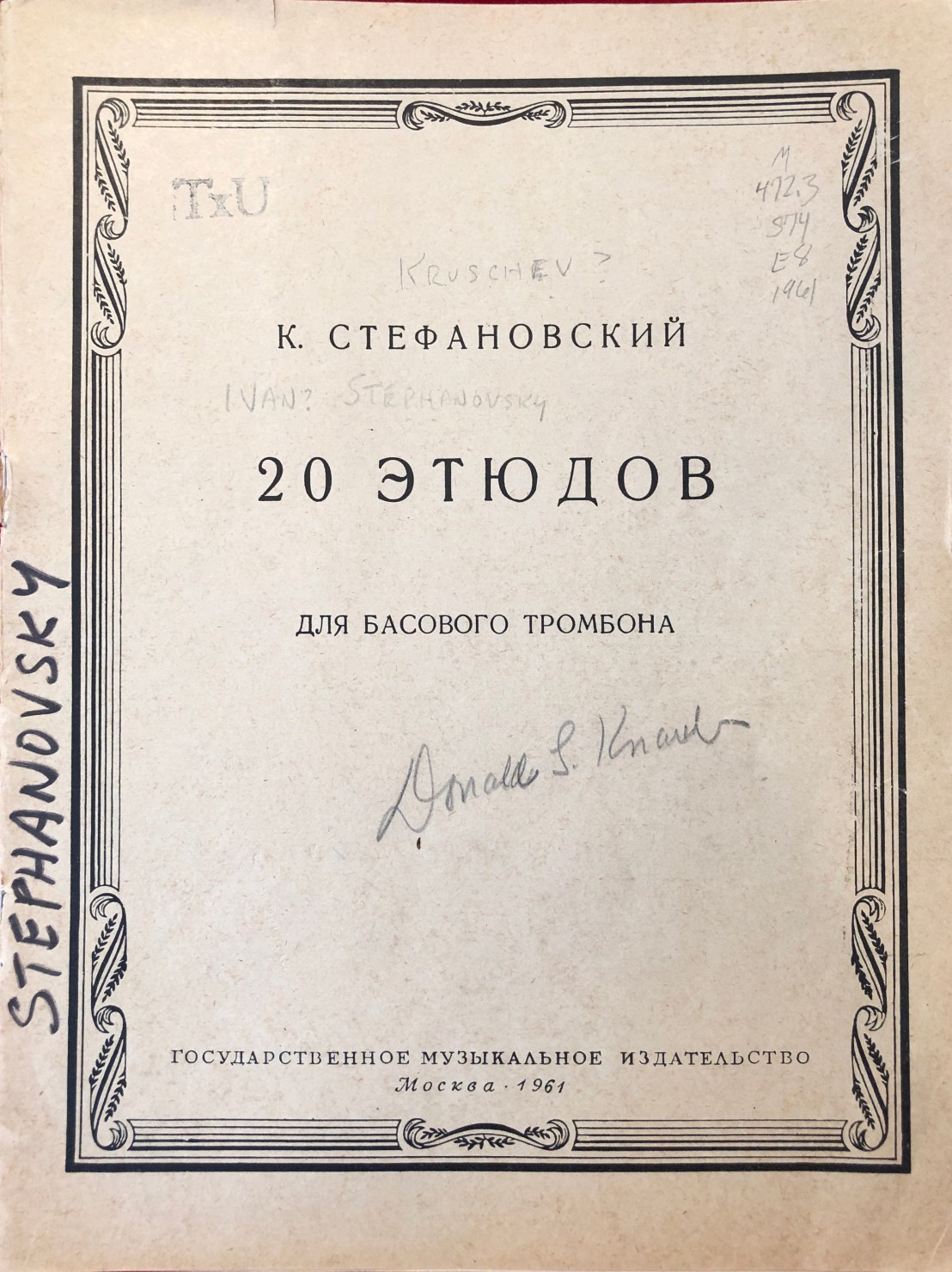
stephanovksy_cover_knaub_copy_1961

SURPRISE! Someone (it was probably Knaub since the handwriting looks like his) made some assumptions about the name of the composer of this music. No, it was not Kruschev, nor Ivan. Stephanovsky’s first name was Karl. The University of Texas librarians got the name right when they entered the music into their catalog.

Whenever I hold music that was owned by someone else, I have great anticipation when I open it up since there are often hand-written markings that prove to be as interesting to me as the music itself. Knaub’s music didn’t disappoint.
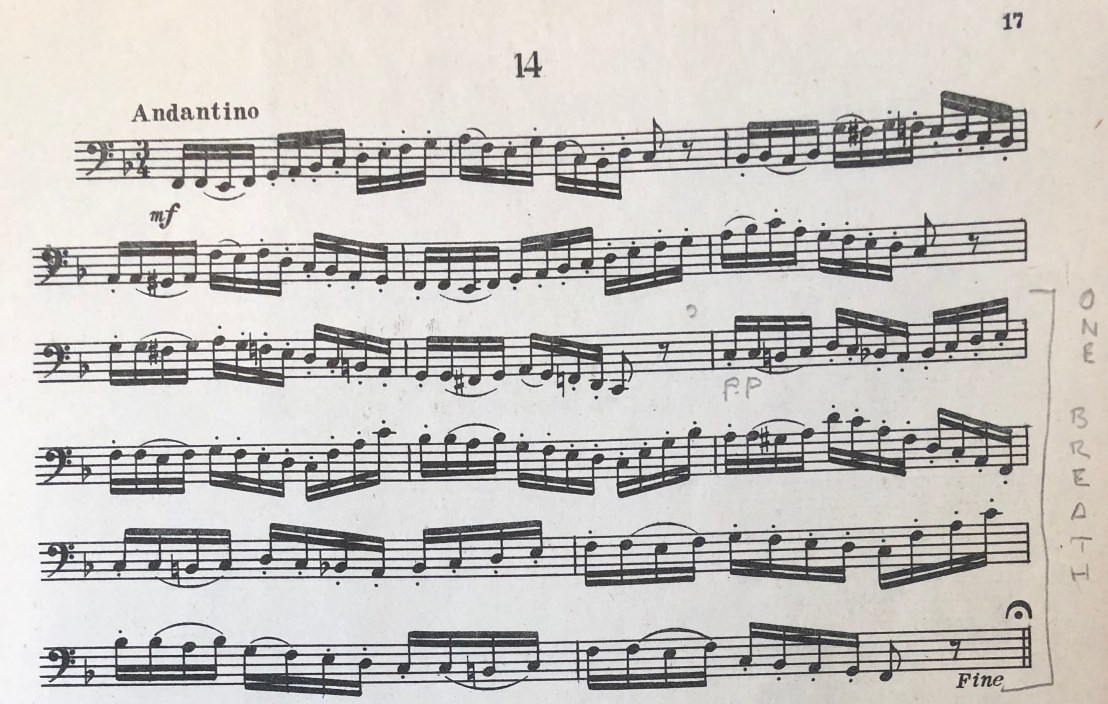
stephanovsky_14_detail_knaub_copy

SURPRISE! When I turned to Etude 14 I saw Knaub’s handwriting that marked out several bracketed staves where he had written “ONE BREATH” next to them, after having changed the dynamic of mezzoforte to pianissimo. I had to smile. I have made the same indications in many copies of this book when I have assigned that same etude to students over my many decades of teaching. Pushing ourselves to play long phrases is an essential part of learning good breath control. It was nice to see that Knaub asked the same thing of himself – and he probably asked it of his students as well.
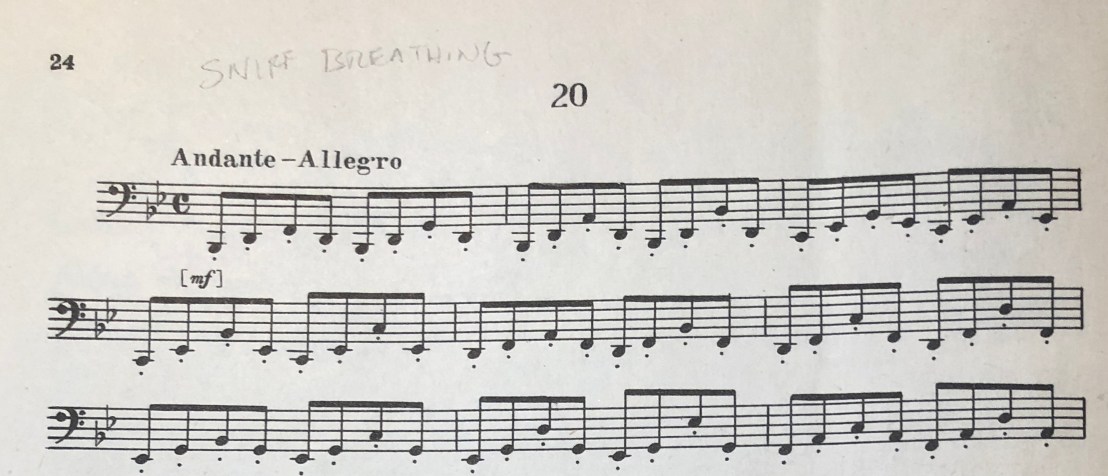
stephanovsky_20_detail_knaub_copy

SURPRISE! When I turned to the final page of the book, Knaub had written “SNIFF BREATHING” at the top of Etude 20. Another big smile from me. I have been extolling the virtues of sniff breathing – that is, taking quick breaths through the nose rather than breathing through the mouth while playing – as a way to deal with playing music like this where there just isn’t a good place to take a breath. I was taught this technique by my former Boston Symphony tuba colleague, Chester Schmitz, and it has served me (and my students) well ever since then. To see that Knaub suggested using sniff breathing on this etude was a great verification to me, since this is the very kind of etude I assign to my students to practice this useful breathing technique.

In 2010, I was in Rouen, France, doing some teaching and performing en route to a conference in Paris that was devoted to the musical instrument called the serpent. Whenever I go to Europe, I always seek out cathedrals and large churches. I have a great interest in Gothic-era church architecture. Rouen, of course, has one of the most famous cathedrals in the world, made all the more famous by the more than thirty paintings of its west front by Claude Monet (below).
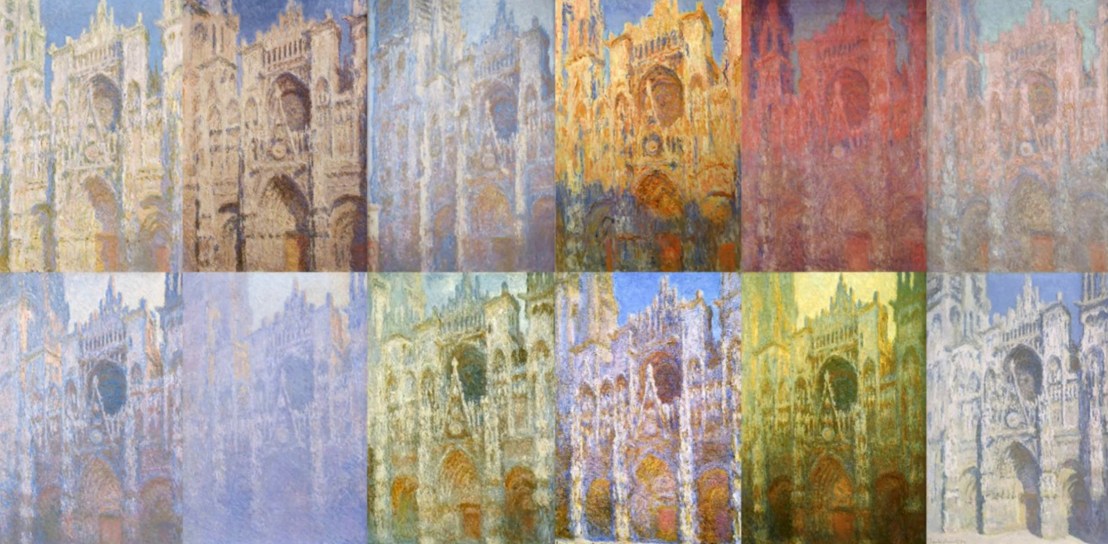
rouen_cathedral_monet

My oldest daughter, Linda (who was accompanying me on the trip), and I spent some time inside and outside this magnificent church, but my host and friend, Volny Hostiou, told us of another interesting church in Rouen that is much less known. And it had a surprise.

SURPRISE! Actually, when Volny told me about the Abbey Church of St. Ouen, he was surprised it was not the first time I had heard of it. I’ve been aware of its architecture ever since a set of twelve aquatints by the English artist, Charles Wild, came into my possession many years ago. Wild’s “Twelve Selected Examples of the Ecclesiastical Architecture of the Middle Ages, Chiefly in France.” In 2001, I wrote an article about one of these prints, “The Choir of the Cathedral of Amiens,” where I discussed the serpent players depicted in the print (you can view and download my article about this in the Historic Brass Society Journal by clicking this link). Among the prints in Wild’s set are two of the Abbey Church of St. Ouen in Rouen. One is of the outside of the church:
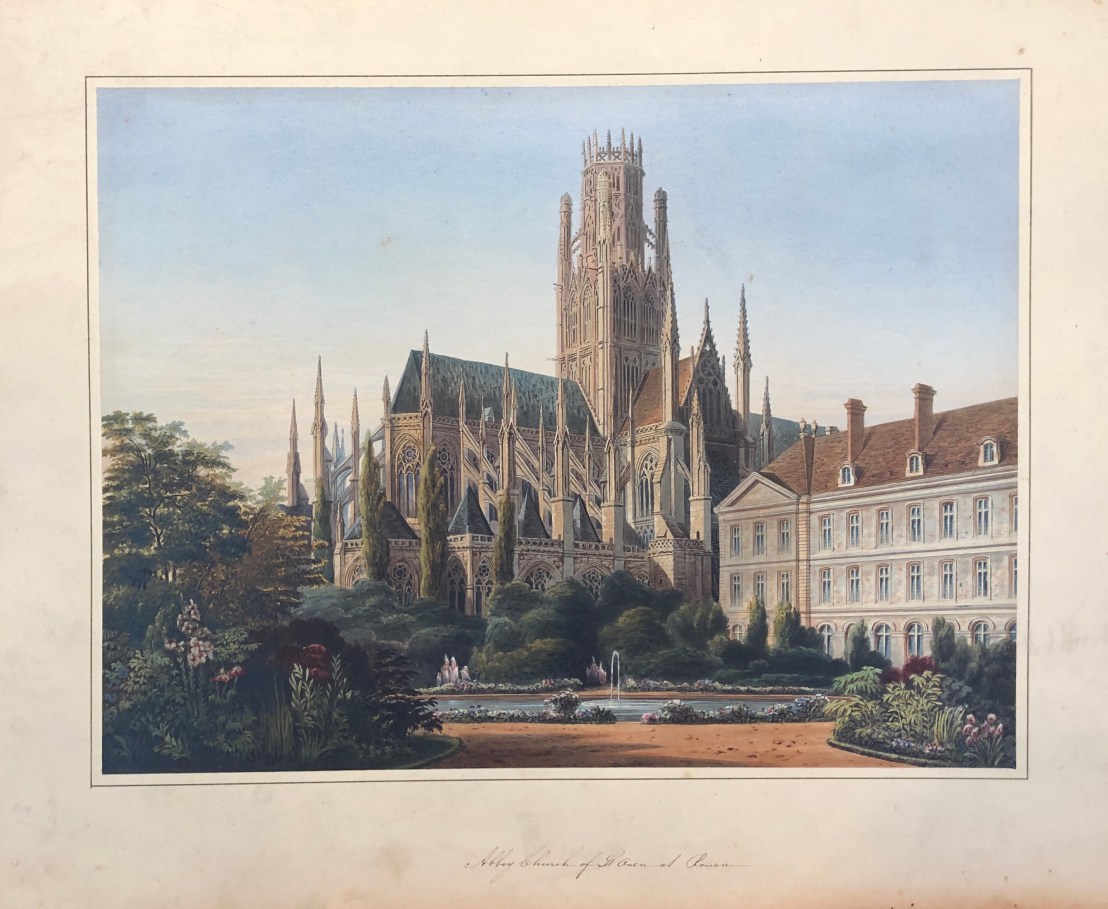
wild_abbey_church_rouen_01

And the other is of the church’s transept:
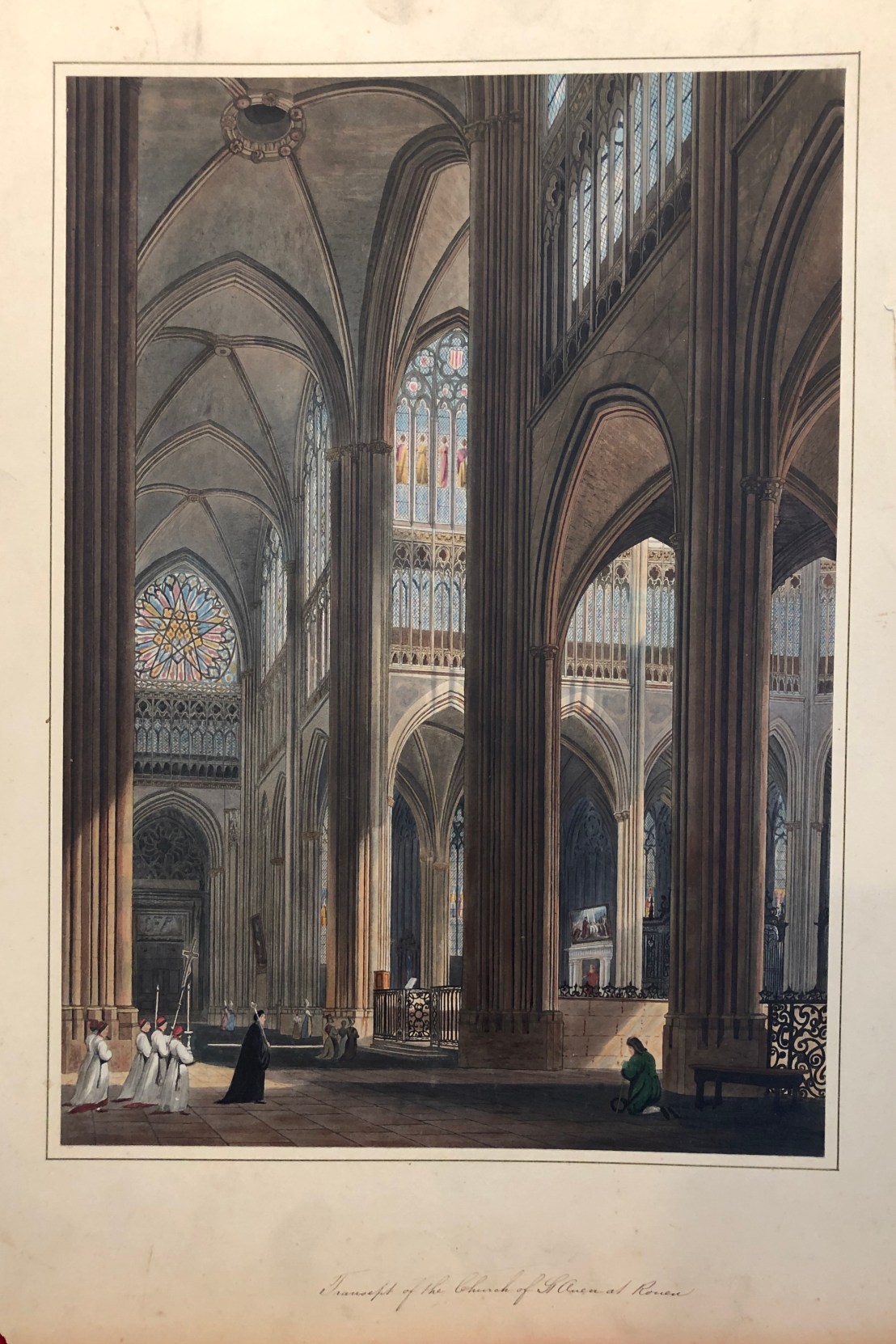
wild_abbey_church_rouen_02

These are beautiful images, ones that have taught me a great deal about Gothic architecture and cathedral/church life. But now Volny had a surprise for me. “When you go inside,” he said, “look up. You will find a serpent player.” Linda and I made a trip to the Abbey Church to find out what Volny was talking about.

st_ouen_serpent_angel_01

SURPRISE! We looked all through the church for the serpent player and finally we found him. High up on the ceiling in a side chapel, there it was, a remarkable painting of an angel playing the serpent. Nothing there about harps in heaven!

st_ouen_serpent

The serpent, which had been invented sometime in the late fifteenth or early sixteenth century and then evolved to be an instrument to accompany the singing of chant in the Church in France, would have been well known to every person who had worshipped in St. Ouen in the sixteenth through nineteenth centuries. The painting is heavily damaged but it is still remarkable nonetheless. Who painted it? When? Questions. . .

st_ouen_serpent_angel_04

SURPRISE! But there was more. As we looked more carefully at the painting, we realized that the serpent player was not alone. Look at the image, above. Just to the right of the serpent-playing angel’s left wing you see another face. It’s very faint and hard to find. (Maybe this will help: look at the chin of the serpent-playing angel, then move your eyes to the right until the stonework of the ceiling appears. The second angel’s face is there, just to the side of the larger angel’s wing.) You can clearly make out the face of another angel who is looking at the serpent-playing angel. An unexpected surprise on top of a surprise. Did this other angel originally have an instrument in hand? What did the rest of the ceiling look like when the paint was all intact? Questions. . .

Some of my biggest surprises come in books. Because of the nature of the research I do, I purchase a lot of used books, and mostly books that are out of print. I get all of my used books through abebooks.com, a website that serves as a massive catalog of the holdings of thousands of bookstores around the world. I can usually find any book I want there, and usually for only a few dollars. And sometimes when I open up a used book, I find a surprise.

halas_by_halas_cover

SURPRISE! My wife and I enjoy football and one of the first things we did when we moved to the Chicago area last fall was to become season ticket holders for the Chicago Bears. We’re all in with the Bears and since we want get to know the team better, I’ve been acquiring several books and DVDs about its history. Last week, I ordered a used copy of Halas by Halas (New York: McGraw-Hill Co., 1979), the autobiography of George S. Halas who was not only the first coach, then player, then owner of the Chicago Bears, but was the driving force behind the creation of the National Football League in 1919.

halas_by_halas_autographs

You can imagine my surprise when I opened this book – which I purchased for under $20 – and I found several autographs inside the front cover. There is Doug Atkins, defensive end for the Chicago Bears from 1955-1966 and a member of the Pro Football Hall of Fame. And Mike Pyle, center for the Bears from 1961-1969. And George Connor, another member of the Pro Football Hall of Fame who played linebacker/tackle for the Bears from 1948-1955. There is also the signature of Jeanne Morris, a pioneering female television sports broadcaster, and two members of the short-lived Chicago Bears cheerleading squad, the Honey Bears. Also of interest is the book plate that celebrates the event where books were distributed and the autographs were probably inscribed. I wonder who else was there at that Chicago Bears Reunion Dinner? Who was “Charlie,” to whom some of the autographs are signed? Questions. . .
rodeheaver_20_years_billy_sunday_cover

Among the several books I am writing at the moment is a biography of Homer Rodeheaver, the trombone-playing song leader for evangelist William Ashley “Billy” Sunday in the first third of the twentieth century. Rodeheaver is a fascinating character who was a driving force in the promotion of gospel music in the twentieth century through his publishing company, record company, and evangelistic work. With my friend and co-author, Kevin Mungons, we are moving along in the process of bringing this book to publication with University of Illinois Press.

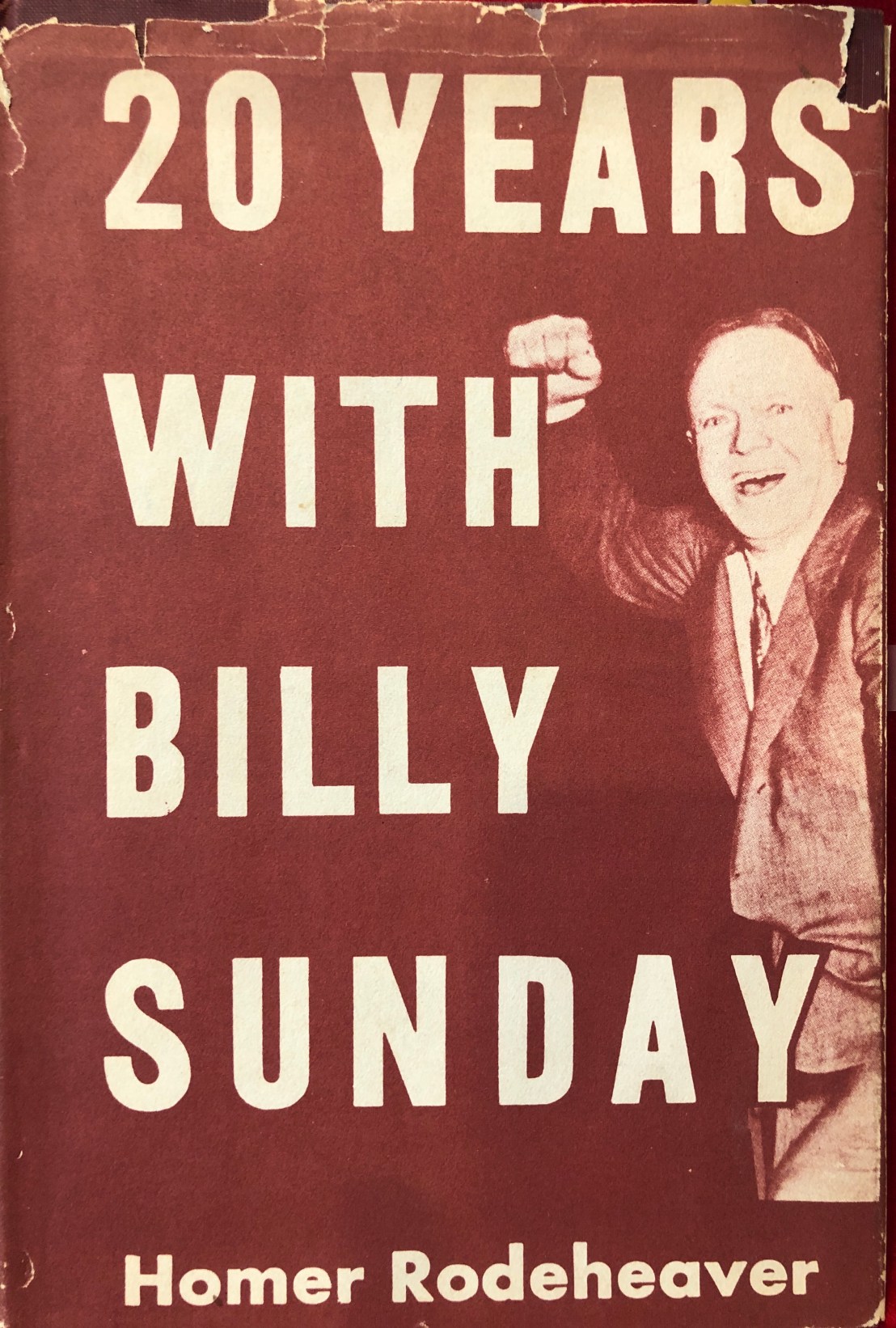
In the course of our research, both Kevin and I have acquired many (hundreds, for sure, maybe thousands?) of books that inform our understanding of Rodeheaver, his life, times, and work. Among them is Rodeheaver’s own book, 20 Years With Billy Sunday (Winona Lake, Indiana: Rodeheaver Hall-Mack Co., 1936), the story of his years as songleader for evangelist Billy Sunday. While long out of print, copies of the book are not especially rare. But. . .

rodeheaver_20_years_billy_sunday_autograph

SURPRISE! When I opened my used copy of Rodeheaver’s book, I found his inscription inside the front cover, with a reference from the Bible, Colossians 3:16, “Let the word of Christ dwell in you richly, teaching and admonishing one another in all wisdom, singing psalms and hymns and spiritual songs with thankfulness in your hearts to God.” I’m not an autograph collector, but to hold and own a copy of Rodeheaver’s book in my hands that he had held in his own hands was a very nice surprise. As to Watts Franklin (or Franklin Watts?) of Elizabethtown, Kentucky, a previous owner of this book – his (her?) return address label appears on the page with Rodeheaver’s signature – I have not been able to learn anything. Did Watts meet Rodeheaver and ask him to sign the book? Was it a gift to him/her? Questions. . .

Unlike Homer Rodeheaver whose life has never been chronicled in a biography, Billy Sunday is the subject of many books. Some were written during his lifetime (he died in 1935) and others are more contemporary. Books about Sunday – whether authorized by the evangelist or not – provide a fascinating window into his life and ministry as seen through the lens of the time in which he lived.

brown_sunday_cover

One of these books is by Elijah P. Brown, The Real Billy Sunday (New York: Fleming H. Revell Co., 1914). My used copy has a stamp in the back that says it was owned by Sarah A. Kemmerer of Allentown, Pennsylvania. Who she was I do not know. More questions. . .
lehigh_christian_endeavor_pamphlet_1916

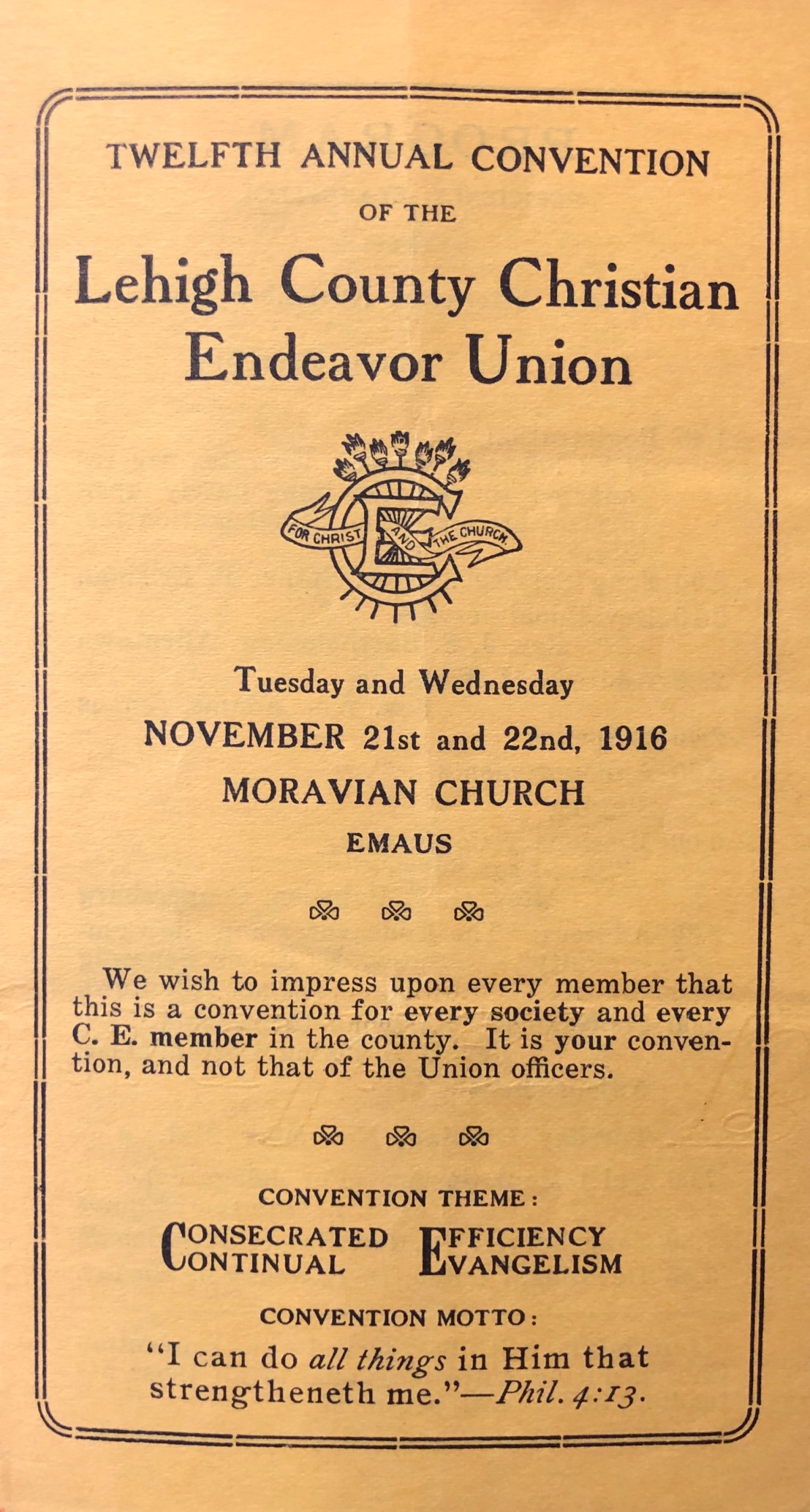
SURPRISE! When I opened my used copy of Brown’s book, a small, six page pamphlet fluttered to the floor. It was a program for the 1916 convention of the Lehigh (Pennsylvania) County Christian Endeavor Union, November 1916. Held at the Moravian church in Emaus, Pennsylvania (this spelling was used for the borough from 1830-1938; before and after that time it was/is spelled Emmaus), the convention featured sermons, singing, devotionals, and other activities for youth and adults. It provides a fascinating glimpse into the schedule of one of these meetings which were common occurrences at the time.

ellis_billy_sunday_cover

SURPRISE! Another among my many biographies of Billy Sunday is “Billy Sunday” The Man and His Message by William T. Ellis (Philadelphia: John C. Winston Co., 1914). This used copy contained a remarkable surprise: an original copy of the brochure that Billy Sunday put into the hands of tens of thousands of people who attended his tabernacle meetings and “walked the sawdust trail” up the aisle to shake hands with the evangelist as they made a public profession to trust Jesus Christ as Savior. The fact that this tract was kept in the book made me wonder if a previous owner bought the book at one of Sunday’s meetings and then put the pamphlet inside that very night for safekeeping. Names of two previous owners of the book are inscribed inside the front cover: a signature of Arthur S. Beale, and a label with the name L. Wilkins of Watertown, Massachusetts. Who were they? When and how did they come to own this book? Questions. . .

The pamphlet is a remarkable historical document and one that is as fresh today as when it was first used by Sunday in the early twentieth century. There are many things I find interesting about this pamphlet, including the fact that it bears the imprint of a union publishing house, Allied Printing of Paterson, New Jersey. Could this brochure have been printed for the 1917 Billy Sunday meetings in New York City? Questions. . .

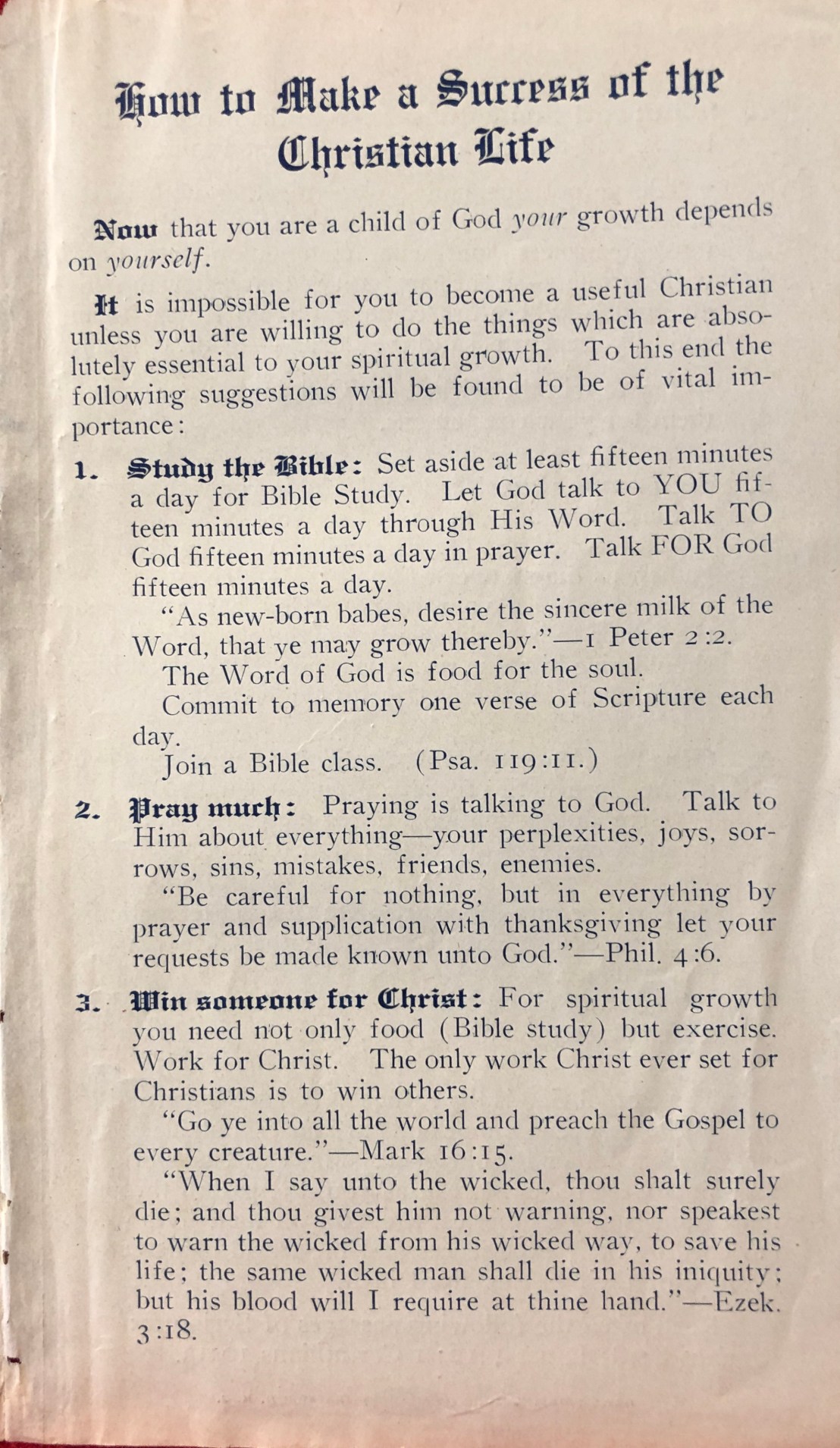
Sunday asks some important questions and gives some important advice. Have a look.

sunday_tract_01sunday_tract_02sunday_tract_03sunday_tract_04

Life is full of surprises. Sometimes they cause you to ask questions. Sometimes they can change your life.