by Douglas Yeo (October 15, 2023)
I retired from the Boston Symphony Orchestra in 2012 after nearly 30 years as a member of that remarkable institution. I use the word institution because the BSO was more than an orchestra. Yes, the orchestra itself was the raison d’être for BSO Inc., but there was so much that flowed from the decision by Major Henry Higginson to establish a symphony orchestra in Boston in 1881. The Boston Symphony Orchestra, the Boston Pops Orchestra—which is the BSO minus most of its principal players—Symphony Hall in Boston, the BSO’s annual summer festival at Tanglewood, recordings, tours. It’s all part of the life I led for so many years and I am grateful that I was able to live my dream.
In the 11 years since I retired from the BSO, I’ve been engaged in a host of interesting and very rewarding activities. From recreational trips with my wife and other members of our family, to the joy of living near our grandchildren, to writing many books and articles, to teaching in several colleges/universities (Arizona State University, Wheaton College (Illinois), University of Illinois Urbana-Champaign), to serving now as interim music director at my church, New Covenant Church in Naperville, Illinois, my life is full and interesting. Yet while I left the full time symphony orchestra world in 2012, I’m still interested in it. Now, however, I’m mostly looking at it from the outside. And with this new perspective, I’m increasingly asking myself this question:
What is happening?
“Time,” as the hymn writer Isaac Watts reminded us in his great hymn, Our God, Our Help in Ages Past, is “like an ever-rolling stream.” Times change, things change. Nothing stays the same. It’s easy for someone at my season of life to look back at “the good old days” and assume the ways things were done back then were always better than they are today. Through an honest lens, I can say that some things were better. But not everything. And part of getting older is seeing things change and evaluating them in light of the ever-rolling stream of the passage of time.
As a college professor and one who now sits more frequently in the audience at concerts than on the stage, I am observing many trends in the performing arts. Many of these flow from current cultural mores, the evolution (and let’s remember that evolution of anything is not always for the better) of cultural thinking and operating. Recently, I’ve observed and heard about some things in the orchestra world that have me asking,
What is happening?
To wit, I recently:
- Attended a concert by a certain professional symphony orchestra where a member of the ensemble—who did not play in the second movement of a piano concerto—took a large sheaf of yellow lined papers out from his tail coat pocket, crossed his legs, sat back in his chair, and proceeded to read the papers—shuffling the pages—for 10 minutes while the concert was going on around him.
- Learned that a member of a certain professional symphony orchestra was recently dismissed because the member arrived late to a concert and had to conspicuously walk through the orchestra to get to the member’s seat in full view of the audience.
- Saw a concert performed by a certain professional symphony orchestra where a player had a rough time with a long, exposed solo—I’m sympathetic to the problem; it can happen to anyone—and while he was missing notes all over the place, leaned back in his chair and kicked up his legs, making light of the situation.
- Learned that a member of a certain professional orchestra was recently dismissed for being rude and insubordinate to the orchestra’s conductor and playing inappropriately loudly after repeatedly being asked to stop doing so during rehearsals and concerts.
- Attended a concert by a certain professional symphony orchestra where a member of the brass section added many extra notes to his part, took several notes down an octave, and generally obliterated the orchestra with his crass, loud playing. And at the end of the concert, he smiled broadly.
- Learned recently that the trombone section of a certain professional symphony orchestra is “the most hated section in the orchestra” because they play so loudly and out of context.
What is happening?
When I joined the Boston Symphony Orchestra in 1985, I was 30 years old. I was an experienced bass trombonist, having been a member of the Baltimore Symphony Orchestra for four years, and having worked in New York City as a freelance player for five years. I was very aware of the storied history of the Boston Symphony, its long roster of celebrated music directors, and its unparalleled recorded legacy. I was also aware that Joannès Rochut, whose name is familiar to many of not most trombonists because of the three volumes of Melodious Etudes he arranged from works of Marco Bordogni, had been principal trombonist of the BSO from 1925–1930. I knew I was coming into something that had been around for over 100 years before me.
The Boston Symphony Orchestra has traditions. Tradition is a word that gets knocked about these days. Many people equate tradition with stuffiness, with a “dead” way of doing things. But that’s not the case if tradition is vibrant. For the 104 years before I joined the Boston Symphony, it had evolved to do things in particular ways. The sound of the orchestra was rich and lush, a sound that was enhanced by the fact that the orchestra played in one of the finest concert halls in the world, Symphony Hall, built in 1900.

Boston Symphony Orchestra low brass section: Ronald Barron, Norman Bolter, Douglas Yeo, Chester Schmitz. Symphony Hall, Boston, 2001.
At the time I joined the BSO, there were members in the orchestra who had been hired by the orchestra’s music director from 1924–1949, Serge Koussevitzky, and many more had been hired by Charles Munch, who was music director from 1949–1962. A member of the orchestra’s cello section had played with Glenn Miller’s orchestra during World War II and was part of Miller’s group at the time Miller died when his plane’s frozen carburetor caused it to crash into the English Channel on December 15, 1944. There were men in the orchestra who wore a jacket and tie to rehearsal. There were certain ways the orchestra played, and the expectation was that new players would come into the orchestra and add to that tradition by blending with the rest of the orchestra while adding one’s own musical personality in appropriate ways. It was exhilarating. There I was, sitting in the orchestra’s low brass section between Chester Schmitz—hands down the finest orchestral tuba player that I have ever heard—and Norman Bolter—who had joined the BSO at the age of 20, a prodigy of epic proportions. Ronald Barron headed our low brass section as principal trombonist. Principal bassoonist Sherman Walt, principal clarinetist Harold “Buddy” Wright, principal timpanist Everett “Vic” Firth—they were all there, plying their craft at the highest level. I sat, I played, I observed, I learned, and above all, I fit in. Fitting in required a measure of humility. It wasn’t just because I was “the young guy” and I needed to wait my turn. No, this was normal, usual operating procedure. The goal of the entire orchestra was to present a unified musical product. And we did.
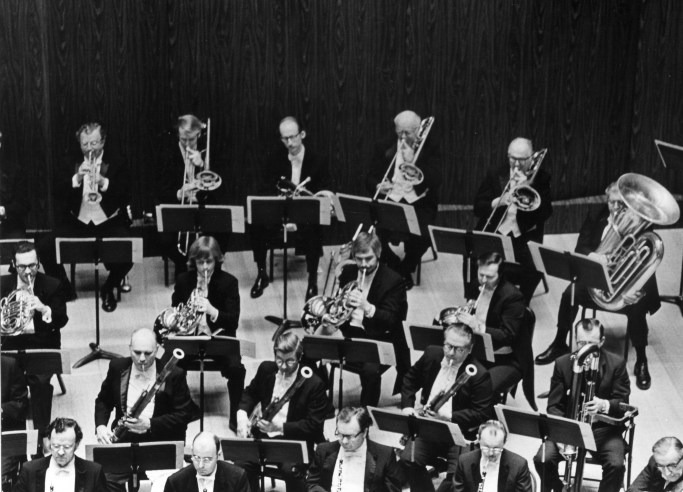
Members of the Chicago Symphony Orchestra brass section. Back row: Adolph Herseth, trumpet; James Gilbertson, Jay Friedman (with euphonium), Frank Crisafulli, Edward Kleinhammer, Arnold Jacobs. Orchestra Hall, Chicago, 1972. Photo courtesy of the Chicago Symphony Orchestra Archives.
I learned the importance of this when I was an undergraduate student at Wheaton College. I studied with Edward Kleinhammer, the celebrated bass trombonist of the Chicago Symphony Orchestra from 1940–1985. In 1975, my wife and I attended a CSO performance of Richard Strauss’ Eine Alpensinfonie. I had never heard the piece before I heard it at that concert (imagine a time in the world’s history where there was only one recording of Strauss’ epic work—and I had not heard it) and I was stunned by the piece and the CSO’s performance. After the concert, my wife and I waited for Mr. Kleinhammer to come up the stairs from the basement of Orchestra Hall and when he arrived at the lobby landing, I blathered away about how amazing he was in the concert. He looked at me with a penetrating stare and then said, “If you heard me, I was a failure. You shouldn’t have heard a fourth trombone player. You should have heard a great orchestra.” And he walked away. I was stunned.
The next day I had a lesson with Mr. Kleinhammer where he unpacked his comment. He told me I was listening to the wrong things. That Eine Alpensinfonie was not all about the fourth trombone player—or the trombones at all. Yes, there were moments when the trombones had a melodic line. But for most of the piece, they worked in community, supporting other instruments. Mr. Kleinhammer told me, “Douglas, it’s not about me. It’s about the MUSIC.” It was at that moment that scales fell from my eyes. I was intoxicated with the trombone section and I missed the orchestra. I had lost the forest for the trees.
And, as God can only do because He is God, I came home from that lesson and opened my Bible and read something that got my attention and changed my life. In the book of First Corinthians, the Apostle Paul wrote about the church, and how a healthy church should be and act. He wrote (1 Corinthians 12:14–27, English Standard Version):
For the body does not consist of one member but of many. If the foot should say, “Because I am not a hand, I do not belong to the body,” that would not make it any less a part of the body. And if the ear should say, “Because I am not an eye, I do not belong to the body,” that would not make it any less a part of the body. If the whole body were an eye, where would be the sense of hearing? If the whole body were an ear, where would be the sense of smell? But as it is, God arranged the members in the body, each one of them, as he chose. If all were a single member, where would the body be? As it is, there are many parts, yet one body.
The eye cannot say to the hand, “I have no need of you,” nor again the head to the feet, “I have no need of you.” On the contrary, the parts of the body that seem to be weaker are indispensable, and on those parts of the body that we think less honorable we bestow the greater honor, and our unpresentable parts are treated with greater modesty, which our more presentable parts do not require. But God has so composed the body, giving greater honor to the part that lacked it, that there may be no division in the body, but that the members may have the same care for one another. If one member suffers, all suffer together; if one member is honored, all rejoice together.
Now you are the body of Christ and individually members of it.
It was at that moment I understood the flaw in my musical thinking. I realized that playing the trombone in an orchestra was not about me. It was not about showing anyone else what I could do, it was not about strutting my stuff, it was not about calling attention to myself. The Apostle Paul’s metaphor for the proper working of the Church—the human body and all of its diverse parts, each of which has a unique function—was a metaphor for the proper working of ANY group of people. A friendship, a marriage, a football team, a business, a church. And a symphony orchestra.
It was then that I distilled Paul’s words into a phrase that I have repeated countless times to my students and colleagues (just ask them; they’ll tell you I say this frequently):
All members of the orchestra are equally important, but at any given moment, all members of the orchestra are not equally prominent.
This is what a symphony orchestra should be about. Each member is equally important. Whether playing the melody, or an underlying rhythmic figure, or soft whole notes, every part is equally important. Just like every part of the body. But when I have long soft notes to play, they are not as prominent as the melody played by the first oboe player. The fact that the oboist has the melody in no way diminishes my contribution at that moment. And if, at the end of the concert, the conductor asks the oboe player to stand up and take a bow and the conductor does not ask me to do so, that is fine, and I will join in the applause for my colleague. Because my oboist colleague was more prominent than I was. It wasn’t about me. It’s about the MUSIC.
If I had made it about me—if I had played my whole notes in a manner that brought attention to myself while obliterating the oboe player’s solo—I would have ruined the performance. So, I committed myself to being a team player, to being part of the body that is the symphony orchestra, and to understanding my role in the greater whole. And this I did—and do—in the service of the MUSIC.

Header graphic and title for Douglas Yeo’s article, “Me, Myself, and I—Are Orchestral Brass Players Losing the Concept of Being Team Players? International Trombone Association Journal, Vol. 25, No. 1, Winter 1997, 21–23.
In 1997, I wrote an article on this subject that was published in the International Trombone Association Journal (Vol. 25, No. 1, Winter 1997); it was subsequently republished in the Tubists Universal Brotherhood Association Journal—the organization has since changed its name to International Tuba Euphonium Association—(Vol. 24, No. 3, Summer 1997). My article was titled, “Me, Myself, and I: Are Orchestral Brass Players Losing the Concept of Being Team Players?” I wrote it in response to a trend I was observing—the very trend that, 26 years later, I am speaking about in this present blog post on The Last Trombone—where I sensed that students and colleagues were beginning to shift from working together to create a unified whole in performance to wanting to stand out and be noticed. A few months later, my friend Gene Pokorny, tubist with the Chicago Symphony, penned a response to my article that was published in the T.U.B.A. Journal in its Winter 1998 issue (Vol. 25, No. 2) in which he echoed and supported my arguments. You can read my article and excerpts from Gene’s response on my website, HERE and Gene’s whole article HERE.
Which brings me back to my question:
What is happening?
As Gene said in his article:
It may be inexperience which dictates some players to not be part of the team on stage but in many cases it is CHOICE. There are many venerable professionals out there who know how to be ensemble players but, for whatever reasons, choose to not be part of the group. Some of it is carelessness, but some of it is choosing to “get back” at a conductor, make a point to a player on stage, impress some friend in the audience, etc. Whatever the reason, the choice of not playing together with everybody else on stage is a mistake in which everybody pays for somebody else’s lack of maturity. . .
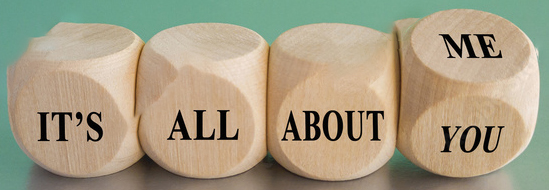
Yet, here we are in 2023, and I’m writing about this again. As I observe the ongoing evolution of musical art, I am seeing more, not less of this tendency to promote one’s self at the expense of the whole. As the examples at the top of this article show so clearly, the “me first” attitude, the “it’s all about me” attitude, the “who are you to tell me what to do” attitude is on display. Players want their students to think of them as “monster” players. A monster? How about being a great trombonist who understands the role of your part in the greater whole? How about some humility? How about an understanding of the difference between importance and prominence? And how about some respect for the music, for your colleagues, for the audience, and for the tradition and history of the ensemble of which you are a part, and to be, as Gene said in his article, “a cog in the wheel” instead of “the nut behind the wheel”? Nobody—including me—does this perfectly. But can this be the goal, the aspiration, something to strive for, and can we talk about this with—even call out— those whose inherent selfishness ruins concerts on a regular basis?
There are things to learn from the way things used to be done. From from our teachers, from the teachers of our teachers, from the people in the jackets and ties. Last week, I was talking with a friend about this ongoing trend of individual players who play in order to be heard and noticed rather than playing in order to support the whole product. Like me, he studied bass trombone with Edward Kleinhammer, and my friend I and frequently talk about the state of the modern symphony orchestra. In a series of text messages last week, he offered:
I miss the old days and our old role models.
Why is the easy stuff SO HARD for some people?
God love you, Ed Kleinhammer.
To which I replied,
Preach it, brother.
Last night, when I was reading my Bible, I turned to this passage (Jeremiah 6:16, English Standard Version) that reminds us of something very important. It starts off with words of wisdom but then observes the response of many people:
Thus says the Lord: “Stand by the roads, and look, and ask for the ancient paths, where the good way is; and walk in it, and find rest for your souls. But they said, ‘We will not walk in it.’”
The ancient paths. The good way. There is a lot we can learn from them. When it comes to playing the trombone, I learned about them from Edward Kleinhammer, and I have tried to emulate his spirit of being a team player throughout my career. My students have heard this from me through my over 40 years of college teaching. There are many players who understand the Apostle Paul’s metaphor of the body and how it perfectly shows us how each of us is valuable and important to any task as long as we understand our role. But there are also many who are hung up on themselves and who ruin music and music making because of their unwillingness to be a team player. Guess what? People are noticing you. Just like the music critic who noticed the trombone section when he heard a certain professional symphony orchestra perform Richard Strauss’ Also Sprach Zarathustra (New York Times, February 15, 1995; review by Alex Ross):
The trombones, who had been emitting ghastly sounds all night, blared too loudly in the “Zarathustra” fanfare, obliterating the top trumpet line.
Yes. You’re noticed.
Will you join me and many others—like Edward Kleinhammer, who taught so many of us about this—in walking “where the good way is”? It’s not all about you. It’s not all about me. It’s about the MUSIC.





 The Last Trombone – Douglas Yeo