
Category: composers, conductors, performers

Celebrating student success

Celebrating student success

I began teaching trombone lessons in 1974, when I arrived at Wheaton College (Illinois) as a transfer student from my freshman year at Indiana University. Wheaton’s Conservatory of Music had a Preparatory Department where young players could come to take music lessons; students at the College were often the teachers. Because there were a number of students who wanted to take trombone lessons, I was asked to help with this. And thus my teaching career began.

Over the last 42 years, I’ve developed a manner of approaching the art of teaching, some of which I learned from the example of my teacher, Edward Kleinhammer. There are well-known teachers who try to get the best out of their students by treating them harshly, by getting angry, employing guilt and humiliation, setting students in a studio in competition against one another to “toughen them up.” I’ve never gone down this road. I have very high standards for my students. But I have found that when I lead by example and work with them in a way that both encourages and challenges them, we build a relationship that leads to good results all around.

When Edward Kleinhammer died in 2013, I wrote a tribute to him for the International Trombone Association Journal. For part of the article, I asked several of his students to write a few words about how they would remember him. Eric Carlson, second trombonist with the Philadelphia Orchestra–Eric and I also were students together at Wheaton College and played together for four years in the Baltimore Symphony–wrote this:

I had an hour train ride home after every lesson. During those rides, I formed the habit of writing down everything I could remember from my lesson, so I would be sure to practice properly in the upcoming week. By the time I finished writing, I would usually have a page or two of notes about things I needed to fix. I remember thinking at one point, “With all of these criticisms, how come I always feel so confident after my lessons?” With time, I realized it came down to two things: I always knew that the severe critiques came out of Ed’s desire to see me succeed. And, towards the end of every lesson, Ed would find a problem small enough to fix right then and there, so I always finished the lesson feeling like we had solved at least one problem that day.

“Ed’s desire to  see me succeed.” Yes. That is a very important thing for teachers to communicate to their students. There is nothing like offering encouragement along with a challenge to fuel a person’s desire to continue working to a goal.

Last week, I received an email from a student in Japan. I’ve been to Japan over a dozen times, both on tour as a member of the Boston Symphony but also to teach and give masterclasses. Many of these teaching opportunities have come at the Hamamatsu International Wind Instrument Academy and Festival where I have been on the faculty on six occasions. Last week’s email came from Yuta Aoki who was in my class at the Hamamatsu Academy in 2014 and 2015. He told me that he had formed a trombone quartet made up of students who had been in my class during those years and that they had recently taken 4th place in a trombone quartet competition; their debut concert will be in September. I was so happy for their success, but also so pleased that they wanted to share this news with me. Even though we are 6000 miles apart, they know that I rejoice with them. To (left to right in the poster above) Yusuke Nishi, Ayaka Watanabe, Noriyuke Komatsu and Yuta Aoki, I send congratulations again, and I wish you well in your upcoming concert. Bravi! And to teachers who are reading this, don’t forget to celebrate the success of your students, no matter how small. Your encouragement is part of the fuel that drives them.
The Trombone in Advertising – 1

The Trombone in Advertising – 1

Advertising is a curious thing. When you think about it, advertising is designed to make us unhappy with what we have, and believe that we would be happier with something else. With this in mind, it’s no surprise a lot of people – like me – fast forward through all commercials when you watch a show on your DVR, or mute commercials in live TV, or have an ad blocker on your phone or tablet. I know what I want to purchase and where I want to get it; advertising rarely influences me to do something, especially to do something that I wouldn’t do without the ad.

But advertising is everywhere, even in the trombone world. Of course we’re all familiar with ads that are designed to sell trombones. Sometimes trombone ads use well-known players. Other ads tell you about new features, metal alloys, the latest valve and improvement. I don’t know anyone who buys a trombone just because she’s seen an ad – any sensible player will try before buying – but ads are out there, trying to persuade us that the trombone we’re playing just isn’t good enough for how good you are and, oh, how much better you’ll be if you’ll switch.

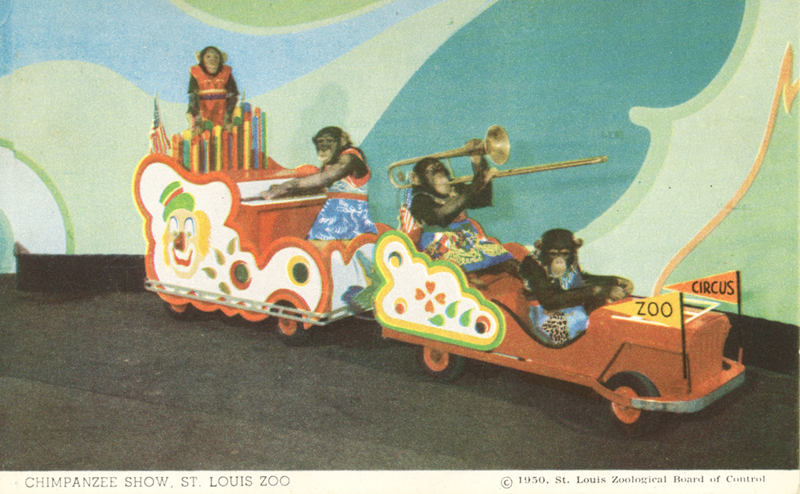
Recently, I’ve gotten interested in trombone advertising. But not advertising to sell trombones. What I have been finding interesting is how many ads have used the trombone to sell OTHER things. I’ve collected so many of these ads that I’m working on an article for the International Trombone Association Journal about them. I’ll be posting a few of them on my blog. Like the postcard above. It’s from the St. Louis Zoo. Great zoo! They make postcards so you’ll buy one, write a note to friend and tell them how great the zoo is, and mail it off. You’re part of the zoo’s advertising plan. So what did they put on this postcard? The elephants? Lions? Tigers? Bears? Nope. Chimpanzees playing musical instruments. Including a trombone.

Now, my students will tell you that sometimes, when I am talking to them about working on their soft playing and how valuable that is as a player, I often start by saying, “Someday they’re going to train a chimpanzee to play the trombone. But the chimp will not be able to play softly. Because the chimp doesn’t have a human soul.” I believe this absolutely to be true. But I did not know, until I bought this postcard, that in 1950, the St. Louis Zoo had trained a chimpanzee to at least hold a trombone and perhaps make a sound from it. A postcard is mute, but I very much doubt that this little chimp band was playing Mozart.

As I work on my article, I’ll be posting a few of these ads that use the trombone. And when you see one, draw your own conclusions. Why does the trombone appear in the advertisement? Is the trombone being used effectively to sell the product? Is the trombone put together and held correctly? And what subliminal messages are going forth from the use of the trombone. I have ads showing the trombone being used to sell clothing, cigarettes, beer, brassieres (yes, bras), tires, cheese, milk, paper products, movies and much more. More to come.

Writing a book – 1

Writing a book – 1

I’ve always loved to read and write. My father was President of the local public library when I was a young boy and books were my best friends. I read everything, but especially history. They say that music and math go together but not for me. My body rejected math and science and nobody was surprised that when I graduated from high school, I received the senior class music and English awards. Over the years I’ve written dozens of articles and book chapters, and I never tire of reading, researching and writing. It’s my nature, my innate curiosity to want to know more about things.

Before I decided to retire and enter this season of life, I sat down and made a list of projects I would like to do while I’m still on this side of the grass. It’s three pages long, single-spaced, and includes my desire – no, my intention – to write five books, three music arrangements, twelve articles, a museum catalog and several book chapters. And that’s just the writing projects on page one. One day at a time, and my work on some of these projects will be the subject of future blog posts. At the moment I am at work on three books simultaneously, having signed contracts to write books for Encore Music Publishers, University of Illinois Press and Oxford University Press. The deadlines for me to submit those manuscripts come over the next several years.

This past January, at our first Trombone Studio Class of the semester at Arizona State University, I took the time to give a master class on the subject of time management. Over the years, I realized that this is a big problem for a lot of people. Over the years I have developed strategies for juggling competing demands and one of them is this: when you have a deadline, don’t look at the due date and think that you have a lot of time to get the job done. Start working on it the day you receive the assignment and make a plan of how you will get it done. Too many people wait until the last minute to do any task and the result is not only a lot of stress in the process, but shoddy work that is far from ones’ best. This simple strategy does require discipline but in my experience it is proven to reap great rewards.

So these days, when my wife and I are not going out to do something together, I have taken my lead from great composers like John Williams and Igor Stravinsky, who are/were disciplined enough to get something done every day. They would compose each morning for several hours, have lunch, take a walk or a nap, then compose in the afternoon for several hours. Every day. Whether they wanted to or not. Sometimes they would look at what they did and throw it away. Sometimes they would write only a few measures in a day. But sometimes their disciplined time bore rich fruit. The process of writing every day for a dedicated amount of time allows/allowed them to be tremendously productive. I have used this strategy in the past and now, with much more time at my disposal, I am employing it every day. And it is a rich time of research and writing.

But no one should be fooled; this is real work! Yesterday, I spent four hours on the hunt for a small piece of information that will amount to no more than a few sentences in one of my books. I was doing some genealogical work, tracing a family tree in hopes of finding the relationship between two people who had the same last name. Two Civil War veterans who were in the same regiment. One was a corporal, one was a bugler. Were they related? If so, how? It seemed like a needle in a haystack, but after a day’s work, I had my answer: they were first cousins. And I had an interesting fact that will enhance my discussion of this family. But it took time.

More on all of this in future posts. For now, at the top of this post is a fragment of a letter, written to me on February 14, 1994 by my teacher, mentor, and friend, Edward Kleinhammer (1919-2013), who played bass trombone in the Chicago Symphony from 1940-1985. He was a remarkable person, player and teacher, and his deeply-held, vibrant Christian faith informed everything he did. I saved the hundreds of letters he wrote to me over the years and they are a wealth of wisdom. [And, yes, one of the books I plan to write is about Edward Kleinhammer.]

His words speak for themselves. This was a man who knew the word discipline, the value and importance of the disciplined life, who understood the need to manage time, to get done what was important, to sacrifice present pleasures for future rewards. He was not allergic to hard work. Take some time to digest his words. “Laziness was not in the dictionary.”