Category: Boston and New England

199: Perseverance and excellence

199: Perseverance and excellence

This article starts with football but even if you’re not interested in that sport, if you stick with it, you’ll see how football flows to music after a few paragraphs.

My students know that I often turn to sports – usually football – for metaphors about excellence, motivation and perseverance. My wife and I have been football fans for many years. We have season tickets to the Arizona Cardinals and we attended many New England Patriots games when we lived in Boston. I attended Super Bowl XXXVI (Patriots defeated the St. Louis Rams) where I played the National Anthem and pregame show as a member of the Boston Pops Orchestra, and my wife and I attended Super Bowl XLIX (Patriots defeated the Seattle Seahawks) here in Arizona just two years ago. Fun times. Great memories.

But there things in football that I turn to over and over as I work with students to help them develop the engine that drives their pursuit of excellence. One of them is the number 199.

When I would attend college football games, I often remarked that very, very few college football players ever end up in the National Football League. The NFL draft has seven rounds; there are 32 teams. That means there are 224 players chosen in the regular draft; several others are chosen as “compensatory picks” and some undrafted players are also signed by teams. The hard reality is that most college football players never play in the NFL. It’s an elite group. Like being a member of a great symphony orchestra.

In the 2000 NFL draft, there were 254 college players chosen in the draft. Number 199, chosen with a compensatory pick in the sixth round, was Tom Brady, from University of Michigan. Six other quarterbacks were drafted before him.

Brady, of course, went on to be arguably the best quarterback in NFL history; some analysts consider him to be the best PLAYER in NFL history. He has led the New England Patriots to five Super Bowl victories; he is a four time Super Bowl Most Valuable Player.

But when the Patriots drafted him at 199 in the 2000 NFL draft, he was a long shot to make the Patriots’ roster. The Patriots had no idea if he would make the team. But Brady had ideas of his own. Brady knew he had what it takes to make a difference on a team. All he needed was a chance.

Tom Brady used the fact that he wasn’t picked until 199 in the sixth round as fuel for his engine. He wanted to prove everyone wrong. When he first met Robert Kraft, owner of the Patriots, Brady said, “Mr. Kraft, drafting me was the best decision you ever made.” I’m sure Kraft’s eyebrows raised a little. But Brady knew he had something. And in his second year with the Patriots, thrust into the starting quarterback role when quarterback Drew Bledsoe was injured, Tom Brady led the Patriots to their first Super Bowl championship.

tb_199_shirt

One of my favorite t-shirts is one  by Under Armour that simply says “199.” It’s a reminder that sometimes you know you have something to offer but you just need a chance to prove it. The chip that Tom Brady carries on his shoulder, the chip that says, “You thought I was only good enough to be 199 but I will show you that you are wrong,” is a reminder that motivation to pursue excellence comes in many shapes and sizes, and from many places.

Tom Brady also has one of the most disciplined work ethics of any person I have known. He absolutely is the embodiment of a phrase I often use: “Success comes from delaying present pleasures for future rewards.” Brady is fanatical about caring for his body, his diet, his physical regimen, for getting the sleep he wants/needs, for engaging in mental stimulation. These things keep him from other recreational pursuits or dietary desires that would throw him off his disciplined routine. There will be time, when he retires someday, for those other things. For now, he remains disciplined to achieve his goals.

A few weeks ago, I was interviewed by the website careersinmusic.com. The interview focused on what is required for a musician to win a position as a section member in a symphony orchestra. The result was a straight-shooting dialogue that I want to share with readers. In the interview, I talk about perseverance, the sacrifices needed to succeed, and the importance of two words that most people don’t really understand at all: Work. Hard.

Click HERE to read my interview on careersinmusic.com

Everyone has a ceiling. Not everyone will succeed at the highest level. Some people with tremendous talent don’t have the discipline needed to succeed at the highest level. Some people with a tremendous work ethic don’t have the talent needed to succeed at the highest level. But everyone CAN succeed at SOME level. The idea that you only need to work at something for 10,000 hours to succeed is foolishness. Practice doesn’t make perfect: practice makes permanent. If you don’t know how to practice something CORRECTLY, then you will get excellent at playing it poorly. And unless you understand the real meaning of the word “perseverance,”  you will never know where your talent and work ethic can take you.

Tom Brady found out. Number 199 became number 1. Not by accident. Not by getting “lucky.” He got there by combining his God-given talent with perseverance and hard work. He had what it took even when others didn’t see it. As my teacher, Edward Kleinhammer (bass trombonist of the Chicago Symphony, 1940-1985) said:

World class trombone players do not just happen. Their talents are forged in the dual furnaces of determination and diligence.


199.
The buccin: the coolest trombone

The buccin: the coolest trombone

by Douglas Yeo

I don’t have a lot of things from my childhood. All of my toys and stuffed animals went away a long time ago. Even my first trombone is gone, given away to a young player whose name I don’t remember any more.

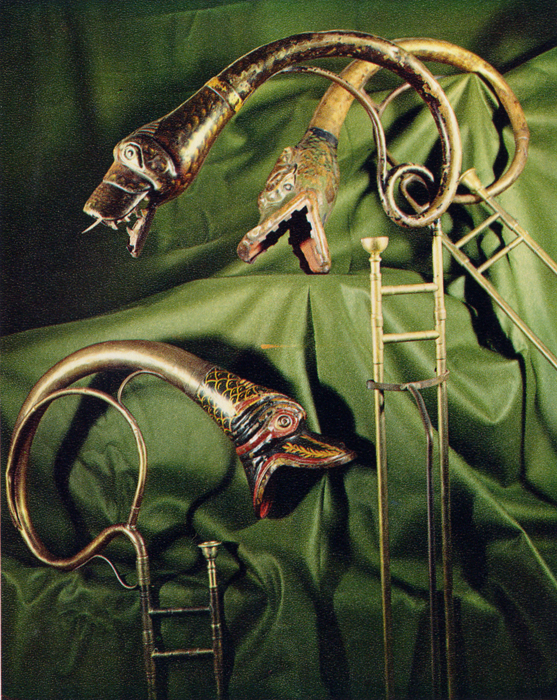
But I do have one thing, a postcard, that I purchased at the Metropolitan Museum of Art in New York City around 1965. I was on a school field trip to the Museum – I grew up in New York City (Queens) and Long Island (Valley Stream) – and my class had just entered the musical instrument gallery. And there, in a display case overlooking the Museum’s collection of suits of armor (another very cool thing, I might add), I saw a display that had these instruments:

met_buccin_01-copy_01

As a young trombone player, I was entranced. What is this!? I learned that this instrument is a form of trombone made in France in the early 19th century. Its name? The buccin. Nobody really knows how to pronounce it. I’ve heard it called “boo-cheen” and “boo-sahn” although most scholars agree on “book-sahn.” But, truly, nobody knows. These instruments were very popular in France in the first half of the 19th century; players of the buccin played trombone parts in bands and in parades, they made a spectacular sight. Buccins were usually painted in gold, red and green and some had a tongue of metal that would wag when it was played. At that moment, when I was all of 10 years old, I knew I had to have one of these remarkable instruments someday. At the time, all I could do was buy the postcard. I’m glad I did, since the Museum no longer has these instruments on display, or at least that was case a few years ago when I last paid the Museum a visit. However, the museum’s musical instrument gallery is closed for renovation at this moment and perhaps these wonderful instruments will be able to be seen once again when it reopens soon.

yeo_becker_buccin

In time, though, I was able to purchase a buccin bell. It’s difficult to find one for sale with a workable slide. So I decided to purchase a bell (made by Sautermeister in Lyon, France) and have it restored, and a new slide constructed. Jim Becker (pictured with me, above) of Osmun Music  in Massachusetts did the restoration and made the slide based on an historical model in the Museum of Fine Arts, Boston. Jim did a fantastic job and the buccin has pride of place in my personal collection of musical instruments; it hangs on the wall in my home studio amidst photos and historical drawings of serpents, sackbuts, trombones, and other instruments, as well as a letter by Hector Berlioz.

yeo_buccin_wall

Historically, there is not much music written specifically for the buccin. As I mentioned, it often doubled the trombone part in bands, particularly military bands. But we do have one piece that was specifically composed for buccin. There is a part for buccin in Hector Berlioz’s Messe solennelle, in the Kyrie. I played the Messe when I was in the Boston Symphony but I was playing the serpent at that time; the buccin part is doubled by the serpent and trombones so with only enough hands to play one instrument and with no buccin at my disposal at that time, the serpent kept my hands full.

yeo_buccin_sh_01

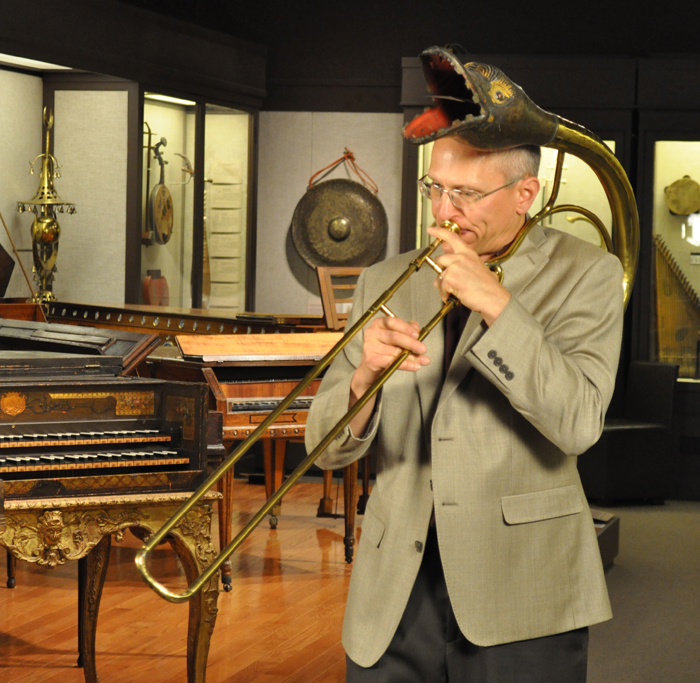
The buccin plays like a normal, modern trombone. Sort of. First of all, the seven positions of the modern trombone are rather flexible on the buccin. The zoomorphic bell does quite a job of disrupting the smooth flow of air through the instrument. So one must make significant adjustments with the slide to get many notes in tune. But then there is this: if you are a trombone player, pick up your trombone and close your eyes. Then play a melody you know. In the key of D major. Having a little trouble finding the right slide positions? Welcome to the world of the buccin. With no bell in front of you to provide a visual guide to slide positions, playing buccin is a bit like playing the trombone in the dark. It’s when you play buccin that you find out how well you REALLY know your trombone. By the way, the photo above was taken at Symphony Hall in Boston, in front of a display case that has several serpents. But that’s another story. . .

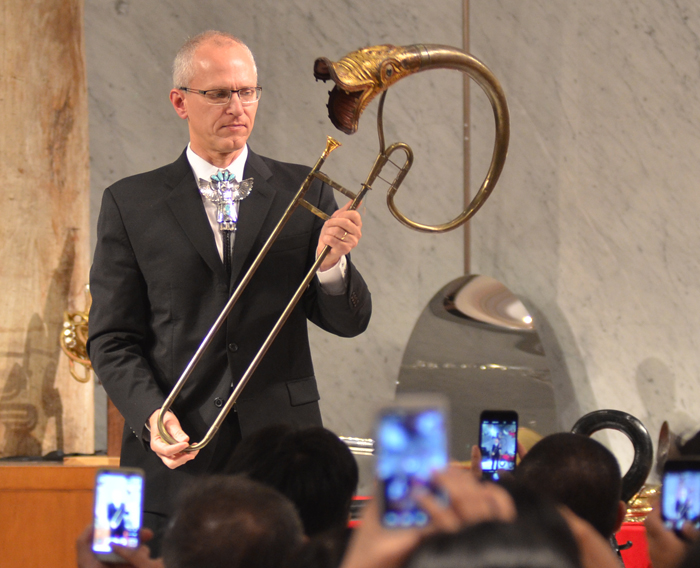
There aren’t many people in the world who play the buccin, so because of my keen interest in the instrument and the research I’ve done to learn more about it, I was asked, a few years ago, to write the entry for the instrument for the new edition of The Grove Dictionary of Musical Instruments. I also wrote most of the Wikipedia entry for the buccin. Two years ago, I gave a recital in the Hamamatsu (Japan) Museum of Musical Instruments and got to demonstrate and talk about the museum’s fine buccin. The photo below tells the story – look at all of the cell phone cameras that went up when I picked up the buccin. The buccin was easily the hit of my recital.

yeo_hamamatsu_buccin_01

 In 2012, I recorded a short video on a buccin owned by the Museum of Fine Arts, Boston. Their buccin was made by Tabard in Lyon around 1830 and still has most of its original paint as well as a metal tongue.

yeo_mfa_buccin_02

The MFA has now posted that video on their YouTube channel and you can view it by clicking HERE (to go to the page in YouTube) or just click the video image below. I am playing the buccin part from Berlioz’s Messe solennelle. It will give you an up close look at the buccin and its sound. And its wagging tongue.

That’s the buccin. The coolest trombone. Ever.

First Music Monday with the serpent

First Music Monday with the serpent

When my wife and I lived in Boston from 1985-2012, I had a very nice relationship with the Museum of Fine Arts, Boston. The Museum is a perfect size to enjoy and it has a fine collection of art from around the world. Tucked away just off the Museum’s main entrance on Huntington Avenue is the musical instrument gallery. While the display space is small, it is inviting and informative, and the gallery has regular demonstrations of its instruments by people who have devoted their lives to mastering particular instruments, many of which are not frequently used today. Conducting research at the Museum and being a docent was very rewarding.

In 2012, I wrote an article for the Galpin Society Journal, Serpents in Boston: The Museum of Fine Arts and Boston Symphony Orchestra Collections. If interested, you can order a copy of that issue by visiting the Galpin Society website by clicking the link above. Here is the first page:

gsj65-yeo-01-1

This peer-reviewed journal is a leading voice for the world of organology, or the study of musical instruments. My article focused both on the serpents in the two collections and also on the four people who were responsible for bringing the collections to Boston: Canon Francis W. Galpin and William Lindsay (MFA), and Henri Casadesus and Serge Koussevitzky (BSO). My research for that article was a culmination of my many hours of work at the MFA and I look back with great fondness at the times when I was in the instrument gallery giving a demonstration and talk to interested museum patrons.

This year, the MFA musical instrument gallery is celebrating the centennial of its establishment, when 560 instruments from Canon Galpin’s private collection were purchased by William Lindsay and donated to the MFA in memory of his daughter, Leslie Hawthorne Lindsay Mason, who died in the sinking of the RMS Lusitania. To celebrate this anniversary, the MFA is posting a video on YouTube and their Facebook page of one of their instruments from the collection being played. So this year, you will see 52 of the MFA’s choice instruments in all of their glory. Visit the MFA’s Facebook page each Monday to see that week’s video:

Museum of Fine Arts, Boston Facebook Page

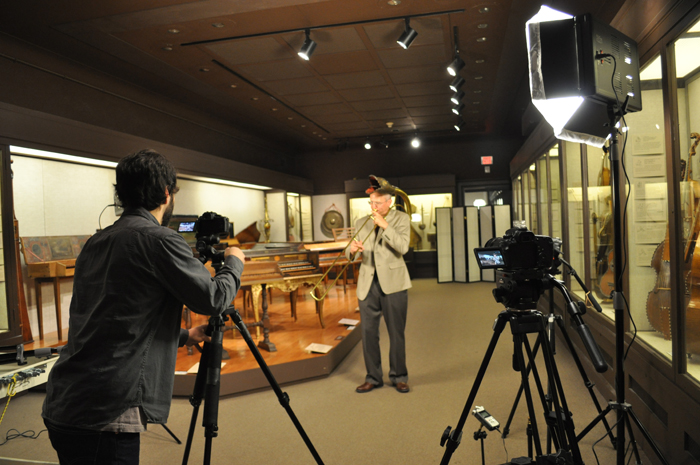
I’m so pleased that the first instrument to be featured is the serpent, in a video I made in 2012 (the photo at the top of this post shows the recording session for the video, with curator Darcy Kuronen overseeing the filming). You can see it on the MFA Facebook page (where, as of today, it’s received over 29,000 views!) – scroll down a little on the page to find the video that was posted on January 2 – or on YouTube in this embedded video  or by clicking the YouTube link above (if you are reading this as an email subscriber of The Last Trombone, click on the title of this post and you will be brought to the website of The Last Trombone where you can see the video as well as the photo of the recording session for the video that is at the top of this page):

Later this year, there will be two more videos that I recorded at the MFA: one with an ophicleide and one with a buccin. Don’t know what they are? I’ll be posting links to those videos when they come up so can learn about them.

You can also see my videos on the serpent and buccin in the ebook edition of the MFA’s book, Musical Instruments by Darcy Kuronen. You can purchase that excellent ebook on the iTunes store by clicking this link below; it’s only $9.99 and you will be introduced to many of the MFA’s fine instruments as well as videos of many of them being played:

Information about the book Musical Instruments by Darcy Kuronen at the iTunes Store

Happy anniversary to the MFA’s Musical Instrument Collection!