Category: books and articles

Just published: “More Than Bordogni: The life, work, and influence of Joannès Rochut”

Just published: “More Than Bordogni: The life, work, and influence of Joannès Rochut”

by Douglas Yeo (January 4, 2025)

I have been researching the life, work, and influence of the celebrated French trombonist, Joannès Rochut, for nearly 40 years. Rochut, as readers of The Last Trombone know (see my previous blog posts about Joannès Rochut HERE, HERE, and HERE), played principal trombone in the Boston Symphony Orchestra from 1925–1930, and he published three volumes of “Melodious Etudes for Trombone” from the vocalises of Marco Bordogni. Rochut’s books are among the most influential study material for trombone ever published.

In May 2024, I gave a presentation about Rochut at the International Trombone Festival, held at Texas Christian University in Fort Worth, Texas. Yesterday, my full research on Rochut was published in the January 2025 issue of the International Trombone Association Journal (Volume 53, No. 1). The issue—with my article—is now available to all ITA members on the ITA’s website. Members who also subscribe to the print version of the Journal will receive their copy later this month.

ITA_Journal_January_2025_cover

If you are not a member of the International Trombone Association, I’d like to encourage you to join. I’ve been a member of the ITA since its founding in 1972. I was a senior in high school at the time, and when I learned that the ITA had been established, I joined right away. Over the years, I’ve written many articles for the ITA Journal, have served on ITA committees, and have attended and presented at many International Trombone Festivals. I’m very grateful that the ITA bestowed its ITA Award on me in 2014, and its Lifetime Achievement Award in 2024. Members of the ITA receive the Association’s quarterly Journal, a regular e-newsletter, and stay connected with the world-wide community of trombonists. As soon as you join, you’ll have access to the current issue and the archive of past issues of the ITA Journal. This is a rich resource that informs our knowledge about trombone activities in the last half-century. The ITA also has a Facebook page where you can keep up to date on the latest activities of the Association and trombonists around the world.

The ITA has several levels of membership. Student membership is heavily discounted, and a further discount is applied if a member does not want to receive the print edition of the ITA Journal (all ITA members have access to the online version of the ITA Journal; it is an exact reproduction of the printed version). Discounts are also available for multi-year membership and 65+ year old membership, and lifetime membership is also available (I became a paid life member of the ITA in 1983). To learn more about all of the ITA’s membership levels and join the ITA, click HERE.

My article about Joannès Rochut is the longest article ever published in the ITA Journal. At 70 pages, with 80 images and 210 endnotes, I am deeply grateful for the commitment th  ITA’s executive board to publish  my article in nearly a double-sized (112 page) January 2025 issue of the ITA Journal. If you’ve ever played a vocalise by Marco Bordogni, own a copy of one of Rochut’s books, are interested in learning more about trombone teachers and students at the Paris Conservatoire in the late nineteenth and early twentieth centuries, want to know more about the history of the Boston Symphony Orchestra, read about Rochut’s quest for the perfect trombone, or learn about Joannès Rochut’s other trombone publications and the students who studied trombone with him at New England Conservatory of Music (they include Ida Isabella Bisbee–the first woman to graduate from New England Conservatory with a degree in trombone performance—and John Coffey), you’ll find all that and more in my article. Here are a couple of sample pages from my article:

ITA_Journal_January_2025_Rochut_pages

It’s all there—and more—on the International Trombone Association’s website, trombone.net, and members receive all of the benefits the Association has to offer.

I’m already at work on several more articles for the ITA Journal that will publish in late 2025 and early 2026. If you’re an ITA member, you’ll find them there when they publish. Stay tuned.

A busy autumn. And a thought.

A busy autumn. And a thought.

By Douglas Yeo (November 11, 2024)

It has been a few months since I’ve posted anything to The Last Trombone and to those who have asked me why, it’s simply that I’ve been busy with other things. Busy with a lot of things. Here’s a quick update before I offer a thought on something else.

YEO_UIUC_trombones_2024

Douglas Yeo with members of the University of Illinois Marching Illini trombone section: Derrick Neal, Pablo Rosales, Douglas Yeo, Poorna Kumar (who, in addition to being a dual major in trombone performance and community health, is also a drum major for the Marching Illini), Jake Bae, Sam Murray, September 2024.

In September, my wife, Patricia, and I returned to the campus of University of Illinois Urbana-Champaign where I served as trombone professor from 2022–2024. We were there for homecoming and the Illinois  football game against Central Michigan (the Illini won, 30–9). While there, I met up with several of my former students who are in the Marching Illini. I was so happy to see them again.

Yeo_Brickens_UT_Austin_trombones_2024

Douglas Yeo with Dr. Nathaniel Brickens and members of the University of Texas trombone studio, September 2024.

The next week, I spent a few days at University of Texas in Austin, in residence with the trombone studio of my good friend and UT’s trombone professor, Dr. Nathaniel Brickens. I always enjoy being at UT and  working with its talented trombonists (and sporting a headpiece of the university’s mascot, Bevo, above).

PBO_Oct_2024

In October, I traveled to San Francisco for a week where I played ophicleide with the superb early music group, Philharmonia Baroque. The conductor, Grete Pedersen, led us in a program that included the overture to Felix Mendelssohn’s A Midsummer Night’s Dream. What a joy it was to play under her leadership with this fine ensemble (I’ve been playing serpent and ophicleide with Philharmonia Baroque since 2009). While there, I visited the Fine Arts Museums of San Francisco. It was my first time visiting these superb museums, and in addition to seeing iconic art by Auguste Rodin, Claude Seurat, Claude Monet, and many others, my eyes were opened at two special exhibitions of art by Mary Cassat and Tamara de Lempicka. Art old and new that inspires, soothes, and provokes.

ASO_Oct_2024

A day after I returned home from San Francisco, I flew to Atlanta where played bass trombone with the Atlanta Symphony, substituting for a week on a program that included Serge Rachmaninoff’s Symphonic Dances conducted by Roderick Cox. While I was there, I was a guest for a session with Slide School, hosted by Atlanta Symphony acting principal trombonist, Nathan Zgonc, and Brian Hecht of the Dallas Symphony. I also had the happy opportunity to spend a lot of time working with the ASO’s two fellowship players, bass trombonist Jordan Johnson (who, a few days later, won the bass trombone position with Houston Grand Opera—bravo, Jordan!) and tubist Joshua Williams. I look forward to returning to the Atlanta Symphony for a few more weeks after the calendar turns to 2025.

Yeo_Ebenezer_Baptist_Church_Oct_2024

Douglas Yeo in front of historic Ebenezer Baptist Church, Atlanta, October 2024.

While in Atlanta, I visited the Dr. Martin Luther King Jr. national historic site. In the book I co-authored with Kevin Mungons, Homer Rodeheaver and the Rise of the Gospel Music Industry (Rowman and Littlefield, 2021), we introduced Rodeheaver to readers with an opening chapter, Prologue, in which we described the 1917 Billy Sunday meetings in Atlanta (Homer Rodeheaver was Billy Sunday’s trombone-playing song leader for 20 years). To stand in front of and inside historic Ebenezer Baptist Church (where Dr. King, his father, and his father’s father-in-law all served as pastor, and where Dr. King’s mother, Alberta Williams King, was tragically murdered in 1974 while she was playing The Lord’s Prayer at the organ), to see the grave of Dr. King and his wife, Coretta Scott King, and imagine the huge temporary, wooden, 15,000 seat tabernacle that Billy Sunday erected on what is now the site of the historic site’s Visitor Center, was powerful, indeed.

Yeo_Sedona_Oct_2024

Douglas and Patricia Yeo on the Fay Canyon trail, Sedona, Arizona, October 2024.

Right after I returned home from Atlanta, my wife, Patricia, and I spent a week in Arizona where we enjoyed some great hiking on spectacular trails in Sedona and Phoenix. After so many weeks of traveling with a trombone in my hand, it was nice to be together on the trail where the sky was blue, the rocks were orange and red, and the peacefulness and beauty of the Sonoran desert was on full display.

Ida Bisbee_1926_NEC_NEUME_cropped

Excerpt from page 27 of the 1926 New England Conservatory of Music yearbook, The NEUME, showing Ida Isabella Bisbee, trombone student of Joannès Rochut. Courtesy of New England Conservatory of Music Archives.

My big project for this autumn was finishing my article about Joannès Rochut that will appear in the January 2025 International Trombone Association Journal. This is an article that has been nearly 40 years in the making. I’ve written a little about my research process for this article; read this post on The Last Trombone about my one day research trip to the Boston Symphony Orchestra archives in August of this year where I uncovered some important information about Rochut’s life and work. Rochut’s influence on the trombone—and brass—world has been remarkable, and in the course of my research, I learned so much about this iconic influencer in the trombone community. Including, thanks to the archives of New England Conservatory of Music, the fact that Rochut’s first student at NEC was Ida Isabella Bisbee, the first woman to graduate from NEC (in 1926) with a degree in trombone performance (above). I’m looking forward to receiving proofs very soon of what is expected to be an 80 page article in the Journal. Stay tuned.

And, overarching all of this in last few months is the tremendous joy I’ve had of playing trombone duets and trios with my granddaughter and her mom, our oldest daughter, Linda (who is a fine bass trombonist and low brass teacher). Our granddaughter, who is 10 years old, began playing trombone in May when I was at the International Trombone Festival. She loves playing the trombone—she’s good, too!—and in our little family of my wife and me, our two daughters and their husbands, and our two grandchildren, our granddaughter is the sixth brass player (and the fourth female brass player: Patricia plays baritone horn, Linda and and her daughter play trombone, and our other daughter, Robin, plays trumpet). Our grandson has told us he wants to play the tuba next year. When that happens, he will become the seventh brass player in our family.

All of these activities were and are fun, exciting, and rejuvenating. But then, there was also an event of momentous importance: the national election here in the United States that was held on November 5. In the midst of all that swirled around that impactful day, I was heartened when I received an email from Dr. Linda Moorhouse, Director of the School of Music at University of Illinois. On election day, she sent a message to all students, faculty, and staff in the School of Music with some helpful, sensible, and comforting thoughts on how to navigate this contentious election season and what follows. Her words, in a message titled, “Managing the Noise,” resonated deeply with me. Dr. Moorhouse wrote, in part:

As a School full of practicing musicians, we manage all kinds of noise every day. And outside of musical noise, we also know how the vast volume of information, opinions, and discussions can sometimes become overwhelming or disruptive.

I’m reaching out to remind you that you are a part of a School of Music community, and while this day and the next few days may be stressful, we are here for one another. Listed below are a few ways we can navigate the next few days and weeks together and keep our environment supportive and respectful:

  1. Be Mindful of Election “Noise”
    Staying informed is important, but the constant influx of election-related content can become a source of stress. Take breaks from social media, limit your news intake to trusted sources, and remember it’s okay to step away when things get to be too much. Giving ourselves space can help maintain balance.
  2. Respect Diverse Perspectives
    We all have different viewpoints shaped by our unique experiences, and recognizing this helps foster mutual respect. Election season is a celebration of our democratic process, and despite differing opinions, we can share in that respect for civic engagement. Supporting each other through this season means being thoughtful and considerate in our communications.
  3. Practice Self-Care
    Anxiety around election outcomes is normal. Be kind to yourself by setting aside time for things that bring you peace and comfort. Exercise, hobbies, meditation, or simply stepping away from the news cycle are great ways to maintain your emotional health.
  4. Be Good to Each Other
    Kindness goes a long way, especially in uncertain times. Small gestures of thoughtfulness and understanding can create a sense of community and support. Let’s check in on each other, be gentle in our interactions, and focus on the qualities that unite us rather than divide us.

One of the reasons I found Dr. Moorhouse’s words so impactful was the fact that a few weeks before her message arrived, a lunchtime conversation I had with a friend and an encounter with a sign I saw on my way home from that meeting got me thinking about some related things.

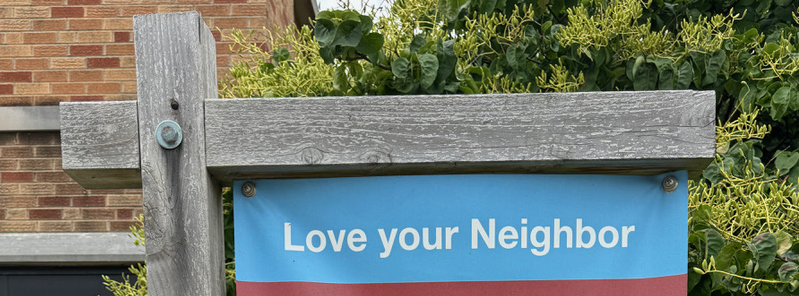
As a result, I wrote a short article for the blog hosted by my church, New Covenant Church of Naperville, Illinois. The article—it was published two days after the election, on November 7, 2024—is about the well-known and well-worn phrase from the Bible, “Love your neighbor.” I’ll let the article speak for itself. Have a look at the article—and the rest of the sign—HERE.

Love_Your_Neighbor_sign_cropped

In a time where there is a lot of shouting, a lot of judging, a lot of anger, a lot of finger pointing; in a time when many people make assumptions about the motives and beliefs of others without taking the time to speak with and understand them; in a time when name calling and insulting others has risen to a harmful, toxic level; the admonition to “Love your neighbor” has, as I discovered on that day when I had lunch with a friend, some unexpected components. It got me thinking. Have a look at my article. Maybe that sign and its implications will prompt you to do some thinking, too.

A new edition, a lower price, and a discount

A new edition, a lower price, and a discount

by Douglas Yeo (February 23, 2024)

In late 2021, Rowman & Littlefield published my book, An Illustrated Dictionary for the Modern Trombone, Tuba, and Euphonium Player. This book is the product of several years of writing and a lifetime of exploration into the world of low brass instruments.

Yeo_Dictionary_cover_full_book

Since the book hit the market, it has received generous reviews and I’ve been heartened knowing that so many individuals and libraries have purchased the book. Here’s a sample of recent reviews:

To simply list all of the topics in this dictionary is not practical; however, suffice it to say that if a topic is not covered in this dictionary, it might not be worthy of investigation. . . Lennie Peterson’s illustrations are engaging and accurate. . . This is an excellent first step for reference or research. There are exhaustive references to outside sources for further study and the 13-page bibliography is perhaps the most comprehensive resource available. This is one of the books that should be on every teacher’s shelf and in every academic library. ~ International Trombone Association (2022)

This new resource is accessible to both beginning and experienced players and is thorough in its hundreds of listings, ranging from “a piacere” to “zugposaune.” . . I am thrilled to add this resource to my collection. I believe that it is a mandatory addition to the library of any low brass player and will be invaluable to any performer, educator, or student who is interested in taking a deep dive into the history and development of the tuba, euphonium or trombone. ~ International Tuba Euphonium Association Journal (2022)

Excellent illustrations created by Lennie Peterson, an award-winning artist and educator and a professional trombonist, enhance many entries. All in all, a fine overview of low brass instruments that will be valuable to novices and professionals alike. Summing up: Essential. Lower-division undergraduates through faculty and professionals; general readers. ~ Choice, the Journal for the Association of College and Research Libraries (2022)

Of all the people that could have been chosen for the task of creating a dictionary for the modern lowbrass player, Yeo is perhaps the most appropriate to undertake such a project. As a performer – having served as bass trombonist in the Boston Symphony Orchestra for nearly 30 years – and pedagogue – having held faculty positions at the New England Conservatory of Music, Boston University, the Peabody Institute of Johns Hopkins University, Arizona State University, and Wheaton College – his name is recognized and respected in the world of modern low brass. Additionally, he is a well-known champion for and practitioner of historical low brass instruments, which, with his practiced eye and knowledge of the history of these instruments, serves the dictionary and its readers well. His interest and yearning for knowledge are clearly the driving forces behind the volume’s success, making it an invaluable resource for any modern low-brass practitioners, students and teachers, amateurs and professionals. ~ Galpin Society Journal (2022)

[This book] offers an absorbing and comprehensive view of our instruments and their craft and lore. . . it is about the present-day instruments and their immediate past, but their predecessors are in here too and are treated respectfully and sympathetically. Douglas Yeo’s definitions and explanations are clear and concise, and the drawings by Lennie Peterson are elegant and surprisingly instructive. ~ Historic Brass Today (2023)

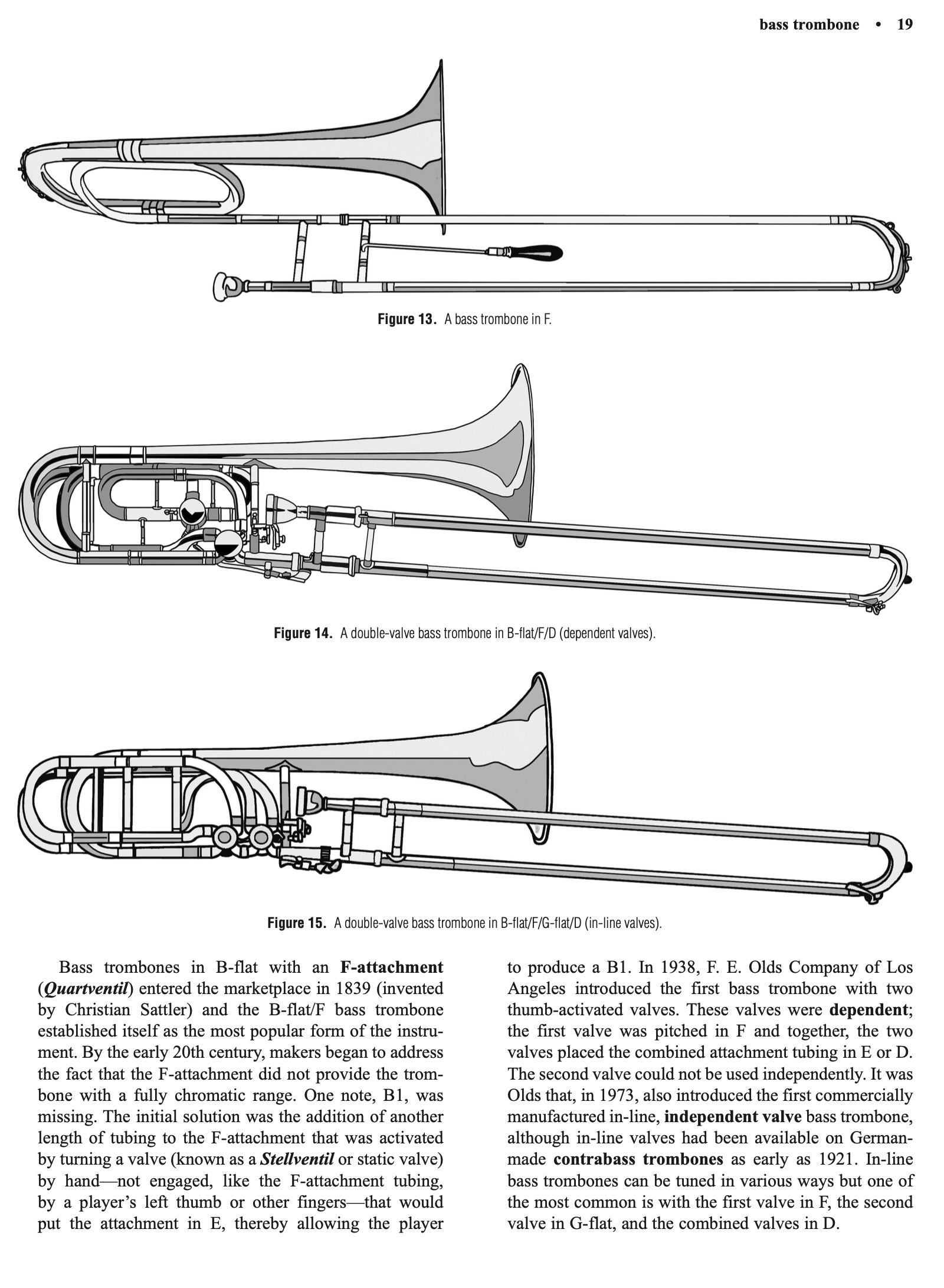
Here is a sample page from the book, with a few of the over 130 illustrations by my friend, Lennie Peterson:

Yeo_Dictionary_bass_trombone_sample

An Illustrated Dictionary for the Modern Trombone, Tuba, and Euphonium Player by Douglas Yeo. Page 18 (part of the entry for bass trombone with illustrations by Lennie Peterson).

While I have been delighted with the reception to my Dictionary, it was initially released as a hard cover book with a price point that was higher than I hoped it would be. The price for the hard cover edition, $105, was set by the publisher, and with many people purchasing the book as a textbook, the price wasn’t out of line with a lot of similar texts. Still, I wished the price had been lower. I’d rather sell more copies of my books at a lower price than fewer copies at a higher price—for me, it’s about the ideas I’m putting out for people, not my royalty check.

So I was especially happy when, last year, my editor at Rowman & Littlefield told me that my Dictionary had been selected by the publisher to be reprinted in a paperback edition at a much lower price point. I was also very pleased when my editor told me that printing the book in a paperback edition meant I could make a few changes and corrections to my original text.

I’m glad to announce that the paperback edition of my An Illustrated Dictionary for the Modern Trombone, Tuba, and Euphonium Player is now available. The price is $50, half of the hard cover $105 price. You can purchase the hard cover ($105.00), the paperback ($50.00), and the Kindle edition ($47.50) on amazon.com.

But if you’d like to purchase the Dictionary for less, go to the page about my book on the Rowman & Littlefield website, HERE.

Once there, you can order the Dictionary, and when you check out, apply this discount code:

RLFANDF30

Doing so will give you a 30% discount on the book, bringing the cost of the paperback edition down to $35.00. That’s a savings I want readers to know about.

And I want to thank all readers who now have the book in their library. My Dictionary was a labor of love, and it makes me very happy to know that so many people are now exploring the same subjects I cover in the book that have fascinated me for so many years.

An award for “Best Historical Research”

An award for “Best Historical Research”

by Douglas Yeo

Readers of The Last Trombone know that last year, University of Illinois Press published a book co-authored by my friend, Kevin Mungons, and me. The subject of the book is Homer Rodeheaver, the trombone-playing song leader for the evangelist William “Billy” Sunday for twenty years during the first third of the twentieth century. Rodeheaver played the trombone for over 100 million—yes, million—people during his lifetime (1880-1955) and he profoundly shaped the course of gospel music. Rodeheaver created the first gospel music record company (Rainbow Records), and he founded what was, at the time, the largest and most successful Christian music publishing company. His influence, nearly 70 years after his death, is still felt today.

Fig 01-1 rodeheaver-and-sunday

Above: Billy Sunday and Homer Rodeheaver, 1917. Courtesy of Morgan Library, Grace College, Winona Lake, Indiana.

Our book has received many enthusiastic reviews , including one in the October 2022 issue of the International Trombone Association Journal:

Kevin Mungons and Douglas Yeo have collaborated on a scholarly, nuanced biography of Homer Rodeheaver. Mungons and Yeo’s book, Homer Rodeheaver and the Rise of the Gospel Music Industry, combines painstaking research with insightful sociological and musicological analysis. Although the book is co-authored, it has a unified narrative. The extensive citations, alone, are worth the price of purchase. Even if one has only marginal interest in Homer Rodeheaver as a person, this scholarly description of American society at the turn of the 20th century proves fascinating and illuminating.

And this one from Christianity Today in March 2022:

Like virtually all books in the University of Illinois’s much-honored Music in American Life series, Homer Rodeheaver and the Rise of the Gospel Music Industry fills in significant blanks in our understanding of different aspects of music history. Mungons and Yeo elevate their contribution with meticulous detail and research; a penchant for finding fascinating, revealing stories and anecdotes; and a sparkling, highly readable prose style that’s all too rare in most academic books.

arsc

Last week (October 12), we learned that our book has just received a major award. The Association for Recorded Sound Collections (ARSC) gives annual awards “to authors of books, articles, or recording liner notes to recognize those publishing the very best work today in recorded sound research.” This is a highly coveted award, one with major significance to the large community of individuals who are heavily invested in understanding and promoting the history and preservation of recorded sound. ARSC publishes a peer-reviewed journal and its 2022 Awards for Excellence in Historical Recorded Sound Research include books on a wide variety of musical styles and genres written by highly respected authors.

Our book received the “Best History” award in the category for Best Historical Research in Recorded Blues, Gospel, Hip Hop, Soul, or R&B. The award will be presented to Kevin and me at the ARSC Conference that will be held in Pittsburgh in May 2023. We are very grateful for this recognition.

Between now and October 31, our publisher, University of Illinois Press, is offering a 50% discount off the cover price of the book. Click on this link to the UofI Press website’s page on books that have won awards in 2022. You’ll find our book there. Click on the image of the cover and you’ll be directed to UofI Press’s page about our book. You can order the book there. Put in the Promo Code MAL50 and the cost of the book will go from $31 to $15.50. That’s a real money savings. But this offer expires on October 31; now is your chance!

ARSC Award graphic