Category: Baltimore Symphony Orchestra

For everything there is a season

For everything there is a season

by Douglas Yeo (May 19, 2024)

The Bible gives us answers, and it reminds us of this (Ecclesiastes 3:1-8, English Standard Version):

For everything there is a season, and a time for every matter under heaven:

a time to be born, and a time to die; a time to plant, and a time to pluck up what is planted;

a time to kill, and a time to heal; a time to break down, and a time to build up;

a time to weep, and a time to laugh; a time to mourn, and a time to dance;

a time to cast away stones, and a time to gather stones together; a time to embrace, and a time to refrain from embracing;

a time to seek, and a time to lose; a time to keep, and a time to cast away;

a time to tear, and a time to sew; a time to keep silence, and a time to speak;

a time to love, and a time to hate; a time for war, and a time for peace.

For each of us, our lives are full of seasons, and I have recently turned the page on a very long season of life and a new season is upon me.

Pearce_trombone_Concert_stylings

One of the Bill Pearce solo trombone with piano books that my first trombone student, Lloyd, gave to me in payment for trombone lessons I gave him at Wheaton College in the summer of 1974.

I have been teaching trombone lessons since the summer of 1974. At that time, I was a student at Wheaton College and another student on campus, Lloyd, asked if he could take some lessons with me. Lloyd wasn’t a trombone major; in fact, he was a student at Wheaton College for only that one summer quarter. But I was happy to help him improve his skills. At the end of the lessons, Lloyd told me he didn’t have money to pay me but if I would accept them, he would give me five books of solos for trombone and piano by the great gospel trombonist Bill Pearce. 50 years later, I still have and use those books. After that summer, I began teaching weekly lessons to young players through the College’s Preparatory Department. Doing so helped me get through college without any debt (that job along with other jobs that included working as student manager of the College artist series, working two days a week at a local White Hen Pantry, and shoveling snow for an office park in the winter).

Since that time, I’ve taught regularly in many schools, first as a high school band director, then as trombone teacher/professor of trombone:

STA_My_Fair_Lady_pit_band

St. Thomas Aquinas High School, Edison NJ (1979-1981) — with students in rehearsal for the school’s production of My Fair Lady, 1981.
Peabody_News_1982

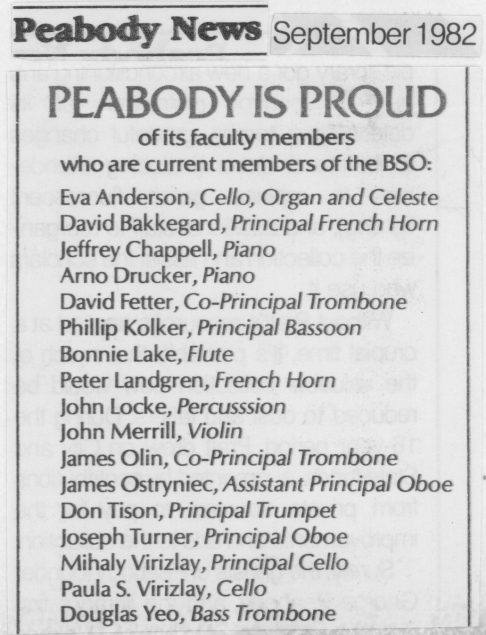
Peabody Institute of Johns Hopkins University, Baltimore MD (1982-1985) — Announcement from September 1982  in Peabody News listing faculty members who were members of the Baltimore Symphony Orchestra

NEC_Trombones_1990_01

New England Conservatory of Music (1984-2012) — conducting the New England Trombone Choir at New England Conservatory, 1990
ASU_Desert_Bones_2016

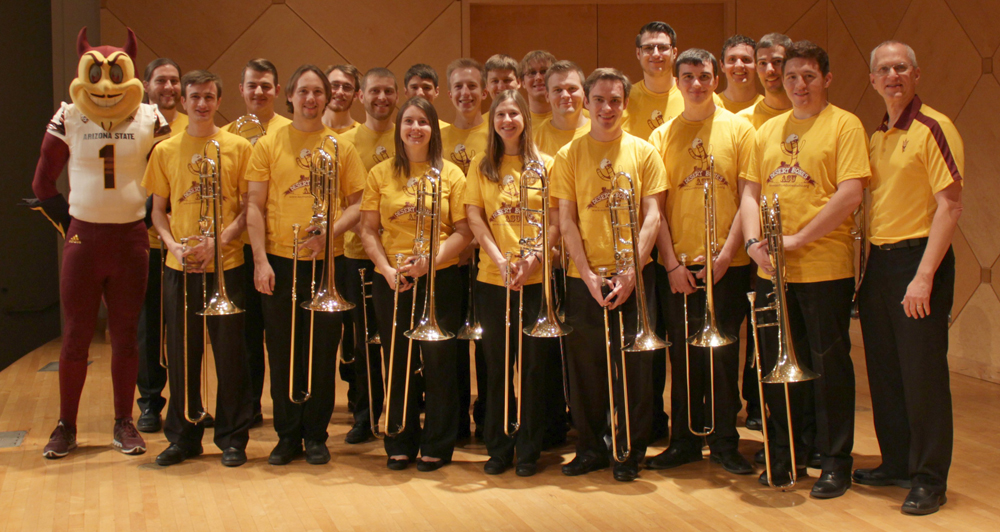
Arizona State University, Tempe AZ (2012-2016) — ASU Trombone Studio with the University’s mascot, Sparky, 2016

Wheaton College, Wheaton IL (2019-2023) — performance of Canzone by Girolamo Frescobaldi, arr. Eddy Koopman, Wheaton College faculty recital, April 23, 2022

UIUC_Illinois_trombone_studio_2024_signed_photo

University of Illinois Urbana-Champaign, IL (2022-2024) — signed photo given to me by members of the University of Illinois Trombone Studio, May 2024

Since I retired from the Boston Symphony Orchestra in 2012 after more than 27 years as a member of that great orchestra, my life has taken many turns. My wife, Patricia, and I moved to Arizona where I immediately flunked retirement and accepted the full time position as professor of trombone at Arizona State University. In 2018, we moved to the Chicago area to be near our grandchildren (grandkids truly make you do crazy things, like move from Arizona to the Midwest) and I flunked retirement again when I was asked to teach at my undergraduate alma mater, Wheaton College. When University of Illinois asked me to take a one year position as professor of trombone for 2022-2023—a position that came to me most unexpectedly and I thoroughly enjoyed—I looked forward to trying this retirement thing again in 2023 when that appointment was up and, at the same time, I decided to step away from teaching at Wheaton College. But as things turned out, one year of teaching at Illinois turned into two years. Happily, the Illinois School of Music recently hired a new full time trombone professor and my appointment at Illinois concluded.
Yeo_UIUC_office_letter

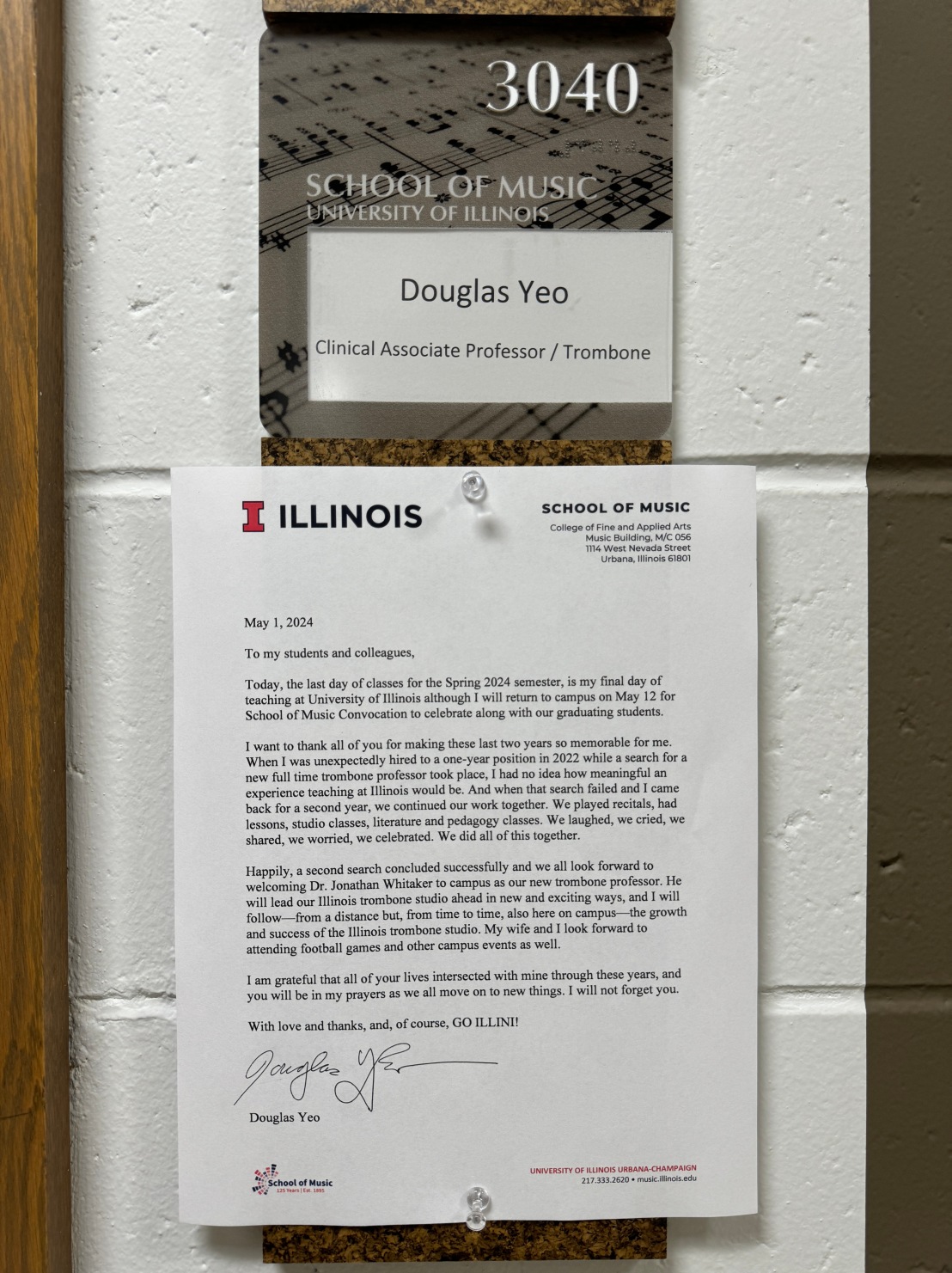
I taught my last trombone lessons at University of Illinois Urbana-Champaign on May 1 and before I headed home, I wrote a letter to my students and colleagues that I posted on the bulletin board next to my office, shown above.
UIUC_Convocation_students_2024

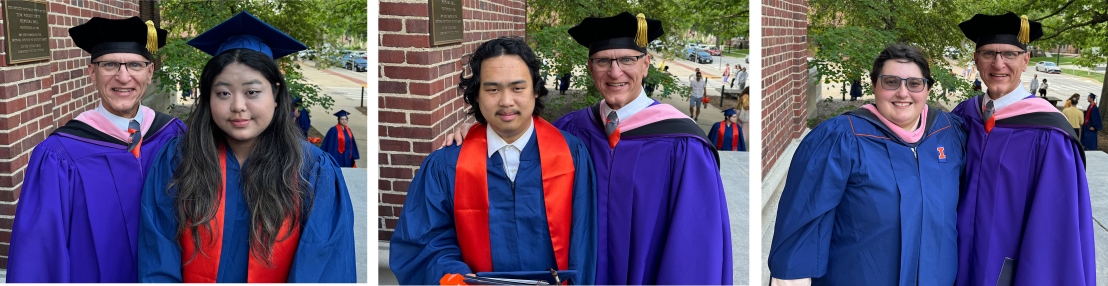
With my graduating students at University of Illinois Urbana-Champaign School of Music Convocation, May 12, 2024. Left to right: Rachel Lin (Bachelor of Music Education), Jerry Min (Bachelor of Music), Lorraine Montana (Master of Music)

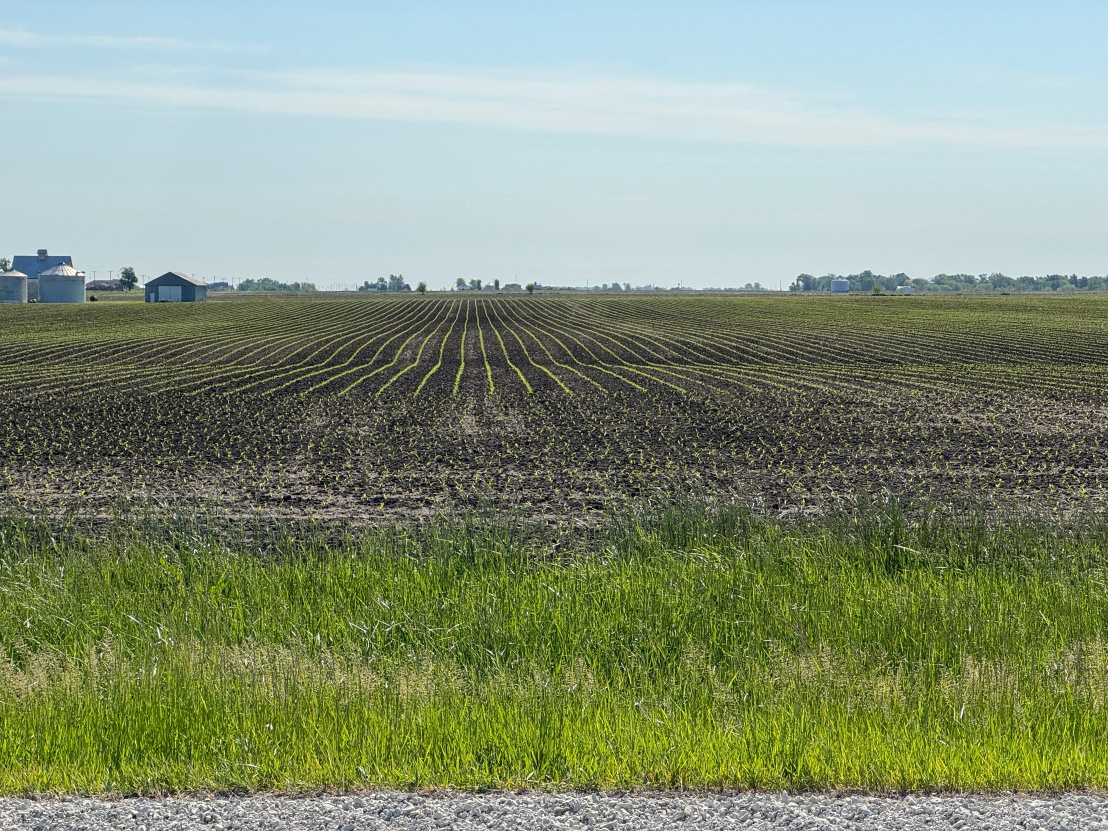
I returned to campus on May 12 when  University of Illinois held a Convocation ceremony for the School of Music and I celebrated the graduation of three of my students. In a sense it was a graduation ceremony for me, too, as I closed out two memorable years teaching at University of Illinois, a campus community where I feel a very strong connection. When the ceremony was over, I took off my academic regalia, switched off the lights in my office, and turned in my keys. On the long drive home through the beautiful, newly planted Illinois cornfields, I began to reflect on all that had just happened. A new season had begun.
Illinois_cornfields_May_2024

Newly planted Illinois cornfields along Illinois Route 115, May 12, 2024

Illinois_corn_May_2024

The corn is now just a few inches tall and in late fall it will be, in the words of the song, “Oh, What a Beautiful Mornin'” from the musical Oklahoma!, “as high as an elephant’s eye.”

As I see it, “retirement” is a lousy word. When I decided to retire from the Boston Symphony, many of my colleagues asked me, “So, are you going to take up golf?” Nope. Golf doesn’t interest me. And I never saw “retirement” as a season of life devoted to non-stop self-entertainment. After decades playing in symphony orchestras, I looked forward to new adventures. I wanted to have more time to research and write, to travel with my wife, to enjoy more time with our daughters and their families, and, with open hands, respond to God’s call to His purposes for my life.

Retirement, as it turned out, meant not playing golf or kicking back and “doing nothing,” but, rather that I was busy doing a host of engaging activities.

UIUC_trombone_studio_Lincoln_poster

The poster that hung in my office at University of Illinois for the last two years. It contains a logo my friend, Lennie Peterson, designed for our trombone studio, my five core tenets of teaching, and a quotation from Dr. Robert E. Gray that sums up the ethos of the University of Illinois Trombone Studio.

I’ve spent most of the last 12 years teaching at colleges and universities each week of the academic year: Arizona State, Wheaton College, University of Illinois. Working with those students has been such a big part of my life. But as I near a birthday with a zero on the end of it (it’s not 60; that was a long time ago. . .), I decided, after much thought and prayer, to step aside from weekly trombone teaching and have more time to do other things. This doesn’t mean I’ve taught my last trombone lesson. I love teaching; I still do. But this change in my life means I won’t be doing that teaching every week as a school’s trombone professor. This freedom gives me time to explore and enjoy both new and familiar things.

And there is a lot ahead for me. Later this month, I’ll travel to Texas Christian University (TCU) in Fort Worth, Texas, to take part in the International Trombone Festival. I’ll give a recital, serve on two roundtable discussion panels (one is about diversity considerations in recital programming; the other is about trombone research), give a major presentation about the celebrated trombonist Joannès Rochut, perform with the TCU trombone choir, and accept the International Trombone Association’s Lifetime Achievement Award. This summer my wife and I will take hiking trips to Grand Canyon and Zion National Parks (with our oldest daughter’s family, including our grandchildren), and Sequoia and King’s Canyon National Parks (with our youngest daughter and her husband). In September, I’ll conduct a trombone residency at University of Texas, Austin. In October I’ll play ophicleide in concerts with the San Francisco-based early music group, Philharmonia Baroque. We’ll attend many baseball games this summer (Chicago Cubs, Schaumberg Boomers, Chicago Dogs, Kane County Cougars, Oakland Ballers), and fall will bring us to our seats in Chicago’s Soldier Field for Chicago Bears football. A major American symphony orchestra has asked if I would be willing to substitute with them in the coming season. Research and writing projects are on my plate (watch the July 2024 issue of the International Trombone Association Journal for my article about the history and a chemical analysis of trombone slide oil, and the January 2025 issue for my article about Joannès Rochut; I’m also at work on a new book for Oxford University Press), as are hikes, walks and tandem bicycle rides with Patricia. And serving our church and enjoying life with our grandchildren.

Doug_Pat_Zion_Observation_Point_June_2023

With my wife, Patricia, at Observation Point, Zion National Park, June 2023. We will return to this special place next month; it will be our 19th trip to Zion National Park.

So, as my long season of institutional teaching has turned a page, I look back at those decades with great fondness and gratitude. And I have learned this: I don’t know all of what God has for me going forward.  With open hands, I’m grateful for the opportunities I’ve had to serve, learn, and contribute. I plan to keep doing that in both new and familiar ways as God leads. I look forward to seeing you along the road.
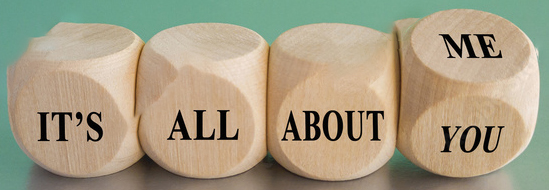
What is happening? It’s not all about you. Or me. It’s about the music.

What is happening? It’s not all about you. Or me. It’s about the music.

by Douglas Yeo (October 15, 2023)

I retired from the Boston Symphony Orchestra in 2012 after nearly 30 years as a member of that remarkable institution. I use the word institution because the BSO was more than an orchestra. Yes, the orchestra itself was the raison d’être for BSO Inc., but there was so much that flowed from the decision by Major Henry Higginson to establish a symphony orchestra in Boston in 1881. The Boston Symphony Orchestra, the Boston Pops Orchestra—which is the BSO minus most of its principal players—Symphony Hall in Boston, the BSO’s annual summer festival at Tanglewood, recordings, tours. It’s all part of the life I led for so many years and I am grateful that I was able to live my dream.

In the 11 years since I retired from the BSO, I’ve been engaged in a host of interesting and very rewarding activities. From recreational trips with my wife and other members of our family, to the joy of living near our grandchildren, to writing many books and articles, to teaching in several colleges/universities (Arizona State University, Wheaton College (Illinois), University of Illinois Urbana-Champaign), to serving now as interim music director at my church, New Covenant Church in Naperville, Illinois, my life is full and interesting. Yet while I left the full time symphony orchestra world in 2012, I’m still interested in it. Now, however, I’m mostly looking at it from the outside. And with this new perspective, I’m increasingly asking myself this question:

What is happening?

“Time,” as the hymn writer Isaac Watts reminded us in his great hymn, Our God, Our Help in Ages Past, is “like an ever-rolling stream.” Times change, things change. Nothing stays the same. It’s easy for someone at my season of life to look back at “the good old days” and assume the ways things were done back then were always better than they are today. Through an honest lens, I can say that some things were better. But not everything. And part of getting older is seeing things change and evaluating them in light of the ever-rolling stream of the passage of time.

As a college professor and one who now sits more frequently in the audience at concerts than on the stage, I am observing many trends in the performing arts. Many of these flow from current cultural mores, the evolution (and let’s remember that evolution of anything is not always for the better) of cultural thinking and operating. Recently, I’ve observed and heard about some things in the orchestra world that have me asking,

What is happening?

To wit, I recently:

  • Attended a concert by a certain professional symphony orchestra where a member of the ensemble—who did not play in the second movement of a piano concerto—took a large sheaf of yellow lined papers out from his tail coat pocket, crossed his legs, sat back in his chair, and proceeded to read the papers—shuffling the pages—for 10 minutes while the concert was going on around him.
  • Learned that a member of a certain professional symphony orchestra was recently dismissed because the member arrived late to a concert and had to conspicuously walk through the orchestra to get to the member’s seat in full view of the audience.
  • Saw a concert performed by a certain professional symphony orchestra where a player had a rough time with a long, exposed solo—I’m sympathetic to the problem; it can happen to anyone—and while he was missing notes all over the place, leaned back in his chair and kicked up his legs, making light of the situation.
  • Learned that a member of a certain professional orchestra was recently dismissed for being rude and insubordinate to the orchestra’s conductor and playing inappropriately loudly after repeatedly being asked to stop doing so during rehearsals and concerts.
  • Attended a concert by a certain professional symphony orchestra where a member of the brass section added many extra notes to his part, took several notes down an octave, and generally obliterated the orchestra with his crass, loud playing. And at the end of the concert, he smiled broadly.
  • Learned recently that the trombone section of a certain professional symphony orchestra is “the most hated section in the orchestra” because they play so loudly and out of context.

What is happening?

When I joined the Boston Symphony Orchestra in 1985, I was 30 years old. I was an experienced bass trombonist, having been a member of the Baltimore Symphony Orchestra for four years, and having worked in New York City as a freelance player for five years. I was very aware of the storied history of the Boston Symphony, its long roster of celebrated music directors, and its unparalleled recorded legacy. I was also aware that Joannès Rochut, whose name is familiar to many of not most trombonists because of the three volumes of Melodious Etudes he arranged from works of Marco Bordogni, had been principal trombonist of the BSO from 1925–1930. I knew I was coming into something that had been around for over 100 years before me.

The Boston Symphony Orchestra has traditions. Tradition is a word that gets knocked about these days. Many people equate tradition with stuffiness, with a “dead” way of doing things. But that’s not the case if tradition is vibrant. For the 104 years before I joined the Boston Symphony, it had evolved to do things in particular ways. The sound of the orchestra was rich and lush, a sound that was enhanced by the fact that the orchestra played in one of the finest concert halls in the world, Symphony Hall, built in 1900.

Boston_Symphony_low_brass_section_Barron_Bolter_Yeo_Schmitz_2001_standing

Boston Symphony Orchestra low brass section: Ronald Barron, Norman Bolter, Douglas Yeo, Chester Schmitz. Symphony Hall, Boston, 2001.

At the time I joined the BSO, there were members in the orchestra who had been hired by the orchestra’s music director from 1924–1949, Serge Koussevitzky, and many more had been hired by Charles Munch, who was music director from 1949–1962. A member of the orchestra’s cello section had played with Glenn Miller’s orchestra during World War II and was part of Miller’s group at the time Miller died when his plane’s frozen carburetor caused it to crash into the English Channel on December 15, 1944. There were men in the orchestra who wore a jacket and tie to rehearsal. There were certain ways the orchestra played, and the expectation was that new players would come into the orchestra and add to that tradition by blending with the rest of the orchestra while adding one’s own musical personality in appropriate ways. It was exhilarating. There I was, sitting in the orchestra’s low brass section between Chester Schmitz—hands down the finest orchestral tuba player that I have ever heard—and Norman Bolter—who had joined the BSO at the age of 20, a prodigy of epic proportions. Ronald Barron headed our low brass section as principal trombonist. Principal bassoonist Sherman Walt, principal clarinetist Harold “Buddy” Wright, principal timpanist Everett “Vic” Firth—they were all there, plying their craft at the highest level. I sat, I played, I observed, I learned, and above all, I fit in. Fitting in required a measure of humility. It wasn’t just because I was “the young guy” and I needed to wait my turn. No, this was normal, usual operating procedure. The goal of the entire orchestra was to present a unified musical product. And we did.

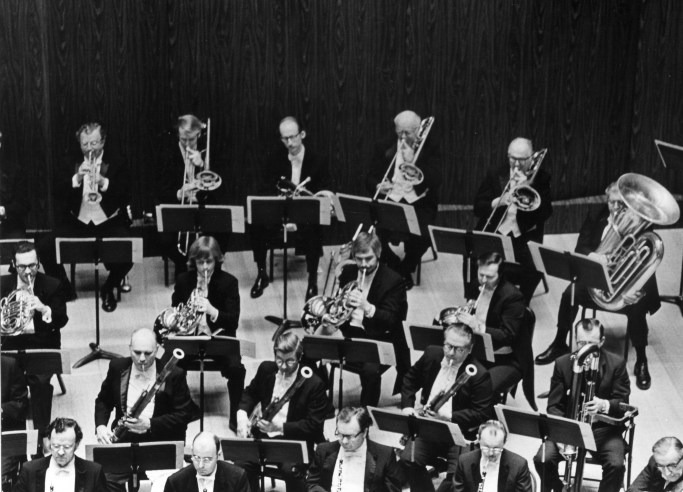
CSO_low_brass_May_1972

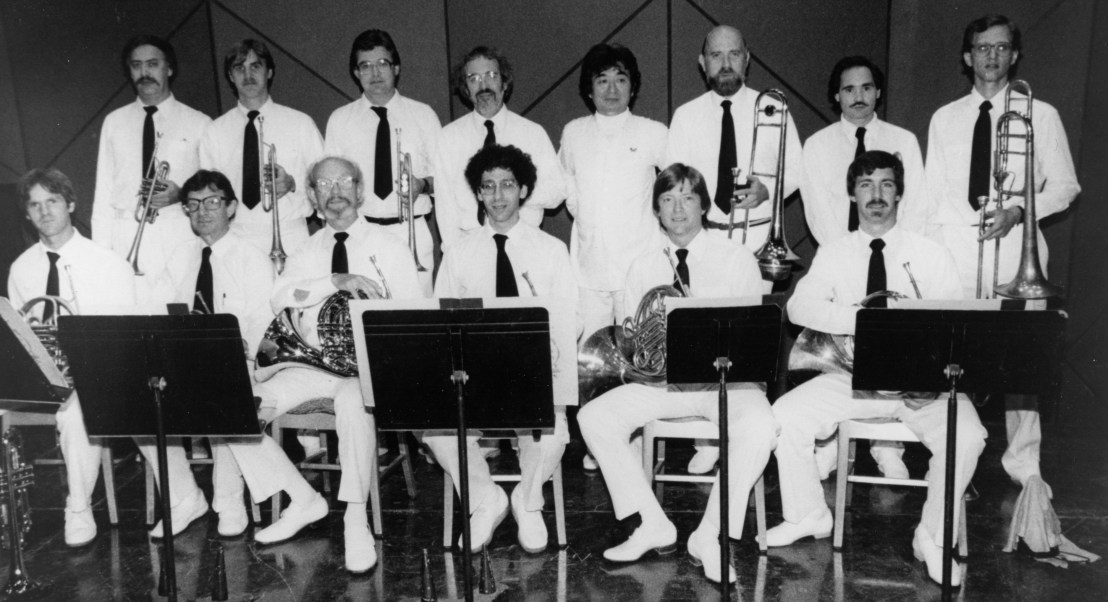
Members of the Chicago Symphony Orchestra brass section. Back row: Adolph Herseth, trumpet; James Gilbertson, Jay Friedman (with euphonium), Frank Crisafulli, Edward Kleinhammer, Arnold Jacobs. Orchestra Hall, Chicago, 1972. Photo courtesy of the Chicago Symphony Orchestra Archives.

I learned the importance of this when I was an undergraduate student at Wheaton College. I studied with Edward Kleinhammer, the celebrated bass trombonist of the Chicago Symphony Orchestra from 1940–1985. In 1975, my wife and I attended a CSO performance of Richard Strauss’ Eine Alpensinfonie. I had never heard the piece before I heard it at that concert (imagine a time in the world’s history where there was only one recording of Strauss’ epic work—and I had not heard it) and I was stunned by the piece and the CSO’s performance. After the concert, my wife and I waited for Mr. Kleinhammer to come up the stairs from the basement of Orchestra Hall and when he arrived at the lobby landing, I blathered away about how amazing he was in the concert. He looked at me with a penetrating stare and then said, “If you heard me, I was a failure. You shouldn’t have heard a fourth trombone player. You should have heard a great orchestra.” And he walked away. I was stunned.

The next day I had a lesson with Mr. Kleinhammer where he unpacked his comment. He told me I was listening to the wrong things. That Eine Alpensinfonie was not all about the fourth trombone player—or the trombones at all. Yes, there were moments when the trombones had a melodic line. But for most of the piece, they worked in community, supporting other instruments. Mr. Kleinhammer told me, “Douglas, it’s not about me. It’s about the MUSIC.” It was at that moment that scales fell from my eyes. I was intoxicated with the trombone section and I missed the orchestra. I had lost the forest for the trees.

And, as God can only do because He is God, I came home from that lesson and opened my Bible and read something that got my attention and changed my life. In the book of First Corinthians, the Apostle Paul wrote about the church, and how a healthy church should be and act. He wrote (1 Corinthians 12:14–27, English Standard Version):

For the body does not consist of one member but of many. If the foot should say, “Because I am not a hand, I do not belong to the body,” that would not make it any less a part of the body. And if the ear should say, “Because I am not an eye, I do not belong to the body,” that would not make it any less a part of the body. If the whole body were an eye, where would be the sense of hearing? If the whole body were an ear, where would be the sense of smell? But as it is, God arranged the members in the body, each one of them, as he chose. If all were a single member, where would the body be? As it is, there are many parts, yet one body.

The eye cannot say to the hand, “I have no need of you,” nor again the head to the feet, “I have no need of you.” On the contrary, the parts of the body that seem to be weaker are indispensable, and on those parts of the body that we think less honorable we bestow the greater honor, and our unpresentable parts are treated with greater modesty, which our more presentable parts do not require. But God has so composed the body, giving greater honor to the part that lacked it, that there may be no division in the body, but that the members may have the same care for one another. If one member suffers, all suffer together; if one member is honored, all rejoice together.

Now you are the body of Christ and individually members of it.

It was at that moment I understood the flaw in my musical thinking. I realized that playing the trombone in an orchestra was not about me. It was not about showing anyone else what I could do, it was not about strutting my stuff, it was not about calling attention to myself. The Apostle Paul’s metaphor for the proper working of the Church—the human body and all of its diverse parts, each of which has a unique function—was a metaphor for the proper working of ANY group of people. A friendship, a marriage, a football team, a business, a church. And a symphony orchestra.

It was then that I distilled Paul’s words into a phrase that I have repeated countless times to my students and colleagues (just ask them; they’ll tell you I say this frequently):

All members of the orchestra are equally important, but at any given moment, all members of the orchestra are not equally prominent.

This is what a symphony orchestra should be about. Each member is equally important. Whether playing the melody, or an underlying rhythmic figure, or soft whole notes, every part is equally important. Just like every part of the body. But when I have long soft notes to play, they are not as prominent as the melody played by the first oboe player. The fact that the oboist has the melody in no way diminishes my contribution at that moment. And if, at the end of the concert, the conductor asks the oboe player to stand up and take a bow and the conductor does not ask me to do so, that is fine, and I will join in the applause for my colleague. Because my oboist colleague was more prominent than I was. It wasn’t about me. It’s about the MUSIC.

If I had made it about me—if I had played my whole notes in a manner that brought attention to myself while obliterating the oboe player’s solo—I would have ruined the performance. So, I committed myself to being a team player, to being part of the body that is the symphony orchestra, and to understanding my role in the greater whole. And this I did—and do—in the service of the MUSIC.

Yeo_team_player_ITAJ

Header graphic and title for Douglas Yeo’s article, “Me, Myself, and I—Are Orchestral Brass Players Losing the Concept of Being Team Players? International Trombone Association Journal, Vol. 25, No. 1, Winter 1997, 21–23.

In 1997, I wrote an article on this subject that was published in the International Trombone Association Journal (Vol. 25, No. 1, Winter 1997); it was subsequently republished in the Tubists Universal Brotherhood Association Journal—the organization has since changed its name to International Tuba Euphonium Association—(Vol. 24, No. 3, Summer 1997). My article was titled, “Me, Myself, and I: Are Orchestral Brass Players Losing the Concept of Being Team Players?” I wrote it in response to a trend I was observing—the very trend that, 26 years later, I am speaking about in this present blog post on The Last Trombone—where I sensed that students and colleagues were beginning to shift from working together to create a unified whole in performance to wanting to stand out and be noticed. A few months later, my friend Gene Pokorny, tubist with the Chicago Symphony, penned a response to my article that was published in the T.U.B.A. Journal in its Winter 1998 issue (Vol. 25, No. 2) in which he echoed and supported my arguments. You can read my article and excerpts from Gene’s response on my website,  HERE and Gene’s whole article HERE.

Which brings me back to my question:

What is happening?

As Gene said in his article:

It may be inexperience which dictates some players to not be part of the team on stage but in many cases it is CHOICE. There are many venerable professionals out there who know how to be ensemble players but, for whatever reasons, choose to not be part of the group. Some of it is carelessness, but some of it is choosing to “get back” at a conductor, make a point to a player on stage, impress some friend in the audience, etc. Whatever the reason, the choice of not playing together with everybody else on stage is a mistake in which everybody pays for somebody else’s lack of maturity. . .

Yet, here we are in 2023, and I’m writing about this again. As I observe the ongoing evolution of musical art, I am seeing more, not less of this tendency to promote one’s self at the expense of the whole. As the examples at the top of this article show so clearly, the “me first” attitude, the “it’s all about me” attitude, the “who are you to tell me what to do” attitude is on display. Players want their students to think of them as “monster” players. A monster? How about being a great trombonist who understands the role of your part in the greater whole? How about some humility? How about an understanding of the difference between importance and prominence? And how about some respect for the music, for your colleagues, for the audience, and for the tradition and history of the ensemble of which you are a part, and to be, as Gene said in his article, “a cog in the wheel” instead of “the nut behind the wheel”? Nobody—including me—does this perfectly. But can this be the goal, the aspiration, something to strive for, and can we talk about this with—even call out— those whose inherent selfishness ruins concerts on a regular basis?

There are things to learn from the way things used to be done. From from our teachers, from the teachers of our teachers, from the people in the jackets and ties. Last week, I was talking with a friend about this ongoing trend of individual players who play in order to be heard and noticed rather than playing in order to support the whole product. Like me, he studied bass trombone with Edward Kleinhammer, and my friend I and frequently talk about the state of the modern symphony orchestra. In a series of text messages last week, he offered:

I miss the old days and our old role models.

Why is the easy stuff SO HARD for some people?

God love you, Ed Kleinhammer.

To which I replied,

Preach it, brother.

Last night, when I was reading my Bible, I turned to this passage (Jeremiah 6:16, English Standard Version) that reminds us of something very important. It starts off with words of wisdom but then observes the response of many people:

Thus says the Lord: “Stand by the roads, and look, and ask for the ancient paths, where the good way is; and walk in it, and find rest for your souls. But they said, ‘We will not walk in it.’”

The ancient paths. The good way. There is a lot we can learn from them. When it comes to playing the trombone, I learned about them from Edward Kleinhammer, and I have tried to emulate his spirit of being a team player throughout my career. My students have heard this from me through my over 40 years of college teaching. There are many players who understand the Apostle Paul’s metaphor of the body and how it perfectly shows us how each of us is valuable and important to any task as long as we understand our role. But there are also many who are hung up on themselves and who ruin music and music making because of their unwillingness to be a team player. Guess what? People are noticing you. Just like the music critic who noticed the trombone section when he heard a certain professional symphony orchestra perform Richard Strauss’ Also Sprach Zarathustra (New York Times, February 15, 1995; review by Alex Ross):

The trombones, who had been emitting ghastly sounds all night, blared too loudly in the “Zarathustra” fanfare, obliterating the top trumpet line.

Yes. You’re noticed.

Will you join me and many others—like Edward Kleinhammer, who taught so many of us about this—in walking “where the good way is”? It’s not all about you. It’s not all about me. It’s about the MUSIC.

Two orchestras, 31 years, 11 colleagues

Two orchestras, 31 years, 11 colleagues

I’ve written many articles for many journals and magazines, but I’ve written the most for the International Trombone Association Journal. I joined the Association in 1973 during its first year of existence—the ITA was incorporated in September, 1972—while I was still in high school. I honestly don’t recall how many articles I’ve written for the ITA Journal; dozens, for sure, as well as many reviews. These articles have included tributes to great players and teachers (click on the links highlighted below and you can read the articles) including Edward Kleinhammer (bass trombonist of the Chicago Symphony, 1940-1985, and my teacher during my years as a student at Wheaton College, Illinois), Keith Brown (long time trombone teacher at Indiana University, former member of the Philadelphia and Metropolitan Opera Orchestras, and my teacher during my freshman year when I was at IU), and Russell “Big Chief” Moore (an outstanding Native American jazz trombonist who played with Louis Armstrong’s “All Stars” and many other great jazz artists). Other articles have been historical in nature, such as my photo essay about trombone players in the Boston Symphony from 1887-1986, and my article about the history of the double-valve bass trombone. I’ve also done interviews with well known players such as bass trombonists David Taylor and Denson Paul Pollard.

There have also been occasions when I’ve been interviewed for articles that others have written. A few weeks ago, my friend, Megumi Kanda, principal trombonist of the Milwaukee Symphony who, along with Matt Walley, edits the ITA Journal’s Orchestral Sectional column, asked if I would join with four other low brass players in answering some questions about what it is like to work day in and day out in a symphony orchestra low brass section. Megumi asked some good questions that got me thinking about the colleagues with whom I’ve worked over the years. At this season of life, looking back at those relationships and friendships and collaborations brings back a lot of memories of the times we shared together. After I hit “send” and the answers to Megumi’s questions were on the way to her (I don’t know when they will be published in the ITA Journal but I expect it will be sometime in 2021), I decided to write this article, a tribute to the players with whom I spent so much time making music over the years.  While I no longer play full time in a major symphony orchestra—something I did for over 31 years in two orchestras—I continue to enjoy envigorating  artistic collaborations with many people. I’m not done yet! But working with these eleven players in two orchestras changed and shaped me and helped bring me to where I am today. 

Baltimore Symphony Orchestra (1981-1985)

Balto_Sym_trombones_summer_1981

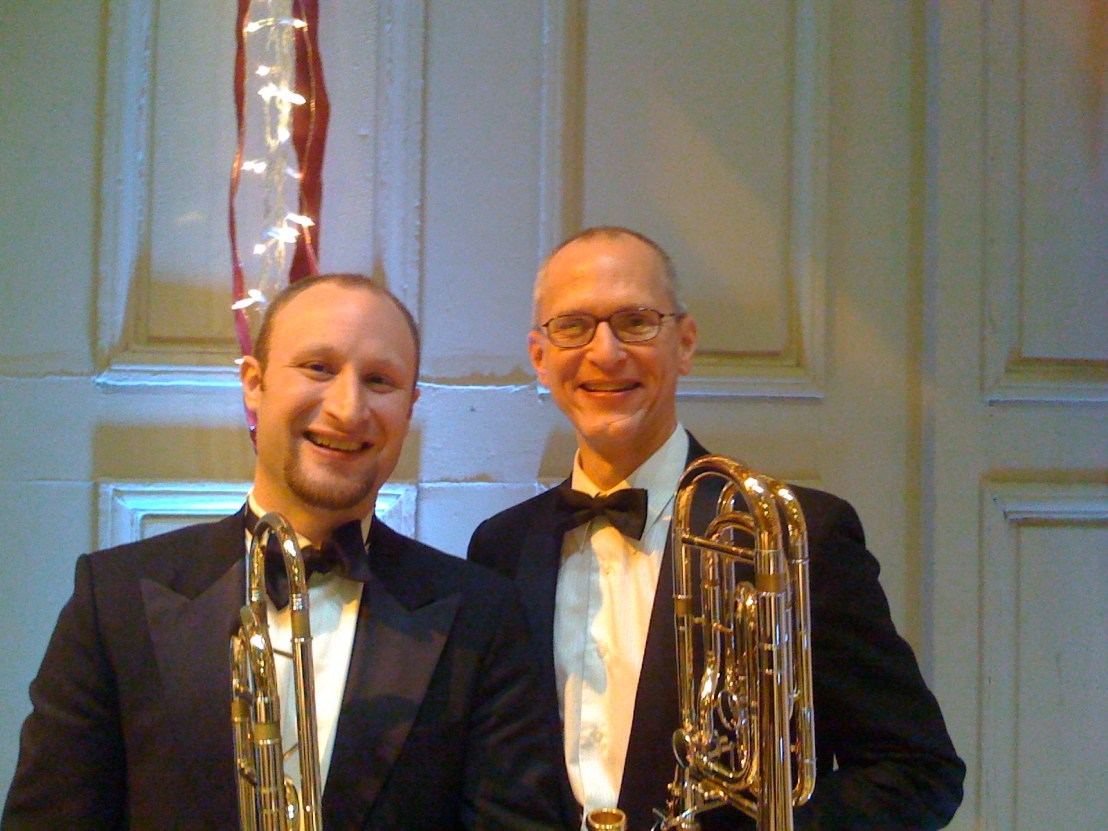
Baltimore Symphony Orchestra trombone section, Harborplace, Baltimore, summer 1981. Left to right: James Olin, co-principal trombone; David Fetter, co-principal trombone; Eric Carlson, second trombone; Douglas Yeo, bass trombone. 

I joined the Baltimore Symphony Orchestra in May, 1981, after two years as the band director at St. Thomas Aquinas High School in Edison, New Jersey. When I joined the BSO—as it was and is still called, although a few years later, I would join another BSO, the Boston Symphony Orchestra—the low brass section consisted of David Fetter and James Olin, co-principal trombone, Eric Carlson, second trombone, and Daniel Brown, tuba. Dan left at the end of my second season and David Fedderly come on as our tubist. While just a few weeks after I joined the orchestra we were locked out in a labor dispute with the orchestra’s management—we settled our contract in January 1982; that was a very long lockout—I enjoyed a very special four years in Baltimore. David Fetter was a name I knew well from his many arrangements with Ensemble Publications. Before coming to Baltimore, he had been assistant principal trombonist in the Cleveland Orchestra. Jim Olin and I were the same age, and he had studied with Frank Crisafulli at Northwestern University at the same time I was studying with Edward Kleinhammer. Eric Carlson and I had been classmates at Wheaton College together where we played together in the orchestra, band, and a trombone quartet. When I graduated from Wheaton in 1976, Eric went on to play second trombone with the North Carolina Symphony. He joined the Baltimore Symphony in 1980 and a year later, I was sitting next to him again.

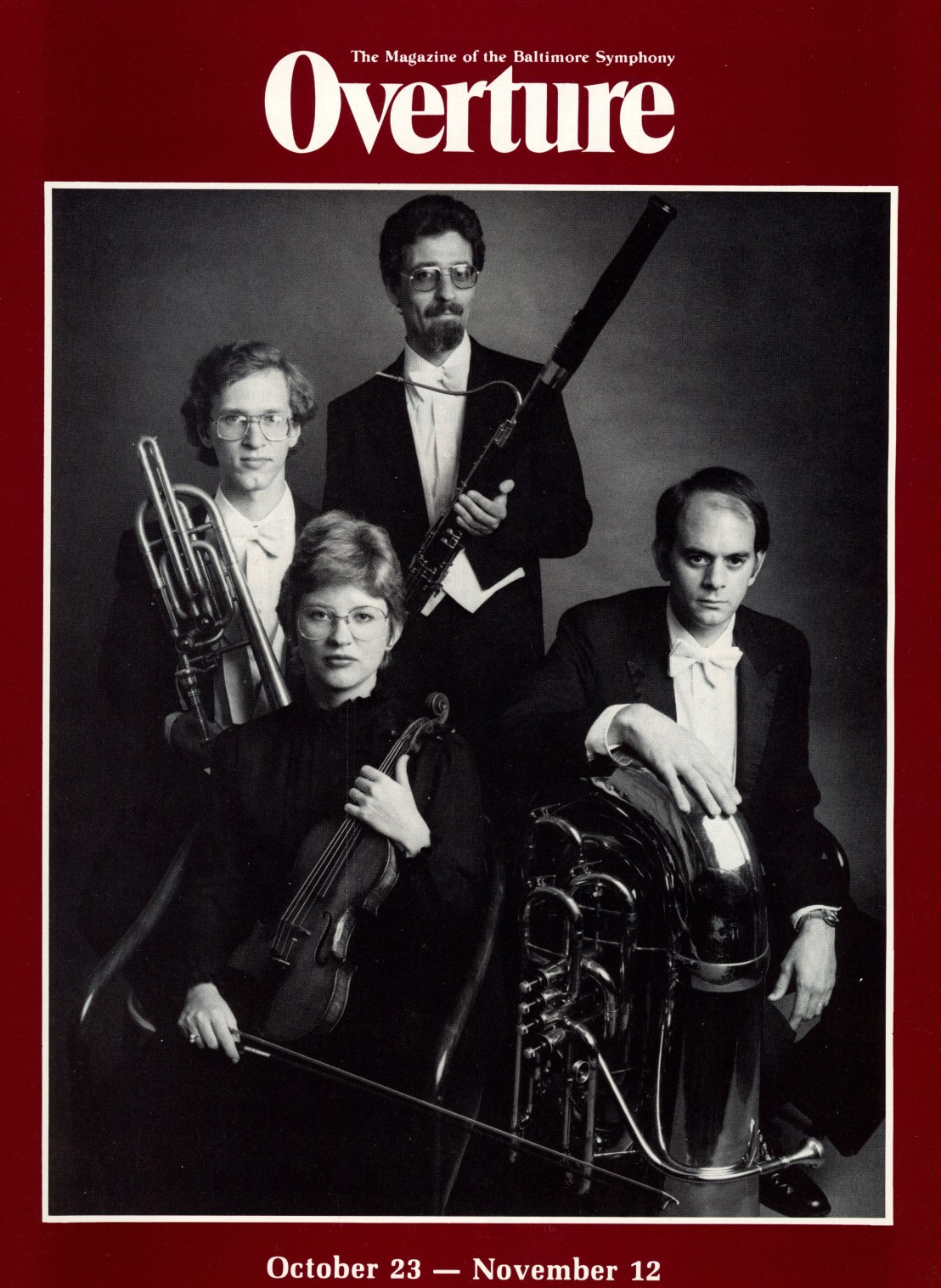
Baltimore_Symphony_program_1982

Overture Magazine (program of the Baltimore Symphony Orchestra), October 23-November 12, 1982. Clockwise from top: Phillip Kolker, principal bassoon; W. Daniel Brown, tuba; Paula Sisson Francis, first violin, Douglas Yeo, bass trombone.

It was in Baltimore that I made my first recording with a symphony orchestra (the Concerto for the Left Hand of Maurice Ravel, with Leon Fleischer, piano soloist); it was where I first played a solo in front of a symphony orchestra (Patrick McCarty’s Sonata); and our second daughter was born there. During my second season, the orchestra opened its new concert hall, Meyerhoff Hall. Those were four very good years, but in May of my fourth season, after a concert in Carnegie Hall, I left Baltimore and headed up Interstate 95 to join the other BSO – the Boston Symphony Orchestra. And, as an aside, a year later, Eric Carlson left the Baltimore Symphony for the Philadelphia Orchestra from which he has just announced his retirement earlier this month.

Boston Symphony Orchestra (1985-2001)

Boston_Symphony_brass_section_1988

Boston Symphony brass section, Tanglewood, summer 1987. From center, left to right: Seiji Ozawa, music director; Ronald Barron, principal trombone; Norman Bolter, second trombone; Douglas Yeo, bass trombone. (Not pictured: Chester Schmitz, tuba)

Boston_Symphony_low_brass_section_Barron_Bolter_Yeo_Schmitz_2001_standing

Boston Symphony low brass section, Symphony Hall, Boston, 2001. Left to right: Ronald Barron, principal trombone; Norman Bolter, second trombone;  Douglas Yeo, bass trombone; Chester Schmitz, tuba.

I joined the Boston Symphony Orchestra in May 1985, in the middle of that year’s spring Boston Pops season. The Boston Pops Orchestra is drawn from members of the Boston Symphony, so the Pops was just part of my job as bass trombonist of the BSO. I recall that my first service—a concert—was recorded for television broadcast, the PBS show, “Evening at Pops.” I had no rehearsal. Before the concert, I introduced myself to the conductor of the Boston Pops, John Williams, and within the first minute of talking he asked me, “Have you heard from Spanky?” I right away knew who he was taking about. He was asking about George Roberts, the great Los Angeles based bass trombonist, known to generations of players as “Mr. Bass Trombone.” George and I had been friends for a long time and John had worked with George on many of his film sessions.

George_Roberts_Yeo_2004

George Roberts and Douglas Yeo, International Trombone Festival, Ithaca College, New York, 2004. That was George, always hugging and smiling.

As things were, I had recently talked with George—”Spanky” as John called him—and I could give John a report on how he was doing. But I made a note to myself: Whenever John Williams was coming to Boston for a run of concerts, I always made sure I called George first so I’d have something to pass on to John. And George always ended our conversations with, “And give John a kiss, and tell him I love him.” If you knew George Roberts, you’ll be smiling right now. George always said something like that. He was always about hugging and loving and caring about people. George died in 2014. I miss him.

Yeo_Williams_Concerto_1991_05_24_ed

Douglas Yeo performing John Williams’ Tuba Concerto, Symphony Hall, Boston, May 24, 1991. Boston Pops Orchestra, John Williams Conductor. Photo by Chester Schmitz.

At that time (1985), principal players of the Boston Symphony didn’t play in the Boston Pops Orchestra. Instead, they formed the Boston Symphony Chamber Players and assistant principal or second players in the BSO moved up to play principal during the Pops season. Norman Bolter, second trombonist of the BSO, played principal in Pops and we had several players work with us over the year to fill the second trombone chair, including Larry Isaacson, Douglas Wright, Darren Acosta, John Faieta, Hans Bohn, Alexi Doohovskoy, and Jim Nova. Oh, wow, we had fun. We made so many recordings with John Williams, and also with Keith Lockhart (and one with Leonard Bernstein), we recorded countless television shows, and we toured Japan twice with John Williams conducting. I performed several concertos with the Boston Pops during my years including the first performances of John Williams’ Tuba Concerto on bass trombone (the piece had been written in 1985 on a commission from the Boston Symphony and it was dedicated to the orchestra’s tuba player, Chester Schmitz), many performances of Chris Brubeck’s Concerto for Bass Trombone conducted by Keith Lockhart, performances of Chris’ second bass trombone concerto, the Prague Concerto, Gerald Steichen, conducting, and also performances of Simon Proctor’s Serpent Concerto with John conducting. Fun times.

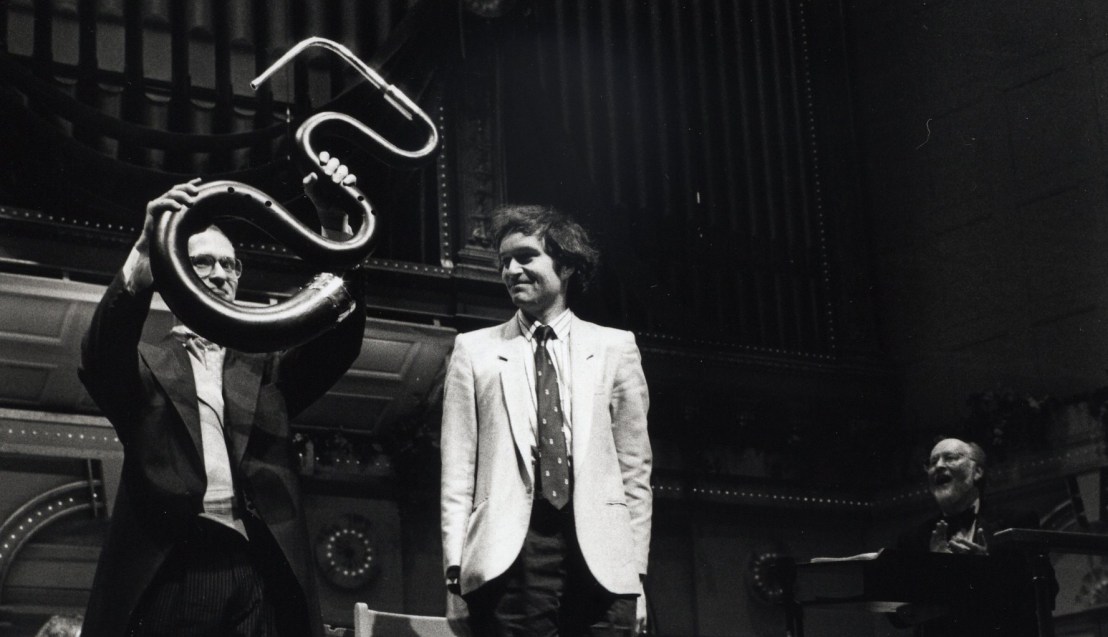
Yeo_Proctor_Williams_Serpent_Concerto_1997

Douglas Yeo (left) after performing Simon Proctor’s Serpent Concerto, Symphony Hall, Boston, May 29, 1997. Boston Pops Orchestra, John Williams, conductor (right) with Simon Proctor (center). 

From 1985 to 2001, our Boston Symphony low brass section was Ronald Barron, principal, Norman Bolter, second, Chester Schmitz, tuba, and me on bass trombone. That’s 17 years we spent together and we did it all. For 17 years, I was the new guy in the section. We recorded all of the Mahler Symphonies with Seiji Ozawa and all of the Brahms Symphonies with Bernard Haitink. And dozens of other recordings of music from Bach to Gubaidulina. We took an international tour during most seasons, traveling across the United States, to South America, all over Europe, the Canary Islands off the coast of Africa, and to Japan and Hong Kong many times. Unforgettable experiences. Working together with the same people for so long allowed us to develop understandings among us. After several years, we didn’t have to talk much about how we were going to approach certain pieces; we just knew. I knew exactly how Norman would breath in, say, a Schumann symphony, or when Chester was going to circular breathe in a Bruckner symphony. Ours was a collaboration of understanding. I learned so much from Ron, Norman, and Chester. So much. Little did I imagine that an event in 2001 would set off a chain reaction of change in the BSO low brass section that would take over a decade to settle. 

Boston Symphony Orchestra (2001-2003)

A career in a symphony orchestra is not a straight line.

Following a September 2001 performance of Brahms Symphony No. 2 in the Amsterdam Concertgebouw conducted by Bernard Haitink (just a few days before the 9/11 attacks), Chester Schmitz retired. He had joined the BSO in 1966, fresh out of the United States Army Band (“Pershing’s Own”) in Washington D.C. It was the end of an era for the BSO low brass section. After being together for 17 years, our low brass section was changing. We held two auditions for Chester’s position but did not hire anyone. I know how frustrating it is for people to prepare for and come to an audition and have it end without someone being hired. “They don’t know what they want!” is a familiar cry. But the truth is we DID know what we wanted; we just didn’t hear it at those auditions. We knew that replacing Chester Schmitz was impossible. But Chester was the standard for tuba playing we all had in our mind. From 2001-2003, we had a succession of substitute tuba players that worked alongside Ron, Norman, and me. 

Boston Symphony Orchestra (2003-2008)

Barron_Bolter_Yeo_Roylance_Levine_2007

Boston Symphony Low Brass Section, Symphony Hall, Boston, 2007. Left to right: Ronald Barron, principal trombone; Norman Bolter, second trombone; James Levine, music director; Douglas Yeo, bass trombone; Mike Roylance, tuba.

After a third tuba audition, Mike Roylance joined the BSO 2003. He was the first new member of the low brass section in 19 years. Mike arrived during an interim period between two music directors, Seiji Ozawa (1973-2002) and James Levine (2004-2011). Our section was complete once again. But not for long.

Boston Symphony Orchestra (2008-2010)

Barron_Bolter_Yeo_2007

Boston Symphony Orchestra Trombone Section, 2008. Left to right: Ronald Barron, principal trombone; Norman Bolter, second trombone; Douglas Yeo; bass trombone.

Ron Barron joined the Boston Symphony in 1970 as second trombonist, and then won the principal trombone position in 1975 upon the retirement of William Gibson. In that same year, 1975, Norman Bolter won the second trombone position that Ron had just vacated. Incredibly, both Norman and Ron decided to retire from the BSO in the same year, 2008. Their final season was bittersweet for me. Suddenly, the trombone section that I had known for the previous 23 years was gone. With two vacancies in the section, the decision was made to hold an audition for a new principal trombonist and after that player received tenure, then schedule an audition for a new second trombonist. That way, the new principal player could serve on the audition committee for the new second player. It made sense but it set up two years when we did not have a full section. For two years, we had substitute players fill the second trombone chair.

Oft_Yeo_2008

Toby Oft and Douglas Yeo, Symphony Hall, Boston, December 24, 2008.

Toby Oft, former principal trombonist of the San Diego Symphony, was hired as our new principal trombonist and he began with the BSO at the start of the 2008 season. I went on sabbatical from the orchestra for six months beginning in January 2009—something that had been planned two years earlier, before Norman and Ron announced their retirement—Toby received tenure in the summer of 2009, and we then held an audition for a new second trombonist. 

Boston Symphony Orchestra (2010-2012)

Lange_Yeo_Oft_2012

Boston Symphony Orchestra Trombone Section, basement of Symphony Hall, Boston, 2012. Left to right: Stephen Lange, second trombone; Douglas Yeo, bass trombone; Toby Oft; principal trombone. Photo by Randall Hawes.

In 2010, we hired Stephen Lange as second trombonist. Steve, who had played for the previous 10 years with the Saint Louis Symphony, completed our low brass section that had been in flux since Norman and Ron’s retirement in 2008. But yet another change was on the horizon. I decided to retire from the BSO in 2012, after over 27 years of occupying the bass trombone chair. But my final two seasons were very special to me as the oldest, most experienced member of my new section, and a carrier of the flame of the BSO’s long performance traditions.

Yeo_Haitink_Sym_Hall_final_bow_2012

My final bow on stage at Symphony Hall, Boston, May 2012. Behind me are BSO concertmaster Malcolm Lowe and conductor Bernard Haitink.

During my last season with the BSO (click HERE to read an interview I gave for the Boston Symphony Program Book in 2011 where I looked back on my long career in the orchestra)—my final concert in Symphony Hall in May 2012 was Beethoven Symphony No. 9 conducted by Bernard Haitink.

Yeo_Final_Bow_Tanglewood_BSO_2012

My final bow on stage at Tanglewood, the summer home of the BSO—my last concert with the Boston Symphony Orchestra—August 5, 2012. 

When I played my final concert with the orchestra at Tanglewood in August 2012—Berlioz Symphonie fantastique conducted by Loren Maazel—a page was turned in the history of BSO low brass playing. The last vestige of the Boston Symphony trombone section that came together when I joined the orchestra in 1985 was no more. When James Markey began as the BSO’s bass trombonist the day after I retired, a new tradition with an entirely new section was born. Toby Oft, Steve Lange, Jim Markey, and Mike Roylance are making their own mark as the BSO’s low brass section. Already they have been at it for eight years. Will the four of them play together for 17 years as Ron, Norman, Chester, and I did? Will the trombone section stay together for 23 years as Ron, Norman, and I did? Time will tell.

But there is this: All of us—Ron, Norman, Chester; Toby, Steve, Jim, Mike, and I—are part of a long stream of low brass players that goes back to the Boston Symphony’s founding in 1881. From George Stewart to Leroy Kenfield to Joannès Rochut to Eugene Adam to Kilton Vinal Smith to Jacob Raichman to Kauko Kahila to William Gibson, all of us were touched by those who came before us. And the same can be said for my colleagues in the Baltimore Symphony; David, Jim, Eric, Dan, David, and I  were part of a long stream of low brass players that came through that orchestra, including John Melick Jr., Ted Griffith, Philip Donatelli, John Marcellus, Douglas Edelman, Charles Vernon, and John Engelkes. Touched, influenced, inspired, changed. I’m glad that Megumi Kanda asked me those questions about working in an orchestral trombone section. It gave me the opportunity to dig out some old photos, recall some old memories, and offer gratitude to God for the life in music that He has given me, a life shared with many others. Thirty one years in two orchestras, sitting amidst 11 colleagues. Thank you, all of you.

[Header photo: Boston Symphony Low Brass Section, Symphony Hall, Boston, February 1992 (performance of Dvorak Symphony No. 9, “From the New World”). Left to right: Ronald Barron, principal trombone; Norman Bolter, second trombone; Douglas Yeo, bass trombone; Chester Schmitz, tuba.]

Do good. Help a widow.

Do good. Help a widow.

As the page is turned to a new year, from 2019 to 2020, we all do well to reflect upon and remember those who helped us in the past. Sometimes that reflection leads to action, and I hope this blog post might encourage others to follow in the steps of many others who are working today to help a person in need.

Most trombonists are aware of the pioneering work of Orla Edward Thayer, who, in 1977, invented the Thayer axial-flow valve. Ed’s invention was hugely influential in the trombone marketplace and it set off a rush of innovative design of valves by a host of manufacturers which resulted in significant improvements to trombones.

Ed’s valve was first patented in 1978 with a cylindrical valve design. In 1985, he was issued another patent with the well-known cone valve design that is still in use today.

[Above: drawings from Ed Thayer’s 1978 and 1985 patents for his axial-flow valve.]

I was an early adopter of Ed Thayer’s valve. When I was a member of the Baltimore Symphony (1981-1985), I contacted Ed and asked him to add his valve to my Bach bass trombone. This he did, with bass trombone valve number B-6, from the very first group of bass trombone valves he ever made. I endorsed his valve for several years and it was on that single valve trombone with Ed Thayer’s valve that I won the bass trombone position in the Boston Symphony Orchestra in 1985.

Oliin_Carlson_Yeo_March_1985

My colleagues in the Baltimore Symphony, Jim Olin (co-principal), Eric Carlson (second) and I all used axial-flow valve equipped trombones—we became one of the first trombone sections to use trombones with Ed’s valve. The photo above shows Jim, Eric, and me in March, 1985.

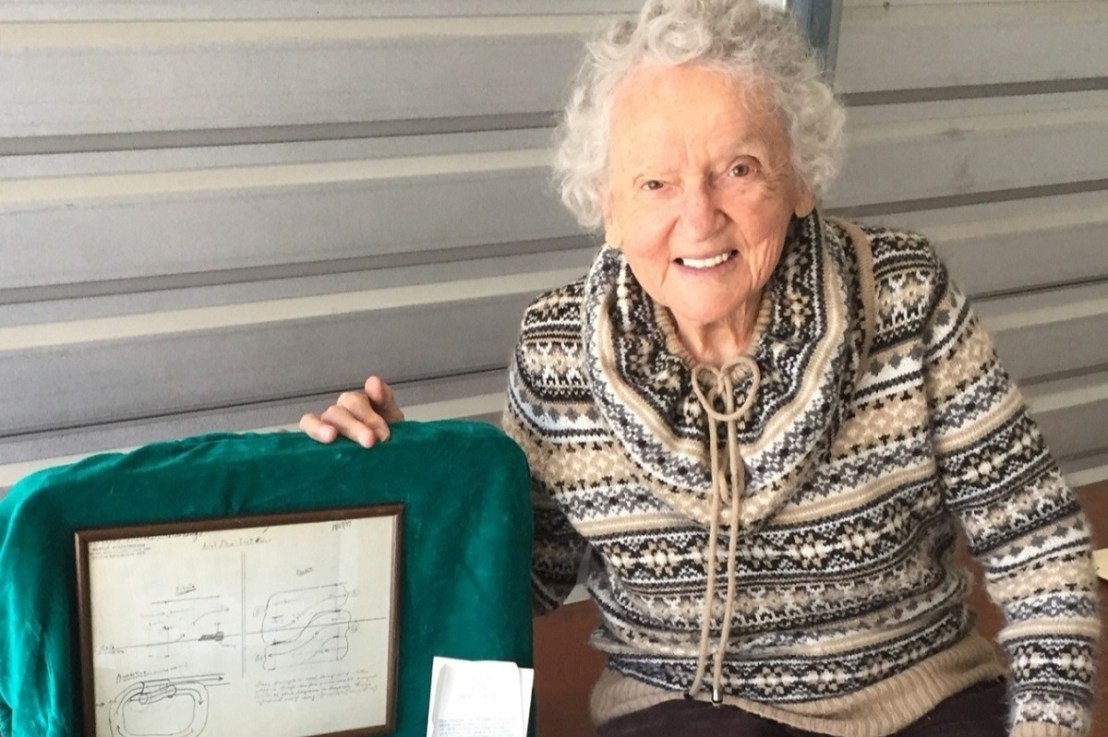
Ed Thayer was a superb inventor. More than that, he was a decent, honorable, kind person, and I and many others have always said the same about his wife, Barbara. I count it a privilege to have called them friends. Ed died in 2009, and while the valve he invented changed the face of trombone design, he was not the most savvy businessman. Several unfortunate circumstances surrounding the patent and production of the axial-flow valve drained Ed and Barbara of their financial resources and they were forced to live on Social Security alone. Barbara, now 94 years old, is living month to month.

Ken Novotny has established a gofundme page to help Barbara Thayer pay down her existing debt and help her with a long-term housing solution. This is an admirable project that has already generated many donations from generous donors. But there is a long way to go to the goal of $11,945.

As I was reading my Bible this morning, the following words jumped off the page:

Wash yourselves; make yourselves clean; remove the evil of your deeds from before my eyes; cease to do evil, learn to do good; seek justice, correct oppression; bring justice to the fatherless, plead the widow’s cause.

These words are from Isaiah 1:16-17. It was shortly after reading these words that I received an email from my friend, Marcel Schot, a trombonist in The Netherlands, letting me know about Barbara Thayer’s plight and this effort to help her. As a result, my wife and I have just made a donation to the Help Barbara Thayer gofundme page.

Would you consider doing the same? I don’t think there is any better way to start the new year than to help a widow. Barbara Thayer is deserving of our help, and doing so also honors the legacy of her late husband, Ed. Click the gofundme icon below to be directed to the “Help Barbara Thayer, Widow of Edward Thayer” page. Do a good thing, and “plead the widow’s cause.” Thank you for your consideration.

gofundme