Category: Arizona and the Southwest

For everything there is a season

For everything there is a season

by Douglas Yeo (May 19, 2024)

The Bible gives us answers, and it reminds us of this (Ecclesiastes 3:1-8, English Standard Version):

For everything there is a season, and a time for every matter under heaven:

a time to be born, and a time to die; a time to plant, and a time to pluck up what is planted;

a time to kill, and a time to heal; a time to break down, and a time to build up;

a time to weep, and a time to laugh; a time to mourn, and a time to dance;

a time to cast away stones, and a time to gather stones together; a time to embrace, and a time to refrain from embracing;

a time to seek, and a time to lose; a time to keep, and a time to cast away;

a time to tear, and a time to sew; a time to keep silence, and a time to speak;

a time to love, and a time to hate; a time for war, and a time for peace.

For each of us, our lives are full of seasons, and I have recently turned the page on a very long season of life and a new season is upon me.

Pearce_trombone_Concert_stylings

One of the Bill Pearce solo trombone with piano books that my first trombone student, Lloyd, gave to me in payment for trombone lessons I gave him at Wheaton College in the summer of 1974.

I have been teaching trombone lessons since the summer of 1974. At that time, I was a student at Wheaton College and another student on campus, Lloyd, asked if he could take some lessons with me. Lloyd wasn’t a trombone major; in fact, he was a student at Wheaton College for only that one summer quarter. But I was happy to help him improve his skills. At the end of the lessons, Lloyd told me he didn’t have money to pay me but if I would accept them, he would give me five books of solos for trombone and piano by the great gospel trombonist Bill Pearce. 50 years later, I still have and use those books. After that summer, I began teaching weekly lessons to young players through the College’s Preparatory Department. Doing so helped me get through college without any debt (that job along with other jobs that included working as student manager of the College artist series, working two days a week at a local White Hen Pantry, and shoveling snow for an office park in the winter).

Since that time, I’ve taught regularly in many schools, first as a high school band director, then as trombone teacher/professor of trombone:

STA_My_Fair_Lady_pit_band

St. Thomas Aquinas High School, Edison NJ (1979-1981) — with students in rehearsal for the school’s production of My Fair Lady, 1981.
Peabody_News_1982

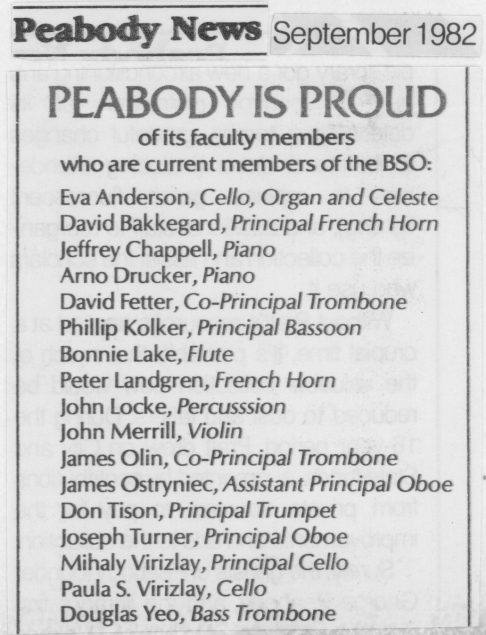
Peabody Institute of Johns Hopkins University, Baltimore MD (1982-1985) — Announcement from September 1982  in Peabody News listing faculty members who were members of the Baltimore Symphony Orchestra

NEC_Trombones_1990_01

New England Conservatory of Music (1984-2012) — conducting the New England Trombone Choir at New England Conservatory, 1990
ASU_Desert_Bones_2016

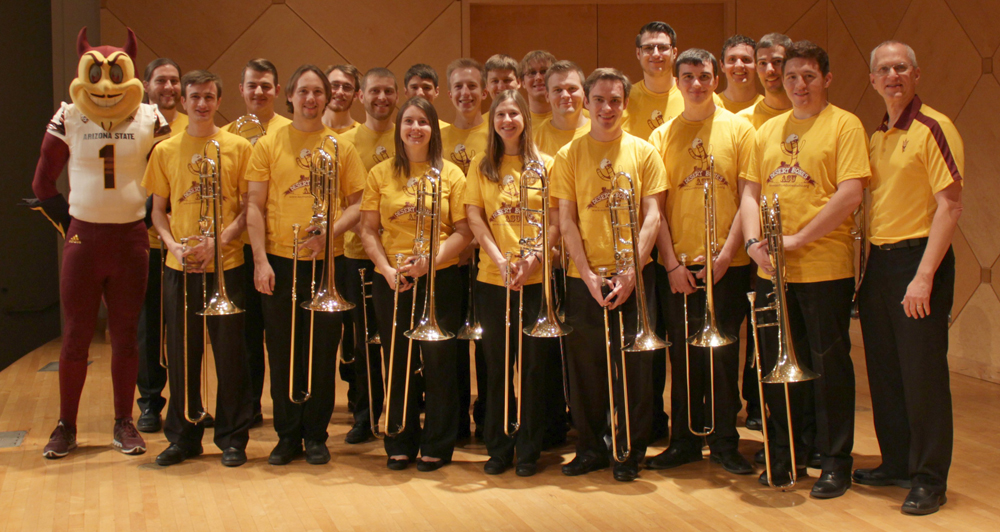
Arizona State University, Tempe AZ (2012-2016) — ASU Trombone Studio with the University’s mascot, Sparky, 2016

Wheaton College, Wheaton IL (2019-2023) — performance of Canzone by Girolamo Frescobaldi, arr. Eddy Koopman, Wheaton College faculty recital, April 23, 2022

UIUC_Illinois_trombone_studio_2024_signed_photo

University of Illinois Urbana-Champaign, IL (2022-2024) — signed photo given to me by members of the University of Illinois Trombone Studio, May 2024

Since I retired from the Boston Symphony Orchestra in 2012 after more than 27 years as a member of that great orchestra, my life has taken many turns. My wife, Patricia, and I moved to Arizona where I immediately flunked retirement and accepted the full time position as professor of trombone at Arizona State University. In 2018, we moved to the Chicago area to be near our grandchildren (grandkids truly make you do crazy things, like move from Arizona to the Midwest) and I flunked retirement again when I was asked to teach at my undergraduate alma mater, Wheaton College. When University of Illinois asked me to take a one year position as professor of trombone for 2022-2023—a position that came to me most unexpectedly and I thoroughly enjoyed—I looked forward to trying this retirement thing again in 2023 when that appointment was up and, at the same time, I decided to step away from teaching at Wheaton College. But as things turned out, one year of teaching at Illinois turned into two years. Happily, the Illinois School of Music recently hired a new full time trombone professor and my appointment at Illinois concluded.
Yeo_UIUC_office_letter

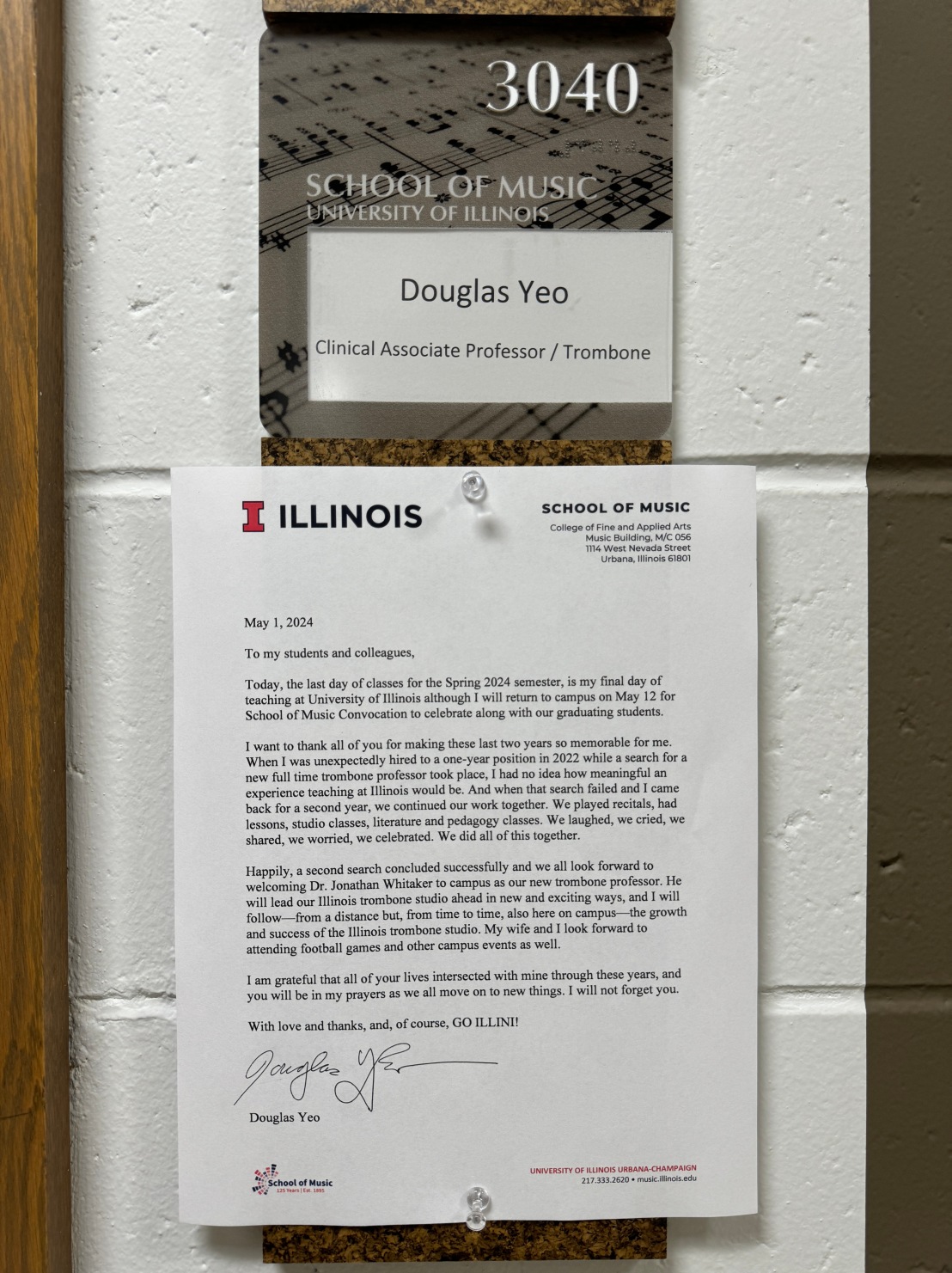
I taught my last trombone lessons at University of Illinois Urbana-Champaign on May 1 and before I headed home, I wrote a letter to my students and colleagues that I posted on the bulletin board next to my office, shown above.
UIUC_Convocation_students_2024

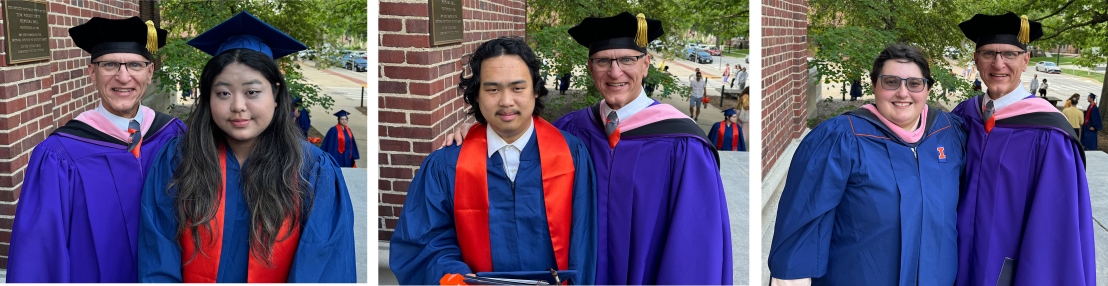
With my graduating students at University of Illinois Urbana-Champaign School of Music Convocation, May 12, 2024. Left to right: Rachel Lin (Bachelor of Music Education), Jerry Min (Bachelor of Music), Lorraine Montana (Master of Music)

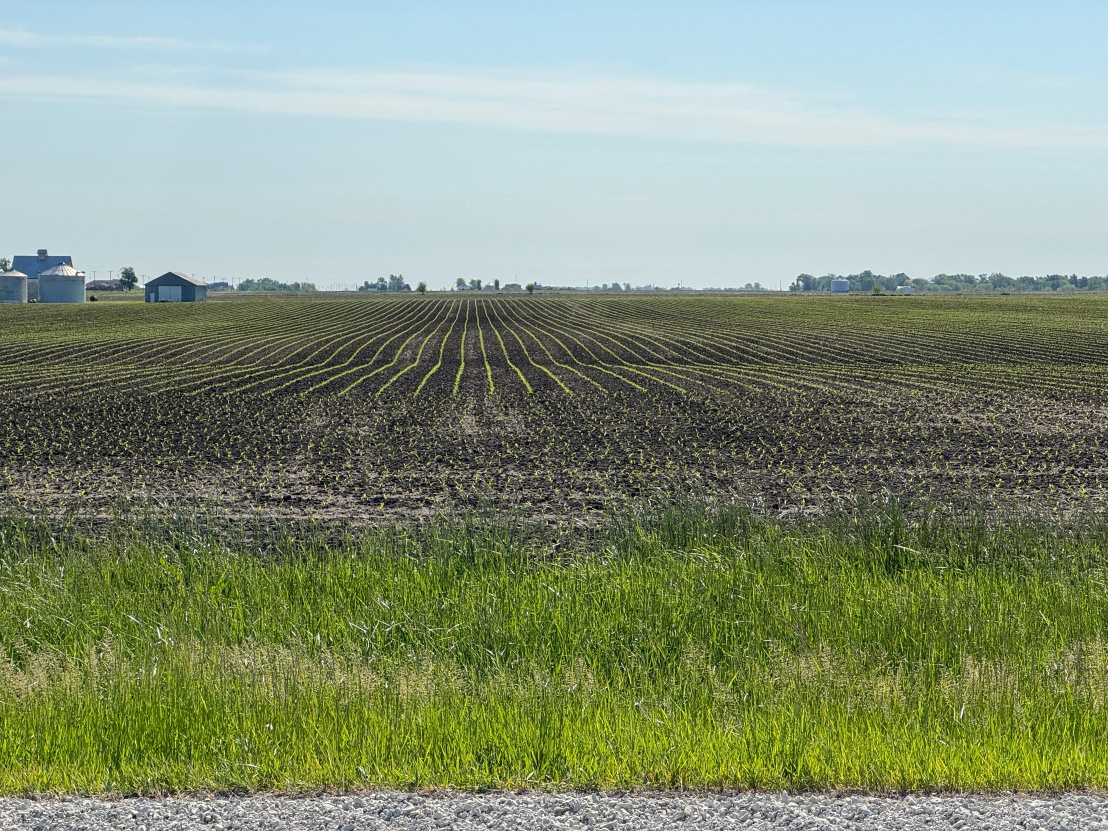
I returned to campus on May 12 when  University of Illinois held a Convocation ceremony for the School of Music and I celebrated the graduation of three of my students. In a sense it was a graduation ceremony for me, too, as I closed out two memorable years teaching at University of Illinois, a campus community where I feel a very strong connection. When the ceremony was over, I took off my academic regalia, switched off the lights in my office, and turned in my keys. On the long drive home through the beautiful, newly planted Illinois cornfields, I began to reflect on all that had just happened. A new season had begun.
Illinois_cornfields_May_2024

Newly planted Illinois cornfields along Illinois Route 115, May 12, 2024

Illinois_corn_May_2024

The corn is now just a few inches tall and in late fall it will be, in the words of the song, “Oh, What a Beautiful Mornin'” from the musical Oklahoma!, “as high as an elephant’s eye.”

As I see it, “retirement” is a lousy word. When I decided to retire from the Boston Symphony, many of my colleagues asked me, “So, are you going to take up golf?” Nope. Golf doesn’t interest me. And I never saw “retirement” as a season of life devoted to non-stop self-entertainment. After decades playing in symphony orchestras, I looked forward to new adventures. I wanted to have more time to research and write, to travel with my wife, to enjoy more time with our daughters and their families, and, with open hands, respond to God’s call to His purposes for my life.

Retirement, as it turned out, meant not playing golf or kicking back and “doing nothing,” but, rather that I was busy doing a host of engaging activities.

UIUC_trombone_studio_Lincoln_poster

The poster that hung in my office at University of Illinois for the last two years. It contains a logo my friend, Lennie Peterson, designed for our trombone studio, my five core tenets of teaching, and a quotation from Dr. Robert E. Gray that sums up the ethos of the University of Illinois Trombone Studio.

I’ve spent most of the last 12 years teaching at colleges and universities each week of the academic year: Arizona State, Wheaton College, University of Illinois. Working with those students has been such a big part of my life. But as I near a birthday with a zero on the end of it (it’s not 60; that was a long time ago. . .), I decided, after much thought and prayer, to step aside from weekly trombone teaching and have more time to do other things. This doesn’t mean I’ve taught my last trombone lesson. I love teaching; I still do. But this change in my life means I won’t be doing that teaching every week as a school’s trombone professor. This freedom gives me time to explore and enjoy both new and familiar things.

And there is a lot ahead for me. Later this month, I’ll travel to Texas Christian University (TCU) in Fort Worth, Texas, to take part in the International Trombone Festival. I’ll give a recital, serve on two roundtable discussion panels (one is about diversity considerations in recital programming; the other is about trombone research), give a major presentation about the celebrated trombonist Joannès Rochut, perform with the TCU trombone choir, and accept the International Trombone Association’s Lifetime Achievement Award. This summer my wife and I will take hiking trips to Grand Canyon and Zion National Parks (with our oldest daughter’s family, including our grandchildren), and Sequoia and King’s Canyon National Parks (with our youngest daughter and her husband). In September, I’ll conduct a trombone residency at University of Texas, Austin. In October I’ll play ophicleide in concerts with the San Francisco-based early music group, Philharmonia Baroque. We’ll attend many baseball games this summer (Chicago Cubs, Schaumberg Boomers, Chicago Dogs, Kane County Cougars, Oakland Ballers), and fall will bring us to our seats in Chicago’s Soldier Field for Chicago Bears football. A major American symphony orchestra has asked if I would be willing to substitute with them in the coming season. Research and writing projects are on my plate (watch the July 2024 issue of the International Trombone Association Journal for my article about the history and a chemical analysis of trombone slide oil, and the January 2025 issue for my article about Joannès Rochut; I’m also at work on a new book for Oxford University Press), as are hikes, walks and tandem bicycle rides with Patricia. And serving our church and enjoying life with our grandchildren.

Doug_Pat_Zion_Observation_Point_June_2023

With my wife, Patricia, at Observation Point, Zion National Park, June 2023. We will return to this special place next month; it will be our 19th trip to Zion National Park.

So, as my long season of institutional teaching has turned a page, I look back at those decades with great fondness and gratitude. And I have learned this: I don’t know all of what God has for me going forward.  With open hands, I’m grateful for the opportunities I’ve had to serve, learn, and contribute. I plan to keep doing that in both new and familiar ways as God leads. I look forward to seeing you along the road.
A radio show and the serpent (the instrument, not a snake)

A radio show and the serpent (the instrument, not a snake)

by Douglas Yeo (December 13, 2023)

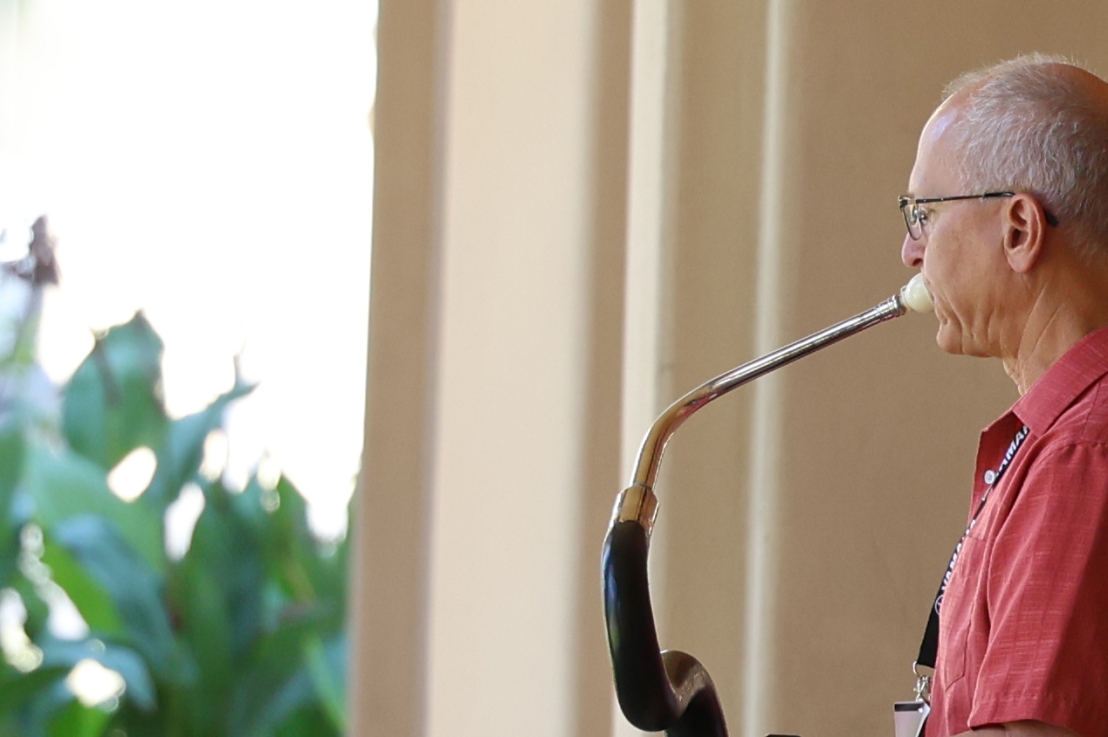
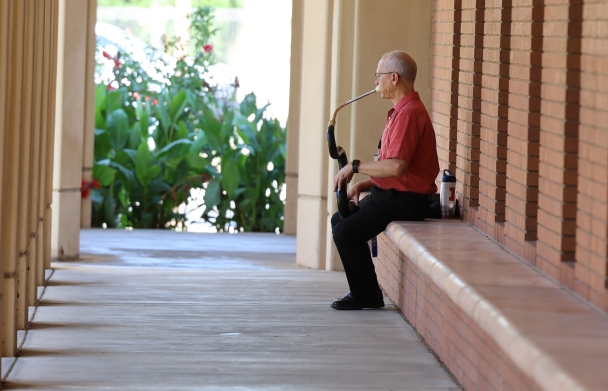
Readers of TheLastTrombone will remember that in May/June 2023, I traveled to Arizona State University to take part in the 50th Anniversary International Tuba Euphonium Conference. The conference, sponsored every other year by the International Tuba Euphonium Association, was hosted by my good friend, Deanna Swoboda, tuba professor at ASU. While there, I gave a presentation about the Native American Sousaphone player John Kuhn and I also played a recital of music that featured that most unusual of musical instruments, the serpent.

ITEC_Hentschel_Yeo_serpent_practicing_01_cropped_2

Finding a practice room at a conference can be challenging, so I warmed up before my recital outside the Arizona State University music building. Photo by Tom Hentschel.

The serpent is an instrument that needs to be both seen and heard to be understood. I’ve written about it before on TheLastTrombone, in First Music Monday with the serpent (January 4, 2017), Residency at Bowling Green State University: serpent, trombone and a face cake (April 8, 2017), and Reformation: Luther, Mendelssohn, and the serpent (November 11, 2017), in addition to the article I wrote in anticipation of the 2023 International Tuba Euphonium Conference, Entering the tuba/euphonium universe: ITEC 2023.

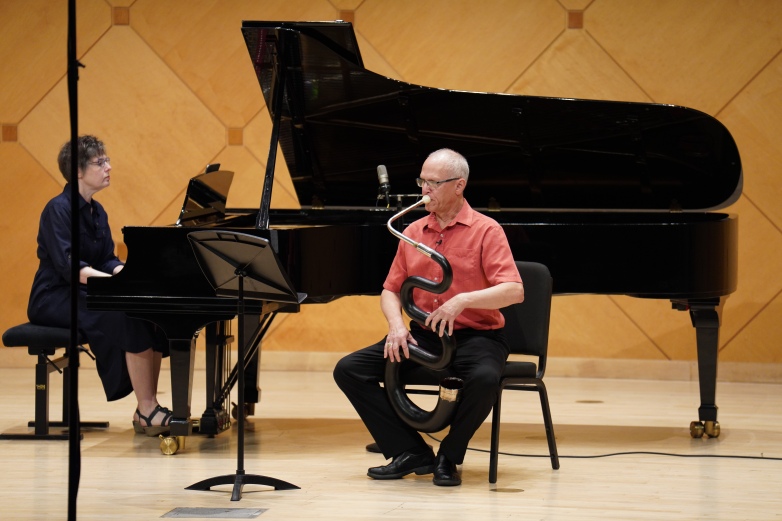
ITEC_Hentschel_Yeo_serpent_recital_Susan_Wass_piano_03

Douglas Yeo, serpent, in performance with pianist Susan Wass, piano. Katzin Concert Hall, Arizona State University. Photo by Tom Hentschel.

The ITEC serpent concert was a happy success thanks to the collaborative artists who worked with me on the program. Our concert included two works for serpent and piano on which Susan Wass accompanied me on piano, and two works for a small chamber group of wind instruments.

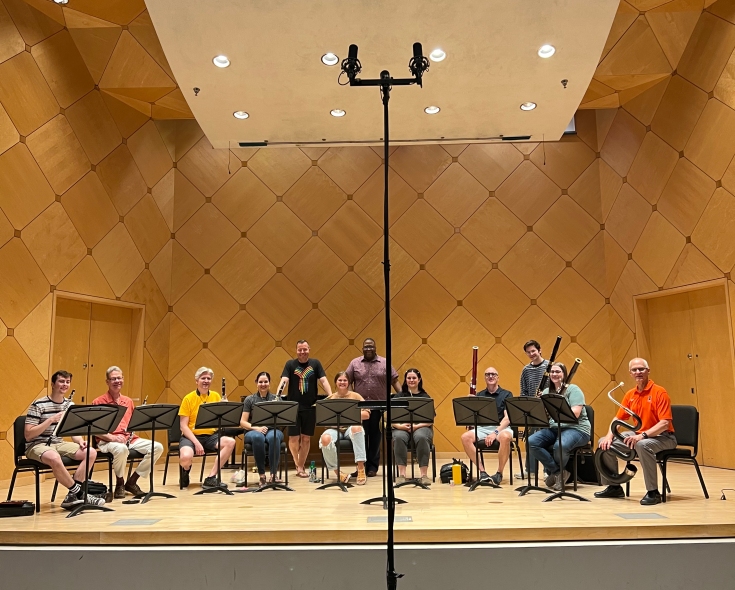
Yeo_serpent_recital_rehearsal_ITEC_2023_cropped

In rehearsal with Curtis Sellers and Martin Schuring, oboe; Josh Gardner and Stefanie Gardner, clarinet; Jason Caslor, conductor (standing), Bailey Hendley, horn; Jamal Duncan, conductor (standing); Isabella Kolasinski, horn; Albie Micklich, bassoon; Harrison Cody, bassoon (standing); Michelle Fletcher, bassoon; Douglas Yeo, serpent. Katzin Concert Hall, Arizona State University.

As you can see from the microphones in the photos above, our concert was recorded by Central Sound at Arizona PBS. I’ve had an affiliation with Central Sound since 2016 when I began working for the weekly radio show, Arizona Encore, broadcast on KBAQ-FM, Phoenix, every Tuesday evening at 7:00. The show is also available on demand on the Arizona PBS website. I started my work for the show when my wife and I lived in Arizona (I wrote about this on TheLastTrombone on September 23, 2016) and I’ve continued to host the show periodically since we moved to the Chicago area in 2018. I enjoy researching and writing the scripts and recording the shows, and in the process, I’ve learned a lot about many superb performers and the music they play.

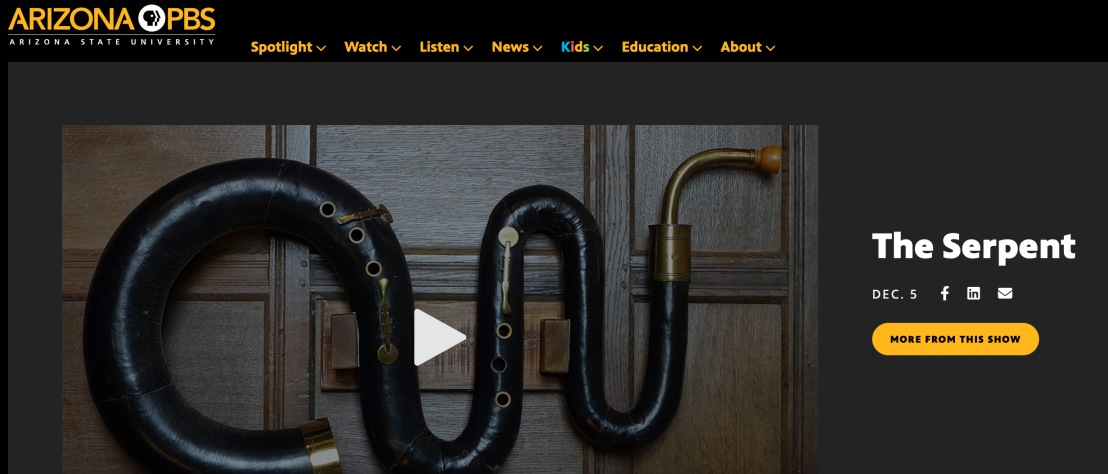
Arizona_encore_serpent_program

When our ITEC serpent recital was packaged for an Arizona Encore show, my producer asked if I would write the script and host the program. Yes! And I’m happy to say the program, which was first broadcast on KBAQ-FM on December 5, 2023, is now available on the Arizona Encore page on the Arizona PBS website. Click HERE or click the image above to go to the Arizona Encore serpent program page and hear the show. Here is the playlist for the show, that, in addition to three pieces from my serpent recital at ITEC 2023, includes a performance by the University of Southern California Thornton School of Music Wind Ensemble:

• Ingolf Dahl – Sinfonietta – University of Southern California – Thornton Wind Ensemble; Robert Reynolds, conductor

I. Introduction and Rondo

II. Pastoral Nocturne

III. Dance Variations

• Clifford Bevan – Variations on “The Pesky Sarpent”Douglas Yeo, serpent; Susan Wass, piano

• attributed to Joseph Haydn – Divertimento in B-flat (Chorale St. Antoni), Hob. II/46 – Joshua Gardner and Stefanie Gardner, clarinet; Albie Micklich, Michelle Fletcher, and Harrison Cody, bassoon; Isabella Kolasinski and Bailey Hendley, horn; Douglas Yeo, serpent; Jamal Duncan, conductor.

I. Allegro con spirito

II. Andante

III. Menuetto

IV. Rondo-Allegretto

• Johann Neopmuk Hummel – Partita in E-flatMartin Schuring and Curtis Sellers, oboe; Joshua Gardner and Stefanie Gardner, clarinet; Albie Micklich, Michelle Fletcher, bassoon; Isabella Kolasinski and Bailey Hendley, horn; Douglas Yeo, serpent; Jason Caslor, conductor.

I. Allegro con spirito

II. Andante piu tosto-Allegretto

III. Vivace assai

Have a listen and enjoy a foray into the world of the serpent, an instrument that’s so old it’s new.

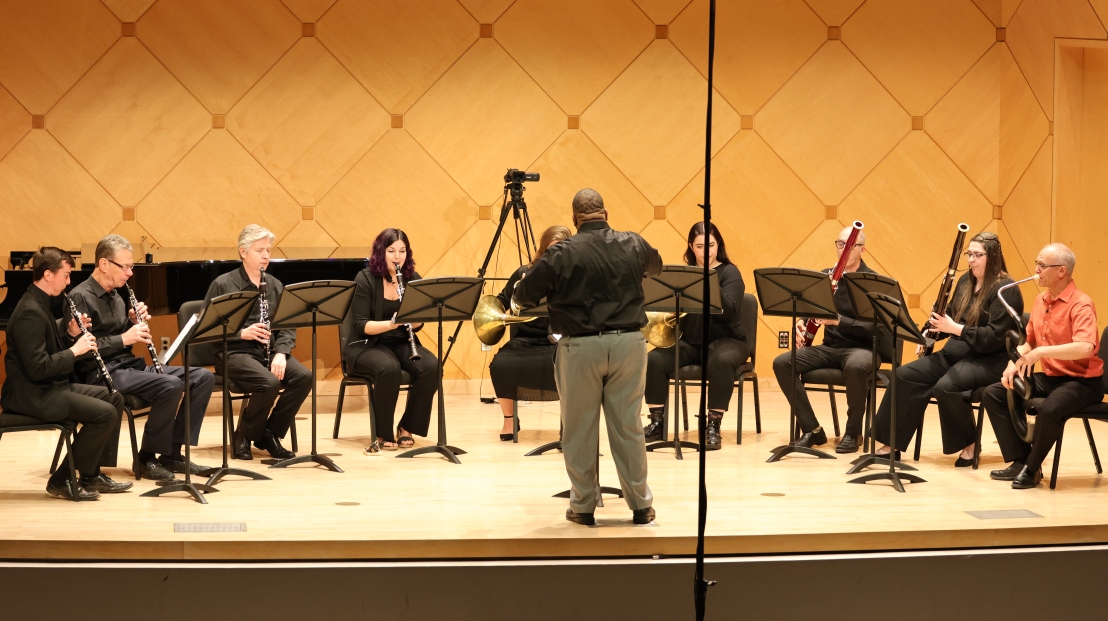
ITEC_Hentschel_Yeo_serpent_recital_group_01

Performance of the Partita in E-flat of Johann Nepomuk Hummel – Joshua Gardner and Stefanie Gardner, clarinet; Isabella Kolasinski and Bailey Hendley, horn; Albie Micklich, Michelle Fletcher, and Harrison Cody, bassoon; Douglas Yeo, serpent; Jamal Duncan, conductor. Katzin Concert Hall, Arizona State University. Photo by Tom Hentschel.

Stay disciplined: a lesson from Super Bowl XLIX

Stay disciplined: a lesson from Super Bowl XLIX

By Douglas Yeo (February 8, 2023)

Readers of The Last Trombone know that I am a football fan. My wife and I are season ticket holders to Chicago Bears football. When we lived in Arizona from 2012-2018 after my retirement from the Boston Symphony Orchestra, we had season tickets to Arizona Cardinals and Arizona State University football. And during my long career in Boston, we attended many New England Patriots games. Football is a big part of our lives.

The Super Bowl is the culmination of the National Football League season and this Sunday, February 12, 2023, millions of people around the world will tune in to watch Super Bowl LVII between the Kansas City Chiefs and Philadelphia Eagles. We’ll be watching, too.

Incredibly, I have attended three Super Bowls. In 2002, I attended Super Bowl XXXVI in New Orleans. The Boston Pops Orchestra was engaged to play the pre-game show and national anthem for the game—this was the first Super Bowl after the 9/11 attacks so the game’s halftime theme was changed from a New Orleans Mardis Gras them to a patriotic theme. Hence the Boston Pops, “America’s Orchestra,” performed at the game. Patriots owner Robert Kraft gave each member of the orchestra a ticket and we were all thrilled to see our team win the game against the St. Louis Rams. I wrote about that unforgettable experience on my website HERE.

In 2020, I attended Super Bowl LIV in Miami. I won a contest sponsored by the Chicago Bears—it was an essay contest and in 100 words, I had to answer the question, “Who would you take to the Super Bowl and why?”—and my son-in-law, Chad, and I had an unforgettable time together at the game, where the Kansas City Chiefs defeated the San Francisco 49ers. I wrote about THAT unforgettable experience on The Last Trombone HERE.

In-between those two memorable Super Bowls was another game, Super Bowl XLIX, held in Glendale, Arizona on February 1, 2015. The game was between the New England Patriots and the Seattle Seahawks. Thanks to the kindness of a friend in Boston whose family had a couple of extra tickets to the game, my wife and I got to attend Super Bowl XLIX. Having been Patriots fans for over 30 years, we had a rooting interest. The game was held in the Arizona Cardinals’ stadium and our seats were five rows from the field on the Patriots’ goal line. Little did we know how that goal line would become so important in the game.

Patricia_Douglas_Yeo_Super_Bowl_XLIX

My wife, Patricia, and me at our seats before kickoff at Super Bowl XLIX.

In my trombone teaching, I speak frequently about the need to be disciplined and focused in one’s practice and performances. We will be at our best if we focus intently on the tasks at hand. If we make a mistake, we cannot let a mistake distract us from the next thing. Frustration over a mistake only causes more mistakes, so remaining disciplined in the face of challenges is critically important for success. I use football metaphors in my trombone teaching all the time—just ask my students. Here is one of the examples I use when I talk about the need for discipline and maintaining focus. Let’s go back to Super Bowl XLIX in Arizona and pick up the story (with apologies to readers who might not understand American football, but I hope you can stick with me to get to the point of this article at the end). . .

The game went back and forth with the Patriots and Seahawks exchanging the lead several times. You can see a chart with every play from the game on Pro Football Reference by clicking HERE. With 2:06 left in the fourth and final quarter, the Patriots took the lead, 28-24. Then, the Seahawks got the ball and began driving down the field. They needed a touchdown (6 points) to win the game; a field goal (3 points) would not be enough. All of us in the stadium thought the Seahawks would win after Seahawks wide receiver Jermaine Kearse made an acrobatic catch for a 33-yard gain. That was a catch that embodied the ideals of focus and discipline. I still don’t know how he made that catch.

Jermaine_Kearse_catch_SB_XLIX

Jermaine Kearse’s acrobatic catch at Super Bowl XLIX. Photo from an article in the Seattle Times.

With the ball on the Patriots 5 yard line with 1:06 left on the game clock, the Seahawks handed off the ball to their star running back, Marshawn Lynch, who gained 4 yards. With the ball at the 1-yard line, we—along with, I expect, every other person in the stadium—assumed that Seahawks quarterback Russell Wilson would hand the ball off to Lynch once more and score a touchdown. But with 0:26 seconds left on the game clock, Wilson threw a pass to Ricardo Lockette. And the pass was intercepted by Patriots safety Malcolm Butler at the 1 yard line. Nobody could believe it.

Malcolm_Butler_interception_SB_XLIX

Malcolm Butler intercepting a pass by Russell Wilson, Super Bowl XLIX. Photo from an article by LWOS (Last Word on Sports).

This was, of course, a disaster for the Seahawks and an unexpected reprieve for the Patriots. It was a stunning turn of events. With victory in their grasp, the Seahawks gave the ball back to the Patriots.

But the game wasn’t over.

After the Patriots took a time out, the game resumed with 0:20 to play. However, the Patriots had a problem. With the ball on the 1-yard line, the Patriots had to run a play and advance the ball. They could not simply “take a knee” and run out the clock; Patriots quarterback Tom Brady was lined up behind his center in his own end zone. The possibility that Tom Brady could be sacked in the end zone—thereby giving the Seahawks a safety (2 points) was very real. The Seahawks had a superb defense. If they had gotten a safety, they still would have been behind the Patriots by 2 points, but the Patriots would have to punt (rather than kick off) the ball to the Seahawks, and with one timeout left and what would have probably been a short field, there was a possibility the Seahawks might be able to kick a long field goal and win the game in dramatic fashion. It was a long shot, but it was possible.

What happened next? Patriots quarterback Tom Brady came up to the 1-yard line and started his snap count. And then another unthinkable thing happened: Seahawks player Michael Bennett jumped offsides. That was THE ONE THING the Seahawks could not do on that play. THE ONE THING. But the Seahawks did it. The offsides penalty gave the Patriots 5 yards, and the ball was placed at the 6-yard line. At that point, the game was essentially over; the Patriots could run out the clock. Then, on the next play (the photo at the top of this article shows this play), the Patriots lined up in “victory formation” (all they needed to do at this point was snap the ball to Tom Brady and then Brady take a knee to stop the play and the clock would run out), the Seahawks were penalized 15 yards for unsportsmanlike conduct when Seahawks linebacker Bruce Irvin punched a Patriots player after the play—clearly he was frustrated by the dramatic turn of events of the last few seconds. On the next play, Brady took a knee again—and the game was over. The Patriots won.

Michael Bennett was not a disciplined player. One can ask the fair question: why was a player (Bennett) who had been called for more offsides penalties in the whole National Football League during the season even on the field for that play? Bennett’s lack of discipline cost the Seahawks a chance to win the game. Sure, it was a long shot. But they had a chance. Until Bennett jumped offsides.

There, in the course of just a few seconds, we saw a remarkable display of focus and discipline from Jermaine Kearse. His catch epitomized focus and discipline. Then we saw another remarkable display of focus and discipline by Malcolm Butler when he intercepted Russell Wilson. But then, we saw a terrible lack of discipline by Michael Bennett (offsides) and another lapse of focus and discipline by Bruce Irvin (unsportsmanlike conduct).

The lesson in all of this? It’s not over until it’s over. Staying disciplined in our tasks, whether playing football or performing a concert with a trombone in your hand, will give us the best possibility to have a great result. Even when you think that things are going badly, you still may have a chance at redemption. When you’re taking an audition for a symphony orchestra, never assume your audition is over because you miss a note. Because unbeknownst to you, maybe everyone else at the same audition missed the same note. Stay focused, stay disciplined. Most people who reflect on Super Bowl XLIX remember the decision by Seahawks coach Pete Carroll to have Russell Wilson throw a pass from the 1-yard line rather than hand the ball off to Marshawn Lynch as the defining moment of the game. And, in many respects, it was. But there was more to the story, and the Seahawks missed a chance—a chance—to win the game when Michael Bennett jumped offsides. His lack of discipline was the real story about the Seahawks loss.

Stay disciplined. Keep working until the task is done. Completely done. It’s not over until it’s over. If you want to be there when the confetti falls for you after you win, you have to be disciplined and focused until the very end. That’s a lesson for all of life.

Patricia_Douglas_Yeo_SB_XLIX_confetti

My wife, Patricia, and me as the confetti fell to celebrate the New England Patriots’ victory at the end of Super Bowl XLIX.

On the move

On the move

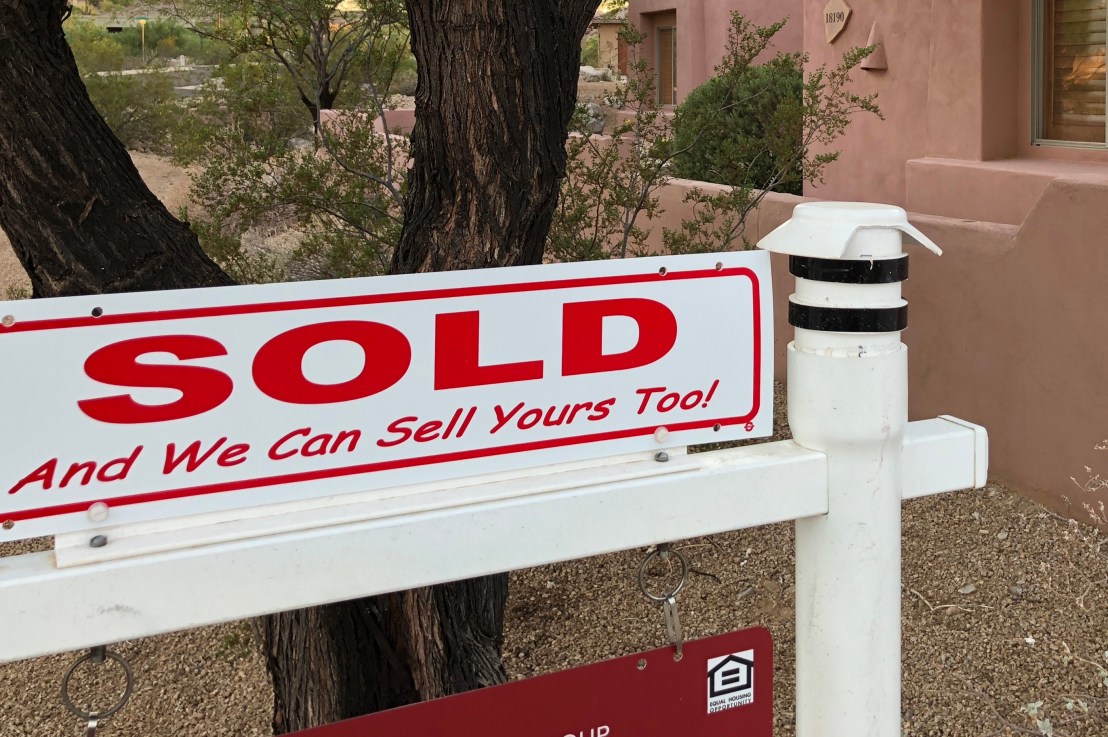
It is a sign I have seen in front of my house only once before, in 2012, when I retired from the Boston Symphony and my wife and I sold our home in Lexington, Massachusetts. The sign tells a much larger story than its single word. But at the fundamental level, a SOLD sign means we are on the move again.

In 2010, we purchased a beautiful home in the Estrella community of Goodyear, Arizona. We knew that someday we would want to live in the southwest and that someday came in May 2012 when we left Massachusetts and moved into our home. We’ve enjoyed six years in this beautiful place. I have had a music room that I could only dream about, a place to play trombone, read, and write.

IMG_9618

But today all of this is going away and we are moving to a new place. United Van Lines pulled up to our home yesterday and our driver, Amerigo, and his assistant, Justin, spent the afternoon taking inventory of our belongings. Today they returned, with three more men, and they are at work right now packing up a huge van with everything we own.

IMG_0782

I have great respect for people and the work they do. Everyone does something. I play the trombone. Others pack up houses. To see Americo and his crew at work is to see people who have strength, knowledge, understanding, and creativity. It is not easy to fit 500 boxes, pieces of furniture, and other items into a rectangular truck. And get everything safely to a new destination. But as I watch them carefully wrap furniture and systematically fit things into the truck, I have to smile. These guys know what they are doing. They are, in their own way, artists.

IMG_0797

In March, we made the big decision to leave Arizona and move to a western suburb of Chicago. Into a much smaller house. Back to winters of cold and snow. I confess that I never imagined we would leave Arizona, a place that we have loved in so many ways. But there was only one thing that could lead us to make this big decision.

Our grandchildren.

IMG_8156

When we made the decision to purchase our home in Arizona in 2010, these two precious ones were not a part of our lives. But all of that changed a few years ago as first Hannah, and then Caleb, were born. As time has marched on, we have enjoyed many visits with them both here in Arizona and in Illinois where our oldest daughter and her family live. But several visits a year and daily FaceTime calls are not enough. Our hearts wanted more. After they visited us in March of this year for a week of Chicago Cubs baseball spring training, I turned to my wife, Pat, and dropped a big one: let’s leave Arizona and move to Illinois. I never imagined those words would come from my mouth. But it seemed that God was prompting us to do something radical, something completely unexpected but at the same time quite wonderful. At first I thought that we would consider moving near to our grandchildren at some undefined time in the future. That rapidly changed to considering doing “the snowbird thing” – living in Arizona in the winter and in Illinois in the summer. But when we ran the numbers, it just didn’t make good, prudent fiscal sense. And we concluded that if we were in Illinois for half the year, we’d miss so many things that happened there in the other half of the year. So in a short time – just a few weeks – we decided to purchase a home in Illinois just 10 minutes from Linda and her family. Since then we have done an extreme makeover of our new place and it will be ready for us when we arrive there in a few days.

So, here we go. Back to Illinois, near Wheaton, where Pat and I were undergraduates at Wheaton College in the early 1970s. Back to the land where I met my trombone teacher and mentor, Edward Kleinhammer (bass trombonist of the Chicago Symphony, 1940-1985). Most of all, we are heading to a place where we can be a bigger part of the lives of our precious grandchildren. Anyone who has grandchildren will surely appreciate what I am saying here.

Yes, I will miss Arizona. But we will be back. We have much more left to explore in the southwest. But no matter how much we love being here, we know that the old adage “family first” is true. We have no regrets about leaving; we are moving ahead, looking to the future with great anticipation.

IMG_0791

This morning I watched the sun rise for the last time from the roof of our home. As it rose over the Estrella Mountains, I felt such gratitude to God for the opportunity to have lived here for the last six years. I have learned so much, and I will share some of that in future articles on The Last Trombone. By the end of the day today, our home in Arizona will be empty. Next Friday, Amerigo and his truck will pull up to our new home in Illinois and a few hours later, it will be full. Soon, the sound of the laughter of children will ring in its rooms. There are no words in the English language that mean more to me than, “I love you, grandpa. I love you, grandma.” That is why we are leaving Arizona. God is good.