Author: Douglas Yeo

For the benefit and enjoyment of the people

For the benefit and enjoyment of the people

It has often been called “America’s best idea.” There is no country in the world with anything like it. I speak of our National Park system, founded in 1872 with the establishment of Yellowstone National Park. This week, the National Park Service – the federal agency charged with care of the Parks – celebrated its 100th birthday. We all do well to stop for a moment and consider, with gratitude, this tremendous gift in our midst.

My wife and I first began exploring our National Parks in 1978 when we took a six-week camping vacation from New York City to California and back. Since that time, we have enjoyed dozens of trips to National Parks and National Monuments, as well as to National Historic Places. It is one of the primary reasons that we moved from Boston to Arizona, so we could be in close proximity to the great national parks of the west. As the inscription atop the great arch that spans the northern entrance to Yellowstone National Park says (photo, above), the parks were established “For the benefit and enjoyment of the people.” Every time I come up to the Yellowstone Arch a deep wave of emotion comes over me. Because I have been one who has benefitted from and enjoyed these parks – places of exceptional beauty and tranquility, wonder and excitement. I can say with great certainty that I would not be the artist/musician I am today were it not for the many hours spent in our National Parks, hiking, gazing upon and engaging the tremendously diverse landscape of this piece of land the world calls the United States of America.

I have always encouraged my students to get out of the practice room and get outside so their playing would be informed by more than what was on the music stand. Appreciating the natural, created order of the universe does more than release positive endorphins into the blood stream. It changes us; it gives us a sense of perspective and certainly it inspires us. The words of Psalm 8 often come to mind as I gaze on a remarkable landscape:

O Lord, our Lord, how majestic is your name in all the earth!

When I look at your heavens, the world of your fingers, the moon and the stars, which you have set in place, what is man that you are mindful of him, and the son of man that you care for him? (Psalm 8:1, 3-4, English Standard Version)

So here, in celebration of the anniversary of the National Park Service, is a little gallery of photos I have taken in a just a few our National Parks. We all are in debt to President Ulysses Grant who established the National Park system in 1872, to President Theodore Roosevelt who championed it, and to all those who have worked so hard to balance preservation and access so these remarkable places can continue to be enjoyed by people from around the world.

Grand_Prismatic

Grand Prismatic Spring, Yellowstone National Park, Wyoming

Observation_Point_small

View from Observation Point, Zion National Park, Utah
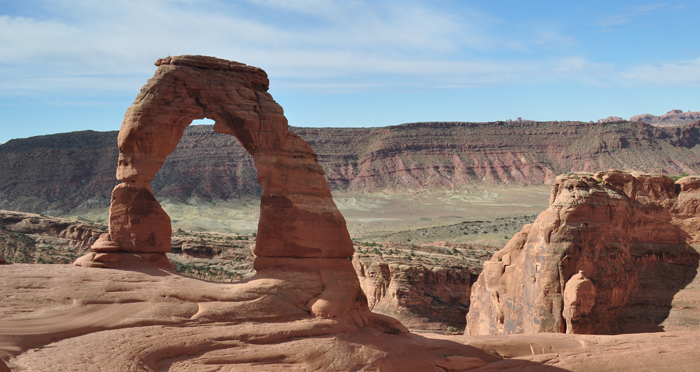
Delicate_arch_small

Delicate Arch, Arches National Park, Utah
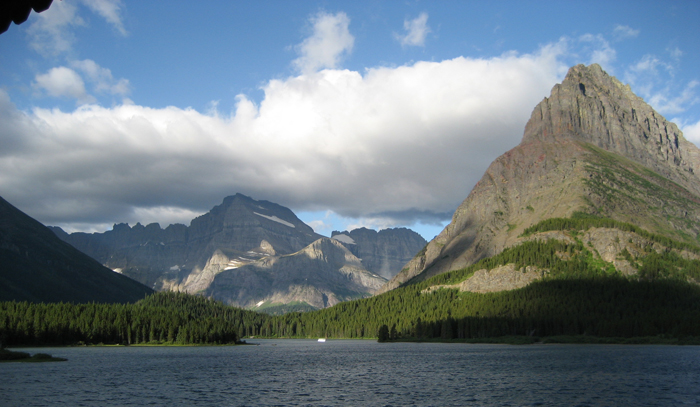
Glacier_Swiftcurrent_lake_small

Swiftcurrent Lake, Glacier National Park, Montana
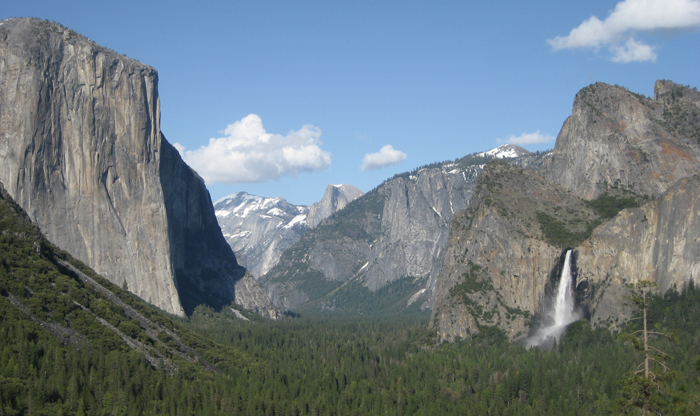
Yosemite_Valley_small

El Capitan, Half Dome and Bridal Veil Falls, Yosemite National Park, California

acadia_national_park_small

Jordan Pond and the Bubbles, Acadia National Park, Maine
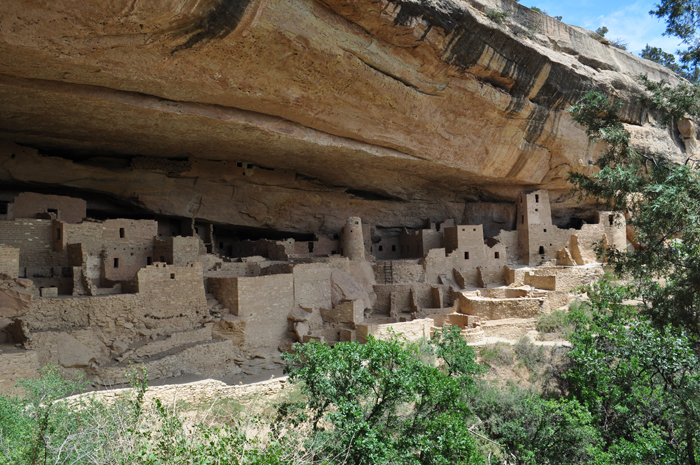
Mesa_Verde_cliff_dwelling_small

Cliff dwelling, Mesa Verde National Park, Colorado

Petrified_Forest_small

Petrified Forest National Park, Arizona

Grand_Canyon_Douglas_Yeo_2012small

Grand Canyon National Park, South Rim, Arizona

Celebrating the bass trombone

Celebrating the bass trombone

I’ve been playing the trombone since I was a young boy, and the bass trombone in particular since I was 18 years old. I’ve been fortunate to have made several solo recordings that are now in the hands of thousands of people around the world – you can see a list of my recordings by clicking here. Many other fine bass trombonists have also made superb solo recordings of diverse repertoire and recently, my good friend Gerry Pagano, bass trombonist of the Saint Louis Symphony, has released a new recording.

I met Gerry in 1987, early in my tenure as a member of the Boston Symphony Orchestra. He was a Fellow at the Tanglewood Music Center that summer and we spent a lot of time together playing and talking. A few months after the Tanglewood season ended, Gerry won the St. Louis Symphony position. Gerry is not only an excellent player but a great person – vivacious, creative, positive. I count it a real privilege to call him my friend.

Gerry’s new recording features works for bass trombone that are accessible to talented players. It doesn’t include works that are only playable by just a handful of super professionals. As always, Gerry’s new album, Horizon, features his beautiful sound and impressive technique. Most of all, his musical artistry comes through.

I’m particularly pleased that Gerry has recorded, along with tenor trombonist Bradley Palmer, my arrangement of Eric Ewazen’s Pastorale, which I made with Eric’s permission for inclusion on my own CD, Two of a Mind, with tenor trombonist Nick Hudson. Gerry and Brad’s performance is quite beautiful and I’m very grateful for the inclusion of this lovely piece on the album.

You can obtain Gerry’s album for free. Yes. For free. Here is the link to download the tracks:

Download Gerry Pagano’s new album, Horizon.

Of course this album wasn’t free on Gerry’s end. He had to record and produce it, and has to pay royalties to composers. So if you download the album and feel like it’s worthwhile, please take the opportunity to click the link at the bottom of the download page and send a few dollars Gerry’s way to help defray his expenses. He made this album of music that he loves and his playing is truly inspirational.

In 2014, I asked Gerry to come to Arizona State University to give a master class. The class was terrific; he is such a natural communicator and his time was extremely helpful to my students. After the class, we sat down in my office and made a video of our playing Tommy Pederson’s great duet for two bass trombones, The Crimson Collop. I posted our recording – done in one take –  on YouTube and much to my surprise, it’s had over 15,000 views. Seriously? Well, we’re just happy that people have enjoyed it. Perhaps you’ll enjoy it too. Watch the video below to see two friends having a nice time together making music, celebrating the bass trombone. Enjoy.

Road closed

Road closed

I’ve been off the grid – truly – for the last two weeks while on vacation with my wife. One of the reasons we decided to move to Arizona was to be in proximity of the great National Parks of the West. We first explored these parks in 1978 when we took a six week camping vacation from New York City to California and back, staying in 11 National Parks. That we were able to accomplish that epic trip for the sum total of $500 – that included gas (which was, at the time, $0.53 a gallon), campground fees and food – is only an interesting aside. The trip fundamentally instilled in us a love for our National Parks which are truly, “America’s best idea.”

This road trip took us up to Zion, Yellowstone and Grand Teton National Parks. We have been to these parks before, particularly to Zion which we have visited on 10 separate occasions. We never tire of visiting again and again, and since Zion was a good enough drive for our first day as we headed up to Yellowstone, we decided to stay there for two days and do some warm-up hiking.

But things don’t always turn out as planned.

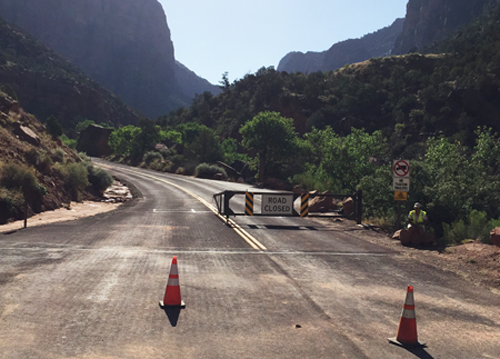
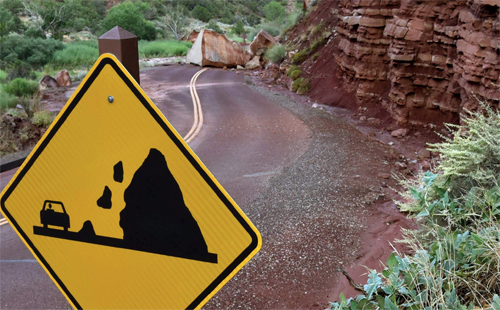
We had experienced a little rain on the trip but nothing significant. But as we drove to Zion National Park’s east entrance, coming from Mount Carmel Junction, Utah, we were confronted by confounding words – ROAD CLOSED. It turns out that earlier in the day, there had been an epic microburst of a storm that caused dramatic flash floods in Zion Canyon. The main street of the town of Springdale – our destination and the gateway to Zion National Park – had turned to a raging torrent of water. And the Virgin River that runs through Zion Canyon had been running at 80,000 cubic feet/second; normal is about 450 cfs.The road was closed because large boulders had crashed onto the Zion/Mount Carmel highway, making passage to Springdale through the east entrance of the park impossible.

Zion_rock_slide_01

The photos above and below (courtesy the National Park Service) show the problem. And they give new meaning to the “DANGER – falling rocks” sign that was just a few feet away.

Zion_rock_slide_02.jpg

Passage was impossible, so we had to retrace our path back to Mt. Carmel Junction and then around the south of Zion, and approach Springdale from the West side. This was a two hour detour – an unwelcome event after about eight hours already in the car that day. By the time we rolled into Springdale, the rain had abated, the flood had receded and apart from a lot of mud on Main Street, we safely got to our hotel.

Zion_altar

The next day the sun was out, and we enjoyed a peaceful and fulfilling day of hiking at Zion, one of our favorite places in the world. The photo above will show you why, if you haven’t been there. Such beauty and majesty. As we hiked on several trails that day, our minds kept coming back to the words of the Bible:

Let the heavens be glad, and let the earth rejoice; let the sea roar, and all that fills it; let the field exult, and everything in it! Then shall all the trees of the forest sing for joy before the LORD, for he comes. (Psalm 96:11-12)

Indeed. Our trip to Zion was delayed, but when we arrived, we were all the more grateful for our safety (and that of others in the –thankfully no lives were lost in the storm) and the beauty of the Park seemed even richer. I will be posting more about our trip in the coming days. It was good to get to a place in the world where my cell phone did not have any coverage. More time to think, to talk with people I loved, slow down and consider my place in God’s great world.

The Olympic Games

The Olympic Games

The games of the XXXI Olympiad get underway today with the opening ceremony in Rio de Janeiro, Brazil.  As a young boy, I was thrilled by the games – the spectacle, the competition, and as ABC television aptly put it, “the thrill of victory and the agony of defeat.” In recent years the Olympics have suffered a bit with world-wide scandals involving the use of performance enhancing drugs. But, still, there is something about the big stage of the Olympics, the celebration of success and what one hopes is a healthy kind of nationalism as we are proud of our country being represented by excellent athletes.

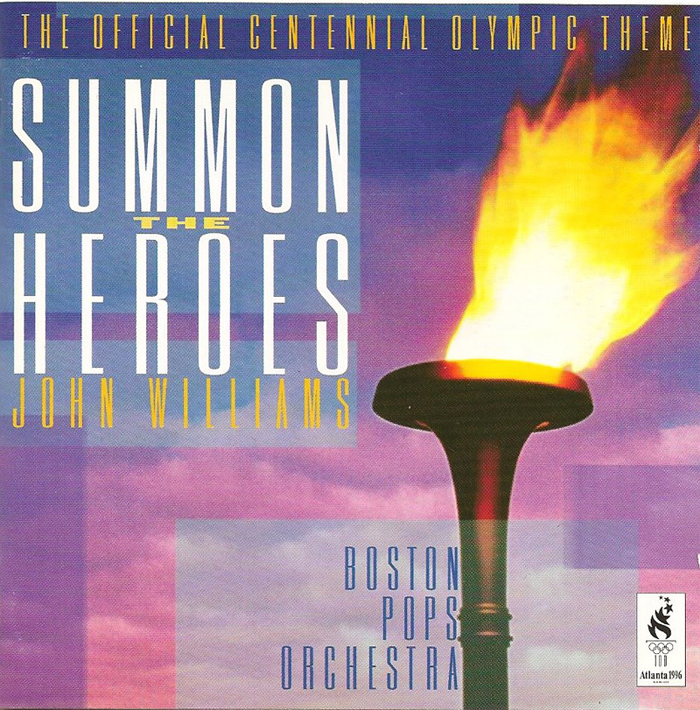
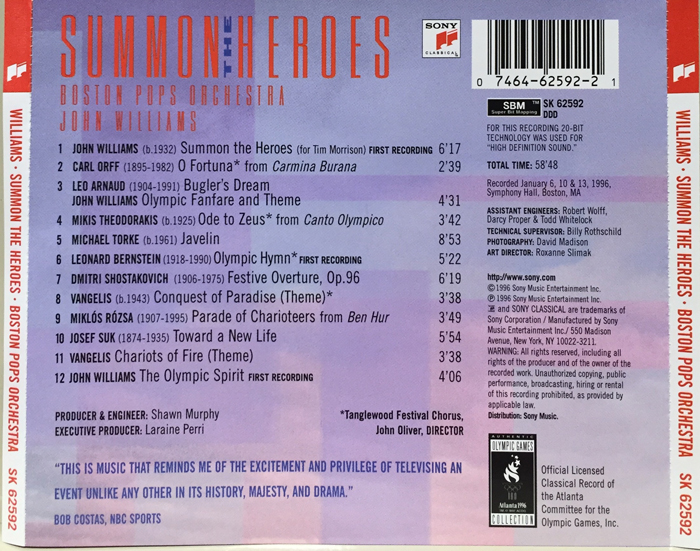
I’ve never been to an Olympic event but I got close. Musically. In 1996, the Olympics were held in Atlanta, Georgia, USA. As a member of the Boston Symphony Orchestra at the time – and membership in the BSO brought with it membership in the Boston Pops Orchestra – I played on the official soundtrack album of the Atlanta 1996 Olympic games, “Summon the Heroes.” Conducted by John Williams, the Boston Pops Orchestra had recording sessions on January  6, 10 and 13, 1996 of a playlist that included well known Olympic game themes (by John Williams) and other heroic, brass-centric, noble works that are often associated with the Olympics. Here is the tray card with the full track list:

Summon_Heroes_playlistThe recording sessions came in the midst of a grueling week of Boston Symphony Orchestra rehearsals and concerts that included Richard Strauss “Eine Alpensinfonie” and we brass players were stretched to our limits. Still, it remains a memorable moment in time for me, my closest personal association with the Olympic games, and “Summon the Heroes” remains one of my favorite recordings from my nearly three decades as a member of the Boston Symphony/Boston Pops Orchestra. “Summon the Heroes” is still available, as a CD or mp3 download.   And you can see a performance of that great fanfare with John Williams conducting the Boston Pops Orchestra on the YouTUBE link, below. The low brass section consists of Norman Bolter, Darren Acosta, Phil Swanson and myself on trombone, Chester Schmitz on tuba, and trumpets Tim Morrison, Tom Rolfs, Peter Chapman and Bruce Hall.  There are offstage trumpets and trombones as well. Enjoy. To our Olympians: Citius – Altius – Fortius – the motto of the modern Olympic games, swifter – higher – stronger.