
Year: 2016

Heed rashness and use perseverance

Heed rashness and use perseverance

Last week I was in San Francisco, and took the opportunity to visit the Asian Art Museum. In my travels I have been to Japan, Taiwan and mainland China and have come to appreciate the cultures and art of these fascinating places. The Asian Art Museum has a special exhibition of items from the National Palace Museum in Taipei and it was quite something to behold. Included in the exhibition is one of the most popular and important pieces of Chinese art, the so-called “meat shaped stone” or “priceless porkbelly”, carved from a piece of jasper during the Qing Dynasty and appearing in the United States now for the first time.

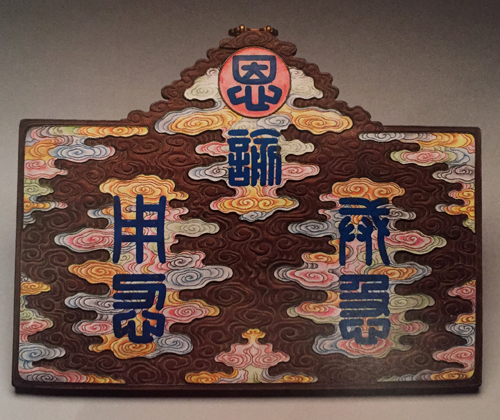
But something else caught my eye and I kept returning to it. It is a sign in lacquer on wood, created for the Emperor Yongzheng who reigned from 1723-1735. Apparently the emperor, when he was a prince, was prone to some habits that displeased his father, Emperor Kongxi. The son took his father’s advice to heart, and had signs made that he put around the palace to remind him of his shortcomings. The photo above shows one of these signs and the message is:

Heed rashness and use perseverance.

In other words, pay attention to your tendency to act rashly and take your time to carefully persevere in tasks.

This is a phrase that has been around since the beginning of time. But this father’s words of wisdom – beautifully portrayed in this sign – are a reminder of the importance of carefully considering what we say and do. We live in an age where it is too easy to “shoot from the hip” – or lip – without thinking through an action. Of course any successful musician has learned the value of the disciplined life, of not acting rashly or looking for quick fixes, but persevering through difficult tasks in order to find success.

When I need advice on how to proceed in a situation, I often turn to the book of Proverbs in the Bible. It has a tremendous amount of wisdom that speaks to every situation you may encounter. On the subjects of rashness, perseverance and heeding advice, it has a great deal to say:

There is one whose rash words are like sword thrusts, but the tongue of the wise brings healing. (Proverbs 12:18)

A wise son hears his father’s instruction, but a scoffer does not listen to rebuke. (Proverbs 13:1)

Whoever loves discipline loves knowledge, but he who hates reproof is stupid. (Proverbs 12:1)

The way of a fool is right in his own eyes, but a wise man listens to advice. (Proverbs 12:15)

And this passage that speaks to the value of perseverance, with a model taken from one of the smallest animals on earth:

Go to the ant, O sluggard; consider her ways, and be wise. Without having any chief, officer, or ruler, she prepares her bread in summer and gathers her food in harvest. How long will you lie there, O sluggard? When will you arise from your sleep? A little sleep, a little slumber, a little folding of the hands to rest, and poverty will come upon you like a robber, and want like an armed man. (Proverbs 6:6-11)

My trombone teacher, Edward Kleinhammer (bass trombonist of the Chicago Symphony Orchestra, 1940-1985) taught me important lessons about perseverance. In the book we wrote together, Mastering the Trombone, Mr. Kleinhammer wrote these important and challenging words:

World class trombone players do not just happen. Their talents are forged by the dual furnaces of determination and diligence.

In this, Edward Kleinhammer was acting like the loving Emperor Kongxi, reminding his son, Emperor Yongzheng, of the importance to “Heed rashness and use perseverance.”

I think I need to go practice now…

On the air

On the air

Over the years, I’ve given many interviews for radio programs. I’m still a big believer in radio; the format allows for imagination and a relaxed pace of conversation. Frankly, I’d rather listen to audio than watch television most of the time.

On occasion, interviews have had to do with particular events, such as my retirement from the Boston Symphony Orchestra in 2012; you can hear that interview, where I reflected on my long career in the Orchestra as well as my many collaborations with composer/conductor John Williams here:

Interview of Douglas Yeo by Brian Bell, WGBH Radio, Boston – 2012

Another interview from 2012 found me talking with Peter Stover of Classics Radio in Fredericksburg and Lynchburg, Virginia, where I talked about my Boston Symphony career and the intersection of my life in music with my Christian faith:

Interview of Douglas Yeo by Peter Stover, Classics Radio – 2012

More recently, I was interview by Central Sound at Arizona PBS for broadcast on Classical Arizona PBS (KBAQ), Arizona’s public radio station. I only just learned that part of the interview was broadcast recently along with my performance of Jan Sandström’s Song Till Lotta (Song for Lotta), accompanied by pianist Aimee Fincher. This was a little divertissement in the middle of a broadcast of a concert by Arizona State University bands that also included a performance of Sandström’s Zephyr. In the interview, I talked about how I came to develop the trombone that I use and why I often say, “Trombone is something I do, it’s not who I am.”

This and a host of fine classical music radio programming is available for free and on demand with the Classical Arizona PBS app for iOS and Android. You can more information and download the app by clicking this link and once you load it, touch Music at the bottom navigation bar and scroll through the options to ASU in Concert – Feb 18, 2016 – Douglas Yeo and ASU Bands. While there, have a look at the other excellent offerings available. Happy listening!

Celebrating student success

Celebrating student success

I began teaching trombone lessons in 1974, when I arrived at Wheaton College (Illinois) as a transfer student from my freshman year at Indiana University. Wheaton’s Conservatory of Music had a Preparatory Department where young players could come to take music lessons; students at the College were often the teachers. Because there were a number of students who wanted to take trombone lessons, I was asked to help with this. And thus my teaching career began.

Over the last 42 years, I’ve developed a manner of approaching the art of teaching, some of which I learned from the example of my teacher, Edward Kleinhammer. There are well-known teachers who try to get the best out of their students by treating them harshly, by getting angry, employing guilt and humiliation, setting students in a studio in competition against one another to “toughen them up.” I’ve never gone down this road. I have very high standards for my students. But I have found that when I lead by example and work with them in a way that both encourages and challenges them, we build a relationship that leads to good results all around.

When Edward Kleinhammer died in 2013, I wrote a tribute to him for the International Trombone Association Journal. For part of the article, I asked several of his students to write a few words about how they would remember him. Eric Carlson, second trombonist with the Philadelphia Orchestra–Eric and I also were students together at Wheaton College and played together for four years in the Baltimore Symphony–wrote this:

I had an hour train ride home after every lesson. During those rides, I formed the habit of writing down everything I could remember from my lesson, so I would be sure to practice properly in the upcoming week. By the time I finished writing, I would usually have a page or two of notes about things I needed to fix. I remember thinking at one point, “With all of these criticisms, how come I always feel so confident after my lessons?” With time, I realized it came down to two things: I always knew that the severe critiques came out of Ed’s desire to see me succeed. And, towards the end of every lesson, Ed would find a problem small enough to fix right then and there, so I always finished the lesson feeling like we had solved at least one problem that day.

“Ed’s desire to  see me succeed.” Yes. That is a very important thing for teachers to communicate to their students. There is nothing like offering encouragement along with a challenge to fuel a person’s desire to continue working to a goal.

Last week, I received an email from a student in Japan. I’ve been to Japan over a dozen times, both on tour as a member of the Boston Symphony but also to teach and give masterclasses. Many of these teaching opportunities have come at the Hamamatsu International Wind Instrument Academy and Festival where I have been on the faculty on six occasions. Last week’s email came from Yuta Aoki who was in my class at the Hamamatsu Academy in 2014 and 2015. He told me that he had formed a trombone quartet made up of students who had been in my class during those years and that they had recently taken 4th place in a trombone quartet competition; their debut concert will be in September. I was so happy for their success, but also so pleased that they wanted to share this news with me. Even though we are 6000 miles apart, they know that I rejoice with them. To (left to right in the poster above) Yusuke Nishi, Ayaka Watanabe, Noriyuke Komatsu and Yuta Aoki, I send congratulations again, and I wish you well in your upcoming concert. Bravi! And to teachers who are reading this, don’t forget to celebrate the success of your students, no matter how small. Your encouragement is part of the fuel that drives them.

The Trombone in Advertising – 1

The Trombone in Advertising – 1

Advertising is a curious thing. When you think about it, advertising is designed to make us unhappy with what we have, and believe that we would be happier with something else. With this in mind, it’s no surprise a lot of people – like me – fast forward through all commercials when you watch a show on your DVR, or mute commercials in live TV, or have an ad blocker on your phone or tablet. I know what I want to purchase and where I want to get it; advertising rarely influences me to do something, especially to do something that I wouldn’t do without the ad.

But advertising is everywhere, even in the trombone world. Of course we’re all familiar with ads that are designed to sell trombones. Sometimes trombone ads use well-known players. Other ads tell you about new features, metal alloys, the latest valve and improvement. I don’t know anyone who buys a trombone just because she’s seen an ad – any sensible player will try before buying – but ads are out there, trying to persuade us that the trombone we’re playing just isn’t good enough for how good you are and, oh, how much better you’ll be if you’ll switch.

Recently, I’ve gotten interested in trombone advertising. But not advertising to sell trombones. What I have been finding interesting is how many ads have used the trombone to sell OTHER things. I’ve collected so many of these ads that I’m working on an article for the International Trombone Association Journal about them. I’ll be posting a few of them on my blog. Like the postcard above. It’s from the St. Louis Zoo. Great zoo! They make postcards so you’ll buy one, write a note to friend and tell them how great the zoo is, and mail it off. You’re part of the zoo’s advertising plan. So what did they put on this postcard? The elephants? Lions? Tigers? Bears? Nope. Chimpanzees playing musical instruments. Including a trombone.

Now, my students will tell you that sometimes, when I am talking to them about working on their soft playing and how valuable that is as a player, I often start by saying, “Someday they’re going to train a chimpanzee to play the trombone. But the chimp will not be able to play softly. Because the chimp doesn’t have a human soul.” I believe this absolutely to be true. But I did not know, until I bought this postcard, that in 1950, the St. Louis Zoo had trained a chimpanzee to at least hold a trombone and perhaps make a sound from it. A postcard is mute, but I very much doubt that this little chimp band was playing Mozart.

As I work on my article, I’ll be posting a few of these ads that use the trombone. And when you see one, draw your own conclusions. Why does the trombone appear in the advertisement? Is the trombone being used effectively to sell the product? Is the trombone put together and held correctly? And what subliminal messages are going forth from the use of the trombone. I have ads showing the trombone being used to sell clothing, cigarettes, beer, brassieres (yes, bras), tires, cheese, milk, paper products, movies and much more. More to come.