by Douglas Yeo (August 15, 2024)
I’ve loved reading, researching, and writing for as long as I can remember. My curious nature leads me to want to know more about things. And when I learn things, I like to tell others about them and share the excitement I feel when I make a new discovery.
Over the years, I’ve published five books and many articles, book chapters, and dictionary entries. If you’re interested in some of what I’ve written over the years, you can find a list of many of my publications HERE. While there, you can click on the names of titles and view PDFs of some of my articles.
At the moment, I am deeply immersed in researching and writing an article about the celebrated French trombonist, Joannès Rochut, who played principal trombone in the Boston Symphony Orchestra from 1925–1930. I have been interested in learning more about Rochut ever since I joined the Boston Symphony Orchestra in 1985.
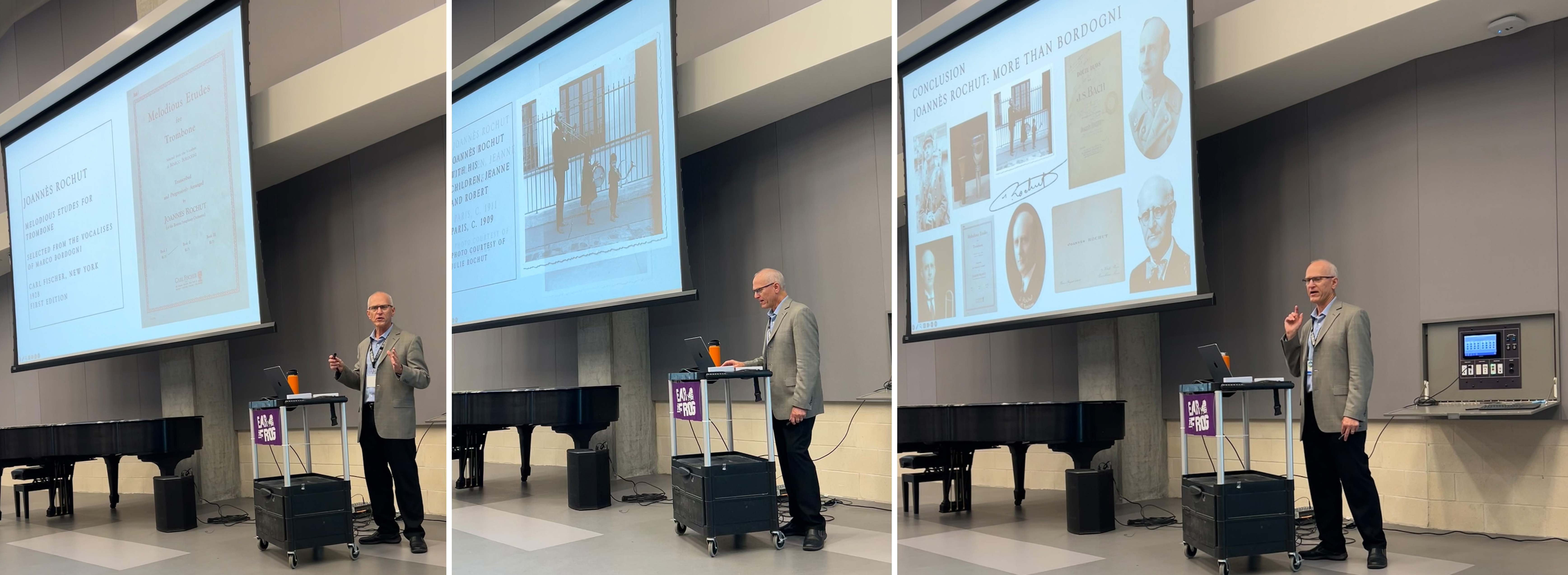
Douglas Yeo giving a presentation about Joannès Rochut, International Trombone Festival, Texas Christian University, Fort Worth, Texas, May 28, 2024
I gave a presentation about Joannès Rochut at the recent International Trombone Festival that was held at Texas Christian University in Fort Worth, Texas. I wrote about my experience at the Festival—including my presentation and other things I did there such as recitals and roundtable discussions HERE. Now I’m continuing the research I conducted to make that presentation and I’m writing a major article about Rochut that will appear in the January 2025 International Trombone Association Journal.

Douglas Yeo’s copy of the first edition of Joannès Rochut’s Melodious Etudes for Trombone, selected from the Vocalises of Marco Bordogni (New York: Carl Fischer, 1928)
I would be hard pressed to think of any serious student of the trombone—including professional players who are life-long students—who does not know the name “Joannès Rochut.” That’s because Rochut compiled three volumes of Melodious Etudes that he transcribed from Vocalises of Marco Bordogni that were published by Carl Fischer in 1928. Rochut’s books are among the most important and most frequently used trombone books in the world. Yet, most people don’t know a thing about Joannès Rochut except the fact that he published these books of Bordogni’s music.
One of the things I tell my students—especially my doctoral students who need to write a thesis or dissertation—is that research takes time. It takes discipline. It takes patience. And it requires money. Not everything is free; not everything can be accomplished from the comfort of your favorite chair at home. The Internet is a remarkable, helpful tool (while, at the same time, it is also toxic cesspool), but anyone that assumes they can successfully research a subject simply by putting a few words in a search engine or an artificial intelligence program will found out quickly that they need to do more. There is no substitute for what I call “real research.” Not “compilation,” which is taking the work of others, stitching it together, and rewording it. I’m talking about real research: finding information from diverse sources, connecting dots, and creating a coherent, new narrative that sheds light on things that are not widely known. THAT is research.
Working in and with museums, universities, libraries, archives, and other institutions is essential if one wants to find information that informs research. In my research of Joannès Rochut, I’ve been in contact with many such institutions. The Library of Congress in Washington D.C. has the Serge Koussevitzky Collection. Koussevitzky was the conductor of the Boston Symphony Orchestra when Rochut played in the orchestra, and Rochut also worked for Koussevitzky in Paris before both of them came to Boston. The LOC has letters that Rochut wrote to Koussevitzky, letters that Rochut’s Boston Symphony Orchestra colleague, Jacob Raichman, wrote to Koussevitzky, and programs from Rochut’s and Koussevitzky’s shared time together in Paris.

Excerpt from page 27 of the 1926 New England Conservatory of Music yearbook, The NEUME, showing Ida Isabella Bisbee, trombone student of Joannès Rochut. Courtesy of New England Conservatory of Music Archives.
The New England Conservatory Archives has yearbooks, student cards, catalogs, and other information about students and faculty including Joannès Rochut and his students. Rochut’s first student at NEC was Ida Isabella Bisbee; she graduated in 1926.
The Sibley Library at Eastman School of Music has the Edna White Collection which contains more photographs of Ida Isabella Bisbee.
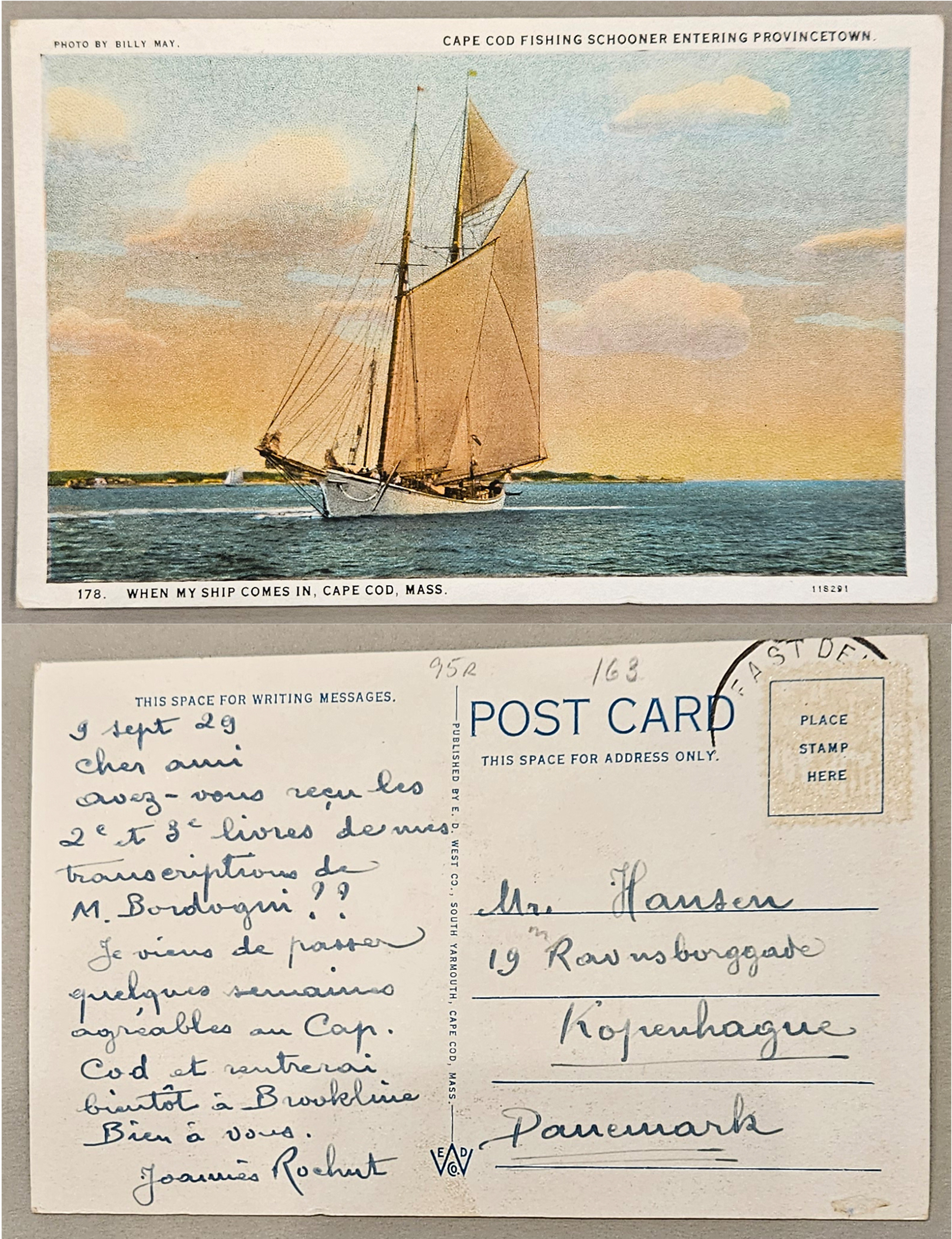
Postcard from Joannès Rochut to Anton Hansen. The text of the card (translated from the original French) reads: 9 September 1929 [the postcard was mailed from East Dennis, Massachusetts], Dear friend, Have you received the 2nd and 3rd books of my transcriptions of Mr. Bordogni?? I just spent a few pleasant weeks at Cape Cod and will soon return to Brookline. Best Regards, Joannès Rochut. Courtesy of the Royal Danish Library, with thanks to Mogens Andresen for photographing the card on my behalf.
The Royal Danish Library in Copenhagen has the papers of the influential Danish trombonist, Anton Hanson, including many letters that Rochut and Hansen wrote to each other in the 1920s and 1930s.
The National Music Museum in Vermillion, South Dakota, has an extensive collection of information about trombone manufacturers, including Besson (of London) who made an instrument that Joannès Rochut played for several years.
The Registrar of Deeds in Norfolk County, Massachusetts, helped me obtain information about the house that Joannès Rochut and his wife, Louis, purchased in 1927.
The Bibliotheque national de France has many documents relating to the annual Paris Conservatoire Concours at which Joannès Rochut won first prize in 1905.
Then there is networking, connecting with old and new friends, and gratefully receiving their considerable help when I ask questions or ask for their assistance. Benny Sluchin in Paris (who has helped me in countless ways, including taking photographs of Joannès Rochut’s home and grave), David Fetter, Ronald Barron, Mogens Andresen, and Carsten Svanberg, and many more. All of them will be thanked in my article.

Joannès Rochut’s business card, 1927, courtesy of the Rochut Family
Most importantly, I made contact with the Rochut family in France. The Rochut family has been exceptionally generous in sharing photographs, documents, and information about Joannès Rochut. I have always said that if you are researching a historical individual and you can find a family member who is willing to share things with you, the needles you find in haystacks suddenly turn to diamonds. I am so grateful to the Rochut family for their kind assistance and generosity.
The list goes on. Without connections to these institutions and individuals, my article about Joannès Rochut would amount to no more than a junior high school level term paper on the level with a paper titled, “My Summer Vacation.”
Sometimes archives are able to provide me with resources through scanning and then sending them to me. In other cases, if it’s not possible for me to get to an archive, a friend of mine is able to view the resources I’m looking for on my behalf. And sometimes, you just have to go yourself.
A few weeks ago, I decided I needed to spend one day researching in the Boston Symphony Orchestra Archives. This is a place that is near and dear to my heart. When I joined the Boston Symphony Orchestra in 1985, I wanted to learn as much as I could about the orchestra and its low brass players in particular, including Joannès Rochut. I asked William Moyer, who at the time (1985) was personnel manager of the BSO (he had played second trombone in the BSO from 1953 to 1966 before becoming personnel manager), if the orchestra had an archive. He took me to a building adjacent to Symphony Hall, what was, at the time, called the Symphony Hall Annex (today, fully renovated, it is the Cohen Wing of Symphony Hall). It was a run down building that the orchestra had plans to renovate someday. Bill and I came to a locked door, he put a key in the door, opened the door, and there was the Boston Symphony Orchestra archives.
It was a shambles. As I walked into the room—a large room with another room next to it—and Bill turned on the light, I saw shelves that stretched from floor to ceiling. There were jumbles of documents, books, and other materials strewn around the room. Filing cabinets were open and documents were falling out. There was no heating or cooling system in the room. It was damp.
But I could tell right away that the room was full of treasures. Despite the chaotic disorganization of materials, my mind raced and recalled on Howard Carter’s words when he first peered into King Tutankhamen’s tomb and was asked what he saw. “I see wonderful things,” Carter said. Yes. I saw wonderful things.

Two of the several dozen negatives Douglas Yeo had made from photographs in the proto-Boston Symphony Archives, 1985–1987
Because of my interest in researching Joannès Rochut and other Boston Symphony Orchestra brass players, Bill gave me a key to this room. The BSO had no archivist at the time; Bill just gave me a key. He told me I could look through it and if I found things that were helpful to my research, I could use them. So I did. I spent hundreds of hours in those rooms, during rehearsal breaks, between rehearsals, before concerts, on some of my days off. And this was in the era before personal computers, scanners, or cell-phone cameras. If I found a photograph I thought I would someday use in an article, I needed to take photographs to a photography studio and have large negatives made so I could submit the images to publications. This was expensive. But it was the only way I could have permanent access to the images I wanted to use and continue to reference.

Cover of the Fall 1986 issue of the International Trombone Association Journal that contains the article by Douglas Yeo, “A Pictorial History of Low Brass Players in the Boston Symphony Orchestra, 1887–1986”
I began to systematically work through the contents of these disorganized rooms, looking for photographs and information about Boston Symphony Orchestra trombone and tuba players. I found a lot. I carefully made new piles of materials on the disorganized shelves, an attempt to bring some order to the mess. I would bring my discoveries to Bill Moyer who shared my excitement and in time, I amassed a great deal of information that eventually found its way into four articles I wrote about Boston Symphony Orchestra brass players (click on the titles to read a PDF of these articles):
- A Pictorial History of Low Brass Players in the Boston Symphony Orchestra, 1887-1986, International Trombone Association Journal, Volume XIV, Number 4, Fall 1986.
- Tuba Players of the Boston Symphony Orchestra, 1913-1987, T.U.B.A. Journal, Volume 14, Number 4, May 1987.
- Horn Players of the Boston Symphony Orchestra, 1881-1988, The Horn Call, Volume XVIII, Number 2, April 1988.
- Trumpet Players of the Boston Symphony, 1881-1990, International Trumpet Guild Journal, Volume 15, Number 2, December 1990.
These were among my earliest published research projects and if I did them over today, I would do them very differently. My research methods have improved over the years, no doubt about that. But they were an earnest attempt to inform readers about some of the rich history of Boston Symphony Orchestra brass players. Even after my articles were published, I continued my research into the lives and work of the fascinating individuals who played brass instruments in the BSO.

The opening paragraphs of a draft memo Douglas Yeo wrote for Boston Symphony Orchestra acting General Manager Daniel Gustin after meetings of the first ac-hoc committee to explore the establishment of the Boston Symphony Orchestra Archives (Douglas Yeo, Steven Ledbetter, Bruce Creditor, and Eleanor McGourty), April 27, 1987
But there was more. Intuitively, I knew that the Boston Symphony Orchestra’s history needed to be better preserved. Two disorganized rooms were not a proper archive. I began talking with others in Symphony Hall about this. I started with Daniel Gustin, who was, at the time, acting General Manager of the Boston Symphony Orchestra. He listened to all I had to say about the need for a proper archives at Symphony Hall. He suggested I get together with others who shared an interest in the BSO’s history and come up with a proposal that he could consider. So I began talking with Bruce Creditor who was Bill Moyer’s assistant. Eleanor McGourty was director of publications for the orchestra—she was responsible for putting together the weekly concert programs for the orchestra along with Steven Ledbetter who, as the orchestra’s musicologist, wrote program notes for the concert programs. Bruce, Steven, Eleanor, and I loved the BSO and its rich history, and we met to put our heads together. After we met, I drafted a memo on April 24, 1987, that summarized some of our discussion. You can read that memo (the opening paragraphs are in the photograph, above) HERE. It was a seminal document, the basis for a subsequent memo that was used by Daniel Gustin and then his successor, Boston Symphony Orchestra General Manager Kenneth Haas, as the orchestra’s management discussed the idea of a proper archive with the Board of Trustees. The happy result was the formal establishment of the Boston Symphony Orchestra Archives and the hiring of a full time archivist, Bridget Carr, who holds the position of Blanche and George Jones Director of Archives/Digital Collections for the Boston Symphony Orchestra, including the Boston Pops, Tanglewood, and Symphony Hall.
If you look at the four articles I wrote about Boston Symphony brass players that appeared in the International Trombone Association Journal, the T.U.B.A. Journal (now the International Tuba Euphonium Association Journal), the International Trumpet Guild Journal, and The Horn Call (linked above), you will see that most of the material that informed those articles came from the Boston Symphony Orchestra Archives. As I’ve continued my research on Joannès Rochut more recently, it became clear to me that I needed to spend some dedicated time in the BSO Archives to get information that can only be found there. Many archivists around the world have been extremely helpful to me—including Bridget Carr—in locating and sending me documents and photographs. But archivists are not my personal research assistants. There is a limit to what I can ask them to do. And, while I had a long list of things I knew I wanted to see in the BSO Archives, I also wanted to look at resources and files and see what I might find that I didn’t even know I wanted.
So, last Tuesday (August 6, 2024), I flew to Boston to spend a day in the Boston Symphony Orchestra Archives. It was another “crazy day,” my second one this summer. Readers of TheLastTrombone know that when my flight to Texas was cancelled when I was scheduled to attend the International Trombone Festival in Fort Worth, I did the only thing I could do to get to the Festival on time: I drove. 16 hours from Chicago to Fort Worth, 960 miles. Straight through, no overnight stop. Truly crazy. My trip to the BSO Archives was not THAT crazy. OK, I did have to get up at 3:00 am to get my 6:05 am flight from Chicago’s O’Hare airport to Boston’s Logan Airport. And I walked in my front door after my return at midnight the same day. But with a $139 round trip plane ticket (thank you, American Airlines), a couple of Uber rides to and from Logan, parking at O’Hare, and lunch and dinner (of COURSE I had a bowl of New England Clam Chowder and a lobster roll at Legal Sea Foods for dinner at Logan airport), my less than $500 investment in the trip bore rich fruit.

Douglas Yeo and Charles Cassell in the basement of Symphony Hall, Boston, August 6, 2024. Photo by Bridget Carr.
Bridget Carr met me at the Symphony Hall Stage door, and as we wound our way through the hall to the Archives, the first person I saw was my friend, Charles Cassell. We met with a big hug. Charlie is the only member of the Symphony Hall house crew who is still there from the years I was a member of the orchestra (1985–2012). When I was a member of the BSO, I always felt that he and the other members of the house crew were superheroes. They cared so deeply about Symphony Hall and nobody cared more—and knew more—about Symphony Hall than Charlie. I appreciated those great guys of the Symphony Hall house crew, and they appreciated me. It was really, really wonderful to see him.

Douglas Yeo in the Reading Room of the Boston Symphony Orchestra Archives, August 6, 2024. Photo by Bridget Carr.
It was an absolute joy to be back in the Boston Symphony Orchestra Archives. It is one of my happy places. Archivist Bridget Carr and I have been good friends for over 30 years. With my long list of things I hoped to find during my time in the Archives in her hand before I arrived, Bridget had them all ready for me in the Archives’ Reading Room. The day flew by and the discoveries mounted up. Bridget was exceptionally accommodating and helpful beyond words as we discussed Joannès Rochut and his time in the Boston Symphony Orchestra. All day long, I kept asking questions, Bridget kept pulling out more resources from the shelves and stacks in the Archives, and we immersed ourself in a moment of time in BSO trombone history nearly 100 years ago.

Handwritten comments by Boston Symphony Orchestra President of the Board Frederick P. Cabot, referencing Joannès Rochut on a document that was used to guide renewal of player contracts and salary adjustments for the 1926–1927 season. Cabot’s comments about Rochut read, “increase pay – magnificent.” Courtesy of the Boston Symphony Orchestra Archives.
I was interested in learning about BSO member salaries at the time. The records were there. I wanted to learn about the impact of the Great Depression on the Boston Symphony Orchestra. The annual auditor reports were there. I wanted to find more photographs of Rochut with the BSO. They were there. I wanted to find newspaper clippings and reviews of concerts. They were there.
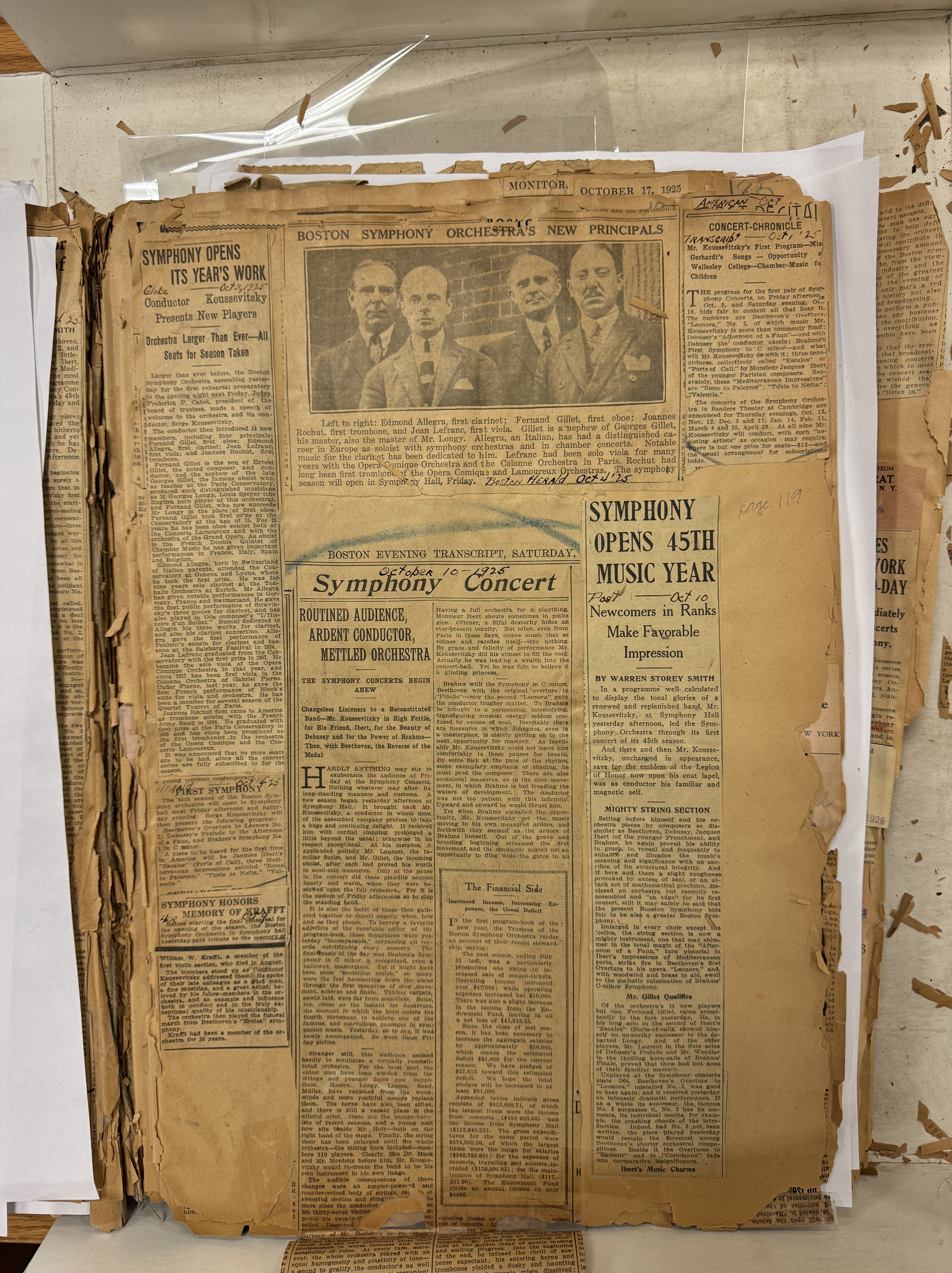
A page from a Boston Symphony Orchestra scrapbook that includes an announcement in the Boston Herald of “Boston Symphony Orchestra’s New Principals” (October 4, 1925). In the photo at the top of the page, Joannès Rochut is second from right. Courtesy of the Boston Symphony Orchestra Archives.
I found a photograph of Joannès Rochut in a Boston Symphony Orchestra scrapbook from 1925 (above). It appeared in an article in the Boston Herald on October 4, 1925. These scrapbooks proved to be invaluable during my research trip. I must have looked at 15 of them during my visit to the Archives. They are old and brittle, but, fortunately, they also have been photographed so the treasures they hold will be available for researchers to consult long after the fragile paper turns to dust.

A check from Arthur Fiedler to Joannès Rochut, payment for one week of concerts on the Charles River Esplanade, August, 1929. Courtesy of the Boston Symphony Orchestra Archives.
And there were other discoveries, like this check (above) that conductor Arthur Fiedler wrote to Joannès Rochut for playing a week of summer concerts with Boston Symphony Orchestra members on the Charles River Esplanade in Boston during the summer of 1929.

Arthur Fiedler with members of the Boston Symphony Orchestra in a concert in the Hatch Memorial Shell, Charles River Esplanade, Boston, summer 1929. Courtesy of the Boston Symphony Orchestra Archives.
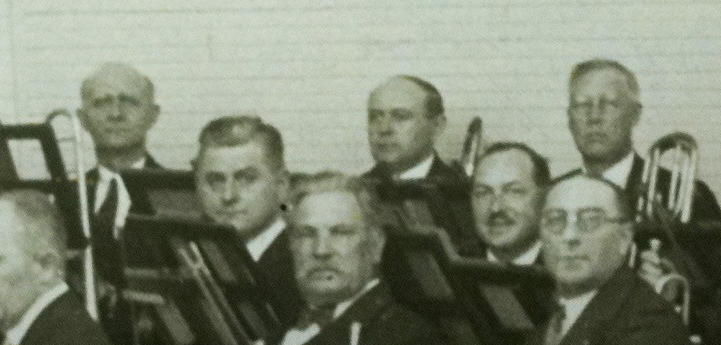
Detail of the above photo. Boston Symphony Orchestra trombone section members Joannès Rochut, Jacob Raichman, and Leroy Kenfield, Hatch Memorial Shell, Charles River Esplanade, summer 1929. Courtesy of the Boston Symphony Orchestra Archives.
Bridget brought out a huge photo of Arthur Fiedler with members of the Boston Symphony Orchestra at a Charles River Esplanade concert in the summer of 1929 (above), one of many things that brought Rochut’s time in Boston to life during my visit to the BSO Archives.
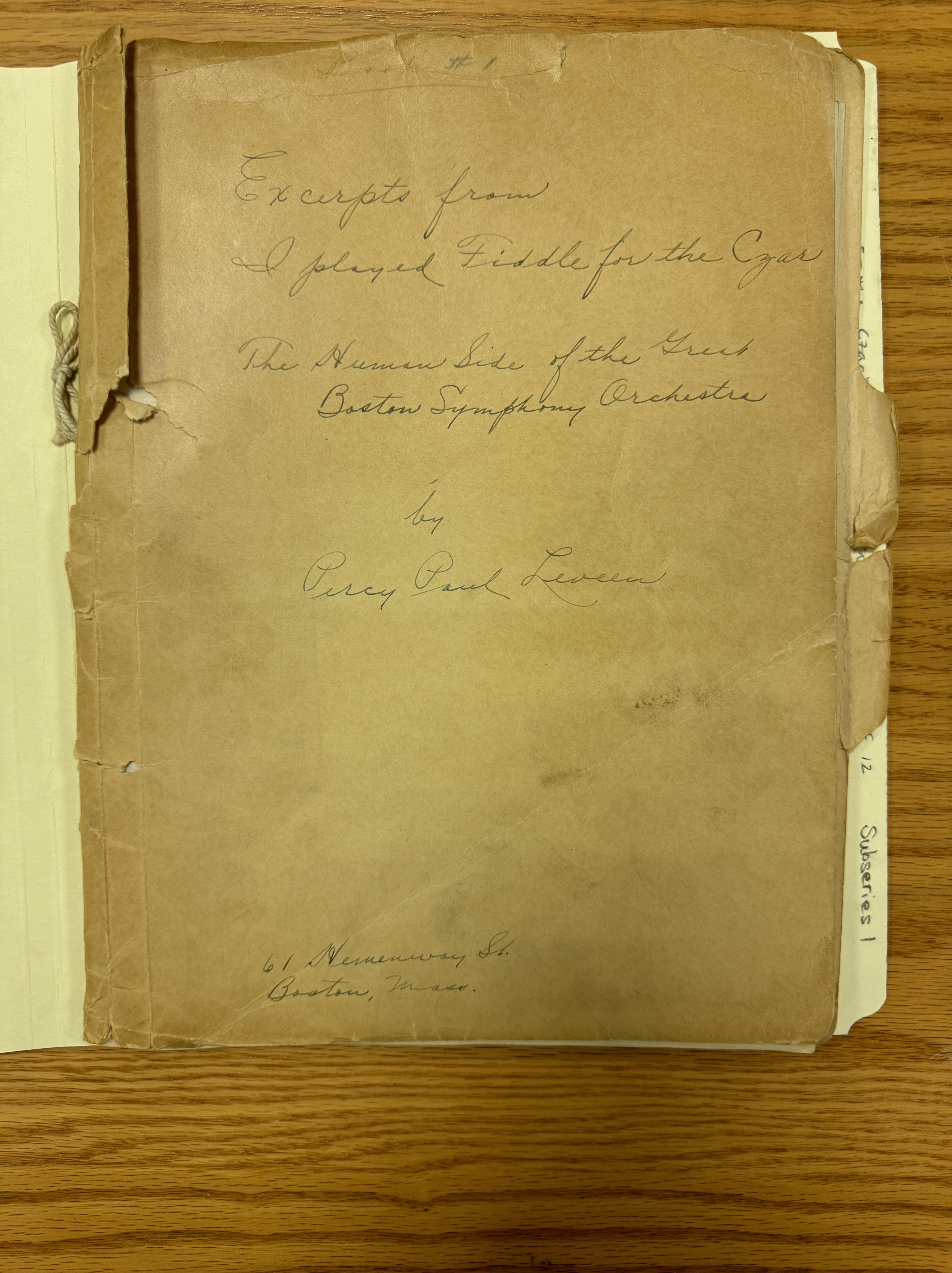
The cover of Percy Paul Leveen’s unpublished book manuscript, I Played Fiddle for the Czar. Courtesy of the Boston Symphony Orchestra Archives.
The Archives had another treasure I had not previously known about—the memoirs of violinist Percy Paul Leveen, who was a member of the BSO from 1919–1944. Leveen’s unpublished manuscript for a planned book, I Played Fiddle For the Czar—there is no doubt, after reading the manuscript, that “the Czar” was BSO conductor Serge Koussevitzky—provides first person insight to pivotal moments in Boston Symphony Orchestra history. Such as “Black Tuesday,” October 19, 1929, that signaled the beginning of the Great Depression. On that fateful day, the Boston Symphony Orchestra was in Chicago for a concert in Orchestra Hall. Leveen’s comments about how players reacted to those life-changing economic events are riveting. And I will use some of Percy Paul Leveen’s insights in my article.

A view from the stage of Symphony Hall, Boston, August 6, 2024
On my way out of Symphony Hall, I told Bridget I’d like to have a look at the inside of the hall itself. I was very happy to stand on the Symphony Hall stage again. The hall was undergoing the changeover from the Boston Pops season—the usual seats are removed on the main floor and replaced with tables and chairs during Pops—while the orchestra is at its summer home, Tanglewood, and there was maintenance work going on. I played so many concerts in Symphony Hall; seeing it again brought back a lot of memories. I played concerts on that stage for over 27 years, the same stage where Joannès Rochut played many concerts. Symphony Hall remains a very special place to my family and me.
In the days since I’ve returned from my visit to the Boston Symphony Orchestra Archives, my article on Joannès Rochut has taken on a new dimension. I have a lot more work to do in the coming weeks before I hit the submission deadline for my article, but many of the documents and photographs I obtained during my visit will now be part of my article. I am so grateful to Bridget Carr and her staff who are keepers of the history of the Boston Symphony Orchestra, and the value of her helpfulness cannot be overstated.

Douglas Yeo and Bridget Carr in the Boston Symphony Orchestra Archives, August 6, 2024
This is research. Looking, digging, contacting, networking, visiting, calling, emailing, connecting. Last Tuesday, all of those things came together in Symphony Hall, Boston’s proud temple of music. The fruits of my research on Joannès Rochut will appear in print soon. His story is quite a story, and thanks to places like the Boston Symphony Orchestra Archives and people like Bridget Carr, I will be able to tell it in a way that has never been told before. Stay tuned.
[And here’s a little bonus. Compare this photo of me, below, that I took last week outside of Symphony Hall’s Stage Door with the following photo of three members of the Boston Symphony Orchestra that was taken in 1934, 90 years ago. I love this stuff.]

Douglas Yeo at the Symphony Hall Stage Door, Boston, August 6, 2024

Three members of the Boston Symphony Orchestra: Jacob Raichman (trombone), Cornelius Van den Berg (horn), and William Gebhart (horn), Symphony Hall Stage Door, 1934. Courtesy of Irene Raichman Shermont.
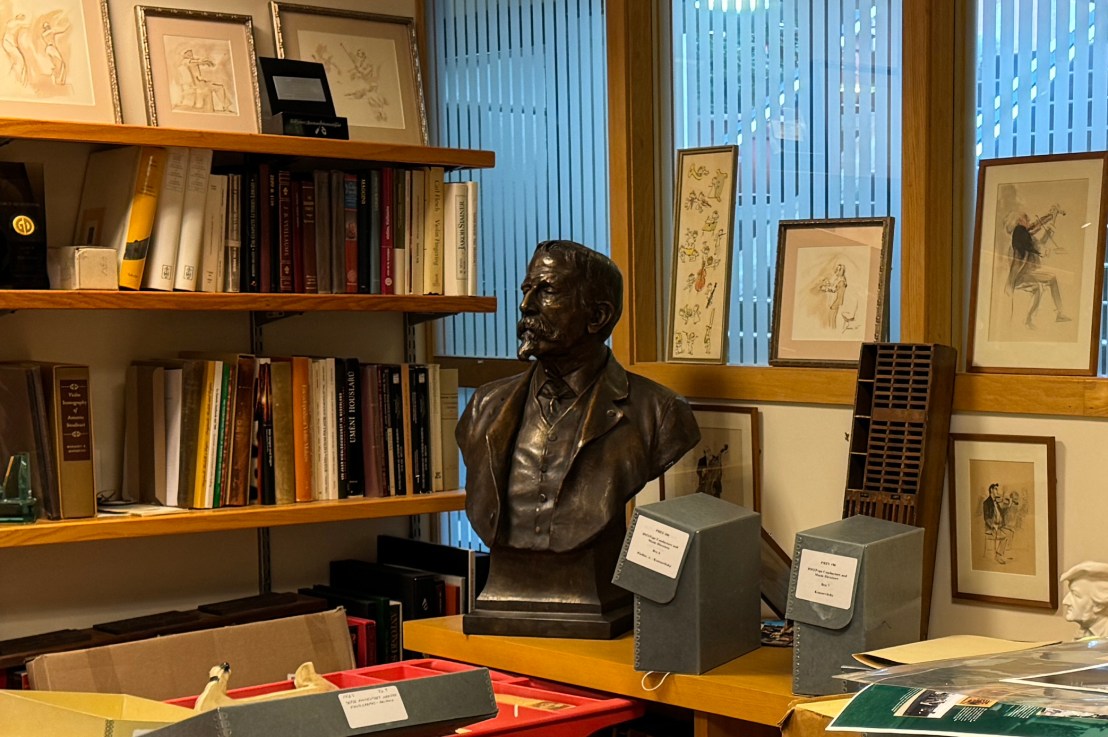
[Header photo: The reading room in the Boston Symphony Orchestra Archives. The bust on the table is of Major Henry Higginson, founder and sustainer of the Boston Symphony Orchestra.]








 The Last Trombone – Douglas Yeo