Category: United States of America

A new/old Kruspe bass trombone: Protec to the rescue

A new/old Kruspe bass trombone: Protec to the rescue

by Douglas Yeo (April 22, 2025)

In 1986, I began a collaboration with YAMAHA Corporation to make a new bass trombone. The happy result was the YAMAHA YBL-622 dependent valve double valve bass trombone (with detachable second valve) that, several years ago, was added to YAMAHA’s Xeno trombone line and renamed the YAMAHA YBL-822G bass trombone. Over the years, I’ve continued to try other bass trombones by many different makers. I like to know what is on the market and how those instruments play. I want to play a bass trombone what works best for me but every time I try something else, I keep coming back to my YAMAHA. That instrument works best for me.

Detail of the bell and slide of a Kruspe bass trombone, showing the Schlangenverzierung (“snake garland”).

That said, I love the history of the trombone, and I’ve always enjoyed playing and hearing trombones made by great German makers like Heckel and Kruspe that were made in the late nineteenth and early twentieth centuries. This school of trombone manufacturing is considered a “golden age” of trombone craftsmanship, and these old German trombones are things of beauty, both visually and aurally. They have a unique sound, a truly beautiful sound that blends with rotary valve trumpets and the other winds of the orchestra in a unique way. And visually, there is nothing like the beautiful Schlangenverzierung, or “snake garland” that is found at the top of the bell section and on the hand slide bow (photos above). The artistic design of ferrules, the wrap of the F-attachment, and the leather thumb strap (rather than a fixed, metal linkage) that operates the F-attachment valve add to the beauty of these instruments.
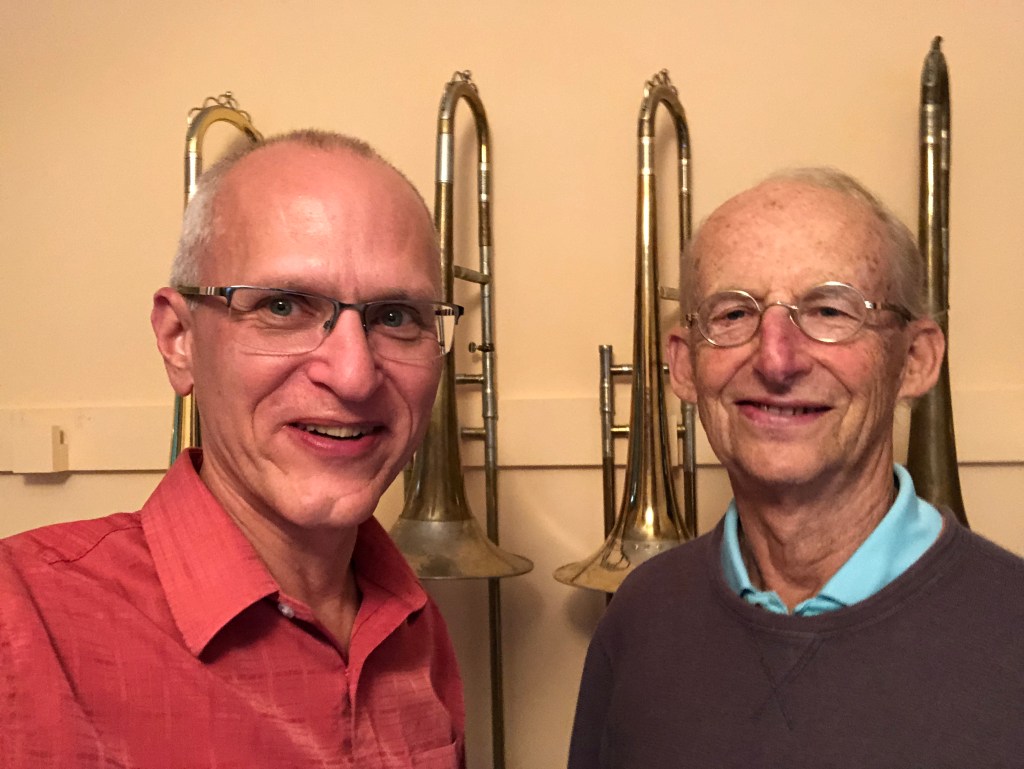
Douglas Yeo and Jay Friedman with some of Jay’s Kruspe trombones, September 9, 2019.

My friend, Jay Friedman, principal trombonist of the Chicago Symphony Orchestra, has an extensive collection of vintage Kruspe trombones, and we often talk about the unique qualities of these iconic instruments.

I played a Kruspe bass trombone during my last seasons as a member of the Boston Symphony Orchestra. Five vintage Kruspe trombones—an alto, two tenors, an F-attachment tenor, and a single valve bass—came on the market in 2007 and I persuaded the management of the BSO to purchase them. I loved playing that Kruspe bass trombone, and I used the BSO’s Kruspe bass whenever we played German repertoire from the 18th through 19th centuries. Music of Mozart, Haydn, Beethoven, Schumann, Schubert, Brahms and their compatriots. Whether my colleagues were using a modern alto and smaller bore tenor trombone, or using the Kruspe alto and a tenor, or an alto and tenor trombone by the modern German maker, Thein, the Kruspe bass blended spectacularly with all of them.

Members of the Boston Symphony Orchestra trombone section, c. 1905, with Holton trombones. Left to right: Leroy Kenfield, bass; Anton Mausebach, second; Carl Hampe, principal.

It’s interesting to note, from an historical perspective, that the American musical instrument makers Frank Holton and C. G. Conn modeled their early 20th century trombones after instruments made by great German makers. This photograph (above) of members of the Boston Symphony Orchestra trombone section (Leroy Kenfield, bass; Anton Mausebach, second; Carl Hampe, principal) was taken around 1905 and they are all playing Holton trombones made in the German style. Likewise, iconic instruments like the Conn 70H bass trombone (including the prized Conn Fuchs model bass trombone) were based on earlier German models. The beauty of sound of these instruments—many factors go into this but they include the bell taper, the bore size, and the type of brass used—is something to behold, and while modern trombonists often favor playing with more “muscle,” there is a lot to be said for the exceptional quality of these German style instruments in the hands of a player who is truly interested in blending into rather than dominating the orchestral texture.

Douglas Yeo’s final bow in Symphony Hall (with Kruspe bass trombone) as a member of the Boston Symphony Orchestra, May 8, 2012. Performance of Beethoven Symphony No. 9. Also shown (standing) are concertmaster Malcolm Lowe (clapping) and conductor Bernard Haitink. 

When I retired from the Boston Symphony Orchestra in 2012, I had to leave that Kruspe bass trombone behind. However, it makes me smile when I remember that the last concert I played in Boston’s Symphony Hall in May, 2012, was the Symphony No. 9 by Ludwig van Beethoven conducted by Bernard Haitink (photo above). I had used BSO’s Kruspe bass trombone for that performance and my final bow in Symphony Hall with the orchestra.

Earlier this year, I played bass trombone with the Atlanta Symphony in performances of Beethoven Symphony No. 5. Acting principal trombonist Nathan Zgnoc played a Thein alto trombone and acting second trombonist Jason Robins played a Conn 8H (that instrument, now owned by Nathan, had previously been owned by Keith Brown). For those performances, I used my YAMAHA YBL-601 Vienna style bass trombone, a dual-bore, single valve bass trombone made in the classic German tradition that, unfortunately, is no longer part of YAMAHA’s trombone catalogue. Our blend worked very nicely in those performances, but knowing I would be returning to the ASO in May 2025 for performances of Beethoven’s Missa solemnis, I began a quest to fulfill a dream and acquire a vintage bass trombone made by the workshop of Eduard Kruspe of Erfurt, Germany.
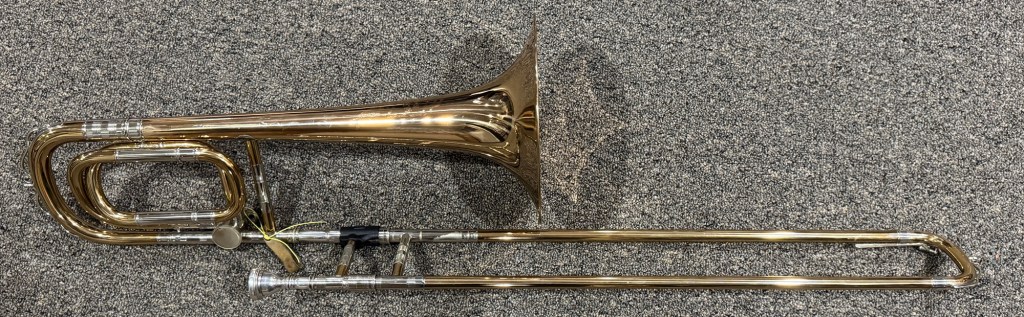
My bass trombone by Kruspe. There is no serial number on the instrument although the number “3” is stamped on the bell receiver.

The bell engraving on my Kruspe bass trombone.

Happily, my search didn’t take long, and in a short time a 100-year old Kruspe single valve bass trombone—of the same vintage as that Kruspe bass I played in the Boston Symphony Orchestra—arrived on my doorstep thanks to Noah Gladstone who runs The Brass Ark in California. Like the BSO’s Kruspe, this instrument is spectacular, and after a little TLC from both Noah and my local brass technician (no, he is much more than a technician, he is an artist, actually), Dana Hofer, I began to get to know my new instrument. Happy times.
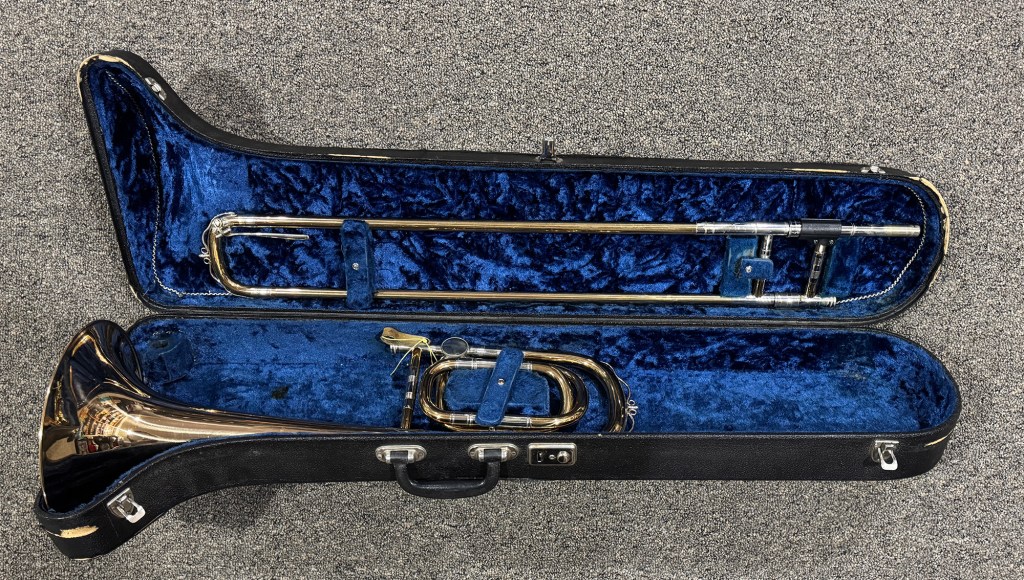
The original wooden case for my Kruspe bass trombone.

My Kruspe bass trombone came in its original wooden case which works quite well but the case is extremely compact (photos above). When I travel by airplane with my trombone, I always bring it onboard (the case for my YAMAHA YBL-822G is very compact) and put it in an overhead compartment, but you never never know when a flight attendant will be less than thrilled to see a trombone in an overhead bin and I might be required to check my trombone as baggage. Because of this, I always pack my trombone in its case as if it had to be checked as baggage, just in case. Fortunately, my YAMAHA YBL-822G case travels very well as checked baggage (with the addition of a styrofoam cone in the bell, the instrument has never suffered damage when I check it as baggage; see my FAQ on my website about traveling with a trombone for some tips). However, while the original Kruspe case is great for normal use of the trombone, it is so compact that I am not confident it would protect my trombone well enough if it ended up as checked baggage.

The slide of my Kruspe bass trombone placed in my YAMAHA YBL-822G bass trombone case.

Unfortunately, solving this dilemma of how to transport my Kruspe bass trombone while flying is not as simple as putting my Kruspe bass trombone in my YAMAHA bass trombone case. As you can see in the photo above, the slide to my Kruspe bass trombone is very long; 35 1/2″ long. My YAMAHA trombone slide is 32″ long. This is typical of these vintage German trombones, and early Conn trombones as well. Their slides are long while their bell sections are short.

Three bass trombone slides, top to bottom: Kruspe bass trombone, Conn 70H bass trombone (made in 1921), Yamaha YBL-822G bass trombone. The black plastic attachment on the Kruspe and Yamaha slides supports a Neotech hand brace.

Trombonists who want a modern trombone case that will fit an historical German bass trombone with a long hand slide do not have many options. I searched a long time to find such a case and happily, Protec came to the rescue.

There are many manufacturers who make aftermarket trombone cases and gig bags. I’m not a fan of gig bags. The risk of damage to a trombone in a soft or semi-hard trombone case is simply too high. I use a rigid trombone case at all times.

My search to find an aftermarket trombone case to fit my Kruspe bass trombone took some time to reach a good result. Manufacturers make their cases to be as compact as possible. Bass trombone cases are manufactured to fit standard 32″ long trombone slides. The additional 3 1/2″ length of the Kruspe slide meant that a case had to be longer. Most bass trombone cases top out at 36″ length and with the padding inside the case, that’s just not long enough to accommodate a 35 1/2″ bass trombone slide. I searched up for a case that had a length that would accommodate the Kruspe slide. And I finally found one: the Protec MAX contoured case.
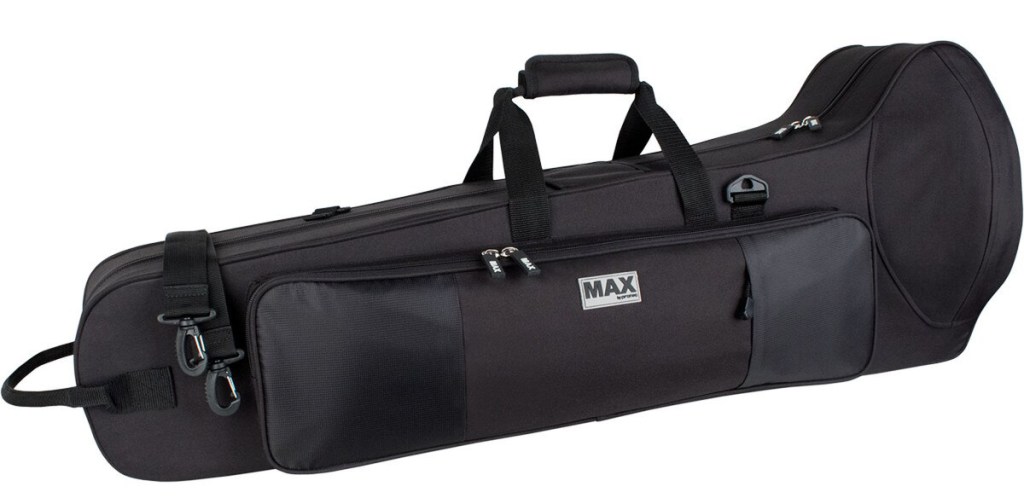
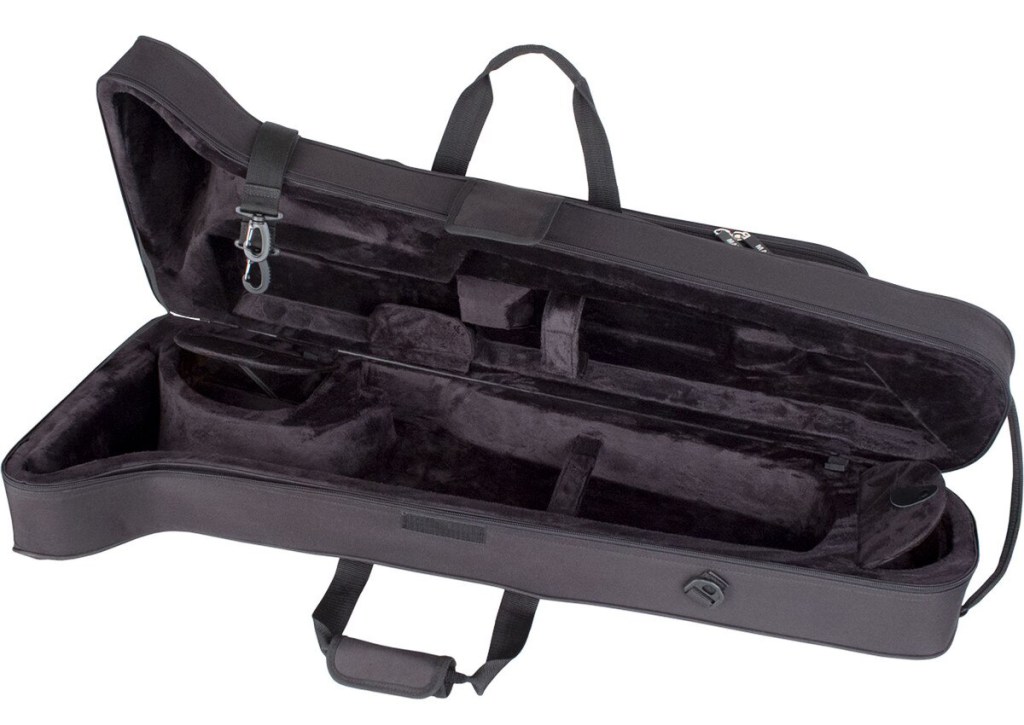
The Protec MAX bass trombone case. Photos courtesy of Protec.

The Protec MAX contoured case is made with EPS styrofoam covered with plush velvet; the outside is covered with durable nylon fabric. With the case’s 38″ length, I thought it might accommodate my Kruspe slide. I called Protec and spent some time talking with Michael Corter. We discussed all of the interior dimensions of the case. As manufactured, the Protec MAX’s compartment for the bass trombone slide was made for a standard 32″ slide. But Michael sent me some photos of the case and I saw that with a slight modification, I could lengthen the slide compartment by a few inches by cutting away some of the styrofoam. It was worth a try.
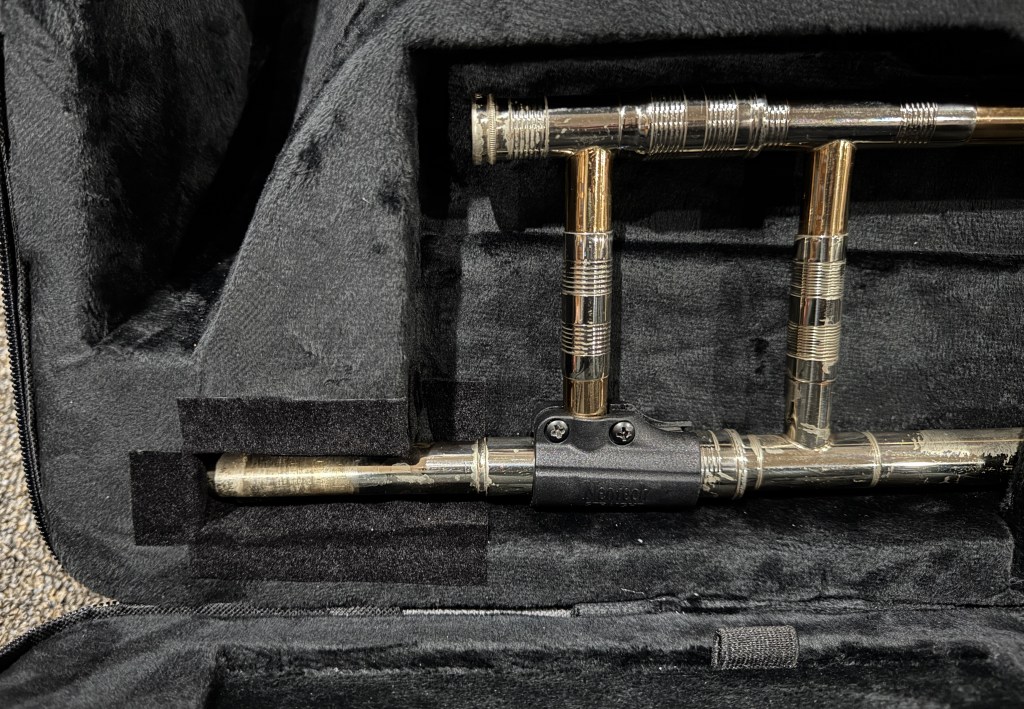
The interior of my Protec MAX case, showing the cutout I made to accommodate the long Kruspe bass trombone slide tenon.

The result turned out to be exactly what I wanted. With a razor blade, I cut away some of the slide compartment foam so it would fit the long slide tenon of my Kruspe bass trombone. Then, I covered the exposed styrofoam with self-adhesive velvet flocked fabric. This is available from amazon.com for $12.99 for 20 sheets, in black and many other colors. After I cut and applied this fabric to the case, everything looked clean and neat and my Kruspe trombone slide fit nicely in the case. The Protec MAX case also has two storage compartments inside the case, a large storage pocket on the outside of the case, backpack straps (that can be hidden under a fabric panel), and a shoulder strap. Most of all, my Kruspe bass trombone is well protected, ready for my next flight.

My Protec MAX case with my Kruspe bass trombone.

If you have a vintage Conn bass trombone or an historical German bass trombone that has a long slide that will not fit in your modern bass trombone case, Protec has a case for you. I also want to say this as well: My experience with Protec was superb in every way. My conversation with Michael Corter was extremely helpful and informative. Protec’s customer service was outstanding. The case was well packed for shipment and it arrived on my doorstep in perfect condition. The workmanship of the Protec case is also superb. The zippers work easily, the interior storage compartments open and close smoothly, and look at the price of the Protec MAX bass trombone case (it comes with free shipping!) on the Protec website—it is a very affordable product. Props to Protec for making this case, and for manufacturing it in such a way that a user can make modifications to it very easily. 

Protec also makes a full line of trombone cases (and cases for other instruments) and case accessories. Visit their website to see all of their products.

Now, it’s time to get back to practicing my part for Beethoven’s Missa solemnis. As an aside, I recently wrote an article about Missa solemnis for the blog hosted by my church, New Covenant Church of Naperville, Illinois. The article is titled, The Nicene Creed, Beethoven, and the Power of a Small Word. Have a look. There is something about how Beethoven set the Credo to his Missa solemnis that I find truly remarkable.

Beethoven. Kruspe. Protec. A good combination!


A busy autumn. And a thought.

A busy autumn. And a thought.

By Douglas Yeo (November 11, 2024)

It has been a few months since I’ve posted anything to The Last Trombone and to those who have asked me why, it’s simply that I’ve been busy with other things. Busy with a lot of things. Here’s a quick update before I offer a thought on something else.

YEO_UIUC_trombones_2024

Douglas Yeo with members of the University of Illinois Marching Illini trombone section: Derrick Neal, Pablo Rosales, Douglas Yeo, Poorna Kumar (who, in addition to being a dual major in trombone performance and community health, is also a drum major for the Marching Illini), Jake Bae, Sam Murray, September 2024.

In September, my wife, Patricia, and I returned to the campus of University of Illinois Urbana-Champaign where I served as trombone professor from 2022–2024. We were there for homecoming and the Illinois  football game against Central Michigan (the Illini won, 30–9). While there, I met up with several of my former students who are in the Marching Illini. I was so happy to see them again.

Yeo_Brickens_UT_Austin_trombones_2024

Douglas Yeo with Dr. Nathaniel Brickens and members of the University of Texas trombone studio, September 2024.

The next week, I spent a few days at University of Texas in Austin, in residence with the trombone studio of my good friend and UT’s trombone professor, Dr. Nathaniel Brickens. I always enjoy being at UT and  working with its talented trombonists (and sporting a headpiece of the university’s mascot, Bevo, above).

PBO_Oct_2024

In October, I traveled to San Francisco for a week where I played ophicleide with the superb early music group, Philharmonia Baroque. The conductor, Grete Pedersen, led us in a program that included the overture to Felix Mendelssohn’s A Midsummer Night’s Dream. What a joy it was to play under her leadership with this fine ensemble (I’ve been playing serpent and ophicleide with Philharmonia Baroque since 2009). While there, I visited the Fine Arts Museums of San Francisco. It was my first time visiting these superb museums, and in addition to seeing iconic art by Auguste Rodin, Claude Seurat, Claude Monet, and many others, my eyes were opened at two special exhibitions of art by Mary Cassat and Tamara de Lempicka. Art old and new that inspires, soothes, and provokes.

ASO_Oct_2024

A day after I returned home from San Francisco, I flew to Atlanta where played bass trombone with the Atlanta Symphony, substituting for a week on a program that included Serge Rachmaninoff’s Symphonic Dances conducted by Roderick Cox. While I was there, I was a guest for a session with Slide School, hosted by Atlanta Symphony acting principal trombonist, Nathan Zgonc, and Brian Hecht of the Dallas Symphony. I also had the happy opportunity to spend a lot of time working with the ASO’s two fellowship players, bass trombonist Jordan Johnson (who, a few days later, won the bass trombone position with Houston Grand Opera—bravo, Jordan!) and tubist Joshua Williams. I look forward to returning to the Atlanta Symphony for a few more weeks after the calendar turns to 2025.

Yeo_Ebenezer_Baptist_Church_Oct_2024

Douglas Yeo in front of historic Ebenezer Baptist Church, Atlanta, October 2024.

While in Atlanta, I visited the Dr. Martin Luther King Jr. national historic site. In the book I co-authored with Kevin Mungons, Homer Rodeheaver and the Rise of the Gospel Music Industry (Rowman and Littlefield, 2021), we introduced Rodeheaver to readers with an opening chapter, Prologue, in which we described the 1917 Billy Sunday meetings in Atlanta (Homer Rodeheaver was Billy Sunday’s trombone-playing song leader for 20 years). To stand in front of and inside historic Ebenezer Baptist Church (where Dr. King, his father, and his father’s father-in-law all served as pastor, and where Dr. King’s mother, Alberta Williams King, was tragically murdered in 1974 while she was playing The Lord’s Prayer at the organ), to see the grave of Dr. King and his wife, Coretta Scott King, and imagine the huge temporary, wooden, 15,000 seat tabernacle that Billy Sunday erected on what is now the site of the historic site’s Visitor Center, was powerful, indeed.

Yeo_Sedona_Oct_2024

Douglas and Patricia Yeo on the Fay Canyon trail, Sedona, Arizona, October 2024.

Right after I returned home from Atlanta, my wife, Patricia, and I spent a week in Arizona where we enjoyed some great hiking on spectacular trails in Sedona and Phoenix. After so many weeks of traveling with a trombone in my hand, it was nice to be together on the trail where the sky was blue, the rocks were orange and red, and the peacefulness and beauty of the Sonoran desert was on full display.

Ida Bisbee_1926_NEC_NEUME_cropped

Excerpt from page 27 of the 1926 New England Conservatory of Music yearbook, The NEUME, showing Ida Isabella Bisbee, trombone student of Joannès Rochut. Courtesy of New England Conservatory of Music Archives.

My big project for this autumn was finishing my article about Joannès Rochut that will appear in the January 2025 International Trombone Association Journal. This is an article that has been nearly 40 years in the making. I’ve written a little about my research process for this article; read this post on The Last Trombone about my one day research trip to the Boston Symphony Orchestra archives in August of this year where I uncovered some important information about Rochut’s life and work. Rochut’s influence on the trombone—and brass—world has been remarkable, and in the course of my research, I learned so much about this iconic influencer in the trombone community. Including, thanks to the archives of New England Conservatory of Music, the fact that Rochut’s first student at NEC was Ida Isabella Bisbee, the first woman to graduate from NEC (in 1926) with a degree in trombone performance (above). I’m looking forward to receiving proofs very soon of what is expected to be an 80 page article in the Journal. Stay tuned.

And, overarching all of this in last few months is the tremendous joy I’ve had of playing trombone duets and trios with my granddaughter and her mom, our oldest daughter, Linda (who is a fine bass trombonist and low brass teacher). Our granddaughter, who is 10 years old, began playing trombone in May when I was at the International Trombone Festival. She loves playing the trombone—she’s good, too!—and in our little family of my wife and me, our two daughters and their husbands, and our two grandchildren, our granddaughter is the sixth brass player (and the fourth female brass player: Patricia plays baritone horn, Linda and and her daughter play trombone, and our other daughter, Robin, plays trumpet). Our grandson has told us he wants to play the tuba next year. When that happens, he will become the seventh brass player in our family.

All of these activities were and are fun, exciting, and rejuvenating. But then, there was also an event of momentous importance: the national election here in the United States that was held on November 5. In the midst of all that swirled around that impactful day, I was heartened when I received an email from Dr. Linda Moorhouse, Director of the School of Music at University of Illinois. On election day, she sent a message to all students, faculty, and staff in the School of Music with some helpful, sensible, and comforting thoughts on how to navigate this contentious election season and what follows. Her words, in a message titled, “Managing the Noise,” resonated deeply with me. Dr. Moorhouse wrote, in part:

As a School full of practicing musicians, we manage all kinds of noise every day. And outside of musical noise, we also know how the vast volume of information, opinions, and discussions can sometimes become overwhelming or disruptive.

I’m reaching out to remind you that you are a part of a School of Music community, and while this day and the next few days may be stressful, we are here for one another. Listed below are a few ways we can navigate the next few days and weeks together and keep our environment supportive and respectful:

  1. Be Mindful of Election “Noise”
    Staying informed is important, but the constant influx of election-related content can become a source of stress. Take breaks from social media, limit your news intake to trusted sources, and remember it’s okay to step away when things get to be too much. Giving ourselves space can help maintain balance.
  2. Respect Diverse Perspectives
    We all have different viewpoints shaped by our unique experiences, and recognizing this helps foster mutual respect. Election season is a celebration of our democratic process, and despite differing opinions, we can share in that respect for civic engagement. Supporting each other through this season means being thoughtful and considerate in our communications.
  3. Practice Self-Care
    Anxiety around election outcomes is normal. Be kind to yourself by setting aside time for things that bring you peace and comfort. Exercise, hobbies, meditation, or simply stepping away from the news cycle are great ways to maintain your emotional health.
  4. Be Good to Each Other
    Kindness goes a long way, especially in uncertain times. Small gestures of thoughtfulness and understanding can create a sense of community and support. Let’s check in on each other, be gentle in our interactions, and focus on the qualities that unite us rather than divide us.

One of the reasons I found Dr. Moorhouse’s words so impactful was the fact that a few weeks before her message arrived, a lunchtime conversation I had with a friend and an encounter with a sign I saw on my way home from that meeting got me thinking about some related things.

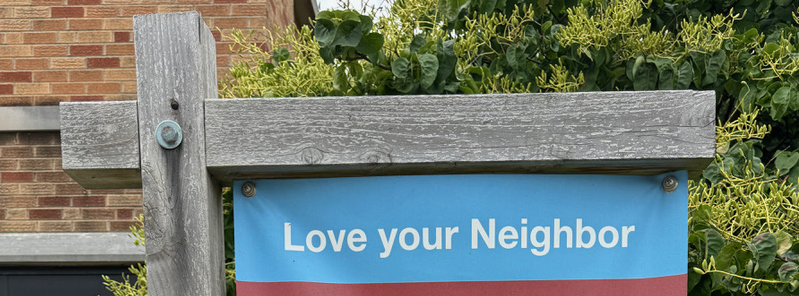
As a result, I wrote a short article for the blog hosted by my church, New Covenant Church of Naperville, Illinois. The article—it was published two days after the election, on November 7, 2024—is about the well-known and well-worn phrase from the Bible, “Love your neighbor.” I’ll let the article speak for itself. Have a look at the article—and the rest of the sign—HERE.

Love_Your_Neighbor_sign_cropped

In a time where there is a lot of shouting, a lot of judging, a lot of anger, a lot of finger pointing; in a time when many people make assumptions about the motives and beliefs of others without taking the time to speak with and understand them; in a time when name calling and insulting others has risen to a harmful, toxic level; the admonition to “Love your neighbor” has, as I discovered on that day when I had lunch with a friend, some unexpected components. It got me thinking. Have a look at my article. Maybe that sign and its implications will prompt you to do some thinking, too.

Fast cars and the value of friendship

Fast cars and the value of friendship

by Douglas Yeo (August 2, 2024)

Life is full of surprises, unexpected moments that lead to bigger things. Try something that’s a little outside your box—your comfort zone—and you’ll probably learn something. If you’re open to learning. Our friends, Phil and Laura Spotts, taught us something about this.

My wife, Patricia, and I met Phil and Laura at our church in 2012. We had just moved to Arizona after I retired from my long career as a member of the Boston Symphony Orchestra. Phil struck me right away as a gregarious, “can do” kind of guy. The kind of person who is always volunteering to do something, make things happen. Phil’s an engineer but not one of those stuffy, geeky, academic types. He’s real, has a great sense of humor, and is always thinking about how to help others. Laura is a gifted pianist who played piano from time to time at our church services, another truly wonderful person. When we met them, they had a son, Cody, and in time, they became Superheroes and adopted two more children, Gage and Annaliese. There was something about this family that made Pat and me smile. We spent time together, went over to each other’s houses for dinner (Phil is a terrific cook, and we still use his fantastic leg of lamb recipe several times a year), we shared life. And our friendship grew even as we were very different people in some ways. For instance, they liked—no, they LOVED—something that was a mystery to me: NASCAR. I’m not gonna lie: before I met Phil and Laura, my life had no place for NASCAR. Growing up in and around New York City and living in Boston for nearly three decades, I fell into the east coast snobbery when it comes to things like NASCAR. “Go fast, turn left.” Doesn’t sound very interesting. Also, fast cars are loud and I work hard to protect my hearing. Big hair, beer, southern accents—those are some of the many stereotypes you bring to something like NASCAR when you’re in a cocoon in some parts of the elitist northeast.

Phil_Laura_PIR_March_2014

Phil and Laura Spotts at Phoenix International Raceway, March 2, 2014

So, when Phil and Laura invited Pat and me to go to a NASCAR race at Phoenix International Raceway (November 2013), my mind quickly buzzed around through all of my NASCAR stereotypes before I said, in a confident voice, “Sure. Let’s go!” And we did. Because this was important to our friends.

PIR_NASCAR_panorama_2013_03_02

Panoramic view of Phoenix International Raceway, March 2, 2014

The experience of going to a NASCAR race is unlike anything I’ve done in my life. I love football, and I enjoy baseball. I know what it is to cheer my team at a game, to engage with other fans around me. But NASCAR was something different all together. First, it was BIG. A lot of people go to races. A. Lot. Some come in campers and motor homes, driving from race to race and living in temporary camps that surround a racetrack, a camp that usually has a popup supermarket, bank, and urgent care center. For race weekend, a NASCAR track becomes a small city.

Phil and Laura had headsets for us that were both excellent hearing protection—I have to say, though, as I looked around from my seat, I was stunned to see so many people who were not wearing any kind of hearing protection, wow—and were connected to Phil’s radio scanner that gave us the race feed. Before the race I kept asking questions. I realized quickly that there was a lot more to NASCAR than the stereotypes I had carried with me for so long. This is a high-tech sport. There is a LOT of money involved. It’s really dangerous for the drivers. Fans are passionate about their drivers and their cars. Sponsorship is really, REALLY important. Pit crews—the crew of technicians who service cars before and during the race—work incredibly hard and fast, like a well-oiled machine. And there is a whole lot of strategy.

Doug_Pat_PIR_2013_11_10

Douglas and Patricia Yeo, Phoenix International Raceway, November 10, 2013

There were other things. At the race, I didn’t have any skin in the game; I didn’t know any drivers, so I asked Phil and Laura who there favorite drivers were. OK, they were now my favorite drivers. But when cars are racing around the track at 180 miles an hour at 130dB (that is loud, like a jet engine ready for takeoff on a runway), there’s no point in cheering during the race. Your driver can’t hear you. Other fans can’t hear you. Heck, you can’t even hear yourself. When the cars were roaring around the track, I didn’t dare take off my headset and expose my ears, so if I wanted to say something to Pat, Phil, or Laura, I pulled out my phone and typed a text message and showed it to them.

PIR_March_2014

Phoenix International Raceway, March 2, 2014

Before the race there was the National Anthem, then a flyover and a prayer, and then we were—literally—off to the races. And somehow, what enfolded in front of me captivated me in a way I didn’t expect. As I saw it with my own eyes, as I gave it a chance, as I tried to understand it, I found myself pulled into it. The old stereotypes fell away; I was learning something new. And I liked it. And that experience would not have happened were it not for friends that asked us to do something that they loved and wanted to share with us. I learned a very important lesson on that day. Several, actually. When, a year later (March 2014), Phil and Laura asked us to go to another race at Phoenix International Raceway, we did.

Then Phil took a new job and their family moved to Tennessee. Pat and I moved to the Chicago area so we could live near our grandchildren. While Phil and I weren’t seeing each other regularly any more—something we did a lot when we both lived in the Phoenix area, especially meeting for lunch at our favorite sushi place, Ah-Hai in Goodyear (yes, there really and truly is amazing sushi in the desert!)—we kept in touch, texting and talking on the phone. Then Phil called one day to tell me Cody started playing the trombone—Phil said that Cody picked the trombone because he had heard me play trombone in our church.

Cody_Spotts_E-Hamilton_HS_trombone

Poster of Cody Spotts, trombonist at East Hamilton High School, Tennessee

Then, last October, Phil texted me. Cody was graduating from high school in a few months and Phil wanted to take him to a NASCAR race as a graduation present. Any race, anywhere. And Cody said, “I want to go to the Chicago Street Race with Mr. Yeo.” Phil and Cody were coming to Chicago and  they asked me to go to another NASCAR race. Of course I said “yes.” I was excited. July 6 and 7, 2024 couldn’t come soon enough.

Doug_Phil_Cody_Portillos_NASCAR_2024

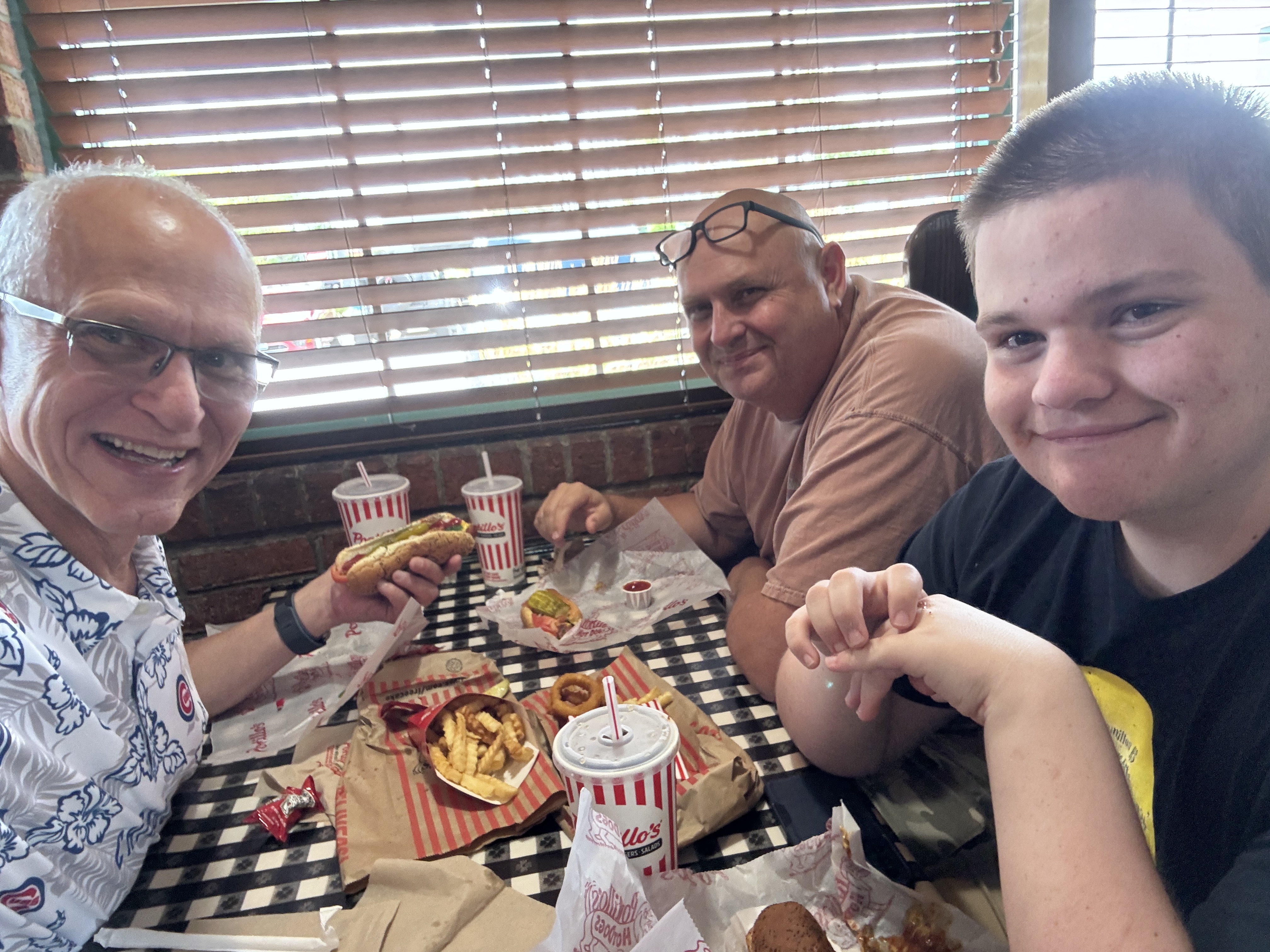
Douglas Yeo and, Phil and Cody Spotts, Portillo’s, July 5, 2024

I picked up Phil and Cody at Chicago’s O’Hare airport and because Cody had never been to Chicago, they wanted to immerse themselves in “the full Chicago experience.” We started with lunch at that iconic Chicago hot dog restaurant, Portillo’s. A Vienna Beef hotdog on a sesame seed bun, tomatoes, mustard, relish, dill pickle, raw onions, sport (hot) peppers, celery salt—but NO KETSUP! There’s nothing like it and Portillo’s is the place to get the real deal.

Doug_Cody_Phil_Giordanos_NASCAR_2024

Douglas Yeo and Cody and Phil Spotts, Giordano’s, July 5, 2024

Dinner that night was at Giordano’s where Cody experienced his first Chicago style deep dish pizza. Pat and I don’t eat at Portillo’s and Giordano’s very often—our low fat diet doesn’t have a lot of room for zillion calorie, high fat meals—but, hey, now and then, you gotta live a little.

NASCAR_Chicago_2024_map

Course map for NASCAR 2024 Chicago Street Race

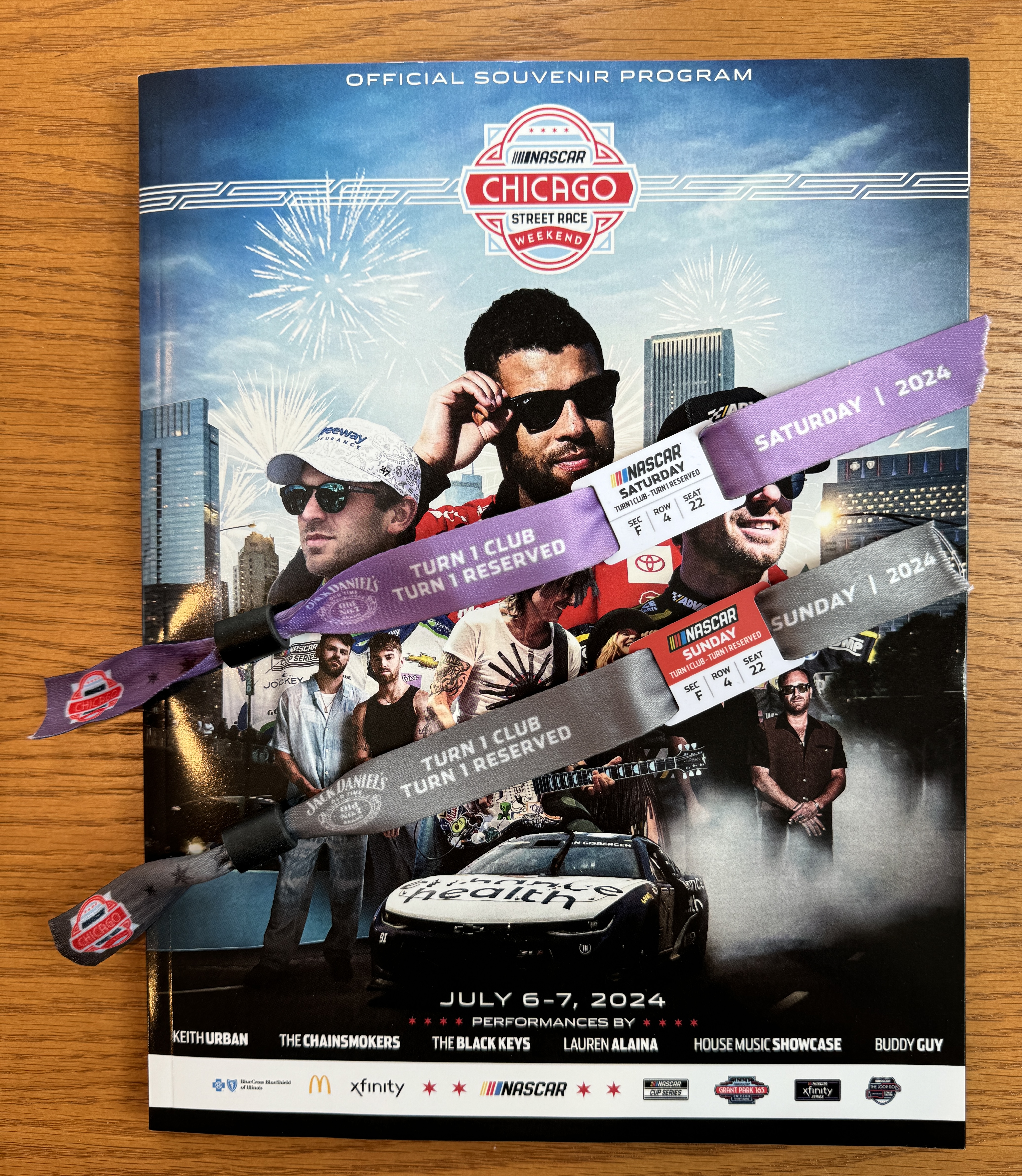
The Chicago Street Race is a unique NASCAR event. It’s a race (two races, actually) that—literally—goes through streets of downtown Chicago. Instead of a long oval track, the Chicago race track is a modified figure-8, a course that snakes through the heart of the city, along Lake Shore Drive, Michigan Avenue, and South Columbus Drive. Phil had gotten Turn 1 Reserved tickets for the three of us in the Jack Daniels Turn 1 Club. I didn’t know what that meant but I found out soon enough.

Cody_Phil_The_Bean_NASCAR_2024

Cody and Phil Spotts at “The Bean” (officially called Cloudgate), Millenium Park, Chicago, July 6, 2024

We took the train from College Avenue Station in Wheaton, Illinois, to downtown Chicago and walked toward Millenium Park near Chicago’s waterfront. There, we walked around as I showed Phil and Cody some of the iconic things in the Park, like “The Bean.” In the photo above, you can see me in my orange Phoenix International Raceway shirt, reflected in this remarkable public art installation, taking this snapshot of Cody and Phil.

Doug_Cody_Phil_NASCAR_2024_sign

Douglas Yeo and Cody and Phil Spotts, Millenium Park, Chicago, July 6, 2024

Once we got through the turnstiles with our wristbands, we made our way to our seats to get a look at our view. It was stunning. As one who knows Chicago pretty well, it was truly remarkable to see the race course laid out on roads and in view of iconic buildings that I had seen in completely different contexts.

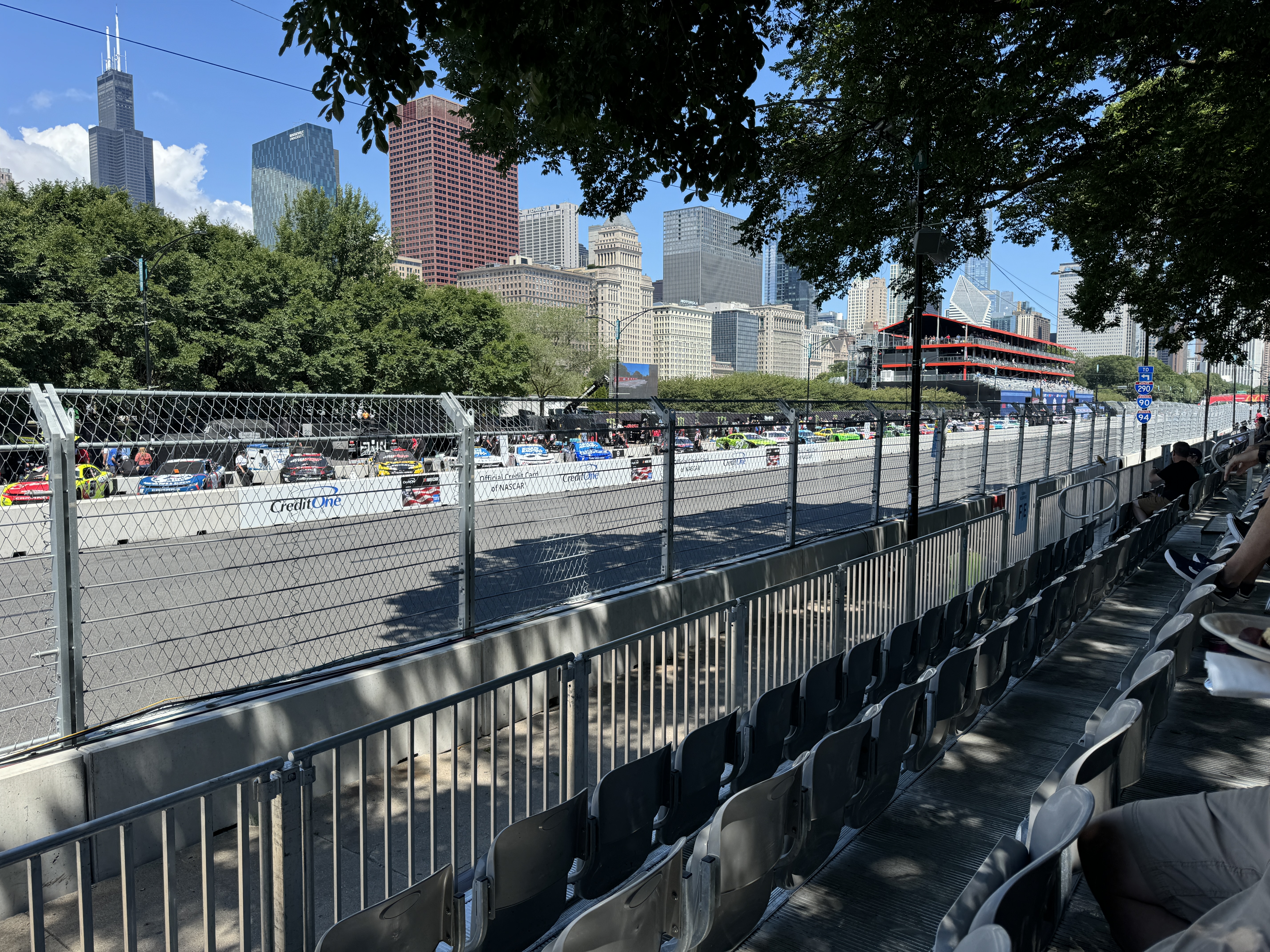
NASCAR_2024_view_turn_1_club

The view from our seats for the NASCAR Chicago Street Race Weekend, Jack Daniels Turn 1 Club, July 6, 2024. The start/finish line was down South Columbus Drive by the grandstand in the right of this photo. The Sears Tower (AKA Willis Tower) is the tall building on the left of the photo, with white antennas on top.

I mean, there we were, seated on South Columbus Drive, with the Sears Tower (OK, I know it’s been called the Willis Tower since 2009, but no Chicagoan calls it by that name) and the hotels of Michigan Avenue in view. I have driven down South Columbus Drive many times on the way home from Chicago Bears games at Soldier Field but traffic is always going north. For the race, the cars would be going south. It took some time for me to get my arms around that. It was surreal to see the city transformed into a racetrack.

Phil_Cody_Doug_club_NASCAR_2024

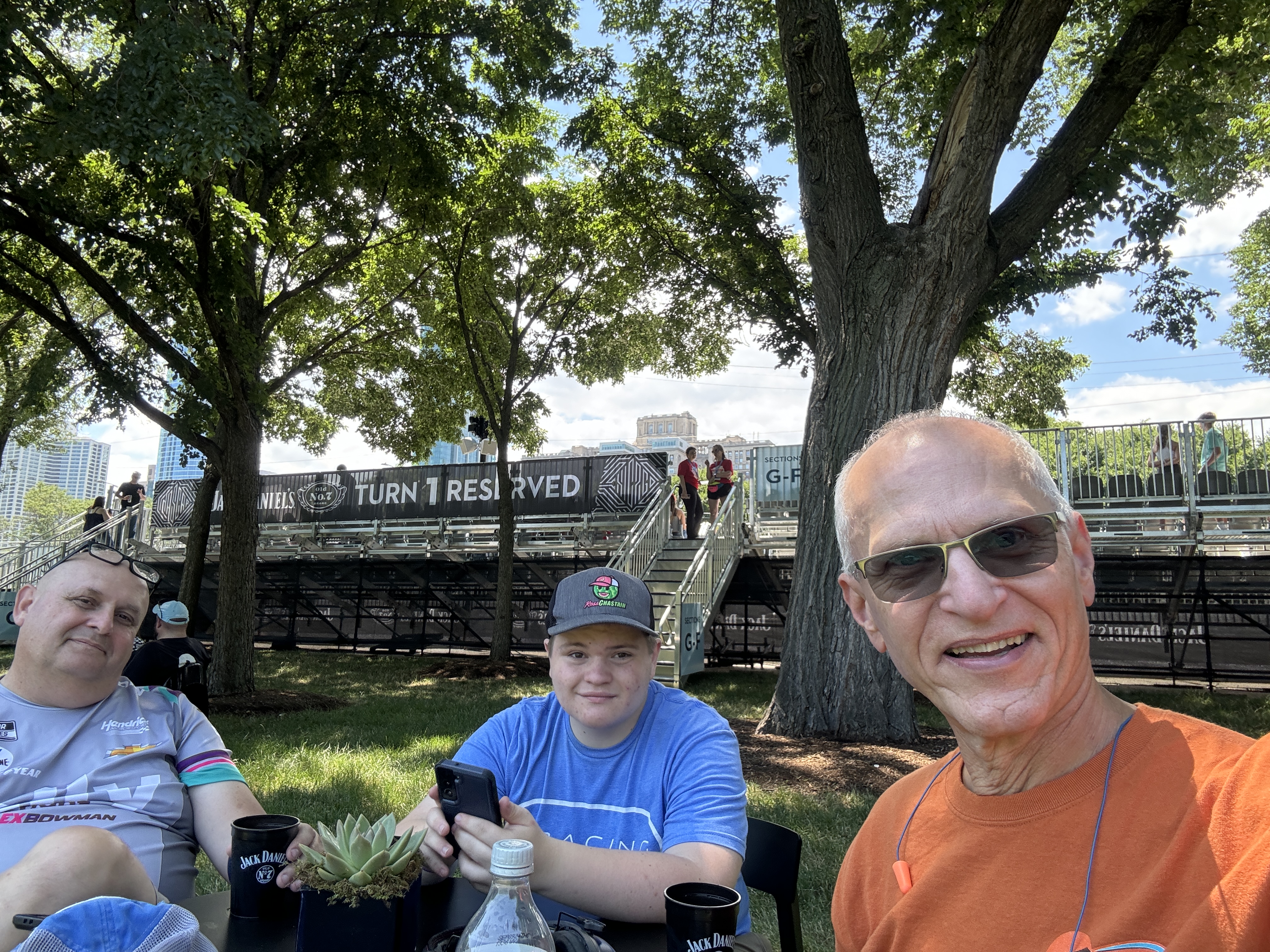
Phil and Cody Spotts and Douglas Yeo, Jack Daniels Turn 1 Club, July 6, 2024

Phil really outdid himself with tickets in the Turn 1 club; it was a lavish gift. We had terrific reserved seats, a nice, shaded area where we could relax, and UNLIMITED amazing food and drink. During the whole race, the three of us grazed on fantastic food. It was always there for us, all day long. What a special experience it was to sit in such remarkable seats with these amenities. And it happened because of friendship.

MONSTER_drink_cyclists_NASCAR_2024b

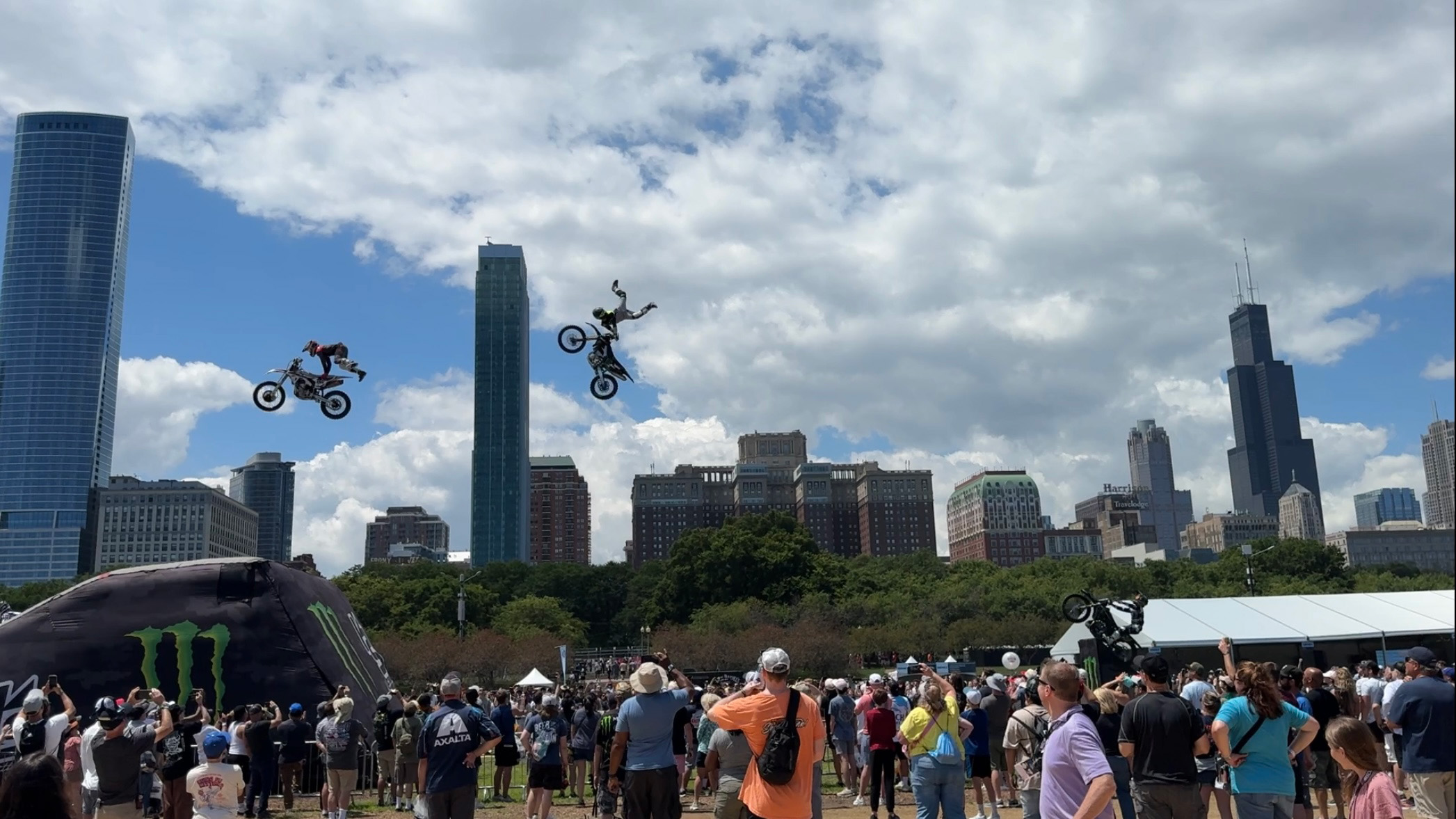
MONSTER Energy Drink acrobatic motorcyclists, Chicago, July 6, 2024

Before the race, we walked around to all of the sponsor tents, the NASCAR shop, and the wide open area where concerts were going on all day. The MONSTER Energy Drink acrobatic motorcyclists did their show; it was breathtaking.

Race_view_finish_Saturday_NASCAR_2024

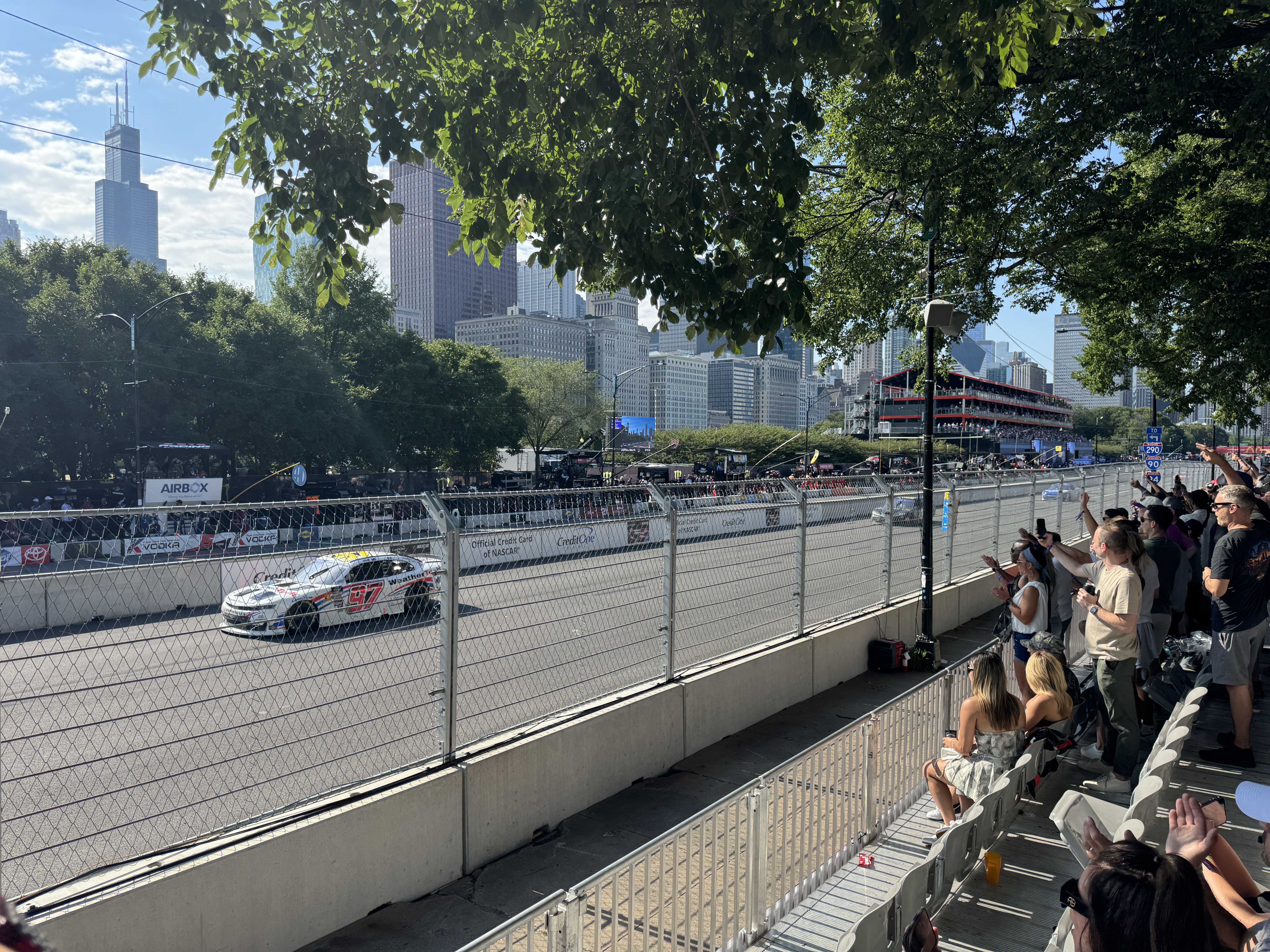
Shane Van Gisbergen (97 car) after crossing the finish line at the Loop 110 NASCAR Xfinity Series Race, Chicago, July 6, 2024

And then Saturday’s race, the Loop 110 NASCAR Xfinity Series Race, began. I can’t explain it. It was such a totally different experience than I had at Phoenix International Raceway. Drivers were not going in a loop, always turning left. They were navigating sharp 90-degree turns after long and short straightaways. Speeds were fast, but not as fast as a regular oval track NASCAR race. The cars went flying by; we followed the progress of the race in our headsets. It was absolutely thrilling. The race was won by Shane van Ginsbergen in his 97 car. If you want to get an idea of what we saw, click here to view the whole race on YouTube.

Cody_Phil_Route_66_NASCAR_2024

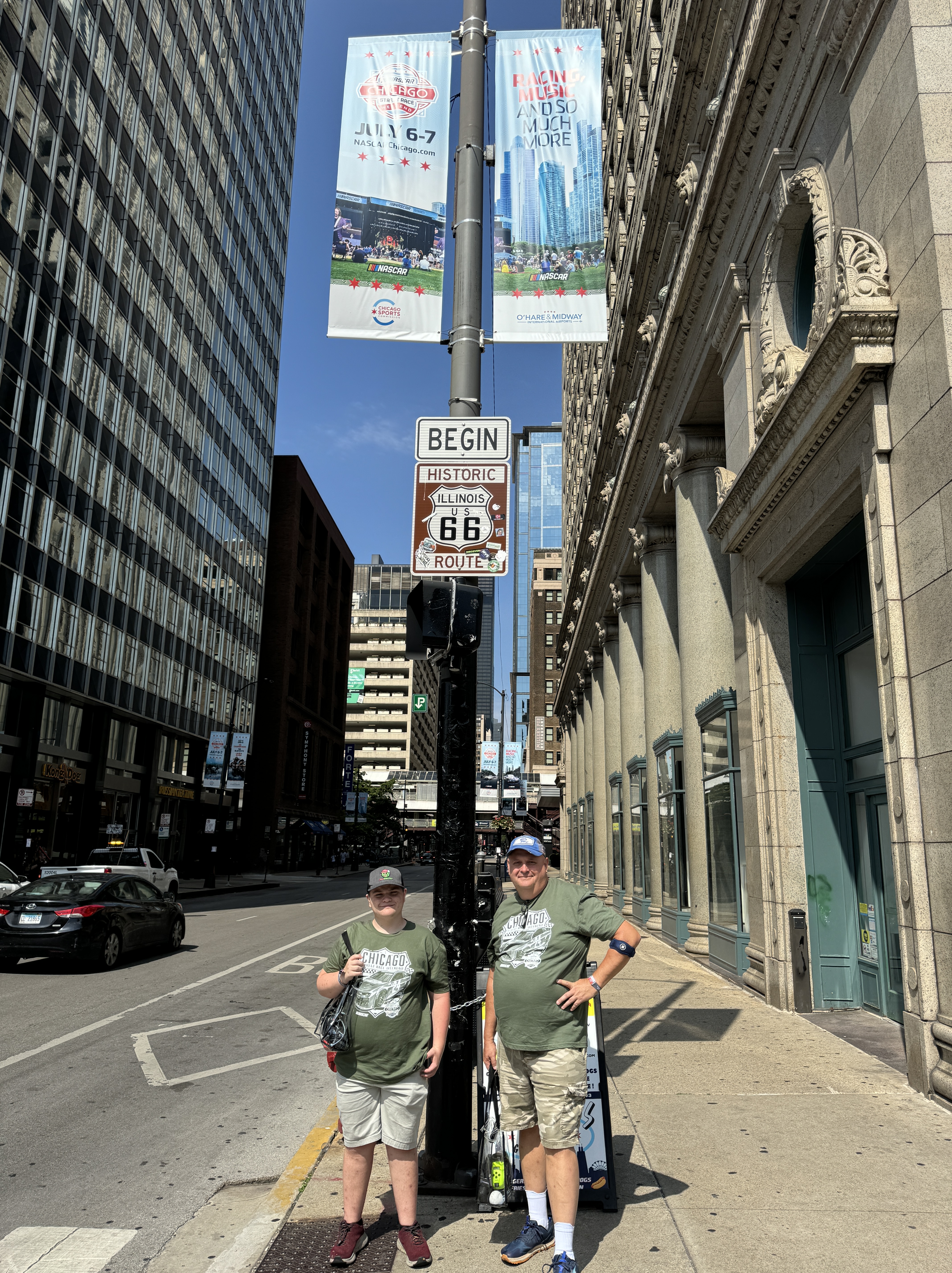
Cody and Phil Spotts at the beginning of historic Route 66 begins, Michigan Avenue, Chicago, July 7, 2024

After the race, we took the train home and after a short night of sleep, we headed back to Chicago for Sunday’s race, the Grant Park 165. When we got downtown, I wanted to show Phil and Cody where historic Route 66 started—at the intersection of Michigan Avenue and East Adams Street, just across from the Art Institute of Chicago. I took this photo (above) while I was STANDING IN THE MIDDLE OF MICHIGAN AVENUE. I had never done THAT before.

Doug_Cody_Phil_Buckingham_Fountain_day_NASCAR_2024

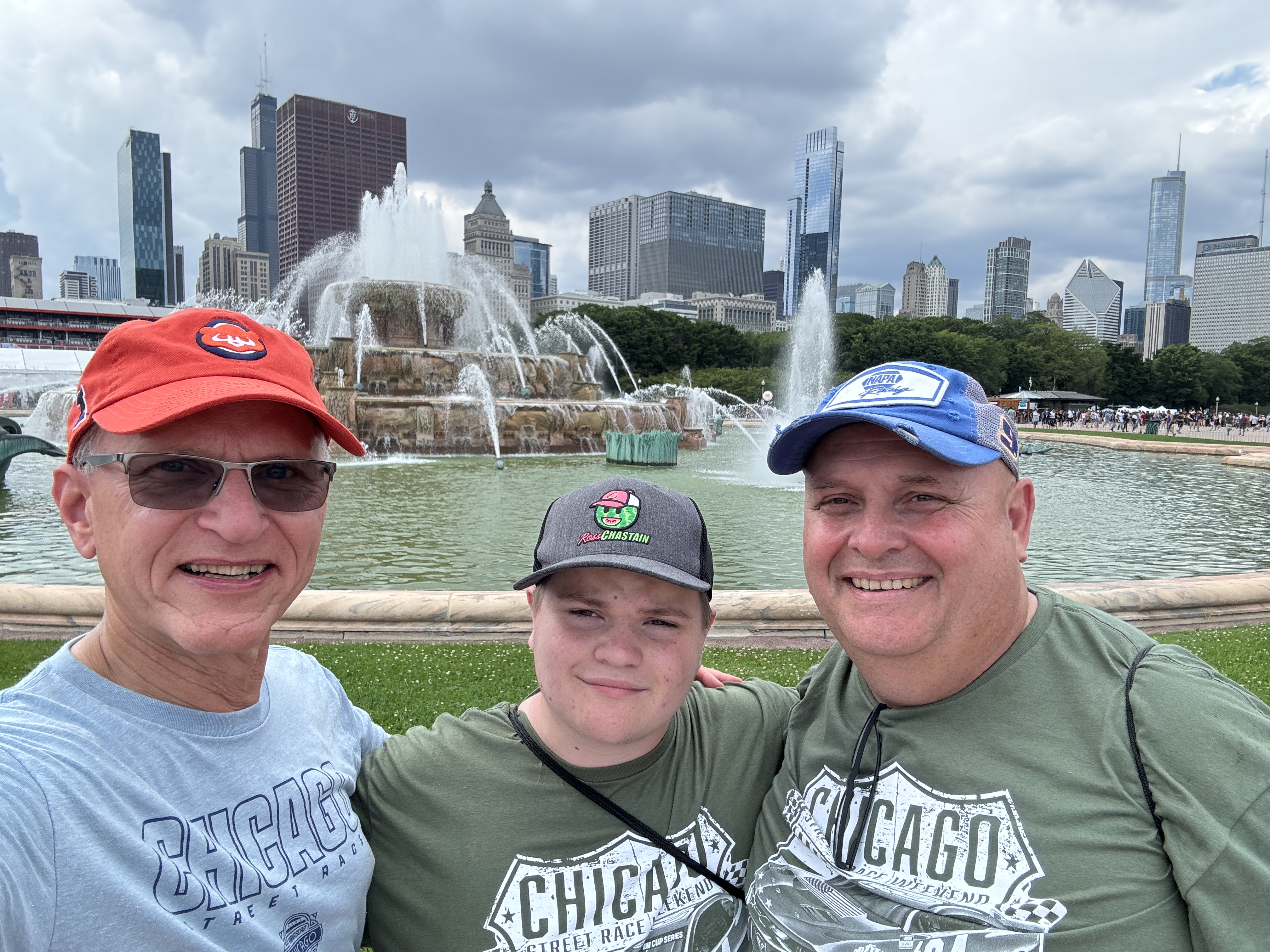
Douglas Yeo and Cody and Phil Spotts, Buckingham Fountain, Chicago, July 7, 2024

In the center of Chicago’s Grant Park is the Buckingham Fountain. It was a centerpiece of our race days, its fountains providing soft mist to cool off on hot days.

Doug_Cody_Phil_on_the_track_NASCAR_2024

Douglas Yeo and Cody and Phil Spotts, on the NASCAR Chicago Street Race track, E. Balbo Drive, Chicago, July 7, 2024. Note the temporary bridge over E. Balbo Drive.

Once we got in the Park, we had an opportunity to walk ON THE TRACK. This was another thrill, to get up close to the view the drivers had.

Doug_wet_NASCAR_Sunday_2024

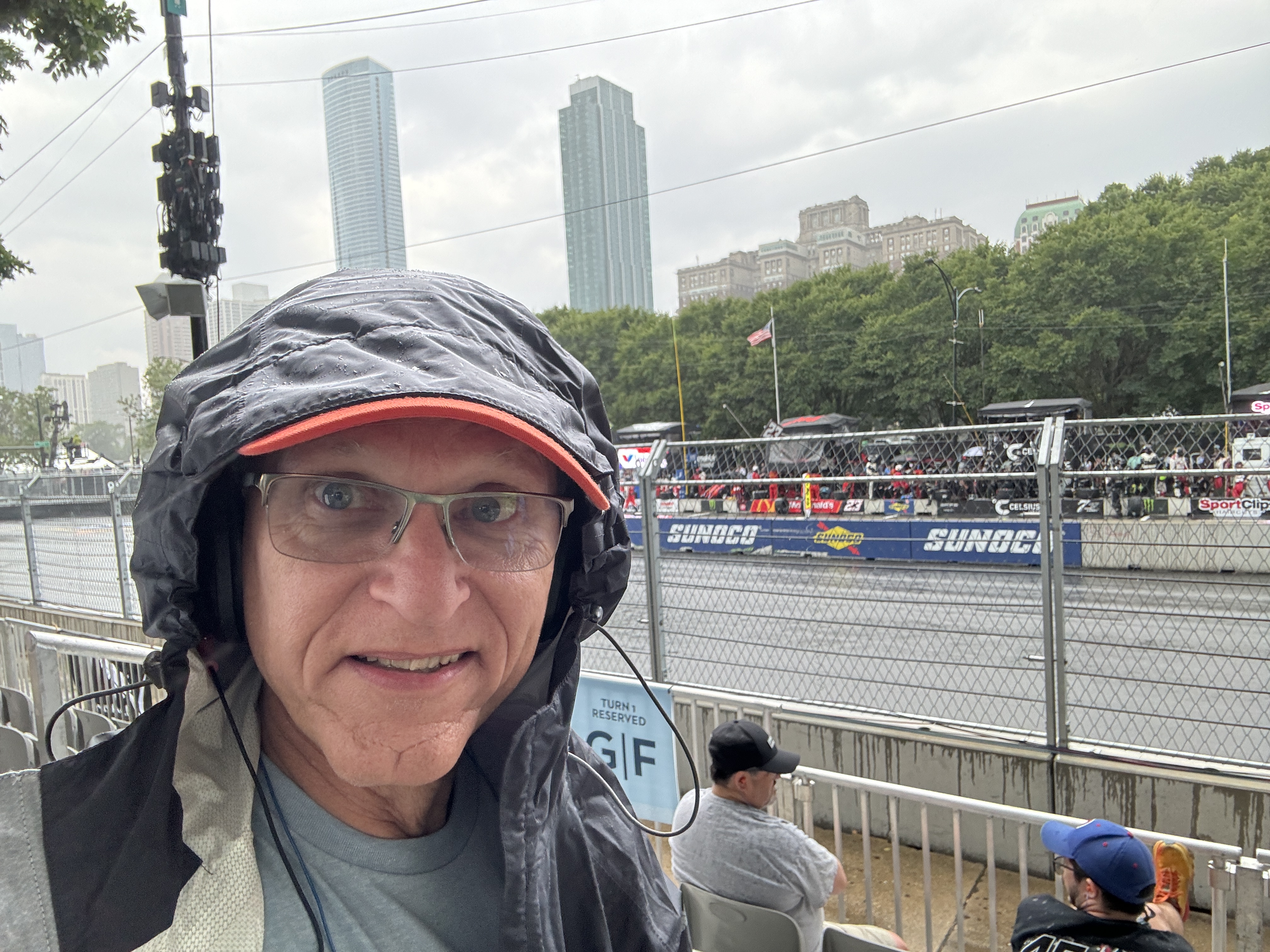
Douglas Yeo in the rain, NASCAR Chicago Street Race, July 7, 2024

While the day—and the race—started off with beautiful sunshine, we knew that rain was in the forecast. And the rain came. It sprinkled. Then it cleared up. Then the skies opened up and it poured. And poured, and poured.

Doug_Cody_Phil_rain_delay_NASCAR_2024

Douglas Yeo and Cody and Phil Spotts during the NASCAR race delay, July 7, 2024

The race continued for awhile in the rain but when it simply got too wet for drivers to race safely, we found ourselves in a rain delay of nearly two hours. We hung out at a picnic table in the Turn 1 Club, under an umbrella. The rain didn’t dampen our spirits. We were still having a great time, grazing on food and drink nonstop, enjoying conversations, talking about the race, the cars, and the drivers. When confronted with a situation you can’t control, you make the best of the situation. As teachers at our grandchildren’s elementary school frequently say, “You got what you get and you don’t throw a fit.” The rain didn’t matter. A lot of fans left but we stayed to watch the race start up, shortened because it was getting dark. Once again, it was a thrill to see the drivers cautiously—at over 100 miles per hour!—navigate the slick race course.

NASCAR_2024_Sunday_race_view

Alex Bowman (48 car) after crossing the finish line at the Grant Park 165 NASCAR Cup Series Race, Chicago, July 7, 2024

The race was won by Alex Bowman in his 48 car, and as he crossed the finish line, the rain stopped, the sun started to come out from behind the clouds even as it was setting, and we finished our days of enjoying racing in downtown Chicago. Click here to view the race on Youtube.

Doug_Cody_Phil_Buckingham_Fountain_NASCAR_2024

Douglas Yeo and Cody and Phil Spotts, Buckingham Fountain, Chicago, July 7, 2024

As we exited Grant Park, we passed by Buckingham Fountain one more time. Its fountains had been turned off for the night but I don’t think I’ve ever seen it look more beautiful than in the twilight of that Sunday night after the race.

Doug_Cody_Phil_Sears_Tower_2024_circle

Douglas Yeo and Cody and Phil Spotts atop the Sears Tower (AKA Willis Tower), Chicago, July 8, 2024. The red circle shows where we sat for the NASCAR Street Race.

We headed home again but our time together was not over. Cody wanted to do something he had never done before: go up a seriously tall building. So we took the train back to Chicago on Monday morning and visited the Sears Tower. From the observation deck, we looked down on the race course. In the photo above, you can see where our seats were in the red circle I drew between Cody and Phil. And yes, I’m wearing a Shane Van Gisbergen t-shirt. I’m a fan.

Cody_Phil_Sears_Tower_Ledge

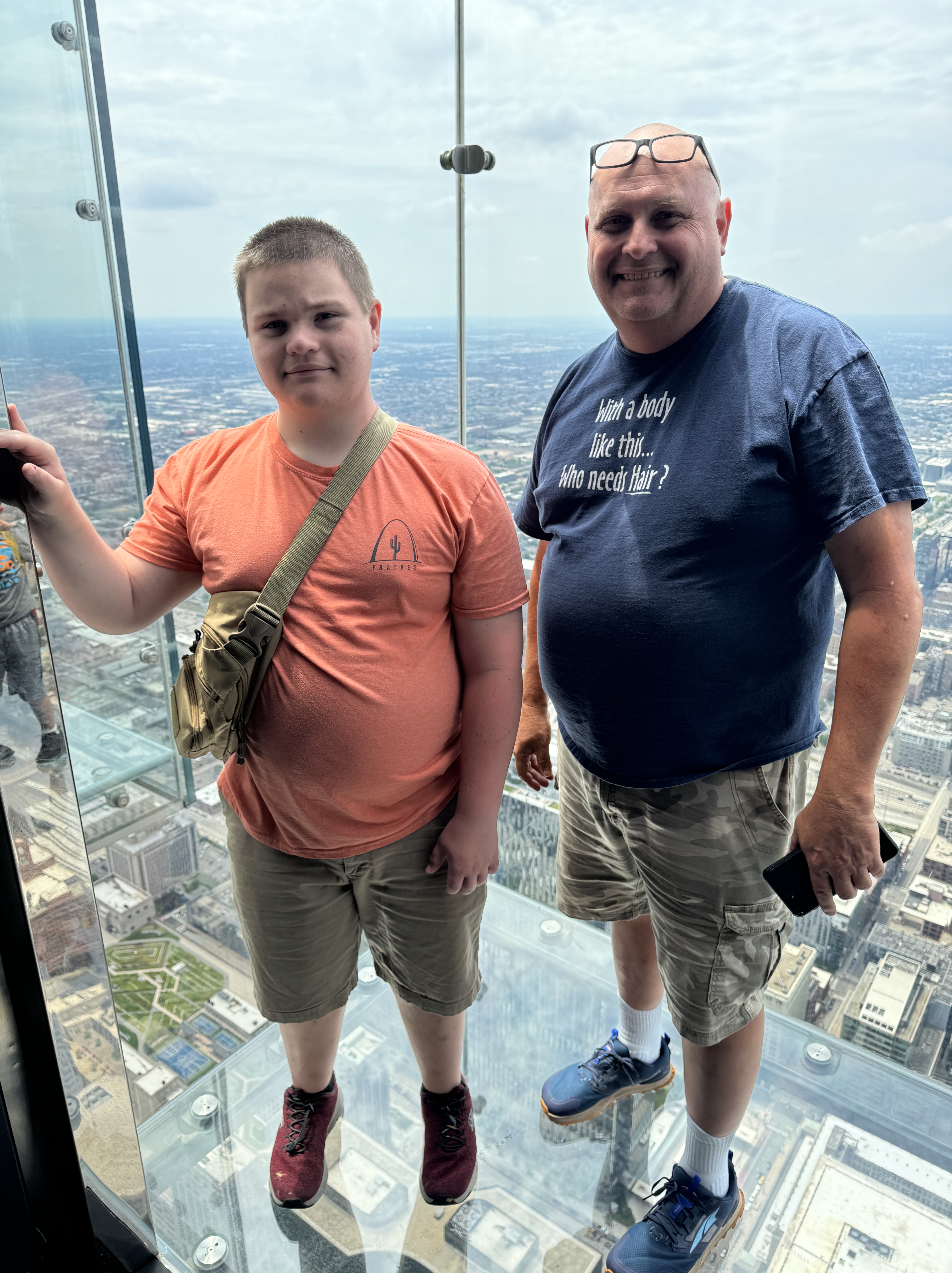
Cody and Phil Spotts on “The Ledge,” Sears Tower (AKA Willis Tower), Chicago, July 8, 2024.

But there was a limit to what I would do. While Cody and Phil happily—and fearlessly—walked out on the Sears Tower’s “The Ledge”—looking straight down 103 floors through glass to the street below—I was happy to be their official photographer, my feet firmly planted on the carpeted floor.

Doug_Cody_trombone_2024\

Douglas Yeo and Cody Spotts, July 8, 2024

When we got back to our house after yet another train ride (Pat had prepared a delicious dinner; as good as the food was at the race, it was nice to be home and have Pat’s wonderful home cooking), Cody and I played trombone duets. I’d never heard Cody play trombone before and it was so great spend some time together with trombones in our hands. The thing that solidified Cody’s and my friendship—the trombone—was shared in a memorable, tangible way.

This is friendship. Being together, talking together, sharing together, enjoying experiences together. Saying “Yes” when a friend asks you to do something you can’t imagine yourself doing. And then appreciating how they stretched you. And saying—and showing—”thank you” when someone gives you a gift—and Phil and Cody gave me a remarkable gift. Not just tickets to a race weekend, but a shared brotherhood that started with our shared faith in Christ. The three of us know and truly understand what the Apostle Paul meant when he wrote, “Therefore encourage one another and build one another up, just as you are doing.” (1 Thessalonians 5:11) Though separated by distance, when Cody asked to come to the Chicago Street Race with his dad and enjoy it with me, we picked up our relationship like we were next door neighbors who had never been apart. That is friendship.

Before I went to the NASCAR Chicago Street Race weekend I did not know what to expect. These friends taught me a lot. We shared something that has bound us together in a new way, and I will treasure the memory. Just as I treasure our friendship. Thank you, friends.

NASCAR_2024_wristbands_program

Official program and my wristbands for the 2024 NASCAR Chicago Street Race Weekend, July 6-7, 2024

Trombone professor search: University of Illinois

Trombone professor search: University of Illinois

by Douglas Yeo (October 6, 2023)

Readers of The Last Trombone know that I have been serving as the trombone professor at University of Illinois Urbana-Champaign (UIUC) since summer 2022. In May of last year, the University’s former trombone professor abruptly announced he was retiring and I agreed to fill in for a year while the UIUC School of Music conducted a search for a new full-time trombone professor. Unfortunately, that search was not successful, and I have come back for another year (2023–2024) while another search is mounted. That new search has just been announced—the chair of the trombone professor position search is Dr. Kevin Geraldi, Director of Bands at UIUC; he is also a trombonist—and details about the position and how to apply may be found HERE. The job description is also found below in this article, and I’d like to encourage readers of The Last Trombone to pass on this information to anyone they know who might be interested in applying to be the next professor of trombone at UIUC. The deadline for applications is November 8—a month from now—and the position begins on August 16, 2024.

Since I arrived at University of Illinois, I have been working to develop a vibrant esprit de corps among my students, and a big part of that has been the reinvigoration of the transformative legacy of Dr. Robert E. Gray (1926–2008) who was trombone professor at UIUC from 1955–1991. Dr. Gray, who also served as President of the International Trombone Association from 1984–1986, was a remarkable person and teacher whose work continues to be remembered today by the many students, faculty members, and other individuals whose lives intersected with his. Dr. Gray was interested in much more than teaching trombone; he was interested in the education of the whole student. His teaching philosophy resonates with my own and his legacy is an important part of what we are about in the UIUC Trombone Studio.

Robert_Gray_ITAJ_Winter_1992-1_cover

The cover of the Winter 1992 International Trombone Association Journal, featuring a photograph of Dr. Robert E. Gray

I’ve installed a large poster on a wall in my studio at University of Illinois and my students face it as they have their weekly lessons with me. It features our fantastic UIUC Trombone Studio logo that my friend, Lennie Peterson (who also illustrated my newest book, An Illustrated Dictionary for the Modern Trombone, Tuba, and Euphonium Player) designed for me (I’ve had t-shirts and stickers with the logo made up for our trombone students). The poster also includes the five core principles of my teaching, and it has an inspiring quotation from Robert E. Gray that I have adopted in my work as a teacher. This is the artistic, musical, teaching, and learning ethos that the next trombone professor at University of Illinois will occupy.

University_Illinois_trombone_studio_Yeo_poster

Another look at the culture I have established at University of Illinois can be found in my trombone studio syllabus. Click HERE to view and download a copy of my Fall 2023 trombone syllabus. Of course, our new trombone teacher will create their own syllabus with their own goals and requirements, but this is where our UIUC trombone studio is today. More than simply listing the requirements for taking trombone lessons, my syllabus speaks into the what and why of what we are doing. It is thrilling for me to be part of this vibrant campus community at this time and I look forward to handing the UIUC trombone studio to our next full-time trombone professor. UIUC—the flagship University of the State of Illinois—has a large, beautiful campus, a diverse student body and faculty, and everything that comes with being part of the Big 10 athletic conference, including UIUC’s outstanding marching band, the Marching Illini

We are moving quickly to fill this position. We would like to have someone hired and an announcement of that hire happen as soon as possible so the announcement of our new trombone professor can impact our upcoming recruiting and admissions cycle for fall 2024. Our students—and I—are looking forward to this search process. This is a tremendous opportunity for the right person, and for our students.

Is this position for you? Or someone you know? Let us know, and GO ILLINI!

Univ_Illinois_Alma_Mater_Laredo_Taft

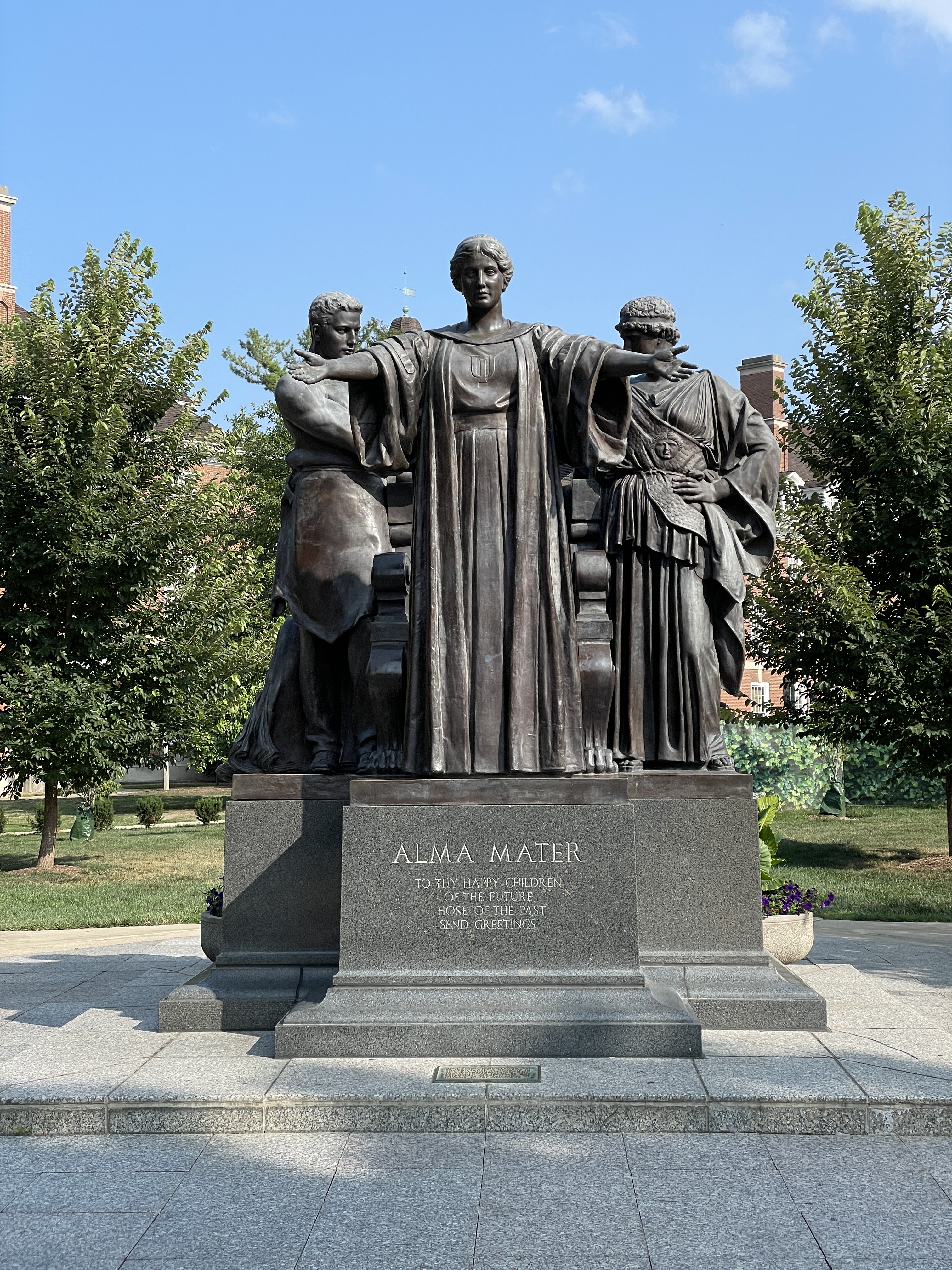
The statue of Alma Mater by Laredo Taft, on the campus of University of Illinois Urbana-Champaign

• • •

Clinical Assistant/Associate/Full Professor of Trombone

University of Illinois Urbana-Champaign
College of Fine and Applied Arts
School of Music

Located on the campus of one of the world’s leading research universities, the University of Illinois School of Music is a center for creativity and collaboration through performance, research, and education. Hosting a diverse population of faculty, students, and staff, the School of Music embraces cutting-edge innovation and discovery while providing an array of musical and engagement opportunities within the artistic and educational communities of Urbana and Champaign. 

The UIUC School of Music invites applications for a one-year, full-time, open rank, non-tenure-track position for Clinical Assistant/Associate/Full Professor of Trombone. Appointments will be for the 2024-25 academic year and begin August 16, 2024. Renewal of the appointment is possible and contingent on availability of funding, sufficient enrollments, and positive performance reviews. Salary is commensurate with experience.  

Responsibilities:

We seek a dynamic, effective, and engaging artist-teacher with a record of high-level performances to teach undergraduate and graduate trombone students in all degree and diploma programs. This includes weekly lessons for each student, a weekly trombone studio class, and graduate-level trombone literature and pedagogy classes. Additional teaching responsibilities will be based on the secondary area(s) of expertise. Successful candidates will pursue an active recruiting program that includes building relationships with schools and private teachers statewide, other universities, and national/international organizations.

Other responsibilities include working collaboratively with faculty and staff across the School to expand engagement opportunities in Illinois school systems and to nurture young performers and assist with School recruiting efforts. Active participation in all events and programs where the visibility of the University of Illinois faculty can serve as an asset for recruiting and/or student success and morale is expected. Service responsibilities include committee work and other activities that benefit the School and its students. Evidence of success in teaching, recruiting, and service is required for possible renewal of this appointment.

All employees of the School of Music are also expected to embrace the following core ideals:

  • Demonstrate a commitment to building and sustaining a diverse, equitable, and inclusive environment, one that reflects the entire State of Illinois.
  • Support the University of Illinois’ dedication to being a community of care.
  • Demonstrate a commitment to student success and well-being through both teaching excellence and broader mentorship.
  • Seek out opportunities for collaboration with colleagues both on and off campus, and both within and across disciplines.
  • View recruiting and retention, particularly of members of underserved communities, as fundamental to the position and to the School’s success.
  • Work as a cooperative member of the School’s community and serve as a model of integrity and collegiality.
  • Exhibit passion for your work, the School, and the role of music in our society.

Required Qualifications: 

  • Artist/Teacher with an emerging or established national reputation as a performer and pedagogue.
  • Successful teaching experience at the university level. 
  • Knowledge of pathways by which students discover the instrument and demonstrated experience attracting, recruiting, and retaining undergraduate and graduate students, particularly those from underrepresented populations.
  • Evidence of clearly defined secondary area(s) of expertise, such as music entrepreneurship, improvisation, intercultural collaboration, community engagement, pedagogy, musicianship, chamber music, health and wellness, and/or orchestra and/or wind band repertoire courses.
  • History of engagement with diverse audiences, collaborators, knowledges, and traditions with respect to race, gender, and class.
  • History of engagement with works by BIPOC, LGBTQ+, and women composers, including new pieces from living composers.
  • Experience performing and/or teaching multiple musical styles, including those other than classical traditions.
  • Master’s degree in music or commensurate experience. 

Preferred Qualifications: 

  • Orchestral and/or professional wind band experience.
  • Chamber coaching experience.
  • Classroom teaching experience at the university level.
  • Demonstrated record of student placement and success.
  • Facility with new technologies and platforms for recording, creating, and distributing music.
  • Evidence of an innovative research profile that engages with diverse audiences.
  • Doctoral degree in music.

Application Procedures & Deadline Information:

Applications must be received by 6:00 pm (CST) on November 8, 2023. Apply for this position using the Apply Now button at the top or bottom of this posting. Applications not submitted through https://jobs.illinois.edu will not be considered. Initial screening of applications will begin immediately, and interviews may be conducted prior to the close of the search. However, no hiring decision will be made until after the close of the search.

Application materials should include: 

  • Letter of interest, including a section that provides hyperlinks or URLs for online audio or audio/video files of recent live or recorded performances.
  • Curriculum Vitae.
  • Diversity and inclusion statement, including relevant experience reaching underserved communities and vision for the social role of music in the 21st century
  • Names and contact information of three references.

Please direct any questions to Associate Professor Kevin Geraldi, Search Committee Chair (kgeraldi@illinois.edu) or Jennifer Steiling, Sr. Human Resource Associate (steiling@uillinois.edu). Women, racial and ethnic minorities, individuals with disabilities, and veterans are encouraged to apply. 

For questions regarding the application process, please contact 217-333-2137.


The University of Illinois System is an equal opportunity employer, including but not limited to disability and/or veteran status, and complies with all applicable state and federal employment mandates. Please visit Required Employment Notices and Posters to view our non-discrimination statement and find additional information about required background checks, sexual harassment/misconduct disclosures, COVID-19 vaccination requirement, and employment eligibility review through E-Verify.

Applicants with disabilities are encouraged to apply and may request a reasonable accommodation under the Americans with Disabilities Act (2008) to complete the application and/or interview process. Requests may be submitted through the reasonable accommodations portal, or by contacting the Accessibility & Accommodations Division of the Office for Access and Equity at 217-333-0885, or by emailing accessibility@illinois.edu.