Category: Uncategorized

Trombone professor search: University of Illinois

Trombone professor search: University of Illinois

by Douglas Yeo (October 6, 2023)

Readers of The Last Trombone know that I have been serving as the trombone professor at University of Illinois Urbana-Champaign (UIUC) since summer 2022. In May of last year, the University’s former trombone professor abruptly announced he was retiring and I agreed to fill in for a year while the UIUC School of Music conducted a search for a new full-time trombone professor. Unfortunately, that search was not successful, and I have come back for another year (2023–2024) while another search is mounted. That new search has just been announced—the chair of the trombone professor position search is Dr. Kevin Geraldi, Director of Bands at UIUC; he is also a trombonist—and details about the position and how to apply may be found HERE. The job description is also found below in this article, and I’d like to encourage readers of The Last Trombone to pass on this information to anyone they know who might be interested in applying to be the next professor of trombone at UIUC. The deadline for applications is November 8—a month from now—and the position begins on August 16, 2024.

Since I arrived at University of Illinois, I have been working to develop a vibrant esprit de corps among my students, and a big part of that has been the reinvigoration of the transformative legacy of Dr. Robert E. Gray (1926–2008) who was trombone professor at UIUC from 1955–1991. Dr. Gray, who also served as President of the International Trombone Association from 1984–1986, was a remarkable person and teacher whose work continues to be remembered today by the many students, faculty members, and other individuals whose lives intersected with his. Dr. Gray was interested in much more than teaching trombone; he was interested in the education of the whole student. His teaching philosophy resonates with my own and his legacy is an important part of what we are about in the UIUC Trombone Studio.

Robert_Gray_ITAJ_Winter_1992-1_cover

The cover of the Winter 1992 International Trombone Association Journal, featuring a photograph of Dr. Robert E. Gray

I’ve installed a large poster on a wall in my studio at University of Illinois and my students face it as they have their weekly lessons with me. It features our fantastic UIUC Trombone Studio logo that my friend, Lennie Peterson (who also illustrated my newest book, An Illustrated Dictionary for the Modern Trombone, Tuba, and Euphonium Player) designed for me (I’ve had t-shirts and stickers with the logo made up for our trombone students). The poster also includes the five core principles of my teaching, and it has an inspiring quotation from Robert E. Gray that I have adopted in my work as a teacher. This is the artistic, musical, teaching, and learning ethos that the next trombone professor at University of Illinois will occupy.

University_Illinois_trombone_studio_Yeo_poster

Another look at the culture I have established at University of Illinois can be found in my trombone studio syllabus. Click HERE to view and download a copy of my Fall 2023 trombone syllabus. Of course, our new trombone teacher will create their own syllabus with their own goals and requirements, but this is where our UIUC trombone studio is today. More than simply listing the requirements for taking trombone lessons, my syllabus speaks into the what and why of what we are doing. It is thrilling for me to be part of this vibrant campus community at this time and I look forward to handing the UIUC trombone studio to our next full-time trombone professor. UIUC—the flagship University of the State of Illinois—has a large, beautiful campus, a diverse student body and faculty, and everything that comes with being part of the Big 10 athletic conference, including UIUC’s outstanding marching band, the Marching Illini

We are moving quickly to fill this position. We would like to have someone hired and an announcement of that hire happen as soon as possible so the announcement of our new trombone professor can impact our upcoming recruiting and admissions cycle for fall 2024. Our students—and I—are looking forward to this search process. This is a tremendous opportunity for the right person, and for our students.

Is this position for you? Or someone you know? Let us know, and GO ILLINI!
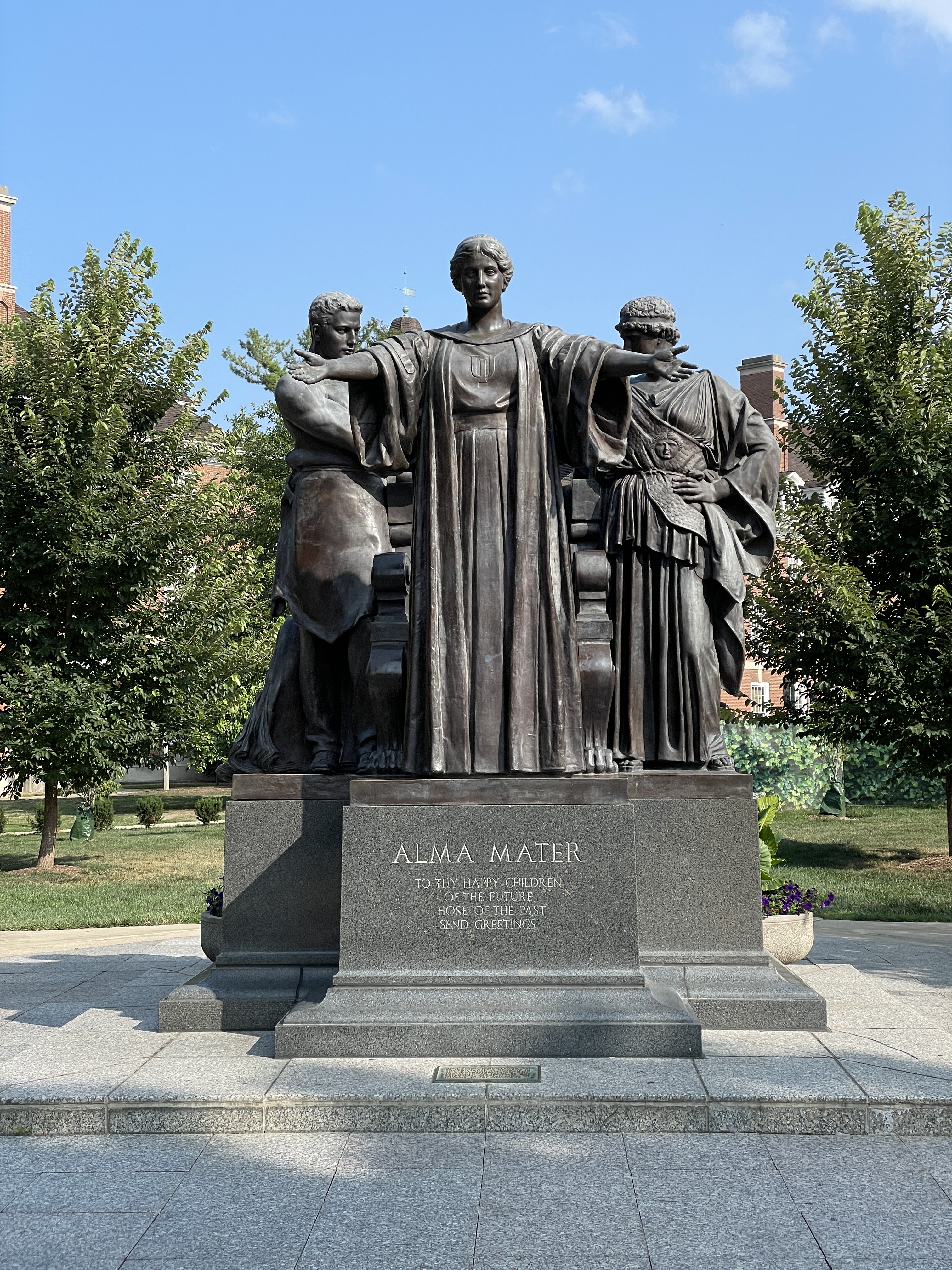
Univ_Illinois_Alma_Mater_Laredo_Taft

The statue of Alma Mater by Laredo Taft, on the campus of University of Illinois Urbana-Champaign

• • •

Clinical Assistant/Associate/Full Professor of Trombone

University of Illinois Urbana-Champaign
College of Fine and Applied Arts
School of Music

Located on the campus of one of the world’s leading research universities, the University of Illinois School of Music is a center for creativity and collaboration through performance, research, and education. Hosting a diverse population of faculty, students, and staff, the School of Music embraces cutting-edge innovation and discovery while providing an array of musical and engagement opportunities within the artistic and educational communities of Urbana and Champaign. 

The UIUC School of Music invites applications for a one-year, full-time, open rank, non-tenure-track position for Clinical Assistant/Associate/Full Professor of Trombone. Appointments will be for the 2024-25 academic year and begin August 16, 2024. Renewal of the appointment is possible and contingent on availability of funding, sufficient enrollments, and positive performance reviews. Salary is commensurate with experience.  

Responsibilities:

We seek a dynamic, effective, and engaging artist-teacher with a record of high-level performances to teach undergraduate and graduate trombone students in all degree and diploma programs. This includes weekly lessons for each student, a weekly trombone studio class, and graduate-level trombone literature and pedagogy classes. Additional teaching responsibilities will be based on the secondary area(s) of expertise. Successful candidates will pursue an active recruiting program that includes building relationships with schools and private teachers statewide, other universities, and national/international organizations.

Other responsibilities include working collaboratively with faculty and staff across the School to expand engagement opportunities in Illinois school systems and to nurture young performers and assist with School recruiting efforts. Active participation in all events and programs where the visibility of the University of Illinois faculty can serve as an asset for recruiting and/or student success and morale is expected. Service responsibilities include committee work and other activities that benefit the School and its students. Evidence of success in teaching, recruiting, and service is required for possible renewal of this appointment.

All employees of the School of Music are also expected to embrace the following core ideals:

  • Demonstrate a commitment to building and sustaining a diverse, equitable, and inclusive environment, one that reflects the entire State of Illinois.
  • Support the University of Illinois’ dedication to being a community of care.
  • Demonstrate a commitment to student success and well-being through both teaching excellence and broader mentorship.
  • Seek out opportunities for collaboration with colleagues both on and off campus, and both within and across disciplines.
  • View recruiting and retention, particularly of members of underserved communities, as fundamental to the position and to the School’s success.
  • Work as a cooperative member of the School’s community and serve as a model of integrity and collegiality.
  • Exhibit passion for your work, the School, and the role of music in our society.

Required Qualifications: 

  • Artist/Teacher with an emerging or established national reputation as a performer and pedagogue.
  • Successful teaching experience at the university level. 
  • Knowledge of pathways by which students discover the instrument and demonstrated experience attracting, recruiting, and retaining undergraduate and graduate students, particularly those from underrepresented populations.
  • Evidence of clearly defined secondary area(s) of expertise, such as music entrepreneurship, improvisation, intercultural collaboration, community engagement, pedagogy, musicianship, chamber music, health and wellness, and/or orchestra and/or wind band repertoire courses.
  • History of engagement with diverse audiences, collaborators, knowledges, and traditions with respect to race, gender, and class.
  • History of engagement with works by BIPOC, LGBTQ+, and women composers, including new pieces from living composers.
  • Experience performing and/or teaching multiple musical styles, including those other than classical traditions.
  • Master’s degree in music or commensurate experience. 

Preferred Qualifications: 

  • Orchestral and/or professional wind band experience.
  • Chamber coaching experience.
  • Classroom teaching experience at the university level.
  • Demonstrated record of student placement and success.
  • Facility with new technologies and platforms for recording, creating, and distributing music.
  • Evidence of an innovative research profile that engages with diverse audiences.
  • Doctoral degree in music.

Application Procedures & Deadline Information:

Applications must be received by 6:00 pm (CST) on November 8, 2023. Apply for this position using the Apply Now button at the top or bottom of this posting. Applications not submitted through https://jobs.illinois.edu will not be considered. Initial screening of applications will begin immediately, and interviews may be conducted prior to the close of the search. However, no hiring decision will be made until after the close of the search.

Application materials should include: 

  • Letter of interest, including a section that provides hyperlinks or URLs for online audio or audio/video files of recent live or recorded performances.
  • Curriculum Vitae.
  • Diversity and inclusion statement, including relevant experience reaching underserved communities and vision for the social role of music in the 21st century
  • Names and contact information of three references.

Please direct any questions to Associate Professor Kevin Geraldi, Search Committee Chair (kgeraldi@illinois.edu) or Jennifer Steiling, Sr. Human Resource Associate (steiling@uillinois.edu). Women, racial and ethnic minorities, individuals with disabilities, and veterans are encouraged to apply. 

For questions regarding the application process, please contact 217-333-2137.


The University of Illinois System is an equal opportunity employer, including but not limited to disability and/or veteran status, and complies with all applicable state and federal employment mandates. Please visit Required Employment Notices and Posters to view our non-discrimination statement and find additional information about required background checks, sexual harassment/misconduct disclosures, COVID-19 vaccination requirement, and employment eligibility review through E-Verify.

Applicants with disabilities are encouraged to apply and may request a reasonable accommodation under the Americans with Disabilities Act (2008) to complete the application and/or interview process. Requests may be submitted through the reasonable accommodations portal, or by contacting the Accessibility & Accommodations Division of the Office for Access and Equity at 217-333-0885, or by emailing accessibility@illinois.edu.


Entering the tuba/euphonium universe: ITEC 2023

Entering the tuba/euphonium universe: ITEC 2023

by Douglas Yeo

I’ve been playing the trombone since 1964, when I was in fourth grade. For many years thereafter, trombone was the only wind instrument I played. OK, I played the flutophone for awhile in elementary school (and then during my freshman year in college when my roommate and I would jam regularly, he on piano and me on flutophone—trust me, you can improvise on it). But maybe that doesn’t count. When I got to Wheaton College, I began to branch out more seriously to other instruments. I minored in euphonium briefly when I was a student at Wheaton College from 1974–1976 before switching my minor instrument to percussion.  In 1988, for Boston Symphony Orchestra performances of Richard Strauss’ opera, Elektra, I picked up the bass trumpet for the first time and I ended up playing that instrument on a host of BSO performances of Stravinsky’s The Rite of Spring, Janacek’s Sinfonietta, excerpts from Wagner operas, and many other pieces. Over the years, contrabass trombone and bass sackbut in F were eventually added to my doubling lexicon.

I love playing those instruments, but in 1994, I began playing an instrument that truly changed my life: the serpent. It was by playing the serpent—an instrument invented in the late sixteenth century that found full flower in France accompanying the singing of chant in the Roman Catholic Church, and which later became a regular member of military bands, chamber music ensembles, and symphony orchestras until the invention of the ophicleide and eventually the tuba and euphonium—in performances with the Boston Symphony Orchestra of Hector Berlioz’s Messe solennelle in Boston, New York, and Tokyo, that I found another instrument (besides bass trombone) that truly changed the course of my musical life. I have played serpent (and ophicleide as well) in modern and period instrument orchestras, in chamber music groups, and as a solo instrument in recitals and orchestra concerts.

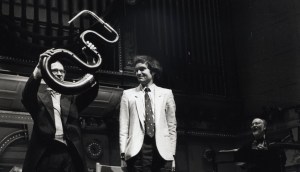
Douglas Yeo, composer Simon Proctor, and conductor John Williams, after a performance of Proctor’s Serpent Concerto with the Boston Pops Orchestra, John Williams, conductor, May 29, 1997

I also made a solo recording on serpent (Le monde du serpent), produced an instructional DVD about the instrument (Approaching the Serpent: An Historical and Pedagogical Overview), wrote a book about it (Serpents, Bass Horns, and Ophicleides at the Bate Collection), and I appear with a serpent in my hands on museum video and audio guides around the world. One of the things my serpentine exploits led me to was an intersection with the universe of tuba and euphonium players.

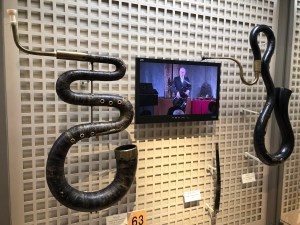
Display of serpents with video of Douglas Yeo, Hamamatsu (Japan) Museum of Musical Instruments, 2019

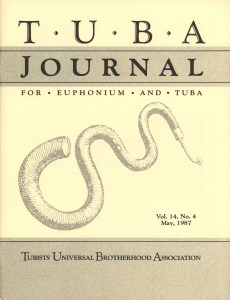
I’m sure many people have forgotten—or never knew—that the logo for the International Tuba Euphonium Association used to be a serpent. Back in the 1980s, when the organization operated under its previous name, Tubists Universal Brotherhood Association, or T.U.B.A. (the name was changed in 2000 to reflect a more inclusive view of women and euphonium players), a serpent figured prominently on the cover of its quarterly journal. Such as was the case on this cover, below, from the May 1987 issue where my article, Tuba Players of the Boston Symphony Orchestra, 1913–1987, was published. You can read that article by clicking HERE.

I’ll say more about the serpent in particular in a future article, but there is a reason for this excursus. Next week I’ll be traveling to Tempe, Arizona, to take part in the 50th International Tuba Euphonium Conference (ITEC), presented by the International Tuba Euphonium Association (ITEA), and hosted by my friend, Dr. Deanna Swoboda at Arizona State University. I’ve attended many International Trombone Festivals, and the Fourth Trombone and Tuba Festival in Beijing. But this is my first time at an ITEC event and as a result, I’m looking forward to entering the tuba/euphonium universe in a new way.

ITEC 2023 will feature the kinds of things brass players are accustomed to at these kinds of events. There will be competitions, solo and ensemble performances, lectures, masterclasses, panel discussions, group sight-reading sessions, exhibitors displaying the latest instruments and accessories, and plenty of time for attendees to hang out and talk shop. I’ll be presenting two programs at ITEC.

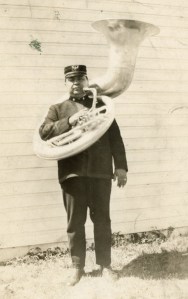
On Thursday, June 1, I’ll give a presentation about John M. “Chief Red Cloud” Kuhn, a Native American sousaphone player who played with the bands of Bohumir Kryl, Patrick Conway, and John Philip Sousa, then with the Isham Jones Orchestra, and then as a member of the NBC Radio Orchestra in Chicago. And these are only a few of the many groups he played with. Kuhn’s story is remarkable. Born a member of the Assiniboine Nation on the Fort Peck Indian Reservation in Poplar, Montana in 1882, he rose to become one of the most celebrated tuba players of the first half of the twentieth century. The story of this influential Native American is fascinating and my presentation will include information about Kuhn and photos that have never been seen before, thanks to the generosity of his granddaughter, Katherine Kuhn Rose, and his great-grandson, Kevin Leahy. They have shared photos and materials from the Kuhn family collection, and my presentation will appear as an article in the ITEA Journal sometime next year.

John Kuhn with John Philip Sousa’s Band, 1919. Photo courtesy Kuhn Family Collection.

Then, on Friday, June 2, I’ll give a recital of music that features serpent. I’ll be joined for two pieces—a partita by Johann Nepomuk Hummel (Partita in E-flat, 1803) and a divertimento attributed to Joseph Haydn (Divertimento in B-flat [Chorale St. Antoni], 1782/84—by a group of ASU faculty and students conducted by Jason Caslor and Jamal Duncan. I’ll also be joined by pianist Susan Wass for two pieces for serpent and piano by Clifford Bevan (Variations on “The Pesky Serpent,” 1996) and Thérèse Brenet (De bronze et de lumière (2008). Here’s a preview, a performance I gave of Cliff Bevan’s piece at a faculty recital I gave at Wheaton College in 2022:

If you’ve never heard a serpent before, ITEC 2023 is an opportunity to see it in action.

Information about ITEC 2023 can be found HERE on the ITEA website. It’s not too late to register. A schedule of activities can be found HERE. If you’re coming to Arizona State University for ITEC 2023, I look forward to seeing you there. Serpent and sousaphone—what’s not to like!

A change of plans and University of Illinois

A change of plans and University of Illinois

by Douglas Yeo

Regular readers of The Last Trombone may notice something is missing. A few weeks ago, I wrote an article for this blog, After 40 years of college teaching, the times they are a-changin’, in which I announced I was stepping away from institutional teaching. Ever since I served as director of bands at St. Thomas Aquinas High School in Edison, New Jersey (1979–1981), I’ve been a teacher in a host of educational institutions. From St. Thomas Aquinas I taught at Peabody Institute of Johns Hopkins University (1982–1985, during the time I was bass trombonist of the Baltimore Symphony Orchestra, 1981–1985), then New England Conservatory of Music (1985–2012, while, during that same time, I was bass trombonist of the Boston Symphony Orchestra), Arizona State University (2012–2016), Wheaton College (starting in 2019) and, for the 2022–2023 academic year, a one-year appointment at University of Illinois Urbana-Champaign. When the spring 2023 semester came to an end in the first week of May, I announced that I was putting down this over 40-year season of life in academia to turn my attention to other things, including writing several books I have under contract.

So it was that I packed up my belongings that occupied my offices in Wheaton and Urbana and brought them home. I received congratulatory messages, high-fives, some nice notes from several students, and even a farewell thank you gift and party. For a few days, I caught up reading back issues of The New Yorker and The Atlantic that had been piling up on my bookshelf, spent more time reading my Bible, visited my 91-year old mentor at his home in Idaho, and took a deep breath while I began mapping out my next steps.

Then something happened.

Over the last five months, University of Illinois had conducted a search for a new full time, tenure track trombone professor. I had been filling in at Illinois for a year between their previous trombone professor (who abruptly retired in May 2022) and when a new full-time professor would join the faculty. I greatly enjoyed my year at Illinois where I engaged with a studio of hard-working, talented students, collaborated with superb faculty colleagues, and was a part of the flagship university of the state of Illinois. I was not on the trombone professor search committee (since I was a not a permanent, full time faculty member myself; neither was I candidate for the full time position), but my students, colleagues, and I all assumed the search would be successful. As things turned out, it wasn’t. The search failed. It’s the outcome nobody ever wants in a search but sometimes it happens. So, Illinois will try again and mount a new search this fall in hopes of bringing a new trombone professor to campus in fall 2024. Watch The Last Trombone for the announcement of the search.

As this news sank in, my announced plans began to morph. Instead of thinking ahead, I thought back, to the students at Illinois with whom I worked last year and who had anticipated the beginning of a new era for trombone on campus this fall.

Together, we had worked hard to instill a new sense of esprit d’corps in the Illinois trombone studio. Among several things, I asked my friend, Lennie Peterson, to design a logo for our trombone studio, and, thanks to the contribution of a generous donor, we printed t-shirts and stickers to promote the work we were doing.

Univ_Illinois_Trombone_studio_logo_2022

A few months ago, when I learned that University of Illinois School of Music had given the Robert E. Gray Trombone Award to a deserving student each year since 1992, I delighted to be asked to choose this year’s recipient. I was honored to teach at Illinois last year in the footsteps of Dr. Robert Gray. His legacy is an important one. Gray studied trombone at Eastman School of Music—where he earned his masters and doctoral degrees—under Emory Remington; taught trombone at Illinois from 1955–1991; founded the University of Illinois wind ensemble; was president of the International Trombone Association from 1984–1986; was recipient of the ITA’s Neill Humfeld Award for Excellence in Teaching; and was choir director at First Presbyterian Church in Champaign. Robert Gray was interested in far more than simply teaching trombone students. He was interested in the education of the whole person, in serving people, in caring for them. I came across something he said that resonated deeply with me:

Take your time in your work. Don’t always push and do what is expedient. Develop an understanding of life and humanity in your degree work. It will make you a better person.

In this and so many other ways, Robert Gray and I share similar views of the role of a teacher. I was grateful to serve for a year in the very same position he occupied at University of Illinois for so long. I wanted to do something more to highlight his work and legacy, and pay forward—in a new way—the generous contributions made to the Robert E. Gray Trombone Award fund by so many of his former students, friends, and family members that made this award possible. Anyone who has ready my books and articles know that history is important to me, and I saw an opportunity to keep Robert Gray’s work in front of future members of the Illinois trombone studio. First, I installed a photo of Robert Gray in the trombone studio. This photo appeared on the cover of the Winter 1992 International Trombone Association Journal in which a tribute to Gray appeared on the occasion of his retirement from University of Illinois. I wanted current and future students to make a connection with this exceptional person.

Robert_Gray_ITAJ_Winter_1992-1_cover

The cover of the Winter 1992 International Trombone Association Journal, featuring a photograph of Dr. Robert E. Gray

Then, I made a donation to the University of Illinois School of Music to produce a plaque to hang in the Illinois trombone studio, a plaque with the names of all of the past recipients of the Robert E. Gray Trombone Award—with room to engrave the names of future recipients. My donation also provides for a Robert E. Gray Trombone Award medal that is now given to recipients (in addition to the financial award the Gray Award fund generates each year) who can wear it at graduation and then have as a keepsake and ongoing reminder of their connection to Robert Gray and the Illinois Trombone Studio.

The 2022-2023 recipient of the Robert E. Gray Trombone Award was Poorna Kumar, a sophomore at University of Illinois who is double majoring in community health and trombone performance. Poorna is also a drum major with the University of Illinois Marching Illini, and while maintaining a 4.0 grade point average, plays in many musical ensembles in the Illinois School of Music. She is a most worthy recipient of the Gray Award; she embodies Robert Gray’s ideals of excellence and service.

Poorna_Kumar_2022-2023_Robert_Gray_Trombone_Award

Poorna Kumar, recipient of the 2022–2023 Robert E. Gray Trombone Award. University of Illinois Trombone Studio, May 4, 2023.

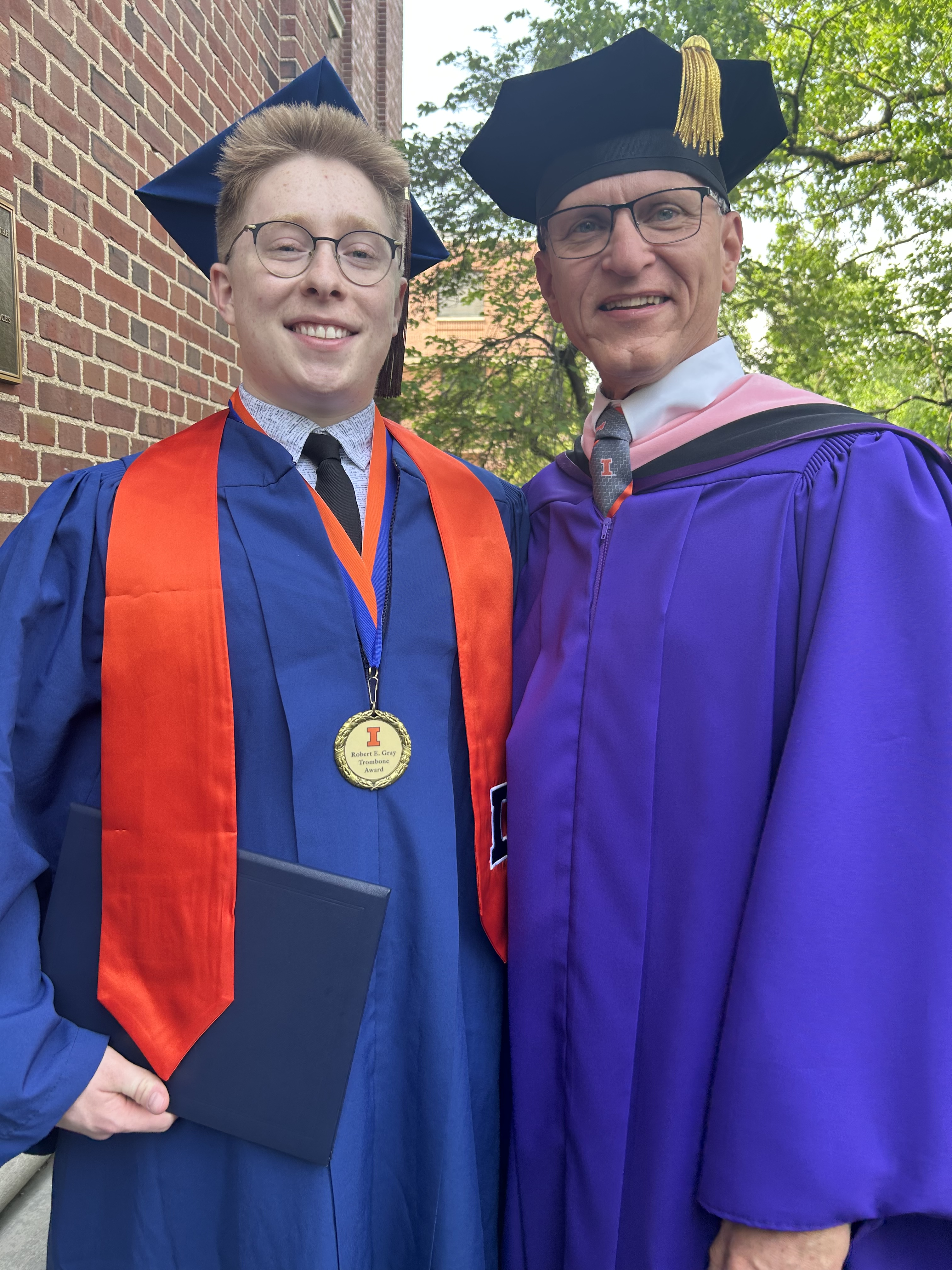
Two previous recipients of the Robert E. Gray Trombone Award were also among my students at Illinois in 2022-2023. Charlie Hall, a senior, received the award in 2020–2021, and Jerry Min, a junior,  received it in 2021–2022. Since we worked together at Illinois last year, I wanted them to have Gray Award medals as well. Earlier this month, Charlie was the first student to wear his Gray Award medal at a University of Illinois graduation ceremony.

Yeo_Charlie_Hall_UIUC_May_2023_2

Charlie Hall and Douglas Yeo, University of Illinois School of Music Convocation, May 14, 2023.

This was what I was leaving at Illinois—a vibrant educational community with students who were making a difference. I looked forward to handing off the Illinois trombone studio to a new full time professor but when the search failed, I thought of the students who would have another one-year appointee as their trombone professor. That didn’t sit right with me—some of them would then have a different trombone professor for every year of their time at University of Illinois—and after a lot of thought and prayer, I offered to return to Illinois for another year if the School of Music was interested in having me back, to provide continuity to the program as they mount another search for a new professor who will build and grow the trombone studio as Robert Gray did for so long. My offer was accepted and I’ll be returning to campus in Urbana in August for another year. With having made some other changes in my regular commitments, I’ll still have time to work on those books and other projects, too. But it seems good and right to invest in these students for one more year. And I deleted my previous blog post about stepping away from teaching. I had a change of plans.

When evaluating goals, aspirations, and dreams, I always encourage my students to hold them with a loose grip. Yes, one’s grip needs to be tight enough to invest deeply in things so you know if they are truly desirable, realistic, and achievable. But our grip should be loose enough that something else can be put into your hand, something you hadn’t thought about. A few weeks ago, completely leaving institutional teaching seemed the right thing for me to do. As it turned out, it was—until it wasn’t. Something else got put in my hand that I didn’t expect. Sometimes we are tested in our willingness to let things go, only to find that there is yet more to be done even if we think a certain work is finished. That openness to flexibility has me heading back to University of Illinois for another year of teaching trombone lessons, teaching trombone literature and trombone pedagogy, leading trombone choir, and advising students on their college and career path—and, like Robert Gray, on the path of life. I’m back.

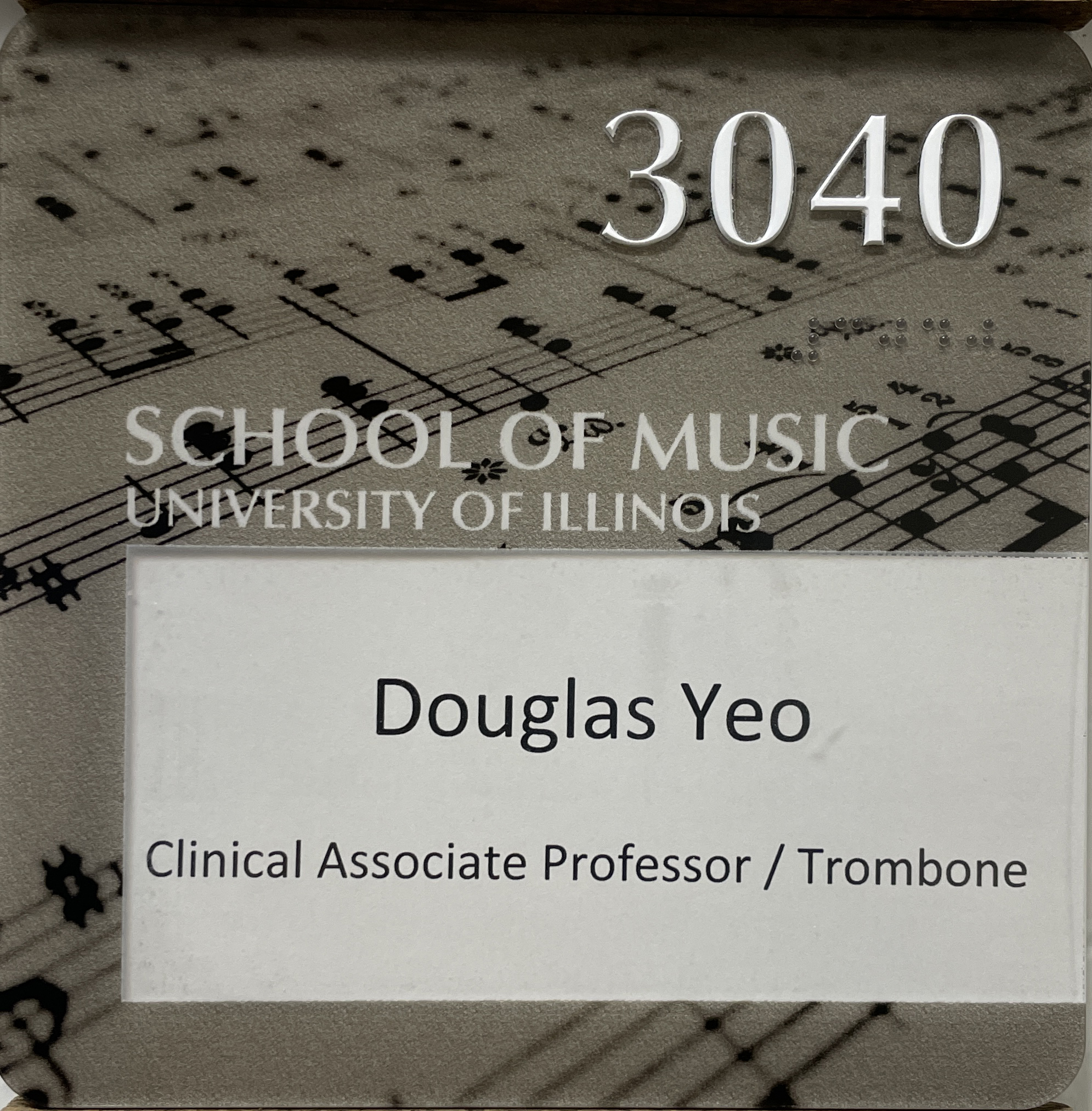
MB3040_UIUC

The sign outside of the University of Illinois Trombone Studio, Music Building 3040

Stay disciplined: a lesson from Super Bowl XLIX

Stay disciplined: a lesson from Super Bowl XLIX

By Douglas Yeo (February 8, 2023)

Readers of The Last Trombone know that I am a football fan. My wife and I are season ticket holders to Chicago Bears football. When we lived in Arizona from 2012-2018 after my retirement from the Boston Symphony Orchestra, we had season tickets to Arizona Cardinals and Arizona State University football. And during my long career in Boston, we attended many New England Patriots games. Football is a big part of our lives.

The Super Bowl is the culmination of the National Football League season and this Sunday, February 12, 2023, millions of people around the world will tune in to watch Super Bowl LVII between the Kansas City Chiefs and Philadelphia Eagles. We’ll be watching, too.

Incredibly, I have attended three Super Bowls. In 2002, I attended Super Bowl XXXVI in New Orleans. The Boston Pops Orchestra was engaged to play the pre-game show and national anthem for the game—this was the first Super Bowl after the 9/11 attacks so the game’s halftime theme was changed from a New Orleans Mardis Gras them to a patriotic theme. Hence the Boston Pops, “America’s Orchestra,” performed at the game. Patriots owner Robert Kraft gave each member of the orchestra a ticket and we were all thrilled to see our team win the game against the St. Louis Rams. I wrote about that unforgettable experience on my website HERE.

In 2020, I attended Super Bowl LIV in Miami. I won a contest sponsored by the Chicago Bears—it was an essay contest and in 100 words, I had to answer the question, “Who would you take to the Super Bowl and why?”—and my son-in-law, Chad, and I had an unforgettable time together at the game, where the Kansas City Chiefs defeated the San Francisco 49ers. I wrote about THAT unforgettable experience on The Last Trombone HERE.

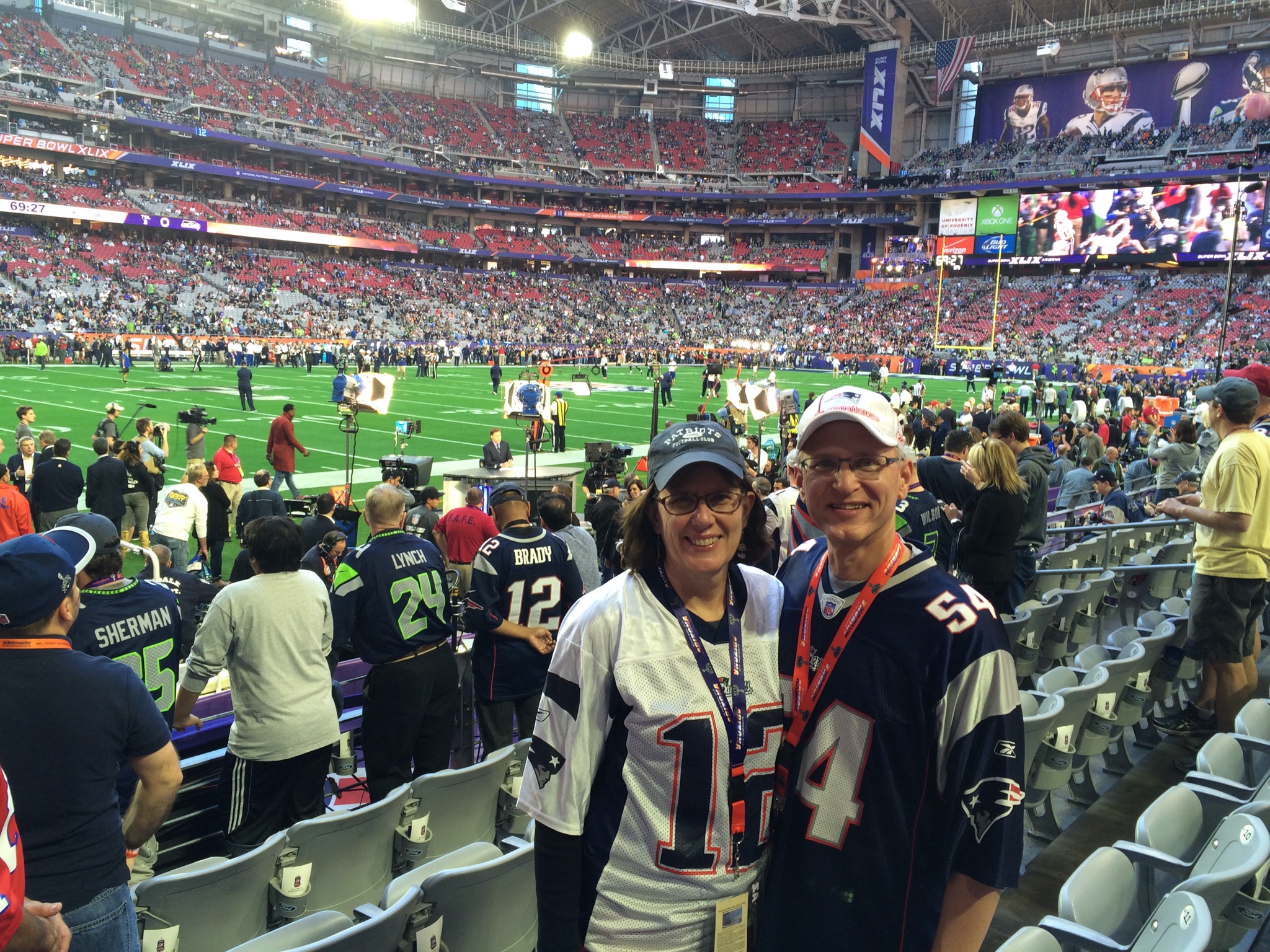
In-between those two memorable Super Bowls was another game, Super Bowl XLIX, held in Glendale, Arizona on February 1, 2015. The game was between the New England Patriots and the Seattle Seahawks. Thanks to the kindness of a friend in Boston whose family had a couple of extra tickets to the game, my wife and I got to attend Super Bowl XLIX. Having been Patriots fans for over 30 years, we had a rooting interest. The game was held in the Arizona Cardinals’ stadium and our seats were five rows from the field on the Patriots’ goal line. Little did we know how that goal line would become so important in the game.

Patricia_Douglas_Yeo_Super_Bowl_XLIX

My wife, Patricia, and me at our seats before kickoff at Super Bowl XLIX.

In my trombone teaching, I speak frequently about the need to be disciplined and focused in one’s practice and performances. We will be at our best if we focus intently on the tasks at hand. If we make a mistake, we cannot let a mistake distract us from the next thing. Frustration over a mistake only causes more mistakes, so remaining disciplined in the face of challenges is critically important for success. I use football metaphors in my trombone teaching all the time—just ask my students. Here is one of the examples I use when I talk about the need for discipline and maintaining focus. Let’s go back to Super Bowl XLIX in Arizona and pick up the story (with apologies to readers who might not understand American football, but I hope you can stick with me to get to the point of this article at the end). . .

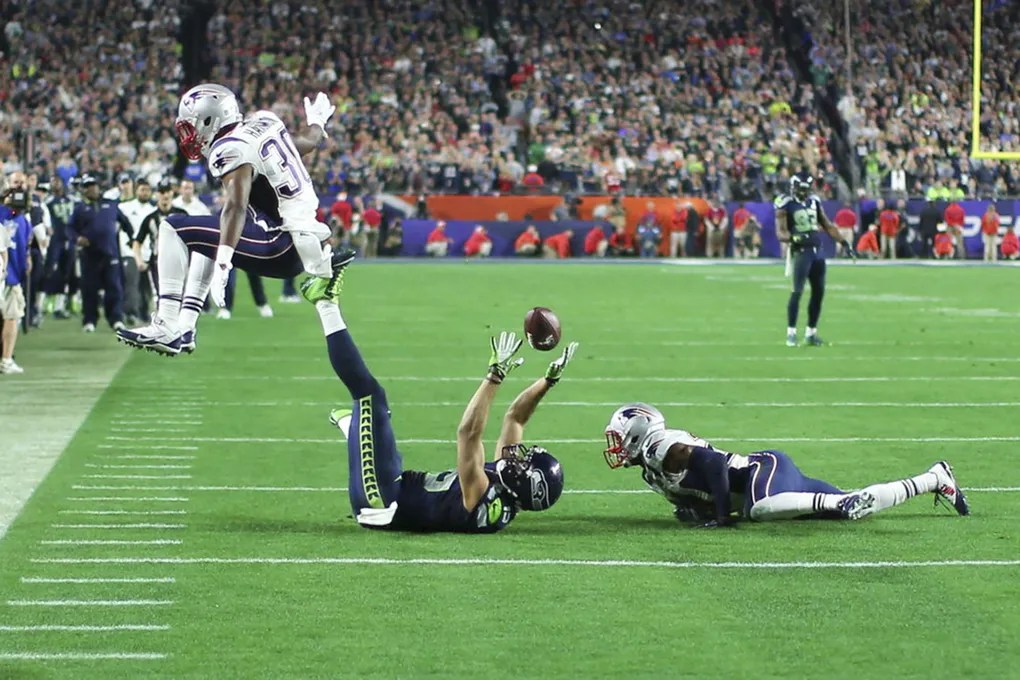
The game went back and forth with the Patriots and Seahawks exchanging the lead several times. You can see a chart with every play from the game on Pro Football Reference by clicking HERE. With 2:06 left in the fourth and final quarter, the Patriots took the lead, 28-24. Then, the Seahawks got the ball and began driving down the field. They needed a touchdown (6 points) to win the game; a field goal (3 points) would not be enough. All of us in the stadium thought the Seahawks would win after Seahawks wide receiver Jermaine Kearse made an acrobatic catch for a 33-yard gain. That was a catch that embodied the ideals of focus and discipline. I still don’t know how he made that catch.

Jermaine_Kearse_catch_SB_XLIX

Jermaine Kearse’s acrobatic catch at Super Bowl XLIX. Photo from an article in the Seattle Times.

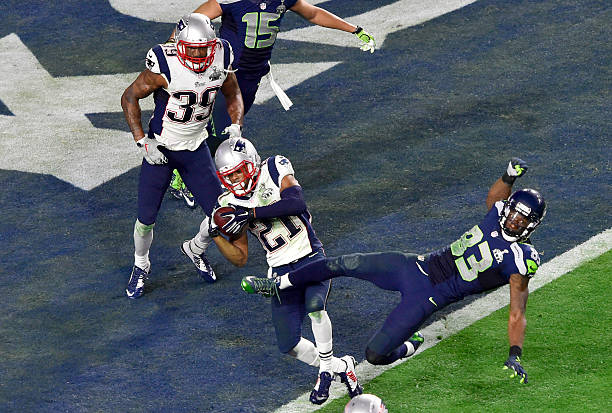
With the ball on the Patriots 5 yard line with 1:06 left on the game clock, the Seahawks handed off the ball to their star running back, Marshawn Lynch, who gained 4 yards. With the ball at the 1-yard line, we—along with, I expect, every other person in the stadium—assumed that Seahawks quarterback Russell Wilson would hand the ball off to Lynch once more and score a touchdown. But with 0:26 seconds left on the game clock, Wilson threw a pass to Ricardo Lockette. And the pass was intercepted by Patriots safety Malcolm Butler at the 1 yard line. Nobody could believe it.

Malcolm_Butler_interception_SB_XLIX

Malcolm Butler intercepting a pass by Russell Wilson, Super Bowl XLIX. Photo from an article by LWOS (Last Word on Sports).

This was, of course, a disaster for the Seahawks and an unexpected reprieve for the Patriots. It was a stunning turn of events. With victory in their grasp, the Seahawks gave the ball back to the Patriots.

But the game wasn’t over.

After the Patriots took a time out, the game resumed with 0:20 to play. However, the Patriots had a problem. With the ball on the 1-yard line, the Patriots had to run a play and advance the ball. They could not simply “take a knee” and run out the clock; Patriots quarterback Tom Brady was lined up behind his center in his own end zone. The possibility that Tom Brady could be sacked in the end zone—thereby giving the Seahawks a safety (2 points) was very real. The Seahawks had a superb defense. If they had gotten a safety, they still would have been behind the Patriots by 2 points, but the Patriots would have to punt (rather than kick off) the ball to the Seahawks, and with one timeout left and what would have probably been a short field, there was a possibility the Seahawks might be able to kick a long field goal and win the game in dramatic fashion. It was a long shot, but it was possible.

What happened next? Patriots quarterback Tom Brady came up to the 1-yard line and started his snap count. And then another unthinkable thing happened: Seahawks player Michael Bennett jumped offsides. That was THE ONE THING the Seahawks could not do on that play. THE ONE THING. But the Seahawks did it. The offsides penalty gave the Patriots 5 yards, and the ball was placed at the 6-yard line. At that point, the game was essentially over; the Patriots could run out the clock. Then, on the next play (the photo at the top of this article shows this play), the Patriots lined up in “victory formation” (all they needed to do at this point was snap the ball to Tom Brady and then Brady take a knee to stop the play and the clock would run out), the Seahawks were penalized 15 yards for unsportsmanlike conduct when Seahawks linebacker Bruce Irvin punched a Patriots player after the play—clearly he was frustrated by the dramatic turn of events of the last few seconds. On the next play, Brady took a knee again—and the game was over. The Patriots won.

Michael Bennett was not a disciplined player. One can ask the fair question: why was a player (Bennett) who had been called for more offsides penalties in the whole National Football League during the season even on the field for that play? Bennett’s lack of discipline cost the Seahawks a chance to win the game. Sure, it was a long shot. But they had a chance. Until Bennett jumped offsides.

There, in the course of just a few seconds, we saw a remarkable display of focus and discipline from Jermaine Kearse. His catch epitomized focus and discipline. Then we saw another remarkable display of focus and discipline by Malcolm Butler when he intercepted Russell Wilson. But then, we saw a terrible lack of discipline by Michael Bennett (offsides) and another lapse of focus and discipline by Bruce Irvin (unsportsmanlike conduct).

The lesson in all of this? It’s not over until it’s over. Staying disciplined in our tasks, whether playing football or performing a concert with a trombone in your hand, will give us the best possibility to have a great result. Even when you think that things are going badly, you still may have a chance at redemption. When you’re taking an audition for a symphony orchestra, never assume your audition is over because you miss a note. Because unbeknownst to you, maybe everyone else at the same audition missed the same note. Stay focused, stay disciplined. Most people who reflect on Super Bowl XLIX remember the decision by Seahawks coach Pete Carroll to have Russell Wilson throw a pass from the 1-yard line rather than hand the ball off to Marshawn Lynch as the defining moment of the game. And, in many respects, it was. But there was more to the story, and the Seahawks missed a chance—a chance—to win the game when Michael Bennett jumped offsides. His lack of discipline was the real story about the Seahawks loss.

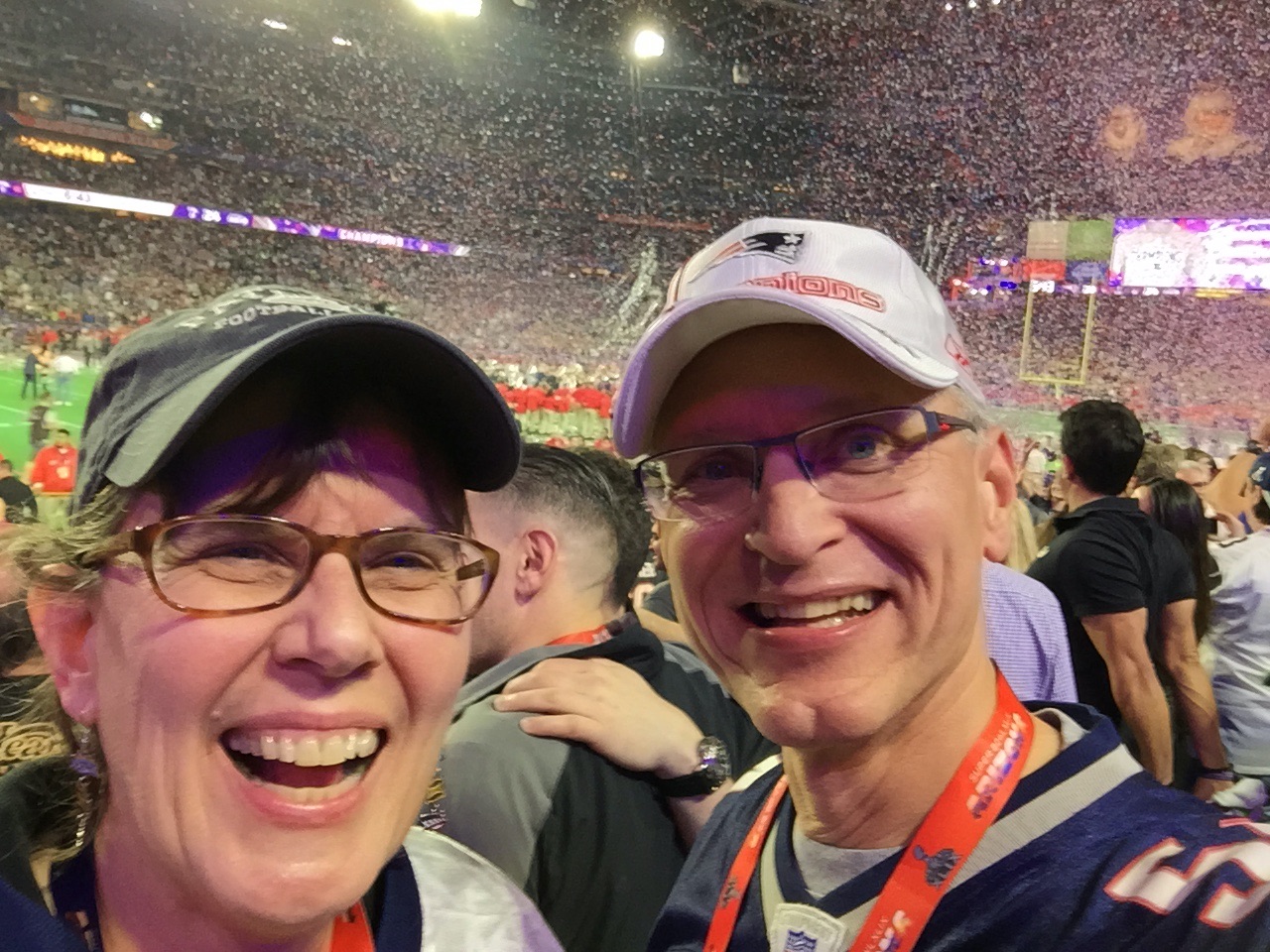
Stay disciplined. Keep working until the task is done. Completely done. It’s not over until it’s over. If you want to be there when the confetti falls for you after you win, you have to be disciplined and focused until the very end. That’s a lesson for all of life.

Patricia_Douglas_Yeo_SB_XLIX_confetti

My wife, Patricia, and me as the confetti fell to celebrate the New England Patriots’ victory at the end of Super Bowl XLIX.