Category: Uncategorized

Road closed

Road closed

I’ve been off the grid – truly – for the last two weeks while on vacation with my wife. One of the reasons we decided to move to Arizona was to be in proximity of the great National Parks of the West. We first explored these parks in 1978 when we took a six week camping vacation from New York City to California and back, staying in 11 National Parks. That we were able to accomplish that epic trip for the sum total of $500 – that included gas (which was, at the time, $0.53 a gallon), campground fees and food – is only an interesting aside. The trip fundamentally instilled in us a love for our National Parks which are truly, “America’s best idea.”

This road trip took us up to Zion, Yellowstone and Grand Teton National Parks. We have been to these parks before, particularly to Zion which we have visited on 10 separate occasions. We never tire of visiting again and again, and since Zion was a good enough drive for our first day as we headed up to Yellowstone, we decided to stay there for two days and do some warm-up hiking.

But things don’t always turn out as planned.

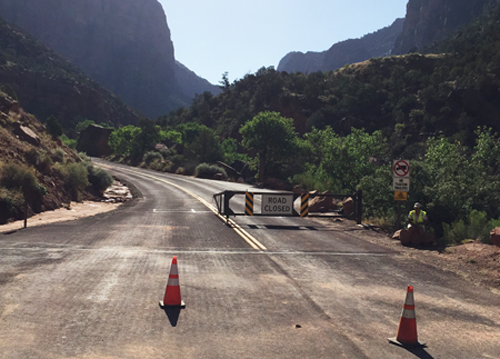
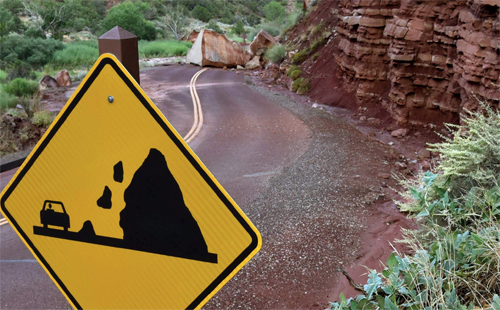
We had experienced a little rain on the trip but nothing significant. But as we drove to Zion National Park’s east entrance, coming from Mount Carmel Junction, Utah, we were confronted by confounding words – ROAD CLOSED. It turns out that earlier in the day, there had been an epic microburst of a storm that caused dramatic flash floods in Zion Canyon. The main street of the town of Springdale – our destination and the gateway to Zion National Park – had turned to a raging torrent of water. And the Virgin River that runs through Zion Canyon had been running at 80,000 cubic feet/second; normal is about 450 cfs.The road was closed because large boulders had crashed onto the Zion/Mount Carmel highway, making passage to Springdale through the east entrance of the park impossible.
Zion_rock_slide_01

The photos above and below (courtesy the National Park Service) show the problem. And they give new meaning to the “DANGER – falling rocks” sign that was just a few feet away.

Zion_rock_slide_02.jpg

Passage was impossible, so we had to retrace our path back to Mt. Carmel Junction and then around the south of Zion, and approach Springdale from the West side. This was a two hour detour – an unwelcome event after about eight hours already in the car that day. By the time we rolled into Springdale, the rain had abated, the flood had receded and apart from a lot of mud on Main Street, we safely got to our hotel.

Zion_altar

The next day the sun was out, and we enjoyed a peaceful and fulfilling day of hiking at Zion, one of our favorite places in the world. The photo above will show you why, if you haven’t been there. Such beauty and majesty. As we hiked on several trails that day, our minds kept coming back to the words of the Bible:

Let the heavens be glad, and let the earth rejoice; let the sea roar, and all that fills it; let the field exult, and everything in it! Then shall all the trees of the forest sing for joy before the LORD, for he comes. (Psalm 96:11-12)

Indeed. Our trip to Zion was delayed, but when we arrived, we were all the more grateful for our safety (and that of others in the –thankfully no lives were lost in the storm) and the beauty of the Park seemed even richer. I will be posting more about our trip in the coming days. It was good to get to a place in the world where my cell phone did not have any coverage. More time to think, to talk with people I loved, slow down and consider my place in God’s great world.
The Olympic Games

The Olympic Games

The games of the XXXI Olympiad get underway today with the opening ceremony in Rio de Janeiro, Brazil.  As a young boy, I was thrilled by the games – the spectacle, the competition, and as ABC television aptly put it, “the thrill of victory and the agony of defeat.” In recent years the Olympics have suffered a bit with world-wide scandals involving the use of performance enhancing drugs. But, still, there is something about the big stage of the Olympics, the celebration of success and what one hopes is a healthy kind of nationalism as we are proud of our country being represented by excellent athletes.

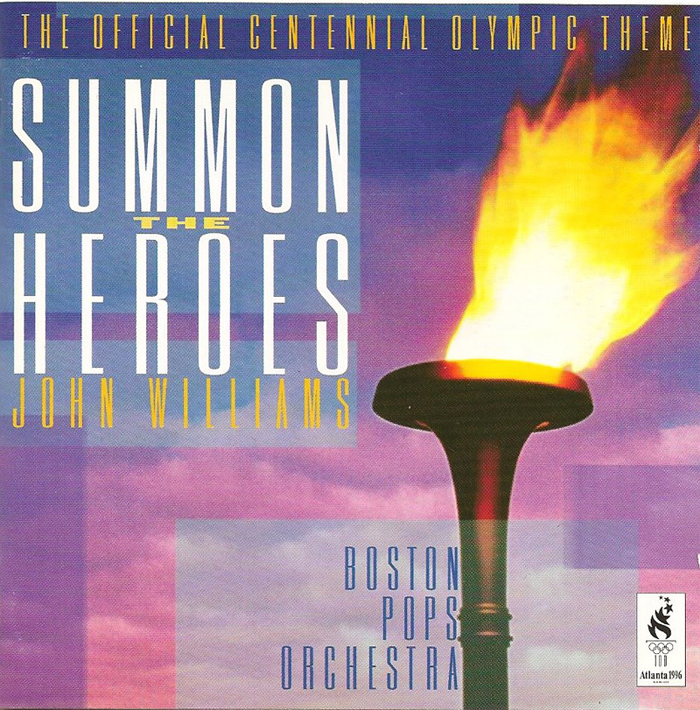
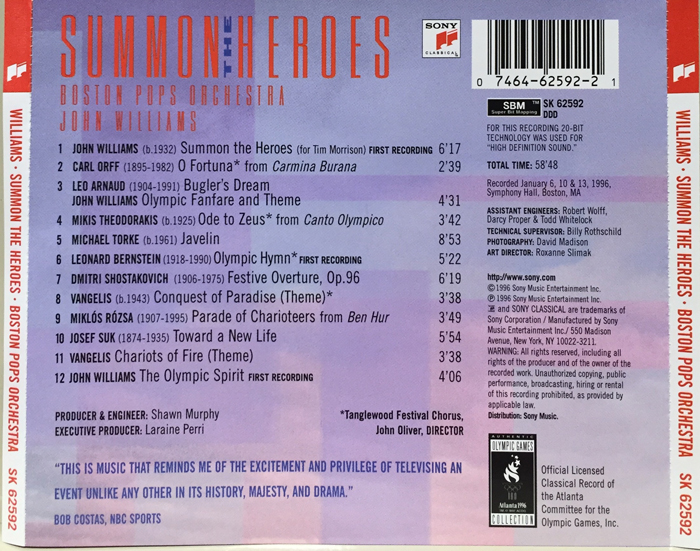
I’ve never been to an Olympic event but I got close. Musically. In 1996, the Olympics were held in Atlanta, Georgia, USA. As a member of the Boston Symphony Orchestra at the time – and membership in the BSO brought with it membership in the Boston Pops Orchestra – I played on the official soundtrack album of the Atlanta 1996 Olympic games, “Summon the Heroes.” Conducted by John Williams, the Boston Pops Orchestra had recording sessions on January  6, 10 and 13, 1996 of a playlist that included well known Olympic game themes (by John Williams) and other heroic, brass-centric, noble works that are often associated with the Olympics. Here is the tray card with the full track list:

Summon_Heroes_playlistThe recording sessions came in the midst of a grueling week of Boston Symphony Orchestra rehearsals and concerts that included Richard Strauss “Eine Alpensinfonie” and we brass players were stretched to our limits. Still, it remains a memorable moment in time for me, my closest personal association with the Olympic games, and “Summon the Heroes” remains one of my favorite recordings from my nearly three decades as a member of the Boston Symphony/Boston Pops Orchestra. “Summon the Heroes” is still available, as a CD or mp3 download.   And you can see a performance of that great fanfare with John Williams conducting the Boston Pops Orchestra on the YouTUBE link, below. The low brass section consists of Norman Bolter, Darren Acosta, Phil Swanson and myself on trombone, Chester Schmitz on tuba, and trumpets Tim Morrison, Tom Rolfs, Peter Chapman and Bruce Hall.  There are offstage trumpets and trombones as well. Enjoy. To our Olympians: Citius – Altius – Fortius – the motto of the modern Olympic games, swifter – higher – stronger.

Important discoveries for brass players – with big implications

Important discoveries for brass players – with big implications

Players of brass instruments spend a lot of time thinking about their tongue, and how it factors in tone production, tonal range and articulation. Many books have been written on the subject but the truth is that since we can’t SEE inside our mouth while we’re playing and it’s very difficult to feel where the tongue actually IS while playing, a lot of what has been said on the subject is just theoretical.

Until now.

In what is proving to be a fascinating study with significant implications, Dr. Peter Iltis (Professor of Kinesiology at Gordon College) and Eli Epstein (former 2nd horn of the Cleveland Orchestra, now teaching at the Boston Conservatory at Berklee and New England Conservatory of Music) are announcing research involving the filming of elite horn players by way of MRI technology. This allows us to see inside the oral cavity of a group of superb players and begin to draw conclusions about the placement of their tongue while playing. Iltis and Epstein have created a Youtube channel to present some of their findings. These findings are applicable to all brass players, not just horn players. For convenience, here are two of the videos. They are each about 20 minutes long but if you are a brass player, they will definitely get your attention and get you thinking about tonguing in a completely new way:

Their second video continues the discussion:

But wait, there’s more! My friend, Dr. John Ericson, horn professor at Arizona State University, has three video podcasts in which he has further conversations with Dr. Peter Iltis about the MRI horn insights. You can see them here:

John Ericson and Peter Iltis, discussion 1

John Ericson and Peter Iltis, discussion 2

John Ericson and Peter Iltis, discussion 3

If you’ve stuck with this so far, then you will want to read this article by Peter Iltis, Jens Frahm, Dirk Voit, Arun Joseph, Erwin Schoonderwalds and Eckart Altenmüller (click the title below to read or download the article – it’s free):

Divergent oral cavity motor strategies between healthy elite and dystonic horn players

This article discusses the comparison between group of elite horn players and a group of players who are experiencing a form of “focal dystonia,” and how tongue placement is an important aspect of healthy brass playing. The article is technical but readable and understandable. And a real revelation.

I think we are just now at the beginning of a new era of understanding about this very important aspect of brass playing. I tip my hat to John Ericson for letting me know about this. I don’t know about you, but after looking at all of this, I think I need to go and practice.


What’s the count?

What’s the count?

I’ve spent the last few days doing some organizing of materials in my several filing cabinets. It’s a good project to do every few years – things get misfiled, too many things get filed that don’t need to be kept, and you never know what you’ll find. In addition to filling up my recycling bin with things I no longer need need, I came across a few surprises.

The little item above will resonate with anyone who remembers the 2000 US Presidential election. George W. Bush, Al Gore and Ralph Nader were running for President. You know the rest of the story – and if you don’t, you can look it up.

This image made the rounds of the Internet that year, the work of some clever trombonist. When I found it deep inside in a filing cabinet the other day, I laughed out loud. In a political season that is sometimes lacking in humor, perhaps this might make you smile, no matter who you voted for in 2000 or will vote for in 2016.