Category: trombone

A message of hope and good news—told with a trombone

A message of hope and good news—told with a trombone

by Douglas Yeo (December 17, 2024)

When I was at work on my book about Homer Rodeheaver (Kevin Mungons and Douglas Yeo, Homer Rodeheaver and the Rise of the Gospel Music Industry, Urbana: University of Illinois Press, 2021)— Rodeheaver was the trombone-playing song leader for the Christian evangelist Billy Sunday in the first third of the 20th century—a side aspect to my research was an investigation into the work of many other trombonists who used their trombones to play sacred music and share the good news of the Gospel. There have been many of them. For instance, Cliff Barrows, who knew Rodeheaver well and who was the song leader for Billy Graham for many years, played the trombone:

Barrows_Graham_trombone

Cliff and Billie Barrows with Billy Graham, c. 1948. Wheaton College Archives and Special Collections.

Others made recordings of gospel music with a trombone in  hand, including Joe and Marion Talley (their name is misspelled on the cover of this album, below):
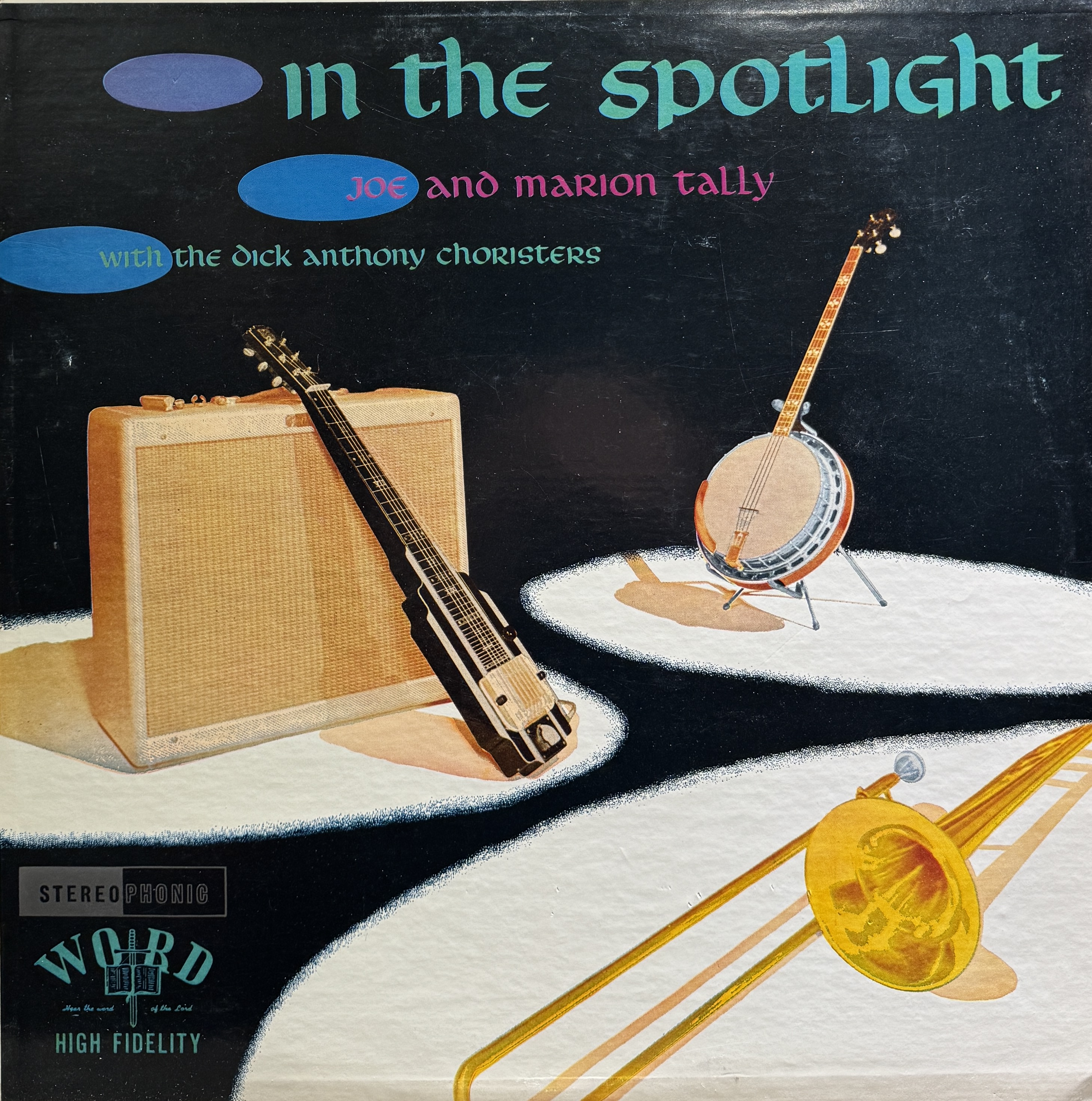
Joe and Marion Tally LP

Joe and Marion Talley, In the Spotlight. WORD WST-8037 (1960)

. . . Marcy Tigner:

Marcy Tigner LP

Marcy Tigner, Marcy Tigner Trombone, Christian Faith Recordings 351 (1961)

. . . Sam Salter:
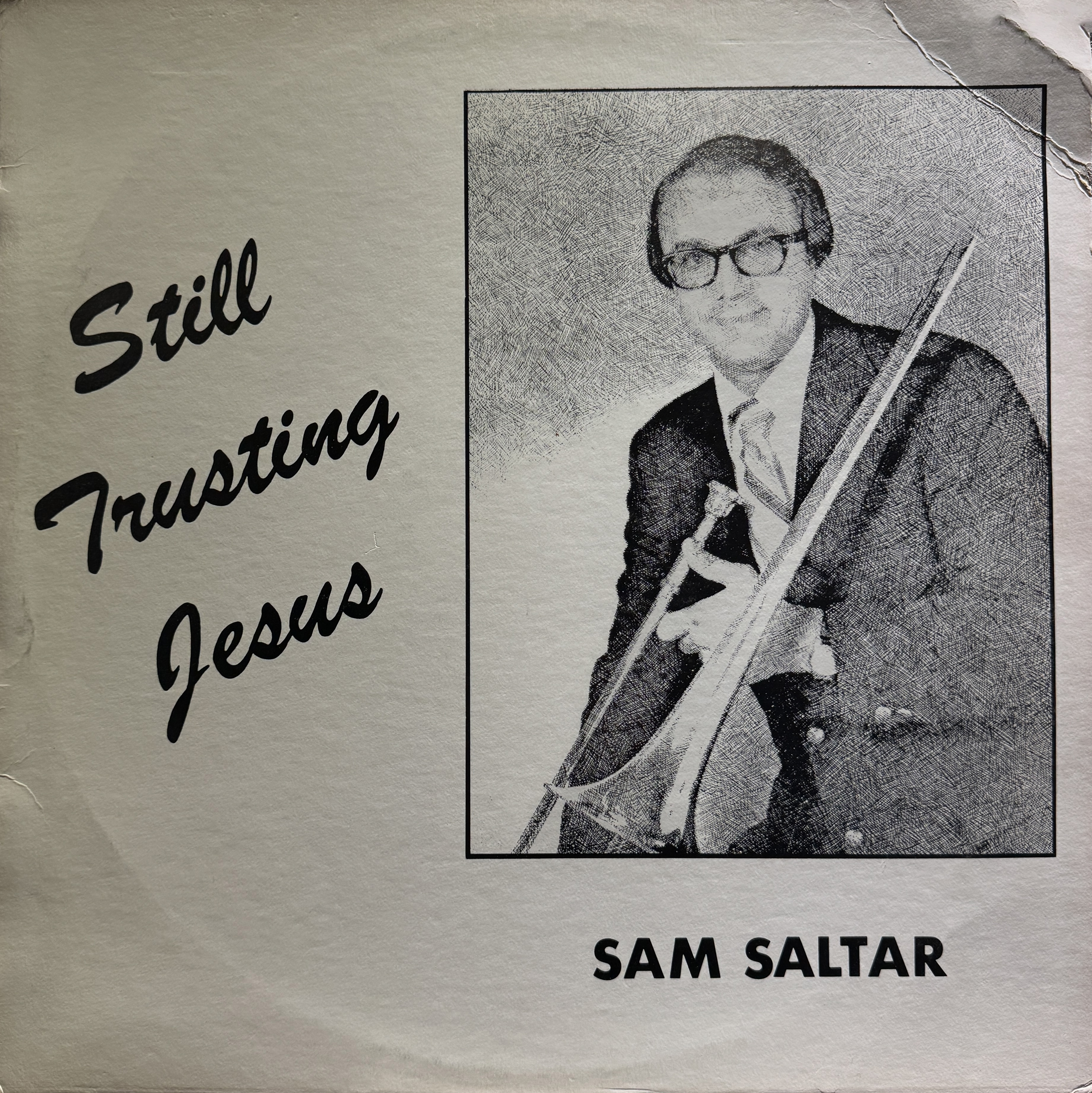
Sam Saltar LP

Sam Saltar, Still Trusting Jesus, Glory Records GL-151

. . . Tom Dale:
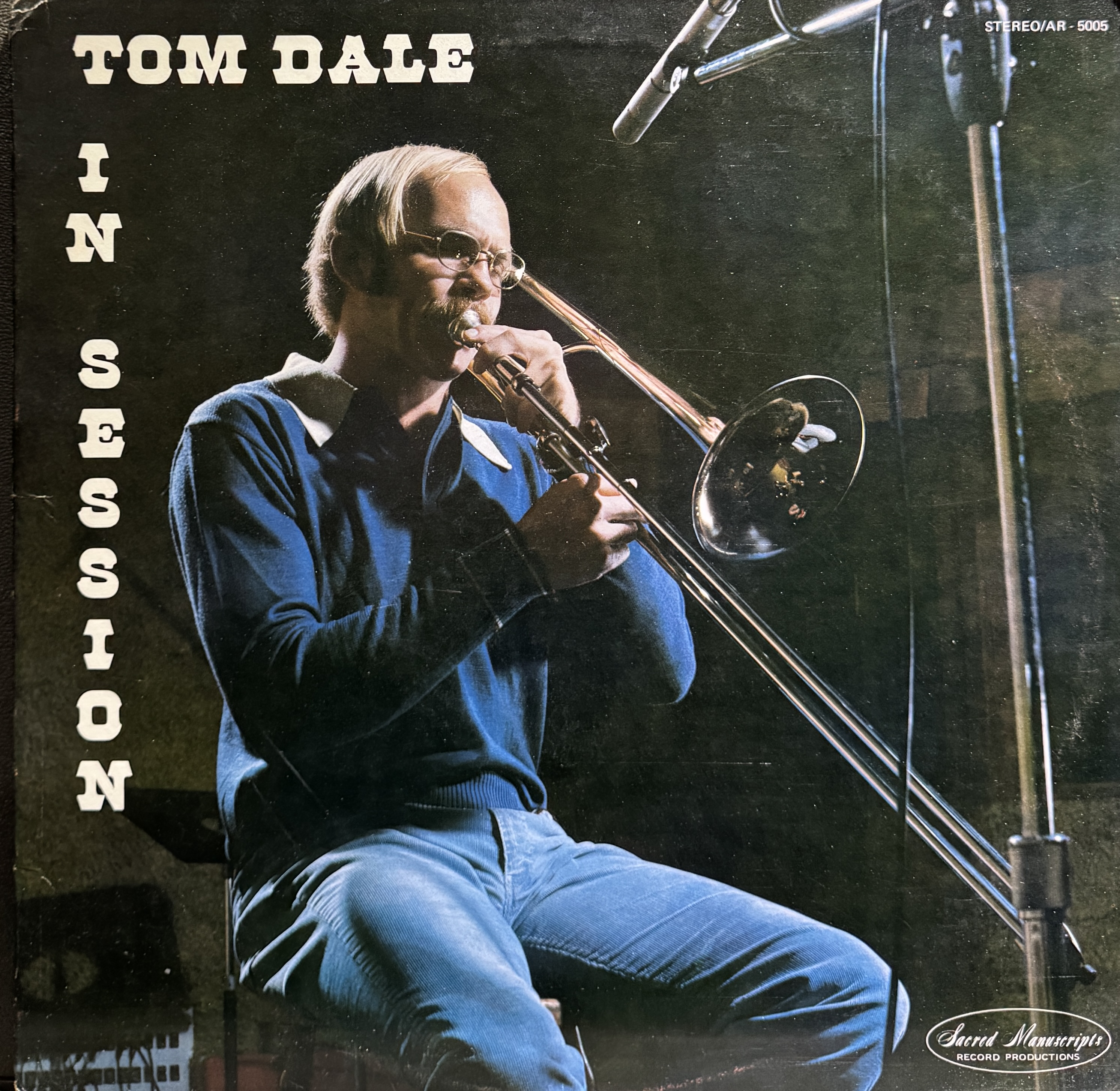
Tom_Dale_LP

Tom Dale, In Session, Sacred Manuscripts Record Productions AR-5005

and Bill Pearce:

Bill Pearce LP

Bill Pearce, The Remarkable Trombone of Bill Pearce, WORD WST-8312 (1964)

There are also many superb recordings with enthusiastic playing of the trombone shout bands that rose in the United House of Prayer for All People:

Tigers Dancing With Daddy G

The Tigers Trombone Shout Band, Dancing with Daddy G, Fire Ant 1004 (1993)

In recent years, Megumi Kanda (principal trombonist of the Milwaukee Symphony):

Kanda_Amazing_Grace

Megumi Kanda, Amazing Grace, Victor VICC-60316 (2002)
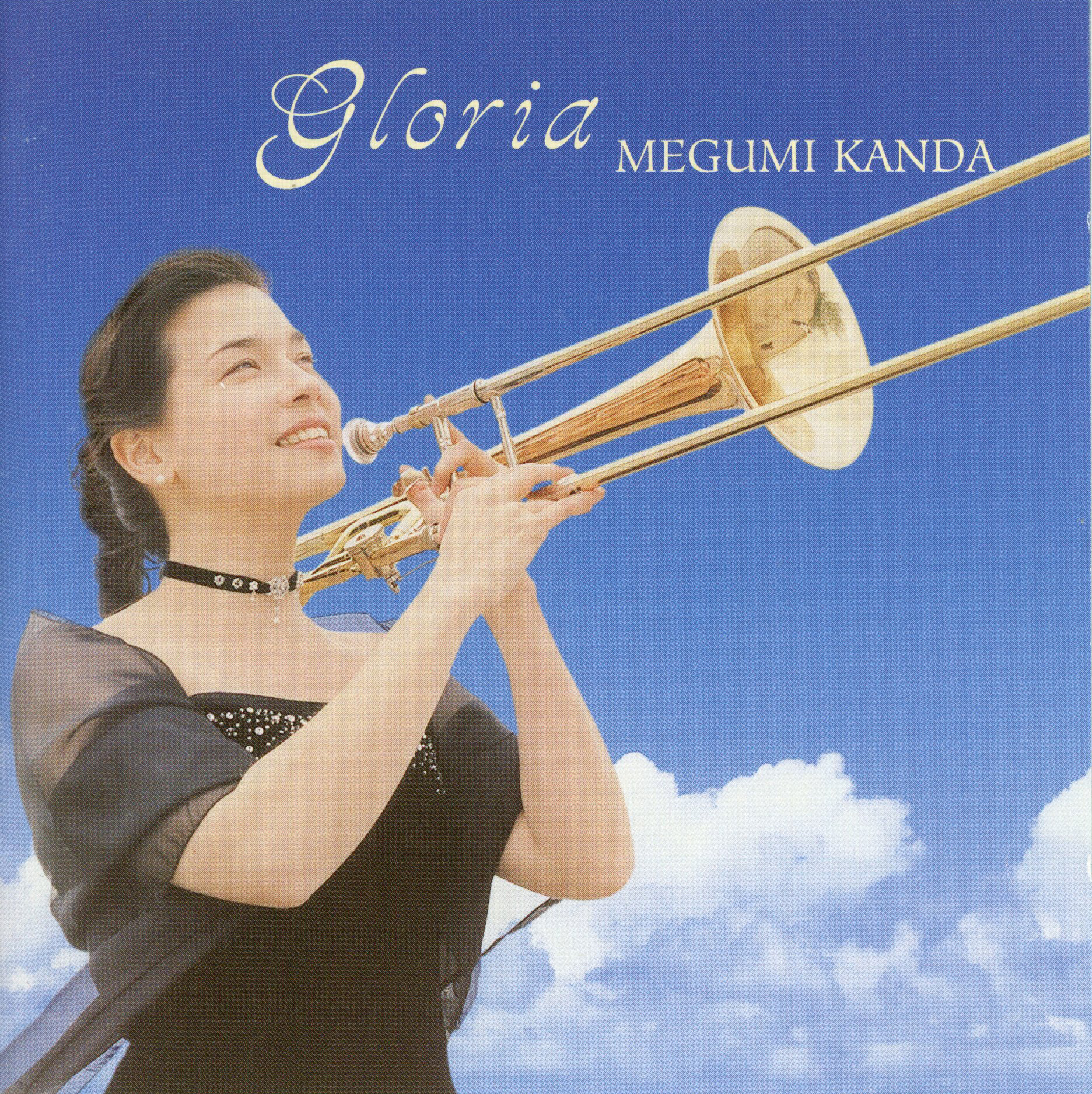
Kanda_Gloria

Megumi Kanda, Gloria, Albany Records TROY694 (2004)

. . . Wycliffe Gordon

Gordon_Gospel_Truth

Wycliffe Gordon, The Gospel Truth, Criss Cross Jazz 1192 (2000)

. . . and I have released albums of hymns, gospel songs, and spirituals.

Yeo_Cornerstone

Douglas Yeo, Cornerstone, Die letzte Posaune CD93175 (2000)

I’m at work on an article about “The Gospel Trombonist,” but with several other writing projects in the pipeline, that article won’t appear for a while. But the subject is on my mind because Christmas is around the corner, and the ubiquitous sound of Salvation Army bell ringers and brass players fills the air at shopping centers, supermarkets, and malls. The work of the Salvation Army to preach the Gospel and help the less fortunate—what Jesus Christ referred to as, “the least of these” (Matthew 25:45)—is well known. The Salvation Army’s motto is, “Doing the most good.” We should also remember that in addition to its religious and humanitarian work, the Salvation Army was also influential in the rise and influence of the brass band movement in England and around the world.

A little history: In 1878, William Booth’s Christian Revival Society—founded in the East End of London in 1865 and later called the Christian Mission—changed its name to The Salvation Army. In that same year, a brass quartet of two cornets, valve trombone and euphonium formed by itinerant preacher Charles Fry and his three sons began supporting outdoor meetings of the Salvation Army in Salisbury, England. Booth, who had long harbored ambivalence toward musical groups accompanying singing, quickly realized the value of an ensemble of brass instruments in helping to attract a crowd, and others would learn from this example. By the following year, organized brass bands had become an integral part of Salvation Army worship and evangelistic efforts.[1]

The Salvation Army has also published a tremendous amount of music for brass band, brass ensemble, and solo brass instruments, and it has released many recordings of its music, including the popular series with a jazz trombone ensemble, Spiritual to the Bone:

Spiritual to the Bone

Spiritual to the Bone, Salvation Army USA South CRD018 (1993)

But there was someone who was first among the many high-profile, trombone-playing representatives of the Gospel message, and we do right to remember him.
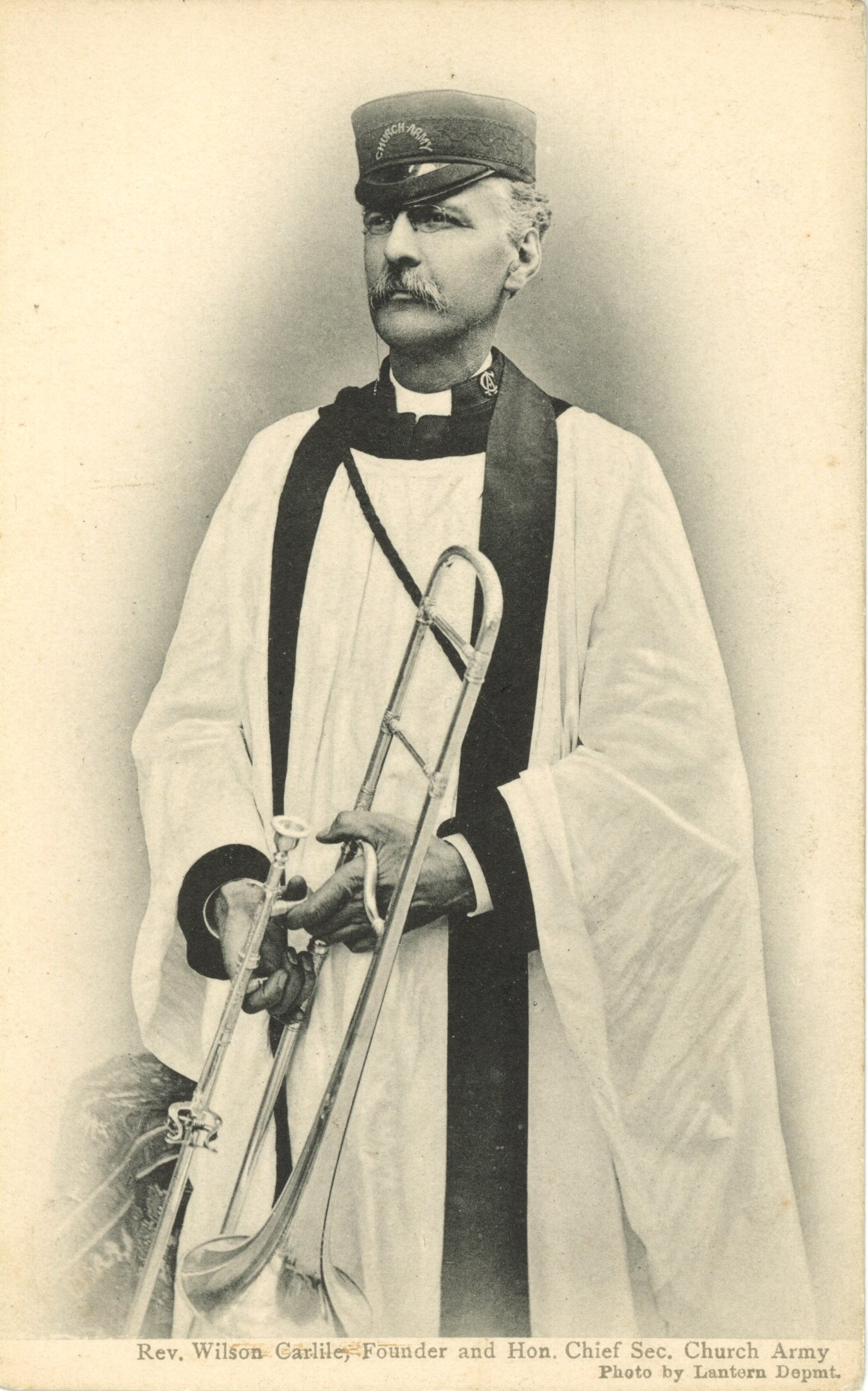
Wilson_Carlile_postcard_1900

Rev. Wilson Carlile, c. 1900

Into the environment of brass playing that was popularized by William Booth in England came Wilson Carlile (1847–1942).[2] Carlile was ordained a deacon in the Church of England in 1880 and served as a curate to the Vicar of Kensington. He began holding open-air evangelistic meetings in an effort to reach people who otherwise might not enter a church. Unlike William Booth–who broke from the Methodist Church to set up his own denomination–Carlile worked within the Church of England to overcome denominational resistance to his desire to be a missionary to the slums of London. In 1882, Carlile resigned his formal position with the Church of England and formed The Church Army, with himself at its head while he and The Church Army maintained close ties with the Church of England.

As a child, Carlile’s first musical instrument was a toy drum that he later put down in favor of the trombone. He admitted his trombone playing was less than accomplished, as when he related a story of an argument over his drum with one of his sisters that resulted in the instrument breaking and inflicting a deep wound on his hand:

I’m afraid that some of my friends today, persecuted by the trombone, wish my early musical talent had received an even sharper lesson.[2]

While the Salvation Army fully embraced the presence of brass instruments during their worship services, and by 1879 brass bands were being organized in many churches [3], Wilson Carlile was, at first, somewhat of an enigma to the Church of England. In an article from 1900 that was headlined, “Newest and Strangest Ally of the Dignified Old Church of England,” Curtis Brown reported the strange occurrence of a trombone in the pulpit in “the haughty old Church of England”:

That most dignified, serious and conservative of institutions, the Church of England, has taken into alliance a man with a trombone, who horrified the stately Bishops at first by carrying his instrument into his pulpit and playing it right lustily, too. . . .The man with the trombone typifies this queer army which is beginning to attract general attention. He has played that trombone in the streets, in saloons and in dance halls, and has had it pretty badly battered in many an encounter with toughs. He was laid up six months after one such fight, and he and his trombone had to be patched before they could get into line again.[4]

“Preachers in their Pulpits: The Rev. Wilson Carlile of the Church Army.” The Tatler, No. 109 (July 22, 1903)

The sight of Wilson Carlile marching around London in his clerical frock while playing his trombone achieved its desired effect. The parade of curiosity seekers that followed Carlile to St. Mary-at-Hill on London’s Love Lane experienced a church service like no other. As Homer Rodeheaver was to do later, Carlile adopted the “magic lantern,” an early form of projector that displayed large images on a large white sheet above the church’s altar. These projections were, in the main, of Biblical characters and scenes, but Carlile also engaged in social commentary, showing the contrast between slum life and the “palaces of the rich.” Carlile also employed a large phonograph during services, a “monsterphone,” from which which emanated sermons by other preachers including the Archbishop of Canterbury as well as an occasional Sousa march.[5]  “This,” Carlile’s biographer wrote, “had the effect of driving away all orthodox people in horror, and attracting the loafers from the street, who warmly supported the new form of service long before it received a friendly smile from the Bishops.”[6] Carlile’s message of the Gospel changed lives.
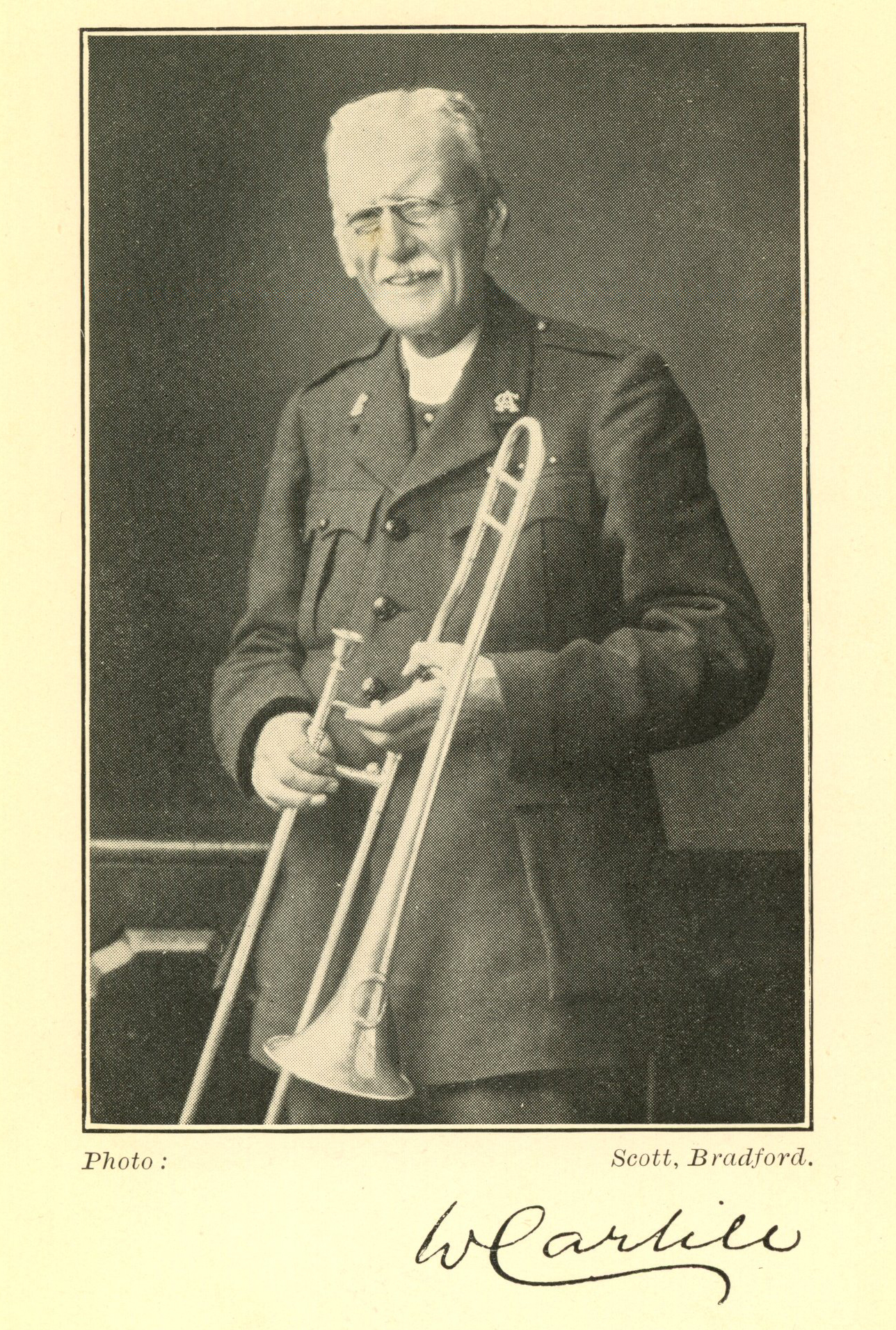
Carlile_trombone_1926

Wilson Carlile. From: Edgar Rowan, Wilson Carlile and the Church Army (London: The Church Army Bookroom, 3rd edition, 1926)

Newspapers across the United States ran articles about Carlile and his unconventional evangelistic outreach. The Louisville Courier-Journal devoted an entire page to the “Man with the Trombone and His Great Army: Newest and Strangest Ally of the Dignified Old Church of England.” [7] The Chicago Daily Tribune painted a vivid picture of Carlile’s use of the trombone as a tool for reaching audiences with his evangelistic message:

The real power of the man behind the trombone is illustrated in the career of the Rev. Wilson Carlile of England, the head of the Church Army. He began his career with a broken-winded harmonium, but he soon found that to reach the masses he must have a trombone. For eight years he has blown that trombone. He has blown it in streets, saloons, and dance halls, and has horrified the stately Bishops by sounding its sonorous blasts in the pulpit. Occasionally the roughs of London have objected to his music, and then he and his trombone have been laid up for repairs, both badly battered. . . . The man with the trombone is an indefatigable worker. . . . He plays on his trombone. He exhorts. He sings. He makes things generally lively in the pulpit. He gathers his audience for the night service by marshaling his band and choir, which he heads with his trusty trombone, and makes a procession through the streets near his church, blowing lustily. The crowd follows him. At each saloon the march halts, while the trombone man drags out three or four habitués who join the procession. When he gets back and sounds the first blast in his pulpit, the church is packed. . . .

All this is the work of the man behind the trombone, and for the possibilities that lie in that much-maligned instrument let all trombone players be respected. They are not as bad as they look. In the hands of a man truly great the trombone is more powerful than the sword.[7]
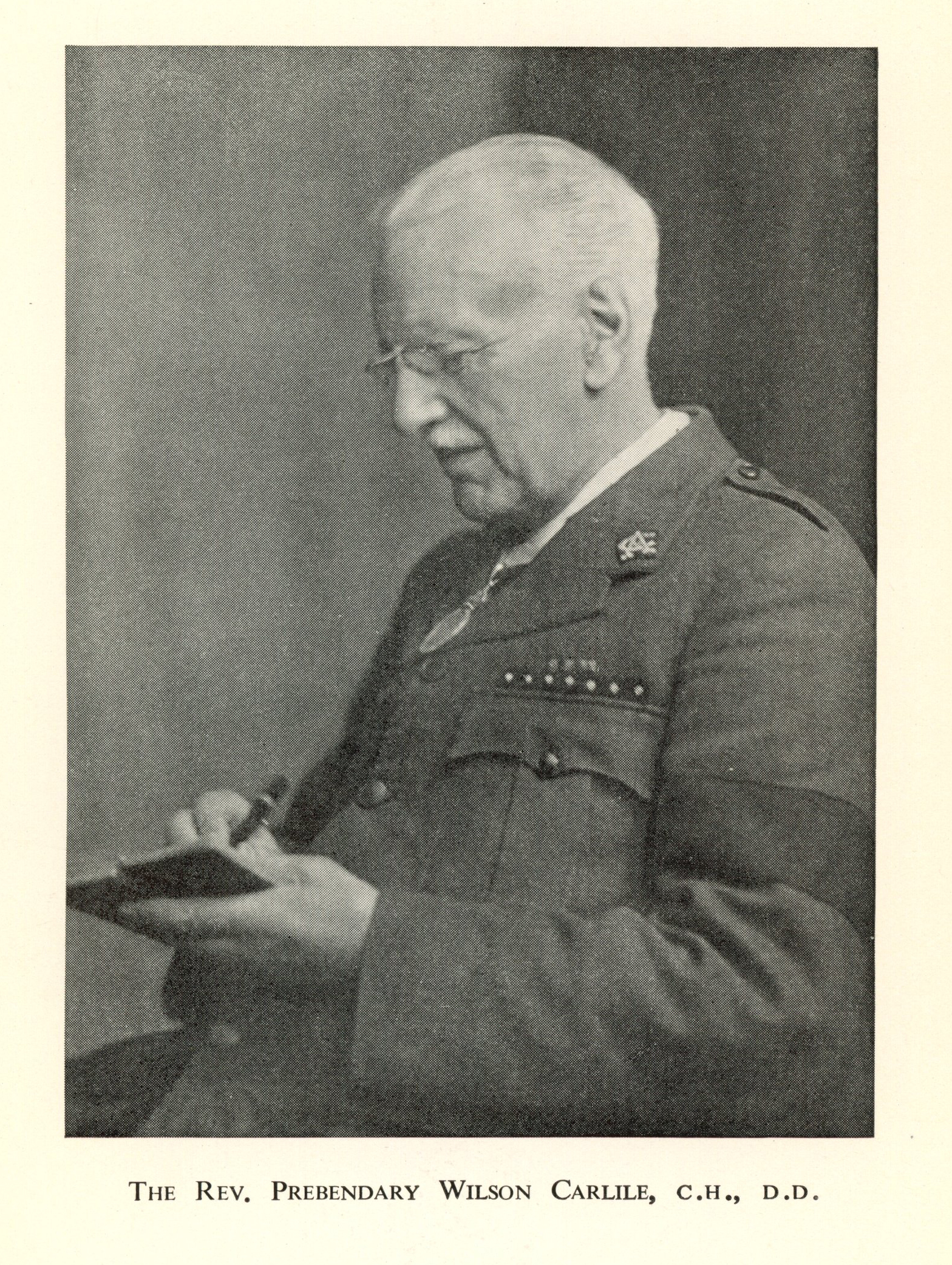
Carlile_c1938

Wilson Carlile. From: A. E. Reffold: The Audacity to Live: A Résumé of the Life and Work of Wilson Carlile (London: Marshall, Morgan, & Scott, 1936)

Now, as Christmas approaches and the sound of brass instruments is in the air, we look at Wilson Carlile—and many others—who joyfully brought—and bring—the Gospel message of hope and good news to a hurting world with a trombone in hand, a message that came to us 2000 years ago in a manger in Bethlehem, to change lives and bring true, lasting peace (Luke 2:14).

• • •

NOTE: Here follows the full text of the article about Wilson Carlile that was referenced above, “The Man Behind the Trombone,” from the Chicago Daily Tribune, March 4, 1900. Notes for this blog post about are found at the end of the Chicago Daily Tribune article.

Carlile - The Man Behind the Trombone- Chicago Tribune_4 Mar 1900

[1] Ronald W. Holz, Brass Bands of the Salvation Army: Their Mission and Music. Volume 1 (Stotfold, Herts.: Street Publishers, 2006), 63–74.

[2] Edgar Rowan, Wilson Carlile and the Church Army, 3rd ed. (London: Church Army Bookroom, 1926), 5.

[3] Ronald W. Holz, Brass Bands of the Salvation Army: Their Mission and Music. Volume 1, 69.

[4] Curtis Brown, “Man With the Trombone and His Great Army: Newest and Strangest Ally of the Dignified Old Church of England,” The Courier-Journal (Louisville, Kentucky), February 25, 1900.

[5] Stephen Bottomore, “Projecting for the Lord: The Work of Wilson Carlile,” Film History, Vol. 14, No. 2, Film and Religion (2002), 199-200.

[6] Edgar Rowan, Wilson Carlile and The Church Army, 60.

[7] “The Man Behind the Trombone,” Chicago Daily Tribune, March 4, 1900.

An update on Joannès Rochut’s “Melodious Etudes” for trombone – the missing etudes

An update on Joannès Rochut’s “Melodious Etudes” for trombone – the missing etudes

by Douglas Yeo (November 14, 2024)

Readers of The Last Trombone know that I have been researching the life, work, and influence of trombonist Joannès Rochut for nearly 40 years. I began my journey to learn more about Rochut when I joined the Boston Symphony Orchestra in 1985 because I knew that Rochut had also played in the BSO (from 1925–1930). This past spring, I gave a presentation about Joannès Rochut at the International Trombone Festival (held on the campus of Texas Christian University in Fort Worth, Texas) and the International Trombone Association Journal will carry my major article about Rochut in its January 2025 issue.

The cover of the first edition of Joannès Rochut’s Melodious Etudes for Trombone (New York: Carl Fischer, 1928).

In 2018, I wrote an article for The Last Trombone about etude No. 1 (in Volume 1) in Rochut’s famous book, Melodious Etudes for Trombone Selected from the Vocalises of Marco Bordogni (New York: Carl Fischer, 1928). That etude was not written by Bordogni, and my article unpacked the source of Rochut’s illusive No. 1.

Since that time, I learned that there is ANOTHER etude in Rochut’s book, No. 73 (in Rochut’s Volume 2) that was not written by Bordogni. That story is told in my forthcoming article about Rochut, but today, I decided to update my blog article about Rochut No. 1 with information about Rochut No. 73. Have a look at the revised blog article HERE.

There, you’ll see the source for Rochut’s Nos. 1 and 73 (these etudes were neither by Bordogni nor Rochut) and I also provide the music to the two Bordogni etudes that are missing from Rochut’s books. If you want your Rochut books to truly have the complete Bordogni Vocalises, you’ll want to download the music to the two missing etudes.

There will be more about this in my ITA Journal article in January, but here’s a preview. My revised article about Rochut’s Nos. 1 and 73 gives readers the opportunity to download copies of the two Bordogni etudes that are missing from what trombone players frequently call, “the Rochut book.”

A busy autumn. And a thought.

A busy autumn. And a thought.

By Douglas Yeo (November 11, 2024)

It has been a few months since I’ve posted anything to The Last Trombone and to those who have asked me why, it’s simply that I’ve been busy with other things. Busy with a lot of things. Here’s a quick update before I offer a thought on something else.

YEO_UIUC_trombones_2024

Douglas Yeo with members of the University of Illinois Marching Illini trombone section: Derrick Neal, Pablo Rosales, Douglas Yeo, Poorna Kumar (who, in addition to being a dual major in trombone performance and community health, is also a drum major for the Marching Illini), Jake Bae, Sam Murray, September 2024.

In September, my wife, Patricia, and I returned to the campus of University of Illinois Urbana-Champaign where I served as trombone professor from 2022–2024. We were there for homecoming and the Illinois  football game against Central Michigan (the Illini won, 30–9). While there, I met up with several of my former students who are in the Marching Illini. I was so happy to see them again.

Yeo_Brickens_UT_Austin_trombones_2024

Douglas Yeo with Dr. Nathaniel Brickens and members of the University of Texas trombone studio, September 2024.

The next week, I spent a few days at University of Texas in Austin, in residence with the trombone studio of my good friend and UT’s trombone professor, Dr. Nathaniel Brickens. I always enjoy being at UT and  working with its talented trombonists (and sporting a headpiece of the university’s mascot, Bevo, above).

PBO_Oct_2024

In October, I traveled to San Francisco for a week where I played ophicleide with the superb early music group, Philharmonia Baroque. The conductor, Grete Pedersen, led us in a program that included the overture to Felix Mendelssohn’s A Midsummer Night’s Dream. What a joy it was to play under her leadership with this fine ensemble (I’ve been playing serpent and ophicleide with Philharmonia Baroque since 2009). While there, I visited the Fine Arts Museums of San Francisco. It was my first time visiting these superb museums, and in addition to seeing iconic art by Auguste Rodin, Claude Seurat, Claude Monet, and many others, my eyes were opened at two special exhibitions of art by Mary Cassat and Tamara de Lempicka. Art old and new that inspires, soothes, and provokes.

ASO_Oct_2024

A day after I returned home from San Francisco, I flew to Atlanta where played bass trombone with the Atlanta Symphony, substituting for a week on a program that included Serge Rachmaninoff’s Symphonic Dances conducted by Roderick Cox. While I was there, I was a guest for a session with Slide School, hosted by Atlanta Symphony acting principal trombonist, Nathan Zgonc, and Brian Hecht of the Dallas Symphony. I also had the happy opportunity to spend a lot of time working with the ASO’s two fellowship players, bass trombonist Jordan Johnson (who, a few days later, won the bass trombone position with Houston Grand Opera—bravo, Jordan!) and tubist Joshua Williams. I look forward to returning to the Atlanta Symphony for a few more weeks after the calendar turns to 2025.

Yeo_Ebenezer_Baptist_Church_Oct_2024

Douglas Yeo in front of historic Ebenezer Baptist Church, Atlanta, October 2024.

While in Atlanta, I visited the Dr. Martin Luther King Jr. national historic site. In the book I co-authored with Kevin Mungons, Homer Rodeheaver and the Rise of the Gospel Music Industry (Rowman and Littlefield, 2021), we introduced Rodeheaver to readers with an opening chapter, Prologue, in which we described the 1917 Billy Sunday meetings in Atlanta (Homer Rodeheaver was Billy Sunday’s trombone-playing song leader for 20 years). To stand in front of and inside historic Ebenezer Baptist Church (where Dr. King, his father, and his father’s father-in-law all served as pastor, and where Dr. King’s mother, Alberta Williams King, was tragically murdered in 1974 while she was playing The Lord’s Prayer at the organ), to see the grave of Dr. King and his wife, Coretta Scott King, and imagine the huge temporary, wooden, 15,000 seat tabernacle that Billy Sunday erected on what is now the site of the historic site’s Visitor Center, was powerful, indeed.

Yeo_Sedona_Oct_2024

Douglas and Patricia Yeo on the Fay Canyon trail, Sedona, Arizona, October 2024.

Right after I returned home from Atlanta, my wife, Patricia, and I spent a week in Arizona where we enjoyed some great hiking on spectacular trails in Sedona and Phoenix. After so many weeks of traveling with a trombone in my hand, it was nice to be together on the trail where the sky was blue, the rocks were orange and red, and the peacefulness and beauty of the Sonoran desert was on full display.

Ida Bisbee_1926_NEC_NEUME_cropped

Excerpt from page 27 of the 1926 New England Conservatory of Music yearbook, The NEUME, showing Ida Isabella Bisbee, trombone student of Joannès Rochut. Courtesy of New England Conservatory of Music Archives.

My big project for this autumn was finishing my article about Joannès Rochut that will appear in the January 2025 International Trombone Association Journal. This is an article that has been nearly 40 years in the making. I’ve written a little about my research process for this article; read this post on The Last Trombone about my one day research trip to the Boston Symphony Orchestra archives in August of this year where I uncovered some important information about Rochut’s life and work. Rochut’s influence on the trombone—and brass—world has been remarkable, and in the course of my research, I learned so much about this iconic influencer in the trombone community. Including, thanks to the archives of New England Conservatory of Music, the fact that Rochut’s first student at NEC was Ida Isabella Bisbee, the first woman to graduate from NEC (in 1926) with a degree in trombone performance (above). I’m looking forward to receiving proofs very soon of what is expected to be an 80 page article in the Journal. Stay tuned.

And, overarching all of this in last few months is the tremendous joy I’ve had of playing trombone duets and trios with my granddaughter and her mom, our oldest daughter, Linda (who is a fine bass trombonist and low brass teacher). Our granddaughter, who is 10 years old, began playing trombone in May when I was at the International Trombone Festival. She loves playing the trombone—she’s good, too!—and in our little family of my wife and me, our two daughters and their husbands, and our two grandchildren, our granddaughter is the sixth brass player (and the fourth female brass player: Patricia plays baritone horn, Linda and and her daughter play trombone, and our other daughter, Robin, plays trumpet). Our grandson has told us he wants to play the tuba next year. When that happens, he will become the seventh brass player in our family.

All of these activities were and are fun, exciting, and rejuvenating. But then, there was also an event of momentous importance: the national election here in the United States that was held on November 5. In the midst of all that swirled around that impactful day, I was heartened when I received an email from Dr. Linda Moorhouse, Director of the School of Music at University of Illinois. On election day, she sent a message to all students, faculty, and staff in the School of Music with some helpful, sensible, and comforting thoughts on how to navigate this contentious election season and what follows. Her words, in a message titled, “Managing the Noise,” resonated deeply with me. Dr. Moorhouse wrote, in part:

As a School full of practicing musicians, we manage all kinds of noise every day. And outside of musical noise, we also know how the vast volume of information, opinions, and discussions can sometimes become overwhelming or disruptive.

I’m reaching out to remind you that you are a part of a School of Music community, and while this day and the next few days may be stressful, we are here for one another. Listed below are a few ways we can navigate the next few days and weeks together and keep our environment supportive and respectful:

  1. Be Mindful of Election “Noise”
    Staying informed is important, but the constant influx of election-related content can become a source of stress. Take breaks from social media, limit your news intake to trusted sources, and remember it’s okay to step away when things get to be too much. Giving ourselves space can help maintain balance.
  2. Respect Diverse Perspectives
    We all have different viewpoints shaped by our unique experiences, and recognizing this helps foster mutual respect. Election season is a celebration of our democratic process, and despite differing opinions, we can share in that respect for civic engagement. Supporting each other through this season means being thoughtful and considerate in our communications.
  3. Practice Self-Care
    Anxiety around election outcomes is normal. Be kind to yourself by setting aside time for things that bring you peace and comfort. Exercise, hobbies, meditation, or simply stepping away from the news cycle are great ways to maintain your emotional health.
  4. Be Good to Each Other
    Kindness goes a long way, especially in uncertain times. Small gestures of thoughtfulness and understanding can create a sense of community and support. Let’s check in on each other, be gentle in our interactions, and focus on the qualities that unite us rather than divide us.

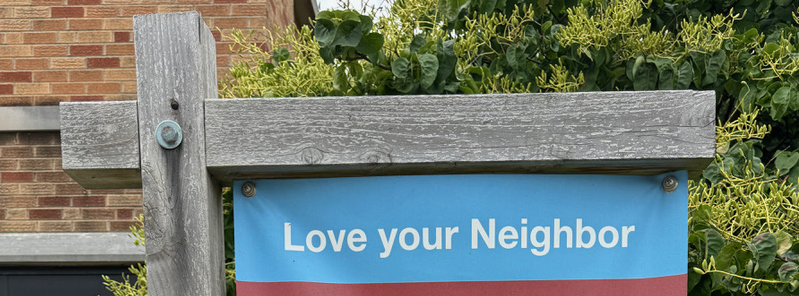
One of the reasons I found Dr. Moorhouse’s words so impactful was the fact that a few weeks before her message arrived, a lunchtime conversation I had with a friend and an encounter with a sign I saw on my way home from that meeting got me thinking about some related things.

As a result, I wrote a short article for the blog hosted by my church, New Covenant Church of Naperville, Illinois. The article—it was published two days after the election, on November 7, 2024—is about the well-known and well-worn phrase from the Bible, “Love your neighbor.” I’ll let the article speak for itself. Have a look at the article—and the rest of the sign—HERE.

Love_Your_Neighbor_sign_cropped

In a time where there is a lot of shouting, a lot of judging, a lot of anger, a lot of finger pointing; in a time when many people make assumptions about the motives and beliefs of others without taking the time to speak with and understand them; in a time when name calling and insulting others has risen to a harmful, toxic level; the admonition to “Love your neighbor” has, as I discovered on that day when I had lunch with a friend, some unexpected components. It got me thinking. Have a look at my article. Maybe that sign and its implications will prompt you to do some thinking, too.

Two trombone anniversaries: 50 and 127 years

Two trombone anniversaries: 50 and 127 years

by Douglas Yeo (August 24, 2024)

Anniversaries are a big deal.

This summer, I got to take part in two trombone anniversaries with the Wheaton (Illinois) Municipal Band.

Since 1930, the Wheaton Municipal Band—a high level community band that is supported by the city of Wheaton, the Municipal Band Commission, and the Board of Directors and Friends of the Wheaton Municipal Band—has been giving concerts for appreciative audiences each summer. In the summers of 1974 and 1975, when I was a student at Wheaton College, I was a member of the Wheaton Municipal Band. My memories of those summers with the band are fond ones, and little did I know that a couple of years later, (in 1977) I would become a member of the most famous concert band in the country, New York City’s Goldman Band. These were important stepping stones in my career as a musician which led to my many years as bass trombonist of the Boston Symphony Orchestra (1985–2012) and so much more.

Wheaton_Trombone_Quartet_reunion_2022

Members of the 1974–1976 Wheaton College Trombone Quartet (Douglas Yeo, James Roskam, Eric Carlson, William Meena) with George Krem, April 23, 2022, on the occasion of a faculty recital given by Douglas Yeo at Wheaton College.

My path to earn my undergraduate degree in college was a little unconventional. I graduated in three, not four, years: one year at Indiana University (where I studied with Keith Brown) and two years and two summers at Wheaton College (where I studied with Edward Kleinhammer). During my first summer quarter at Wheaton College, I took trombone lessons with Wheaton College’s trombone teacher, George Krem. George was a superb teacher and trombonist and when I arrived at Wheaton College, he had already announced he would be leaving the faculty at the end of the summer to take the position of principal trombonist with the Victoria Symphony in Canada. (George later went on to be professor of trombone at University of Iowa.) In the summer of 1974, both George and I were members of the Wheaton Municipal Band and we played a duet with the band, Paul Tanner’s Concert Piece for Tenor and Bass Trombones. Teacher—George—and student—me.

Yeo_Krem_Wheaton_Municipal_Band_1974_CROPPED

Article from The Wheaton Leader, July 24, 1975

Wheaton’s town newspaper, The Wheaton Leader, published an article on July 24, 1974, about the performance George and I would give of Tanner’s Concert Duet at the Band’s concert the following day. Then, on July 25, 1974, we played the duet. I was so proud to stand on stage performing alongside my teacher. When I look at the photo of George and me that accompanied that article, I always smile. There I am, with my long hair (and it got much longer than it was at that time) and a little goatee. Times have changed. Good thing!

Now, fast forward 50 years. A few months ago, when I realized that the Wheaton Municipal Band had a concert on July 25, 2024—EXACTLY 50 years after George Krem and I played the Concert Duet, I contacted Dr. Bruce Moss, conductor of the Wheaton Municipal Band. Bruce has been conductor of the Wheaton Municipal Band for 45 years and he has just retired from his position for the last three decades of director of bands at Bowling Green State University.  Two more anniversaries. I asked Bruce, knowing how much he likes anniversaries and celebrations, “Wouldn’t it be fun if the band played Paul Tanner’s Concert Duet again with another teacher/student combination, exactly 50 years after George Krem and I played it together?” Bruce jumped at the idea and I knew exactly who I would ask to play the duet alongside me.

Kumar_Yeo_WMB_2024

Poorna Kumar and Douglas Yeo, July 14, 2024

As readers of TheLastTrombone know, I served as trombone professor at University of Illinois Urbana-Champaign from 2022-2024 while the School of Music was conducting a search for a new full-time trombone professor. One of my students at UIUC, Poorna Kumar, was a member of the Wheaton Municipal Band in the summer of 2022 and she was playing in the band again in the summer of 2024. Poorna is an exceptional person and player. She is now a senior at University of Illinois, simultaneously earning two degrees: a bachelor of science degree in community health, and a bachelor of music degree in trombone performance. Poorna is also in her third year as a drum major with the Marching Illini and she received the prestigious Robert E. Gray trombone award at Illinois in 2023. I pitched the idea to Poorna and she was happy to agree to play the Concert Duet with me. We had a rehearsal at our home (photo above) and a few days later, we were standing on stage together with Bruce Moss and the Wheaton Municipal Band at the bandshell at Memorial Park in Wheaton.

Kumar_Yeo_WMB_25_July_2024

Douglas Yeo and Poorna Kumar performing Paul Tanner’s Concert Duet for Tenor and Bass Trombones with the Wheaton Municipal Band, Bruce Moss, conductor, July 25, 2024

Anyone who has been to a summer band concert knows how special and fun those events are. People of all ages bring chairs and picnic blankets to enjoy music as the sun is setting. My family was there; Poorna’s family was there, and together with a large, appreciative audience, we all enjoyed celebrating the 50th anniversary of a moment when the Wheaton Municipal Band featured a teacher/student duet with one person—me—as a common denominator in both performances.

Kumar_Moss_Yeo_Wheaton_Municipal_Band_25_July_2024

Poorna Kumar, Bruce Moss, and Douglas Yeo on stage at Memorial Park, Wheaton, Illinois, July 25, 2024

That 50th anniversary performance was great fun. Any teacher can tell you what a joy it is to work alongside a student. I was so proud of Poorna; it was a special collaboration in so many ways.

But wait, there’s more! There was another anniversary coming up the following week.

Berliner_62Z_Romance_for_Trombone_May_27_1897_label_sm

Berliner 62Z, Romance for Trombone (1897)

In 2022, I wrote an article for TheLastTrombone about Berliner 62Z, one of the earliest trombone solo recordings (if you click the link above, you can also hear the recording). This recording was made before the great trombone soloist, Arthur Pryor, began recording trombone solos. I acquired an original copy of Berliner 62Z and researched the history of the recording, the composer of the piece, Romance for Trombone (Charles William Bennet), the trombone soloist (Harry Stone), and  the accompanying band (William Haley’s Military Concert Band). You can read all about it HERE.

The Wheaton Municipal Band concert on August 1, 2024, was a special event that celebrated University of Illinois. Bruce had invited three conductors from University of Illinois School of Music to guest conduct the band: Dr. Linda Moorhouse, Director of the School of Music; Dr. Kevin Geraldi, Director of Bands (who as a young student, had been a member of the Wheaton Municipal Band); and Gary Smith, director emeritus of the Marching Illini. When I learned that the concert would be a celebration of University of Illinois bands, I just had to be a part of it and work alongside my friends from UIUC. I loved teaching at University of Illinois for the last two years; it was a very memorable time for me to work with my talented students and with great colleagues. I will always be an Illini.

So, I pitched another idea to Bruce Moss. How about, since the concert would celebrate music at our state’s flagship university, I do something that combined education and music? I asked Bruce if I could say a few words to the audience about Berliner 62Z and its important place in the history of the trombone. A little music history lesson, appropriate for an evening when we were celebrating University of Illinois. Then, we could play the original Berliner 62Z recording, on the 127th anniversary after it was released. And then I would perform Charles William Bennet’s Romance for Trombone with the Wheaton Municipal Band. Bruce said “LET’S DO IT!” So, we did.

Yeo_Moorhouse_WMB_Aug_1_2024

Douglas Yeo performing Charles William Bennet’s Romance for Trombone with the Wheaton Municipal Band, Linda Moorhouse, conductor

Just like the week before, the audience was engaged in everything that was going on onstage. There were a lot of alumni and friends of University of Illinois present that evening. There was a lot of orange and blue—the school’s colors—in Memorial Park. When I came on stage, I opened my tuxedo jacket to reveal the orange and blue Illinois shirt I was wearing. The crowd roared. Then, I led the audience in the Illini cheer: I shouted, “I-L-L” after which the audience shouted, “I-N-I”! With school spirit fully activated, I said a few words about Charles William Bennet’s Romance for Trombone and we played the 127 year old recording. Hearing an old 78 rpm record made all of us smile – there were more than a few people present who remembered those old discs, and hearing the scratchy recording made all of us appreciate how far recording technology has come in 127 years. Then I played Bennet’s Romance with the band, conducted by my good friend, Linda Moorhouse. Working again with Linda was so much FUN – There’s that word again, FUN. Music making should ALWAYS be FUN! – and the band played great for the enthusiastic audience.

Geraldi_Smith_Moss_Yeo_Moorhouse_WMB_08_01_2024a

Kevin Geraldi, Gary Smith, Bruce Moss, Douglas Yeo, and Linda Moorhouse on stage at Memorial Park, Wheaton, Illinois, August 1, 2024

Two weeks of performing as soloist in concerts with the Wheaton Municipal Band. That in itself would have been a memorable experience for me. But to have those concerts celebrate two anniversaries—the 50th anniversary of the performance of Paul Tanner’s Concert Duet that George Krem and I gave with the band, and the 127th anniversary of the release of one of the earliest recordings of a trombone solo—took these experiences to a new level. This is the joy of making music: collaborating with friends, colleagues, and students, playing pieces that have importance in one way or another, bringing smiles to the faces of audience members. I’m grateful to Bruce Moss and the Wheaton Municipal Band for giving me the opportunity, once again, to stand on stage at concerts with them. Thank you, friends. These anniversaries were truly something to celebrate.