Category: trombone

A new book – The One Hundred: Essential Works for the Symphonic Bass Trombonist

A new book – The One Hundred: Essential Works for the Symphonic Bass Trombonist

Over the last year and a half, I have been at work every day on a new book that has actually taken me 40 years to write. I’m very pleased that The One Hundred: Essential Works for the Symphonic Bass Trombonist is now at the printer and available for pre-order; copies will be shipped in March.

I took my first professional symphony orchestra audition in 1977, the year after I graduated from Wheaton College. That audition was for the Minnesota Orchestra. I didn’t win; the audition was won by Max Bonecutter, although I was one of four players in the final round and got cut at the same time as Charles Vernon, bass trombonist of the Chicago Symphony Orchestra who at the time was bass trombonist of the Baltimore Symphony Orchestra. That was the beginning of a process that eventually brought me to the Boston Symphony in 1985. Over these many decades, I have been engaged in  studying the orchestral literature and learning all I could from colleagues, conductors, authors and many others. I brought the full orchestra score to most works to rehearsals, I took notes about how conductors were handling certain passages, and I noted when there were misprints and mistakes in my part. I have hundreds of scores, books and facsimile editions in my personal library and I have gotten great pleasure from studying them over and over again.

After having played the standard orchestral repertoire many times over, served on dozens of audition committees and taught hundreds of lessons in this music, I was glad that eighteen months ago, Wesley Jacobs, owner of Encore Music Publishers, asked me if I would like to write an annotated orchestral excerpt book for bass trombone.

I was delighted to be asked to undertake this huge project, and to have a book stand alongside the two other important annotated orchestral excerpt books in The One Hundred series:  The One Hundred: Essential Works for the Symphonic Tenor Trombonist (by Megumi Kanda, principal trombonist of the Milwaukee Symphony) and The One Hundred: Essential Works for the Symphonic Tubist (by Wesley Jacobs, retired tubist of the Detroit Symphony).

In an effort to write the most comprehensive book on the subject of bass trombone orchestral repertoire preparation, I collected as many sources as I could to inform my scholarship. Take, for instance, the well-known passage from the fourth movement of Beethoven’s Symphony No. 9. Below you can see the first page of this important excerpt as printed in my new book (FYI, the watermark, 2021, is the Encore Music Publishers catalog number; this image is from the final PDF proof of the book):

beethoven_9_the_100

I’m sure the music looks mostly familiar to those who have played this part. But I did not simply duplicate what I have seen in various editions of the symphony. Below you can see all of the sources that I consulted to inform both my commentary and my presentation of Beethoven’s music:

beethoven_9_sources

I used two different editions of the full orchestra score, two editions of the bass trombone part, two books about Beethoven, a book about the Ninth Symphony, a critical commentary about the Ninth Symphony and a facsimile of Beethoven’s manuscript to the piece. All of these sources, in addition to my own performance notes that I had taken during my dozens of performances of this great work, all were utilized as I put together this single page in my book. I have corrected some mistakes that have appeared in earlier printings of this music, and provided some insight into both how I approach playing this music and how conductors have led it during rehearsals and performances as well. I endeavored to leave no stone unturned and provide readers with the best, most accurate information to help them in their preparation.

While our aim was to have a book that contained 100 works, there are actually 109 works in my book. Among those works that we wanted to include were 30 that are currently under copyright, for which we needed to obtain a license and pay royalties to copyright holders in order to reproduce them in the book. We anticipated that some of the copyright holders might not give us permission to reproduce so I came up with a list of 110 works to include in case we came up short with copyrighted works. We were very pleased that 29 of the 30 copyright holders graciously agreed to license us. This left us with more works than we had originally intended but we decided to include the additional nine works over the intended 100; I have a feeling nobody will complain! The result? A book with 360 excerpts from 109 works by 49 composers.

If you are interested in more information about this new book or would like to order a copy, there are three ways you can do this:

The website of Encore Music Publishers will lead you to a page about the book; it is featured on the website’s first page. While there, have a look at Encore Music Publisher’s many other fine publications, including the edition of the Arban Complete Method for trombone and euphonium by Joseph Alessi and Brian Bowman, and the Complete Vocalises by Marco Bordogni edited by Michael Mulcahy.

Encore Music Publishers has created a website for the three books in The One Hundred series. This is a convenient gateway to information about all three books in the series, for tenor trombone, bass trombone and tuba.

I have put a page on my own website devoted to The One Hundred. There you can get a fuller account of how this book came to be, and you can also download a free PDF with 10 sample pages from the book so you can see the front and back covers, table of contents, preface, and four sample pages.

I want to thank Wesley Jacobs, owner of Encore Music Publishers, for working with me so I could – at last – write this book. It has been a labor of love, something I have wanted to do for a very long time. It is very, very satisfying to know that soon, it will be in the hands of students and players around the world.

01_cover

The Sackbut, The Psaltery and The Dulcimer – 1954 recording

The Sackbut, The Psaltery and The Dulcimer – 1954 recording

by Douglas Yeo (February 3, 2017)

A few weeks ago, I posted an article on The Last Trombone about Fake News and The Trombone. One of the things that has caused a lot of confusion about the origin of the trombone is the fact that the translators of the King James Bible (1611) translated an Aramaic word for a form of lyre as “sackbut” in Daniel Chapter 3. Sackbut is an early word for the trombone and, faced with an Aramaic word they didn’t understand, the KJV Bible translators substituted a word for something they DID know that sounded similar. Hence, the myth that the trombone dates from ancient times (rather than the 15th century) gained traction. And to be fair, most translations of the Bible since then get it right—the early trombone is no longer credited with being around in Biblical times. Including the New King James Bible.

In my ongoing research on the trombone for several of my book projects, I came across a recording made in 1954 by a doo-wop group, The Collegians, with the Sid Bass Orchestra. I saw the 45rpm record on sale on an auction site and sight unseen, I decided to buy it. The title of the song? The Sackbut, the Psaltery and the Dulcimer.

sackbut_the_collegians

That got my attention. Those are three of the instruments that are found in the King James translation of the Bible, in Daniel, Chapter 3, verse 5:

That at what time ye hear the sound of the cornet, flute, sackbut, psaltery, dulcimer, and all kinds of music, ye fall down and worship the golden image that Nebuchadnezzar the King hath set up.

The connection between the recording and the Bible verse was immediately apparent to me. So I bought the record, not knowing what I was getting. And, wow, I am glad I bought it. I found myself owning a recording of an absolutely charming song. The songwriters – who are only identified as Hoffman-Manning-Sloane – crafted a clever story about six musicians at in ancient Babylon and Egypt who played sackbut, psaltery, dulcimer, harp, cornet and flute. They stuck the harp in for good measure. The Sid Bass Orchestra’s trombone section has a prominent role, of course. It’s well sung and played, and adds something to what we know about how the trombone was used in popular culture.

You can hear this cute song on YouTube by clicking this link or click on the video image below (if you’re reading this message in an email message, you won’t see the video image below):

If you don’t smile when you hear this, you don’t have a pulse. The trombone in Biblical times? No, that’s fake news. But that doesn’t mean we can’t have a little fun with the idea. The Collegians sure did, and we can, too.

sackbut-and-musicians

Wilson Carlile: The Man Behind the Trombone

Wilson Carlile: The Man Behind the Trombone

by Douglas Yeo (January 28, 2017)

Readers of The Last Trombone know that I am at work writing several books, as well as a number of articles for various journals and magazines. I’ve just completed an article for the July 2017 International Trombone Association Journal about jazz trombonist Russell “Big Chief” Moore, a member of the Akimel O’odham (Pima) tribe who was born in Arizona and went on to play with many jazz greats including Louis Armstrong, Sidney Bechet and Charlie Parker. Moore was born in Komatke, Arizona, on the east side of the Sierra Estrella; if you threw a stone from my front porch over the mountains, it would land in Komatke. I’ve also recently completed an article about the Mozart Requiem Tuba mirum trombone solo for the Boston Symphony Orchestra program in April of this year, to coincide with performances of that piece by the orchestra (my good friend, Steve Lange, will be playing the trombone solo). And my new annotated orchestral excerpt book, The One Hundred: Essential Works for the Symphonic Bass Trombonist (Encore Music Publishers) is in the final proofreading process and will be published this spring. More on all of these projects will be coming in future posts on The Last Trombone.

One of the major writing projects that is occupying my time is a biography of Homer Rodeheaver, who was the trombone-playing song leader for evangelist Billy Sunday in the first third of the twentieth century. I am co-authoring this book with my friend Kevin Mungons of Chicago and it will be published by University of Illinois Press. In my research about Rodeheaver, I’ve been studying the use of the trombone by many pastors, evangelists and song leaders.  Many, like the late Cliff Barrows, were inspired by Rodeheaver’s example.

But before Homer Rodeheaver, there was Rev. Wilson Carlile, founder of England’s Church Army. Carlile had a life long ministry to the downtrodden in London and his movement spread around the world. He also used the trombone as a way to gain attention to his ministry, often marching through the streets of London while playing–something that resulted in his being severely beaten on numerous occasions by those who did not want to hear his message of temperance and the saving power of the Christian Gospel.

The photo below appeared as a full page image in the July 22, 1903 issue of The Tatler with the caption:

The Rev. Wilson Carlile, who leads off our series of “Preachers in their Pulpits,” the first newspaper attempt to present the clergy with the genuine actuality that photography can alone provide, is the honorary chief secretary of the Church Army, which he founded in the slums of Westminster in 1882. He is rector of St. Mary-at-Hill, the church which is illustrated in our picture. He is fifty-six years of age.

carlile_full_photo_small

On May 4, 1900, the Chicago Daily Tribune ran an article about Wilson Carlile and his ministry; it is reproduced below. The article is written in a spectacularly evocative style, and is a tremendous tribute to this Godly man who did so much good for so many. The author, who is not credited, certainly found that the trombone made an impression, and his conclusion will bring a smile to anyone who plays the trombone or has known a trombone player:

All this is the work of the man behind the trombone, and for the possibilities that lie in that much maligned instrument let all trombone players be respected. They are not as bad as they look. In the hands of a man truly great, the trombone is more powerful than the sword.

the-man-behind-the-trombone-carlile

Wilson Carlile (1847-1942). The man behind the trombone.

wilson_carlile_trombone_small

The buccin: the coolest trombone

The buccin: the coolest trombone

by Douglas Yeo

I don’t have a lot of things from my childhood. All of my toys and stuffed animals went away a long time ago. Even my first trombone is gone, given away to a young player whose name I don’t remember any more.

But I do have one thing, a postcard, that I purchased at the Metropolitan Museum of Art in New York City around 1965. I was on a school field trip to the Museum – I grew up in New York City (Queens) and Long Island (Valley Stream) – and my class had just entered the musical instrument gallery. And there, in a display case overlooking the Museum’s collection of suits of armor (another very cool thing, I might add), I saw a display that had these instruments:

met_buccin_01-copy_01

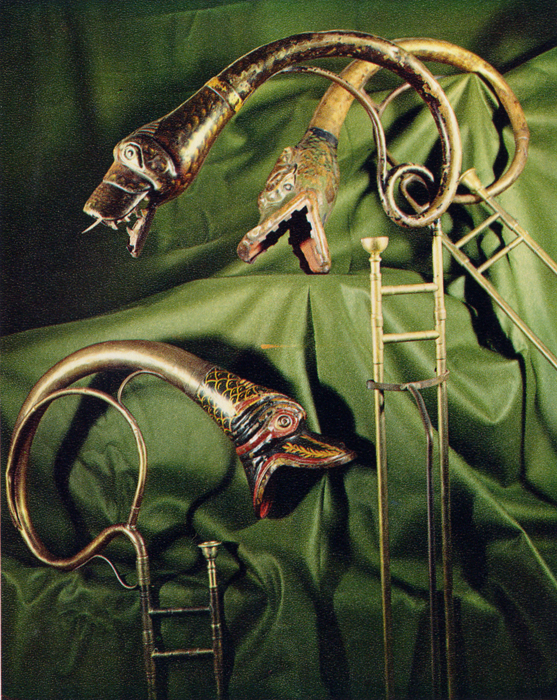
As a young trombone player, I was entranced. What is this!? I learned that this instrument is a form of trombone made in France in the early 19th century. Its name? The buccin. Nobody really knows how to pronounce it. I’ve heard it called “boo-cheen” and “boo-sahn” although most scholars agree on “book-sahn.” But, truly, nobody knows. These instruments were very popular in France in the first half of the 19th century; players of the buccin played trombone parts in bands and in parades, they made a spectacular sight. Buccins were usually painted in gold, red and green and some had a tongue of metal that would wag when it was played. At that moment, when I was all of 10 years old, I knew I had to have one of these remarkable instruments someday. At the time, all I could do was buy the postcard. I’m glad I did, since the Museum no longer has these instruments on display, or at least that was case a few years ago when I last paid the Museum a visit. However, the museum’s musical instrument gallery is closed for renovation at this moment and perhaps these wonderful instruments will be able to be seen once again when it reopens soon.

yeo_becker_buccin

In time, though, I was able to purchase a buccin bell. It’s difficult to find one for sale with a workable slide. So I decided to purchase a bell (made by Sautermeister in Lyon, France) and have it restored, and a new slide constructed. Jim Becker (pictured with me, above) of Osmun Music  in Massachusetts did the restoration and made the slide based on an historical model in the Museum of Fine Arts, Boston. Jim did a fantastic job and the buccin has pride of place in my personal collection of musical instruments; it hangs on the wall in my home studio amidst photos and historical drawings of serpents, sackbuts, trombones, and other instruments, as well as a letter by Hector Berlioz.

yeo_buccin_wall

Historically, there is not much music written specifically for the buccin. As I mentioned, it often doubled the trombone part in bands, particularly military bands. But we do have one piece that was specifically composed for buccin. There is a part for buccin in Hector Berlioz’s Messe solennelle, in the Kyrie. I played the Messe when I was in the Boston Symphony but I was playing the serpent at that time; the buccin part is doubled by the serpent and trombones so with only enough hands to play one instrument and with no buccin at my disposal at that time, the serpent kept my hands full.

yeo_buccin_sh_01

The buccin plays like a normal, modern trombone. Sort of. First of all, the seven positions of the modern trombone are rather flexible on the buccin. The zoomorphic bell does quite a job of disrupting the smooth flow of air through the instrument. So one must make significant adjustments with the slide to get many notes in tune. But then there is this: if you are a trombone player, pick up your trombone and close your eyes. Then play a melody you know. In the key of D major. Having a little trouble finding the right slide positions? Welcome to the world of the buccin. With no bell in front of you to provide a visual guide to slide positions, playing buccin is a bit like playing the trombone in the dark. It’s when you play buccin that you find out how well you REALLY know your trombone. By the way, the photo above was taken at Symphony Hall in Boston, in front of a display case that has several serpents. But that’s another story. . .

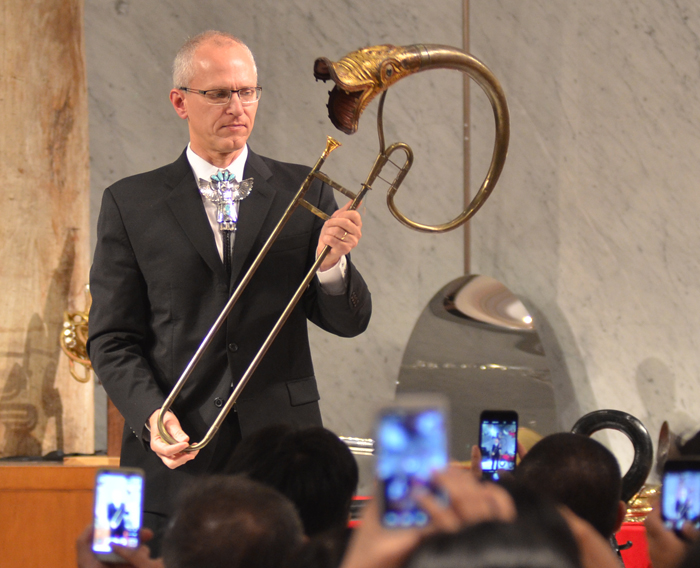
There aren’t many people in the world who play the buccin, so because of my keen interest in the instrument and the research I’ve done to learn more about it, I was asked, a few years ago, to write the entry for the instrument for the new edition of The Grove Dictionary of Musical Instruments. I also wrote most of the Wikipedia entry for the buccin. Two years ago, I gave a recital in the Hamamatsu (Japan) Museum of Musical Instruments and got to demonstrate and talk about the museum’s fine buccin. The photo below tells the story – look at all of the cell phone cameras that went up when I picked up the buccin. The buccin was easily the hit of my recital.

yeo_hamamatsu_buccin_01

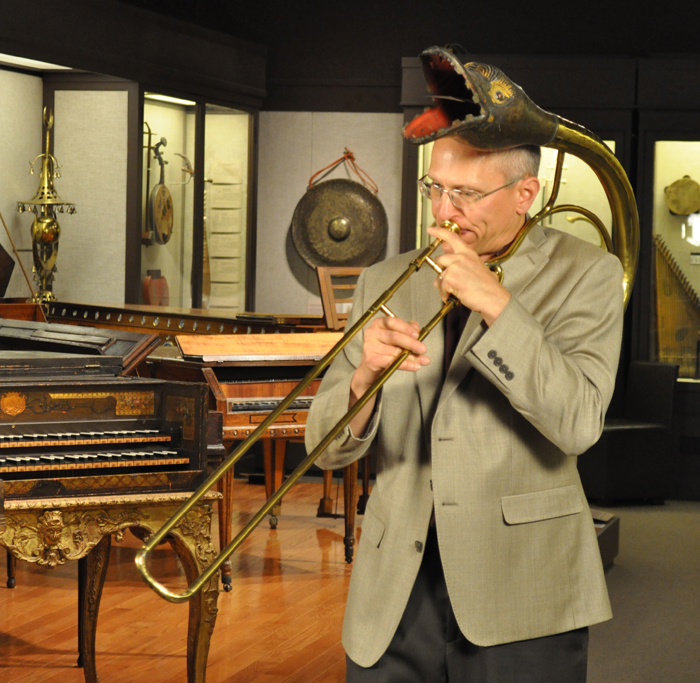
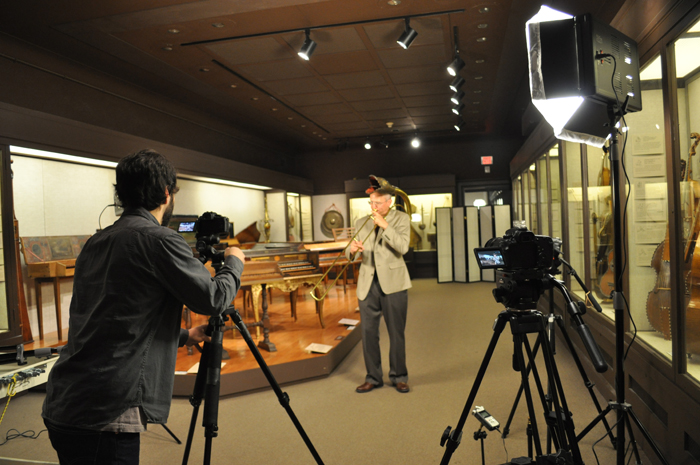
 In 2012, I recorded a short video on a buccin owned by the Museum of Fine Arts, Boston. Their buccin was made by Tabard in Lyon around 1830 and still has most of its original paint as well as a metal tongue.

yeo_mfa_buccin_02

The MFA has now posted that video on their YouTube channel and you can view it by clicking HERE (to go to the page in YouTube) or just click the video image below. I am playing the buccin part from Berlioz’s Messe solennelle. It will give you an up close look at the buccin and its sound. And its wagging tongue.

That’s the buccin. The coolest trombone. Ever.