Category: trombone

Trombone iconography: confusion abounds (and it shouldn’t be this difficult)

Trombone iconography: confusion abounds (and it shouldn’t be this difficult)

The trombone as we know it has been with us for around 500 years. That is, the familiarly shaped instrument with a U-shaped slide for the right hand that is connected to a bell that sits on the player’s left shoulder. The “as we know it” bit is my disclaimer to leave aside, for the purposes of this article, any discussion of precursors of the trombone -– real or imagined – such as the Renaissance slide trumpet. For this discussion, I’m talking about the trombone as a trombone, that familiar instrument that is instantly recognizable when seen on stage, in parades, and in artwork.

Well, maybe it’s recognizable.

I’ve been working on several books and in the course of my research, I’ve been very interested to see how artists – painters, sculptors, photographers – render the trombone. Because of the instrument’s distinctive shape, one would not think it would be so difficult to draw a trombone correctly, or more fundamentally, put it together correctly. But it apparently is more complicated than I think it should be. This article is a gallery of some images where artists got the trombone wrong. The point of this exercise: to remind us of the dangers of making assumptions about musical instruments from iconography alone. Imagine if a researcher stumbles upon these images 500 years from now. What kinds of assumptions would they make about the trombone and how it is held and played if they base their conclusions on these (and similar) images that are simply wrong in their depiction of the trombone? Abundans cautela non nocet! (Abundant caution does no harm!)
Douglas_Yeo_solo_Boston_Pops copy

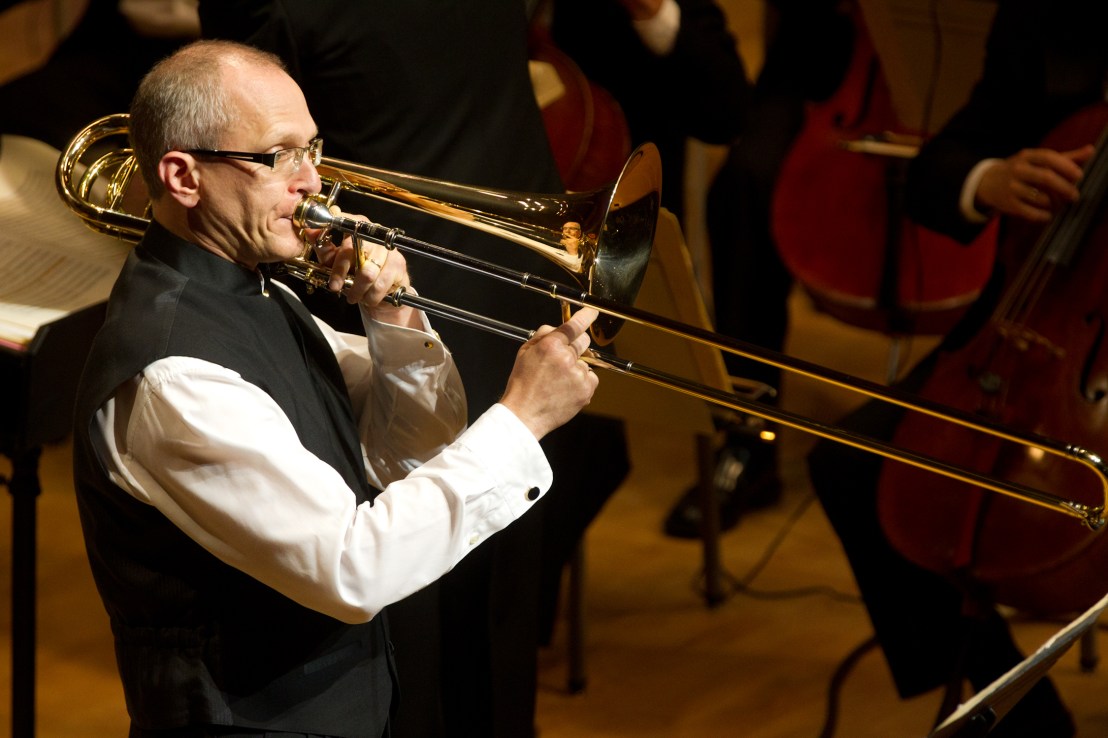
First, here is how most people hold the trombone while playing. That’s me soloing with the Boston Pops Orchestra in Symphony Hall, Boston, a 2011 performance of the Bass Trombone Concerto written by my good friend, Chris Brubeck. The photo was taken by Michael J. Lutch. The instrument’s bell section is positioned on top of my left shoulder with the bell extending in front of my head. The hand slide is held by my right hand and is moved in and out. This said, we must note that in history, there have been trombones where the bell has extended backwards over the player’s left shoulder; these instruments are known as “over-the-shoulder” or OTS instruments. They achieved some popularity in the nineteenth century although they are known to have existed as early as the sixteenth century. At least that’s what some iconography tells us. They were never commonplace. And, yes, there are some trombone players who have put the trombone bell over their RIGHT shoulder moved the hand slide with their LEFT hand – jazz trombonist Locksley Wellington “Slide” Hampton comes to mind. But these instances are rare in the big scheme of things.
IMG_1337

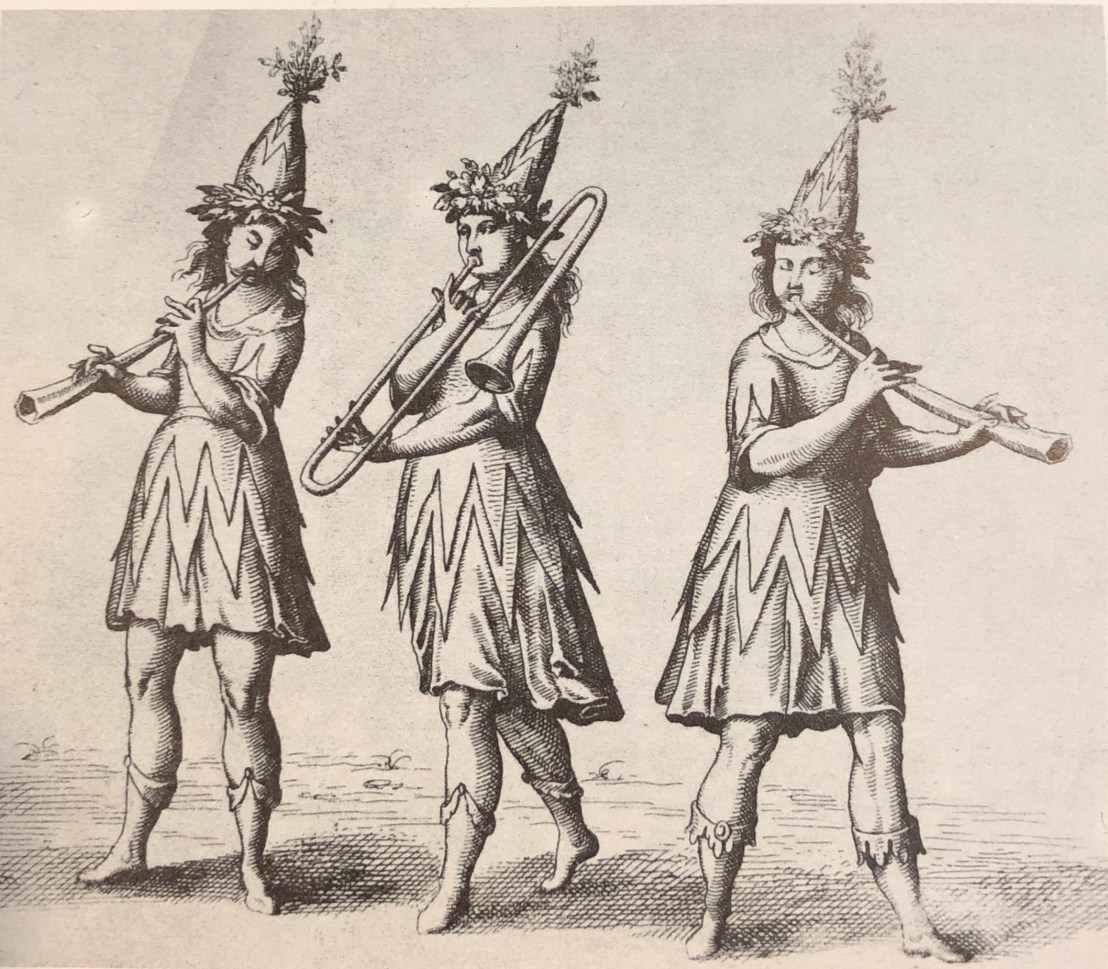
From the beginning of the trombone’s history, artists have had trouble with the concept of the trombone’s slide. This print, above, by Esaias van Husen dates from 1616 and is an example of the problem. At first glance all looks well with the trombone player who is flanked by cornettists. But while the trombone bell is properly shown as resting on the player’s left shoulder, the instrument is being held by the RIGHT hand and the slide moved by the LEFT hand. Further, the player’s left hand is far down the slide; in this position, the player could only move the slide perhaps one or two positions before his arm would be fully extended. Seventh position would remain illusory. Readers will notice that there are no braces on the bell. This in itself is not “wrong” in that we have a few surviving historical trombones from the Renaissance that do not have any bell braces although the lack of braces certainly contributes to an undesirable flexibility of the whole instrument and would make it more difficult to hold.

To be fair, these artists probably drew the trombone from memory. They would remember the bell and the slide, but exactly how it all fit together often had them scratching their collective heads.

We should perhaps forgive our artists from the Renaissance; the trombone was still relatively new and it was not ubiquitous in culture. Still, we must be very careful when we try to draw conclusions about what the trombone looked like in its early history solely on the basis of paintings, drawings, and sculptures.
trombone_wrong_01

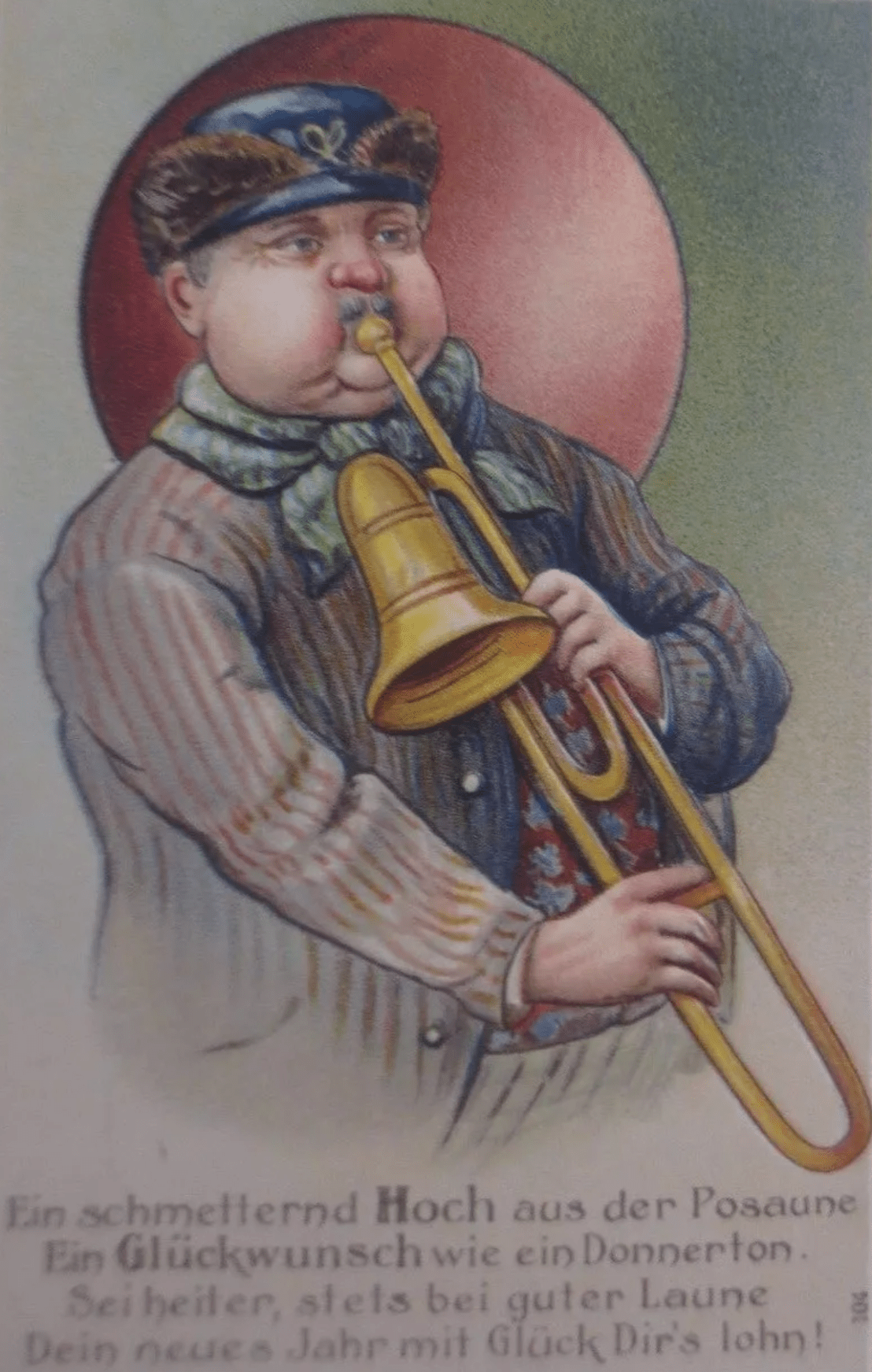
But from the nineteenth century forward, I’m a little less forgiving. I mean, who thought that THIS (above) actually looked like a trombone? Where do we begin with the problems?! This New Year’s card carries the following greeting (a loose translation):

A blaring high note from the trombone,

A greeting like the sound of thunder.

Be cheerful, and in a good mood,

And good luck to you in the new year!

Well, good luck playing that instrument, whatever it is.
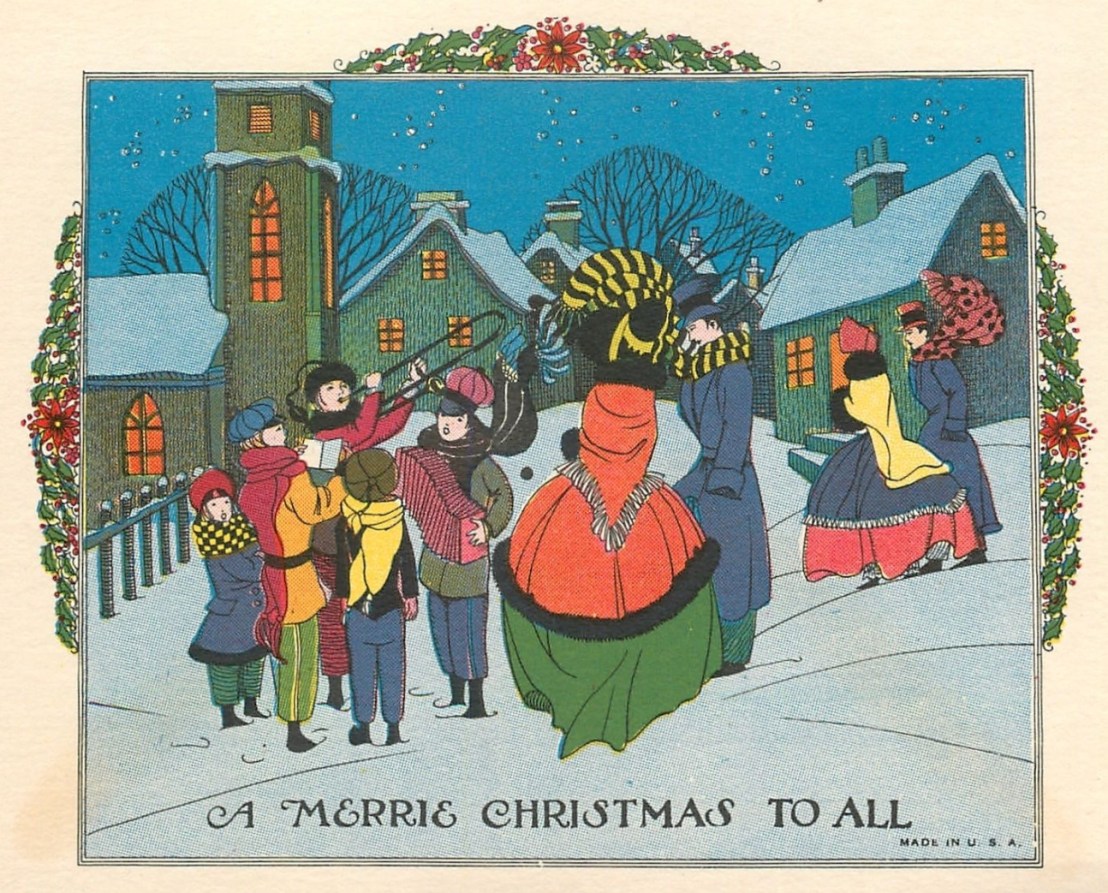
trombone_wrong_02

Here we go again. A lovely Christmas card, probably early twentieth century, with a woman playing trombone to accompany some Christmas carolers. But look at the impossibly small size of the trombone bell, and once again, with the bell over the left shoulder, it’s the left hand moving the slide. It ain’t necessarily so.
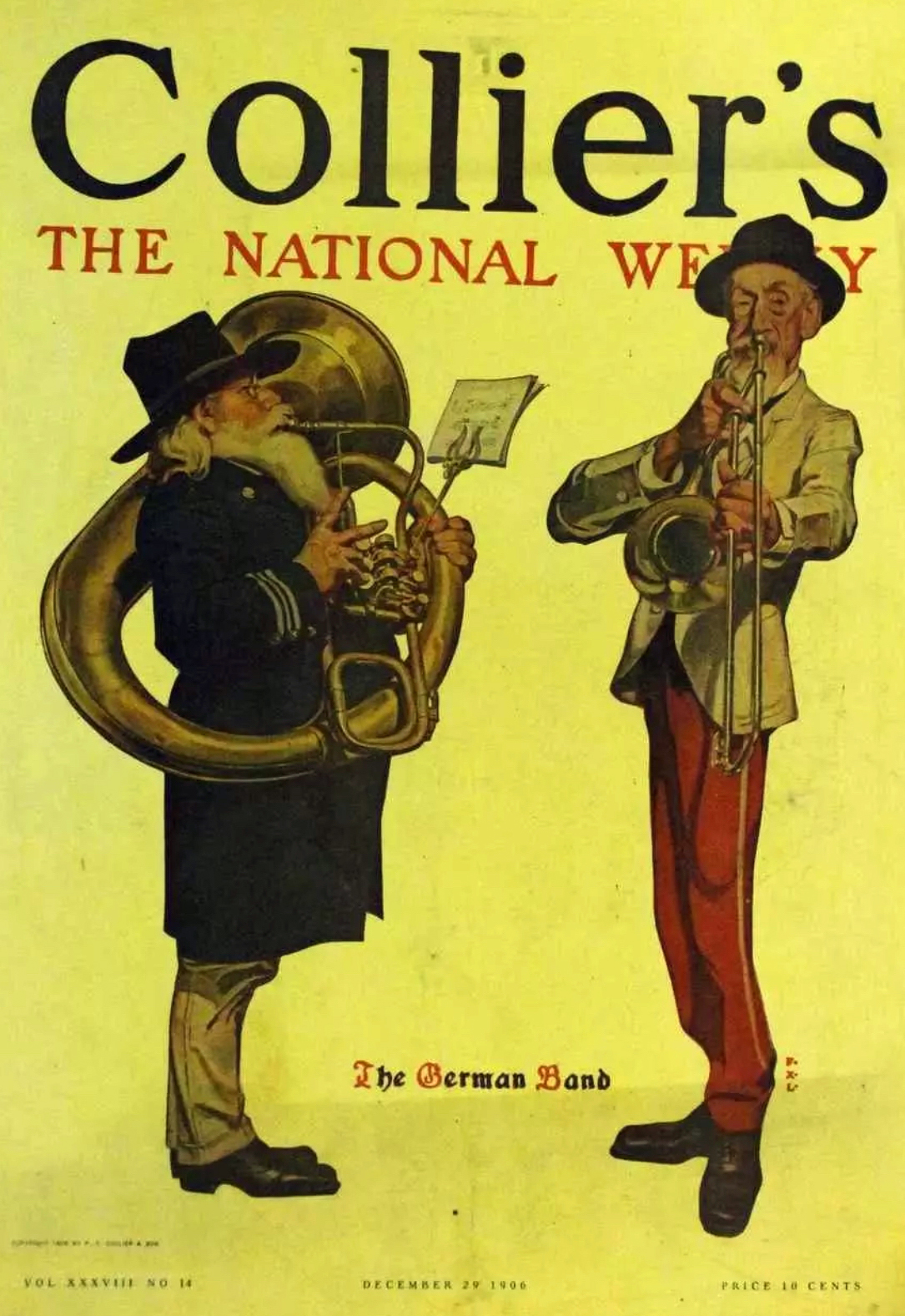
trombone_wrong_03

Here is a cover of Collier’s magazine, from December 1906. “The German Band” is shown.  I don’t know any German trombone players who hold the trombone like this. In fact, I don’t know any trombone players of ANY nationality that hold the trombone like this. Once again, we have a left-handed trombone player but, wow, with the bell under his right arm, it sure looks like the trombone is a weapon. I don’t like that look on his face. Better get out of the way!

trombone_wrong_04

Here is the famous poster made in 1894 or 1895 by Louis Anquetin; it features Marguerite Dufay, a well-known entertainer in the late nineteenth and early twentieth centuries in the cafés concerts in Paris. I think we can give Anquetin a mulligan with this portrayal of Dufay. It is a poster that is 100% caricature. Dufay was a woman of ample proportions but did not have arms like this – at all. The trombone is oversized like her personality but the fact that her trombone is held over her RIGHT shoulder by her LEFT hand was noticed by writers in 1898, shortly after the poster appeared. As an aside, this is one of the most famous images of a trombone and I’ve written an article about Marguerite Dufay, “Finding Marguerite Dufay: an iconic trombonist revealed” that will appear in the January issue of the International Trombone Association Journal. Anquetin’s artistic license was part of the success of the poster. But it is still wrong!

Screen Shot 2018-11-13 at 4.19.40 PM.png

Remember those Valentine’s Day cards you used to give out to classmates in elementary school? OK, maybe you’re not old enough to remember those days where such a thing wouldn’t be met with a lawsuit, but I remember that time well. It was a very 1950s and 1960s thing. We used to give out valentines that had the look of this one, above. But, wow, what in the world is THIS? It’s actually a pretty fancy valentine. The player’s right arm moves; you can see the little hinge pin on his shoulder. Now, I THINK it’s a trombone. At least it has enough pieces to make a trombone. But who thought this instrument could work at all? Is he holding the instrument with his right hand or moving the slide? I thought that perhaps the mechanical aspect of the card might make it right. But. . . noooooo. Here’s what you can do with it:
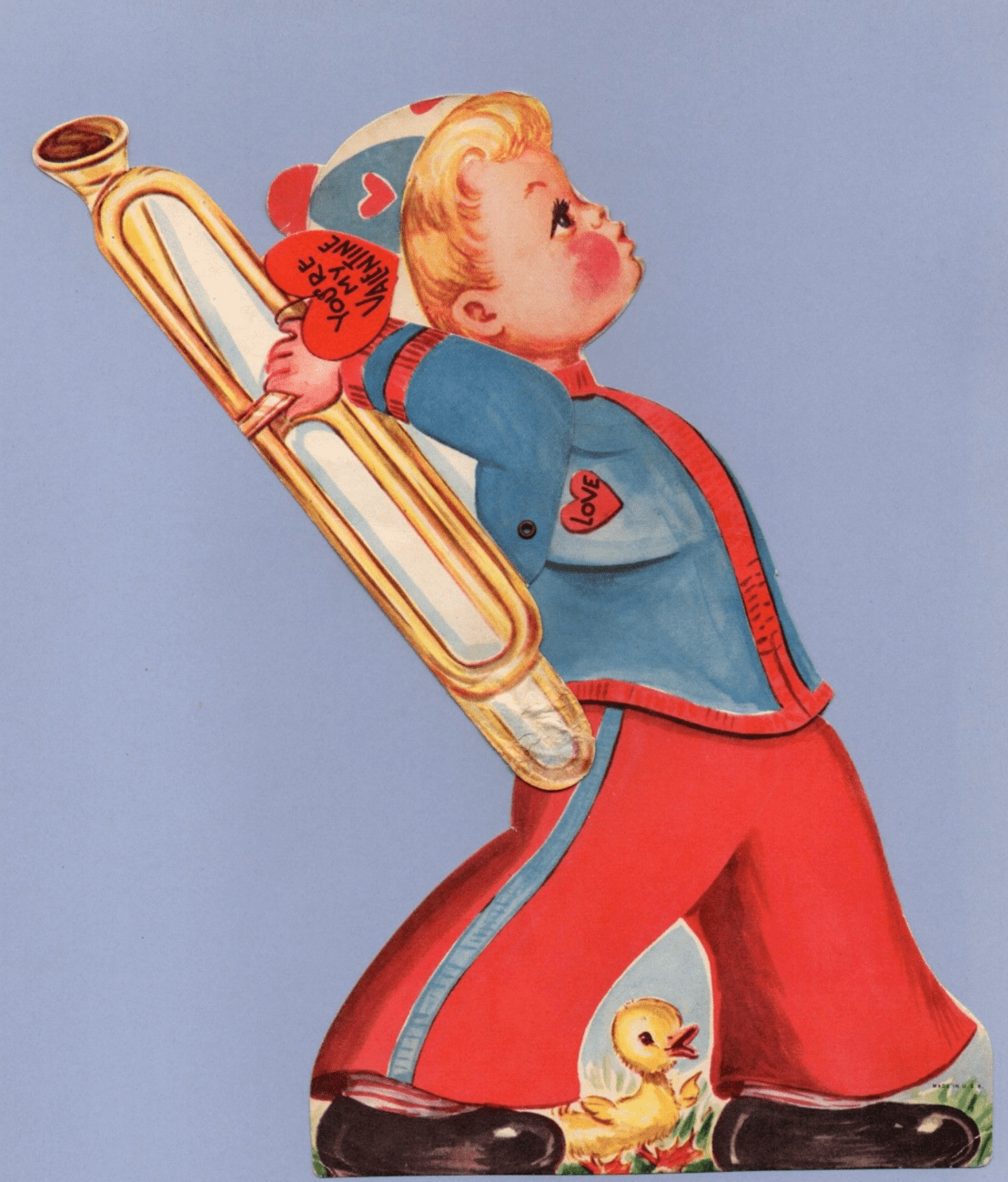
Screen Shot 2018-11-13 at 4.27.19 PM.png

Yikes. The only thing this boy can do is launch the trombone like a javelin. A new Olympic sport! Play it? No way! Where’s the mouthpiece (among other problems)? I’m always particularly disappointed when the trombone is misrepresented for children. They ought to see the instrument as it really is, and see it in a way that can help them understand what it can actually do. As they say on Monday Night Countdown before each Monday Night Football game, “C’mon, man!”
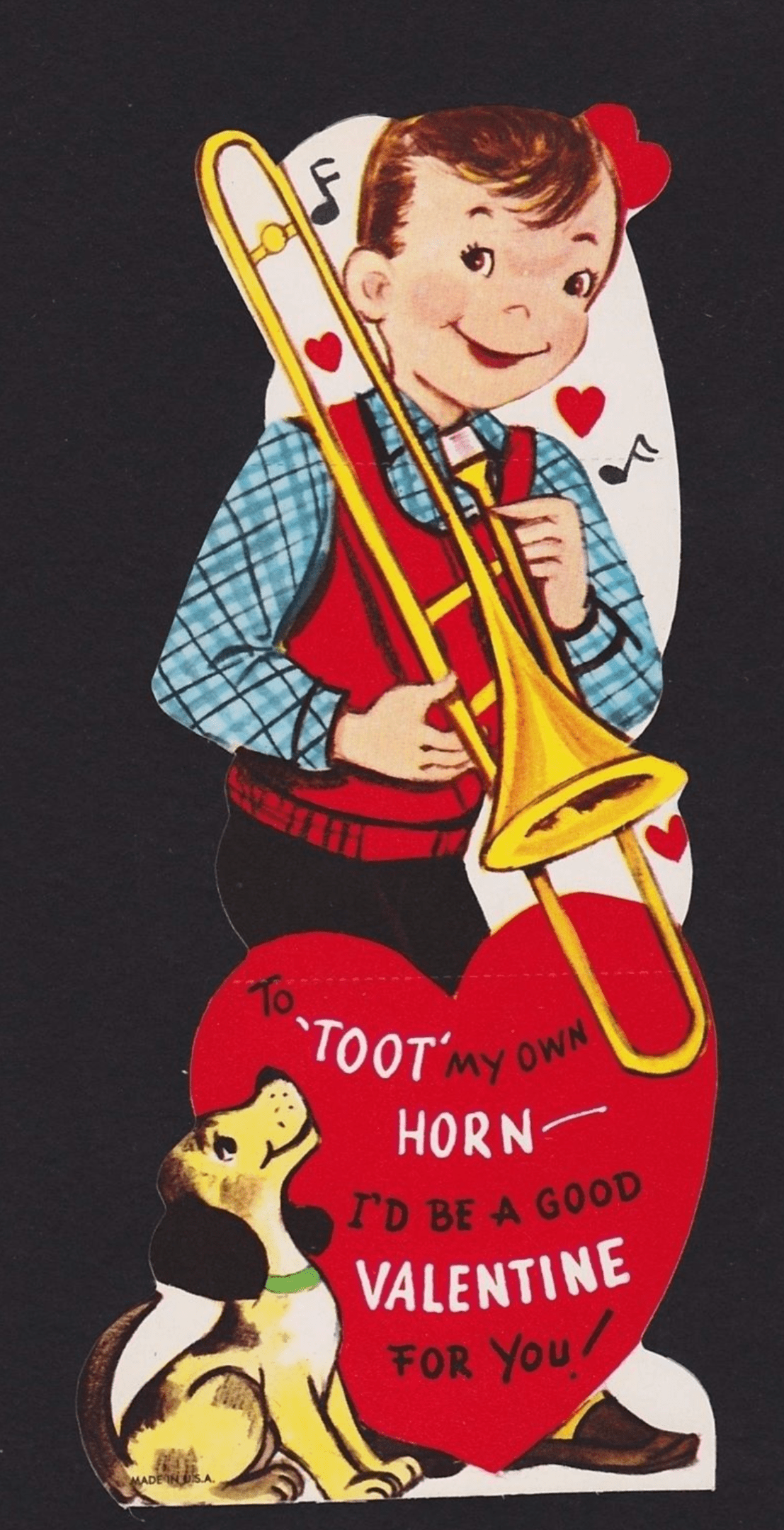
Screen Shot 2018-11-13 at 4.32.14 PM.png

Speaking of valentines, here’s another one. Such a nice young man. But since his trombone is all out of whack – once he toots his horn, I’m not sure he could actually move the slide since the slide tubes are not parallel, among other problems – I’m not sure he’d be such a good valentine after all. Why is it so difficult to get this right?!
Grimace_McDonalds_trombone_mug

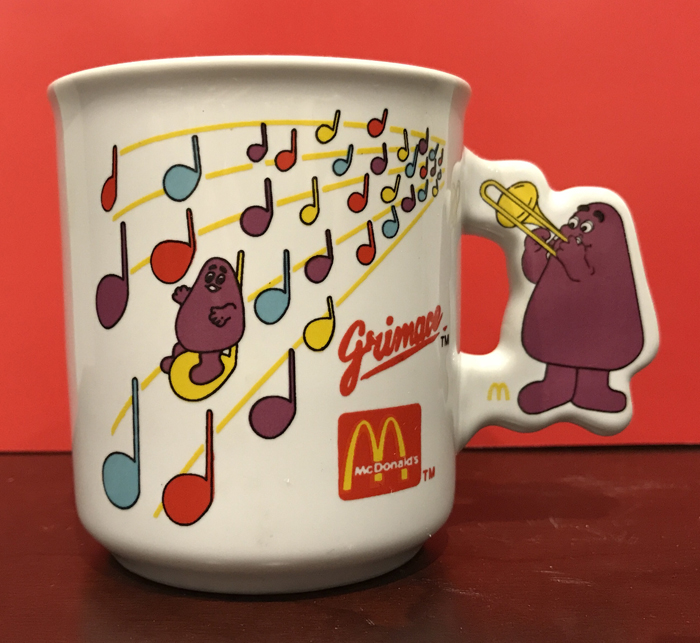
When the trombone intersects with fictional creatures, anything can happen. I picked up this mug at McDonald’s many years ago. It shows the character Grimace playing the trombone. At first glance all looks well but as you look closely, there’s a problem: where is the back end of the trombone bell? It appears to go over his left shoulder. But the bell/slide receiver appears to go right into Grimace’s chest. I don’t know, I can’t figure it out. But it is a cool mug (if you like to hold purple creatures who play the trombone while you’re drinking your coffee).
Smiths_umbrellas_trombone_card_01

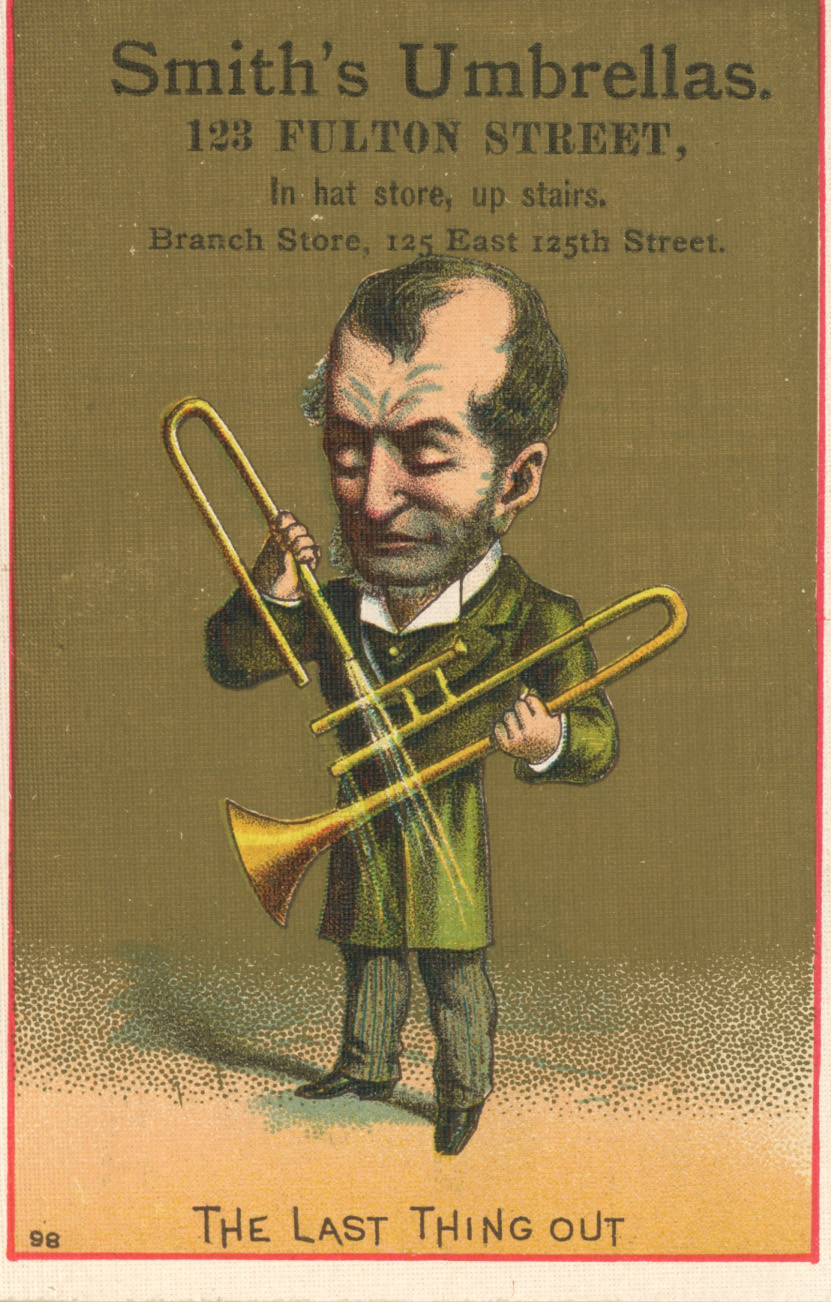
This late nineteenth century advertising card for Smith’s Umbrellas – I have several of these cards, all featuring different merchant names – shows a trombonist solving the proverbial problem of getting condensation out of his slide. But look at the inner slide – it appears to be only a few inches long. I don’t think this player could have gotten past third position before his outer slide came off in his hand. So much for the seven position trombone. . .
Rodeheaver photo with truncated trombone, 1926 - Newspapers.com

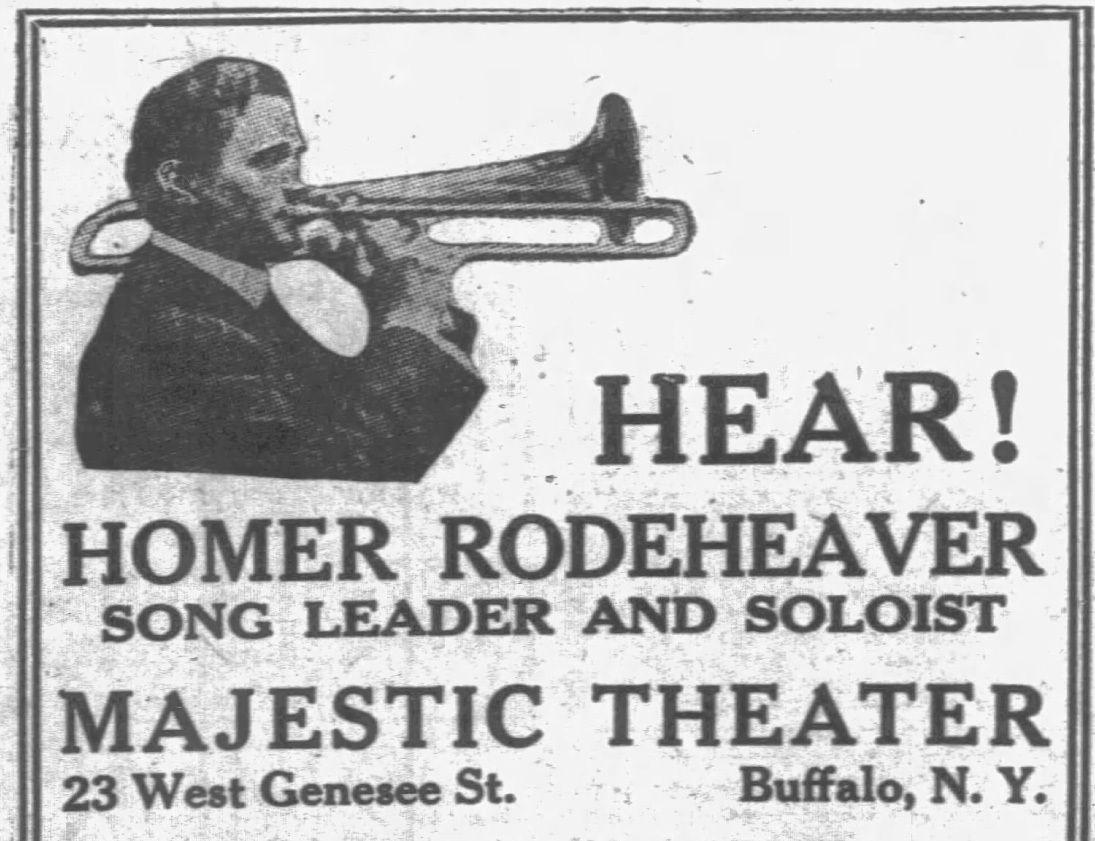
Speaking of trombones with truncated slides, here is an advertisement for an appearance by Homer Rodeheaver in Buffalo, New York, in 1926. Rodeheaver was the trombone-playing song leader for evangelist “Billy” Sunday in the first third of the twentieth century. He is the subject of a biography that I’ve recently co-authored with my friend, Kevin Mungons, that will be published by University of Illinois Press. Rodeheaver’s trombone was part of his personal brand and I’ve come across hundreds of photos of him with his instrument. I assure you, he played a standard seven-position slide trombone. But look at this advertisement; it looks like he’s playing a very short slide. The bell is the right size but the slide – what happened?

Rodeheaver020

It’s not difficult to figure out. Here is the original photo that was used in the ad. As you can see, the end of Rodeheaver’s trombone slide is cut off in the photo. For the advertisement, the copy editor obviously knew the photo was not complete and to use it in the ad, the trombone slide needed to have its bottom crook. So he just added one where the slide ended in the photo, ignoring the fact that the slide was actually much longer. Whoops!
Macys_ad

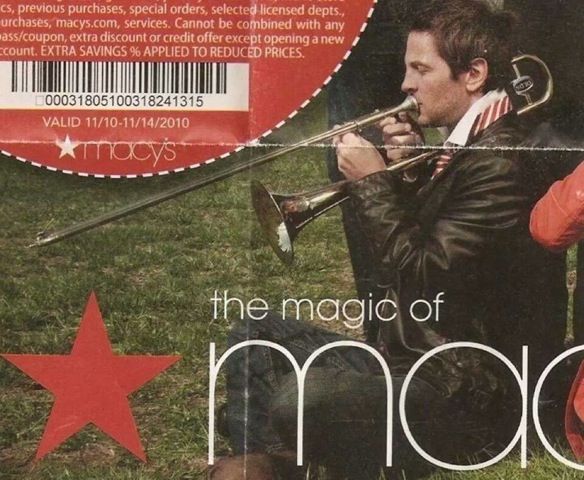
More recently, we find advertisements like this one for Macy’s. Cool looking guy. But I don’t know any trombone player who would buy a leather jacket from Macy’s based on this photo. We’ve got an impossibility here. Just try to think through how far the player’s LEFT hand can go before it slams into the bell. That could get very expensive. And painful. And speaking of money,  lot of it went into this photo shoot. You would have thought they could have gotten the actor to hold the trombone correctly, you think? EPIC FAIL!

trombone macy's

And there’s even more to the Macy’s story. Here’s another, fuller version of the advertisement. This woman may be smiling on the outside, but I have a feeling that when her trombone playing dude goes fast for sixth position, she’ll be calling 911 for an ambulance to come and take care of his broken wrist. Nothing funny about that. What in the world was Macy’s thinking? [ANSWER: Macy’s probably was NOT thinking.]
trombone_wrong_05

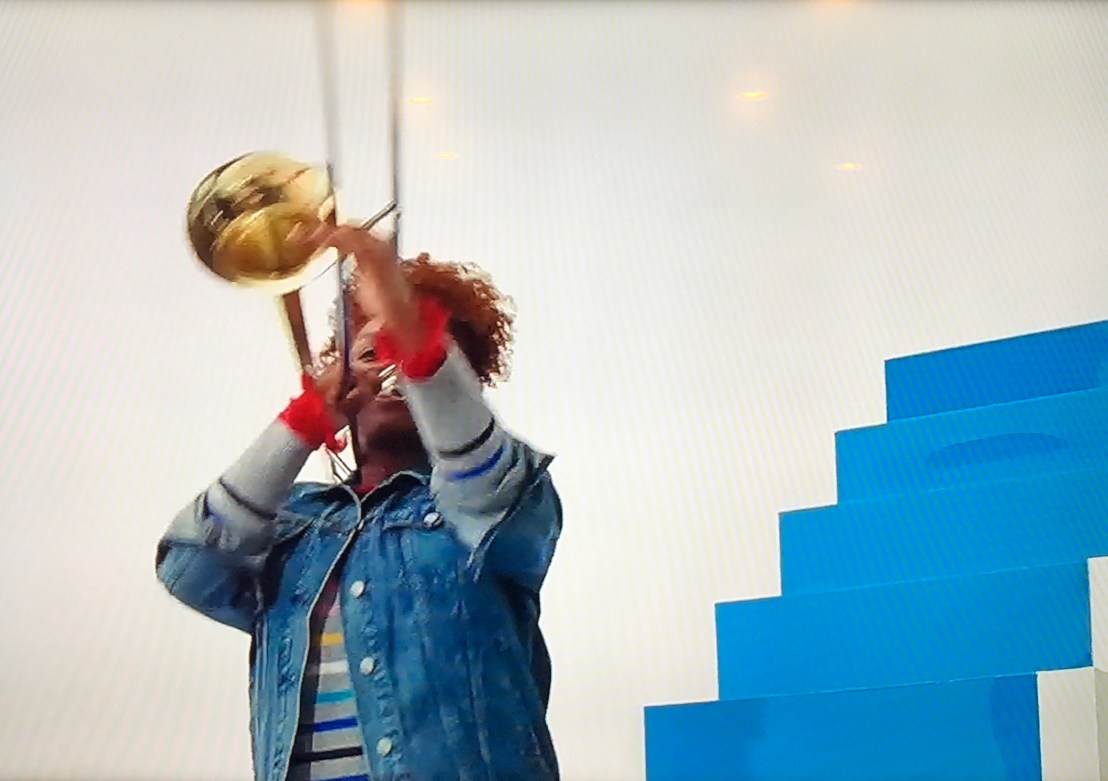
Here’s another one, a snapshot of a television advertisement for the GAP that I saw last night while watching a football game. Now, maybe this young woman really IS a left handed trombone player. But I don’t think so. It’s a rare thing when an advertising agency uses an actual musician in an advertisement. Besides, I didn’t hear any trombone playing in the ad’s soundtrack. She sure looks like she’s having a great time. But the trombone put together backwards? Uh-uh.

These kinds of examples are legion, on and on we could go. We can chuckle when we see the trombone portrayed in a goofy, or even impossible configuration. But it really shouldn’t be so difficult to get it right. And it is important. Just beware when you look at iconography for ANYTHING. Artists take their liberties, and we should always check twice before trusting any image!

 

The elusive “Rochut No. 1 and No. 73”

The elusive “Rochut No. 1 and No. 73”

by Douglas Yeo (August 2, 2018; revised November 13, 2024)

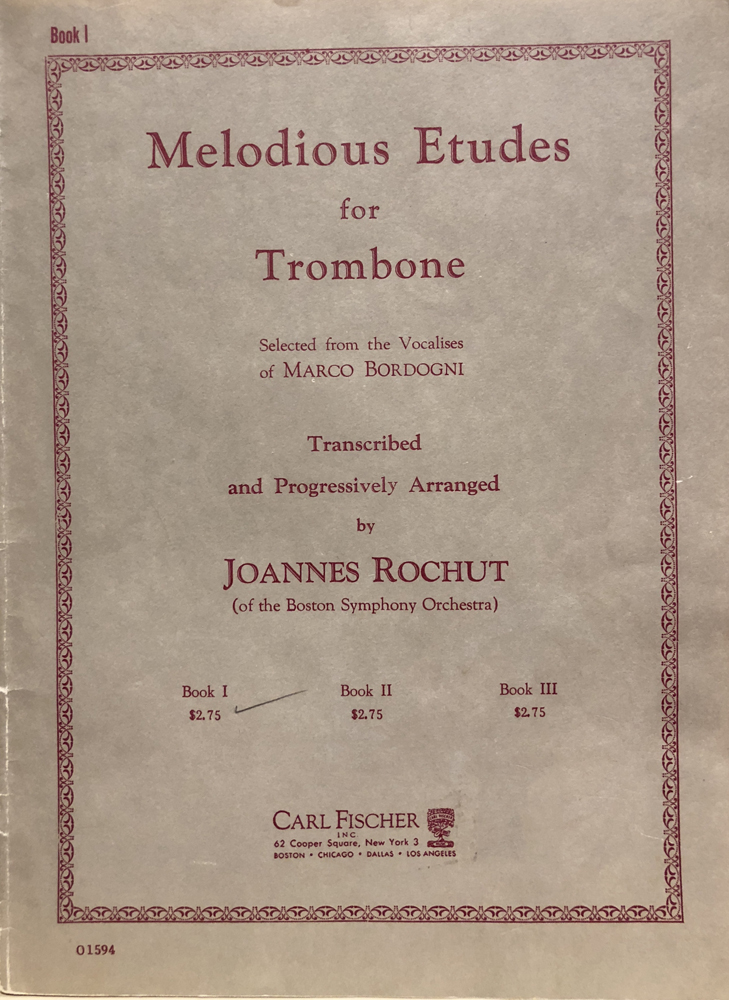
The name Joannès Rochut has been known to generations of trombone players around the world, thanks, in large part, to the three volumes of Vocalises of Marco Bordogni that he arranged for trombone. Published as Melodious Etudes for Trombone Selected from the Vocalises of Marco Bordogni, Rochut’s books were published in 1928 by Carl Fischer of New York City. The date is significant: it was during Rochut’s tenure as principal trombonist of the Boston Symphony Orchestra from 1925-1930 that he published the books that made his name so famous to trombone players. Most players today are unaware that Rochut played in the Boston Symphony, and his tenure in Boston is part of a major article about Rochut I have written that will appear in the January 2025 issue of the International Trombone Association Journal.

Rochut_Bordogni_book_1_cover

Cover to the first edition of Volume 1 of Joannès Rochut, Melodious Etudes for Trombone, Selected from the Vocalises of Marco Bordogni (New York: Carl Fischer,  1928).

But if most players today are unaware of Rochut’s connection with Boston, those who first bought his Melodious Etudes certainly knew about it, since his affiliation with the orchestra was printed on the cover of the Melodious Etudes. See the photo above of the cover of my first edition copy of Book I.

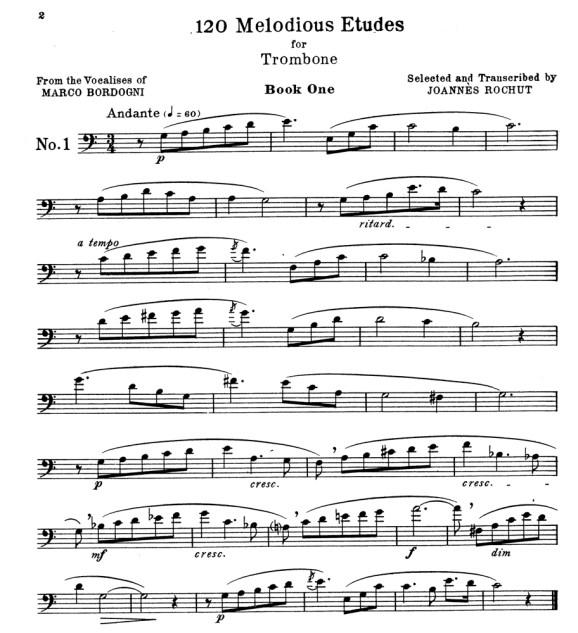
There is something about Rochut’s books that has puzzled many trombone players and scholars. Rochut transcribed and arranged 120 of Bordogni’s Vocalises. 118 of them have been identified in Bordogni’s works. But No. 1 of Rochut’s Book I and No. 73 in Book 2 have not been found in Bordogni’s oeuvre.  So, who wrote these etudes?

Bordogni_Rochut_Book_1_1928-3

Volume 1, etude 1 from Joannès Rochut, Melodious Etudes for Trombone, Selected from the Vocalises of Marco Bordogni (New York: Carl Fischer,  1928).

Some people have assumed that Rochut composed these etudes. No. 1 happens to be one of my favorite exercises in Book I and I, too, have puzzled over this, wondering who wrote it. [As an aside, note that Rochut’s first name is spelled “Joannès.” Unfortunately, Carl Fischer’s new edition of “the Rochut book” does not spell his name correctly, but that is a story for another time. . .]

A few months ago, the mystery solved itself. A needle in a haystack surfaced as I was doing research for one of the books I’m writing at this time. I had some correspondence with Gary Spolding about his planned edition of Bordogni for trumpet and we discussed “Rochut No. 1.” As a result of our conversation, I located a copy of 26 Etudes Techniques d’apres Bordogni by Louis Allard and Henri Couillaud.

Allard_Couillaud_cover

The cover of Louis Allard and Henri Couillaud, 26 Etudes Techniques d’apres Bordogni (Paris: Buffet-Crampon, 1927).

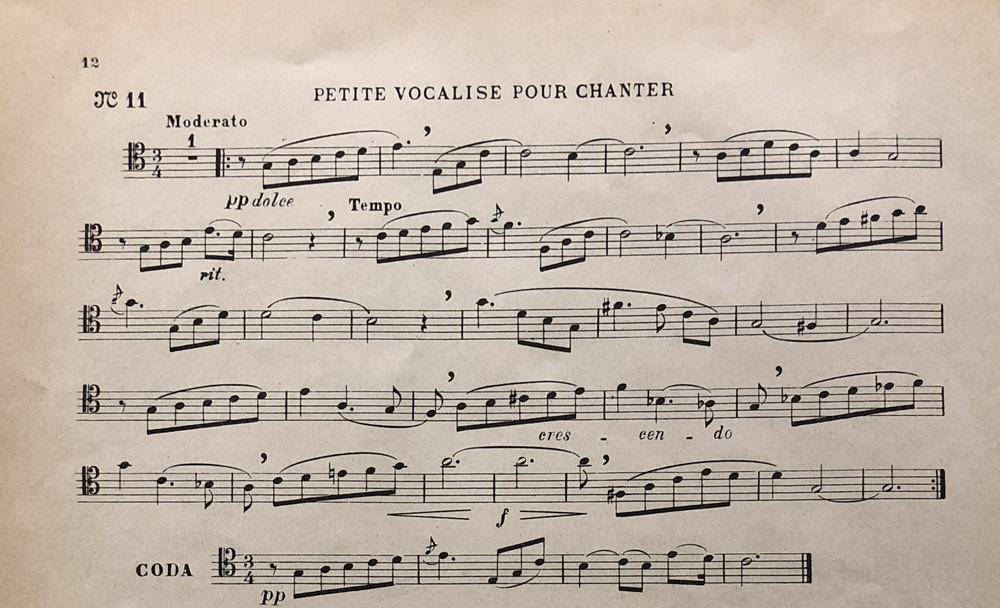
Published in Paris in 1927 – a year before Rochut’s Melodious Etudes – Allard and Couillaud’s book contains original exercises in the style of Bordogni. And on page 12, exercise 11 is found:

Allard_Couillaud_12

Exercise 11 from Louis Allard and Henri Couillaud,26 Etudes Techniques d’apres Bordogni (Paris: Buffet-Crampon, 1927).

What is this? It is none other than “Rochut No. 1.” Except it’s not. It’s Allard and Couillaud’s No. 11. Allard and Couillaud were the chickens; Rochut was the egg.

Louis Allard and Henri Couillaud were trombone professors at the Paris Conservatoire; Allard from 1888-1925 and Couillaud from 1925-1948. Rochut studied with Allard at the Conservatoire; in fact, Rochut won the first prize in trombone there in 1905, playing Sigismond Stojowski’s Fantasie.

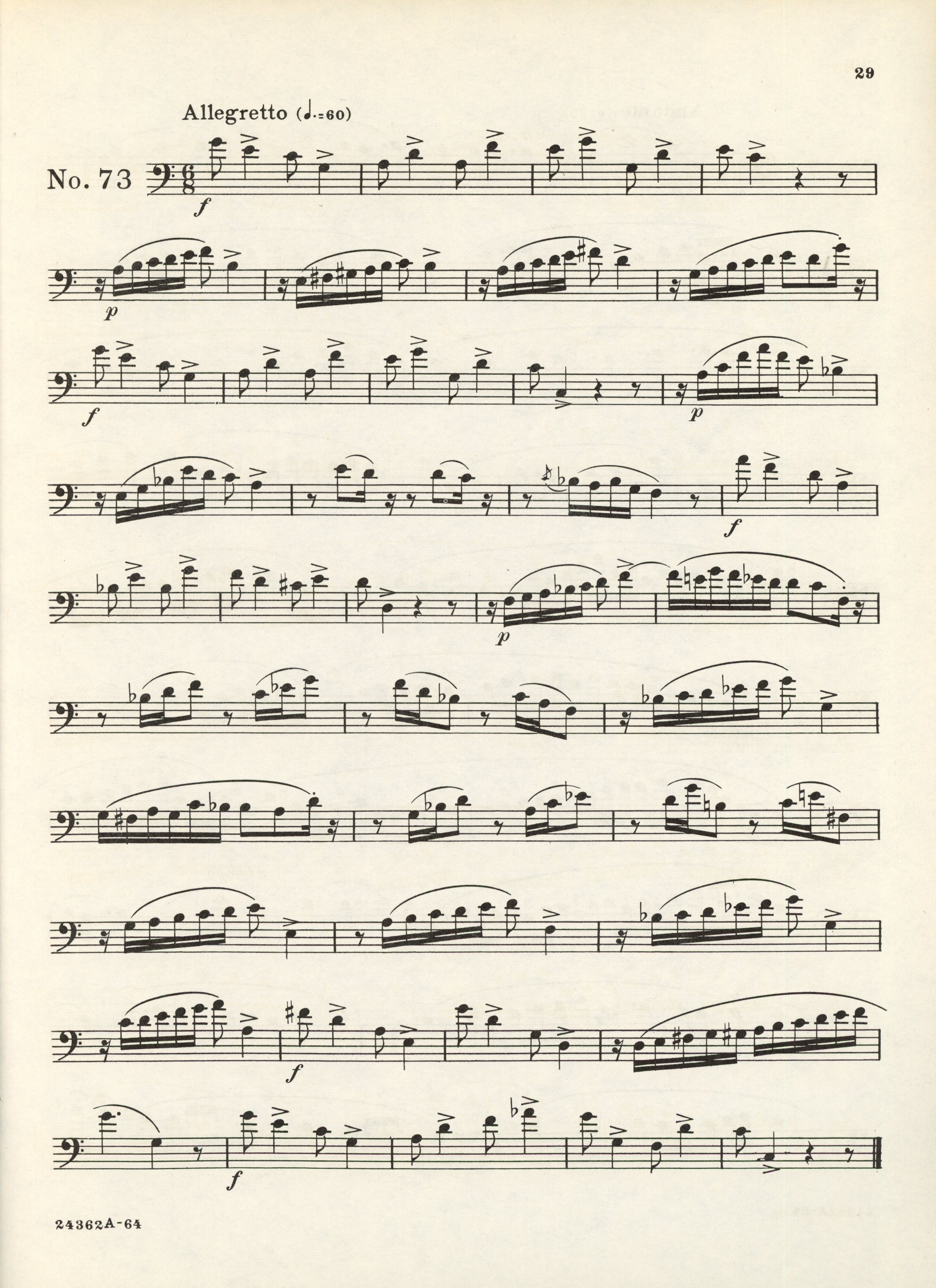
We find a similar situation with Rochut’s No. 73. It wasn’t written by Bordogni. It was also written by Allard and Couillaud, and it’s found in the same book. Here’s Rochut’s No. 73:

56.ROCHUT_Rochut_73

Volume 2, etude 73 from Joannès Rochut, Melodious Etudes for Trombone, Selected from the Vocalises of Marco Bordogni (New York: Carl Fischer, 1928).

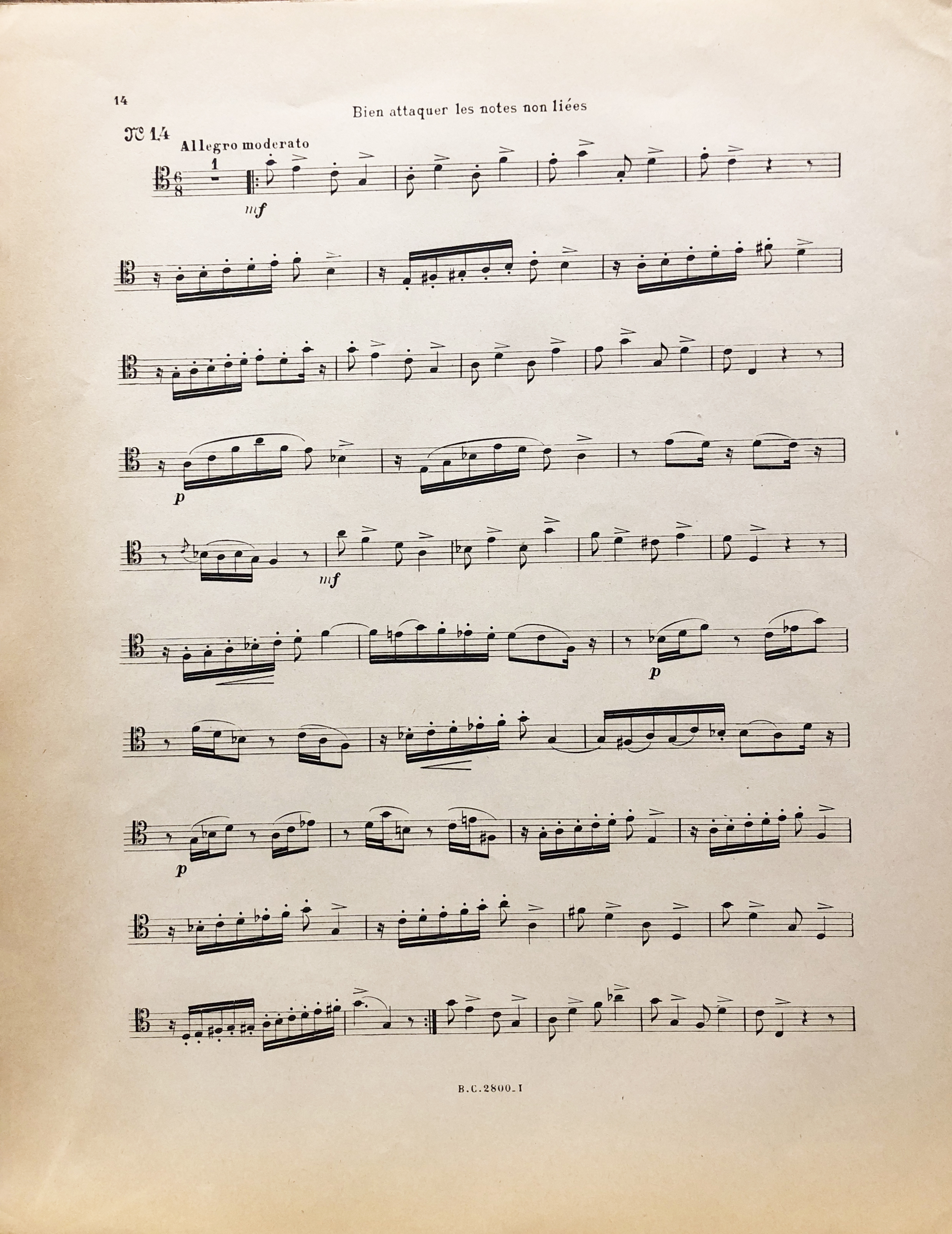
And here’s what Allard and Couillaud wrote a year before Rochut published his book of Bordogni etudes:

55.ROCHUT_Allard_Couillaud_14

Etude 14 from Louis Allard and Henri Couillaud, 26 Etudes Techniques d’apres Bordogni (Paris: Buffet-Crampon, 1927)

So here we have a situation. Rochut’s Nos. 1 and 73 were published in 1928. Allard and Couillaud’s Nos. 11 and 14 were published in 1927. Clearly authorship of the etudes points to Allard and Couillaud (1927), not Rochut (1928). And certainly they were not written by Bordogni. Which begs the question: why did Rochut include these etudes by Allard and Couillaud in his books when they had been published in another book (in France) the year before? Was he paying tribute to his teacher? If so, why did he not credit Allard and Couillaud as the composers? Did Rochut (and Carl Fischer) pay royalties to Allard and Couillaud (the Carl Fischer edition gives no credit to another publisher for their printing of No. 1 and No. 73)? Or did Rochut assume the etudes were by Bordogni; perhaps he just missed the “après” in Allard and Couillaud’s book title? [Après means “after,” as in “after Bordogni,” or “in the style of Bordogni.”] Why did Rochut omit two of Bordogni’s etudes?  What was the response of Allard and Couillaud (and their publisher) when they saw their etudes reprinted in Rochut’s book. Allard and Couillaud’s book is forgotten; Rochut’s book continues to be one of the best selling trombone books—if not THE best selling trombone books—of all time.

Spend a few minutes with Allard and Couillaud’s printing of their etudes, above; there are some significant differences between them in their book and the way they were reprinted in Rochut’s book (including tempo, dynamic, a different note, and phrasing, as well as the repeat).

Now, the hunt is on to find Allard and Couillaud’s original piano accompaniment to their etudes in the style of Bordogni. Another haystack; another needle to be found.

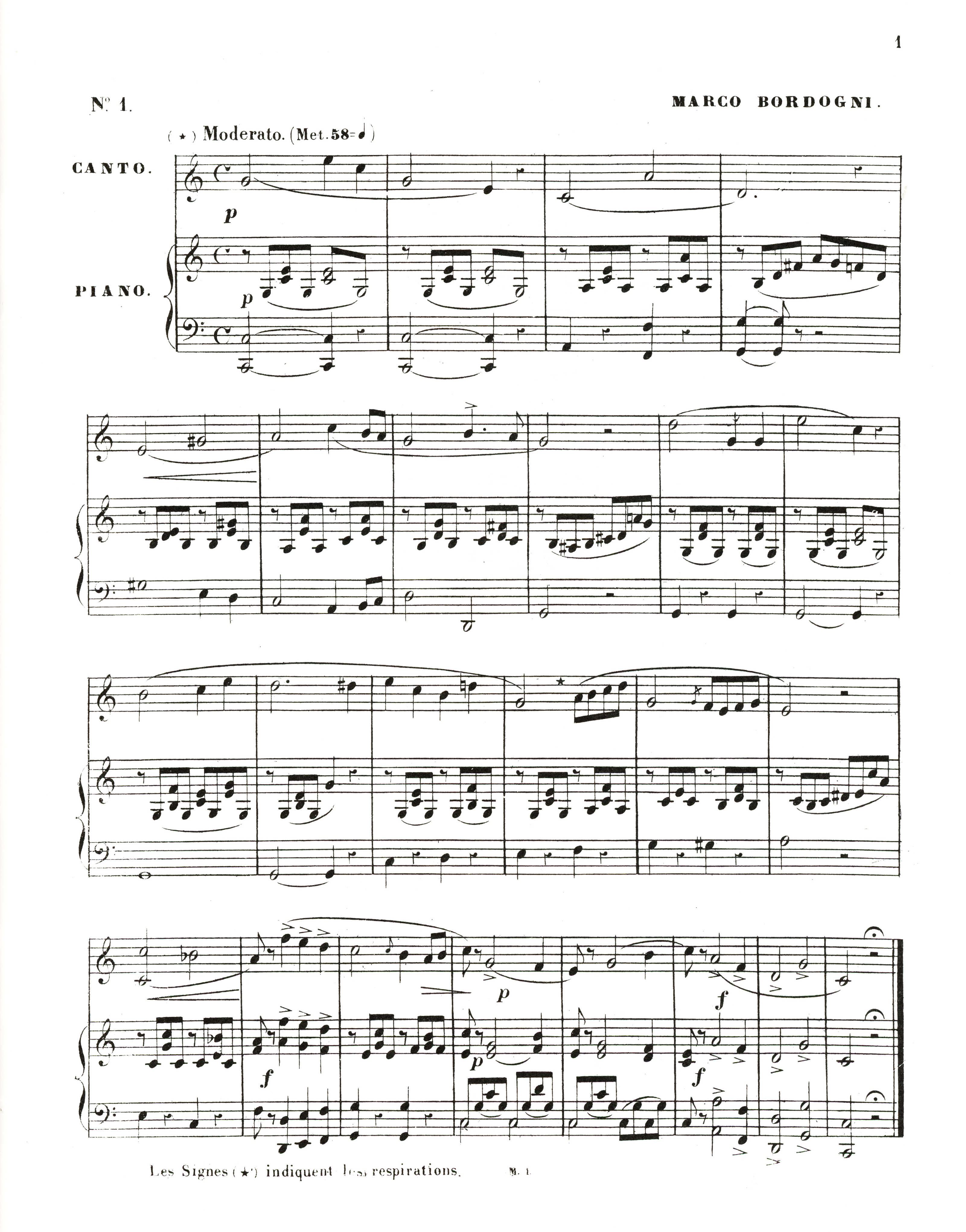
But wait, there’s more! What are the two etudes by Bordogni that Rochut left out of his book? Several  editors of editions of Bordogni vocalises for brass instruments have figured out what should be in place of etude No. 1 in Rochut’s book. Etude 1 from Bordogni’s publication, 24 Vocalises (Livre 11) is missing from Rochut’s book. Here is Bordogni’s etude; click HERE to download a PDF of this etude:
50.ROCHUT_Bordogni_livre_11_no_1

Etude 1 from Marco Bordogni, 24 Vocalises (Livre 11).

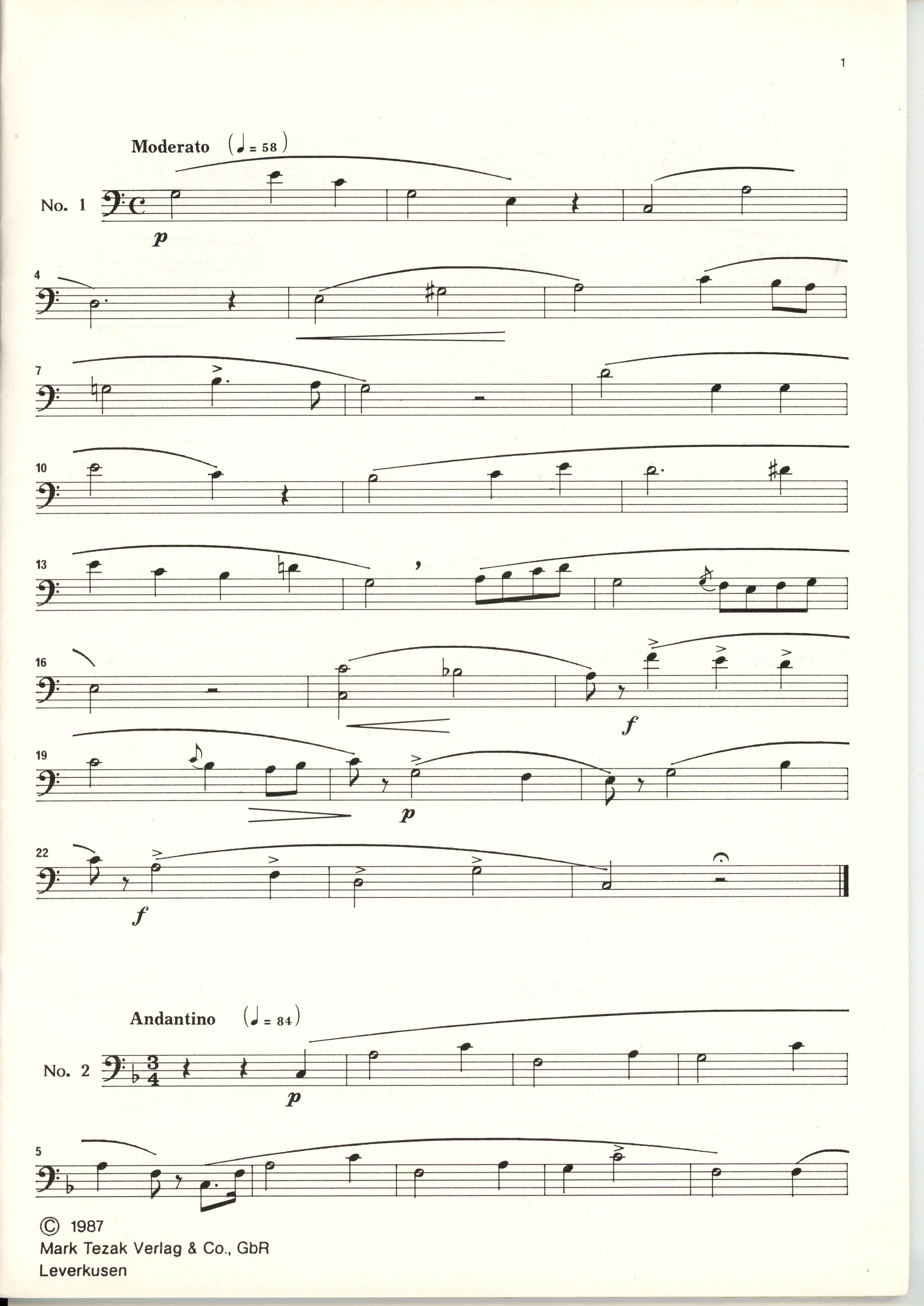
Benny Sluchin got this right back in 1987 when he published his first volume of what was planned to be an edition of the complete Bordogni for trombone (the publisher, Tezak, ultimately did not follow through and publish the complete series of etudes):

Sluchin_Bordogni_cover Sluchin_Bordogni_1

Etude 1 from Benny Sluchin, Giulio Marco Bordogni (1788-1856): The Complete Book of Vocalises, Vol. 1 (Leverkusen: Mark Tezak Verlag, 1987).

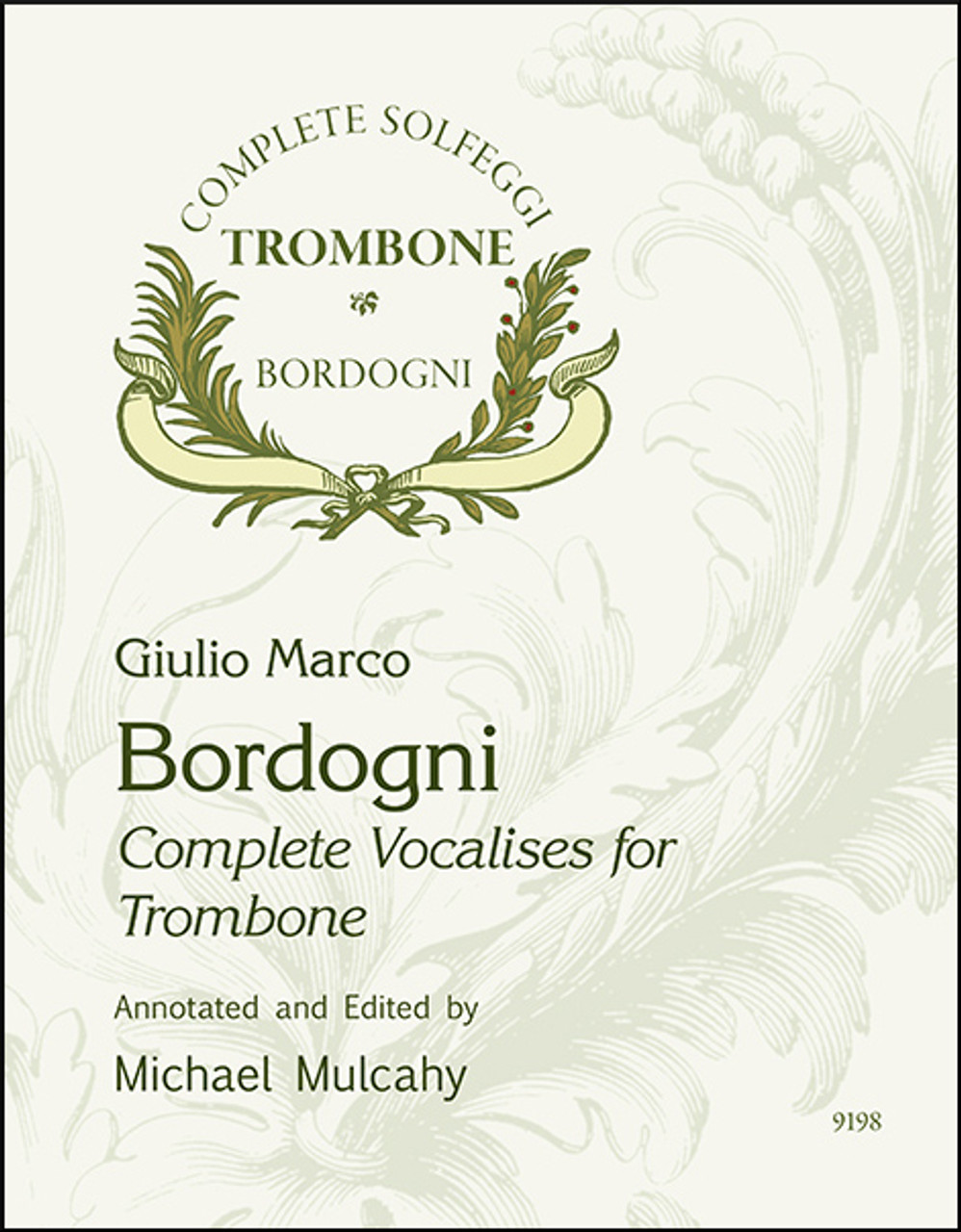
You will also find this etude correctly included in Michael Mulcahy’s book, Giulio Marco Bordogni: Complete Vocalises for Trombone (Encore Music Publishers, 2008):

  Bordogni_Mulcahy_cover  Bordogni_Mulcahy_1

Etude 1 from Marco Bordogni, ed. Michael Mulcahy, Giulio Marco Bordogni: Complete Vocalises for Trombone (Encore Music Publishers, 2008).

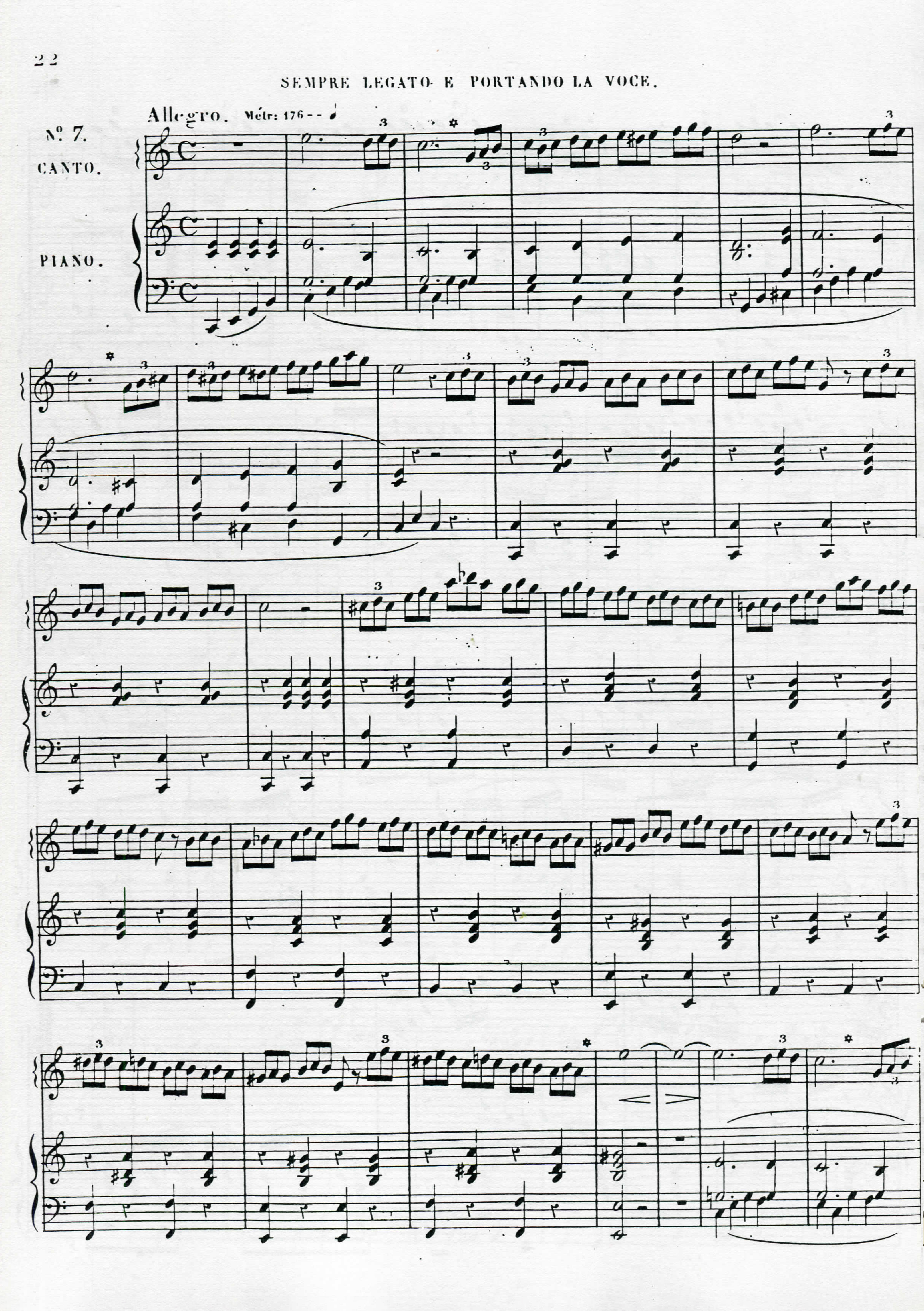
As for No. 73 in Rochut’s book (and Michael Mulcahy’s book), here is the missing Bordogni etude that should be there. It is etude 7 from Bordogni’s 36 Vocalises (Livre 1); click HERE to download a PDF of this etude:

51.ROCHUT_Bordogni_livre_1_no_7_p1 52.ROCHUT_Bordogni_livre_1_no_7_p2

Etude 7 from Marco Bordogni, 36 Vocalises (Livre 1).

Print out these two etudes by Bordogni and slip them in your copy of Rochut’s book and you will then have “the complete Bordogni.” That said, the two etudes by Allard and Couillaud that Rochut included in his books are superb. We just don’t know why Rochut included them. Happily, we now we have something more to practice.

[Photo at the top of this article: Joannès Rochut (standing) with his Lefevre trombone, and Georg Wendler (seated, horn), 1926. Detail from a photo of the Boston Symphony Orchestra brass section, 1925, courtesy of the Boston Symphony Orchestra Archives.]

Reflections on the Second Nagoya (Japan) Trombone Festival

Reflections on the Second Nagoya (Japan) Trombone Festival

I don’t think I could possibly count all of the times during my long career when I have traveled to schools, colleges, and universities to do some teaching or performing, or attended trombone festivals or symposiums as a guest artist. It would certainly number in the hundreds throughout the United States, Canada, South American, Europe, Africa, and Asia. I have always enjoyed working with trombone players around the world and I recently returned from a week in Japan where I was the guest artist for the Second Nagoya Trombone Festival.

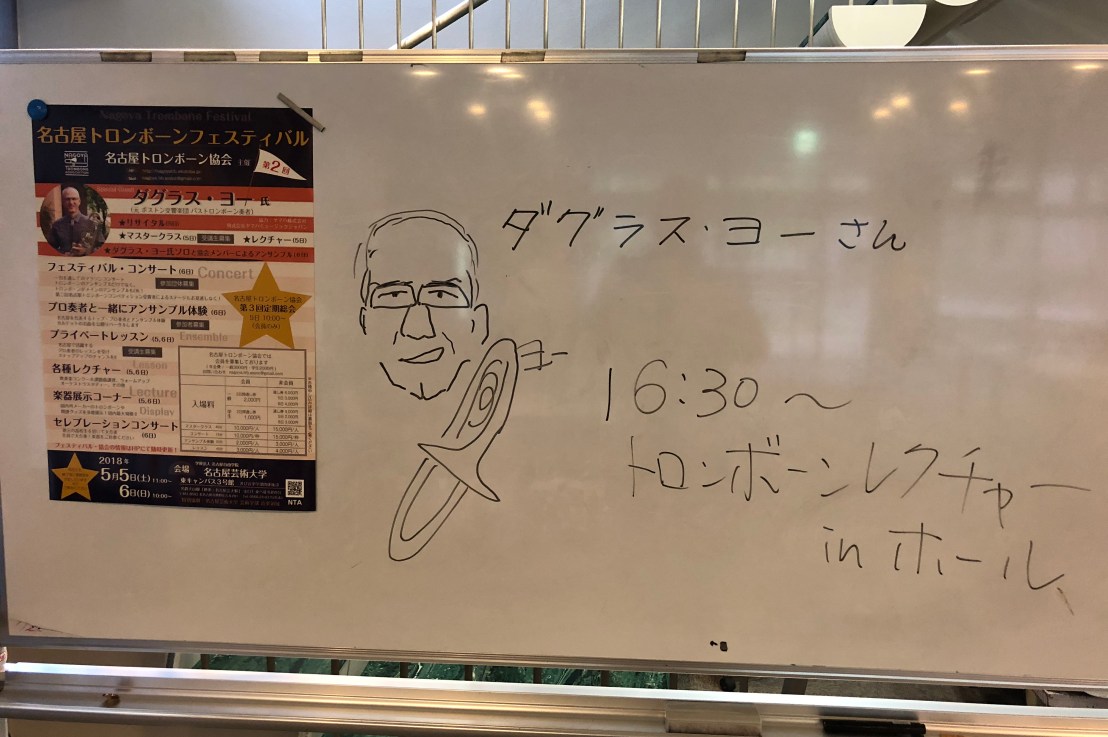
As I mentioned in my earlier post about the Festival — made before the trip — I have been to Japan twelve or thirteen times. I’ve lost count. Many of these trips were tours with the Boston Symphony (conducted by Seiji Ozawa) or Boston Pops Orchestras (conducted by John Williams), and other times were to teach and perform at the Hamamatsu International Wind Instrument Academy and Festival. The First Nagoya Trombone Festival, hosted by the Nagoya Trombone Association, was held in 2016 and Jörgen van Rijen, principal trombonist of the Royal Concertgebouw Orchestra in Amsterdam, was the guest artist. I was very honored to be asked to come as guest artist for this, the Second Nagoya Trombone Festival, held on May 5-6, 2018..

Here are a few reflections about my time in Nagoya, a time that was very special to me in many ways.

image1-1

Before the Festival began, I spent an afternoon teaching at Aichi Prefectural University in Nagoya. The University’s trombone professor is Hiroshi Kurata (about whom I recently wrote on The Last Trombone), and it is the undergraduate alma mater of Nozomi Kasano Flatt, bass trombonist of the Japan Century Orchestra in Osaka. I met Nozomi in 2004 when she was a student in my class at the Hamamatsu Academy and Festival and she subsequently came to Boston to study with me; she earned a Graduate Diploma and a Master of Music degree at New England Conservatory of Music. It was a special joy for me to have Nozomi as my translator in Nagoya, both during my masterclass at the University and also at the Festival. The photo above shows the students with whom I worked at the University, with Professor Hiroshi Kurata on the left and Nozomi Kasano Flatt on the right.

image2-1

I worked with several students who played solos, and also with an orchestra trombone section. The level of talent at the University was very high as was the level of attention of the audience members. I ended my teaching sessions with a lengthy question and answer period where several students asked engaging questions about a life in music. Kurata San was kind enough to take Nozomi and me to dinner at the finest sushi restaurant I have ever enjoyed – a small restaurant with just a handful of seats and a private chef; it was a memorable experience in so many ways. A few years ago I saw the documentary “Jiro Dreams of Sushi.” Never did I even dream that I would have a culinary experience of the quality shown in that movie. But I did, thanks to Kurata San. The photo above shows a piece of sushi as a work of art. It is impossible to describe but something I will never, ever forget.

IMG_0568

The Nagoya Trombone Association organized the Nagoya Trombone Festival and among the many people who worked hard to put it all together was my host, Hiroshi Tanaka (shown above with me after the Festival’s final concert along with the announcer for the concert).

IMG_9351

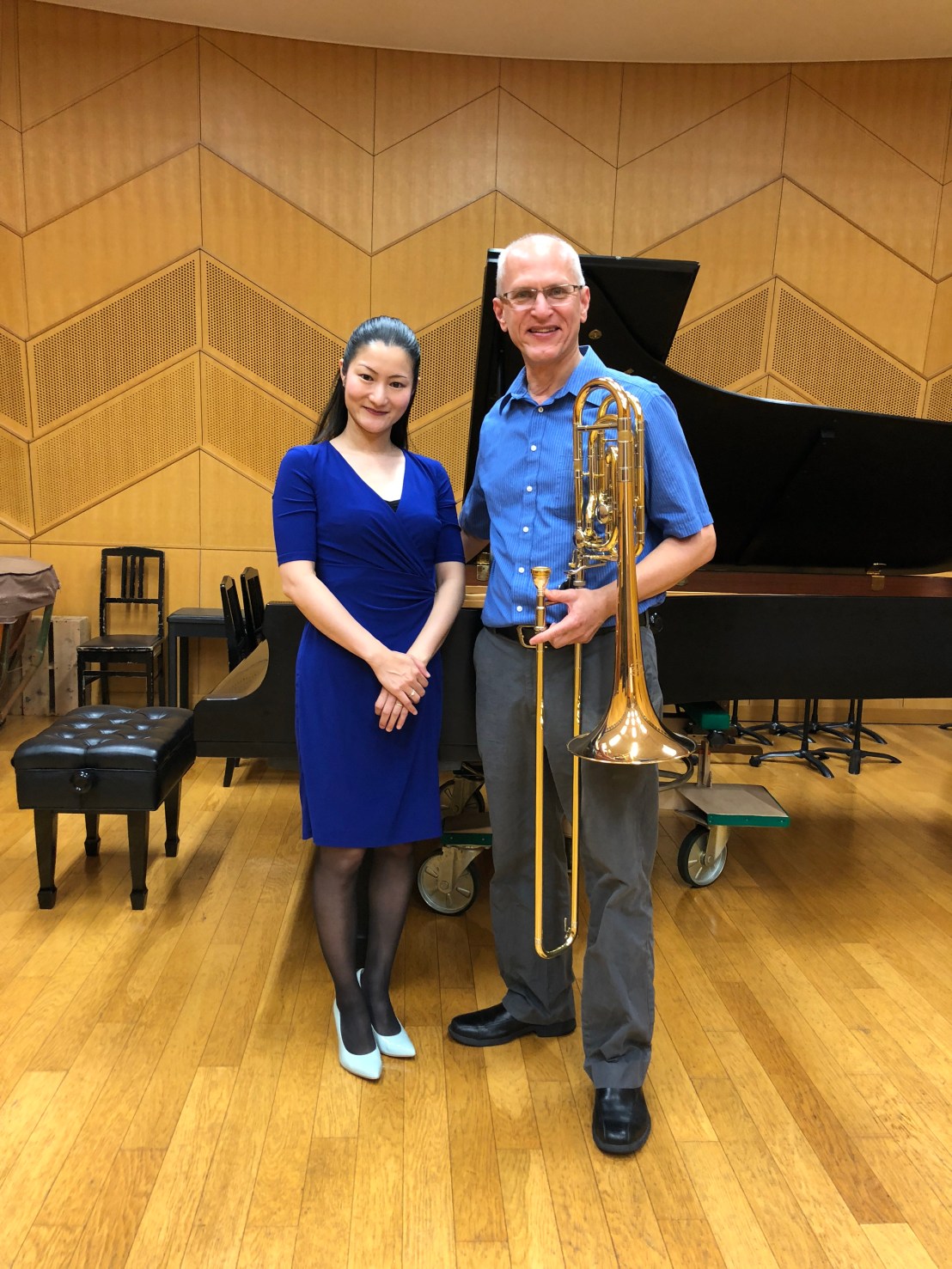
Tanaka San had engaged a superb pianist for my recital, Shoko Gamo (shown above with me after a rehearsal) and we enjoyed a very, very fruitful collaboration. I have rarely worked with a pianist who possessed such tremendous abilities as well as a very deep, emotional side to her musical personality. And a very nice person, too!

IMG_0147

The festival took place over two days. I gave a masterclass on the first day, working again with some very talented students. The photo above shows me working with a student; Nozomi Kasano Flatt is translating for me.

32076799_858622191008010_1195102425665503232_n

In addition, I gave a lecture on the history of the trombone — in 50 minutes! This was a whirlwind for sure, with nearly 100 Powerpoint slides in my presentation and Nozomi working hard to keep up with my pace. She did a great job. One of the great things about her translation skill is that she captures the character of my spoken personality. This does not happen all the time when I need a translator and it really helped those in attendance understand what I was talking about. I have rarely given a lecture for such an attentive, engaged audience. In the photo above, I have just told the audience that I was going to do the impossible — talk about 500 years of the trombone’s history in a very short time. This image from the movie Home Alone captured my feelings about the impossibility of the task!

Takei_Suzuki_Yeo_Ohse_Nagoya

The Festival also had a number of instrument companies present so participants could try out different trombones. It was great for me to see friends from YAMAHA who were present at the Festival. YAMAHA has been so great to me over the years and our relationship goes back over three decades, to 1986. In the photo above are Ken Takei, Naoki Suzuki, me (with my YAMAHA YBL-822G bass trombone), and Michio Ohse.

IMG_9378

Before I headed to the Festival on the second day, I took a long walk to Nagoya Castle, one of the great castles of Japan. I have been to Nagoya once before, on a Boston Pops Orchestra tour, but it was nice to get to the Castle, something I had read about but had never visited previously. It is a very special, majestic, peaceful place.

Day Two of the festival included my giving a recital. My program was an eclectic mix of repertoire:

Widmung — Robert Schumann, transcribed by Douglas Yeo

Sutenaide Kudasai — Jan Kaňka

Sonata No. 6 from 18 Canons Mélodieux — George Philipp Telemann, arr. Douglas Yeo

Sonata for Bass Trombone and Piano — Alec Wilder

Canzone — Girolamo Frescobaldi, arr. Eddie Koopman

Sonata for Alto Horn and Piano — Paul Hindemith

Sång till Lotta — Jan Sandström

Each piece had a particular reason for being on the program.

In recent years, I have always begun recitals with Schumann’s great paean of love to his wife, Clara, Widmung. It always reminds me of my wife, especially when I am far away from home. I also like to give my accompanist a superb piece of art music to play on my recitals and this piece certainly fits the bill. Shoko was very happy to play Schumann’s beautiful song; she told me she often plays it in the arrangement for solo piano by Franz Liszt. Her playing was spectacular.

IMG_0364

Several years ago, I became aware of the work of Czech composer Jan Kaňka. A trombonist himself, I found his Sutenaide Kudasai (the title is in Japanese and is roughly translated, “Please don’t throw it away”) to be very engaging and I thought the Nagoya Trombone Festival was a great place for me to perform it for the first time.

IMG_0275

I was then joined by Nozomi Kasano Flatt for one of Telemann’s remarkable canons, a piece that I had arranged for my book published by G. Schirmer, Trombone Essentials, and that I also recorded with Gerry Pagano on our new compact disc, Fratres. Playing a duet with Nozomi on my recital was very important to me and it was an absolute joy to collaborate with her on my recital.

Russ_Schultz_Douglas_Yeo

I wanted to perform a piece by an American composer and I chose Alec Wilder’s Sonata for Bass Trombone, a piece that for many years was the most frequently performed  piece ever written for bass trombone. Over the years, I have written several articles about the Sonata for the International Trombone Association Journal and in a serendipitous convergence of events, I had just recently happened to meet Russ Schultz, who as a student of Emory Remington at Eastman School of Music gave the world premiere of Wilder’s Sonata on March 24, 1969. The photo above shows Russ and me in a diner in Fort Worth, Texas two weeks before I went to Japan; it was great to finally meet him and then play the Wilder Sonata in Nagoya.

Yeo_Nagoya_Trombone_Festival_buccin

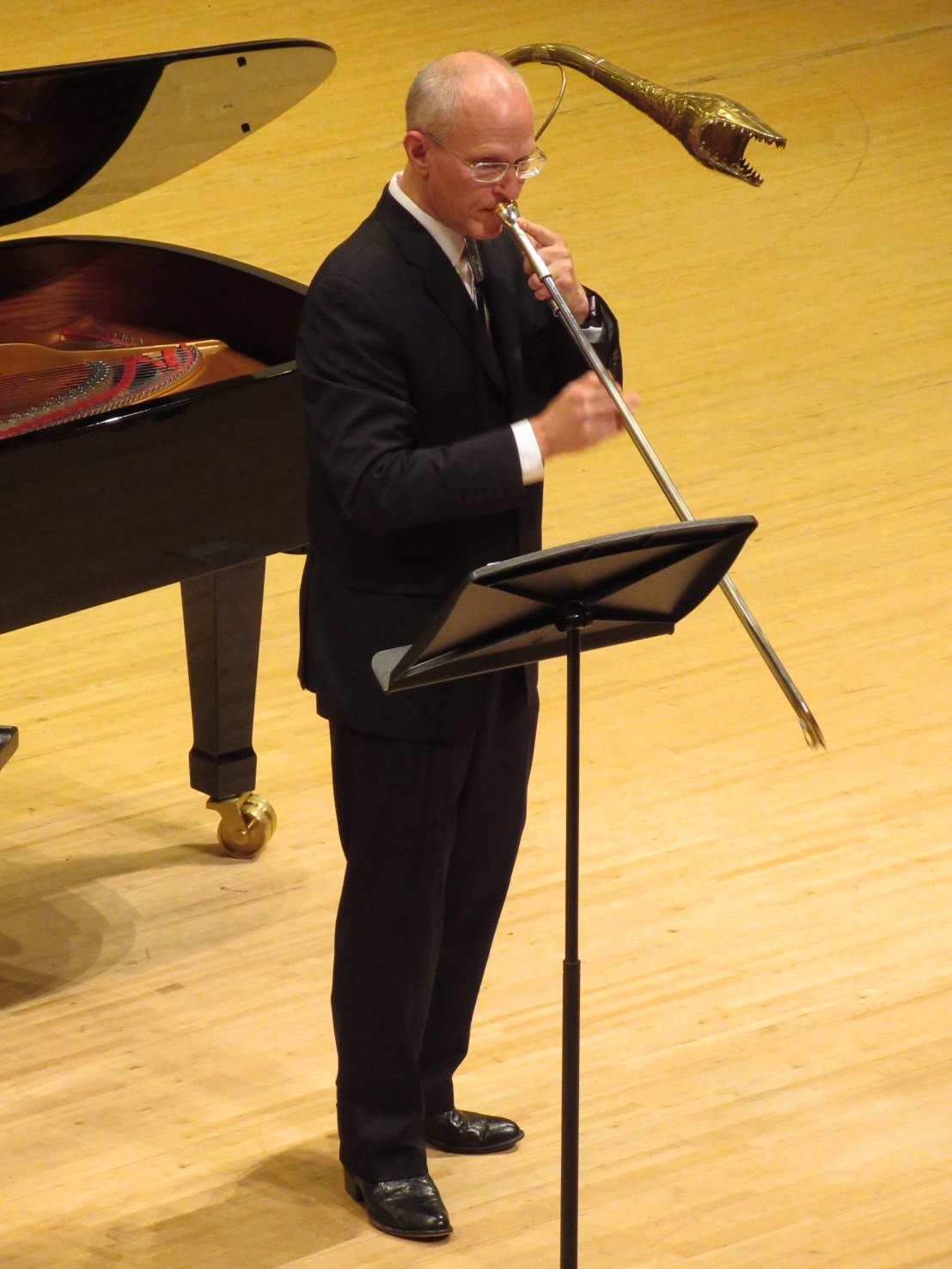
I then turned to Eddie Koopman’s arrangement of the first Canzone by Girolamo Frescobaldi, in a version with pre-recorded accompaniment. For this performance, I used a buccin — a dragon bell trombone used in France and Belgium in the early nineteenth century. I love playing historical instruments and the buccin is the coolest kind of trombone. This particular buccin (photo above) is a one-of-a-kind instrument that was made by YAMAHA; it is a fantastic instrument with a great, unique sound. Eddie Koopman’s techno-pop-Rennaisance accompaniment brought this old piece and instrument right into the twenty-first century.

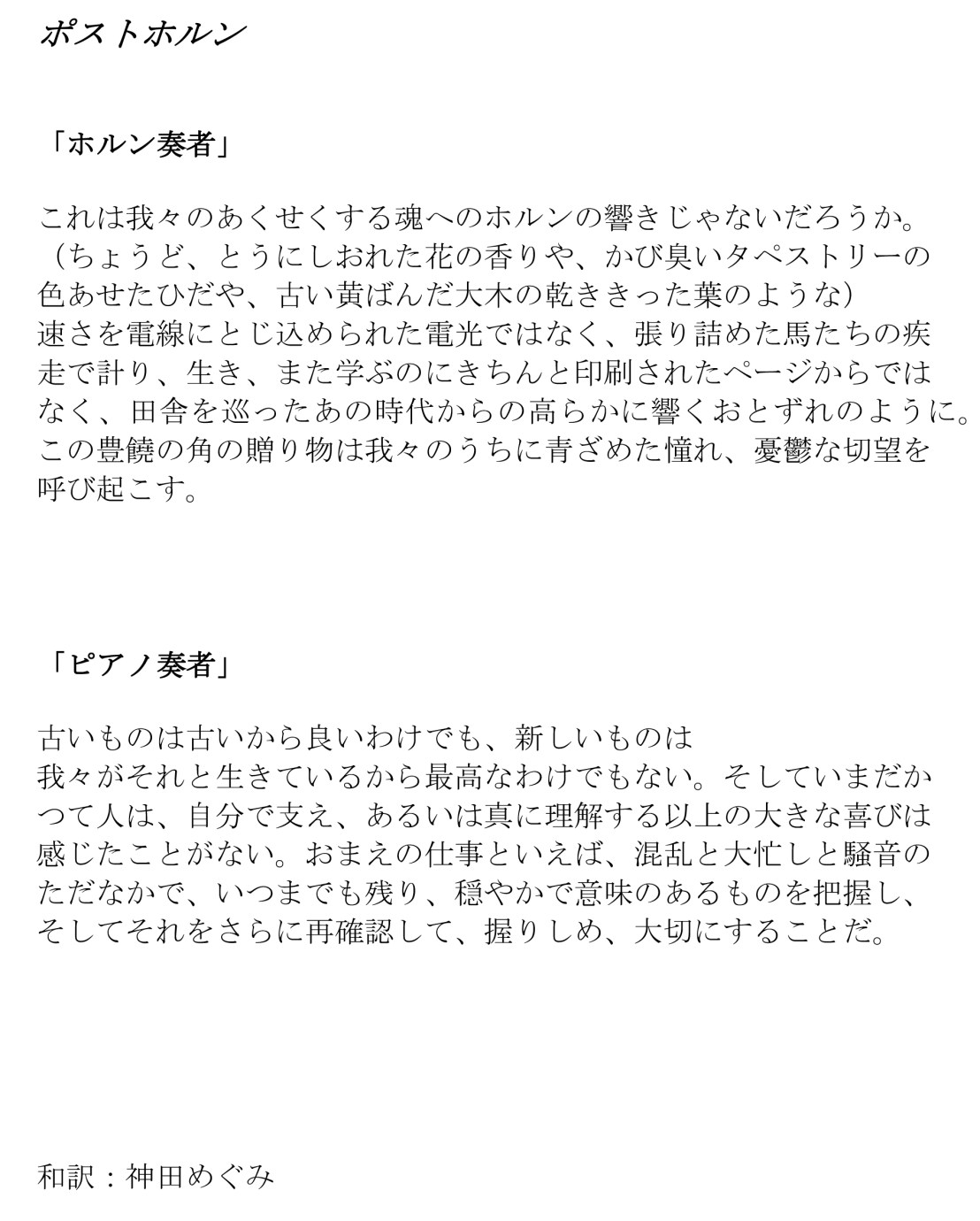
The other major work on the program was Paul Hindemith’s Sonata for Alto Horn and Piano. It is the least performed of Hindemith’s Sonatas and it works very well for bass trombone, transcribed down an octave. Shoko Gamo had a fiendishly difficult part that she performed with superb technique and style. The Sonata also has a poem by Hindemith, The Posthorn, that the composer requires the soloist and accompanist to recite before the last movement. While Hindemith’s poem is in German and English, I wanted to recite it in Japanese. I asked my good friend, Megumi Kanda, principal trombonist of the Milwaukee Symphony, if she would translate it for me so Shoko and I could read it during the recital. I read the first part of the poem and Shoko read the second part. I practiced this very hard! The audience was very supportive in my reciting this in Japanese — people told me they actually understood what I was saying!

Hindemith The Posthorn ポストホルン

Hindemith_The_Posthorn

Finally, I ended with Jan Sandström’s beautiful song, Song for Lotta. For many years I have ended recitals with this beautiful piece, slow and soft, very emotional, and different than the kind of loud piece that people usually play as a final piece. Shoko’s playing was exceptionally sensitive and the audience responded with great enthusiasm and warmth.

IMG_9387

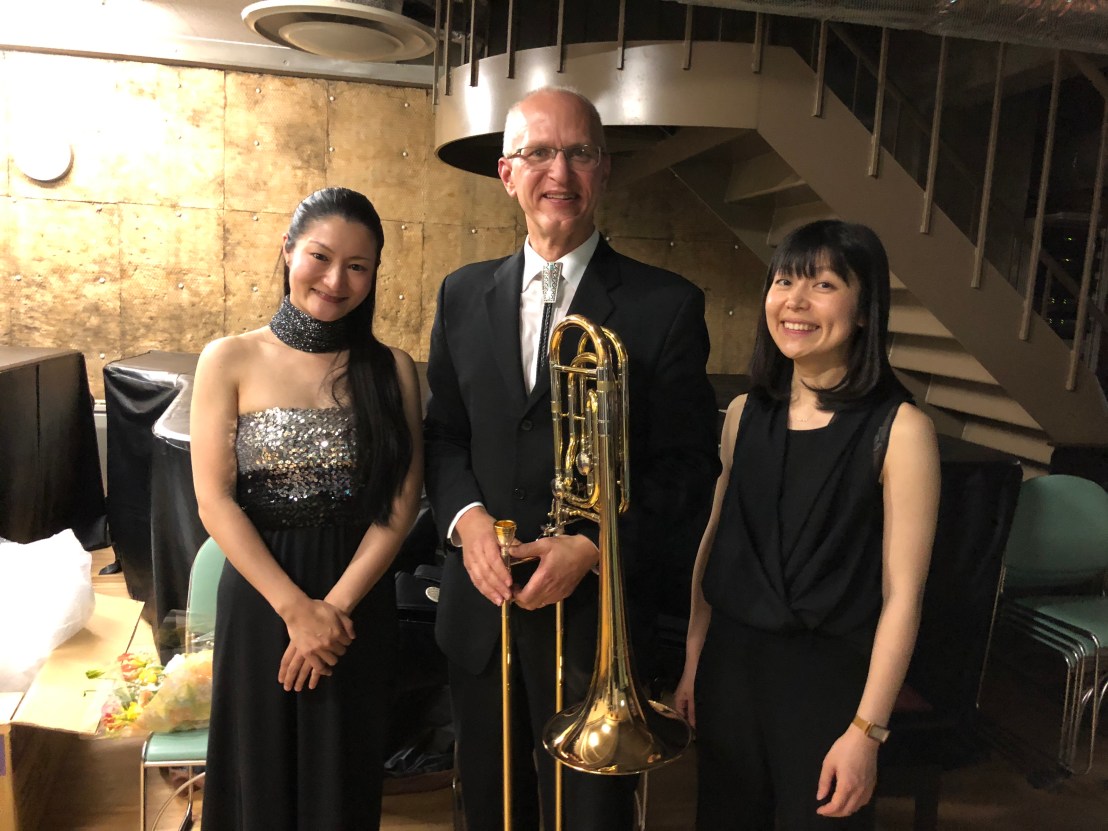
At the end of the recital there were flowers and congratulations all around. But there was more to come.

IMG_9366

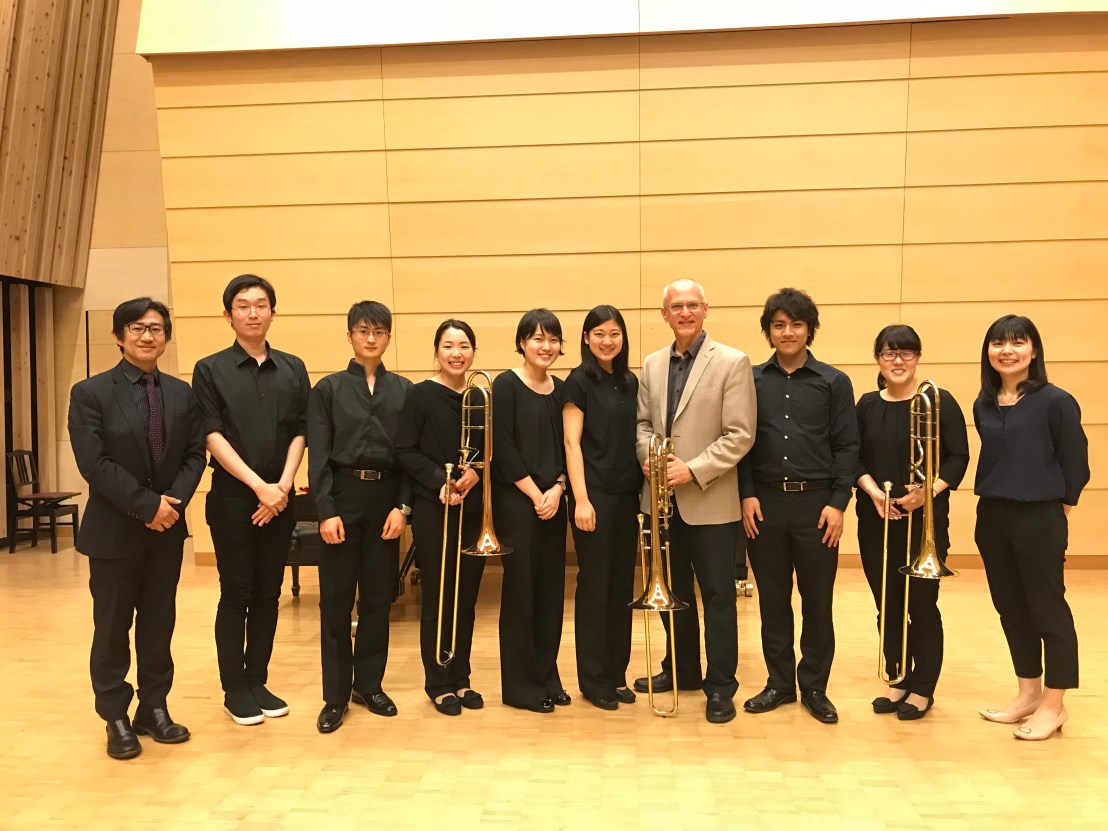
One of the great things about the Festival was seeing so many former students who had been part of my class over the years at the Hamamatsu Academy and Festival. Here I am (above) with several of them — and there were others, too. It was great to see them and talk about their progress and successes since we had last met.

IMG_0539

The Festival ended with a gala concert that featured members of the Nagoya Trombone Association’s organizing committee trombone ensemble. I performed as soloist in John Stevens’ The Chief, dedicated to Emory Remington (above),

IMG_0553

and I also conducted the ensemble in Stephen Bulla’s arrangement of Londonderry Air (above).

IMG_0554

The concert concluded with all of the Festival’s participants coming on stage for a performance of two pieces: Steven Verhelst’s A Song for Japan (above), especially arranged for this concert, and Tommy Pederson’s arrangement of 76 Trombones. What a sound! And what great playing from all of the players, from students to players who were older than me.

Here is a video of my performance of The Chief, and also of A Song for Japan. I hope it will give you a sense of the great music making we all heard from so many people at the Festival (to view this video on YouTube, click HERE):

Following the concert, we had a group photo. And then another, with everyone raising a hand and shouting:

Screen Shot 2018-04-28 at 7.47.14 AM

The word isn’t really translatable into English, but it captures the joy of a job well done — with great enthusiasm. It was a word that was used throughout the festival — always with a big smile.

NTF-5

We followed the concert with a reception — food and games and prizes, and each participant went home with a little bag of chocolates that had been designed by Shiori Tanaka, Hiroshi Tanaka’s wife who is also a very fine percussionist. This was the first time I’d ever seen my photo on a piece of chocolate — I guess there is a first time for everything!

IMG_9335

I left Nagoya the following day with a feeling of deep satisfaction. I made many new friends and met many old friends. To Hiroshi Kurata (below),

image10

and Hiroshi Tanaka (below, as we enjoyed some traditional Nagoya kishimen at the airport just before I returned home), you have my deepest, sincerest thanks. Thank you for hosting me at the University and at the Festival, and for becoming new friends. Making music with you and your students and colleagues was a great, great pleasure.

IMG_4683

And to Nozomi Kasano Flatt,

IMG_9390

I cannot say “thank you” enough times. She was a tremendous help to me in so many ways, and I am so proud of her and her success.

The trombone brings people together around the world and I am a very fortunate person to have been to Japan so many times to engage with interested and interesting players and teachers who have taught me far more than I could possibly offer to them. Thank you, Nagoya Trombone Association. I hope we can work together again soon. The International Trombone Festival may be in Japan in 2020 — the Olympic year — and it would be the first time the ITF would be held in Asia. I hope that happens; it would be great for Japan, for Asia, for the trombone.

One thing is very clear to me: Nagoya is a place for the trombone. I am fortunate to have been part of its most recent Trombone Festival, and to feel a new kinship with this great city in Japan.

To my Japanese friends:

ありがとうございました

FullSizeRender


“It is the hope of man translated into a piece of music.”

“It is the hope of man translated into a piece of music.”

by Douglas Yeo

I’m reflecting on my recent trip to Japan, something I will write about more presently.

Among the many new friends I made on my trip to Nagoya, where I was guest artist at the Nagoya Trombone Festival, was Hiroshi Kurata, trombone professor at Aichi Prefectural University. Kurata-San gave me two of his CDs as gifts. They are treasures, and unlike anything I have heard and seen before. That’s because Kurata-San is not only a superb tenor trombonist. He is a tenor. A singer. And his albums, Speranza and Tromvoce, feature him both singing and playing the trombone. It works. It really, really works. This man is a fine, fine trombonist and a fine, fine singer. More than that, he is a fine artist / musician.

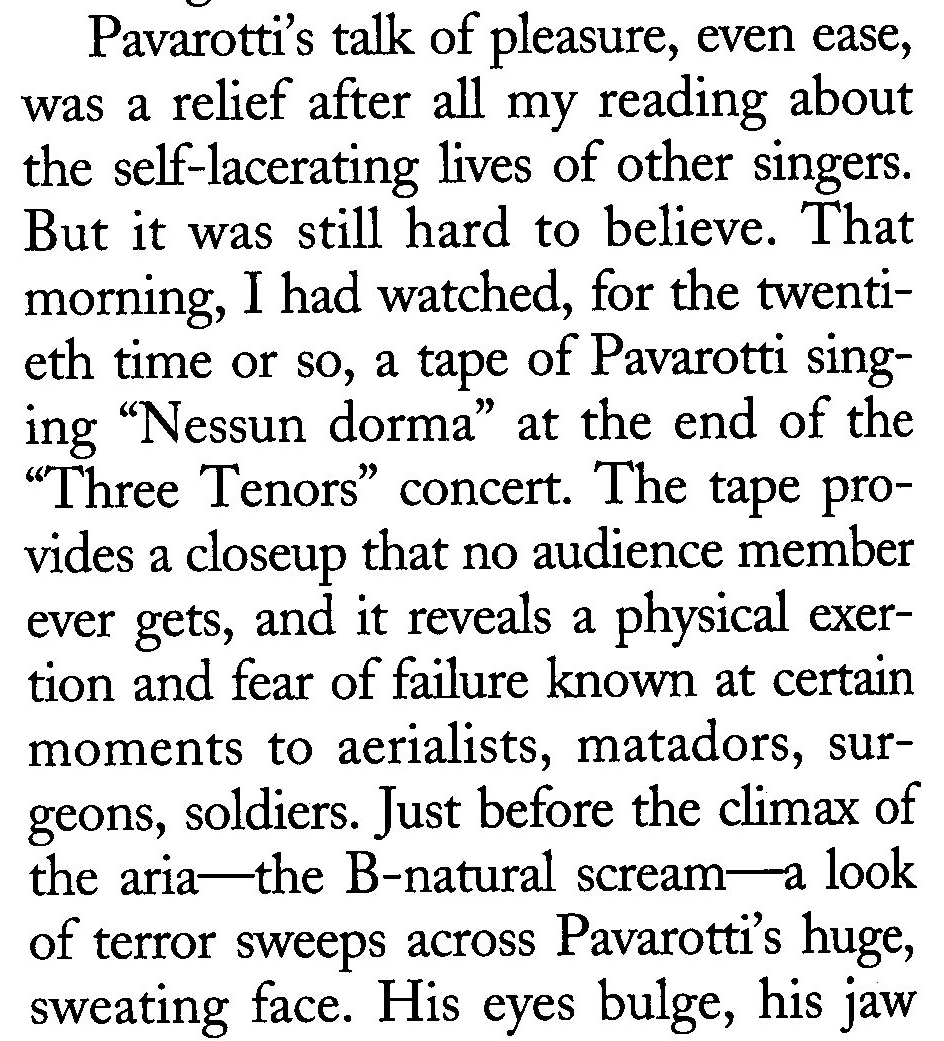
This afternoon, while I was driving home from church, I was listening to Tromvoce. Among the tracks was an arrangement of themes from Giacomo Puccini’s Turandot by K. Ohashi, for trombone and voice titled Turandot Fantasy. When Tanaka-San got to the famous Act III aria, “Nessun dorma,” I pulled off the road so I could pay attention. I have loved this aria as so many others have loved it since Puccini wrote it in 1926. Kurata-San sang the aria magnificently, and when I got home, I got out my copy of the June 21, 1993 issue of The New Yorker that contains an article about the great Italian tenor, Luciano Pavarotti. The article, “The Last Italian Tenor” by David Remnick, is a riveting piece of writing, and in it Pavarotti is remarkably candid. And insightful.

Screen Shot 2018-05-20 at 1.49.36 PM

There were a few paragraphs from the article that I have used in many masterclasses, and I used them again in Japan while working with students. My message was this: What we do with the trombone in our hands is important. What we do as artists / musicians / trombonists is consequential because it makes a difference in people’s lives. I quoted Pavarotti’s comments about “Nessun dorma.”

The end of this aria contains these dramatic words:

Dilegua, o notte!              Vanish, o night!

Tramontate, stelle!          Fade, you stars!

Tramontate, stelle!          Fade, you stars!

All’alba vincerò!              At dawn, I will win!

Vincerò! Vincerò!            I will win! I will win!

Read Pavarotti’s comments below:

Pavarotti_Nessun_dorma_interview_01

Pavarotti_Nessun_dorma_interview_02

To me — and I am not alone in this thinking — this is the essence of music. Communication with an audience of an essential truth that speaks directly to the heart. The emotion of “Nessun dorma” is inescapable and Pavarotti’s comments are very, very insightful. What kind of singer are YOU? One who tries to make your music making “perfect” at all costs or one who, with honest, heartfelt expression, takes chances and wishes to change people’s lives in the process?

Listen for yourself. First, here is a recording of Pavarotti in concert from 1994. His performance, which is recorded live, is very fine. Watch it so you can observe Pavarotti’s face. “In this there is all the hope of a man,” Pavarotti said. Here, he sings it. Observe the look on his face as he sings the final Vincerò! I mean, REALLY look at his face at the final cadence; you will see exactly what Remnick was referencing in his article. This is musical and emotional  involvement of the highest order. [NOTE: due to copyright restrictions, you may not be able to watch the video embedded in my blog but you CAN watch it on YouTube by clicking here.]

Haven’t had enough of “Nessun dorma”? Then click on this link for an article that has links to 10 more performances. Each has something to say.

I end this blog post where I began, with my friend, Hiroshi Kurata. Here is a video of him playing and singing “Nessun dorma.” Any trombone player will appreciate the difficulty of what he is doing here. No overdubbing. This is a live recital. Playing the trombone with great beauty and expression, then immediately singing with tremendous passion. This is a rare accomplishment. [ To view this video on YouTube, click here.]

Thank you, Kurata-San. Thank you, Pavarotti. Thank you, God, for this remarkable gift that we call music that can stir our hearts.

Vincerò!

Screen Shot 2018-05-20 at 1.12.45 PM copy