
by Douglas Yeo
NOTE: This article contains offensive material of an historical nature that is presented in an effort to inform the trombone community of a regrettable vestige of racism that continues to be a part of the trombone’s concert repertoire since it first came to light over 100 years ago. It is my hope that this article will lead trombonists around the world to make important, needed changes in the repertoire we choose for our recitals, and rid our concerts of music that is rooted in racial stereotyping and racist portrayals of African Americans.
A week ago, I published an article on thelasttrombone.com, Trombone players: It’s time to bury Henry Fillmore’s “Lassus Trombone.” I subsequently wrote two short followup articles, A statement from Wycliffe Gordon: Will Things Change This Time? and It matters—in music, politics, sports.
Since the publication of my article, it has been viewed over 64,000 times on thelasttrombone.com. It has been republished on several other websites and blogs, and various online fora have featured threads of discussion. Facebook, Instagram, Twitter, and other social media platforms have circulated the article and a vigorous discussion is taking place.
I’d like to follow up with a few thoughts, answer some questions, and propose a path forward in light of what we know.
Over the last week, I’ve been contacted by many trombone players, trombone teachers, and band directors from around the world. These include many members of major symphony orchestras, professors at some of the world’s top music schools, and directors of some of the most respected bands in the United States. I have already posted links to the statement by Wycliffe Gordon, one of the most respected jazz trombonists of our time. The support of Wycliffe and so many musicians is very gratifying.
But there are others who are not supportive, who for various reasons, want to hold on to Lassus Trombone. To those, I offer a few thoughts:
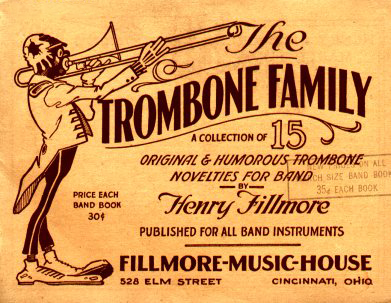
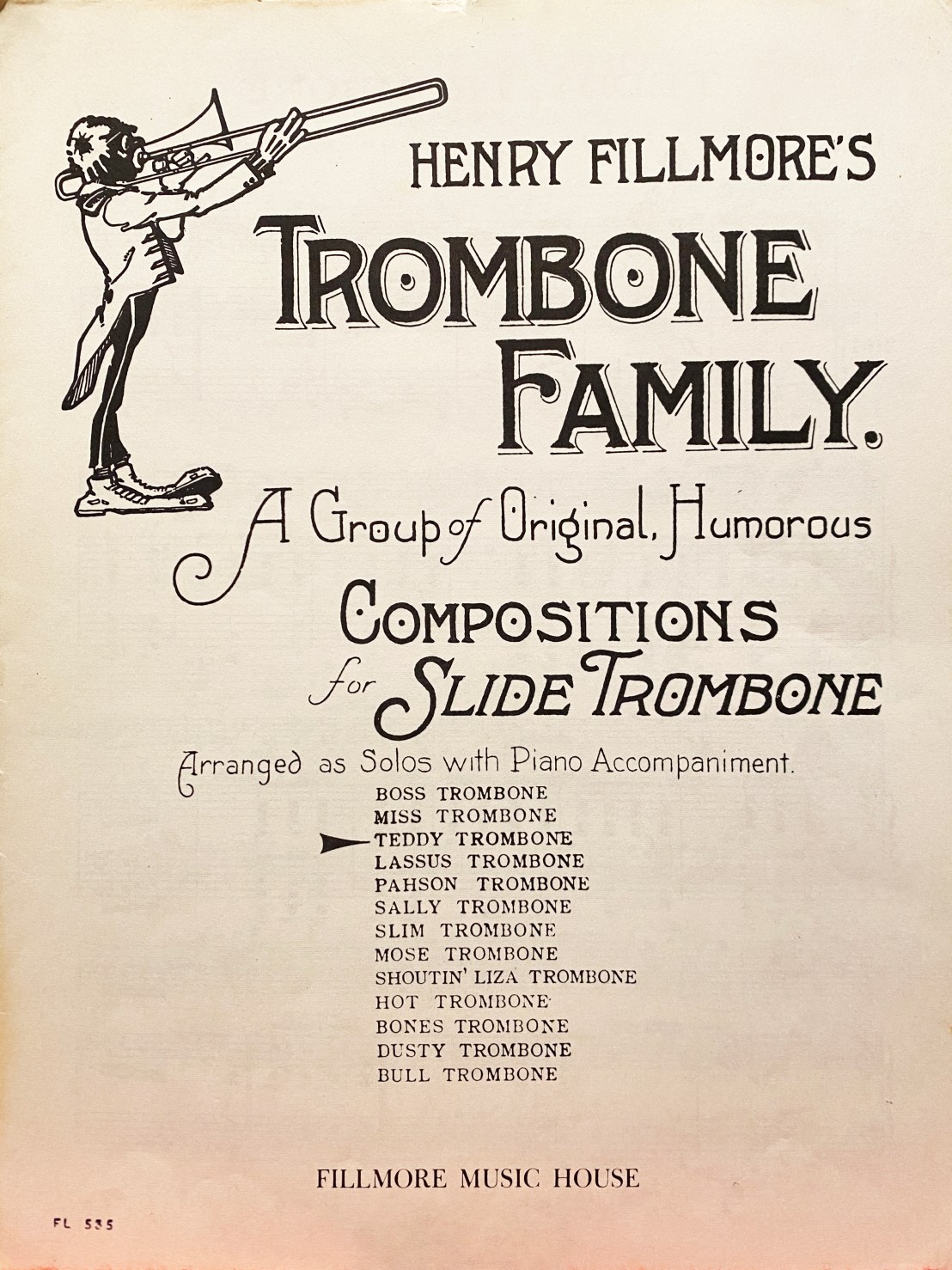
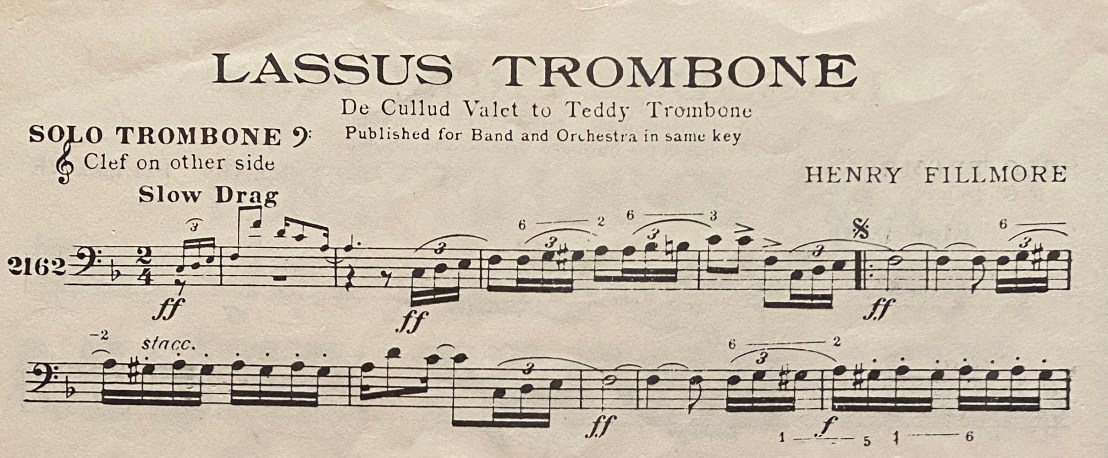
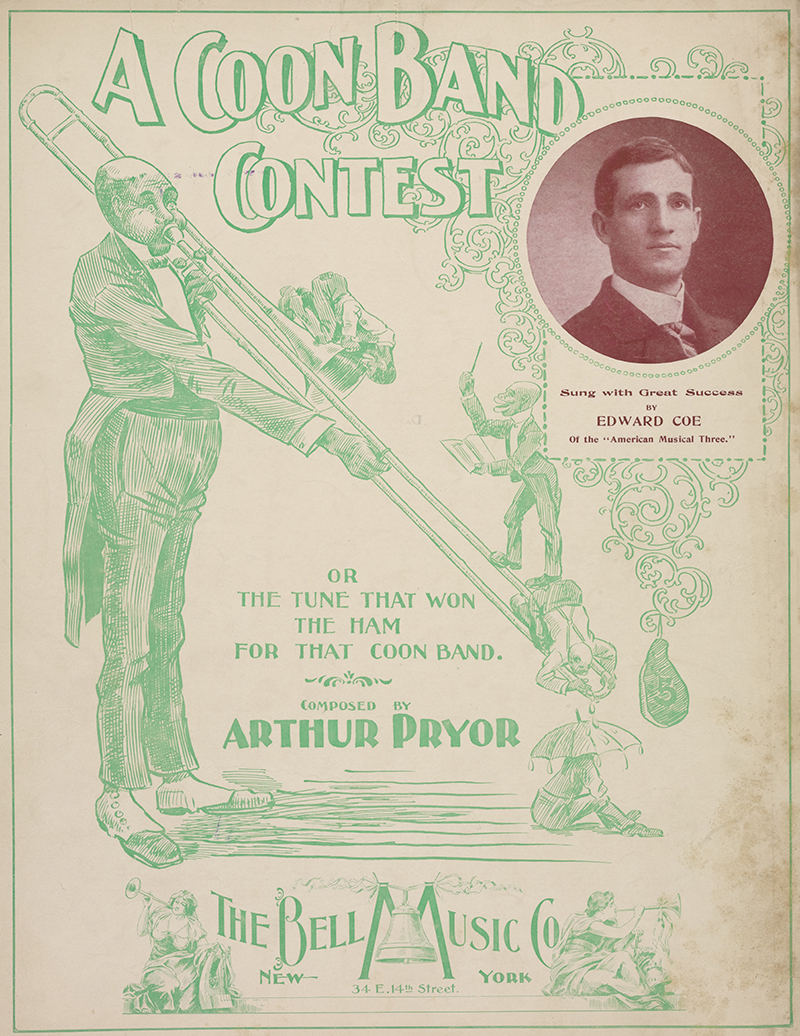
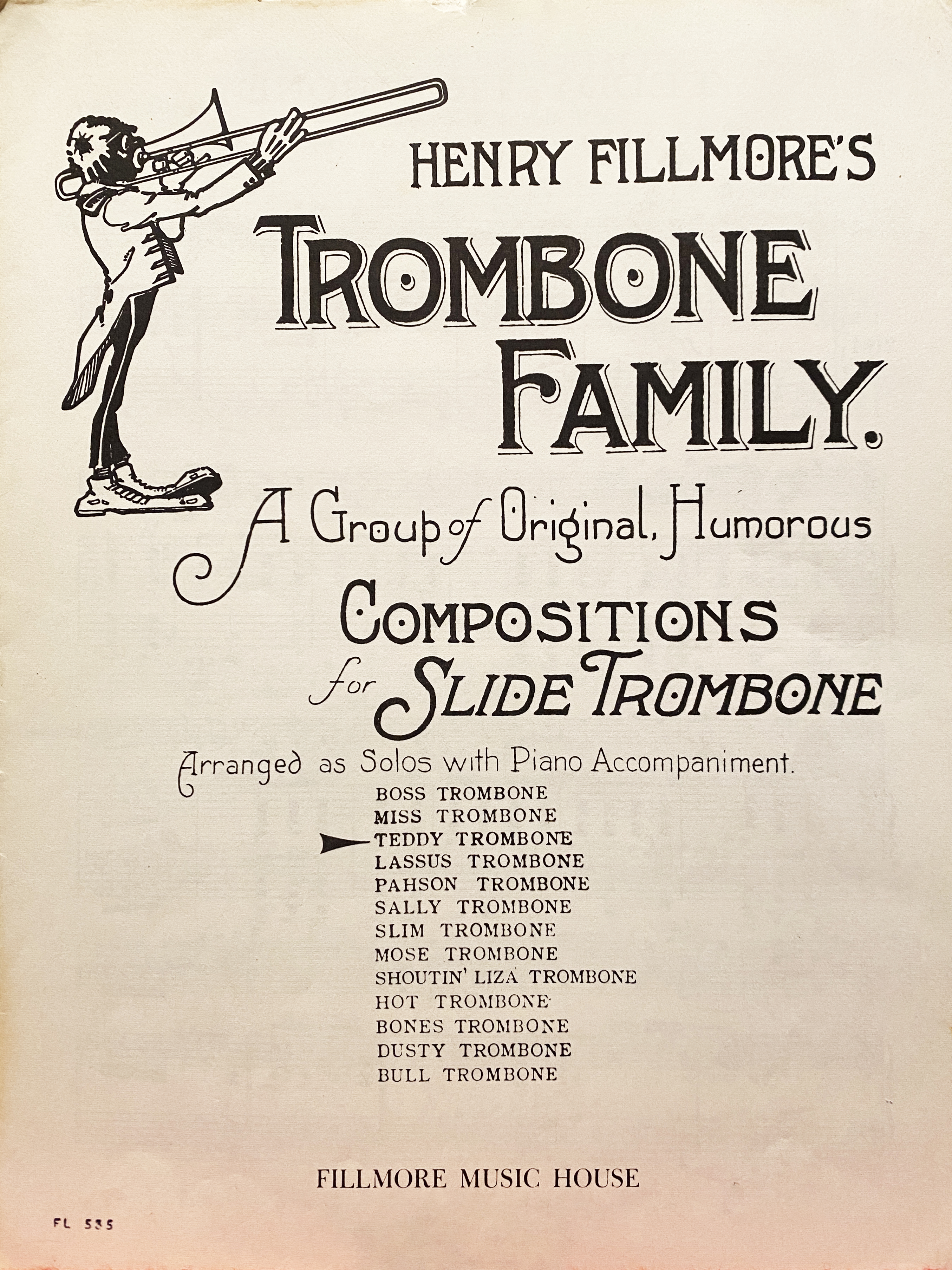
Some take exception to my phrase, “It’s time to bury Henry Fillmore’s Lassus Trombone.” They have a problem with my using the word, “bury.” To be clear: I am not suggesting that we should forget The Trombone Family. I am not suggesting that we burn Lassus Trombone. If all copies of The Trombone Family suddenly disappeared from the earth, we and the next generations could not learn from them. I have an original copy of several of the pieces and I plan to keep them in my library so I can show them to students and others and talk about them. By “bury” I mean “put away.” As I said in my article, we do not need to play these pieces today; we do not need them. When people are buried, they are still remembered; we place a grave marker over them, we continue to talk about them. That is my hope for Henry Fillmore’s The Trombone Family. Bury, but remember. We need to remember The Trombone Family because we need to remember why a cover like this (below) was socially acceptable to a portion of white America, and why such a cover should never be considered acceptable again.
Some assume I am calling for a boycott of all of Henry Fillmore’s music. I did not call for this; to say that I said this is false. Fillmore wrote a great deal of fine music, including several excellent marches including Americans We and Men of Ohio. Those pieces were not marketed using the kinds of racist stereotyping and demeaning language of the pieces in Fillmore’s The Trombone Family. As I’ve looked through Fillmore’s output (see: Paul E. Bierley, The Music of Henry Fillmore and Will Huff. Columbus: Integrity Press, 1982), I can find only one other work (other than those that are part of The Trombone Family) that gives me pause, the march Little Rastus (1920), that Fillmore composed under his pseudonym Harold Bennett. While that piece does not have a dialect subtitle (it is subtitled “Characteristic March”), the name “Rastus” has been considered a pejorative, racist trope since the late nineteenth century. [For a discussion of how minstrel shows, advertising, and marketing played up African American characters like Rastus (who was also the long time symbol for Cream of Wheat from 1890) as “docile, subservient, and laughable characters,” see, Marilyn Kern-Foxworth: Aunt Jemima, Uncle Ben, and Rastus: Blacks in Advertising, Yesterday, Today, and Tomorrow (Westport: Praeger, 1994.)] Fillmore’s march would have stood just fine on its own without the provocative title but, unfortunately, Fillmore decided to weigh it down with a derogatory stereotype. That said, I don’t have a problem with anyone playing any of Fillmore’s fine music that does not carry that heavy baggage of a regrettable, racially insensitive past.
All of us do wrong. You, me, everyone. The Bible uses the word “sin.” In using racist tropes and stereotypes to promote and inform Lassus Trombone, Henry Fillmore did wrong. He was on the wrong side of right. He was on the wrong side of the judgment of history. He demeaned African Americans. Whether or not he did so just to sell music or it reflected his personal view of African Americans I do not know. I do not know his heart and neither do I judge his heart. He was not alone in using racial stereotypes to sell music. For instance, Henry’s father, James Henry Fillmore Sr., was a devoutly religious man. The music publishing company that he and his brother, Charles, founded, The Fillmore Brothers Company (later Fillmore Music House) published many hymnals. J. H. Fillmore Sr. is remembered for the many hymn tunes he wrote, including that for “I Am Resolved No Longer to Linger”:
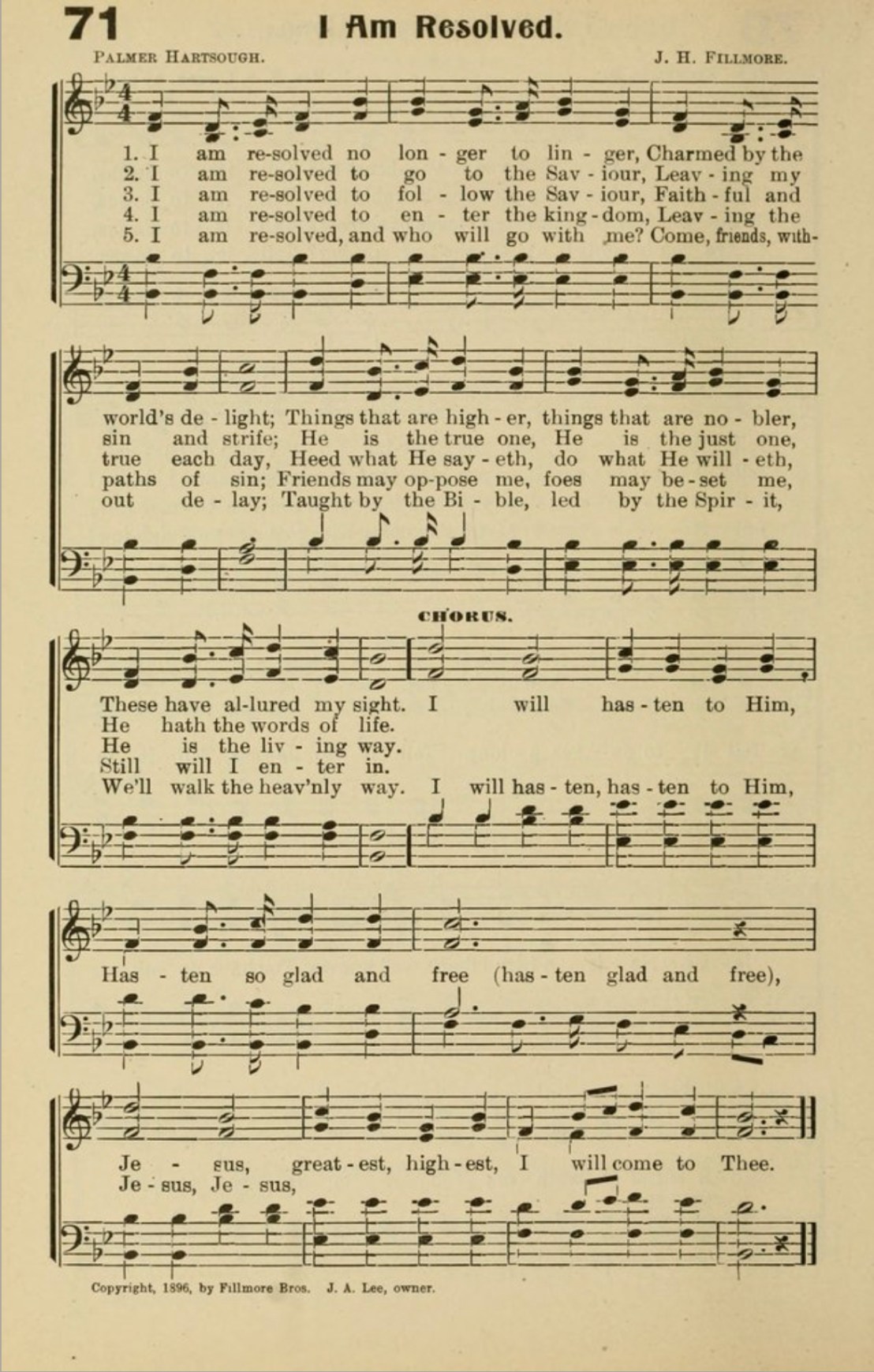
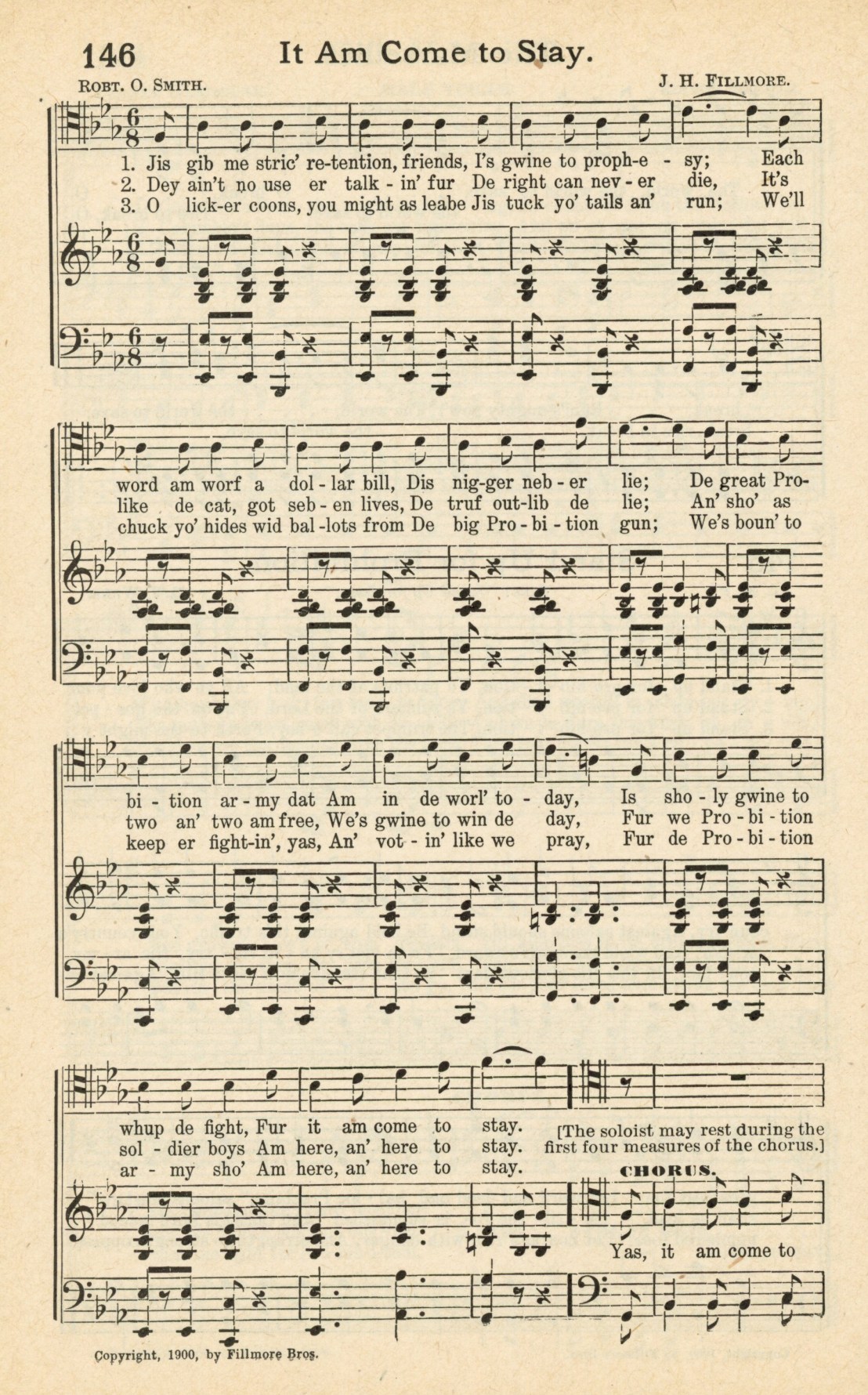
This hymn, with its noble aspirations, is still sung in churches today. But the same J. H. Fillmore Sr. who wrote the music to this inspirational hymn also published Fillmore’s Prohibition Songs (1903), a book with over 200 songs on the theme of temperance; the song book also includes several hymns. Among the songs in Fillmore’s Prohibitions Songs for which J. H. Fillmore wrote the music is “It Am Come to Stay.” The dialect language and use of the n-word in this song, the first page of which is printed below, is hardly inspirational.
The same can be said for another song published in J. H. Fillmore’s Prohibition Songs. I Draws De Line Right Dar has music written by Charles H. Gabriel, the noted composer of gospel songs that include”His Eye Is On The Sparrow” and “Since Jesus Came Into My Heart.” But “I Draws De Line Right Dar” is yet another example of a song written by whites that uses the n-word and parodies the Black experience and dialect. And, incredibly, more than 35 years after the Emancipation Proclamation, the song makes reference to “de Mastah.”
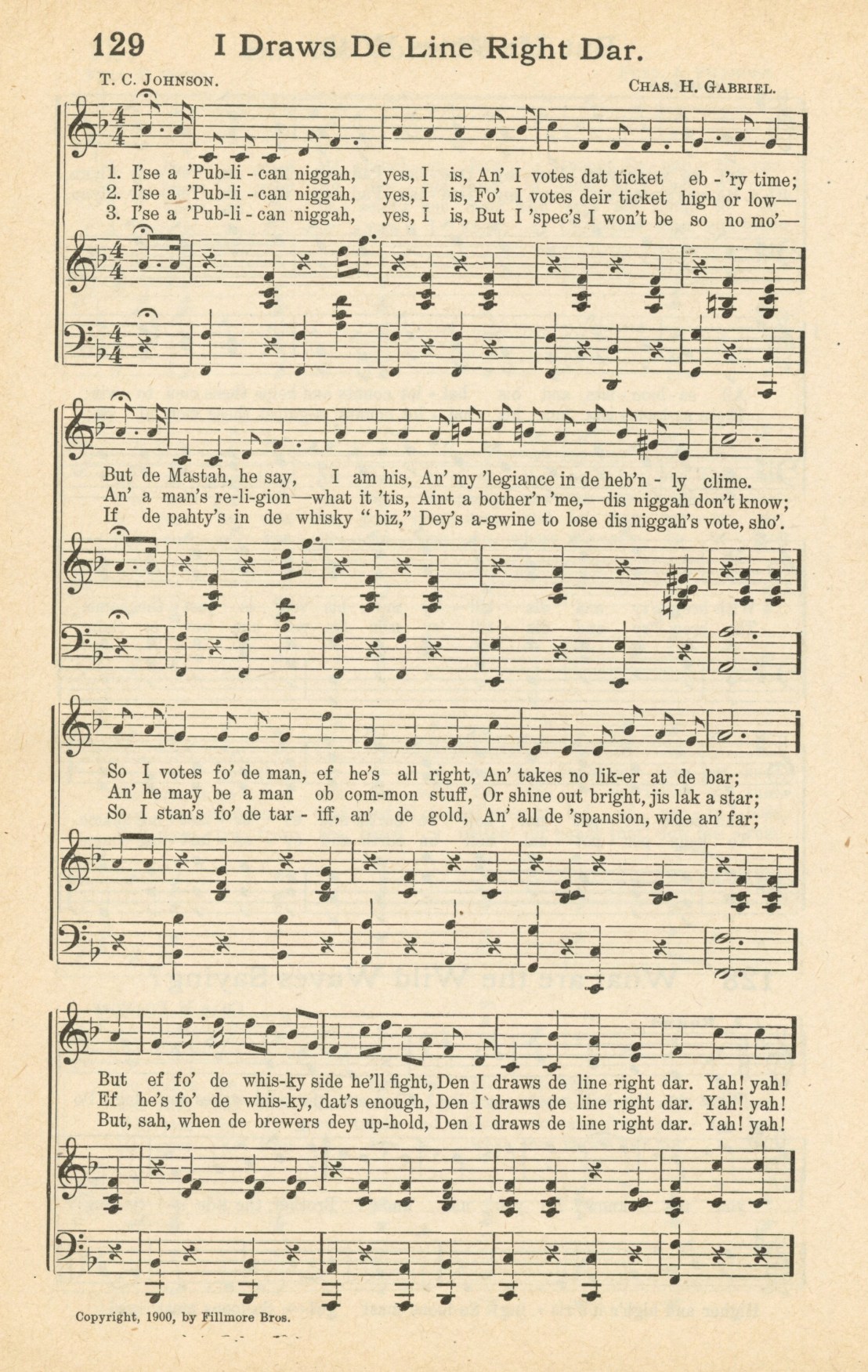
These songs are despicable. They were despicable in 1903 when they were published and they are despicable today. We don’t sing them today. We buried them. But we do still sing other songs that J. H. Fillmore and Charles Gabriel wrote. With The Trombone Family, Henry Fillmore showed that “the apple doesn’t fall far from the tree.” Racial stereotyping ran in the family. But the good news is that Henry did not continue to write music that had racial stereotyping at its core. So, I’d prefer we not play Lassus Trombone today—just like we don’t sing his father’s racially insensitive songs today—but I have no problem with people who play other music by Henry Fillmore and others that does not include racist tropes and the denigration of African Americans (or any other people or culture).
Some ask why we should not play Lassus Trombone while we still play the music of the avowed racist composer, Richard Wagner. See above and think through what I said carefully. But there is this: Talking about Wagner in a discussion about The Trombone Family is deflecting from the issue, what some scholars call “centering.” If we want to talk about Wagner, let’s talk about Wagner. It’s a big conversation. But right here I’m talking about The Trombone Family. The parallels between the two men and their music are not all analogous. Let’s not get off point here.
Some refer to me as one who is “woke,” engaging in “cancel culture” and “virtue shaming.” The applying of such labels to people is unfortunate. I am none of those things. I am a trombonist, teacher, historian, and writer. I bring up topics and use my platforms to let people know about them. And discuss them. Name-calling doesn’t help any conversation. One of the reasons society struggles to tackle difficult issues is that some people have trouble engaging in a civil conversation, one that does not devolve to name-calling and epithets. You may not agree with me or like that I brought up the uncomfortable origins of The Trombone Family. I get that. But calling me—or others—names or insulting me because of my views doesn’t change the historical record and how I choose to respond to it. I hear the insults but I won’t take the bait.
Some say they never knew about the origins of The Trombone Family in the dark swamp of white minstrelsy and racial stereotyping. They like the pieces and because they never played them with any racist intent, they want to keep playing them. They say it’s too late to bother with dealing with the pieces’ racist beginnings, that they are by now so firmly entrenched in the repertoire. There was a time when I didn’t know about racist roots of The Trombone Family, either. But I learned, and now I know. Now you know. Now that we know, I’m arguing that we ought to have a conversation with ourselves and act in light of what we now know. At one point, we were ignorant of the racist origins of the pieces. Since we now know about them, we can no longer claim ignorance. As to whether it’s too late to deal with the racist origins of The Trombone Family, a driving principle of my life has always been that it’s never too late to do the right thing. It’s never too late.
Some believe that because Carl Fischer changed the image of the blackface trombonist that appeared on the original cover of the pieces and also removed the dialect subtitles that we should just forget about the original racist images and language and move on from them.
In 1978, Carl Fischer published all 15 of Fillmore’s trombone rags in a single collection. At that time, they discontinued selling the individual pieces with the blackface cartoon on the cover. Fischer colorized the cartoon, but it kept the trombonists’ large blackface lips, exaggerated eyes, and floppy shoes. His face became white. Fischer was trying to change the blackface trombonist into a clown. It didn’t work.
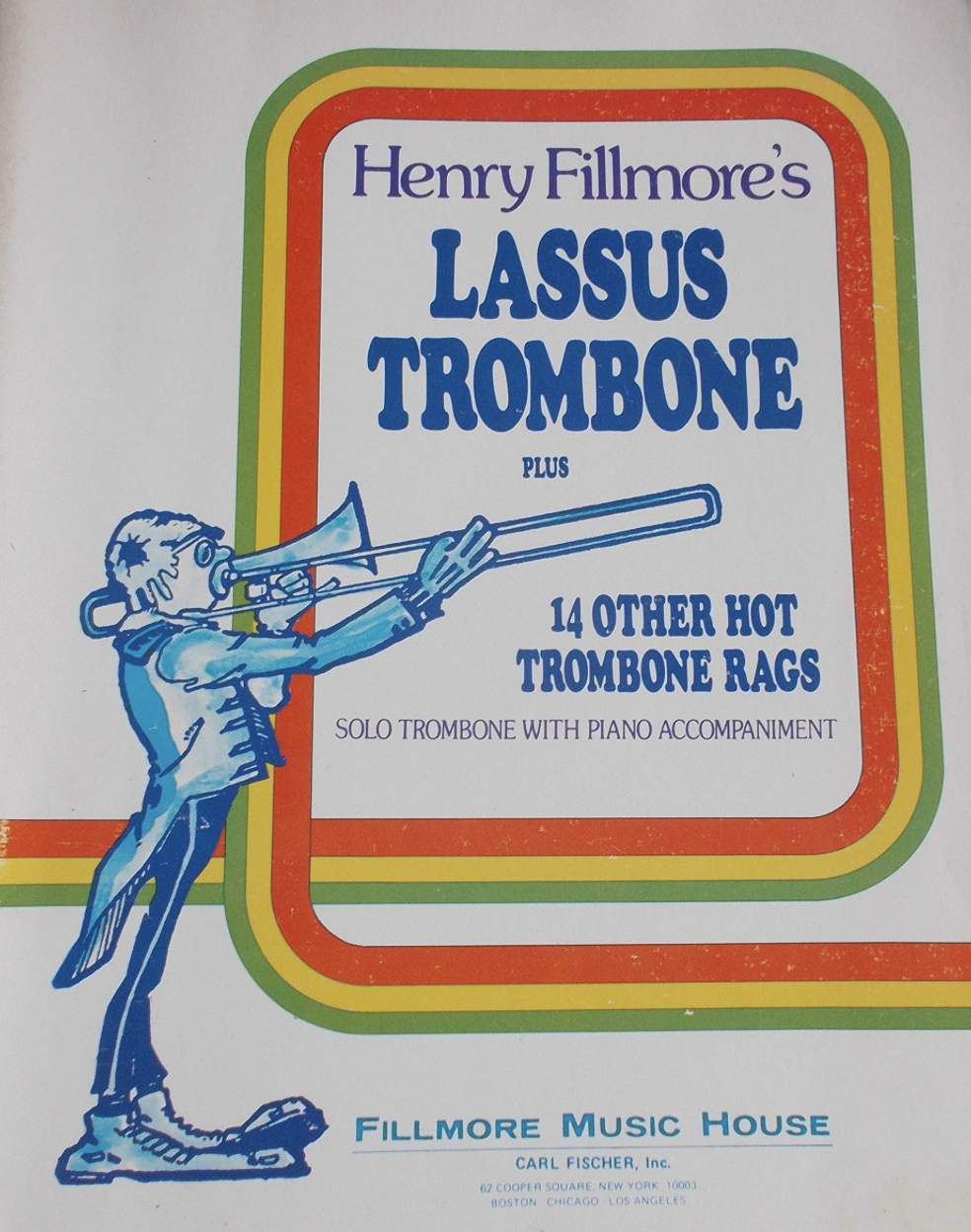
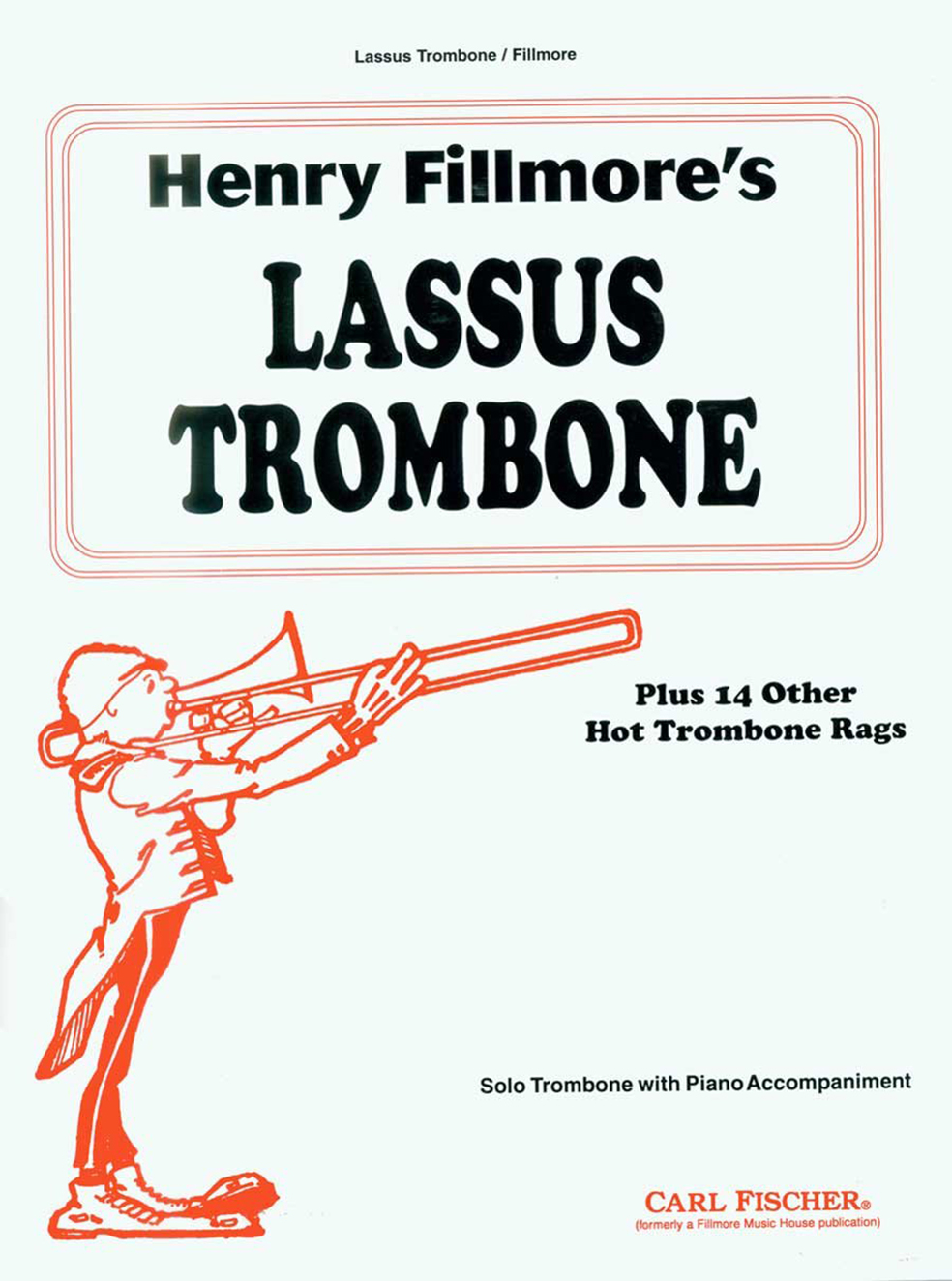
Then, in 2010, Fischer republished the collection with a revised caricature which removed the trombonist’s blackface eyes and lips and the dialect subtitles found on each piece. It seems clear Fischer was aware of the racist nature of the original cartoon and the subtitles. So we give them credit for removing them. But that was a whitewash; it didn’t erase the history of the pieces. Four generations of trombonists and conductors played the pieces with the original racist cartoon on the cover. Other publishers still sell The Trombone Family with the dialect subtitles today.
Some argue that they’re not racists and that if they play Lassus Trombone, that doesn’t make them a racist. They want to keep playing Fillmore’s The Trombone Family and don’t see the pieces as being offensive. When I read comments by people who hold this view, I’m struck by an obvious fact: Such comments are usually made by white men. Here’s a suggestion. Michael Dease, associate professor of jazz trombone at Michigan State University has been engaging on Facebook with some people who are discussing my article. He told me that he finds it unfortunate that some people “equate education and empathy with censorship.” When he engages white people who say they will keep playing The Trombone Family, he says (reprinted here with his permission):
As a Black American musician, I would ask defenders of “Lassus” to show and discuss Yeo’s article with a Black friend or colleague, and listen to their reaction.
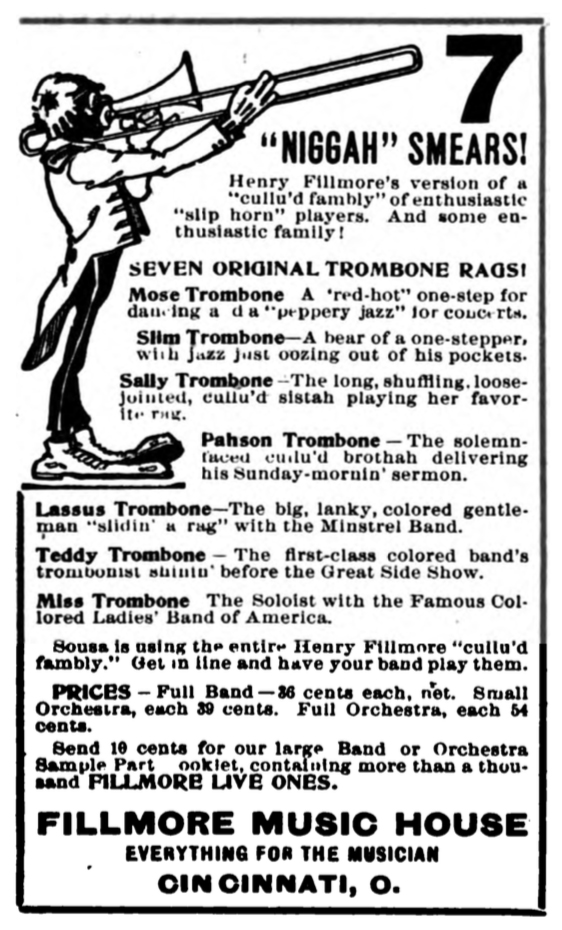
Should white people decide if representations of Black people are racist? “The lady [or man] doth protest too much, methinks,” is what Shakespeare wrote in Hamlet, and the quotation seems apropos to this discussion. Take Michael Dease’s suggestion. Before your next performance of Lassus Trombone, show this advertisement (below) to one of your Black friends. Don’t just talk about it with your white friends. Show your Black friend this:

Then show your friend the cover of the music.
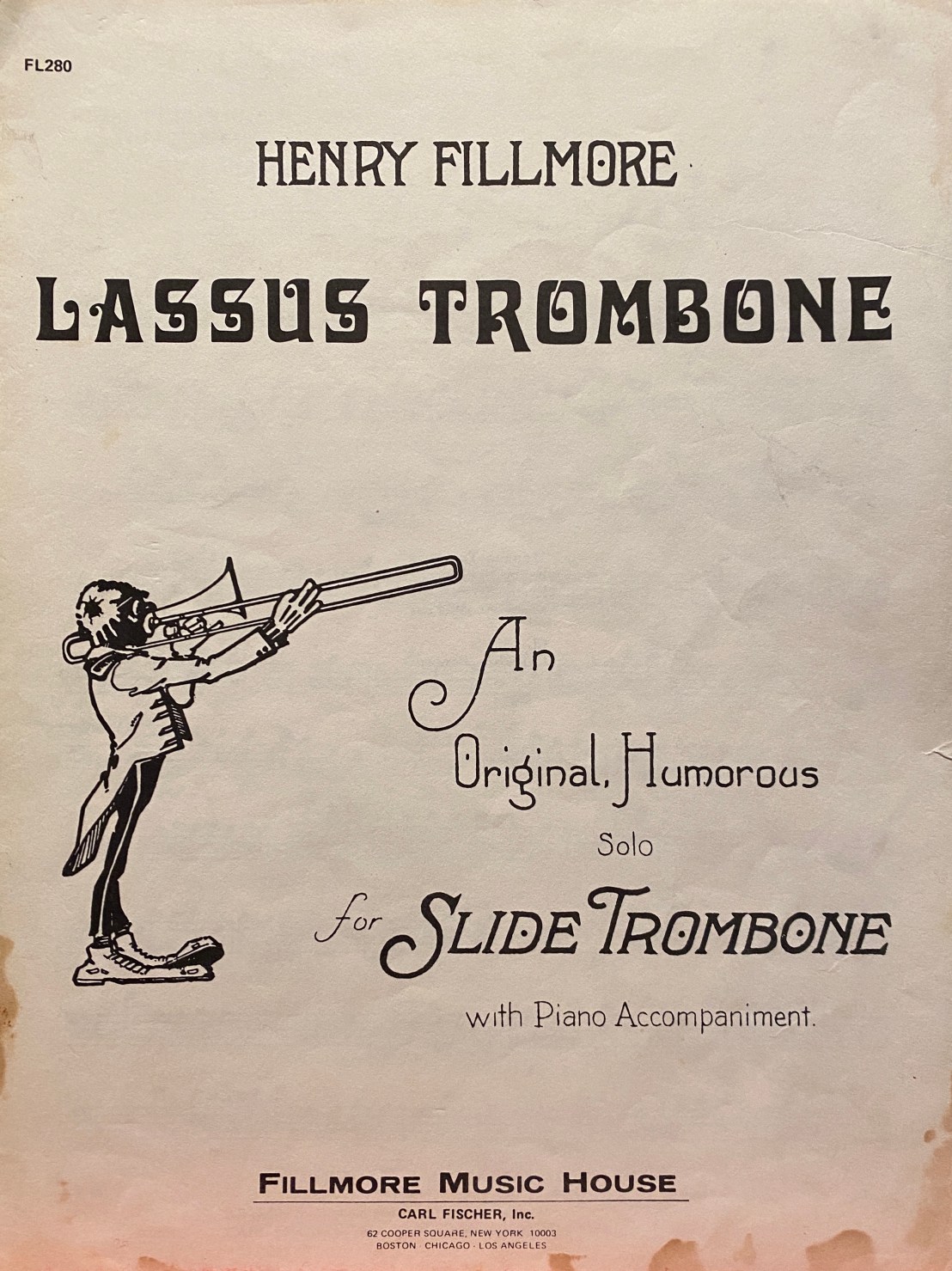
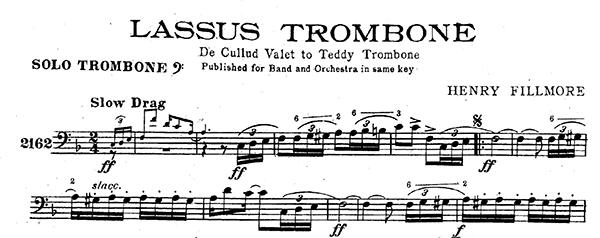
Finally, show your friend the dialect subtitles.
Explain as much as you want; justify as much as you want. Make your best case. Then listen to what your friend has to say about this. And, after listening, decide if you still want to play it. I can say this: Much of the outpouring of support for my argument has come from African American players, teachers, and conductors. What African Americans say about this matters.
So, where do we go from here? I have a few suggestions.
First, it is important to acknowledge the troubled history of Lassus Trombone and similar pieces. It is important to learn how these pieces were originally conceived and marketed. It may make us squirm today but if we ignore their origin, then we are ignoring history. And we cannot ignore history.
Second, we need to have a broad conversation about music that has racial stereotyping at its core. In my recent articles, I’ve been talking about Fillmore’s The Trombone Family. I will leave it to others to initiate and continue discussions about other pieces with a troubled, racially stereotypical past. If white trombonists and conductors talk about Lassus Trombone with Black trombonists and conductors, and all trombonists and conductors inform themselves about how these pieces came about and were marketed for most of the 20th century and even today, the ensuing conversations and the actions that flow from them can help us learn from the past and do differently going forward.
Also, we can seek out other pieces to play that are not mired in racism. Fillmore’s pieces in his The Trombone Family are not the only pieces written in the ragtime/trombone glissando genre that are worth playing. They might be the most famous but it doesn’t mean they are the only or best exemplars. And if there are other fine examples available of the same kind of piece, why is it necessary to play pieces with an embarrassing, ugly origin story?
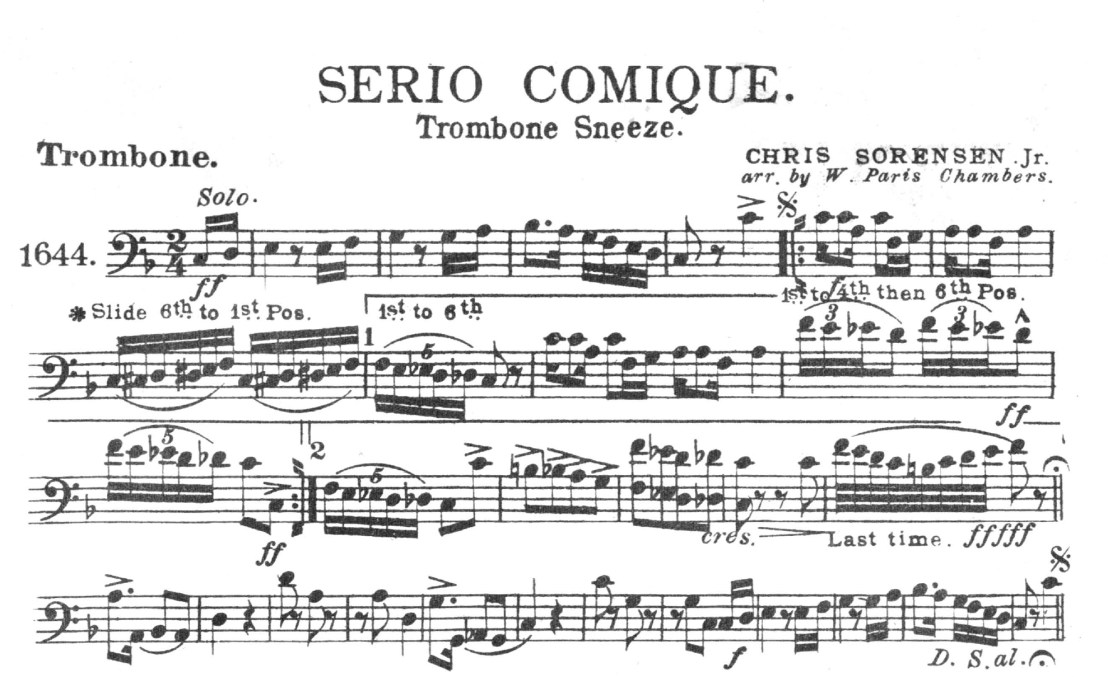
In my first article in this series, I suggested a piece like Chris Sorensen Jr.’s Trombone Sneeze that was recorded by Arthur Pryor and John Philip Sousa’s Band in 1902. The music for the band version of this piece is available for free (it’s in the public domain) and you can download it HERE. There’s no racial stereotyping Trombone Sneeze.
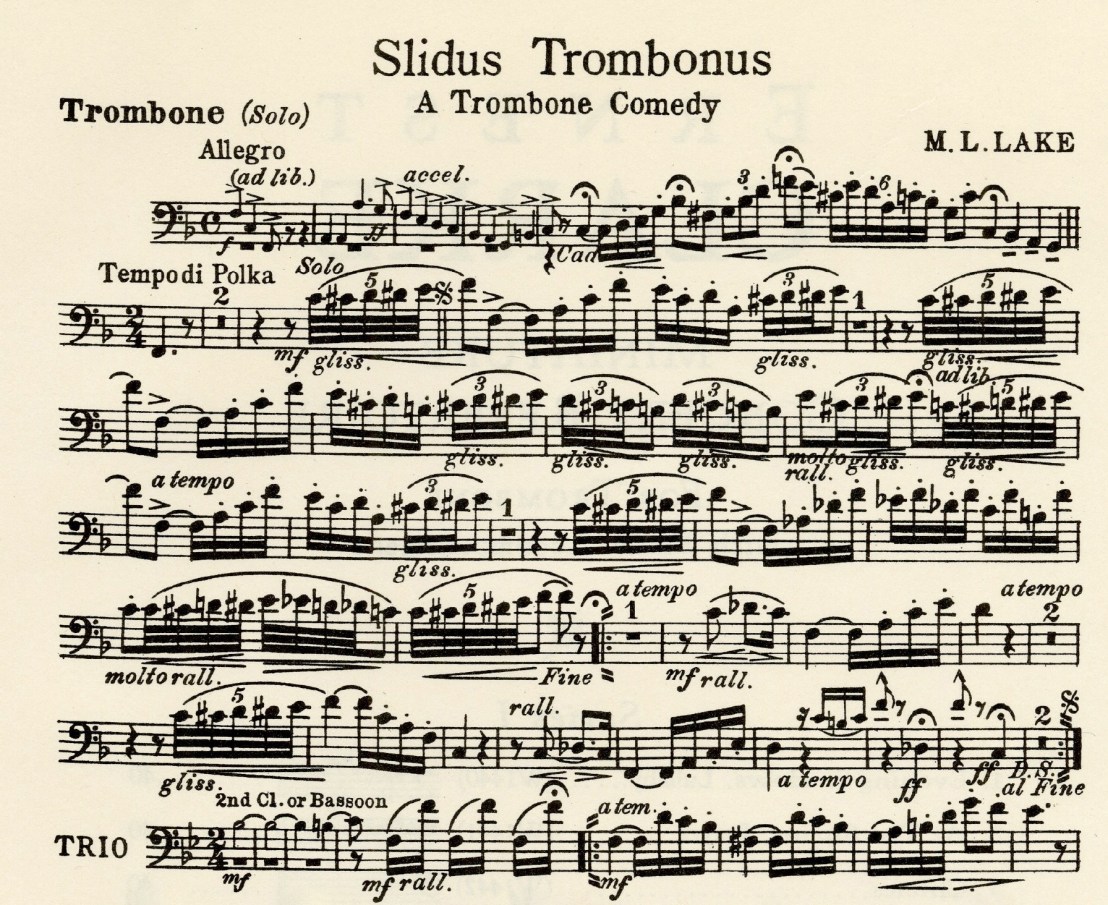
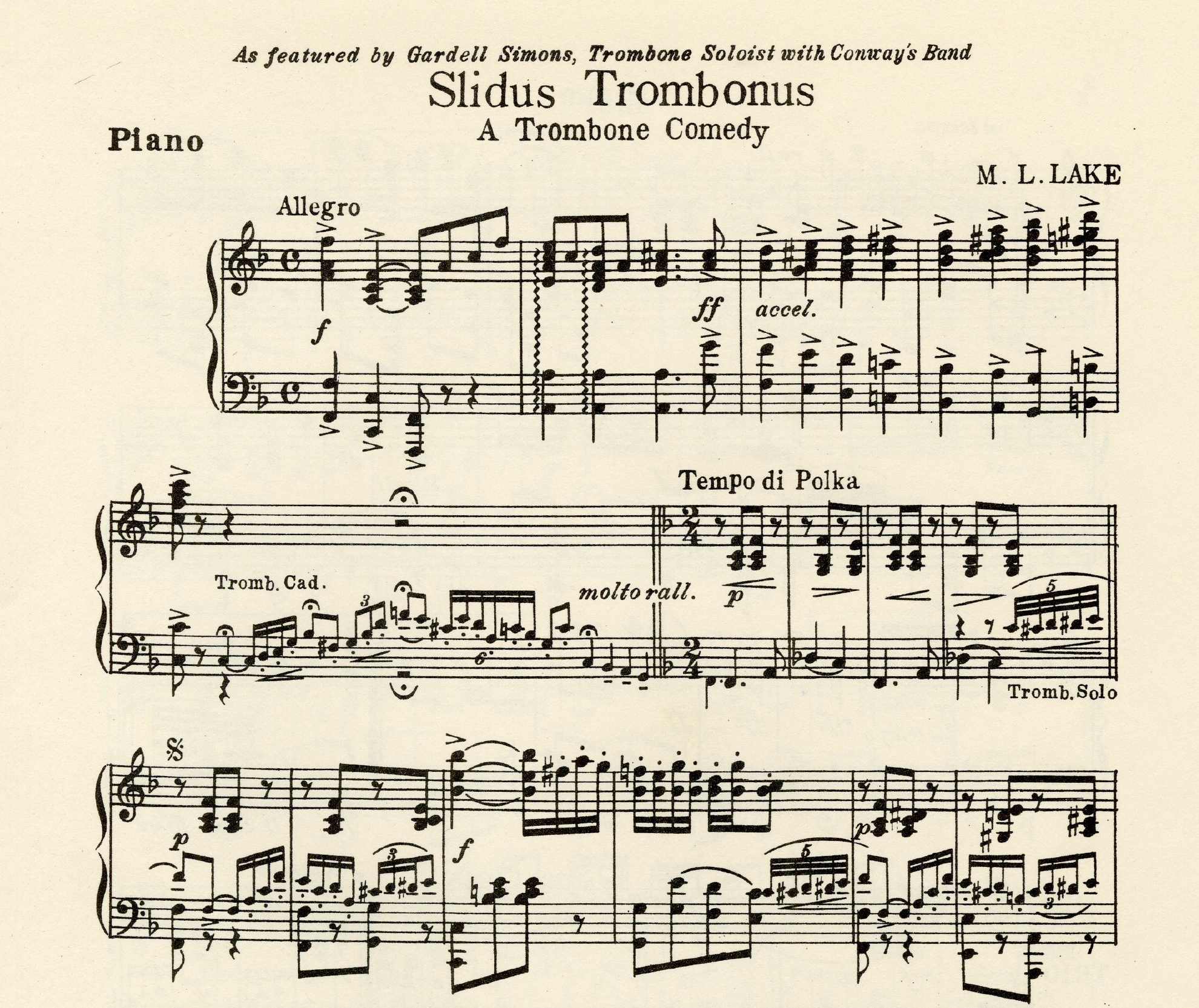
I also mentioned Mayhew Lake’s Slidus Trombonus (1905), a piece that I think that has more musical interest than Lassus Trombone. You can download the trombone and piano version of that piece for free (it’s also in the public domain) from my website by clicking HERE. There’s no racial stereotyping in Slidus Trombonus.
And here’s something else you might not know. Fillmore’s was not the only “trombone family” composed in the early twentieth century. Nathaniel Cleophas “Shorty” Davis was an African American trombonist, band leader, composer, and publisher. Between 1915 and 1921, he composed five trombone ragtime/glissando features that were all part of a “family” just like Fillmore’s pieces. They were published by Davis’s own Nashville-based company which he ran along with his brothers Otis and Clarence, as well as C. G. Conn. And also Carl Fischer, publisher of Fillmore’s The Trombone Family. Clearly there was a market for more than one trombone family in the early twentieth century, although Fillmore’s works, with their connections to blackface and racial stereotyping, went on to be famous and Davis’ trombone family, which had no racial stereotyping, has largely been forgotten.
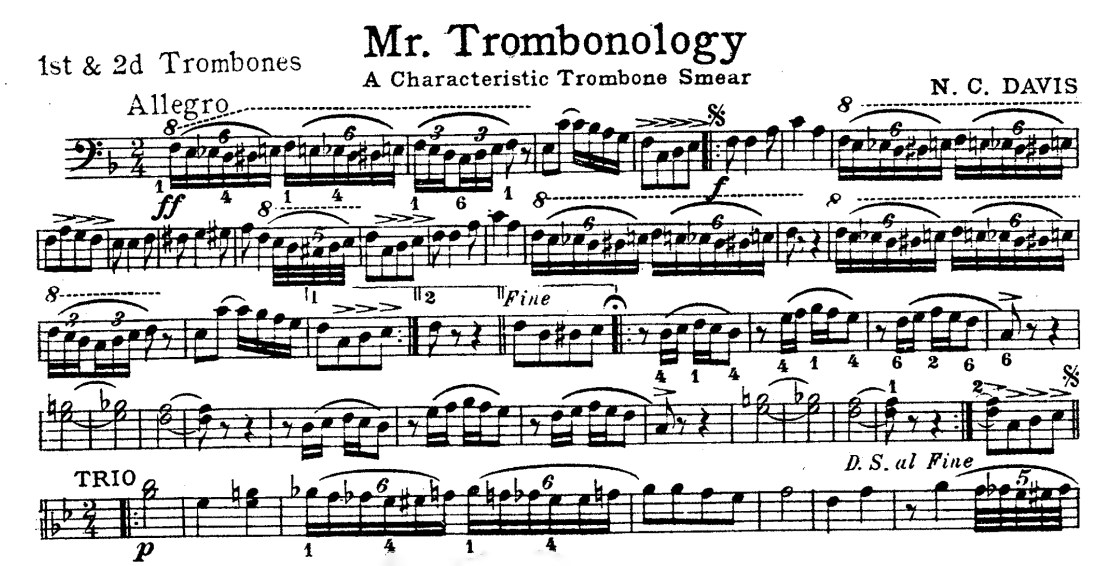
Here are Nathaniel Davis’ trombone pieces. I’ve been able to find subtitles that Davis gave to a few of his pieces both from the pieces themselves and some advertisements Davis’ company took out in 1917 in The Musical Messenger, a monthly publication of Fillmore Music House.
Oh Slip It Man (1916) — Trombone novelty. That heavy dose of thunder on parade. [NOTE: The word “slip” derives from a late nineteenth and early twentieth century slang word for the trombone, sliphorn, that referred to the trombone’s slippery slide.]
Mr. Trombonology (1917) — A characteristic trombone smear. The son of Oh Slip It Man. One great flash of lightening on parade.
Miss Trombonism (1918)—A Slippery Tune. The granddaughter of “Oh Slip It Man” and daughter of Mr. Trombonlogy.
Master Trombone (1919) [NOTE: The word “master” is an honorific title for boys and young men, a male equivalent in some quarters to “Miss” for females.]
Trombone Francais (1921)—Trombone novelty.
The band music to all five of these pieces is available for free (they are all in the public domain) by clicking HERE.
By the way, if you’ve heard of or played Tommy Dorsey’s composition Trombonology (1947), now you know where he might gotten the name for his piece’s title.
And now a few questions, ones I’m hoping might capture the imagination of some enterprising arrangers.
Is there someone out there who might take up the project of arranging Sorensen’s band version of Trombone Sneeze for trombone and piano? At this time, there only seems to be an edition of the piece for band. As one of the earliest known pieces in the ragtime trombone ragtime/glissando genre, it’s an item of some historical importance and interest. After all, it was performed by Arthur Pryor and John Philip Sousa. Not a bad endorsement.
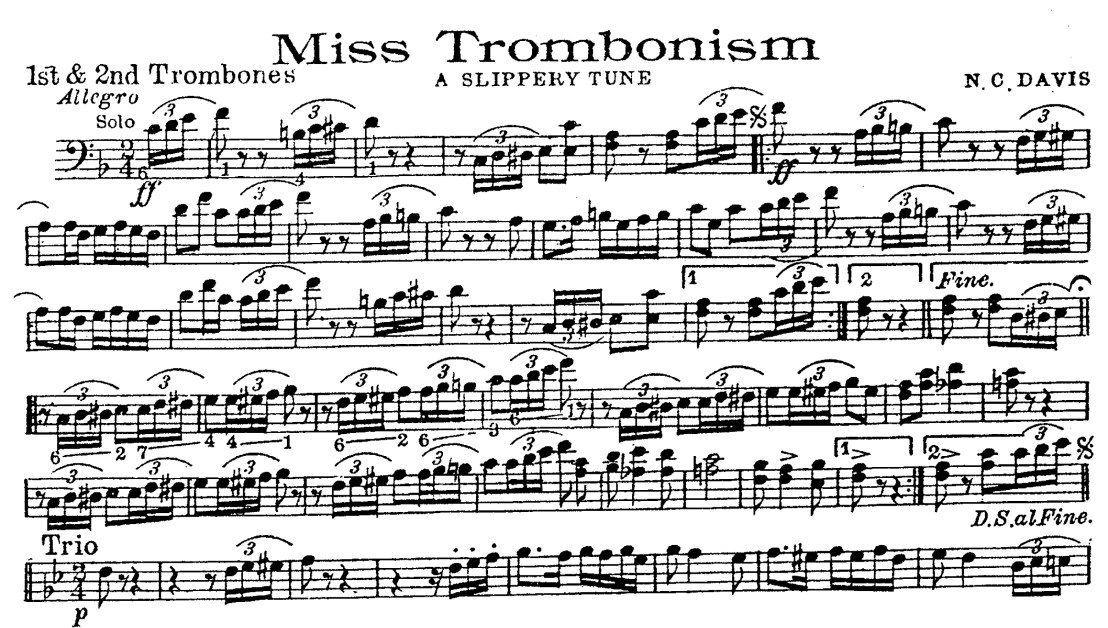
And is there an arranger who would be interested in taking Nathaniel Davis’ trombone family pieces as we have them for band and arranging them for trombone solo with piano? Don’t you think there might be a market for a set of works written by an African American composer 100 years ago that have real charm? Works that are new for most of today’s audiences? Works that never stooped to racial stereotyping in their marketing? Works that provide us with an attractive alternative to the racially baggage-laden Lassus Trombone and others in The Trombone Family? I have to believe there is someone out there who would take up the challenge and provide us with something interesting to play if one wants to include a work from the trombone ragtime/glissando genre on a concert or recital. And here’s an added incentive if you’re inclined to make these arrangements. My friend, publisher Gordon Cherry, founder and owner of Cherry Classics, has told me that he would be thrilled to publish the best arrangement of Davis’ pieces that is submitted to him. So there you go: A publisher wants to publish your arrangement of Davis’ ragtime trombone works. Your arrangement has to be the best that Gordon receives, and he gets to decide if he thinks it is good enough. So, here’s a challenge—and a reward. You can contact Gordon Cherry directly through his website at www.cherryclassics.com. Thank you, Gordon.
[UPDATE: Gordon Cherry has announced the publication of all five of Nathaniel Davis’ trombone rags in arrangements for trombone and piano by Aaron Hettinga, a brass quintet version of Mr. Trombonology by Josh Houser, and a new version of Miss Trombonism by Hettinga for modern concert band. It is great to see these now in print. Click HERE to see and order these new publications.]
When I wrote my article about Lassus Trombone last week, I was hoping to inform the trombone community of the history of a popular piece in our repertoire, ask some questions, and make some suggestions. I wasn’t trying to start a “movement.” I just wanted to bring it up. So I did. And look what happened. Thanks to many people who read my article and felt it resonated with them, it got passed around and an important conversation is going on around the world.
Whether or not you agree with my premise that it’s time to put Lassus Trombone and the other members of Henry Fillmore’s The Trombone Family to rest, at least you know more about the pieces. And when you know something, it just might lead you to do something. And doing something is important.
It matters.
© 2020, Douglas Yeo. All rights reserved.



 The Last Trombone – Douglas Yeo