Category: teaching

Hope.

Hope.

We are living through an extraordinary crisis. Words fail. Everyone has a story; no one is immune from the implications of COVID-19. Every part of every life is impacted on every level.

As I, like everyone on our planet, work to navigate the challenges before us, I am reminded that there is one thing we cannot do: we cannot give up hope. Everyone hopes in something. My hope is in God. I do not doubt God’s wisdom or rightness; God is Sovereign—God is in, around, above, before, behind, under all things. In this present crisis, as always, I have some questions for God. But I know God  hears my prayers every day. I trust God even in the midst of the storm; God is teaching us something in all of this.

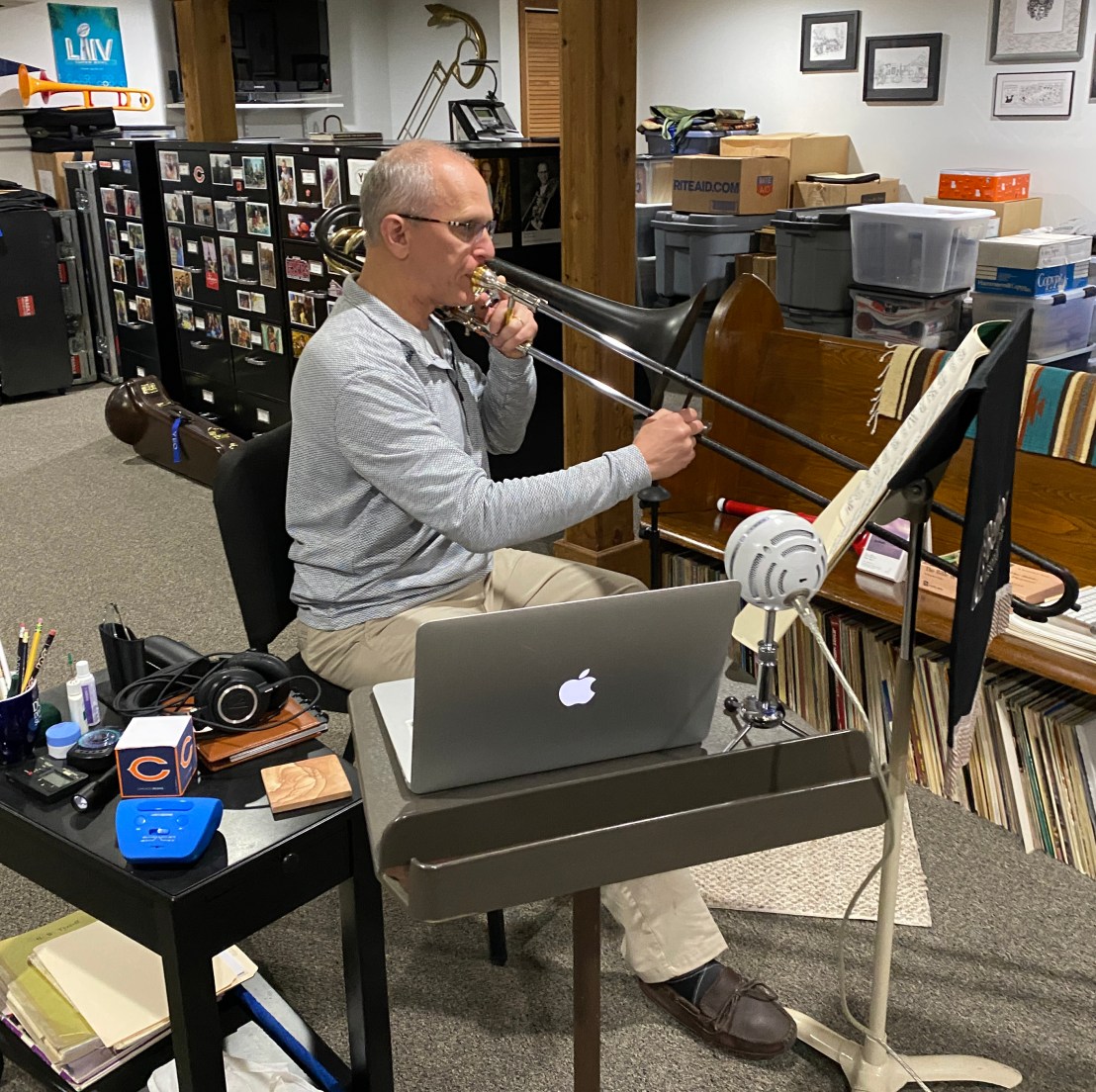
With life now sideways and our feet treading in quicksand, I spent a few hours yesterday cleaning up our basement where I practice trombone and have most of my music, books, recordings, and files. It is there where tomorrow, I will begin teaching remote lessons to my students at Wheaton College (Illinois).

Yeo_remote_teaching

Sometimes when you go looking for something, you find something else. While filing away some documents yesterday, I came across the Boston Symphony Orchestra program for opening night, September 24, 2008, four years before I retired from the orchestra in 2012. It was the fifth year of James Levine’s tenure as music director of the orchestra, and the program included Pictures at an Exhibition of Modeste Mussorgsky, orchestrated by Maurice Ravel. The concert remains memorable to me, but the reason I saved that program is because of its beautiful cover image. It shows the center of the ceiling of Symphony Hall, Boston, where the middle of three crosses on the ceiling is illuminated by a chandelier. I spent many hours looking at that ceiling and its three crosses, which always reminded me of three crosses on a hill called Golgotha outside Jerusalem 2000 years ago where my Hope, Jesus Christ, lived, died and rose again, and gave me the Hope I hold. And now, looking at this beautiful, artistic photograph, I am reminded again of my Hope. Light in darkness. Good in the midst of evil. The solid rock in the midst of sinking sand.

Symphon_Hall_Boston_ceiling_Low_res

In the midst of this storm, the only hope we have is in God. Pray for deliverance from this pestilence. Pray for safety. Pray for wisdom in how we can help others. Pray for others who have greater challenges than we have. Pray that when this ordeal is over, we will act in new ways in light of the lessons we are learning today. This we pray. Amen.

So we do not lose heart. Though our outer self is wasting away, our inner self is being renewed day by day. For this light, momentary affliction is preparing for us an eternal weight of glory beyond all comparison, as we look not to the things that are seen but to the things that are unseen. For the things that are seen are transient, but the things that are unseen are eternal. (2 Corinthians 4:16-18)

[Header image: Sunrise over the Sierra Estrella, Goodyear, Arizona, 2012. I took this photo from the front porch of our home where we lived from 2012-2018. Sunrise. A new day. Hope.]

Coming back home: Teaching trombone at Wheaton College

Coming back home: Teaching trombone at Wheaton College

They say you can’t go back. But I just did. In a circle of my life spanning 45 years, I’ve just gone back home. Just a few weeks ago, I was appointed the trombone teacher at my undergraduate alma mater, Wheaton College (Illinois). In a big sense, I feel like I’ve come home, returning to a place that dramatically shaped me even as I now have the opportunity to shape the lives of others.

Yeo_Wheaton_College_1975

[That’s me, warming up before a concert in Wheaton College’s Edman Chapel, spring 1975. This photo appeared in the 1975 edition of Tower, Wheaton College’s annual yearbook.]

It was while I was a student at Wheaton College that I studied trombone with Edward Kleinhammer, then bass trombonist of the Chicago Symphony, and started on my road to become an orchestral bass trombonist, a road that led me to the Boston Symphony Orchestra (1985-2012) and many other remarkable places.

Kleinhammer_Yeo_1976

[Edward Kleinhammer and me at my last lesson with him in his studio in the Fine Arts Building, Chicago, May 1976.]

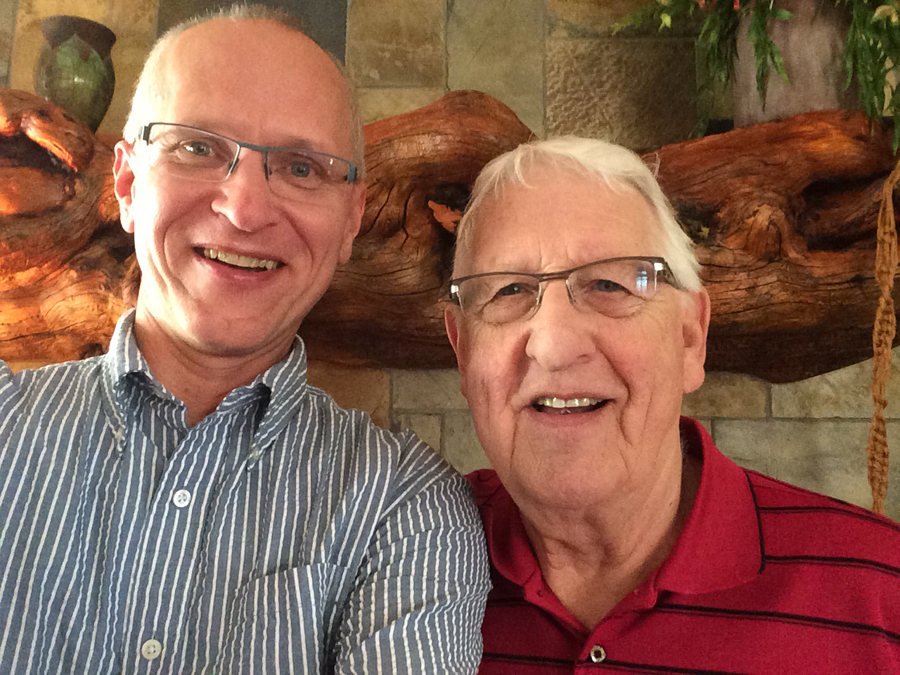
It was while I was a student at Wheaton College that I met Dr. Harold Best—then the Dean of the Wheaton College Conservatory of Music and author of the remarkable book, Music Through the Eyes of Faithand began an abiding and life-changing relationship with a man who began as my advisor, became my mentor, and is now one of my closest friends.

Douglas_Yeo_Harold_Best_sm.jpg

[Dr. Harold Best and me, at his home in Idaho, 2014.]

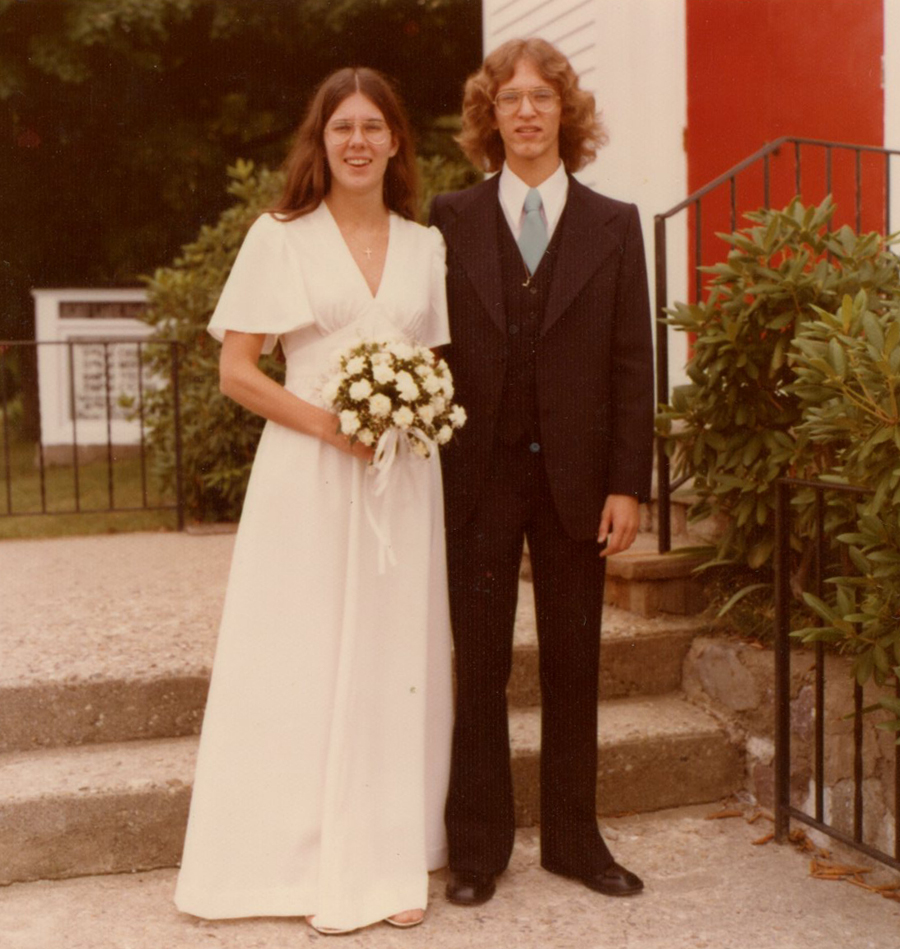
It was while I was a student at Wheaton College where, two weeks after the most wonderful girl in the world and I got married, we set up our first home. After 44 years of marriage, I thank God that she’s still that girl.

Yeo_wedding_1975

[August 31, 1975]

Travis_Yeo_wedding_announcement

It was while I was a student at Wheaton College where I memorized all of the verses to Martin Luther’s great hymn, A Mighty Fortress is Our God (for extra credit on an exam), and since that time, I have recalled it every day of my life, especially its second verse:

Did we in our own strength confide, our striving would be losing;

Were not the right Man on our side, the Man of God’s own choosing.

Dost ask who that may be? Christ Jesus, it is He;

Lord Sabaoth His name, from age to age the same, and he must win the battle.

And it was at Wheaton College where our two daughters attended and graduated with degrees in music.

We all have hopes and dreams. One of mine, held for the last 45 years, has been that God might allow me to return to Wheaton College some day to serve on its faculty, and repay some of what that remarkable place gave to my family and me. Last month, that dream—that prayer—was answered most unexpectedly, when Dr. Michael Wilder, Dean of the Conservatory of Music and Division of Arts and Communication at Wheaton College, asked me to join Wheaton College’s faculty as its trombone teacher. It all happened so quickly, so remarkably, and after a time of prayer and consideration, I accepted.

In announcing my appointment, Dean Wilder said,

“We are delighted to welcome Douglas Yeo to the music faculty of the Conservatory of Music at Wheaton College. He brings an amazing life of experience as a performer, teacher, and thought leader in matters of artistry, faith, and creativity. A very few minutes with Douglas Yeo will pull any person into a whirlwind of ideas and inspiration and we are looking forward to all that he will accomplish at Wheaton College, as he invests in the lives of students, colleagues, alumni, and friends.”

I pray that I might live up to those words.

The fall 2019 semester is now half over, and my students and I are on fall break, a few days of refreshment before we head back to school for more trombone lessons, more trombone studio classes, more concerts, recitals, juries, and our ongoing exploration of music and music making.

Yeo_office_sign

So it is that on Tuesdays, you find me teaching lessons in room 022 of Wheaton College’s brand new (just two years old), state-of-the-art Armerding Center for Music and the Arts. It’s a teaching studio I share with four other Wheaton College faculty, a place where my students and I contend to be better stewards of the talents that God has given to us. On Fridays, I’m in the Armerding Center’s room 141, a spectacular “smart classroom” where we hold our weekly trombone studio class and engage in playing trombone ensembles and solos, listening to music, watching presentations, and much more.

Yeo_WC_piano_dedication_04_sm

[Armerding Center for the Performing Arts, Room 141.]

Next fall, Wheaton College will open a new 648 seat concert hall (this new hall is in addition to the Conservatory’s 101 seat recital hall and the 2400 seat Edman Memorial Chapel), making its music facilities second to none. My wife and I have been blessed to be able contribute to help with the construction and outfitting of these new music buildings and we’d like to encourage others who believe in the mission and work of Wheaton College to support the effort to complete the building of the Concert Hall. Click HERE to read a story about why we are helping with this and learn how you can join us and help as well.

Now, we are already beginning to make plans for the 2020-21 school year. Auditions will take place in the next several months—the deadline to apply for fall 2020 admission is January 10—and I am praying now for the group of students who will be part of the Wheaton College trombone studio next year. If you’re interested in studying trombone with me and attending an outstanding liberal arts college (which has a Conservatory of Music that has a superb undergraduate music curriculum that leads to a bachelor of arts, bachelor of music, or bachelor of music education degree; Wheaton also offers a minor in music), a college that has at its core the commitment to “Christ and His Kingdom,” a place that has high and rigorous academic standards in which students grow and learn to be good stewards of the talents God has given them, and a place that Forbes has recently named one of America’s Top Colleges, I’d like to encourage you to apply for admission. The Wheaton College Conservatory of Music website has details about everything you’d want to know about the study of music at Wheaton: a look at our facilities, biographies of all of our outstanding faculty, videos of large ensemble performances, and much more. You can also get details about how to apply to the Wheaton College Conservatory of Music by clicking HERE. The Conservatory’s mission statement stakes out our commitment to our students:

The Conservatory seeks to bring each of its students to an intellectual understanding of the theoretical, historical, and stylistic aspects of musical practice; to relate each of these to the vast literature of music; and to demand the highest level possible of technical and artistic achievement in performance, composition, and teaching. Most importantly the Conservatory seeks to undertake this task in the light of a biblical perspective which describes the making of music as an act of worship and service, calls for excellence as the norm of stewardship, and relates all of human creativity to the Creatorhood of God.

For more information about trombone study at Wheaton College, go to my bio page on the Wheaton College Conservatory website and click on the tab that says Faith and Learning. There you will find my underlying core philosophy of teaching, and the fundamentals of what it is that we work to do in Armerding Room 022 and 114, across campus, and even to the ends of the earth.

And if you are entering grades 9-12 in the fall of 2020 and are looking for an engaging, one-week long summer music program, I’d like you to know that I will be teaching at Wheaton College’s summer music camp, to be held next summer from June 21-28. This is an ideal way to explore music at Wheaton; for information, click HERE.

I’m back home again, at Wheaton College. If God leads you home there, too, I look forward to seeing you.

Print


100 years ago today: Edward Marck Kleinhammer (1919-2013)

100 years ago today: Edward Marck Kleinhammer (1919-2013)

100 years ago today—on August 31, 1919—Edward Marck Kleinhammer was born (that is not a typo, his middle name was spelled Marck). He had a  long and especially distinguished career as bass trombonist of the Chicago Symphony Orchestra from 1940-1985. His influence on bass trombone performance and pedagogy is incalculable, even today, years after his death in 2013.

This was a man who changed my life. He was my trombone teacher during my years as an undergraduate at Wheaton College, Illinois (1974-1976). In the years that followed, the teacher/student relationship changed into a deep, abiding friendship, and I count myself very blessed that God brought our lives together. The story of his accomplishments and his influence on me and so many others is something I told in two articles I wrote about him for the International Trombone Association Journal. On both occasions, his photo graced the cover of the Journal. I wrote the first on the occasion of his retirement from the Chicago Symphony, in 1985. You can read it by clicking HERE.

Yeo_Kleinhammer_ITAJ_1985.jpg

I wrote the second in 2014, shortly after his death. You can read it by clicking HERE.

Yeo_ITAJ_April_2014_Kleinhammer_tribute

The photo on both of these International Trombone Association Journal covers dates from 1976, and first appeared in a book published by the Chicago Symphony in that year, Reflections: A collection of personality sketches of the Chicago Symphony Orchestra.

Kleinhammer_CSO_Reflections_1976

Both of my articles are personal tributes to a great man and contain much information about his life, work, and influence. Today, on what would have been his 100th birthday, I don’t need to say many more words about Mr. Kleinhammer. He was a superb bass trombonist, a caring, challenging, effective, and tremendously inspiring teacher, and one who loved God and lived his life with the Bible as his guide. But a picture, it has been said, tells a thousand words. Here are some photos of him that tell more of his story. Many have never been published before. Several were given to me by Ed Kleinhammer himself; others were given to me by his widow, Dessie, after his death, and still others come from my own collection. Edward Kleinhammer: a life well lived, and a life remembered by all who knew and were influenced by him. Captions are above each photo.

[Below] Ed Kleinhammer played trombone in Leopold Stokowski’s All-American Youth Orchestra in 1940, during the summer before he joined the Chicago Symphony. This photo shows the orchestra on stage at the Boardwalk Hall in Atlantic City before their tour of South America:
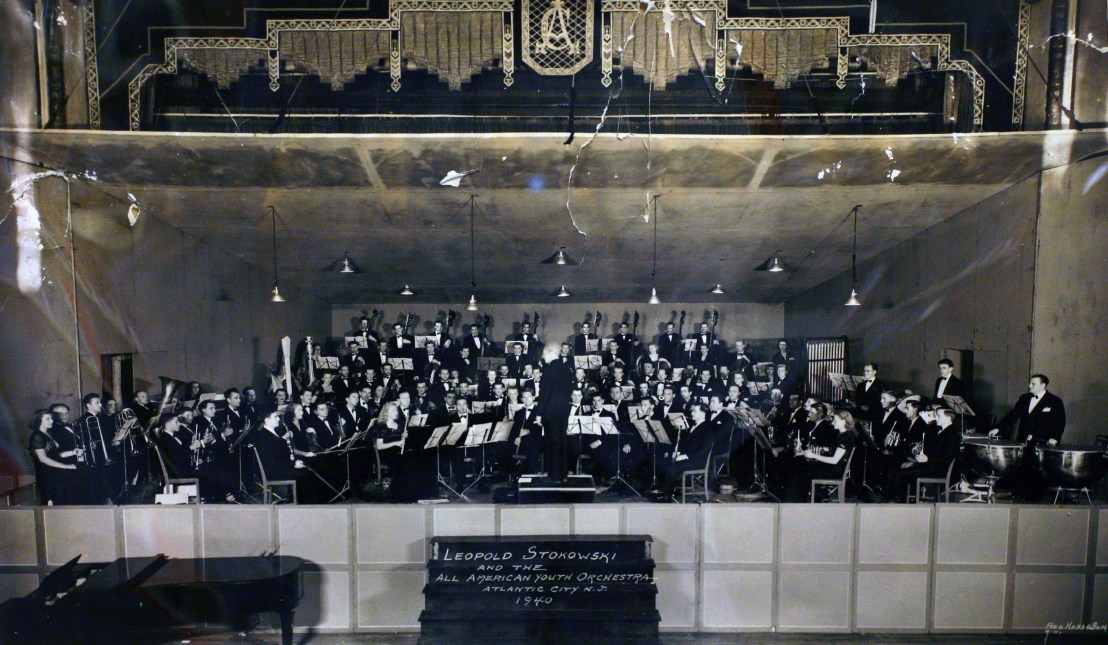
1940_AAYO

[Below] This is a closeup of the low brass section of the orchestra, cropped from the above photo. From the left (front) are Dorothy Zeigler, Charles Gusikoff (who was principal trombonist of the Philadelphia Orchestra at the time—Stokowski engaged several members of the PO to play alongside the younger players in the orchestra), Edward Kleinhammer, Howard Cole, and Philip Silverman, tuba:

1940_AAYO_low_brass_Kleinhammer

[Below] Edward Kleinhammer and an unidentified All-American Youth Orchestra member  outside the Atlantic City Boardwalk Hall, 1940:

1940_AAYO_Kleinhammer_Zeigler

[Below] After I joined the Boston Symphony Orchestra in 1985, Edward Kleinhammer sent me his copy of the Method for trombone by Carl Hampe, who had been principal trombonist with the BSO in the early 20th century. It was one of his earliest trombone study books but it was one he turned to even after he joined the Chicago Symphony. When I opened it, I found many of his markings inside including those on these two pages. This one has an aphorism that he penned in 1947, and is a good reminder of how discipline and “slow and steady wins the race” were themes of his life:

Hampe_Method_01_Kleinhammer

[Below] This page, below, made me smile. Evidently, Leopold Stokowski had asked Mr. Kleinhammer to demonstrate his range on the trombone. His note to himself speaks for itself:

Hampe_Method_02_Kleinhammer

[Below] Here is the Chicago Symphony, October 8, 1940. This is a scan of half of a photo of the orchestra; I only have this scan of this portion of the photo which was given to me by Edward Kleinhammer.
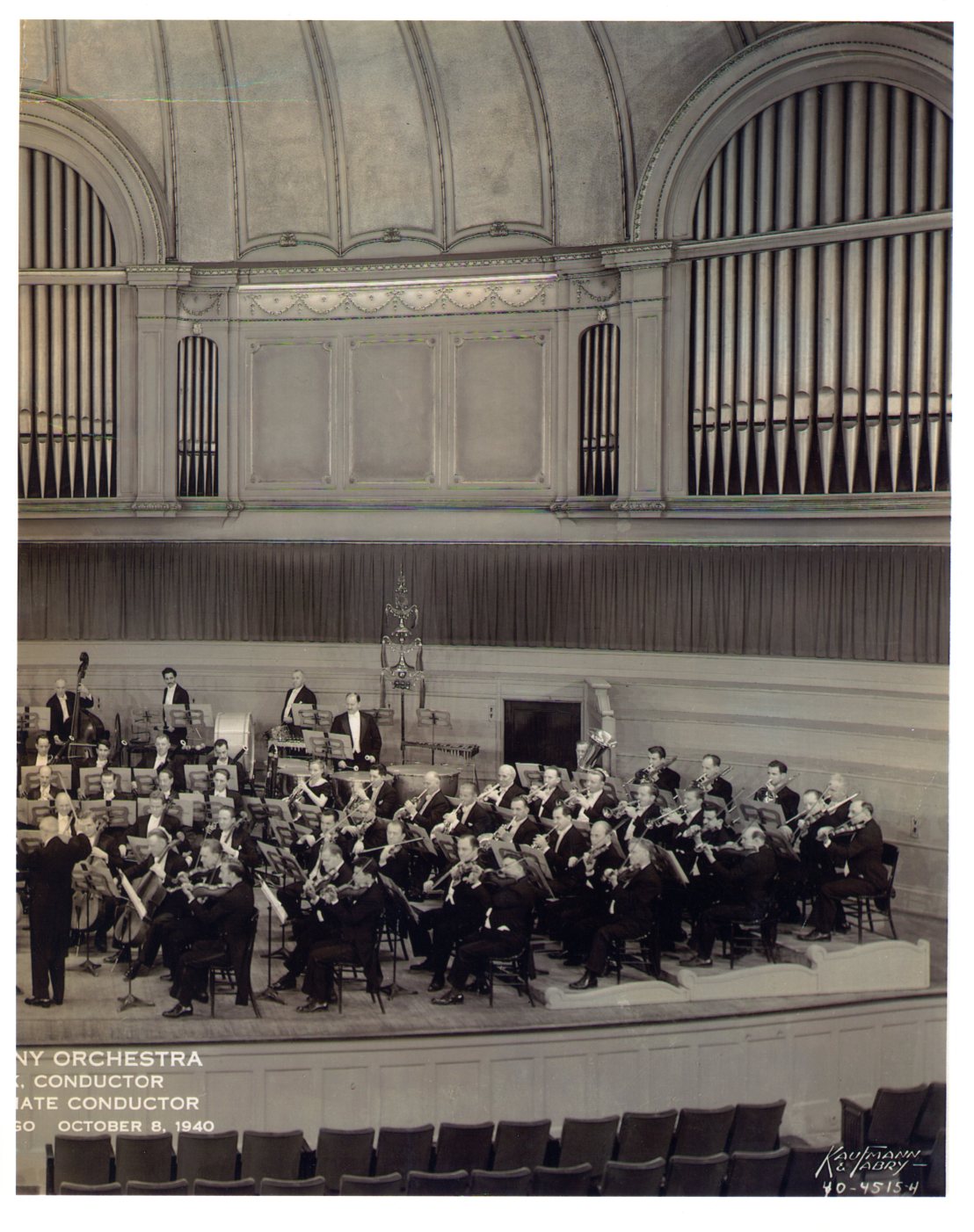
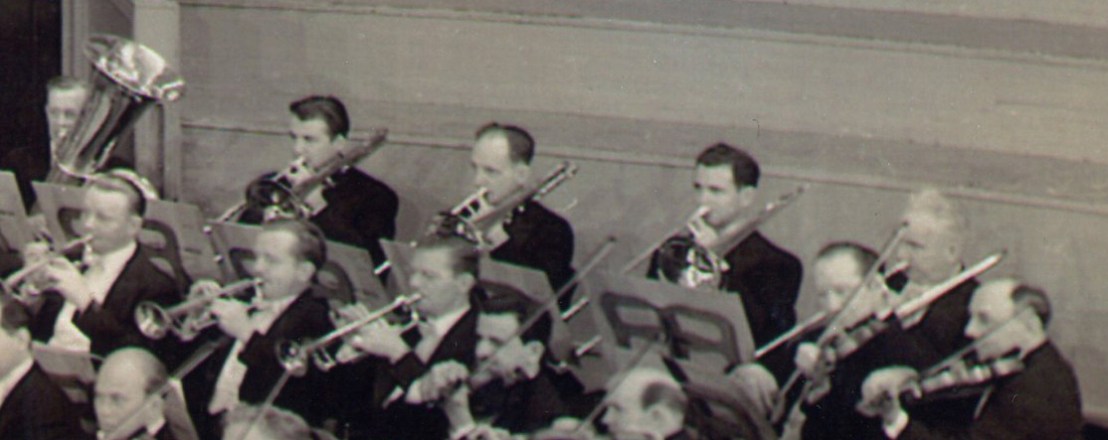
CSO_1940[Below] Here is the low brass section of the Chicago Symphony Orchestra, fall 1940, cropped from the larger photo shown above of the CSO with Frederick Stock, conductor, at the beginning of Edward Kleinhammer’s tenure in the orchestra. Left to right: George Washington Hamburg, tuba; Edward Kleinhammer, bass trombone; David Anderson, second trombone; Frank Crisafulli, principal trombone; Edward Geffert, assistant principal trombone.
CSO_trombones_Kleinhammer_1940

[Below] From 1942—1945, Edward Kleinhammer was in a U.S. Army band, stationed at Fort Leonard Wood, Missouri. In this photo, he is in the top row, second from the right, next to a Sousaphone player:

Kleinhammer_Army_Band_c1942_01

[Below] Ed Kleinhammer in uniform, c. 1944:

Kleinhammer_Army_c.1944

[Below] The caption on the back of this photo is in Edward Kleinhammer’s handwriting and reads, “Stage Band, Independence, Kansas. Early 1940s.” He drew a small “X” on the photo to show where he was sitting in the back row of the Army band:

Kleinhammer_Army_Stage_Band_c.1944

[Below] The caption on the back of this photo, reads (in his wife, Dorothy’s handwriting), “Ed is practicing near our cabin.” In his handwriting, it reads, “Calling ‘Moose'” (Moose was Ed Kleinhammer’s nickname in the CSO). The photo looks to date from the late 1950s.

Kleinhammer_1950s_woods

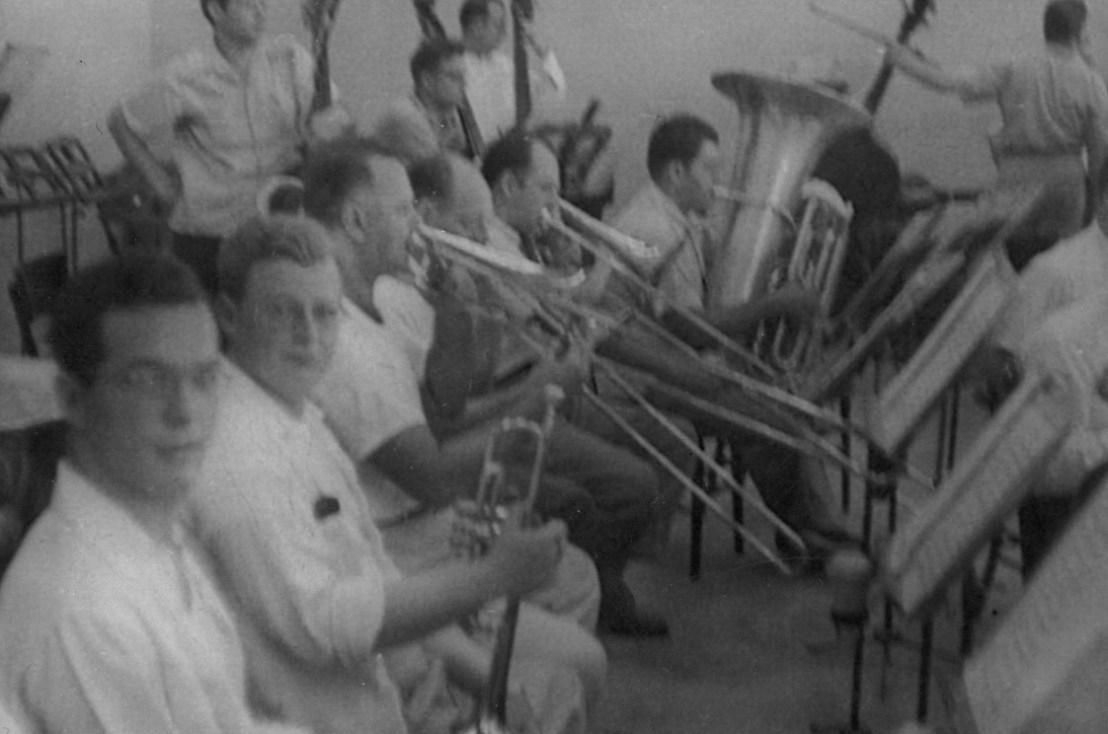
[Below] This photo is from the Ravinia Festival, taken around 1960. From left to right: Rudolph “Rudy” Nashan, trumpet; Adolph “Bud” Herseth, principal trumpet; Robert Lambert, principal trombone, Frank Crisafulli, second trombone; Edward Kleinhammer, bass trombone; Arnold Jacobs, tuba.
CSO_brass_players_Ravinia_c1960

[Below] This is a Chicago Symphony Orchestra brass quartet, around 1970. David Babcock, horn; Charles Geyer, trumpet; Edward Kleinhammer, bass trombone (playing his single valve Bach 50-B bass trombone); James Gilbertson, tenor trombone.

CSO_Brass_Quartet_c1970

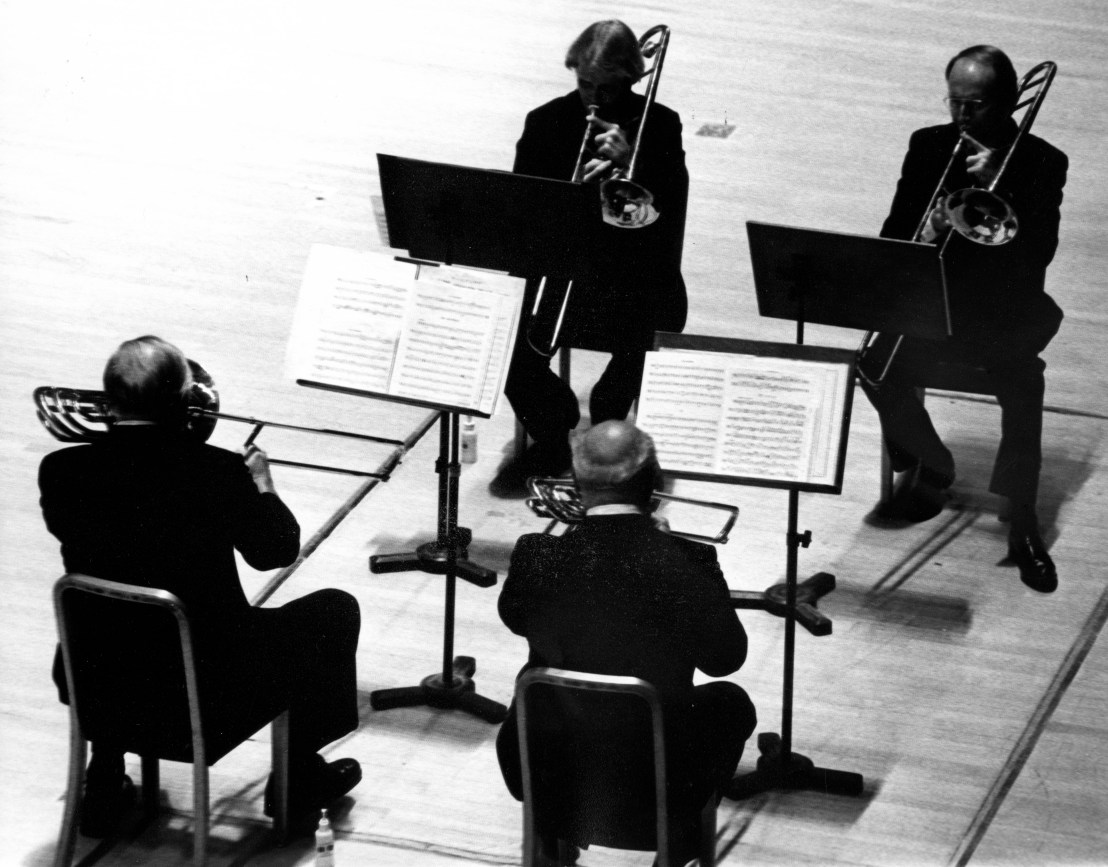
[Below] The caption on the back of this photo, in Edward Kleinhammer’s handwriting, reads, “Trombone Section CSO Circa 1970.” Back to camera: Edward Kleinhammer, Frank Crisafulli; facing camera, James Gilbertson, Jay Friedman.
CSO_trombone_section_c_1970

[Below] Chicago Symphony brass players, May 1972. Back row, from left to right: Adolph “Bud” Herseth, principal trumpet; James Gilbertson, assistant principal trombone; Jay Friedman, euphonium (principal trombone); Frank Crisafulli, second trombone; Edward Kleinhammer, bass trombone; Arnold Jacobs, tuba.

CSO_low_brass_May_1972

[Below] Members of the Chicago Symphony brass section, around 1975. Back row, left to right: Philip Smith, fourth trumpet; William Scarlett, third trumpet; Charles Geyer, second trumpet; Adolph “Bud” Herseth, principal trumpet; James Gilbertson, assistant principal trombone; Frank Crisafulli, second trombone; Edward Kleinhammer, bass trombone; Arnold Jacobs, tuba.

CSO_Brass_c1975

[Below] This photo was taken by my wife after my last lesson with Edward Kleinhammer, just before my graduation from Wheaton College, May 1976. The location is his studio in the Fine Arts Building on Michigan Avenue, Chicago. He is holding his bass trombone made by Schilke with a bell by Earl Williams.

Kleinhammer_Yeo_1976

[Below] The caption on the back of this photo, in Edward Kleinhammer’s handwriting, reads, “Ravinia 1976.”

Kleinhammer_Ravinia_1976

[Below] Edward Kleinhammer and Arnold Jacobs, c. 1984:

Kleinhammer_Jacobs_c_1984

[Below] Edward Kleinhammer’s final concert with the Chicago Symphony in Orchestra Hall was in May 1985. These three photos (below) were taken during that concert and hung in his home office for many years after.

Edward_Kleinhammer_May_1985_01

[Below] Edward Kleinhammer’s final bow at his chair in Orchestra Hall, May 1985. Also seen are Frank Crisafulli, second trombone, and Arnold Jacobs, tuba:

Edward_Kleinhammer_May_1985_02

[Below] Edward Kleinhammer’s final concert in Orchestra Hall, May 1985. Here he is at the podium, being presented with the Chicago Symphony’s Theodore Thomas Medallion by guest conductor Michael Tilson Thomas:

Edward_Kleinhammer_May_1985_03


[Below] Edward Kleinhammer’s Theodore Thomas Medallion, presented to him by the Chicago Symphony Orchestra on the occasion of his retirement from the Orchestra:

Chicago Symphony Orchestra

The Theodore Thomas Medallion for Distinguished Service

Presented to Edward Kleinhammer

1940-1985

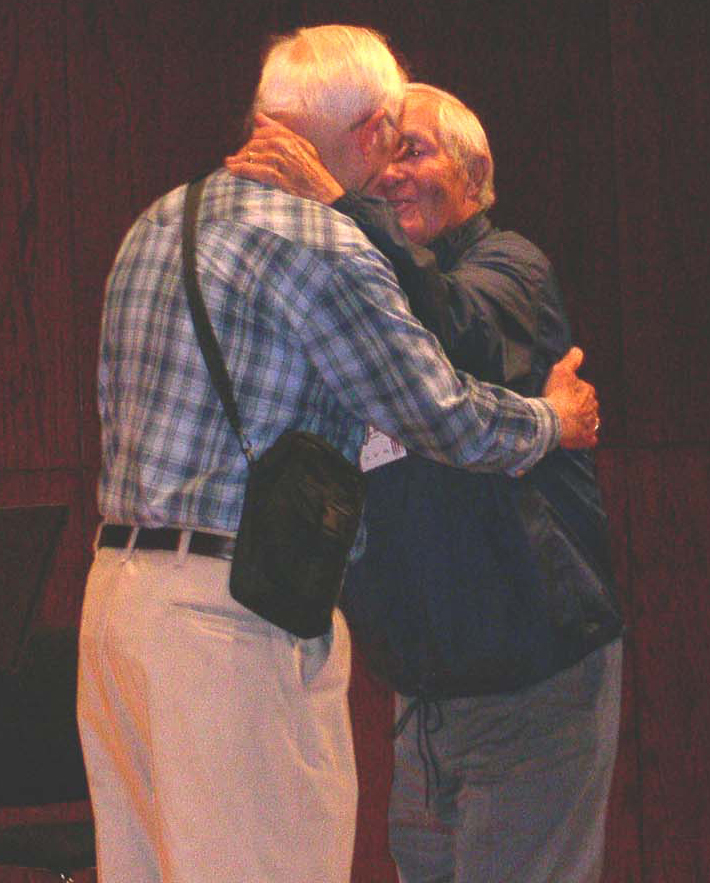
[Below] At the 2004 International Trombone Festival in Ithaca, New York, Edward Kleinhammer and George “Mr. Bass Trombone” Roberts met for the first time. It was a very special moment to see these two giants of the bass trombone from very different parts of the musical universe (classical and commercial) meet on stage together after Mr. Kleinhammer’s master class. George, ever effusive, came up to Ed and gave him a big hug and a kiss on the cheek. At the moment this interaction occurred, I was sitting in the audience with Ed’s wife, Dessie.
Kleinhammer_Roberts_2004

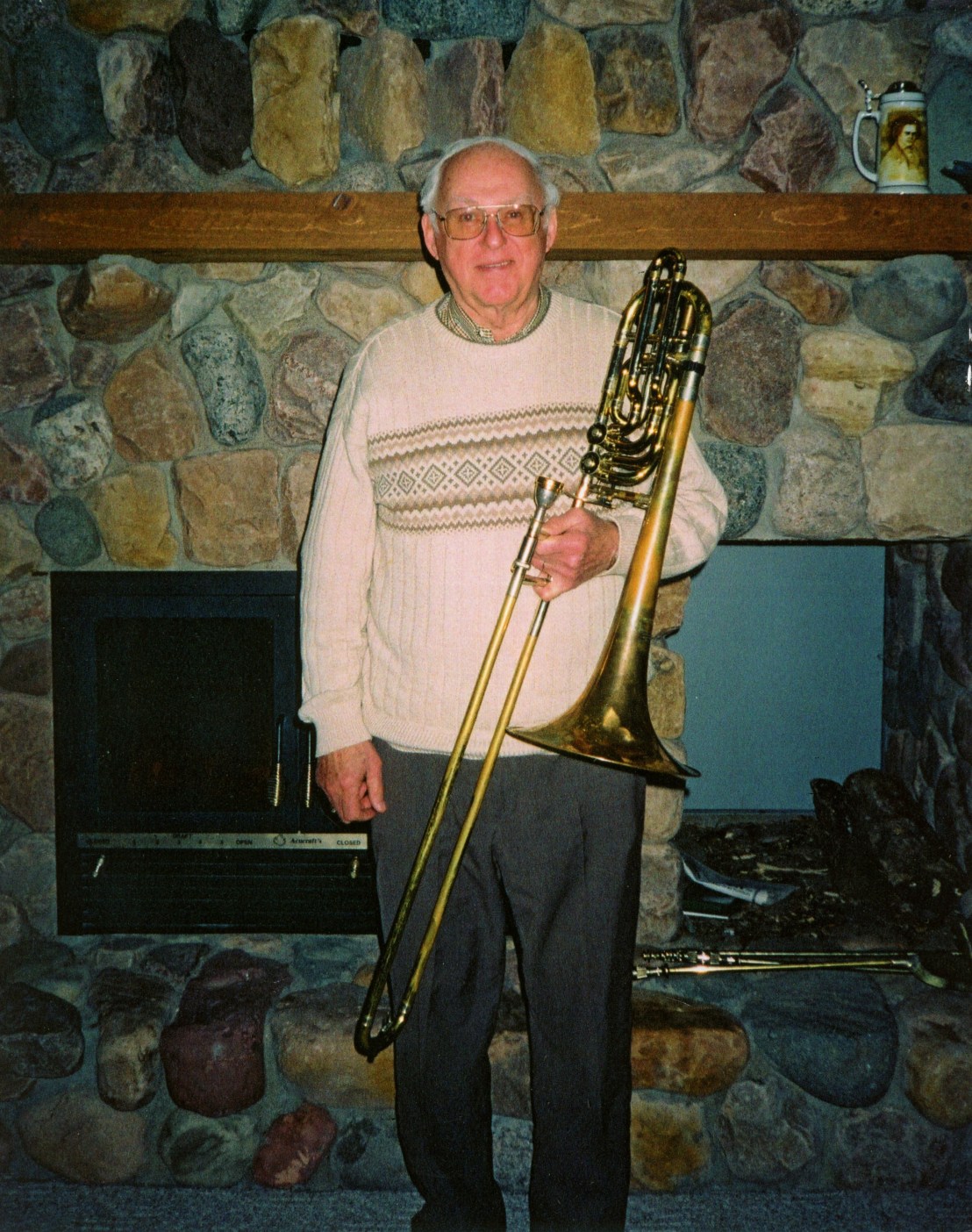
[Below] Edward Kleinhammer at home in Hayward, Wisconsin, around 2000 (photo by David Wilson). The mouthpiece in this Bach 50B3 is my YAMAHA Douglas Yeo Signature Series Mouthpiece that I had given to him several years earlier.
Edward Kleinhammer_c2005

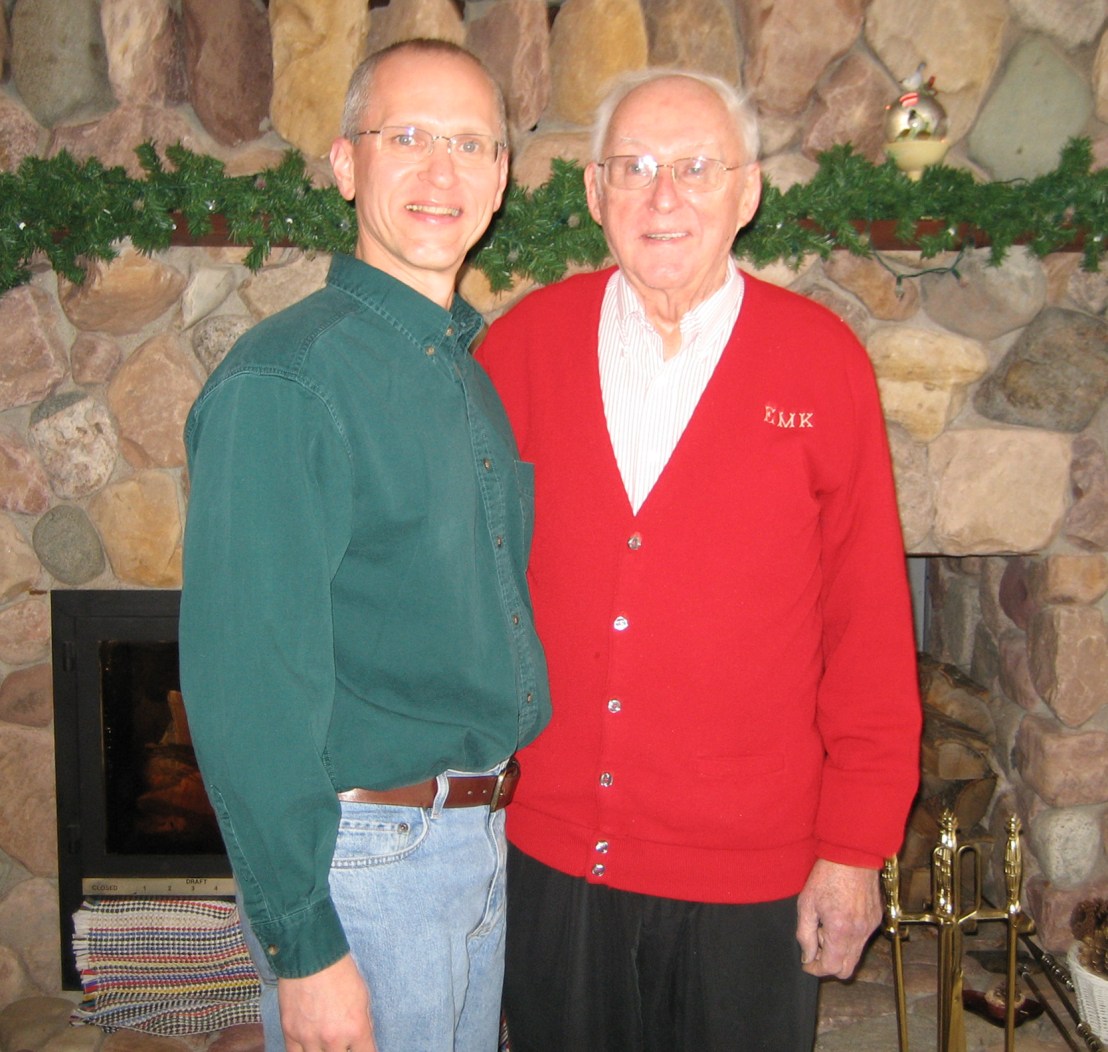
[Below] I kept in close contact with Mr. Kleinhammer over the years; I have several hundred hand written letters from him, even more emails, and we spoke by phone frequently. He always called me on August 31—his birthday— to wish my wife and me a happy anniversary. My wife and I were married on August 31, 1976, and every year, without fail, before I could pick up the phone to wish him a happy birthday, my phone rang and it was him, to wish us well. The last time I saw him was at his home in Hayward in 2009. This is how I will always remember him:
08.Yeo_Kleinhammer_2009

I last spoke to Ed a few days before he died. Nothing in his voice gave a clue that a week later, he would pass from this world to the next while taking a nap in his favorite chair. I am a better person and trombonist because of the influence of Edward Kleinhammer, and I know many others can say the same thing. Today, on what would have been his 100th birthday, we honor this man who did so much for so many.
Inspired in Japan – the 25th Hamamatsu International Wind Instrument Academy and Festival

Inspired in Japan – the 25th Hamamatsu International Wind Instrument Academy and Festival

I have been to Japan 14 or 15 times in my life; I’ve lost count. I first travelled to the island nation in 1986, on tour with the Boston Symphony and its music director Seiji Ozawa. More Boston Symphony and Boston Pops Orchestra (with John Williams, conducting) tours followed over the years. I have also been to Japan many times to teach and perform at the Hamamatsu International Wind Instrument Academy and Festival. I was on the faculty of the first Academy in 1995 and this month, I returned to Hamamatsu for the seventh (or eighth?) time to take part in its 25th anniversary event.

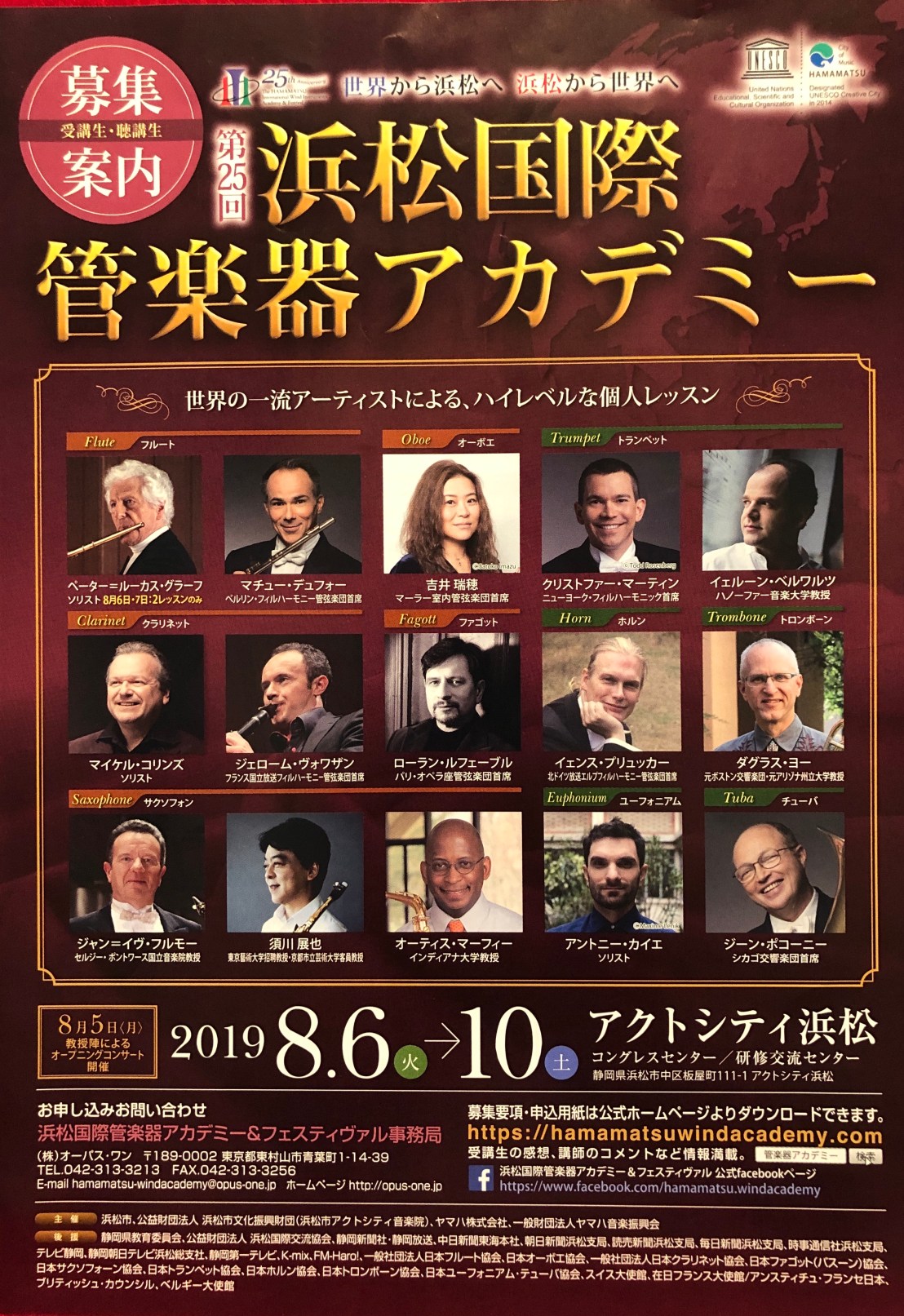
Hamamatsu_Academy_brochure_2019

The Hamamatsu International Wind Instrument Academy and Festival has grown to be an event of major importance for wind players. Jointly sponsored by the City of Hamamatsu, the Hamamatsu Cultural Foundation, and YAMAHA Corporation, the Academy and Festival assembles an international faculty of wind instrument teachers and performers. Each teacher chooses a class of eight students from recorded auditions, and students receive four lessons during a week. Lessons are open —they are conducted in large rooms with plenty of seating—and teaching rooms are always full of those who want to learn from the teachers. As such, each lesson is as much a masterclass as it is a private lesson. Before the teaching part of the event begins, the faculty always give an opening concert which, over the years, has taken different forms. Sometimes faculty play solos with piano, sometimes they play chamber music, and sometimes they take part in large ensemble performances.

Hamamatsu_Academy_brass_faculty_2019

I was delighted to be invited to the 2019 Academy and Festival. Of the fifteen faculty members—there were between one and three classes for every wind instrument—there were four Americans: Otis Murphy, saxophone (professor, Indiana University), Chris Martin, trumpet (principal trumpet, New York Philharmonic), Gene Pokorny (principal tuba, Chicago Symphony), and myself. The other brass faculty members were Jeroen Berwaerts, trumpet (professor, Hochschule für Musik in Hannover), Jens Plücker, horn (principal horn, NDF Elbphilharmonie Orchester), and Anthony Caillet, euphonium (international soloist). Apart from Anthony, who I met and worked with for the first time, I knew all of the other brass faculty from our working together at previous Hamamatsu Academies.

Yamaha_Innovation_Road

Before the Academy started, several faculty members were invited to visit the YAMAHA Innovation Road Museum. This is new, a telling of the history of YAMAHA Corporation. The museum was fascinating to me, having been involved with YAMAHA since 1986.

IMG_3866

Among the many interesting things about the Innovation Road Museum is that many of its instruments were available for the public to play. While we were visiting, we saw dozens of children playing pianos, guitars, and other instruments. This is a huge commitment on Yamaha’s part, since these instruments get heavy use and eventually need to be replaced. But this “hands-on” aspect of the exhibit showed how YAMAHA is committed to engaging the public with its work. Gene Pokorny (above) had a moment with a Sousaphone and his single note—played with GREAT enthusiasm—got everyone’s attention.

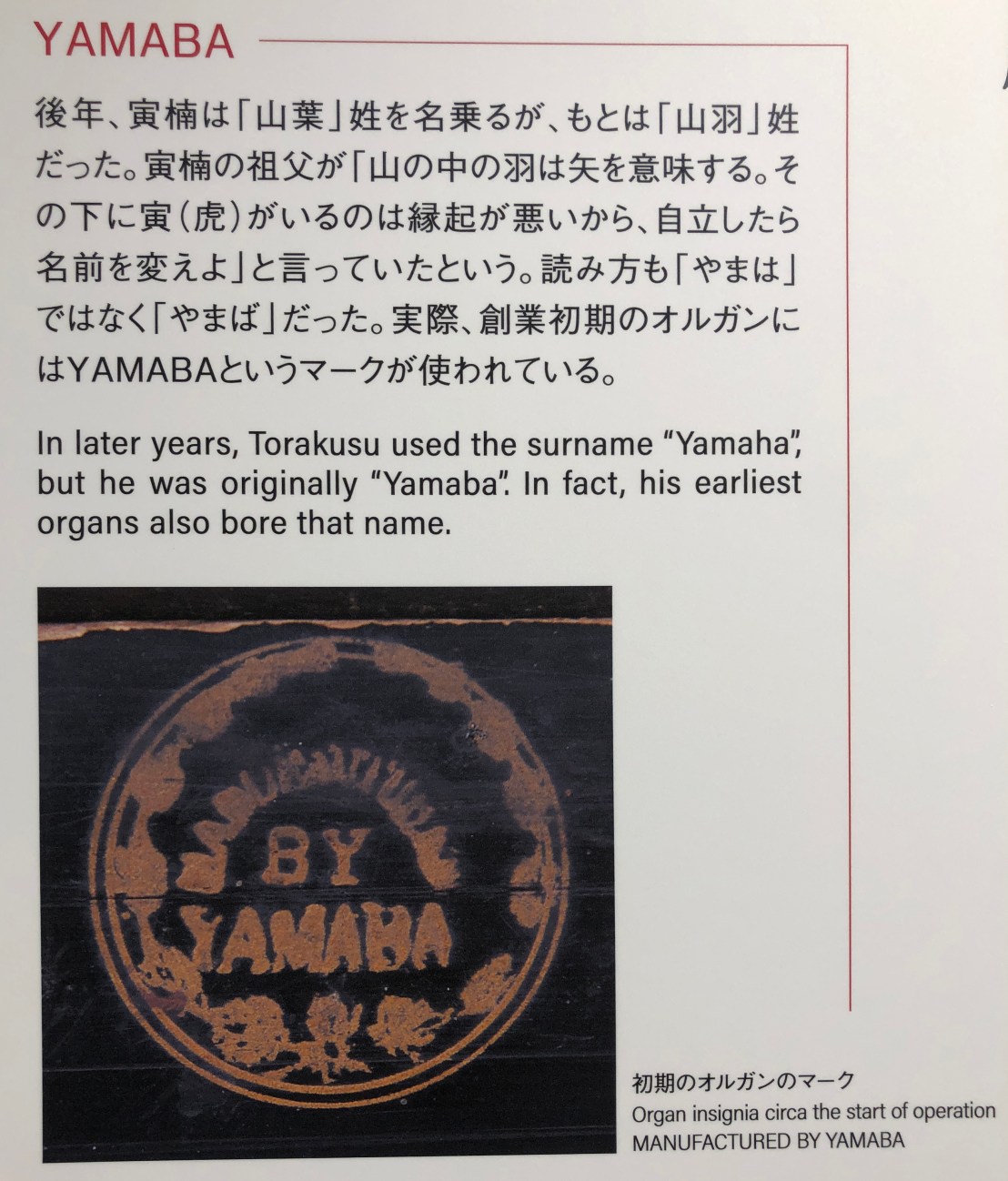
Yamaha_Yamaba

I learned a lot of the company’s history, including the fact that Torakusu Yamaha, the founder of YAMAHA Corporation, was originally named Torakusu Yamaba. He changed his name to Yamaha because he thought that name would be of greater interest to the export market. I learned many new things!

Hamamatsu_Academy_2019_brass_concert_cropped

This year, the opening concert featured a brass ensemble that performed the world premiere of a newly commissioned work by Eric Ewazen, Hamamatsu Overture. The same ensemble played movements of Hans Werner Henze’s Ragtimes and Habaneras. Originally for brass band, it had been arranged for the Concertgebouw Brass. I had previously conducted this piece with a brass band (at the Boston Symphony’s summer home, Tanglewood, with members of the Boston Symphony, Empire Brass, and students from the Tanglewood Music Center—Henze was also in the audience for the performance) and I found this arrangement to be spectacular, and quite faithful to Henze’s original. It was such a pleasure to play in this brass ensemble. Was playing in a group ever easier or more rewarding than this, with such accomplished (and nice!) players? I don’t think so.

OLYMPUS DIGITAL CAMERA

For the second half of the concert, the Festival had assembled a wind ensemble. The 15 faculty members made up the core of the group while it was filled out with other professional Japanese players. This was, for brasses, mostly a “one-on-a-part” band. I had not played in a band since the summer of 1980 when I played my last concert as a member of the Goldman Band in New York City (I was a member of the Goldman Band from 1977-1980) although I have conducted many bands over the years. The program consisted of several classic works for wind ensemble: the Second Suite of Gustav Holst, Darius Milhaud’s Suite Francaise, an arrangement of “Elsa’s Procession to the Cathedral” from Richard Wagner’s Lohengrin, and John Philip Sousa’s march, The Thunderer. Once again, playing in this band while sitting next to Anthony Caillet and Gene Pokorny was a rare and tremendously satisfying experience. The transparency of playing was notable, and the ensemble came together in a beautiful, rare way.

Here is a video of our performance of the Second Suite of Gustav Holst (edited by Ito Yasuhide), which you can also watch on YouTube:

Here is a video of our performance of Elsa’s Procession to the Cathedral of Richard Wagner (arr Hiroshi Hoshina), which you can also watch on YouTube:

And here is a video of our performance of The Thunderer of John Philip Sousa, which you can also watch on YouTube:

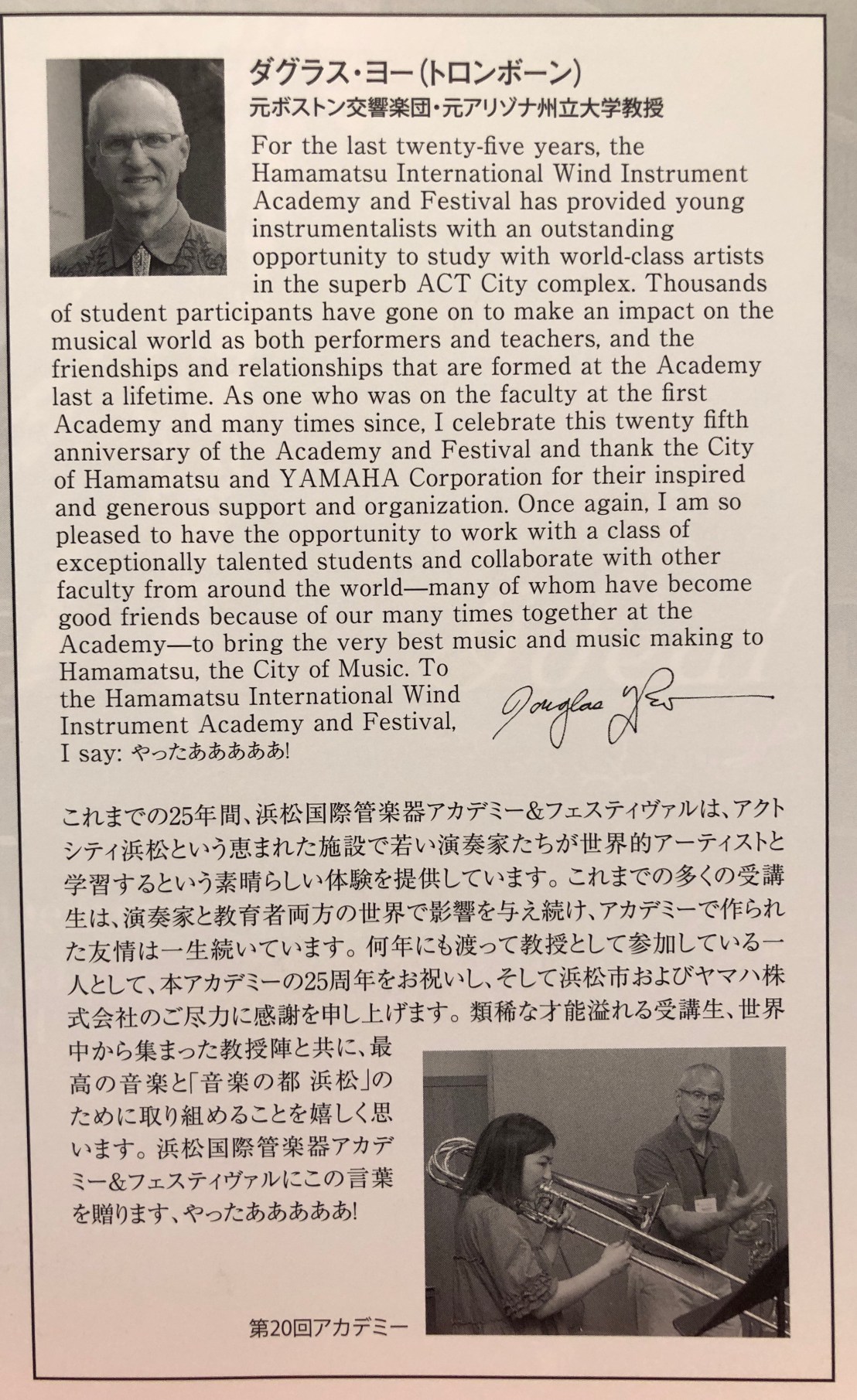
Hamamastus_Academy_Yeo_greeting_2019

I was also very grateful to have been asked to pen a few words of congratulations to the Festival for inclusion in the opening concert program which you can read above.

OLYMPUS DIGITAL CAMERA

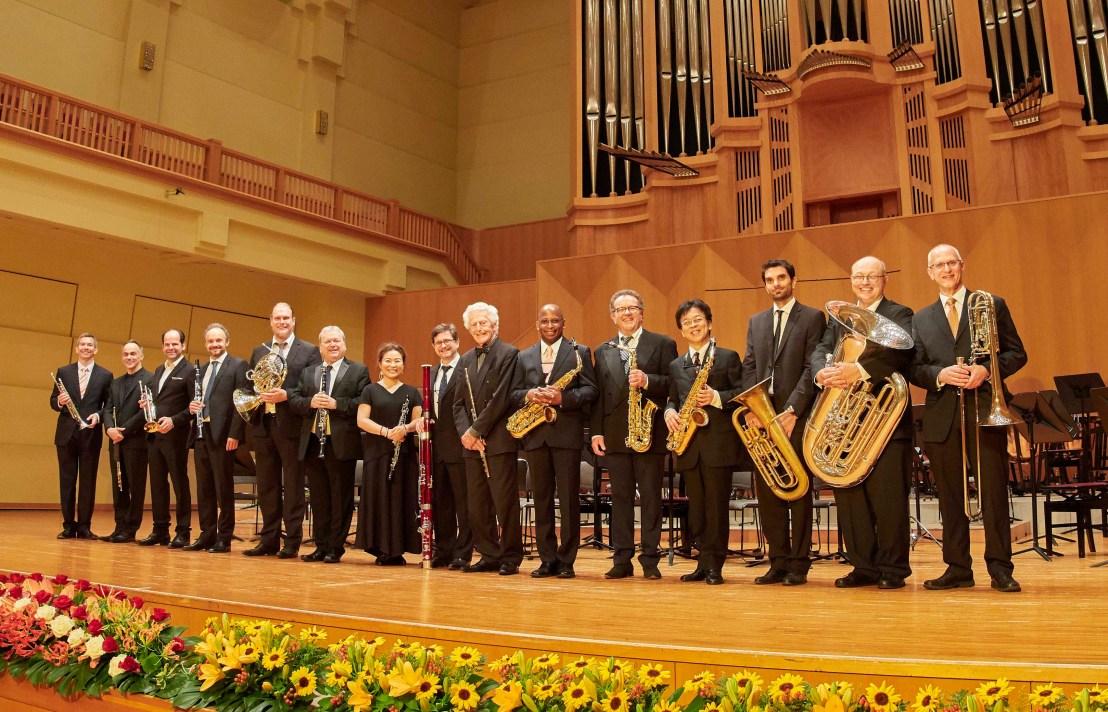
Hamamatsu_Academy_2019_faculty_silly.jpg

We gathered on stage after the concert for a photo of the Academy professors. Two photos actually, each of which tell part of the story of our very enjoyable shared collaboration.

2019_Hamamatsu_Academy_Yeo_trombone_class

From the opening concert we began our days of teaching. My class had five tenor and three bass trombonists. Five women and three men. Over the years, I have had many different kinds of students. There is no age limit for the Academy, so in the past I have had both young players and professionals. This year, all of my students were young. One was 17, others were in college/university, and a few had recently graduated from college. But, wow, they had such talent! It was a joy to work with them; they were all eager to try, learn, experiment. I chose three phrases as the motto for our class:

Pay attention.

Try everything.

Chase greatness.

If we pay attention to everything around us—not just other trombone players—there is much we can bring to our artistic/musical expression. If we try every option for every decision we face as musicians—where to breathe, what slide position to use, etc.—we can benefit from the improvement we make each day and not become fossilized with ideas that we implemented when we first laid our eyes on a piece of music. And from the Chicago Bears, I brought “chase greatness.” You must first know what greatness IS and when you see it, run after it, hunt it down, embrace it, and make it yours. My students bought into this and worked very hard. All of them —ALL of them!—had major breakthroughs in their playing at each lesson. I cannot remember ever seeing this happen. But this class was special. Very, very special.

Doug_Hitomi_Nozomi_2019

Another nice aspect of this event was the fact that my translator was Nozomi Kasano (on the right in the photo above). I  first met Nozomi at the 10th Hamamatsu Academy and Festival in 2005. She subsequently came to Boston to study with me at New England Conservatory of Music where she earned a graduate diploma and Master’s degree. The then returned to Japan where she won the position of bass trombonist with the Japan Century Orchestra in Osaka. I am so proud of her. This was the third time Nozomi had been my translator in Japan (she did this six years ago at the 20th Academy, and two years ago when I was the guest artist at the Nagoya Trombone Festival). She knows me so well, and translates more than just my words—she translates ME. Also, our class pianist was Hitomi Takara (in the middle in the photo above), a superb artist with whom I had worked with at the Academy in the past. She was my accompanist five years ago at the 21st Academy, both for my class and for me when I gave a recital at the Hamamatsu Museum of Musical Instruments. Having them with me again made the trombone class room a very, very happy place.

Hamamatsu_Musical_Instrument_Museum_Yeo_serpent_video_2019

Speaking of the Musical Instrument Museum, I enjoyed another visit before the Academy started. I was surprised and delighted to find video screens installed throughout the museum where visitors can both hear and see several instruments being played. This is a great addition to the musical instrument museum, and my surprise was even greater when I went to look at the museum’s serpent collection and found a video there of me playing serpent during my recital.

Hamamatsu_Academy_Miho_congratulations_2019

The Academy also features a concert of student performers. Each class holds an audition of all of its students and one player from each studio is chosen by the professor to represent the class on the student concert. The winner that I chose to represent the trombone class on the concert was Miho Ogose, a University senior. She played the first movement of Eric Ewazen’s Concerto for Bass Trombone. Like all of my students, she played with exceptional musicality. All of us in the trombone class were so proud of her and her performance was absolutely great. Look at the photo above, taken right after the concert. The look on Miho’s face—surrounded by other trombone players from our class who were congratulating her on her performance—reflects the joy of music and music making. It was a special moment for all of us.

Hamamatsu_Academy_2019_Farewell_Party_trombones

The Academy and Festival concluded with a farewell party at Mein Schloss, a German beer hall near the ACT City Hamamatsu complex where all of our concerts and teaching took place (we also stayed at the Okura Hotel ACT City). This is always a fun event, with plenty of food and drink, and performances by each class. Some are silly, some are more serious, and when we drew lots to determine the order in which classes would play at the party, the trombone class drew last! So we wrapped up the festivities with performances of my friend Stephen Bulla’s arrangement of Londonderry Air and an arrangement of 76 Trombones that I commissioned from my friend Ken Amis, tubist of the Empire Brass. Fun times.

Japan_2019_plane_farewell

As my plane took off from Tokyo and I watched the Pacific Ocean come into view, I reflected on my days in Japan. I have so many memories from my trips to that fascinating country. I feel fortunate to have had the opportunity to work with so many Japanese students over the years. I have friendships with many players and teachers, as well as many employees of YAMAHA Corporation, with whom I have collaborated for many years to make the bass trombone (YBL822G) and mouthpiece (Douglas Yeo Signature Series Mouthpiece) that I have played for so long. Wonderful food, interesting experiences, deep friendships, students who are eager to learn. It all combined to make for an especially satisfying trip. While it is true that “there’s no place like home,” traveling around the world has opened my eyes to many things and has made a deep imprint on how I think and live. Thank you, Hamamatsu International Wind Instrument Academy and Festival, its organizers (especially Naoki Suzuki of YAMAHA), faculty, translators, pianists, and students. All of you are a big part of my life. Thank you for this time we shared together. I hope to see all of you again soon.

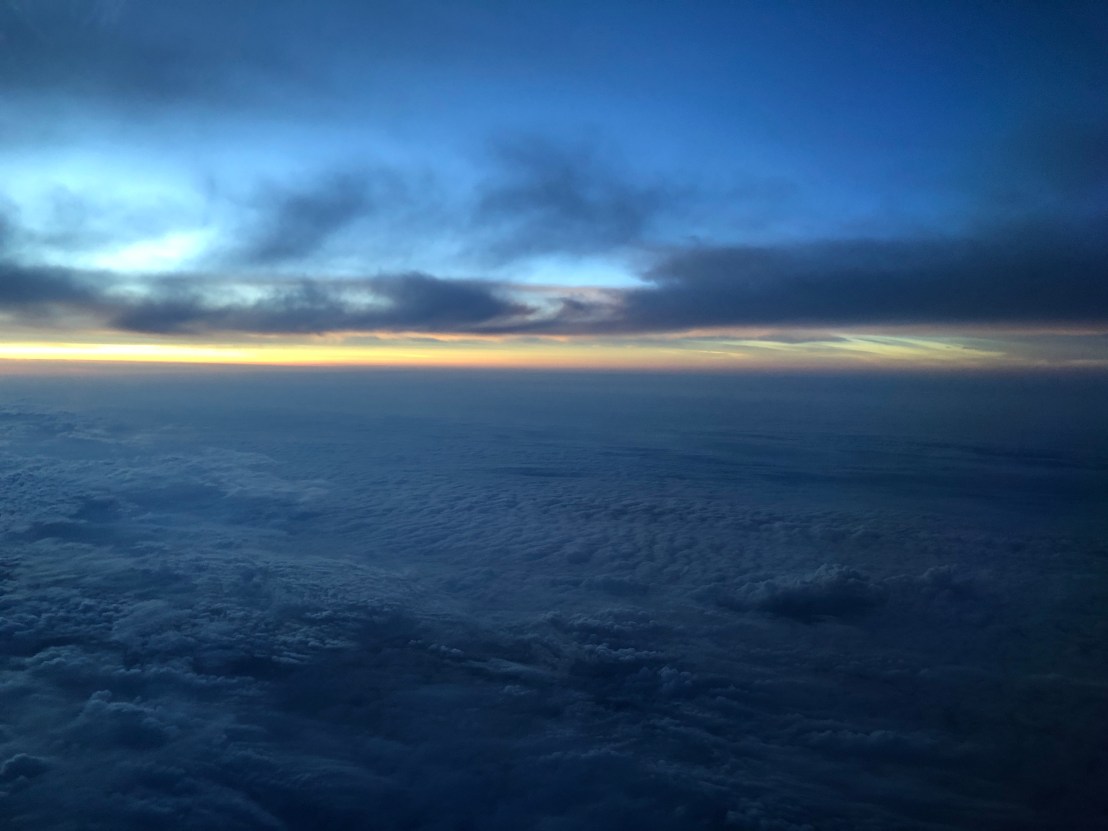
Sunset_over_clouds_Pacific_Ocean_2019

[Photo above: Sunset at 38,000 feet, above the clouds, over the Pacific Ocean. August 11, 2019.]

[Featured photo at the top of this article: Several faculty members of the 25th Hamamatsu International Wind Instrument Academy and Festival after the Opening Concert. Left to right: Otis Murphy, Jean-Yves Fourmeau, Nobuya Sugawa, Anthony Caillet, Gene Pokorny, Douglas Yeo.]