Category: sports

A few Olympic Games surprises: Miracle and Bugler’s Dream.

A few Olympic Games surprises: Miracle and Bugler’s Dream.

by Douglas Yeo (July 29, 2025)

During my long career as bass trombonist of the Boston Symphony Orchestra (1985–2012), I participated in hundreds of recording sessions that resulted in commercially available records, CDs, and streaming. Works by Brahms (the symphonies and Ein Deutsches Requiem), Mahler (Symphonies 1, 2, 3, 5, 6, 7, 9, 10), Ravel (a dozen works), Franck (Symphonie in d minor), and many other great composers, plus dozens of recordings with the Boston Pops Orchestra. In addition, I played on three film scores recorded by the Boston Symphony Orchestra: Schindler’s List and Saving Private Ryan (music by John Williams) and Mystic River (music by Clint Eastwood—sort of—but there’s a story behind that for another time. . .). The recording sessions for these films remain very memorable to me.

Covers to soundtrack albums recorded by the Boston Symphony Orchestra: Schindler’s List (1993), Saving Private Ryan (1998), and Mystic River (2003)

Work rules and payments for recording sessions are governed by agreements made between orchestras and their players, and the players are represented by the American Federation of Musicians (AFM). These agreements cover working conditions for the sessions (how long they are, when and how long a break in a session occurs), and payment. I always looked at recording sessions as one of the great benefits of playing in the BSO, because not only was playing great music that would be enjoyed by the public over and over and I was  being paid my regular weekly salary as a member of the orchestra, but I received an additional payment for playing the actual recording sessions. Then, it came as a surprise to me after my first season with the BSO that every year thereafter, I received a check—usually in the summer—that represented royalty, residual, and secondary market payments for those same sessions. Recording sessions were—and are—the gift that keeps on giving to this present day.

Those annual royalty payments fluctuate up and down, and each year, I receive a detailed statement that explains the amount I am paid for each film score or orchestral recording I made. A few years ago, I noticed a new entry on my annual Film Musicians and Secondary Markets Fund statement. In addition to entries for Schindler’s List, Saving Private Ryan, and Mystic River, there was another movie listed: Miracle.
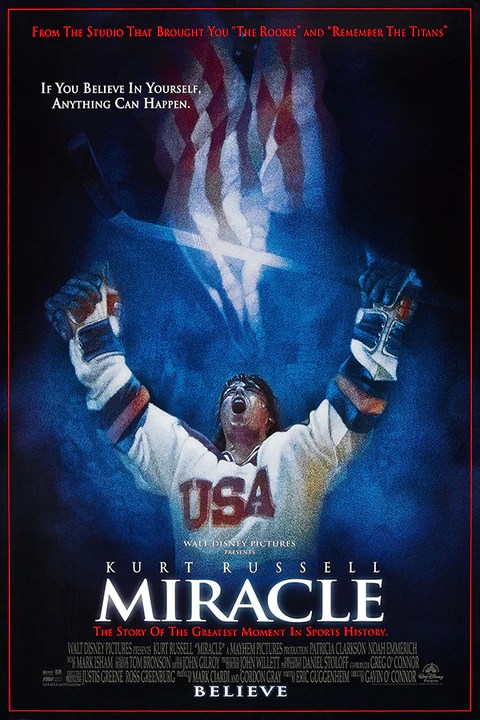
Promotional poster for Miracle (2004)

I didn’t remember playing any recording sessions for Miracle—a movie about the 1980 United States Winter Olympics men’s hockey team that defeated the Soviet Union’s team in the semi-final round and went on to defeat Finland to win the gold medal. But I certainly remember those Olympic games, and I had a vague recollection that a movie had been made about the team and their stunning victory. I don’t go to many movies, so it’s not surprising that I missed it.

But why was Miracle appearing on my annual film payments statement? I asked the Boston Symphony Orchestra’s manager about this and there was a simple explanation: the producers of Miracle wanted to use some music from a Boston Pops Orchestra recording in the film’s soundtrack. They didn’t need to convene a new recording session to do so. They just needed to get permission and pay royalties to the players who were on the original recording session.

As it turned out, the music that Miracle wanted to use was Bugler’s Dream by Leo Arnaud. Arnaud—who was a trombonist and successful composer and arranger who, after moving to the United States from his native France in 1931, worked on more than 160 films. Bugler’s Dream was composed in 1959. It was not “official music” for the Olympics but it was picked up and used by ABC television for their broadcast of the 1968 Winter Olympics (Grenoble, Switzerland). Since then, it has become an iconic piece that’s associated with the Olympic games.

Now, a quick aside. Since 1896, the International Olympic Committee has commissioned music for each Olympics. While Bugler’s Dream was not officially composed for the Olympics, the story of the music that was written for the games is told in William K. Guegold’s book, 100 years of Olympic Music: Music and Musicians of the Modern Olympic Games 1896–1996 (Mantua, Ohio: Golden Clef Publishing, 1996). The book, which is out of print but used copies are readily available, opens with an interview of John Williams and contains detailed commentary about music written for the Olympics including many samples of scores and other images. It’s a fascinating book.
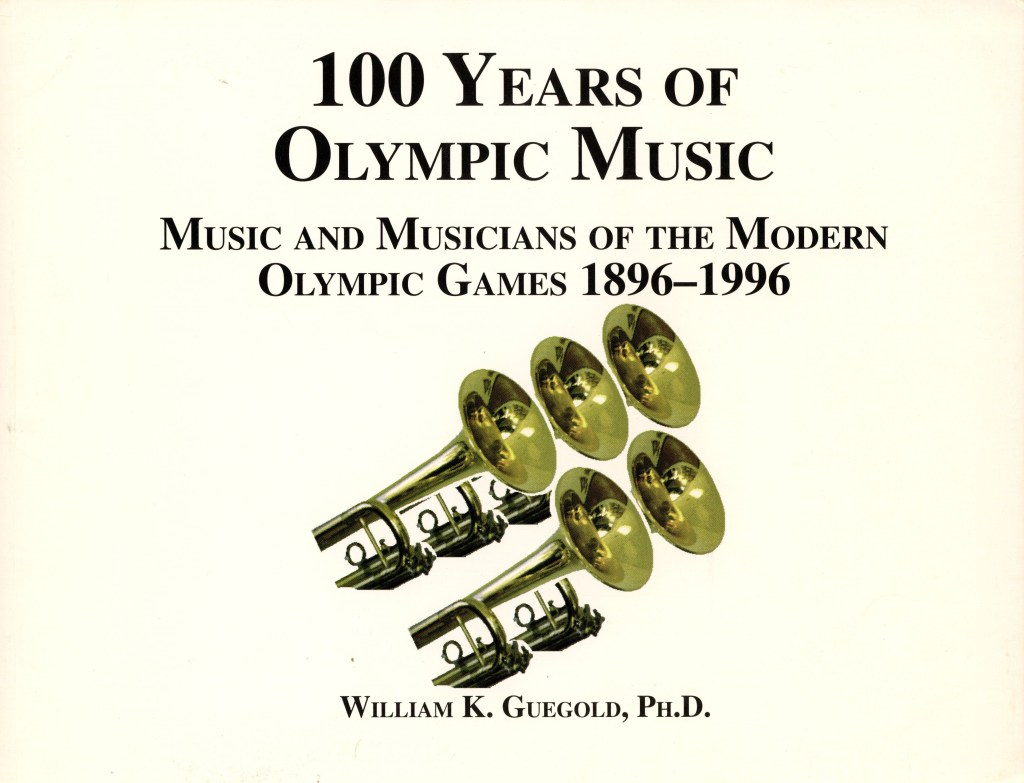
Cover to William K. Guegold’s 100 Years of Olympic Music: Music and Musicians of the Modern Olympic Games 1896–1996

In 1996, the Boston Pops Orchestra made the official album of music for the 1996 Olympics (Atlanta, Georgia). John Williams was commissioned to write the theme music for those Olympic games, and that piece turned out to be Summon the Heroes; that was also the title of the compact disc recording that also included several other Olympic themed selections. Williams had previously written theme music for two other Olympic games: Olympic Fanfare and Theme (1984 Olympic Games, Los Angeles, California), and The Olympic Spirit ( 1988 Olympic Games, Seoul, Korea; this theme was composed for NBC’s television coverage), and in 2002, Williams wrote Call of the Champions (2002 Olympic Games, Salt Lake City, Utah).

For the broadcast of the 1996 Olympic games on NBC, John Williams created a medley that began with Arnaud’s Bugler’s Dream and continued with Williams’ own Olympic Fanfare and Theme. This mashup of two familiar Olympic related pieces proved to be very popular. So popular that many people now assume that Williams wrote Bugler’s Dream. But the recording makes clear who wrote what; there are two pieces with two composers clearly identified on the printed notes to the recording.
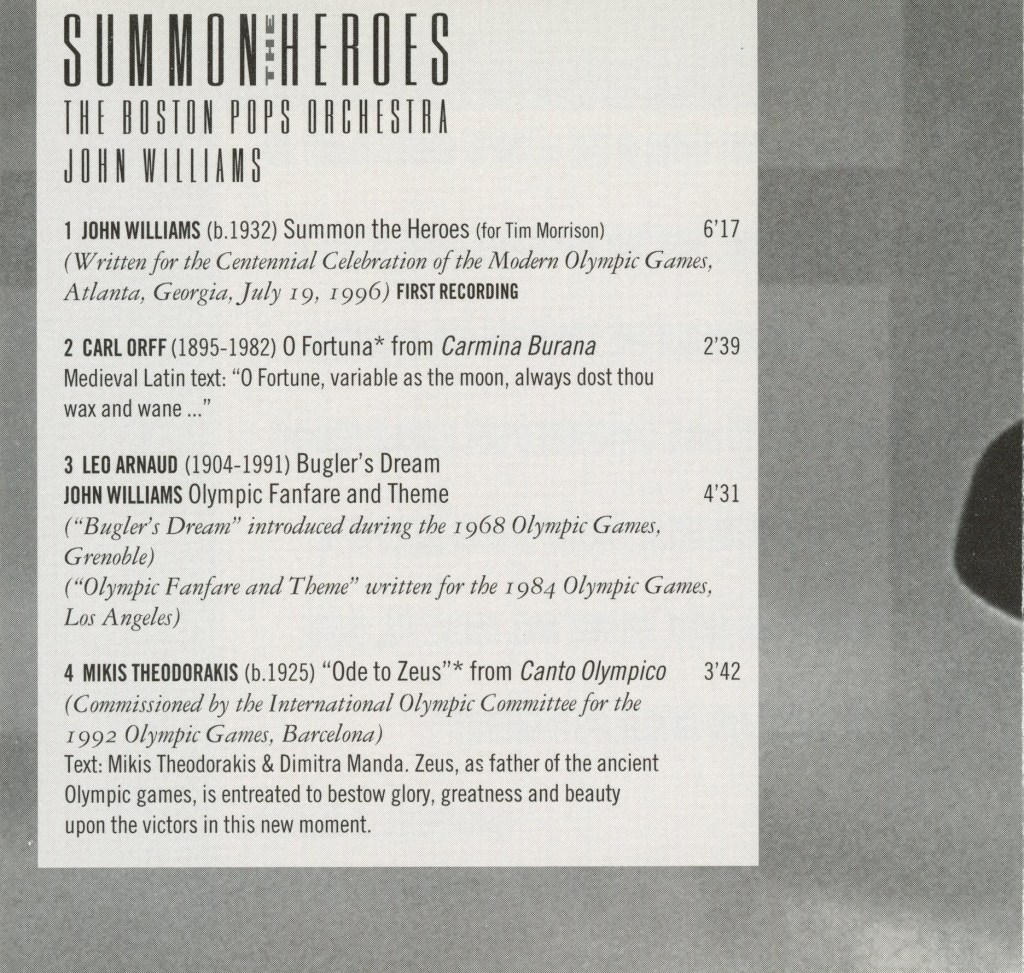
Page from the accompanying booklet to the CD recording, Summon the Heroes (Boston Pops Orchestra, John Williams, conductor)

You can hear this recording of the medley of  Bugler’s Dream and John Williams’ Olympic Fanfare and Theme recorded by the Boston Pops Orchestra with John Williams conducting on the 1996 recording, Summon the Heroes, HERE.

Back to Miracle. The movie about the 1980 US Olympic hockey team wanted to use Arnaud’s Bugler’s Dream, so all of a sudden, I was listed as a performer on the movie’s soundtrack. My contribution: 53 seconds of music. So, each year since 2005, I’ve received a small payment for Miracle in my annual royalty check. The other day, my wife and I finally got around to watching Miracle. It’s a terrific story that’s well told. And there it was: at the beginning of the scene where the US Olympic team gets off the bus in Lake Placid, New York (images below), you can hear the Boston Pops Orchestra playing Bugler’s Dream.

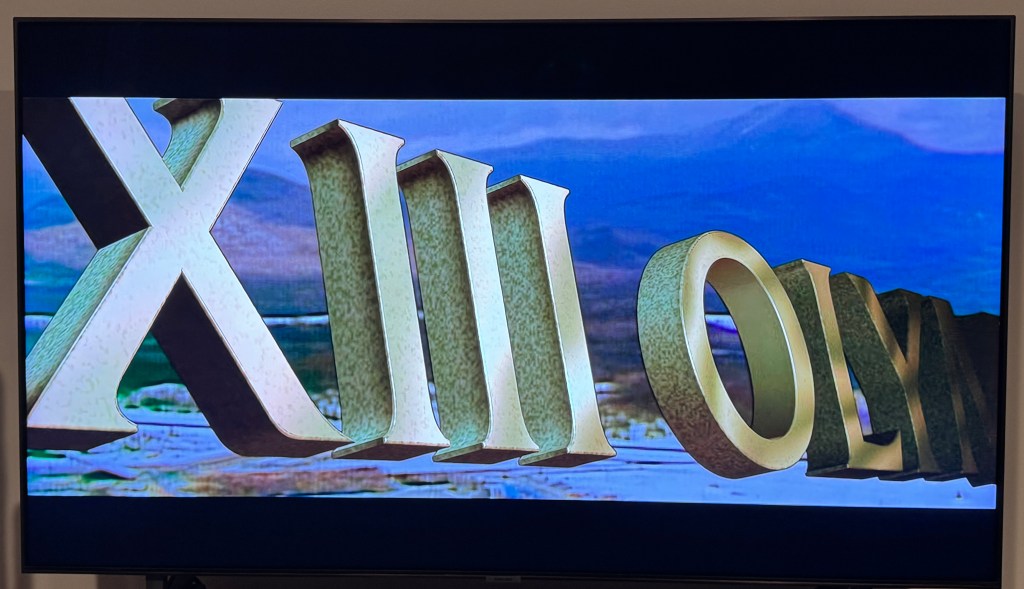
Images from the movie Miracle, showing the moment when Bugler’s Dream is heard, and the end credits.

By the way, if you purchase the soundtrack recording to Miracle, you won’t find the Boston Pops Orchestra track there. The soundtrack album only includes some original music  for the movie composed by Mark Isham (four tracks), and songs by Blue Öyster Cult, J. Geils Band, and Jay Ferguson that were used in the movie. If you want the Bugler’s Dream recording that appears on Miracle, you can purchase the Summon The Heroes recording on amazon.com; you’ll find it there as an LP, CD, or streaming on amazon music.

That’s the first Olympic Games surprise to share with you. At least it was a surprise to me to find myself with credit as a performer on another movie. But here’s another Olympic Games surprise.

A few years ago, I began researching Maurice Ravel’s iconic composition, Bolero. The result of that research will be told in my forthcoming article, “Maurice Ravel’s Bolero: A Fresh Look at a Familiar Masterpiece.” The article will be published in two parts, in the October 2025 and January 2026 issues of the International Trombone Association Journal. In the article, I discuss the origin of Bolero, its premiere and other early performances, and I offer insights and discoveries about Bolero’s famous trombone solo. I’m not going to spoil the story here—you’ll have to read the article for yourself when it comes out—but one of the things I researched were the many claims that Leo Arnaud made about Ravel and Bolero. Arnaud often told stories about his friendship with Ravel, so I wanted to investigate them.

Among the things I researched was Arnaud’s Bugler’s Dream. I wanted to mention Arnaud’s most famous composition when I wrote about him in my Bolero article, but as I always do when I write about history, I do my due diligence to verify everything I read before I write about it. As I was investigating Bugler’s Dream, I learned a lot about the piece that was new to me. And it’s probably new to you, too.

I had known about and performed Bugler’s Dreams for many years. Those 53 seconds of music are an indelible part of our Olympic  Games consciousness. During my research, I learned that Bugler’s Dream was commissioned by conductor Felix Slatkin (father of conductor Leonard Slatkin) in 1959 for the LP recording, Charge! Side 1 of the record has three compositions listed as composed by Arnaud (Charge!, Drummer Boys, and Bugler’s Dream), and side 2 has three arrangements by Arnaud (Fifes and Drums, Bagpipes and Drums, and When Johnny Comes Marching Home).

Front and back covers to Charge! (1959), conducted by Felix Slatkin

I purchased a copy of the Charge! LP and when I listened to it, there were more surprises. The 53 seconds of Bugler’s Dream that we all know and love is only the first part of the composition with that title. Bugler’s Dream is actually 3:55 long. There are five other sections to the piece, and the opening theme is not reprised. So, when we hear Bugler’s Dream on Olympic Games broadcasts, we’re hearing just the first part of the whole piece. Have a listen, below, to the complete Bugler’s Dream, the first 3:55 of this recording on YouTube:

But wait, there’s more.

As I continued researching Bugler’s Dream, there was another surprise waiting for me. Those first 53 seconds of Bugler’s Dream were not COMPOSED by Leo Arnaud. They were ARRANGED by him. While the label of the disc credits Arnaud as the composer of Bugler’s Dream—and every time the piece is recorded or played in concert, Arnaud is credited as the composer—the liner notes to Charge! tell a different story: 

Incipit about Bugler’s Dream from the back cover of Charge!

Bugler’s Dream was “derived from various bugle calls,” and is a “fantasy of classical fanfares and radically modern cadenzas.” Bugler’s Dream is an arrangement. But of what?

I dug around some more and found the source for the famous theme that is credited to Arnaud and heard by millions of people at Olympic Games. The opening theme of Bugler’s Dream was written by Joseph-David Buhl (1781–1860). Buhl was a French trumpeter and composer who revised and wrote many bugle calls for the French Military under Napoleon Bonaparte and Louis XVIII. He published a method for trumpet in 1825, and in his time was highly regarded as a player, band leader, and composer.  

One of Buhl’s bugle calls was Salut aux étendards (sonnerie triumphal)Salute to the Standards (Triumphal Fanfare). It was recorded on the 1986 LP, Glorie à la Cavalerie, with Les Trompettes du “boute-selle” and La Fanfare du 2e Régiment de hussars, conducted by Éric Conrad. Have a listen to Buhl’s fanfare, above. You’ll immediately recognize it as the source for Bugler’s Dream.

Front and back covers to Gloire à la Cavalerie (1986), conducted by Éric Conrad

Leo Arnaud’s Bugler’s Dream begins with an arrangement of Joseph-David Buhl’s Salut aux étendards, and then moves to several more themes. I have not researched the source of these other themes but given what the liner notes to Charge! say about Bugler’s Dream — that it was “derived from various bugle calls” —  I would not be surprised if the other themes in Bugler’s Dream were composed by someone other than Arnaud, too. And wouldn’t be surprised at all  if the rest of Bugler’s Dream was also composed by Buhl. I’ll keep looking. It’s time to research French bugle calls.

Joseph-David Buhl died 165 years ago. He is not here to claim his rightful credit (and royalties, which must be considerable) for a piece that has become an iconic part of the modern Olympic Games. But the next time you hear Bugler’s Dream, tip your hat to Buhl. We can be grateful to Leo Arnaud for making Buhl’s fanfare famous to today’s ears. But we give Arnaud too much credit if we say Bugler’s Dream was composed by him. It was not. Arnaud should have given Buhl credit. Here’s how we should refer to the piece:

Joseph-David Buhl: Salut aux étendards. Arranged and adopted by Leo Arnaud as Bugler’s Dream.

Let’s give credit where credit is due.

It’s Super Bowl Sunday!

It’s Super Bowl Sunday!

by Douglas Yeo (February 9, 2025)

It’s that time of year again. The National Football League’s Super Bowl will kick off in a few hours. Millions of people around the world will be watching, whether on television, through a streaming service, or the internet. Even people who are not football fans will be watching. The game is just that big, such a big part of life for so many people. Whether your team is playing (mine isn’t. . .) or not, whether you tune in just to watch the commercials or the halftime show, my guess is most readers of these words will be watching or have watched Super Bowl LIX – Super Bowl 59.

The Super Bowl is one of those unique events—like a World Cup soccer final, or a college football championship final—that is bigger than life. When I was young and living in Valley Stream, New York (just a few miles across the border of Queens, New York City, where I spent the first few years of my life), I remember watching Super Bowl III in January 1969. I was in eighth grade, but I remember the thrill of watching the game (on our family’s black and white television) and seeing our team, the New York Jets win. It was thrilling. I wish I still had my Joe Namath rookie football card. Yup, I had one. But after the Super Bowl III, I took that card and did what all of my friends and I did with all of our football and baseball cards: We got a clothespin and attached them to the back frame of our bicycles to make a fluttering sound. Seriously. I just looked: a Joe Namath rookie football card in near mint/mint condition is selling on eBay right now. For $48,500. I’ll pass. (No pun intended.)

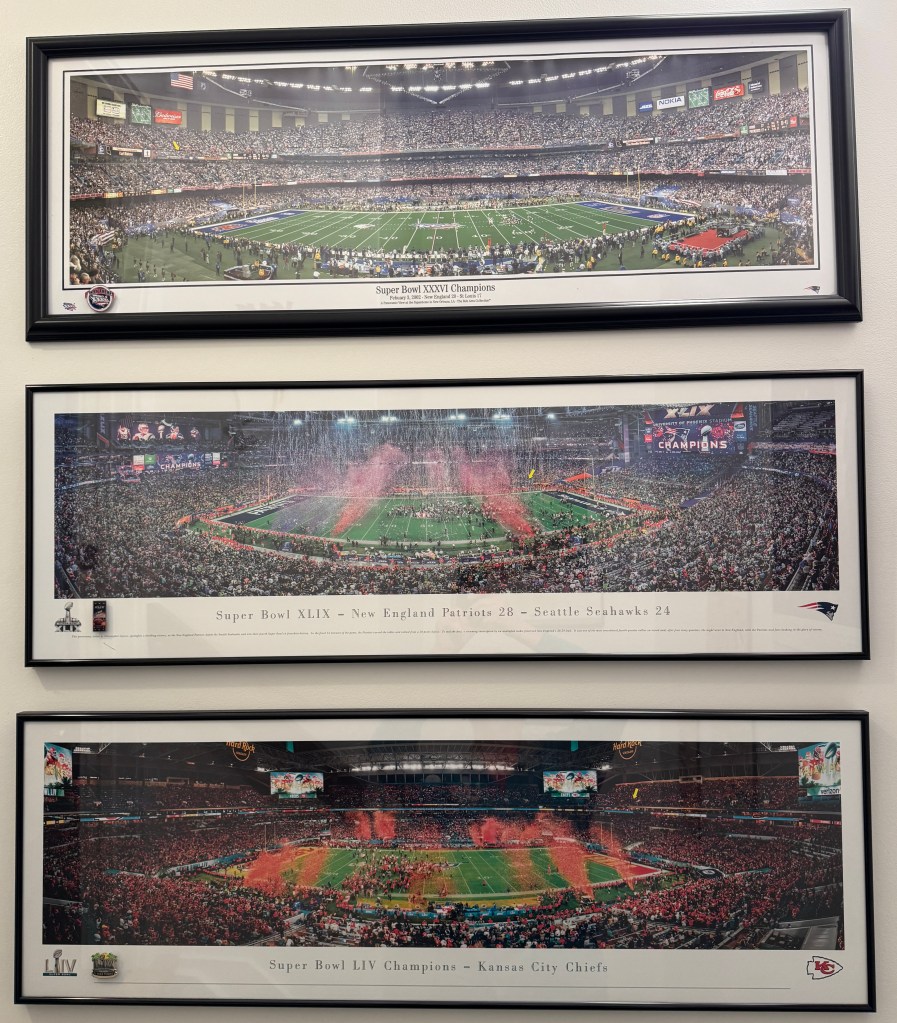
Over the years, I’ve attended three Super Bowls. Each one of them are indelibly imprinted in my memory, historical events in my life that I’ll never forget.

Panoramic photos of Super Bowls XXXVI (New England Patriots vs. St. Louis Rams), XLIX (New England Patriots vs. Seattle Seahawks), and LIV (Kansas City Chiefs vs. San Francisco 49ers).

SUPER BOWL XXXVI – February 3, 20020

I was a member of the Boston Symphony Orchestra from 1985-2012. In December 2001, we began to hear rumors that the Boston Pops Orchestra—which IS the Boston Symphony Orchestra minus most of the principal players in the BSO—would be playing in the pregame show at Super Bowl XXXVI in New Orleans on February 3, 2002. The September 11, 2001 terrorist attacks turned the world upside down, and the next Super Bowl after the attacks was scheduled to be played in New Orleans, with a typical Mardi Gras type theme. 9/11 changed that and the theme of the game was switched to a patriotic theme.

Robert Kraft, owner of the New England Patriots, was on the NFL’s Super Bowl entertainment committee and he suggested that the Boston Pops—”America’s Orchestra”—be involved in the game. That got set many weeks before any of us in Boston knew that the New England Patriots would actually be playing in the game. 

I told the story of how that all happened in a long article on my website: The New England Patriots and the Boston Pops: A Super Bowl XXXVI Diary, January/February 2002. You can read that article HERE.

Tom Rolfs, Douglas Yeo, and Ronald Barron at Super Bowl XXXVI

New England Patriots owner Robert Kraft gave each member of the orchestra a ticket for the game. Amazing. I sat between two great friends, BSO trumpet player Tom Rolfs (he is now principal trumpet in the orchestra) and Principal trombonist Ronald Barron. 

My view from the end zone at Super Bowl XXXVI.

We were seated in an end zone; little did we know that we would watch the winning field goal come off Patriots’ kicker Adam Vinatieri’s foot and come right to us. Unforgettable.

A framed box of Super Bowl XXXVI highlights.

SUPER BOWL XLIX – February 1, 2015

I retired from the Boston Symphony Orchestra in 2012 and when we moved to Arizona, my wife and I became season ticket holders for Arizona Cardinals (and Arizona State University—where I was trombone professor) football. That said, we still followed the Patriots; after all, one does not give up a nearly 30 year fandom overnight. In 2015, the Patriots were in the Super Bowl again, and Super Bowl XLIX was held at University of Phoenix Stadium in Glendale, Arizona, the home of the Arizona Cardinals. Just a 30 minute drive from our home.

Naturally we wanted to go to the game but ticket prices were out of this world. But then, the most unexpected thing happened. A friend in Boston, whose family had many season ticket seats to Patriots football, called and said that their family had two extra tickets. Would I like them? WOULD I LIKE THEM?!?!? YES! This was a remarkable gift, one I could not wholly accept without paying something. My friend didn’t want money for the tickets, but she said her family had supported an Christian ministry in Haiti for many years and if we wanted to make a donation to that group of selfless workers who served the poor, that would be great. So I sent a donation to the ministry and my wife and I went to the game. 

Douglas and Patricia Yeo outside University of Phoenix Stadium before Super Bowl XLIX

Our seats were five rows from the field, right on a goal line. It was WILD to be in the stadium—where we had seen so many Arizona Cardinals football games—and don our old Patriots gear for another game for the first time in several years.

At our seats for Super Bowl XLIX

I had never sat so close to the field for the game and I confess I never thought such a view right next to the end zone would be that interesting. But it was! At one point in the game, Patriots tight end Rob Gronkowski caught a touchdown at the other side of the end zone. A week later, a photo of that touchdown that showed Pat and me across the end zone appeared in Sports Illustrated.

Rob Gronkowski catching a touchdown at Super Bowl XLIX. Douglas and Patricia Yeo are circled in red, across the end zone. I’m wearing a white baseball hat and Pat is next to me, on my left.

This was a wild, back and forth game. And at the end, the Patriots won in a stunning way, when Malcolm Butler intercepted Seahawks quarterback Russell Wilson at the goal line. I wrote about my experience at Super Bowl XLIX and how I apply a very important lesson that was in evidence at the end of that game to my trombone playing and teaching in an article on TheLastTrombone. The article is titled: Stay disciplined: a lesson from Super Bowl XLIX. You can read that article HERE.

Patricia and Douglas Yeo celebrating the end of Super Bowl XLIX.

SUPER BOWL LIV – February 2, 2020

After Super Bowl XLIX in Arizona, the thought of attending another Super Bowl never entered my mind. I had been to two. Another one? I never really thought about it. But I DID go to another Super Bowl. And that is quite a story in itself.

Pat and I moved from Arizona to the Chicago area in 2018 in order to live closer to our grandchildren. One of the first things we did was get Chicago Bears season tickets. New town, new team.

Douglas and Patricia Yeo at Soldier Field, Chicago, September 8, 2024.

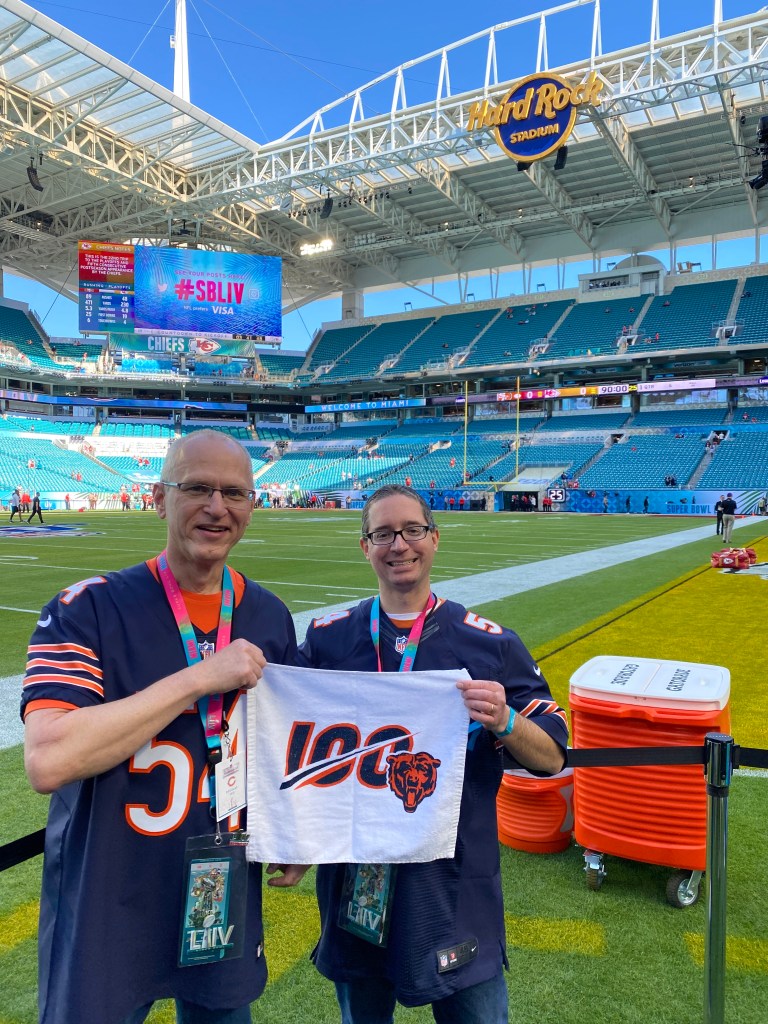
In 2019, the Chicago Bears ran a contest. The winner would receive an all-expenses paid trip to Super Bowl LIV in Miami, Florida. The contest was this: Write an essay of 100 words or less on the subject, “Who would you take to the Super Bowl and why?” I wrote an essay about my son-in-law, Chad, who is a hospice chaplain. My essay was exactly 100 words. And I won the contest. Unbelievable.

Douglas Yeo and Chad Leonard on the field at Super Bowl LIV.

Two fans from each of the NFL’s32 teams were given this remarkable experience. Each team decided how to award the two tickets allowed to them. The Bears had a contest. Some teams sent their “fan of the year.” Others had a random drawing. Going to Miami, staying at the Biltmore Hotel, going to the NFL Experience, NFL Honors, and Super Bols LIV was a truly remarkable experience, made all the better because we were with super fans from all teams.

Fans from all 32 NFL teams at the 2020 Super Bowl LIV fan experience. (AP Photo/Steve Luciano)

Once again, I found myself seated in the end zone at a Super Bowl, just like I had been at Super Bowl XXXVI. Chicago Bears Chairman George McCaskey came up to say hello to Chad and me and we watched a memorable game as the Kansas City Chiefs defeated the San Francisco 49ers. We witnessed the beginning of the Kansas City Chief’s NFL dynasty as they won their first Super Bowl since they won Super Bowl IV in 1970.

Douglas Yeo, Chicago Bears Chairman George McCaskey, and Chad Leonard at Super Bowl LIV.
I wrote several posts on TheLastTrombone about this remarkable experience. You can read my article, 100 Words – Super Bowl LIV which tells the story of the contest and has my winning essay HERE. And you can read my long article about the whole experience at Super Bowl LIV, Super Bowl LIV – an exceptional fan experience thanks to the Chicago Bears and the NFL, HERE.

Today, when I’m watching Super Bowl LIV with Pat and our oldest daughter, Linda, her husband, Chad, and our two grandchildren, all of these live-in-person memories of past Super Bowls will be in my mind. The Super Bowl. It’s a special experience every year. Here’s hoping we’ll see a great game later today.

UPDATE: The Philadelphia Eagles defeated the Kansas City Chiefs 40-22 in Super Bowl LIV. Congratulations to the Eagles. And now we’re on to next season. But first, baseball! Go Cubs, Go!


Fast cars and the value of friendship

Fast cars and the value of friendship

by Douglas Yeo (August 2, 2024)

Life is full of surprises, unexpected moments that lead to bigger things. Try something that’s a little outside your box—your comfort zone—and you’ll probably learn something. If you’re open to learning. Our friends, Phil and Laura Spotts, taught us something about this.

My wife, Patricia, and I met Phil and Laura at our church in 2012. We had just moved to Arizona after I retired from my long career as a member of the Boston Symphony Orchestra. Phil struck me right away as a gregarious, “can do” kind of guy. The kind of person who is always volunteering to do something, make things happen. Phil’s an engineer but not one of those stuffy, geeky, academic types. He’s real, has a great sense of humor, and is always thinking about how to help others. Laura is a gifted pianist who played piano from time to time at our church services, another truly wonderful person. When we met them, they had a son, Cody, and in time, they became Superheroes and adopted two more children, Gage and Annaliese. There was something about this family that made Pat and me smile. We spent time together, went over to each other’s houses for dinner (Phil is a terrific cook, and we still use his fantastic leg of lamb recipe several times a year), we shared life. And our friendship grew even as we were very different people in some ways. For instance, they liked—no, they LOVED—something that was a mystery to me: NASCAR. I’m not gonna lie: before I met Phil and Laura, my life had no place for NASCAR. Growing up in and around New York City and living in Boston for nearly three decades, I fell into the east coast snobbery when it comes to things like NASCAR. “Go fast, turn left.” Doesn’t sound very interesting. Also, fast cars are loud and I work hard to protect my hearing. Big hair, beer, southern accents—those are some of the many stereotypes you bring to something like NASCAR when you’re in a cocoon in some parts of the elitist northeast.

Phil_Laura_PIR_March_2014

Phil and Laura Spotts at Phoenix International Raceway, March 2, 2014

So, when Phil and Laura invited Pat and me to go to a NASCAR race at Phoenix International Raceway (November 2013), my mind quickly buzzed around through all of my NASCAR stereotypes before I said, in a confident voice, “Sure. Let’s go!” And we did. Because this was important to our friends.

PIR_NASCAR_panorama_2013_03_02

Panoramic view of Phoenix International Raceway, March 2, 2014

The experience of going to a NASCAR race is unlike anything I’ve done in my life. I love football, and I enjoy baseball. I know what it is to cheer my team at a game, to engage with other fans around me. But NASCAR was something different all together. First, it was BIG. A lot of people go to races. A. Lot. Some come in campers and motor homes, driving from race to race and living in temporary camps that surround a racetrack, a camp that usually has a popup supermarket, bank, and urgent care center. For race weekend, a NASCAR track becomes a small city.

Phil and Laura had headsets for us that were both excellent hearing protection—I have to say, though, as I looked around from my seat, I was stunned to see so many people who were not wearing any kind of hearing protection, wow—and were connected to Phil’s radio scanner that gave us the race feed. Before the race I kept asking questions. I realized quickly that there was a lot more to NASCAR than the stereotypes I had carried with me for so long. This is a high-tech sport. There is a LOT of money involved. It’s really dangerous for the drivers. Fans are passionate about their drivers and their cars. Sponsorship is really, REALLY important. Pit crews—the crew of technicians who service cars before and during the race—work incredibly hard and fast, like a well-oiled machine. And there is a whole lot of strategy.

Doug_Pat_PIR_2013_11_10

Douglas and Patricia Yeo, Phoenix International Raceway, November 10, 2013

There were other things. At the race, I didn’t have any skin in the game; I didn’t know any drivers, so I asked Phil and Laura who there favorite drivers were. OK, they were now my favorite drivers. But when cars are racing around the track at 180 miles an hour at 130dB (that is loud, like a jet engine ready for takeoff on a runway), there’s no point in cheering during the race. Your driver can’t hear you. Other fans can’t hear you. Heck, you can’t even hear yourself. When the cars were roaring around the track, I didn’t dare take off my headset and expose my ears, so if I wanted to say something to Pat, Phil, or Laura, I pulled out my phone and typed a text message and showed it to them.

PIR_March_2014

Phoenix International Raceway, March 2, 2014

Before the race there was the National Anthem, then a flyover and a prayer, and then we were—literally—off to the races. And somehow, what enfolded in front of me captivated me in a way I didn’t expect. As I saw it with my own eyes, as I gave it a chance, as I tried to understand it, I found myself pulled into it. The old stereotypes fell away; I was learning something new. And I liked it. And that experience would not have happened were it not for friends that asked us to do something that they loved and wanted to share with us. I learned a very important lesson on that day. Several, actually. When, a year later (March 2014), Phil and Laura asked us to go to another race at Phoenix International Raceway, we did.

Then Phil took a new job and their family moved to Tennessee. Pat and I moved to the Chicago area so we could live near our grandchildren. While Phil and I weren’t seeing each other regularly any more—something we did a lot when we both lived in the Phoenix area, especially meeting for lunch at our favorite sushi place, Ah-Hai in Goodyear (yes, there really and truly is amazing sushi in the desert!)—we kept in touch, texting and talking on the phone. Then Phil called one day to tell me Cody started playing the trombone—Phil said that Cody picked the trombone because he had heard me play trombone in our church.

Cody_Spotts_E-Hamilton_HS_trombone

Poster of Cody Spotts, trombonist at East Hamilton High School, Tennessee

Then, last October, Phil texted me. Cody was graduating from high school in a few months and Phil wanted to take him to a NASCAR race as a graduation present. Any race, anywhere. And Cody said, “I want to go to the Chicago Street Race with Mr. Yeo.” Phil and Cody were coming to Chicago and  they asked me to go to another NASCAR race. Of course I said “yes.” I was excited. July 6 and 7, 2024 couldn’t come soon enough.

Doug_Phil_Cody_Portillos_NASCAR_2024

Douglas Yeo and, Phil and Cody Spotts, Portillo’s, July 5, 2024

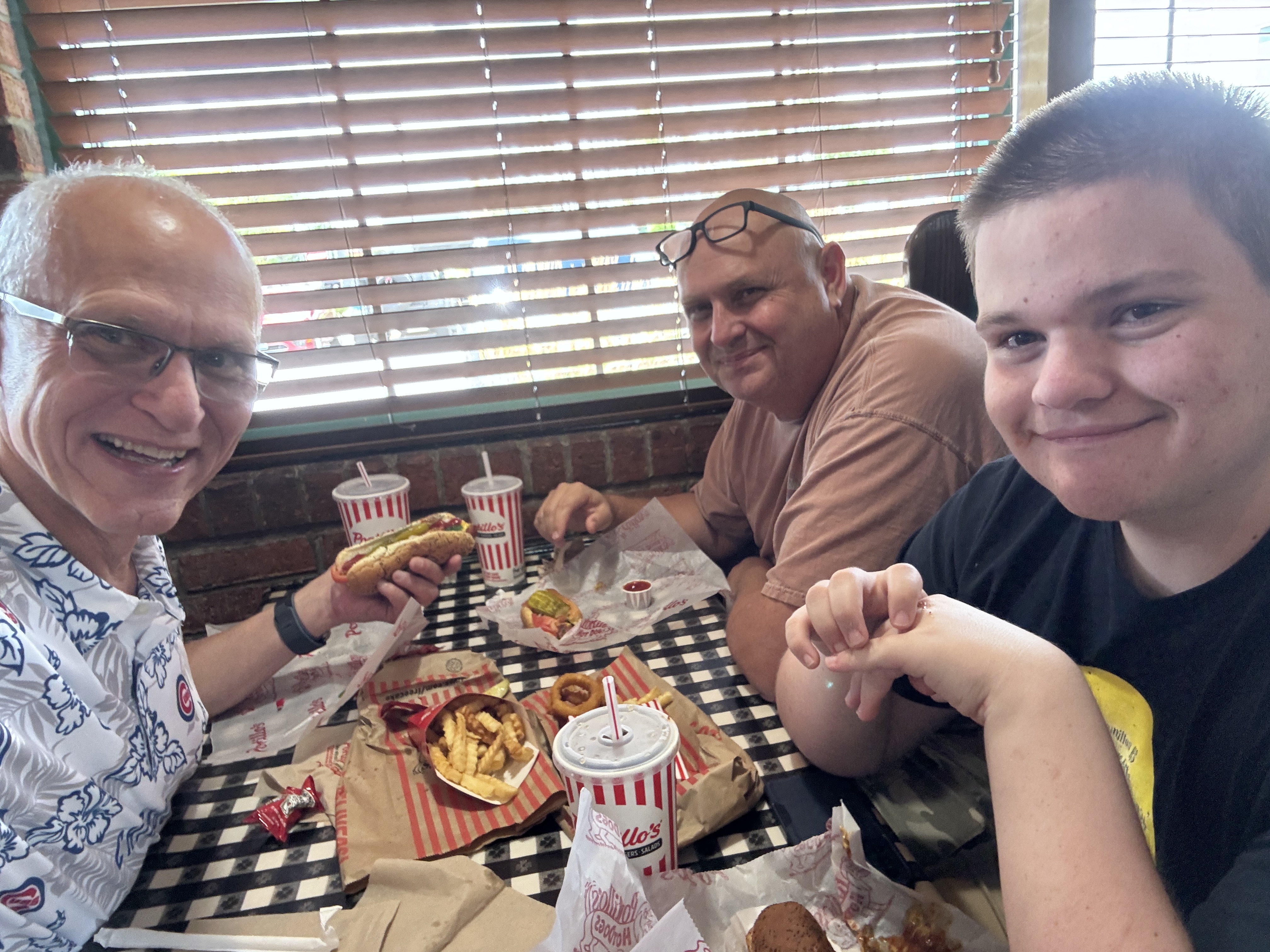
I picked up Phil and Cody at Chicago’s O’Hare airport and because Cody had never been to Chicago, they wanted to immerse themselves in “the full Chicago experience.” We started with lunch at that iconic Chicago hot dog restaurant, Portillo’s. A Vienna Beef hotdog on a sesame seed bun, tomatoes, mustard, relish, dill pickle, raw onions, sport (hot) peppers, celery salt—but NO KETSUP! There’s nothing like it and Portillo’s is the place to get the real deal.

Doug_Cody_Phil_Giordanos_NASCAR_2024

Douglas Yeo and Cody and Phil Spotts, Giordano’s, July 5, 2024

Dinner that night was at Giordano’s where Cody experienced his first Chicago style deep dish pizza. Pat and I don’t eat at Portillo’s and Giordano’s very often—our low fat diet doesn’t have a lot of room for zillion calorie, high fat meals—but, hey, now and then, you gotta live a little.

NASCAR_Chicago_2024_map

Course map for NASCAR 2024 Chicago Street Race

The Chicago Street Race is a unique NASCAR event. It’s a race (two races, actually) that—literally—goes through streets of downtown Chicago. Instead of a long oval track, the Chicago race track is a modified figure-8, a course that snakes through the heart of the city, along Lake Shore Drive, Michigan Avenue, and South Columbus Drive. Phil had gotten Turn 1 Reserved tickets for the three of us in the Jack Daniels Turn 1 Club. I didn’t know what that meant but I found out soon enough.

Cody_Phil_The_Bean_NASCAR_2024

Cody and Phil Spotts at “The Bean” (officially called Cloudgate), Millenium Park, Chicago, July 6, 2024

We took the train from College Avenue Station in Wheaton, Illinois, to downtown Chicago and walked toward Millenium Park near Chicago’s waterfront. There, we walked around as I showed Phil and Cody some of the iconic things in the Park, like “The Bean.” In the photo above, you can see me in my orange Phoenix International Raceway shirt, reflected in this remarkable public art installation, taking this snapshot of Cody and Phil.

Doug_Cody_Phil_NASCAR_2024_sign

Douglas Yeo and Cody and Phil Spotts, Millenium Park, Chicago, July 6, 2024

Once we got through the turnstiles with our wristbands, we made our way to our seats to get a look at our view. It was stunning. As one who knows Chicago pretty well, it was truly remarkable to see the race course laid out on roads and in view of iconic buildings that I had seen in completely different contexts.

NASCAR_2024_view_turn_1_club

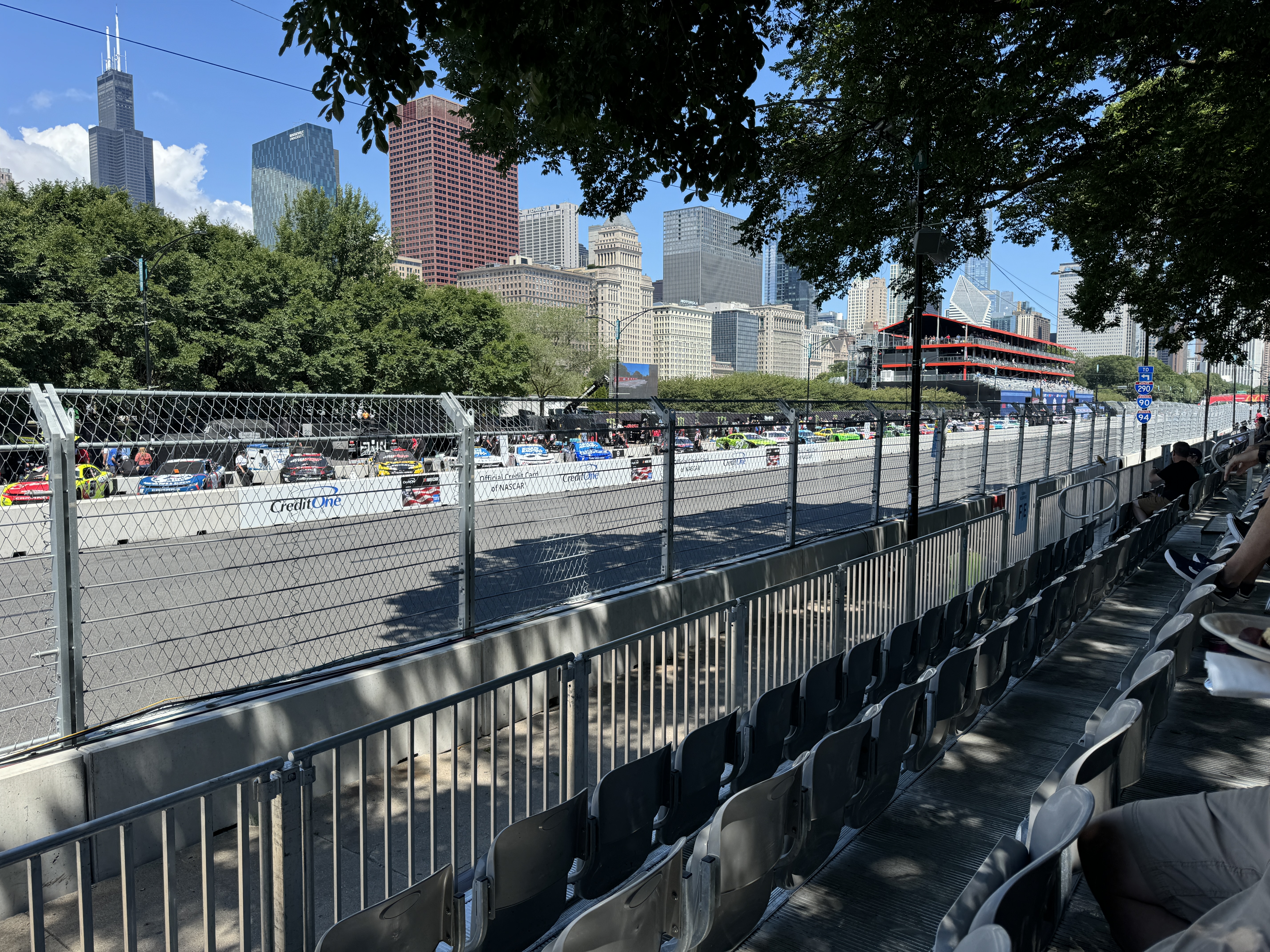
The view from our seats for the NASCAR Chicago Street Race Weekend, Jack Daniels Turn 1 Club, July 6, 2024. The start/finish line was down South Columbus Drive by the grandstand in the right of this photo. The Sears Tower (AKA Willis Tower) is the tall building on the left of the photo, with white antennas on top.

I mean, there we were, seated on South Columbus Drive, with the Sears Tower (OK, I know it’s been called the Willis Tower since 2009, but no Chicagoan calls it by that name) and the hotels of Michigan Avenue in view. I have driven down South Columbus Drive many times on the way home from Chicago Bears games at Soldier Field but traffic is always going north. For the race, the cars would be going south. It took some time for me to get my arms around that. It was surreal to see the city transformed into a racetrack.

Phil_Cody_Doug_club_NASCAR_2024

Phil and Cody Spotts and Douglas Yeo, Jack Daniels Turn 1 Club, July 6, 2024

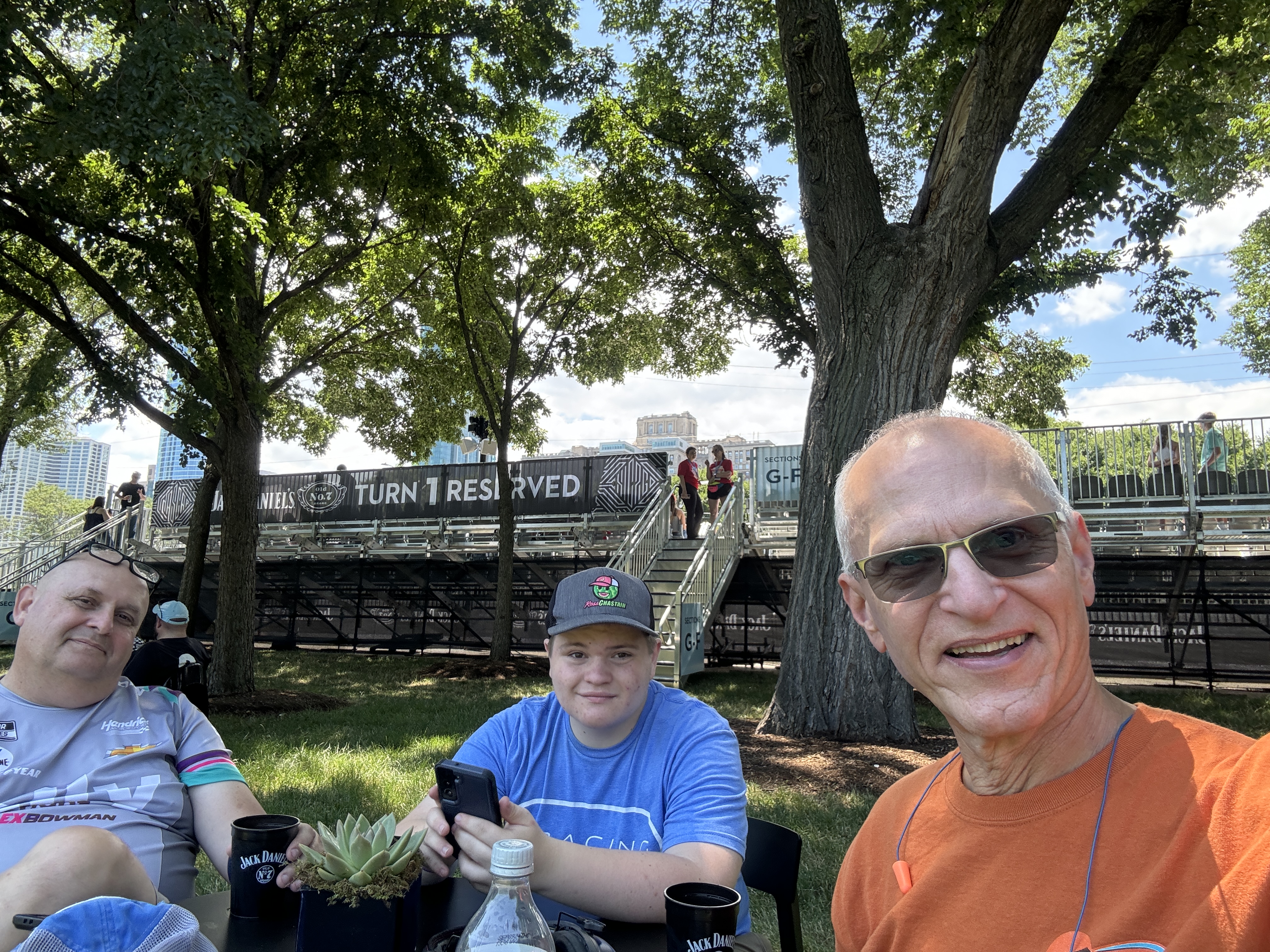
Phil really outdid himself with tickets in the Turn 1 club; it was a lavish gift. We had terrific reserved seats, a nice, shaded area where we could relax, and UNLIMITED amazing food and drink. During the whole race, the three of us grazed on fantastic food. It was always there for us, all day long. What a special experience it was to sit in such remarkable seats with these amenities. And it happened because of friendship.

MONSTER_drink_cyclists_NASCAR_2024b

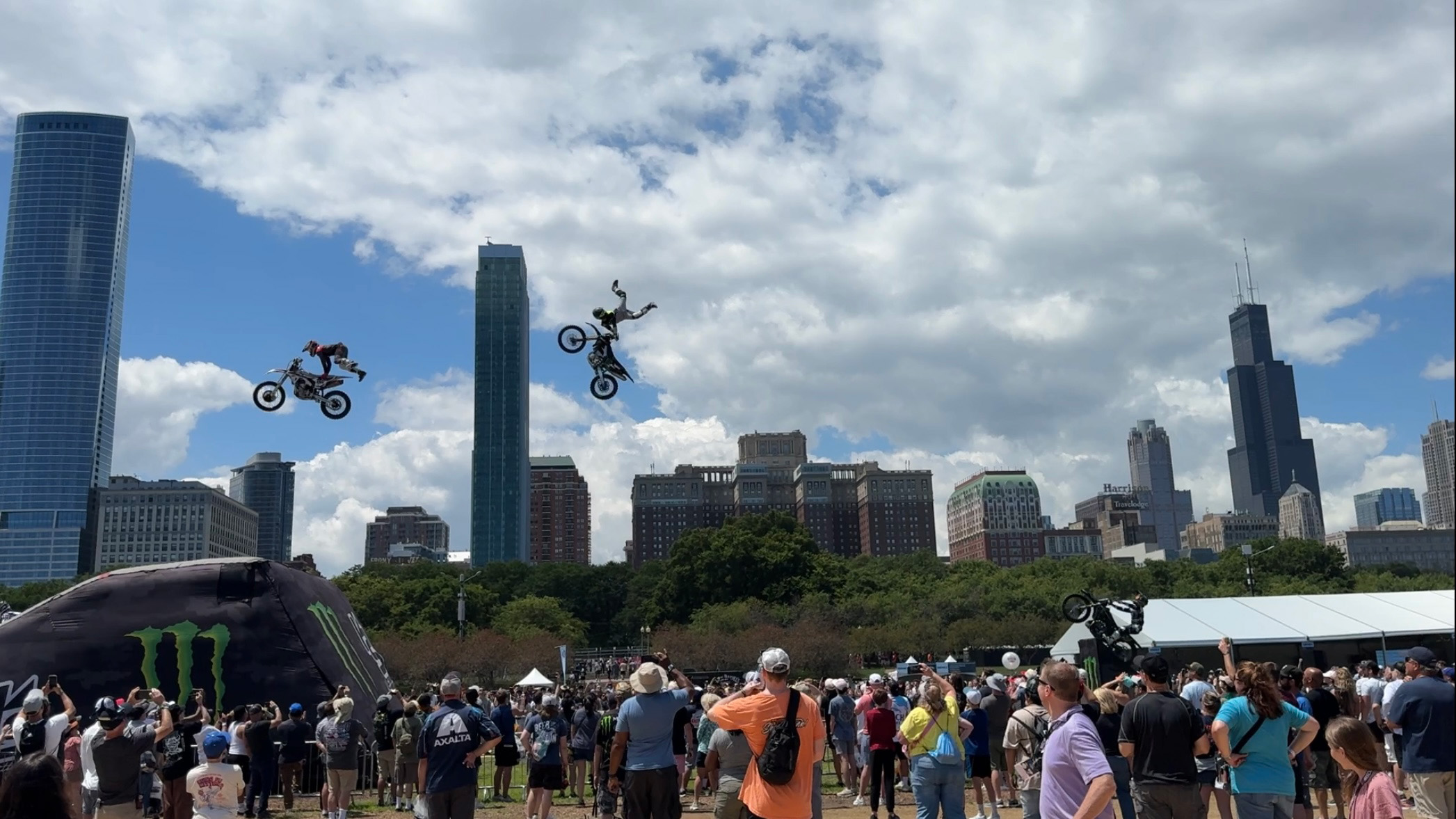
MONSTER Energy Drink acrobatic motorcyclists, Chicago, July 6, 2024

Before the race, we walked around to all of the sponsor tents, the NASCAR shop, and the wide open area where concerts were going on all day. The MONSTER Energy Drink acrobatic motorcyclists did their show; it was breathtaking.

Race_view_finish_Saturday_NASCAR_2024

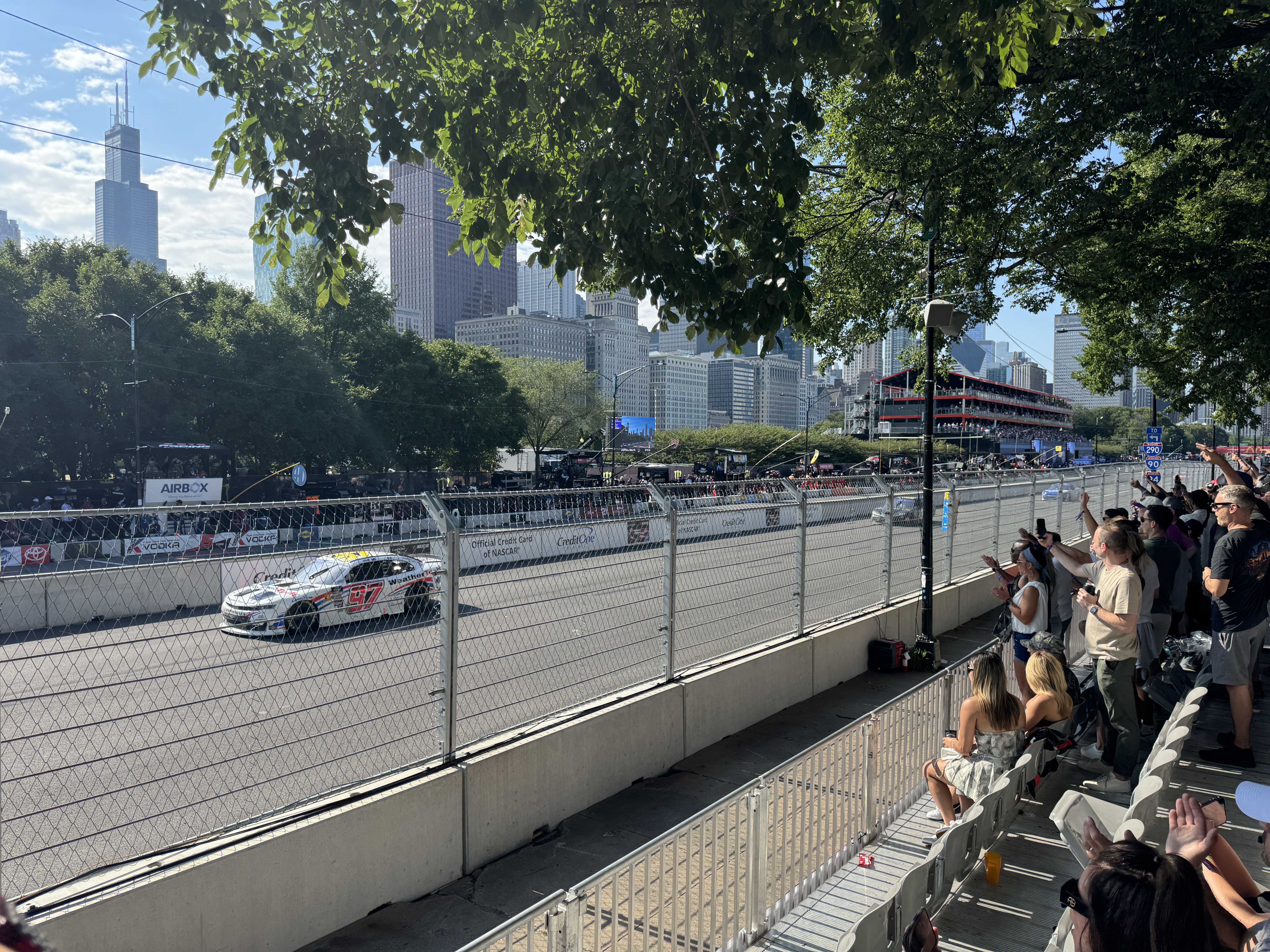
Shane Van Gisbergen (97 car) after crossing the finish line at the Loop 110 NASCAR Xfinity Series Race, Chicago, July 6, 2024

And then Saturday’s race, the Loop 110 NASCAR Xfinity Series Race, began. I can’t explain it. It was such a totally different experience than I had at Phoenix International Raceway. Drivers were not going in a loop, always turning left. They were navigating sharp 90-degree turns after long and short straightaways. Speeds were fast, but not as fast as a regular oval track NASCAR race. The cars went flying by; we followed the progress of the race in our headsets. It was absolutely thrilling. The race was won by Shane van Ginsbergen in his 97 car. If you want to get an idea of what we saw, click here to view the whole race on YouTube.

Cody_Phil_Route_66_NASCAR_2024

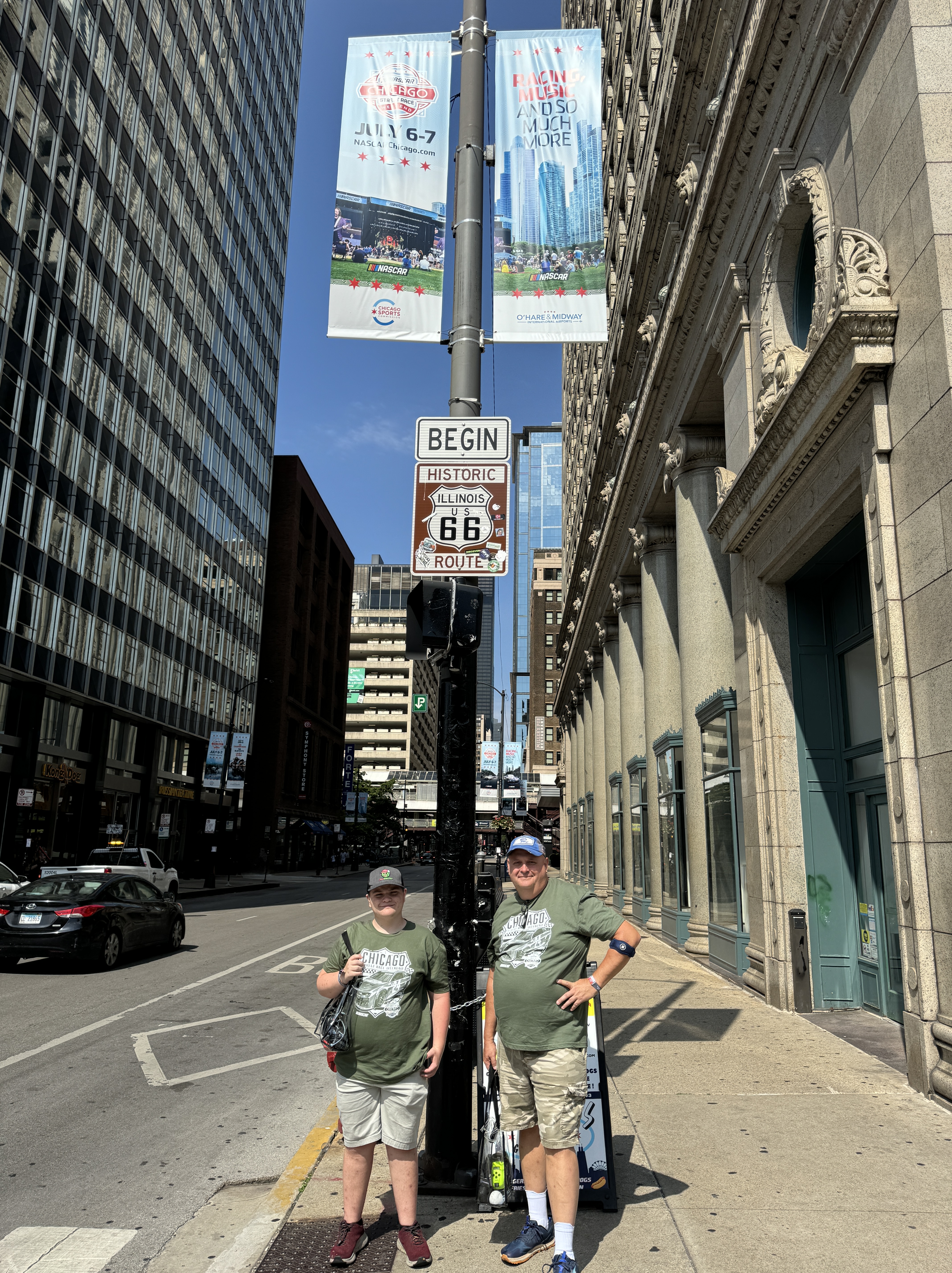
Cody and Phil Spotts at the beginning of historic Route 66 begins, Michigan Avenue, Chicago, July 7, 2024

After the race, we took the train home and after a short night of sleep, we headed back to Chicago for Sunday’s race, the Grant Park 165. When we got downtown, I wanted to show Phil and Cody where historic Route 66 started—at the intersection of Michigan Avenue and East Adams Street, just across from the Art Institute of Chicago. I took this photo (above) while I was STANDING IN THE MIDDLE OF MICHIGAN AVENUE. I had never done THAT before.

Doug_Cody_Phil_Buckingham_Fountain_day_NASCAR_2024

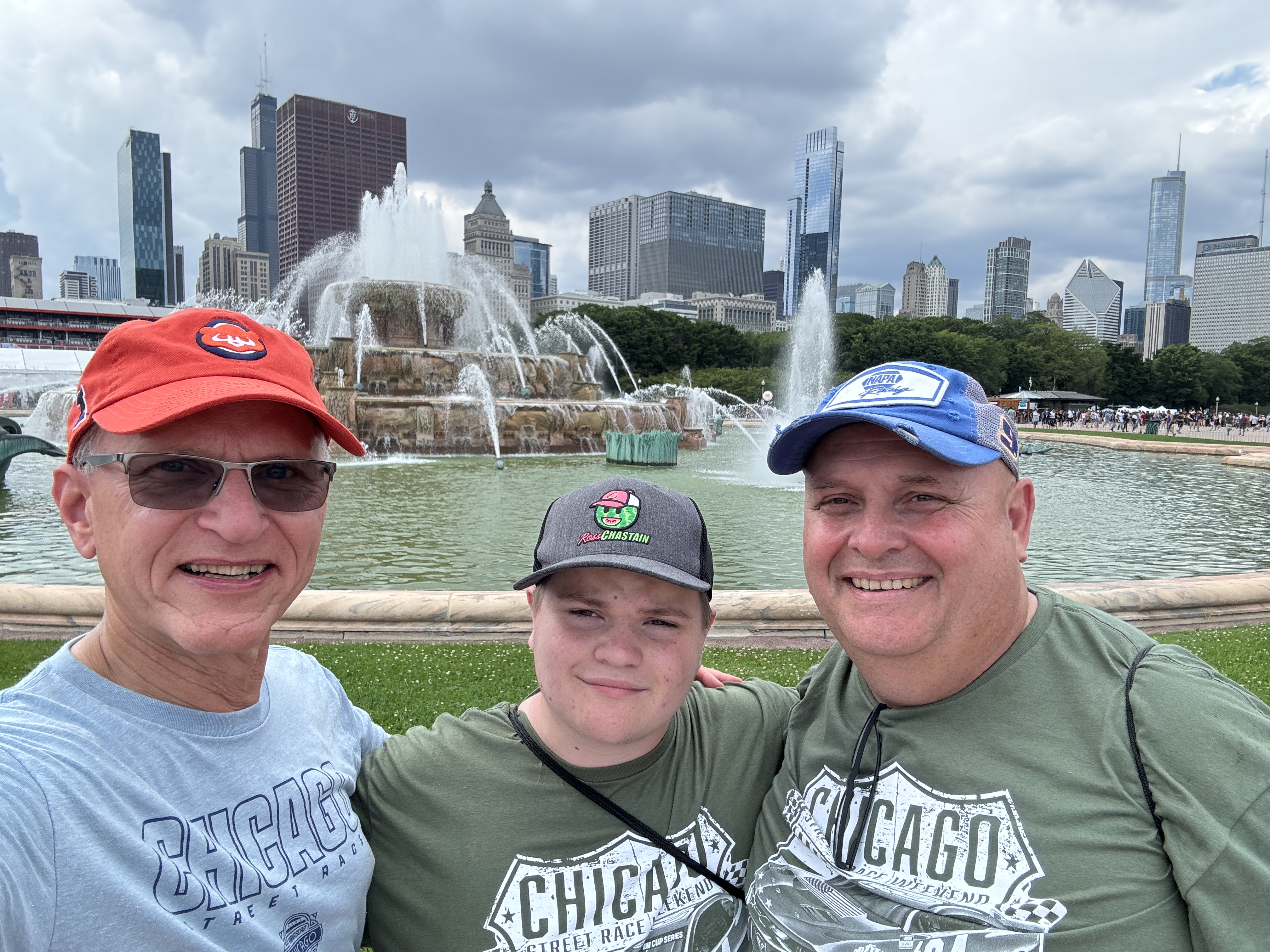
Douglas Yeo and Cody and Phil Spotts, Buckingham Fountain, Chicago, July 7, 2024

In the center of Chicago’s Grant Park is the Buckingham Fountain. It was a centerpiece of our race days, its fountains providing soft mist to cool off on hot days.

Doug_Cody_Phil_on_the_track_NASCAR_2024

Douglas Yeo and Cody and Phil Spotts, on the NASCAR Chicago Street Race track, E. Balbo Drive, Chicago, July 7, 2024. Note the temporary bridge over E. Balbo Drive.

Once we got in the Park, we had an opportunity to walk ON THE TRACK. This was another thrill, to get up close to the view the drivers had.

Doug_wet_NASCAR_Sunday_2024

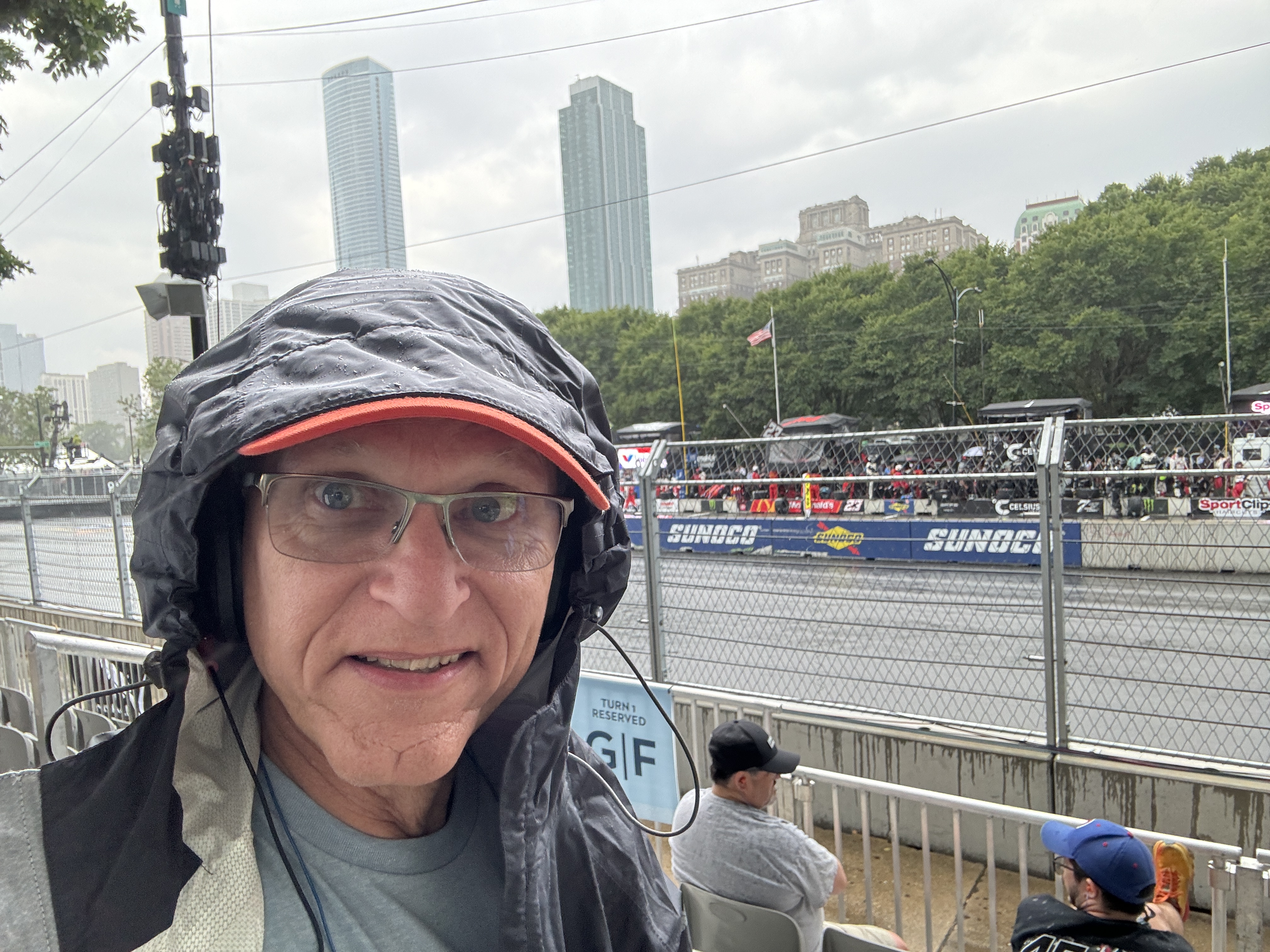
Douglas Yeo in the rain, NASCAR Chicago Street Race, July 7, 2024

While the day—and the race—started off with beautiful sunshine, we knew that rain was in the forecast. And the rain came. It sprinkled. Then it cleared up. Then the skies opened up and it poured. And poured, and poured.

Doug_Cody_Phil_rain_delay_NASCAR_2024

Douglas Yeo and Cody and Phil Spotts during the NASCAR race delay, July 7, 2024

The race continued for awhile in the rain but when it simply got too wet for drivers to race safely, we found ourselves in a rain delay of nearly two hours. We hung out at a picnic table in the Turn 1 Club, under an umbrella. The rain didn’t dampen our spirits. We were still having a great time, grazing on food and drink nonstop, enjoying conversations, talking about the race, the cars, and the drivers. When confronted with a situation you can’t control, you make the best of the situation. As teachers at our grandchildren’s elementary school frequently say, “You got what you get and you don’t throw a fit.” The rain didn’t matter. A lot of fans left but we stayed to watch the race start up, shortened because it was getting dark. Once again, it was a thrill to see the drivers cautiously—at over 100 miles per hour!—navigate the slick race course.

NASCAR_2024_Sunday_race_view

Alex Bowman (48 car) after crossing the finish line at the Grant Park 165 NASCAR Cup Series Race, Chicago, July 7, 2024

The race was won by Alex Bowman in his 48 car, and as he crossed the finish line, the rain stopped, the sun started to come out from behind the clouds even as it was setting, and we finished our days of enjoying racing in downtown Chicago. Click here to view the race on Youtube.

Doug_Cody_Phil_Buckingham_Fountain_NASCAR_2024

Douglas Yeo and Cody and Phil Spotts, Buckingham Fountain, Chicago, July 7, 2024

As we exited Grant Park, we passed by Buckingham Fountain one more time. Its fountains had been turned off for the night but I don’t think I’ve ever seen it look more beautiful than in the twilight of that Sunday night after the race.

Doug_Cody_Phil_Sears_Tower_2024_circle

Douglas Yeo and Cody and Phil Spotts atop the Sears Tower (AKA Willis Tower), Chicago, July 8, 2024. The red circle shows where we sat for the NASCAR Street Race.

We headed home again but our time together was not over. Cody wanted to do something he had never done before: go up a seriously tall building. So we took the train back to Chicago on Monday morning and visited the Sears Tower. From the observation deck, we looked down on the race course. In the photo above, you can see where our seats were in the red circle I drew between Cody and Phil. And yes, I’m wearing a Shane Van Gisbergen t-shirt. I’m a fan.

Cody_Phil_Sears_Tower_Ledge

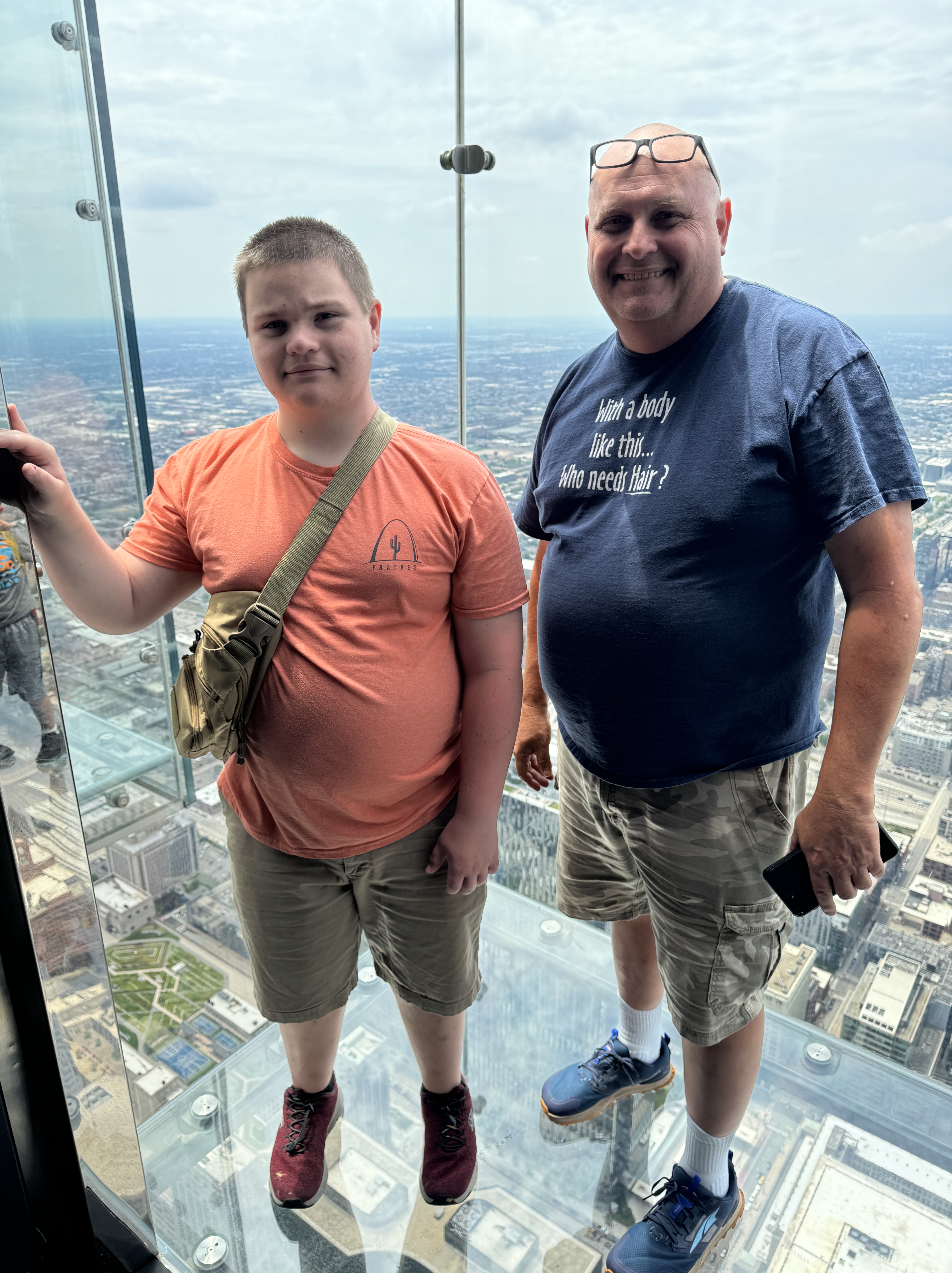
Cody and Phil Spotts on “The Ledge,” Sears Tower (AKA Willis Tower), Chicago, July 8, 2024.

But there was a limit to what I would do. While Cody and Phil happily—and fearlessly—walked out on the Sears Tower’s “The Ledge”—looking straight down 103 floors through glass to the street below—I was happy to be their official photographer, my feet firmly planted on the carpeted floor.

Doug_Cody_trombone_2024\

Douglas Yeo and Cody Spotts, July 8, 2024

When we got back to our house after yet another train ride (Pat had prepared a delicious dinner; as good as the food was at the race, it was nice to be home and have Pat’s wonderful home cooking), Cody and I played trombone duets. I’d never heard Cody play trombone before and it was so great spend some time together with trombones in our hands. The thing that solidified Cody’s and my friendship—the trombone—was shared in a memorable, tangible way.

This is friendship. Being together, talking together, sharing together, enjoying experiences together. Saying “Yes” when a friend asks you to do something you can’t imagine yourself doing. And then appreciating how they stretched you. And saying—and showing—”thank you” when someone gives you a gift—and Phil and Cody gave me a remarkable gift. Not just tickets to a race weekend, but a shared brotherhood that started with our shared faith in Christ. The three of us know and truly understand what the Apostle Paul meant when he wrote, “Therefore encourage one another and build one another up, just as you are doing.” (1 Thessalonians 5:11) Though separated by distance, when Cody asked to come to the Chicago Street Race with his dad and enjoy it with me, we picked up our relationship like we were next door neighbors who had never been apart. That is friendship.

Before I went to the NASCAR Chicago Street Race weekend I did not know what to expect. These friends taught me a lot. We shared something that has bound us together in a new way, and I will treasure the memory. Just as I treasure our friendship. Thank you, friends.

NASCAR_2024_wristbands_program

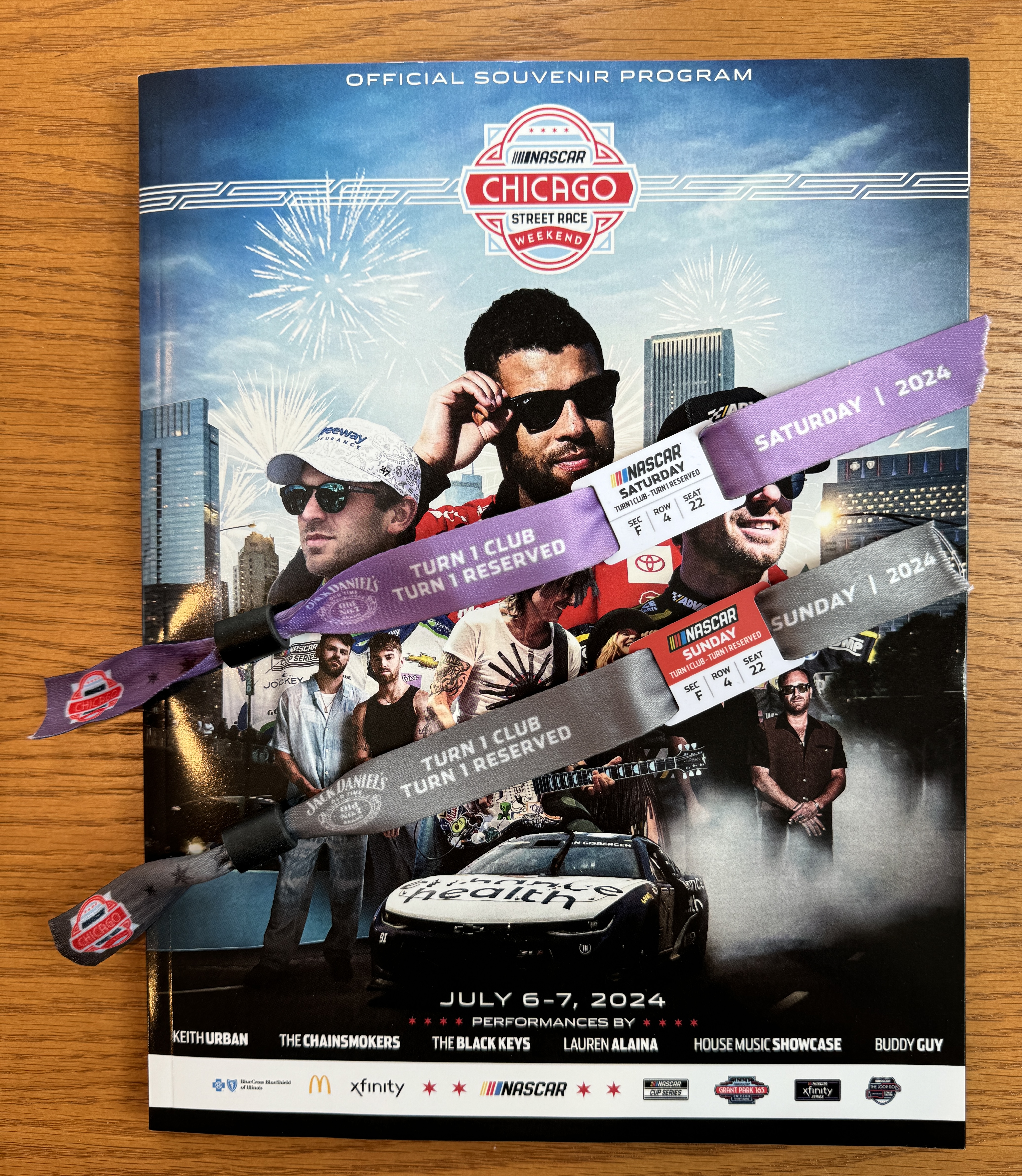
Official program and my wristbands for the 2024 NASCAR Chicago Street Race Weekend, July 6-7, 2024

For everything there is a season

For everything there is a season

by Douglas Yeo (May 19, 2024)

The Bible gives us answers, and it reminds us of this (Ecclesiastes 3:1-8, English Standard Version):

For everything there is a season, and a time for every matter under heaven:

a time to be born, and a time to die; a time to plant, and a time to pluck up what is planted;

a time to kill, and a time to heal; a time to break down, and a time to build up;

a time to weep, and a time to laugh; a time to mourn, and a time to dance;

a time to cast away stones, and a time to gather stones together; a time to embrace, and a time to refrain from embracing;

a time to seek, and a time to lose; a time to keep, and a time to cast away;

a time to tear, and a time to sew; a time to keep silence, and a time to speak;

a time to love, and a time to hate; a time for war, and a time for peace.

For each of us, our lives are full of seasons, and I have recently turned the page on a very long season of life and a new season is upon me.

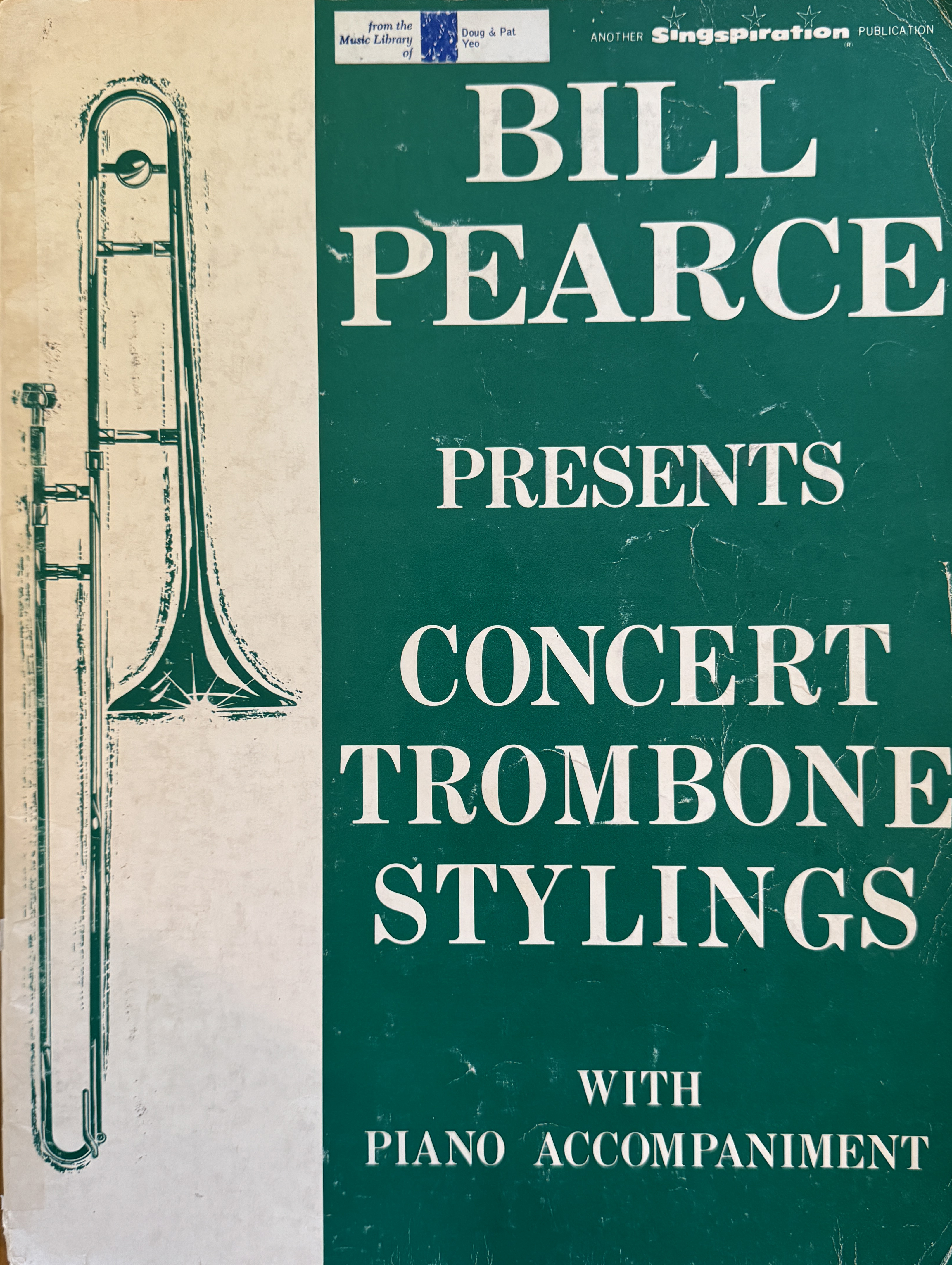
Pearce_trombone_Concert_stylings

One of the Bill Pearce solo trombone with piano books that my first trombone student, Lloyd, gave to me in payment for trombone lessons I gave him at Wheaton College in the summer of 1974.

I have been teaching trombone lessons since the summer of 1974. At that time, I was a student at Wheaton College and another student on campus, Lloyd, asked if he could take some lessons with me. Lloyd wasn’t a trombone major; in fact, he was a student at Wheaton College for only that one summer quarter. But I was happy to help him improve his skills. At the end of the lessons, Lloyd told me he didn’t have money to pay me but if I would accept them, he would give me five books of solos for trombone and piano by the great gospel trombonist Bill Pearce. 50 years later, I still have and use those books. After that summer, I began teaching weekly lessons to young players through the College’s Preparatory Department. Doing so helped me get through college without any debt (that job along with other jobs that included working as student manager of the College artist series, working two days a week at a local White Hen Pantry, and shoveling snow for an office park in the winter).

Since that time, I’ve taught regularly in many schools, first as a high school band director, then as trombone teacher/professor of trombone:

STA_My_Fair_Lady_pit_band

St. Thomas Aquinas High School, Edison NJ (1979-1981) — with students in rehearsal for the school’s production of My Fair Lady, 1981.

Peabody_News_1982

Peabody Institute of Johns Hopkins University, Baltimore MD (1982-1985) — Announcement from September 1982  in Peabody News listing faculty members who were members of the Baltimore Symphony Orchestra

NEC_Trombones_1990_01

New England Conservatory of Music (1984-2012) — conducting the New England Trombone Choir at New England Conservatory, 1990

ASU_Desert_Bones_2016

Arizona State University, Tempe AZ (2012-2016) — ASU Trombone Studio with the University’s mascot, Sparky, 2016

Wheaton College, Wheaton IL (2019-2023) — performance of Canzone by Girolamo Frescobaldi, arr. Eddy Koopman, Wheaton College faculty recital, April 23, 2022

UIUC_Illinois_trombone_studio_2024_signed_photo

University of Illinois Urbana-Champaign, IL (2022-2024) — signed photo given to me by members of the University of Illinois Trombone Studio, May 2024

Since I retired from the Boston Symphony Orchestra in 2012 after more than 27 years as a member of that great orchestra, my life has taken many turns. My wife, Patricia, and I moved to Arizona where I immediately flunked retirement and accepted the full time position as professor of trombone at Arizona State University. In 2018, we moved to the Chicago area to be near our grandchildren (grandkids truly make you do crazy things, like move from Arizona to the Midwest) and I flunked retirement again when I was asked to teach at my undergraduate alma mater, Wheaton College. When University of Illinois asked me to take a one year position as professor of trombone for 2022-2023—a position that came to me most unexpectedly and I thoroughly enjoyed—I looked forward to trying this retirement thing again in 2023 when that appointment was up and, at the same time, I decided to step away from teaching at Wheaton College. But as things turned out, one year of teaching at Illinois turned into two years. Happily, the Illinois School of Music recently hired a new full time trombone professor and my appointment at Illinois concluded.

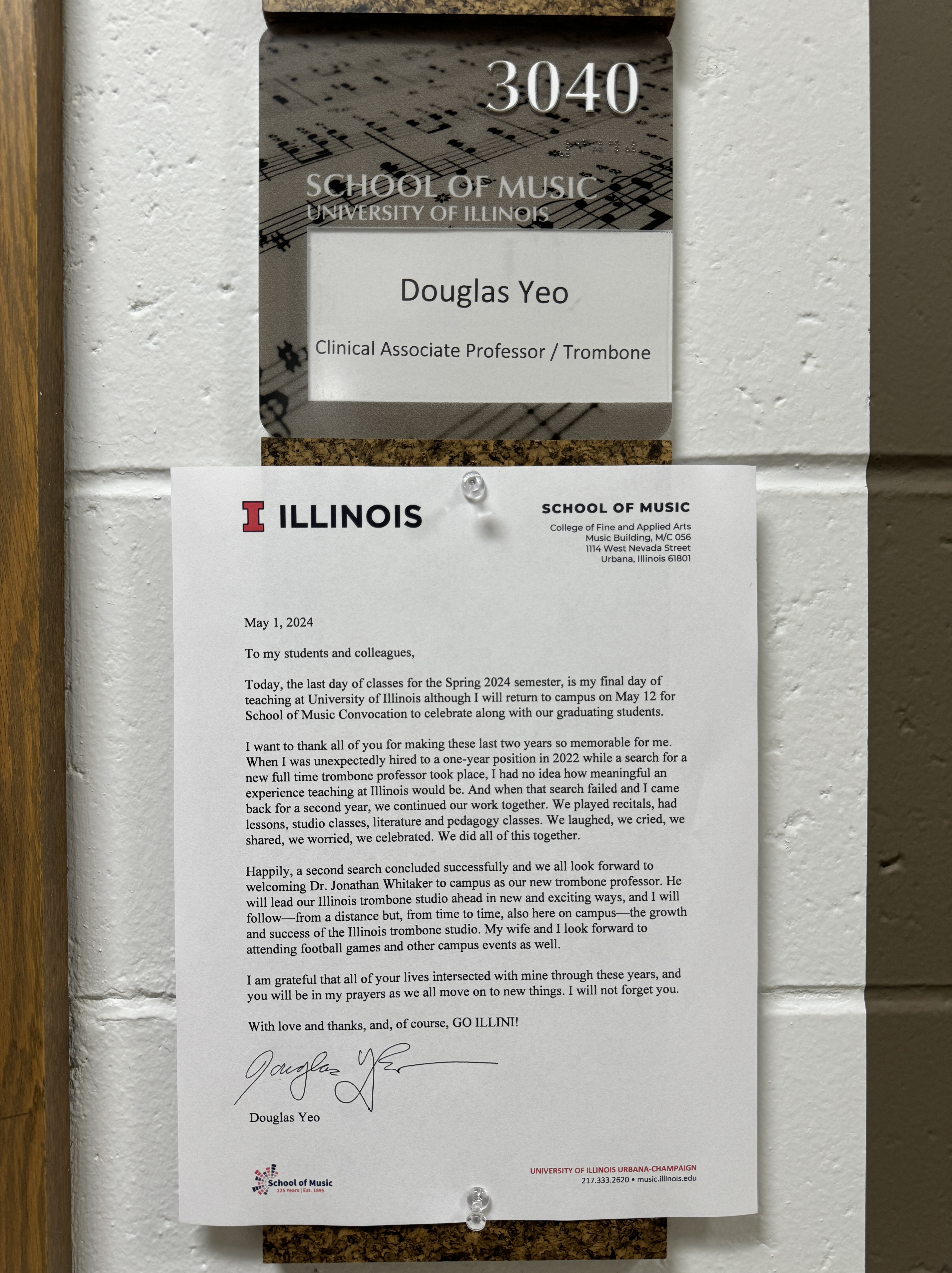
Yeo_UIUC_office_letter

I taught my last trombone lessons at University of Illinois Urbana-Champaign on May 1 and before I headed home, I wrote a letter to my students and colleagues that I posted on the bulletin board next to my office, shown above.

UIUC_Convocation_students_2024

With my graduating students at University of Illinois Urbana-Champaign School of Music Convocation, May 12, 2024. Left to right: Rachel Lin (Bachelor of Music Education), Jerry Min (Bachelor of Music), Lorraine Montana (Master of Music)

I returned to campus on May 12 when  University of Illinois held a Convocation ceremony for the School of Music and I celebrated the graduation of three of my students. In a sense it was a graduation ceremony for me, too, as I closed out two memorable years teaching at University of Illinois, a campus community where I feel a very strong connection. When the ceremony was over, I took off my academic regalia, switched off the lights in my office, and turned in my keys. On the long drive home through the beautiful, newly planted Illinois cornfields, I began to reflect on all that had just happened. A new season had begun.

Illinois_cornfields_May_2024

Newly planted Illinois cornfields along Illinois Route 115, May 12, 2024

Illinois_corn_May_2024

The corn is now just a few inches tall and in late fall it will be, in the words of the song, “Oh, What a Beautiful Mornin'” from the musical Oklahoma!, “as high as an elephant’s eye.”

As I see it, “retirement” is a lousy word. When I decided to retire from the Boston Symphony, many of my colleagues asked me, “So, are you going to take up golf?” Nope. Golf doesn’t interest me. And I never saw “retirement” as a season of life devoted to non-stop self-entertainment. After decades playing in symphony orchestras, I looked forward to new adventures. I wanted to have more time to research and write, to travel with my wife, to enjoy more time with our daughters and their families, and, with open hands, respond to God’s call to His purposes for my life.

Retirement, as it turned out, meant not playing golf or kicking back and “doing nothing,” but, rather that I was busy doing a host of engaging activities.

UIUC_trombone_studio_Lincoln_poster

The poster that hung in my office at University of Illinois for the last two years. It contains a logo my friend, Lennie Peterson, designed for our trombone studio, my five core tenets of teaching, and a quotation from Dr. Robert E. Gray that sums up the ethos of the University of Illinois Trombone Studio.

I’ve spent most of the last 12 years teaching at colleges and universities each week of the academic year: Arizona State, Wheaton College, University of Illinois. Working with those students has been such a big part of my life. But as I near a birthday with a zero on the end of it (it’s not 60; that was a long time ago. . .), I decided, after much thought and prayer, to step aside from weekly trombone teaching and have more time to do other things. This doesn’t mean I’ve taught my last trombone lesson. I love teaching; I still do. But this change in my life means I won’t be doing that teaching every week as a school’s trombone professor. This freedom gives me time to explore and enjoy both new and familiar things.

And there is a lot ahead for me. Later this month, I’ll travel to Texas Christian University (TCU) in Fort Worth, Texas, to take part in the International Trombone Festival. I’ll give a recital, serve on two roundtable discussion panels (one is about diversity considerations in recital programming; the other is about trombone research), give a major presentation about the celebrated trombonist Joannès Rochut, perform with the TCU trombone choir, and accept the International Trombone Association’s Lifetime Achievement Award. This summer my wife and I will take hiking trips to Grand Canyon and Zion National Parks (with our oldest daughter’s family, including our grandchildren), and Sequoia and King’s Canyon National Parks (with our youngest daughter and her husband). In September, I’ll conduct a trombone residency at University of Texas, Austin. In October I’ll play ophicleide in concerts with the San Francisco-based early music group, Philharmonia Baroque. We’ll attend many baseball games this summer (Chicago Cubs, Schaumberg Boomers, Chicago Dogs, Kane County Cougars, Oakland Ballers), and fall will bring us to our seats in Chicago’s Soldier Field for Chicago Bears football. A major American symphony orchestra has asked if I would be willing to substitute with them in the coming season. Research and writing projects are on my plate (watch the July 2024 issue of the International Trombone Association Journal for my article about the history and a chemical analysis of trombone slide oil, and the January 2025 issue for my article about Joannès Rochut; I’m also at work on a new book for Oxford University Press), as are hikes, walks and tandem bicycle rides with Patricia. And serving our church and enjoying life with our grandchildren.

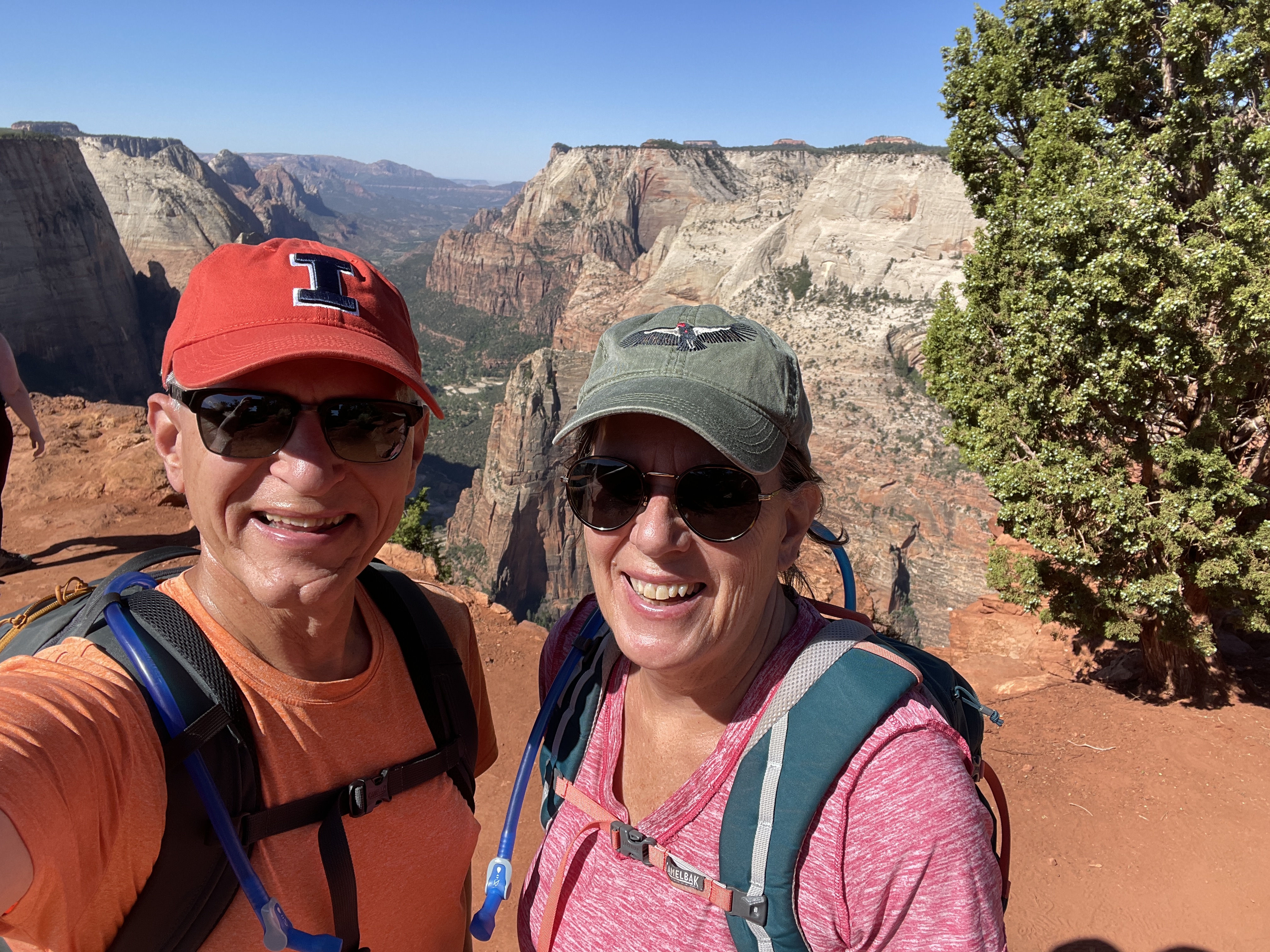
Doug_Pat_Zion_Observation_Point_June_2023

With my wife, Patricia, at Observation Point, Zion National Park, June 2023. We will return to this special place next month; it will be our 19th trip to Zion National Park.

So, as my long season of institutional teaching has turned a page, I look back at those decades with great fondness and gratitude. And I have learned this: I don’t know all of what God has for me going forward.  With open hands, I’m grateful for the opportunities I’ve had to serve, learn, and contribute. I plan to keep doing that in both new and familiar ways as God leads. I look forward to seeing you along the road.