Category: research projects

Trombone players: It’s time to bury Henry Fillmore’s “Lassus Trombone.”

Trombone players: It’s time to bury Henry Fillmore’s “Lassus Trombone.”

by Douglas Yeo (June 28, 2020)

NOTE: This article contains offensive material of an historical nature that is presented in an effort to inform the trombone community of a regrettable vestige of racism that continues to be a part of the trombone’s concert repertoire since it first came to light over 100 years ago. It is my hope that this article will lead trombonists around the world to make important, needed changes in the repertoire we choose for our recitals, and rid our concerts of music that is rooted in racial stereotyping and racist portrayals of African Americans.

UPDATE (July 6, 2020): Over 64,000 people have read this article since I wrote and published it a week ago. Today, I wrote a followup article, A path forward from Henry Fillmore’s “Lassus Trombone.” When you finish reading this article, please click HERE to read my response to the conversation that has been going on over the last week.

UPDATE (March 5, 2024): Since this article was posted on The Last Trombone, it has been viewed by over 1 million people, including those who have read it when it was reprinted in over a dozen music journals. The conversation continues.

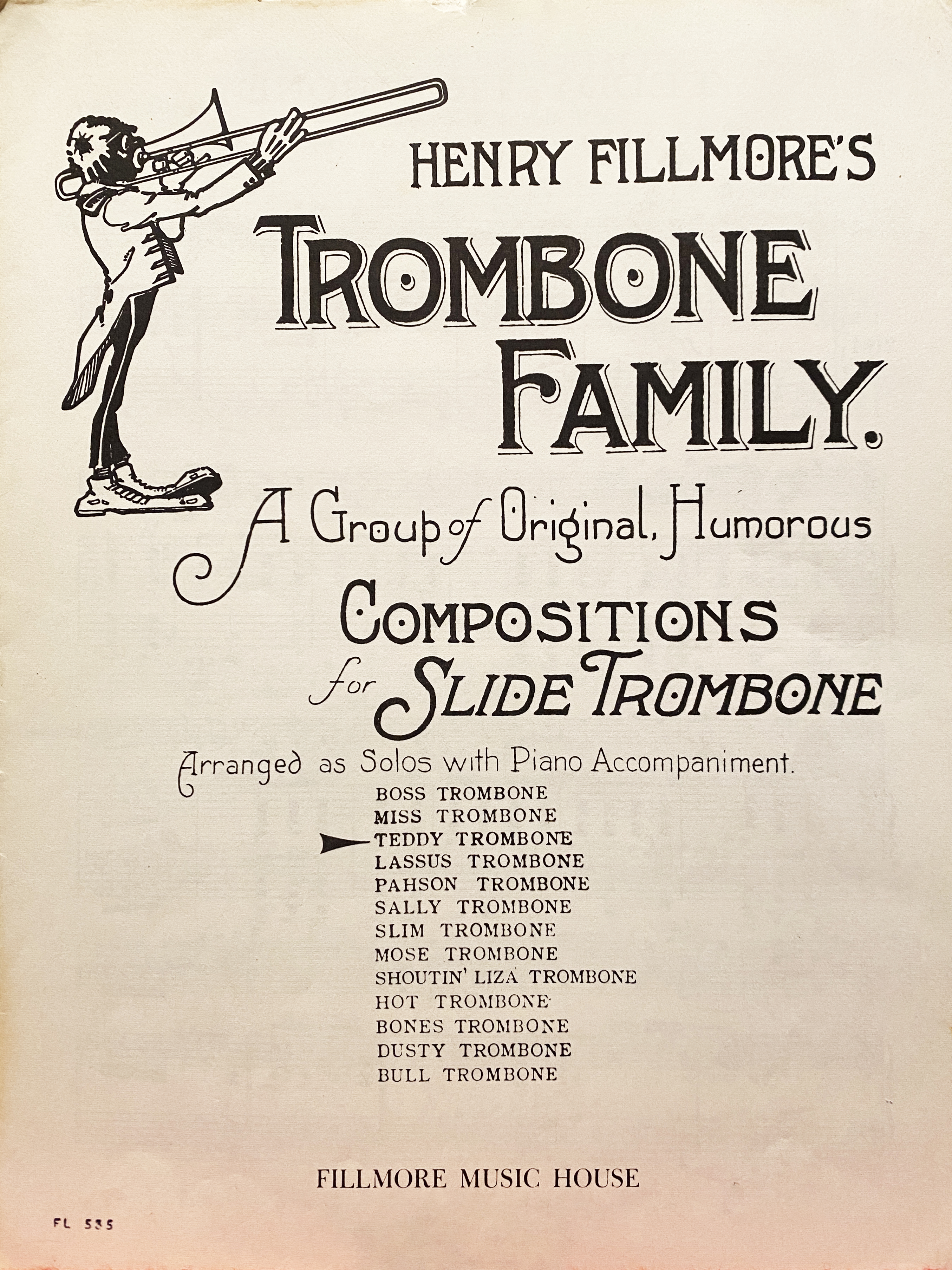
In 1908, American composer Henry Fillmore (1881-1956) composed Miss Trombone for solo trombone and piano; it was published by his family’s company, Fillmore Music House of Cincinnati. Miss Trombone was a novelty piece in ragtime style and it featured slide glissandos, or what were also referred to at the time as “trombone smears.” The glissando is a signature feature of the trombone and Miss Trombone capitalized on the technique. By 1919, trombone glissandos were known by a new name: jazzes; the technique was called jazzing. Around that time, three method books were published that taught trombone players how to add  jazzing to their playing of popular music. These books were Mayhew L. Lake’s The Wizard Trombone Jazzer (Carl Fischer, 1919), Henry Fillmore’s Jazz Trombonist (Fillmore Music House, 1919), and Fortunato Sordillo’s Art of Jazzing for the Trombone (Oliver Ditson, 1920).

Miss Trombone was so successful that Fillmore followed it with more trombone solos in the same style, all with glissandos that ripped up and down the horn. The pieces had names that tied them together. Miss Trombone was followed by Teddy Trombone, and 13 others were added, and by 1929, the series was complete with the publication of Ham Trombone. Together, they were marketed as a set, The Trombone Family.

Trombone players have been playing these pieces for over 100 years. The most popular member of Fillmore’s Trombone Family has always been Lassus Trombone. It’s a piece that has appeared on countless trombone solo recitals, and trombone ensemble, band and orchestra concerts. YouTube features 8000 recordings of the piece.

But there is an uncomfortable truth about Henry Fillmore’s The Trombone Family. It was born and marketed in a crucible of racial stereotyping, minstrelsy, racism, and Jim Crow. It is time to put these pieces to rest, to bury them, to remove them from our concert programs, and do better when selecting music in the future. For those who are unaware of the racist background of Fillmore’s signature works, or who may respond by saying, “It’s not such a big deal,” here is the story. It matters.

The trombone glissando first appeared in classical music in Alexander Glazanov’s symphonic fantasy, The Sea, a work for orchestra that was composed in 1889. In time, it found its way into other classical works including Edward Elgar’s The Dream of Gerontius (1899) and Arnold Schoenberg’s Pelleas und Melisande (1902). For an excellent discussion of the trombone glissando in both classical and popular idioms, I refer readers to Trevor Herbert’s excellent article, “Trombone Glissando: A Case Study in Continuity and Change in Brass Instrument Performance Idioms” (Historic Brass Society Journal, Vol. 22, 2010, 1-18). The trombone glissando came into popular music by the turn of the century. Arthur Pryor recorded Trombone Sneeze: A Humoresque Cakewalk by Chris Sorensen Jr. with John Philip Sousa’s band in 1902 (Victor 1223); the piece is full of trombone smears. Have a listen below (to hear this piece on YouTube, click HERE):

It was not long before the trombone glissando began to be strongly associated with music that was a part of minstrel shows. These were entertainments that featured caricatures of African Americans, with both white performers in blackface and black performers made up to look like white performers in blackface. The shows were mostly presented for the benefit of white audiences, and the caricature of black culture that the shows embodied was a product of white, racist thought that saw African Americans as bumbling and unintelligent. Music that reinforced these stereotypes  was a a part of the Jim Crow era and it proved to be very popular among many whites. Arthur Pryor’s song (yes, THAT Arthur Pryor, the most famous trombone player in all history), A Coon Band Contest or The Tune That Won the Ham for That Coon Band, was published in 1899 and recorded by his band in 1906. It’s a typical example of the genre of music that used racial stereotyping as a marketing tool. The cover of A Coon Band Contest (see below) featured a caricature of a bulging-eyed African American trombonist with several stereotypical depictions of other blacks who were listening to and conducting the trombonist (including a large lipped conductor and a suspender clad man emptying the trombone’s water key onto another person who protects him/herself with an umbrella). The publisher of the song, The Bell Music Company, probably thought the cover was cute. It wasn’t. Racism is never cute.
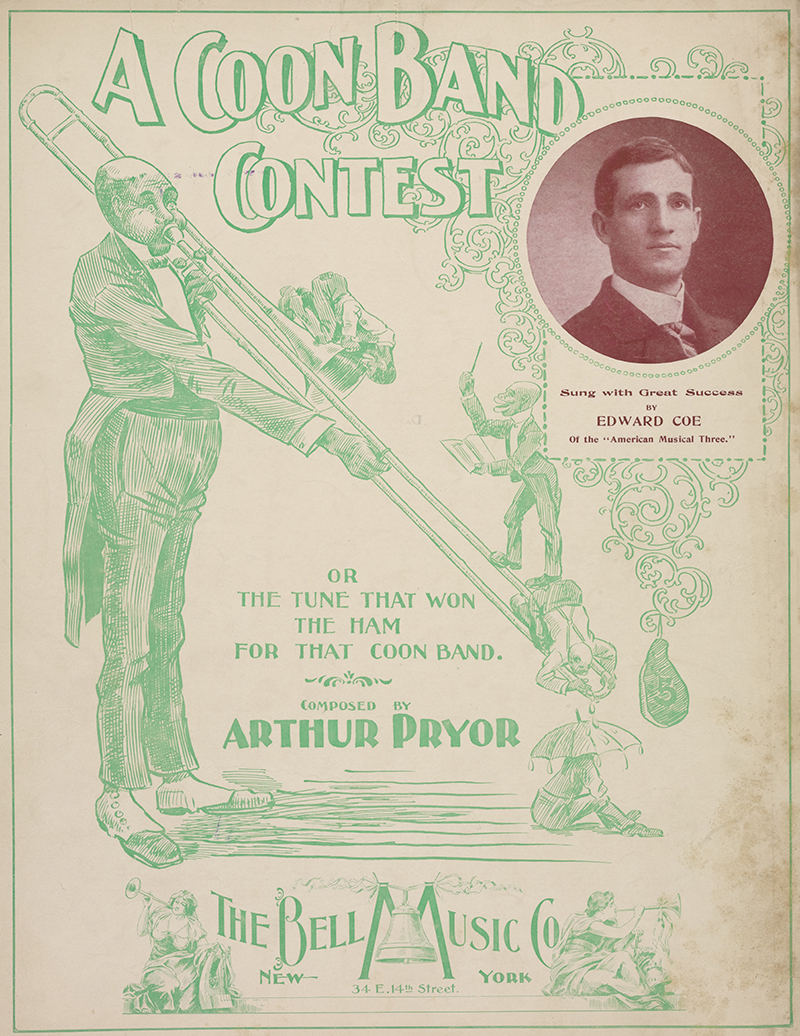
Pryor_A_Coon_Band_Contest_cover_sm

Into this environment of demeaning portrayals of African Americans walked Henry Fillmore. By the time Miss Trombone was published in 1908, the cakewalk had given way to ragtime which was beginning to morph to what was first referred to as “jass” and then jazz. There was no reason that Fillmore’s Trombone Family had to caricature an African American family except for one simple fact: placing Miss Trombone and her family members into the environment of minstrelsy and racial stereotyping sold music to whites and their audiences.

All of the pieces in Fillmore’s Trombone Family featured trombone smears and they were given subtitles to frame them in the context of his fictional black family, what he called a “cullu’d fambly.” A look at all of the titles takes us into uncomfortable territory.

Miss Trombone (1908): A Slippery Rag

Teddy Trombone (1911): A Brother to Miss Trombone

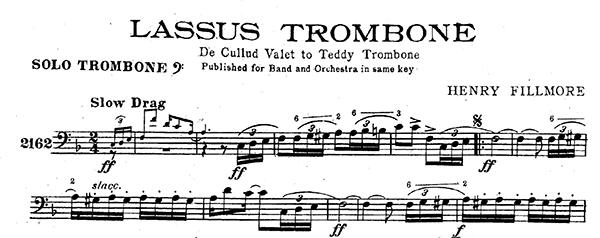
Lassus Trombone (1915): De Cullud Valet to Miss Trombone

Pahson [Parson] Trombone (1916): Lassus Trombone’s ‘Ole Man

Sally Trombone (1917): Pahson Trombone’s Eldest Gal – Some Crow!

Slim Trombone (1917): Sally Trombone’s City Cousin – the Jazzin’ One Step Kid

Mose Trombone (1919): He’s Slim Trombone’s Buddy

Shoutin’ Liza Trombone (1920): Mose Trombone’s Ah-finity

Hot Trombone (1921): He’s Jes a Fren’ ob Shoutin’ Liza Trombone

Bones Trombone (1922): He’s Jes as Warm as Hot Trombone

Dusty Trombone (1923): He’s de Next Door Neighbor to Bones Trombone

Bull Trombone (1924): A Cullud Toreador

Lucky Trombone (1926): He’s de Thirteenth Member uv de Fambly

Boss Trombone (1929): He’s de Head Man

Ham Trombone (1929): A Cullud Bahbaque

Many of the subtitles are given in a caricatured African American dialect, something that, when done by whites, has always been racist. Fillmore, when asked about the title, “Lassus Trombone,” had a standard answer: “Why, molasses, of course. I really don’t know why except I thought of molasses on bread for breakfast, dinner, and supper.” However, as J. Stanley Lemons pointed out in his important article, “Black Stereotypes as Reflected in Popular Culture, 1880-1920” (American Quarterly, Spring 1977, Vol. 29, No. 1), the minstrel-era character of Jim Crow “spent his time sleeping’, fishing’, hunting’ ‘possums, or shuffling’ along slower than molasses.” Molasses was one of many stereotypical tropes used to represent “the slow-thinking, slow-moving country and plantation darkey.”  It’s worth noting that Shoutin’ Liza Trombone was originally titled Hallelujah Trombone. But Fillmore’s father, James Henry Fillmore Sr. (1849-1936), a prolific composer of hymns and a publisher of hymnals, disapproved of the piece’s appropriation of the opening measures of Georg Frideric Handel’s Hallelujah Chorus from Messiah. In deference to his father, Henry Fillmore changed the piece’s title. Unfortunately, Henry’s father didn’t disapprove of his son’s racist portrayals in The Trombone Family—the pieces were all published during his lifetime. Offending Handel was off limits. But offending African Americans? It was par for the course.

Fillmore’s marketing of The Trombone Family with its stereotyping of blacks would be offensive enough. But it is for his advertising campaign for the music that Fillmore reserved his most outrageous insults.

The first ad reproduced below appeared in February 1919 in The Musical Messenger, “a monthly band and orchestra journal” published by Fillmore Music House. The second one was published in Jacobs Orchestra Monthly in September 1918. These racist ads were at the heart of Fillmore’s advertising for The Trombone Family. The cartoon of Slim Trombone in the Jacobs Orchestra Monthly ad is taken directly from advertising by Harvey’s Greater Minstrels for its trombonist, Slim Jim Austin. There can be no doubt that Fillmore’s Slim Trombone was given its title to capitalize on the popularity of Austin on the minstrel show circuit. And the image of the floppy shoed  trombone player in blackface in the ad from The Musical Messenger appeared on the cover of the sheet music for each of the pieces. The language of the ads needs no explanation. It is disgusting stuff.
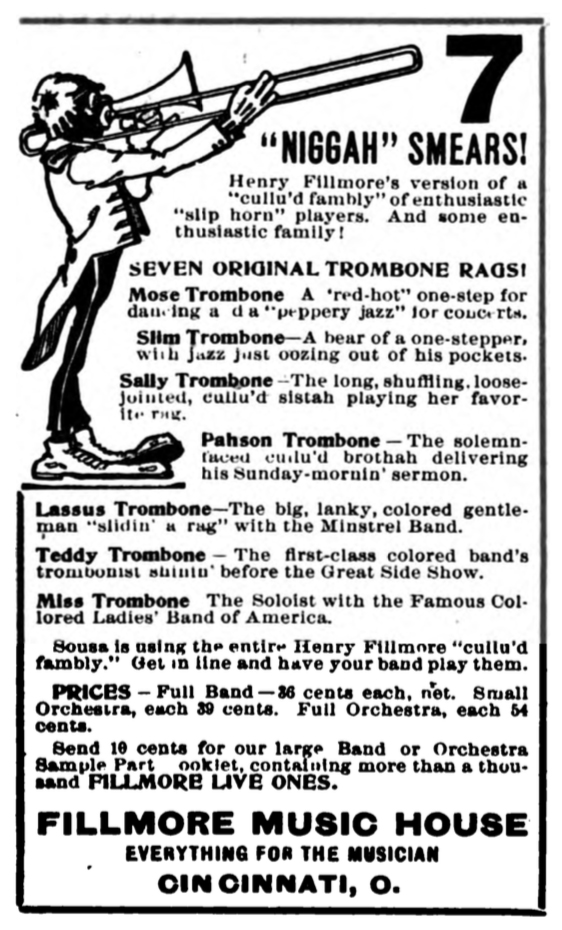
Fillmore_Trombone_Family_ad_1919.1

Fillmore_Trombone_Family_ad_1919.2

Fillmore_Trombone_Family_cover

Had enough? Yet in the face of all of this, some may protest. “But Fillmore was just a product of his time. Minstrelsy and blackface were socially acceptable and he was just playing to the market.” This kind of apology just won’t do. It is revisionist history, a fiction promulgated by white “scholars” and others who try to make a distinction between “good minstrelsy” and “bad minstrelsy,” between “good blackface” and “bad blackface.” The truth of the matter is that there never was good minstrelsy or good blackface. It has always been offensive. Always. And the use of the “n-word” by whites was always offensive. Always. It was offensive in the nineteenth century, it was offensive in the twentieth century, and it is offensive today. Minstrelsy did not originate in or reflect the true black experience and true black cultural practices. It was a racist caricature of black life that was based in racial ridicule. It was always offensive, it was always racist, and it was always wrong. Henry Fillmore’s The Trombone Family promoted the racial stereotypes promulgated by the minstrel show era,  promoted white domination of blacks, and reinforced harmful, hurtful stereotypes that are still, regrettably, with us today.

So, what to do about Lassus Trombone?

In his message to Congress on December 1, 1862, Abraham Lincoln said, “Fellow citizens, we cannot erase history.” That is true. History is history; it happened; we can’t change it. When we view history, we need clear eyes. And clear eyes lead me to only one conclusion: It is time to bury Henry Fillmore’s Lassus Trombone and The Trombone Family. They were born of racism and a racist culture. They padded the pockets of the Fillmore Music House and, later, Carl Fischer Co. which took over the copyright from The Trombone Family, and in recent years, since the works went out of copyright, a host of publishers around the world. Fillmore’s racist portrayals of African Americans sold. Racism was good business.

It is time for this to stop.

First, we need to inform our trombone community about the story behind these pieces that have been such a part of the fabric of the trombone’s performance history of the last 100 years. For instance, several years ago, I was invited to be guest artist at a major American university, to give a masterclass, solo with the university’s trombone choir, and conduct a massed trombone choir of high school and college students. The school’s trombone professor—a very good friend of mine—and I engaged in a conversation about what piece I might choose to conduct. He said he had a really nice arrangement of Lassus Trombone for trombone ensemble that he had used on many occasions; he thought it might be a good closer for the concert. I told him I would not conduct Lassus Trombone, and I shared with him the story behind the piece that I have laid out in this article. He was horrified; he didn’t know. He had no idea of the racist roots of Lassus Trombone. And he was so grateful that I told him. Lassus Trombone quickly disappeared from his trombone choir’s library. I conducted Simon Wills’ Tinguely’s Fountain instead.

Second, it is time for us to bury Lassus Trombone and the other members of Fillmore’s Trombone Family.  We don’t need them. We don’t need to play music that is rooted in racism and racial stereotypes. We don’t need to play music that makes fun of any person. There are other pieces in the trombone glissando “jazzing” tradition that would make for a fine substitute for Lassus Trombone on a recital program. Why not try Mayhew L. Lake’s Slidus Trombonus? Composed in 1915—the same year Lassus Trombone was written—it was written for Gardell Simons. He was the celebrated soloist with Patrick Conway’s Band who also played principal trombone with the Philadelphia Orchestra from 1915-1930, and the piece was recorded by Conway’s band in 1916. You can hear Conway’s recording of Slidus Trombonus on the Library of Congress website by clicking HERE. And I have scanned my copy of Slidus Trombonus (which is in the public domain) and made it available for free on my website. You can download the trombone and piano music to Lake’s humorous piece by clicking HERE.
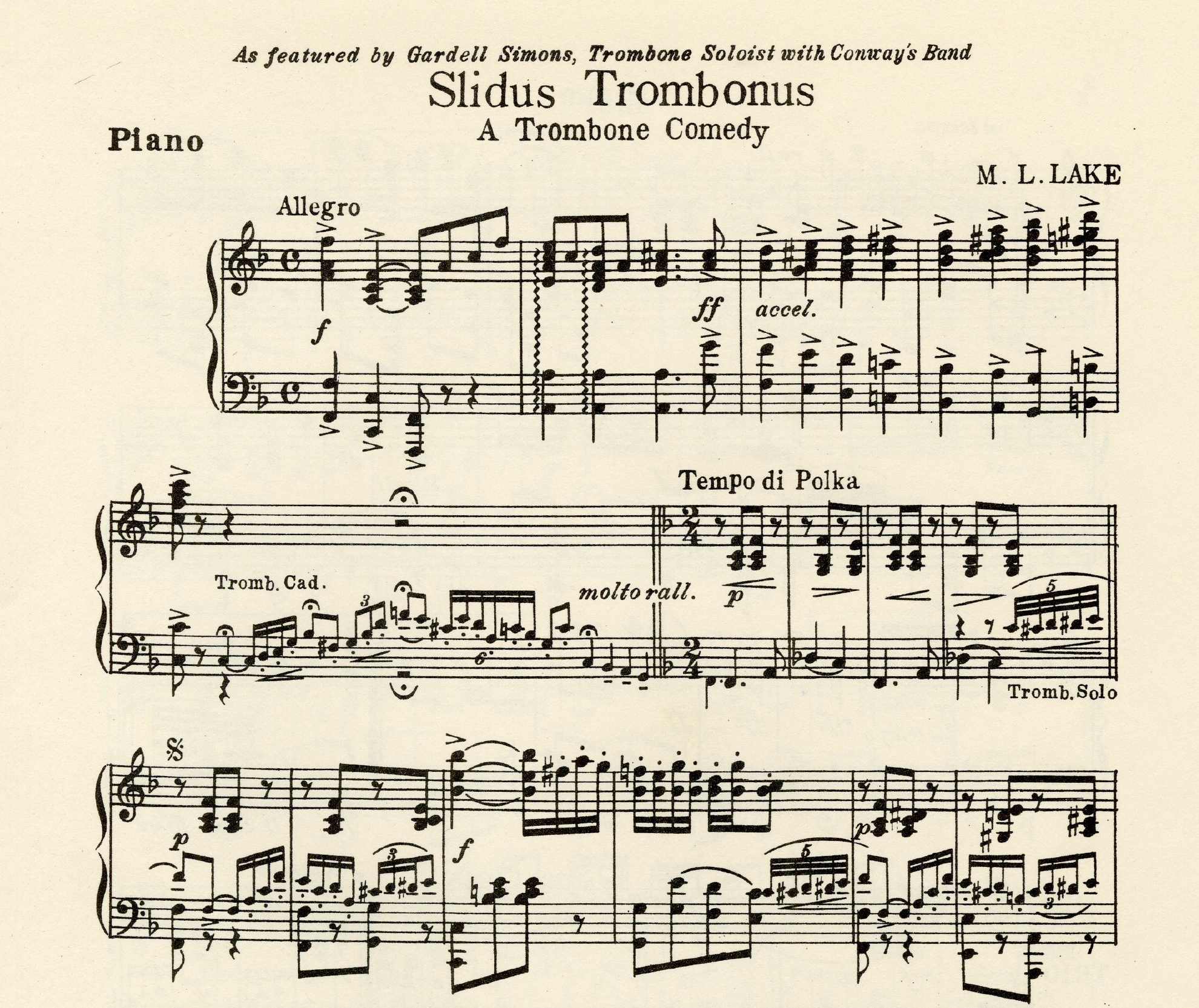
Lake Slidus Trombonus

“We cannot escape history.” But we can learn from it. We must learn from it. For over 100 years, trombone players have been complicit in continuing and fostering harmful racial stereotypes by performing Henry Fillmore’s Lassus Trombone and other pieces from The Trombone Family. We can do better. We must do better. And we will do better.

[UPDATE: One way to do better is to consider alternative programming. See my second article about this issue, “A Path Forward From Henry Fillmore’s ‘Lassus Trombone'”, where I discuss the trombone glissando rags of African-American composer Nathaniel Cleophas Davis, whose five rags were composed around the same time as Henry Fillmore’s The Trombone Family. These are excellent works that are available for band and have also been newly arranged for trombone and piano. And they do not carry the baggage of racial stereotyping.]

This is not a matter of political correctness or of censorship. This is a matter of righting a wrong and doing the right thing.

And here is something else. There is someone else who is doing the right thing with this. I began writing this article yesterday, June 27, 2020. I woke up very early this morning and went right to my computer to complete it. Between proofreading sessions, I went to look at my email “in” box and found a message from my friend, Gordon Cherry, founder and owner of Cherry Classics, one of the largest publishers of music for brass instruments in the world. Gordon is the retired principal trombonist of the Vancouver Symphony and his Cherry Classics catalog is very deep and wide. Gordon and I are in contact about various issues from time to time and he had something important he wanted to share with me. Gordon said that he had come to the realization—a realization that had been hiding in plain sight but that he just didn’t put all together until last week—that he was profiting by selling two arrangements of Lassus Trombone. Gordon told me that he plans to remove those arrangements from his catalog—something he will do tonight—and send a message to his email list of 6000 subscribers to tell them why he is removing this piece that has its origin in racial stereotyping. Gordon wanted to let me know about his thinking about this and he wanted to know what I thought about it. We just finished a FaceTime call where we both marveled that the two of us, friends separated by 2,000 miles, were thinking about the same issue in the very same way at the very same time, and that both of us had decided to do something about it. Thank you, Gordon, for doing the right thing. He has set a model for all publishers. Sometimes doing the right thing is more important than making another dollar. This is one of those times.

If you’d like to join me in removing Lassus Trombone and The Trombone Family from today’s trombone repertoire conversations, please feel free to share this article on social media and other types of platforms. Let’s get the message out. Ending racial stereotypes matters. Thank you for doing your part in this.

NOTE: Now that you have read this article, please click HERE to read my followup article, “A path forward from Henry Fillmore’s “Lassus Trombone.”

NOTE: I also welcome you to read my article, “Lassus Trombone: Now That You Know, What Do You Do? A conversation about music, marketing, hurt, and healing,” that appeared in Vol. 51, No. 3 (July 2023) issue of the International Trombone Association Journal. The article contains more historical perspective on the subject of music and minstrelsy and it answers the argument, “Well, it was acceptable at the time so. . .” You can read/download that article HERE.

© 2020, Douglas Yeo. All rights reserved.

Rewarded: a new book

Rewarded: a new book

I love to write. Ever since I was a young boy, I have been passionate about writing. Give me a 2,000 word essay on a school exam any day over three math problems. My love of writing was birthed from my love of reading, something imparted to me by my parents. My father was Chairman of our local public library while I was going up, and every week, my brothers and I trekked to the the library to take out another stack of books to read. I was fortunate to attend schools that emphasized reading, whether contemporary literature (a little), the classics (a lot), and the ancients (Edith Hamilton’s Mythology remains a favorite).

I’m at work writing several books at the moment. In the introduction to The Trombone Book, a planned 500 page book I’m writing for Oxford University Press that will cover the history, use, performance, teaching, and care of the instrument (for trombone players who are reading this, think of this book as the successor to the long out of print Trombone Technique by Denis Wick), I’ve written these words:

In a sense, I have been writing this book since I first picked up the trombone in 1964. My parents, Alan and Jeannine Yeo, now gone from this world to the next, taught me to pay attention. From them I received the gift of a disciplined work ethic and the understanding that it was required to succeed in anything. They instilled in me a love of books and reading, and from that it was not a far walk to a love of writing. I grew to appreciate words and how they were put together, and I particularly thank Alfred, Lord Tennyson (Enoch Arden), Henry Wadsworth Longfellow (Evangeline), Herman Melville (Moby Dick), Thomas Hardy (Under the Greenwood Tree and The Choirmaster’s Burial), J. D. Salinger (Catcher in the Rye), William Buckley (The Right Word) and Jacques Barzun (many books, but especially Berlioz and the Romantic Century, From Dawn to Decadence, The Use and Abuse of Art, The Culture We Deserve, and Darwin, Marx, Wagner: Critique of a Heritage) for their exceptional modeling of the possibilities of the English language. An exasperated Abigail Adams was known to say to her husband, John, whose predilection for long narrative introductions before getting to the main point used to annoy her to no end, “John! Do you always have to start at Genesis?” Like our Second President, I confess to being guilty as charged, and also to finding solace in the writing of the Apostle Paul, whose first sentence of his letter to the Romans contains 132 words before the insertion of the punctuation mark we call the period. Stopping a thought is sometimes hard to do.

I love well crafted sentences, the putting together of words, how they flow past the eye and off the lips.

As much as I like writing, I also like what happens before writing: research. I don’t write fiction; I write about music and music making, musical instruments and real people and history. I love the chase, the tracking down of facts both obscure and well known, the hunt for needles in haystacks. It is intense, patient, time-consuming, frustrating, and rewarding work. And I never tire of it.

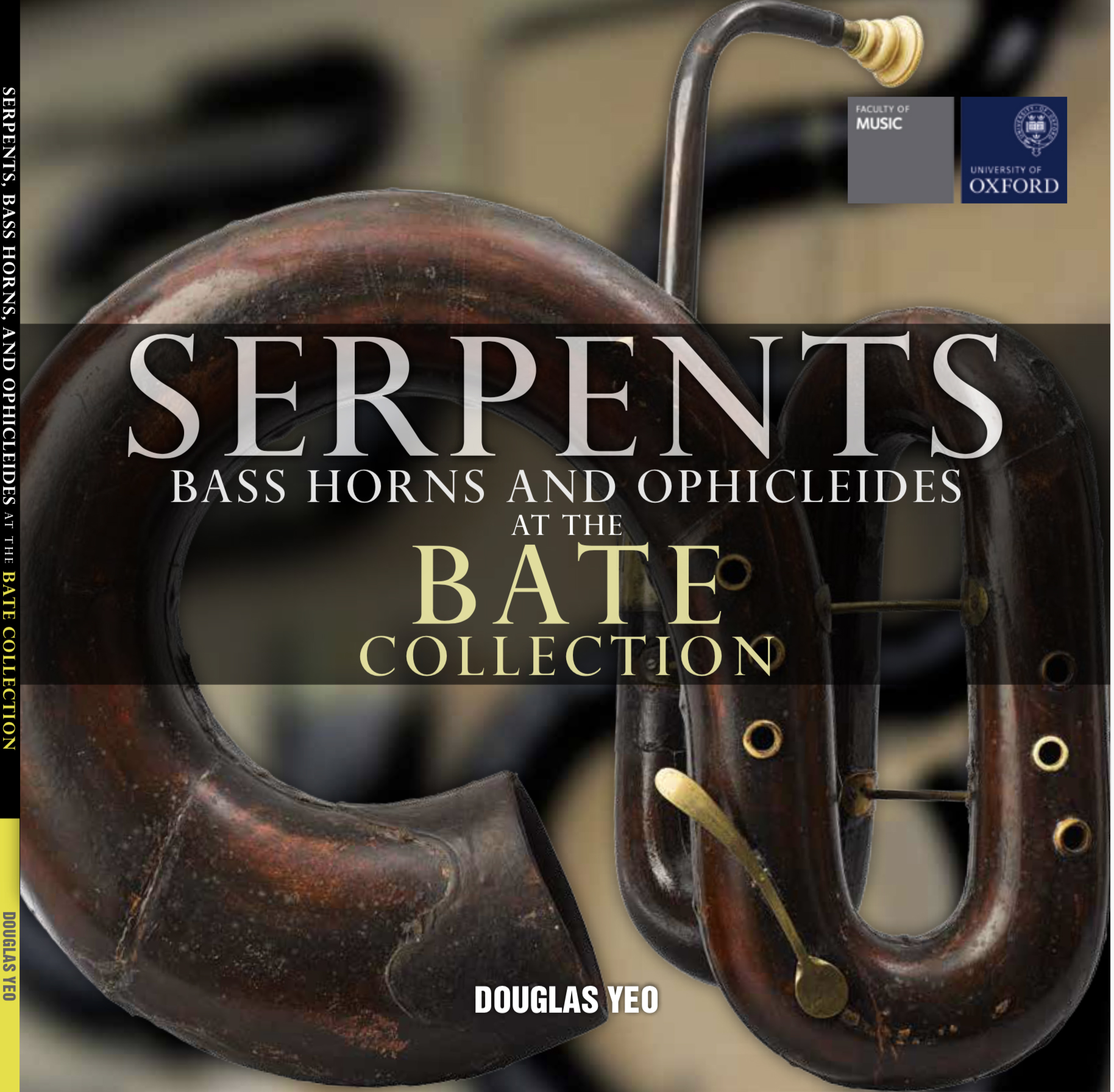
So, today is a particularly happy day for me, as my mailman brought me a most welcome package: several copies of my newest book, Serpents, Bass Horns and Ophicleides at the Bate Collection, just published by the University of Oxford in Oxford, England.

Bate_Yeo_serpents_cover

The Bate Collection in Oxford has a superb collection of musical instruments. I visited there in 2009 and had the opportunity to play several instruments under the watchful eye of my friend, curator Andrew Lamb.

Yeo_Waterloo_serpent

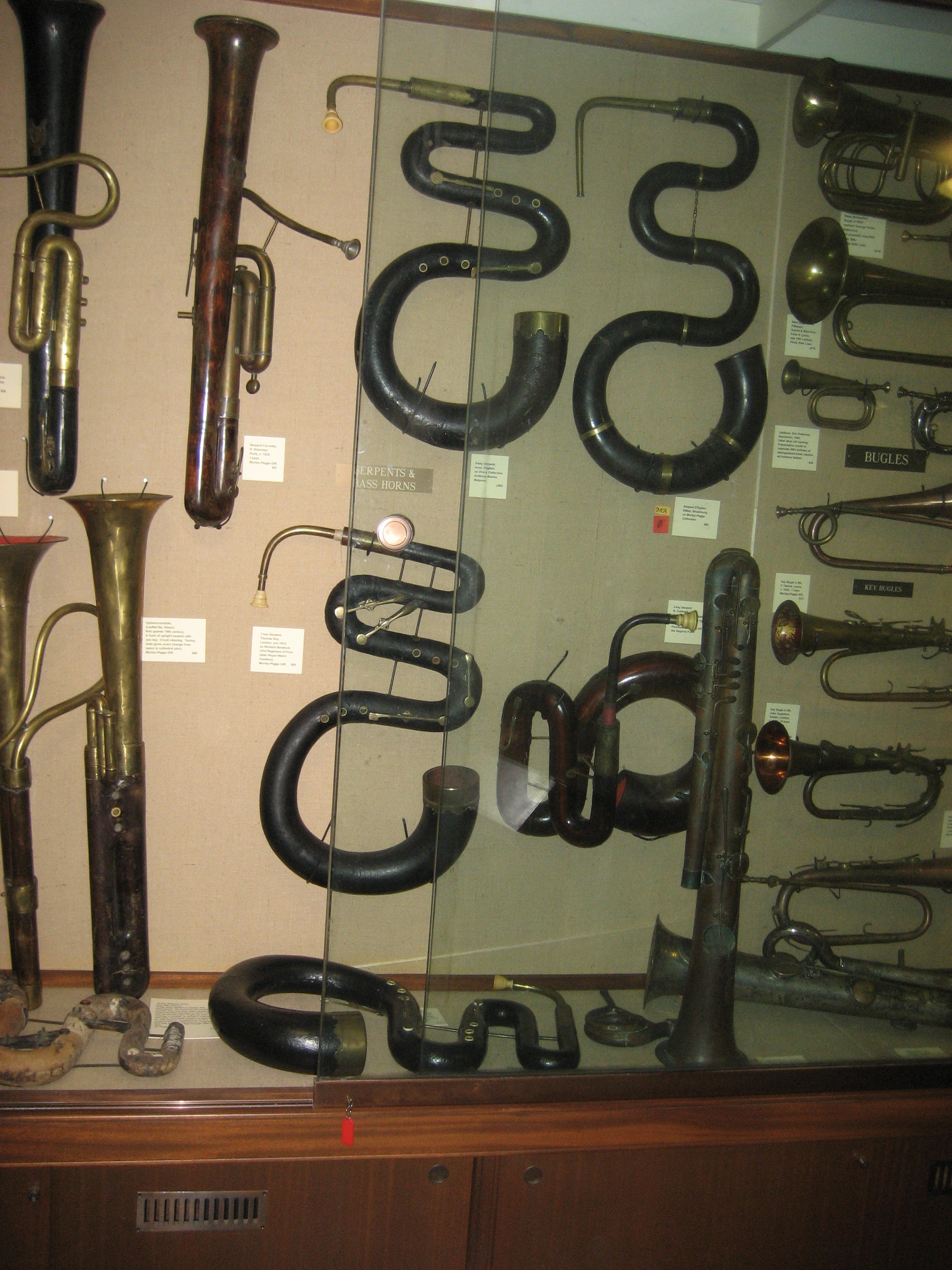
The Collection is a veritable “Ali Baba’s cave” of musical instruments, as you can see from this snapshot of one of the many display cases:

Bate_serpents_situ

In 2011, Andrew Lamb asked if I would be interested in writing a book about The Bate’s collection of serpents and related instruments. It took me all of one second to agree, although the project was delayed for many reasons. It was not as simple as sitting down and getting to work; a great deal of groundwork needed to be laid. And I also needed time to research and write. In 2012, I retired from the Boston Symphony and promptly flunked retirement and took the full time position of Professor of Trombone at Arizona State University. That job, as wonderful as it was, was all-consuming, and with many other writing projects going at the same time, the Bate book had to wait. But there was much to do as well, including collecting detailed information about all of The Bate’s instruments, arranging for high quality photos to be taken of each instrument, as well as research into the instruments themselves. I devised a plan for the structure of the book and last year, I began discussions with Bryn Walls, a superb designer who had been engaged to lay out and put the book together.

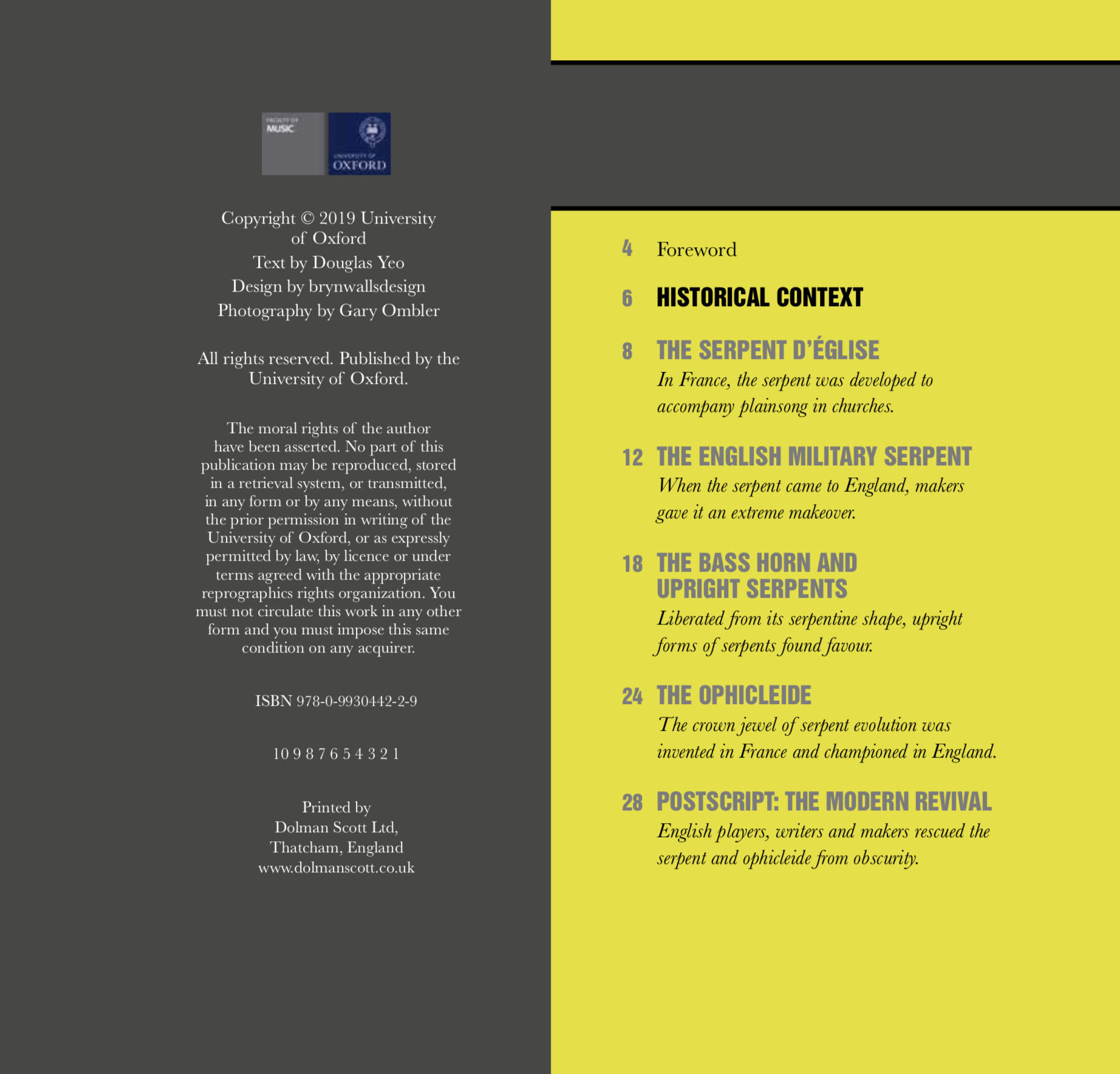
Screen Shot 2019-05-13 at 4.37.15 PM

As you can see from the first page of table of contents above, the book is divided into two primary sections. After a Foreward by Craig Kridel (not a Forward – remember that this book is published in England and England and the USA are two countries separated by a common language – my text needed to undergo “Anglicization” so its spelling and punctuation conformed to British publishing style), five chapters of Historical Context appear. In this section, I wrote a brief history of the instruments as seen through those at The Bate.

Screen Shot 2019-05-13 at 4.37.26 PM

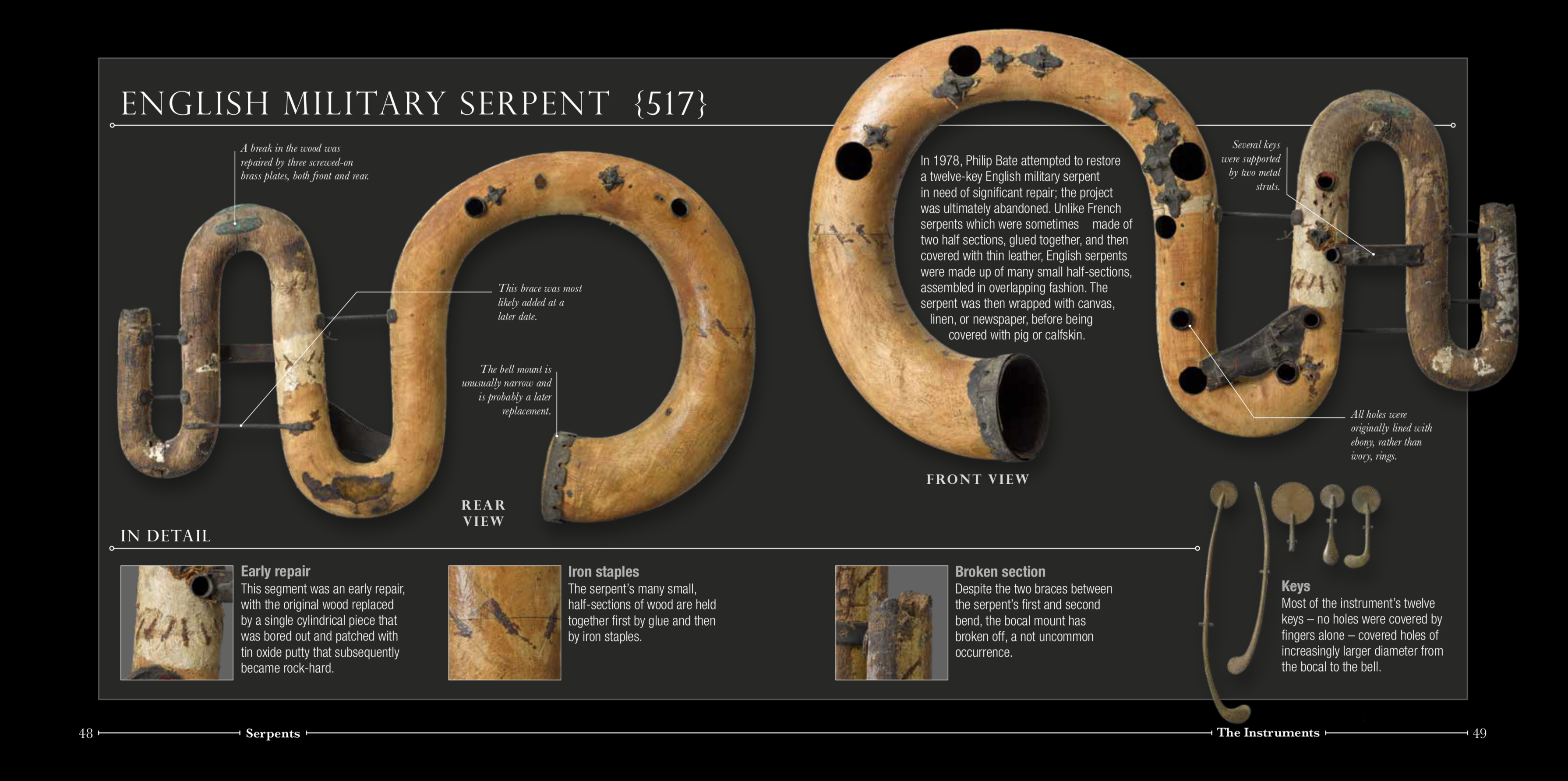
The second section of the book is a detailed discussion of the instruments at The Bate. My commentary is greatly enhanced by superb photos of the instruments by Gary Ombler. Following the discussion of the instruments is a brief section of back matter, including a checklist of the instruments, a bibliography so readers and learn more, a bio and photo of moi, and a page with the index and acknowledgements.

Bate_denuded_serpent

Bate_Courtois_ophicleide

Each instrument is afforded its own two page spread, with at least two full views of the instrument (sometimes there are three or four – front, back, and sides), many photographs of detailed elements of the instruments, as well as my commentary.

With this book, serpents, bass horns, and ophicleides at The Bate come alive in a new way. Visitors to the Collection can walk through the gallery with the book in hand as they look at the instruments and learn more than the identifying label next to the instrument itself can tell them. Those who can’t get to The Bate can enjoy the instruments while sitting at home in their favorite (whoops – favourite) chair. 80 pages of photos and commentary about some of the most interesting musical instruments ever conceived and manufactured.

The book is now available through the Bate Collection’s online publications store; click HERE to go there in a new browser window. Or, of course, you can stop by the Bate Collection yourself and pick one up there. I am delighted that this book, the subject a long period of research, writing, layout, and proofreading, is now available. Holding copies in my hand today is a great reward at the end of a long process. I will enjoy this moment, but tomorrow I’ll be happily back to my other writing projects. More on them soon!

Bate_serpents_situ


Symphony Hall: Boston’s proud temple of music since 1900

Symphony Hall: Boston’s proud temple of music since 1900

From 1985-2012, I was bass trombonist of the Boston Symphony Orchestra. The orchestra’s home is Symphony Hall, on the corner of Huntington and Massachusetts Avenues in Boston’s Back Bay section (301 Massachusetts Avenue). Opened in 1900 after the orchestra left the Boston Music Hall where it had played concerts since it was founded in 1881, Symphony Hall is considered to be one of the three finest concert halls in the world, with its acclaimed acoustics putting it in the company of the Musikvereinsaal (Vienna) and Concertgebouw (Amsterdam). Before it was destroyed in World War II, the old (alte) Gewandhaus in Leipzig was also similarly acclaimed. Having played concerts in the halls in Vienna and Amsterdam, I can say that in my view, Symphony Hall is simply the finest concert hall in which I have ever performed.

When I joined the Boston Symphony, I was aware of the rich history of both the orchestra itself and its storied home. I’ve read everything I could find about the BSO and Symphony Hall, spent countless hours in the orchestra’s archives (with which I had a hand in formally establishing in 1987), and have been fascinated at all I have found and learned.

Two important books have informed my quest for information about Symphony Hall.

Johnson_Symphony_Hall_Boston_1950

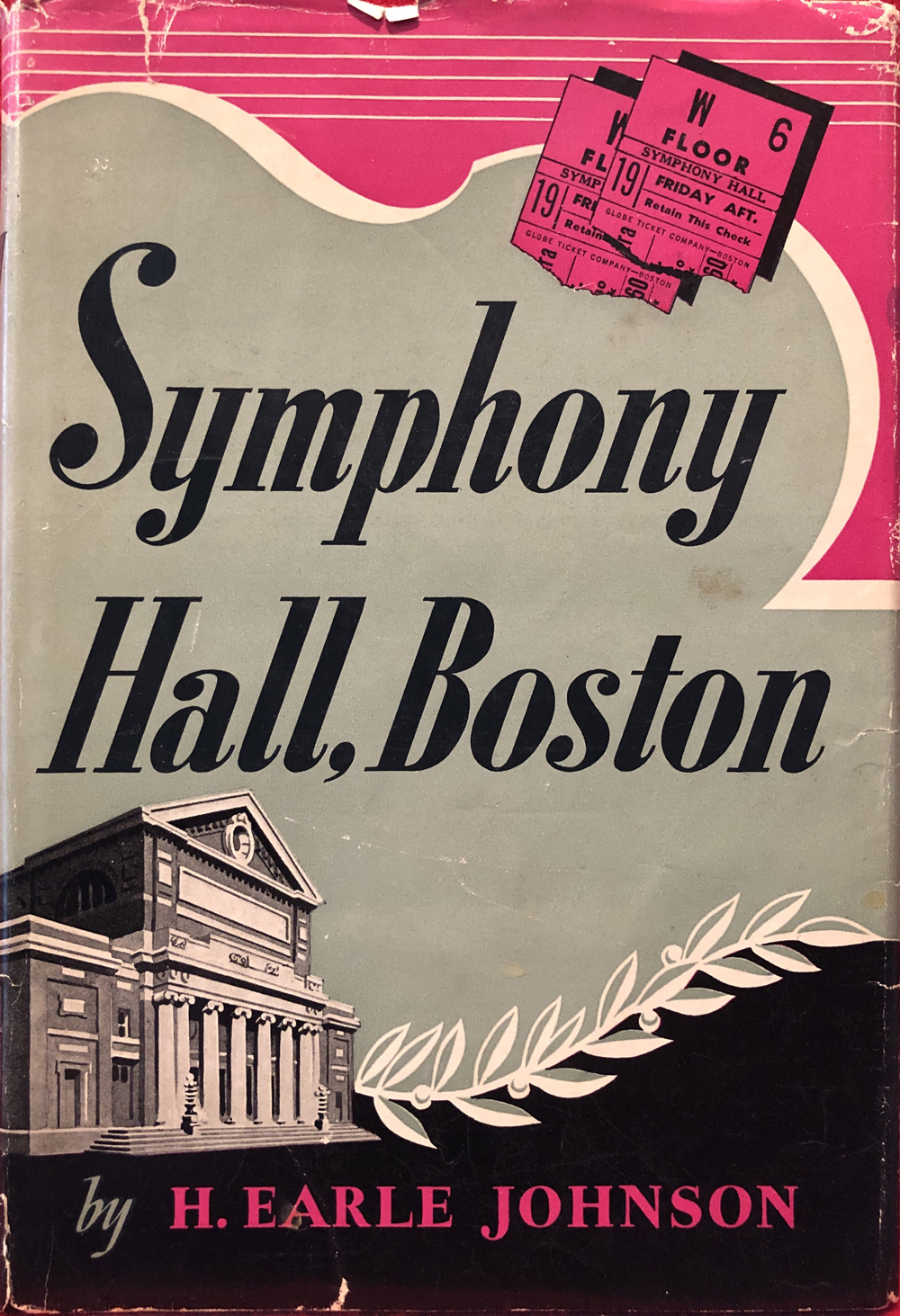
Published in 1950 on the occasion of the 50th anniversary of the opening of Symphony Hall, H. Earle Johnson’s Symphony Hall, Boston (Boston: Little, Brown and Co., 1950)  surveys the orchestra’s first 50 years, discusses programming and personnel, and features commentary on the building and opening of Symphony Hall. Now out of print (but copies can be found on through used book outlets such a abebooks.com), it unfortunately has no illustrations. 

Stebbins_Symphony_Hall_2000


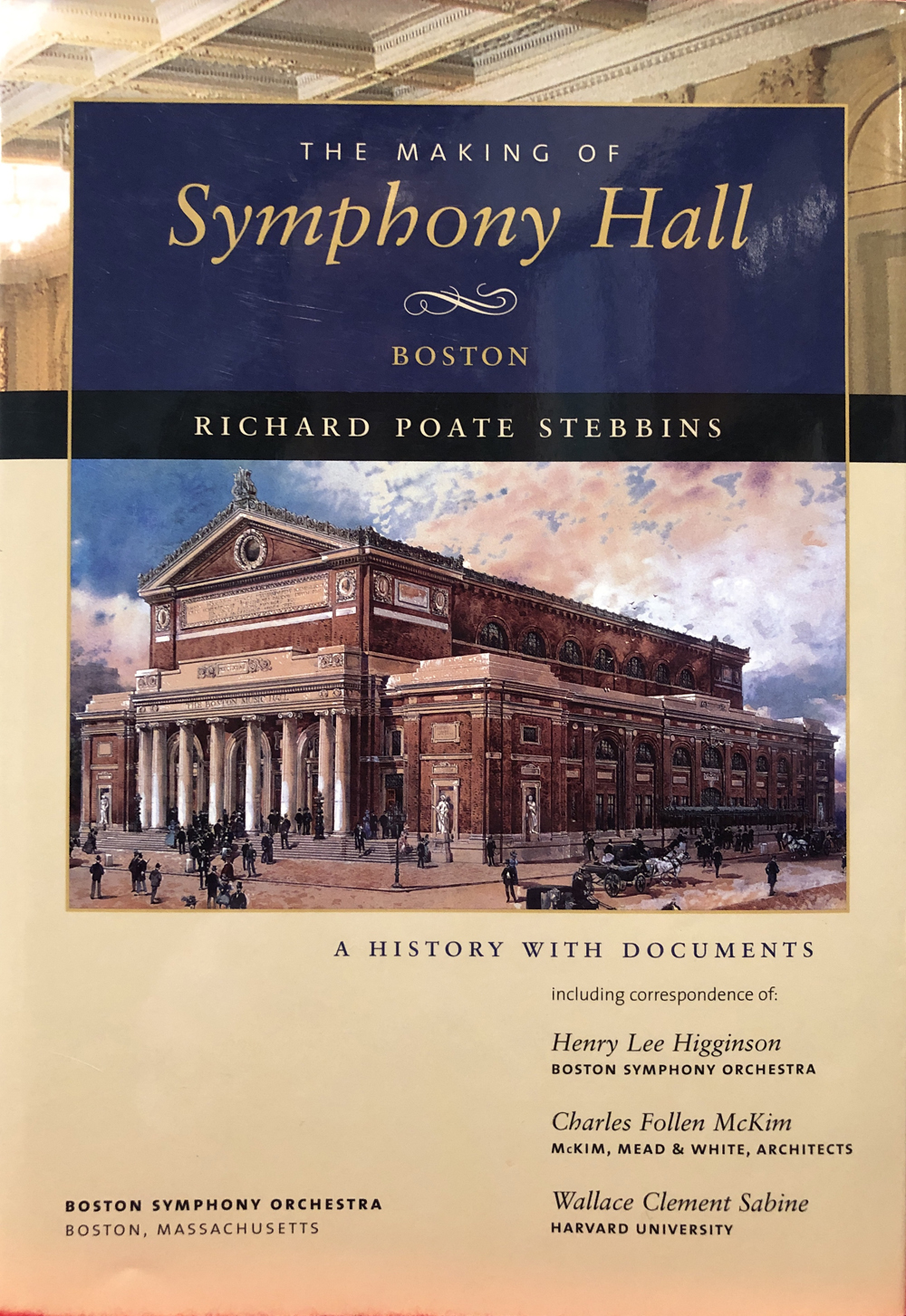
Richard Poate Stebbins’ book, The Making of Symphony Hall: A History with Documents (Boston: Boston Symphony Orchestra, 2000) is a superb volume that documents, in fascinating detail, the planning, construction, and opening of Symphony Hall. It was published on Symphony Hall’s centennial, a year I remember with great fondness for the many historical exhibits in the Hall’s corridors and the many celebrations of the Hall throughout the year. The cover of the book features an early, color rendering of the original design of the hall, with many statues, inscriptions, and decorative cornices. Ultimately, none of these items were incorporated in hall when it was finished. Money ran out, and to this day, even there is no external decoration to the hall. Even the Hall’s  name is not found on its exterior. Yet it is this austerity that is part of Symphony Hall’s charm; somehow it fits in with the Boston way.

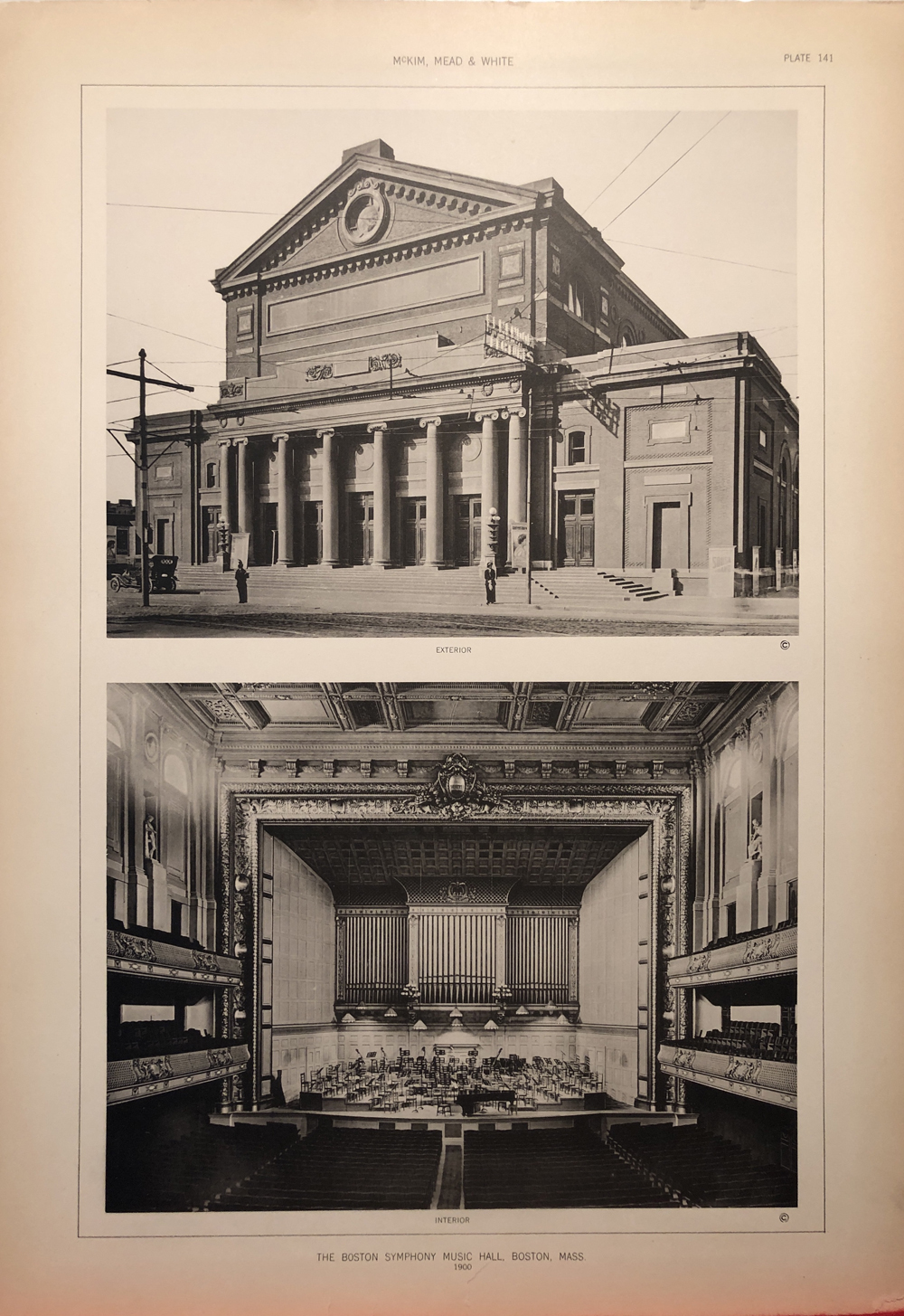
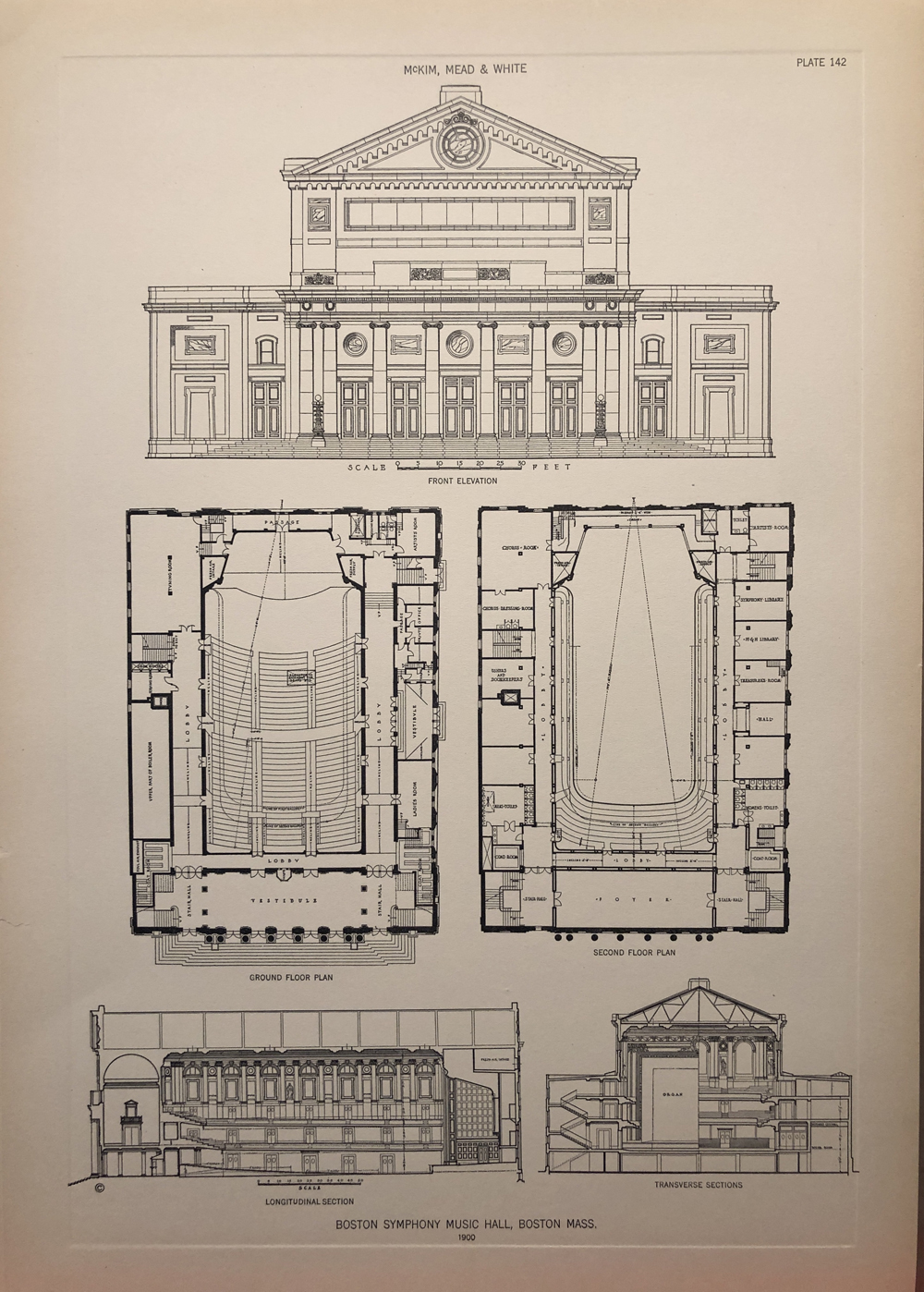
Symphony Hall was designed by  the architectural firm of McKim, Mead & White and an early photo of the completed Hall appeared in A Monograph of the Work of McKim, Mead & White, 1879-1915 (New York: Architectural Book Publishing Co, 1915), below. The publication was a massive four volume set with nearly 400 photographs; each had a simple caption without commentary. It details the breadth of the buildings designed by McKim, Mead & White and it includes three plates that feature Symphony Hall, plates 141, 142, and 143. Several years ago, I was able to obtain original copies of these plates, which are also contained in a modern reproduction of the original four volume set that is still readily and affordably available (McKim, Mead & White, The Architecture of McKim, Mead & White in Photographs, Plans and Elevations (New York: Dover Publications, 1990).  While McKim, Mead & White’s portfolio was published in 1915, the caption reflects the original name for Symphony Hall, The Boston Symphony Music Hall, which was changed to Symphony Hall just before its opening in October, 1900.

Symphony_Hall_plate_141

The other two plates feature some interior and exterior cross sections of Symphony Hall (the aisles on the main floor were changed to a different configuration in the final design), plate 142:

Symphony_Hall_plate_142

And plate 143, that features details of exterior design for the Hall:

Symphony_Hall_plate_143

Over the years, I have collected many postcards of Symphony Hall; I usually paid only one or two dollars apiece for a piece of Boston Symphony history. I was fascinated at how many different images of the facade of the Hall had been made over nearly 100 years. In all, I found dozens of different postcards with nearly 30 images of the exterior of the hall. Many were crisp and clean, but the ones that were most interesting were the ones that had been used, with writing, stamps, and postmarks. It is these postcards that helped to document the approximate time when the photo or image of Symphony Hall was made. Early postcards were black and white; later ones were hand tinted before reproduction, and later ones are faithful photographic reproductions. Most postcards do not have copyright dates; I am not an expert at automobile models which could help further pinpoint years photos were taken. Still, these cards tell the story of Symphony Hall in a unique way. I’m presenting them here in rough chronological order with only light commentary; captions appear beneath each card. The images speak for themselves and are a reminder of a very important part of my life and the lives of thousands upon thousands of lovers of music who have walked through the doors of Symphony Hall, Boston’s proud Temple of Music. 

01_Symphony_Hall_Yeo_postcard

01. Music Hall, Boston, Mass. c. 1900. Card produced by National Art Views Co., N. Y. City. One of the earliest photos of the exterior of Symphony Hall, the view is of the original front entrance of Symphony Hall on Huntington Avenue; the Huntington Avenue trolly line power lines have been removed from this image. The Hall’s original name, Music Hall, which was changed to Symphony Hall before the first Boston Symphony concert was performed there on October 15, 1900, is featured in the caption.

02_Symphony_Hall_Yeo_postcard

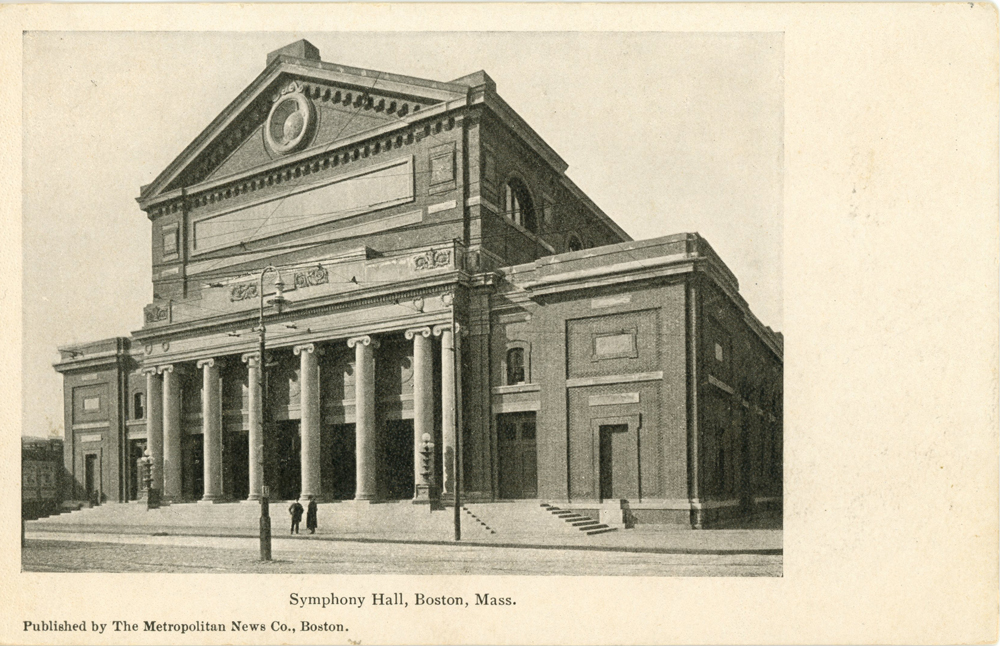
02. Symphony Hall, Boston, Mass. c. 1900. Card produced by The Metropolitan News Co., Boston. This is the identical photo seen in the previous card except the trolley power lines have not been removed. Note the name of the Hall has now been changed from Music Hall to Symphony Hall.

03_Symphony_Hall_Yeo_postcard

03. Symphony Hall. c. 1902. This collage of buildings are from Boston’s Back Bay area, including the Horticultural Hall, which is across the street from Symphony Hall on Massachusetts Avenue. The Art Museum on the card is the Museum of Fine Arts, Boston, which moved from its original location in Copley Square (shown on the card) to its present location on Huntington Avenue in 1907.

03a_Symphony_Hall_Yeo_postcard

03a. Symphony Hall, Boston, Mass. c. 1904. Card produced by Detroit Photographic Co. The card is used and is postmarked October 7, 1908, addressed to Miss Mary Merkins, Winsted, Connecticut. The copyright date of the image is given as 1904. Note the woman in the bottom right corner who is holding on to her hat in the gusting wind.

04_Symphony_Hall_Yeo_postcard

04. Symphony Hall, Boston, Mass. c. 1905. Produced by F. von Bardelben, New York & Germany. Made in Germany. Note the presence of a single horse-drawn carriage.

05_Symphony_Hall_Yeo_postcard

05. Symphony Hall, c. 1905. Card produced by Chisholm Bros., Portland, Maine. The card is used and is postmarked September 4, 1905, addressed to Miss Myrtle Kiefer, Homer, Michigan. The view is similar to the card above but several pedestrians are seen standing against the building.

06_Symphony_Hall_Yeo_postcard

06. Symphony Hall, Boston, Mass. c. 1905. Card produced by The New England News Company, Boston, Mass. – Leipzig — Berlin. The card is used and is postmarked June 29, 1905, addressed to Mrs. K. B. Keene of Washington, D.C. In this view, one can see one of the rising-sun  shaped windows in the clerestory; these were boarded up during World War II (a blackout precaution) and were only reopened in the early 2000s at which time natural light once again could shine into the Hall.

07_Symphony_Hall_Yeo_postcard

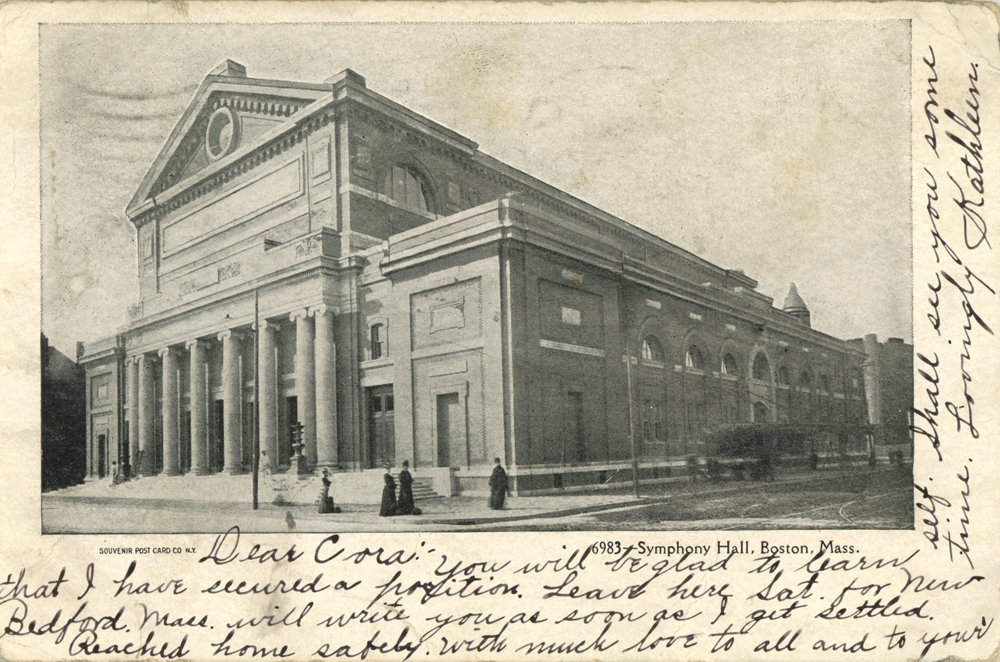
07. Symphony Hall, Boston, Mass. c. 1905. Card produced by Souvenir Post Card Co., New York. The card is used and is postmarked November 11, 1906, addressed to Mrs. A. L. Turner of Atlantic, Massachusetts. The photo is identical to the one in the card above although it is cropped differently and you can see many people along the Massachusetts Avenue side of Symphony Hall who had been removed in the previous card. I own a second copy of this card that was also used, postmarked March 7, 1907, addressed to Mr. George A. Ohlmsted, Barre, Vermont (c/o Ladd’s Grocery).

07a_Symphony_Hall_Yeo_postcard

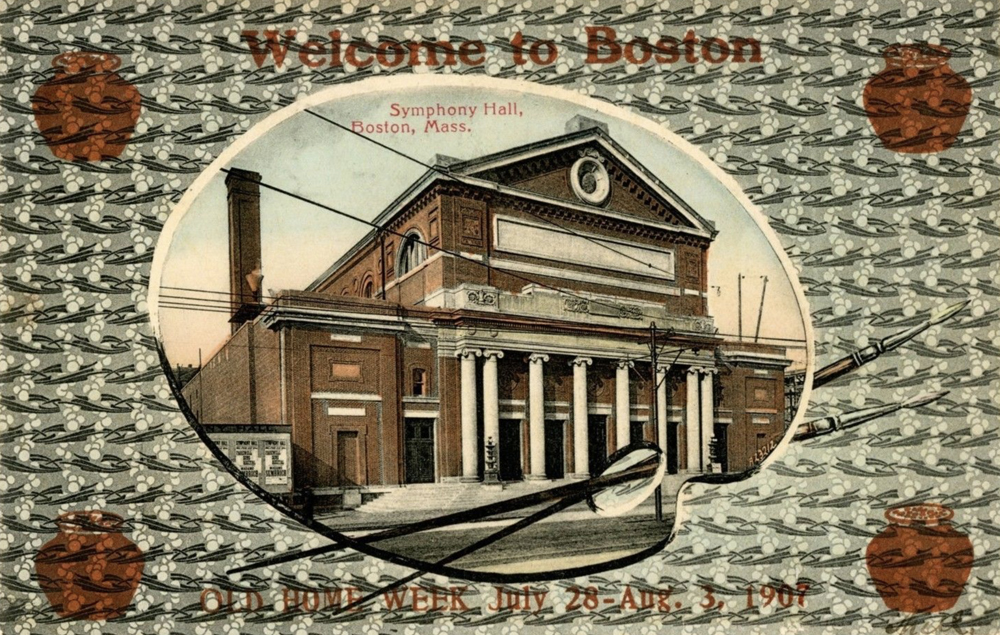
07a. Symphony Hall, Boston, Mass. c. 1907. Card produced by Reichner Bros., Boston, München, Prag., Leipzig. Made in Austria. This curious card appears in version with no text on the image side and also as shown here, with the imprint of an event – Welcome to Boston, Old Home Week, July 28-Aug. 3, 1907 – that was probably held in Symphony Hall that had nothing to do with the Boston Symphony. Organizations sometimes issued commemorative cards with their own imprint to celebrate their events. Note the Boston bean pots in the four corners. The photo of Symphony Hall is centered in an artist’s palate. 

08_Symphony_Hall_Yeo_postcard

08. Symphony Hall, Boston, Mass. c. 1908. Card produced by Robbins Bros., Boston, Mass. Made in Germany. The card is used and is postmarked April 6, 1908, addressed to Mrs. Robert Skillings, Danville, Quebec. This card is the earliest I have seen that shows an automobile – on Huntington Avenue around the corner from a horse drawn carriage on Massachusetts Avenue.

09_Symphony_Hall_Yeo_postcard

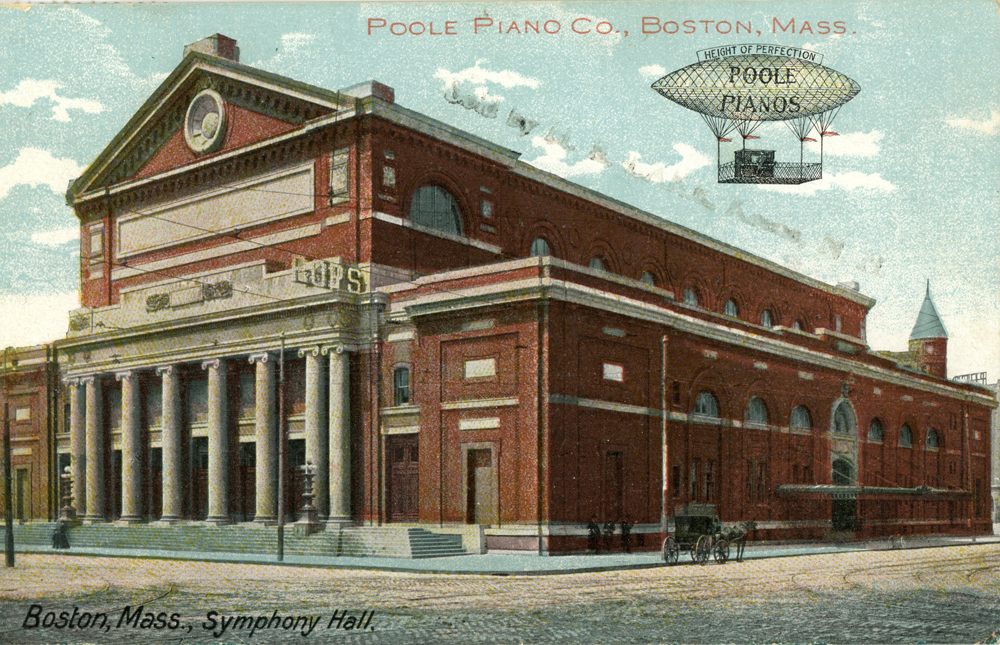
09. Boston, Mass., Symphony Hall. c. 1911. Card produced by  The Hugh C. Leighton Co., Portland, ME, USA. Made in Germany. The card is used and is postmarked November 10, 1911, addressed to Mr. Georgie Worren, Wilton, New Hampshire. Two things are notable: The card was sold by Poole Piano Company (established in Boston in 1893) which inserted its company name and the hot air balloon with a piano hovering above the hall. This was a common advertising tool in the late nineteenth and early twentieth centuries. Also, note the sign that says “POPS” above the right pair of columns. This sign indicates that the photo was taken during the Boston Pops season. Pops concerts – originally “Promenade concerts” – began in 1885 and continue to this day. Today, this lighted sign is installed each year over the Massachusetts Avenue side of Symphony Hall (see card 24, below).

10_Symphony_Hall_Yeo_postcard

10. Symphony Hall and Horticultural Society Building, Huntington Ave., Boston, Mass. c. 1912. The card is used and is postmarked  December 10, 1912, addressed to Mrs. C. E. Palmer, Bath, Maine. This card looks down Huntington Avenue and shows the proximity of Symphony Hall and the Horticultural Hall (built in 1901); note, too, the three modes of transportation: horse-drawn carriage, automobile, and trolley.

11_Symphony_Hall_Yeo_postcard

11. Boston, Mass., Symphony Hall. c. 1913. Card produced by Raphael Tuck & Sons, Art Publishers to Their Majesties the King & Queen. Printed in Holland.  The card’s caption on the back reads, “SYMPHONY HALL, successor of the old Music Hall, is the home of the Symphony Orchestra, and here the oratorios of Handel and Hayden Society are even. The Hall has a seating capacity of 2,500, and the interior decorations, lighting, etc., are up-to-date as it was erected recently.”

12_Symphony_Hall_Yeo_postcard

12. Symphony Hall, Boston, Mass. c. 1914. Card produced by The Leighton & Valentine Co., N. Y. City. Printed in United States. The card is used, postmarked 1914, addressed to Mrs. C. H. Gateo, Petersham, Massachusetts. The lighted POPS sign is seen again in this card, as are two trollies and a horse-drawn carriage. Notice, too, the large three-sheet advertisements for Boston Pops concerts in the niches on the corners of the building as well as one standing against the Huntington Avenue columns.

13_Symphony_Hall_Yeo_postcard

13. Symphony Hall, Boston, Mass. c. 1914. Published by Tichnor Bros., Inc., Cambridge, Mass. Huntington Avenue is bustling with activity; many signs lean up against the Huntington Avenue columns to advertise upcoming concerts and events. Two styles of automobiles are seen as well as the wheel of a horse-drawn carriage on the far left. Crossing Massachusetts Avenue on the right side of the card is someone with a long case or parcel. Could it be a member of the Boston Symphony heading to a rehearsal?

14_Symphony_Hall_Yeo_postcard

14. Symphony Hall, Boston, Mass. c. 1915. Card produced by  E. H. & F. A. Rugg, Medford, Mass. Visible in this card is one of the shutters — standing open — that could be raised to cover   the rising-sun clerestory windows. 

14a_Symphony_Hall_Yeo_postcard

14a. Symphony Hall and Horticultural Hall, Massachusetts Avenue, Boston, Mass. c. 1927. Card produced by  Tichnor Bros., Inc., at Cambridge, Mass, USA. The postcard is used and is postmarked 1927, addressed to Mrs. Wilber Tasker, Etna, Maine. This view shows Symphony Hall and the Horticultural Hall, with the dome of the mother church of First Church, Christ Scientist (built in 1906) rising in the background. The caption on the back of the postcard refers to Symphony Hall as “Boston’s Temple of Music.”

15_Symphony_Hall_Yeo_postcard

15. Symphony Hall, Boston, Mass. c. 1930s? Card produced by C. T. American Art. 

16_Symphony_Hall_Yeo_postcard

16. Symphony Hall, Boston, Mass. c. 1930s? Card produced by The New England News Company, Boston, Mass. 

17_Symphony_Hall_Yeo_postcard

17. Symphony Hall, Boston, Mass. c. 1930s? Card produced by The Process Photo Studios, Troy at 21st St., Chicago, Ill. The presence of a kiosk in the intersection of Huntington and Massachusetts Avenues with an traffic officer from the Boston Police Department adds a certain kind of frightening charm to this image. I would not have wanted to be in his position.

18_Symphony_Hall_Yeo_postcard

18. Huntington Avenue Showing Y.M.C.A. and Symphony Hall, Boston, Mass. Before 1941. Card produced by M. Abrams, Roxbury, Massachusetts. This view is down Huntington Avenue and shows Symphony Hall on the right (with the POPS lighted sign in place), and the Boston Y.M.C.A. building in the center. To the left of the Y.M.C.A. is New England Conservatory of Music where I taught from 1985-2012; many Boston Symphony musicians teach at NEC owing to its close proximity to Symphony Hall.

19_Symphony_Hall_Yeo_postcard

19. Symphony Hall, Y.M.C.A. and Junction, Mass. Ave. and Huntington Ave., Boston, Mass. Before 1941. Card produced by The New England News Company, Boston, Mass. Similar to the view above, this postcard features later style automobiles, the absence of the POPS advertising, and large American flags on top of the Y.M.C.A.

20_Symphony_Hall_Yeo_postcard

20. Symphony Hall, Boston, Mass. c. 1941. Card produced by United Art Co., Boston, Mass. I do not know if the large American flag on the roof of Symphony Hall was actually a feature of the hall for a time or if it is an artistic addition from around the time of World War II. I have been on the roof of Symphony Hall and do not recall seeing a stand for a flag of that size although it’s quite possible it was there at one time.

21_Symphony_Hall_Yeo_postcard

21. Huntington Avenue at Massachusetts Avenue Showing Symphony Hall, Horticultural Hall and Dome of Christian Science Church. Boston, Mass. c. 1949. Card produced by “COLOURPICTURE” Publications, Cambridge, Mass. USA. The card is used and is postmarked September 7, 1949, addressed to Mrs. Harry Monroe, Fitchburg, Massachusetts. In 1941, the Tremont Street Subway (now the Green Line E spur) was moved from surface level to underground to avoid traffic on Massachusetts Avenue. This made using the original Huntington Avenue entrance of Symphony Hall more difficult since the road was necessarily more narrow. The main entrance of the Hall was switched to the Massachusetts Avenue side. This was a practical decision but it has disrupted the original flow of concert goers into the Hall; they now enter the auditorium from the side rather than from the rear.

22_Symphony_Hall_Yeo_postcard

22. Symphony Hall, Massachusetts and Huntington Avenue, Boston, Mass. c. 1954. Card Produced by United Art Co., 89 Bedford St., Boston, Mass. The postcard is used and is postmarked July 21, 1954, addressed to Mr. & Mrs. Harry Davidson, Lakewood, Ohio. This interesting view shows a long building to the left of Symphony Hall (a sign for a bowling alley is visible). This building, which stretches for the whole block, is now owned by the Boston Symphony which has plans to redevelop the block with a new building. Currently it houses the Orchestra’s Cohen Wing which includes the Symphony Hall gift shop, BSO archives, management offices, the Casadesus Collection of Musical Instruments, and various other businesses that rent space from the Boston Symphony.

23_Symphony_Hall_Yeo_postcard

23. Symphony Hall. c. 1990. Card photo by Lincoln Russell, Stockbridge, MA. Symphony Hall at dusk, in a time-lapse photograph. 

24_Symphony_Hall_Yeo_postcard

24. Symphony Hall. c. 1995. Card photo by Helen Eddy, Cambridge, Massachusetts. This view is of the canopy over the Massachusetts avenue entrance to Symphony Hall, showing decorative bunting and the lighted POPS sign celebrating the spring season of the Boston Pops Orchestra.

25_Symphony_Hall_Yeo_postcard.jpg

25. Seiji Ozawa and the Boston Symphony Orchestra, Symphony Hall. c. 2000. Card photo by Christian Steiner, New York, New York. This photo shows a view of the stage of Symphony Hall near the end of the tenure of Music Director Seiji Ozawa (music director 1973-2002). The trumpets and trombones are seated in the back row of the orchestra in front of librarians and personnel mangers and stage managers who are standing in the center: Thomas Rolfs, Peter Chapman and Charles Schlueter, trumpets; Ronald Barron, Norman Bolter, Douglas Yeo, trombones; Chester Schmitz, tuba. The story of the interior of Symphony Hall is one for another time!


Surprises

Surprises

Life is full of surprises, unexpected things that intersect our lives. Sometimes a surprise is shocking, such as a car accident, or the sudden death of a friend or loved one. Sometimes surprises are joyful, like getting accepted to a college you thought was out of reach. No matter how they come, surprises always get our attention. A recent surprise got me thinking of how interesting this theme of surprises (good ones!) has been in my life recently.

Among my many ongoing projects, I have been doing a study of the Stephanovsky 20 Etudes for Bass Trombone. As my friend, Peter Ellefson (Professor of Trombone at Indiana University) pointed out to me a few weeks ago, Keith Brown’s 1964 edition of the Stephanovsky 20 Etudes contains a great deal of common material with Brown’s edition of Fritz Werner’s 38 Studies for Trombone. What? Two composers whose books contain much music that is identical? Keith Brown died last year so he isn’t here to explain what happened. So I’ve been trying to figure out this little puzzle.

In my research, I learned that the 20 Etudes were first published under Stephanovsky’s name in the Soviet Union, first around 1950 and then again in 1961 (Werner’s book was first published in 1927). I hunted around for copies of Stephanovsky’s Russian editions to obtain via Inter Library Loan and finally located a copy of the 1961 edition (I did locate a copy of the c. 1950 edition but the library that owns it is in Europe and does not participate in ILL) in the library at University of Texas, Austin. In a few days, it was heading to me for examination.

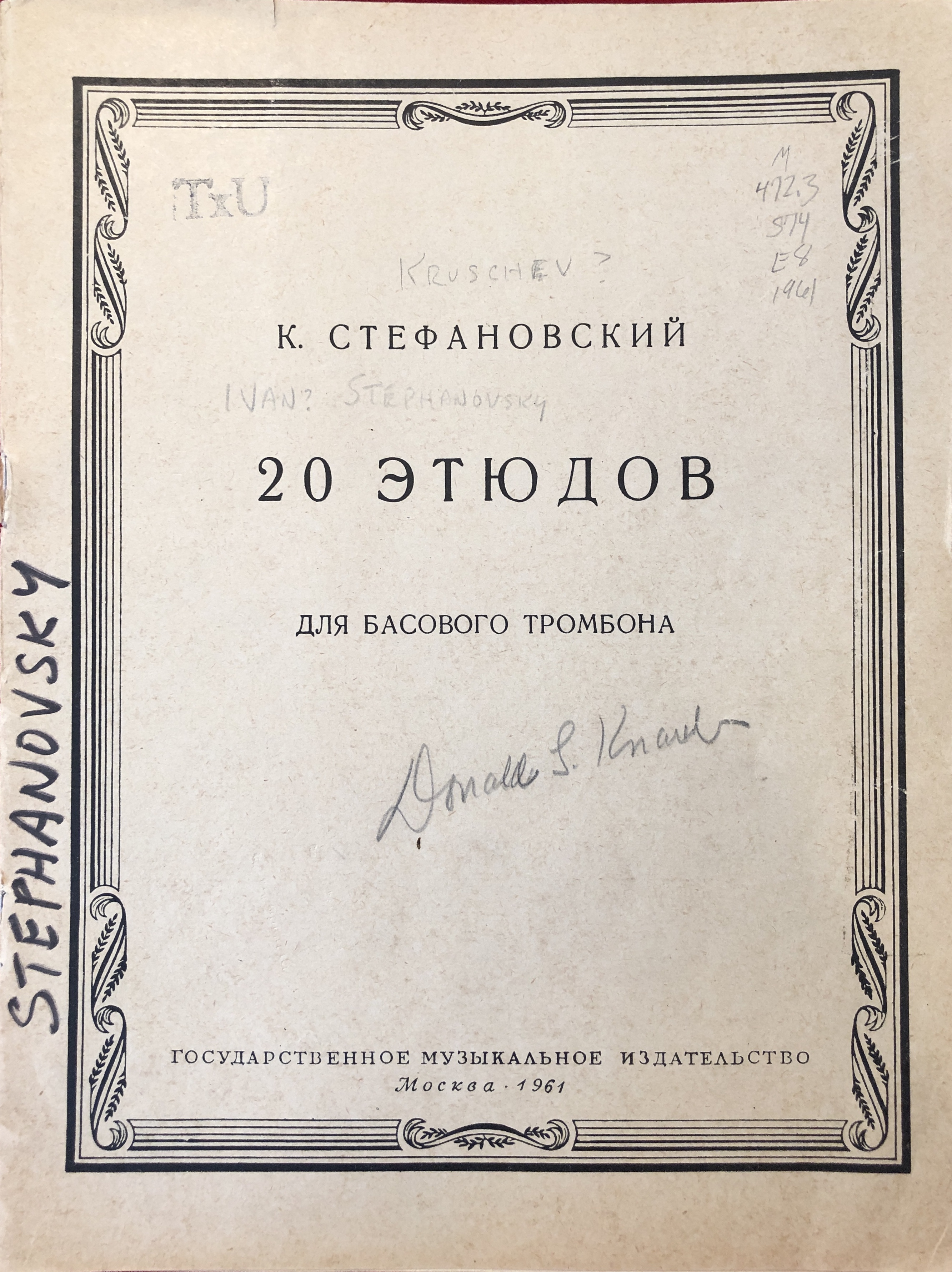
SURPRISE! When I opened it, the title page revealed that this copy had been previously owned by Donald S. Knaub, former professor of trombone at Eastman School of Music and University of Texas. Knaub is one of the most respected trombone teachers of the twentieth century; I was very privileged to meet him a few years ago when I gave a masterclass at University of Houston. A book from his personal library? Nice.

stephanovksy_cover_knaub_copy_1961

SURPRISE! Someone (it was probably Knaub since the handwriting looks like his) made some assumptions about the name of the composer of this music. No, it was not Kruschev, nor Ivan. Stephanovsky’s first name was Karl. The University of Texas librarians got the name right when they entered the music into their catalog.

Whenever I hold music that was owned by someone else, I have great anticipation when I open it up since there are often hand-written markings that prove to be as interesting to me as the music itself. Knaub’s music didn’t disappoint.

stephanovsky_14_detail_knaub_copy

SURPRISE! When I turned to Etude 14 I saw Knaub’s handwriting that marked out several bracketed staves where he had written “ONE BREATH” next to them, after having changed the dynamic of mezzoforte to pianissimo. I had to smile. I have made the same indications in many copies of this book when I have assigned that same etude to students over my many decades of teaching. Pushing ourselves to play long phrases is an essential part of learning good breath control. It was nice to see that Knaub asked the same thing of himself – and he probably asked it of his students as well.

stephanovsky_20_detail_knaub_copy

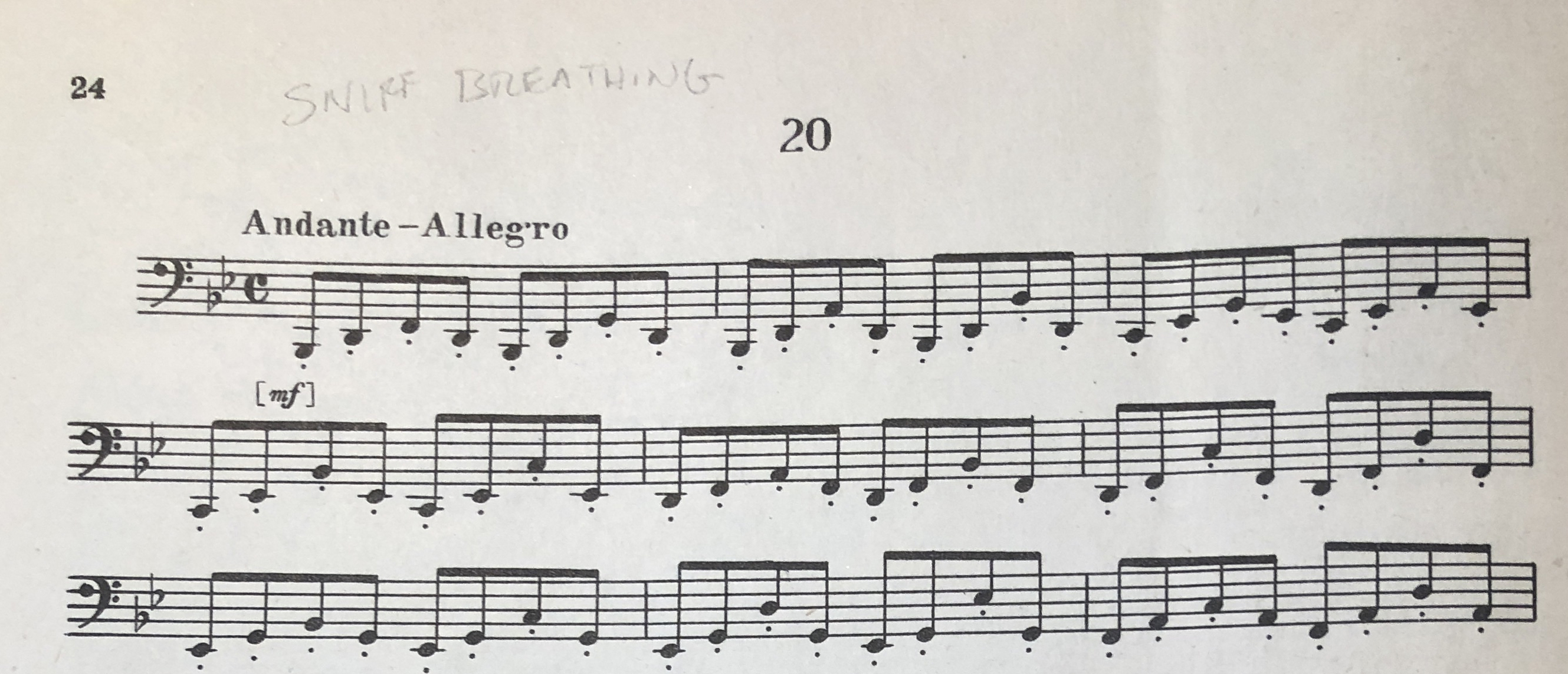
SURPRISE! When I turned to the final page of the book, Knaub had written “SNIFF BREATHING” at the top of Etude 20. Another big smile from me. I have been extolling the virtues of sniff breathing – that is, taking quick breaths through the nose rather than breathing through the mouth while playing – as a way to deal with playing music like this where there just isn’t a good place to take a breath. I was taught this technique by my former Boston Symphony tuba colleague, Chester Schmitz, and it has served me (and my students) well ever since then. To see that Knaub suggested using sniff breathing on this etude was a great verification to me, since this is the very kind of etude I assign to my students to practice this useful breathing technique.

In 2010, I was in Rouen, France, doing some teaching and performing en route to a conference in Paris that was devoted to the musical instrument called the serpent. Whenever I go to Europe, I always seek out cathedrals and large churches. I have a great interest in Gothic-era church architecture. Rouen, of course, has one of the most famous cathedrals in the world, made all the more famous by the more than thirty paintings of its west front by Claude Monet (below).

rouen_cathedral_monet

My oldest daughter, Linda (who was accompanying me on the trip), and I spent some time inside and outside this magnificent church, but my host and friend, Volny Hostiou, told us of another interesting church in Rouen that is much less known. And it had a surprise.

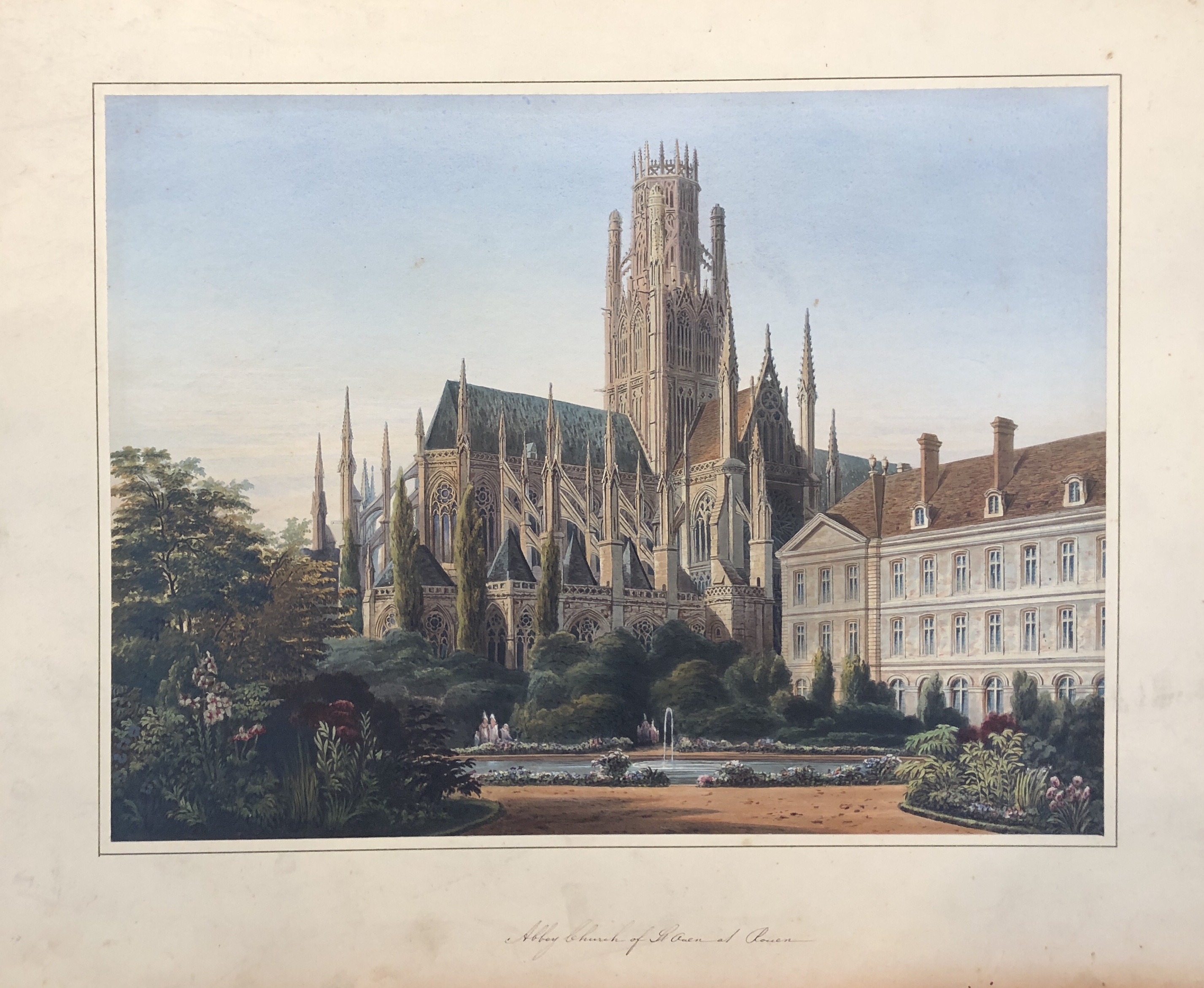
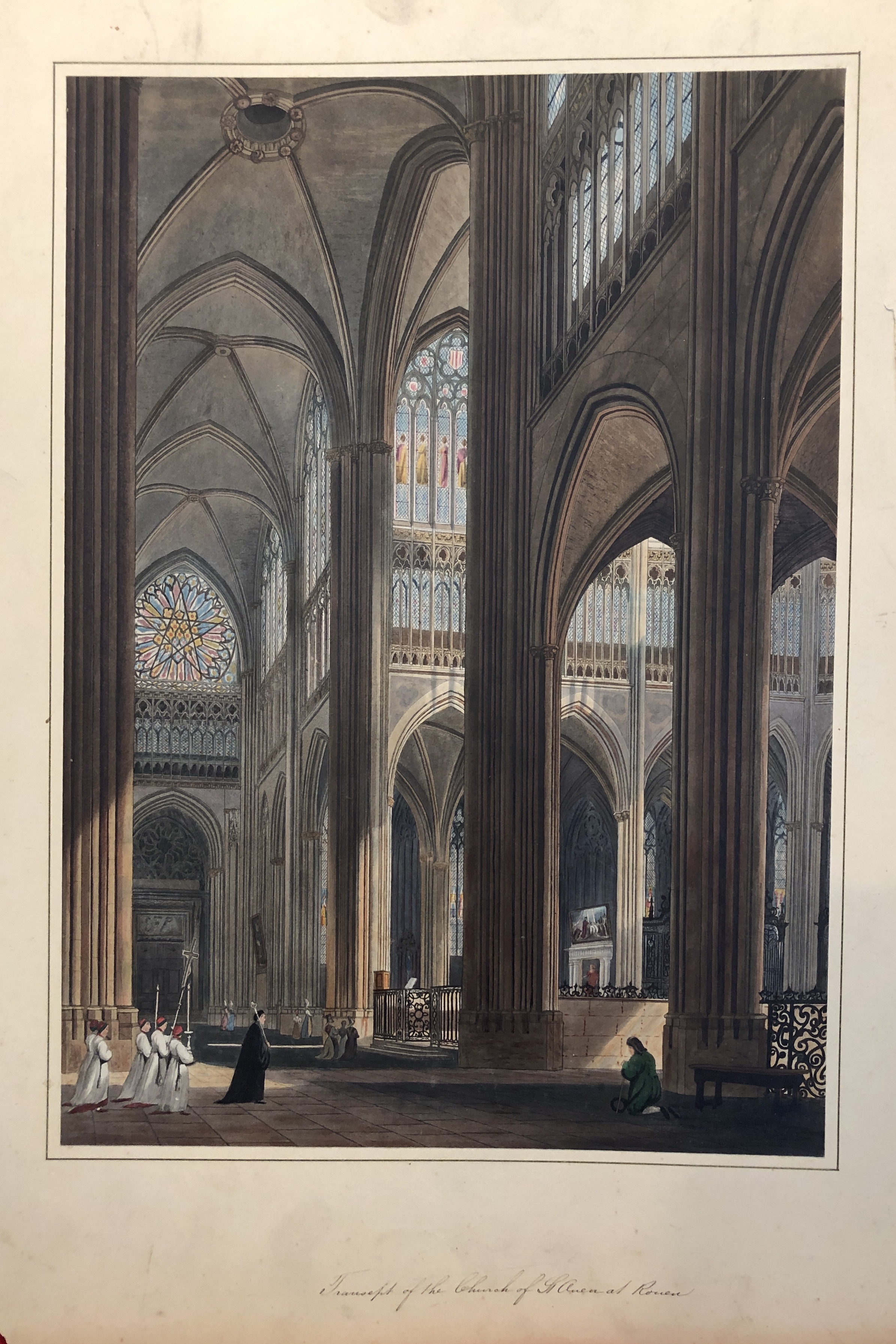
SURPRISE! Actually, when Volny told me about the Abbey Church of St. Ouen, he was surprised it was not the first time I had heard of it. I’ve been aware of its architecture ever since a set of twelve aquatints by the English artist, Charles Wild, came into my possession many years ago. Wild’s “Twelve Selected Examples of the Ecclesiastical Architecture of the Middle Ages, Chiefly in France.” In 2001, I wrote an article about one of these prints, “The Choir of the Cathedral of Amiens,” where I discussed the serpent players depicted in the print (you can view and download my article about this in the Historic Brass Society Journal by clicking this link). Among the prints in Wild’s set are two of the Abbey Church of St. Ouen in Rouen. One is of the outside of the church:

wild_abbey_church_rouen_01

And the other is of the church’s transept:

wild_abbey_church_rouen_02

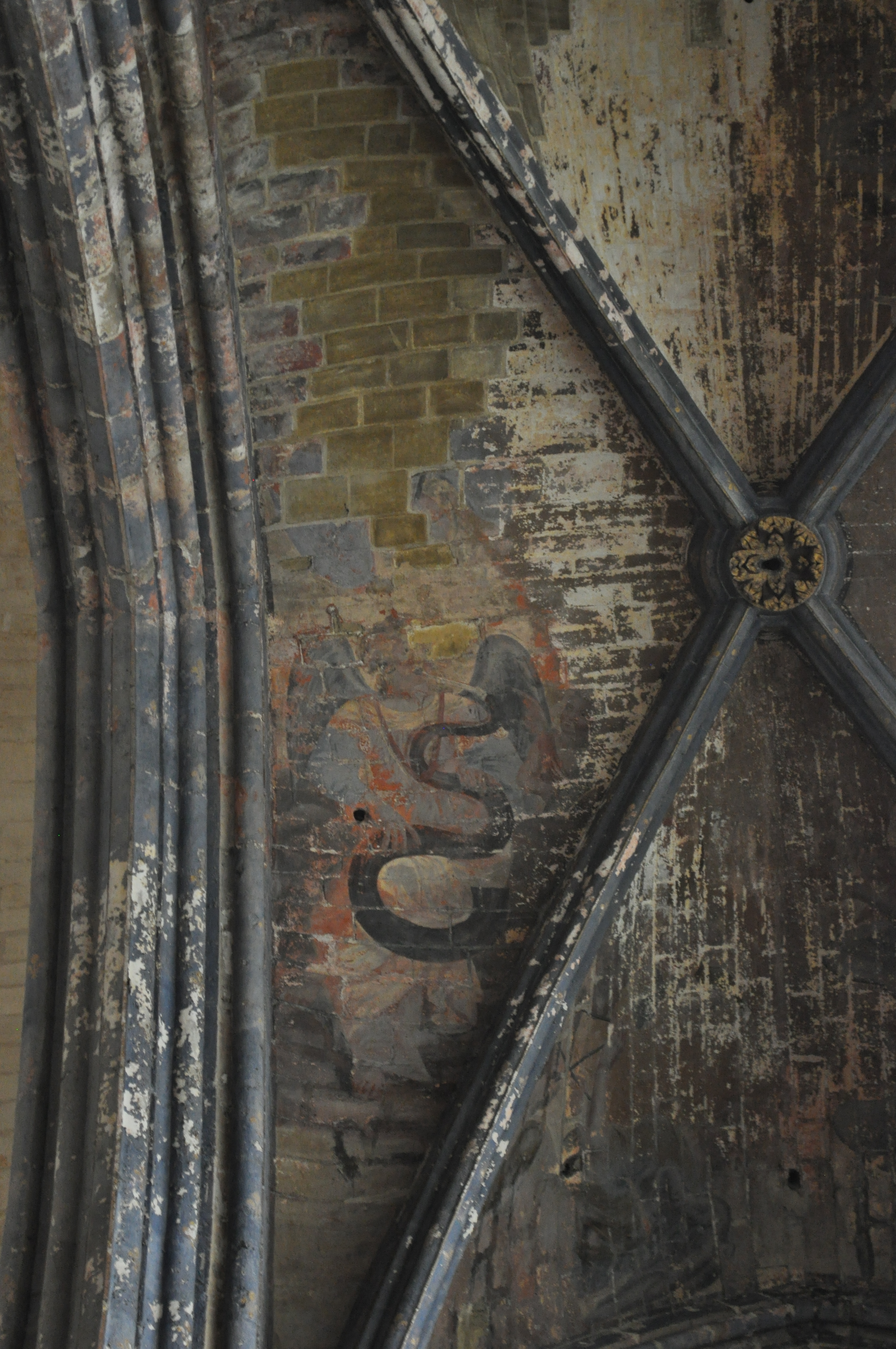
These are beautiful images, ones that have taught me a great deal about Gothic architecture and cathedral/church life. But now Volny had a surprise for me. “When you go inside,” he said, “look up. You will find a serpent player.” Linda and I made a trip to the Abbey Church to find out what Volny was talking about.

st_ouen_serpent_angel_01

SURPRISE! We looked all through the church for the serpent player and finally we found him. High up on the ceiling in a side chapel, there it was, a remarkable painting of an angel playing the serpent. Nothing there about harps in heaven!

st_ouen_serpent

The serpent, which had been invented sometime in the late fifteenth or early sixteenth century and then evolved to be an instrument to accompany the singing of chant in the Church in France, would have been well known to every person who had worshipped in St. Ouen in the sixteenth through nineteenth centuries. The painting is heavily damaged but it is still remarkable nonetheless. Who painted it? When? Questions. . .

st_ouen_serpent_angel_04

SURPRISE! But there was more. As we looked more carefully at the painting, we realized that the serpent player was not alone. Look at the image, above. Just to the right of the serpent-playing angel’s left wing you see another face. It’s very faint and hard to find. (Maybe this will help: look at the chin of the serpent-playing angel, then move your eyes to the right until the stonework of the ceiling appears. The second angel’s face is there, just to the side of the larger angel’s wing.) You can clearly make out the face of another angel who is looking at the serpent-playing angel. An unexpected surprise on top of a surprise. Did this other angel originally have an instrument in hand? What did the rest of the ceiling look like when the paint was all intact? Questions. . .

Some of my biggest surprises come in books. Because of the nature of the research I do, I purchase a lot of used books, and mostly books that are out of print. I get all of my used books through abebooks.com, a website that serves as a massive catalog of the holdings of thousands of bookstores around the world. I can usually find any book I want there, and usually for only a few dollars. And sometimes when I open up a used book, I find a surprise.

halas_by_halas_cover

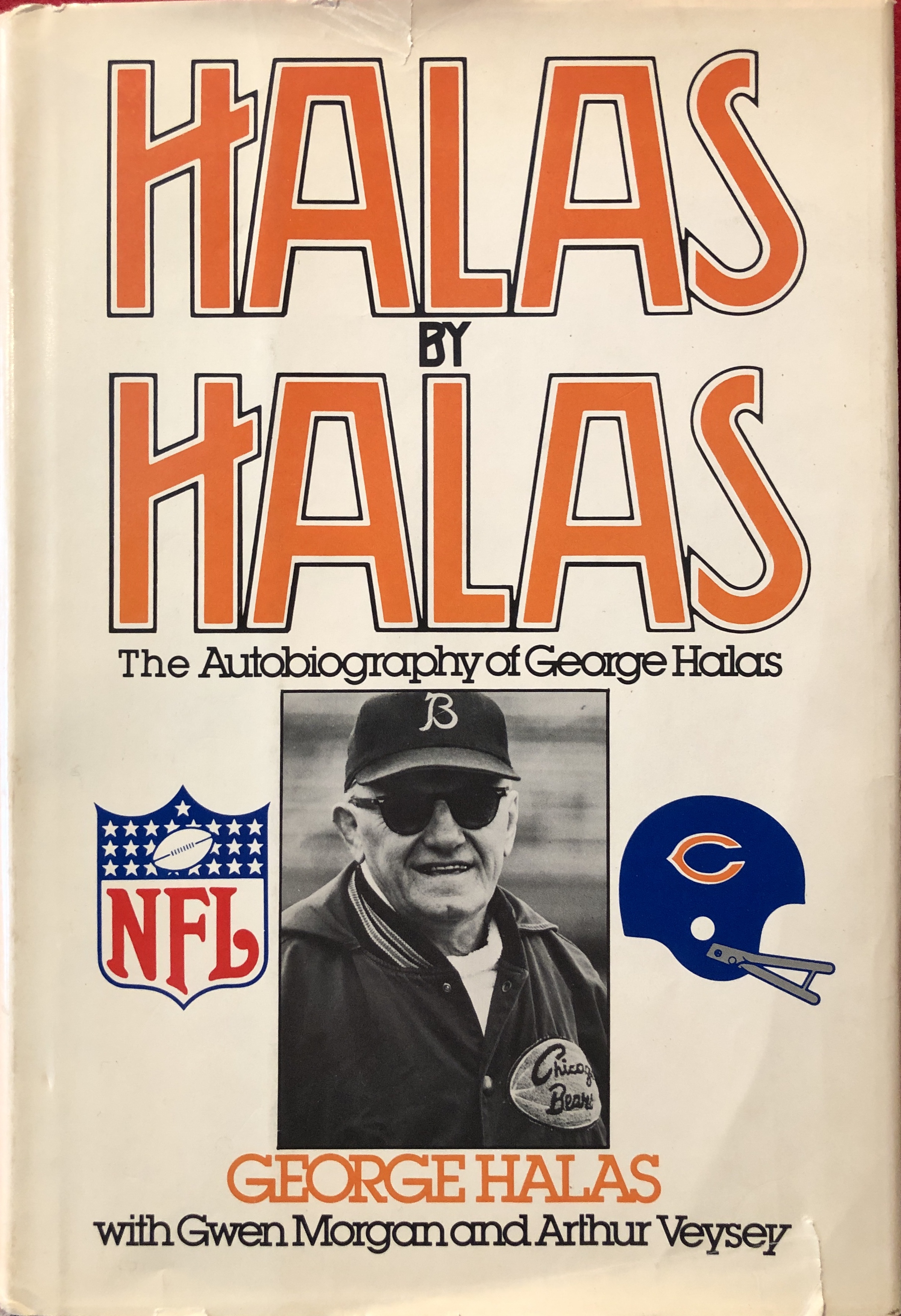
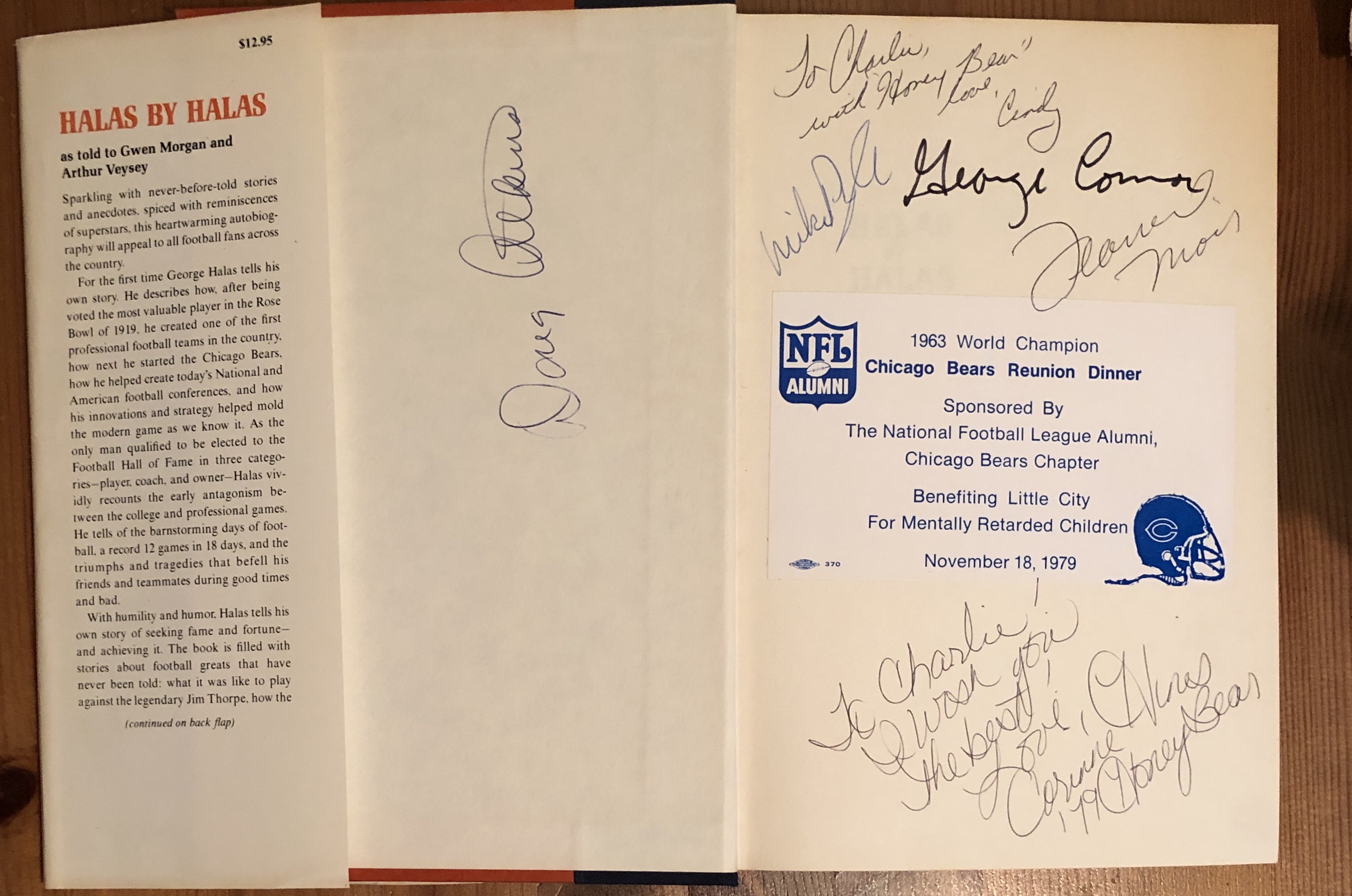
SURPRISE! My wife and I enjoy football and one of the first things we did when we moved to the Chicago area last fall was to become season ticket holders for the Chicago Bears. We’re all in with the Bears and since we want get to know the team better, I’ve been acquiring several books and DVDs about its history. Last week, I ordered a used copy of Halas by Halas (New York: McGraw-Hill Co., 1979), the autobiography of George S. Halas who was not only the first coach, then player, then owner of the Chicago Bears, but was the driving force behind the creation of the National Football League in 1919.

halas_by_halas_autographs

You can imagine my surprise when I opened this book – which I purchased for under $20 – and I found several autographs inside the front cover. There is Doug Atkins, defensive end for the Chicago Bears from 1955-1966 and a member of the Pro Football Hall of Fame. And Mike Pyle, center for the Bears from 1961-1969. And George Connor, another member of the Pro Football Hall of Fame who played linebacker/tackle for the Bears from 1948-1955. There is also the signature of Jeanne Morris, a pioneering female television sports broadcaster, and two members of the short-lived Chicago Bears cheerleading squad, the Honey Bears. Also of interest is the book plate that celebrates the event where books were distributed and the autographs were probably inscribed. I wonder who else was there at that Chicago Bears Reunion Dinner? Who was “Charlie,” to whom some of the autographs are signed? Questions. . .

rodeheaver_20_years_billy_sunday_cover

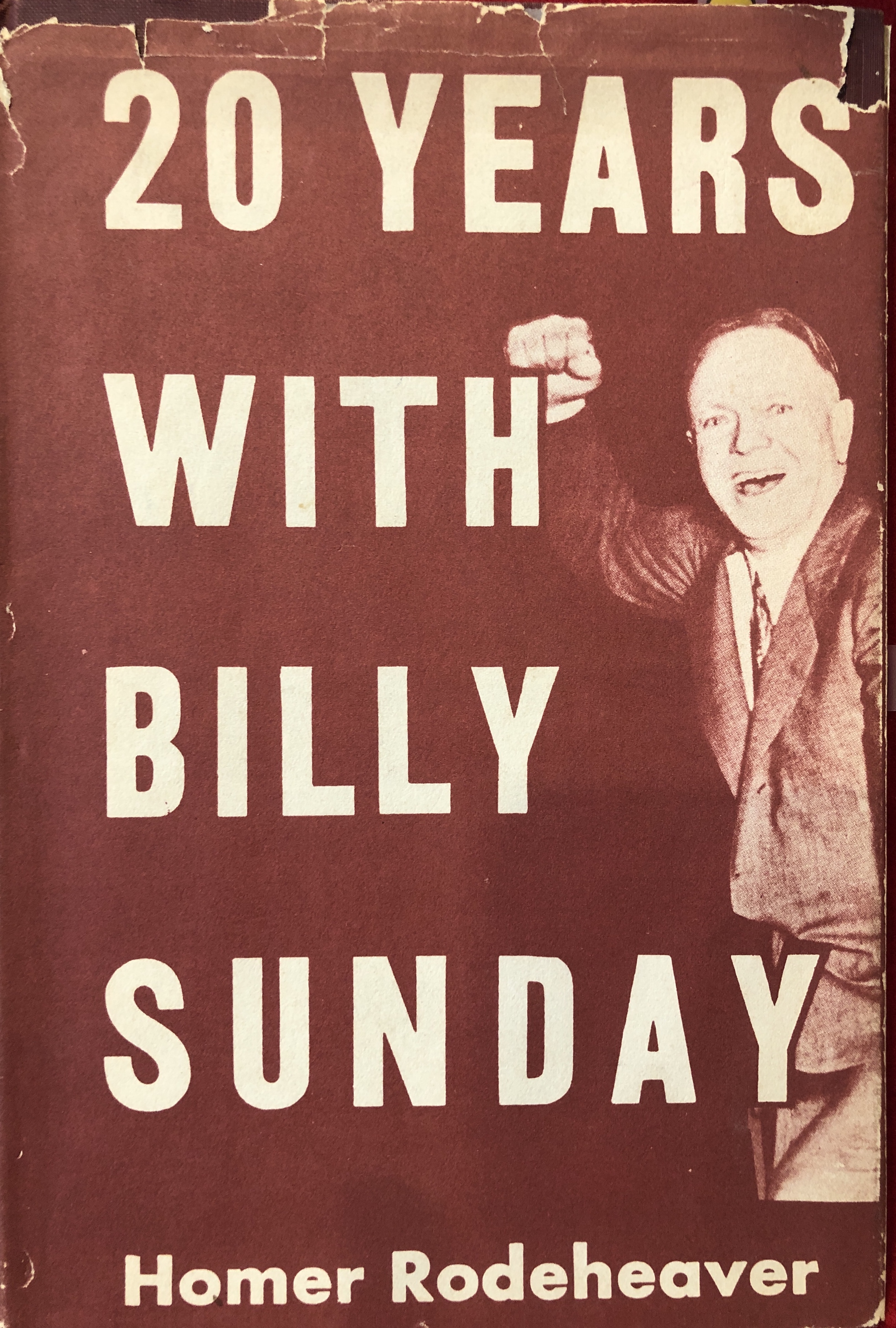
Among the several books I am writing at the moment is a biography of Homer Rodeheaver, the trombone-playing song leader for evangelist William Ashley “Billy” Sunday in the first third of the twentieth century. Rodeheaver is a fascinating character who was a driving force in the promotion of gospel music in the twentieth century through his publishing company, record company, and evangelistic work. With my friend and co-author, Kevin Mungons, we are moving along in the process of bringing this book to publication with University of Illinois Press.

In the course of our research, both Kevin and I have acquired many (hundreds, for sure, maybe thousands?) of books that inform our understanding of Rodeheaver, his life, times, and work. Among them is Rodeheaver’s own book, 20 Years With Billy Sunday (Winona Lake, Indiana: Rodeheaver Hall-Mack Co., 1936), the story of his years as songleader for evangelist Billy Sunday. While long out of print, copies of the book are not especially rare. But. . .

rodeheaver_20_years_billy_sunday_autograph

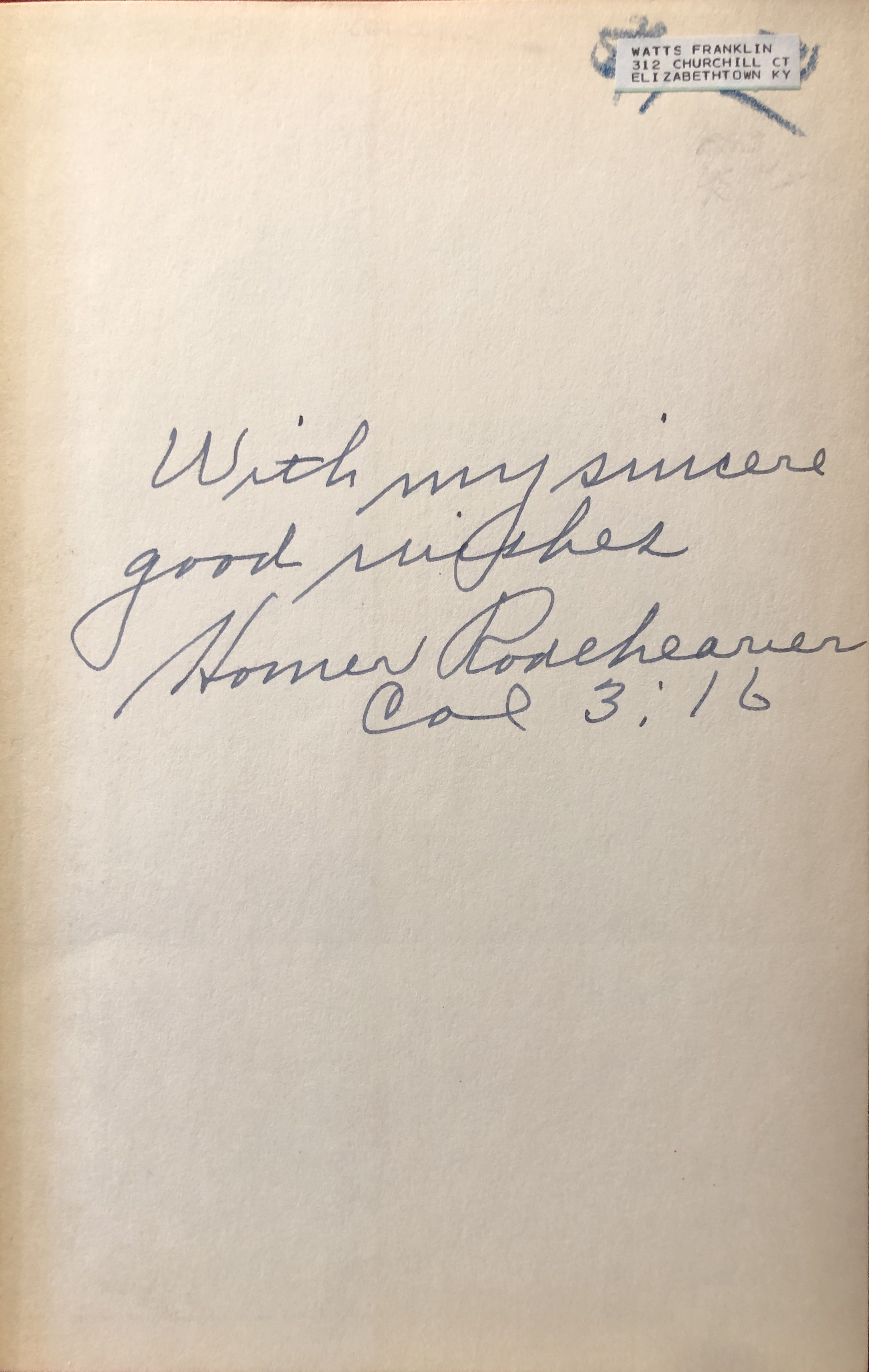
SURPRISE! When I opened my used copy of Rodeheaver’s book, I found his inscription inside the front cover, with a reference from the Bible, Colossians 3:16, “Let the word of Christ dwell in you richly, teaching and admonishing one another in all wisdom, singing psalms and hymns and spiritual songs with thankfulness in your hearts to God.” I’m not an autograph collector, but to hold and own a copy of Rodeheaver’s book in my hands that he had held in his own hands was a very nice surprise. As to Watts Franklin (or Franklin Watts?) of Elizabethtown, Kentucky, a previous owner of this book – his (her?) return address label appears on the page with Rodeheaver’s signature – I have not been able to learn anything. Did Watts meet Rodeheaver and ask him to sign the book? Was it a gift to him/her? Questions. . .

Unlike Homer Rodeheaver whose life has never been chronicled in a biography, Billy Sunday is the subject of many books. Some were written during his lifetime (he died in 1935) and others are more contemporary. Books about Sunday – whether authorized by the evangelist or not – provide a fascinating window into his life and ministry as seen through the lens of the time in which he lived.

brown_sunday_cover

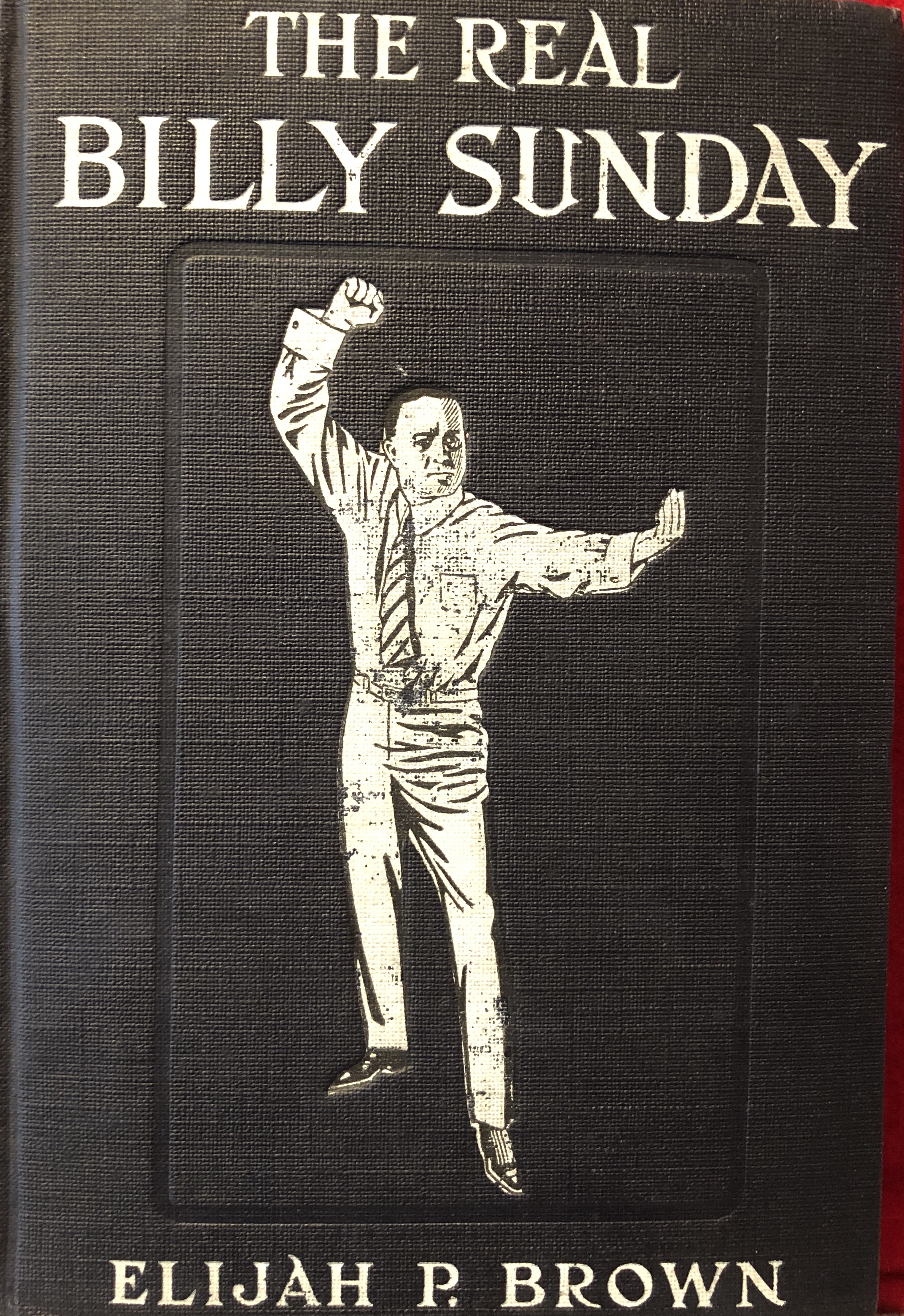
One of these books is by Elijah P. Brown, The Real Billy Sunday (New York: Fleming H. Revell Co., 1914). My used copy has a stamp in the back that says it was owned by Sarah A. Kemmerer of Allentown, Pennsylvania. Who she was I do not know. More questions. . .

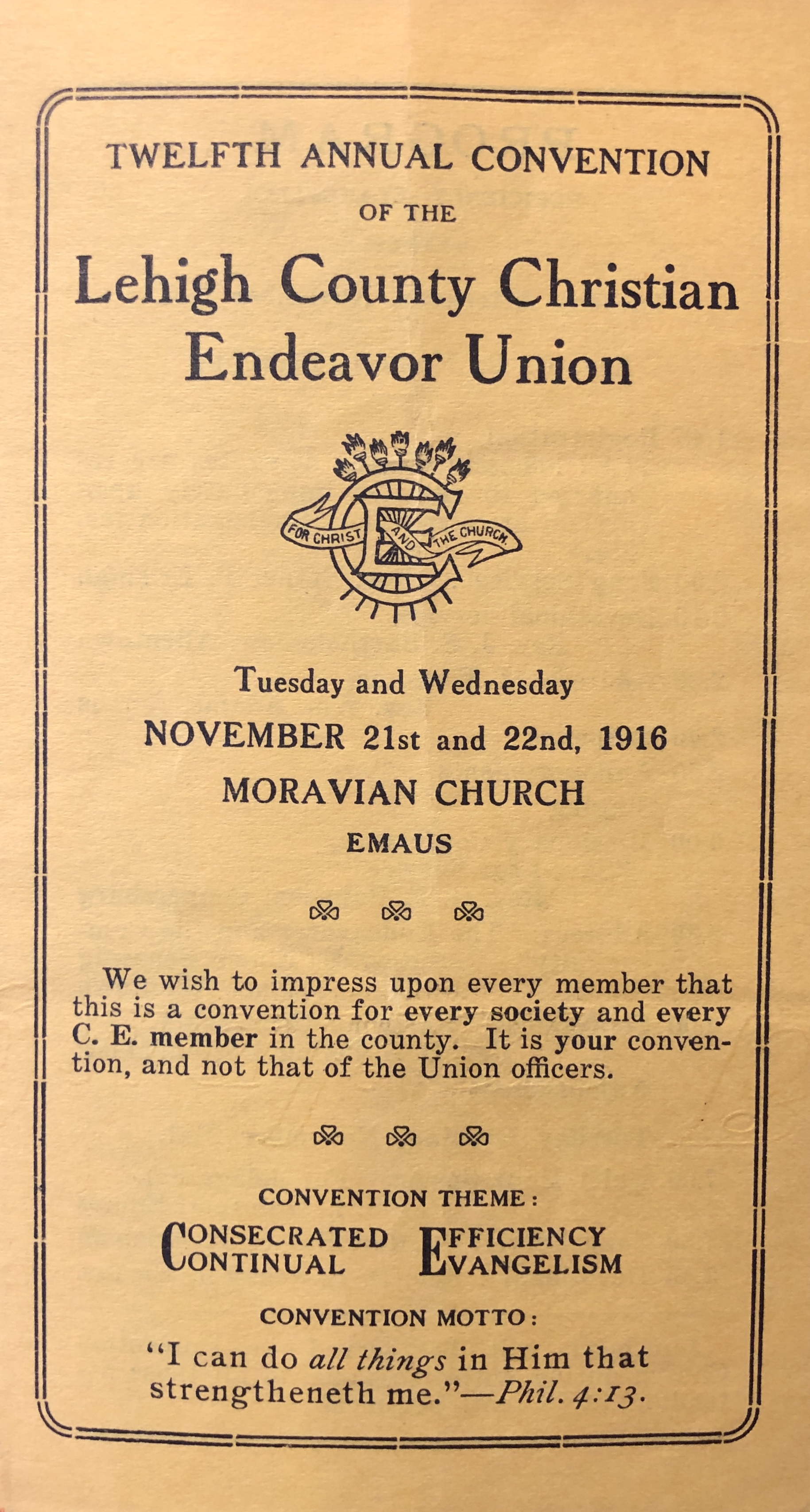
lehigh_christian_endeavor_pamphlet_1916

SURPRISE! When I opened my used copy of Brown’s book, a small, six page pamphlet fluttered to the floor. It was a program for the 1916 convention of the Lehigh (Pennsylvania) County Christian Endeavor Union, November 1916. Held at the Moravian church in Emaus, Pennsylvania (this spelling was used for the borough from 1830-1938; before and after that time it was/is spelled Emmaus), the convention featured sermons, singing, devotionals, and other activities for youth and adults. It provides a fascinating glimpse into the schedule of one of these meetings which were common occurrences at the time.

ellis_billy_sunday_cover

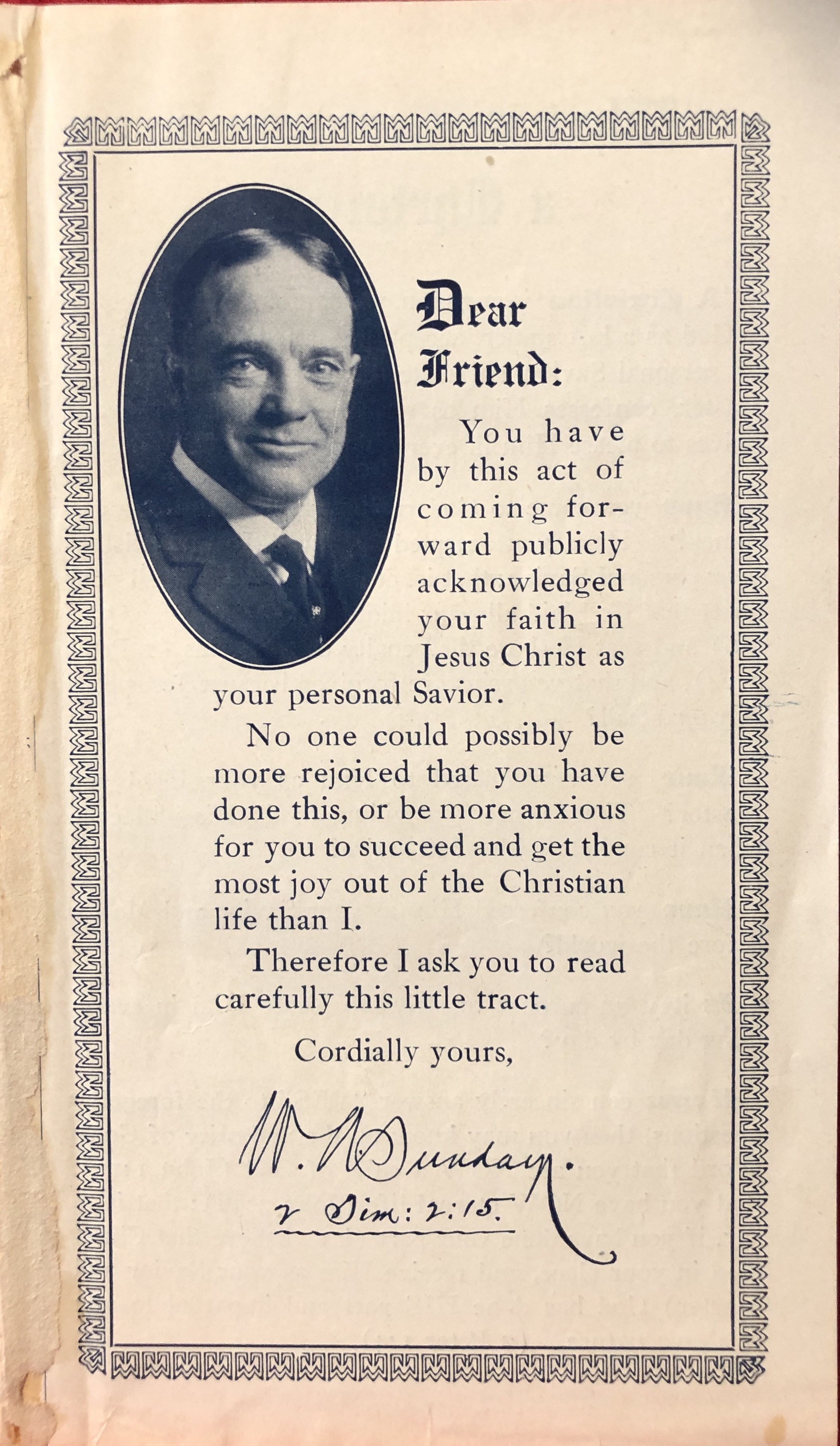
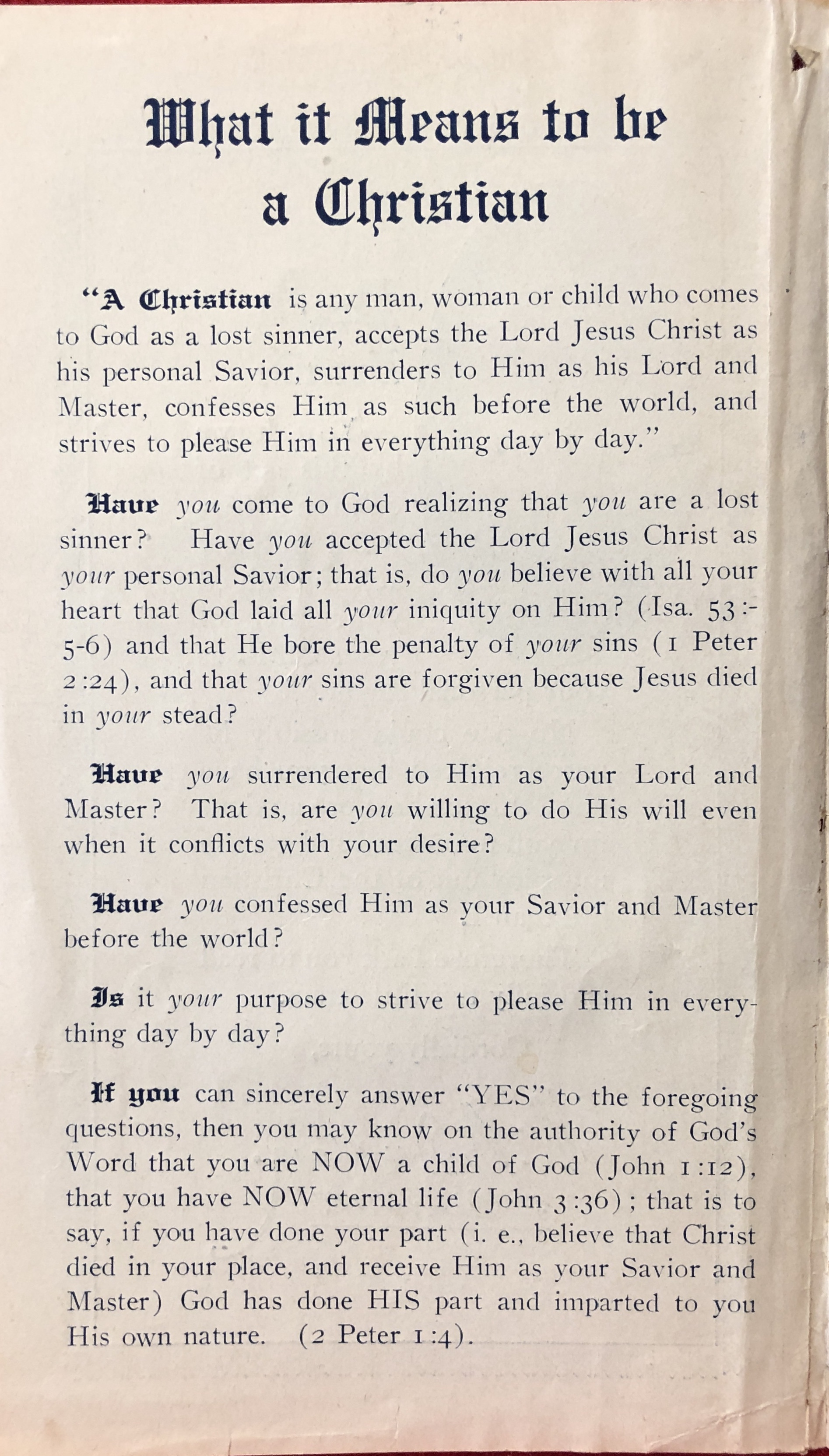
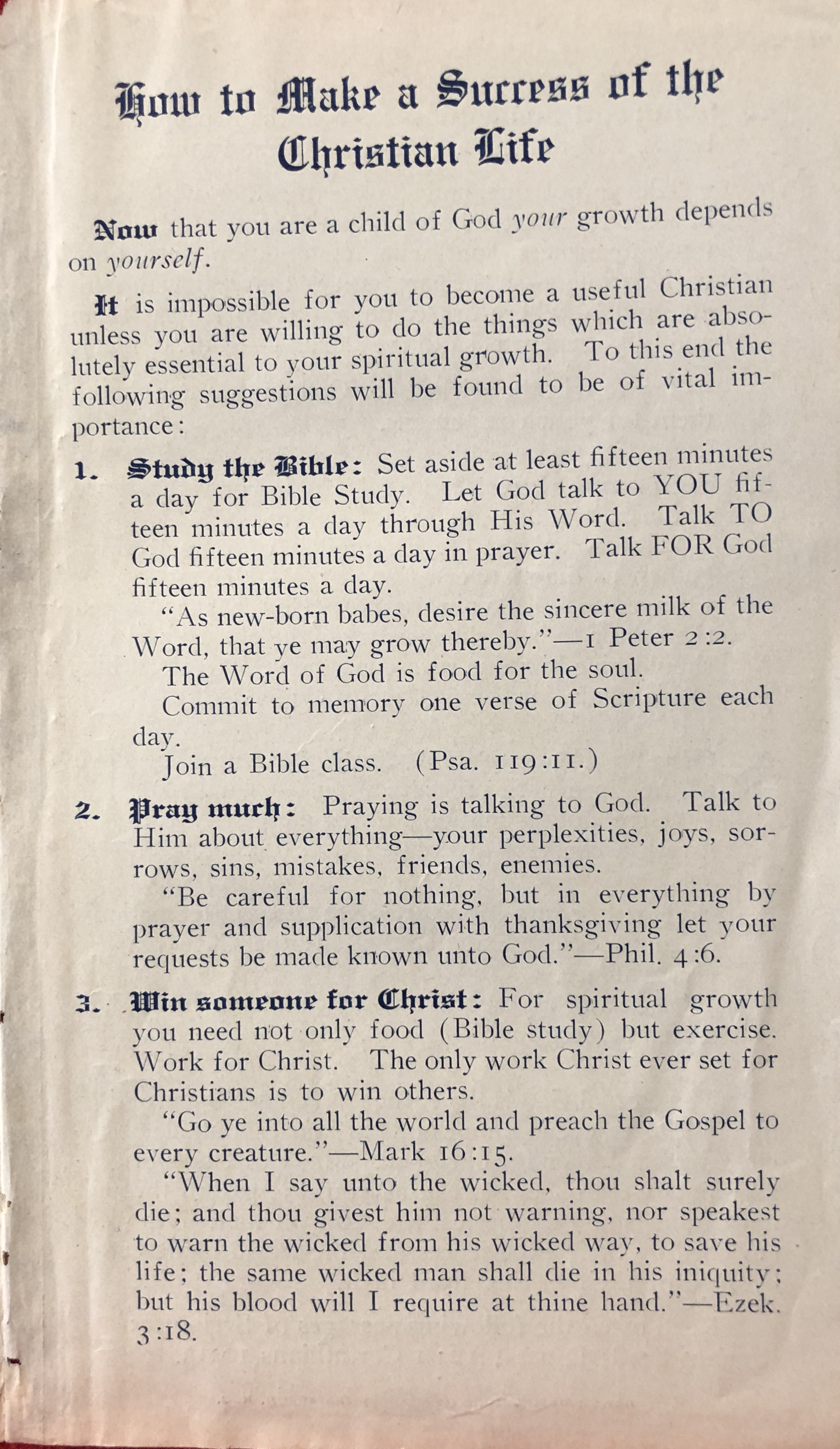
SURPRISE! Another among my many biographies of Billy Sunday is “Billy Sunday” The Man and His Message by William T. Ellis (Philadelphia: John C. Winston Co., 1914). This used copy contained a remarkable surprise: an original copy of the brochure that Billy Sunday put into the hands of tens of thousands of people who attended his tabernacle meetings and “walked the sawdust trail” up the aisle to shake hands with the evangelist as they made a public profession to trust Jesus Christ as Savior. The fact that this tract was kept in the book made me wonder if a previous owner bought the book at one of Sunday’s meetings and then put the pamphlet inside that very night for safekeeping. Names of two previous owners of the book are inscribed inside the front cover: a signature of Arthur S. Beale, and a label with the name L. Wilkins of Watertown, Massachusetts. Who were they? When and how did they come to own this book? Questions. . .

The pamphlet is a remarkable historical document and one that is as fresh today as when it was first used by Sunday in the early twentieth century. There are many things I find interesting about this pamphlet, including the fact that it bears the imprint of a union publishing house, Allied Printing of Paterson, New Jersey. Could this brochure have been printed for the 1917 Billy Sunday meetings in New York City? Questions. . .

Sunday asks some important questions and gives some important advice. Have a look.

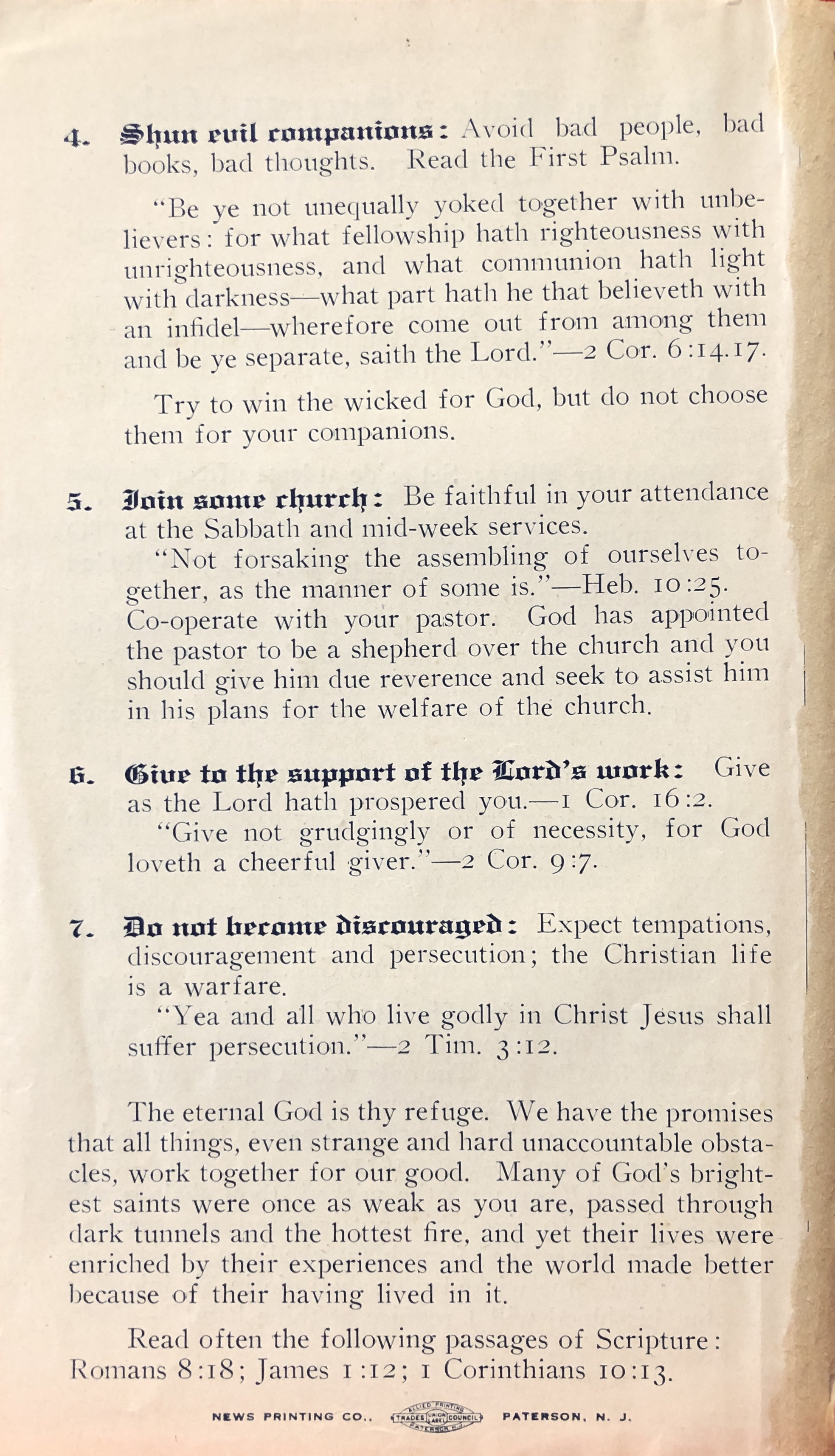
sunday_tract_01sunday_tract_02sunday_tract_03sunday_tract_04

Life is full of surprises. Sometimes they cause you to ask questions. Sometimes they can change your life.