by Douglas Yeo (January 2, 2025)
A few days ago, I received word that my friend, William “Bill” Moyer, died peacefully on December 18, 2024. He was 95 years old. If you’ve never heard of Bill Moyer, hold on, because at a particular moment in time, he was the most famous trombone player in the world, and he played the most famous trombone solo ever written in a performance that was seen and heard by over 23 million people around the world. This is a time to remember Bill Moyer.
Born in 1929, William C. Moyer attended Oberlin Conservatory in Ohio where he studied trombone with Arthur Williams and Thomas Cramer. In 1952—shortly before he graduated from Oberlin—he auditioned for and was hired as second trombonist of the Boston Symphony Orchestra by music director Charles Munch.
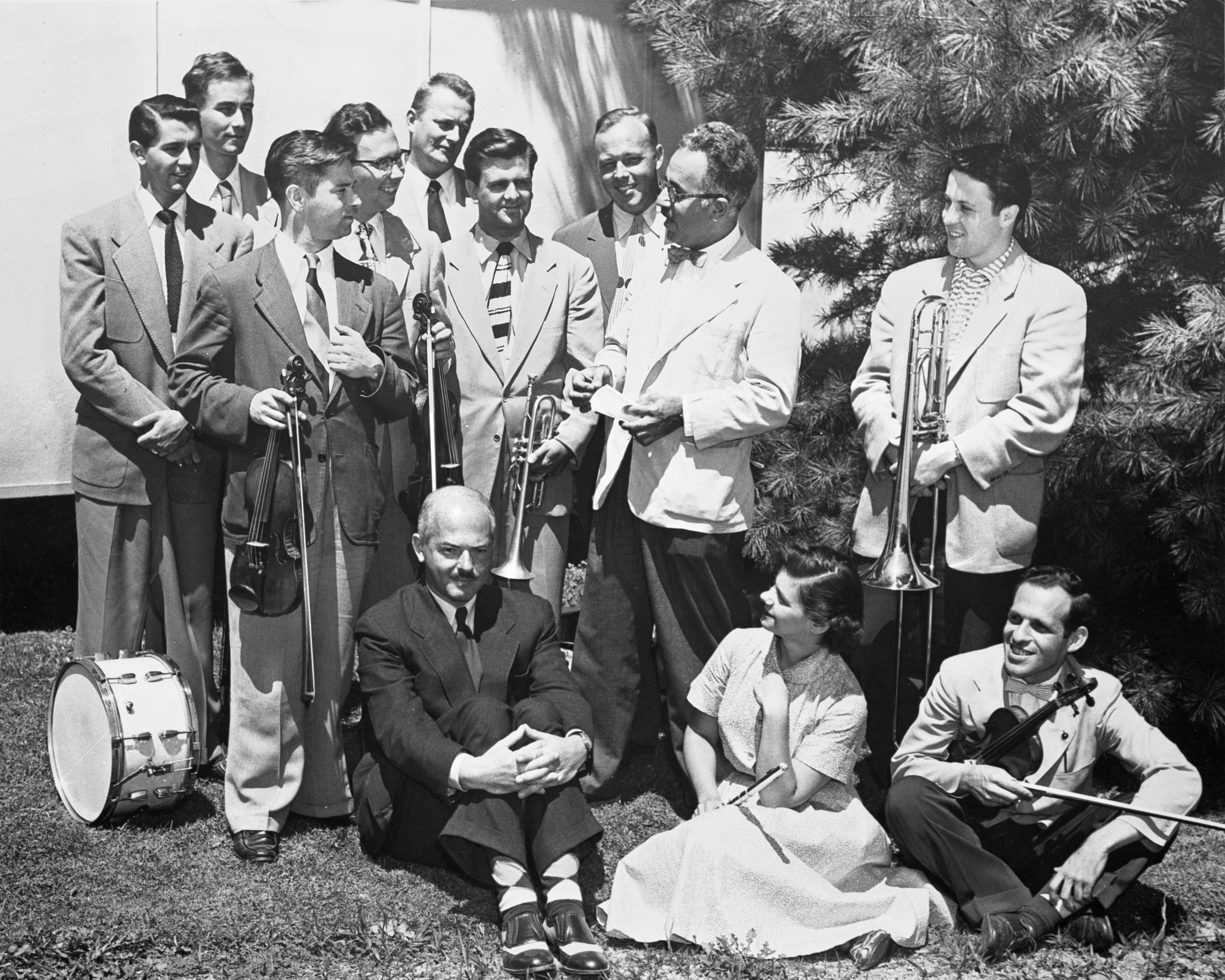
Members of the Boston Symphony Orchestra who joined the orchestra in fall 1952 through early 1953. Standing (left to right): Everett “Vic” Firth (timpani), Richard Plaster (contrabassoon), Fredy Ostrovsky (violin), William “Bill” Marshall (violin), Harold J. “Tommy” Thompson (cymbals), Gerard Goguen (trumpet), Kauko “Koko” Kahila (bass trombone), Rosario Mazzeo (clarinet and personnel manager; joined in 1933); William “Bill” Moyer (trombone). Seated: Martin Hoherman (cello), Doriot Anthony Dwyer (flute), Leonard “Lenny” Moss (violin). Tanglewood, summer 1953. (Boston Symphony Orchestra archives)

Members of the low brass section of the Boston Symphony Orchestra. Standing (left to right): Jacob Raichman (principal trombone), William Moyer (second trombone), Kauko Kahila (bass trombone). Seated: Kilton Vinal Smith (tuba). Not pictured is Joseph Orosz (assistant principal and utility trombone). Tanglewood, summer 1953. (Boston Symphony Orchestra archives)
Sitting between principal trombonist Jacob Raichman (until 1955) or William Gibson (after 1955) and bass trombonist Kauko “Koko” Kahila—and sometimes next to the BSO’s assistant principal and utility trombonist, Joseph Orosz—Bill was a solid citizen of the orchestra. With his trombone in his hand, he performed on over 180 recordings with the Boston Symphony Orchestra conducted by Charles Munch, Pierre Monteux, and Erich Leinsdorf, and he also recorded over 600 works with the Boston Pops Orchestra conducted by Arthur Fiedler. Bill Moyer played second trombone in the BSO for fourteen years before, in 1966, he became the orchestra’s personnel manager until his retirement in 1987. If I had to characterize Bill Moyer’s trombone playing based on my hearing many of the recordings on which he played, I would call it “solid,” “present,” and “reliable.” In all of this I am offering high praise. As a member of the Boston Symphony Orchestra’s low brass section, Bill was the consummate team player.
Bill Moyer was a very fine trombonist but he never made a solo album and was not widely known as a trombone teacher. That said, Bill Moyer’s impact on the trombone world was dramatic, and his impact on me was profound. Bill Moyer’s story is a reminder that one does not have to be a “famous” player to make a difference.
On November 22, 1963, John F. Kennedy, President of the United States, was assassinated. It was at about 2:45 pm on that fateful Friday afternoon when word that the president had died was broadcast over the PA system to classrooms in Hewlett Elementary School in Hewlett, New York, where I was a student. My third grade teacher burst into tears. President Kennedy had grown up and lived in Massachusetts, graduated from Harvard University, and been a United States Senator from Massachusetts before he was elected President. The Kennedy family was Roman Catholic, and on Sunday, January 19, 1964, a Solemn Pontifical Requiem Mass was given in John F. Kennedy’s memory in the Cathedral of the Holy Cross in Boston. The mass was attended by members of the Kennedy family including President Kennedy’s widow, Jacqueline Kennedy; his mother, Rose Kennedy; and the President’s brother, Edward “Ted” Kennedy. The Boston Symphony Orchestra was there, too, to play Wolfgang Amadeus Mozart’s Requiem as part of the service.

Facsimile of the invitation to the Mass for John F. Kennedy, Cathedral of the Holy Cross, Boston, January 19, 1964. This was included in the RCA Victor boxed set of the recording of the Mass, RCA Victor LSC-7030.
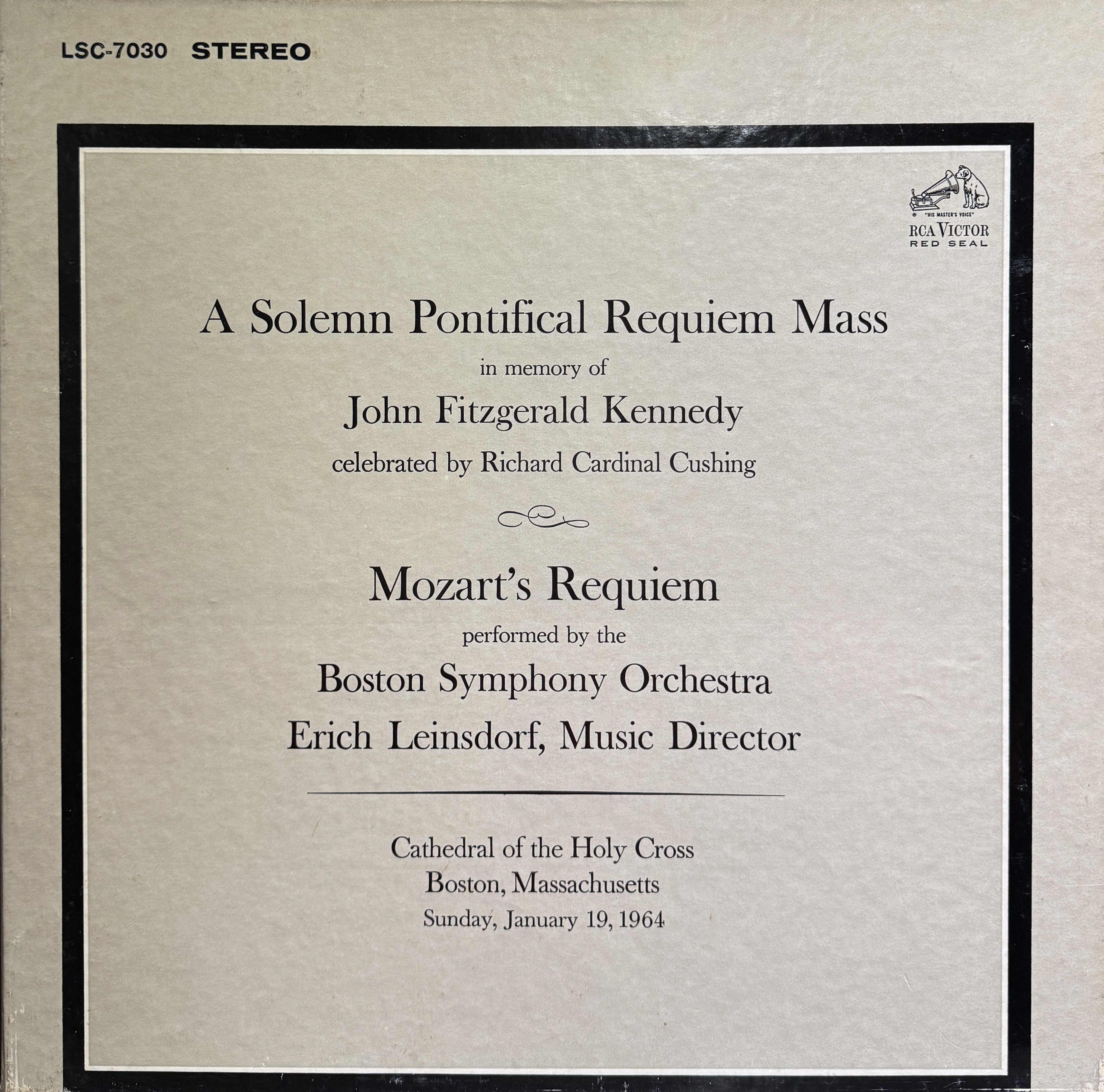
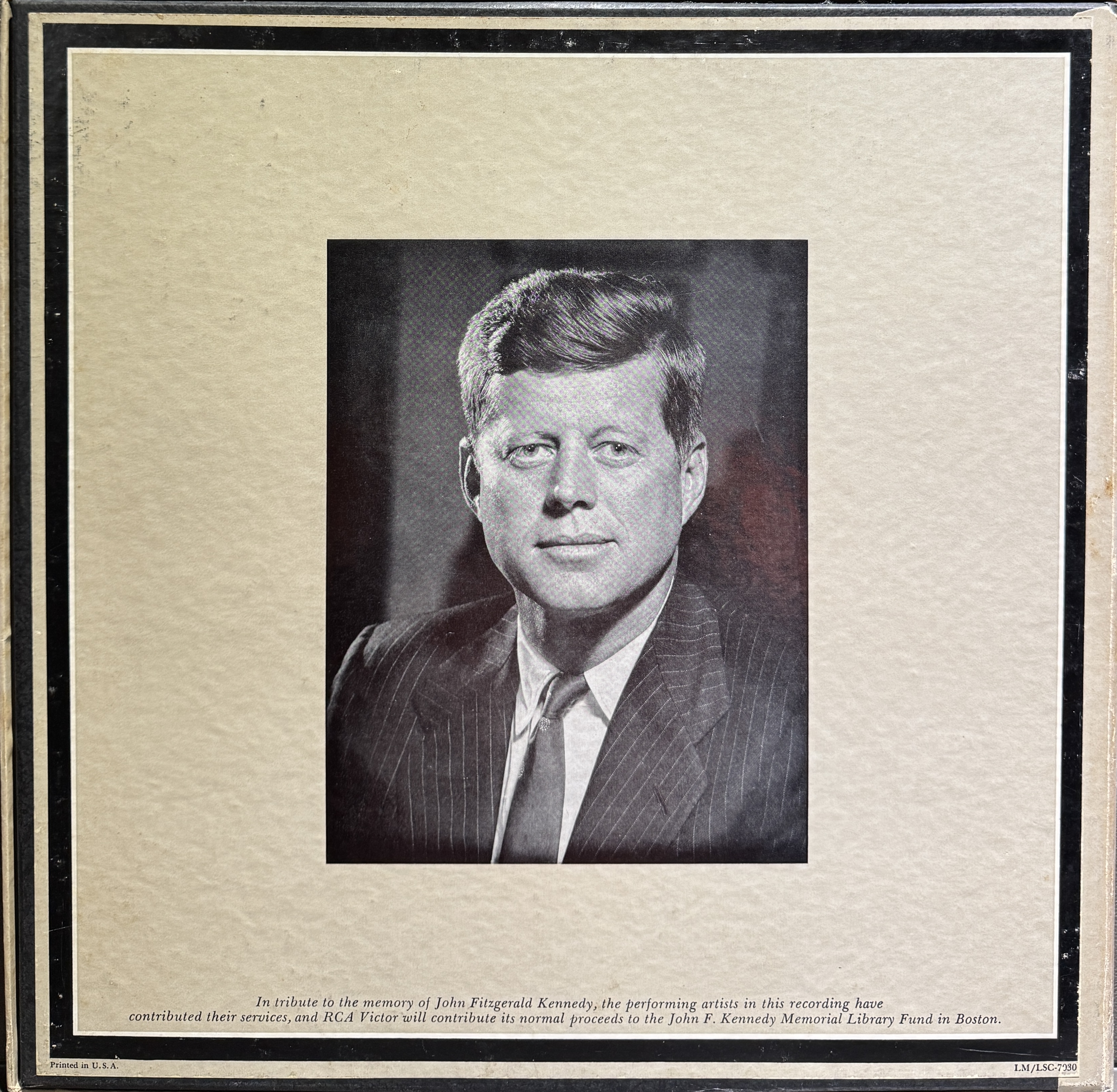
The front and back covers of the boxed set of the LP recording of the Mass for John F. Kennedy. Cathedral of the Holy Cross, Boston, January 19, 1964. RCA Victor LSC-7030.
Mozart’s Requiem was a centerpiece of the Mass for John F. Kennedy. While today, we mostly hear the Requiem in a concert hall, it was originally conceived to be played as part of a church service—a memorial service—with readings from Scripture and other readings interspersed between the Requiem’s movements. After the Requiem Mass on January 19, 1964, RCA Victor released the recording of the service on two LPs accompanied by a large booklet with the text of the service.

Pages from the program for the Mass for John F. Kennedy, included in boxed set of the RCA Victor recording of the Mass for John F. Kennedy.
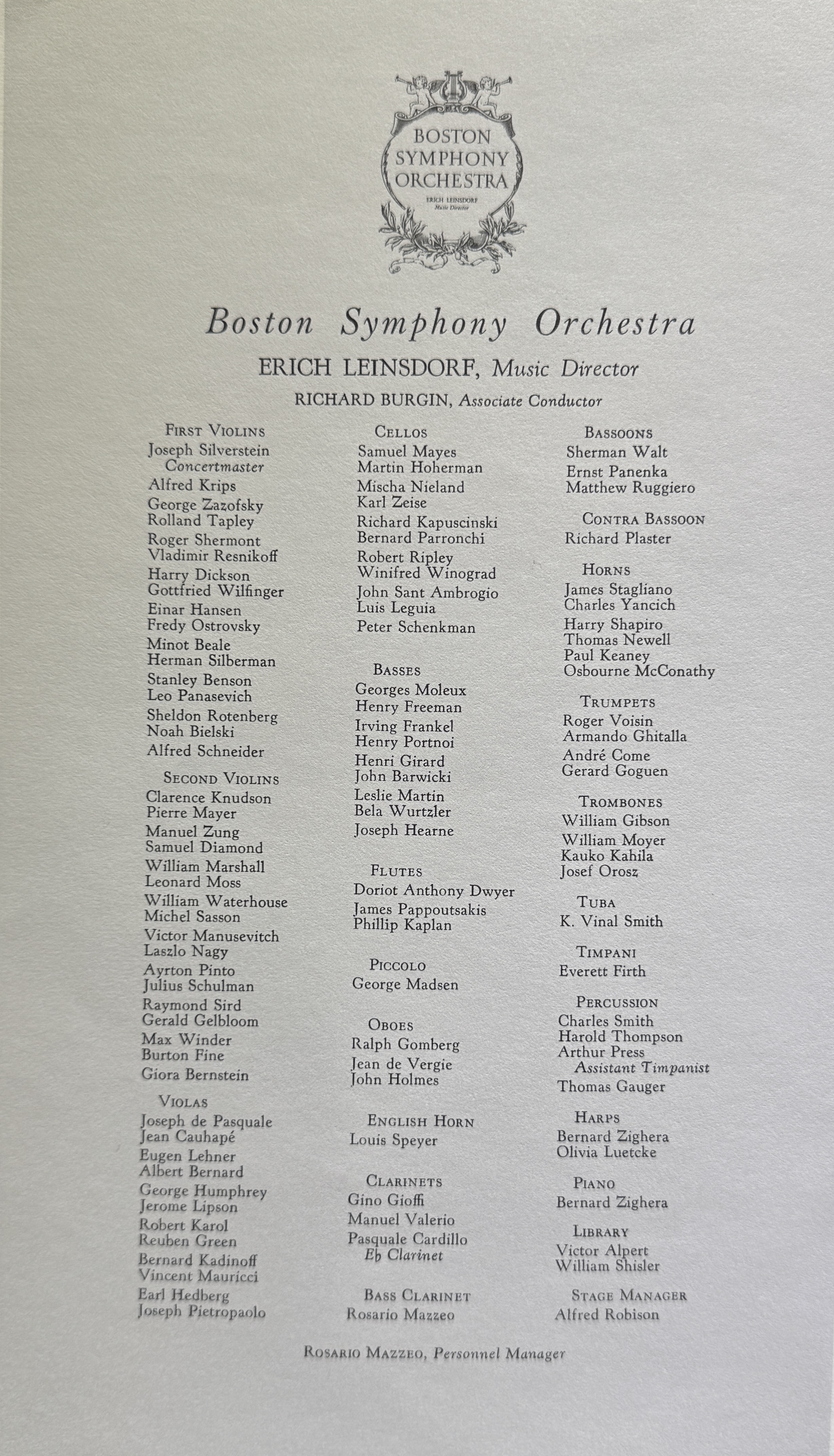
Page with the listing of Boston Symphony Orchestra members, contained in the boxed set of the recording of the Mass for John F. Kennedy, RCA Victor LSC-7030.

The Mass for John F. Kennedy, Cathedral of the Holy Cross, Boston. January 19, 1964. The Boston Symphony Orchestra and the combined choruses of Chorus Pro Musica, Harvard Glee Club and Radcliffe Choral Society, New England Conservatory Chorus, and St. John’s Seminary Chorus are seated to the left of the altar. (AP Wire photo; Douglas Yeo collection)
The Boston Symphony Orchestra and the combined choruses of Chorus Pro Musica, Harvard Glee Club and Radcliffe Choral Society, New England Conservatory Chorus, and St. John’s Seminary Chorus were assembled to the left of the altar at the Cathedral of the Holy Cross.

The Boston Symphony Orchestra (center right; Erich Leinsdorf, conductor) at the Mass for John F. Kennedy, Cathedral of the Holy Cross, Boston, January 19, 1964. (Photo courtesy of the John F. Kennedy Library Foundation. Kennedy Family Collection. Scrapbooks and albums: John Family. Kennedy Memorial Mass, 19 January 1964. KFC-090-001. John F Kennedy Presidential Library and Museum, Boston)
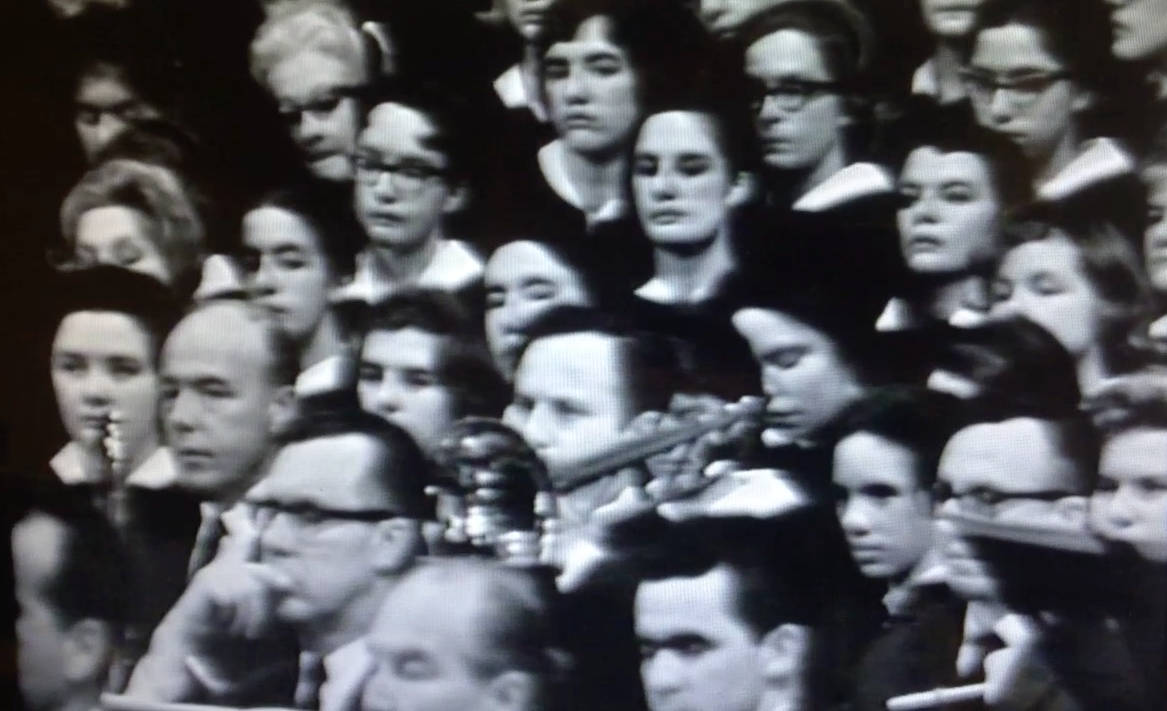
William Moyer (center)playing the Tuba mirum solo from Wolfgang Amadeus Mozart’s Requiem. Mass for John F. Kennedy, Cathedral of the Holy Cross, Boston, January 19, 1964. Boston Symphony Orchestra bass trombonist Kauko Kahila is at William Moyer’s right. (Photo courtesy of Frederick Moyer)
In the Boston Symphony Orchestra sat second trombonist William Moyer, who, at the appointed time, played the Tuba mirum trombone solo from Mozart’s Requiem. Trombonists know this solo well. It is among the most famous trombone solos in the trombone’s musical canon. It begins with the trombonist intoning a solemn fanfare with no accompaniment; the trombone represents the sound of “the last trumpet” in the Biblical account of the last judgment (found in, among other places, Matthew 24:31 and 1 Corinthians 15:52). I cannot imagine the pressure Bill experienced at that moment. Anyone who has played the Tuba mirum at a trombone audition has an inkling of what Bill Moyer must have been feeling. But the stakes for Bill were very high: He was not playing an audition; he was playing at Requiem Mass for the slain President that was broadcast live on television and radio. This was not a recording session; it was a live performance. There were no second chances. It is estimated that over 23 million people around the world watched and heard the service on January 19, 1964, and countless others heard it on the RCA Victor LP set that was subsequently issued. It may have been—it probably was—the largest audience to ever hear a trombone solo.
You can hear the Tuba mirum movement from the Mass for John F. Kennedy HERE. Bill Moyer is the trombone soloist. The vocal soloists are Saramae Enrich, soprano; Eunice Alberts, contralto; Nicholas DiVirgilio, tenor; and Mac Morgan, baritone.
As we listen to this, we hear several things:
Erich Leinsdorf’s tempo for the movement is exceptionally slow. In my article, “A Fresh Look at Mozart’s Tuba mirum” (International Trombone Association Journal Vol. 50, No. 1, January 2022), I surveyed tempi of several historical recordings of the Requiem. Leinsdorf’s tempo for the Tuba mirum is the slowest on record: quarter note = 54 beats per minute. Mozart’s tempo of Andante in a movement with a time signature of cut time (the metronome had not been invented when Mozart was alive) has led scholars to coalesce around a tempo of quarter note = 88 beats per minute for the Tuba mirum. Bill Moyer’s breath control in the solo was superb. It is not easy to play the Tuba mirum at this slow, stentorian tempo. Bill’s sound was full, without even a hint of a wobble of nervousness. His pitch was excellent, and he played the solo with a wholly appropriate style for Erich Leinsdorf’s interpretation. When the stakes were the highest, Bill Moyer came through.
The Mass for John F. Kennedy came as Bill Moyer was in his twelfth season with the Boston Symphony Orchestra. During his time as the orchestra’s second trombonist, he played in a brass section along with many other notable players, including, as seen in the photograph below, trumpet players Roger Voisin and Armando Ghitalla.

Boston Symphony Orchestra brass players. Standing (left to right): Roger Voisin (trumpet), Paul Keaney (horn), Armando Ghitalla (trumpet), Harold Meek (horn), Kauko Kahila (bass trombone), William Moyer (trombone). Seated: Kilton Vinal Smith (tuba); Joseph Orosz (euphonium and trombone). Symphony Hall, Boston, c. 1962. (Boston Symphony Orchestra archives)
But there was much more to Bill Moyer than the trombone. He was also a composer.
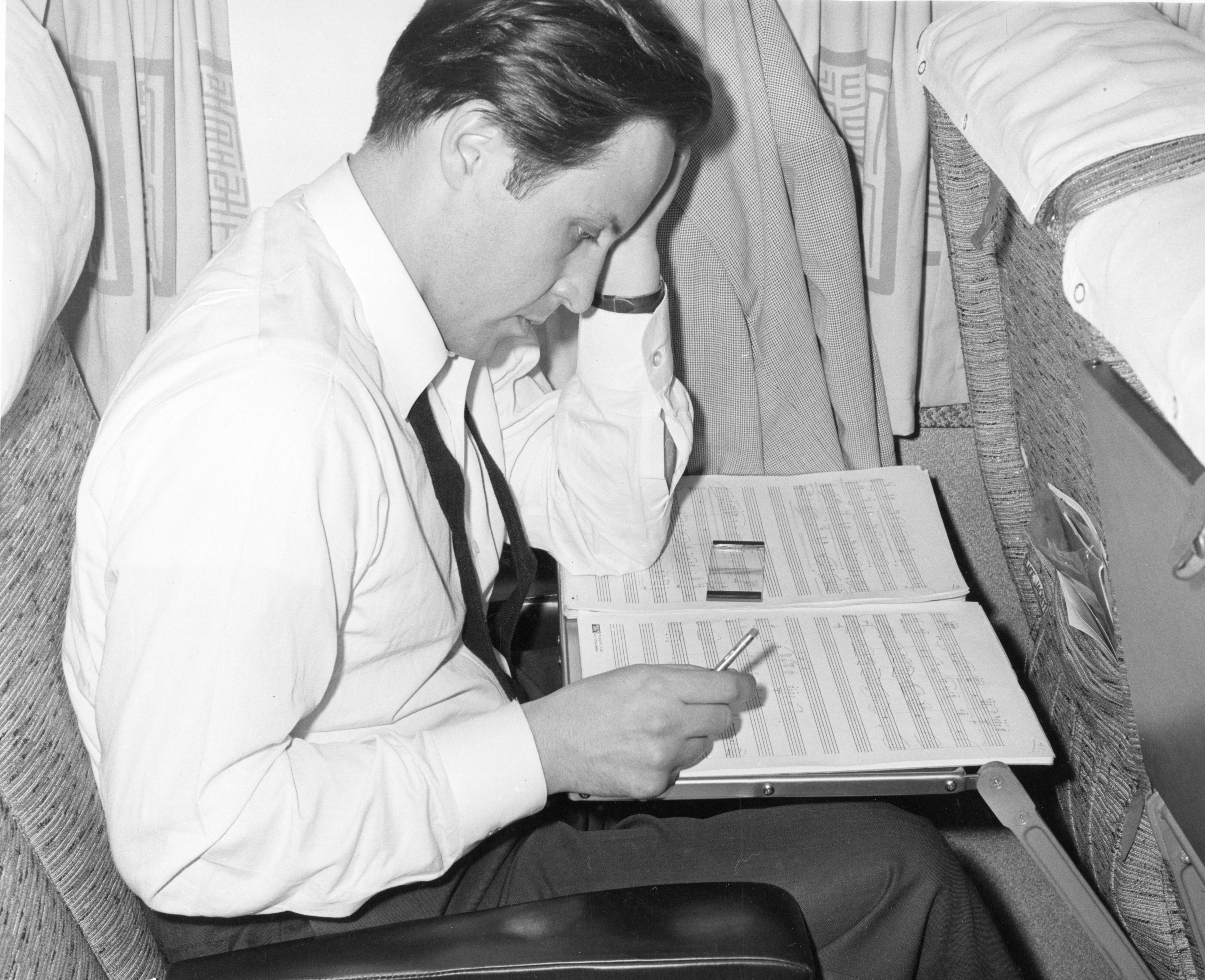
William Moyer composing while on the Boston Symphony Orchestra Australasian tour; undated photo, 1960. (Photo by George Humphrey; Boston Symphony Orchestra Archives)
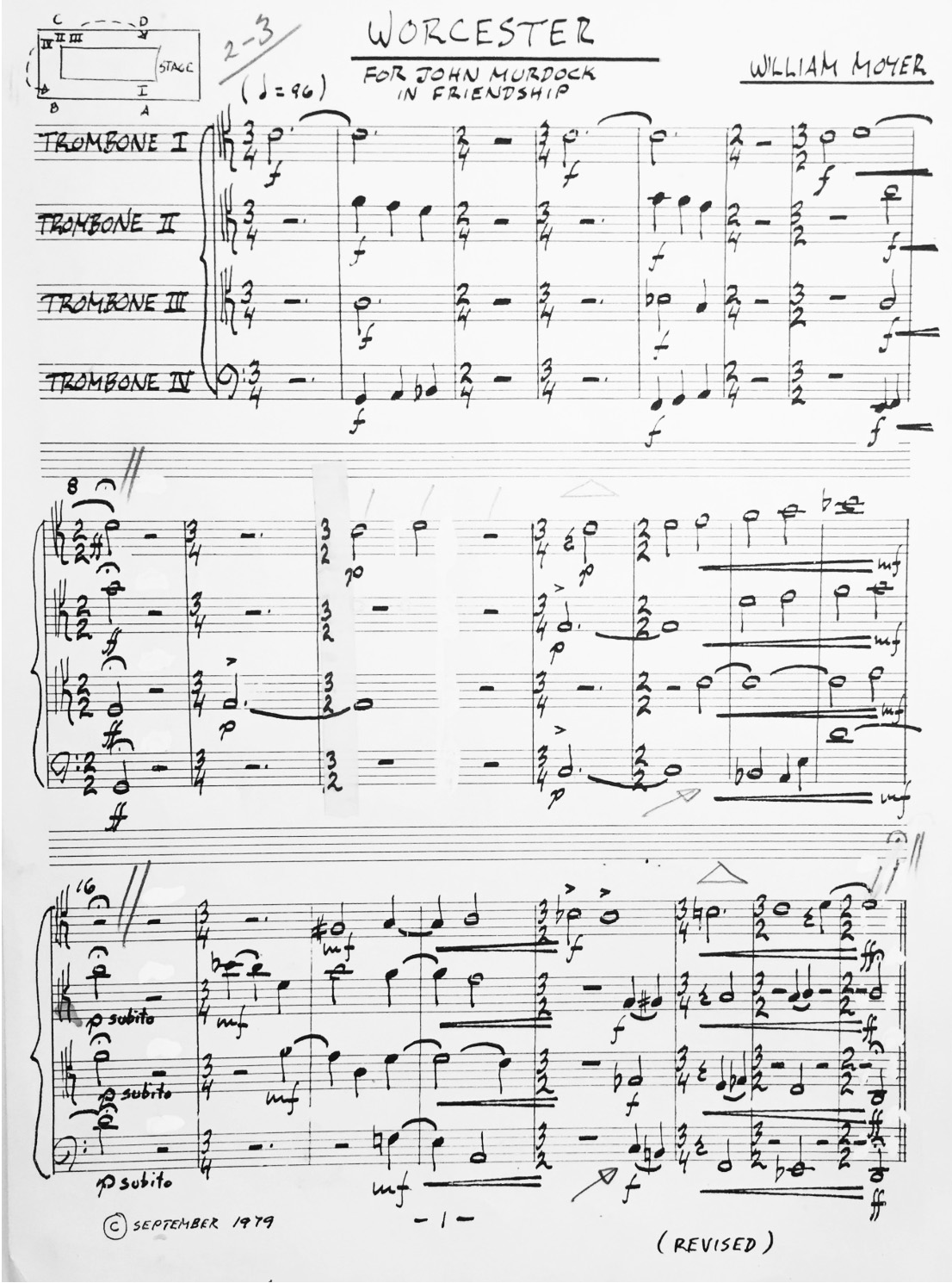
Page 1 to William Moyer’s trombone quartet, Worcester. (Courtesy of Frederick Moyer)
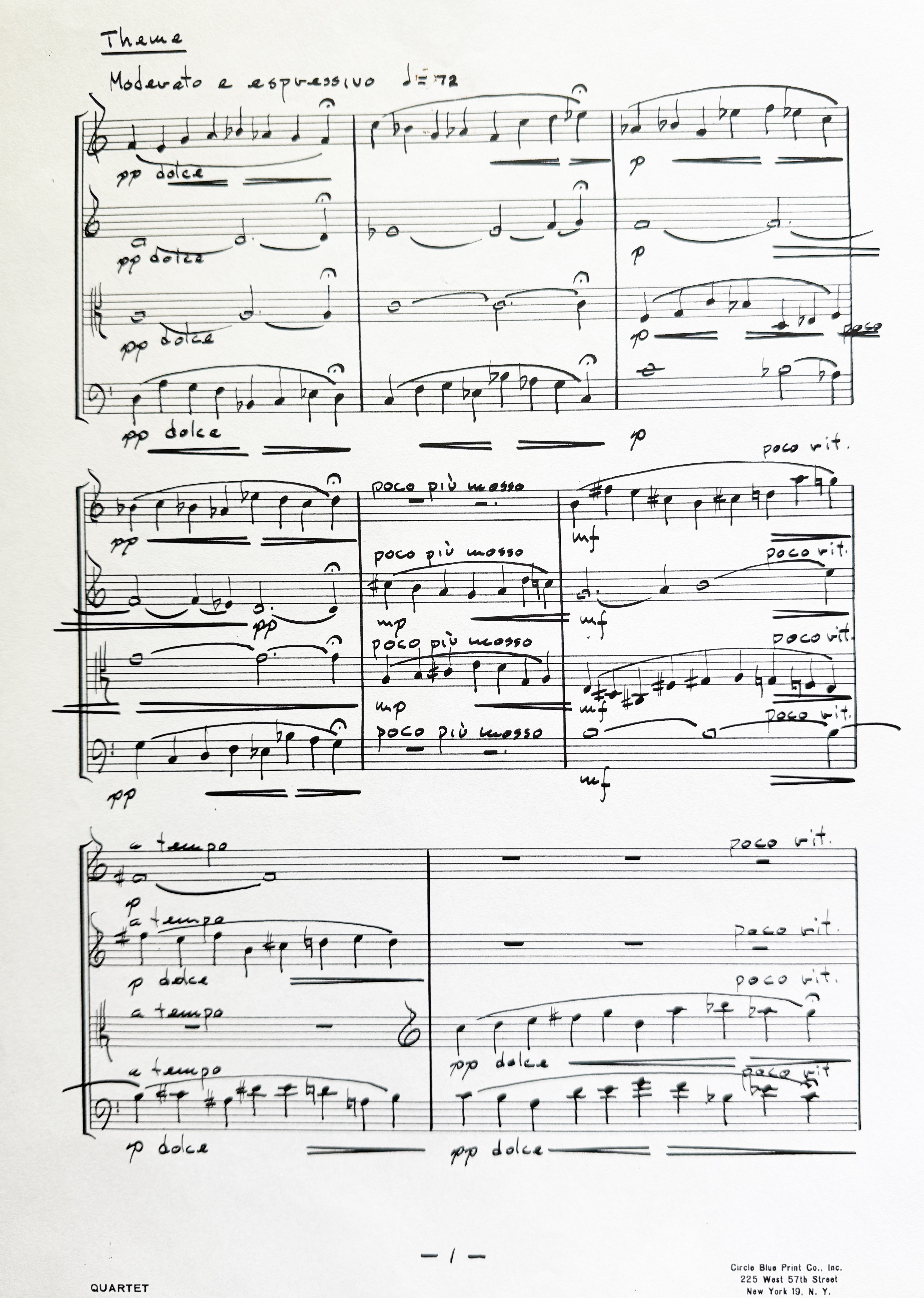
Page 1 to William Moyer’s String Quartet, completed January 1961. (Courtesy of Frederick Moyer)
Some of Bill Moyer’s music can be viewed and heard in performance on the website of his son, pianist Frederick Moyer. Click HERE to go the page, “The Music of William (“Bill”) Moyer.” Of particular interest is Bill’s trombone quartet, Worcester. As you can see in the examples above, Bill’s superb musical notation skill mirrored his personality: fastidious and professional, executed with great care.
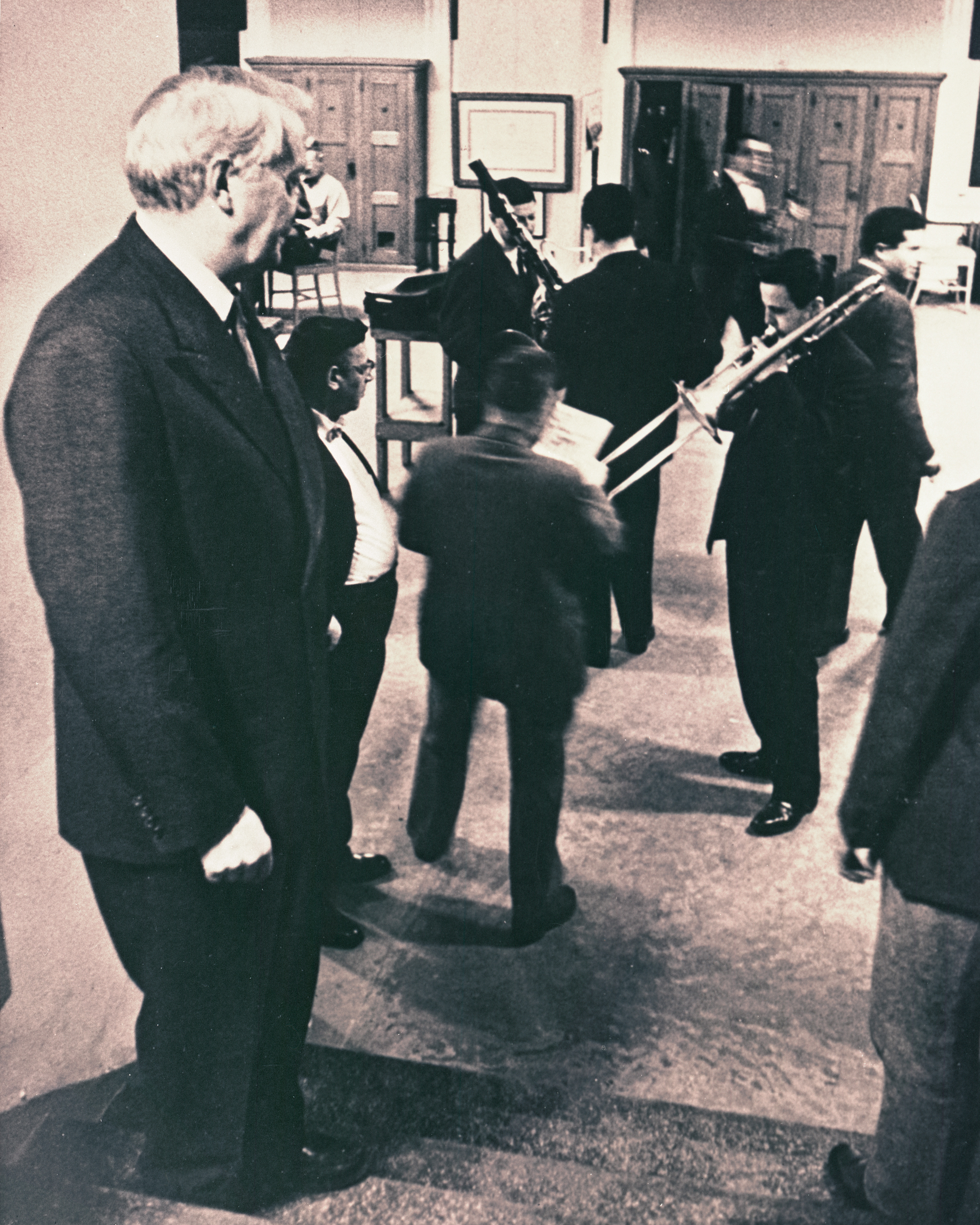
William Moyer warming up in the tuning room at Symphony Hall, Boston, while Music Director Charles Munch (left) looks on. The bassoonist is Sherman Walt, principal bassoon, who is speaking with Harry Shapiro, second horn. Undated photo. (Boston Symphony Orchestra Archives)
In 1966, William Moyer made the decision to step away from his position as second trombonist in the Boston Symphony Orchestra and accept the position of personnel manager of the orchestra. When Bill left the BSO’s trombone section, Joseph Orosz, who was the orchestra’s assistant principal and utility trombonist starting in 1940, moved to second trombone until his retirement in 1970. In 1970, Ronald Barron joined the BSO on second trombone after Ororz’s retirement, and when William Gibson retired from his principal trombone position in 1975, Ron won the BSO’s principal trombone audition and Norman Bolter won the second trombone position. I joined the BSO in 1985, and the first time I met Bill was at the first of my two auditions for the orchestra in May 1984 (no winner was declared at that audition, and I won the second audition in December 1984).
Even when he was personnel manager of the BSO, Bill played trombone in the orchestra from time to time. For instance, when the Boston Symphony Orchestra toured Europe in 1971, one of the tour pieces was Gustav Mahler’s Symphony No. 7. William Gibson, who played principal trombone in the BSO at the time, played the tenor horn solo in the first movement, so second trombonist Ronald Barron played first trombone in that movement and Bill played second trombone. Bill then played assistant principal trombone in the other movements.
I had one encounter with Bill Moyer and a trombone in his hands. On August 2, 1986, the Boston Symphony Orchestra was scheduled to perform Carl Maria von Weber’s opera, Oberon. The orchestra was at Tanglewood, the BSO’s summer home, and as the orchestra assembled on stage, Ron Barron and I realized that our second trombonist, Norman Bolter, wasn’t there. This was a time before mobile phones; nobody knew where Norman was. The concert was delayed; no Norman. Finally, Bill, Ron, and I had a conversation—Bill said he would play second trombone. What?! That was quite an offer to help the orchestra in an emergency. Ron got an extra trombone out of his locker, Bill put the mouthpiece to his lips and buzzed a little. The three of us went on stage, and as we got our music out of the folders on our stands, I turned to Bill and said, “Bill, be careful at measures 39 and 40 – we have some octaves to play together.” Bill turned to me with a focused look in his eyes and said, “I know.” Of course he did.
Music Director Seiji Ozawa came on stage and following him came Norman Bolter, running to his position in the trombone section. He had been delayed by bad traffic—REALLY bad traffic—and there was no way to contact the BSO to let them know he would be late. In his words, Norman was “freaking out” the whole time in his car—he was not in the habit of being late to concerts or rehearsals. The look of relief on Bill’s face was priceless, and as he stood up to leave the stage, he looked at Norman and offered a happy whisper, “Thank you, Norman!” As personnel manager, Bill should have had words with Norman after the concert; coming late to a concert was a BIG no-no in the BSO. But that was not to be: Bill was so relieved to see Norman that all was forgiven. While Bill didn’t play a note of that Oberon performance, I will never forget his willingness to step in at the shortest possible notice—and after not playing the trombone for how many years?—and help the Boston Symphony Orchestra in its hour of need.
In 1986, I found the photograph, below, in the Symphony Hall Annex, before the Boston Symphony Orchestra archives was formally established (more on the BSO’s archives below). It shows Bill reading on stage during a rehearsal that was part of the BSO’s 1956 tour of Europe and Russia. It made me smile because I knew how, in his role as personnel manager of the orchestra, Bill strongly frowned upon players reading on stage. But here he was, reading on stage. It was a gotcha moment that, when I shared it with Bill, elicited a roar of laughter from him. Bill didn’t remember what he was reading at that moment but knowing him, it was probably Beowulf, or The Illiad. Seriously!
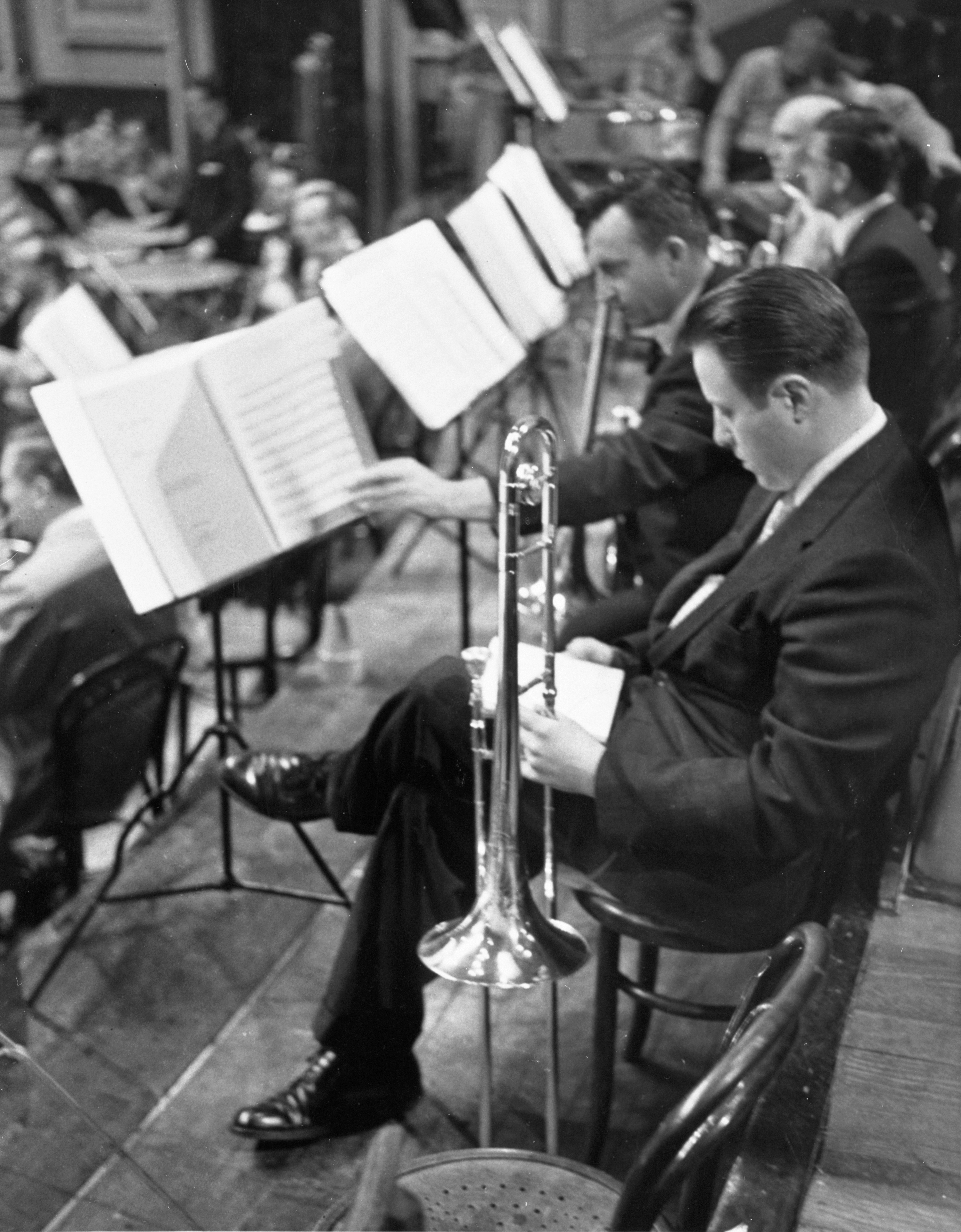
William Moyer (reading) and William Gibson in rehearsal on stage, Boston Symphony Orchestra tour of Europe and Russia, 1956. (Boston Symphony Orchestra Archives)
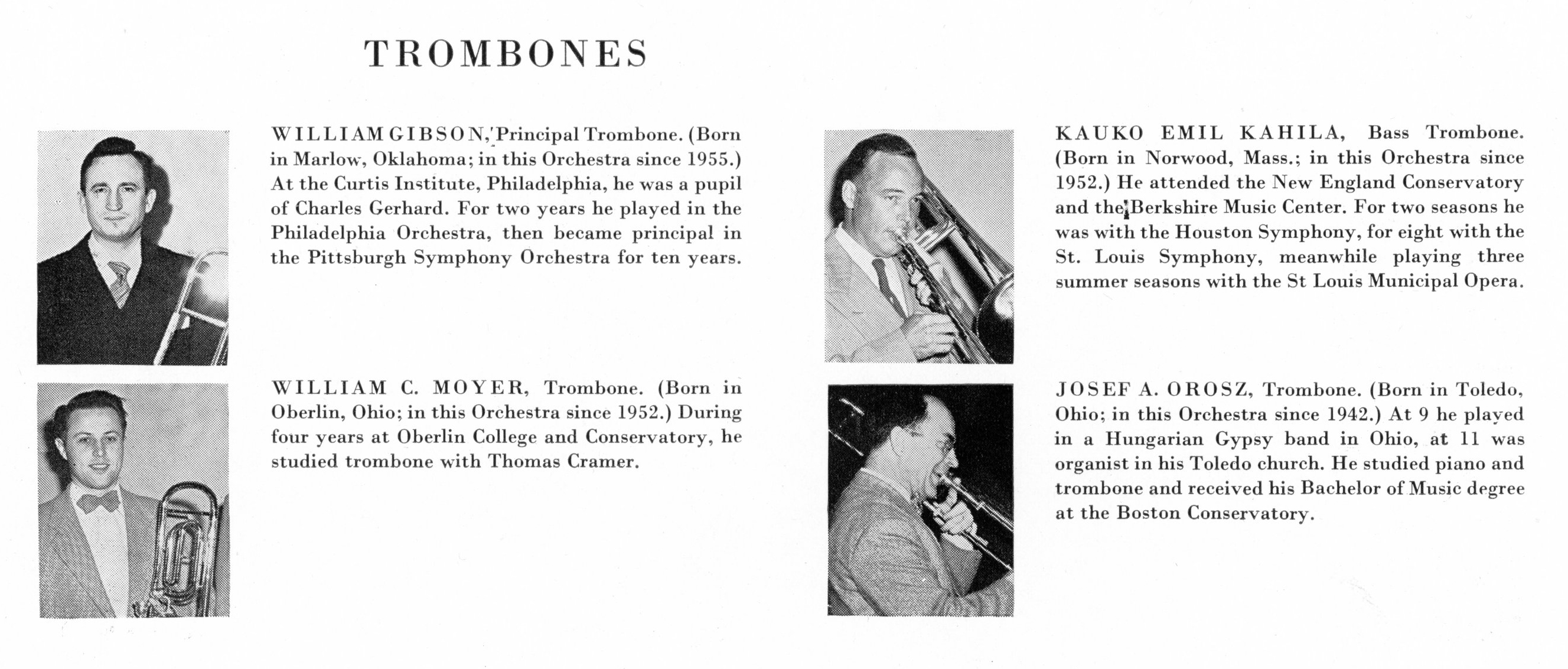
Photographs and brief biographies of members of the trombone section of the Boston Symphony Orchestra, from a promotional booklet issued by the orchestra for its 1956 tour of Europe and Russia. (Boston Symphony Orchestra Archives)
Bill Moyer was a superb administrator, and he brought all of his organizational and people skills to his work as personnel manager of the Boston Symphony Orchestra. This was not easy. Dealing with 100 musicians, all of whom are supremely talented and have egos to match their talent, presented challenges. Bill was bright, knowledgable, firm, compassionate, understanding, and caring. He and I had countless conversations about a host of musical and non-musical subjects, and will always remember his laugh and smile. Norman Bolter—who enjoyed a very special friendship with Bill—has posted some personal remembrances of Bill in a video (click HERE) and on his blog (click HERE). Take time to read and listen to Norman’s comments; you will get an even greater sense of how Bill Moyer interacted with people.

Biography of William Moyer. Know Your Orchestra (1977).
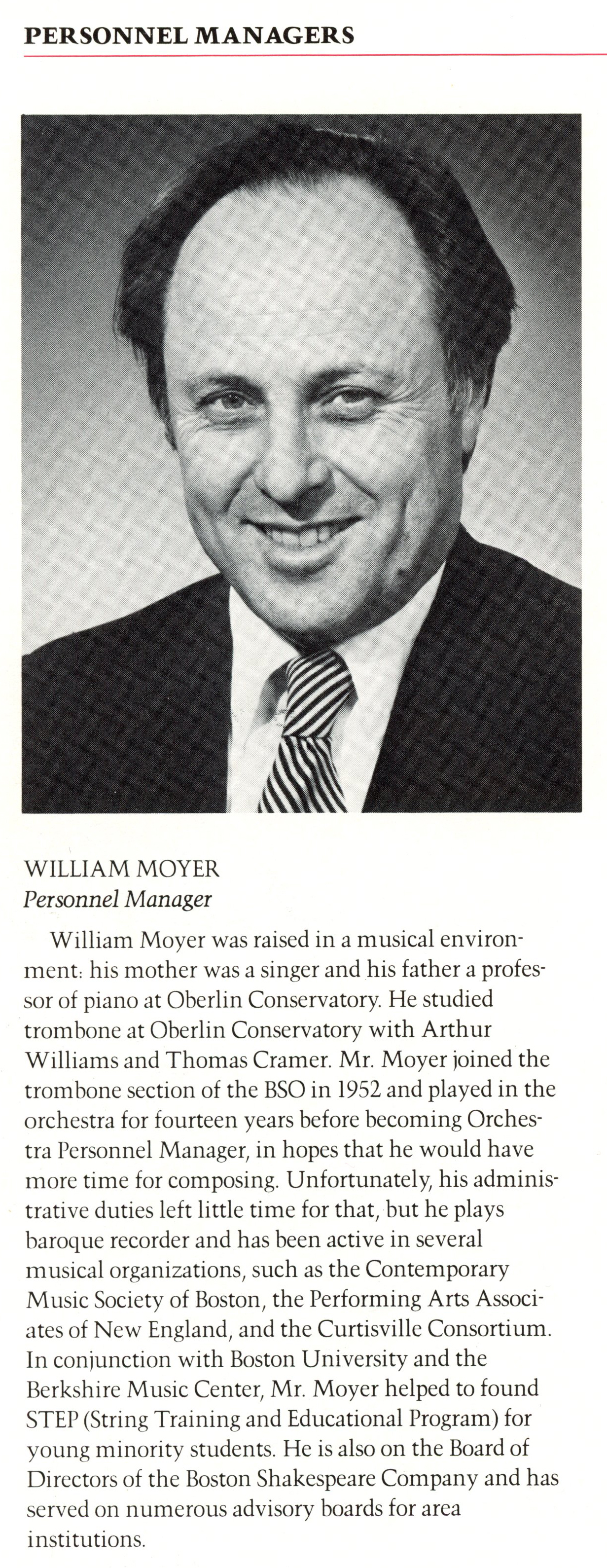
Biography of William “Bill” Moyer. The Orchestra Book (1983).
In 1985, during my first week as a member of the Boston Symphony Orchestra, I asked Bill if the BSO had an archive. I was interested in researching the life of trombonist Joannès Rochut, who I knew, through conversations with my colleague in the Baltimore Symphony Orchestra (where I played from 1981-1985), David Fetter, had played principal trombone with the Boston Symphony Orchestra from 1925–1930. Bill looked at me, curled his right index finger, wiggled it a little, and said, “Follow me.”
Bill took me through the basement maze of Symphony Hall to an adjoining building that connected to the Hall. What was then called “the Symphony Hall Annex” (it is now called the Cohen Wing) was a long, two story building owned by the Boston Symphony Orchestra that stretched along Boston’s Huntington Avenue. Bill took out his keys and opened a door. As I peered inside, I felt as if I was viewing King Tutankhamen’s tomb for the first time. Like explorer Howard Carter, I whispered to myself, “I see wonderful things.”
There were photographs, ledger books, musical instruments, and more. The 100 year institutional history of the Boston Symphony Orchestra was before my eyes. But it was a shambles. A jumble of tall shelf units (some 15 feet tall) contained boxes and piles of papers, there was detritus strewn all around the room, a completely disorganized, chaotic mass of papers on the floor, documents pouring out of open filing cabinet drawers. The floor of the room was wet; there was no heating or cooling system. But I knew there were treasures waiting to be found.
I asked Bill if I could look around the room and he did me one better: He gave me a key to the room. “Come here as often as you like. You will find things.” So, I did. And I found things. Many things. For several years, during the break of every rehearsal and intermission of every concert, during my lunch hours at Symphony Hall and during intervals between teaching trombone lessons at New England Conservatory of Music and playing BSO concerts, I went to the Annex, put the key Bill had given me in the door, and immersed myself in the history of the Boston Symphony Orchestra. I found treasures beyond measure. And when I found things, I showed them to Bill. He loved talking about the history of the BSO; its players, its music, its tours, everything. I looked through hundreds of photographs, many of which appeared in my photo essay articles that were published in the four journals of record for brass instruments (click on the titles of the articles below to read them):
- “A Pictorial History of Low Brass Players in the Boston Symphony Orchestra, 1887-1986,” International Trombone Association Journal, Volume 14, Number 4, Fall 1986.
- “Tuba Players of the Boston Symphony Orchestra, 1913-1987,” T.U.B.A. Journal, Volume 14, Number 4, May 1987.
- “Horn Players of the Boston Symphony Orchestra, 1881-1988,” The Horn Call, Volume XVIII, Number 2, April 1988.
- “Trumpet Players of the Boston Symphony, 1881-1990,” International Trumpet Guild Journal, Volume 15, Number 2, December 1990.
The writing of these articles jumpstarted my interest in doing serious research and presenting my findings in articles and books. While these pictorial articles were not “scholarly” in the sense that the information in them is not cited, they presented a snapshot into the world of Boston Symphony Orchestra brass players since the orchestra’s founding in 1881. I can trace my interest in and discovery of the richness of the history of the BSO and the world of brass players to that moment when Bill Moyer gave me a key so I could paw around in a room in the Symphony Hall Annex.

Draft memo (incipit) by Douglas Yeo to Daniel Gustin, acting managing director of the Boston Symphony, on the subject of establishing an archive for the Boston Symphony Orchestra. April 24, 1987.
But there was much more that came from my time in the Annex than writing those four articles. I began to make the case to the Boston Symphony’s management that it was vitally important to establish a proper, formal archive, with a full-time, paid archivist, so the BSO’s remarkable history could be properly preserved. I talked with Bill about this and he encouraged me to meet with others at the BSO who also had an interest in an archive. In early 1987, shortly before Bill retired from the BSO, acting managing director Daniel Gustin asked me to join with three other BSO staff members—Steven Ledbetter, Bruce Creditor, and Eleanor McGourty—and make a proposal to him about establishing an archive so he could present the idea to the orchestra’s Board of Trustees. The memo that I prepared after the meetings of our group of four—dated April 24, 1987—became a template for the hiring of a full time archivist, Bridget Carr, and the establishment of the Boston Symphony Orchestra Archives. While I am proud of my involvement in bring the BSO’s archives to life, it was Bill Moyer who gave me the opportunity to see the need and its importance. In August 2024, I flew to Boston for a one day research trip in the BSO’s archives, in the midst of my research for my upcoming article about Joannès Rochut that will appear in the January 2025 International Trombone Association Journal. Have a look at THIS ARTICLE I wrote on The Last Trombone about that trip, the BSO archives, and Rochut.

Trombones by Lefèvre that were owned by Joannès Rochut.
Bill did another extraordinary thing for me that related to the Boston Symphony Orchestra’s history. As I explored the room in the Symphony Hall Annex, I came across two trombones by the French maker, Lefèvre. I immediately recognized one of them as similar to a trombone that Joannès Rochut held in several photographs I had found of him that were taken during his time as principal trombonist of the BSO. I brought the instruments to Bill and asked if he knew anything about them. “Bill smiled, and sighed, “Yes, those trombones were owned by Rochut. Somewhere there was a note about that but the last time I looked for it, I couldn’t find it. Several years ago, the trombones were put up for auction at a BSO fundraising event, ‘Symphony Sunday.’ Someone bought them for a pittance but the winner of the auction never came to collect them. Officially they are no longer property of the Boston Symphony; they were sold. So, I think you should have them and take care of them.”
I was stunned. Trombones owned by Joannès Rochut? Even though Bill told me I should have the instruments, I never considered that they were mine. I took them home for safekeeping, and purchased cases for them. Before I retired from the Boston Symphony Orchestra, I entrusted the instruments to BSO principal trombonist Toby Oft and second trombonist Stephen Lange. I did not “give” the instruments to them; I “entrusted” them. These instruments are part of the BSO’s history, cared for at this time by current trombonists in the orchestra, but they will always be handed down to subsequent trombone players in the orchestra. The instruments are treasures.

William Moyer backstage on the Boston Symphony Orchestra’s tour of Japan, February 1986. (Photo by Douglas Yeo)
I took this photo of Bill (above) on the Boston Symphony Orchestra’s 1986 tour of Japan. Here he was, backstage at a concert hall, his makeshift office set up on top of some violin travel trunks. This is a side of Bill we all knew: industrious and focused.

William Moyer and Norman Bolter on a train during the Boston Symphony Orchestra’s tour of Japan, February 1986. (Photo by Douglas Yeo)
On the other hand, the photo above captures one of my favorite memories of Bill. I took this photo of Bill and Norman Bolter on a bullet train in Japan on the BSO’s 1986 tour. Norman and Bill had a very special relationship. It was more than a “second trombone player thing.” They shared a lot of conversations about music and life, and I don’t think I ever heard Bill or Norman laugh louder or smile more broadly than when they were talking together.

William Moyer and Kauko Kahila, backstage at Tanglewood, summer 1987. (Photo by Douglas Yeo)
Bill Moyer decided to retire from the Boston Symphony Orchestra in 1987; he was 58 years old. He had served long and well, and as a fellow trombonist, I thought he deserved a proper farewell party. Our BSO low brass section organized a party for Bill. We invited Bill and his family, and we also invited his BSO colleagues from his playing days in the orchestra, William Gibson and Kauko Kahila. We had the party at Seranak at Tanglewood, the BSO’s summer home. Along with Ron Barron and Chester Schmitz (Norman Bolter was unable to attend), we spent an afternoon and evening sharing stories and enjoying a fine meal together.
One of Bill’s duties as personnel manager of the BSO was to let conductors know when it was time for a break in a rehearsal and when the rehearsal was over. Bill’s eye always had to be on the clock. Bill would usually come on stage a few minutes before the appointed moment and get the attention of the conductor. But when it came to dealing with Leonard Bernstein, there were challenges. Lenny did not care what the clock said. And, as a result, he and Bill knocked heads more than a few times over the end of rehearsals and overtime. As I wrote in my post on The Last Trombone, “The Leonard Bernstein I knew”:
As personnel manager of the BSO, one of Bill’s many duties was to come on stage just before the end of a rehearsal and give the conductor “a significant look,” which indicated that the rehearsal was going to be over in a matter of minutes. Overtime was expensive and was very rarely granted to conductors. Of course, Lenny wasn’t just any conductor, and when he was around, the clock was always covered. Bill would come on stage and give Lenny “the look” which Lenny would ignore, the rehearsal would continue past the designed ending time (at which point—with overtime beginning—players would whisper, “cha-ching!”, the sound of a cash register opening), and Bill would walk off stage. But union rules said that after 25 minutes of overtime, the rehearsal HAD to stop for a five minute break. So when Bill would come on at the 25 minute mark and clap his hands and the orchestra would get up and leave the stage —sometimes in mid-phrase—Lenny would throw a little tantrum. Of course, Bill was only doing his job and Lenny knew it, and there was no personal acrimony between the two of them despite Lenny’s histrionics.
When Bill announced his retirement, I got the idea to write to Bernstein and ask if he would write a short note to Bill that I could read at his party. A few weeks later, I opened my mail to find a handwritten letter from Lenny (above) with a few lines of verse to Bill and a personal note to me. I gave the original to Bill but I kept a photocopy for myself. In his signature scrawl, Lenny wrote:
Fontainebleau, Bastille Day, ’87
Leonard Bernstein
There is a fine fellow named Moyer
A red-blooded kid, like Tom Sawyer- – –
But some things one hears
make one prick up one’s ears. . .
If you want to know more, call my lawyer.
Love, Lenny B
14 Juillet ’87
P.S. Sorry for the belatedness; your letter just caught up with me –
When I read Lenny’s playful poem at Bill’s party it was met with laughter and smiles. It was great of Lenny to take the time to scribble a few words for his friend/nemesis.
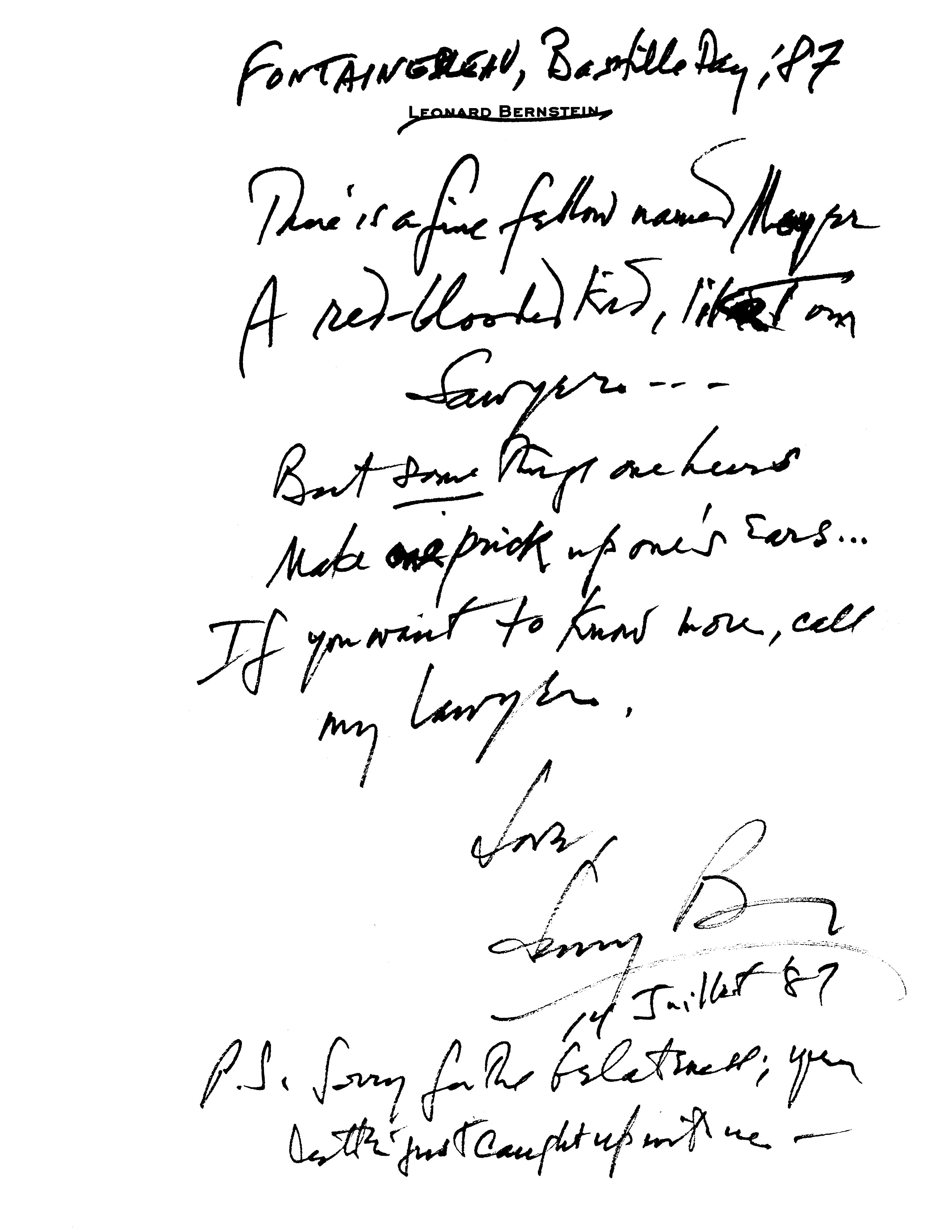
Tribute to William “Bill” Moyer written by Leonard Bernstein on the occasion of Moyer’s retirement from the Boston Symphony Orchestra. July 14, 1987.

Boston Symphony Orchestra low brass players at a retirement party for William “Bill” Moyer. Standing (left to right): Chester Schmitz (tuba), Ronald Barron (principal trombone), Douglas Yeo (bass trombone). Seated (left to right): William Gibson (principal trombone), William Moyer (second trombone), Kauko Kahila (bass trombone). Seranak at Tanglewood, summer 1987. (Photo by Patricia Yeo)

William Gibson, William Moyer, and Kauko Kahila at Bill Moyer’s retirement party. Seranak at Tanglewood, summer 1987. (Photo by Douglas Yeo)
In retirement, Bill continued to engage in many activities that made a difference in the world. Among them was ongoing work with Project STEP (String Training and Education Program) that he founded in 1982. Project STEP continues to provide training for young players of color from underserved communities. The program has been highly successful, with Project STEP graduates now serving as members of symphony orchestras, as soloists, and educators.

Betsy and Bill Moyer in Symphony Hall, Boston, with Project STEP alum Tony Rymer. (Photo courtesy of Project STEP)
Bill Moyer’s 95 years among us were well-lived. He is survived by his wonderful wife of 72 years, Betsy, and children, grandchildren, and a great-granddaughter. Bill made a significant impact on Boston’s musical life, and on the lives of countless professional, amateur, and student musicians. With his trombone in his hand, he brought music to millions of people through his concerts, recordings, and radio broadcasts with the Boston Symphony Orchestra and Boston Pops Orchestra—none more significant than his performance of Mozart’s Tuba mirum at the Mass for John F. Kennedy on January 19, 1964—and his humor, wit, and care for and of others will be remembered by all those whose lives intersected with his. I count myself fortunate to have been Bill Moyer’s friend, and we do well to honor his memory.

Three Boston Symphony Orchestra second trombone players: (left to right) William Moyer (1952-1966), Ronald Barron (1970-1975; then principal trombone 1975-2008), and Norman Bolter (1975-2008). Photograph taken at a gathering of Boston Symphony Orchestra retirees, c. 2011. (Photo courtesy of Norman Bolter.)

















 The Last Trombone – Douglas Yeo