Category: musical instruments

A few famous trombone players—Holton catalog, c.1920

A few famous trombone players—Holton catalog, c.1920

We live in an age where endorsements are a big part of advertising. For all kinds of products. When you pick up an issue of the International Trombone Association Journal, you see many endorsements of trombones and trombone-related products. A look through the April 2020 issue of the ITA Journal finds advertisements that feature endorsements by many well-known trombonists: Denson Paul Pollard (Courtois trombones), Steve Turre (YAMAHA trombones), Peter Ellefson, Joseph Alessi, and Jay Friedman (ChopSaver), John Fedchock, and Megumi Kanda (Greenhoe trombones. Go back to the January 2020 issue and you find Nathan Siler (Courtois trombones), and me (YAMAHA trombones) added to the Journal endorsement mix.

The products advertised in the ITA Journal and the people that endorsed them have changed over time. The ITA Journal was an annual publication from 1973 (Volume 1) to 1981. In 1982, the Journal began to be published quarterly. During those early years of the ITA when the Journal was published only once a year, the ITA Newsletter, which was published two to four times a year, was also published. It was in the May 1976 issue (Vol. 3, No. 2) of the ITA Newsletter that advertisements first appeared in an ITA publication. In its pages you found endorsements by  Ashley Alexander (Holton Superbone), George Roberts (Olds trombones), and Phil Wilson (Conn trombones).

Now, everyone knows that using ChopSaver won’t make you play like Joe Alessi any more than playing a YAMAHA trombone will make you sound like me or playing a Holton Superbone will make you sound like Ashley Alexander (I sure wish it did; Alexander was a truly remarkable player on the Superbone and euphonium). But celebrity endorsements have been with us for a long time and if that endorsement is credible—if the person actually uses the product that’s being advertised—that’s all the better for the manufacturer.

A few years ago, I acquired an original copy of a trombone catalog issued by the Frank Holton Company around 1920. The catalog is full of celebrity trombone endorsements. Holton and C. G. Conn ruled the world of trombone endorsements in the early twentieth century; that was an indication of their place as the leading American trombone makers of the time. Frank Holton was an accomplished trombonist himself; he was the trombone soloist in John Philip Sousa’s Band in 1892 and 1893. Then a young kid named Arthur Pryor joined the band and Holton, deeply impressed with the young player’s talent, told Sousa that Pryor should be the band’s soloist. Holton subsequently left the band (under good terms with Sousa) and Pryor went on to be one of the greatest trombone soloists of all time.

Here are a few pages from the Holton c.1920 trombone catalog with a little commentary about some of its famous players.

Holton_1920_Sousa_trombones_01

An endorsement from members of John Philip Sousa’s band carried weight. Holton’s c. 1920 catalog shows he scored a major coup: six members of Sousa’s trombone section with Holton trombones.

Holton_1920_Sousa_trombones_02

One page later, the Sousa band’s trombone players are named (dates of service with Sousa are taken from Paul Bierley’s fine book, The Incredible Band of John Philip Sousa (Urbana: University of Illinois Press, 2006):

Ralph H. Corey. He succeeded Leo Zimmerman as the band’s principal trombonist. Corey played with Sousa between 1906 and 1920.

Louis Schmidt. He played with Sousa between 1916 and 1917, and later in radio broadcasts the band gave in 1929 and 1931.

Ernest E. Gentile. He played with Sousa between 1916 and 1917.

Marcus Charles “Marc” Lyon. He played with Sousa from 1892 through 1917.

Athol John “A. J.” Garing. Garing played euphonium with Sousa from 1909 through 1917, but also sometimes played trombone with the band.

Edward A. Williams. He played bass trombone with Sousa from 1891 through 1917.

As we look at the dates when each of these six players were members of Sousa’s band, it’s clear that the only time that they all played together was between 1916 and 1917. So, while Holton’s catalog dates from around 1920, he was all too happy to hold on to the photo from a few years earlier that shows the Sousa band trombone section playing his trombones.

Holton_1920_Kuss

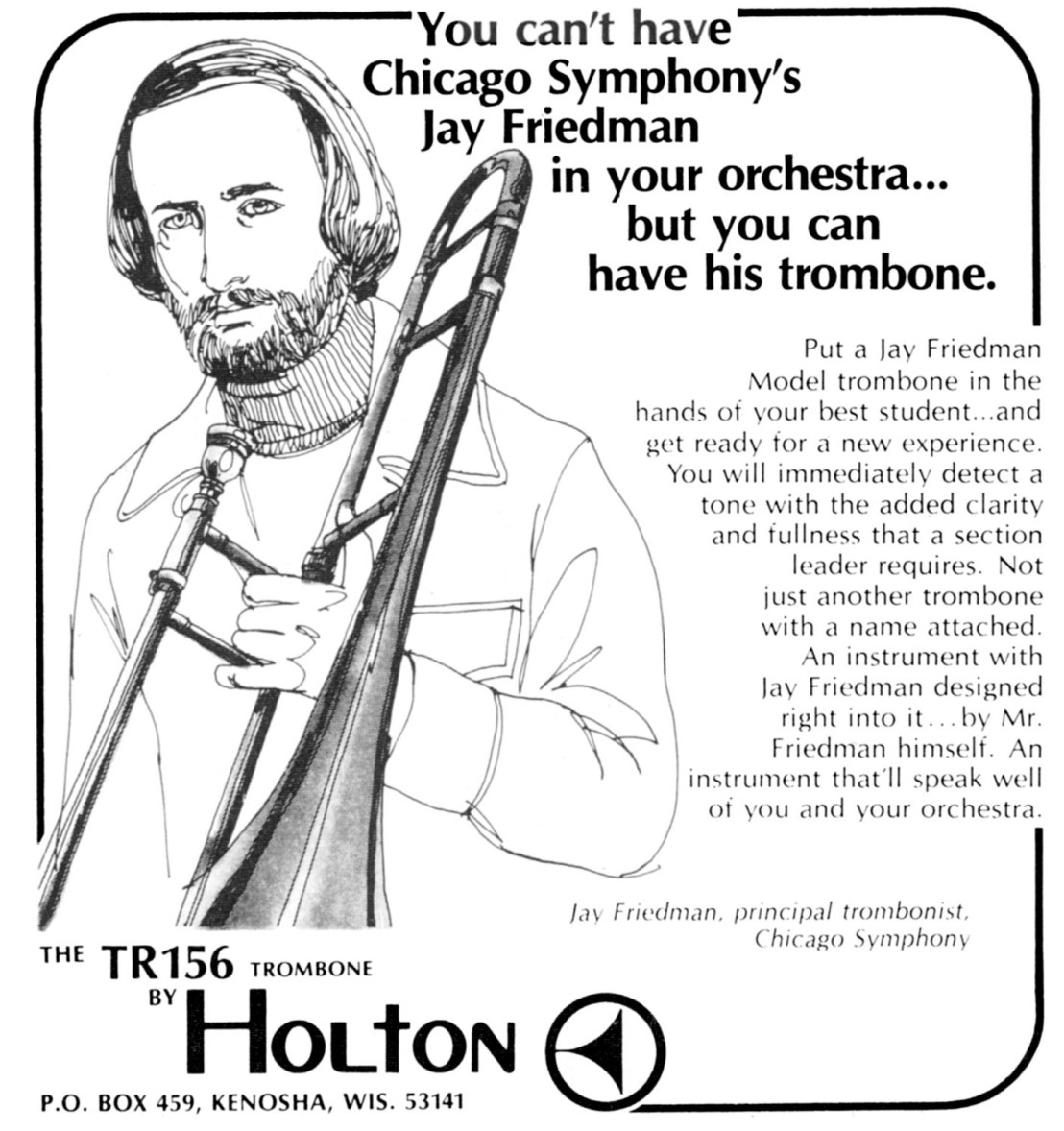
In the center of this page of endorsements (above) is a photo of Richard Kuss. He played bass trombone in the Chicago Symphony from 1912 to 1918. It’s interesting to note that several later trombonists of the Chicago Symphony, including Jay Friedman, Frank Crisafulli, and Edward Kleinhammer, all played and endorsed Holton trombones for a time in the 1960s and 1970s.
Instruments & Equipment

Jay Friedman Holton trombone advertisement, 1974
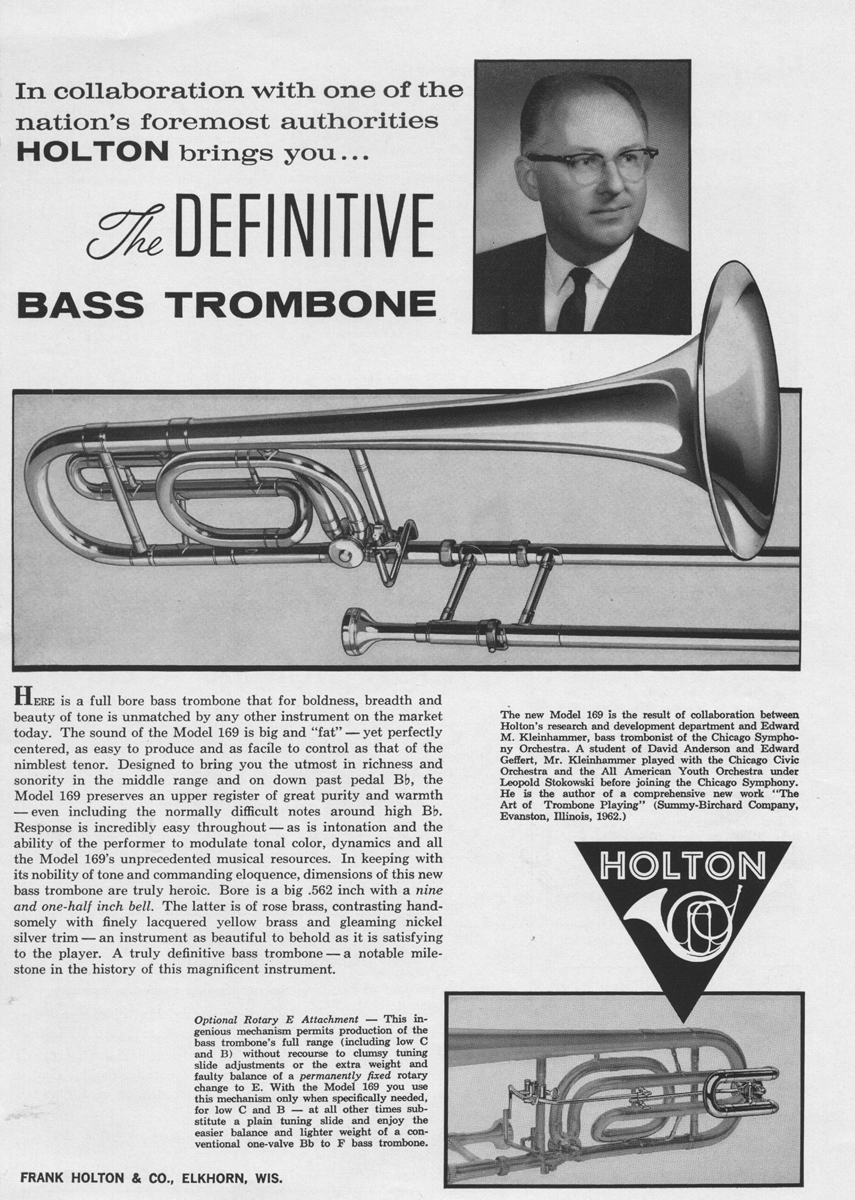
 

Kleinhammer_Holton_ad_1962

Edward Kleinhammer, Holton bass trombone advertisement, 1962


Now, back to Holton’s c.1920 trombone catalog. . .

Holton_1920_Hampe

Carl Hampe played principal trombone with the Boston Symphony from 1886-1891, 1892-1914, and 1920-1925. In 1916, Holton also published Hampe’s Hampe Method for the Slide Trombone With an Appendix for the Trombone with E Valve. The cover of the Method features Hampe with his Holton trombone; it’s the same photo of him that’s in the Holton trombone catalog.

Hampe_Trombone_Method_Holton_1916

As an aside, my copy of Hampe’s Method was given to me by my teacher, Edward Kleinhammer. Have a look at this page from the book, below, with Mr. Kleinhammer’s hand-written aphorism at the bottom of the page. And look at the date: June 26, 1947. By that time, he had been a member of the Chicago Symphony for seven years. He was a supremely accomplished player. But in his Hampe Method, a book he told me he used every day for many years, he wrote a reminder of the value of the disciplined life, of how slow and steady wins the race:

By the Yard • Life is hard

By the Inch • Life’s a cinch
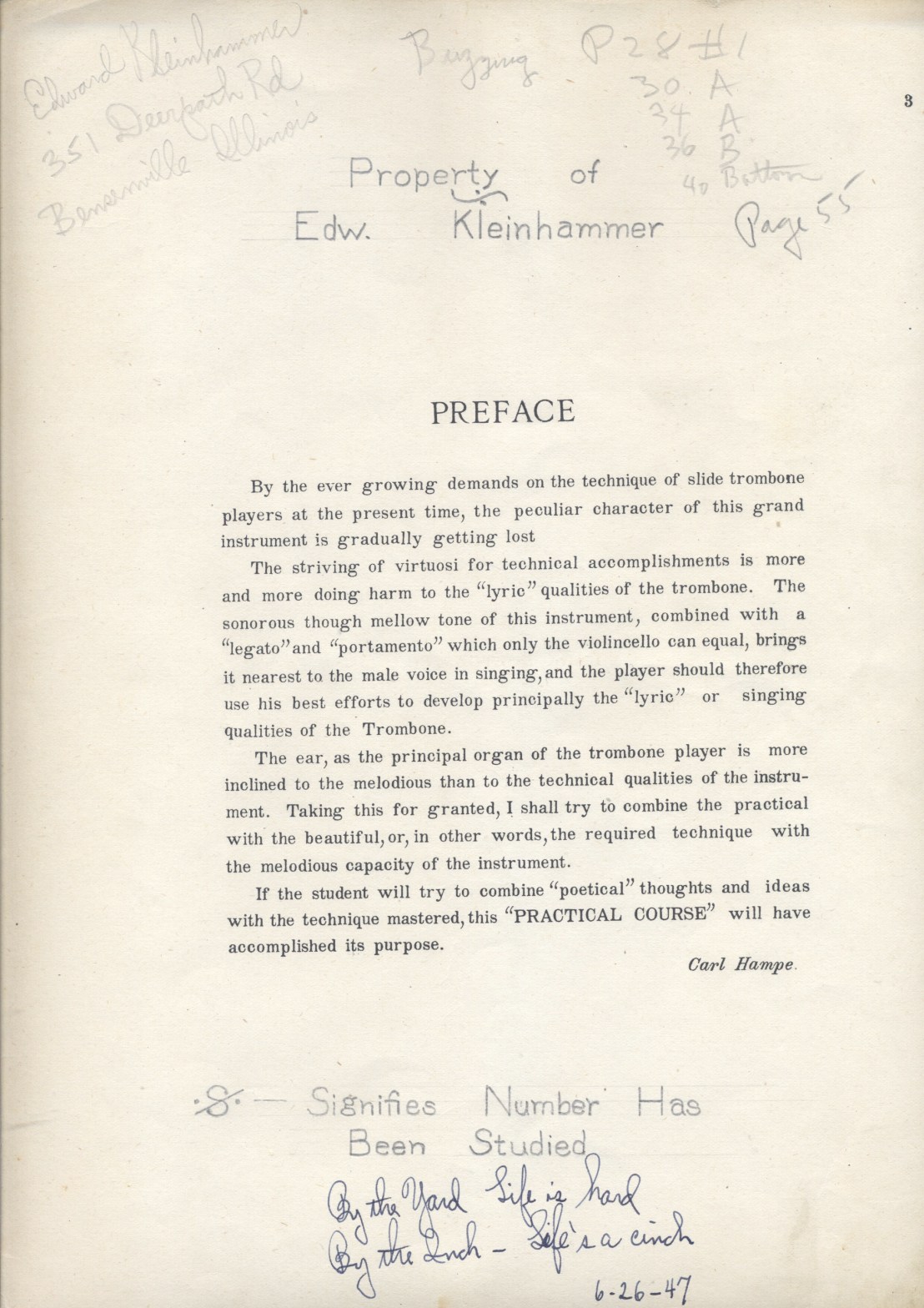
Hampe_Method_01_Kleinhammer

Carl Hampe was not the only principal trombonist from the Boston Symphony to be featured in Holton’s c.1920 trombone catalog. Fortunato Sordillo (below) played principal trombone in the BSO from 1918 to 1920. He was fired during an ill-fated strike and Carl Hampe came back to the orchestra to fill the principal trombone position for five more years. Sordillo also played euphonium and trombone with Sousa’s band in 1912 and 1913.

Holton_1920_Rochut_Sordillo

It’s notable that on the page with Sordillo is another person who would play principal trombone with the Boston Symphony: Joannès Rochut. Yes, THAT Rochut, the one whose name is on the book of Melodious Etudes for Trombone Selected from the Vocalises of Marco Bordogni that, if you’re a trombone player, is probably sitting on your music stand right now. [By the way, if you haven’t read my article about the first etude in Rochut’s Bordogni Vocalise book, you might find it interesting. Click HERE to read it.] Rochut played principal trombone with the BSO from 1925 to 1930, but in this photo, he is shown in his uniform of the band of the Garde républicaine. How Rochut came to play a Holton trombone when he was living and working in France is not known to me, but it’s interesting that when he joined the Boston Symphony Orchestra, he brought with him—and played in the orchestra—two trombones by the French maker Lefevre, and when he left Boston to return to France in 1930, he left his Lefevre trombones in Boston and took with him Bach trombone serial number 6. I will be writing more about Rochut and his time in Boston here on thelasttrombone.com very soon.

And here’s something else. Sordillo published a book in 1920 titled Art of Jazzing for the Trombone (Boston: Oliver Ditson Company). This was a treatise about the slide glissando, and how to employ it—trombone glisses at the time were known as “smears” or “jazzes,” and the technique was called “jazzing”—in ragtime and early jazz music. Here are three interesting things about Sordillo and his book. First, shortly after the book was published, Sordillo was fired from the Boston Symphony. Second, the photo of Sordillo on the cover of his method book shows him wearing his Sousa band uniform. Finally, the trombone on the cover of the method is put together backwards. Alas.

Sordillo_Art_of_Jazzing_cover_1920

One final thought on this. Holton’s trombone catalog is undated but I’ve been saying it was published around 1920. Why? Look at the endorsement by Hampe. It says he was “For 28 years first trombone player of the Boston Symphony.” Then look at Sordillo’s endorsement. It says he was “Formerly First Trombone” of the BSO. Sordillo was fired in 1920. Hampe played principal trombone in the BSO for 28 years (1886-1891 and 1892-1914) before replacing Sordillo and playing a further five years from 1920-1925. From connecting these dots, it seems that Holton’s catalog was probably published in mid-1920, after Sordillo was fired (March 1920) and before Hampe began his final stint as principal trombonist with the Boston Symphony (fall 1920).


Making and sharing music in a challenging time

Making and sharing music in a challenging time

The coronavirus pandemic has shuttered concert halls and theaters, opera houses and nightclubs. Live music with multiple performers working together in a collaboration just can’t be done in public in most places these days.

Yet musicians are finding creative ways to bring music to a world that seems to need it now more than ever. A day doesn’t go by when someone doesn’t forward me a video of some group of performers who put together a music video with a number of “socially distanced” players who have recorded a track individually and then put it together to make a group performance. I’m involved in a project with some friends as well; more on that once we get it done. Some of these projects are not very well done or are just not that interesting to me, but others make me smile, cry, laugh, and celebrate. Here are a few I’ve enjoyed recently. I hope you enjoy them, too.

The Milwaukee Symphony has recorded Edward Elgar’s “Nimrod” from his Enigma Variations. I find this performance very moving on a lot of levels, especially because the music itself is so compelling. Among those members of the orchestra who are performing are my friends, second hornist Dietrich Hemann and his wife, principal trombonist Megumi Kanda, who share a screen. To view this video on YouTube, click HERE.

In 1996, the Boston Pops Orchestra recorded an album of music to celebrate the 1996 Summer Olympic Games in Atlanta. Conducted by John Williams, it included many works that had been written for previous Olympic games, as well as Summon the Heroes, a fanfare which Williams wrote for the Atlanta games. I was a member of the Boston Symphony at that time (1985-2012) and I count recording that album as one of the most memorable events of my musical career. Recently, 50 members of the Boston Pops Orchestra recorded Summon the Heroes once again, conducted by Boston Pops conductor, Keith Lockhart. Tom Rolfs plays the trumpet solo and the low brass section is Toby Oft, Steve Lange, Jim Markey (bass trombone), and Mike Roylance (tuba). To view this video on YouTube, click HERE.

I’ve played many concerts – playing serpent, ophicleide, and bass sackbut – with Boston’s Handel & Haydn Society, an early music group based in Boston. Here’s a fun video by H&H principal flutist Emi Ferguson who makes a do-it-yourself baroque flute. Seriously! And it sounds great (and Emi sounds great, too). Try it! To view this video on YouTube, click HERE.

Here is a new piece, All Day Long (The Coronavirus Song), written by my friend, Paul Langford, and his 14 year old daughter, Chloe. Paul has been a singer and arranger for the acapella group GLAD for many years and I think this original song and Chloe’s performance are absolutely terrific and inspiring inspiring. And there’s euphonium and trombone content, too! For more about the piece and how it came about, see this article from Chicago’s WBZ; click HERE to read it. To view this video on YouTube, click HERE.

Terry Everson is professor of trumpet at Boston University, and a good friend of our family since he and his family moved to Boston in 1999. Terry served as principal cornet of the New England Brass band for most of my tenure as the band’s music director, and he is a super trumpet player (and teacher), pianist, and arranger. In this video of John Dykes’ Holy, Holy, Holy, Terry is joined by his wife, Lori, on violin, and their son, Peter, who just graduated with a degree in trumpet performance from Boston University. To view this video on YouTube, click HERE.

Mashups of classical and popular music don’t usually work for me, but this performance of J. S. Bach’s Brandenburg Concerto No. 3 and Paul Simon’s American Tune does. The group is The Knights, joined by vocalist Christina Courtin. American Tune is my favorite pop song; it has been since it was first released on Simon’s solo album, There Goes Rhymin’ Simon, in 1973. The music is adapted from a tune by Hans Leo Hassler, adapted by J. S. Bach in his Saint Matthew Passion as, O Haupt voll Blut und Wunden (O Sacred Head, Now Wounded). The group gives a superb performance of Bach’s Concerto, and Courtin’s take on American Tune is honest, heartfelt, and moving. Paul Simon’s text never felt more relevant to me than in this challenging time; he could have written it yesterday. To view this video on YouTube, click HERE.

Our youngest daughter, Robin, is Director of Public Relations for San Francisco Symphony. She recently shared this fine performance of Paul Dukas’ Fanfare from La Peri, featuring members of the San Francisco Symphony brass section. And while you have the San Francisco Symphony on your mind, take the time to view the orchestra’s excellent video series, Keeping Score, where music director Michael Tilson Thomas and the orchestra provide an in-depth look at some of classical music’s greatest works including compositions by Aaron Copland, Charles Ives, Ludwig van Beethoven, Hector Berlioz, and many others. To view this video on YouTube, click HERE.

I’ve played the ophicleide for many years, a bass instrument in the brass family that was invented in France in the early nineteenth century and was a predecessor to the tuba on a long evolutionary path. In recent years, the ophicleide has gotten the attention of many superb, young players, including Francesco Gibellini. Of the many overdubbed recordings people are making these days, I think this one is one of the best. I have no idea how he did it but I think this will make you smile. To view this video on YouTube, click HERE.

The coronavirus pandemic is challenging for all of us. But in the midst of the storm, we can hold on to the promise of God: He is faithful. Stevener Gaskin, who is Intercultural Arts Associate at Wheaton College where I teach trombone, has contributed an inspiring video – Faithful Promise –  in his unique performance style. I have heard Stevener in person several times and I’ve never failed to be moved by his work. This video was filmed in part on the front campus of Wheaton College; you will see the College’s first building, historic Blanchard Hall, in the background. I return to this video over and over again to be encouraged to persevere through this storm, knowing that God is faithful and He will bring us through this, even as we pray that we will also learn the important lessons God would have us see and understand that are already unfolding before us. To view this video on YouTube, click HERE.

[Header image of coronavirus in headphones from Variety.]

Loud, Louder, Loudest: How Classical Music Started to Roar (New York Times)

Loud, Louder, Loudest: How Classical Music Started to Roar (New York Times)

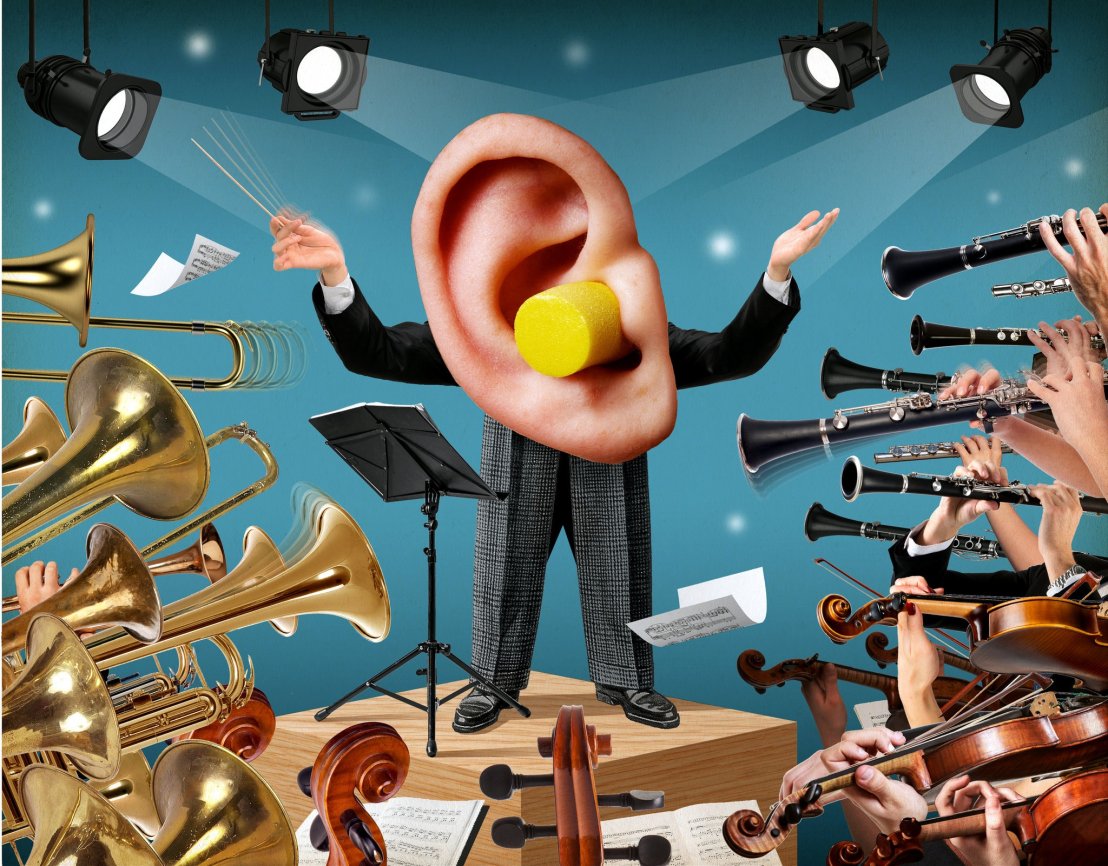
Last night, The New York Times published an article by Corinna da Fonseca-Wollheim, “Loud, Louder, Loudest: How Classical Music Started to Roar.” She reached out to me a little over a year ago, asking if she could interview me for a planned story about the trend toward excessively loud dynamics in symphony orchestras. You will find several quotations from me in her article.

The subject has interested me for many years and I was pleased to speak with Corinna; I think her article is insightful and thought provoking. And I must say that I think that Michael Waraska’s illustration that accompanies Corinna’s article is absolutely superb.

Loudness_NY_Times_Michael_Waraksa

[Above: illustration for The New York Times by Michael Waraksa, 2020.]

Waraksa’s image is in the spirit of a much earlier one that addressed the same issue of loud dynamic levels at classical music concerts. In 1845, Jean-Ignace-Isidore Gérard, who was known by the pseudonym Grandville, published a caricature of French composer Hector Berlioz. A year later, German caricaturist Anton Elfinger, known as Cajetan, adopted (and colorized) Grandville’s drawing; it was published in Allgemeine Theaterzeitzung (Jahrgang 39, No. 81, Vienna, April 4, 1846). This issue has been before us for a very long time, as Corinna da Fonseca-Wollheim describes in her superb article.

Berlioz_Grandville_1846

[Above: illustration for Allgemeine Theaterzeitzung, “Satirical Concert; a Concert in 1846!”, by Anton Elfinger after Grandville, 1846.]

To read Corinna da Fonseca-Wollheim’s article, click its title under Michael Waraska’s graphic below, or click HERE.

I have written several essays on this subject that appear on my website. The first, Me, Myself, and I: Are Brass Players Losing the Concept of Being Team Players?, was first published in the International Trombone Association Journal in 1997. It was subsequently reprinted in the T.U.B.A. Journal (now the Journal of the International Tuba Euphonium Association) later that year. My friend, Gene Pokorny, tubist of the Chicago Symphony, wrote an encouraging response to my article that also appeared in the T.U.B.A. Journal. You can read both my article and Gene Pokorny’s response by clicking HERE.

Then, later in 1997, I wrote another article which appears on the FAQ section of my website. I wrote an article that addressed this question:

I’ve been reading about problems with people complaining about excessive “noise” levels on stage in orchestras and bands, leading some players who sit near brass players to complain of hearing loss. What insights do you have on this situation?

The impetus to write this article came when a member of the Boston Symphony Orchestra—of which I was bass trombonist from 1985-2012—filed a complaint with the Unites States Occupational Safety and Health Administration (OSHA) about excessive noise levels on stage during rehearsals and concerts in Symphony Hall. That report and my commentary on the issue be viewed by clicking HERE.

My articles have generated a huge amount of discussion in the nearly 25 years since I first wrote them. They have been reprinted in dozens of blogs and they appear on many websites. I’m very happy that this important discussion is ongoing, and I salute Corinna da Fonseca-Wollheim for her superb contribution to the conversation.


The music goes on.

The music goes on.

There are no concerts today at Carnegie Hall, or Symphony Hall, Boston, or in Edman Memorial Chapel on the campus of Wheaton College (IL) where I teach trombone. The Star Spangled Banner won’t be sung tonight before any sporting events. The world of live, public performances of music is shuttered now—all around the world. To even write these words seems incomprehensible. Yet, for the good of humankind, we are taking extraordinary measures to help prevent the spread of COVID-19. Even as we do what we can, we pray that God will deliver us from this pandemic and also give us the eyes to see and the ears to hear what it is that we should learn from this challenging experience.

It is an adjustment, for sure, to not be able to listen to live music and to make it together in community. In addition to the loss of the performances themselves, we ache for the musicians who were to have played them. Most of those players are not getting paid now. Many of our country’s top symphony and opera orchestras have been telling their players that their salaries will be reduced or cut completely in the coming days, although many employers say they will continue to pay for their players’ health insurance benefits. Freelance musicians are adrift, with neither salaries or health insurance. Tomorrow is April 1; rents and mortgages are due and without any income, many people are facing an existential threat. These are real challenges that are felt by all of us in the trickle-down connectedness of our world.

My own trombone playing is now being done solo, by myself. Many engagements that I had planned for these weeks—a solo appearance at a brass band festival in Seattle, a masterclass at Interlochen Arts Academy, concerts in Helsinki and Japan with the Finnish National Radio Orchestra—have been cancelled and I expect more planned engagements will be cancelled as well.

Yet music is still important to us, and there are still ways to hear it. While watching performances in front of a computer or smartphone screen can’t take the place of live music, with a set of headphones, earbuds, or AirPods, or connecting those devices to a larger stereo system or television or other remote speakers, we can enjoy performances from the past on demand. Many orchestras and popular music groups are offering superb videos of recitals and performances. A a quick look throughYouTube brings countless offerings.

I think one of the most interesting classical music offerings is that by the San Francisco Symphony. Click HERE to go to the orchestra’s YouTube channel and their fantastic series of documentaries and performances by several composers, Keeping Score. The programs are superbly produced, the Symphony sounds fantastic, and Michael Tilson Thomas’ commentary is informative and engaging. Have a look!

I’ve put together a few videos of my own performances that have enjoyed some popularity on YouTube. Below, you’ll find performances I gave while I was professor of trombone at Arizona State University (2012-2016), several from my time with the Boston Symphony and Boston Pops (1986-2012), a video I made in the YAMAHA factory in Japan about how trombones are made, and a few other surprises. We pray for the day when we can all go to enjoy music while sitting chairs in concert halls, jazz clubs, and sports arenas. Until then, we can be grateful we live in such a time as this when we have at our fingertips so many enjoyable and inspiring performances to help us get through each day. For each of the videos below, you can view them right here on The Last Trombone or click on the YouTube link that’s provided..

The Star Spangled Banner, arranged by Robert Elkjer. Arizona State University Desert Bones Trombone Choir, Douglas Yeo, conductor at Chase Field, Phoenix, August 31, 2014. I have played the national anthem at more sporting events than I can count, including Super Bowl XXXVI in 2002 as a member of the Boston Pops Orchestra. When I came to Arizona State University, I wanted to share that great experience of playing the national anthem at a sporting event with my students. We played at Arizona Diamondbacks baseball games several times, as well as at several ASU games. This performance was from the first of our appearances at Chase Field; the video was made and supplied to us by the Diamondbacks. Click HERE to view this on YouTube.


Making trombones. A tour of the YAMAHA Toyooka factory in Japan with Douglas Yeo, 2004. I have been playing YAMAHA trombones since 1986, and in 2004, I was asked to make a video of a tour of the YAMAHA factory where many of their trombones are made. It’s a fascinating process—as you can see. Click HERE to view this on YouTube.


Prayer from Jewish Life, No. 1, by Ernest Bloch, arr. Gordon Cherry. Douglas Yeo, bass trombone; Aimee Fincher, piano, 2014. This performance was recorded on my 2014 faculty recital at Arizona State University. Bloch’s Prayer was originally written for cello and was beautifully arranged by my friend, Gordon Cherry, former principal trombonist of the Vancouver Symphony and owner of the music publishing company, Cherry Classics. Click HERE to view this on YouTube.


Heart, We Will Forget Him from Three Emily Dickinson Songs by Michael Hennagin. Douglas Yeo and Randall Hawes, bass trombone; Aimee Fincher, piano, 2015. In 2015, I invited my friend, Randy Hawes (bass trombonist of the Detroit Symphony) to give a masterclass at Arizona State University. At the beginning of the class, we played this beautiful duet by Michael Hennagin. This was recorded in the large rehearsal room where we had our weekly ASU trombone studio class. Click HERE to view this on YouTube.


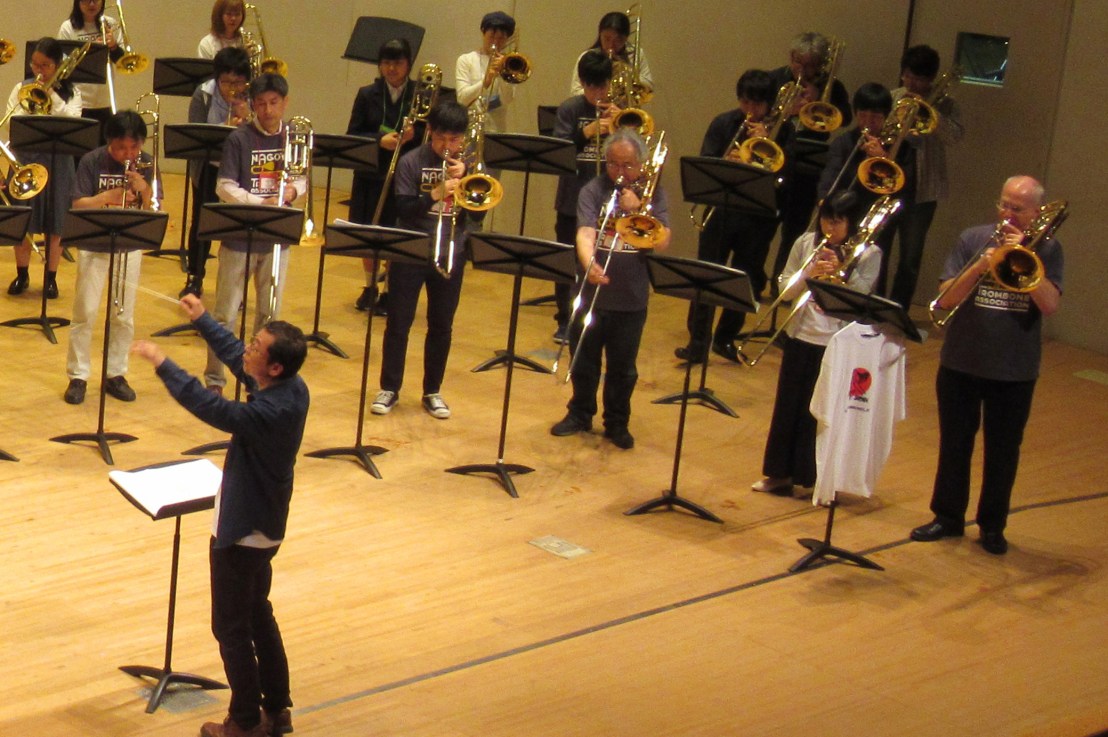
The Chief  for bass trombone and trombone ensemble by John Stevens, and A Song for Japan by Steven Verhelst. Douglas Yeo, bass trombone solo, with members of the Nagoya Trombone Association, 2018. In 2018, I traveled to Nagoya, Japan, to be the guest artist at the Nagoya Trombone Festival. The gala concert at the end of the Festival included several trombone ensemble works, including John Stevens’ tribute to the great trombone teacher, Emory Remington, The Chief, and an arrangement of Steven Verhelst’s beautiful A Song for Japan. The two pieces are combined in this video, below. Click HERE to view this on YouTube.


Demonstration of a buccin (dragon bell trombone) at the Museum of Fine Arts, Boston. Douglas Yeo, buccin. While living in Boston, I had a long and happy relationship with those in the Musical Instrument Gallery of the Museum of Fine Arts. I gave many concerts and demonstrations there, and conducted a great deal of research in its back rooms. A few years ago, I recorded some demonstration videos on several MFA-owned instruments, including a buccin made by Jean Baptiste Tabard around 1830. I’m playing a bit of the buccin part from Hector Berlioz’s Messe solennelle. Note the tongue that moves in the instrument’s bell throughout! Playing the buccin is like playing the trombone with your eyes closed; with the bell over my head, I don’t have the bell in front of me as a visual reference point to aid in accurately hitting all of the slide positions. It is a great challenge but great fun to play, with its deep, teutonic sound and rather unconventional overtone series that is related to but not exactly like a modern trombone. Click HERE to view this on YouTube.


The Lost Chord by Sir Arthur Sullivan. Douglas Yeo, ophicleide; Kimberly Marshall, organ, 2012. In 2012, I gave my first faculty recital at Arizona State University. The concert featured me playing bass trombone, bass sackbut, serpent, and ophicleide, all accompanied by ASU’s organ professor, Dr. Kimberly Marshall. She had been the Director of the ASU School of Music when I was hired and I told her that I wanted my first recital to be a collaboration with her, in thanks for her confidence in hiring me. This performance of The Lost Chord, a well-known Victorian era vocal and instrumental solo, features me playing the ophicleide, used extensively in the nineteenth and early twentieth century particularly in France, Belgium, and England (although it was in use around the world) before the nearly universal adoption of the tuba as the preferred bass brass instrument. Click HERE to view this on YouTube.


Rhapsody for Bass Trombone by Stephen Bulla. Douglas Yeo, bass trombone, with the New England Brass Band; Terry Everson, conductor, 2008. I was music director of the New England Brass Band for 10 years, from 1998–2008. We played many concerts together, and also recorded five compact discs in Boston’s Symphony Hall. My last concert with the Band was at Hope Church in Lenox, Massachusetts, near the summer home of the Boston Symphony, Tanglewood. This performance is from that concert, and I chose to play Rhapsody by my good friend, Steve Bulla, who succeeded me as music director of the NEBB. I recorded the Rhapsody in 1996 with England’s Black Dyke Mills Band on my first solo CD, Proclamation, and it was always a joy to play it with my hometown band, the NEBB. Click HERE to view this on YouTube.


Southern Gothic from Three Imaginary Landscapes by James M. David. Douglas Yeo, bass trombone with Sangmi Lim, piano, 2019. In March 2019, I traveled to Del Mar College in Corpus Christi, Texas, to give a recital and masterclass. I performed the recital on my YAMAHA YBL-822G bass trombone with a carbon fiber bell, tuning slide, and outer hand slide by Dave Butler of Butler Trombones in Dallas. I’m very enthusiastic about Dave’s work with carbon fiber and you can hear the result for yourself. This video was put up without editing out my introductory comments where I speak about the carbon fiber trombone so if you want to go right to the music, drag the slider to 1:24. Click HERE to view this on YouTube.


The Crimson Collop by Tommy Pederson. Douglas Yeo and Gerry Pagano, bass trombones, 2014. In 2014, I invited my friend, Gerry Pagano, bass trombonist of the St. Louis Symphony, to give a masterclass at Arizona State University. We opened the masterclass with a performance of this great duet by Tommy Pederson but after the class, we learned that the camera operator forgot to hit RECORD. So after the class, Gerry and I went back to my office and recorded the duet. It’s an informal collaboration between two friends that later led to us deciding to make a CD of bass trombone duets. More about that below. Click HERE to view this on YouTube.


Star Wars Main Title by John Williams. Boston Pops Orchestra, John Williams, conductor, 1993. This performance was recorded in 1993 in a concert from the Boston Pops Orchestra’s tour of Japan. The concert was entirely of John’s music and that evening was one of the highlights of my career with the Boston Symphony/Boston Pops. Yup, look at all of that 90s hair. . . The trombone players in this performance are Norman Bolter, Douglas Wright, Darren Acosta, and me. Click HERE to view this on YouTube.

There are also several other videos from that 1993 concert that appear on YouTube that can’t be imbedded here on The Last Trombone. If you’re interested, click HERE to see the March from Raiders of the Lost Ark, and click HERE to see Adventures on Earth from E.T.


Selections from Horn Trios, Op. 82 by Anton Reicha, arr. John Ericson. John Ericson, horn; Douglas Yeo, bass trombone; Deanna Swoboda, tuba, 2013. This performance of several trios by Anton Reicha was given at a Trombone Studio class at Arizona State University in 2013. Subsequently, my good friends John Ericson, Deanna Swoboda, and I recorded a CD on Summit Records, “Table for Three,” that included these trios and other pieces for horn, bass trombone, and tuba. The performance is rather informal but it’s a very happy memory of many nice collaborations with these friends. Click HERE to view this on YouTube.


Bone Moan by David Jones. Ryan Haines, trombone solo; Arizona State University Desert Bones Trombone Choir, Douglas Yeo, conductor, 2015.  I met David Jones in the 1990s when he was a student at New England Conservatory. I conducted several performances of his superb work for tenor trombone solo and trombone choir, Bone Moan, with the New England Trombone Choir at New England Conservatory with Douglas Wright (now principal trombonist of the Minnesota Orchestra) as soloist. The opportunity to conduct the piece again arose when I was at ASU and Ryan Haines, who at the time of this recording was the jazz trombone teacher at ASU, gives a great performance of this evocative and unusual piece. Click HERE to view this on YouTube.


Song for Lotta by Jan Sandstrom. Douglas Yeo, bass trombone; Aimee Fincher, piano, 2013. I have played Jan Sandstrom’s Song for Lotta many times over the years, in recitals all around the world, including in China and Japan. I have found it is a very powerful final piece on a recital. Rather than something flashy, I like playing something soft and contemplative which gives the audience something special to think about as they leave the concert hall. Click HERE to view this on YouTube.


Theme and Variations on Arkansas Traveler by David Herring. Douglas Yeo, bass trombone; Natural State Brass Band, Rusty Morris, conductor, 2010. The world of the British-style brass band has been important to me for many decades. Earlier in this article, you saw a performance by me of Stephen Bulla’s Rhapsody for Bass Trombone with the New England Brass Band. I’ve also enjoyed a long friendship with members of the Natural State Brass Band of Little Rock, Arkansas, especially the band’s former music director, Rusty Morris. In 2010, I joined the band on their tour of England, both as guest conductor and guest soloist. A bonus of the trip was that my wife and oldest daughter played baritone horn and bass trombone with the band on the tour. David Herring’s piece based on the familiar folk tune, Arkansas Traveler, and was especially written for me to perform on this tour. This performance was recorded in a Wesleyan Church in Bolton, England, just north of Manchester. Click HERE to view this on YouTube.


Below 10th Street by Tommy Pederson. Gerry Pagano and Douglas Yeo, bass trombone; Mike Lake, Hammond Organ and drums. 2017. In August 2017, in the thick of the heat of the Arizona summer, Gerry Pagano and I came together make a new CD of duets for bass trombones, FRATRES. We recorded the album in the studio of Michael Lake, a tremendously gifted jazz trombonist, recording engineer, and digital media guru. The album has many duets by Tommy Pederson (including The Crimson Collop which you have seen earlier in this article). Mike had the idea to add accompaniment to several of the duets and Below 10th Street features Mike on Hammond B-3 organ and drums. Thanks to Mike’s drone, he put together a promotional video of Gerry and me in the Sonoran desert north of Phoenix, horsing around with our trombones to the background of our performance of Below 10th Street. Fun times. For those interested, I start the piece, followed by Gerry, although our parts go back and forth between the top and bottom voice throughout. Click HERE to view this on YouTube.


Quidditch from Harry Potter by John Williams. Boston Pops Orchestra Brass Section. While I was a member of the Boston Symphony/Boston Pops Orchestra, I played many concerts with John Williams; earlier you saw several videos of performances of his music with the Boston Pops Orchestra from our 1993 Japan tour. Here is a video of John’s arrangement of his Quidditch—a game played by Harry Potter and his friends—from a performance in the early 2000s. The video begins with a little spoken commentary from John. The trombone players are Norman Bolter, Darren Acosta, and me. Click HERE to view this on YouTube.


Dear Lord, I Love Thee, by Wycliffe Gordon. Arizona State University Desert Bones Trombone Choir, Douglas Yeo, conductor, 2015. The great jazz trombonist, Wycliffe Gordon, is a good friend, and he came to Arizona State University in April 2015 to give a masterclass for my students. He brought along some music he had written and later that month, I decided to include one of them on our trombone choir concert. Click HERE to view this on YouTube.

His piece, “Dear Lord, I Love Thee,” is beautiful in its simplicity. Wycliffe composed words to the piece which he included in the trombone parts. It is a fitting benediction for this playlist that reminds us that while the concert halls around the world are dark, the music still goes on. In this challenging time, Wycliffe’s prayer is shared by me and so many others, as we turn to God, the giver of everything, for guidance and sustenance.

Dear Lord, I love thee. Saviour that saved me.

Lost, my soul was in sin, cleansed, made whole from within

     by my Lord God, Jesus, who made me and saved me.

He’s God! God, mighty Lord, God who saved me.

Wretched my soul was in sin, then He gave me life anew.

Dear Lord, I love thee. Saviour that saved me.

Came inside and made me whole.

Blessed me, then saved my soul!!!